
BAAM AI Blog
Social Media Content Services: A Practical Guide to Strategy, Creation, Publishing, and Growth
Social media content services are no longer just about posting graphics, writing captions, or keeping a brand “active” online. The real job is to turn social channels into a repeatable content system that attracts...

Social media content services are no longer just about posting graphics, writing captions, or keeping a brand “active” online. The real job is to turn social channels into a repeatable content system that attracts attention, builds trust, creates demand, and supports sales without making the brand sound desperate. That takes strategy, creative direction, production, publishing discipline, community management, analytics, and a clear understanding of what each platform is actually good for.
The problem is that many businesses still treat social media like a task list. Post three times a week. Make a few reels. Repurpose a blog post. Reply to comments when someone remembers. That approach can keep a feed alive, but it rarely creates momentum because every post is disconnected from the bigger commercial goal.
Good social media content services solve that gap. They give a business a structured way to decide what to say, who it is for, how it should look, where it should be published, how conversations should be handled, and what should happen after someone engages. That last part matters because social content without follow-up is just attention leaking out of the funnel.
this guide breaks the topic into six connected parts so the whole system is easy to understand and easier to implement. Each section builds on the last one, starting with strategy and ending with measurement, scaling, and service selection.
Why Social Media Content Services Matter
Social media has become one of the most visible parts of a company’s brand, but visibility alone is not the win. The win is showing up with content that makes the right people understand the business faster, trust it sooner, and take the next step with less friction. That is why social media content services should be judged by clarity, consistency, audience fit, and business impact instead of vanity activity.
For many teams, the biggest issue is not a lack of ideas. It is a lack of structure. They have product updates, customer questions, founder opinions, sales objections, testimonials, short-form video concepts, behind-the-scenes material, and educational content sitting everywhere, but no clear system for turning those raw inputs into useful posts.
That is where a professional service becomes valuable. A strong provider does not just “make content.” It helps translate business goals into platform-native content, then connects that content to lead capture, email follow-up, sales conversations, or community growth when appropriate.
For example, a brand using social comments and direct messages as part of its acquisition flow may pair content production with conversational automation through ManyChat. A lean team that needs scheduled publishing, approval workflows, and basic reporting may use a platform like Buffer. The tool is not the strategy, but the right tool can make the strategy easier to execute every week.
The Social Content Services Framework
A useful way to understand social media content services is to think of them as a framework, not a single deliverable. The framework starts with business context, moves into audience and message strategy, turns that strategy into content assets, distributes those assets across the right channels, and then improves the system based on performance. When one of those pieces is missing, the content usually becomes either inconsistent, generic, or difficult to connect to revenue.
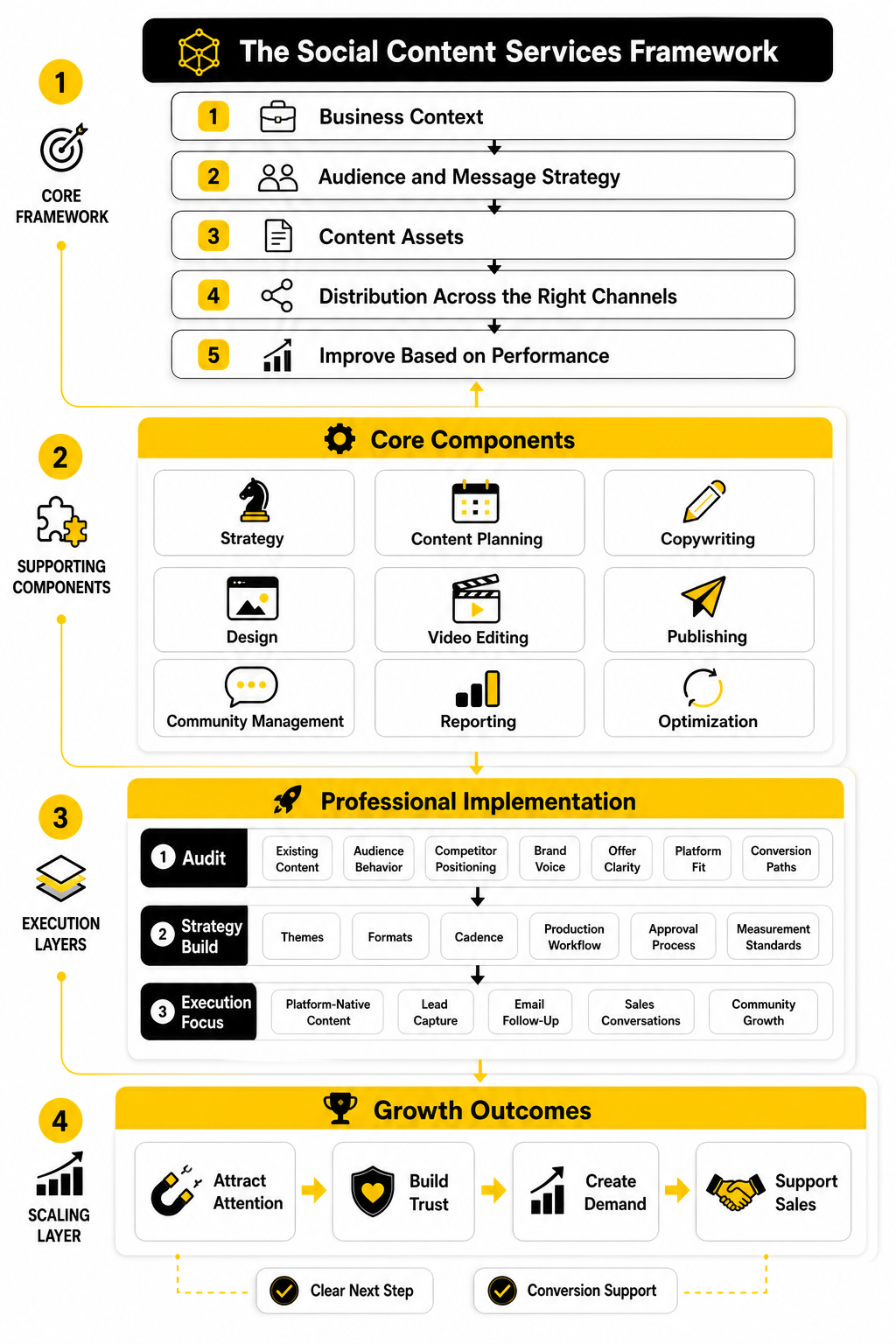
The framework also protects the brand from random acts of content. Without it, teams often chase trends, copy competitors, or post whatever is easiest to produce that week. With it, every post has a job, whether that job is reach, education, trust-building, objection handling, community engagement, lead generation, or conversion support.
This does not mean every post needs to sell. In fact, a feed that only sells usually becomes easy to ignore. The better approach is to build a balanced content system where educational posts create authority, opinion posts create differentiation, proof posts build confidence, community posts invite participation, and conversion posts make the next step obvious.
Core Components of Social Media Content Services
Most social media content services include some mix of strategy, content planning, copywriting, design, video editing, publishing, community management, reporting, and optimization. The exact mix depends on the business model, team size, budget, platform focus, and whether the brand needs organic growth, paid social support, or both. A local service business, a SaaS company, an ecommerce brand, and a creator-led education business should not all buy the same package.
The strategy component defines what the brand should be known for and how social content supports the larger marketing system. The production component turns that strategy into posts, carousels, short videos, stories, scripts, newsletters, landing page assets, and campaign creative. The distribution component makes sure the content is published at the right cadence and adapted to the expectations of each platform.
The final component is feedback. Social content improves when comments, saves, shares, clicks, replies, watch time, lead quality, and sales conversations are reviewed together. If a provider only sends a monthly report full of surface-level metrics, the business misses the deeper insight: which messages are actually moving people closer to trust.
Professional Implementation
Professional implementation begins with a simple decision: social media should support the business model, not distract from it. A service provider needs to understand how the company makes money, what the sales cycle looks like, what objections buyers have, and what content already performs across other channels. Without that context, even polished posts can feel disconnected from the commercial reality of the business.
The practical implementation process usually starts with an audit. That audit should review existing content, audience behavior, competitor positioning, brand voice, offer clarity, platform fit, and conversion paths. From there, the provider can build a content strategy that defines themes, formats, cadence, production workflow, approval process, and measurement standards.
This is also where automation and funnel tools can be useful, but only when they serve a clear purpose. A business that wants to turn social engagement into booked calls may connect content to a CRM and follow-up system through GoHighLevel. A brand that needs social traffic to convert on campaign pages may pair social creative with focused landing pages built in a tool like Replo. The principle is simple: content should not end at the post; it should create a clear next step.
Strategy and Positioning
Strategy is where social media content services either become useful or become noise. Before anyone writes captions, edits videos, designs carousels, or builds a publishing calendar, the business needs to know what it is trying to become known for. Without that decision, content turns into a collection of disconnected posts that may look polished but do not create a clear memory in the buyer’s mind.
The first strategic question is simple: what should the audience believe after seeing this brand repeatedly? Not after one post. Repeatedly. Strong social media positioning comes from consistent themes, sharp opinions, useful education, recognizable creative patterns, and proof that the company understands the buyer’s real problem.
This is why the best social media content services start with positioning before production. They define the audience, the message, the offer, the buying triggers, the objections, and the emotional reason someone should care. Once those pieces are clear, the content calendar becomes much easier to build because every idea has a strategic reason to exist.
Define the Audience Before Choosing the Content
A business does not need to speak to everyone on social media. It needs to speak clearly to the people most likely to care, trust, and eventually buy. That means audience definition should go deeper than age, location, job title, or income level.
A strong audience profile looks at the buyer’s situation. What problem are they trying to solve? What have they already tried? What makes them skeptical? What would make them feel like a brand finally understands them? These questions create stronger content than generic demographic research because they connect directly to the buyer’s decision-making process.
This also helps avoid one of the biggest mistakes in social content: copying the style of brands with completely different audiences. A B2B software company does not need the same voice as a fashion brand. A local service business does not need the same content mix as a creator selling digital products. The right content strategy starts with the right audience, not the latest trend.
Clarify the Brand’s Point of View
A brand that only shares tips is useful, but it is not always memorable. A brand that has a clear point of view is much easier to recognize because people know what it stands for, what it challenges, and what it believes should be done differently. This is where content starts to become positioning instead of just publishing.
The point of view does not need to be loud or controversial for the sake of attention. It needs to be specific. A marketing agency might believe that social content should be built around buyer objections, not platform hacks. A fitness coach might believe that simple routines beat extreme transformations. A SaaS company might believe that implementation support matters more than feature volume.
This point of view gives the content team a stronger creative filter. It shapes hooks, post topics, scripts, founder posts, educational carousels, short videos, and comparison content. More importantly, it gives the audience a reason to remember the brand for something specific.
Connect Content Themes to Business Goals
Good content themes are not random categories. They are bridges between what the audience cares about and what the business sells. If the themes are too broad, the content attracts weak attention. If they are too narrow, the brand runs out of useful things to say.
A practical content strategy usually includes a small group of recurring themes. These might include education, industry perspective, product use cases, customer proof, founder insight, objection handling, behind-the-scenes content, and conversion-focused offers. The exact mix depends on whether the business needs awareness, trust, leads, booked calls, product trials, purchases, or retention.
This is where social media content services should become commercially aware. A provider should understand which themes support top-of-funnel discovery and which themes help someone move closer to action. For example, a brand that wants more booked sales calls may need content that leads into scheduling through a tool like Cal.com, while an ecommerce brand may need content that pushes traffic to focused product pages or campaign landing pages.
Build a Message Map
A message map keeps the brand from saying the same thing in slightly different words every week. It organizes the core ideas the business needs to communicate, then turns those ideas into repeatable content angles. This makes the content system easier to scale without making it feel repetitive.
A simple message map can include the main promise, the audience problem, the cost of ignoring the problem, the brand’s unique method, common objections, proof points, and next steps. Each part can become multiple posts across different formats. One objection can become a short video, a carousel, a founder post, a customer-facing FAQ, and a sales enablement asset.
This is also useful for agencies and internal teams because it creates alignment. Designers know what the content is trying to communicate. Copywriters know which ideas matter most. Strategists can review performance without guessing whether a post supported the larger positioning.
Match Platforms to Intent
Every platform has its own behavior pattern, and pretending otherwise is expensive. People do not use LinkedIn, Instagram, TikTok, YouTube Shorts, Facebook, Pinterest, and X in the exact same way. The same idea can work across multiple platforms, but it usually needs to be adapted to fit the platform’s context.
For example, LinkedIn often rewards professional insight, founder perspective, industry commentary, and useful B2B education. Instagram may require stronger visual packaging, short-form video, stories, reels, and content that feels native to mobile discovery. Facebook can still matter for groups, local communities, retargeting ecosystems, and certain demographics, while TikTok often requires a faster hook, looser creative style, and stronger entertainment value.
This is why platform selection should not be based on where the brand feels pressured to appear. It should be based on where the audience spends attention, what kind of content the team can produce consistently, and how each platform supports the business goal. A small team with limited production capacity is usually better off doing two channels well than spreading weak content across six.
Turn Strategy Into a Working Calendar
A calendar is not a strategy, but it is where strategy becomes operational. The calendar should show what gets published, when it goes live, which theme it supports, which format it uses, who owns it, and what next step it encourages. Without that structure, even a strong strategy can get lost in day-to-day execution.
The best calendars balance planning with flexibility. Some content should be scheduled in advance, especially educational posts, campaign assets, evergreen proof, and offer-related content. Other content should leave room for timely industry commentary, audience questions, trend responses, and lessons from recent customer conversations.
A tool like Buffer can help keep publishing organized, but the calendar still needs strategic thinking behind it. The goal is not just to fill dates. The goal is to create a steady rhythm of content that compounds trust, sharpens positioning, and gives the audience clear reasons to keep paying attention.
Set the Rules for Voice and Creative Direction
Voice is one of the most underrated parts of social media content services. A brand can have strong ideas, but if the voice feels generic, stiff, or obviously outsourced, the content loses trust fast. People can usually tell when a post was written by someone who does not understand the business.
A useful voice guide should define how the brand sounds, what it avoids, how direct it should be, how technical it can get, and how it handles humor, urgency, authority, and disagreement. It should also include examples of strong and weak phrasing so writers and creators can make better decisions without asking for approval on every sentence. This keeps the brand consistent while still leaving room for personality.
Creative direction works the same way. The brand needs rules for visual style, layout, pacing, video structure, hooks, captions, thumbnails, and recurring formats. These rules should make the content recognizable without turning every post into a template that feels lifeless.
Content Creation and Production
Once the strategy is clear, social media content services move into the part most people notice first: creation. This is where ideas become posts, scripts, carousels, short videos, graphics, stories, threads, emails, landing page snippets, and campaign assets. But strong production is not just about making content look good. It is about turning the brand’s message into formats people actually want to consume.
The production process should protect both creativity and consistency. If every post starts from scratch, the team wastes time and the brand voice becomes uneven. If every post follows the same template, the feed starts to feel predictable. The sweet spot is a repeatable production system with enough creative range to keep the audience interested.
The demand for this system is obvious when you look at how social platforms are behaving. Recent social content research from Sprout Social points to content as the center of brand social strategy, while HubSpot’s 2025 marketing analysis highlights short-form video as one of the strongest-performing formats marketers are using. That does not mean every brand should chase the same formats blindly. It means the production system needs to be ready for faster, more visual, more platform-native content.
Turn Raw Inputs Into Content Assets
The best content usually comes from material the business already has. Sales calls, customer questions, product demos, founder opinions, support tickets, webinar clips, podcast conversations, reviews, internal training, and client onboarding notes can all become useful social content. A good service provider knows how to mine those inputs without making the team feel like it has to invent ideas every week.
This is where the process becomes practical. The provider should collect raw material, identify the strongest angles, match those angles to content themes, then turn them into platform-specific assets. One customer objection might become a short video, a carousel, a LinkedIn post, a story sequence, and a sales follow-up email.
This approach also keeps content grounded. Instead of guessing what the audience might care about, the team creates from real buyer language and real business context. That usually produces sharper hooks, stronger educational posts, and more useful conversion content.
Build a Repeatable Production Workflow
A repeatable workflow keeps content moving without constant chaos. The goal is not to make the process complicated. The goal is to remove friction so strategy, writing, design, editing, approval, publishing, and review happen in the right order.
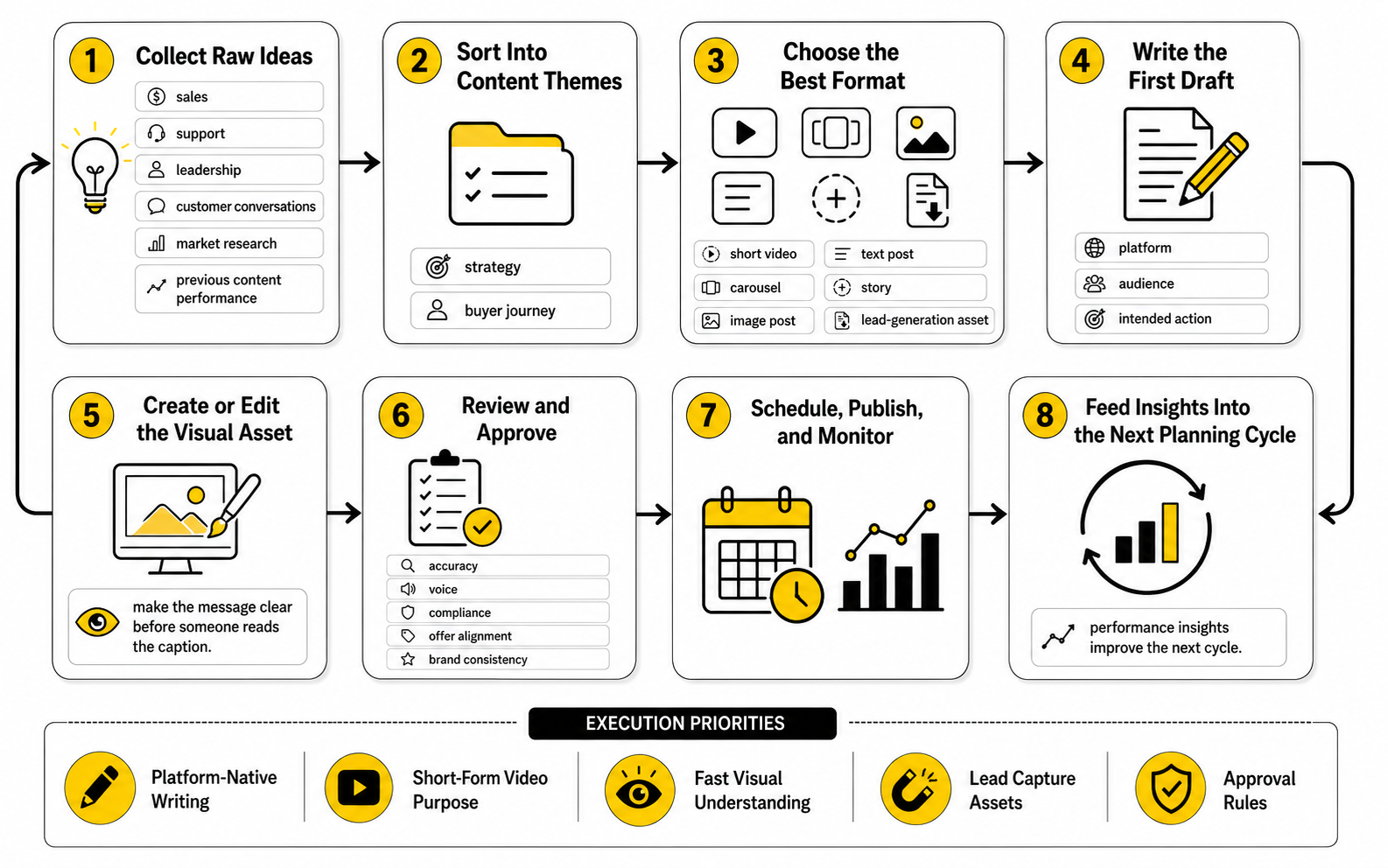
A practical production workflow usually looks like this:
This workflow gives the team a real operating rhythm. It also makes outsourcing easier because everyone knows what stage each asset is in and what “finished” actually means. Without that clarity, content production quickly turns into scattered files, delayed approvals, and last-minute publishing.
Write for the Platform, Not Just the Brand
A strong brand voice matters, but platform behavior matters too. A caption that works on LinkedIn may feel too formal on Instagram. A short-form video that works on TikTok may need a different opening for YouTube Shorts. A Facebook group post may need to feel more conversational than a polished brand announcement.
This is why social media content services should not simply copy and paste the same content everywhere. The core idea can stay the same, but the hook, pacing, layout, length, and call to action should fit the platform. That is how one message can travel across channels without feeling lazy or recycled.
Good platform writing also respects attention. The first line needs to give people a reason to keep reading or watching. The middle needs to deliver value without wandering. The ending needs to make the next step clear, whether that means commenting, saving, sharing, clicking, replying, booking, or buying.
Produce Short-Form Video With a Clear Purpose
Short-form video deserves its own process because it is easy to waste time on it. A brand can spend hours filming, editing, captioning, and posting videos that look fine but do not move the audience anywhere meaningful. The fix is to define the purpose before filming begins.
Some videos should create reach by making a sharp point quickly. Some should build trust by showing the person behind the brand. Some should explain a product, handle a common objection, or turn a customer question into a useful answer. When the role of the video is clear, the script becomes tighter and the edit becomes easier.
The structure does not need to be complicated. A strong short-form video usually needs a clear hook, one focused idea, a fast path to the point, and a natural next step. If the brand uses voice notes or spoken drafts to capture ideas quickly, a tool like Wispr Flow can help turn rough thinking into usable scripts faster.
Design Content for Fast Understanding
Design is not decoration. On social media, design helps people understand the message before they decide whether to engage with it. That matters because users are scrolling quickly, comparing options instantly, and ignoring anything that feels unclear.
Good design makes the core idea obvious. A carousel should have a strong opening slide, clean progression, and a reason to keep swiping. A quote graphic should highlight a point worth remembering, not just fill space. A thumbnail should make the video easier to choose, not just look branded.
This is also where consistency matters. Colors, typography, spacing, layout, image treatment, and recurring visual patterns help people recognize the brand over time. But consistency should not become visual boredom. The best content systems use recognizable rules while still leaving room for campaign-specific creative.
Create Lead Capture Assets Around Social Content
Not every social post needs to capture a lead, but some content should clearly connect attention to a next step. That might be a checklist, quiz, calculator, template, mini-course, webinar, free audit, consultation, community invite, or product trial. The key is to make the next step relevant to the post that created the interest.
This is where production expands beyond the feed. Social media content services may need to create landing page copy, form questions, confirmation messages, automated follow-up, and simple lead routing. If the asset is clunky after the click, the post did its job but the system failed.
For simple forms and intake flows, Fillout can support lightweight lead capture without overbuilding. For businesses that want content, forms, conversations, pipelines, and follow-up connected in one place, GoHighLevel can make sense when the team is ready to manage the full system properly.
Set Approval Rules Before Content Gets Delayed
Approvals can quietly destroy a social content system. If every post needs five opinions, nothing moves fast enough. If no one reviews important claims, the brand risks publishing something inaccurate, off-brand, or legally sensitive.
The fix is to define approval rules by content type. Low-risk educational posts may need a simple brand review. Product claims, regulated topics, customer proof, pricing references, and partnership announcements may need a more careful review. Time-sensitive posts may need a faster approval lane so they do not become irrelevant before they go live.
This is especially important when working with an outside provider. The provider should know who approves content, what they are checking, how long reviews take, and what happens when feedback conflicts. Clear approval rules keep quality high without turning every post into a committee project.
Statistics and Data
Measurement is where social media content services become accountable. Not in a fake “look at all these impressions” way, but in a practical way that shows whether content is reaching the right people, creating useful engagement, and helping the business move closer to revenue. The point of analytics is not to decorate a monthly report. The point is to make better decisions next month.
The mistake is treating every number like it has the same value. Reach, saves, comments, clicks, profile visits, direct messages, booked calls, and sales are not interchangeable. Each metric answers a different question, and each question belongs to a different stage of the social content system.
This matters because social media is still a massive attention channel. The Digital 2025 Global Overview Report shows that social platforms remain central to how people discover, follow, research, and interact with brands online. But attention by itself is not enough. A business needs to know what that attention is doing.
Start With the Right Measurement Question
Before choosing metrics, the business needs to define the question it is trying to answer. If the goal is brand awareness, the question might be whether more qualified people are seeing the content. If the goal is trust, the question might be whether people are saving, sharing, commenting, or spending more time with the content. If the goal is pipeline, the question becomes whether social activity is producing clicks, replies, leads, booked calls, or sales conversations.
This is why one dashboard cannot tell the whole story. A post with high reach and low conversions may still be valuable if it introduced the brand to the right audience. A post with low reach and high lead quality may be valuable because it spoke directly to buyers who were already close to action. Context decides whether a metric is good or meaningless.
For social media content services, this means reporting should be tied to intent. A provider should not celebrate a viral post if it attracted the wrong audience. They should not dismiss a smaller post if it generated strong comments, qualified direct messages, or useful sales insight. Measurement only works when the metric is matched to the job of the content.
Understand the Four Main Performance Layers
A useful analytics system separates performance into four layers: visibility, engagement, conversion, and learning. Visibility shows whether the content is being seen. Engagement shows whether people care enough to interact. Conversion shows whether attention is turning into a business action. Learning shows what the team should do next.
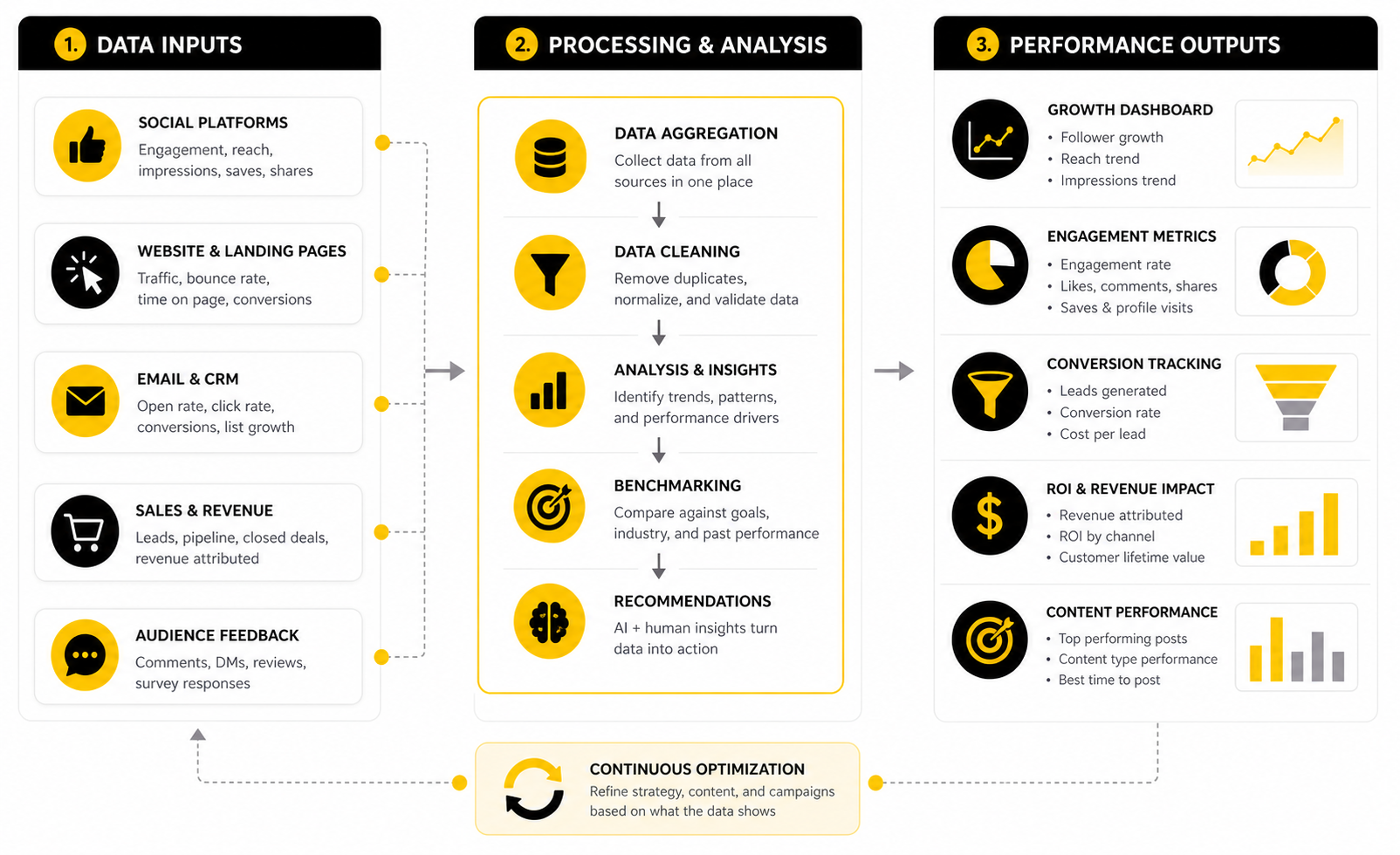
Visibility metrics include impressions, reach, profile visits, video views, and follower growth. These numbers help reveal whether the content is getting distribution, but they do not prove that the content is persuasive. A high-reach post can still be strategically weak if it attracts passive attention from people who will never buy.
Engagement metrics include comments, shares, saves, reactions, replies, watch time, and completion rate. These signals are more useful because they show active interest. Still, they need interpretation. A funny post may get reactions, while a practical checklist may get saves, and a strong opinion may get comments. Each signal tells a different story about audience behavior.
Conversion metrics include link clicks, form submissions, booked calls, trial signups, purchases, newsletter opt-ins, demo requests, and direct sales conversations. This is where content connects most clearly to business outcomes. If social content is meant to support demand generation, the reporting system needs to track what happens after someone leaves the platform.
Learning metrics are the most underrated layer. They include recurring questions, objections in comments, post topics that consistently earn saves, videos with strong retention, offers that produce replies, and content formats that repeatedly underperform. These signals help the team improve the strategy instead of just judging the past.
Use Benchmarks Without Becoming a Slave to Them
Benchmarks are useful, but they are not commandments. A benchmark can show whether a brand is broadly underperforming, average, or outperforming similar accounts. It can also help a team spot platform-level changes and understand whether a dip is specific to the brand or part of a wider pattern.
The 2025 Sprout Social benchmarks are useful because they separate industry, competitive, and personal benchmarks instead of pretending one universal number applies to everyone. That distinction matters. A B2B service brand, a beauty company, a local restaurant, and a software platform should not expect the same engagement patterns.
The 2025 Rival IQ benchmark report also shows why comparison needs nuance. Engagement rates, posting frequency, post types, and platform behavior vary by industry and channel. A low engagement rate may be a warning sign in one category and completely normal in another.
The best benchmark is usually the brand’s own historical performance. If saves are increasing, comments are getting more qualified, video retention is improving, and social leads are becoming easier to convert, the system is getting healthier. If reach is growing but business signals are flat, the brand may be attracting attention without enough relevance.
Read Engagement Quality, Not Just Engagement Volume
Engagement volume can be misleading. A post with many likes may feel successful, but likes are often the weakest signal because they require very little effort. Comments, saves, shares, replies, and direct messages usually tell a richer story because they show more intent.
A save often means the content was useful enough to revisit. A share can mean the content helped someone express an identity, teach someone else, or pass along a useful idea. A comment can reveal agreement, disagreement, confusion, interest, or objection. A direct message often shows a much stronger level of intent because the person has moved into a more private conversation.
This is where social media content services should look beyond the dashboard. The actual words people use in comments and messages can be more valuable than the number of comments alone. Those words can reveal buyer pain, missing information, content gaps, product confusion, or new offer angles.
Measure Video With Retention, Not Just Views
Video views can look impressive, but they are not enough. A view may only show that the video started playing. Retention shows whether people stayed long enough for the message to land.
For short-form video, the key questions are practical. Did people drop off immediately after the hook? Did they stay through the main point? Did completion improve when the video was shorter, more direct, or more visual? Did the video create comments, profile visits, clicks, or follows from the right audience?
This is why video reporting should include hook performance, average watch time, completion rate, replays, comments, shares, and downstream actions. The goal is not just to make videos that get watched. The goal is to make videos that communicate clearly and move the right people toward trust.
Connect Social Metrics to the Funnel
A social post rarely closes the full sale by itself, especially in higher-consideration markets. Someone may see a post, visit the profile, click a link, read a landing page, join a list, receive emails, book a call, and buy weeks later. If the reporting stops at platform analytics, the business misses most of the journey.
This is why social content should connect to a simple funnel view. A content team needs to see which posts drive clicks, which pages convert, which forms capture useful information, which follow-up messages get responses, and which leads become real opportunities. Without that connection, the team keeps guessing.
For businesses that run social content into forms, booking pages, pipelines, and follow-up campaigns, GoHighLevel can help centralize the conversion side of the system. For ecommerce or campaign-specific pages, a tool like Replo can support focused landing pages that make social traffic easier to convert. The important part is not the tool itself. The important part is having a visible path from post to outcome.
Watch for Leading Indicators
Revenue is the outcome most businesses care about, but it is often a lagging indicator. By the time revenue changes, the content system has already been working for weeks or months. That is why leading indicators matter.
Useful leading indicators include stronger comments from target buyers, more profile visits from relevant posts, more saves on educational content, higher completion rates on short videos, more direct messages, more qualified form submissions, and better sales conversations influenced by social content. These signals show whether the strategy is starting to work before the revenue report catches up.
This is especially important for newer social programs. A brand may not see immediate sales from the first month of content, but it should see whether the audience is responding to the message. If there are no signs of attention, interest, trust, or movement, the team should adjust before waiting for a bigger failure.
Turn Reporting Into Decisions
A good report should lead to action. If the report only lists numbers, it is incomplete. The real value comes from explaining what changed, why it likely changed, what the team learned, and what should happen next.
A useful monthly review might answer these questions:
This is where measurement becomes a growth loop. The team publishes, listens, reviews, improves, and publishes better work next time. That loop is what separates serious social media content services from basic posting packages.
Scaling Social Media Content Services
Scaling social media content services is not the same as posting more. More content can help, but only when the system underneath it is strong enough to handle the extra volume. If the strategy is vague, approvals are slow, reporting is shallow, or the brand voice is inconsistent, scaling only makes the problems louder.
The more carefully move is to scale in layers. First, improve the quality of the content system. Then increase the number of usable formats. Then expand to more channels, more campaigns, more creators, or more automation. That order matters because a weak system does not become strong just because it gets busier.
This is especially important now because social teams are dealing with more pressure from AI, short-form video, creator partnerships, platform fragmentation, and rising expectations around customer response. The 2025 Sprout Social Index is built around surveys of more than 4,000 consumers and 1,200 marketers, which reflects how central social media has become to brand perception, customer care, and commercial strategy. In plain English: social is not just a content channel anymore. It is part of how people judge whether a company is trustworthy, responsive, and worth buying from.
Decide What Should Be In-House and What Should Be Outsourced
The best setup is rarely fully in-house or fully outsourced. Most businesses need a hybrid model. Internal teams usually understand the product, customer, brand context, and company priorities better than anyone. External providers often bring stronger production systems, platform knowledge, creative volume, and outside perspective.
The tradeoff is control versus speed. Keeping everything in-house can protect accuracy and brand nuance, but it can also slow down execution if the team is small. Outsourcing can increase output quickly, but only if the provider has access to the right information and clear decision-makers.
A practical split is to keep strategy ownership, product expertise, customer insight, and final approval close to the business. Then outsource pieces like editing, design, repurposing, scheduling, reporting support, and campaign asset production when those tasks are slowing the team down. That way, the brand keeps its brain while still getting more hands.
Protect the Brand From Generic AI Content
AI can be useful, but it can also make a brand sound like everyone else. That is the risk. When every company uses the same prompts, the same generic hooks, and the same over-polished phrasing, the feed becomes forgettable fast.
The 2026 Hootsuite Social Trends report points to a clear tension: AI is becoming more embedded in content workflows, while audiences remain cautious about overly artificial brand communication. That is the line to watch. AI should help the team think faster, organize ideas, draft variations, summarize research, and repurpose content. It should not replace the brand’s judgment, personality, or lived expertise.
The safest rule is simple: use AI for leverage, not identity. Let it help with outlines, first drafts, content variations, transcription cleanup, research organization, and performance summaries. But the final message should still sound like the business has a real point of view, real standards, and real people behind it.
Use Creators Without Losing Strategy
Creator partnerships can be powerful, but they are not magic. A creator can bring attention, trust, style, and cultural fluency that a brand may not have on its own. But if the campaign brief is weak, the offer is unclear, or the creator’s audience does not match the buyer, the partnership becomes expensive noise.
Creator spending keeps growing because brands want more native, human-feeling content. Recent reporting on creator marketing notes that U.S. creator ad spending is projected to reach tens of billions of dollars, while brands are shifting more budget toward creator-led campaigns because creators can carry trust and attention in ways traditional ads often cannot. The important lesson is not “hire creators because everyone is doing it.” The lesson is to use creators when they can say something more believably than the brand can say alone.
For social media content services, creator work should be treated as part of the content system. The provider should define the role of the creator, the message, the usage rights, the approval process, the content formats, the campaign landing path, and the measurement plan. Otherwise, the brand gets assets but not a scalable strategy.
Balance Brand Content and Performance Content
Brand content and performance content are often treated like enemies. They are not. Brand content builds memory, trust, and preference. Performance content asks for action, captures intent, and supports revenue. A healthy social system needs both.
The problem starts when a business expects every post to generate immediate leads. That creates desperate content, repetitive offers, and a feed that feels like a sales page. The opposite problem is just as bad: posting endlessly for awareness with no clear next step, no offer, and no conversion path.
A strong content mix gives each type of post a job. Some posts should make people understand the brand better. Some should make them trust the process. Some should help them solve a problem. Some should invite a reply, click, booking, or purchase. The balance changes by business model, but the principle does not.
Build a Content Library, Not Just a Feed
A feed is temporary. A content library compounds. That is a major difference, and it changes how social media content services should be managed.
A content library stores the strongest ideas, hooks, scripts, visuals, proof points, objections, FAQs, offers, and performance notes in a way the team can reuse. This helps the brand avoid constantly starting from zero. It also makes onboarding easier when new writers, editors, designers, or agencies join the workflow.
The library should not become a dumping ground. It should be organized by theme, audience problem, funnel stage, format, product, campaign, and performance. When done well, the team can quickly find proven ideas and turn them into new posts, emails, ads, landing page sections, webinars, sales assets, and customer education material.
Watch the Hidden Risks
Social content feels low-risk because it is easy to publish, but the hidden risks are real. A rushed post can make an inaccurate claim. A poorly handled comment can damage trust. A reused customer quote can create permission issues. A trend can pull the brand into a conversation it does not understand.
The risk increases as output grows. More platforms, more creators, more automation, more AI drafts, and more team members all create more places where mistakes can happen. This is why scaling needs rules, not just enthusiasm.
At minimum, a serious social content operation should define rules for claims, customer proof, regulated language, competitor mentions, crisis response, comment moderation, permissions, and approval authority. These rules do not need to make the process slow. They make the process safer so the team can move faster without being careless.
Know When Automation Helps and When It Hurts
Automation is useful when it removes repetitive work. It becomes dangerous when it removes judgment. Scheduling posts, routing leads, tagging conversations, sending reminders, and triggering follow-up sequences can all make the system stronger. Auto-replying to sensitive customer complaints with generic messages can make the brand look tone-deaf.
A simple rule works well: automate the handoff, not the humanity. Let automation help route people to the right place, deliver requested resources, confirm bookings, and keep follow-up from slipping. Keep human review for sensitive comments, serious objections, public complaints, partnership conversations, and high-intent sales opportunities.
For comment-to-DM flows, ManyChat can be useful when the offer is clear and the follow-up feels natural. For broader CRM, pipeline, and automated follow-up workflows, GoHighLevel can support the back end when the team has already defined the customer journey. The tool should make the process smoother, not make the brand feel robotic.
Create a Clear Scaling Sequence
Scaling should follow a sequence. If the business skips steps, it usually creates more work than growth. The right sequence depends on the company, but the general path is straightforward.
This keeps the business from scaling chaos. It also makes social media content services easier to evaluate because the provider is not just selling more posts. They are helping the business build a stronger operating system for attention, trust, and conversion.
Choosing the Right Social Media Content Services Provider
The final decision is not just which provider can make attractive posts. The real question is which provider can understand the business, build a repeatable system, protect the brand voice, and connect content to measurable outcomes. That is a higher bar, and it should be.
A strong provider should ask about positioning, offers, sales process, audience objections, customer proof, existing performance, approval rules, and how social media fits into the wider marketing system. If the conversation starts and ends with post volume, that is a warning sign. Volume matters, but volume without direction is just organized noise.
This is also where the full ecosystem comes together. Social media content services work best when strategy, production, publishing, engagement, automation, reporting, and conversion paths support each other instead of operating as separate tasks.
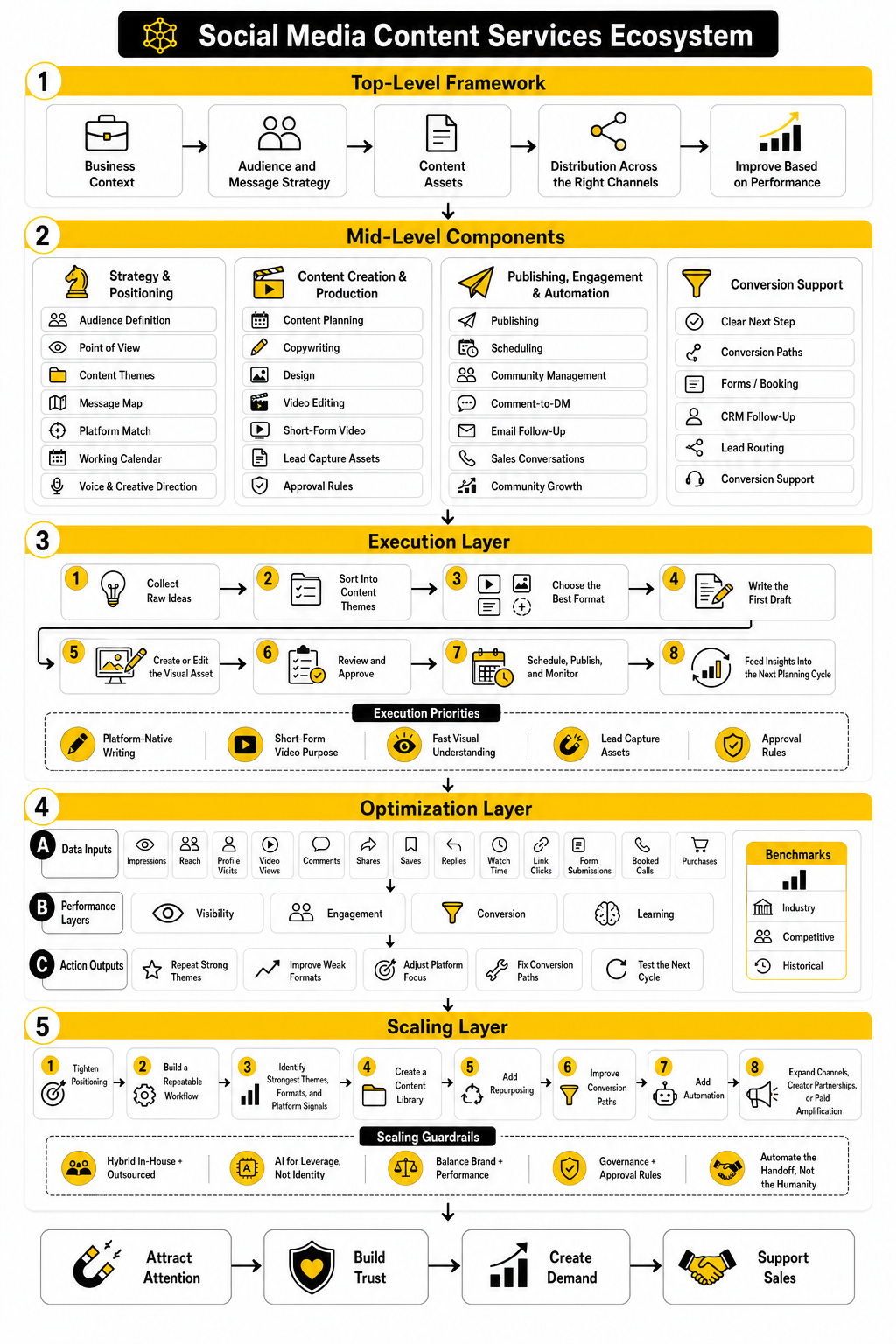
What a Strong Provider Should Bring
A serious provider should bring strategic thinking first. They should understand why each content theme exists, what stage of the buyer journey it supports, and how the brand should sound in public. They should be able to explain the difference between content that creates reach, content that builds trust, content that handles objections, and content that drives action.
They should also bring operational discipline. That means clear timelines, organized asset delivery, approval workflows, reporting rhythms, and a simple way to review what is live, what is pending, and what is being tested. The best creative ideas still fail when the process is messy.
Finally, they should bring honest interpretation. A provider that only reports good news is not useful. You want someone who can say which posts worked, which did not, what the data suggests, and what should change next.
Red Flags to Watch For
Be careful with providers who promise guaranteed virality. Social platforms are too dynamic for that, and serious professionals know it. A provider can improve the odds with better strategy, stronger creative, more carefully distribution, and tighter iteration, but they cannot honestly guarantee that every campaign will explode.
Another red flag is generic content that could belong to any brand in the category. If the posts do not reflect the company’s actual point of view, customer language, proof, offer, or product reality, the content will feel interchangeable. Interchangeable content is easy to ignore.
Also watch for providers who treat reporting as an afterthought. Social media content services should include some form of performance review, even if it is simple. Without feedback, the provider is just publishing into the void.
Match the Service Model to the Business Stage
A new business may not need a large social team. It may need positioning, a simple content system, and a small set of repeatable formats that prove what resonates. Paying for a huge content package too early can create complexity before the business knows which message works.
A growing business may need stronger production, faster repurposing, basic automation, and a clearer reporting cadence. This is where tools like Buffer, ManyChat, and GoHighLevel can support the workflow when the strategy is already clear. The tool stack should make execution easier, not distract the team from the message.
A mature business may need a more specialized setup. That could include creator partnerships, paid social creative, content localization, advanced analytics, sales enablement assets, community management, and stronger governance. At that level, the provider needs to collaborate with marketing, sales, support, product, and leadership instead of operating in isolation.
How to Evaluate Proposals
A good proposal should explain the thinking behind the work, not just list deliverables. It should show what the provider will do, why it matters, how the process works, what the business needs to provide, how performance will be reviewed, and what success looks like. If the proposal is vague, the engagement will probably be vague too.
Look for specificity. Which platforms are included? How many content pieces are created? Are captions, graphics, video editing, scheduling, community management, and reporting included? Who approves content? How many revision rounds are allowed? What happens if priorities change?
The best proposals also make tradeoffs clear. A provider might recommend fewer platforms, more short-form video, a stronger lead capture path, or a tighter content calendar. That is a good sign when the reasoning is sound. Experts do not just say yes to everything; they help choose what matters most.
What are social media content services?
Social media content services help businesses plan, create, publish, manage, and improve content across social platforms. They can include strategy, copywriting, graphic design, short-form video production, scheduling, community management, analytics, and campaign support. The best services connect content to business goals instead of treating posting as a standalone task.
Who should use social media content services?
A business should consider social media content services when it needs consistent content but lacks the time, team, process, or creative capacity to produce it well. They are useful for agencies, ecommerce brands, SaaS companies, consultants, local businesses, coaches, creators, and B2B service providers. The key is choosing a service model that matches the company’s stage and goals.
What should be included in a social media content package?
A strong package usually includes strategy, content planning, copywriting, creative production, publishing support, and reporting. Some packages also include video editing, community management, influencer coordination, paid social creative, lead capture assets, and automation setup. The right package depends on whether the business needs awareness, engagement, leads, sales support, or customer retention.
How often should a business post on social media?
There is no universal posting frequency that works for every business. A better question is how often the team can publish useful, brand-aligned content without lowering quality. For many businesses, a consistent rhythm across one or two priority platforms is more valuable than high-volume posting across every channel.
Are social media content services worth it for small businesses?
They can be worth it when the service saves time, improves quality, clarifies the message, and helps the business create more opportunities. Small businesses should avoid oversized packages that create more complexity than value. A focused content system with clear themes, simple production, and a practical conversion path is usually the better starting point.
What is the difference between content creation and social media management?
Content creation focuses on producing the assets, such as posts, captions, graphics, videos, scripts, and stories. Social media management usually includes publishing, scheduling, engagement, community response, reporting, and account oversight. Some providers offer both, while others specialize in only one part of the workflow.
How do social media content services measure success?
Success should be measured by the job the content is meant to do. Awareness content may be measured by reach, impressions, video views, and profile visits. Trust-building content may be measured by saves, shares, comments, watch time, and direct messages. Conversion-focused content should be measured by clicks, leads, bookings, purchases, pipeline influence, and sales conversations.
Should businesses use AI for social media content?
AI can help with brainstorming, research organization, draft variations, transcription cleanup, repurposing, and reporting summaries. It should not replace brand judgment, customer insight, or human voice. The safest approach is to use AI to speed up the workflow while keeping final content specific, accurate, and genuinely aligned with the brand.
What platforms should social media content services cover?
The right platforms depend on the audience, offer, content format, and business model. LinkedIn often fits B2B and professional services. Instagram, TikTok, and YouTube Shorts can work well for visual education, creator-led brands, ecommerce, and short-form video. Facebook can still be useful for communities, local markets, groups, and certain customer segments.
How long does it take to see results from social media content?
Results depend on the starting point, offer, audience, content quality, platform fit, and consistency. Some signals, such as comments, saves, direct messages, and profile visits, can appear earlier. Revenue impact often takes longer because social content usually supports a wider buying journey rather than closing every sale immediately.
What should a business prepare before hiring a provider?
A business should prepare its offer details, audience information, brand guidelines, past content, customer questions, sales objections, testimonials, product notes, and examples of content it likes or dislikes. This gives the provider better raw material and reduces guesswork. The more context the provider has, the less generic the content will feel.
How much do social media content services cost?
Pricing depends on scope, platform count, content volume, strategy depth, video needs, management responsibilities, and reporting expectations. A simple content creation package costs less than a full-service strategy, production, management, automation, and analytics engagement. The real question is not just price; it is whether the service can create useful output that supports the business goal.
Can social media content services help with lead generation?
Yes, but only when the content has a clear path to the next step. That might include a lead magnet, booking page, form, quiz, direct message flow, webinar, consultation, product page, or email sequence. Without a conversion path, even strong content can create attention that never turns into pipeline.
What makes social media content services fail?
They usually fail when the strategy is unclear, the audience is too broad, the brand voice is generic, approvals are slow, or reporting does not lead to decisions. They can also fail when a business expects instant sales from every post. Social media works best as a system that builds attention, trust, conversation, and action over time.
Build a stronger local presence with BAAM AI
Turn your website, Google profile, social channels, and AI visibility into one growth engine
Most businesses do not need more random marketing activity. They need a consistent presence system that helps the right people find them, trust them, and take action. BAAM AI brings strategy, local SEO, website updates, Google Maps visibility, social content, AI-search readiness, media production, and reporting into one practical monthly engine.
If you want your marketing to keep working after the campaign ends, start with a free BAAM AI presence audit. See how your business shows up today and where the fastest visibility wins are at BAAM AI.