
BAAM AI Blog
Social Media Ad Campaign Strategy: The Practical Framework For Profitable Growth
A social media ad campaign is not just a boosted post with a budget behind it. It is a structured system that connects audience research, creative testing, offer positioning, landing pages, automation, measurement...
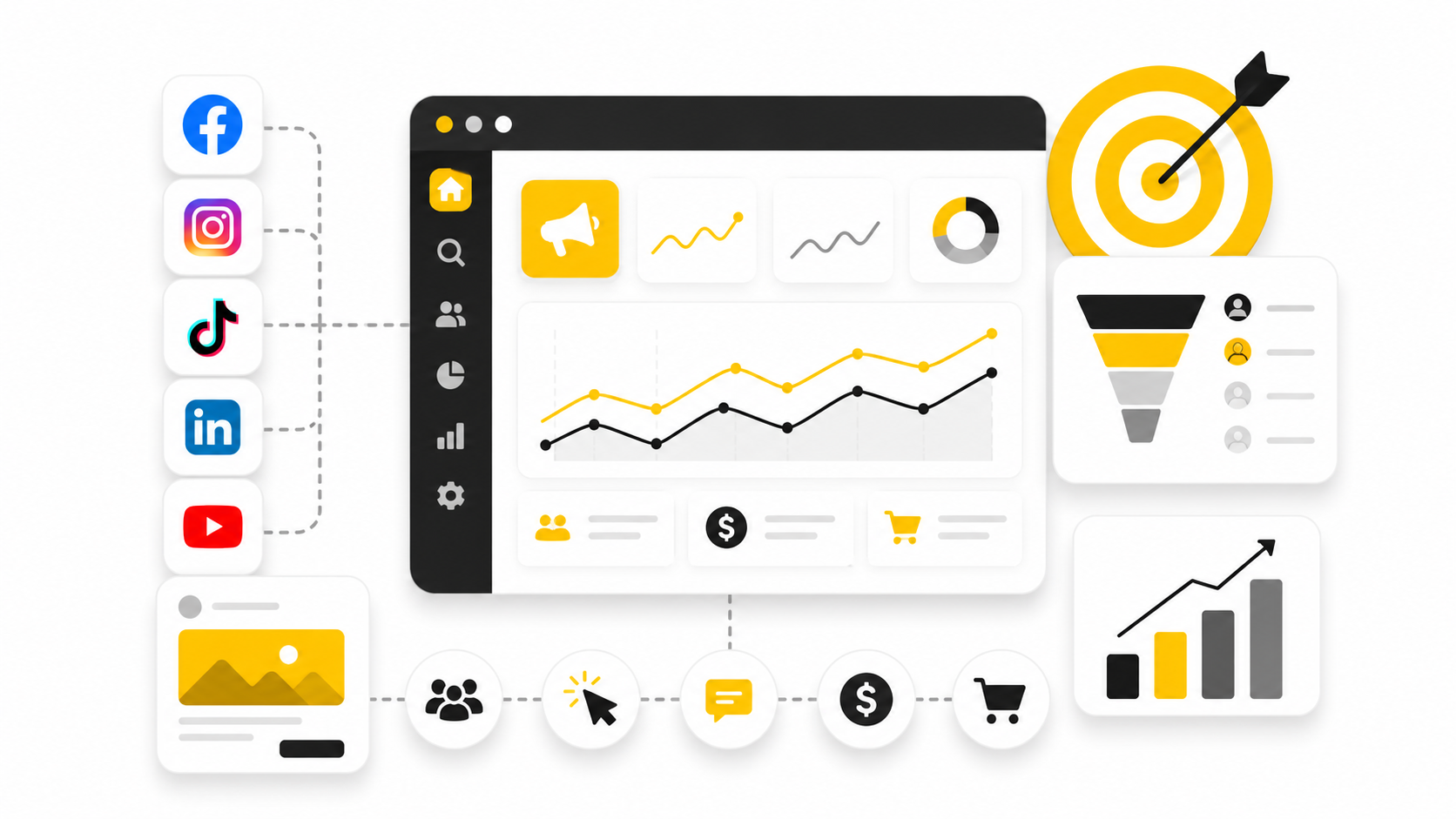
A social media ad campaign is not just a boosted post with a budget behind it. It is a structured system that connects audience research, creative testing, offer positioning, landing pages, automation, measurement, and follow-up into one commercial engine.
That matters because paid social is crowded, expensive, and brutally transparent. The brands that win are not always the brands with the biggest budgets. They are the brands that understand what they are testing, why the message should work, and what happens after someone clicks.
Digital advertising keeps moving toward social, creator-led content, short-form video, and AI-assisted campaign management. Global social media use passed 5 billion users, and the 2025 Digital report shows that social platforms remain deeply tied to product discovery, brand research, and online buying behavior through Digital 2025.
this guide breaks the full social media ad campaign process into six practical parts. Each part builds on the last, so you can move from strategy to execution without guessing.
Why A Social Media Ad Campaign Matters
A strong social media ad campaign gives your market a reason to pay attention before you ask them to buy. That sounds simple, but most campaigns fail because they skip the thinking and rush straight into the ad manager. They target too broadly, write generic copy, send traffic to a weak page, and then blame the platform.
Paid social works best when every part of the journey is intentional. The ad should create curiosity, the offer should feel relevant, the landing page should remove friction, and the follow-up should continue the conversation. Tools like ManyChat can help when the campaign depends on Messenger, Instagram DM, or comment-to-message flows, but automation only works when the core offer is already clear.
The real advantage is feedback speed. A social media ad campaign can show you which hook, promise, audience, creative angle, and landing page message gets real market response. That makes paid social more than an acquisition channel. Used properly, it becomes a research engine.
The Campaign Framework
A profitable campaign is built in layers. You do not start with the budget. You start with the market problem, the buying trigger, the offer, and the message that makes someone stop scrolling.
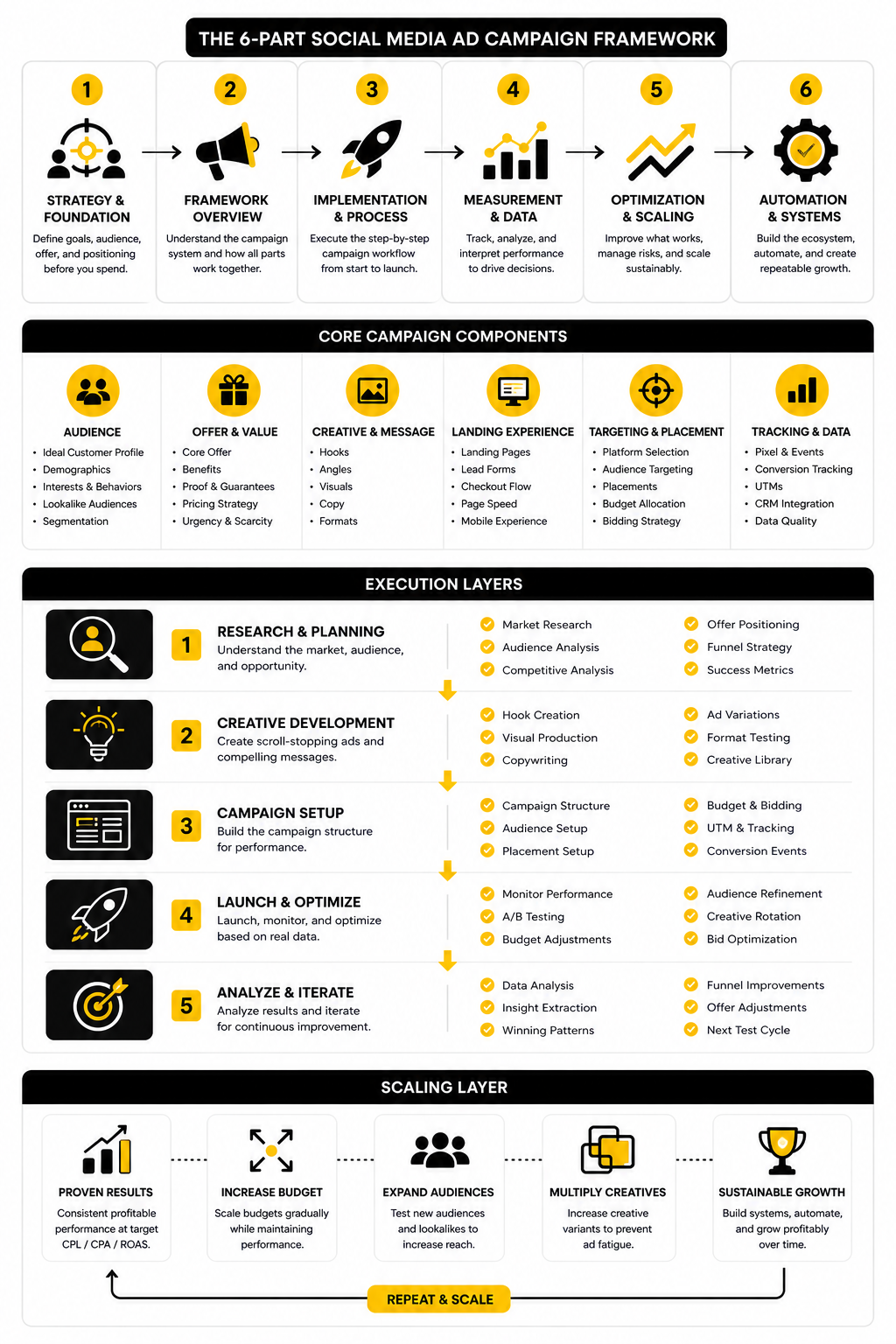
The framework used throughout this guide has four layers: strategy, creative, conversion, and optimization. Strategy defines who the campaign is for and why they should care. Creative turns that strategy into ads people actually notice.
Conversion turns attention into leads, calls, purchases, trials, demos, or booked appointments. Optimization improves the system after real data comes in. For service businesses, a platform like GoHighLevel can make sense when the campaign needs CRM, pipeline tracking, appointment booking, email, SMS, and follow-up in one place.
Core Components Of A Social Media Ad Campaign
Every campaign needs a clear objective. Awareness, lead generation, sales, retargeting, appointment booking, and customer reactivation all require different structures. When the objective is vague, the reporting becomes vague too.
Every campaign also needs an offer that is specific enough to create action. “Learn more” is usually weak because it asks for attention without offering a compelling next step. A stronger campaign gives the user a reason to click now, whether that is a useful guide, a limited promotion, a product demo, a quiz, a consultation, or a direct purchase path.
Finally, every campaign needs a conversion environment that matches the promise of the ad. If you are sending traffic to a landing page, tools like Replo can help ecommerce teams build campaign-specific pages without waiting on slow development cycles. If the campaign depends on a full funnel, ClickFunnels or Systeme.io may fit better when speed and simple funnel deployment matter more than complex customization.
Professional Implementation Starts With Restraint
The biggest beginner mistake is launching too many things at once. Too many audiences, too many objectives, too many offers, and too many creative ideas make the results impossible to read. A professional social media ad campaign starts narrower so the signal is clean.
That does not mean playing small. It means testing with discipline before scaling with confidence. You choose a clear segment, build a sharp offer, test a small set of creative angles, and measure the full path from impression to conversion.
This is where the rest of the article goes deeper. The next parts will cover how to research your audience, shape the offer, build ads, create landing pages, set budgets, track results, and automate follow-up without turning the campaign into a messy pile of disconnected tools.
Audience Research, Offer Positioning, And Message Development
The next layer of a social media ad campaign is the part most people rush through: understanding the buyer before writing the ad. This is where the campaign either becomes sharp or turns into another generic promotion fighting for attention. Your goal is not to describe your product better; your goal is to describe the buyer’s problem so clearly that the offer feels like the next obvious step.
Good audience research starts with behavior, not demographics. Age, location, and job title can help with media planning, but they rarely explain why someone stops scrolling, clicks, saves, comments, books a call, or buys. Better research looks at the moment before action: what changed, what frustrated them, what they tried already, and what they now believe they need.
That is why social platforms are so useful for campaign planning. People reveal objections, desires, language patterns, buying triggers, and frustrations in comments, reviews, creator content, search behavior, community discussions, and competitor ads. With social commerce expected to keep expanding and social platforms playing a larger role in product discovery, the strongest campaigns are built from real market language rather than boardroom assumptions, as shown in HubSpot’s 2025 social media trends research.
Start With The Buying Trigger
A buying trigger is the event, frustration, goal, or shift that makes someone receptive to your message now. Without a trigger, your campaign has no urgency. The person may fit your audience, but they are not yet in the right mental state to care.
For example, a fitness coach should not only target “people interested in fitness.” That audience is too broad and too lazy. A sharper trigger might be “people who have tried calorie tracking but still cannot stay consistent,” or “busy professionals who want visible progress without building their life around the gym.”
The same applies to B2B campaigns. A software buyer may not care about a better dashboard until reporting becomes painful, revenue attribution breaks, team handoffs get messy, or leadership starts asking harder questions. When your social media ad campaign speaks to that trigger, the ad feels timely instead of random.
Map The Audience By Awareness Level
Not every prospect is ready for the same message. Some people are problem-aware, which means they feel the pain but have not chosen a solution category yet. Others are solution-aware, which means they are comparing options and need a reason to believe yours is the right one.
This matters because the same ad cannot do every job. A cold audience may need a short video, useful post, quiz, checklist, or diagnostic angle before they are ready for a sales page. A warmer audience may respond better to proof, comparison, pricing context, case studies, demos, or a direct offer.
For simple scheduling-based campaigns, a tool like Cal.com can help reduce booking friction once the prospect is already interested. For earlier-stage lead capture, Fillout can fit when the campaign needs quizzes, forms, surveys, or qualification flows before a call or email sequence.
Build The Offer Around One Clear Promise
The offer is not just the product. It is the product, the promise, the mechanism, the risk reversal, the timing, the proof, and the next step packaged together. A weak offer forces the ad to work too hard.
A strong offer makes the value obvious quickly. It tells the right person what they get, why it matters, why it is different, and what to do next. That does not mean hype. It means removing confusion.
For a social media ad campaign, the offer should usually be narrow enough to test cleanly. Do not promote five benefits at once. Pick the benefit most connected to the buying trigger and build the campaign around that.
Write The Message Before You Write The Ad
Before creating ad copy, define the message. The message is the strategic idea underneath the copy. It is the reason the buyer should care.
A practical message structure looks like this:
This structure keeps the campaign from becoming a random set of hooks. It also helps creative teams produce different ads without drifting away from the strategy. TikTok’s own ad testing guidance emphasizes ongoing iteration, documentation, and learning loops, which is exactly why the message needs to be clear before creative testing begins through TikTok’s ad testing guide.
Use Customer Language, Not Marketing Language
Your best ad copy often comes from the market. Reviews, sales calls, support tickets, comment sections, Reddit threads, competitor testimonials, and post-purchase surveys can reveal phrases your team would never invent. That language is valuable because it sounds familiar to the buyer.
Marketing teams often polish the message until it loses the pain. They replace direct language with vague positioning. The result sounds professional but forgettable.
Keep the sharp phrases. If customers say “I’m tired of posting every day and still getting no leads,” do not rewrite it into “improve your organic demand generation workflow.” The first version has tension. The second one sounds like a slide deck.
Segment Without Overcomplicating The Campaign
Segmentation helps, but too much segmentation creates chaos. You do not need twelve personas for one campaign. You need enough separation to make the message relevant and the results readable.
Start with the segments that change the offer or the message. If two groups have the same buying trigger, same objection, and same desired outcome, they may not need separate campaigns yet. If they have different pain points or different buying moments, separating them can make the creative sharper.
For content planning and publishing support around campaign assets, Buffer can be useful when organic posts, creator collaborations, and paid campaign messaging need to stay coordinated. The point is not to add another tool for the sake of it. The point is to keep the message consistent across every touchpoint the buyer sees.
Turn Objections Into Campaign Assets
Objections are not problems to hide from. They are raw material for better ads. Price concerns, skepticism, timing issues, trust gaps, technical worries, and comparison questions can all become useful creative angles.
A prospect who thinks “this probably will not work for my business” needs a different message from someone who thinks “this looks good, but I need to justify the cost.” One needs relevance. The other needs proof and financial logic.
This is also where retargeting becomes more useful. Instead of showing the same ad again, you can build follow-up creative around the objection that likely stopped the first conversion. That makes the social media ad campaign feel more like a guided conversation and less like repeated interruption.
Define The Primary Conversion Before Launch
Before moving into creative production, define the conversion that matters most. It could be a purchase, booked call, lead form, webinar registration, trial signup, demo request, conversation started, or qualified application. Pick one primary action so the campaign has a clear job.
Secondary metrics still matter, but they should not become the scoreboard. Click-through rate, engagement, video watch time, saves, and comments can help diagnose performance, yet they do not automatically prove the campaign is profitable. The campaign needs a conversion goal that connects to revenue or a measurable sales step.
This discipline will make Part 3 much easier. Once the audience, trigger, offer, message, objections, and conversion goal are clear, creative testing stops being random. You are no longer asking, “What should we post?” You are asking, “Which expression of this message gets the right buyer to take the next step?”
Creative Testing, Ad Formats, And Platform-Specific Execution
Once the audience, offer, message, and conversion goal are clear, the campaign finally moves into visible execution. This is where the social media ad campaign becomes real: creative briefs, scripts, visuals, landing page links, tracking checks, naming conventions, launch settings, and review cycles. The work becomes practical, but it should not become random.
The mistake is treating creative as decoration. In paid social, creative is targeting, qualification, objection handling, and positioning all at once. Platform algorithms can help distribute ads, but the creative still has to earn attention in a feed where the user did not ask to see your offer.
Creative testing should be built as a learning system. TikTok’s own ad testing guidance emphasizes creative variety, hook testing, call-to-action testing, and documenting what works over time through its ad testing guide. That is the right mindset for any platform: each ad should teach you something useful, even when it does not win.
Turn The Message Into Creative Angles
A creative angle is one specific way to express the campaign message. It might lead with a problem, a misconception, a comparison, a customer objection, a transformation, a strong visual contrast, or a practical demonstration. The point is to avoid making ten versions of the same ad with only tiny visual changes.
Start with the message from Part 2 and create three to five angles from it. One angle can attack the painful problem directly. Another can show the mechanism behind the offer. Another can handle the biggest objection before it blocks the click.
This keeps the campaign focused while still giving the platform enough creative variety. You are not testing random ideas. You are testing different expressions of the same strategic promise.
Build The Creative Brief
The creative brief is where strategy becomes production. It does not need to be long, but it does need to be clear. A good brief tells the creator, designer, copywriter, or media buyer exactly what the ad must communicate.
A practical creative brief should include:
The brief prevents the classic execution problem: everyone is busy producing assets, but nobody knows what is actually being tested. That wastes budget and makes results hard to interpret. A tight brief creates speed because the team can make decisions without reopening the strategy every five minutes.
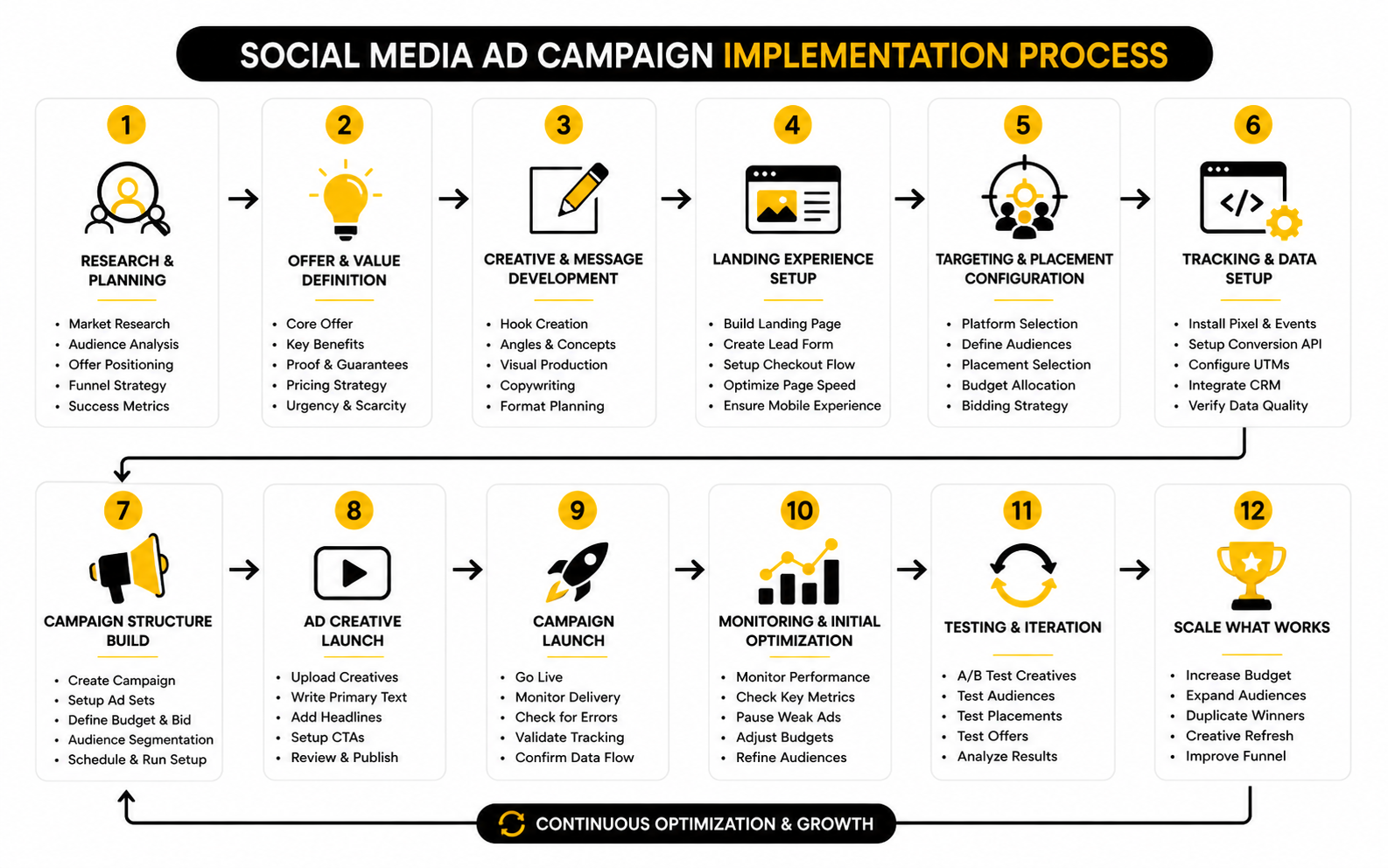
Follow A Simple Execution Process
A social media ad campaign should move through a repeatable launch process. The goal is not bureaucracy. The goal is to catch obvious mistakes before money starts leaving the account.
Use this process before every launch:
This is the point where tools can either help or create noise. If the campaign drives people into a booking flow, CRM, SMS sequence, or sales pipeline, GoHighLevel can keep the follow-up connected to the ad source. If the campaign uses chat-based entry points, ManyChat can support Instagram and Messenger flows that turn comments, clicks, or DMs into a structured conversation.
Choose Formats Based On The Job
Do not choose an ad format because it is trendy. Choose it because it fits the message and the buying stage. A short vertical video can be excellent for showing a problem, demonstrating a product, or using a creator-style hook, while a carousel can work well for step-by-step education, comparisons, and proof points.
Image ads still have a place when the message is instantly clear. Lead forms can reduce friction when the offer is simple, but they can also attract lower-intent leads if the qualification is weak. Landing page campaigns usually create more friction, but they give you more control over the argument, proof, and next step.
Meta’s ad guide provides current placement and format specifications through the Meta Ads Guide, which matters because bad formatting can make good creative look broken. This is basic, but important. If your ad is cropped badly, loads slowly, or hides the main visual message, the campaign is already fighting itself.
Adapt The Creative To Each Platform
A good social media ad campaign respects the platform environment. People do not use TikTok, Instagram, LinkedIn, YouTube, Facebook, Pinterest, and X in exactly the same way. The same core message may work across platforms, but the expression usually needs to change.
TikTok creative often benefits from native-feeling video, fast hooks, trend awareness, and a less polished style, which TikTok highlights in its creative best practices. LinkedIn usually rewards credibility, professional relevance, clear value, and human voices, especially in B2B contexts where trust and expertise matter. Instagram and Facebook often sit somewhere in the middle, depending on whether the creative feels like creator content, product education, social proof, or direct response.
The mistake is copying and pasting one ad everywhere. That creates lazy execution. Keep the same strategic message, but rebuild the opening, format, visual rhythm, proof, and call to action for the platform where the ad will actually run.
Make The Hook Specific
The hook is not just the first sentence. It is the first thing the user sees, hears, reads, or understands. In a video, it may be the opening frame, the first line, the facial expression, the prop, the movement, or the text overlay.
A strong hook creates immediate relevance. It makes the right person think, “That is my problem,” “I have wondered about that,” “I disagree,” “I need to see this,” or “That looks useful.” A weak hook makes the ad feel like every other brand trying to interrupt the feed.
Test hooks around different psychological entry points. Try the painful problem, the surprising mistake, the before-and-after contrast, the direct question, the contrarian belief, the quick demonstration, and the objection. Do not test twenty hooks at once without structure, but do not assume your first hook is the winner either.
Use Proof Without Overloading The Ad
Proof makes the promise believable, but too much proof can slow down the ad. The job is to include just enough evidence to keep the viewer moving. That might be a customer result, product demonstration, review snippet, founder credibility, recognizable client type, data point, or comparison.
Be careful with claims. If you cannot support a number, do not use it. If the platform might flag the wording, rewrite it. If the proof depends on a unique case, make the context clear.
For B2B campaigns, proof often needs to feel more concrete than inspirational. A vague “scale faster” claim is easy to ignore. A specific workflow improvement, reporting benefit, cost reduction, time saving, or sales process outcome is easier to understand.
Prepare Variations Before Launch
Creative testing gets messy when new ads are added casually after launch. Prepare your first batch in a way that makes analysis possible. Each variation should have a reason to exist.
A clean first batch might include:
This gives you a spread of angles without turning the account into a junk drawer. If one category wins, you can create more variations around that category. If everything fails, you know the issue may be bigger than the thumbnail or first line.
Keep Production Fast But Controlled
Paid social rewards speed, but speed without control creates waste. You need a workflow that can produce new creative regularly while keeping the campaign strategy intact. That means templates, naming rules, approval steps, and a shared testing log.
For teams managing organic posts alongside paid assets, Buffer can help keep publishing organized without losing track of campaign themes. For teams turning ad traffic into email follow-up, Brevo can support email and automation flows after the first conversion. These tools are useful only when they support the process instead of replacing it.
The main rule is simple: do not let production drift away from the buyer. Every script, graphic, caption, and call to action should connect back to the audience research and offer positioning from Part 2. That is how creative execution becomes a growth system instead of a guessing game.
Measurement, Analytics, And Performance Signals
A social media ad campaign is only as good as the decisions its data helps you make. Metrics are not trophies. They are signals that tell you where the campaign is strong, where it is leaking money, and what needs to change next.
The danger is reading numbers in isolation. A high click-through rate can still produce terrible leads. A low cost per lead can still waste money if the sales team never closes those leads. A strong return on ad spend can still hide a weak first-purchase margin if repeat buying is the real profit driver.
Good measurement connects the ad, the audience, the offer, the landing page, the follow-up, and the final business result. That is the difference between reporting and actual decision-making.
Statistics And Data
Social advertising benchmarks are useful, but only when you treat them as context, not law. WordStream’s 2025 Facebook ads benchmark data shows that performance varies heavily by industry, objective, and funnel stage, which means a “good” CPC or conversion rate is not universal through its 2025 Facebook ads benchmarks. That matters because comparing your campaign to a generic average can push you into the wrong decision.
The more practical question is not, “Is our CTR above average?” The better question is, “Does this CTR bring the right traffic at a cost that our funnel can monetize?” A campaign with a modest CTR and strong lead quality can beat a flashy campaign that attracts cheap curiosity.
The same logic applies to platform shifts. The DDMA Social Advertising Benchmark 2025 shows advertisers putting more weight back on conversion-focused campaigns while expanding platform mixes beyond only Meta through the DDMA social advertising benchmark. That does not mean every brand should instantly add more channels. It means measurement needs to show whether each channel has a clear role in the funnel.
Build The Analytics System Before You Scale
Measurement should be set up before the campaign launches, not after the first confusing report. At minimum, you need clean tracking for impressions, clicks, landing page views, conversion events, lead quality, sales outcomes, and follow-up performance. If those pieces are disconnected, the campaign will create debate instead of clarity.
The analytics system should answer three basic questions. First, are the ads getting attention from the right people? Second, is the landing experience turning that attention into action? Third, are those actions producing revenue, pipeline, or another meaningful business result?
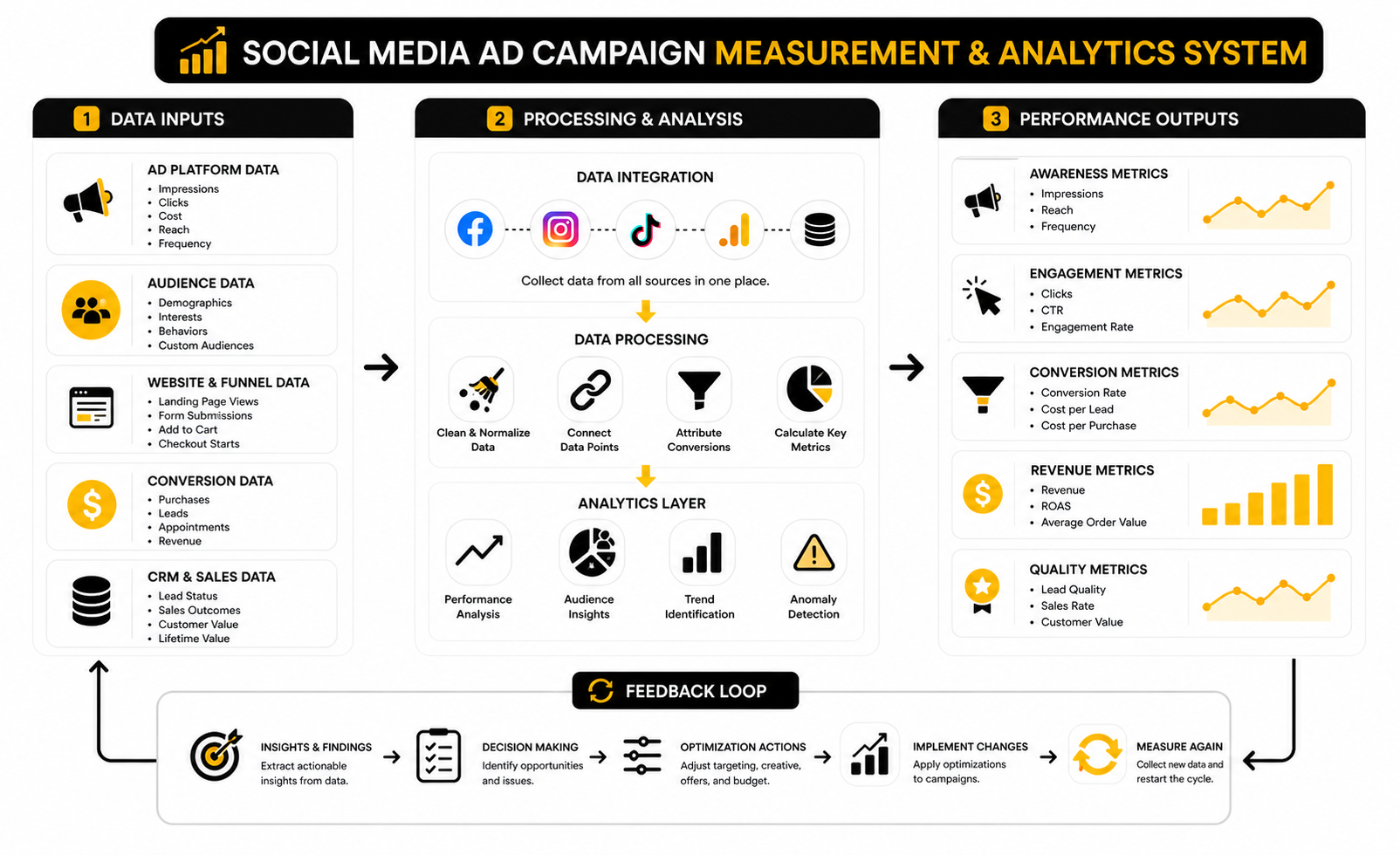
For businesses that need ad leads to move into pipelines, appointments, SMS, email, and sales follow-up, GoHighLevel can help connect campaign source data with CRM activity. For email-heavy follow-up, Brevo can support automation after the first conversion. The tool is not the strategy, but disconnected tools make clean measurement much harder.
Read Metrics By Funnel Stage
Top-of-funnel metrics show whether the creative is earning attention. These include impressions, reach, frequency, video hold rate, thumb-stop rate, click-through rate, and engagement quality. They are useful because they show whether the message has enough pull to create movement.
Middle-of-funnel metrics show whether the click was worth anything. Landing page view rate, scroll depth, form starts, quiz completions, add-to-cart rate, booked-call rate, and email opt-in rate all help reveal whether the promise in the ad matches the next step. If the ad gets clicks but the page does not convert, the problem may be message mismatch, page speed, weak proof, unclear offer, or too much friction.
Bottom-of-funnel metrics show whether the campaign has commercial value. Cost per qualified lead, cost per booked call, show-up rate, sales conversion rate, cost per acquisition, return on ad spend, payback period, and lifetime value matter more than vanity numbers. This is where a social media ad campaign either becomes a growth asset or an expensive distraction.
Separate Platform Data From Business Data
Ad platforms are useful, but they do not see your entire business. They optimize based on the events you send back and the attribution rules inside the platform. That means platform reporting can be directionally helpful while still being incomplete.
Meta recommends using the Conversions API alongside the Meta Pixel so advertisers can share web and offline events more reliably through Meta’s Conversions API best practices. TikTok also emphasizes attribution analysis, view-through attribution, and event quality as part of its measurement best practices. The takeaway is simple: better signal quality usually gives the platform more useful data for optimization.
Still, do not let the platform be the only source of truth. Match platform data against CRM data, payment data, booking data, and sales team feedback. When those sources disagree, investigate instead of blindly trusting the prettiest dashboard.
Know What Each Metric Should Make You Do
Data becomes useful when each metric has a decision attached to it. If click-through rate is weak, the creative angle, hook, visual, or audience match may need work. If click-through rate is strong but conversion rate is weak, the landing page or offer may be the problem.
If lead cost is low but sales quality is poor, tighten the qualification step. That might mean adding a better form, a stronger pre-sell page, a clearer price expectation, or a more specific call to action. For campaigns using forms or quizzes, Fillout can help qualify leads before they reach the sales team.
If conversion volume is strong but profitability is weak, the issue may sit in pricing, margin, upsells, repeat purchase, sales follow-up, or retention. That is why performance analysis should not stop at the ad account. The ad account shows acquisition behavior, but the business model determines whether that acquisition is worth scaling.
Use Benchmarks Without Becoming Average
Benchmarks can help you spot unusual performance. If your CPC is dramatically higher than market context, your creative, audience, bid environment, or offer may need attention. If your conversion rate is far lower than comparable campaigns, the landing experience probably deserves a hard review.
But benchmarks can also make you lazy. A campaign can beat the average and still fail your economics. Another campaign can look expensive compared with a benchmark and still be profitable because the customers are worth more.
Your internal benchmark matters most. Track results by campaign type, offer, audience, creative angle, channel, and funnel stage. Over time, your own data becomes more useful than broad industry averages because it reflects your pricing, market, sales process, and customer quality.
Watch Frequency And Creative Fatigue
Frequency shows how often people are seeing your ads. A rising frequency is not automatically bad, especially in retargeting or high-consideration sales. But when frequency climbs while click-through rate and conversion rate fall, creative fatigue is probably setting in.
Creative fatigue usually means the audience has already absorbed the message. Showing the same ad more often will not magically restore performance. You need new angles, new hooks, new proof, new formats, or a different audience stage.
This is why the creative testing process from Part 3 matters so much. If you only launch one or two ads, fatigue becomes a crisis. If you maintain a structured testing pipeline, fatigue becomes a normal part of the optimization cycle.
Measure Lead Quality, Not Just Lead Volume
Lead generation campaigns can look excellent in the ad manager and terrible in the sales pipeline. Cheap leads are not valuable if they do not answer, cannot afford the offer, misunderstand the promise, or never intended to buy. This is one of the most common measurement traps.
Track what happens after the lead is captured. Measure contact rate, qualification rate, booked-call rate, show-up rate, close rate, average deal value, refund rate, and time to purchase. These numbers tell you whether the campaign is attracting buyers or just collecting names.
For appointment-based campaigns, Cal.com can reduce scheduling friction, but the booking itself is still not the final win. The better question is whether those booked calls show up and convert. That is the data that protects your budget.
Turn Reports Into Decisions
A campaign report should not be a screenshot dump. It should explain what happened, why it likely happened, what changed, and what the next action should be. If the report does not lead to a decision, it is not finished.
A useful weekly review can stay simple:
This keeps the social media ad campaign grounded. You are not reacting emotionally to every daily fluctuation. You are building a system that learns, improves, and earns the right to scale.
Budgeting, Optimization, And Scaling
Scaling a social media ad campaign is not the same as increasing the budget. Anyone can push more spend into an ad account. The hard part is increasing spend without destroying lead quality, margin, conversion rate, or cash flow.
This is where the campaign becomes a business decision, not just a media buying decision. If your funnel cannot convert the extra traffic, scaling only exposes the weakness faster. If your sales team cannot handle more volume, scaling creates operational drag instead of growth.
The best campaigns scale when the system is ready. That means the creative pipeline is active, tracking is reliable, the offer has proven demand, the sales process can handle volume, and the economics still make sense when costs rise.
Know What You Are Scaling
Before increasing spend, define exactly what has earned more budget. Are you scaling a creative angle, an audience segment, a funnel path, a platform, or an offer? This matters because “the campaign is working” is too vague to guide smart decisions.
A campaign might be profitable because one ad is carrying the whole account. It might be profitable because retargeting is converting demand created elsewhere. It might be profitable because one audience is strong while the rest is weak.
Do not scale the average. Scale the signal. Find the part of the social media ad campaign that is producing quality conversions and protect it from unnecessary changes.
Increase Budget Without Breaking The Learning
Ad platforms need stable data to optimize delivery. Meta explains that the learning phase is the period when its delivery system is still learning how an ad set may perform through Meta’s learning phase guidance. When you make aggressive edits too often, you can interrupt the system before it has enough useful conversion data.
That does not mean you should never touch a campaign. It means budget changes should be intentional. Gradual increases often preserve stability better than emotional jumps after one good day.
A practical approach is to scale in stages. Increase budgets on proven campaigns, watch conversion quality, check blended acquisition cost, and confirm that downstream results still hold. If cost per lead stays stable but sales quality drops, the campaign is not really scaling.
Balance Vertical And Horizontal Scaling
Vertical scaling means increasing the budget on what already works. It is simple, but it can hit saturation quickly. As spend rises, the platform may need to reach less responsive people inside the same audience, which can push costs up.
Horizontal scaling means expanding into new creative angles, audience segments, placements, offers, or platforms. It takes more work, but it gives the campaign more room to grow. This is usually where sustainable scaling comes from.
The best approach uses both. Push more budget into proven winners, but keep building new tests before the old winners fatigue. That keeps the campaign moving instead of waiting for performance to collapse.
Protect Your Unit Economics
A campaign can look good in the ad account while quietly damaging the business. This happens when the team optimizes for cheap conversions instead of profitable customers. It also happens when discounts, refunds, fulfillment costs, sales commissions, or long payback periods are ignored.
Before scaling, know your numbers:
This is not finance theater. It decides how aggressive you can be. If your payback period is short and retention is strong, you can scale differently from a business that needs months to recover acquisition cost.
Manage Creative Fatigue Before It Hurts
Creative fatigue is one of the biggest scaling risks. As more people see the same ad, performance can decline even if the offer is still strong. RevenueCat’s 2025 analysis of ad fatigue points to falling CTR, rising frequency, onboarding drop-offs, and cross-channel performance shifts as warning signs through its ad fatigue detection guide.
The solution is not always a brand-new campaign. Sometimes you need a new hook, a new opening frame, a different proof point, a stronger objection-handling angle, or a fresh creator-style execution. Small changes can extend a winner, but eventually the market needs a new reason to pay attention.
Build creative refresh into the operating rhythm. If new assets only get made after performance drops, you are already late. A serious social media ad campaign needs a pipeline, not occasional panic production.
Decide When To Consolidate And When To Segment
Campaign structure gets harder as accounts grow. Too much segmentation spreads data too thin. Too much consolidation can hide important differences between audiences, offers, and creative types.
Consolidation works well when the platform needs more conversion volume to optimize and the audiences behave similarly. Segmentation works better when the buying triggers, offers, funnel paths, or customer values are meaningfully different. The decision should be based on learning quality, not personal preference.
A clean rule: segment only when the segment changes the decision you would make. If two segments require the same creative, same landing page, same offer, and same follow-up, they may not deserve separate structures yet. If one segment closes at a much higher value or needs a different sales process, separate it.
Scale The Follow-Up System Too
More ad spend creates more conversations, leads, checkouts, bookings, and support questions. If the follow-up system cannot handle that volume, performance will look worse even when the ads are doing their job. This is especially important for high-ticket services, agencies, coaching, local businesses, and B2B offers.
For pipeline-heavy campaigns, GoHighLevel can help centralize CRM stages, automations, appointment reminders, call tracking, and sales follow-up. For campaigns where comments or DMs are part of the conversion path, ManyChat can help turn social engagement into structured conversations. The advanced move is not adding automation everywhere; it is automating the moments where speed and consistency increase conversion quality.
Email also becomes more important as scale increases. Not every lead buys immediately, and not every buyer sees the first follow-up. Tools like Moosend or Brevo can support nurture sequences, campaign follow-ups, and reactivation when the social click is only the beginning of the journey.
Watch Platform Risk
Relying on one platform is convenient until it is not. Costs can rise, policies can change, accounts can get restricted, attribution can shift, and creative styles can fatigue faster than expected. IAB reported that U.S. digital advertising revenue reached nearly $300 billion in 2025, which shows how competitive and performance-driven the market has become through the IAB Internet Advertising Revenue Report.
That competition is not a reason to avoid paid social. It is a reason to build resilience. Your campaign should not depend on one ad, one audience, one platform, one tracking method, or one follow-up channel.
Diversification does not mean spreading budget randomly. It means expanding once you have a reason: a new audience behavior, a better creative format, a stronger retargeting path, or a platform where the buying context fits the offer.
Avoid Scaling Bad Assumptions
The most expensive mistake is scaling a campaign before you know why it worked. A few profitable days can create false confidence. Seasonality, attribution overlap, small sample sizes, returning customers, influencer spillover, or offline sales activity can all make a campaign look stronger than it is.
Before scaling hard, pressure-test the result. Look at new customer quality, repeatability across creative, consistency across days, contribution from retargeting, and whether the offer still works with colder traffic. If the campaign only works in a tiny warm pocket, treat it like a clue, not a machine.
This is where advanced operators stay calm. They do not kill winners too early, but they also do not worship them. They protect what is working while building the next layer of evidence.
Make Scaling A System, Not A Mood
Scaling should follow rules. Decide in advance when you increase budget, when you hold, when you cut, when you refresh creative, and when you investigate lead quality. This removes emotional decision-making from the account.
A simple scaling rule set might look like this:
The point is discipline. A social media ad campaign becomes easier to scale when decisions are made from a system instead of stress. Part 6 will bring everything together with automation, tool stack choices, reporting habits, and the final FAQ.
Campaign Automation, Tool Stack, Reporting, And FAQ
The final layer of a social media ad campaign is the operating system around it. This includes automation, reporting, handoffs, lead routing, creative production, sales feedback, and the rules that keep the campaign improving after launch. Without this layer, even a strong campaign can slowly become messy.
Automation should make the campaign faster, cleaner, and easier to measure. It should not hide weak strategy. If the offer is unclear, the creative is generic, or the follow-up is poor, automation only helps you make mistakes at scale.
The strongest setup keeps human judgment where it matters and uses tools for the repeatable work. AI and platform automation are becoming more important, with Meta positioning Advantage+ as an AI-driven campaign optimization system through Meta Advantage+, and TikTok offering automated campaign support through Smart+ Campaigns. That shift makes strategy even more important, not less.
Build The Campaign Ecosystem
A complete campaign ecosystem connects the ad platform to the conversion path and the follow-up system. The ad creates the first action. The landing page, form, checkout, chat flow, calendar, CRM, and email sequence turn that action into a measurable business outcome.
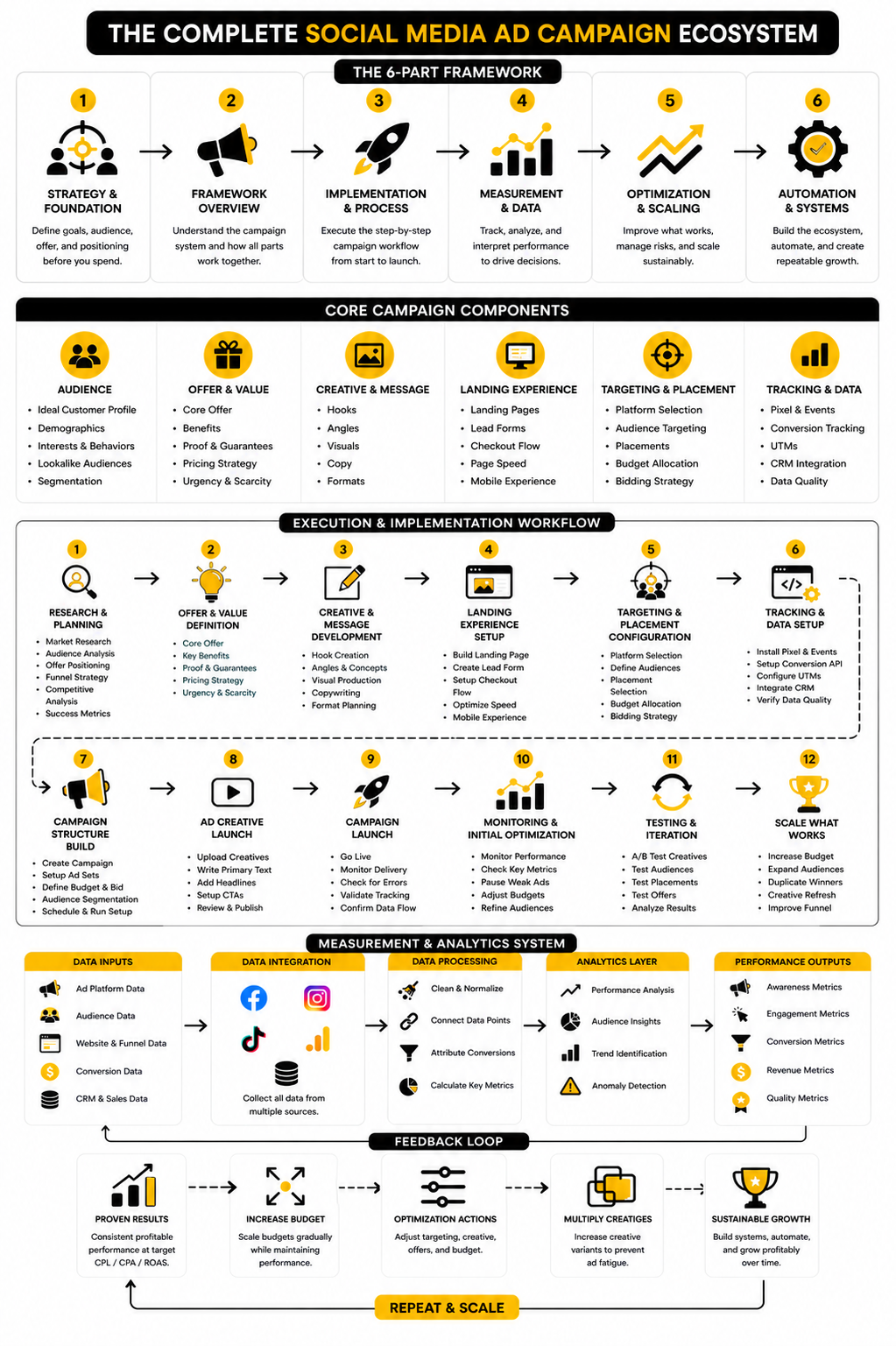
A practical ecosystem might include Replo for ecommerce landing pages, ClickFunnels for funnel builds, GoHighLevel for CRM and appointment-based follow-up, ManyChat for chat automation, and Brevo for email nurturing. You do not need every tool. You need the few tools that remove friction from your specific campaign.
The rule is simple: every tool must have a job. If it does not improve speed, tracking, conversion, follow-up, or reporting, it is probably just adding complexity. A lean stack used well beats an impressive stack nobody maintains.
Create Reporting That People Actually Use
Campaign reporting should help the team make better decisions. It should not be a weekly ritual where everyone stares at dashboards and leaves with no action. A useful report connects performance to the campaign strategy.
The report should show what changed in spend, creative performance, conversion quality, funnel behavior, and sales outcomes. It should also explain what the team learned and what will happen next. If the report cannot answer “so what?” it is not finished.
A simple reporting rhythm works best. Daily checks catch technical issues. Weekly reviews guide optimization. Monthly reviews evaluate bigger questions like channel mix, offer strength, budget allocation, creative direction, and profitability.
What is a social media ad campaign?
A social media ad campaign is a structured paid advertising effort across platforms like Facebook, Instagram, TikTok, LinkedIn, YouTube, Pinterest, or X. It includes the audience, offer, creative, budget, landing experience, tracking, and follow-up process. The goal is to turn attention into a measurable business result, not just impressions or likes.
What makes a social media ad campaign successful?
A successful campaign has a clear buyer, a strong offer, relevant creative, clean tracking, and a conversion path that matches the promise in the ad. It also has enough testing discipline to learn what works instead of guessing. The best campaigns improve over time because every result creates a more carefully next decision.
How much should I spend on a social media ad campaign?
The right budget depends on your offer value, sales cycle, conversion rate, audience size, and testing needs. A small campaign should still have enough budget to generate meaningful data, not just a handful of clicks. Start with a testing budget you can afford to learn from, then scale only when conversion quality and unit economics support it.
Which platform is best for a social media ad campaign?
There is no universal best platform. Meta can work well for broad consumer and local business campaigns, TikTok can be powerful for native video and discovery, LinkedIn can fit B2B targeting, and YouTube can support education-heavy offers. The best platform is the one where your audience, creative style, buying intent, and economics line up.
How long should a campaign run before judging results?
Do not judge a campaign too quickly. Early data can reveal technical problems and obvious creative mismatches, but deeper decisions need enough conversion volume to be meaningful. Review daily for errors, weekly for optimization, and monthly for strategic direction.
What is the difference between a boosted post and a campaign?
A boosted post is usually a simplified promotion of existing content. A campaign is built around a business objective, structured targeting, testing, tracking, creative variations, and a defined conversion path. Boosting can be useful in some cases, but it rarely replaces a properly built campaign.
How many ads should I test at once?
Test enough ads to learn, but not so many that the budget gets spread too thin. A strong first batch might include three to five creative angles with clear reasons behind each one. The key is knowing what each ad is meant to test before it launches.
Why are my ads getting clicks but no conversions?
This usually means the ad is creating curiosity, but the next step is not convincing enough. The landing page may be slow, unclear, mismatched, too long, too thin, or asking for too much too soon. It can also mean the creative is attracting the wrong people because the hook is too broad.
Why are my leads cheap but low quality?
Cheap leads often come from low-friction offers, vague promises, weak qualification, or audiences that are curious but not ready to buy. Add stronger qualification, clearer pricing context, better forms, or more specific messaging. The goal is not the lowest lead cost; the goal is profitable lead quality.
Should I use AI automation in paid social campaigns?
Yes, but with control. Platform automation can help with delivery, creative combinations, placements, and bidding, but it still needs strong inputs. Your job is to provide clear strategy, strong creative, accurate tracking, and business feedback so automation optimizes toward the right outcome.
How do I know when to scale a campaign?
Scale when the campaign has proven conversion quality, stable economics, reliable tracking, and enough creative support to handle more reach. Do not scale just because one day looked good. Scale the part of the campaign that is clearly working, then watch downstream results carefully.
What should I do when performance drops?
First, identify where the drop happened. If attention metrics fall, review creative fatigue and audience saturation. If clicks stay strong but conversions fall, inspect the landing page, offer, tracking, or follow-up. If leads still come in but sales drop, review lead quality and sales handling.
Build a stronger local presence with BAAM AI
Turn your website, Google profile, social channels, and AI visibility into one growth engine
Most businesses do not need more random marketing activity. They need a consistent presence system that helps the right people find them, trust them, and take action. BAAM AI brings strategy, local SEO, website updates, Google Maps visibility, social content, AI-search readiness, media production, and reporting into one practical monthly engine.
If you want your marketing to keep working after the campaign ends, start with a free BAAM AI presence audit. See how your business shows up today and where the fastest visibility wins are at BAAM AI.