
BAAM AI Blog
Social Marketing Companies: How To Choose, Structure, And Manage The Right Partner
Social marketing companies are no longer just “the people who post on Instagram.” The best ones now sit closer to growth, brand strategy, content production, paid media, community, analytics, creator partnerships...
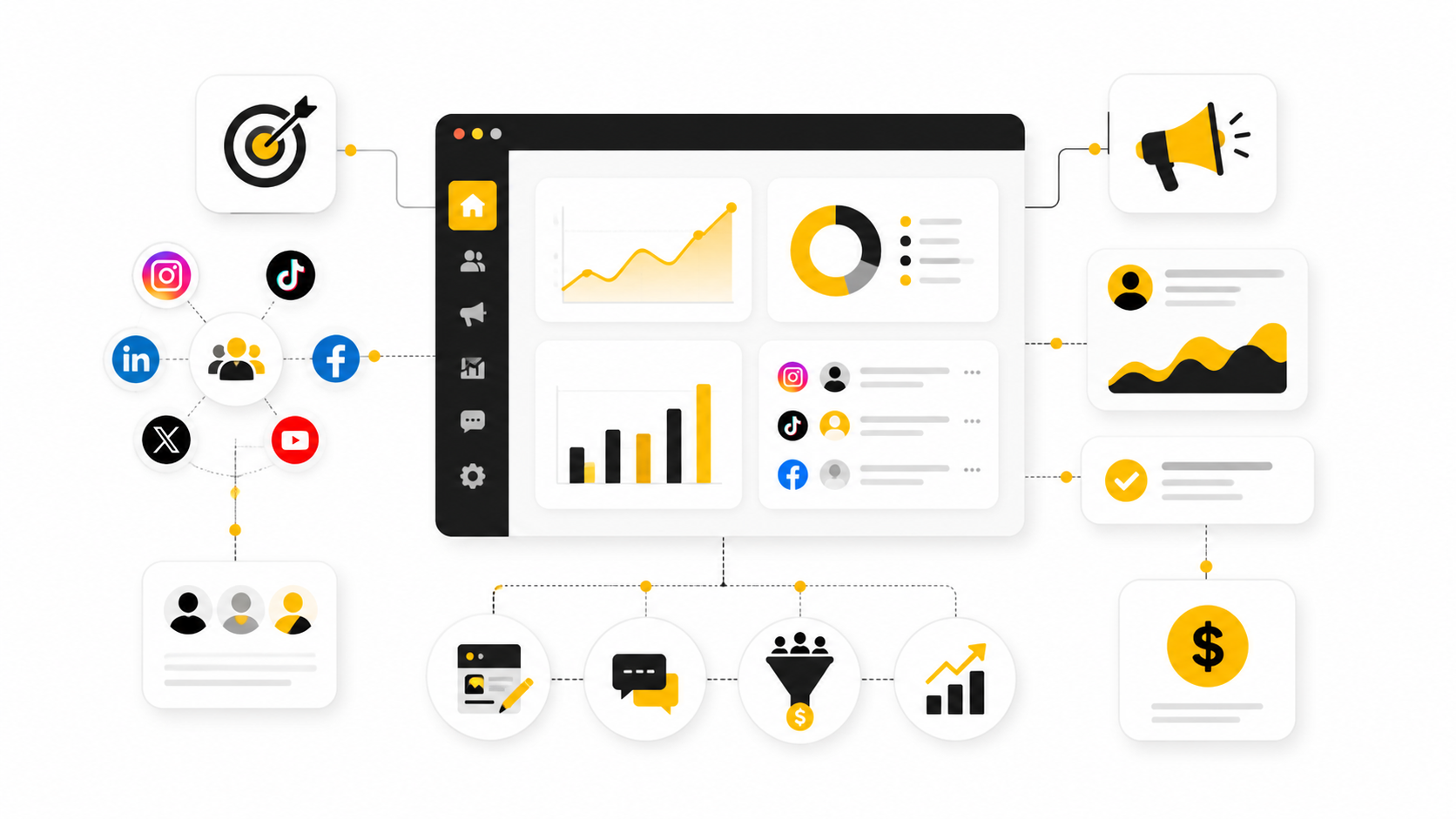
Social marketing companies are no longer just “the people who post on Instagram.” The best ones now sit closer to growth, brand strategy, content production, paid media, community, analytics, creator partnerships, and customer experience.
That shift matters because social is where attention, trust, and purchase intent increasingly overlap. Pew Research Center’s 2025 research shows YouTube and Facebook remain the most widely used online platforms in the U.S., while Instagram, TikTok, WhatsApp, and Reddit continue gaining ground. Meanwhile, social ad budgets keep rising, with EMARKETER projecting more than $121 billion in U.S. social network ad spending in 2026.
So the real question is not whether your business should take social seriously. It is whether you need a specialist partner, what that partner should actually own, and how to avoid hiring a company that sells activity instead of outcomes.
Why Social Marketing Companies Matter Now
Social platforms have become discovery engines, trust channels, support touchpoints, and sales environments at the same time. That makes social more complex than traditional posting calendars. A company that treats social as a weekly content chore will usually lose to a competitor that treats it as a full marketing system.
The challenge is that most businesses do not need “more content” in a vague sense. They need sharper positioning, better creative testing, clearer attribution, stronger community response, and a repeatable way to turn attention into pipeline or revenue. That is where the right social marketing companies can be genuinely useful.
The wrong partner, though, can make things worse. They may chase vanity metrics, recycle generic templates, or report impressions while the business still has no clearer path to leads, sales, retention, or brand preference. This is why selection matters so much.
The Social Marketing Company Framework
A strong social marketing partner should connect four things: strategy, content, distribution, and measurement. Strategy decides who you are trying to reach and why they should care. Content turns that strategy into useful, entertaining, credible, or persuasive assets.
Distribution decides how those assets reach people through organic posts, paid campaigns, creators, communities, email capture, or retargeting. Measurement closes the loop by showing what worked, what failed, and what should change next. Without that loop, social becomes guesswork with a nicer dashboard.
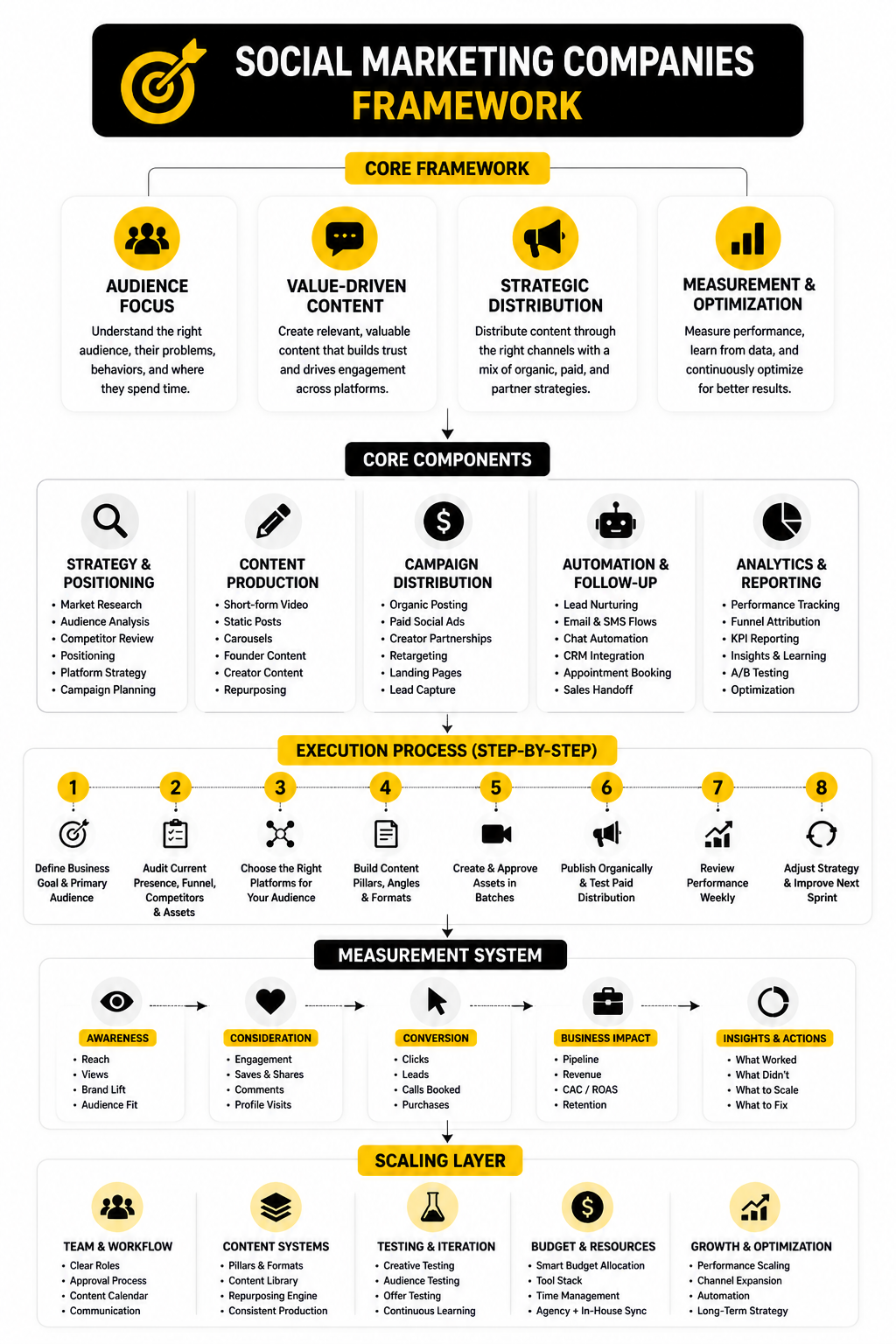
The framework also helps you spot weak agencies fast. If a company only talks about posting frequency, they may be too tactical. If they only talk about brand voice and never discuss conversion paths, they may be too soft. If they only talk about ads and ignore trust-building content, they may be too narrow.
Core Components Of A Strong Social Partner
The first component is audience insight. A serious partner should understand customer pain points, buying triggers, platform behavior, competitor positioning, and category language. This is the difference between content that looks good internally and content that actually earns attention.
The second component is creative production. Social rewards speed, clarity, and native execution, so polished brand assets alone are rarely enough. A good team can produce short-form video, carousels, founder-led posts, creator briefs, ad variations, and community-led content without turning every asset into a six-week production.
The third component is the conversion layer. This can include landing pages, messaging flows, CRM follow-up, lead magnets, booked calls, or ecommerce funnels. For example, businesses that rely heavily on DM automation may pair their agency work with tools like ManyChat, while service businesses often need a CRM and follow-up system such as GoHighLevel.
Professional Implementation Starts With Ownership
The biggest mistake businesses make is hiring social marketing companies without deciding who owns what. Strategy, creative approval, publishing, community replies, ad budget, reporting, and sales follow-up all need clear owners. Otherwise, the agency blames the client, the client blames the agency, and the campaign slowly turns into noise.
A professional setup starts with a practical operating rhythm. That usually means a strategy sprint, a content system, weekly performance review, monthly planning, and a clear escalation process for comments, complaints, and opportunities. It does not need to be complicated, but it does need to be consistent.
This is also where expectations need to become specific. “Grow our social media” is not a useful brief. “Increase qualified demo requests from LinkedIn and retarget engaged visitors through paid social over the next 90 days” gives a partner something real to build around.
Core Services Social Marketing Companies Provide
Most social marketing companies will describe their work in broad terms, but the real value usually sits inside a few specific service areas. You want to know whether they are helping you clarify the market, create better assets, distribute those assets intelligently, and learn from performance. Anything outside that should support those outcomes, not distract from them.
The first service is strategy. This includes audience research, positioning, channel selection, content pillars, competitor review, and campaign planning. It matters because social media is not one channel anymore; Pew’s 2025 platform research shows YouTube, Facebook, Instagram, TikTok, WhatsApp, and Reddit all play different roles in how adults spend attention online.
The second service is content production. That can include short-form video, static posts, carousels, founder-led content, employee-generated content, creator briefs, social ads, and repurposed long-form assets. Strong partners do not just make things look polished; they make each asset fit the platform, the buyer, and the business goal.
The third service is campaign distribution. Organic posting is only one piece of the work. Many brands also need paid social, creator partnerships, retargeting, newsletter capture, landing pages, or automated follow-up so social attention has somewhere useful to go.
Strategy And Positioning Come Before Posting
A serious social partner should start by asking sharper questions than “How often do you want to post?” They should want to know who buys, why people hesitate, what competitors are claiming, what proof already exists, and where your audience actually spends time. Without that foundation, posting more often simply creates more average content.
This is especially important because marketing budgets are under pressure. Gartner’s 2025 CMO Spend Survey found that marketing budgets remained flat at 7.7% of company revenue, while another Gartner release reported that digital channels account for 61.1% of total marketing spend. That means businesses cannot afford vague social work that only “keeps the feed active.”
Good positioning also protects the brand from sounding like everyone else. Many social marketing companies can write captions, but fewer can translate a real point of view into content people remember. That difference shows up in hooks, angles, proof, offers, comments, and even how the brand responds when someone challenges it publicly.
Content Systems Beat Random Content Ideas
Random content ideas feel productive for about two weeks. Then the team runs out of inspiration, approvals slow down, and every post starts sounding the same. A better agency builds a content system that can produce consistently without becoming generic.
That system usually includes recurring formats, message pillars, creator workflows, editing standards, approval rules, and a testing backlog. For lean teams, scheduling and publishing tools like Buffer can help keep the operating rhythm clean, especially when internal reviewers and external partners need one shared workflow. The tool is not the strategy, but the right workflow removes friction from the strategy.
The best content systems also leave room for speed. Social platforms reward timing, trends, community response, and fast creative iteration. If every post requires four departments and ten days of approvals, even a talented agency will struggle to create momentum.
Paid Social Needs A Clear Conversion Path
Paid social can amplify a strong message, but it cannot rescue a weak offer forever. Before spending heavily, social marketing companies should help clarify the audience, creative angle, landing experience, follow-up sequence, and sales handoff. This matters because the ad is only the front door.
For ecommerce brands, that conversion path may include product pages, landing pages, bundles, quizzes, and email capture. For service businesses, it may include lead forms, booked calls, SMS follow-up, pipeline tracking, and qualification. Tools such as ClickFunnels or Systeme.io can fit when the business needs simple funnel infrastructure around campaigns.
The key is discipline. A partner should not launch ten campaigns with ten different goals and call that testing. They should isolate variables, review creative performance, track downstream quality, and decide what to scale based on business impact rather than surface-level engagement.
How Professional Implementation Actually Works
Professional implementation is where the difference between an agency and a content vendor becomes obvious. A content vendor waits for instructions, makes assets, and asks what to post next. Strong social marketing companies build a repeatable process that turns goals into campaigns, campaigns into assets, and assets into measurable learning.
The process should feel structured without becoming slow. Social moves too quickly for endless planning, but it also punishes sloppy execution. The right balance is a clear sprint system: research first, build the message, produce creative, publish, measure, and improve.
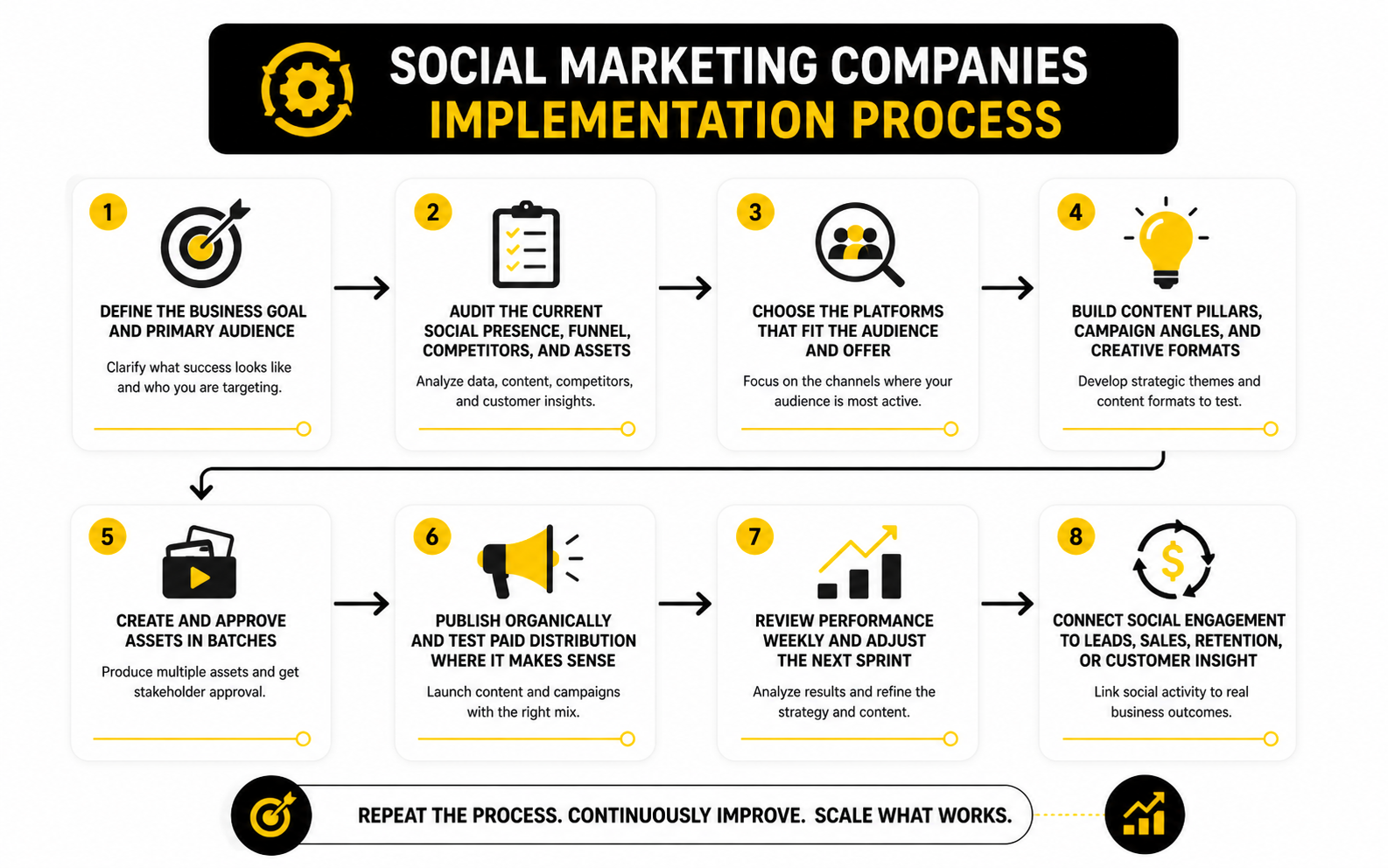
A practical implementation flow usually looks like this:
The First 30 Days Should Be About Clarity
The first month should not be a chaotic rush to post everywhere. It should be a focused setup period where the agency learns the business, identifies the real opportunities, and removes obvious friction. This is where you find out whether the partner thinks strategically or just wants to look busy.
A strong onboarding process should include access to analytics, ad accounts, brand assets, customer research, sales notes, past campaigns, and existing content. The agency should also interview internal stakeholders when needed, especially sales and customer support. Those teams often know the objections, buying triggers, and complaints that never show up in a brand guideline.
The output of this phase should be practical. You want a social strategy, campaign priorities, platform roles, content pillars, approval workflow, reporting rhythm, and a clear first sprint. If the agency comes back with a vague presentation and no operating plan, that is a problem.
The Content Sprint Turns Strategy Into Assets
Once the foundation is clear, the agency should move into content sprints. A sprint keeps production focused, usually around a specific theme, campaign, offer, audience segment, or testing question. This prevents the team from creating random posts that look active but teach you nothing.
A good sprint includes multiple creative formats, not just one big idea repeated everywhere. One campaign angle might become a short-form video, a LinkedIn post, a carousel, an email teaser, a retargeting ad, and a founder-led opinion post. The point is not to spam every channel; it is to adapt the same strategic idea to the places where it has the best chance to work.
This is also where tools can help if they support the process instead of replacing judgment. Teams managing approvals, calendars, and multi-channel publishing may use Buffer, while teams building campaign landing pages may prefer Replo for ecommerce or ClickFunnels for direct-response funnels.
Reporting Should Lead To Decisions
Reporting is not a monthly performance theater. It should help the business make better decisions about message, market, creative, channel, and budget. If a report only shows impressions, likes, and follower growth, it is incomplete.
The metrics should match the role of each campaign. Awareness content may be judged by reach, saves, shares, view-through quality, audience fit, and brand search lift where available. Conversion-focused campaigns should connect to clicks, landing page behavior, lead quality, booked calls, pipeline, revenue, or repeat purchases.
This is why implementation needs a clean measurement setup from the start. UTM links, CRM stages, lead source tracking, platform analytics, ad account data, and landing page performance should not live in separate worlds. When social marketing companies can connect those signals, they stop guessing and start improving the system.
Statistics And Data That Actually Matter
The useful numbers are the ones that change what you do next. Social marketing companies should not throw benchmarks into a deck just to make the report look serious. They should use data to decide which platforms deserve attention, which creative deserves more budget, and which campaigns should be killed before they waste another month.
Start with budget pressure. Gartner’s 2025 CMO Spend Survey found that marketing budgets stayed flat at 7.7% of company revenue, while EMARKETER projects U.S. social network ad spending will pass $121 billion in 2026. That combination tells you something important: social is getting more competitive while marketing teams are still being asked to prove efficiency.
Engagement benchmarks also need context. Rival IQ’s 2025 benchmark report found that engagement rates fell across Facebook, Instagram, TikTok, and X, which means a lower engagement rate is not automatically a strategy failure. It may reflect broader platform conditions, weaker creative, poor audience fit, or a content mix that is optimized for reach rather than interaction.
Build A Measurement System, Not A Vanity Dashboard
A good analytics setup connects platform behavior to business outcomes. That means you still track reach, views, engagement, saves, shares, comments, clicks, and follower growth, but you do not stop there. The real work is connecting those signals to landing page visits, lead quality, sales conversations, customer acquisition cost, retention, and revenue.
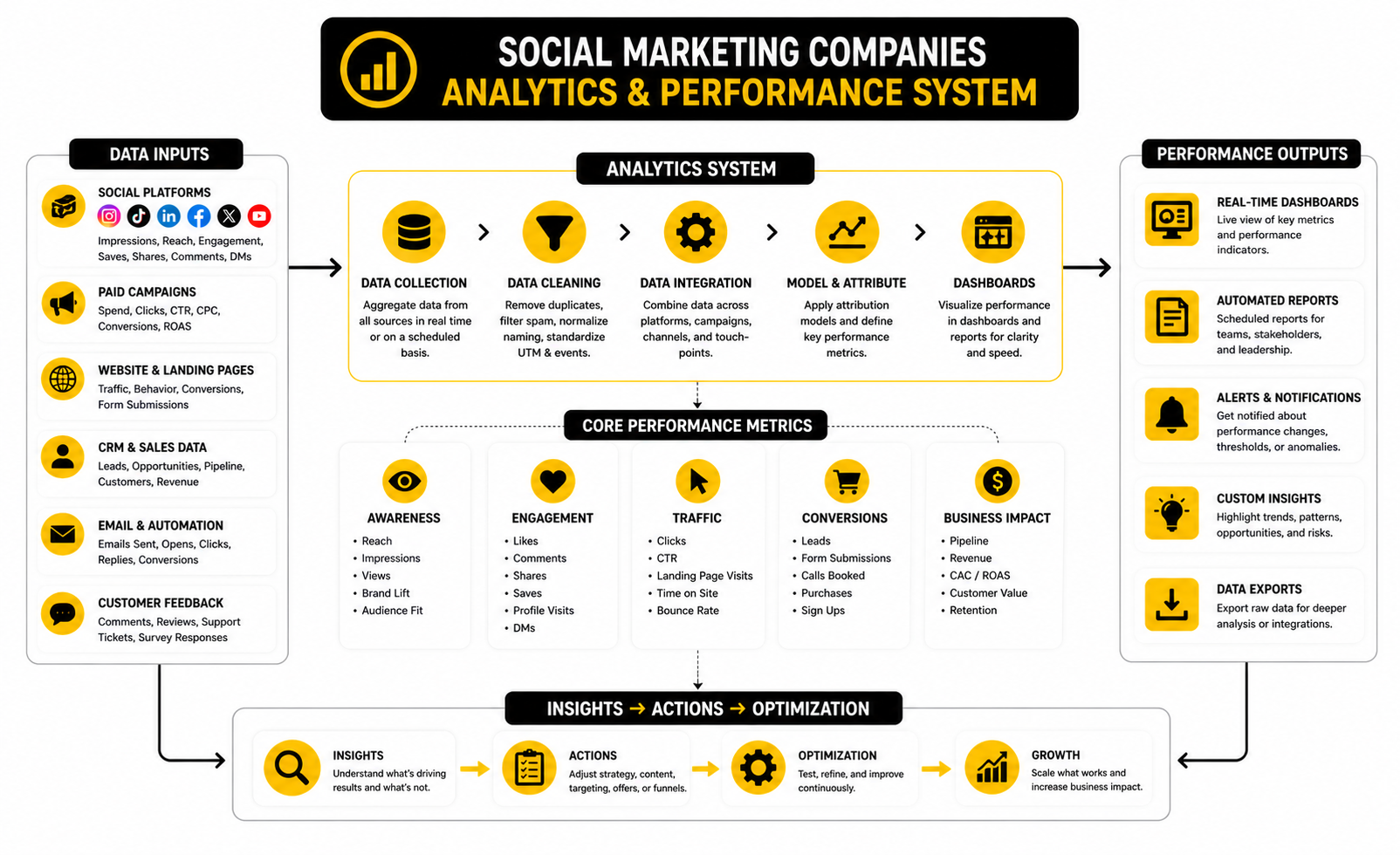
The simplest way to organize the data is by funnel role. Top-of-funnel content should prove that the right people are seeing and remembering the brand. Middle-of-funnel content should show deeper interest through saves, shares, profile visits, comments, DMs, email signups, or repeat visits. Bottom-of-funnel campaigns should be judged by cost per qualified lead, booked calls, purchases, pipeline value, and return on ad spend where attribution is reliable.
This structure protects you from bad decisions. A post with low clicks but high saves may be building trust. An ad with cheap leads may still be useless if sales marks every lead as low quality. A viral video may be a win for awareness but a distraction if it attracts the wrong audience.
Benchmarks Are Starting Points, Not Targets
Benchmarks help you avoid flying blind, but they are not your strategy. Sprout Social’s 2025 benchmark work separates daily inbound engagements from engagements per post, which is useful because overall account momentum and individual creative quality are not the same thing. A brand can have a strong account average while still producing weak campaign assets, and the reverse can also happen.
This is why social marketing companies should compare performance in three layers. First, compare against your own historical baseline. Second, compare against relevant industry benchmarks. Third, compare against the business goal attached to the campaign.
The third layer matters most. If a campaign beats an engagement benchmark but produces poor-fit leads, it is not a win. If a niche LinkedIn campaign generates fewer reactions but creates qualified conversations with buyers, it may be doing exactly what it should.
Performance Signals Should Drive Specific Actions
Each metric should have a decision attached to it. If watch time drops early, the hook or pacing needs work. If people save the content but do not click, the offer or next step may be too weak. If comments show confusion, the message is not clear enough.
If paid social gets clicks but poor conversion, the issue may be the landing page, offer, form, price, or audience quality. For ecommerce teams, a landing page builder like Replo can help test product-focused campaign pages faster. For service businesses, a CRM and follow-up system like GoHighLevel can make it easier to see whether social leads turn into booked appointments and pipeline.
Do not let an agency hide behind “brand awareness” forever. Awareness is real, but it still needs evidence: reach among the right audience, branded search movement, direct traffic changes, audience growth quality, repeat engagement, creator lift, and stronger retargeting pools. The numbers do not need to be perfect, but they do need to teach you what to do next.
How To Compare And Choose The Right Company
Choosing between social marketing companies gets much easier when you stop comparing pitch decks and start comparing operating models. A beautiful proposal does not mean the team can think, produce, test, report, and adapt under real pressure. You need to understand how the company works when the strategy meets deadlines, feedback, platform changes, and revenue expectations.
The strongest partners can explain their process without hiding behind buzzwords. They can tell you how they research an audience, how they build a content sprint, how they decide what to test, how they report performance, and how they handle a campaign that underperforms. That last part matters because every serious social program hits friction eventually.
Look for evidence of judgment, not just evidence of activity. A weak partner says, “We post five times per week.” A stronger partner says, “We are testing three message angles across two formats because your audience has two different buying objections.” That is a very different level of thinking.
Specialist Agency Or Full-Service Partner
A specialist agency is usually better when you already know the problem. If you need TikTok creative, paid social testing, creator sourcing, executive LinkedIn content, community management, or social commerce, a focused team may outperform a broad generalist. Specialists tend to move faster because they have seen the same problem many times.
A full-service partner can make more sense when social is tied to a wider growth system. If you need strategy, creative, funnels, CRM, email, paid media, landing pages, and sales follow-up working together, one coordinated team may reduce handoff problems. This is where infrastructure choices matter, because a campaign that generates leads is only useful if those leads are captured, followed up, and measured properly.
The tradeoff is control. Full-service partners can simplify execution, but they can also become expensive and harder to replace if everything sits inside their workflow. Before signing, make sure you own the accounts, data, creative files, landing pages, tracking setup, and CRM records.
When To Hire In-House Instead
Hiring social marketing companies is not always the right move. If your brand voice depends heavily on founder insight, technical expertise, customer intimacy, or daily cultural participation, an in-house person may create more authentic output than an external team. Agencies can support the system, but they cannot magically replace access to the people closest to the product and customer.
The best setup is often hybrid. Internal people provide expertise, opinions, product knowledge, and fast approvals. The external partner provides structure, production capacity, creative testing, paid media skill, analytics, and campaign discipline.
This hybrid model also reduces dependency. You are not asking an agency to invent the brand from the outside, and you are not asking your internal team to master every platform, editing style, ad format, and reporting method alone. Done well, it gives you both authenticity and execution speed.
Advanced Risks To Watch Before You Scale
The first risk is creative fatigue. A campaign may work for a short period, then performance drops because the audience has seen the same message too many times. Social marketing companies should plan for this by building creative variation into the system from the beginning, not scrambling only after results decline.
The second risk is attribution confusion. Social can create demand that does not convert immediately or cleanly inside one platform report. Someone may see a video, search the brand later, read reviews, join an email list, and convert through another channel. That does not mean social failed, but it does mean the agency needs a more mature measurement conversation than “last-click revenue only.”
The third risk is brand dilution. Chasing every trend can make the company look desperate, especially in serious B2B, healthcare, finance, legal, or premium categories. Speed matters, but fit matters more. If a trend does not support the brand, audience, or offer, skip it.
Scaling Requires Better Inputs, Not Just More Output
Scaling social does not simply mean posting more. It means improving the quality of inputs: sharper customer research, stronger proof, better offers, clearer creative briefs, faster production, cleaner reporting, and tighter follow-up. More volume with weak inputs just creates a bigger mess.
This is where advanced teams start treating social as a feedback system. Comments reveal objections. DMs reveal buying intent. Saves show what people want to revisit. Paid tests reveal which promises get attention. Sales feedback reveals whether attention is turning into real opportunity.
For businesses that use social to generate leads, the handoff after the click becomes critical. Appointment-based companies may need stronger booking flows with tools like Cal.com, while teams handling ongoing lead nurture may need email and CRM workflows through platforms such as Brevo. The agency can drive attention, but the business still needs a system that converts and retains it.
The Contract Should Protect Momentum
A good contract makes the working relationship clearer, not heavier. It should define scope, deliverables, approval timelines, reporting cadence, ad budget responsibilities, content ownership, account access, cancellation terms, and what happens if priorities change. This is not legal decoration; it prevents operational drift.
Pay attention to ownership. You should own your social accounts, ad accounts, pixels, analytics properties, landing pages, creative assets, and customer data. If a company insists on keeping everything inside its own accounts, that is a serious red flag.
Also clarify what is not included. Strategy, production, community management, paid media, creator outreach, landing pages, CRM setup, and reporting are different workloads. If they are all vaguely bundled into “social media management,” you are setting yourself up for confusion later.
Costs, Red Flags, FAQs, And Final Decision Checklist
By this point, the pattern should be clear. The best social marketing companies do not sell “posting.” They sell a working system for attention, trust, testing, conversion, and learning.
That system can include strategy, content, paid social, community, creators, landing pages, automation, reporting, and sales handoff. But the pieces only matter when they fit together. A smart company will help you decide what to build now, what to ignore, and what to improve after real data comes in.
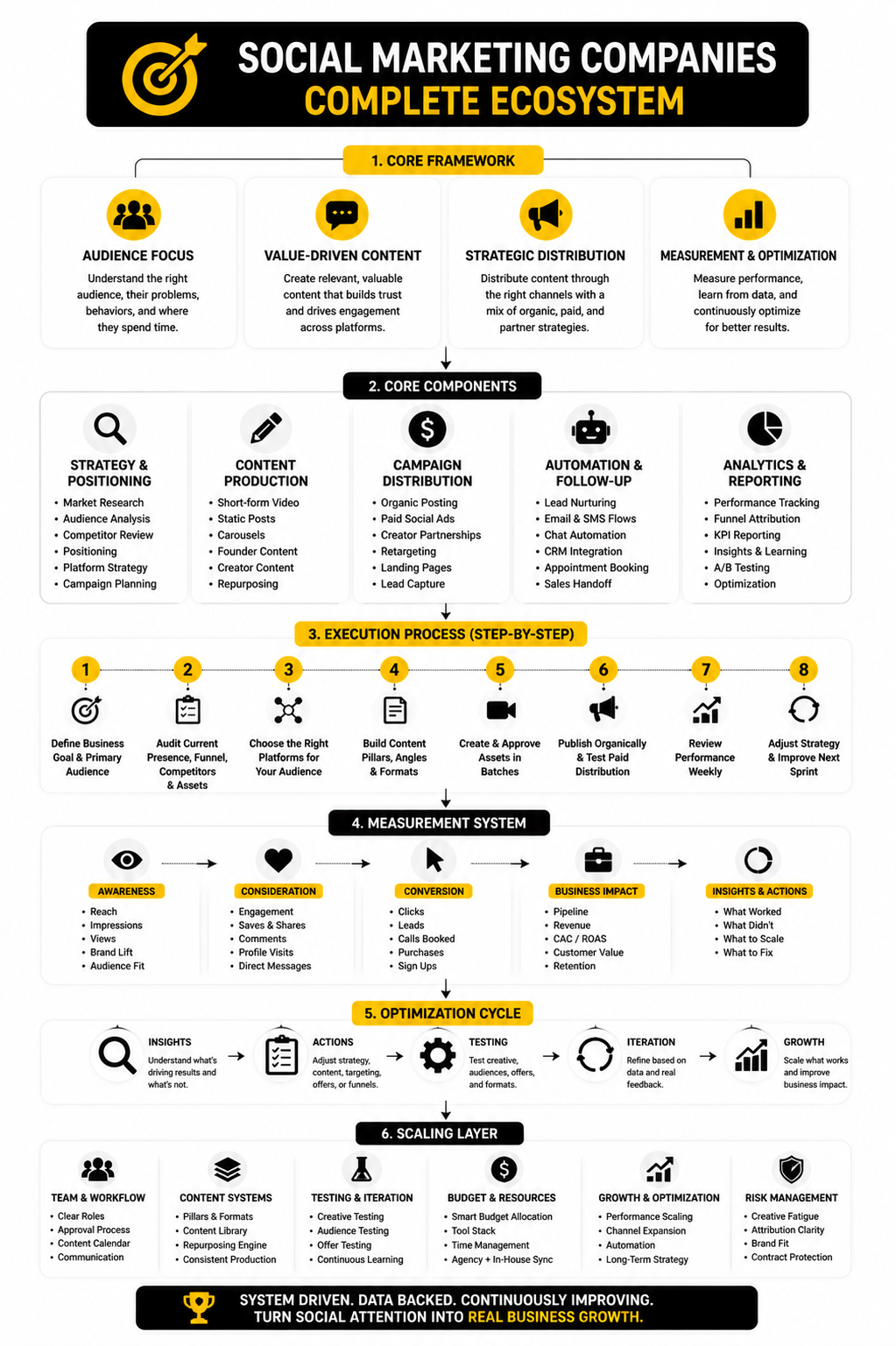
Before you hire, ask one simple question: will this partner make the whole system stronger, or will they only add more tasks? If they improve the system, they may be worth the investment. If they only add noise, keep looking.
What do social marketing companies do?
Social marketing companies help brands plan, create, publish, promote, and measure content across social platforms. Their work can include organic content, paid social ads, influencer campaigns, community management, analytics, landing pages, and lead generation. The best companies connect social activity to real business goals instead of only chasing likes and followers.
How are social marketing companies different from social media managers?
A social media manager usually handles day-to-day publishing, scheduling, engagement, and basic reporting. A social marketing company typically brings a broader team with strategy, creative, paid media, analytics, and campaign execution. That broader structure is useful when social needs to support growth, not just maintain a presence.
When should a business hire a social marketing company?
Hire one when your team lacks the time, skill, or structure to turn social into a reliable marketing channel. It makes sense when you need better strategy, faster content production, paid campaign support, or clearer measurement. It does not make sense if you have no offer, no customer insight, and no internal person available to give feedback.
How much do social marketing companies cost?
Costs vary widely based on scope, market, team seniority, content volume, paid media involvement, and whether strategy is included. A small content-focused package may be very different from a full growth system with ads, landing pages, CRM setup, and reporting. The better question is not “What is the cheapest option?” but “What business outcome is this scope designed to improve?”
What should be included in a social marketing proposal?
A strong proposal should explain the goal, audience, strategy, deliverables, timeline, approval process, reporting cadence, and responsibilities on both sides. It should also clarify what is not included. If the proposal is vague, the working relationship will probably become vague too.
How long does it take to see results?
Some signals can appear quickly, especially creative performance, engagement quality, click behavior, and early lead flow. Bigger outcomes such as lower acquisition costs, stronger brand demand, and consistent pipeline usually take longer because the system needs testing and refinement. Be careful with any company that promises instant scale without first understanding your market, offer, and conversion path.
Which platforms should social marketing companies focus on?
The right platforms depend on your audience, offer, category, and content strengths. A B2B consulting firm may care more about LinkedIn and YouTube, while an ecommerce brand may lean into TikTok, Instagram, Pinterest, or paid Meta campaigns. Do not choose platforms because they are popular; choose them because your buyers use them in ways that support the business goal.
Should social marketing companies handle paid ads too?
They can, but only if they have real paid media skill. Paid social requires creative testing, audience structure, budget control, landing page awareness, tracking, and performance analysis. If the company mainly does organic content, do not assume they can manage serious ad spend without proof.
What are the biggest red flags when hiring?
Red flags include guaranteed viral results, unclear reporting, no strategy process, weak questions during discovery, no ownership clarity, and an obsession with posting frequency over outcomes. Another major warning sign is when the company wants to control your accounts or data. You should own your assets, analytics, ad accounts, and customer information.
Should I hire a niche social marketing company?
A niche company can be a strong choice if your industry has specific regulations, buyer behavior, platform norms, or creative standards. For example, B2B SaaS, healthcare, ecommerce, local services, and professional services often need very different social approaches. A niche partner is useful when their experience creates better decisions, not when they simply use industry jargon.
Can social marketing companies help with lead generation?
Yes, but only when social is connected to a conversion system. That may include landing pages, forms, booking links, email follow-up, CRM tracking, retargeting, and sales qualification. Social creates attention and intent; the follow-up system turns that intent into revenue.
What should I ask before signing a contract?
Ask who will work on the account, how strategy is built, how content is approved, how performance is measured, and what happens if results are weak. Ask to see examples of thinking, not just examples of design. Also ask who owns the accounts, creative files, tracking setup, and data after the contract ends.
Build a stronger local presence with BAAM AI
Turn your website, Google profile, social channels, and AI visibility into one growth engine
Most businesses do not need more random marketing activity. They need a consistent presence system that helps the right people find them, trust them, and take action. BAAM AI brings strategy, local SEO, website updates, Google Maps visibility, social content, AI-search readiness, media production, and reporting into one practical monthly engine.
If you want your marketing to keep working after the campaign ends, start with a free BAAM AI presence audit. See how your business shows up today and where the fastest visibility wins are at BAAM AI.