
BAAM AI Blog
Social Marketing Ads: A Practical Framework for Turning Attention Into Revenue
Social marketing ads are no longer just a way to “boost a post.” They are a full acquisition system that sits between your content, your offer, your funnel, your CRM, and your sales process. When they work, they...
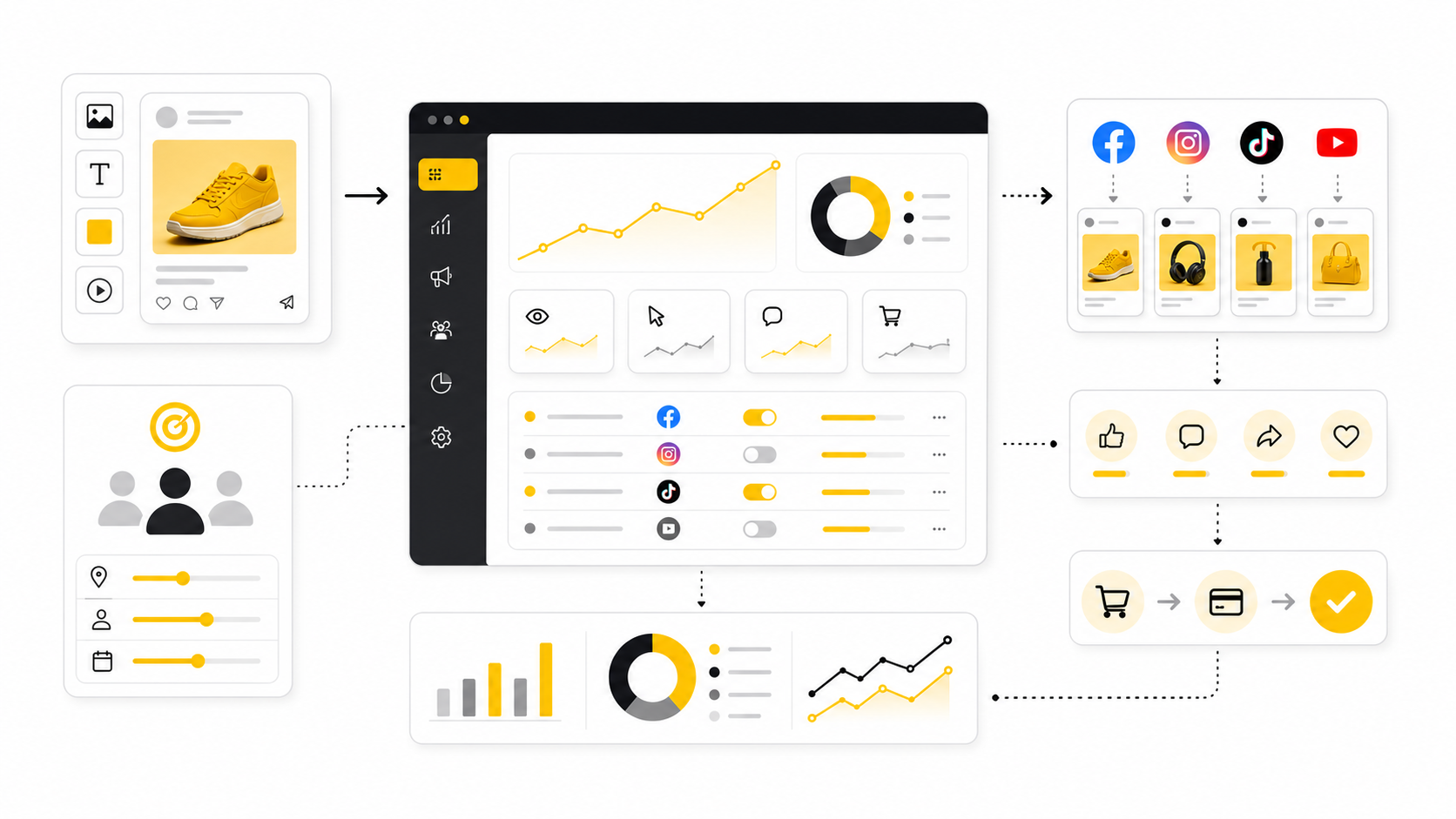
Social marketing ads are no longer just a way to “boost a post.” They are a full acquisition system that sits between your content, your offer, your funnel, your CRM, and your sales process. When they work, they create demand you can measure. When they fail, they usually fail because the business treated ads like isolated media buys instead of a connected growth system.
That distinction matters because paid social has become one of the most competitive places to buy attention. Social platforms keep changing how targeting works, creative fatigue arrives faster, and buyers expect a much smoother path from ad to purchase. At the same time, social media remains one of the largest digital advertising channels, with industry research showing continued growth in social ad spending and buyer demand for more performance accountability from every campaign.
The goal of this guide is simple: give you a practical, professional way to think about social marketing ads from strategy to execution. Not theory. Not vague “post more content” advice. A real structure you can use whether you are running ads for an ecommerce brand, a local business, a course, a SaaS product, a service offer, or an agency client.
Why Social Marketing Ads Matter Now
Social marketing ads matter because customer attention has become fragmented, expensive, and heavily influenced by what people see in their feeds. A buyer may discover a product on Instagram, compare alternatives on TikTok, click a retargeting ad on Facebook, read reviews, join an email list, and only then make a decision. That means the ad is not always the final step, but it is often the first serious touchpoint.
The strongest advertisers understand this. They do not expect one ad to do the entire job. They use paid social to create awareness, test positioning, validate offers, retarget warm audiences, and push qualified buyers into a conversion path that makes sense.
This is also why social marketing ads are useful for more than direct sales. They can support lead generation, webinar registrations, appointment bookings, app installs, content distribution, product launches, and customer reactivation. The channel is flexible, but that flexibility only helps when the campaign has a clear purpose.
Recent industry reporting from the IAB shows that buyers continue to see social media as a major growth channel within digital advertising, especially as brands shift budgets toward measurable formats and commerce-driven media. The broader digital environment is also still expanding, with DataReportal’s Digital 2025 Global Overview Report showing how deeply social platforms remain embedded in everyday internet behavior.
The Social Marketing Ads Framework
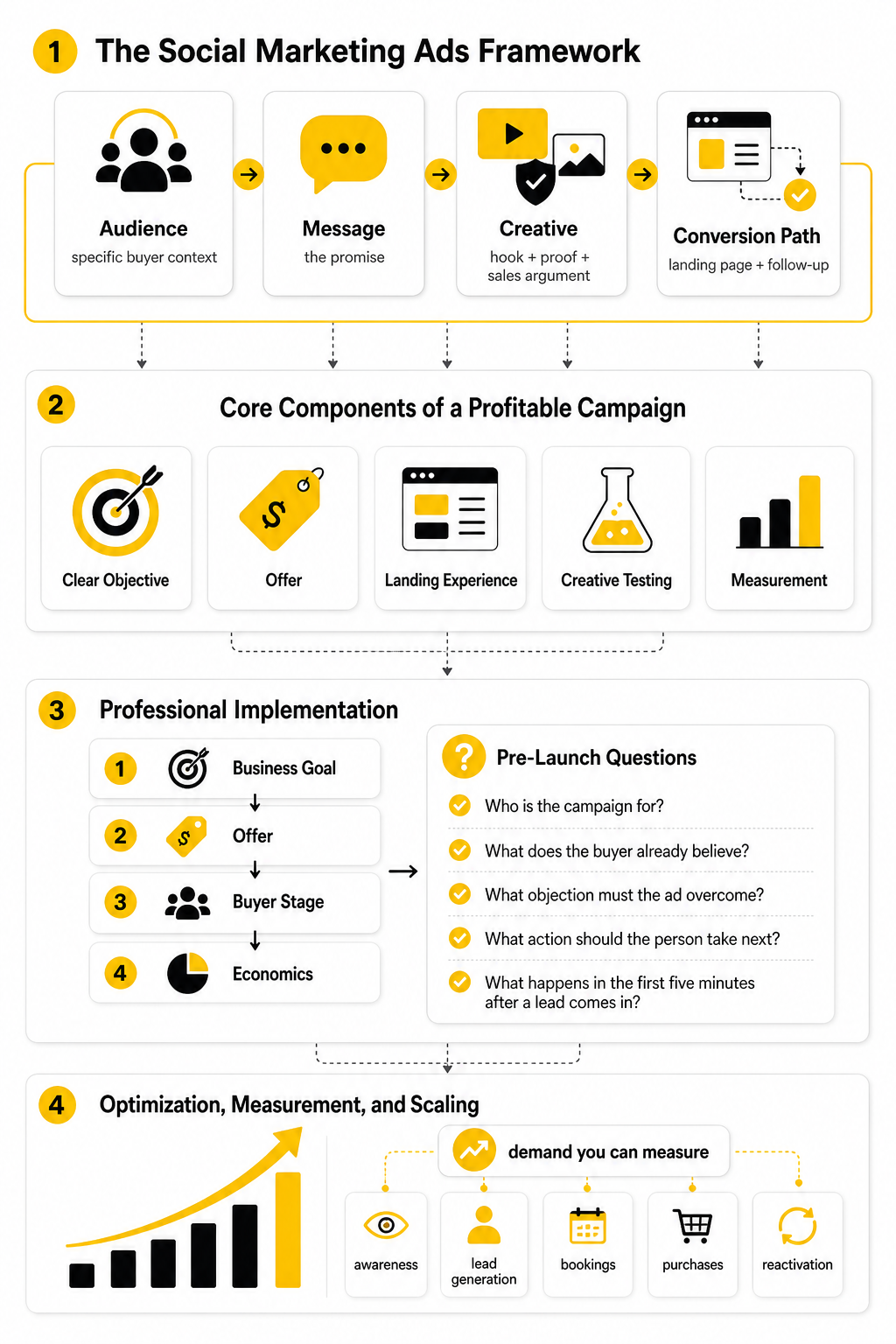
A profitable social marketing ads system has four layers: audience, message, creative, and conversion path. Most weak campaigns overfocus on one layer and ignore the others. For example, a business may obsess over targeting while sending people to a poor landing page, or it may build a beautiful funnel but run generic ads that nobody stops to watch.
The framework starts with the audience because ads are only effective when they speak to a specific buyer context. That does not mean you need hyper-narrow targeting in every campaign. It means you need to understand the buyer’s problem, awareness level, objections, desired outcome, and reason to act now.
The second layer is the message. This is the promise your ad makes in plain language. A good message connects the buyer’s current frustration with a believable next step, while a weak message sounds like every other brand in the feed.
The third layer is creative. On social platforms, creative is not decoration. It is the targeting, the hook, the proof, and the sales argument compressed into a format people can understand quickly.
The fourth layer is the conversion path. This includes your landing page, form, checkout, booking page, email follow-up, SMS follow-up, retargeting sequence, and sales process. Tools like ManyChat can fit naturally here when the campaign relies on Messenger, Instagram DM automation, or conversational lead capture. For businesses that need a broader CRM, funnel, automation, and follow-up system, GoHighLevel is often a better fit than stitching together too many separate tools.
Core Components of a Profitable Campaign
A profitable campaign begins with one clear objective. Not three. Not “brand awareness and leads and purchases and engagement.” One primary objective that matches the stage of the business and the buyer journey.
For cold traffic, that objective may be to introduce a problem and move the right people into a funnel. For warm traffic, it may be to turn recent visitors, video viewers, email subscribers, or abandoned checkout users into customers. For existing customers, it may be to increase repeat purchases, upsells, referrals, or product adoption.
The offer is the next major component. Social marketing ads rarely fix a weak offer. They usually expose it faster. If people do not understand the value, urgency, price logic, or next step, the campaign will struggle no matter how much budget you add.
The landing experience matters just as much. A click is not a win unless it leads somewhere useful. For ecommerce brands, a focused product page or custom landing page built with a tool like Replo can help align the ad message with the buying experience. For lead generation, a clean form, calendar, or funnel flow usually beats sending traffic to a generic homepage.
Creative testing is another core component. One ad is not a strategy. A serious campaign tests multiple hooks, angles, formats, proof points, and calls to action so the market can show you what actually earns attention.
Measurement is the final component. You need enough tracking to understand what is happening, but not so much reporting that you drown in dashboards. At minimum, every campaign should connect spend, clicks, leads, conversion rate, cost per result, revenue, and follow-up performance.
Professional Implementation Starts Before the Ad Account
Professional implementation starts before anyone opens Meta Ads Manager, TikTok Ads Manager, LinkedIn Campaign Manager, or any other platform. The campaign should begin with a decision about the business goal, the offer, the buyer stage, and the economics. If the numbers do not make sense on paper, they will not magically work because the ad looks good.
This is where many businesses get social marketing ads wrong. They launch because they want traffic, not because they have mapped the path from attention to revenue. Then they blame the platform when the real issue is a weak offer, unclear funnel, slow follow-up, or poor sales process.
A professional setup answers practical questions before launch. Who exactly is this campaign for? What does the buyer already believe? What objection must the ad overcome? What action should the person take next? What happens in the first five minutes after a lead comes in?
Those questions are not busywork. They are the difference between buying random clicks and building an acquisition system. That is the foundation the rest of this guide will build on.
The Social Marketing Ads Framework
The easiest way to make social marketing ads confusing is to start with the platform. Meta, TikTok, LinkedIn, Pinterest, YouTube, and X all have their own campaign types, placements, bidding options, and reporting quirks. But underneath all of that, every serious campaign still comes down to the same four-part system: audience, message, creative, and conversion path.
This framework keeps you from treating paid social like a guessing game. Instead of asking, “Which ad should we run?” you ask better questions. Who are we trying to reach, what do they need to believe, what will make them stop scrolling, and what happens after they click?
That is the work. The platform matters, but it comes second. A weak strategy does not become strong because you selected the right campaign objective, and a strong strategy can often be adapted across several platforms once the core logic is clear.
Audience Comes Before Targeting
Audience and targeting are not the same thing. Targeting is what you select inside the ad platform. Audience is the real group of people whose problems, motivations, habits, and buying triggers you understand before you ever build the campaign.
This matters because platform targeting has become more automated over time. Many campaigns now rely on broader audiences, algorithmic delivery, conversion signals, and creative variation to find buyers. That does not mean audience research is less important. It means the audience has to show up inside the message and creative, not only inside the targeting settings.
A good audience definition includes the buyer’s situation, not just their demographics. A local gym is not targeting “men and women aged 25 to 45.” It may be targeting busy professionals who feel out of shape, have tried fitness plans before, and want a realistic program that fits around work. That second version gives you better hooks, better offers, and better creative angles.
Message Turns Attention Into Interest
The message is the central idea your ad communicates. It is not the caption alone, and it is not the headline alone. It is the reason someone should care.
Strong social marketing ads usually make one clear argument. They do not try to explain everything the business does. They focus on a specific pain, desire, objection, moment, or outcome that the buyer already recognizes.
For example, a message built around “save time” is often too broad. A stronger version would explain what kind of time is being wasted, why it is frustrating, and what changes when the buyer solves it. Specificity makes the ad feel like it was written for a real person instead of a generic market segment.
The message should also match the buyer’s awareness level. Cold audiences often need context, education, or problem recognition. Warm audiences may need proof, comparison, urgency, or a reason to finish the decision they already started.
Creative Is the Delivery System
Creative is where the strategy becomes visible. It is the video, image, carousel, script, hook, headline, caption, testimonial, demonstration, or offer presentation that carries the message into the feed. In paid social, creative is not a cosmetic layer. It is one of the biggest performance levers you control.
Good creative earns attention quickly, but it should not rely on cheap tricks. A strong hook is useful only if the rest of the ad pays it off. If the opening grabs attention but the body of the ad feels disconnected, people leave just as fast as they arrived.
The best creative usually makes the buyer’s problem easier to understand. It may show the product in use, break down a misconception, compare the old way with the new way, answer an objection, or demonstrate the outcome. For ecommerce campaigns, this may mean product demos, user-generated-style videos, founder explanations, comparison ads, or offer-led creatives. For service businesses, it may mean problem breakdowns, proof-driven ads, direct-response videos, or lead magnet promotion.
Creative also needs volume. One ad concept rarely gives the algorithm enough room to learn. A practical testing batch might include different hooks, formats, lengths, proof points, and calls to action while keeping the offer consistent enough to compare results fairly.
The Conversion Path Completes the Campaign
The conversion path is everything that happens after someone engages with the ad. This is where many campaigns lose money. The ad does its job, the person clicks, and then the landing page, form, checkout, booking flow, or follow-up process creates friction.
A good conversion path feels like a natural next step from the ad. If the ad promises a free guide, the landing page should focus on that guide, not the entire company history. If the ad promotes a consultation, the page should make the value of that consultation clear before asking someone to book.
This is where tools can help, but only when they support the strategy. A funnel builder like ClickFunnels can make sense when the campaign needs dedicated landing pages, sales pages, order forms, or upsell flows. A simpler all-in-one option like Systeme.io may fit smaller businesses that want pages, email, and basic automation in one place.
The important point is not the tool. The important point is continuity. The ad, page, offer, and follow-up should feel like one connected experience.
Follow-Up Is Part of Paid Social
Social marketing ads often get judged too early. A lead comes in, does not buy immediately, and the campaign gets labeled as unprofitable. But in many businesses, the real issue is not the ad. It is the follow-up.
If you are generating leads, speed matters. People forget quickly, compare options quickly, and lose motivation quickly. A business that waits a day to respond is competing against companies that reply in minutes with email, SMS, chat, or a direct call.
This is why paid social and CRM automation belong together. For agencies, local businesses, coaches, consultants, and service providers, GoHighLevel can support the handoff from ad click to lead capture, pipeline management, follow-up, booking, and sales activity. For campaigns built around Instagram or Messenger conversations, ManyChat can help turn comments, DMs, and chat flows into structured lead capture.
Follow-up should not feel robotic, though. The goal is not to blast people with generic messages. The goal is to continue the conversation they already started when they clicked, replied, booked, downloaded, or asked for more information.
Core Components of a Profitable Campaign
Once the framework is clear, the campaign needs real operating parts. This is where strategy becomes execution. You need an objective, an offer, a creative testing plan, a conversion mechanism, and a measurement system that tells you what is actually happening.
A profitable campaign does not require all of these pieces to be complex. In fact, simpler is often better when the offer is clear and the numbers work. But every piece needs to be intentional.
The mistake is treating campaign setup like administration. It is not. The setup determines what the platform optimizes for, what the buyer sees, what action they take, and how the business evaluates success.
The Campaign Objective Must Match the Business Goal
The campaign objective should be chosen based on the business outcome, not vanity metrics. Engagement can be useful, but only if engagement is the actual strategic goal. Traffic can be useful, but cheap clicks are not automatically valuable.
If the goal is purchases, the campaign should usually optimize toward purchases once the account has enough signal. If the goal is qualified appointments, the system should optimize toward leads or booked calls, then measure the quality of those calls. If the goal is demand creation, the campaign may use video views, reach, or engagement as part of a broader sequence, but those metrics still need a business reason.
This sounds obvious, but it is a common source of wasted budget. Businesses choose cheaper objectives because the early numbers look good. Then they realize the campaign trained the platform to find people who click, watch, or like instead of people who buy.
The Offer Has to Carry Weight
The offer is the reason someone takes action now. It can be a product, discount, bundle, free trial, consultation, lead magnet, webinar, demo, audit, quote, sample, or limited-time promotion. The format matters less than the perceived value.
A weak offer creates hesitation. A strong offer reduces hesitation because the buyer understands what they get, why it matters, and why the next step is worth taking. That does not mean every offer needs a discount. Sometimes the strongest offer is clarity, speed, access, convenience, proof, or risk reversal.
For social marketing ads, the offer should be easy to understand quickly. People are not reading your ad in a quiet room with full concentration. They are scrolling between messages, videos, notifications, and other brands competing for the same moment of attention.
The Landing Page Should Match the Ad
Message match is one of the simplest ways to improve campaign performance. If the ad talks about a specific problem, the landing page should open with that same problem. If the ad promotes a specific product, the click should not send people to a broad category page unless there is a clear reason.
A strong landing page keeps the buyer moving. It explains the promise, builds trust, answers the next objection, and makes the action obvious. It does not make people hunt for the reason they clicked.
For ecommerce brands that need campaign-specific product pages or landing pages, Replo can be useful because the page can be built around the ad angle instead of forcing every visitor into the same default template. For service businesses, the same principle applies even if the page is simpler. The page should continue the argument the ad started.
Measurement Should Separate Signals From Noise
Paid social reporting can make campaigns look better or worse than they really are. Attribution windows, delayed conversions, platform modeling, tracking loss, and cross-device behavior all affect what you see. That is why measurement needs to be practical, not blindly dependent on one dashboard.
Start with the numbers that matter most. Spend, cost per result, conversion rate, lead quality, sales rate, revenue, gross margin, and payback period usually tell you more than likes or impressions alone. For lead generation, the most important number may not be cost per lead. It may be cost per qualified opportunity or cost per closed customer.
This is where many advertisers get uncomfortable, but it is necessary. A campaign with expensive leads can be profitable if those leads close well. A campaign with cheap leads can be a disaster if the sales team wastes time chasing people who were never serious.
Professional Implementation: From Strategy to Launch
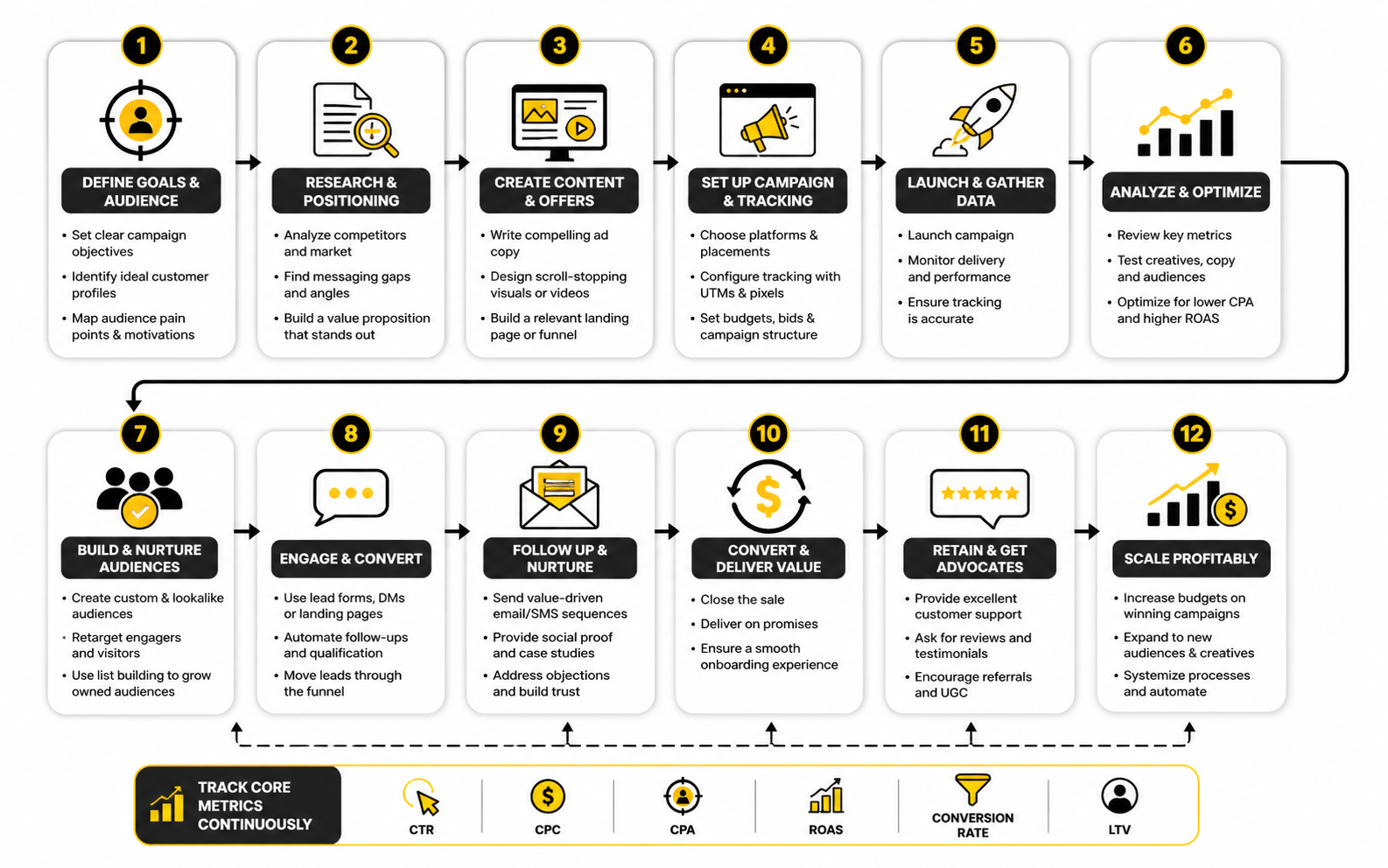
Professional implementation is where social marketing ads become more than a good idea. This is the point where you turn the framework into a campaign that can actually be built, launched, measured, and improved. The goal is not to make the setup complicated. The goal is to remove guesswork before money starts leaving the ad account.
The process should feel controlled. You define the offer, map the buyer journey, prepare the creative, build the destination, set up tracking, launch with a testing plan, and review the numbers against the business goal. When each step has a purpose, campaign management becomes calmer and more profitable.
Skipping this process is expensive. Paid social can give you feedback quickly, but fast feedback is only useful when you know what you are testing. Otherwise, you are just reacting to random numbers.
Step 1: Define the Campaign Goal
Start with the business result, not the ad platform objective. A campaign built to sell a product needs a different structure from a campaign built to generate booked appointments. A campaign built to warm up a cold audience needs a different measurement approach from one built to retarget people who already visited a pricing page.
The goal should be specific enough to guide every decision that follows. “Get more leads” is too loose. “Generate qualified consultation requests for a high-ticket service” is much better because it affects the offer, landing page, form questions, follow-up, and sales review process.
This is also where you decide what success looks like. For ecommerce, that might be purchase volume, profit, blended return, or first-order acquisition cost. For service businesses, it may be booked calls, show-up rate, close rate, and cost per customer.
Step 2: Choose the Right Offer
The offer is the bridge between the ad and the buyer’s next action. If the offer is unclear, the campaign has to work too hard. If the offer is strong, the ad can be simple and still perform.
For cold audiences, the offer may need to reduce risk or lower the commitment level. That could mean a quiz, guide, audit, free trial, sample, webinar, estimate, or entry-level product. For warmer audiences, you can usually be more direct because the person already has some context.
The right offer depends on the buyer’s awareness. Someone who knows they need a CRM can be sent directly to a platform like GoHighLevel if the campaign explains why it fits their use case. Someone who only knows their follow-up is messy may need a softer lead magnet, demo, or workflow breakdown before they are ready to compare tools.
Step 3: Map the Buyer Journey
Before building ads, map what happens from the first impression to the final conversion. This does not need to be a complex diagram. It just needs to make the path obvious.
A simple journey might look like this:
This journey protects you from building disconnected assets. The video, page, form, emails, retargeting ads, and sales process all support the same argument. That is how social marketing ads become a system instead of a collection of random campaigns.
Step 4: Build the Landing Experience
The landing experience should continue the exact promise made in the ad. If the ad says the buyer can get a free checklist, the page should focus on the checklist. If the ad promotes a product bundle, the page should make that bundle clear immediately.
A strong page usually includes a clear headline, a short explanation of the outcome, proof, objection handling, and one primary action. It should not make people work to understand what is being offered. The more mental effort the page creates, the more clicks you waste.
For campaign-specific ecommerce pages, Replo can help create landing pages that match a specific ad angle instead of relying only on a standard product template. For funnels, lead capture, order forms, and upsell flows, ClickFunnels can be useful when the campaign needs a more controlled conversion path. The tool should serve the campaign strategy, not replace it.
Step 5: Prepare Creative in Testing Batches
Do not launch one ad and call it a campaign. Launch a controlled batch of creative ideas so you can learn what the market responds to. The batch should be structured enough to compare results without turning the test into chaos.
A practical first batch might include three to five angles. One angle could focus on the pain point. Another could demonstrate the product or process. Another could handle an objection, show proof, compare alternatives, or lead with the offer.
Each creative should have a reason for existing. You are not testing random designs. You are testing specific beliefs, objections, hooks, and formats that could move the buyer closer to action.
Step 6: Set Up Tracking Before Launch
Tracking should be ready before the first impression is bought. That means pixels, conversion events, UTMs, CRM fields, form tracking, checkout tracking, and offline conversion imports where relevant. You do not need a perfect attribution setup, but you do need enough visibility to make decisions.
The biggest mistake is waiting until performance looks confusing and then trying to fix measurement afterward. By then, the campaign has already spent money without clean signals. Worse, the platform may have optimized around incomplete or low-quality events.
For lead generation, tracking should not stop at the form submission. You also need to know which leads became qualified, which booked, which showed up, and which closed. That is where a CRM-centered setup such as GoHighLevel can be useful because the campaign can be judged by pipeline movement, not just lead volume.
Step 7: Launch With a Clear Testing Plan
A good launch is not a guessing sprint. It is a controlled test with a budget, time frame, objective, and decision rules. You should know what you are willing to spend before making changes and what numbers will trigger the next move.
Avoid making changes too early unless something is obviously broken. Paid social platforms need enough data to stabilize, and early results can be noisy. If you keep editing budgets, audiences, creatives, and landing pages at the same time, you will not know what caused the change.
The launch plan should also protect the campaign from emotional decisions. One bad day does not always mean the campaign failed. One good day does not always mean it is ready to scale.
Step 8: Connect Follow-Up to the Campaign
Follow-up is part of implementation, not something to “add later.” If the campaign generates leads, the first message, first call attempt, first email, and first reminder should already be planned before launch. Speed and relevance matter because attention fades fast.
For campaigns built around Instagram DMs, Messenger, or comment-to-message flows, ManyChat can help turn social engagement into structured conversations. This is especially useful when the ad invites people to comment, ask a question, claim a resource, or start a guided flow.
Email follow-up also matters. A platform like Brevo can fit campaigns where the next step depends on nurturing, reminders, newsletters, or segmented email communication. The key is to make the follow-up feel like a continuation of the ad, not a generic autoresponder dumped into someone’s inbox.
Step 9: Review Early Results by Funnel Stage
Early campaign review should separate the funnel into stages. Do people stop and engage with the creative? Do they click? Do they convert on the page? Do leads respond? Do sales conversations move forward?
This breakdown makes diagnosis much easier. If people are not clicking, the issue may be the creative, hook, audience, or offer presentation. If people click but do not convert, the issue may be the page, form, price, trust, or message match. If leads convert but do not buy, the issue may be qualification, follow-up, sales process, or offer fit.
Do not let one metric explain the whole campaign. Social marketing ads are connected systems. You improve them by finding the weak link, not by blaming the entire channel.
Step 10: Document What You Learn
Every launch should produce learning, even if it does not produce profit immediately. Document which hooks worked, which objections showed up, which landing page sections mattered, which audiences responded, and which follow-up steps created movement. This becomes the starting point for the next test.
Without documentation, teams repeat the same experiments and call it optimization. That wastes time and budget. A simple campaign log can prevent this by recording what changed, when it changed, why it changed, and what happened afterward.
This habit becomes more valuable as campaigns scale. The bigger the budget, the more expensive sloppy learning becomes. Clear documentation turns paid social from a series of guesses into a compounding growth process.
Optimization, Measurement, and Scaling
Optimization is not about touching the campaign every time a number moves. That is how advertisers break tests before they learn anything. Real optimization means reading the campaign like a system and improving the weakest part first.
With social marketing ads, the data can look messy because the buyer journey is messy. Someone may see an ad on Instagram, visit the website later from Google, watch a retargeting video, join an email list, and buy after a reminder. If you only look at one platform dashboard, you can miss the real path.
The job is to build a measurement system that shows both platform performance and business performance. Platform data tells you how the ad is behaving. Business data tells you whether the campaign is actually making money.
Statistics and Data
Social advertising is too big to treat casually. The IAB’s 2025 internet advertising revenue reporting showed U.S. digital ad revenue reaching nearly $294.6 billion, with social advertising reported at roughly $117.7 billion and about 40% of total digital ad revenue in coverage of the IAB full-year 2025 report. That matters because it tells you competition is not going away. More budget is flowing into the channel because brands still see paid social as a serious growth lever.
Meta’s own financial reporting also shows why measurement has become more important. In its full-year 2025 results, Meta reported that ad impressions across its Family of Apps increased 12% year over year, while average price per ad increased 9% year over year in the Meta Q4 and full-year 2025 results. That combination is important. It means advertisers are dealing with both massive reach and rising auction pressure, so weak creative and weak conversion paths get punished faster.
The bigger point is simple: benchmark numbers are useful, but they are not instructions. A social marketing ads campaign should not copy an average CPC, CPM, CTR, or ROAS target without understanding the offer, margin, audience, funnel, and sales cycle. A campaign selling a $29 product and a campaign selling a $5,000 service should not be judged the same way.
Benchmarks Are Starting Points, Not Targets
Benchmarks help you spot whether something is obviously broken. If your click-through rate is extremely low compared with typical performance in your market, the creative or offer may not be earning attention. If your landing page conversion rate is weak, the issue may be message match, trust, form friction, price resistance, or a confusing next step.
But benchmarks can also mislead you. A cheap CPM does not matter if the traffic is low quality. A high CTR does not matter if people click out of curiosity and never convert. A low cost per lead does not matter if the leads are unqualified.
Use benchmarks as diagnostic clues, not final verdicts. The real question is not, “Is this metric good?” The real question is, “What does this metric tell us to improve next?”
The Metrics That Actually Matter
The most useful metrics depend on the campaign goal. For ecommerce, you usually care about cost per purchase, conversion rate, average order value, gross margin, contribution margin, payback period, and returning customer behavior. For lead generation, you care about cost per lead, lead quality, booked-call rate, show-up rate, close rate, cost per customer, and customer lifetime value.
Top-of-funnel metrics still matter, but they should be interpreted carefully. CPM shows how expensive it is to reach people. CTR shows whether the creative and message create enough interest to earn a click. CPC shows how efficiently that interest turns into traffic.
Middle and bottom-of-funnel metrics reveal whether the campaign can become profitable. Landing page conversion rate shows whether the click had somewhere useful to go. Sales conversion rate shows whether the offer and follow-up can turn interest into revenue. Revenue per lead or revenue per visitor shows whether the campaign has room to scale.
The Analytics System Should Follow the Funnel
A clean analytics system follows the buyer from impression to revenue. You do not need a giant dashboard to do this. You need a simple view that connects each stage of the funnel and shows where people drop off.
A practical measurement flow looks like this:
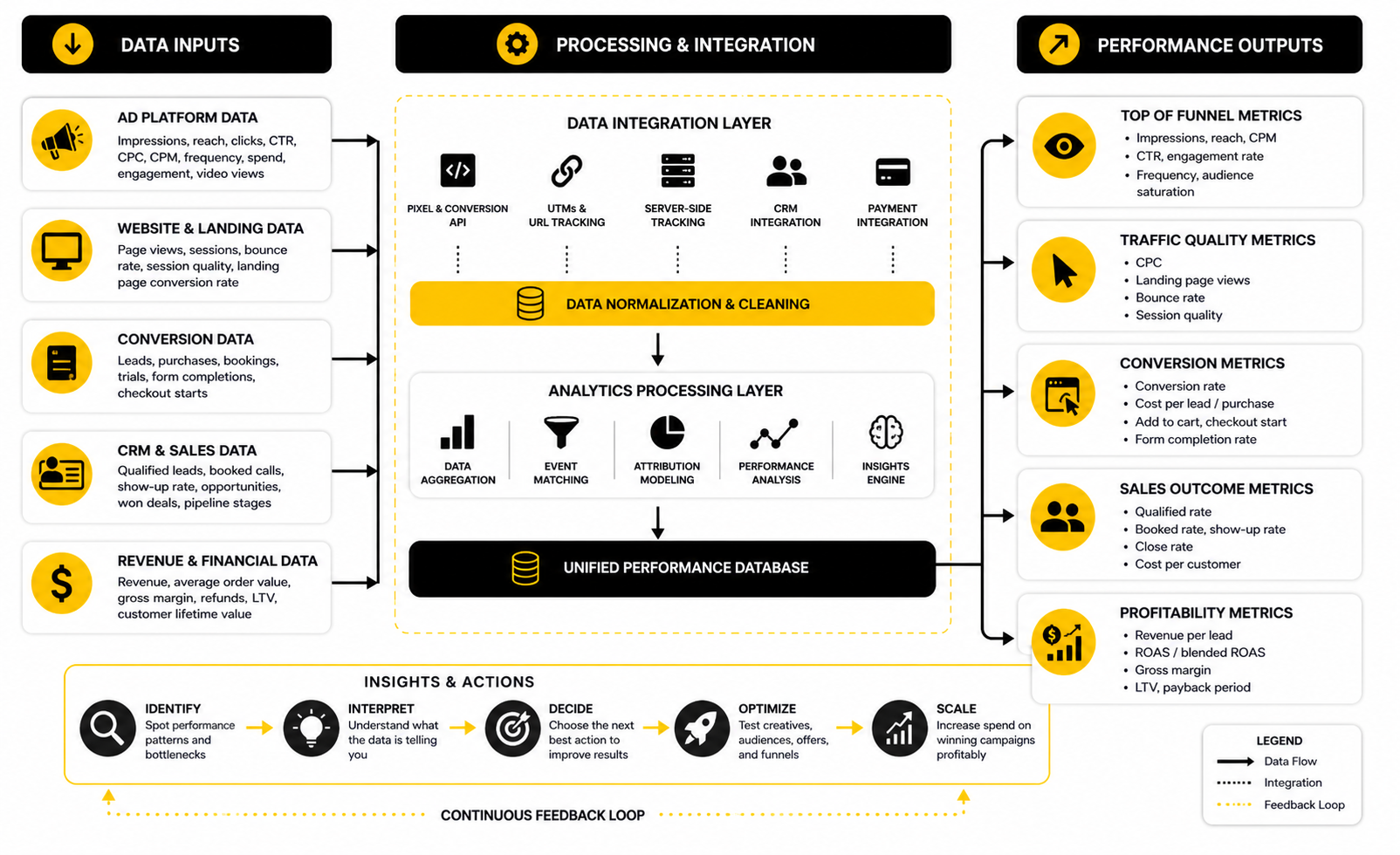
This structure stops you from making lazy decisions. If impressions are expensive but conversion is excellent, the campaign may still be profitable. If clicks are cheap but sales are weak, the campaign may be attracting the wrong people or making the wrong promise.
This is also why CRM data matters. If your ad platform shows 200 leads but your sales team says only 12 were qualified, the campaign is not as healthy as the platform dashboard suggests. A CRM such as GoHighLevel can help connect lead capture, pipeline stages, follow-up, appointments, and sales outcomes so you are not optimizing only for form fills.
Attribution Needs Practical Judgment
Attribution is useful, but it is not perfect. Platform dashboards, analytics tools, CRM data, and payment processors can all report different numbers because they measure different events in different ways. This is normal, especially when buyers move across devices, browsers, apps, and channels.
The mistake is pretending one number tells the whole truth. Meta may claim conversions based on its attribution model, while your analytics platform may undercount because of cookie loss or cross-device behavior. Your payment processor may show revenue accurately, but it will not always explain which touchpoint created demand.
A practical approach is to compare multiple views. Look at platform-reported conversions, site analytics, CRM outcomes, payment data, and blended business performance. If all of them point in the same direction, you can move with more confidence.
Frequency Tells You When the Audience Is Getting Tired
Frequency shows how often the average person in your selected audience sees the ad. It is one of the fastest ways to spot fatigue, especially in smaller audiences or retargeting campaigns. When frequency climbs and performance drops, the market may be telling you the creative has done its job and needs replacement.
High frequency is not always bad. Retargeting campaigns often need repeated exposure because people need reminders before they act. But high frequency with falling CTR, rising CPM, and weaker conversion is a warning sign.
The action is not always to increase the budget or change the audience. Sometimes the right move is to refresh creative, rotate angles, adjust exclusions, widen the audience, or move people into a different stage of the funnel. The metric matters only because it tells you what action to consider.
Creative Data Should Guide New Angles
Creative reporting should answer one question: what is the market responding to? Do people react to pain-point hooks, proof-led hooks, comparison angles, product demonstrations, founder-led videos, testimonials, or offer-first ads? This is where social marketing ads become a feedback machine.
Do not only look at the winning ad. Look for patterns across winners and losers. If three different ads with the same objection-handling angle outperform everything else, that tells you the objection is important. If product demo ads get clicks but not purchases, people may be curious but not convinced.
Use creative data to write the next batch. The goal is not to keep squeezing one winning ad until it dies. The goal is to understand why it worked and turn that learning into new variations.
Lead Quality Beats Lead Volume
Lead generation campaigns are especially vulnerable to bad measurement. A campaign can look amazing on cost per lead while quietly destroying the sales team’s time. Cheap leads are not cheap if they never answer, never qualify, never show up, or never buy.
That is why every lead campaign should measure quality after the form submission. At minimum, track qualified rate, booked rate, show-up rate, close rate, and revenue per lead. These numbers tell you whether the campaign is finding buyers or just finding people willing to fill out a form.
Form design can help here. A form built with a tool like Fillout can qualify people before they enter the pipeline by asking the right questions without making the experience feel heavy. The goal is not to create friction for no reason. The goal is to protect the sales process from leads that were never a real fit.
Scaling Means Increasing What Already Works
Scaling is not just raising the budget. Scaling means increasing spend while keeping the economics under control. If the campaign only works at a tiny budget, it may not have enough audience depth, creative depth, offer strength, or operational support to scale.
There are several ways to scale social marketing ads. You can increase budgets gradually, expand audiences, launch new creative angles, open new placements, test new offers, build retargeting layers, or improve the conversion path so each click becomes more valuable. The safest path usually starts with the bottleneck.
If the campaign has strong conversion but not enough volume, you may need more creative and broader reach. If volume is strong but profit is weak, you may need better landing pages, higher average order value, stronger follow-up, or a better qualification process. Scaling works when the system improves, not when the budget gets bigger and everyone hopes.
Profit Is the Final Measurement Layer
The final measurement layer is profit. Not likes. Not clicks. Not leads. Profit.
For ecommerce, that means looking beyond platform ROAS and understanding margin, shipping, returns, discounts, payment fees, and repeat purchase behavior. For service businesses, it means understanding sales capacity, fulfillment cost, close rate, churn, and customer lifetime value. A campaign that looks expensive on day one may still be profitable if it brings in customers who buy again or stay for a long time.
This is where blended numbers matter. Platform dashboards help you optimize campaigns, but business-level reporting tells you whether marketing is moving the company forward. If social marketing ads are increasing total revenue, improving acquisition efficiency, and bringing in customers the business can serve profitably, the system is doing its job.
Advanced Strategy: Tradeoffs That Decide Whether Campaigns Scale
Once the basics are working, social marketing ads become a game of tradeoffs. You are no longer asking whether ads can generate clicks or leads. You are asking how far the system can scale before quality drops, costs rise, creative burns out, or the sales process gets overloaded.
This is where many campaigns break. The first profitable test creates confidence, then the business increases budget too aggressively, broadens too quickly, or launches too many disconnected ideas at once. Growth exposes weak points that small tests can hide.
The advanced stage requires discipline. You need to know which parts of the campaign are flexible, which parts are fragile, and which numbers must stay protected as spend increases.
Automation Works Best When the Inputs Are Strong
Modern ad platforms are built around automation. The algorithms can test placements, allocate budget, find pockets of buyers, and learn from conversion signals faster than a human media buyer can manually adjust every setting. That is useful, but it does not remove the need for strategy.
Automation performs best when you give it strong inputs. That means clear conversion events, enough creative variation, clean tracking, a real offer, and a conversion path that does not waste traffic. If those inputs are weak, automation simply helps you spend money faster.
The practical takeaway is simple. Do not fight automation just because you want control, but do not worship it either. Use automation to distribute and learn, while your team controls the offer, positioning, creative strategy, and business economics.
Broad Targeting Requires Sharper Creative
As targeting gets broader, creative has to do more of the filtering. The ad itself needs to attract the right people and repel the wrong ones. That is why vague creative becomes expensive in broad campaigns.
A broad audience can work well when the creative speaks to a specific situation. For example, an ad does not need to target only agency owners if the first three seconds clearly say it is for agency owners struggling with client follow-up. The platform may handle delivery, but the creative handles relevance.
This is why strong hooks are not just attention devices. They are qualification devices. A good hook tells the right buyer, “This is for you,” before the campaign spends more money trying to figure it out.
Creative Fatigue Is a Scaling Problem, Not Just a Creative Problem
Creative fatigue happens when the market has seen the same message too many times. Performance drops, costs rise, and the ad that used to carry the account starts losing its edge. At small budgets, this can happen slowly. At higher budgets, it can happen fast.
The solution is not to panic and replace everything. The solution is to build a creative pipeline before fatigue becomes an emergency. You need new angles, new formats, new hooks, new proof points, and new offer presentations ready before the current winners collapse.
This does not mean every new ad needs to be completely different. Some of the best iterations come from changing one meaningful variable: the opening line, the visual demonstration, the proof sequence, the objection being handled, or the call to action. Scaling rewards teams that can produce consistent learning, not just occasional creative hits.
Retargeting Should Move People Forward
Retargeting is often wasted because it repeats the same message to people who already heard it. If someone clicked an ad and visited the page, they do not always need the same hook again. They may need proof, urgency, comparison, reassurance, or a clearer reason to act.
A strong retargeting sequence should match the buyer’s behavior. Website visitors may need a reminder of the offer. Checkout abandoners may need risk reversal or a stronger incentive. Video viewers may need the next layer of education. Leads who did not book may need a simpler scheduling path.
This is where tools like ManyChat can support conversational retargeting when the campaign uses comments, DMs, or Messenger flows. Retargeting does not have to mean only showing another ad. It can also mean continuing the conversation in the channel where the buyer already engaged.
The Sales Process Can Limit Ad Performance
A campaign can generate good leads and still fail because the sales process is not ready. Slow response times, weak qualification, poor appointment reminders, unclear handoffs, and inconsistent follow-up can destroy the value created by the ads. This is especially common in local services, agencies, coaching, consulting, and high-ticket offers.
If a business wants to scale lead generation, it has to measure sales behavior with the same seriousness as ad performance. How quickly are leads contacted? How many book? How many show up? How many are qualified? How many close? Where do the best customers come from?
A CRM and automation platform like GoHighLevel can help here because it connects lead capture, pipelines, reminders, follow-up, booking, and reporting. But the system still needs human discipline. Software can support the process, but it cannot fix a team that does not follow up properly.
Offer Scaling Is Different From Budget Scaling
Raising the budget is only one way to scale. Sometimes the better move is improving the offer so every click becomes more valuable. That may mean increasing average order value, adding a bundle, improving the guarantee, creating a stronger entry offer, or building a better upsell path.
For ecommerce, offer scaling might come from bundles, post-purchase upsells, subscriptions, free shipping thresholds, or better product education. For service businesses, it might come from a clearer diagnostic offer, a better consultation promise, a faster booking flow, or a more specific lead magnet. For software, it might come from a trial, demo, comparison page, onboarding sequence, or use-case-specific funnel.
This is why funnel structure matters. A tool like ClickFunnels can be useful when the business needs a controlled path from ad to offer to upsell. A leaner platform like Systeme.io can make more sense when the priority is getting a simple funnel, email sequence, and offer live without overbuilding.
Platform Diversification Should Come After Message Clarity
It is tempting to expand to every platform once one channel works. That can be smart, but only when you know what is actually working. If the winning ingredient is the offer, it may transfer well. If the winning ingredient is a platform-specific format, the transfer may be weaker.
Before expanding, identify the core message that drove performance. Was it a specific pain point? A product demonstration? A proof angle? A comparison? A creator-style video? A direct offer? That insight tells you what to adapt for the next channel.
Do not copy and paste blindly. A TikTok-style creative may not work the same way on LinkedIn. A Facebook lead generation funnel may need a different level of proof on YouTube. The strategy can stay consistent, but the execution should respect the platform.
Compliance and Trust Are Part of Performance
Social marketing ads operate inside platform rules, consumer expectations, and legal requirements. Claims, testimonials, before-and-after language, financial promises, health-related statements, targeting practices, privacy disclosures, and data collection can all create risk if handled carelessly. This is not just a legal issue. It affects trust.
Aggressive claims may create short-term clicks, but they can also increase refunds, complaints, low-quality leads, ad disapprovals, and account instability. The stronger long-term move is to make claims you can support and offers you can fulfill. That sounds basic, but many advertisers ignore it when they are under pressure to hit numbers.
Trust also shows up on the landing page. Clear pricing, believable proof, transparent next steps, privacy language, and realistic expectations all reduce friction. Buyers are more skeptical now, so the campaign has to feel solid from ad to conversion.
Team Workflow Becomes a Competitive Advantage
At scale, the best advertisers are not just better at ads. They are better at workflow. They can research faster, produce creative faster, launch tests faster, read results faster, and turn learning into the next campaign faster.
This requires a simple operating rhythm. The media buyer needs data. The creative team needs insights. The copywriter needs objections and winning hooks. The sales team needs lead quality feedback. The founder or marketing lead needs to know whether the campaign is supporting the real business goal.
A practical weekly rhythm might include:
This is not glamorous, but it works. Social marketing ads reward teams that keep learning while competitors keep guessing.
AI Can Speed Up Production, But It Should Not Replace Judgment
AI can help with research, ad variations, script drafts, landing page ideas, audience insights, and reporting summaries. That can save time, especially when the team has a clear strategy and needs more creative volume. But AI should not be trusted to invent proof, make unsupported claims, or decide the business strategy on its own.
The best use of AI is acceleration. Use it to generate angles, organize ideas, rewrite hooks, summarize feedback, or build first drafts. Then apply human judgment to make sure the message is accurate, specific, legally safe, and aligned with the offer.
For businesses already using broader automation and CRM workflows, GoHighLevel AI can fit into the follow-up and operations side of the system. The same rule applies there too. Automation should make the process faster and more consistent, not less human.
The Real Scaling Question
The real scaling question is not, “Can we spend more?” It is, “Can the system absorb more demand without breaking?” That includes creative production, landing pages, tracking, lead handling, fulfillment, customer support, and cash flow.
If the business cannot serve the additional customers profitably, scaling ads creates operational stress instead of growth. If the sales team cannot handle more leads, the campaign will look worse as volume increases. If the creative pipeline cannot keep up, fatigue will eventually slow everything down.
So yes, social marketing ads can scale. But they scale best when the business behind them is ready. The campaign is only one part of the machine.
Final Checklist Before You Run Social Marketing Ads
By this point, the pattern should be clear. Social marketing ads are not just campaigns. They are systems that connect attention, messaging, creative, landing pages, follow-up, sales, and measurement.
Before you launch or scale, run through the essentials. This is where you catch the gaps that usually turn into wasted budget later. If any part feels weak, fix it before the market charges you for the lesson.
A complete campaign should answer these questions clearly:
Social marketing ads become much easier to manage when the whole system is visible. You stop arguing about isolated metrics and start improving the actual customer journey. That is how campaigns mature from short-term tests into reliable acquisition channels.
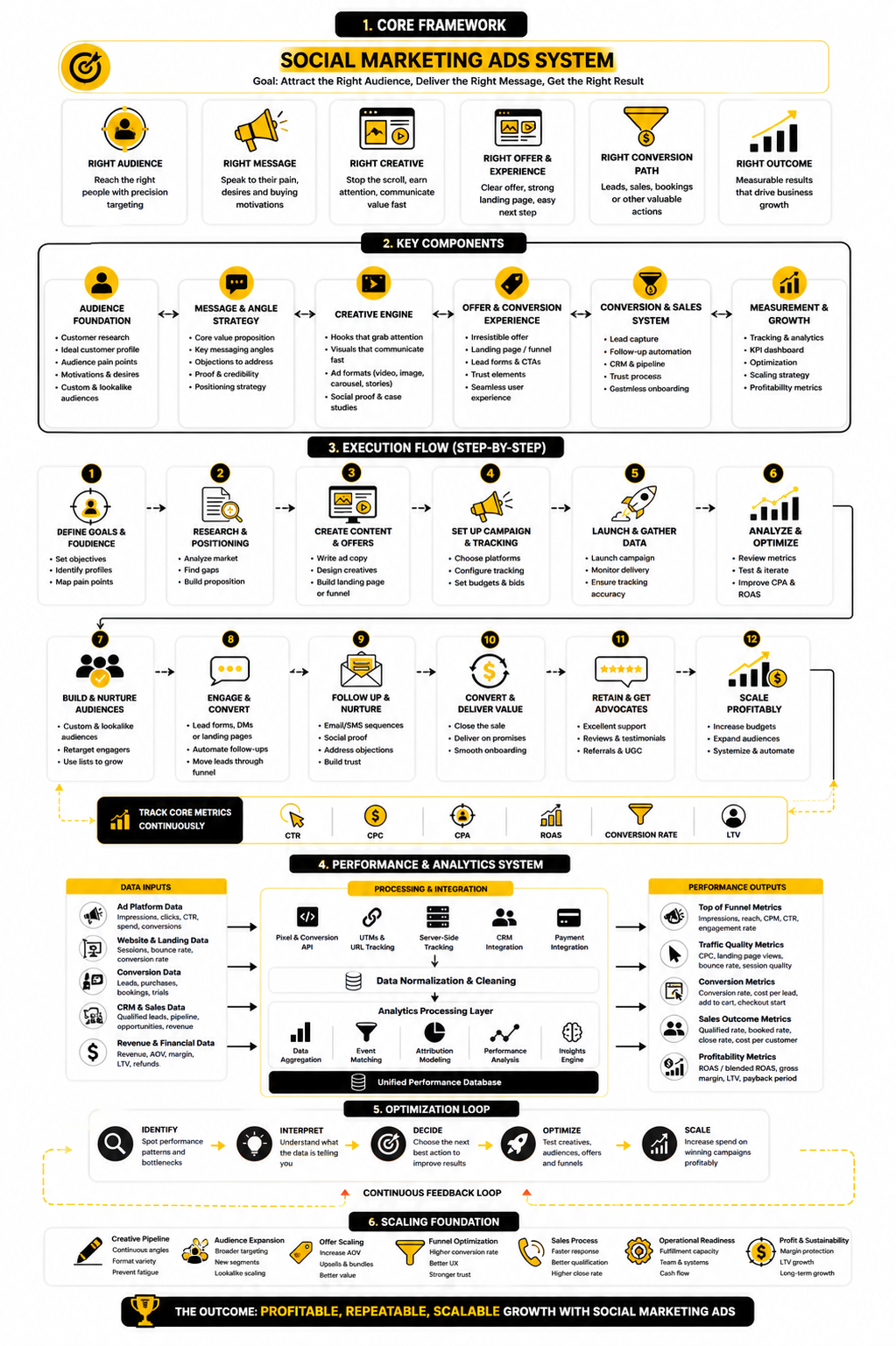
What are social marketing ads?
Social marketing ads are paid advertisements placed on social media platforms to reach, engage, and convert specific audiences. They can appear as videos, images, carousels, stories, reels, sponsored posts, lead forms, or direct-message campaigns. The best campaigns connect the ad to a clear offer, landing experience, follow-up process, and measurable business result.
Are social marketing ads the same as social media marketing?
No, they are related but not the same. Social media marketing includes organic posting, community management, content strategy, influencer work, and audience engagement. Social marketing ads specifically refer to paid campaigns that use social platforms to buy reach, clicks, leads, purchases, bookings, or other measurable actions.
Which platforms are best for social marketing ads?
The best platform depends on the audience, offer, creative style, and conversion goal. Meta is often strong for broad consumer reach, ecommerce, lead generation, and retargeting. TikTok can work well for native video, product discovery, creator-style content, and trend-driven offers. LinkedIn usually makes more sense for B2B campaigns, high-value professional services, recruiting, and account-based marketing.
How much should a business spend on social marketing ads?
The right budget depends on the cost of the offer, the sales cycle, the target market, and how much data the campaign needs to learn. A small local lead generation campaign may start with a modest daily test budget, while an ecommerce brand may need more spend to test enough creative and collect purchase data. The practical rule is to spend enough to get a meaningful signal, but not so much that one weak test damages the business.
What is a good return on ad spend?
A good return on ad spend depends on margin, repeat purchases, fulfillment cost, and cash flow. A 2x ROAS can be excellent for a business with strong margins and repeat purchases, but terrible for a business with low margins and high operating costs. ROAS should never be judged alone because profit, payback period, and customer lifetime value matter more.
Why do social marketing ads stop working after a while?
Campaigns often slow down because of creative fatigue, audience saturation, rising auction costs, weak offer relevance, or a conversion path that cannot support higher volume. Sometimes the platform did not “break” the campaign. The market simply saw the same message too many times or the campaign reached the easiest buyers first.
How many creatives should I test?
Start with enough creative variation to learn something useful. For many campaigns, that means testing several distinct angles rather than tiny design changes. A practical batch might include pain-point creative, proof-led creative, product demonstration, comparison, objection handling, and offer-first creative.
Should I use broad targeting or detailed targeting?
Broad targeting can work well when the creative, offer, and conversion signals are strong. Detailed targeting can still help in some situations, especially for niche audiences, B2B campaigns, local markets, or early testing. The key is not choosing broad or detailed as a rule. The key is making sure the campaign gives the platform clear signals and gives the buyer a message that feels relevant.
What is the biggest mistake businesses make with social marketing ads?
The biggest mistake is treating ads as the whole strategy. Ads only create the opportunity. The offer, landing page, follow-up, sales process, and customer experience decide whether that opportunity becomes revenue.
Do I need a landing page for every campaign?
Not always, but most serious campaigns need a focused destination. Sending paid traffic to a generic homepage often creates friction because the visitor has to figure out the next step. A dedicated landing page, product page, booking page, lead form, or funnel usually performs better because it continues the message from the ad.
How important is follow-up for lead generation campaigns?
Follow-up is critical. A lead is not revenue until the person qualifies, responds, books, shows up, and buys. If the business responds slowly or sends generic messages, the campaign may look worse than it really is because the sales process is leaking value.
Can social marketing ads work for small businesses?
Yes, but small businesses need to be disciplined. They usually cannot afford vague testing, weak tracking, or slow follow-up. A small business should start with one clear offer, one clear audience, one focused landing path, and a simple measurement system before expanding into more complex campaigns.
Can social marketing ads work without a big creative team?
Yes, but creative still needs to be consistent. A small team can test founder videos, simple product demos, customer-style explanations, screen recordings, testimonials, and direct-response image ads without producing expensive studio content. The goal is not to look like a massive brand. The goal is to communicate clearly and learn quickly.
How do I know whether the ad or the funnel is the problem?
Break the campaign into stages. If impressions are delivered but people do not click, the creative, hook, audience, or offer presentation may be weak. If people click but do not convert, the landing page, form, trust, price, or message match may be the issue. If leads convert but do not buy, look at qualification, follow-up, sales process, and offer fit.
When should I scale a campaign?
Scale when the campaign has enough consistent data to show that the economics work. That means the campaign is not just generating cheap clicks or leads, but producing customers, revenue, or qualified opportunities at an acceptable cost. Scaling too early can turn a promising test into a messy, expensive lesson.
What tools help manage social marketing ads better?
The right tools depend on the campaign. GoHighLevel can help with CRM, funnels, lead follow-up, booking, and pipeline visibility. ManyChat can help with Instagram, Messenger, and DM-based campaign flows. ClickFunnels can help build dedicated funnel paths, while Systeme.io can be useful for simpler funnels and email automation.
Build a stronger local presence with BAAM AI
Turn your website, Google profile, social channels, and AI visibility into one growth engine
Most businesses do not need more random marketing activity. They need a consistent presence system that helps the right people find them, trust them, and take action. BAAM AI brings strategy, local SEO, website updates, Google Maps visibility, social content, AI-search readiness, media production, and reporting into one practical monthly engine.
If you want your marketing to keep working after the campaign ends, start with a free BAAM AI presence audit. See how your business shows up today and where the fastest visibility wins are at BAAM AI.