
BAAM AI Blog
Social Influencer Marketing: A Practical Framework for Brands That Want Real Results
Social influencer marketing has moved far beyond paying someone with a large following to post a product photo. It is now a serious growth channel that sits between brand strategy, content production, social...
Affiliate disclosure: this article may include compensated links. Recommendations should still be evaluated against your use case, budget, and current provider terms.
Should you choose this tool?
this tool is worth considering when the use case, budget, and implementation effort match what you actually need to do next.
teams that want a practical tool decision without reading another generic feature list
Check this toolSocial influencer marketing has moved far beyond paying someone with a large following to post a product photo. It is now a serious growth channel that sits between brand strategy, content production, social commerce, paid media, community building, and performance marketing. When it works, it gives a brand something ads alone struggle to create: borrowed trust from people the audience already chooses to watch.
That trust is also fragile. Audiences are more aware of sponsored content, platforms are more algorithmic, and regulators expect clear disclosure when a creator has a material relationship with a brand. The FTC’s guidance on endorsements, influencers, and reviews makes the point simple: paid relationships, free products, affiliate commissions, and other brand connections must be disclosed clearly.
The opportunity is still massive, but the easy version is gone. IAB projected U.S. creator economy ad spend to reach $37 billion in 2025, while Influencer Marketing Hub projected the global influencer marketing market at $32.55 billion in 2025. That does not mean every brand should throw money at influencers. It means brands need a better system for choosing creators, shaping offers, measuring impact, and turning content into compounding assets.
this guide gives you that system. We will treat social influencer marketing as a professional operating model, not a one-off campaign tactic. You will see how to define the role of influencers in your funnel, how to evaluate creator fit, how to structure collaborations, how to protect trust, and how to connect influencer content to actual revenue.
Why Social Influencer Marketing Matters Now
Social influencer marketing matters because attention has changed. People still discover products through search, ads, reviews, and retail channels, but social platforms now shape demand before buyers even know what they want. A creator can introduce a problem, demonstrate a product, answer objections, and create social proof inside one short video.
The deeper reason is trust. A brand message often feels like a claim, while a creator message can feel like a recommendation, a demonstration, or a useful shortcut. That does not make influencer content automatically trustworthy, but it explains why the channel can outperform traditional brand-only content when the creator, offer, and audience fit are real.
There is also a content economics advantage. A strong influencer program does not only buy reach. It creates usable creative for organic social, paid amplification, landing pages, email, product pages, and sales enablement. This is where many brands miss the point: the post is only one asset, but the creator’s angle, language, proof, and footage can become the raw material for a much larger marketing system.
The Social Influencer Marketing Framework
The simplest way to understand social influencer marketing is this: the creator brings attention and trust, the brand brings a relevant offer, and the campaign turns both into measurable action. If any part is weak, the whole thing underperforms. A famous creator with the wrong audience is expensive noise. A perfect creator with a weak offer becomes polite engagement without sales. A great offer with no tracking becomes a guessing game.
The framework for this guide has four layers: strategy, creator fit, content execution, and performance infrastructure. Strategy defines why the campaign exists and where it sits in the funnel. Creator fit determines whether the influencer’s audience, credibility, style, and values match the brand. Content execution turns the partnership into posts people actually want to watch. Performance infrastructure tracks what happened and captures the demand the campaign creates.
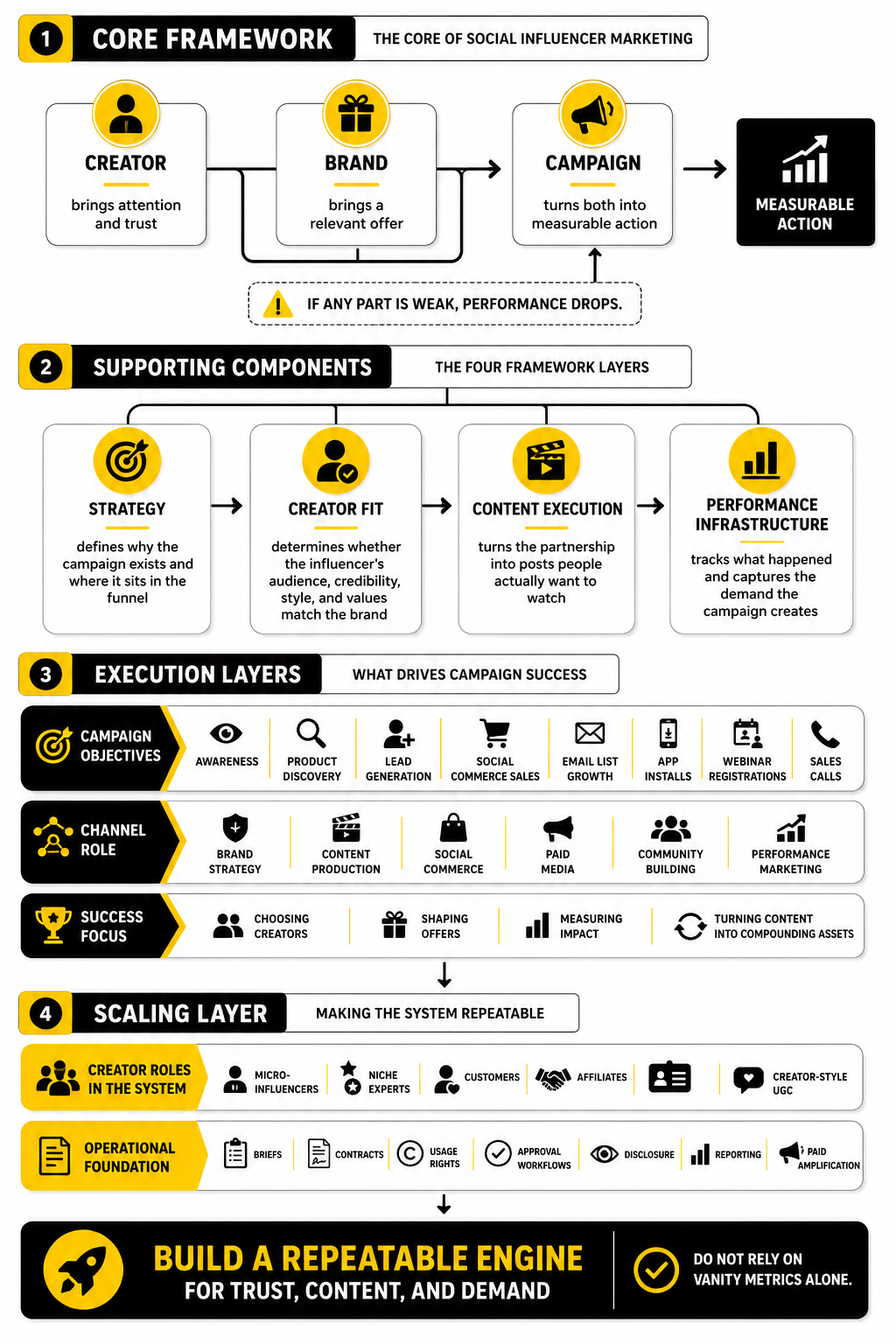
This framework also keeps the work honest. Social influencer marketing is not just “awareness” unless you decide it should be. It can drive product discovery, lead generation, retail demand, social commerce sales, email list growth, app installs, webinar registrations, or sales calls. The job is to pick the objective first, then design the influencer program around that objective.
What this guide Will Help You Build
By the end of the full article, you should be able to build a social influencer marketing program that is practical enough to run and structured enough to scale. That means you will not be relying on vanity metrics alone. Followers, likes, and views can help, but they are not the strategy.
You will learn how to separate creators who look popular from creators who can actually move your market. You will also see why micro-influencers, niche experts, customers, affiliates, employees, and creator-style UGC can all play different roles in the same system. The goal is not to find one magic influencer. The goal is to build a repeatable engine for trust, content, and demand.
The later sections will also cover the operational side that brands often ignore until it hurts: briefs, contracts, usage rights, approval workflows, disclosure, reporting, and paid amplification. This matters because the best influencer programs are not random acts of posting. They are managed like a channel, measured like a campaign, and improved like a product.
Core Components of a Strong Influencer Strategy
A strong social influencer marketing strategy starts before you contact a single creator. The first decision is not who to hire. The first decision is what job the influencer program must do for the business.
That sounds basic, but it changes everything. A campaign built for awareness should not be judged the same way as a campaign built for booked calls, email signups, direct sales, app installs, retail visits, or affiliate revenue. The creator may be the visible part of the campaign, but the objective determines the offer, brief, content format, tracking setup, landing page, and follow-up sequence.
This is where many brands make the channel harder than it needs to be. They pick creators based on audience size, negotiate a few posts, wait for results, and then decide whether influencer marketing “works.” That is not a strategy. That is gambling with nicer screenshots.
The Objective
The objective gives the campaign a spine. Without it, every metric looks important and none of them tell you what to do next. Views, likes, saves, comments, link clicks, leads, and revenue can all matter, but they do not matter equally in every campaign.
For a new product, the objective may be fast education and category awareness. For an ecommerce brand, it may be profitable creator-led sales. For a service business, it may be qualified conversations started through DMs, forms, or booked calls. For a SaaS brand, it may be trial signups, demo requests, or content that helps buyers understand a complex feature faster.
A practical objective should answer three questions:
Once those questions are clear, the campaign becomes much easier to design. A creator promoting a $29 impulse product needs a different content angle than a creator explaining a high-ticket consulting offer. A creator driving people into a quiz needs a different call to action than a creator sending buyers to a product detail page. The audience may discover the brand on social, but the conversion path still needs to feel obvious.
The Audience Match
The best creator is not always the biggest creator. In social influencer marketing, audience fit beats audience size more often than brands want to admit. A smaller creator with strong trust in a narrow niche can outperform a larger creator whose followers are too broad, too passive, or not ready to buy.
Audience match has several layers. Demographics matter, but they are not enough. You also need to understand the audience’s problem awareness, buying intent, content habits, language, objections, and relationship with the creator. A fitness creator, for example, may have an audience that follows for entertainment, transformation, education, accountability, or identity. Those are different buying contexts.
The creator’s relationship with the audience matters just as much as the audience itself. Do people ask for recommendations? Do they comment with specific questions? Do they save educational posts? Do they challenge the creator because they expect honesty? Those signals tell you more than a surface-level engagement rate.
The Creator Fit
Creator fit is the connection between the person, the brand, and the message. It includes content style, credibility, tone, values, production quality, category experience, and the creator’s ability to make the offer feel natural. A creator can have the right audience and still be the wrong messenger.
The question is simple: would this creator talk about this product even if the brand were not paying them? Not for free, necessarily, but naturally. If the answer feels like no, the content will probably feel forced. Audiences can smell that quickly.
Good creator fit also protects the brand. The FTC’s endorsement guidance makes disclosure non-negotiable, but disclosure alone does not create trust. The creator still needs to explain the product honestly, avoid exaggerated claims, and make the recommendation fit their actual experience. This matters even more in categories like finance, health, software, parenting, education, and professional services.
The Offer
The offer is where influencer campaigns often win or die. A creator can generate attention, but the offer has to make the next step feel worth taking. If the product page is weak, the discount is unclear, the lead magnet is generic, or the call to action feels disconnected from the content, the campaign leaks demand.
A good influencer offer does not always need to be a discount. It can be a bundle, quiz, free trial, waitlist, consultation, checklist, webinar, sample, exclusive launch, limited drop, or creator-specific bonus. The right choice depends on the buying cycle and the audience’s level of intent.
For brands using creator content to start conversations, the offer may live inside DMs instead of on a landing page. In that case, tools like ManyChat can help turn comments, keywords, and messages into structured follow-up flows. That is useful when the creator’s content creates interest, but the buyer still needs a nudge, a link, a guide, or a simple path to ask questions.
The Content Angle
The content angle is not the same as the product benefit. The product benefit is what the brand wants to communicate. The content angle is the reason someone keeps watching.
This distinction matters. “Our skincare serum hydrates your skin” is a benefit, but it is not automatically a strong social post. “I changed one step in my nighttime routine for 14 days” is closer to a content angle because it creates curiosity, context, and a reason to watch. The creator’s job is not to recite the brand’s feature list. Their job is to translate the value into content their audience already understands.
Strong influencer content usually uses one of several angles:
The best angle depends on the platform and the creator. TikTok and Reels often reward fast hooks, visible demonstration, and native pacing. YouTube can support deeper explanation and stronger buying intent. LinkedIn works better when the creator has professional credibility and the content teaches something useful. Pinterest, newsletters, podcasts, and communities can also matter, but only when they match the buying journey.
The Conversion Path
A creator post should not be the end of the campaign. It should be the start of a controlled path. That path might lead to a product page, landing page, quiz, email sequence, SMS flow, sales page, booking calendar, community, or checkout.
This is where social influencer marketing becomes performance marketing. The content creates the moment of attention, but the system after the click captures the value. If the landing page does not match the creator’s promise, conversion drops. If the email follow-up is generic, warm leads go cold. If tracking is messy, the brand cannot tell which creator or angle worked.
For ecommerce and creator-led landing pages, a dedicated builder like Replo can help brands create campaign-specific pages instead of sending every influencer audience to the same generic homepage. For funnels, offers, and lead capture pages, tools like ClickFunnels or Systeme.io can be useful when the goal is to move people through a clear sequence. The tool is not the strategy, but a clean conversion path makes the strategy measurable.
The Measurement Plan
Measurement should be designed before the campaign goes live. Waiting until after the content is posted is how brands end up with screenshots, vague summaries, and no useful learning. A good measurement plan tells you what happened, why it may have happened, and what to change next.
At minimum, brands should track creator, platform, content format, post date, offer, landing page, link clicks, conversions, revenue, cost, and usage rights. For awareness campaigns, the measurement plan may include reach, video completion, branded search lift, follower growth, saves, comments, sentiment, and content reuse value. For conversion campaigns, the plan should include UTMs, unique codes, affiliate links, pixel data, post-purchase surveys, and customer acquisition cost.
The hard truth is that attribution will never be perfect. People may see a creator video, search the brand later, click a retargeting ad, ask a friend, and buy three days after that. That does not make measurement pointless. It means brands need a blended view that combines direct tracking, platform data, qualitative feedback, and business-level outcomes.
The Follow-Up System
Most influencer campaigns underuse follow-up. They treat the creator post as a single event instead of the first touch in a sequence. That leaves money on the table, especially when the product has a longer consideration cycle.
A practical follow-up system can include retargeting ads, email flows, SMS reminders, abandoned cart messages, sales team outreach, or creator-content remarketing. If someone clicked from a creator post but did not buy, they may still be interested. The next message should help them understand the product better, overcome a specific objection, or return to the offer with less friction.
For brands managing leads, pipelines, and follow-up across channels, GoHighLevel can fit influencer campaigns that need CRM, automation, booking, and nurture sequences in one place. For email-heavy campaigns, tools like Brevo or Moosend can help turn influencer traffic into owned audience growth instead of one-time clicks.
The Content Reuse Plan
Influencer content becomes more valuable when it is planned for reuse. A single creator video can become a paid social ad, product page asset, email section, sales page proof point, short clip, testimonial-style snippet, or retargeting creative. But the brand needs permission before using it that way.
Usage rights should be discussed before the contract is signed. The agreement should clarify where the brand can use the content, for how long, whether paid ads are allowed, whether the creator’s handle can be used in whitelisting or partnership ads, and whether edits are permitted. This protects both sides and avoids awkward disputes after a post performs well.
This is especially important because creator content and paid media are becoming more connected. IAB’s 2025 creator economy research projected U.S. creator ad spend at $37 billion in 2025, and the market is increasingly treating creator content as media inventory, not just organic posting. That shift rewards brands that plan ahead, secure rights properly, and build campaigns that can scale beyond one feed post.
Choosing the Right Influencers and Platforms
Choosing influencers is not a popularity contest. It is a fit decision, a risk decision, and a distribution decision all at once. The creator has to reach the right people, earn enough trust to influence behavior, and produce content that fits the way the platform actually works.
This is why social influencer marketing should never start with a spreadsheet of follower counts. Follower count is visible, so it feels useful, but it does not tell you whether the audience is relevant, active, reachable, or likely to take action. A creator with 25,000 loyal followers in a narrow category can be more valuable than a creator with 500,000 passive followers who came for entertainment and ignore brand recommendations.
The better approach is to build a creator selection process that removes guesswork. You want clear criteria, consistent scoring, and a workflow that helps you compare creators fairly. That does not make the process robotic. It makes your creative judgment sharper because you are no longer reacting to vanity metrics.
Start With the Buying Context
The first question is not “Who has influence?” The better question is “Who does our buyer already trust when they are thinking about this problem?” That small shift changes the entire creator search.
For a beauty brand, that trusted person may be a skincare educator, a routine-focused creator, a dermatologist, a makeup artist, or a customer with a believable transformation. For a B2B software company, it may be a consultant, operator, agency owner, analyst, newsletter writer, podcast host, or practitioner who shows real workflows. For a local service business, it may be a community creator whose audience lives in the right area and actually follows their recommendations.
Buying context also helps you avoid mismatched platforms. A low-ticket product with visual appeal may work well on TikTok, Instagram Reels, YouTube Shorts, or Pinterest. A complex product that needs explanation may need YouTube, LinkedIn, newsletters, webinars, podcasts, or creator-led demos. The channel should match the buyer’s decision process, not just the brand’s preferred content format.
Map Creator Types to Campaign Goals
Not all influencers do the same job. Some are excellent at reach, some are better at education, some create strong proof, and some are best used as affiliate partners over time. Treating every creator like the same media unit is lazy planning.
Celebrity and macro creators can help when the goal is broad visibility, cultural relevance, or launch momentum. Mid-tier creators often balance reach and niche credibility. Micro and nano creators can be powerful when trust, specificity, and community feel matter more than raw scale. Expert creators are useful when the product requires authority, explanation, or risk reduction.
This matters because the creator type should match the campaign objective. If you need awareness, reach and memorability matter. If you need conversions, audience intent and recommendation credibility matter more. If you need content assets, production skill and natural storytelling may be more important than the creator’s own audience size.
Evaluate the Audience Before the Creator
The creator is the face of the partnership, but the audience is the market you are buying access to. That means you need to inspect the audience before you fall in love with the creator’s content. The comments, questions, saves, shares, and community language often reveal more than the profile itself.
Look for signs that the audience has the problem your product solves. Are people asking for links, product names, routines, templates, tools, or recommendations? Are they discussing objections that your product can answer? Are they in the right country, age range, profession, life stage, income band, or interest cluster?
You should also watch for audience quality problems. Generic comments, sudden engagement spikes, irrelevant follower geography, suspicious giveaway growth, and low comment substance can all weaken performance. No single signal proves a creator is wrong, but weak audience signals should slow you down before money changes hands.
Review Content Fit Like a Buyer Would
Content fit is about how the creator communicates, not just what they talk about. A creator may be in the right niche but use a tone that would make your brand feel awkward. Another creator may not seem obvious at first, but their storytelling style may make your product instantly understandable.
Watch at least 10 to 20 recent posts before shortlisting a creator. Look for their hooks, pacing, editing style, visual quality, depth of explanation, humor, honesty, and willingness to show practical details. Then ask a blunt question: would your ideal buyer believe this person if they recommended your offer?
Also check how the creator handles sponsored content. If every brand post feels dramatically weaker than their organic content, that is a warning sign. Good social influencer marketing should feel native to the creator’s channel, not like a brand brief was pasted into a caption.
Build a Creator Shortlist Process
A structured shortlist keeps your team from choosing creators based on vibes alone. You can still use judgment, but the process should force you to compare the things that actually affect campaign performance. The shortlist should include creators at different levels of reach so you are not overexposed to one risky bet.
A simple scoring system can work well. Give each creator a score for audience fit, content quality, category relevance, engagement quality, brand safety, platform strength, past sponsorship quality, and estimated cost efficiency. You do not need a complicated model. You need a consistent way to make decisions.
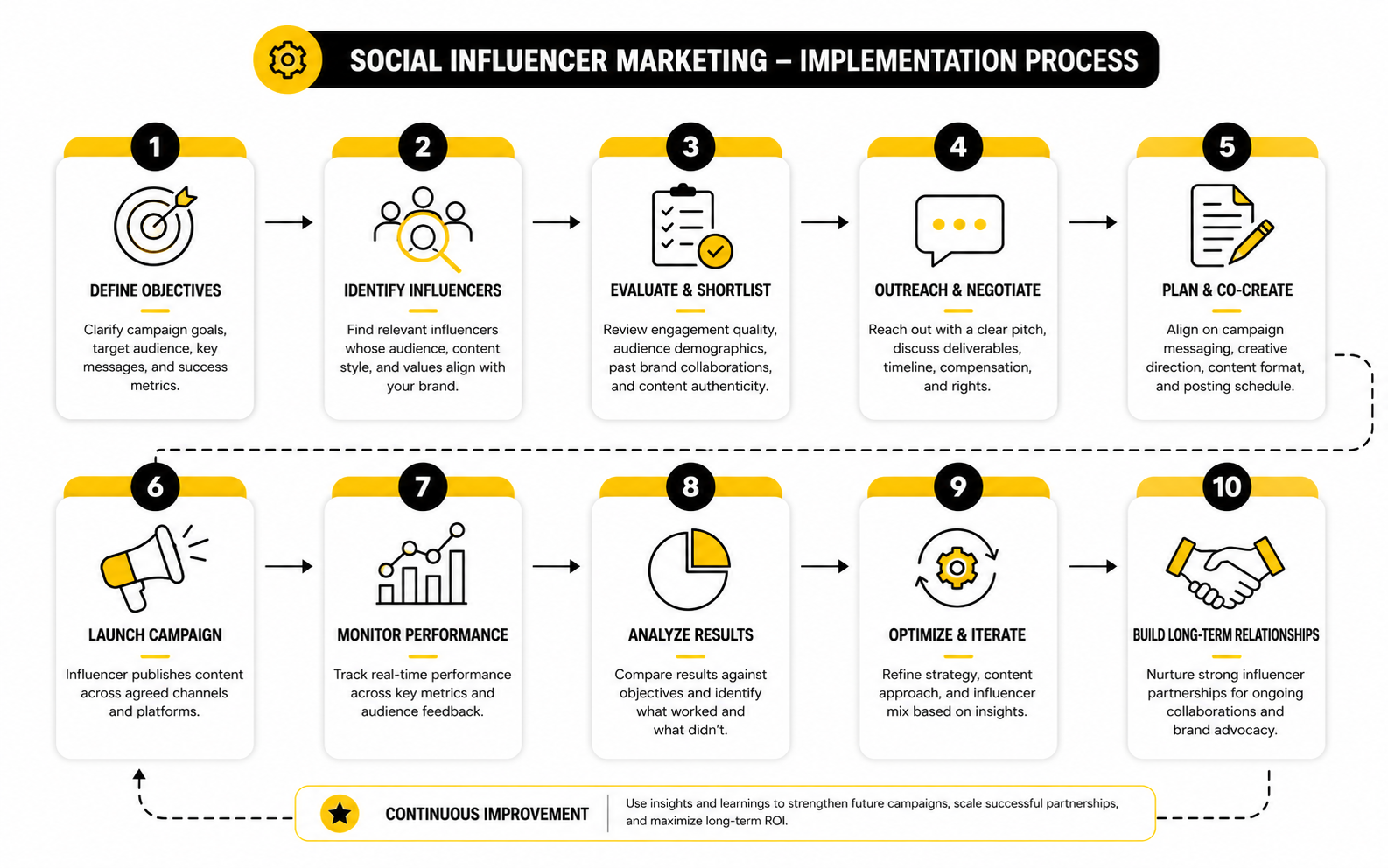
A practical creator selection process looks like this:
Choose Platforms Based on Behavior, Not Hype
Platform choice should follow buyer behavior. TikTok may be excellent for discovery, entertainment-driven product education, social commerce, and fast creative testing. Instagram can work well for lifestyle categories, creator relationships, visual proof, Stories, Reels, and retargetable engagement. YouTube is stronger when the product needs search intent, deeper explanation, tutorials, reviews, comparisons, or long-form trust.
LinkedIn deserves its own category because influence there often looks less like lifestyle content and more like expertise. A strong LinkedIn creator can shape professional opinion, introduce software, promote events, validate services, and support B2B demand generation. The content does not need to be flashy. It needs to be useful, credible, and specific.
Pinterest, newsletters, podcasts, communities, and blogs can also play a role, especially when the buying cycle is longer or the product benefits from evergreen discovery. Do not dismiss them just because they are less trendy. The best platform is the one where your buyer is already open to the type of recommendation you need the creator to make.
Match the Format to the Message
Every platform has formats that fit different types of persuasion. Short-form video is strong for hooks, demonstrations, routines, reactions, fast education, and visual proof. Long-form video is better for tutorials, reviews, comparisons, objections, and more expensive buying decisions. Static posts can still work when the creator’s visual style, credibility, or audience relationship supports the message.
Stories and live formats are useful when the campaign needs immediacy. They can support product drops, launches, limited offers, behind-the-scenes access, Q&A, and direct-response prompts. They are also good for reducing friction because the creator can answer questions in a casual way.
Written formats matter when the audience needs detail. LinkedIn posts, newsletters, blog reviews, and community posts can give the creator more room to explain why the product matters. That can be especially valuable for software, services, education, finance, professional tools, and higher-consideration ecommerce products.
Create a Brief That Protects the Idea
A good brief gives direction without killing the creator’s voice. This is a delicate balance. Too little guidance creates vague content, while too much control makes the post feel like an ad nobody asked to watch.
The brief should explain the campaign goal, target audience, product truth, key benefits, required claims, prohibited claims, disclosure requirements, offer details, deadlines, deliverables, usage rights, and tracking links. It should also include examples of strong angles, but not scripts unless the format truly requires one. The creator should understand the strategy, then translate it into their own language.
The most useful briefs focus on what the audience needs to understand. Instead of saying “mention these five features,” say “show how this helps someone solve this specific problem faster.” Instead of saying “make it exciting,” explain the tension the buyer feels before discovering the solution. That gives the creator room to make the content human.
Set Up Tracking Before Outreach Turns Into Chaos
Tracking should not be patched together after the first post goes live. Every creator should have a clean tracking setup before content is published. That usually means unique links, UTM parameters, creator codes, landing pages, affiliate tracking, platform pixels, and a clear naming convention.
The goal is not perfect attribution. The goal is useful learning. You want to know which creator, platform, format, hook, offer, and landing page produced the strongest signals. That lets you scale what works and stop funding what only looks good on the surface.
For campaigns where creators are driving leads into forms, quizzes, or applications, tools like Fillout can help create cleaner intake flows. For campaign links and attribution hygiene, Dub.co can be useful when you need trackable links that are easier to manage across creators and platforms. The point is simple: make the path measurable before the traffic arrives.
Negotiate Deliverables and Usage Rights Clearly
Creator negotiations should cover more than the number of posts. Deliverables matter, but so do timelines, revisions, exclusivity, whitelisting, paid usage, organic usage, raw footage, cancellation terms, payment schedule, disclosure language, and performance expectations. If you skip these details, you are inviting confusion later.
Usage rights are especially important. If a creator makes a video that performs well, the brand may want to use it in ads, on landing pages, in emails, or across product pages. That is not automatically included unless the agreement says it is included. The creator deserves clarity and compensation for broader usage.
Payment terms also matter because creator relationships are still business relationships. Recent reporting around unpaid influencer contracts shows how quickly trust can break when deliverables and payment expectations are not honored. A professional brand should be clear, fair, and fast with payment because reputation travels both ways in creator networks.
Run a Test Before You Scale
A first campaign should usually be treated as a learning sprint, not a final verdict on the whole channel. Test several creators, angles, formats, and offers with controlled spend. Then compare both hard metrics and qualitative signals.
Hard metrics include reach, watch time, clicks, conversion rate, cost per lead, revenue, customer acquisition cost, and repeat purchase behavior. Qualitative signals include comment quality, audience questions, objections, sentiment, creator feedback, and whether the content produced useful creative insights. Sometimes a campaign teaches you that the product needs a clearer offer. Sometimes it teaches you that the hook was wrong. Sometimes it proves that one creator segment deserves more budget.
This is why the first test should be designed to create learning, not just sales. Sales matter, of course. But if you learn which creator profile, message, and conversion path work best, you are building an asset that can improve every campaign after it.
Turn Creator Feedback Into Better Marketing
Creators are not only distribution partners. They are often close to the customer’s language, objections, desires, and content habits. Smart brands listen carefully before, during, and after the campaign.
Ask creators what their audience usually responds to, what claims would feel unnatural, what objections they expect, and what format they think would perform best. After the content goes live, ask what comments surprised them and whether people sent private messages. That feedback can improve your ads, landing pages, email copy, product positioning, and future briefs.
This is one of the underrated benefits of social influencer marketing. You are not just renting attention. You are getting a live read on how the market reacts when a trusted person explains your offer in plain language. Used properly, that feedback is worth far more than a single post.
Statistics and Data
Data should make social influencer marketing easier to manage, not harder to understand. The problem is that most teams collect too many numbers and then make decisions from the wrong ones. A post with high reach can still produce weak buyers, while a smaller creator can create fewer clicks but stronger leads, better comments, and higher conversion quality.
The goal is not to prove that influencer marketing worked once. The goal is to understand which creator, platform, message, format, offer, and follow-up path should get more budget next time. That is the difference between reporting and learning. Reporting tells you what happened. Learning tells you what to change.
Influencer marketing is also becoming too expensive to measure casually. U.S. creator economy ad spend was projected to reach $37 billion in 2025, and the global influencer marketing market was projected at $32.55 billion in 2025. When a channel attracts that much money, brands cannot rely on screenshots, vanity metrics, and vague “brand lift” language forever.
The Metrics That Actually Matter
The right metrics depend on the campaign objective. If the goal is awareness, you care about reach, impressions, frequency, video views, completion rate, branded search movement, follower growth, sentiment, and content recall. If the goal is demand generation, you care about clicks, landing page conversion rate, cost per lead, booked calls, email opt-ins, qualified pipeline, and follow-up engagement.
For ecommerce, the core metrics usually include creator-level revenue, conversion rate, average order value, cost per acquisition, new customer percentage, repeat purchase behavior, and contribution margin. Revenue alone can mislead you if the creator drives discount-heavy buyers who never return. A campaign can look strong on first-order sales and still be weak if the economics do not hold after refunds, shipping, product costs, and creator fees.
For B2B and higher-ticket offers, the numbers take longer to mature. A creator may drive webinar signups, demo requests, newsletter subscribers, or sales conversations before revenue appears. That does not make the campaign soft. It means the measurement window needs to match the buying cycle.
Why Engagement Rate Is Useful but Dangerous
Engagement rate is one of the most commonly used influencer metrics because it is easy to compare. It can reveal whether a creator’s audience reacts to their content, and it can help identify accounts with inflated follower counts or weak community response. Used carefully, it is a helpful filter.
But engagement rate is not a business outcome. A creator can get strong likes and comments from an audience that enjoys their personality but has no intent to buy. Another creator may have lower engagement because their audience is busy, professional, or less publicly expressive, yet still drives serious buyers when the offer is relevant.
Interpret engagement rate as a quality signal, not a final answer. Look at what people are saying, not just how many people are reacting. A comment like “Where can I get this?” is more valuable than a hundred generic fire emojis when the campaign is built to drive action.
The Analytics System
A useful analytics system connects four layers: platform performance, creator performance, conversion performance, and business impact. These layers should be reviewed together because each one explains a different part of the campaign. If you only look at one layer, you will make incomplete decisions.
Platform performance tells you how the content behaved inside the social feed. Creator performance tells you which partners produced the strongest audience response. Conversion performance tells you whether that attention turned into action. Business impact tells you whether the action was worth the cost.
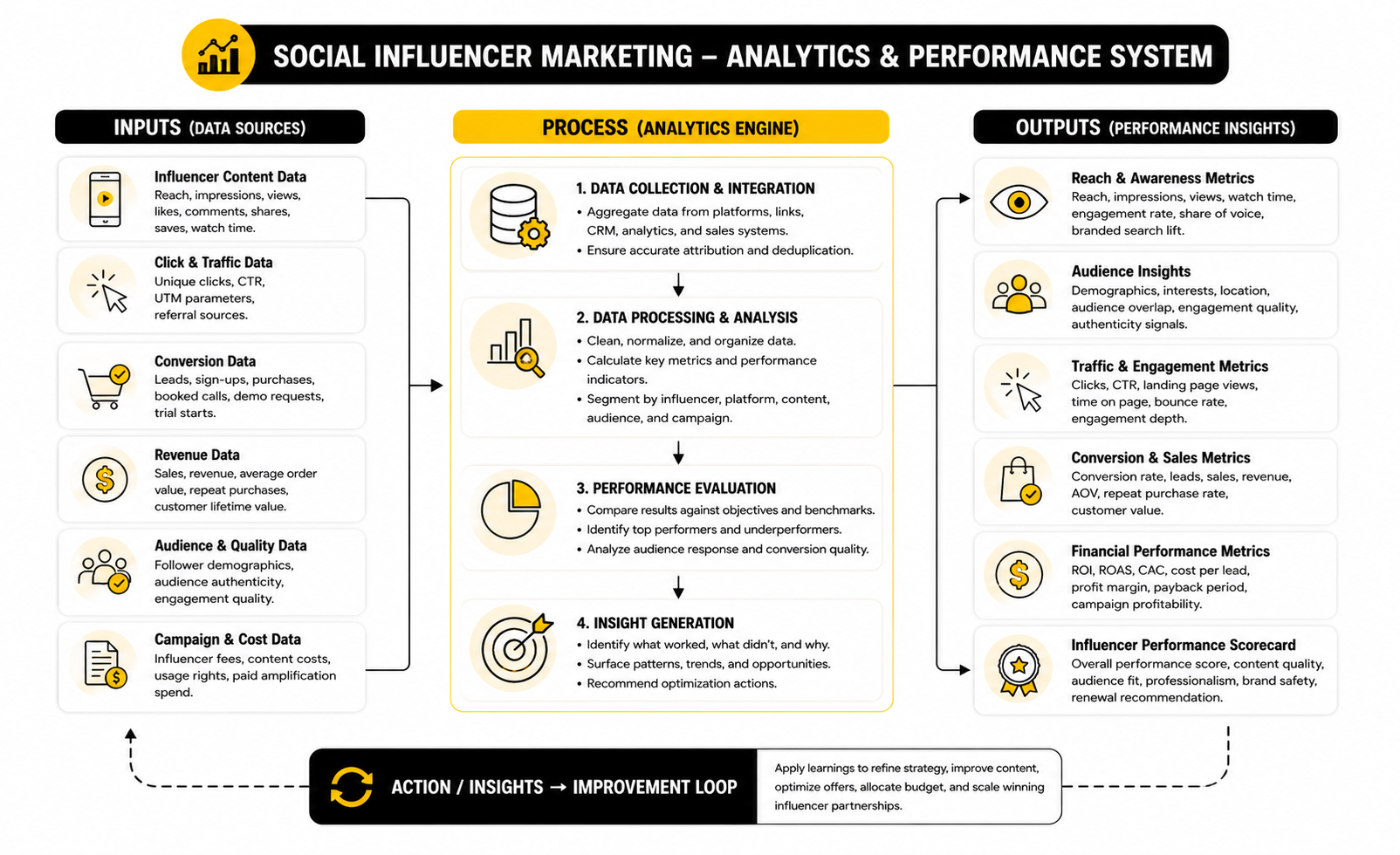
A simple measurement system should track:
This does not need to be complicated at first. A clean spreadsheet is better than a fancy dashboard nobody trusts. As the program grows, the reporting can move into a CRM, attribution platform, affiliate system, or business intelligence tool.
Benchmarks Need Context
Benchmarks are useful when they stop you from making emotional decisions. They are dangerous when they become universal rules. A “good” engagement rate, cost per click, conversion rate, or creator fee depends on category, platform, audience quality, content format, price point, brand awareness, seasonality, and the strength of the offer.
The better way to use benchmarks is to compare like with like. Compare TikTok creators against other TikTok creators in the same campaign. Compare skincare creators against similar skincare creators, not against B2B LinkedIn creators. Compare first-time testing data against future rounds after the brief, offer, and landing page have improved.
You should also separate campaign benchmarks from account benchmarks. A creator’s normal organic engagement may not predict sponsored performance perfectly. Sponsored content often behaves differently because the message, call to action, and audience skepticism are different.
What Reach Tells You
Reach tells you how many people had the opportunity to see the content. It is useful for awareness, launch momentum, and top-of-funnel exposure. It also helps you understand whether the platform actually distributed the creator’s content.
Reach does not tell you whether people cared. A campaign can reach a large audience and leave almost no trace if the creative is forgettable, the offer is weak, or the audience is too broad. That is why reach should be interpreted alongside watch time, completion rate, saves, shares, branded search, and comments.
When reach is high but clicks are weak, the issue may be the call to action, offer, or audience intent. When reach is low but engagement and conversion are strong, the content may deserve paid amplification. That is where creator content becomes more than an organic post; it becomes a tested creative asset.
What Watch Time and Completion Rate Tell You
Watch time shows whether the content held attention. This matters because short-form video platforms can generate huge view counts without deep attention. A weak three-second view is not the same as someone watching a full explanation, demonstration, or review.
Completion rate helps you understand whether the structure worked. If people drop off early, the hook may be too slow, the first line may be vague, or the visual opening may not create enough curiosity. If people watch but do not click, the content may be interesting without making the next step feel necessary.
Do not treat watch time as only a creator metric. Treat it as message feedback. The market is telling you whether the angle is clear, whether the problem is recognizable, and whether the explanation is strong enough to earn attention.
What Clicks Tell You
Clicks are a stronger signal than views because they show intent. Someone moved from passive consumption to active interest. That does not mean they are ready to buy, but it does mean the content created enough curiosity to continue.
A low click-through rate can mean several things. The call to action may be buried, the offer may not feel compelling, the link path may be awkward, or the content may have entertained people without creating buying motivation. It can also mean the platform format is not built for easy clicking, especially when the creator has to rely on link-in-bio behavior or verbal instructions.
Clicks should always be reviewed with landing page behavior. If clicks are strong but conversions are weak, the post did its job and the destination may be the problem. The landing page may not match the creator’s promise, may load slowly, may ask for too much too soon, or may fail to answer the objections raised by the content.
What Conversions Tell You
Conversions are the clearest performance signal, but they still need interpretation. A conversion can be a sale, lead, demo request, booked call, trial signup, quiz completion, download, or message opt-in. The right conversion depends on the campaign goal.
The first mistake is treating all conversions as equal. A low-quality lead that never replies is not worth the same as a qualified sales call. A discounted first purchase is not worth the same as a full-price buyer with strong repeat potential. A free trial signup is not worth much unless activation and retention are measured after the signup.
The second mistake is ending the analysis too early. Some influencer campaigns create delayed demand. A buyer may see a creator post, search the brand later, compare alternatives, and return through another channel. This is why post-purchase surveys, branded search monitoring, coupon codes, affiliate links, and CRM attribution should work together instead of fighting for one “perfect” answer.
What Comments and DMs Tell You
Comments and DMs are qualitative data. They show what the audience noticed, questioned, doubted, misunderstood, or wanted next. This is where you find the language buyers actually use.
Do not only count comments. Read them. A smaller comment section filled with serious questions can be more valuable than a huge comment section filled with jokes, arguments, or generic praise. The words people use can improve the next brief, landing page, FAQ, email sequence, and paid ad.
DMs can be even more useful because people often ask buying questions privately. If creators report repeated questions about price, sizing, ingredients, setup time, shipping, integrations, or proof, that is not noise. That is your market handing you the next round of copy.
What Revenue Data Can and Cannot Prove
Revenue is the number everyone wants, and for good reason. If social influencer marketing is part of a growth strategy, it eventually needs to connect to money. But revenue data can be distorted by attribution gaps, delayed purchase behavior, discount codes shared outside the creator’s audience, and buyers who switch devices or channels before converting.
This is why direct revenue should be treated as one strong signal, not the entire truth. Unique codes, UTMs, affiliate links, landing pages, and post-purchase surveys can all help. None of them are perfect alone. Together, they give you a clearer picture.
A campaign that appears break-even on direct revenue may still be valuable if it produces high-performing ad creative, improves branded search, drives email subscribers, generates retail demand, or introduces the brand to buyers who convert later. The key is to define those secondary values before the campaign starts, not after the numbers disappoint.
Paid Amplification Changes the Measurement Game
Organic creator posts are only one part of the channel now. More brands are turning strong influencer content into paid ads through whitelisting, partnership ads, Spark Ads, creator licensing, and usage rights. This changes how performance should be measured.
When creator content is amplified, the creator’s organic reach becomes less important than the content’s ability to perform as media. You care about thumb-stop rate, cost per view, click-through rate, cost per acquisition, creative fatigue, audience segment performance, and conversion quality. The creator still matters, but the asset is now competing inside a paid auction.
This is one reason contracts and usage rights matter so much. If a creator post performs well organically but the brand did not secure paid usage, the campaign may lose its biggest scaling opportunity. Measurement and legal permissions are connected. Ignore that and you cap your upside.
How to Read Campaign Results Without Fooling Yourself
The most useful campaign review compares expectations against reality. Did the creator reach the intended audience? Did the content communicate the right idea? Did the audience take the next step? Did the conversion path turn that interest into business value? Did the campaign create assets or insights that can be reused?
Avoid judging a campaign from one number. A high-reach campaign with weak conversions may still teach you which message people notice. A low-reach campaign with strong conversion rate may identify a creator type worth scaling. A campaign with poor sales but excellent comments may reveal an offer problem, not an influencer problem.
A good review should lead to clear action. You should know whether to renew the creator, test a new angle, improve the landing page, change the offer, negotiate usage rights, amplify the asset, or stop spending in that segment. If the data does not lead to a decision, the reporting is too vague.
A Practical Scorecard for Influencer Campaigns
A scorecard keeps the team focused on the whole system. It prevents overreacting to one flashy metric and helps compare creators across different roles. The scorecard should be simple enough to use after every campaign.
Score each creator across five areas:
This turns social influencer marketing into a repeatable learning loop. You are not just asking, “Did this post work?” You are asking, “What did this creator, content, audience, and offer teach us about how to grow?” That is the question serious brands keep answering until the channel becomes predictable.
Advanced Strategy, Risk, and Scaling
Once the basic system is working, social influencer marketing becomes less about finding more creators and more about making better strategic choices. More budget does not automatically mean better results. More creators can create more reach, but they can also create more complexity, weaker quality control, messy attribution, and higher brand risk.
This is the stage where brands need discipline. The early campaign asks, “Can this work?” The scaling stage asks, “Can this keep working without becoming chaotic, expensive, or fake?” That second question is harder, and it is where many influencer programs quietly break.
Scaling should not mean turning creators into interchangeable ad slots. The reason the channel works is that people trust specific voices in specific contexts. If you remove that trust by over-controlling the message, chasing cheap impressions, or flooding the market with repetitive sponsorships, the channel starts to look like the ads audiences already ignore.
Build a Creator Portfolio, Not a Creator List
A creator list is just a set of names. A creator portfolio has roles. That distinction matters because different creators should do different jobs inside the same social influencer marketing program.
Some creators are best for reach. Some are best for education. Some are best for trust-building inside a niche. Some are best for product demonstrations. Some are best for long-term affiliate revenue. Some may not drive immediate sales but create content assets that outperform brand-made ads later.
A balanced creator portfolio usually includes several layers:
This portfolio approach protects you from overdependence. If one creator underperforms, the program does not collapse. If one platform changes its algorithm, the brand still has other channels, assets, and relationships working.
Decide When to Use One-Off Campaigns
One-off campaigns are not bad. They can be useful for product launches, seasonal promotions, limited drops, event pushes, market tests, or creative experiments. They work best when the brand needs a focused burst of attention or wants to test a new creator segment before committing deeper.
The weakness is that one-off campaigns rarely build compounding trust. A creator mentions the brand once, the audience sees it once, and then the message disappears into the feed. That can still produce results, but it often leaves the brand constantly hunting for the next burst.
Use one-off campaigns when speed and learning matter more than relationship depth. Keep the brief tight, the tracking clean, and the expectations realistic. If the campaign performs, the next move should usually be a deeper partnership, not just another random creator.
Decide When to Build Long-Term Partnerships
Long-term partnerships can be more powerful because trust grows through repetition. When a creator uses a product across multiple posts, formats, and contexts, the recommendation can feel more believable. The audience gets more chances to understand the product, see it in action, and ask questions.
This does not mean every creator deserves a long-term deal. A long-term partnership should be earned through fit, performance, professionalism, and audience response. The first collaboration is often the test. The second and third show whether the creator can keep the message fresh without sounding repetitive.
Long-term deals also create strategic advantages. The creator learns the product better. The brand learns the creator’s audience better. Content quality improves because both sides stop treating the relationship like a transaction. That is where social influencer marketing starts feeling less like media buying and more like market development.
Manage Brand Safety Without Killing Authenticity
Brand safety is not just about avoiding scandal. It is about protecting trust, legal compliance, customer expectations, and the long-term reputation of the business. A creator partnership can put your brand inside conversations you do not fully control, so the vetting process needs to be serious.
Review past content, comments, controversies, tone, claims, category conflicts, and audience behavior. Look beyond the last few posts. Check whether the creator has promoted questionable products, made unsupported claims, hidden sponsorships, or built an audience through outrage. A creator may be popular and still be a poor risk.
At the same time, do not overcorrect into sterile content. If every creator sounds like the same legal-approved brand script, the campaign loses the human voice that made it valuable. The better approach is to set clear guardrails around claims, disclosures, sensitive topics, and prohibited language while giving creators room to communicate naturally.
Treat Compliance as Part of the Workflow
Compliance should not be handled after content is already live. It should be built into the brief, contract, approval process, and reporting checklist. The FTC endorsement guidance is clear that people need to understand when a creator has a material connection to a brand, including payment, free products, or other incentives.
This matters because hidden sponsorships damage both legal standing and audience trust. Disclosure is not a small technical detail. It is part of the relationship between the creator, the audience, and the brand.
Brands should make disclosure easy for creators. Give them approved language, platform-specific placement guidance, and examples of what not to do. Then check the live content. Do not assume that because the contract mentions disclosure, the post is compliant.
Watch for Creator Fatigue
Creator fatigue happens when the audience sees too many sponsorships, too many similar recommendations, or too many brand messages that do not feel earned. The creator may still have reach, but the recommendation loses weight. This is especially common when creators monetize aggressively without protecting audience trust.
You can spot fatigue in the comments. People may joke about constant ads, question whether the creator actually uses the product, or ignore sponsored posts while engaging with organic content. You can also see it in declining sponsored engagement, weak click behavior, or lower conversion quality across repeated campaigns.
The fix is not always to drop the creator. Sometimes the partnership needs better spacing, stronger story angles, more authentic usage, or deeper product integration. But if the creator’s audience no longer believes their recommendations, the brand should not keep paying for the illusion of influence.
Protect the Offer From Overexposure
A strong offer can become weaker when too many creators promote it in the same way. Audiences overlap, social feeds repeat patterns, and the campaign starts to feel manufactured. This is especially risky when every creator uses the same discount, hook, and talking points.
The solution is controlled variation. The core product truth should stay consistent, but the angle should adapt to each creator’s audience. One creator might focus on speed. Another might focus on confidence. Another might focus on workflow, routine, or the cost of the old way.
You should also manage timing. A launch wave can create momentum, but constant identical posts can create suspicion. Plan the calendar so the market feels consistent energy, not spam.
Scale Content Assets Separately From Creator Reach
One advanced move is separating the value of the creator’s audience from the value of the creator’s content. Sometimes a creator’s post does not produce huge organic results, but the footage, angle, or testimonial style works extremely well in paid ads. Other times the creator’s audience performs well, but the content is not reusable outside that context.
This is why usage rights, raw footage, and paid amplification rights should be negotiated intentionally. A creator partnership can produce organic reach, paid creative, landing page proof, email content, and sales enablement assets. Those are different values, and they should be planned separately.
The market is moving in this direction. Recent industry coverage has noted a shift toward brands spending more to boost creator content through platforms instead of relying only on organic sponsored posts, with projections that paid amplification may match influencer fees in 2027 and surpass them in 2028 through eMarketer estimates reported by Business Insider. That changes the economics. The winning brands will not just buy posts; they will build creator-powered creative systems.
Know When to Whitelist or Amplify
Whitelisting, partnership ads, Spark Ads, and similar formats can help strong creator content reach beyond the creator’s organic audience. This can be powerful because the ad still carries creator context while giving the brand more targeting, budget control, and testing ability. It is especially useful when an organic post has strong engagement, watch time, or conversion signals.
But paid amplification can also expose weak creative faster. If the hook is unclear, the offer is soft, or the content only worked because of the creator’s loyal audience, paid spend may not save it. Amplification is not magic. It is fuel.
Before amplifying, check whether the content has a clear first three seconds, a strong reason to care, a natural product connection, and a conversion path that matches the promise. If those pieces are in place, paid amplification can turn a good creator post into a scalable acquisition asset.
Build Internal Operating Rules
As the program grows, informal decisions become expensive. Your team needs operating rules for creator selection, outreach, approval, legal review, tracking, payment, reporting, and renewal. These rules keep the work moving without forcing every campaign to start from zero.
The rules do not need to be complicated. They should answer practical questions. Who approves creators? Who reviews claims? What requires legal review? What usage rights are standard? What rates are acceptable? What makes a creator eligible for renewal? What performance signals trigger paid amplification?
This is where a simple operating system beats scattered tools. If your team is managing creator outreach, landing pages, follow-up, and sales conversations across multiple places, a CRM and automation platform like GoHighLevel can help centralize the follow-up side. If the campaign relies heavily on scheduling creator calls, onboarding sessions, or partner reviews, Cal.com can make the coordination less painful. The goal is not tool overload. The goal is fewer dropped balls.
Use AI Carefully
AI can help with creator research, transcript analysis, comment mining, brief drafting, performance summaries, and content repurposing. It can also help teams spot repeated objections, summarize creator feedback, and generate first drafts of campaign angles. Used well, it speeds up the work around the strategy.
But AI should not replace human judgment in creator selection. A model can score surface signals, but it may miss cultural nuance, humor, audience trust, brand fit, and subtle risk. It can also overvalue what is easy to measure and undervalue what makes a creator persuasive.
Use AI as an assistant, not the strategist. Let it organize inputs, find patterns, and speed up repetitive tasks. Keep final decisions human, especially when the partnership touches sensitive claims, brand reputation, or creator relationships.
Plan for Platform Risk
Social platforms are not stable ground. Algorithms change, formats rise and fall, links become harder to use, organic reach shifts, and platform rules can change the economics overnight. A brand that depends on one platform or one creator segment is exposed.
The answer is not to be everywhere. The answer is to avoid building a program that only works under one narrow set of platform conditions. Capture emails, build retargeting audiences where allowed, reuse content across channels, and turn creator insights into owned assets.
This is also why influencer campaigns should connect to owned channels. Email lists, SMS lists, communities, CRM records, and customer data give the brand more control after the first social touch. For brands that need a simple email and automation layer after creator-driven traffic arrives, Brevo or Moosend can support that transition from rented attention to owned audience.
Avoid the Biggest Scaling Mistake
The biggest scaling mistake is trying to make influencer marketing too efficient too quickly. Brands build rigid briefs, squeeze creator fees, standardize every post, demand aggressive performance terms, and then wonder why the content feels dead. Efficiency is good, but not when it destroys the reason the channel works.
The better path is controlled creativity. Standardize the operating system, not the creator’s personality. Standardize the tracking, not every sentence. Standardize the compliance rules, not the human delivery.
Social influencer marketing scales best when the brand knows what must stay consistent and what must stay flexible. The product truth, claims, offer, disclosure, and measurement should be controlled. The storytelling, pacing, examples, and delivery should still feel like the creator. That balance is where the channel keeps its edge.
Mistakes, Compliance, Tools, and FAQ
At this point, the full system should be clear: social influencer marketing works best when creator trust, audience fit, strong offers, clean execution, and disciplined measurement all support each other. The channel falls apart when brands isolate one piece and expect it to carry everything. A creator cannot fix a weak product promise, a messy funnel, a bad landing page, or an unclear campaign objective.
The final layer is the ecosystem around the campaign. This includes compliance, operations, tools, contracts, content rights, follow-up systems, and the internal habits that keep the program healthy. These pieces may not look as exciting as viral content, but they are what separate serious influencer programs from random sponsored posts.
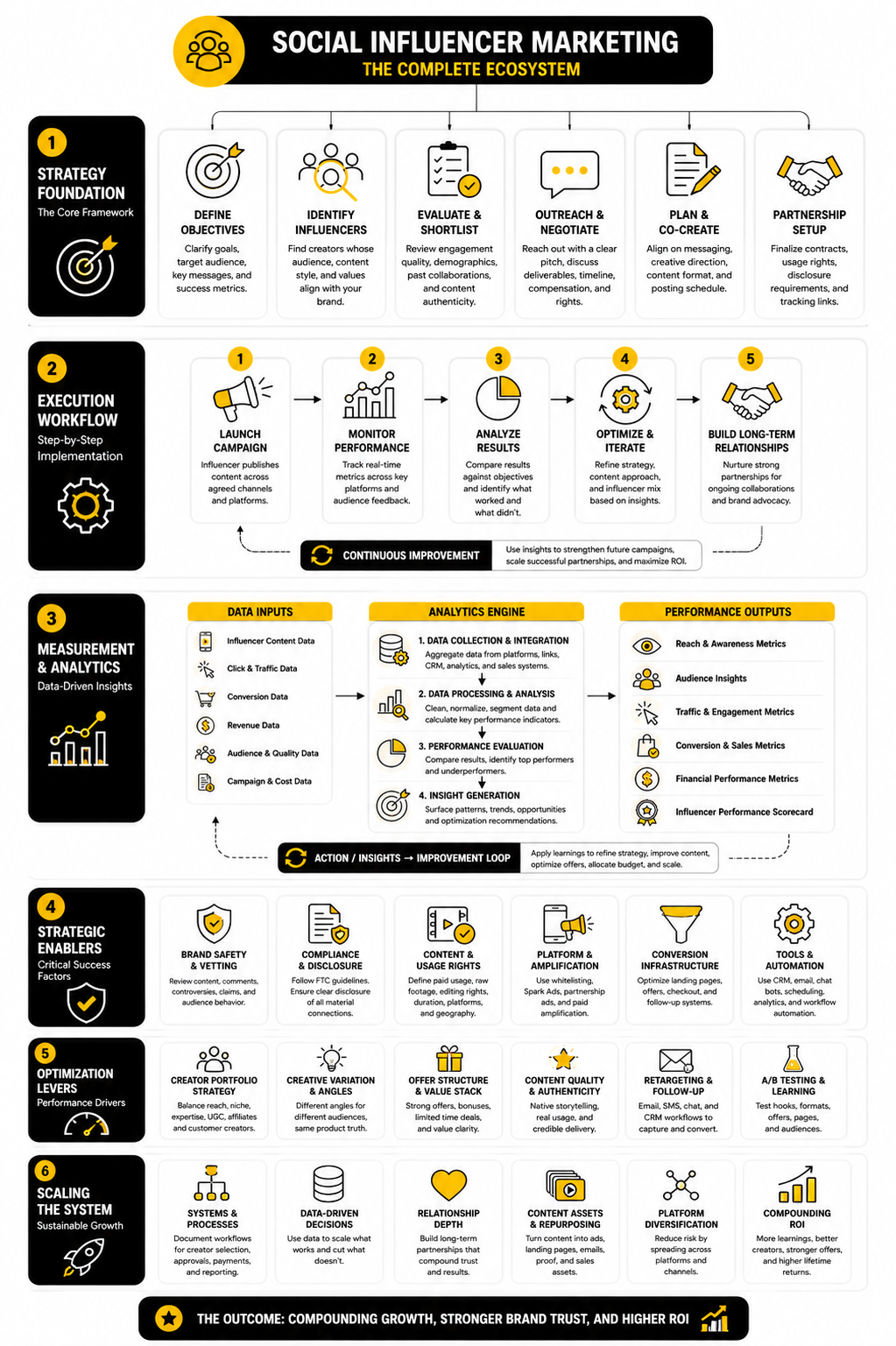
The Mistakes That Quietly Kill Campaigns
The first mistake is choosing creators only because they look popular. Popularity can help, but it does not guarantee relevance, trust, or buying intent. A large audience with weak fit usually creates expensive noise.
The second mistake is forcing creators to sound like the brand. This defeats the point of working with creators in the first place. The brand should control the product truth, claims, compliance rules, and offer, but the creator needs enough room to communicate in their own voice.
The third mistake is underbuilding the conversion path. If the creator sends people to a slow homepage, a generic product page, or a form with no follow-up, the campaign will leak demand. Social influencer marketing needs a full path from attention to action.
Compliance Is Not Optional
Influencer campaigns need clear disclosure when there is a material relationship between the creator and the brand. That includes payment, free products, affiliate commissions, gifts, employment, family relationships, or other incentives that could affect how the audience interprets the recommendation. The FTC’s guidance on endorsements, influencers, and reviews makes this a core part of responsible marketing, not a nice-to-have.
Disclosure should be easy to notice and easy to understand. Vague language, buried tags, unclear abbreviations, or hidden disclosures can create risk and damage trust. The safer approach is simple, direct wording that tells the audience what relationship exists.
Brands should also review claims before content goes live. If a creator says a product guarantees a result, cures a condition, replaces professional advice, or performs beyond what the brand can prove, the campaign may create legal and reputational problems. Strong influencer marketing is persuasive, but it still has to be truthful.
The Tool Stack Should Match the Workflow
Tools should support the influencer program, not complicate it. A small brand can start with spreadsheets, shared folders, creator briefs, trackable links, and a simple CRM. A larger brand may need dedicated systems for creator discovery, contract management, payments, affiliate tracking, content approvals, paid amplification, analytics, and customer follow-up.
For brands turning creator traffic into leads, sales calls, and nurture sequences, GoHighLevel can support CRM, automation, funnels, booking, and follow-up in one place. For brands that need campaign-specific landing pages, Replo can help create more focused ecommerce pages instead of sending every creator audience to the same generic destination. For comment-to-DM flows and social conversation capture, ManyChat can be useful when the campaign needs fast, structured follow-up.
The important thing is not having the longest tool list. The important thing is having a stack that helps the team move from creator selection to content approval, publication, tracking, conversion, and reporting without losing context. If a tool does not make that workflow clearer, it is probably a distraction.
What is social influencer marketing?
Social influencer marketing is the use of creators, experts, public figures, customers, or niche personalities to promote a brand through social platforms and creator-led channels. The creator brings attention, credibility, and audience relationship, while the brand provides the product, offer, and campaign goal. When it is done well, the partnership feels useful to the audience instead of forced.
How is social influencer marketing different from traditional advertising?
Traditional advertising usually starts with the brand’s own message and pays to distribute it. Social influencer marketing starts with a creator’s relationship with an audience and uses that trust to introduce, explain, or validate an offer. The difference matters because the creator’s voice is not just media placement; it is part of the persuasion.
Does influencer marketing still work?
Yes, but the lazy version works less often. Paying random creators for generic posts is not a reliable strategy. The channel works when the creator has real audience fit, the content feels native, the offer is relevant, and the brand has a clear measurement and follow-up system.
How do I choose the right influencer?
Start with the buyer, not the creator. Identify who your audience already trusts when they think about the problem your product solves, then evaluate creators based on audience quality, relevance, content style, engagement substance, brand safety, and past sponsored performance. Follower count should be considered, but it should not be the main decision factor.
Are micro-influencers better than large influencers?
Micro-influencers can be better when the campaign depends on trust, niche relevance, and practical recommendations. Larger influencers can be better for broad awareness, launch visibility, and cultural reach. The best choice depends on the objective, offer, platform, and buying context.
What metrics should I track in an influencer campaign?
Track the metrics that match the campaign objective. For awareness, review reach, watch time, completion rate, saves, shares, sentiment, branded search movement, and content recall. For performance, track clicks, landing page conversion rate, leads, purchases, booked calls, revenue, customer acquisition cost, repeat purchase quality, and creator-level return.
How much should I pay influencers?
There is no universal rate because pricing depends on platform, audience size, category, production effort, usage rights, exclusivity, creator demand, and expected deliverables. A short organic post with no usage rights should not be priced the same as content the brand can run in paid ads for six months. Always separate the cost of the creator’s audience from the cost of content usage.
Should I use affiliate deals with influencers?
Affiliate deals can work well when creators are comfortable with performance-based partnerships and the product has a clear conversion path. They are especially useful for long-term creator relationships, niche audiences, and products with strong repeat purchase or subscription value. They are less effective when the creator has to do heavy education, high-effort production, or brand-building work without guaranteed compensation.
What should be included in an influencer brief?
A strong brief should include the campaign goal, target audience, product truth, key benefits, required claims, prohibited claims, disclosure instructions, offer details, tracking links, deliverables, deadlines, approval process, and usage rights. It should also explain the buyer problem and desired takeaway. The brief should guide the creator, not turn them into a brand robot.
Do influencers need to disclose sponsored content?
Yes. If there is a material connection between the creator and brand, the audience needs to understand that relationship. This includes paid posts, gifted products, affiliate commissions, free trips, employment, or other incentives. Clear disclosure protects the audience, the creator, and the brand.
Can influencer content be used in paid ads?
Yes, but only when the brand has the correct rights and permissions. Paid usage, whitelisting, partnership ads, Spark Ads, raw footage, editing rights, duration, platforms, and geographic scope should be defined before the campaign goes live. If those rights are not included, the brand should not assume it can reuse the content freely.
What is the biggest mistake brands make with social influencer marketing?
The biggest mistake is treating influencer marketing as a post purchase instead of a system. The creator post is only one part of the channel. The real performance comes from the full setup: strategy, creator fit, content angle, offer, tracking, landing page, follow-up, usage rights, and campaign review.
How long should an influencer campaign run?
A simple launch or test campaign may run for a few days or weeks, but a serious influencer program should be evaluated over multiple creator tests and several content cycles. One post is rarely enough to understand the full potential of a creator, platform, or angle. The best programs build learning over time.
Should B2B brands use social influencer marketing?
Yes, but the creator profile often looks different from consumer campaigns. B2B influence may come from operators, consultants, analysts, founders, educators, niche newsletter writers, podcast hosts, or respected practitioners. The content usually needs more substance, clearer proof, and a conversion path that matches a longer buying cycle.
What makes an influencer campaign scalable?
Scalability comes from repeatable systems, not random viral moments. The brand needs a consistent creator selection process, clear contracts, reusable briefs, strong tracking, clean landing pages, reliable follow-up, content rights, and a scorecard for renewals. Once those pieces are in place, the brand can scale what is already working instead of guessing louder.
Build a stronger local presence with BAAM AI
Turn your website, Google profile, social channels, and AI visibility into one growth engine
Most businesses do not need more random marketing activity. They need a consistent presence system that helps the right people find them, trust them, and take action. BAAM AI brings strategy, local SEO, website updates, Google Maps visibility, social content, AI-search readiness, media production, and reporting into one practical monthly engine.
If you want your marketing to keep working after the campaign ends, start with a free BAAM AI presence audit. See how your business shows up today and where the fastest visibility wins are at BAAM AI.