
BAAM AI Blog
Social Digital Marketing: A Practical Framework For Turning Attention Into Revenue
Social digital marketing is the work of using social platforms, content, conversations, paid media, automation, and customer data to attract the right audience, build trust, and move people toward a measurable...
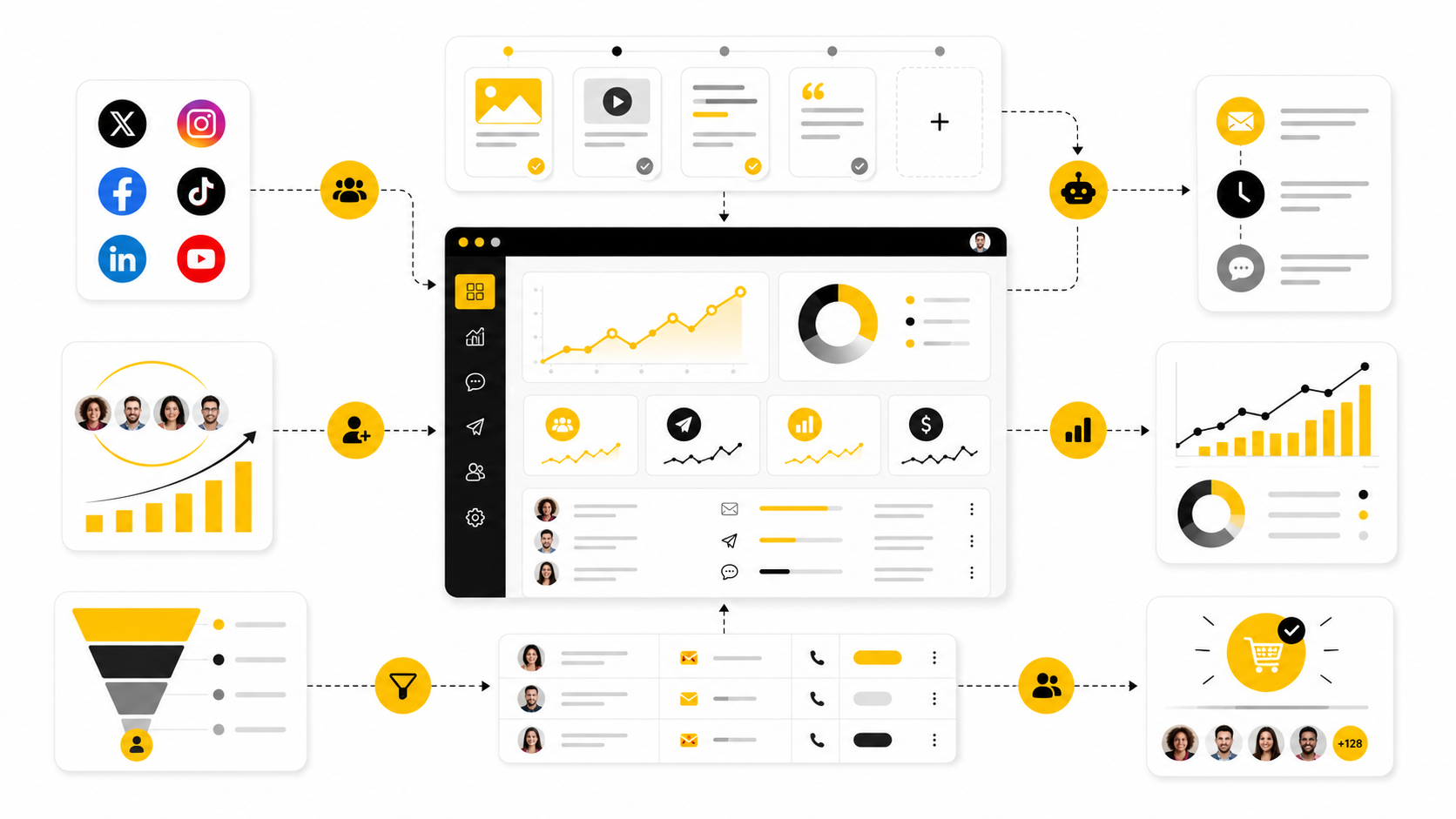
Social digital marketing is the work of using social platforms, content, conversations, paid media, automation, and customer data to attract the right audience, build trust, and move people toward a measurable business outcome. It is not just posting on Instagram, running ads, or chasing whatever format is trending this week. Done well, social digital marketing connects the public side of your brand with the operational side of your business: messaging, offers, funnels, email, CRM, sales follow-up, retention, and reporting.
That connection matters because social media is no longer a side channel. More than 5.6 billion social media user identities were active worldwide in late 2025, and global internet use has now passed 6 billion people. For most buyers, social content is not the whole journey, but it is often where discovery, comparison, proof, objection-handling, and brand memory begin.
The mistake many businesses make is treating social digital marketing as a content calendar problem. They ask what to post, how often to post, or which platform is best, before they understand the system behind the content. A stronger approach starts with positioning, then builds a repeatable framework for content, distribution, conversion, automation, measurement, and optimization.
this guide breaks that system into six practical parts. Each part builds on the one before it, so by the end, you will have a complete way to think about social digital marketing without drowning in tactics.
Social Digital Marketing Foundations
Social digital marketing begins with a simple idea: attention only matters when it can be turned into trust, action, and long-term customer value. A viral post can create awareness, but awareness without a next step usually disappears quickly. The goal is to design a system where each touchpoint helps the buyer understand the problem, believe in the solution, and feel confident enough to continue.
That system includes organic content, paid promotion, direct messaging, landing pages, email sequences, CRM follow-up, analytics, and customer feedback. Some brands keep those pieces separate, which makes the work feel scattered and hard to measure. Better brands connect them, so a comment, click, form fill, booked call, purchase, or repeat order can be understood as part of one customer journey.
This is where the word “digital” matters. Social media creates the front-facing relationship, but digital infrastructure turns that relationship into something trackable and scalable. A practical social digital marketing strategy should therefore answer two questions at the same time: why would someone care, and what should happen next?
Why Social Digital Marketing Matters Now
Social platforms have become discovery engines, research tools, community spaces, customer service channels, and sales assistants all at once. Buyers use them to compare brands, judge credibility, watch product demonstrations, read comments, save ideas, and ask questions before they ever land on a website. That means your social presence is often doing sales work before your sales process officially begins.
The volume of activity is hard to ignore. Social media user identities grew by 259 million year over year as of October 2025, which shows that social behavior is still expanding rather than fading. At the same time, platforms are more competitive, feeds are more fragmented, and audiences are more selective about what they trust.
That is why random posting is not enough anymore. A brand needs a clear point of view, useful content, proof, consistent distribution, and a smooth path from interest to conversion. Social digital marketing matters because it gives that whole process structure instead of leaving growth to chance.
The Framework Overview
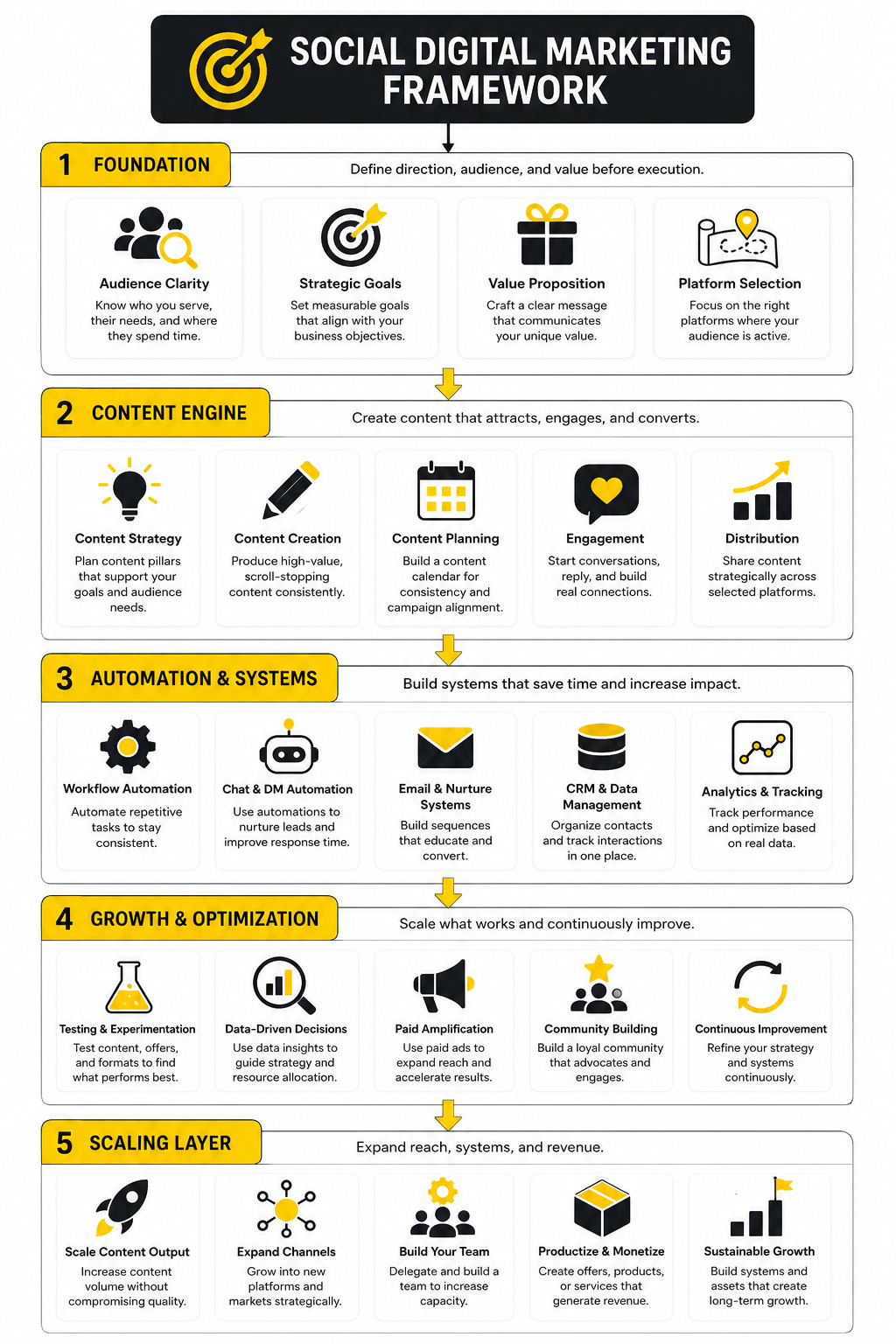
A useful framework for social digital marketing has four layers: strategy, content, conversion, and optimization. Strategy defines who you serve, what they need, how you are different, and which platforms deserve attention. Content turns that strategy into visible proof through education, perspective, entertainment, comparison, authority, and community.
Conversion is where interest becomes a measurable action. That could mean joining an email list, starting a chat conversation through a tool like ManyChat, booking a call, downloading a resource, requesting a quote, or buying directly from a landing page. For ecommerce and creator-led offers, a focused landing page built with a tool like Replo or a funnel builder like ClickFunnels can make the difference between attention that leaks and attention that converts.
Optimization closes the loop. It uses performance data, customer responses, sales outcomes, and content feedback to improve the system over time. Without optimization, social digital marketing becomes a guessing game; with it, every campaign teaches you what to do next.
Core Components Of Social Digital Marketing
The first component is audience clarity. You need to know who you are speaking to, what problem they are trying to solve, what they already believe, what they are skeptical about, and what kind of proof helps them move forward. Without that clarity, content tends to become either too broad or too self-centered.
The second component is content architecture. A strong social presence usually includes content that educates, demonstrates, differentiates, relates, proves, and converts. The mix changes by brand and platform, but the principle stays the same: people need more than promotional posts before they trust you.
The third component is conversion infrastructure. This includes landing pages, forms, calendars, chat flows, email follow-up, CRM pipelines, and reporting. Tools like GoHighLevel, Brevo, Buffer, and Fillout can support different parts of that system, but the tool is never the strategy by itself.
Professional Implementation
Professional implementation starts by choosing a business goal before choosing a tactic. A local service business may care most about booked appointments, while a software company may care about qualified trials, and an ecommerce brand may care about repeat purchase behavior. The content, platform mix, funnel, and reporting should all reflect that goal.
The next step is building a workflow that a real team can actually maintain. That means planning content themes, creating assets in batches, repurposing intelligently, scheduling posts, responding to comments and messages, and reviewing performance at a consistent rhythm. A simple system that runs every week beats an ambitious system that collapses after ten days.
The final step is connecting creative decisions to commercial outcomes. The best social digital marketing teams do not only ask which post got the most likes. They ask which messages created qualified conversations, which offers produced action, which audiences moved through the funnel, and which patterns should shape the next campaign.
Audience, Positioning, And Platform Strategy
The next layer of social digital marketing is deciding who you are trying to reach, what you want them to believe, and where your message has the best chance of being noticed. This sounds basic, but it is where a lot of campaigns quietly fail. They start with platform tactics before the business has made the harder strategic decisions.
A good strategy does not try to be everywhere at once. It chooses the audience, the promise, the angle, the channel mix, and the conversion path with intention. When those choices are clear, content gets easier, paid campaigns get sharper, and reporting becomes more useful because you know what you are actually trying to prove.
The practical question is not “Which social platform is best?” The better question is “Where does our specific buyer pay attention, compare options, ask questions, and make decisions?” That shift keeps your social digital marketing grounded in buyer behavior instead of platform hype.
Start With The Buyer, Not The Platform
Your buyer is not just a demographic profile. Age, location, income, job title, and industry can help, but they do not explain the whole decision. What matters more is the situation your buyer is in, the problem they are trying to solve, the result they want, and the friction stopping them from acting.
A strong buyer profile should describe what the person already knows, what they have tried before, what they misunderstand, and what they need to see before they trust you. That gives your content real direction. Instead of posting generic tips, you can create posts that answer the exact questions sitting between awareness and action.
For example, a beginner does not need the same message as a skeptical buyer comparing three providers. A founder who knows they need more leads does not need the same content as a marketing manager trying to justify budget to a team. Social digital marketing works better when those differences shape the strategy from the beginning.
Define The Problem In The Customer’s Words
Positioning gets stronger when you stop describing the offer only from your side. Most brands naturally talk about features, deliverables, tools, and processes. Buyers usually think in terms of pain, risk, opportunity, status, convenience, and outcomes.
That does not mean you should exaggerate the problem. It means you should translate your value into language the buyer already recognizes. A business owner may not wake up thinking, “I need a better omnichannel nurture system,” but they may absolutely think, “Too many leads go cold after they message us.”
That difference matters because social content moves fast. If the first line of a post feels abstract, people scroll. If the first line names a real situation clearly, the right person pauses because they feel understood.
Build A Positioning Angle That Is Easy To Remember
A positioning angle is the simple idea you want the market to associate with you. It is not a slogan you paste everywhere. It is the strategic thread behind your content, offers, proof, and point of view.
Strong positioning usually answers three questions. Who is this for, what problem does it solve, and why is this approach different from the obvious alternatives? If you cannot answer those questions plainly, your content will probably sound like everyone else’s.
This is especially important in crowded categories. Most audiences have already seen the usual claims about saving time, increasing revenue, improving engagement, or growing faster. Your job is to make the promise more specific, more credible, and more connected to the buyer’s real situation.
Match Platforms To Buyer Behavior
Each platform has a different role in the customer journey. Some are stronger for discovery, some are better for education, some support community, and some make direct response easier. Treating every platform the same usually leads to watered-down content that fits nowhere perfectly.
LinkedIn may work well when the buyer needs professional context, proof, and authority. TikTok, Instagram Reels, and YouTube Shorts can work when the idea is visual, fast, and easy to demonstrate. YouTube can support deeper education, while Facebook Groups, communities, and direct messaging can help with conversation and follow-up.
The key is to choose platforms based on how your audience behaves, not based on what marketers are currently excited about. A platform is only useful if your buyer is there in the right mindset and your team can create content that fits the environment consistently.
Choose A Primary Channel Before Expanding
Most small teams should choose one primary channel and one or two support channels. The primary channel is where you build your strongest presence, learn fastest, and publish with the most consistency. Support channels help with repurposing, retargeting, search visibility, or customer communication.
This is not about playing small. It is about building enough focus to get real feedback. If you spread limited creative energy across five platforms too early, you may never give any one channel enough quality or consistency to work.
Once the primary channel starts producing patterns, expansion becomes much easier. You can repurpose proven ideas, adapt formats, and build distribution without guessing from zero. That is how social digital marketing becomes a system instead of a constant scramble.
Create Message Pillars Before Content Ideas
Message pillars are the recurring themes your brand needs to own. They keep your content from becoming random and help your audience understand what you stand for. A good set of pillars also makes it easier to plan content without repeating the same post in slightly different words.
For most businesses, useful pillars include the problem, the method, the proof, the objections, the buyer’s mistakes, the opportunity, and the next step. These themes can turn into educational posts, short videos, carousels, email topics, webinars, landing page sections, and sales scripts. The same strategic thinking can power many different formats.
This is where tools can help, but only after the message is clear. A scheduling tool like Buffer can support consistency, and a CRM-focused platform like GoHighLevel can help connect social activity to follow-up. But the tool will not fix vague positioning or weak messaging.
Map Content To Awareness Levels
Not every follower is ready to buy. Some people are just discovering the problem, some are actively comparing options, and some are waiting for the right reason to act. If your content only speaks to one stage, you leave a lot of potential demand untouched.
Top-of-funnel content should make the problem clear and relevant. Middle-of-funnel content should explain your method, compare approaches, handle objections, and show proof. Bottom-of-funnel content should make the next step obvious, low-friction, and valuable.
This creates a healthier content mix. You are not selling in every post, but you are also not hiding the offer forever. The audience gets value at each stage, and the business still has a clear path to revenue.
Make The Next Step Fit The Buyer’s Intent
A common mistake is asking for too much too early. Someone who just watched a short video may not be ready for a sales call, but they might be ready to save a checklist, answer a poll, join a list, or start a chat. The next step should match the level of trust already created.
For warmer prospects, a stronger call to action makes sense. That could be a booked consultation, a product demo, a trial, a quote request, or a focused landing page. For buyers who need more education first, an email sequence, guide, webinar, or messaging flow may perform better.
This is where social digital marketing becomes more than content. If someone shows intent, the system should know what happens next. A form built with Fillout, a booking flow through Cal.com, or an email platform like Brevo can turn interest into a cleaner buyer journey.
Keep The Strategy Simple Enough To Execute
The best strategy is not the one with the most moving parts. It is the one your team can actually run, measure, and improve. Complexity feels impressive in planning, but it often breaks during execution.
A practical strategy should fit on one page. It should include the audience, the core problem, the positioning angle, the primary platform, the message pillars, the content rhythm, the conversion path, and the main success metric. If those pieces are clear, the day-to-day work becomes much easier.
This foundation prepares the next part of the article: content systems. Once you know who you are speaking to and what you need them to understand, the next challenge is building content that earns attention without losing strategic discipline.
Content Systems That Build Trust
Once the audience and positioning are clear, the next job is execution. This is where social digital marketing becomes visible to the market. Your strategy has to turn into posts, videos, stories, emails, landing page copy, conversations, and offers that people can actually experience.
Trust does not come from one perfect post. It comes from repeated signals that tell the buyer you understand their problem, have a real point of view, and can help them make a better decision. That is why content should be treated as a system, not a collection of disconnected ideas.
A content system gives your team a repeatable way to create useful material without starting from scratch every week. It keeps your message consistent while still leaving room for platform trends, timely reactions, and creative testing. That balance matters because rigid content feels stale, but random content is impossible to scale.
Turn Strategy Into Content Themes
Content themes are the bridge between positioning and production. They translate your audience research into repeatable topics your brand can speak about with authority. Instead of asking “What should we post today?” you ask “Which part of the buyer’s decision do we need to support?”
A strong theme should connect to a real customer question, objection, desire, or misconception. For example, if your audience struggles to turn followers into leads, one theme could focus on conversion paths from social content. Another theme could explain why engagement alone does not prove commercial intent.
The goal is not to create endless categories. Four to seven strong themes are usually enough for most brands. Each theme should be broad enough to produce multiple pieces of content, but specific enough that your audience immediately understands why it matters.
Build Content Around Buyer Questions
The easiest way to make content useful is to answer the questions buyers already have. Those questions usually show up in sales calls, comments, support tickets, reviews, competitor comparisons, community threads, and direct messages. If your team is not collecting them, you are probably leaving your best content ideas scattered across the business.
Buyer questions also help you avoid content that sounds clever but does not move anyone closer to action. A strong post can still be entertaining or opinionated, but it should connect back to something the buyer cares about. That is the difference between content that gets a quick reaction and content that builds serious trust.
This is especially important in social digital marketing because attention is easy to misread. A post can perform well because it is controversial, funny, or familiar, while doing very little to attract qualified buyers. Buyer-led content keeps the work tied to the customer journey instead of vanity feedback.
Use A Practical Content Mix
A useful content mix should cover education, proof, perspective, process, objection-handling, and action. Education helps the audience understand the problem and the opportunity. Proof reduces doubt by showing evidence, outcomes, customer language, product details, or real operational clarity.
Perspective gives the brand a reason to be remembered. It shows what you believe, what you reject, and how you think differently from the default advice in the market. Process content makes the work feel tangible by showing how something is planned, built, measured, or improved.
Objection-handling content is often underused, but it is extremely valuable. Buyers hesitate because of time, cost, complexity, risk, trust, internal approval, or past disappointment. If your content can address those concerns before the sales conversation, the whole buyer journey becomes smoother.
Create A Repeatable Execution Workflow
A content system needs an execution workflow that is simple enough to run every week. Without a workflow, even good strategy becomes inconsistent. The team wastes energy deciding what to do next instead of improving the quality of the work.
A practical workflow starts with collecting raw material, then turning it into content ideas, choosing the best formats, producing the assets, publishing consistently, engaging with responses, and reviewing performance. This does not need to be complicated. It just needs to be visible and repeatable.
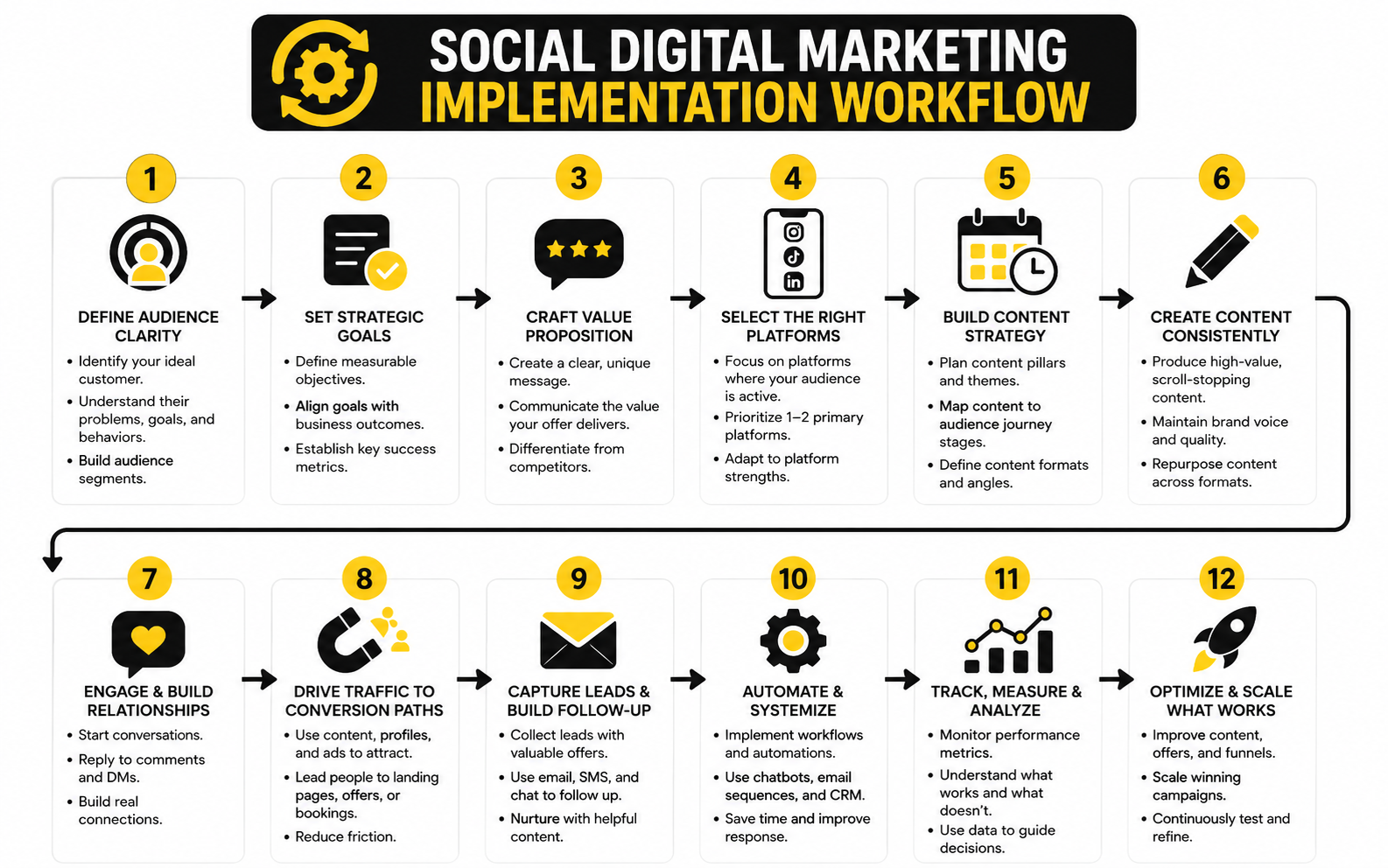
A simple execution process can look like this:
This process works because it separates thinking from production. You are not trying to research, write, design, publish, and analyze at the same time. Each step has a clear purpose, which makes the system easier to manage and easier to improve.
Match Format To Intent
Not every idea belongs in every format. A complex comparison may need a carousel, long-form post, blog article, or video breakdown. A simple insight may work better as a short post, Reel, TikTok, or YouTube Short.
The format should serve the message. Short-form video is useful when the idea can be shown quickly, explained with energy, or turned into a memorable angle. Longer content works better when the buyer needs depth, nuance, proof, or a step-by-step explanation.
This is where many teams create unnecessary friction. They decide they need more video, more carousels, or more threads before deciding what the content actually needs to accomplish. Start with the job of the content, then choose the format that gives that message the best chance to land.
Repurpose Without Copying And Pasting
Repurposing is not taking one post and dumping it everywhere unchanged. That usually feels lazy because each platform has its own pace, structure, and audience expectation. Good repurposing keeps the core idea but adapts the hook, format, depth, and call to action.
A strong long-form idea can become a short video, a carousel, an email, a LinkedIn post, a sales enablement note, and a landing page section. But each version should feel native to where it appears. The audience should not feel like they are seeing a resized asset that was made for somewhere else.
This is one of the biggest leverage points in social digital marketing. You do not need a brand-new idea for every channel every day. You need a disciplined way to extract more value from the ideas that already deserve attention.
Build A Content Library
A content library keeps your best ideas, hooks, proof points, objections, examples, captions, visuals, and calls to action in one place. This sounds simple, but it prevents a lot of wasted effort. Without a library, teams forget what worked and keep rebuilding the same assets from memory.
The library should include both finished content and raw ingredients. Finished content helps with republishing, updating, and adapting. Raw ingredients help with future campaigns because your team can quickly pull customer language, market insights, sales questions, and product details.
This also makes onboarding easier. When a new writer, designer, editor, strategist, or freelancer joins the process, they can understand the brand faster. Instead of guessing the voice and message, they can study the patterns that already work.
Add AI Without Losing The Human Edge
AI can speed up research organization, brainstorming, repurposing, editing, and workflow management. It can help turn one strong idea into multiple outlines, identify gaps in a content calendar, or reshape a message for different platform formats. Used well, it makes the team faster.
But AI should not replace judgment, customer understanding, or brand taste. Social audiences are already sensitive to content that feels generic, over-polished, or disconnected from real experience. If the content could have been written by any brand in the category, it is probably not strong enough.
Use AI as a production assistant, not the source of the strategy. Your strongest material should still come from customer conversations, sales feedback, product insight, founder perspective, market experience, and real proof. That human edge is what makes content worth trusting.
Make Engagement Part Of The Process
Publishing is not the finish line. Comments, replies, shares, saves, DMs, and mentions are part of the content system because they reveal what people care about. They also create opportunities to deepen trust in public and private conversations.
A smart team reviews engagement for meaning, not just volume. A smaller post that creates qualified questions may be more valuable than a larger post that attracts broad but irrelevant attention. The best responses often become future content because they show exactly what the audience wants clarified.
This is why community management should not be treated as an afterthought. The way a brand replies, explains, redirects, and follows up can shape perception as much as the original content. In social digital marketing, the conversation around the content is often where the real buying signals appear.
Connect Content To The Next Step
Every content system needs a path forward. Not every post should sell directly, but your audience should never be confused about how to go deeper. That might mean subscribing, downloading a resource, joining a webinar, starting a chat, booking a call, or viewing a focused offer page.
The call to action should fit the content and the buyer’s readiness. Educational content may lead to a guide or email sequence. Comparison content may lead to a demo or consultation. High-intent content may lead directly to a landing page or checkout.
Tools can support this handoff when the strategy is clear. A chat flow through ManyChat, a funnel in ClickFunnels, or a simple website link hub with Dub.co can help move people from attention to action. The important part is that the next step feels useful, timely, and natural.
Review Content Like A Business Asset
Content should be reviewed with the same seriousness as any other growth asset. That does not mean obsessing over every small metric. It means looking for patterns that help you make better decisions.
Useful review questions include which themes attracted qualified attention, which hooks created meaningful engagement, which formats helped explain the offer, and which calls to action produced movement. The answers should shape the next round of content instead of sitting in a report no one uses.
This is how your content system compounds. Each cycle gives you better audience insight, stronger messaging, clearer proof, and a sharper sense of what deserves more investment. Once that foundation is working, the next step is connecting content to funnels, automation, and lead capture so attention has a reliable path toward revenue.
Statistics And Data
Measurement is where social digital marketing stops being a guessing game. The point is not to collect every number a platform gives you. The point is to understand which signals show attention, which signals show trust, which signals show buying intent, and which signals show revenue impact.
A useful analytics system separates platform performance from business performance. Platform performance tells you how content behaves inside the feed. Business performance tells you whether that attention creates leads, sales conversations, customers, retention, or revenue.
That distinction matters because social metrics can be seductive. A post with high reach may still attract the wrong audience. A post with fewer views may create more qualified leads because it speaks directly to a sharper problem.
Why Benchmarks Need Context
Benchmarks are useful, but only when they are treated as reference points instead of rules. Social media performance changes by industry, platform, audience size, content format, paid budget, offer type, and brand maturity. Comparing a local service business to a global ecommerce brand will create bad decisions fast.
Recent benchmark reports show how wide the spread can be. Hootsuite’s 2026 benchmark data shows different engagement patterns by industry and platform, including cases where posting frequency and engagement do not move in a straight line across Facebook, Instagram, LinkedIn, and X. Sprout Social’s 2025 benchmark work was built from billions of messages across more than one million public profiles, which is useful at a macro level, but still needs to be filtered through your own audience and business model.
Use benchmarks to spot obvious underperformance, not to define success by themselves. If your engagement, click-through rate, lead quality, or conversion rate is far below your category average, that is worth investigating. But the real question is always whether your numbers are improving against your own baseline and producing the outcome the business actually needs.
The Four Levels Of Social Digital Marketing Measurement
A clean measurement system has four levels: attention, engagement, conversion, and revenue. Attention shows whether people are seeing the content.
Paid Social, Retargeting, And Performance Tracking
Once content has a working rhythm, paid social can help the best ideas reach more of the right people. This is where social digital marketing becomes more technical, more expensive, and more sensitive to bad assumptions. Paid distribution can accelerate growth, but it can also accelerate waste if the message, offer, and measurement system are weak.
The goal is not to boost every post or copy what competitors appear to be doing. The goal is to use paid media to test demand, scale proven messages, retarget engaged audiences, and create a more predictable path from attention to revenue. That requires discipline because paid social rewards clarity much more than complexity.
A strong paid strategy starts with the same foundation as organic: audience, positioning, content, and conversion path. The difference is that paid media exposes weak points faster. If the hook is unclear, the offer is vague, the landing page is slow, or the follow-up is messy, you will see it in the numbers.
Scale The Message Before You Scale The Budget
The first advanced rule is simple: do not scale spend until the message has evidence behind it. If an organic post, sales call theme, email angle, or customer objection keeps showing up as important, that is a better paid media starting point than a random campaign idea. Paid social performs best when it amplifies something the market already responds to.
This does not mean organic engagement automatically predicts paid performance. A funny or polarizing post might get attention without attracting buyers. But organic feedback can reveal language, pain points, hooks, and objections that are worth testing in a controlled paid campaign.
Budget should follow learning, not ego. Start by testing a small number of clear angles, then increase spend behind the ones that show qualified intent. If a campaign cannot produce useful signals at a smaller scale, throwing more money at it usually makes the problem louder, not better.
Understand The Tradeoff Between Reach And Precision
One of the biggest strategic tradeoffs in paid social is reach versus precision. A broad audience gives the platform more room to find patterns, but it can waste spend if the creative is too generic. A narrow audience can feel safer, but it may limit learning, raise costs, and fatigue quickly.
The right choice depends on offer clarity, market size, budget, and creative quality. If the offer has broad appeal and the creative clearly qualifies the viewer, broader targeting can work well. If the offer is specialized, high-ticket, or tied to a very specific buyer profile, stronger audience constraints may still be useful.
The creative has to do more of the targeting than many people expect. A strong ad should attract the right person and quietly repel the wrong one. That is why sharp hooks, specific pain points, and clear use cases matter so much in social digital marketing.
Treat Creative Fatigue As A Business Risk
Creative fatigue happens when an audience has seen the same message or format too many times and performance starts to decline. You may see falling click-through rates, rising costs, weaker conversion rates, lower engagement quality, or more negative feedback. The danger is that teams often notice fatigue too late because they are only watching surface metrics.
Fatigue is not just a media buying issue. It is a strategy issue. If your campaign relies on one winning ad for too long, your acquisition system becomes fragile because performance depends on an asset that will eventually lose strength.
The solution is not to create random new ads every week. The solution is to build a creative pipeline with controlled variation. Test different hooks, proof points, objections, formats, offers, and audience entry points while keeping the strategic promise consistent.
Build Retargeting Around Intent Signals
Retargeting works best when it respects the level of intent someone has already shown. A person who watched a short video for three seconds is not the same as someone who visited a pricing page, started a checkout, filled out a form, or sent a direct message. Treating all warm audiences the same creates lazy follow-up.
Low-intent audiences may need more education, proof, or problem framing. Mid-intent audiences may need comparison content, objection-handling, testimonials, or a stronger explanation of the process. High-intent audiences may need urgency, a cleaner offer, a reminder, or a direct path back to the next step.
This is where the earlier content system becomes valuable. Retargeting should not be a pile of discount ads chasing people around the internet. It should be a structured sequence that answers the next question a serious buyer is likely to have.
Use Funnels Without Making The Journey Feel Mechanical
Funnels are useful because they give the buyer journey structure. They help you decide what happens after someone clicks, subscribes, books, replies, or buys. But a funnel becomes a problem when it feels like a trap instead of a helpful path.
A good funnel gives people the right amount of information at the right moment. It reduces confusion, removes friction, and makes the next step obvious. A bad funnel overcomplicates the journey with too many pages, too many upsells, weak copy, or generic automation that ignores buyer intent.
For businesses that need a focused path from ad or content to conversion, ClickFunnels, Systeme.io, and GoHighLevel can all support different funnel setups. The important part is not the software choice. The important part is whether the funnel matches the buyer’s actual decision process.
Protect The Brand While Chasing Performance
Performance marketing can create pressure to push harder, promise more, and optimize for short-term clicks. That pressure is dangerous when it starts to damage trust. A brand can win the click and still lose the customer if the message feels exaggerated, manipulative, or disconnected from the real experience.
Brand safety also matters because social platforms are unpredictable environments. Ads can appear near content that does not fit the brand, comment sections can shift tone quickly, and algorithmic distribution can put messages in front of audiences outside the original plan. A mature social digital marketing strategy needs guidelines for claims, creative boundaries, moderation, escalation, and response.
This does not mean the brand should become boring. It means the team should know the difference between a strong angle and a reckless one. Strong creative earns attention without creating future trust debt.
Balance Platform Data With Business Reality
Ad platforms are useful, but they do not see the whole business. They may over-credit their own role, undercount delayed conversions, miss offline sales, or struggle with cross-device behavior. If you only trust platform dashboards, you may make confident decisions from incomplete information.
Business reality includes CRM data, sales quality, refund rates, customer lifetime value, pipeline movement, booked-call show rates, and actual revenue. A campaign that looks expensive inside the ad account may still be profitable if it brings in better customers. A campaign that looks cheap may be weak if the leads never close.
This is why tracking has to connect the media layer to the commercial layer. For service businesses and agencies, a CRM like GoHighLevel can help connect campaigns to conversations, appointments, pipelines, and follow-up. For email-heavy journeys, platforms like Brevo or Moosend can support the nurture layer after the first click.
Know When To Add Automation
Automation should remove friction, not create distance. It is useful when it helps people get faster answers, receive relevant follow-up, book more easily, or move through a process without waiting on manual work. It becomes harmful when it makes a warm prospect feel ignored or handled by a machine.
The right automation depends on the buying cycle. A low-ticket offer may need fast email follow-up, abandoned checkout reminders, and simple segmentation. A high-ticket service may need lead qualification, appointment reminders, sales pipeline stages, and personal follow-up tasks.
Chat automation can be especially useful when social engagement turns into direct messages. A tool like ManyChat can help route interest from comments or DMs into a more structured flow. The key is to keep the experience helpful and clear, not robotic.
Prepare For Scaling Problems Before They Hit
Scaling social digital marketing creates new problems. More traffic can expose weak landing pages. More leads can overwhelm sales follow-up. More comments can strain community management. More campaigns can make reporting messy if naming conventions, tracking links, and ownership are unclear.
This is why operations matter earlier than most teams think. Before increasing volume, make sure the team can handle the extra activity. That includes response times, lead routing, content approvals, creative production, tracking discipline, and customer support.
Scaling also changes the cost of mistakes. A vague claim in one organic post may disappear quickly. A vague claim in a paid campaign with serious spend behind it can create wasted budget, low-quality leads, compliance issues, or customer disappointment. Growth needs speed, but it also needs control.
Make Expert Decisions With A Testing Roadmap
Advanced social digital marketing is not about guessing more carefully. It is about testing in a way that compounds. A testing roadmap helps the team decide which assumptions matter most and which experiments should happen first.
The best tests are tied to meaningful business questions. Which audience segment has the strongest buying intent? Which offer creates better lead quality? Which proof point reduces hesitation? Which landing page angle produces more qualified conversions? Which follow-up sequence improves show rates or repeat purchases?
Do not test everything at once. Isolate the variable, give the test enough time to produce a useful signal, and document what changed. The value of testing is not just the winning version. The value is the learning that makes the next decision sharper.
Keep Organic, Paid, And Sales Aligned
Organic content, paid campaigns, and sales conversations should not operate like separate departments. They are different parts of the same growth system. Organic content reveals what the market responds to, paid media scales the strongest angles, and sales feedback shows which messages create real buying momentum.
When those loops are connected, the whole system improves faster. Sales objections become content topics. Strong organic posts become ad tests. Paid campaign comments reveal new objections. Customer wins become proof assets.
This alignment is what separates mature teams from teams that constantly chase tactics. Social digital marketing gets much more powerful when every channel is feeding insight back into the others. That is the bridge into the final part: optimization, tools, FAQs, and the next steps for building a system that keeps improving.
Optimization, Tools, And Next Steps
At this stage, the social digital marketing system has all the major pieces: audience strategy, positioning, content, conversion paths, paid distribution, automation, and performance feedback. The final challenge is making those pieces work together without turning the operation into a mess. That is where optimization matters.
Optimization is not just changing a headline, testing a button, or posting at a different time. Those things can help, but they are small moves inside a larger system. Real optimization means improving the quality of attention, the clarity of the message, the strength of the offer, the speed of follow-up, and the reliability of measurement.
This is also where teams need discipline. It is easy to chase the newest platform feature, ad format, AI tool, or growth hack. It is harder, but much more profitable, to keep improving the few parts of the system that actually create revenue.
Build The Final Social Digital Marketing Ecosystem
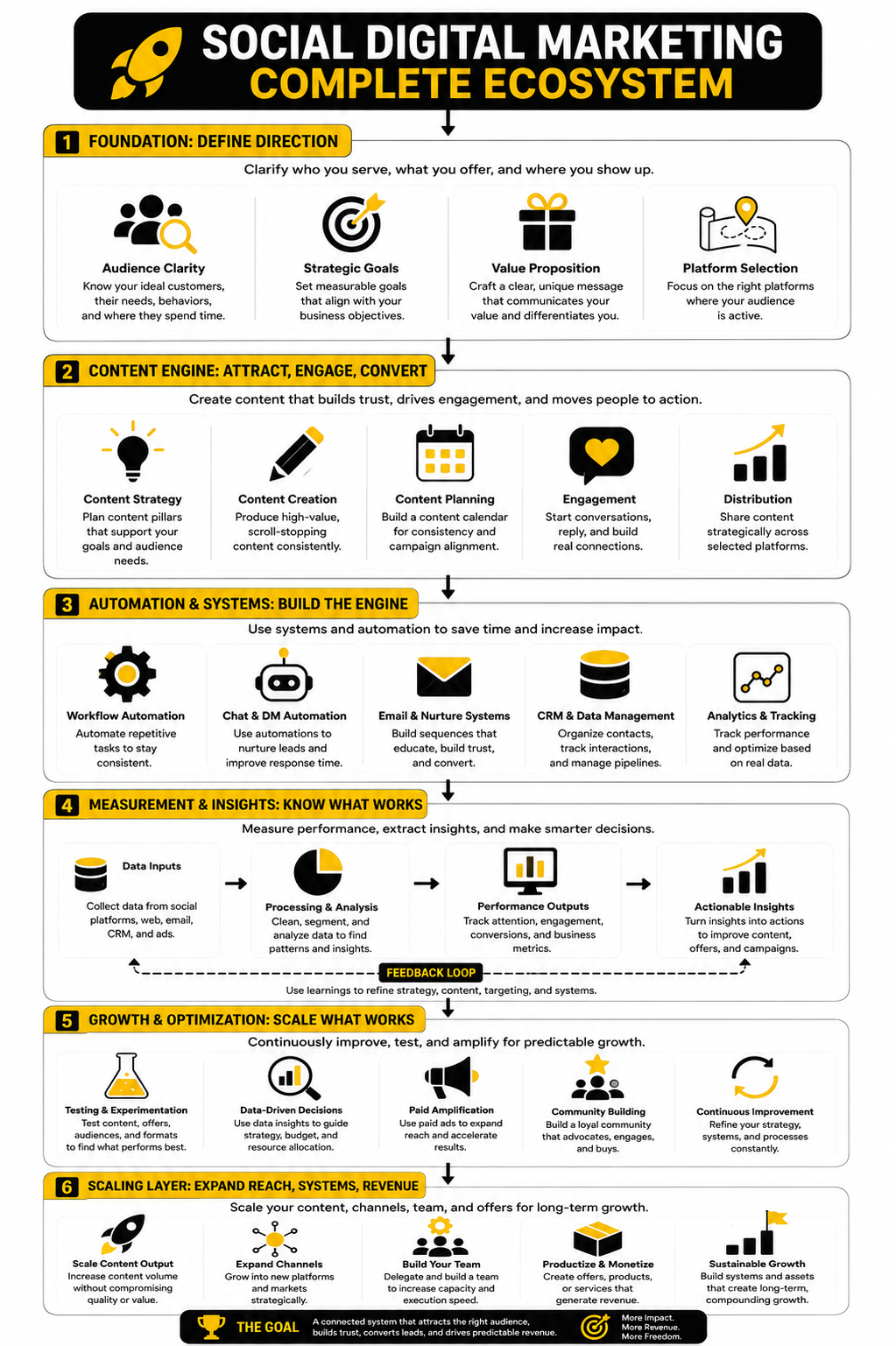
The finished ecosystem should feel connected from the buyer’s point of view. They discover the brand through content, learn through useful material, see proof, take a relevant next step, receive timely follow-up, and get a clear path toward buying. Behind the scenes, the business tracks what happened and uses that data to improve the next cycle.
That ecosystem does not need to be huge. A small business might only need one primary platform, one lead magnet, one landing page, one email sequence, one booking flow, and one basic dashboard. A larger team may need more segmentation, paid campaigns, retargeting paths, CRM stages, creative testing, and sales enablement.
The point is not to make the system impressive. The point is to make it understandable, measurable, and useful. If the team cannot explain how someone moves from first touch to customer, the system is probably too vague.
Choose Tools Around The Workflow
Tools should support the workflow instead of defining it. Start with the job you need done, then choose the simplest tool that can do it reliably. If you reverse that order, you end up paying for features before you have a process mature enough to use them.
For scheduling and content operations, Buffer can help maintain consistency across social channels. For funnel building, ClickFunnels, Systeme.io, and Replo can support different types of landing pages and conversion paths. For CRM, follow-up, and agency-style operations, GoHighLevel can help connect leads, automations, appointments, and pipelines.
For email and nurture, Brevo and Moosend can support ongoing communication after the first conversion. For forms, booking, chat, and support experiences, tools like Fillout, Cal.com, ManyChat, and Chatbase can make the handoff from attention to action smoother.
Keep The System Honest
A social digital marketing system gets dangerous when the team only reports what makes the work look good. Reach can look impressive while sales stay flat. Leads can look cheap while close rates collapse. Engagement can rise while the audience becomes less relevant.
The fix is to define success at multiple levels. Attention metrics show whether people noticed. Engagement signals show whether the message created interest. Conversion metrics show whether people took action. Business metrics show whether the action was worth anything.
This is where honest reporting protects the business. A good dashboard should make it harder to hide weak performance behind surface-level wins. It should help the team ask better questions, make sharper decisions, and improve the system without pretending every campaign is a success.
Improve One Constraint At A Time
Every system has a constraint. Sometimes the constraint is content quality. Sometimes it is weak positioning, poor landing page conversion, slow follow-up, bad lead qualification, low sales close rates, or unclear measurement. The fastest way to improve is to find the constraint and work on that first.
Do not try to fix everything at once. If the offer is unclear, more content will not solve it. If the landing page does not convert, more traffic will only expose the leak faster. If sales follow-up is slow, better ads may just create more missed opportunities.
The best teams diagnose before they act. They look at the full journey, find the most important bottleneck, improve it, then move to the next one. That is how the system compounds without creating chaos.
What is social digital marketing?
Social digital marketing is the use of social platforms, digital content, paid media, automation, analytics, and conversion systems to attract an audience and turn that attention into measurable business results. It includes organic posts, short-form video, social ads, community engagement, direct messaging, landing pages, email follow-up, and CRM activity. The point is not just to be visible, but to create a connected journey from discovery to revenue.
How is social digital marketing different from social media marketing?
Social media marketing often focuses on platform activity such as posting, engagement, and audience growth. Social digital marketing is broader because it connects that activity to digital infrastructure like funnels, analytics, email, automation, and customer relationship management. In simple terms, social media marketing creates attention, while social digital marketing turns that attention into a trackable business system.
Which platform is best for social digital marketing?
There is no universal best platform. The best platform is the one where your specific buyer pays attention, compares options, asks questions, and takes action. LinkedIn may be stronger for B2B authority, TikTok and Instagram may be stronger for visual discovery, YouTube may be stronger for education, and Facebook or community-based channels may be useful for conversation and retargeting.
How often should a business post on social media?
Posting frequency should match your team’s ability to maintain quality and consistency. A strong weekly rhythm that your team can sustain is better than an aggressive schedule that burns out after a month. Start with a realistic cadence, review performance, and increase volume only when the content system can support it.
What metrics matter most in social digital marketing?
The most useful metrics depend on the goal, but they usually include reach, engagement quality, saves, shares, clicks, lead conversions, booked calls, cost per lead, cost per acquisition, sales close rate, and customer value. The mistake is treating all metrics as equally important. A business should know which numbers reflect attention, which reflect intent, and which reflect actual commercial progress.
Are likes and followers still important?
Likes and followers can be useful signals, but they are not the whole story. A larger audience can help with distribution and credibility, but it does not automatically mean the audience is qualified or ready to buy. Serious social digital marketing looks beyond popularity and asks whether the right people are moving toward the right next step.
Should small businesses use paid social ads?
Small businesses can use paid social ads, but they should not use them to compensate for unclear messaging or a weak offer. Paid ads work better when the business already understands the audience, has a clear conversion path, and knows how to follow up with leads. Start small, test the core message, and scale only when the data shows a real business signal.
What is the role of AI in social digital marketing?
AI can help with research organization, content repurposing, drafting, editing, segmentation, chatbot experiences, and workflow speed. It should support the team rather than replace real customer insight, strategy, and judgment. The best use of AI is to make strong thinking faster, not to generate generic content at higher volume.
How do funnels fit into social digital marketing?
Funnels give structure to the journey after someone shows interest. A funnel might move someone from a social post to a landing page, then to an email sequence, booking page, checkout, demo, or sales conversation. The funnel should feel helpful and natural, not forced or mechanical.
What is the biggest mistake businesses make with social digital marketing?
The biggest mistake is treating social digital marketing as a posting activity instead of a business system. Posting without positioning, conversion paths, follow-up, and measurement creates noise. A better approach connects strategy, content, offers, automation, sales, and analytics into one operating system.
How long does social digital marketing take to work?
The timeline depends on audience size, offer clarity, content quality, budget, market demand, and follow-up strength. Some campaigns can generate leads quickly, especially with paid media and a strong offer. Organic trust-building usually takes longer because the market needs repeated exposure before it believes and acts.
How should a beginner start?
Start with one audience, one primary platform, one clear message, one useful offer, and one simple next step. Do not try to build a massive multi-channel machine immediately. Prove that you can create relevant attention and move some of that attention into action, then improve the system from there.
When should a business hire help?
A business should consider hiring help when the strategy is unclear, content production is inconsistent, paid spend is being wasted, tracking is messy, or the team does not have enough time to execute properly. Hiring support is especially useful when there is already demand, but the system is not organized enough to capture it. The right professional can bring structure, speed, and outside judgment.
Build a stronger local presence with BAAM AI
Turn your website, Google profile, social channels, and AI visibility into one growth engine
Most businesses do not need more random marketing activity. They need a consistent presence system that helps the right people find them, trust them, and take action. BAAM AI brings strategy, local SEO, website updates, Google Maps visibility, social content, AI-search readiness, media production, and reporting into one practical monthly engine.
If you want your marketing to keep working after the campaign ends, start with a free BAAM AI presence audit. See how your business shows up today and where the fastest visibility wins are at BAAM AI.