
BAAM AI Blog
Social Content Agency: The Practical Guide To Strategy, Systems, And Scalable Execution
A social content agency is no longer just the team that “posts on Instagram.” That version of the market is dead, or at least dying fast. Brands now need content that earns attention, adapts across platforms...
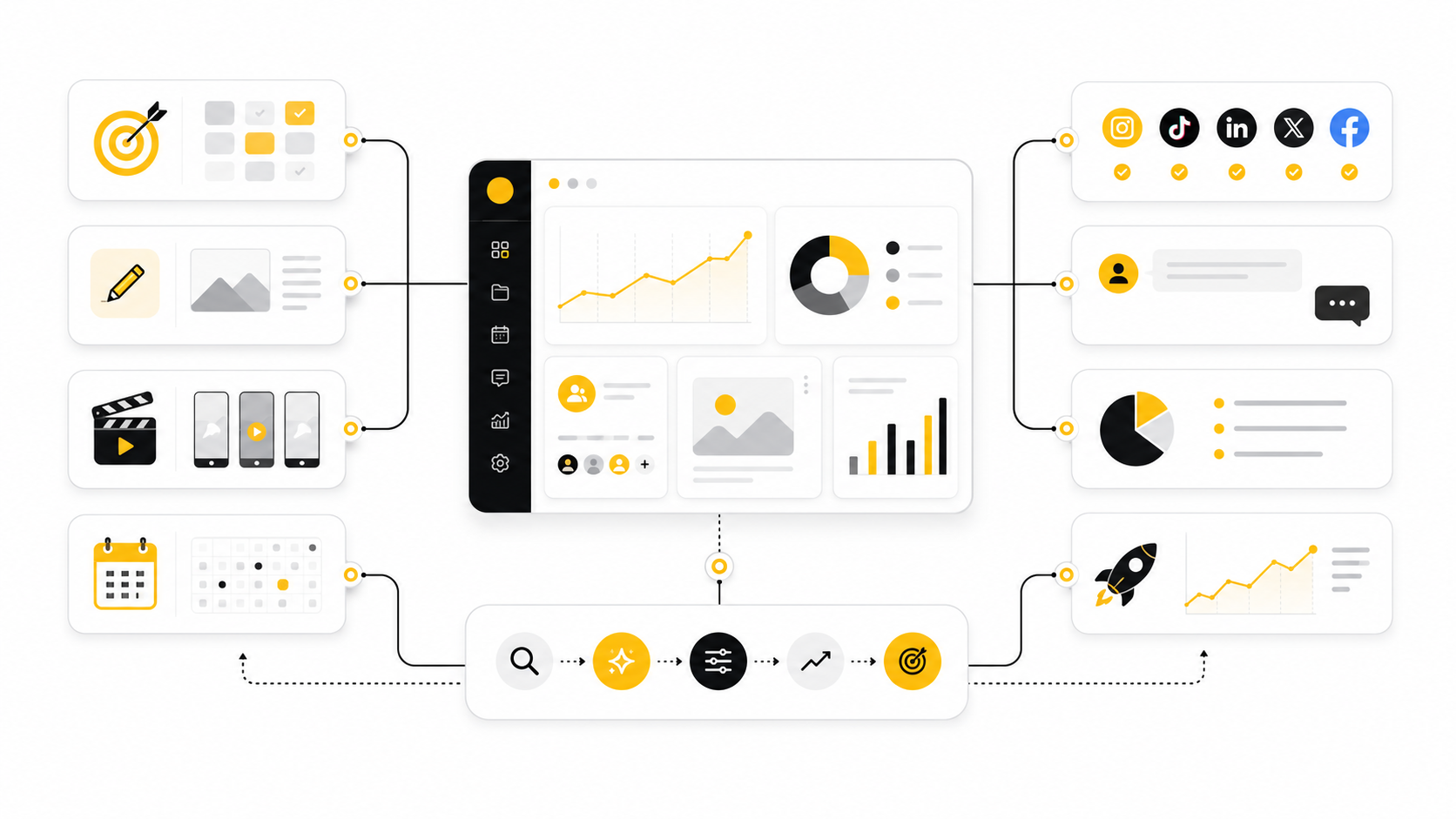
A social content agency is no longer just the team that “posts on Instagram.” That version of the market is dead, or at least dying fast. Brands now need content that earns attention, adapts across platforms, supports paid campaigns, feeds sales conversations, and gives the business a consistent public voice.
The pressure is obvious. Social platforms have become a core media environment, with Deloitte’s 2025 Digital Media Trends report describing social platforms, creators, and user-generated content as a new center of gravity for media consumption and advertising spend: social platforms are becoming central to digital media. At the same time, the content workload keeps growing because every platform wants different formats, faster cycles, tighter hooks, and more native creative.
That is why the right social content agency is not simply a vendor. It becomes a production engine, a strategy partner, and a feedback loop for the brand. The best agencies help companies turn ideas, offers, expertise, customer stories, and cultural moments into repeatable content systems instead of random posts.
This guide breaks down how a modern social content agency actually works. It will cover what the agency should own, what the client still needs to bring, how strategy turns into production, and how performance should be measured without pretending every post has to become a viral hit. The goal is simple: help you understand what to build, what to buy, and what to expect when social content becomes a serious growth channel.
this guide is split into six parts so each section can go deep without turning into a messy wall of advice. The structure follows the way a serious social content operation should be built: first the business case, then the framework, then the operating system, then execution, measurement, and decision-making. Each section uses practical language because social content only matters when it can be turned into consistent action.
Why A Social Content Agency Matters Now
The reason this topic matters is not because social media is new. It matters because the job has become too broad for most companies to handle casually. A brand now needs short-form video, platform-native writing, creative testing, community signals, analytics, founder or executive content, paid social assets, and sometimes creator-style production at the same time.
The demand for better content is showing up across marketing plans. In B2B, 61% of marketers expected their organization to increase investment in video in 2025, making video the top expected investment area in Content Marketing Institute’s research: B2B content marketing trends and benchmarks. That matters because video is not just another format; it usually requires scripting, editing, hooks, repurposing, distribution judgment, and a faster creative feedback loop.
A social content agency becomes valuable when it reduces that operational drag. Instead of asking an internal marketer to become strategist, copywriter, editor, producer, analyst, and community manager all at once, the agency creates a system around the work. That system is what separates serious content growth from “we should probably post more.”
The Social Content Agency Framework
A strong social content agency should be judged by its framework, not by how nice its portfolio looks. Pretty posts are easy to sell, but consistent outcomes require a clear operating model. The framework should connect strategy, content pillars, production, publishing, engagement, measurement, and iteration into one repeatable loop.
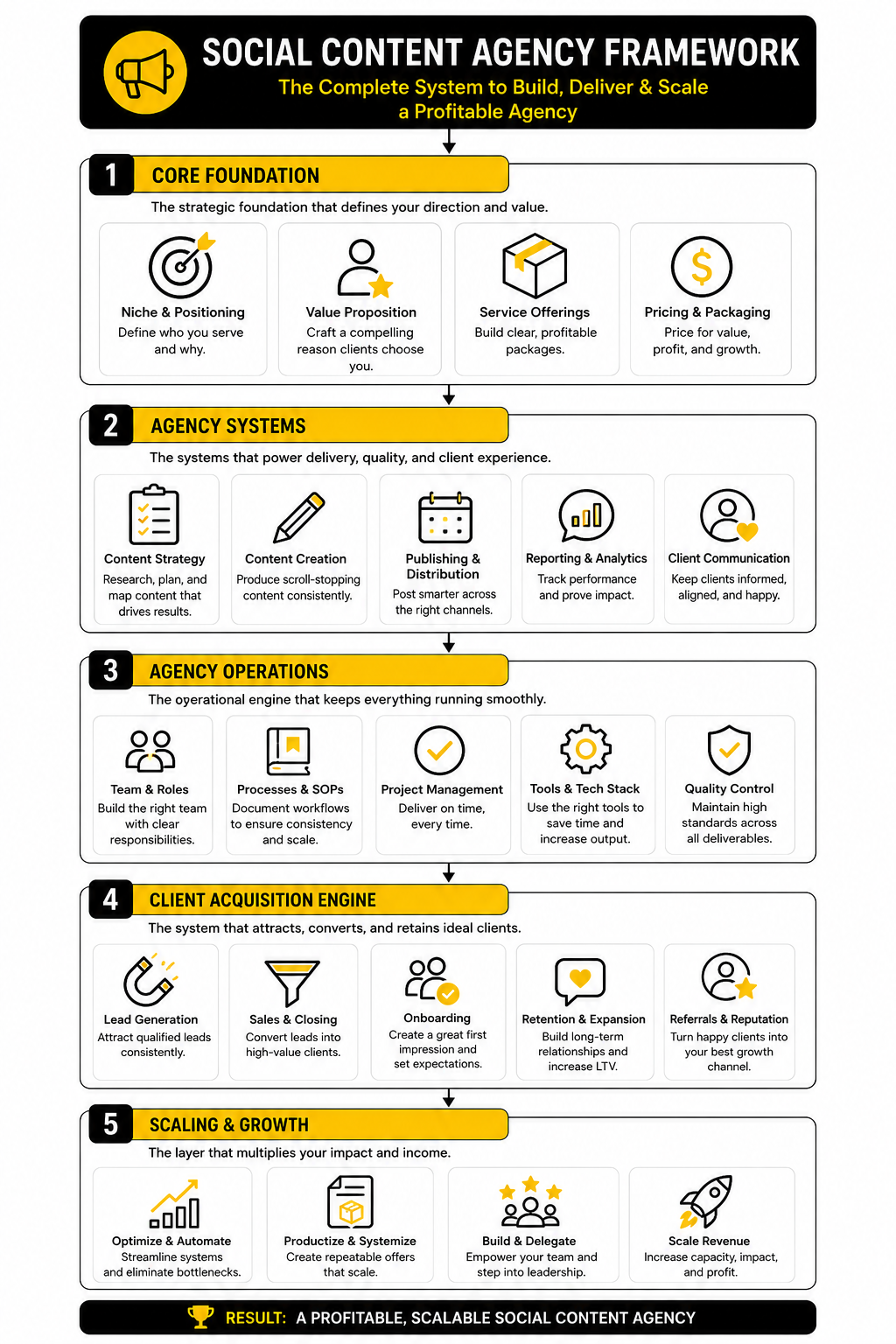
The practical framework starts with positioning. A brand needs to know who it is speaking to, what problems it wants to be known for solving, and why its perspective deserves attention. Without that foundation, the agency is forced to guess, and guessed content usually turns into generic tips, recycled trends, or posts that sound like every competitor.
From there, the agency turns strategy into a production system. That includes planning content themes, capturing raw material, writing platform-native posts, editing assets, scheduling distribution, reviewing performance, and using real audience signals to improve the next batch. Sprout Social’s 2025 benchmark work, based on large-scale social content analysis, reinforces the point that content performance varies heavily by network, format, and industry: 2025 content benchmarks report.
Core Components Of A High-Performing Social Content Agency
A high-performing social content agency usually has four core components: strategy, creative production, distribution management, and performance analysis. If one of those pieces is missing, the whole system gets weaker. Strategy without production stays theoretical, production without distribution gets buried, and distribution without analysis becomes a guessing game.
The strategy component defines the role of social in the wider business. For some brands, social is mainly a trust-building channel. For others, it supports lead generation, recruitment, product education, customer retention, founder visibility, or paid acquisition creative.
The production component turns that strategy into assets people actually want to consume. This is where hooks, editing pace, post structure, visual clarity, storytelling, and platform fluency matter. A good agency does not just ask, “What should we post?” It asks, “What does the audience already care about, and how do we package the brand’s point of view so it earns attention?”
How Professional Implementation Works
Professional implementation is where many social content plans succeed or collapse. It is easy to agree on a strategy in a meeting. It is much harder to create the workflow that produces strong content every week without burning out the client or drowning the agency in revisions.
A serious implementation process usually starts with discovery, content audits, audience research, and message mapping. Then it moves into content pillars, production calendars, approval flows, publishing rules, and reporting rhythms. The point is not to make the process complicated; the point is to make it reliable.
This matters because social content is a consistency game. One good post can help, but one good post is not a system. The agency’s job is to create enough structure that the brand can show up often, stay recognizable, test new angles, and keep improving without reinventing the process every month.
The Social Content Agency Framework
A social content agency works best when it has a clear framework before it ever opens a content calendar. Without a framework, content becomes a pile of ideas, trends, captions, clips, and last-minute requests. That creates activity, but not momentum.
The framework should answer four practical questions. Who are we trying to reach? What should they remember us for? What formats give us the best chance of earning attention? How will we turn audience response into better content next month?
This is where many brands get stuck. They hire an agency because they want output, but the real value is not just output. The real value is a system that turns brand knowledge into content people actually care about.
Positioning Comes Before Posting
A social content agency should start by clarifying the brand’s position in the market. This does not mean writing a poetic mission statement that nobody uses. It means defining the specific audience, the problems that audience already feels, and the point of view the brand can credibly own.
Good positioning makes content easier to create because it narrows the field. Instead of chasing every trending sound, platform feature, and competitor idea, the agency can judge every post against a simple question: does this strengthen the way the brand wants to be known? That one question prevents a lot of weak content.
Positioning also protects the brand from sounding interchangeable. In crowded markets, most content blends together because everyone is reacting to the same trends and using the same advice. A strong social content agency pulls the brand back toward its own expertise, customer reality, and commercial goals.
Audience Insight Drives Better Creative
Audience research should go deeper than demographics. Age, location, job title, and income can help, but they rarely explain why someone stops scrolling. The better inputs are pain points, buying triggers, objections, language patterns, beliefs, habits, and the content formats the audience already trusts.
This matters because creative performance is usually not random. Posts work when the idea, format, hook, and timing match what the audience is already open to consuming. A social content agency should be able to explain why a content angle deserves to exist, not just whether it looks good.
Research also keeps the brand from talking only about itself. The audience does not wake up hoping to consume company updates. They pay attention when a brand helps them solve something, understand something, avoid a mistake, feel seen, or make a more carefully decision.
Content Pillars Create Focus
Content pillars are the recurring themes a brand uses to organize its social presence. They are not rigid boxes, and they should not make the content feel repetitive. Done well, they give the agency enough structure to plan consistently while still leaving room for fresh ideas.
A practical set of pillars might include education, proof, perspective, product context, customer questions, founder insight, and community conversation. The exact mix depends on the business model. A SaaS company, local service business, creator-led brand, and ecommerce company should not all use the same pillar system.
The point is to create balance. If every post educates, the brand may feel useful but forgettable. If every post sells, the audience tunes out. If every post chases entertainment, the brand may get attention without building trust.
Platform Strategy Keeps The Work Native
A social content agency should never treat every platform like the same channel with different image sizes. LinkedIn, TikTok, Instagram, YouTube Shorts, Facebook, X, Pinterest, and Threads all reward different behaviors. The same idea can travel across several platforms, but it usually needs to be rewritten, reframed, or repackaged.
This is especially important now because organic engagement is harder to earn. Rival IQ’s 2025 benchmark report found that engagement rates fell across major platforms, including Facebook, Instagram, TikTok, and X: engagement rates declined across major social platforms. That does not mean organic social is dead. It means lazy cross-posting is expensive because every weak post burns attention.
Native platform strategy looks at format, hook style, caption length, visual pacing, posting rhythm, search behavior, and community norms. A strong agency understands that the same audience may behave differently depending on where they see the brand. That is why the best strategy is not “post everywhere.” It is “show up where the brand can be useful, memorable, and consistent.”
Production Systems Turn Strategy Into Output
Strategy only matters if it survives the production process. A social content agency needs a workflow for capturing ideas, writing content, producing assets, getting approvals, publishing posts, and reviewing results. If that workflow is weak, even smart strategy turns into missed deadlines and rushed creative.
The production system should be visible. Everyone should know what is being created, who owns each step, when feedback is needed, and what happens after a post goes live. This is where simple tools can help, but tools do not fix unclear ownership.
For scheduling and collaboration, platforms like Buffer can make publishing easier for lean teams. For agencies managing more complex client workflows, CRM, pipeline, and automation tools like GoHighLevel can support the broader system around social content, especially when content is tied to leads, follow-up, and client reporting.
Feedback Loops Make The Agency more carefully
The best social content agency does not treat reporting as a monthly screenshot exercise. Reporting should answer what the audience responded to, what the brand learned, and what should change next. That turns analytics into better creative decisions instead of a vanity metric dashboard.
A useful feedback loop looks at both numbers and meaning. Reach, watch time, saves, shares, comments, clicks, leads, and conversions all matter in different contexts. But the agency also needs to read the qualitative signals: what people object to, what they repeat, what they ask, and what language they use.
This is where content improves over time. The agency starts with a strategic hypothesis, publishes against it, studies the response, and adjusts the next round. That loop is what turns social from a content treadmill into a compounding asset.
Core Components Of A High-Performing Social Content Agency
A high-performing social content agency is built around a few core components that work together. None of them should sit in isolation. Strategy, production, distribution, community, reporting, and optimization all need to feed each other, or the agency becomes just another content supplier.
This is where the relationship becomes more operational. The client brings business context, customer knowledge, product depth, and approvals. The agency brings structure, creative judgment, channel expertise, production capacity, and the discipline to keep the machine moving.
The strongest setup is not chaotic brainstorming followed by random posting. It is a repeatable operating system that turns raw ideas into published assets, audience feedback, and better decisions.
Discovery And Audit
The first practical step is discovery. A social content agency needs to understand the brand’s offer, audience, sales process, competitors, existing content, positioning, and internal constraints before it recommends a posting plan. Skipping this step usually creates content that looks polished but misses the business.
A proper audit should review what has already been published, what performed well, what underperformed, and what the brand has avoided saying. The agency should look at creative patterns, audience reactions, platform mix, content quality, and conversion paths. The point is not to criticize old work; the point is to find the useful signals already hiding inside it.
This is also where expectations get grounded. If the brand has no clear offer, no proof, no customer insight, and no approval process, social content will expose those gaps quickly. A good agency names those gaps early instead of pretending better captions will fix them.
Message Mapping
Message mapping turns business strategy into usable content language. It defines the main problems the brand speaks to, the promises it can make, the objections it needs to handle, and the proof points it can use without exaggeration. This step matters because social content has to be fast to consume but still rooted in real positioning.
A message map gives writers, editors, designers, and strategists a shared source of truth. It helps the agency avoid making up new angles every week just to fill the calendar. It also protects the brand voice because the team can see which phrases, claims, offers, and themes are approved.
The best message maps are practical, not decorative. They include audience pains, common questions, product differentiators, category beliefs, competitor contrasts, and examples of language customers already use. That gives the agency enough material to create posts that feel specific instead of generic.
Content Planning
Once the message map is clear, the agency can build a content plan. This should include content pillars, platform priorities, publishing cadence, asset types, campaign themes, and the role of each channel. It should also separate evergreen content from timely content, because both have value.
Evergreen content builds authority over time. It explains the brand’s thinking, teaches the audience, handles objections, and creates reusable assets. Timely content responds to market shifts, launches, trends, news, events, or audience conversations that matter right now.
A good social content agency does not fill every calendar slot just because the calendar has empty space. It builds a plan around what the business needs and what the audience is likely to engage with. That is a subtle difference, but it matters a lot.
The Execution Process
The execution process is where the agency’s value becomes tangible. This is the point where strategy stops being a document and becomes a weekly workflow. The more clearly this process is defined, the less energy gets wasted on confusion, duplicate work, and endless revisions.
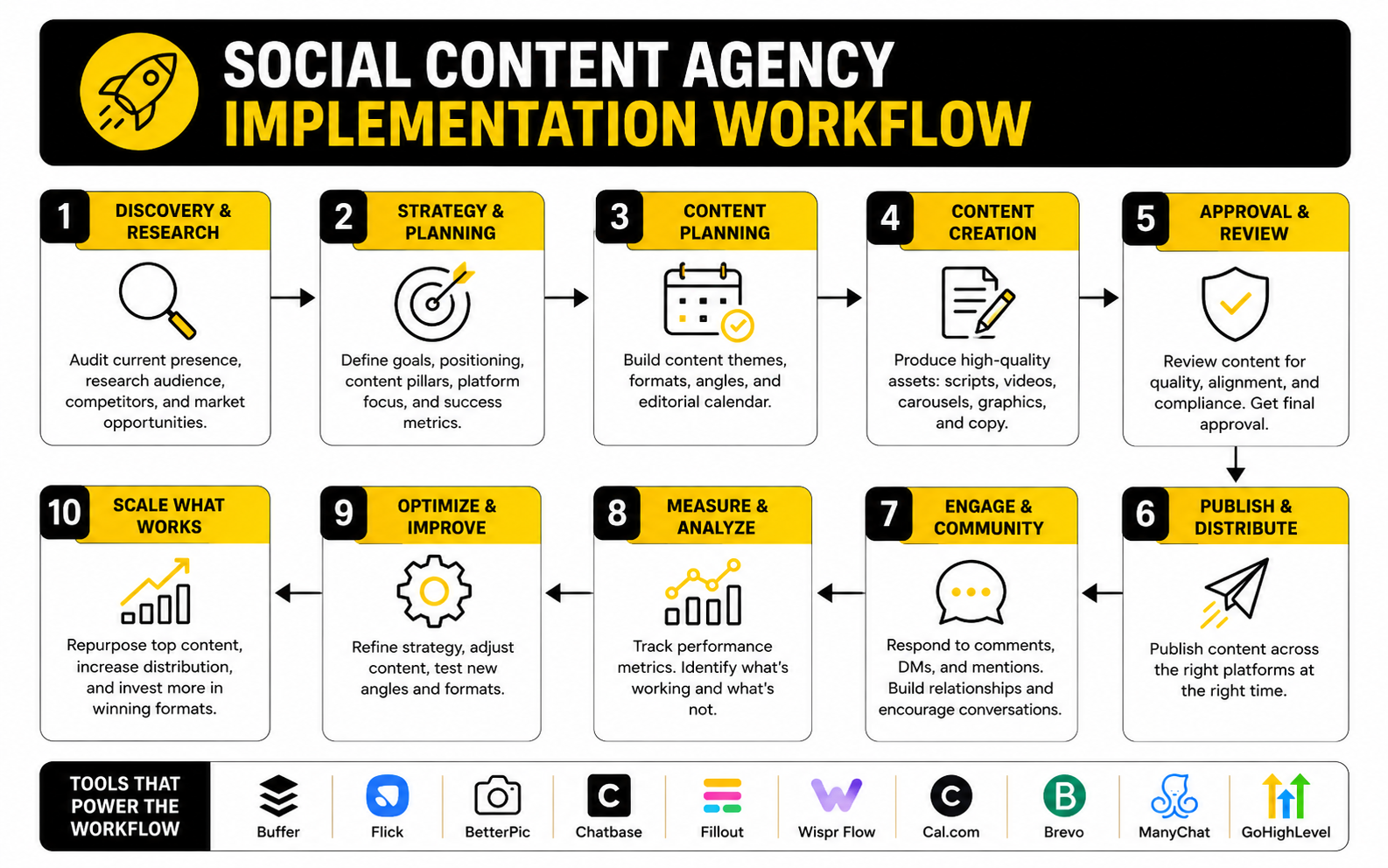
A simple execution process usually looks like this:
That process does not need to be bloated. In fact, it should be as lean as possible. But it does need to exist, because consistency depends on workflow more than motivation.
Creative Production
Creative production is more than making assets look good. It includes the concept, hook, structure, pacing, visual treatment, copy, editing, and call to action. The job is to package the idea so the audience can understand it quickly and care enough to keep watching, reading, saving, sharing, or clicking.
This is especially important because social content is competing against everything else in the feed. A strong idea can still fail if the opening is weak, the editing is slow, or the format does not fit the platform. The agency needs to understand both brand quality and feed behavior.
For short-form video, the production process usually needs scripting, recording guidance, editing systems, caption styling, thumbnail judgment, and repurposing logic. For written social content, it needs sharp opening lines, clear structure, strong examples, and clean formatting. For visual posts, it needs design discipline without turning every asset into a corporate brochure.
Approval Workflows
Approval workflows can quietly destroy social momentum. If five people need to approve every post, the content gets slower, safer, and less useful. A social content agency should help the client create an approval process that protects the brand without suffocating the work.
The best approval workflows define who gives strategic feedback, who checks accuracy, who approves legal or compliance-sensitive claims, and who has final sign-off. Those roles should not blur. When everyone comments on everything, the agency ends up editing around personal preferences instead of business priorities.
Clear approval rules also reduce revision cycles. The client should know when to correct facts, when to challenge positioning, and when to trust the agency’s creative judgment. That level of trust does not happen automatically, but the process should make it easier to build.
Distribution And Repurposing
Distribution is where many brands leave value on the table. They create one asset, publish it once, and move on. A strong social content agency thinks about how one idea can become multiple platform-specific assets without feeling copy-pasted.
A single strong insight might become a LinkedIn post, a short-form video, an email section, an Instagram carousel, a sales enablement snippet, and a paid ad concept. The idea stays consistent, but the packaging changes. That is how content production becomes more efficient without becoming lazy.
Tools can support this system when they are used for the right job. Flick Social can help with planning and social workflow, while ManyChat can support automated conversations from social engagement when a brand has a real reason to move people from comments or DMs into a next step. The tool is not the strategy, but the right tool can remove friction from a strategy that already makes sense.
Community And Response Management
Publishing is not the end of the process. The comment section, replies, DMs, shares, and mentions often show what the audience actually thinks. A social content agency should treat those signals as research, not just engagement chores.
Community management is especially useful for finding content ideas. Repeated questions can become educational posts. Objections can become proof-based content. Positive comments can reveal language the brand should reuse.
This also protects the brand from sounding one-way. Social content should not feel like a company standing on a stage with a megaphone. It should feel like a brand that understands the room, responds intelligently, and knows when to join the conversation.
Measurement, Optimization, And Scaling
A social content agency should measure performance in a way that helps the brand make better decisions. That sounds obvious, but it is where a lot of reporting goes wrong. Too many dashboards show numbers without explaining what those numbers mean, why they changed, or what the team should do next.
Measurement is not just proof that work happened. It is the operating system for improvement. When the agency knows which ideas create attention, which formats hold attention, which posts trigger response, and which assets support revenue, the next round of content gets sharper.
The goal is not to worship data or kill creativity. The goal is to use data as a feedback loop so creative decisions become less random over time. That is how a social content agency moves from posting content to building a performance engine.
Statistics And Data
Social benchmarks are useful, but only when they are interpreted correctly. A benchmark should give the brand context, not become a cage. If the industry average is low, that does not mean the brand should accept weak content; if the industry average is high, that does not mean every post has failed unless it beats the market.
Recent benchmark data shows why this matters. Rival IQ’s 2025 industry benchmark report found that median engagement rates declined across Facebook, Instagram, TikTok, and X, which makes quality, relevance, and format discipline more important than volume alone: social media engagement rates declined across major platforms. That should push agencies away from lazy posting and toward stronger creative testing.
Sprout Social’s 2025 content benchmark research analyzed large-scale publishing and engagement patterns across industries and networks, showing that content performance depends heavily on channel, audience behavior, and content type: content performance varies by network and industry. The practical takeaway is simple. A social content agency should not judge every platform by the same standard, because each platform creates different signals.
Content investment data points in the same direction. B2B marketers continue to prioritize video, with 61% expecting increased investment in video in 2025: video remains a top B2B content investment area. That does not mean every brand should suddenly produce endless video. It means video deserves a serious place in the testing plan when the audience, offer, and production capacity support it.
What The Metrics Actually Mean
A metric only matters when it points to a decision. Reach tells you how far the content traveled, but it does not prove the right people cared. Engagement tells you the content created a response, but it does not automatically prove business impact.
Watch time, saves, shares, comments, clicks, profile visits, direct messages, leads, and conversions all measure different parts of the journey. A high-save educational post may be building trust. A high-share opinion post may be expanding reach. A low-reach post with strong replies from qualified prospects may be commercially valuable even if it looks unimpressive in a top-line report.
This is why the agency and client need to agree on the job of each content type. Awareness content should not be judged only by leads. Sales-support content should not be judged only by likes. Community content should not be dismissed just because it does not drive immediate clicks.
The Analytics System
A practical analytics system should connect goals, content types, platform signals, and next actions. It should be simple enough to use every month, but strong enough to reveal patterns. If the report takes longer to explain than the strategy itself, something is wrong.
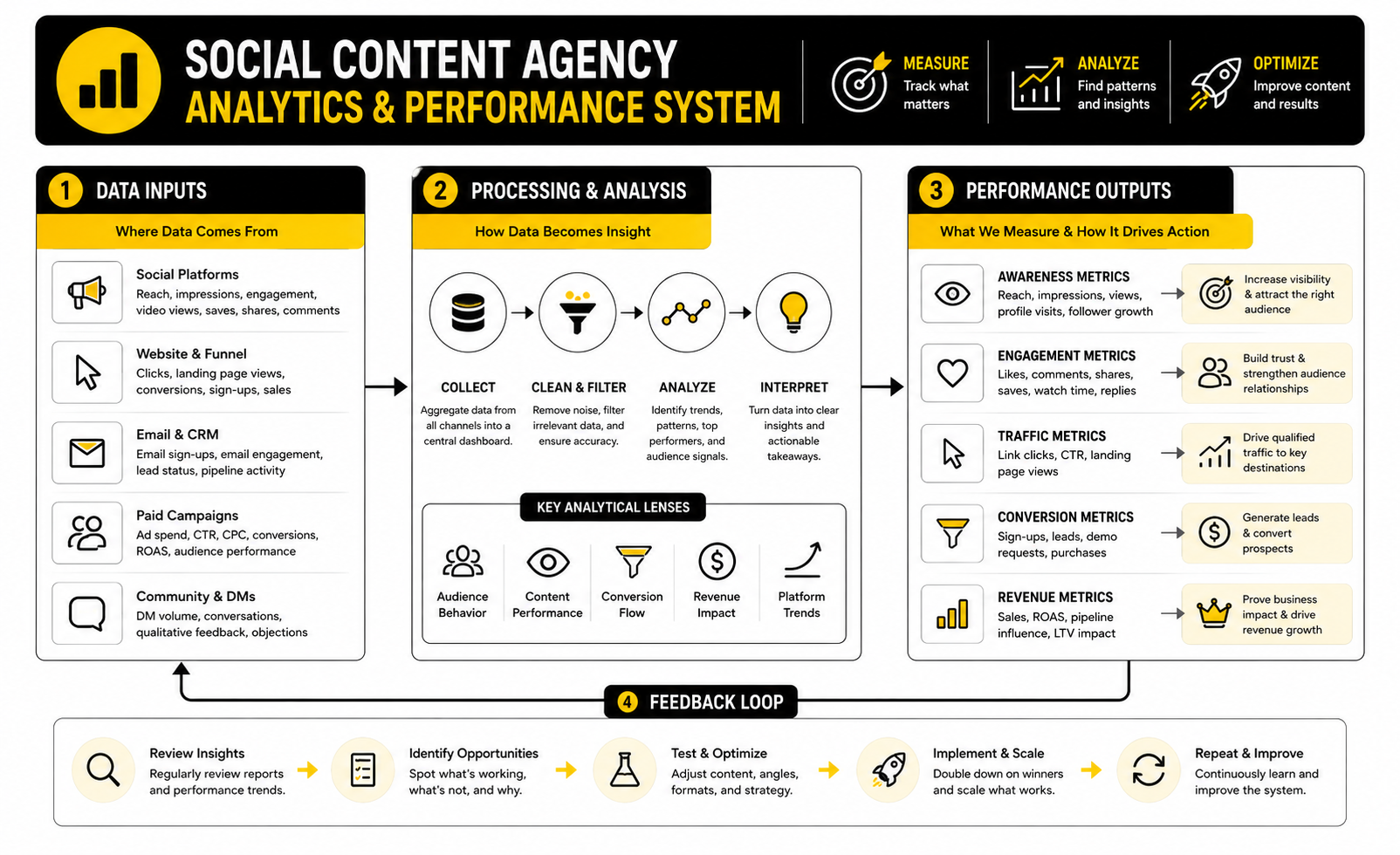
A useful measurement system usually tracks four layers:
The fourth layer is the one many teams skip, and it is often the most valuable. Learning metrics tell the agency what to make next. They turn analytics from a scorecard into a creative brief.
Benchmarks Should Be Directional, Not Absolute
Benchmarks help a social content agency understand whether performance is unusually strong, weak, or normal for a category. But they should not replace internal trend analysis. A brand’s own baseline is often more useful than an industry median because it reflects the actual audience, positioning, offer, creative quality, and posting history.
The more carefully question is not, “Did this post beat the internet?” The more carefully question is, “Did this post improve on our own baseline, and what can we learn from it?” That keeps the team focused on progress instead of vanity comparisons.
Benchmarks are especially risky when they combine brands with very different budgets, audiences, creator networks, and brand recognition. A small service business, a funded SaaS company, and a global consumer brand should not expect the same performance curve. A good agency uses benchmarks for context, then builds a custom performance model around the client’s reality.
Reporting Should Lead To Action
A good report should end with decisions. That means the agency should not only show what happened; it should recommend what to continue, what to stop, what to test, and what to improve. The report should make next month’s content easier to produce, not just summarize last month’s activity.
The best reports usually include a small number of clear observations. Which topics earned the strongest response? Which formats held attention best? Which posts created qualified conversations? Which hooks underperformed? Which audience objections showed up repeatedly?
This is where a social content agency proves it is paying attention. Anyone can export numbers. The value is in turning those numbers into sharper strategy, better creative, and cleaner execution.
Attribution Needs To Be Handled Carefully
Social content often influences buying decisions before a prospect ever clicks a tracked link. Someone may watch five posts, read a founder’s LinkedIn content, see a customer proof post, and then search the brand directly later. If the agency only measures last-click attribution, a lot of social’s influence disappears.
That does not mean attribution should be ignored. It means the agency should combine tracked conversions with qualitative signals, sales feedback, customer surveys, and CRM data. The goal is to understand influence, not force every social interaction into a perfect spreadsheet.
This is especially important for considered purchases. In B2B, high-ticket services, agencies, coaching, consulting, SaaS, and complex ecommerce, social often creates familiarity and trust before it creates a direct conversion. The measurement model needs to reflect that reality.
Scaling What Works
Scaling social content does not mean posting more of everything. It means identifying the ideas, formats, creators, offers, and channels that show promise, then giving them more support. Sometimes that means producing more variations. Sometimes it means turning an organic winner into a paid creative test.
A social content agency should look for repeatable patterns before scaling. One strong post is interesting. Three strong posts around the same theme are a signal. A theme that performs across multiple formats, platforms, and stages of the funnel is worth building around.
This is also where landing pages, forms, automations, and follow-up systems matter. If social starts creating demand but the next step is weak, the business loses value. Tools like Fillout can help capture structured responses, while GoHighLevel can support lead tracking, follow-up, and client-side automation when the content strategy is tied to pipeline.
Advanced Considerations For Scaling A Social Content Agency Relationship
Once the basics are working, the next challenge is not simply producing more content. The next challenge is making more carefully tradeoffs. A social content agency can help a brand scale faster, but scale also creates new risks around voice, approvals, creative quality, brand safety, attribution, and operational complexity.
This is where the relationship needs to mature. Early on, the main question is usually, “Can this agency help us post consistently and improve quality?” Later, the better question becomes, “Can this agency help us build a social content system that stays sharp as the business gets bigger?”
That difference matters. More content can create more reach, more tests, and more data. But more content without stronger judgment usually creates noise.
The Tradeoff Between Speed And Control
Speed matters in social content. Trends move quickly, audience conversations shift fast, and the best moment to respond is often short. A slow approval process can turn a strong idea into yesterday’s news.
Control matters too. A brand still needs accuracy, consistency, compliance, and good judgment. This is especially true in industries where claims, customer data, financial outcomes, health topics, or legal language require care.
The answer is not choosing speed or control. The answer is designing different lanes. Evergreen content can go through a normal review process, while low-risk reactive content can use pre-approved boundaries, voice guidelines, and faster sign-off rules.
Brand Voice Gets Harder As The Team Grows
A small team can often protect brand voice informally. Everyone knows how the founder talks, what the brand believes, and which phrases feel wrong. That breaks down when more writers, editors, strategists, freelancers, and client stakeholders enter the workflow.
A social content agency should help turn brand voice into a usable system. That means documented tone rules, approved phrases, banned claims, example posts, positioning notes, and clear differences between platforms. It should be practical enough that a new writer can use it without needing a two-hour explanation.
This is not about making every post sound identical. Strong brand voice has range. The brand can educate, challenge, entertain, explain, and sell while still sounding like the same company.
AI Should Support The Process, Not Replace Judgment
AI can make a social content agency faster. It can help organize research, draft variations, summarize calls, repurpose long-form content, generate hook options, and speed up first drafts. Used properly, that is useful.
But AI also creates a real sameness problem. Research on generative AI in social environments found that AI tools can increase content volume and engagement while also reducing perceived quality and authenticity in some contexts: AI can increase activity while creating authenticity concerns. That is exactly the trap brands need to avoid.
The right use of AI is simple: let it support the machine, but do not let it become the brain. Human strategy, audience insight, customer understanding, taste, and editorial judgment still decide whether the content deserves to exist.
Brand Safety Is Not Just A Legal Issue
Brand safety is often treated like a compliance checklist, but it is broader than that. It includes what the brand comments on, which trends it joins, which creators it partners with, which claims it makes, and how it responds when people push back. A social content agency needs to understand the difference between being bold and being careless.
This becomes more important as brands participate in public conversations. Comment sections, stitched videos, creator collaborations, and reactive posts can create visibility fast, but they can also create screenshots that travel without context. The agency should help the brand define where it has permission to speak and where silence is more carefully.
The best protection is not fear. It is clarity. When the brand knows its values, audience, limits, and approval rules, the agency can move faster without gambling with reputation.
Creator-Led Content Needs Clear Ownership
Many brands want creator-style content because it feels more native and less corporate. That instinct is right. Social platforms often reward content that feels personal, direct, and human.
The risk is that creator-led content can become messy if ownership is unclear. Who owns the relationship with the creator? Who approves the message? Who holds usage rights? Can the content be repurposed for paid ads, email, landing pages, or sales enablement?
A social content agency should define these rules before production starts. That protects the brand and the creator. It also makes the content more valuable because the business knows exactly how the asset can be used after the first post goes live.
Paid And Organic Should Share Creative Learning
Organic content and paid social should not live in separate worlds. Organic content can reveal what people care about, which hooks earn attention, which objections show up, and which angles feel natural. Paid content can then test those ideas with more reach and clearer conversion data.
The reverse is also true. Paid campaigns can show which offers, headlines, proof points, and landing page angles generate action. Those learnings can feed organic content so the brand becomes sharper across the whole funnel.
This is where funnel tools become relevant, but only when the strategy is already clear. For brands turning social attention into offers, opt-ins, webinars, or sales pages, platforms like ClickFunnels or Systeme.io can support the conversion layer. The content earns the attention; the funnel has to convert it without breaking trust.
Scaling Requires Better Inputs, Not Just More Output
Most content problems are input problems. If the agency only gets vague prompts, recycled ideas, and last-minute requests, the output will eventually flatten. Better inputs create better content.
Strong inputs include customer interviews, sales call notes, product updates, founder opinions, support tickets, reviews, objections, internal research, event notes, and competitive observations. These are the raw materials that make content specific. Without them, even a talented social content agency will be forced to create from surface-level assumptions.
This is why the client cannot fully disappear after hiring an agency. The agency can run the system, but the brand still needs to feed the system. The best results usually come from a partnership where the agency owns the process and the client consistently provides insight.
The Risk Of Over-Optimizing
Optimization is useful until it makes the brand boring. If every decision is based only on what worked last month, the content can become predictable. The audience may respond for a while, but eventually the brand stops saying anything new.
A good social content agency protects room for experimentation. Some content should be designed to perform reliably. Some should test new formats, stronger opinions, different hooks, or unusual angles.
The trick is to separate reckless experimentation from strategic experimentation. Reckless experimentation chases novelty with no reason. Strategic experimentation starts with a hypothesis, defines what the team wants to learn, and uses the result to improve future work.
When To Build In-House Instead
Not every brand should outsource everything forever. At some point, it may make sense to bring parts of social content in-house. This is especially true when the content depends heavily on daily internal access, executive voice, product expertise, or fast community response.
That does not make the agency less valuable. The role may shift from full execution to strategy, training, production support, creative direction, analytics, or campaign development. A mature social content agency should be comfortable helping the client build a stronger internal capability.
The right model depends on the company’s stage. Early teams may need an agency for speed and structure. Growing teams may need a hybrid model. Larger teams may need specialist agency support around campaigns, video production, creator programs, paid creative, or analytics.
What Expert-Level Partnership Looks Like
An expert-level agency relationship feels less like ordering content and more like running a shared growth system. The agency understands the business deeply enough to challenge weak ideas, protect the strategy, and bring better options to the table. The client trusts the agency enough to give access, feedback, and decision-making clarity.
That kind of partnership is direct. It does not hide behind vanity metrics. It does not celebrate activity when the work is not improving.
The best social content agency will push for sharper positioning, cleaner workflows, stronger creative, better reporting, and more useful customer insight. That is the standard. Anything less is just content production with a nicer invoice.
Choosing The Right Social Content Agency
Choosing a social content agency is not about finding the team with the flashiest feed. It is about finding a partner that can understand the business, build the system, produce strong creative, read the data, and keep improving without needing to be micromanaged. The right agency should make the brand sharper, not just busier.
By this point, the article has covered strategy, framework, production, measurement, scaling, and the risks that come with bigger content operations. The final decision is about fit. A good agency for one brand can be the wrong agency for another if the offer, workflow, voice, budget, or growth goals do not match.
The best way to choose is to look for evidence of thinking, not just evidence of activity. Ask how the agency would diagnose the brand’s current content, what it would test first, how it defines success, and how it handles feedback. The answers will tell you quickly whether you are talking to a strategic partner or a posting service.
What A Strong Agency Should Bring
A strong social content agency should bring more than creative capacity. It should bring perspective. The agency should be able to explain where the brand is underusing its expertise, where the content feels too generic, where the workflow is likely to break, and which opportunities are worth testing first.
The agency should also bring a clear process. You should know how discovery works, how ideas become briefs, how assets get approved, how publishing is handled, and how performance is reviewed. If the agency cannot explain the process clearly, the relationship will probably become messy once the work starts.
Most importantly, the agency should understand the difference between attention and business value. Attention is useful, but only when it supports trust, demand, pipeline, customer education, retention, or community strength. Content that gets seen but does not move the brand forward is still incomplete.
Red Flags To Watch For
One red flag is an agency that promises guaranteed virality. Nobody can honestly guarantee that. A good agency can improve the odds through better ideas, better packaging, better timing, and better testing, but social platforms still involve audience behavior and algorithmic variables outside anyone’s full control.
Another red flag is a team that jumps straight into posting frequency before understanding the business. More posts are not automatically better. If the positioning is weak, the audience is unclear, or the offer is confusing, higher volume only spreads the problem faster.
A third red flag is reporting that only celebrates surface metrics. Likes, views, and followers can matter, but they do not tell the whole story. A serious agency should be willing to talk about qualified engagement, message resonance, pipeline influence, audience learning, and content quality.
Questions To Ask Before Hiring
The best hiring conversations are specific. You are not trying to catch the agency out. You are trying to understand how it thinks, how it works, and whether it can handle the reality of your business.
Useful questions include:
The strongest agencies will answer these questions directly. They will not hide behind vague language about “brand awareness” or “full-service solutions.” They will show you how the work gets done.
The Final System
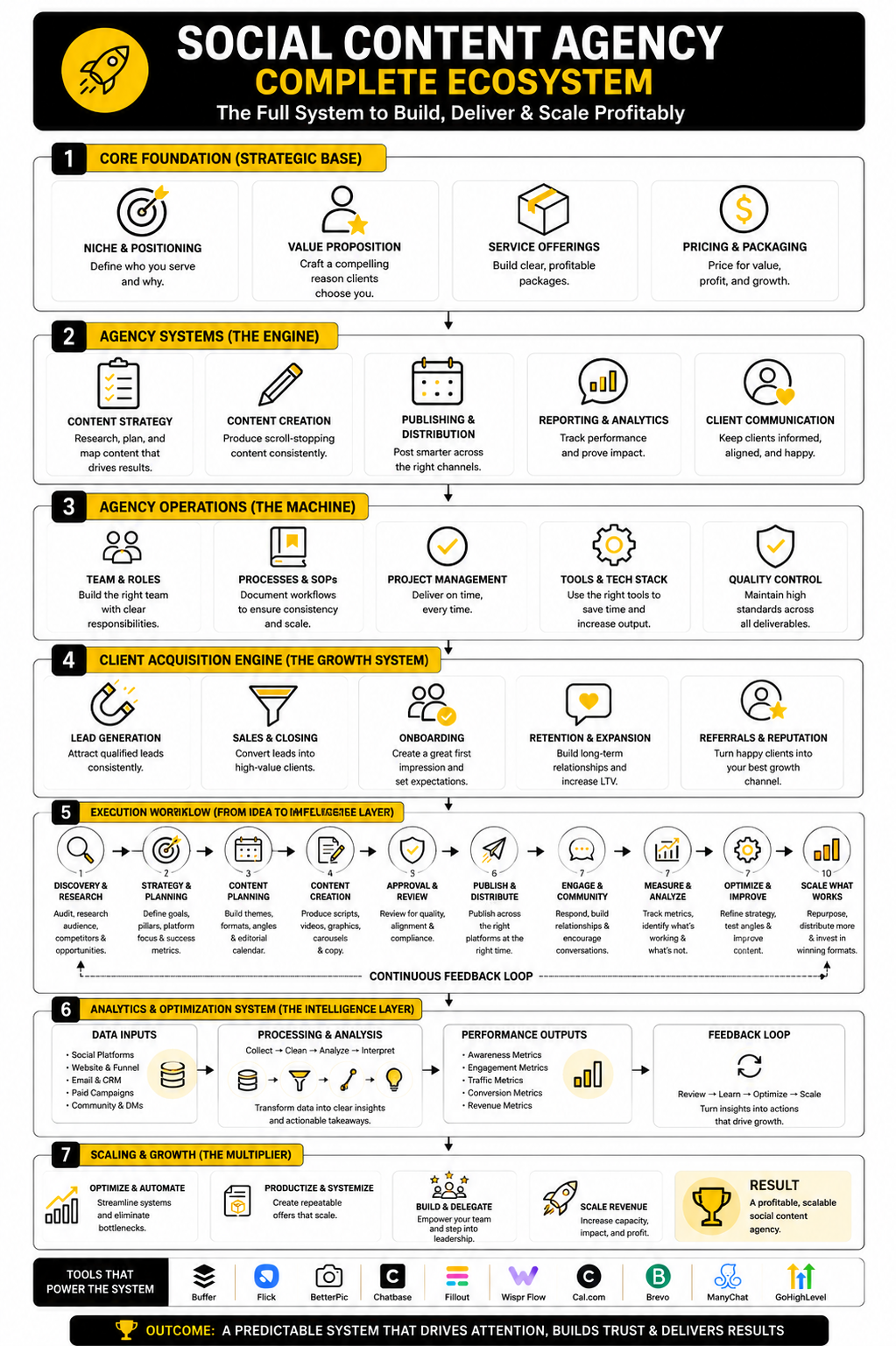
A mature social content system has many moving parts, but the principle is simple. Strategy defines the direction, production creates the assets, distribution earns attention, community creates feedback, analytics reveals patterns, and optimization improves the next cycle.
That is the ecosystem a social content agency should help build. It should not feel like random content being pushed into the feed. It should feel like a connected system where every part makes the next part stronger.
When that system works, the brand stops asking, “What should we post today?” It starts asking better questions. What are we learning from the market? Which ideas are becoming assets? Which conversations are becoming opportunities? Which content is helping people trust us faster?
What does a social content agency do?
A social content agency helps brands plan, produce, publish, manage, and improve content across social platforms. The work can include strategy, short-form video, copywriting, design, scheduling, analytics, creator coordination, community management, and content repurposing. The best agencies connect all of that work to business goals instead of treating social as a random posting calendar.
How is a social content agency different from a social media agency?
A social media agency may focus broadly on account management, ads, engagement, and platform growth. A social content agency is more specifically focused on the content engine behind social performance. In practice, the two can overlap, but a content-focused agency should be especially strong at ideas, messaging, production systems, creative testing, and platform-native asset creation.
When should a business hire a social content agency?
A business should consider hiring a social content agency when content has become important but the internal team lacks time, creative range, workflow discipline, or platform expertise. It is also a smart move when the brand has useful expertise but struggles to turn that expertise into consistent posts, videos, carousels, and campaigns. The agency is most useful when the business already has a clear offer and wants to show up more consistently with better quality.
What should a social content agency need from the client?
A good agency needs access to the brand’s offer, customer insights, sales objections, proof points, product updates, positioning, voice guidelines, and approval stakeholders. It may also need interviews with founders, subject-matter experts, sales teams, support teams, or customers. The agency can own the process, but the client still needs to provide the raw material that makes the content specific and credible.
How long does it take to see results from social content?
Some signals can appear quickly, such as stronger engagement, better comments, improved watch time, or more profile visits. Business outcomes usually take longer because social content often builds trust before it creates a conversion. A practical early goal is to improve content quality, establish a baseline, identify winning themes, and build a consistent feedback loop.
Which platforms should a social content agency prioritize?
The right platforms depend on the audience, offer, content format, and internal resources. A B2B brand may prioritize LinkedIn and YouTube, while an ecommerce brand may lean toward Instagram, TikTok, Pinterest, and paid social creative. A strong agency should recommend focus instead of spreading the brand thin across every platform.
How much content should a brand publish?
There is no universal number. Publishing frequency should depend on platform expectations, production capacity, content quality, and the brand’s ability to learn from the work. Consistency matters, but consistent weak content is still weak content.
Should a social content agency handle paid ads too?
It depends on the agency’s strengths. Some agencies are excellent at organic content but weak at paid strategy, while others can connect organic learning to paid creative testing. The ideal setup is a shared learning loop where organic content reveals strong angles and paid campaigns validate them at scale.
What metrics should matter most?
The right metrics depend on the job of the content. Awareness content may be judged by reach, views, shares, and profile visits. Trust-building content may be judged by saves, comments, replies, watch time, and qualitative feedback.
Conversion-oriented content should be judged by clicks, form fills, booked calls, purchases, or direct message starts. The important thing is matching the metric to the purpose of the post.
Can AI replace a social content agency?
AI can help with drafting, repurposing, summarizing, research organization, and variation testing. It should not replace strategy, customer understanding, taste, brand judgment, or editorial decision-making. The best agencies will use AI to move faster while keeping humans in charge of what the brand actually says.
What makes a social content agency worth the investment?
A social content agency is worth it when it improves quality, consistency, clarity, and learning speed. It should reduce operational drag while helping the brand publish content that earns attention and supports business outcomes. If the agency only creates more posts without improving the system, it is probably not delivering enough value.
What should be included in a social content agency contract?
A contract should define deliverables, timelines, revision limits, approval responsibilities, usage rights, reporting cadence, confidentiality, payment terms, and cancellation rules. If creators, freelancers, or paid ads are involved, ownership and usage rights become even more important. Clear expectations protect both sides and make the working relationship easier.
Should startups hire a social content agency early?
Startups can benefit from a social content agency when they have a clear audience, a credible offer, and enough customer insight to fuel content. If the product, message, and market are still changing every week, a lighter advisory or hybrid model may be better than a heavy retainer. The goal should be to create useful market signal, not just look active.
What is the biggest mistake brands make with social content?
The biggest mistake is treating social content as a task instead of a system. Posting is only one part of the work. The real value comes from positioning, production, distribution, community response, analytics, and continuous improvement working together.
Build a stronger local presence with BAAM AI
Turn your website, Google profile, social channels, and AI visibility into one growth engine
Most businesses do not need more random marketing activity. They need a consistent presence system that helps the right people find them, trust them, and take action. BAAM AI brings strategy, local SEO, website updates, Google Maps visibility, social content, AI-search readiness, media production, and reporting into one practical monthly engine.
If you want your marketing to keep working after the campaign ends, start with a free BAAM AI presence audit. See how your business shows up today and where the fastest visibility wins are at BAAM AI.