
BAAM AI Blog
Social Commerce Marketing: A Practical Framework for Turning Attention Into Revenue
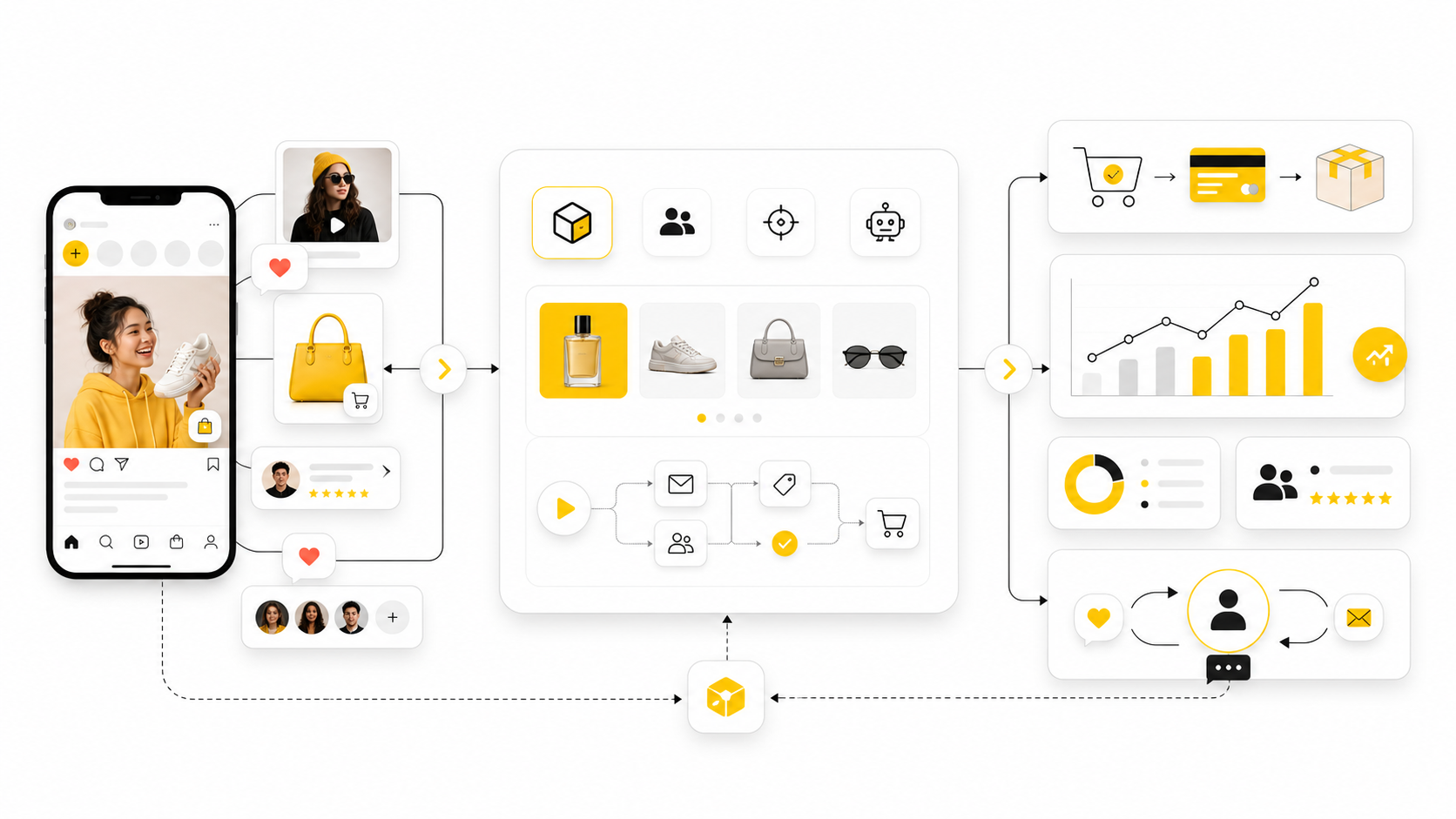
Social commerce marketing is the practice of using social platforms not just to create awareness, but to move people from discovery to trust, decision, checkout, repeat purchase, and advocacy. It sits between content...
Affiliate disclosure: this article may include compensated links. Recommendations should still be evaluated against your use case, budget, and current provider terms.
Should you choose this tool?
this tool is worth considering when the use case, budget, and implementation effort match what you actually need to do next.
teams that want a practical tool decision without reading another generic feature list
Check this toolSocial commerce marketing is the practice of using social platforms not just to create awareness, but to move people from discovery to trust, decision, checkout, repeat purchase, and advocacy. It sits between content marketing, influencer marketing, paid social, community building, ecommerce merchandising, and customer experience. Done well, it does not feel like a brand shouting “buy now” into a feed. It feels like the product naturally belongs in the conversations, videos, recommendations, comments, and creator content your audience already trusts.
That distinction matters. Traditional ecommerce usually starts with intent: someone searches, compares, lands on a product page, and decides. Social commerce often starts earlier, with discovery. A person may not be looking for a product at all, but a creator uses it, a customer demonstrates it, a short video explains the outcome, or a community discussion makes the need obvious. The sale happens because content, proof, conversation, and buying access are close together.
The numbers explain why brands are taking it seriously. Global social commerce spending is now measured in the hundreds of billions, and projections continue to rise as platforms add native shops, live selling, creator storefronts, and in-app checkout. In the United States alone, social commerce is expected to keep expanding as more shoppers become comfortable buying directly through social environments, with TikTok Shop becoming one of the clearest signals that product discovery and checkout are merging inside entertainment feeds. Emarketer reported that TikTok Shop reached a meaningful share of U.S. social commerce after rapid growth from its 2023 launch, while Salesforce found that 76% of Gen Z shoppers have discovered products on social media and 39% have purchased there through its 2025 Connected Shoppers research.
this guide will treat social commerce marketing as a system, not a trend. A brand does not win by opening a shop tab, posting random product videos, or paying creators once and hoping something goes viral. The winners build a repeatable engine: they understand the buyer journey, create content that matches real decision moments, connect creators and communities to offers, make checkout frictionless, measure what actually drives revenue, and improve the system every week.
What Social Commerce Marketing Is and Why It Matters
Social commerce marketing is different from simply promoting products on social media. A brand can post product photos, run ads, and send people to a website without really doing social commerce. Social commerce begins when the social experience itself becomes part of the shopping experience. The customer discovers the product, sees proof, asks questions, compares options, clicks, saves, shares, or buys without feeling like they have left the environment where their interest started.
This matters because buyer behavior has changed. People still search Google, browse marketplaces, and read reviews, but they also use TikTok, Instagram, YouTube, Pinterest, Reddit, Facebook Groups, and creator recommendations as discovery engines. Product research is no longer limited to polished product pages. It happens in comment sections, short-form videos, live streams, unboxings, “get ready with me” videos, customer posts, side-by-side comparisons, and creator-led demonstrations.
The practical impact is simple: brands need to earn attention before they ask for conversion. A social commerce marketing strategy should answer the questions buyers are already asking in their heads. What does this product do? Who is it for? Can I trust it? What does it look like in real life? Will it work for someone like me? Is there a better option? Why should I buy now instead of later?
Social commerce also compresses the funnel. In older digital marketing models, awareness, consideration, conversion, and retention were treated as separate stages with separate channels. Social platforms blur those lines. One strong creator video can introduce a product, explain the use case, provide social proof, answer objections in the comments, and send shoppers to a checkout path in the same session.
That compression is powerful, but it also raises the standard. If the content is weak, the offer is unclear, the comments are ignored, shipping details are buried, or the landing page does not match what the social post promised, the buyer loses momentum. Social commerce marketing rewards brands that remove friction and punish brands that treat social platforms like billboards.
Why Social Commerce Is Becoming a Serious Revenue Channel
Social commerce is growing because it reflects how people already behave online. Shoppers want convenience, but they also want context. They want to see products used by real people, not only photographed under studio lighting. They want confidence before they click. They want fast answers, visible reviews, relatable proof, and a buying path that does not make them restart the whole decision process.
Platform behavior is moving in the same direction. TikTok Shop, Instagram Shopping, YouTube Shopping, Pinterest product discovery, Facebook Marketplace, and creator affiliate tools all show the same pattern: social platforms want to reduce the distance between content and commerce. This does not mean every brand should rely entirely on native checkout. It does mean every brand should understand how social attention turns into buying intent.
Recent research supports the shift. DHL’s ecommerce trends research shows that social media and AI are reshaping online shopping expectations across markets, especially as consumers expect easier discovery, personalization, and delivery transparency through the buying journey. McKinsey’s 2025 consumer research also highlights that shoppers remain value-conscious and selective, which makes trust, relevance, and proof more important than generic brand messaging. In social commerce, the brand that explains clearly and proves quickly usually beats the brand that only looks polished.
The strongest opportunity is not just “selling on social.” The stronger opportunity is learning what your audience responds to, then using that feedback to improve content, offers, product pages, email flows, retargeting, creator briefs, and even product development. Social commerce marketing gives brands a faster feedback loop than many traditional channels because comments, saves, shares, clicks, questions, objections, and creator performance reveal what the market actually cares about.
The Social Commerce Marketing Framework
A useful framework starts with one idea: social commerce is not a single tactic. It is a connected system. Content creates demand, creators expand trust, community builds familiarity, offers shape urgency, checkout captures intent, and retention turns customers into proof for the next buyer. When those pieces are disconnected, performance becomes unpredictable. When they work together, social commerce becomes a repeatable growth channel.
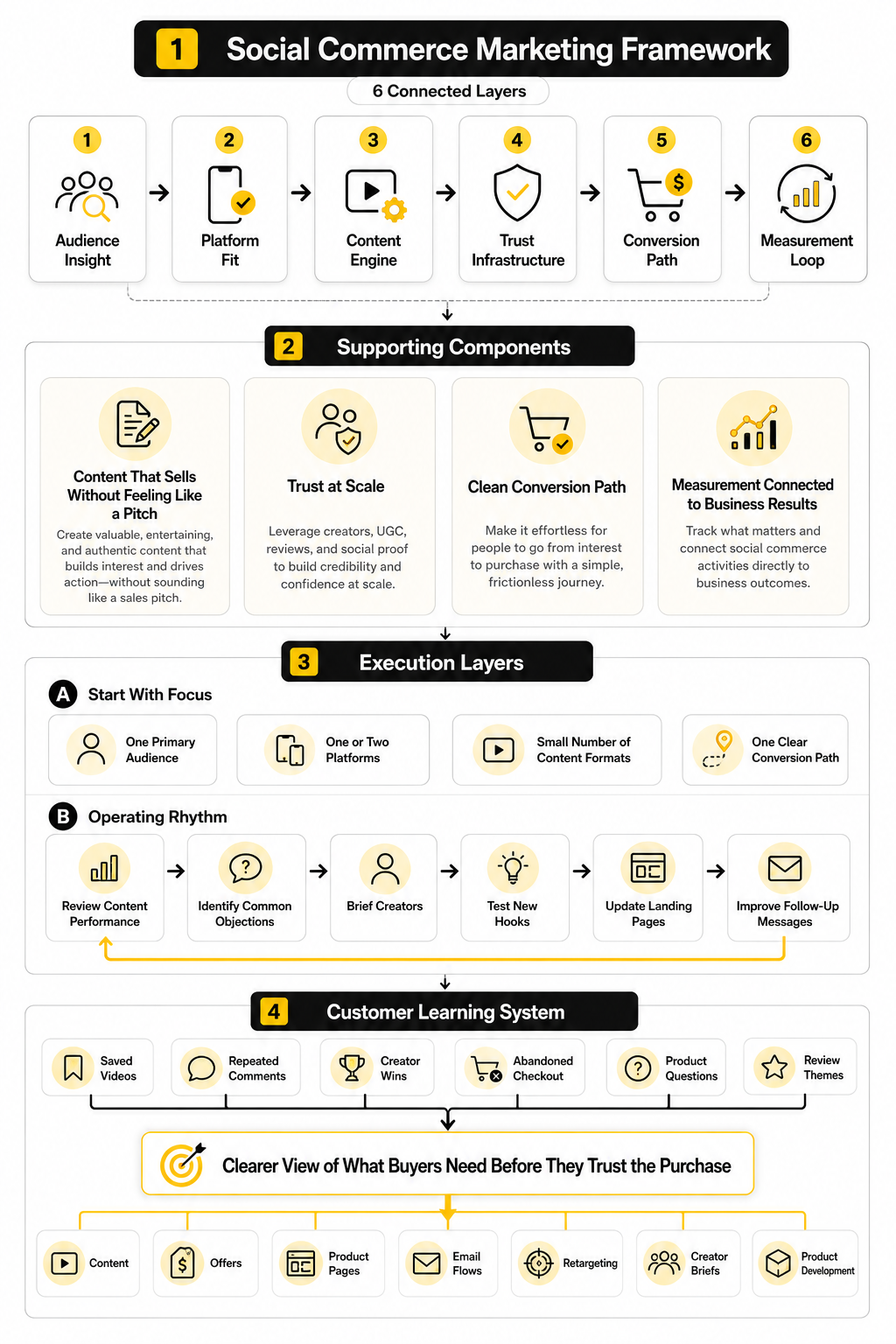
The framework here has six layers: audience insight, platform fit, content engine, trust infrastructure, conversion path, and measurement loop. Audience insight defines who you are trying to reach and what buying moments matter. Platform fit decides where the brand should focus instead of spreading thinly across every channel. The content engine turns product value into repeatable formats. Trust infrastructure brings in creators, customers, reviews, comments, and community proof. The conversion path connects interest to checkout. The measurement loop shows what to keep, cut, and improve.
This structure keeps the strategy practical. Many brands jump straight to tactics: “Should we use TikTok Shop?” “Should we run creator ads?” “Should we post more reels?” Those questions matter, but they are not the starting point. The better starting point is: what must a buyer believe before they purchase, and where can social content help them believe it faster?
For example, a beauty brand may need demonstrations, shade matching, creator proof, and review volume. A software brand may need problem-aware educational content, workflow examples, comparison posts, and fast lead capture. A home product brand may need before-and-after visuals, durability proof, user-generated content, and clear shipping expectations. The platform and content format should follow the buying decision, not the other way around.
Core Components of Social Commerce Marketing
The first core component is content that sells without feeling like a pitch. Social commerce content needs to be useful, watchable, and specific. It should show the product in context, explain the outcome, handle objections, and make the next step obvious. This is where many brands fail because they produce content that looks like an ad but does not answer the questions that stop people from buying.
The second core component is trust at scale. In social commerce, trust does not come only from the brand. It comes from creators, customers, comments, reviews, community discussions, and repeated exposure. A shopper may believe a customer demonstration more than a brand claim because it feels closer to real life. That is why creator partnerships, user-generated content, review capture, and comment management belong inside the strategy, not as side projects.
The third core component is a clean conversion path. If people discover a product on social, the next step should feel natural. That could mean native checkout, a product landing page, a quiz, a messenger flow, a limited offer, a product bundle, or an email/SMS capture path. For brands that rely on conversations before purchase, tools like ManyChat can help automate Instagram or Messenger follow-ups when someone comments, clicks, or asks for product details. For ecommerce teams building dedicated campaign pages, Replo can be useful when the social content needs a matching landing page instead of a generic product page.
The fourth core component is measurement that connects social activity to business results. Views are useful, but views alone do not prove a social commerce strategy is working. Brands need to track click-through rate, add-to-cart rate, conversion rate, cost per acquisition, creator revenue, assisted conversions, average order value, repeat purchase, refund rate, and customer acquisition payback. The goal is not to make the dashboard complicated. The goal is to know which content and creator assets create profitable customers.
Professional Implementation Starts With Focus
Professional social commerce marketing begins by narrowing the field. A brand does not need to launch every platform, every creator program, every shop feature, and every automation at once. That usually creates noise. A stronger approach is to choose one primary audience, one or two platforms, a small number of content formats, and one clear conversion path. Then the team can learn fast without drowning in complexity.
The next step is to build an operating rhythm. Social commerce rewards consistency because every post, comment, creator asset, and checkout test teaches the brand something. A weekly rhythm might include reviewing content performance, identifying common objections, briefing creators, testing new hooks, updating landing pages, and improving follow-up messages. This is not glamorous work, but it is where the compounding happens.
The most important mindset is that social commerce marketing is not just a media channel. It is a customer learning system. Every saved video, repeated comment, creator win, abandoned checkout, product question, and review theme gives the brand a clearer view of what buyers need before they trust the purchase. The rest of this guide will build that system step by step, starting with the full framework and then moving into the components, execution process, measurement, and optimization.
The Social Commerce Marketing Framework
A strong social commerce marketing framework turns scattered social activity into a repeatable revenue system. Without a framework, teams usually end up chasing trends, copying competitors, or posting whatever feels easiest that week. That is how brands get views without sales, creator content without attribution, and social engagement that never turns into a useful customer relationship.
The framework should make one thing clear: social commerce is not only about where the sale happens. It is about how demand is created, how trust is built, how objections are handled, and how easy the buying step becomes once a customer is ready. The sale might happen inside TikTok Shop, through Instagram, on a Shopify product page, in a DM automation, through a landing page, or after an email follow-up. What matters is that the journey feels connected.
The best way to think about it is as six connected layers:
Each layer has a job. If one layer is weak, the whole system becomes harder to scale. You can have great creators, but if the landing page is generic, conversions suffer. You can have a beautiful shop, but if the content does not create desire, traffic stays cold. You can have viral posts, but if you do not measure revenue properly, you will not know what to repeat.
Audience Insight
Audience insight is the starting point because social commerce marketing depends on relevance. You are not just asking, “Who is our customer?” You are asking, “What would make this person stop scrolling, care, believe, click, and buy?” That is a sharper question, and it leads to better content.
The useful insight is usually more practical than demographic. Age, location, and income can help, but they rarely tell you what to post. A better profile includes the customer’s problem, desired outcome, hesitation, current alternative, trust barrier, price sensitivity, and the language they already use when talking about the category. This is where comment mining, review analysis, customer interviews, Reddit threads, TikTok search suggestions, competitor comments, and support tickets become valuable.
For example, a brand selling skincare does not only need to know that its audience is women aged 25 to 40. It needs to know whether they are worried about irritation, confused by ingredients, skeptical of before-and-after photos, tired of expensive routines, or looking for something that works under makeup. Those details shape the hook, the creator brief, the product page, the FAQ, and the offer. The closer the strategy gets to the real buying hesitation, the more natural the content feels.
Social discovery keeps getting more important here. Salesforce found that 53% of shoppers discover products through social platforms, up from 46% in 2023, while Gen Z leads the behavior with 76% discovering products on social media through its 2025 social shopping research. That does not mean every buyer is ready to purchase immediately. It means social content is increasingly where the first serious buying signal appears.
Platform Fit
Platform fit means choosing channels based on buyer behavior, content strength, and purchase path instead of chasing every platform at once. This is important because each platform has a different rhythm. TikTok rewards discovery and native-feeling video. Instagram is strong for visual proof, creator content, DMs, and retargeting. YouTube supports deeper education and long-term search value. Pinterest can work well for visual planning, inspiration, and product discovery. Facebook Groups can still matter when community discussion and trust are central to the sale.
A brand should not ask, “Which platform is hot?” It should ask, “Where does our buyer already look for this type of solution, and what format helps them trust it?” That small shift prevents wasted effort. A product that needs demonstration may belong on TikTok, Instagram Reels, and YouTube Shorts. A high-consideration product may need YouTube explainers, comparison content, creator reviews, and retargeting. A visual lifestyle product may need Instagram, Pinterest, and creator-led product photography.
Platform fit also includes the checkout environment. TikTok Shop may be useful for impulse-friendly products, creator affiliate programs, bundles, beauty, fashion, gadgets, wellness, and lower-friction purchases. A brand-owned site may be better when the product needs more education, customization, subscription logic, upsells, or stronger customer data ownership. Emarketer projected that U.S. social commerce sales would reach $87.02 billion in 2025, with TikTok Shop becoming one of the most important growth drivers in the channel through its 2025 social commerce forecast.
The practical move is to start with one primary platform and one support platform. The primary platform gets the deepest creative effort. The support platform catches demand, retargets attention, or helps buyers who need more context. This keeps the team focused enough to learn quickly instead of spreading mediocre content across five channels.
Content Engine
The content engine is the part of the framework that turns product value into repeatable social formats. This is not about posting more for the sake of posting more. It is about building a library of angles that consistently move people from passive attention to active interest.
A useful content engine usually includes several types of content. You need problem-aware content that makes the pain obvious. You need demonstration content that shows the product in use. You need proof content that makes the promise believable. You need objection-handling content that removes friction. You need comparison content that helps people understand why this option is different. You also need community or customer-led content that shows the product living in the real world.
The mistake is treating every post like a direct sales pitch. People do not open social apps hoping to read a product brochure. They respond to useful explanations, honest demonstrations, satisfying transformations, specific recommendations, entertaining moments, and relatable problems. Social commerce marketing works when the product is integrated into content that already gives the viewer a reason to care.
A simple content engine can be built around these recurring formats:
The engine should also match the buying cycle. A first-time viewer may need a clear problem and simple demonstration. A warmer viewer may need proof, comparison, and objections answered. A returning viewer may need an offer, bundle, guarantee, or reminder. When content is mapped this way, the brand stops relying on one viral post and starts building a system that repeatedly creates buying intent.
Trust Infrastructure
Trust infrastructure is everything that makes the buyer feel safer before purchasing. This includes creators, customer reviews, product ratings, visible comments, founder content, community conversations, guarantees, transparent shipping details, return policies, and clear product education. In social commerce, trust is not a soft metric. It is often the difference between a saved post and a completed order.
Creators matter because they can make product value feel more believable. Deloitte’s social commerce research describes creators as a key part of the customer journey because they give brands access to audiences in a more relatable context than traditional ecommerce environments through its work on social commerce and the creator economy. That does not mean every creator partnership will work. The right creator must match the audience, the use case, the product category, and the level of explanation the buyer needs.
Customer proof is just as important. Reviews, tagged posts, customer videos, and comment screenshots can answer questions faster than polished brand copy. A shopper may trust a rough customer video more than a studio ad because it feels less controlled. That is why brands should actively collect user-generated content, request reviews after delivery, ask satisfied customers for short clips, and turn common positive feedback into social content.
Trust infrastructure also includes responsiveness. Comments are not decoration. They are market research, objection handling, and conversion support happening in public. A brand that replies clearly, answers product questions, acknowledges concerns, and pins useful responses can improve the buying experience without creating more content from scratch.
For brands using Instagram comments or DMs as a sales touchpoint, ManyChat can help turn buyer signals into automated follow-ups without forcing every interested person to search for the next step manually. This fits best when the conversation is genuinely useful, such as sending a product guide, quiz, discount, size help, routine recommendation, or link to a specific offer. Automation should remove friction, not pretend to be a human relationship.
Conversion Path
The conversion path is where attention becomes action. This is where many social commerce campaigns lose money because the content and buying experience do not match. The viewer clicks because of a specific promise, use case, product angle, or creator recommendation, then lands on a generic page that makes them start over. That disconnect kills momentum.
A good conversion path keeps the context alive. If the content showed a bundle, the landing page should show that bundle. If the creator explained a specific use case, the page should reinforce that use case. If the post answered a problem, the next step should make the solution obvious. The buyer should never feel like they clicked into a different conversation.
The right conversion path depends on the offer. Native checkout can work when the product is simple, visual, and impulse-friendly. A dedicated landing page works when the product needs more explanation, proof, bundles, or comparison. A quiz works when the buyer needs personalization. A DM flow works when people need help choosing the right option. A lead magnet works when the purchase is high-consideration and requires nurturing.
For ecommerce brands that need dedicated pages for social campaigns, Replo can be useful because social traffic often performs better when the landing page matches the exact content angle. For service businesses, agencies, coaches, or local businesses that need follow-up pipelines after social engagement, GoHighLevel can make sense when the offer requires forms, calls, automations, reminders, and CRM tracking in one place. The tool is not the strategy, though. The strategy is making the next step obvious and reducing the number of reasons someone can delay.
Measurement Loop
The measurement loop is what turns social commerce marketing from guesswork into a system. A brand should know which content creates reach, which content creates clicks, which content creates carts, which content creates purchases, and which customers come back. Without that loop, the team ends up debating opinions instead of improving based on evidence.
The first mistake is overvaluing vanity metrics. Views, likes, and followers can be useful signals, but they do not automatically equal revenue. A video with fewer views can outperform a viral post if it reaches a warmer audience, explains the product better, or attracts higher-intent buyers. The question is not “Did this post perform?” The better question is “What job did this post perform in the buying journey?”
The second mistake is expecting perfect attribution. Social commerce often involves multiple touches. A buyer may see a creator post, search the brand, read reviews, watch another video, click a retargeting ad, and buy three days later. The measurement system needs both platform data and business data. Platform metrics show content behavior. Store analytics show purchase behavior. Customer surveys, post-purchase questions, discount codes, UTM links, affiliate dashboards, and creator-specific landing pages help connect the two.
A practical weekly measurement loop should review:
This loop should lead to decisions. Keep the content formats that create qualified interest. Cut the angles that attract empty engagement. Brief creators with the objections customers actually mention. Improve landing pages based on the promises that made people click. Build retargeting around the proof that converts warm viewers. That is how social commerce marketing compounds.
How the Framework Works Together
The framework works because each layer feeds the next one. Audience insight tells you what buyers care about. Platform fit tells you where to reach them. The content engine turns those insights into repeatable posts, videos, lives, stories, and creator briefs. Trust infrastructure makes the promise believable. The conversion path captures the demand. The measurement loop shows what to improve.
This is also why copying isolated tactics rarely works. One brand may win with TikTok Shop because its product is visual, affordable, creator-friendly, and easy to understand in ten seconds. Another brand may need longer educational content, a quiz, a consultation, or a more detailed landing page. The tactic only works when it matches the product, buyer, platform, and buying journey.
A mature social commerce system feels simple from the outside, but it is disciplined underneath. The customer sees a useful video, a trusted creator, a helpful comment reply, a clear offer, and an easy next step. The brand sees a structured flow of insight, content, proof, conversion, and measurement. That is the difference between random posting and a real social commerce marketing strategy.
Core Components of a Social Commerce Strategy
Once the framework is clear, implementation becomes much easier. The job now is to turn the six layers into a process your team can actually run. Social commerce marketing should not depend on random inspiration, one lucky creator, or a founder posting whenever there is time. It needs a practical operating system.
The core components are simple, but they need discipline. You need a clear offer, a sharp audience angle, platform-native content, creator and customer proof, a buying path that matches the content, and a measurement rhythm that tells you what to improve. When these pieces work together, social commerce stops feeling like “posting more” and starts behaving like a real acquisition channel.
This section moves from strategy into execution. The goal is not to build a complicated machine on day one. The goal is to create a repeatable process that can be tested, measured, and improved without losing the human feel that makes social commerce work in the first place.
Start With the Offer Before the Content
Most brands start by asking what to post. That is understandable, but it is not the best first question. Before the content plan, you need to know what you are asking people to do after they become interested. A strong social commerce offer gives the content a clear destination.
The offer does not always need to be a discount. It can be a starter bundle, a limited drop, a quiz result, a free sample, a consultation, a product finder, a creator-exclusive bundle, a gift-with-purchase, or a simple best-seller path. What matters is that the offer feels connected to the reason someone cared in the first place. If the content creates curiosity but the offer feels generic, momentum drops.
This is especially important because shoppers are more selective now. McKinsey’s recent consumer research shows that many shoppers are still value-conscious and willing to switch brands when the value is unclear, which means the offer has to communicate usefulness, not just urgency through its consumer sentiment research. Social commerce marketing works better when the offer makes the next step feel obvious, safe, and worth taking now.
A good offer should answer four questions quickly:
If your offer cannot answer those questions, the content will have to work too hard. You can still get views, but conversion will be inconsistent. The offer is the bridge between attention and revenue, so tighten it before scaling the posting schedule.
Build the Audience and Message Map
The audience and message map turns customer insight into execution. It gives your team a clear view of what to say, who to say it to, and which buying hesitation each content asset should handle. This prevents the common problem where every post says a slightly different version of “our product is great.”
Start with the buying situation. Is the customer actively looking for a solution, casually discovering the category, switching from a competitor, buying as a gift, solving a recurring frustration, or trying something for the first time? Each situation needs a different message. A cold viewer may need the problem made visible. A warm viewer may need proof. A hesitant buyer may need risk reversal, comparison, or a practical explanation.
Then map the key objections. Price, quality, fit, results, trust, shipping, complexity, taste, sizing, time, and compatibility all create friction. The exact objections depend on the category, but the principle stays the same. Your content should not avoid objections. It should answer them directly, calmly, and repeatedly in different formats.
A simple message map can include:
This map should guide creator briefs, video hooks, landing page copy, comment replies, product page sections, email follow-ups, and retargeting ads. When the message is consistent across the journey, the customer does not have to rebuild trust at every step.
Choose the First Execution Channel
The first execution channel should be chosen for fit, not ego. A brand does not need to be everywhere to prove it is serious. It needs one channel where the audience already pays attention and the product can be explained in a format the team can produce consistently.
For many consumer brands, TikTok, Instagram Reels, and YouTube Shorts are natural starting points because short-form video can demonstrate products quickly. For visually planned purchases, Pinterest and Instagram may deserve more attention. For high-consideration products, YouTube, LinkedIn, Reddit, or community-led channels may play a bigger role. For local services, agencies, coaches, and appointment-based offers, the channel may matter less than the follow-up system after someone raises their hand.
Platform choice should also reflect checkout behavior. TikTok’s own commerce materials position TikTok Shop as a way to drive product discovery, convert high-intent shoppers, and enable checkout inside the platform through its 2025 commerce playbook. That can be powerful for the right product, but it is not automatically right for every business. If the product needs education, customization, or sales assistance, a landing page, quiz, form, or DM flow may perform better than forcing the buyer straight into checkout.
The first channel should pass three tests:
This is where discipline matters. Pick the strongest channel, build proof of performance, then expand. Spreading thin too early is one of the fastest ways to make social commerce feel harder than it needs to be.
Create the Execution Process
The execution process turns the strategy into weekly action. It should be clear enough that a small team can follow it without needing a new brainstorm every morning. A good process creates room for creativity, but it does not depend on chaos.
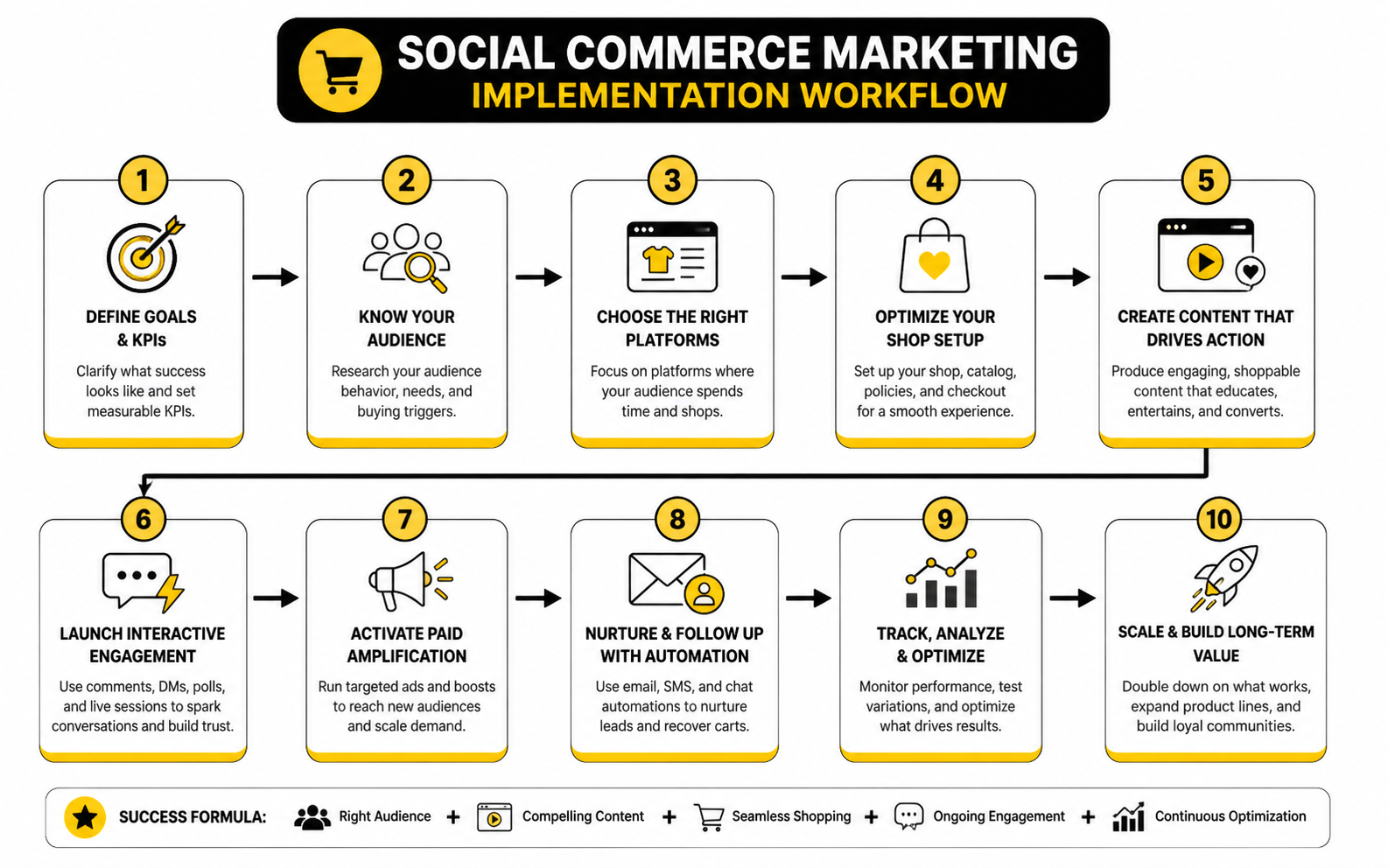
The simplest version runs in weekly cycles. On Monday, review performance and choose the angles to test. On Tuesday, script or brief the content. On Wednesday and Thursday, produce, edit, publish, and engage. On Friday, review comments, clicks, carts, sales, creator performance, and landing page behavior. Then use those insights to brief the next cycle.
That rhythm may sound basic, but it is powerful because it keeps learning close to execution. Social commerce marketing improves when the team sees what buyers actually respond to and adjusts fast. If the team waits a month to analyze performance, too much context gets lost. Weekly review keeps the feedback loop tight.
A practical execution process looks like this:
This process keeps everyone focused on the buyer journey. The content is not just there to look active. It has a job. It either creates awareness, builds trust, answers an objection, proves demand, or moves someone toward purchase.
Turn Content Ideas Into Repeatable Formats
Social commerce content becomes easier when you stop treating every post as a blank page. The team should build repeatable formats that can be reused with new hooks, products, creators, objections, and customer scenarios. This helps scale production without making the brand feel robotic.
The best formats are usually simple. Show the product solving a real problem. Compare the old way with the new way. Answer a common objection from the comments. Demonstrate one use case. Explain who the product is not for. React to a customer review. Show a creator using the product in a natural routine. Break down the difference between two options.
Repeatable formats also make measurement cleaner. If one format consistently drives saves and another drives clicks, you can assign them different jobs. If a creator demonstration drives higher conversion than a polished studio asset, you can shift budget and production time. If objection-handling videos produce lower reach but better sales, you do not kill them just because they are not viral.
Useful content formats include:
This is also where planning tools help. A team can use Buffer to organize publishing, review what is going out, and keep a steady rhythm across platforms. The point is not to automate the personality out of the brand. The point is to remove operational friction so the team can spend more energy on better angles, better hooks, and better responses.
Build Creator and Customer Proof Into the Process
Creator and customer proof should not be treated as a bonus. It should be part of the implementation plan from the beginning. Social commerce depends on believable context, and believable context often comes from people outside the brand.
Start with creators who match the buying situation, not just creators with the biggest audience. A smaller creator with a highly relevant audience and a natural use case can outperform a larger creator who does not fit the product. The creator’s job is not only reach. The creator should help the buyer understand why the product matters, how it fits into real life, and what makes it worth trying.
Deloitte’s social commerce research highlights creators as a key pillar because they can engage consumers in a more authentic and relatable context than traditional owned ecommerce environments through its creator commerce strategy research. That is the practical reason creator briefs should be specific but not suffocating. Give creators the audience insight, product truth, claims guidance, and required disclosures, but leave room for their voice.
Customer proof should follow a similar process. Ask for reviews after delivery. Invite customers to submit short clips. Save useful comments. Turn repeated praise into content themes. Build a simple folder of proof assets so the team can use them in posts, landing pages, ads, email, and retargeting. Proof should not live in one place. It should support every important buying moment.
Match the Landing Experience to the Social Promise
The landing experience should continue the same conversation that started on social. This is one of the easiest implementation wins because many brands still send every click to the same generic product page. That forces the buyer to reconnect the dots alone.
If the video showed a specific problem, the page should start with that problem and the product’s solution. If the creator promoted a bundle, the page should feature the bundle clearly. If the post compared two options, the page should reinforce why this option is the better fit. If the content promised a quiz or guide, the next step should deliver exactly that.
A dedicated landing page is especially useful when social traffic comes from a specific angle. For example, a product may have one page for first-time buyers, another for a creator bundle, another for a seasonal campaign, and another for a comparison angle. This gives the brand more control over message match and makes performance easier to read. Replo fits this use case when an ecommerce team wants campaign-specific pages without waiting on a full development cycle.
The page does not need to be long for the sake of being long. It needs the right proof in the right order. A strong social commerce landing experience usually includes the core promise, product demonstration, customer proof, clear offer, shipping and return details, frequently raised objections, and a direct purchase action. Every section should reduce friction.
Set Up Follow-Up Before You Scale Traffic
Follow-up is the part many teams leave until later, and that is expensive. Social commerce creates a lot of soft intent. People click, save, comment, ask questions, view products, add to cart, and leave. If there is no follow-up system, the brand keeps paying to create interest and then lets too much of it disappear.
Follow-up can happen through retargeting ads, email, SMS, DM automation, creator remarketing, abandoned cart flows, product education sequences, or sales calls. The right method depends on the business model. A low-ticket product may need a fast abandoned cart reminder and review-based retargeting. A high-consideration offer may need a quiz, consultation, or educational sequence. A service business may need a form, calendar booking, CRM pipeline, and reminders.
For businesses where social leads need sales follow-up, GoHighLevel can be useful because it connects forms, funnels, automations, pipelines, and appointment reminders in one system. For brands that use email as a key follow-up channel, Brevo can support campaigns and automation when the buyer needs more education before purchasing. The tool choice should follow the buying journey, not the other way around.
The basic follow-up logic is simple:
This is where social commerce marketing becomes more than acquisition. The same system that creates first purchases can also create repeat purchases, reviews, referrals, and stronger creator content. That is where the channel starts to compound.
Assign Roles and Responsibilities
Implementation gets messy when nobody owns the system. Social commerce touches content, creative, ecommerce, customer support, paid media, creators, analytics, and retention. If ownership is vague, important work falls between teams.
At minimum, the process needs clear responsibility for strategy, content production, creator management, community response, landing page updates, paid amplification, and measurement. In a small business, one person may cover several roles. In a larger team, these responsibilities may sit across departments. Either way, the work needs an owner.
The most overlooked role is community response. Comments and DMs are not interruptions. They are part of the sales environment. Someone should be responsible for answering questions, collecting objections, flagging product issues, saving strong comments, and feeding insights back into the content plan. This is where the brand sounds human instead of corporate.
A simple ownership model can look like this:
Clear roles do not make the process rigid. They make it faster. Everyone knows what they are responsible for, and the weekly review becomes a decision meeting instead of a blame session.
Launch With a 30-Day Test
A 30-day test is long enough to learn something meaningful and short enough to stay focused. The goal is not to prove the whole channel forever. The goal is to validate the audience, message, content formats, offer, and conversion path with real market behavior.
The test should be narrow. Choose one primary product or offer, one main audience, one primary platform, a small set of repeatable formats, and one conversion path. Publish consistently, reply actively, track every meaningful signal, and make small improvements weekly. Do not change everything at once, or you will not know what caused the result.
A practical 30-day test might include:
This test gives the brand a real baseline. You will see which hooks get attention, which objections keep appearing, which posts create clicks, which pages hold attention, and which offers people actually respond to. That is more useful than a giant launch plan built on assumptions.
Decide What to Scale
Scaling should be earned. Do not scale because one post went viral. Do not scale because a competitor is spending heavily. Scale when you can see a pattern that connects content, buyer intent, conversion, and customer quality.
The first thing to scale is usually the winning content format. If product demonstrations consistently drive qualified clicks, make more demonstrations with different hooks and creators. If objection videos convert warm audiences, build a retargeting sequence around them. If a specific creator style produces better customers, recruit more creators with similar audience fit.
The second thing to scale is the conversion path. A page that converts should get more variations, better proof, stronger bundles, cleaner checkout, and more traffic. A DM flow that answers questions well should be improved with better segmentation and faster routing. A quiz that captures qualified buyers should feed email, SMS, retargeting, and product recommendations.
The third thing to scale is the feedback loop itself. More content without better learning just creates noise. More creators without better briefs creates inconsistent output. More traffic without better measurement creates confusion. Social commerce marketing scales cleanly when the team improves the system before it increases the volume.
Statistics and Data
The data behind social commerce marketing is useful only when it helps you make better decisions. Random statistics do not improve a strategy. A number should tell you something about buyer behavior, channel maturity, content quality, conversion friction, or where to focus next.
The big picture is clear: social commerce is no longer a side experiment. U.S. social commerce sales were forecast to reach $87.02 billion in 2025, with another jump expected in 2026 as the channel passes the $100 billion mark through Emarketer’s 2025 social commerce forecast. That matters because it changes the role of social from “brand awareness channel” to “commerce environment.” Brands still need content that earns attention, but they also need the infrastructure to turn that attention into measurable revenue.
The customer behavior data points in the same direction. Salesforce reported that 53% of shoppers discover products through social platforms, while 76% of Gen Z shoppers discover products on social media and 39% have purchased there through its 2025 social shopping research. The action here is not “post more because Gen Z likes social.” The action is to build content for discovery, proof, and conversion because more buyers are using social platforms as part of the shopping journey before they ever reach a traditional product page.
The platform-level data is also important, but it needs context. TikTok Shop was projected to make up nearly 20% of U.S. social commerce in 2025, with sales expected to exceed $20 billion in 2026 through Emarketer’s TikTok Shop forecast. That does not mean every brand should immediately move its whole ecommerce operation into TikTok Shop. It means brands should study why TikTok Shop works: fast discovery, creator-led proof, native checkout, algorithmic distribution, and a buying experience that sits close to entertainment.
What the Numbers Actually Mean
The strongest conclusion from the data is that social commerce marketing is becoming a behavior shift, not just a platform feature. Buyers are not only seeing ads on social media. They are discovering products, watching creators use them, reading comments, comparing alternatives, clicking shop links, saving posts, asking questions, and buying inside or near the platform. That means the content and commerce teams can no longer operate separately.
The numbers also show that social commerce is not equally mature for every category. Beauty, fashion, home goods, gadgets, wellness, food, accessories, and impulse-friendly products often have an easier path because they can be demonstrated visually and understood quickly. Higher-ticket, technical, regulated, or complex products may still benefit from social commerce, but the conversion path usually needs more education, lead capture, consultation, or retargeting. The data should push teams to ask where social influence fits in the buying journey, not whether every sale must happen directly inside the social app.
The other lesson is that discovery does not equal conversion. A shopper discovering a product on TikTok or Instagram is not the same as a shopper searching for that product by name. Social discovery is often colder, more emotional, more visual, and more proof-driven. So the measurement system must separate attention signals from buying signals. If those are mixed together, teams either overvalue viral content or undervalue practical content that quietly drives sales.
The Measurement System
A proper measurement system should show how attention turns into revenue. It does not need to be complicated, but it must be connected. Social commerce marketing should be measured across four layers: content performance, engagement quality, conversion behavior, and customer value.
Content performance tells you whether the asset earns attention. Engagement quality tells you whether that attention has commercial meaning. Conversion behavior tells you whether the buying path works. Customer value tells you whether social-acquired customers are profitable after the first order. Looking at only one layer gives you a distorted view.
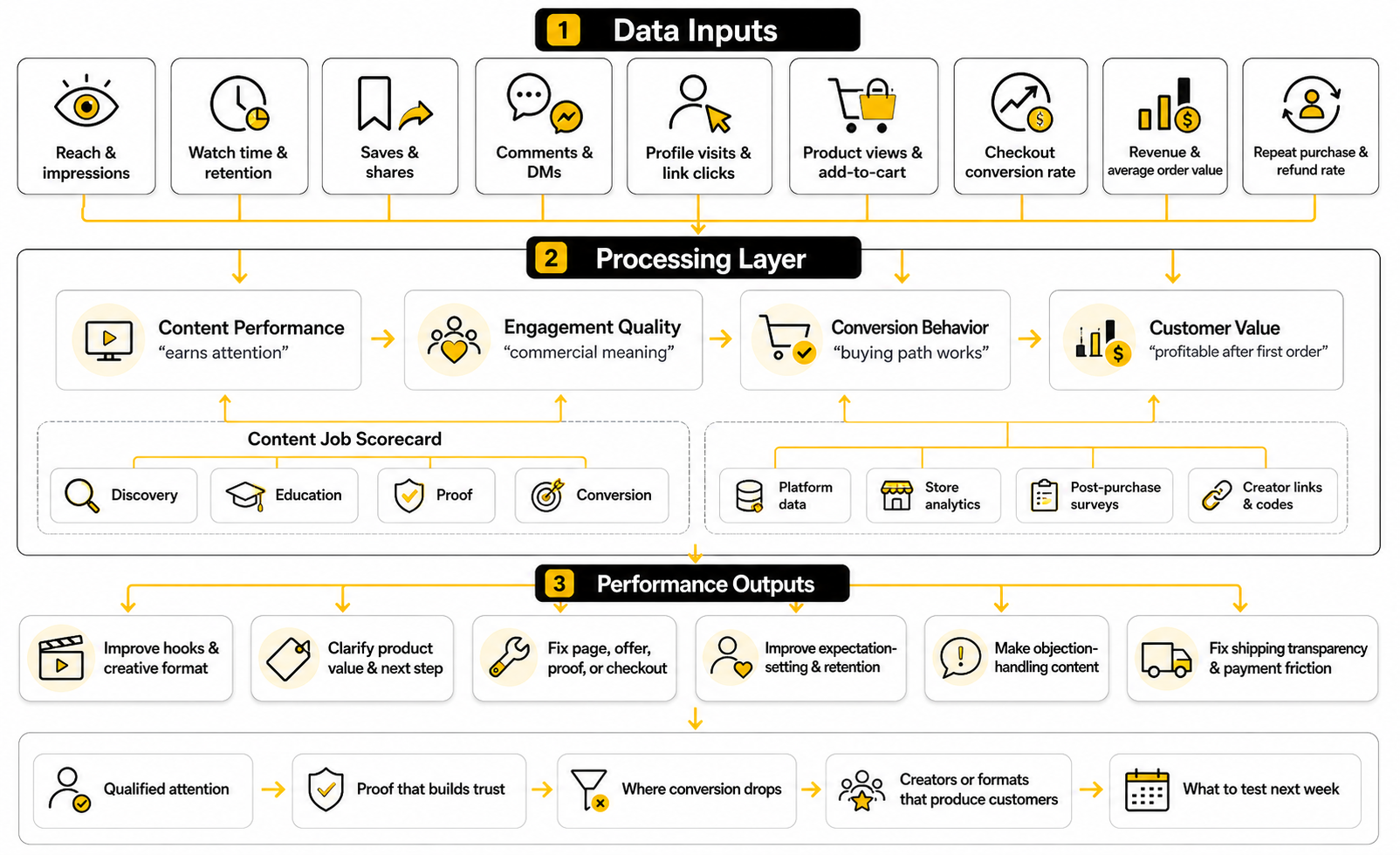
For example, a video with high reach but low clicks may still be useful if it creates broad awareness and gets saved often. A video with modest reach but strong click-through and purchase rate may be a better asset for retargeting or paid amplification. A creator post with fewer views but higher average order value may be more valuable than a viral creator post that attracts discount hunters. The point is not to worship one metric. The point is to understand the job each asset is doing.
A clean measurement system should connect:
This structure keeps the team honest. If reach is strong but clicks are weak, the content may be entertaining but not commercially clear. If clicks are strong but conversions are weak, the issue may be the landing page, price, proof, offer, shipping, or checkout experience. If conversions are strong but repeat purchase is weak, the problem may be expectation-setting or product fit. Each metric points to a different action.
Benchmarks Without Blind Benchmarking
Benchmarks are helpful, but they can also be dangerous. A benchmark should give you a reference point, not an excuse. Your category, price point, platform, offer, audience temperature, traffic quality, and product maturity all change what “good” performance looks like.
For ecommerce conversion, broad benchmark sources often show average store conversion rates somewhere in the low single digits. Shopify-focused benchmark analysis has cited an average Shopify store conversion rate around 1.4%, with much stronger stores reaching higher tiers through 2025 Shopify conversion benchmark coverage. That number is useful because it reminds teams that most traffic does not buy immediately. It is not useful if you apply it blindly to every social campaign.
Social traffic can behave differently from search traffic. A search visitor often arrives with stronger intent. A social visitor may be curious, inspired, skeptical, distracted, or still learning the category. That means social commerce conversion rates may look weaker at first glance, but the channel may still be valuable if it creates new demand, feeds retargeting pools, grows email/SMS lists, brings in creator content, or assists later purchases.
The better benchmark is your own baseline. Measure the first 30 days honestly. Then compare each new test against that baseline. Did hook retention improve? Did click-through rate improve? Did add-to-cart rate improve? Did the creator page outperform the generic page? Did the landing page built around one social angle beat the standard product page? Internal improvement is usually more actionable than comparing your store to a generic industry average.
Performance Signals That Matter
The best social commerce marketing teams watch for signals, not just final sales. Sales matter, obviously. But if you wait until purchase data is the only thing you study, you will miss the early clues that explain why performance is rising or falling.
One of the strongest early signals is retention. If people leave in the first two seconds, the hook is weak or the opening does not match the viewer’s context. If people watch but do not click, the content may be interesting but the product value or next step is unclear. If people save but do not buy, the product may need more proof, a stronger offer, or better follow-up. These are different problems, and they need different fixes.
Comments are another serious signal. A high volume of generic comments may mean the content entertained people. A high volume of specific questions may mean the content created buying intent but left gaps. Repeated objections about price, sizing, shipping, quality, ingredients, compatibility, or results should feed directly into future content and landing page updates. Comments are not just engagement. They are free customer research sitting in public.
Click behavior is where commercial intent becomes clearer. If profile visits rise but link clicks stay low, the bio, pinned posts, storefront, or call to action may be weak. If link clicks rise but product views do not turn into carts, the page may not match the social promise. If add-to-cart is healthy but checkout completion is weak, look at shipping costs, payment options, trust badges, delivery timelines, discount expectations, or checkout friction.
How to Read Creator Performance
Creator performance should not be judged only by views. A creator can generate reach without trust, and trust is what social commerce needs. The better question is whether the creator helped the buyer understand the product, believe the promise, and take the next step.
Creator metrics should include both content signals and commerce signals. Content signals include hook retention, watch time, comments, saves, shares, and audience quality. Commerce signals include clicks, product views, add-to-cart rate, conversion rate, revenue, average order value, refund rate, and repeat purchase. When possible, use creator-specific links, codes, storefronts, landing pages, or affiliate dashboards to make performance easier to read.
The most important insight is creative pattern recognition. You are not just trying to find “the best creator.” You are trying to find the creator angles that work. Does the product sell better through tutorials, reviews, comparisons, routines, unboxings, before-and-after content, founder interviews, or live demonstrations? Once you know the pattern, you can brief more creators with better direction and give paid media stronger assets to amplify.
Deloitte’s creator economy research found that 47% of respondents said they would take action by visiting a brand’s website after engaging with a creator endorsement through its creator commerce research. That matters because creator content should not be measured only as direct sales in the same session. It can also create branded searches, website visits, retargeting audiences, email signups, and assisted conversions.
How to Measure Content by Funnel Job
Not every piece of content should be judged by the same metric. A discovery video, a proof video, an objection-handling post, and an offer post all have different jobs. Treating them the same leads to bad decisions.
Discovery content should be measured by reach, retention, shares, saves, and new audience exposure. Its job is to make the right people notice the problem or product. Proof content should be measured by saves, comments, clicks, and assisted conversions because its job is to build belief. Objection-handling content may get lower reach, but it can be extremely valuable if it improves conversion among warm audiences. Offer content should be measured more directly by clicks, carts, purchases, revenue, and profitability.
This matters because many teams kill the wrong content. They stop making objection videos because they do not go viral. They overproduce trend content because it gets reach. Then revenue becomes unstable because the content mix is not supporting the whole buying journey. Social commerce marketing needs a balanced content portfolio, not just top-of-funnel entertainment.
A practical content scorecard can separate assets into four jobs:
Once content is grouped this way, the team can make more carefully decisions. If discovery is strong but sales are weak, add more proof and conversion content. If proof is strong but reach is weak, create more discovery hooks. If conversion content works in retargeting but not organically, use it where the audience is already warm. The data tells you where the system is thin.
How to Measure the Landing Page
The landing page is part of the social commerce system, not a separate ecommerce asset. If the page does not continue the same promise from the social post, performance drops. That is why landing page analytics should be reviewed alongside content analytics.
The first metric to watch is message match. This is not always visible in a dashboard, but the behavior will reveal it. If people click and bounce quickly, the page may not reflect the hook, creator angle, or offer that made them click. If people scroll but do not add to cart, the page may be interesting but not persuasive enough. If people add to cart but do not buy, the issue is likely pricing, shipping, trust, checkout, or timing.
For campaign-specific social traffic, dedicated pages often give better learning than sending everyone to a standard product page. A page can be built around one audience, one use case, one creator offer, one bundle, or one objection. That makes the data easier to interpret because the visitor’s reason for clicking is clearer. Replo is useful in this context when ecommerce teams need to build and test social-specific landing pages quickly without waiting for a full development queue.
The page should be measured by:
The action depends on where the drop-off happens. If people do not stay, improve message match and page speed. If people stay but do not cart, improve proof, offer clarity, product explanation, and calls to action. If people cart but do not buy, improve shipping transparency, trust, payment options, guarantees, and checkout flow.
How to Measure DM and Lead Flows
DMs, quizzes, forms, and lead flows are often used when the buyer needs guidance before purchasing. These flows are especially useful for products with options, sizing, routines, customization, consultations, or higher consideration. They are also useful when the business sells services instead of simple products.
The mistake is measuring these flows like normal content. A DM automation may not create immediate sales from every interaction, but it can qualify buyers, answer questions, collect emails, recommend products, or move people toward a call. That means the metrics should follow the flow’s purpose. If the goal is product recommendation, measure completion and click-through. If the goal is lead generation, measure qualified leads and booked calls. If the goal is support-assisted conversion, measure response quality and purchase rate after interaction.
For Instagram or Messenger-driven commerce, ManyChat can help connect comment triggers, keyword responses, product links, and follow-up messages. For service businesses or offers that require appointment booking and pipeline management, GoHighLevel can help track forms, calls, reminders, and follow-up stages. The measurement principle is the same in both cases: track the next meaningful action, not just the first click.
Useful DM and lead-flow metrics include:
These metrics help you improve the conversation. If many people trigger the flow but few finish it, the flow may be too long or unclear. If people finish but do not click, the recommendation may be weak. If people click but do not buy, the landing page or offer needs work. Measurement should lead directly to the next fix.
Attribution Without Losing Your Mind
Attribution in social commerce is messy. A buyer may see a short video, follow the brand, watch a creator review, search the product later, click a retargeting ad, read reviews, and buy days later. If you demand perfect attribution before making decisions, you will move too slowly.
The practical approach is to use multiple signals. Use UTM links, creator codes, affiliate links, platform analytics, post-purchase surveys, customer interviews, branded search trends, email signup sources, and store analytics together. None of them is perfect alone. Together, they give you a clearer picture of what is influencing revenue.
Post-purchase surveys are especially useful because they catch influence that platforms miss. Ask buyers where they first heard about the product and what convinced them to buy. Keep the question simple. Over time, patterns will appear. You may discover that TikTok creates first discovery, Instagram builds trust, YouTube answers final objections, and email captures the purchase.
The goal is not perfect certainty. The goal is better decisions. If multiple signals point to the same content angle, creator type, or platform, you can act with confidence. If the data conflicts, run a cleaner test with dedicated links, a specific landing page, and a tighter offer. Good attribution is less about proving every sale and more about reducing expensive guessing.
Turning Data Into Decisions
Data only matters when it changes what you do next. A weekly analytics review should end with decisions, not just observations. Keep what is working, fix what is leaking, and test what is uncertain.
A practical review should ask five questions. Which content created qualified attention? Which proof made people trust the product? Where did the conversion path lose people? Which creators or formats produced customers, not just views? What should we test next week based on the strongest signal?
The answers should drive specific actions. If comment questions repeat, make objection-handling content. If creator demos outperform polished ads, shift production toward creator-style assets. If add-to-cart is weak, improve the offer and product page. If checkout drop-off is high, fix shipping transparency and payment friction. If repeat purchase is low, improve expectation-setting before the first order.
This is the discipline that separates real social commerce marketing from content noise. The best teams do not just collect numbers. They interpret them, act on them, and build a tighter system every week.
Advanced Strategy and Scaling Tradeoffs
Scaling social commerce marketing is not just doing more of what worked in the first test. More content, more creators, more paid spend, and more platforms can grow revenue, but they can also expose weak operations fast. The strategy that works at a small scale can break when order volume rises, customer questions increase, creators need approvals, and attribution becomes harder to read.
The deeper challenge is control. Social commerce grows through distributed trust, which means the brand is no longer the only voice shaping the buying decision. Creators, customers, comments, algorithms, platform policies, delivery experience, refund handling, and public complaints all influence conversion. That is powerful when the system is healthy. It is risky when the brand has not built the guardrails to support it.
This part is about those tradeoffs. The goal is not to make social commerce sound complicated for no reason. The goal is to help you scale without turning a promising channel into an operational mess.
Platform Dependence Versus Owned Assets
The first serious tradeoff is platform dependence. Social platforms can create demand quickly, but they also control the feed, rules, reach, shop policies, ad approvals, creator tools, and sometimes the checkout experience. If a brand gets most of its revenue from one platform, it has speed, but it also has concentration risk.
That does not mean you should avoid platform-native selling. TikTok Shop, Instagram Shopping, YouTube Shopping, and creator storefronts can reduce friction and capture impulse demand. The risk appears when the brand treats the platform as the whole business instead of one layer of the business. A policy update, account issue, algorithm shift, product restriction, payout delay, or creative fatigue can hit revenue hard.
The safer approach is to use social platforms for discovery and conversion while building owned assets in parallel. That means email lists, SMS lists, customer accounts, review databases, first-party purchase data, product education hubs, customer communities, and branded search demand. Social commerce marketing should create customers you can serve again, not just transactions you rent from a feed.
A simple rule works well: use platforms for reach, but use owned assets for resilience. If a social campaign performs, capture emails where appropriate, collect reviews after purchase, build retargeting audiences, improve your product pages, and create evergreen content from the best-performing angles. The brand should become stronger after every campaign, even if the platform changes tomorrow.
Native Checkout Versus Brand-Owned Checkout
Native checkout can be a major advantage because it reduces friction. A buyer sees a product, trusts the creator, clicks, and buys without leaving the platform. For simple products with strong visual appeal, that can work extremely well. The shorter path matters because every extra step gives the buyer another chance to get distracted.
Brand-owned checkout gives you more control. You can customize the landing page, manage bundles, add upsells, capture richer customer data, control post-purchase flows, test offers, and shape the full brand experience. That matters when the product needs explanation, personalization, subscriptions, financing, consultations, or deeper trust. It also matters when customer lifetime value depends on retention, not just the first order.
The tradeoff is not “native checkout good” or “website checkout good.” The right choice depends on buyer intent and product complexity. Native checkout is often better for quick, low-friction purchases. Brand-owned checkout is often better for education-heavy, higher-value, or relationship-driven purchases.
A mature system may use both. Let native checkout capture impulse demand where the platform is strong. Use dedicated landing pages for campaigns that need story, proof, bundles, comparison, or personalization. If the brand needs campaign-specific pages that match social angles, Replo can help ecommerce teams create those pages without slowing every test down through a full development cycle.
Creator Scale Versus Creator Quality
Creator programs often look easy from the outside. Send products, collect videos, repost the best ones, and scale what works. In reality, creator quality becomes harder to manage as volume increases. More creators means more briefing, contracts, usage rights, disclosure checks, revisions, payments, shipping coordination, performance tracking, and brand safety review.
The biggest mistake is scaling creators before the brand understands which creator patterns actually convert. A large creator list is not the same as a creator strategy. You need to know which audience segments respond, which content formats build trust, which creator styles explain the product clearly, and which assets can be reused in paid media or landing pages. Otherwise, the team produces a lot of content without a clear performance pattern.
Disclosure and compliance also matter. The FTC’s endorsement guidance says creators must clearly disclose material connections with brands, including payments, free products, or other incentives, through its social media disclosure guidance. This is not just a legal box to tick. Clear disclosure protects trust because buyers should never feel tricked after realizing a recommendation was sponsored.
A better creator scaling model has three tiers:
This structure keeps the program from becoming chaotic. Testing stays flexible. Performance gets measured. Long-term partners get better briefs and stronger collaboration. That is how creator marketing becomes part of the social commerce system instead of a content lottery.
Speed Versus Brand Control
Social commerce rewards speed. Trends move fast, comments reveal objections quickly, and platform-native content often performs better when it feels current. If every post needs weeks of approvals, the brand will miss opportunities. But speed without control creates its own problems: inaccurate claims, inconsistent offers, off-brand creator content, unapproved discounts, missing disclosures, and customer expectations that operations cannot meet.
The solution is not to slow everything down. The solution is to create clear guardrails. Teams need approved claims, product facts, pricing rules, visual guidelines, disclosure requirements, prohibited language, shipping promises, return policy language, and escalation rules for sensitive comments. Once those are clear, the content team and creators can move faster without creating avoidable risk.
This matters most in categories where claims are sensitive. Health, wellness, beauty, finance, supplements, children’s products, regulated goods, and professional services need extra care. A creator exaggerating results can generate short-term sales and long-term damage. Social commerce marketing depends on trust, and trust is expensive to rebuild.
The practical move is to build a creator and content playbook. Keep it short enough that people actually use it. Include what can be said, what cannot be said, how to disclose partnerships, how to talk about results, how to handle comments, and when to escalate questions to support or legal. Good guardrails do not kill creativity. They make it safer to move fast.
Paid Amplification Versus Organic Learning
Organic content is a learning engine. Paid amplification is a scaling engine. Confusing the two creates bad decisions. If a brand pushes paid spend behind weak content before understanding why people respond, it can spend money faster without learning much. If a brand refuses to amplify proven content, it may leave profitable growth on the table.
Organic testing helps identify hooks, formats, creators, objections, and proof angles. Paid media can then amplify the strongest assets to larger or warmer audiences. The best paid social commerce ads often do not feel like traditional ads. They look like useful creator videos, product demonstrations, customer proof, comparison content, or direct answers to a real objection.
The tradeoff is creative fatigue. An asset that works today may decline as audiences see it repeatedly. That means scaling paid social commerce requires a creative pipeline, not just a media budget. The team needs a steady flow of new hooks, variations, creators, edits, landing page matches, and retargeting angles.
A useful paid amplification process is:
This keeps paid media connected to real customer behavior. Instead of guessing what ad to make, you promote what the market has already shown interest in.
Growth Versus Customer Experience
Fast social commerce growth can create customer experience problems. A viral post can drive sudden demand, but operations still need to handle inventory, shipping, support, returns, exchanges, product questions, and refund expectations. If the backend is not ready, the same attention that creates sales can create public complaints.
This is where many brands underestimate the channel. Social commerce compresses demand. A product can go from quiet to overwhelmed very quickly if a creator asset takes off. That sounds like a dream until stock runs out, shipping delays begin, DMs pile up, and comment sections turn into support queues. The channel does not forgive hidden operational problems for long.
Returns and fraud also need attention as volume scales. Signifyd described online returns as a major ecommerce challenge, with returns pressure, fraud, and abuse becoming more operationally important in its 2025 fraud and returns research. Social commerce can increase the risk of mismatched expectations because buyers may act quickly after seeing a short piece of content. That makes accurate product representation, sizing guidance, clear delivery timelines, and realistic claims even more important.
Customer experience should be treated as part of the marketing system. If customers ask the same question after purchase, fix the pre-purchase content. If returns are driven by misunderstanding, fix the product page and creator briefs. If support is overwhelmed, improve self-serve answers, order updates, and proactive communication. Social commerce marketing does not end at checkout. The post-purchase experience becomes the proof for the next buyer.
Personalization Versus Privacy
Personalization can improve social commerce because buyers often need guidance. A quiz can recommend the right product. A DM flow can send a relevant bundle. Email can follow up based on browsing or purchase behavior. Retargeting can show proof that matches the buyer’s earlier interest. Done well, personalization reduces friction.
The tradeoff is privacy and trust. Buyers do not want to feel tracked in a creepy way. They also do not want to hand over information if the value is unclear. The brand needs to be transparent about what it is asking for and why. If you ask for an email, give a useful reason. If you run a quiz, make the result genuinely helpful. If you retarget, use content that answers likely questions instead of hammering the same discount repeatedly.
This is especially important as privacy rules, browser behavior, platform tracking limits, and consumer expectations keep changing. The brands that win will not be the ones with the most aggressive tracking. They will be the ones that create enough value for customers to willingly share information and keep engaging.
A healthy personalization strategy uses first-party data respectfully. It improves recommendations, education, timing, and support. It does not manipulate, over-message, or hide how the customer got into the flow. The more human the experience feels, the more trust it builds.
Automation Versus Human Judgment
Automation can make social commerce more scalable. Comment triggers, DM flows, email sequences, SMS reminders, lead routing, abandoned cart messages, review requests, and CRM pipelines can all reduce manual work. Without automation, a growing brand may miss high-intent signals simply because the team cannot respond fast enough.
But automation can also damage trust when it is overused. A robotic DM sequence after a casual comment can feel spammy. An abandoned cart flow that pushes too hard can cheapen the brand. A chatbot that cannot answer real questions can frustrate buyers who were ready to purchase. Automation should make the experience easier, not colder.
The rule is simple: automate predictable steps, but keep human judgment for sensitive moments. Sending a product link after someone comments a keyword is predictable. Handling a complaint, refund issue, allergy concern, sizing confusion, or high-value sales question may need a person. The best systems make it easy to escalate.
For DM-led social commerce, ManyChat fits best when the flow is short, useful, and tied to a clear buyer action. For service businesses and sales-led offers, GoHighLevel can help manage follow-up, pipeline stages, appointments, and reminders. In both cases, automation should support the relationship. It should not pretend the relationship does not matter.
Brand Safety and Marketplace Trust
Trust issues are getting more serious as social commerce grows. Fraudulent sellers, counterfeit products, misleading ads, fake reviews, and AI-generated scams can make shoppers more cautious. That affects legitimate brands too because buyers bring that skepticism into every social shopping experience.
TikTok Shop reported that it removed 200,000 prohibited or restricted products after listing and reviewed more than 900,000 user reports globally during the first half of 2025 in its latest safety report. The action for legitimate brands is clear: do not assume platform trust is enough. You still need transparent product information, clear policies, real reviews, visible support, and consistent brand presence.
Social commerce marketing should make buyers feel safer at every step. Show the product clearly. Avoid exaggerated claims. Use honest creator content. Display real customer feedback. Make shipping and returns easy to understand. Respond to concerns in public when appropriate. A buyer who feels safe is more likely to complete the purchase and less likely to regret it.
Brand safety also includes where and how your content appears. Paid amplification, creator whitelisting, affiliate programs, and marketplace listings should be monitored. If creators make claims you cannot support, correct them. If affiliates use misleading tactics, remove them. If counterfeit sellers appear, report them. Trust is not a one-time setup. It is ongoing maintenance.
International Expansion Versus Local Fit
Social commerce can make international expansion tempting because platforms cross borders easily. A video can reach another market before the brand has planned for language, payments, delivery, taxes, returns, customer support, and cultural context. That reach feels exciting, but selling into a market is different from being operationally ready for it.
Local fit matters. Content style, humor, creator trust, product expectations, sizing, payment preferences, delivery standards, return behavior, and platform popularity vary by market. A campaign that works in the United States may not work the same way in Germany, Brazil, Japan, or the United Kingdom. Even within one language, buyer expectations can differ sharply.
DHL’s ecommerce research emphasizes that social buying behavior, delivery expectations, and cross-border ecommerce preferences are changing across markets through its 2025 social commerce trends research. The strategic takeaway is not just “sell globally.” It is to validate operational readiness before scaling social demand into new regions.
A careful expansion plan starts with demand signals, then checks operational reality. Are people in the market engaging with the content? Can they buy easily? Is shipping reliable? Are returns manageable? Are local creators available? Are claims and disclosures compliant? Can support handle the language and time zone? If the answer is no, fix the backend before pushing harder.
When Social Commerce Is Not the Right Primary Channel
Social commerce is powerful, but it is not always the best primary channel. Some products are hard to demonstrate visually. Some purchases require long procurement cycles. Some industries face strict compliance limits. Some buyers do not use social platforms for serious product research. Some offers need deep consultation before a sale can happen.
That does not mean social has no role. It may still help with education, trust, recruitment, community, retargeting, proof, or founder visibility. But the primary conversion channel may be search, partnerships, outbound sales, marketplaces, retail, webinars, referrals, or direct sales calls. A smart strategy uses social commerce where it genuinely supports the buying journey.
The warning sign is when the team has to force the channel. If every post needs too much explanation, if buyers keep asking for sales help, if compliance blocks useful claims, or if traffic never moves beyond curiosity, social commerce may be better as an assist channel. That is not failure. That is strategic clarity.
The best marketers do not worship channels. They match channels to buyer behavior. Social commerce marketing deserves serious attention, but it should still earn its role through performance, fit, and customer quality.
Optimization, Common Mistakes, and FAQ
At this stage, the strategy is no longer about proving that social commerce marketing can work. The question is whether the system can keep improving without becoming messy, expensive, or shallow. That is where optimization matters.
Optimization is not only changing hooks, testing thumbnails, or moving buttons around. It is the discipline of finding the weak point in the journey and fixing the thing that actually limits revenue. Sometimes the problem is content. Sometimes it is the creator brief. Sometimes it is trust. Sometimes it is the offer, checkout, support, retention, or the gap between what the social post promised and what the buyer experienced.
The best teams treat social commerce like an ecosystem. They improve the content, the platform fit, the creator program, the landing experience, the follow-up, the customer experience, and the measurement loop together. That is how the channel becomes more durable over time.
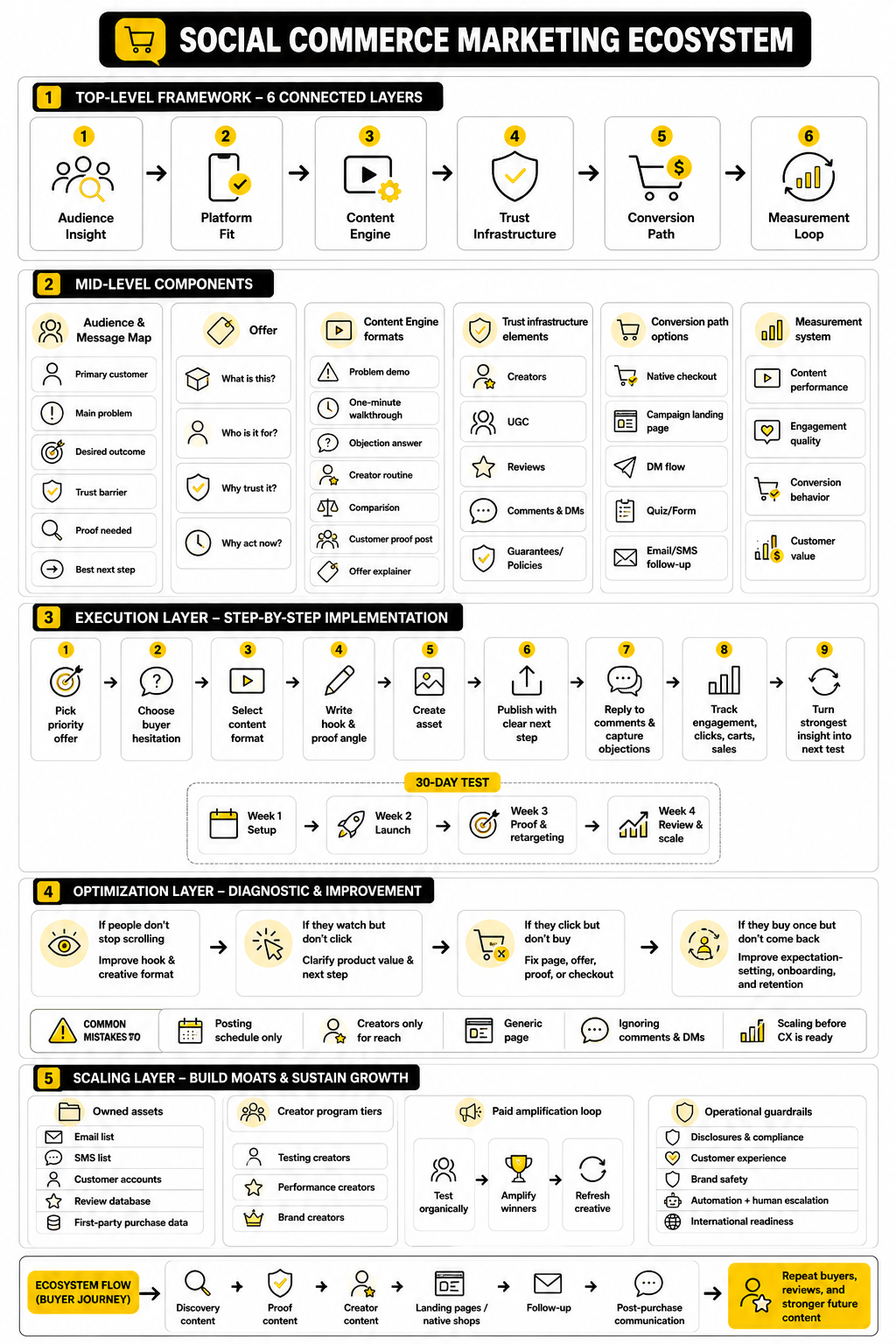
The Final Social Commerce System
A complete social commerce system should feel simple to the buyer and structured behind the scenes. The buyer sees useful content, believable proof, an easy next step, and a brand that responds like a real business. The team sees audience insights, content formats, creator assets, customer feedback, conversion data, and retention signals feeding into one operating rhythm.
The system works best when every part has a clear job. Discovery content brings new people into the category conversation. Proof content builds belief. Creator content gives the product social context. Landing pages or native shops turn interest into action. Follow-up captures people who were close but not ready. Post-purchase communication turns customers into reviewers, repeat buyers, and future proof.
This is where social commerce marketing becomes more than a campaign. It becomes a market learning machine. Every comment, creator video, customer review, abandoned cart, product question, repeat purchase, and refund reason gives you information. The brand that learns from those signals faster will usually beat the brand that only publishes more content.
Common Mistakes That Hurt Social Commerce Results
The first mistake is treating social commerce as a posting schedule. Posting more can help only when the content has a clear role in the buying journey. If every post is just a product reminder, the brand becomes easy to ignore. The better approach is to build a balanced mix of discovery, education, proof, objection-handling, and conversion content.
The second mistake is using creators only for reach. Reach is useful, but creator value comes from trust, explanation, audience fit, and reusable assets. A small creator who shows the product clearly and speaks to the right buyer can be more valuable than a large creator who creates empty attention. The creator program should be judged by commercial behavior, not vanity metrics alone.
The third mistake is sending all traffic to the same generic page. Social traffic often arrives with a specific context. If the post showed a bundle, the page should show that bundle. If the creator explained one use case, the page should reinforce that use case. If the content answered a problem, the landing experience should continue that exact conversation.
The fourth mistake is ignoring comments and DMs. Comments are not just engagement. They reveal objections, confusion, urgency, skepticism, and buying intent. A brand that mines comments properly can improve content, product pages, FAQs, creator briefs, and customer support from the same source of truth.
The fifth mistake is scaling before the customer experience is ready. Social commerce can compress demand quickly, especially when creator content performs. If inventory, shipping, support, returns, and post-purchase communication are weak, growth will expose the weakness in public. The sale is not the end of the journey. It is the start of the proof loop.
How to Optimize the System Over Time
Optimization should start with the biggest constraint. If people do not stop scrolling, improve the hook and creative format. If they watch but do not click, make the product value and next step clearer. If they click but do not buy, fix the page, offer, proof, or checkout. If they buy once but do not come back, improve expectation-setting, onboarding, product experience, and retention.
The weekly review should stay practical. Pick one or two improvements that can actually be implemented before the next cycle. Do not change the offer, audience, platform, landing page, creator brief, and follow-up all at once. When everything changes together, the team learns less.
Social commerce is already large enough to deserve this discipline. U.S. social commerce sales were projected to hit $87.02 billion in 2025 and pass $100 billion in 2026 through Emarketer’s social commerce forecast. That growth does not guarantee results for every brand. It simply means the channel is mature enough that weak execution becomes more expensive.
Optimization also needs ethical boundaries. The FTC requires influencers to disclose material relationships with brands in a clear way through its social media influencer disclosure guidance. This matters because trust is the asset social commerce depends on. Short-term sales from unclear sponsorships, exaggerated claims, or misleading scarcity can damage the brand faster than they help it.
What is social commerce marketing?
Social commerce marketing is the practice of using social platforms to create product discovery, build trust, answer objections, and drive purchases. It connects content, creators, community, checkout, and follow-up into one buying journey. The sale may happen inside a platform, through a landing page, in a DM flow, or after retargeting, but the demand starts and develops through social behavior.
How is social commerce different from social media marketing?
Social media marketing can focus on awareness, engagement, brand building, or audience growth. Social commerce marketing is more directly tied to buying behavior. It asks how social attention becomes product interest, how that interest becomes trust, and how trust becomes a purchase or qualified lead.
Is social commerce only for ecommerce brands?
No. Ecommerce brands usually have the clearest path because products can be shown, clicked, and purchased quickly. But service businesses, agencies, coaches, software companies, local businesses, and consultants can also use social commerce principles. For them, the conversion path may be a form, booked call, DM flow, quote request, webinar, trial, or consultation instead of a simple checkout.
Which platforms are best for social commerce marketing?
The best platform depends on the buyer, product, and content format. TikTok is strong for discovery, creator-led product demos, and native shopping behavior. Instagram is useful for visual proof, creator content, DMs, stories, and retargeting. YouTube is strong for deeper education and searchable content. Pinterest can work well for visual planning and product inspiration. The right platform is the one where your buyer already looks for ideas, proof, or recommendations in your category.
Do I need TikTok Shop to do social commerce?
No. TikTok Shop is one possible social commerce path, not the entire strategy. It can work well for products that are visual, easy to understand, and suited to creator-led discovery. But many brands still perform better by sending traffic to a dedicated landing page, quiz, product page, DM flow, or email capture path. The correct choice depends on how much explanation and trust the buyer needs before acting.
What metrics matter most in social commerce?
The most useful metrics depend on the job of the content. Discovery content should be judged by reach, retention, saves, shares, and new audience quality. Proof content should be judged by engagement quality, comments, clicks, and assisted conversions. Conversion content should be judged by click-through rate, add-to-cart rate, checkout completion, revenue, and profitability. A complete system also tracks repeat purchase, refund rate, customer acquisition cost, and customer lifetime value.
How often should a brand post for social commerce?
Posting frequency matters less than learning frequency. A small team should start with a sustainable rhythm that allows consistent publishing, comment response, creative testing, and performance review. For many brands, that may mean several short-form videos per week, one or two creator assets, and a weekly review cycle. Posting every day is not useful if the content does not improve or connect to a clear conversion path.
What kind of content works best for social commerce?
The strongest content usually shows the product in context. Demonstrations, creator routines, customer proof, before-and-after explanations, comparison posts, objection answers, tutorials, and offer explainers tend to work better than generic product announcements. The content should make the buyer think, “That is for me,” “I understand how it works,” or “I trust this enough to take the next step.”
How do creators fit into social commerce marketing?
Creators help make the product believable in a real-life context. They can demonstrate use cases, translate brand claims into human language, answer category questions, and introduce the product to an audience that already trusts them. The best creator partnerships are not based only on follower count. They are based on audience fit, content quality, trust, clarity, compliance, and the ability to drive useful commercial signals.
Should I use discounts in social commerce?
Discounts can work, but they should not become the whole strategy. A strong offer can also be a bundle, trial, limited drop, gift-with-purchase, product quiz, creator-exclusive package, or clear first-time buyer path. If the only reason people buy is a discount, margins suffer and customer quality may decline. Use urgency carefully and make the value clear before using price as the main lever.
How do I know whether my landing page is hurting performance?
Look at the drop-off after the click. If people click from social but bounce quickly, the page may not match the promise that made them click. If they scroll but do not add to cart, the page may need stronger proof, clearer product explanation, or a better offer. If they add to cart but do not complete checkout, review shipping costs, delivery timelines, payment options, trust signals, and checkout friction.
Can automation help with social commerce?
Yes, but only when it makes the buyer experience easier. Comment triggers, DM flows, abandoned cart messages, lead routing, review requests, and follow-up sequences can all help capture intent. For example, ManyChat can support Instagram or Messenger flows when people comment or ask for product details, while GoHighLevel can support pipelines, forms, appointments, and follow-up for service-led offers. Automation should feel helpful, not pushy.
What is the biggest risk in social commerce marketing?
The biggest risk is creating demand faster than the business can support it. A viral post can expose weak inventory, slow shipping, unclear policies, poor customer support, or exaggerated product claims. Another major risk is platform dependence. Brands should use social platforms for discovery and conversion, but they should also build owned customer assets like email lists, reviews, customer data, and repeat purchase systems.
How long does it take to see results?
Some products can generate sales quickly if the offer is simple, the content is strong, and the buying path is clean. But a serious social commerce system usually needs several weeks of testing before useful patterns appear. A 30-day test can reveal which hooks, formats, creators, offers, and landing paths deserve more investment. The goal is not instant perfection. The goal is to create a feedback loop that keeps getting sharper.
What tools are useful for social commerce marketing?
The right tools depend on the bottleneck. Buffer can help organize publishing and content rhythm. Replo can help ecommerce teams build landing pages that match specific social campaigns. ManyChat can support DM-based follow-up. Brevo can help with email campaigns and automation. GoHighLevel can support service businesses, agencies, and sales-led funnels that need CRM, appointments, and follow-up in one place.
Build a stronger local presence with BAAM AI
Turn your website, Google profile, social channels, and AI visibility into one growth engine
Most businesses do not need more random marketing activity. They need a consistent presence system that helps the right people find them, trust them, and take action. BAAM AI brings strategy, local SEO, website updates, Google Maps visibility, social content, AI-search readiness, media production, and reporting into one practical monthly engine.
If you want your marketing to keep working after the campaign ends, start with a free BAAM AI presence audit. See how your business shows up today and where the fastest visibility wins are at BAAM AI.