
BAAM AI Blog
Social And Digital Marketing: A Practical Framework For Building Demand, Trust, And Revenue
Social and digital marketing used to be treated like a traffic job. Post more. Run more ads. Send more emails. Push harder until something converts.
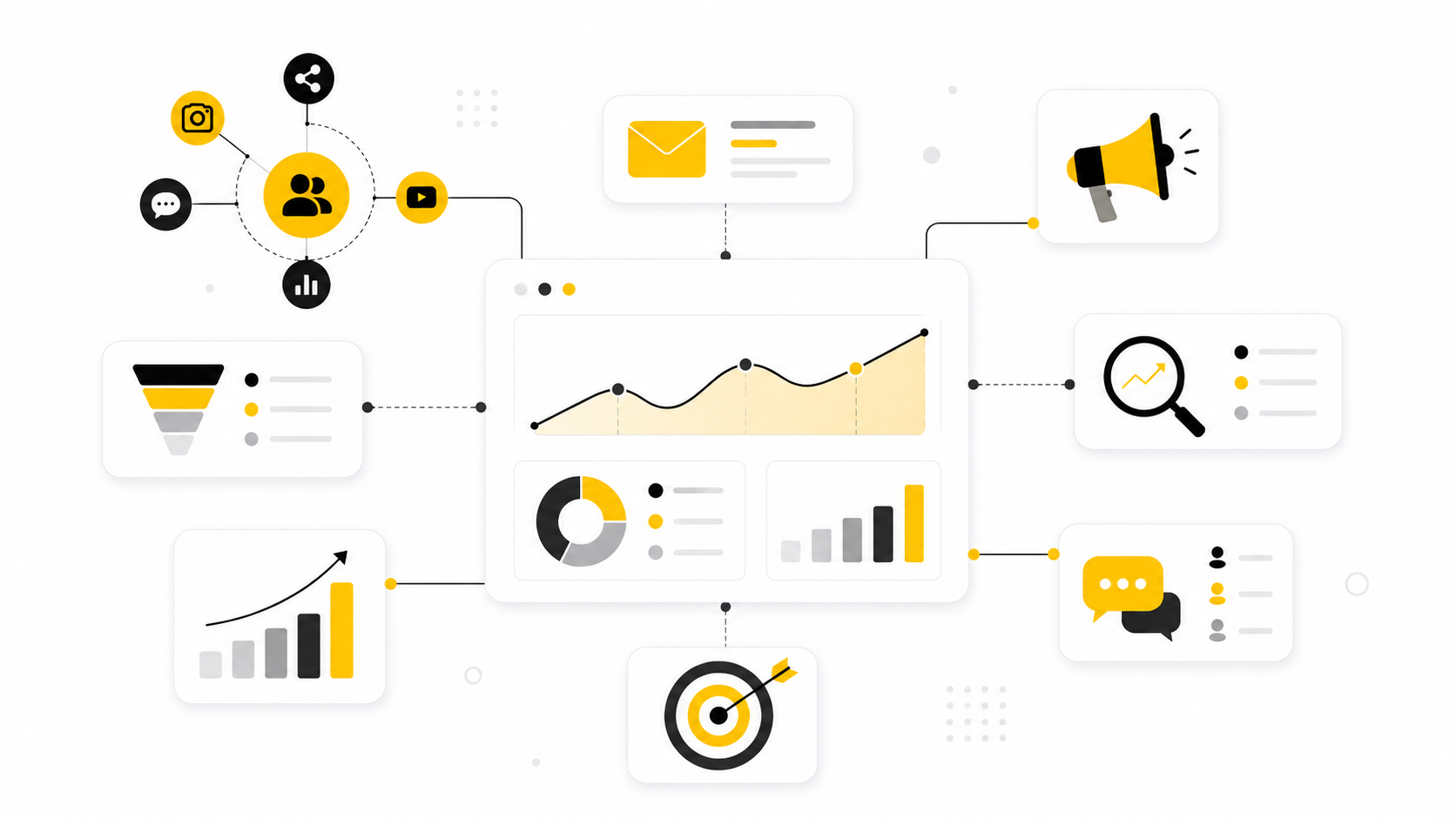
Social and digital marketing used to be treated like a traffic job. Post more. Run more ads. Send more emails. Push harder until something converts.
That approach is getting weaker because the customer journey is no longer clean or linear. People discover brands on TikTok, compare them on Google, check reviews on Reddit, watch YouTube explainers, click a retargeting ad, join an email list, ignore three promotions, then buy after a friend mentions the same product in a group chat. Social and digital marketing is the discipline of making that messy journey easier to understand, easier to trust, and easier to act on.
The scale is too big to treat casually. The Digital 2025 Global Overview Report estimates 5.24 billion social media user identities worldwide, equal to 63.9% of the global population, while internet users increased by 136 million during 2024. In the United States, digital advertising revenue reached a record $294.6 billion in 2025, which tells you where attention, competition, and measurement pressure are moving.
But bigger budgets do not automatically create better marketing. More channels often create more noise. More tools often create more disconnected work. More content often creates less clarity.
That is why this guide treats social and digital marketing as a system, not a checklist. The goal is not to be everywhere. The goal is to build a connected engine where audience insight, content, distribution, conversion, automation, and measurement support each other.
Why Social And Digital Marketing Matters Now
Social and digital marketing matters because buying decisions now happen across many small moments instead of one obvious sales interaction. A person may first notice a brand through a creator, then search for proof, then compare alternatives, then enter a funnel through a lead magnet or product page. If those touchpoints feel disconnected, the brand loses momentum.
This is also why “just post consistently” is incomplete advice. Consistency helps, but consistency without positioning becomes background noise. The stronger play is to make every channel carry the same promise, proof, and next step in a format that fits the platform.
The trust side matters just as much as the reach side. The 2025 Edelman Trust Barometer Special Report on Brands points to a shift toward personal relevance, optimism, support, and emotional connection. In practical terms, people do not only ask whether a brand is visible. They ask whether it understands them, whether it feels credible, and whether the offer fits their situation.
The Social And Digital Marketing Framework
A useful social and digital marketing framework has four layers: attention, trust, conversion, and retention. Attention gets the right people to notice you. Trust gives them reasons to keep paying attention. Conversion turns interest into a measurable action. Retention keeps the relationship alive after the first click, lead, or purchase.
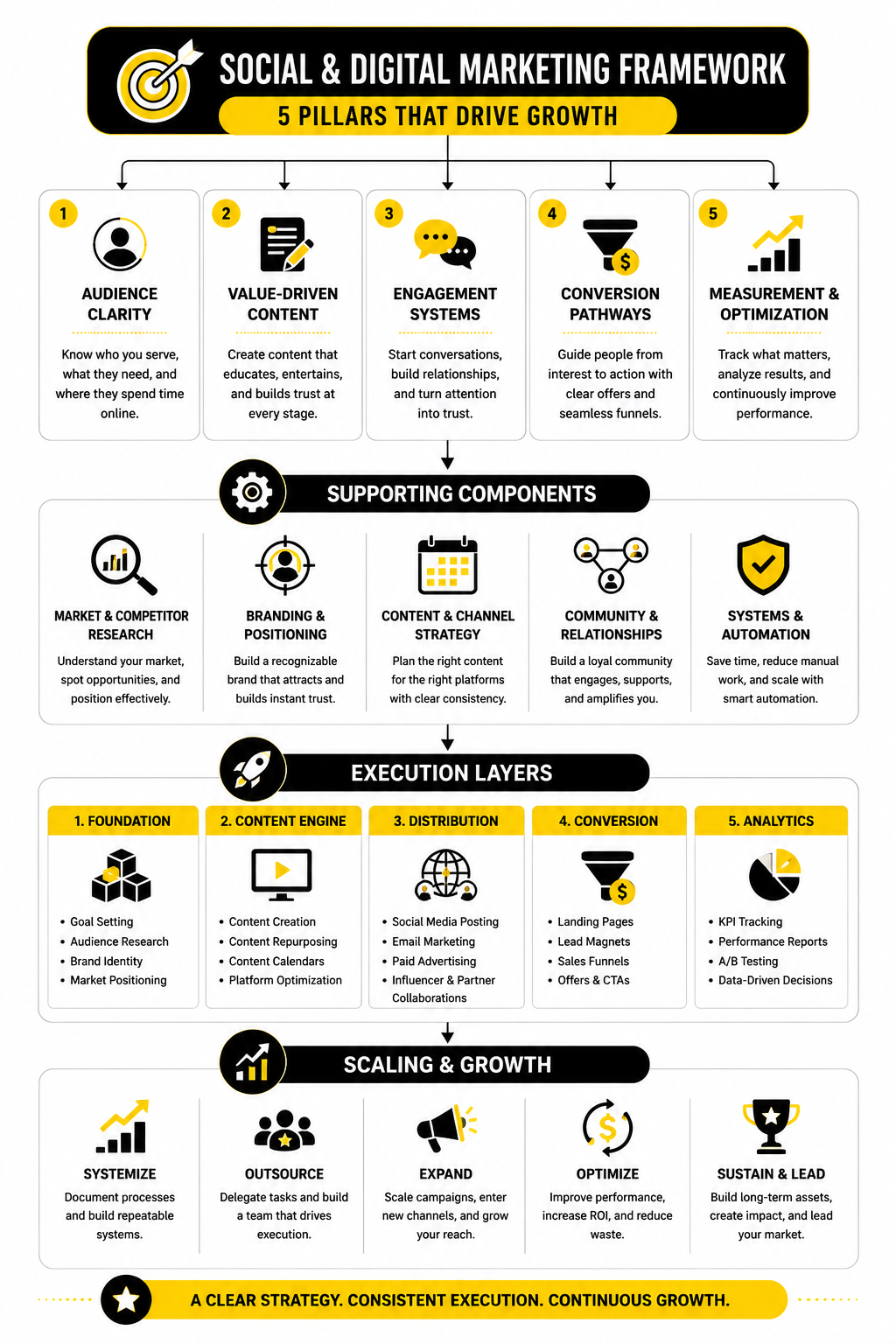
The framework works best when each layer has a clear job. Social platforms are often strongest at discovery, community, proof, and demand creation. Digital channels like search, email, landing pages, paid media, CRM, and automation are often stronger at capture, nurturing, segmentation, and revenue tracking.
This is where many businesses make the wrong move. They try to make every channel do every job. A better approach is to decide which channels create demand, which channels capture demand, which channels convert demand, and which channels expand demand after the first purchase.
Core Components Of Social And Digital Marketing
The first component is audience understanding. You need to know what people want, what they already believe, what objections stop them, and what language they use when describing the problem. Without this, your content sounds generic even if the design looks polished.
The second component is channel strategy. Social media, search, email, paid ads, messaging, landing pages, webinars, and communities all behave differently. A short-form video may create desire, while a comparison page captures high-intent search demand, and an email sequence handles objections over several days.
The third component is the conversion path. This is where tools matter, but only after the offer and message are clear. A business might use ManyChat for social messaging automation, Buffer for social publishing, Brevo or Moosend for email marketing, ClickFunnels for funnel building, or GoHighLevel for CRM, automation, and client campaign management. The tool is not the strategy. The tool should make the strategy easier to execute.
Professional Implementation
Professional implementation starts by removing randomness. You define the audience, offer, message, channels, content rhythm, conversion path, and metrics before scaling activity. This prevents the common trap where a team is “busy with marketing” but cannot explain what is actually working.
Measurement also needs to go beyond vanity metrics. Reach, impressions, likes, and followers can be useful signals, but they are not the whole picture. A stronger system tracks content saves, profile visits, clicks, leads, pipeline, conversion rate, customer acquisition cost, repeat purchase behavior, and revenue influenced by each channel.
The best teams also treat social and digital marketing as a feedback loop. Content reveals what people care about. Search data reveals what people actively want. Ads reveal which promises create action. Email and CRM data reveal which objections slow people down. When those signals are reviewed together, marketing becomes sharper, faster, and much easier to scale.
Audience Research And Positioning
Strong social and digital marketing starts before you write a caption, build a funnel, or launch an ad. It starts with knowing exactly who you are trying to reach and why they should care. Without that, every channel becomes a guessing game.
The mistake is assuming audience research means collecting demographics and calling it strategy. Age, location, income, and job title can help, but they do not explain the real reason someone clicks, saves, searches, subscribes, or buys. Better research looks at the customer’s situation, motivation, pain, objections, desired outcome, and buying context.
This matters because digital attention is crowded. The Digital 2025 Global Overview Report shows that social media user identities increased by 206 million over the previous year, which means more people are online, but also more brands are competing for the same moments of attention. Positioning is what stops your message from blending into the feed.
Start With The Customer’s Real Problem
Most weak marketing starts with the product. Strong marketing starts with the problem the customer is already trying to solve. That sounds simple, but it changes everything.
A business selling software is not only selling software. It may be selling fewer missed leads, faster follow-up, cleaner reporting, less manual admin, or a better way to prove marketing ROI. A consultant is not only selling advice. They may be selling clarity, confidence, speed, accountability, or a path out of a messy growth plateau.
When the real problem is clear, content becomes easier to produce because you are no longer asking, “What should we post today?” You are asking, “What does this buyer need to understand before they trust us?” That shift makes social and digital marketing more useful for the audience and more profitable for the business.
Identify Buying Triggers
A buying trigger is the moment when a passive audience member becomes an active buyer. It could be a failed launch, a rising ad cost, a missed sales target, a new competitor, a leadership change, a personal frustration, or a sudden need to move faster. Good marketing speaks to those triggers directly.
This is why timing matters so much. Someone who is casually browsing needs education and trust. Someone comparing vendors needs proof, differentiation, and a clear next step. Someone ready to buy needs friction removed.
You can usually find buying triggers in sales calls, customer support tickets, reviews, search queries, social comments, community threads, and CRM notes. The best insights are often hiding in the exact phrases customers use when they are frustrated. Do not sanitize that language too much. Use it to make your message sharper.
Map The Audience By Awareness Level
Not every prospect is equally ready. Some people do not know they have a problem yet. Some know the problem but do not know the solution. Some know the solution category but do not know why they should choose you. Some are already comparing options.
That is why one message cannot carry the whole strategy. A top-of-funnel social post might challenge a belief or name a hidden problem. A search-focused article might explain the solution category. A landing page might show proof, benefits, and objections. An email sequence might create urgency and help the buyer make a confident decision.
This is where social and digital marketing becomes more strategic. You are not just creating content for platforms. You are creating content for different stages of belief.
Build A Clear Positioning Statement
Positioning is the answer to a practical question: why should this specific audience choose you instead of doing nothing, doing it themselves, or choosing someone else? If that answer is vague, your marketing will be vague. If that answer is sharp, every channel gets easier.
A strong positioning statement should define:
This does not need to become a public slogan. It is an internal filter that keeps your social posts, ads, emails, landing pages, and offers aligned. When a team skips this step, they usually compensate with volume. More posts, more campaigns, more redesigns, more meetings. That is expensive confusion.
Separate Market Research From Customer Research
Market research tells you what is happening in the category. Customer research tells you what is happening in the buyer’s head. You need both, but they are not the same thing.
Market research might show platform shifts, budget trends, competitor messaging, pricing models, or changes in consumer behavior. Customer research shows the emotional and practical reasons people hesitate, compare, trust, ignore, or buy. One gives you context. The other gives you message-market fit.
Recent research makes this distinction even more important because trust is becoming more personal. The 2025 Edelman Brand Trust report highlights how people increasingly expect brands to be relevant to their lives, not just visible in the market. That means broad category claims are not enough. The message has to feel specific.
Turn Research Into Messaging Angles
Research only helps when it turns into usable messaging. The goal is not to create a giant document nobody opens. The goal is to produce practical angles your team can use across content, ads, funnels, and sales conversations.
Useful messaging angles often come from:
This is where you should be disciplined. Do not turn every insight into a campaign. Pick the angles that are specific, believable, and tied to a real business outcome. Good messaging does not just sound clever. It helps the right person recognize themselves and take the next step.
Choose The Channels After The Message
Many teams pick channels too early. They decide they need TikTok, LinkedIn, YouTube, SEO, email, paid ads, and a newsletter before they understand what they are trying to say. That creates scattered execution.
The more carefully order is message first, channel second. If your audience needs education, long-form content, search, webinars, and email may matter more. If your audience needs discovery and social proof, short-form video, creator partnerships, and community-driven content may work better. If your audience is already aware and comparing options, retargeting, landing pages, case studies, and review content become more important.
This also protects your budget. You do not need to be everywhere. You need to be present where your message has the best chance of creating belief, demand, and action. That is the foundation the rest of the strategy builds on.
Content Strategy Across Social And Digital Channels
Once the audience and positioning are clear, the next job is turning that strategy into content people actually want to consume. This is where social and digital marketing becomes visible. The strategy moves from research documents into posts, videos, emails, landing pages, ads, lead magnets, webinars, product pages, and sales conversations.
The key is to stop thinking about content as “things to publish” and start thinking about it as a belief-building system. Every piece should help the right person understand a problem, trust your point of view, see a better path, or take the next step. If content does not move the audience closer to clarity, confidence, or action, it is probably just noise.
This matters even more because content is no longer limited to brand-owned channels. Creators, communities, search engines, newsletters, private groups, review sites, and AI-powered discovery all influence how people form opinions. The 2025 Creator Economy Ad Spend and Strategy Report projected U.S. creator ad spend to reach $37 billion in 2025, which shows how much brand influence has shifted toward people and personalities audiences already trust.
Build Content Around Buyer Questions
The best content strategy starts with buyer questions. What are people trying to figure out before they buy? What do they misunderstand? What makes them hesitate? What would make them feel stupid, risky, or exposed if they made the wrong decision?
These questions should shape your content pillars. A content pillar is not a vague category like “tips” or “industry news.” A useful pillar is tied to a buying belief, such as why the problem matters, what causes it, how to evaluate solutions, what mistakes to avoid, what proof to look for, and why your approach works.
For social and digital marketing, this creates a clean bridge between visibility and conversion. A short LinkedIn post can challenge a bad assumption. A blog article can explain the deeper strategy. A landing page can connect that education to an offer. An email sequence can handle the objections that still remain.
Match The Format To The Job
Different content formats do different jobs. Short-form video is strong for attention, pattern interruption, and quick trust. Long-form articles are better for search intent, depth, and buyer education. Email is better for nurturing, repetition, segmentation, and direct response. Landing pages are better for focused action.
This is where many teams create friction for themselves. They take one idea and force it into every format without changing the angle. A 30-second video should not sound like a blog intro. A sales email should not read like a generic social caption. A landing page should not try to educate on everything at once.
Instead, make the same strategic idea fit the channel. The message stays consistent, but the execution changes. That is how you build recognition without boring people.
Create A Practical Content Workflow
A good workflow turns strategy into repeatable execution. It should be simple enough for a small team to run and structured enough for a larger team to scale. If the workflow depends on heroic effort every week, it will break.
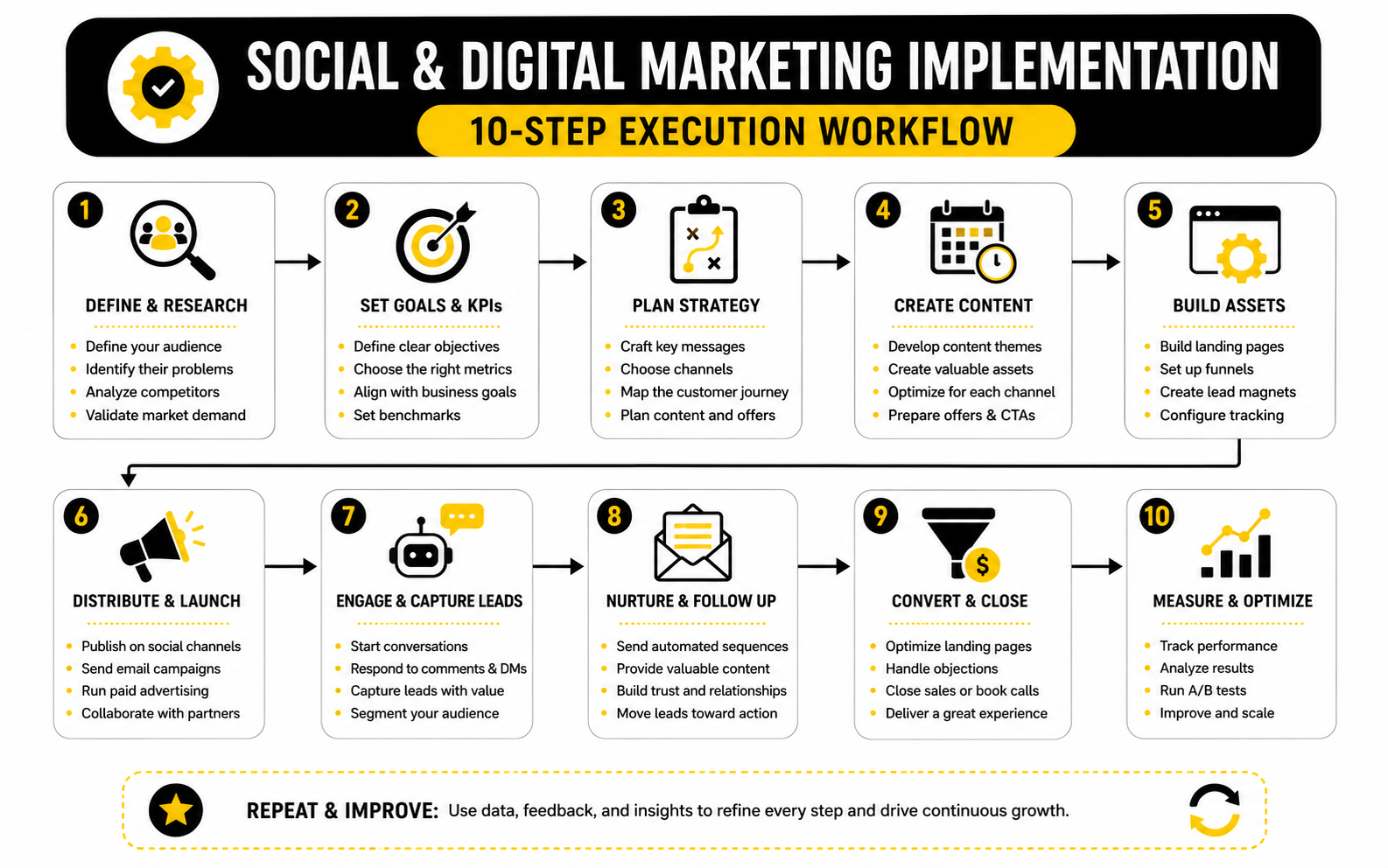
A practical workflow looks like this:
This process keeps the team focused. Instead of constantly inventing new ideas, you build from a core message and adapt it intelligently. It also makes measurement easier because each asset connects back to a clear theme, audience, and business goal.
Use Social Content To Create Demand
Social content is not just for awareness. Done well, it creates demand by helping people see a problem differently. That is the point.
The strongest social content usually does one of four things. It names a problem the audience feels but has not clearly articulated. It challenges a belief that keeps them stuck. It shows a better way to approach the outcome they want. Or it provides proof that the outcome is possible.
This is why original content matters. The 2025 Sprout Social Index surveyed more than 4,000 consumers and 1,200 marketers, and its findings point toward higher expectations for brands that want to stand out on social. People do not want brands to chase every trend. They want relevance, responsiveness, and content that feels like it belongs in the culture of the platform.
Use Digital Content To Capture And Convert Demand
Digital content captures demand when someone is actively looking for help. This includes search-optimized articles, comparison pages, pricing pages, product pages, lead magnets, email sequences, webinars, and retargeting campaigns. These assets do not need to be loud. They need to be useful and persuasive.
A strong capture asset answers the questions a buyer has when they are closer to action. What does this solve? Who is it for? How does it work? What makes it different? What will happen after I sign up? What proof supports the claim? What risk am I taking if I wait?
Tools can help once the content logic is clear. A business that needs a simple funnel can use Systeme.io. A team building dedicated ecommerce landing pages may prefer Replo. A consultant, agency, or local service business that needs CRM, pipeline tracking, and follow-up automation may be better served by GoHighLevel. The point is not to collect tools. The point is to remove friction between interest and action.
Repurpose Without Diluting The Message
Repurposing is powerful when it preserves the core idea. It becomes weak when it turns one good asset into ten shallow posts. The goal is not to recycle content for the sake of volume. The goal is to give the same strategic message more chances to land.
A strong repurposing system starts with the most complete version of the idea. That could be a research-backed article, a webinar, a podcast conversation, a product demo, or a long-form video. From there, you can extract objections, hooks, proof points, short clips, carousels, email lessons, ad angles, and sales enablement notes.
This is how social and digital marketing becomes more efficient. The team spends more time developing strong ideas and less time filling empty calendar slots. Better ideas travel further.
Connect Every Piece To A Next Step
Every content asset needs a job, but not every job is “buy now.” Sometimes the next step is to read a guide, watch a demo, reply to a message, join a list, compare options, book a call, or save the post for later. The next step should match the buyer’s awareness level.
This is where many brands lose people. They create useful content but do not guide the audience anywhere. Or they ask for a sale before trust exists. Both mistakes waste attention.
A clean content path feels natural. A social post earns attention. A deeper resource builds understanding. A lead capture or messaging flow starts the relationship. Follow-up content handles objections. The offer appears when the buyer has enough context to act. That is the process. Not flashy, but effective.
Statistics And Data
Data should make social and digital marketing clearer, not more confusing. The goal is not to collect every possible metric or screenshot another dashboard. The goal is to understand what is creating attention, what is building trust, what is turning interest into action, and what should change next.
This matters because digital channels are now too large and too expensive to manage by instinct. U.S. internet advertising revenue reached $294.6 billion in 2025, up 13.9% year over year. That growth is not just a market headline. It means more competition for the same auctions, feeds, placements, keywords, creators, and customer attention.
The right response is not panic. The right response is cleaner measurement. If your analytics only tell you what happened after the campaign ended, they are too slow. Good measurement helps you decide what to stop, what to improve, what to scale, and what deserves a deeper test.
Start With The Metrics That Match The Journey
A simple measurement system should follow the same journey your buyer follows. First, people notice you. Then they engage. Then they trust you enough to click, subscribe, message, book, compare, or buy. If you only measure the final sale, you miss the signals that explain why the sale happened.
For social and digital marketing, the practical metric groups are:
These metrics should not be treated equally. A save may matter more than a like if the content is educational. A reply may matter more than a click if the offer is high-ticket. A lower cost per lead may be useless if those leads never convert. Context decides what the number means.
Read Benchmarks Carefully
Benchmarks are useful, but they are not commandments. They help you understand whether performance is wildly off, roughly normal, or unusually strong. They should not replace your own baseline.
Social benchmarks can vary heavily by industry, platform, audience size, creative format, and posting frequency. The 2025 Rival IQ Social Media Industry Benchmark Report compares engagement rates, posting frequency, content types, and hashtags across major platforms, which is useful for orientation. But a benchmark cannot tell you whether your specific content is attracting the right buyer.
Use benchmarks to ask better questions. If reach is low, the hook, format, topic, or distribution may need work. If engagement is high but clicks are weak, the content may be entertaining without creating intent. If clicks are strong but conversions are weak, the landing page, offer, proof, or follow-up probably needs attention.
Build One Analytics System Instead Of Ten Disconnected Reports
The biggest measurement problem is not lack of data. It is disconnected data. Social platforms show platform performance, ad accounts show campaign performance, website analytics show traffic behavior, email tools show nurture performance, and CRM systems show pipeline or revenue. If those pieces never connect, the team argues from partial truth.
A cleaner analytics system connects the journey from first touch to meaningful action. It does not need to be perfect on day one. It does need consistent naming, clean campaign tracking, clear conversion events, and a shared definition of what counts as progress.
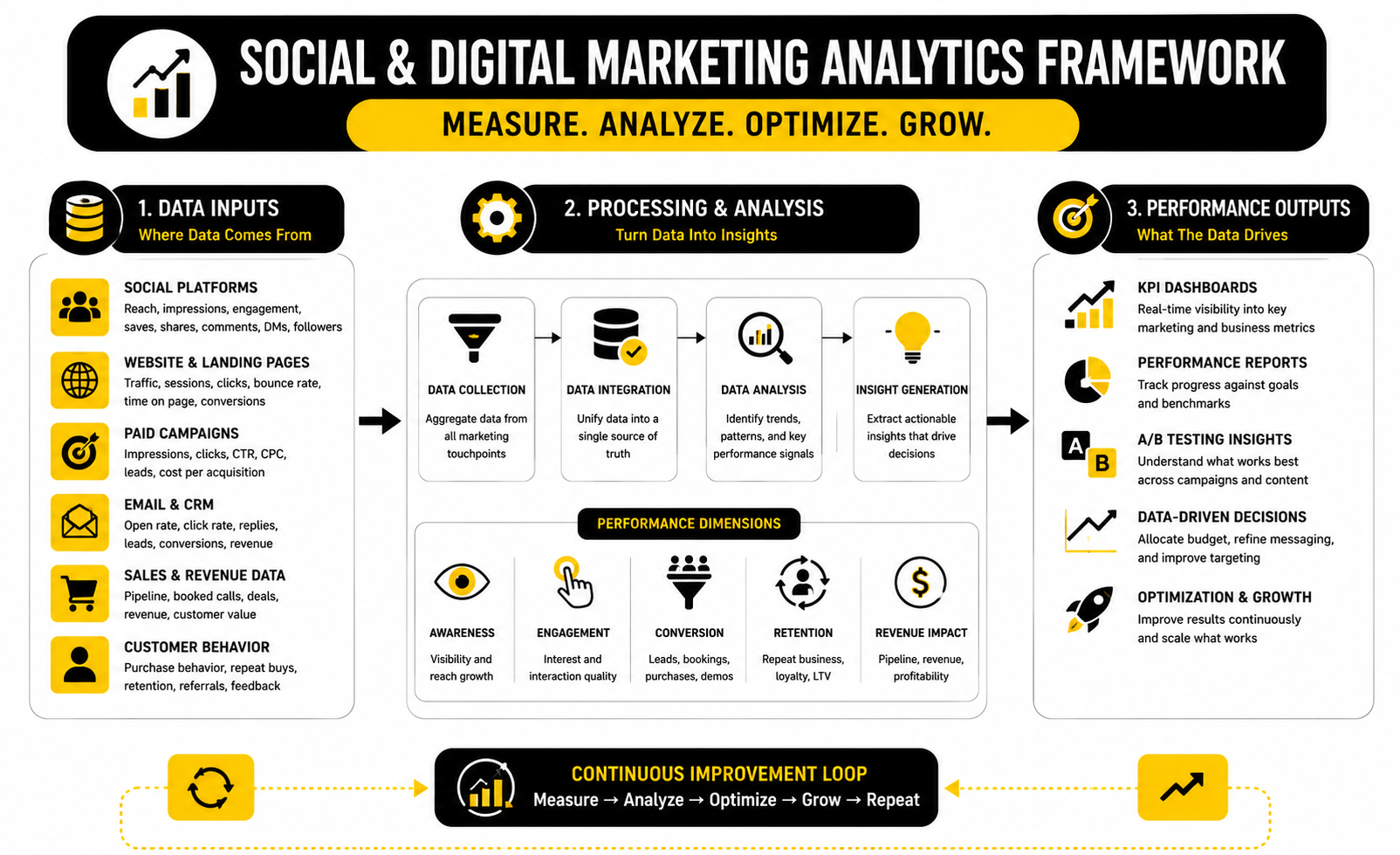
A practical analytics system should answer five questions:
This is where a CRM or funnel platform becomes useful. A team using GoHighLevel can connect forms, funnels, calendars, pipelines, messaging, and follow-up automation in one place. A creator, consultant, or small business using ClickFunnels may focus more on offer pages, checkout flow, and funnel conversion. The tool should make the customer path easier to see, not harder to manage.
Track Content Performance By Intent
Not all content should be judged by the same number. A thought leadership post may create comments and profile visits. A tutorial may create saves. A comparison article may create demo requests. A retargeting ad may create purchases. Measuring all of them by the same engagement rate is lazy.
Instead, assign intent to each asset before publishing. Is the content meant to create awareness, educate the buyer, generate leads, handle objections, support sales, or drive conversion? Once that job is clear, the metric becomes obvious.
For example, a short video explaining a common mistake should be judged by retention, shares, comments, and profile visits. A landing page should be judged by conversion rate, scroll behavior, form completion, and lead quality. An email sequence should be judged by replies, clicks, booked calls, purchases, unsubscribes, and downstream revenue. The point is simple: measure the job the asset was built to do.
Watch For Leading Indicators
Revenue is the final score, but leading indicators tell you where the game is moving. If you wait until revenue drops, you are already late. Strong social and digital marketing teams watch the signals that show whether demand is building before it appears in sales reports.
Useful leading indicators include:
These signals are not perfect, but they are valuable. They tell you whether the market is starting to recognize your message. If those signals improve while revenue stays flat, the issue may be conversion, sales follow-up, offer clarity, or pricing friction rather than top-of-funnel demand.
Separate Volume Problems From Conversion Problems
A volume problem means not enough of the right people are seeing the offer. A conversion problem means enough people are seeing it, but not enough are taking action. Mixing those up leads to expensive mistakes.
If reach, impressions, search visibility, and traffic are weak, the problem may be distribution. You may need stronger creative, better posting consistency, paid promotion, SEO work, creator partnerships, or clearer channel focus. If traffic is strong but leads are weak, the problem is likely message match, page structure, offer relevance, or trust. If leads are strong but sales are weak, the problem may be lead quality, sales process, pricing, urgency, or follow-up.
This is why dashboards need to show the full path. A campaign with low cost per click can still fail if the traffic is unqualified. A campaign with a higher cost per lead can still win if those leads close faster and spend more. Cheap attention is not the same as profitable attention.
Use Data To Improve Creative
Data should not make your marketing bland. It should make your creative sharper. The best teams use performance signals to understand which hooks, angles, objections, formats, and proof points are working.
If one topic gets more saves, it may deserve a deeper article, webinar, or lead magnet. If one hook gets better watch time, it may become a paid ad angle. If one objection keeps appearing in comments, it should be addressed on the landing page and in the email sequence. If one comparison page drives qualified leads, it may deserve more internal links, retargeting, and sales enablement.
This is where measurement becomes practical. You are not staring at dashboards for entertainment. You are using real audience behavior to decide what to create next.
Review Performance On The Right Cadence
Daily checks are useful for spotting technical problems, broken links, rejected ads, tracking errors, or sudden performance drops. They are not always useful for strategic conclusions. Reacting too quickly can make you kill good ideas before they have enough data.
Weekly reviews are better for content patterns, campaign pacing, and short-term optimization. Monthly reviews are better for channel strategy, offer performance, funnel conversion, and budget decisions. Quarterly reviews are better for positioning, audience development, retention, and bigger strategic moves.
A strong reporting rhythm keeps the team calm. You know what needs fast action and what needs patience. That discipline matters because social and digital marketing always includes noise, randomness, and platform volatility. The job is not to react to every spike. The job is to identify the patterns that can be turned into growth.
Professional Implementation, Measurement, And Optimization
At this stage, the strategy is no longer theoretical. You know who you are trying to reach, what they need to believe, how content supports the buyer journey, and how measurement should guide decisions. The next challenge is scaling the system without turning it into chaos.
This is where social and digital marketing becomes an operating discipline. The difference between an amateur setup and a professional one is not only budget. It is how clearly the team makes decisions, protects focus, manages risk, and improves performance without chasing every shiny new tactic.
A mature system does not mean complicated. In fact, the best systems are usually simpler than messy ones. They have fewer random campaigns, fewer disconnected tools, fewer unclear owners, and fewer metrics nobody uses. That is the whole point.
Prioritize Focus Before Scale
Scaling weak marketing only creates bigger problems. If the positioning is unclear, scaling content creates more confusion. If the offer is weak, scaling ads burns budget faster. If the follow-up is broken, scaling lead generation creates a bigger pile of wasted opportunities.
Before scaling, make sure the basics are working. The audience should be specific. The message should be easy to understand. The offer should be relevant. The landing page should match the promise that brought people there. The follow-up should happen quickly and feel personal.
This is also why channel discipline matters. You do not need to publish heavily on every platform just because the platform exists. A better move is to identify the two or three channels where your audience, message, and offer have the strongest fit, then build repeatable execution there before expanding.
Balance Owned, Earned, And Paid Channels
A strong social and digital marketing strategy should not depend on one type of channel. Paid media can move fast, but costs change. Social reach can create attention, but algorithms shift. Search can compound, but it takes time. Email and CRM can build direct relationships, but only if people have a reason to stay subscribed.
The healthier model is a balanced channel mix. Owned channels give you more control. Earned channels create credibility. Paid channels add speed and testing power. Each one has a different role, and the mix should change based on the maturity of the business.
For a newer business, paid tests and social content may reveal which messages create traction. For a growing business, search, email, retargeting, partnerships, and creator collaborations may help turn early traction into a repeatable acquisition engine. For a mature business, the priority may shift toward retention, brand trust, customer education, and more precise segmentation.
Protect The Brand While Moving Fast
Speed matters, but speed without judgment creates risk. A rushed post, careless creator partnership, weak claim, poor automation, or badly targeted campaign can damage trust quickly. The larger the audience, the more expensive those mistakes become.
Brand safety is especially important as creator partnerships and social placements become more central to growth. The 2025-2026 CreatorIQ State of Creator Marketing report highlights brand safety as a bigger concern because creator marketing now carries more scale, complexity, and reputational risk. That means vetting should go beyond follower count, engagement rate, and surface-level content quality.
Good brand protection is not about making everything boring. It is about having standards before the pressure hits. Define what claims can be made, what topics require review, what proof is needed, what creators fit the brand, and what escalation process applies when something goes wrong.
Treat AI As Leverage, Not Strategy
AI can help with research, drafting, editing, summarization, segmentation, testing ideas, customer support, reporting, and workflow automation. Used well, it makes the team faster. Used badly, it makes the brand sound like everyone else.
The distinction matters. The McKinsey State of AI in 2025 report found that high-performing organizations are more likely to redesign workflows around AI rather than simply add tools on top of existing processes. That is the right lesson for marketing too. AI should improve the system, not become a shortcut around thinking.
Use AI to accelerate the parts that benefit from speed, but keep strategy, positioning, judgment, and final messaging under human control. Your audience can feel the difference between useful automation and empty output. The more AI content floods the market, the more sharp human perspective matters.
Build For Privacy And First-Party Data
Privacy is not a side issue anymore. It affects targeting, attribution, personalization, retargeting, analytics, and customer trust. If your strategy depends entirely on borrowed platform data and fragile tracking, you are building on unstable ground.
That is why first-party data matters. Email subscribers, CRM records, purchase behavior, form submissions, quiz answers, survey responses, customer interviews, and direct message conversations all create a stronger foundation than anonymous traffic alone. The goal is not to collect data aggressively. The goal is to earn data by offering enough value that people willingly share it.
This also changes the role of funnels. A lead magnet, quiz, webinar, consultation form, newsletter, or messaging automation is not only a conversion asset. It is a permission-based relationship starter. Tools like ManyChat, Fillout, Brevo, and GoHighLevel can support that process when the value exchange is clear.
Know When To Automate And When To Stay Human
Automation is powerful when it removes delay, repetition, and manual follow-up. It is dangerous when it removes empathy from moments that need judgment. This is one of the most important tradeoffs in social and digital marketing.
Automate reminders, confirmations, lead routing, basic segmentation, abandoned checkout messages, welcome sequences, appointment scheduling, and routine follow-up. Keep human attention close to sales conversations, complex customer issues, sensitive complaints, partnership decisions, and high-value prospects. The line is not always fixed, but the principle is clear.
The customer should feel helped, not processed. If automation makes the experience faster and more relevant, use it. If it makes the experience colder or more confusing, fix it before scaling.
Create A Testing System That Does Not Chase Noise
Testing is essential, but not every change deserves a test. Changing the headline, offer, audience, creative, call to action, price, and landing page all at once teaches you almost nothing. It may produce a result, but it does not produce learning.
A better testing system isolates one meaningful variable at a time. Test one message angle against another. Test one offer structure against another. Test one audience segment against another. Test one landing page promise against another. Keep the rest stable enough that the result means something.
Testing should also be tied to business impact. A higher click-through rate is useful only if it brings better prospects. A cheaper lead is useful only if it moves closer to revenue. A viral post is useful only if it strengthens the brand or creates qualified demand. Growth without learning is gambling.
Avoid The Most Expensive Scaling Mistakes
The biggest mistakes usually look reasonable at first. A team adds more platforms because growth feels slow. They buy more tools because execution feels messy. They increase ad spend because a campaign had one good week. They hire creators because competitors are doing it. They automate follow-up because the team is overwhelmed.
None of those moves are automatically wrong. They become expensive when the underlying system is not ready. More channels require stronger coordination. More tools require cleaner processes. More budget requires better measurement. More creators require brand standards. More automation requires better messaging.
Before making a scaling decision, ask one practical question: will this increase clarity or complexity? If the honest answer is complexity, slow down and fix the system first. That discipline saves money.
Build A Marketing Operating Rhythm
A professional marketing system needs rhythm. Without rhythm, the team either reacts constantly or drifts without momentum. Neither is good.
A simple operating rhythm might include weekly content planning, weekly performance review, monthly funnel review, monthly customer insight review, and quarterly positioning or channel strategy review. This keeps the work connected. Content is not separate from analytics. Analytics is not separate from sales. Sales feedback is not separate from positioning.
This is how social and digital marketing becomes more than campaigns. It becomes a business learning system. You publish, observe, improve, and repeat. Over time, the message gets sharper, the audience gets clearer, the funnel gets smoother, and the brand becomes easier to trust.
Bringing The Whole System Together
The strongest social and digital marketing strategy is not a pile of tactics. It is an ecosystem where every part has a clear role. Audience research shapes the message, content creates belief, distribution brings the message to the right people, funnels turn attention into action, analytics explain what is working, and optimization keeps the system improving.
That ecosystem matters because the market keeps getting noisier. Creator partnerships, AI content, paid media, search, short-form video, newsletters, communities, and messaging automation are all competing for attention at the same time. The brands that win are not always the brands posting the most. They are the brands making the customer journey feel simple, relevant, and trustworthy.
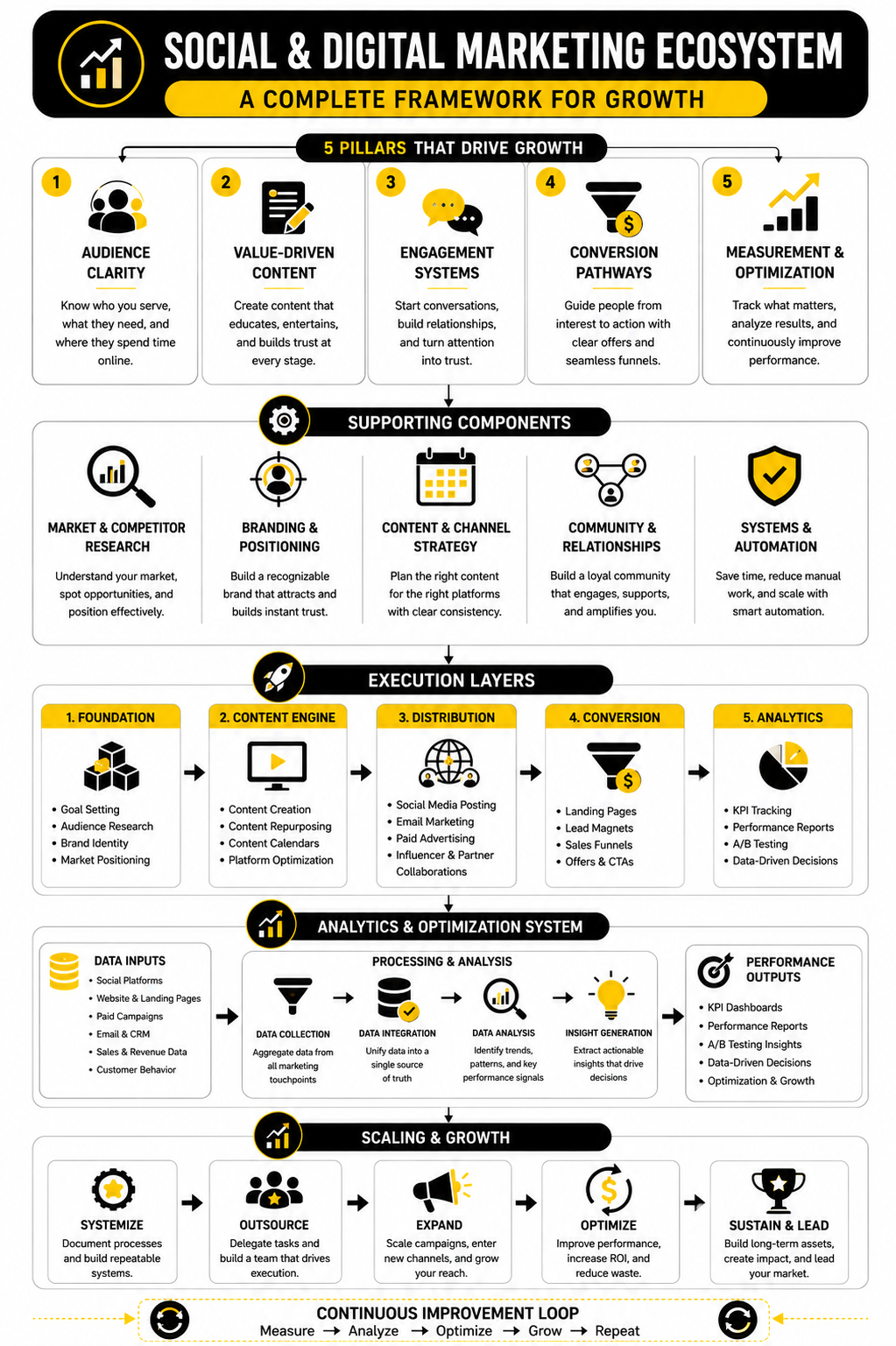
This is also why the work never really “finishes.” You will keep learning from customer conversations, content performance, search behavior, sales feedback, retention data, and market changes. The job is to keep the system tight enough to measure and flexible enough to improve.
What Is Social And Digital Marketing?
Social and digital marketing is the combined use of social platforms, websites, search, email, paid media, funnels, automation, analytics, and customer data to attract, educate, convert, and retain customers. Social marketing focuses heavily on attention, conversation, community, creators, and trust. Digital marketing includes the wider system that turns that attention into measurable business outcomes.
The two should not be treated as separate worlds. A social post may create demand, while a landing page, email sequence, CRM workflow, or retargeting campaign turns that demand into action. When both sides work together, marketing becomes easier to understand and easier to scale.
Why Is Social And Digital Marketing Important?
It matters because customers do not make decisions in one place anymore. They discover brands on social, search for proof, read reviews, compare alternatives, watch videos, click ads, join lists, and ask peers before buying. If your marketing is disconnected across those touchpoints, trust leaks out of the system.
It also matters because competition for attention keeps rising. Digital ad revenue, creator spend, and social media usage have all grown significantly in recent years, which means brands need more than visibility. They need clearer positioning, better content, stronger conversion paths, and sharper measurement.
What Is The Difference Between Social Media Marketing And Digital Marketing?
Social media marketing is one part of digital marketing. It usually covers platforms like LinkedIn, Instagram, TikTok, YouTube, Facebook, X, Pinterest, and community-driven channels. Its main strengths are discovery, trust-building, conversation, culture, creators, and social proof.
Digital marketing is broader. It includes social media, search engine optimization, paid advertising, email marketing, landing pages, funnels, analytics, automation, webinars, CRM, conversion rate optimization, and retention campaigns. A serious strategy uses social media to create and shape demand, then uses the wider digital system to capture, nurture, and convert that demand.
What Channels Should A Business Start With?
Start with the channels that match your buyer’s behavior and your offer. If your audience actively searches for solutions, SEO, comparison pages, and search ads may matter early. If your audience needs education and trust first, social content, email, webinars, and creator partnerships may be better starting points.
Do not choose channels just because they are popular. Choose them because your message can work there and because the channel can move the buyer closer to action. Two focused channels executed well will usually beat six scattered channels managed badly.
How Do You Create A Social And Digital Marketing Strategy?
Start by defining the audience, problem, offer, positioning, and buying journey. Then decide which channels will create demand, which channels will capture demand, which channels will convert demand, and which channels will retain customers. This order matters because tactics only work when they are tied to a clear strategy.
After that, build a content system, a conversion path, and a measurement plan. Your content should answer buyer questions. Your funnel should make the next step obvious. Your analytics should show where attention, trust, conversion, and retention are improving or breaking down.
What Metrics Should You Track?
Track metrics that match the customer journey. For awareness, look at reach, impressions, search visibility, video views, and profile visits. For engagement, look at saves, shares, comments, replies, watch time, direct messages, and qualified clicks. For conversion, track leads, booked calls, purchases, trials, demos, checkout starts, and form completions.
Then connect those numbers to efficiency and revenue. Cost per lead, cost per acquisition, conversion rate, customer lifetime value, repeat purchase behavior, pipeline, and payback period give the numbers business meaning. A metric is only useful if it helps you make a better decision.
How Often Should You Post On Social Media?
There is no universal posting frequency that works for every business. A brand with a large creative team, strong content engine, and active community can publish more often. A smaller business may get better results by publishing fewer, stronger pieces tied to clear buyer questions.
The better question is whether your content rhythm is sustainable and strategic. If posting more forces you into shallow content, slow down and improve the ideas. If you have strong ideas and a repeatable workflow, increase frequency carefully and watch whether quality, engagement, and conversion hold up.
How Long Does Social And Digital Marketing Take To Work?
Some parts can work quickly, especially paid ads, retargeting, messaging campaigns, and conversion improvements. Other parts take longer, especially SEO, brand trust, audience development, creator relationships, and email list quality. The timeline depends on the offer, market, budget, content quality, competition, and existing audience.
The important thing is to separate early signals from final outcomes. Saves, replies, qualified clicks, demo page visits, branded search growth, and better sales conversations can appear before revenue fully catches up. Those signals help you decide whether the strategy is gaining traction or needs a sharper adjustment.
What Tools Are Useful For Social And Digital Marketing?
The best tools depend on the job. For social scheduling and planning, Buffer can help keep publishing organized. For social messaging automation, ManyChat can support conversations and lead capture. For email marketing, Brevo and Moosend can help with campaigns and automation.
For funnels, ClickFunnels and Systeme.io are useful options. For CRM, pipeline, automation, calendars, and follow-up, GoHighLevel can make sense for agencies, consultants, and service businesses. The tool should fit the process, not replace the strategy.
How Do You Know If Your Strategy Is Working?
A working strategy creates better signals across the whole journey. More of the right people notice the brand, engage with useful content, click through to relevant assets, join the list, book calls, buy, return, or refer others. The pattern matters more than one isolated metric.
You should also see qualitative improvement. Sales conversations become easier because prospects understand the problem and your point of view before they speak with you. Comments, replies, searches, and customer language become more specific. That is usually a sign the market is starting to understand your message.
What Are The Biggest Mistakes To Avoid?
The first mistake is starting with tools instead of strategy. The second is chasing every platform without knowing where the buyer actually pays attention. The third is measuring vanity metrics while ignoring conversion quality and revenue. The fourth is scaling paid traffic before the offer, page, and follow-up are ready.
Another expensive mistake is creating content without a next step. Attention is valuable, but it needs somewhere to go. If your content earns trust and then leaves people stuck, the system is leaking.
Should Small Businesses Use Paid Ads?
Small businesses can use paid ads, but they should be careful. Paid ads work best when the audience, offer, message, landing page, and follow-up are already reasonably clear. If those pieces are weak, paid traffic simply exposes the weakness faster.
A smart approach is to test small, learn quickly, and connect every campaign to a specific outcome. Use paid ads to validate messages, promote proven content, retarget warm audiences, or drive traffic to a clear offer. Do not use ads as a substitute for positioning.
How Does AI Fit Into Social And Digital Marketing?
AI can help with research, content drafts, repurposing, segmentation, reporting, customer support, workflow automation, and idea development. It can save time and help teams move faster. But it should not make the strategy generic.
The best use of AI is leverage. Let it support the work, organize the thinking, and speed up production. Keep human judgment in charge of positioning, brand voice, customer insight, offers, and final messaging. That is where the real edge still lives.
What Is The Best Way To Improve Results?
Improve the weakest link in the system first. If the right people are not seeing the message, fix distribution and creative. If people are clicking but not converting, fix the offer, page, proof, or call to action. If leads are coming in but not buying, fix lead quality, follow-up, sales process, or urgency.
Do not optimize randomly. Look at the customer journey, find the point where momentum drops, and improve that piece. One focused fix usually beats ten scattered tweaks.
Build a stronger local presence with BAAM AI
Turn your website, Google profile, social channels, and AI visibility into one growth engine
Most businesses do not need more random marketing activity. They need a consistent presence system that helps the right people find them, trust them, and take action. BAAM AI brings strategy, local SEO, website updates, Google Maps visibility, social content, AI-search readiness, media production, and reporting into one practical monthly engine.
If you want your marketing to keep working after the campaign ends, start with a free BAAM AI presence audit. See how your business shows up today and where the fastest visibility wins are at BAAM AI.