
BAAM AI Blog
So Social Advertising Has Changed: A Practical Framework For Turning Attention Into Revenue
Social advertising used to be simple enough to describe in one sentence: buy attention on Facebook, Instagram, TikTok, LinkedIn, YouTube, or another platform, then send people somewhere useful. That definition is...
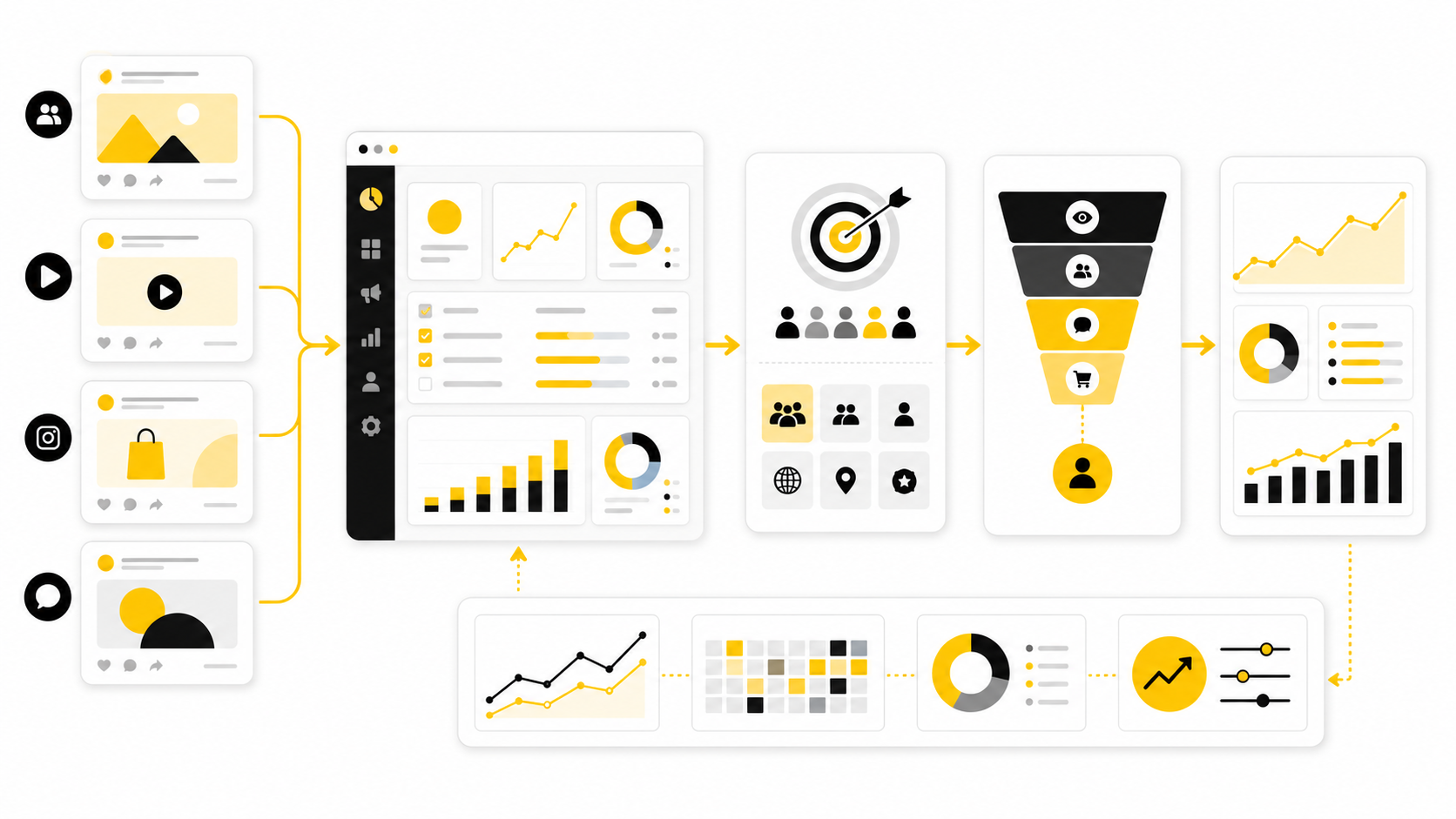
Social advertising used to be simple enough to describe in one sentence: buy attention on Facebook, Instagram, TikTok, LinkedIn, YouTube, or another platform, then send people somewhere useful. That definition is still technically true, but it is no longer enough. So social advertising now sits at the intersection of paid media, creative testing, audience psychology, automation, community, and conversion design.
The reason this matters is obvious when you look at the scale. DataReportal counted 5.79 billion social media user identities worldwide in April 2026, while IAB reported that U.S. social media advertising revenue reached $88.8 billion in 2024. This is not a side channel anymore. For many brands, it is where people first discover the offer, judge the credibility of the business, ask questions, compare alternatives, and decide whether to buy.
The trap is treating social ads like a traffic faucet. You put money in, clicks come out, and everyone pretends the campaign is working until the numbers say otherwise. Better social advertising starts before the ad account and continues after the click, because the real job is not to “run ads.” The real job is to build a reliable path from attention to trust to action.
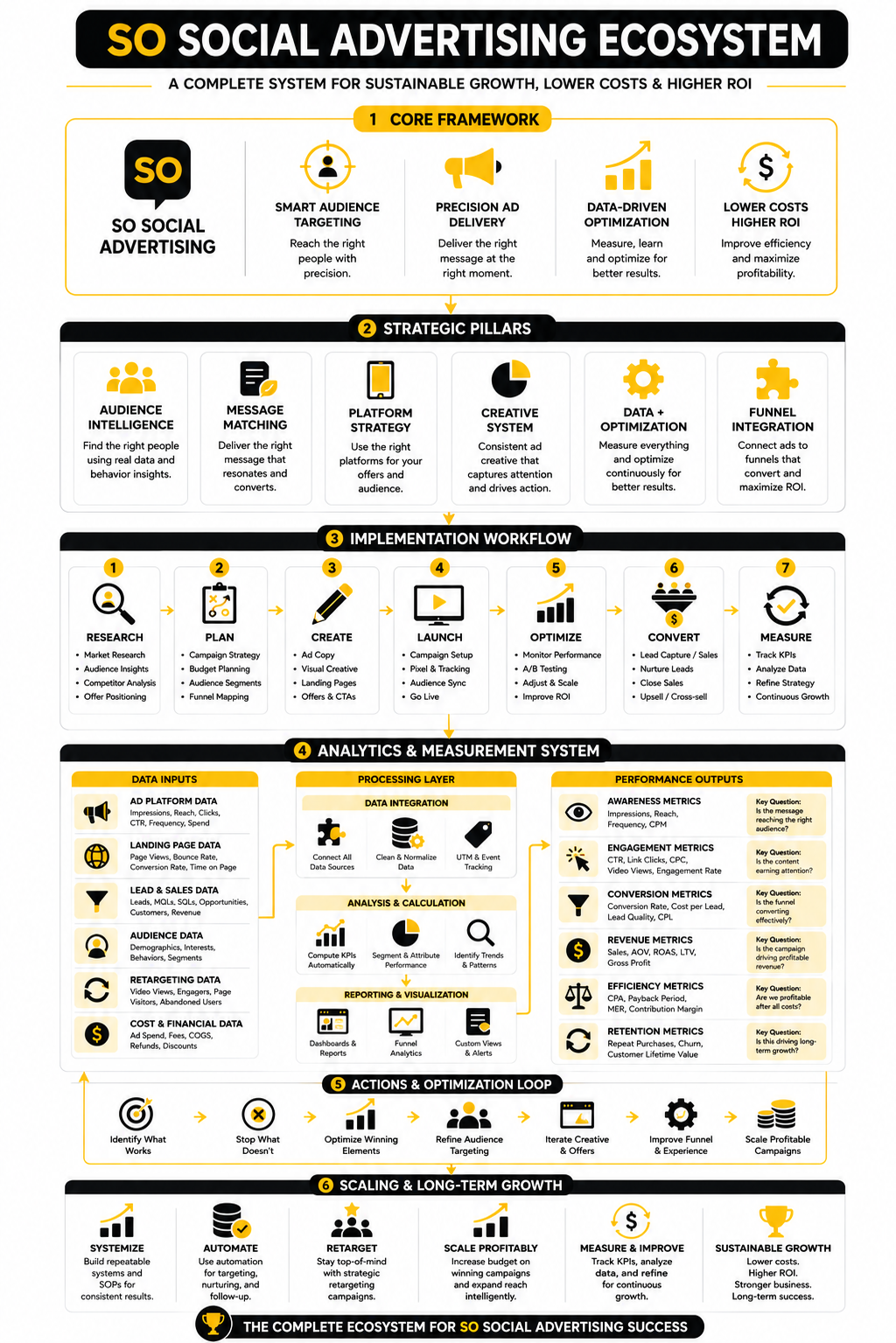
this guide is split into six connected parts so the strategy builds in the right order. Each part handles one layer of the system, from the market reality to the campaign structure to optimization and scaling. The goal is to make social advertising feel less like gambling and more like a repeatable operating system.
Why Social Advertising Matters Now
Social advertising matters because social platforms are no longer just places where people scroll between life updates. They are search engines, entertainment feeds, product discovery channels, customer support spaces, creator marketplaces, and trust filters. GWI’s brand discovery research shows that 30% of consumers find new brands through social media ads, which means paid social often enters the customer journey before search intent ever exists.
That changes how campaigns should be planned. A cold prospect on social is usually not asking for your product yet, even if they are a perfect-fit buyer. They are reacting to a creative, a problem, a belief, a comparison, a creator, or a moment that feels relevant enough to stop the scroll.
This is why the best campaigns do not begin with targeting tricks. They begin with message clarity. The platform can help you find people, but it cannot fix a weak promise, a confusing offer, or a landing page that fails to continue the conversation started by the ad.
The Social Advertising Framework
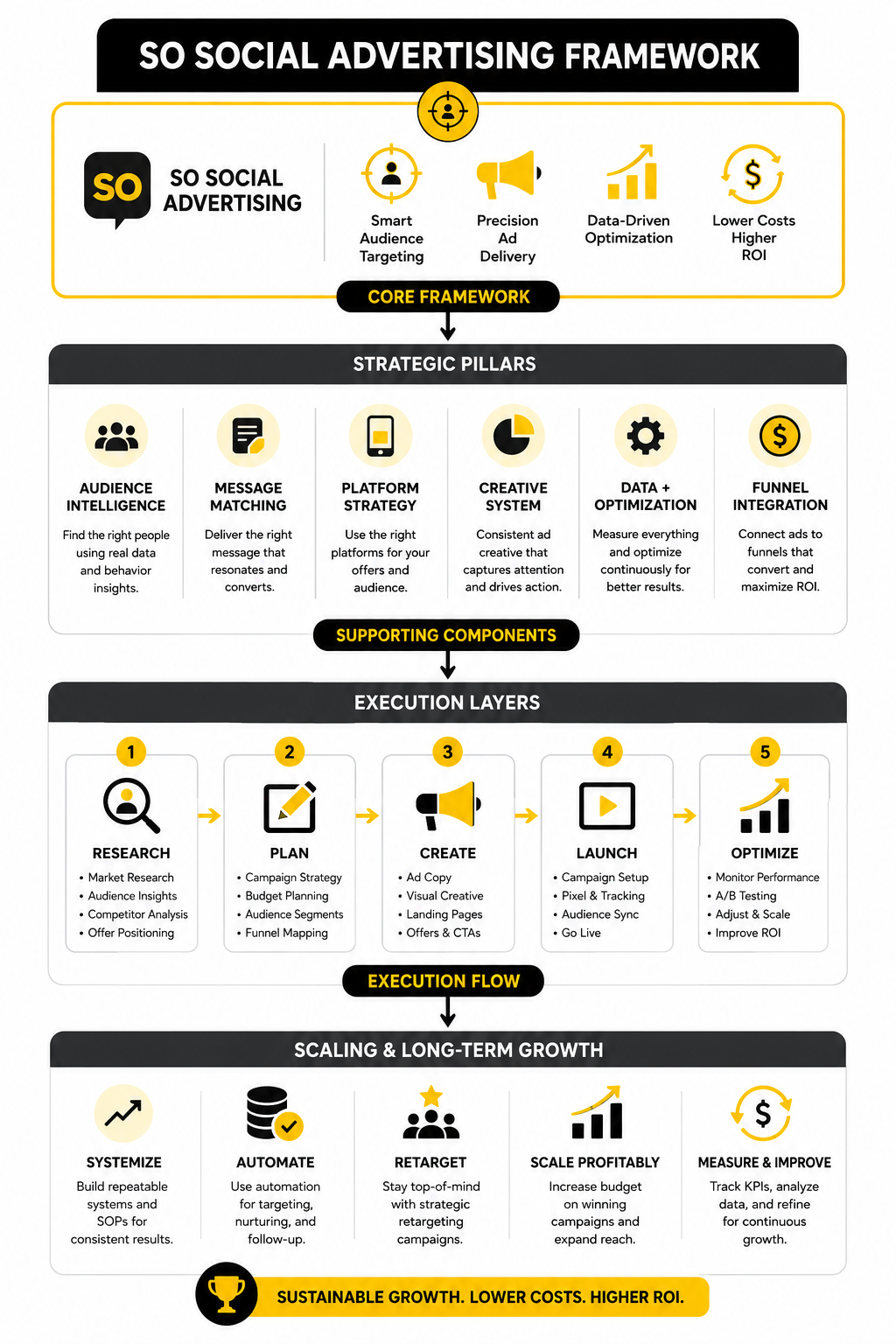
A useful social advertising framework has four connected layers: market, message, mechanism, and measurement. The market layer defines who you are trying to reach and what they already believe. The message layer turns that understanding into angles, hooks, proof, objections, and offers that feel native to the platform.
The mechanism layer is where the campaign becomes operational. This includes creative production, campaign structure, funnel design, lead capture, follow-up, and the tools that move people from click to conversion. For example, a brand using comments or direct messages as part of the buying journey may connect ads with a tool like ManyChat, while a service business may route leads into a CRM and automation platform like GoHighLevel.
Measurement is the layer that keeps the system honest. It tells you whether attention is becoming qualified traffic, whether traffic is becoming leads or buyers, and whether the economics still work when spend increases. Without this layer, social advertising becomes opinion-driven, and opinion-driven advertising gets expensive fast.
How The Framework Fits Together
Think of social advertising as a chain, not a single campaign. The creative earns attention, the offer creates interest, the landing experience builds confidence, the follow-up captures the undecided, and the reporting shows where the chain is weak. When one part breaks, the whole system feels unpredictable.
This is also why “winning ads” are often misunderstood. An ad can have a strong click-through rate and still fail if the landing page does not match the promise. A landing page can convert well and still lose money if the audience is too broad, the offer is underpriced, or the follow-up is too slow.
The practical move is to diagnose the system in order. Start with the audience and message, then examine the creative, then inspect the conversion path, then review the economics. That sequence prevents the common mistake of blaming the algorithm when the real problem is a weak offer, unclear positioning, or a broken post-click experience.
The Core Components Of A Profitable Campaign
A profitable social advertising campaign is not built from one clever ad. It is built from a few parts working together without friction. When those parts are clear, every test teaches you something useful, even when the campaign does not win immediately.
The first component is the audience. Not a vague demographic audience, but a real group of people with a specific problem, desire, trigger, or buying situation. So social advertising works best when you understand what the person is already thinking before your ad interrupts them.
The second component is the promise. This is the reason someone should care now, not someday. A strong promise makes the ad feel relevant before the viewer has to work too hard, and that matters because social feeds are built for speed.
The third component is the path after the click. If the ad creates curiosity but the landing page creates confusion, the campaign loses momentum. That is why the post-click experience needs to match the message, continue the argument, and make the next step obvious.
Audience Clarity Comes Before Targeting
Targeting is useful, but it is not the same as strategy. Platform algorithms can find patterns inside a campaign, but they still need a strong signal from the offer, creative, landing page, and conversion event. If the audience is poorly defined, the platform may still spend the budget, but the learning will be noisy.
A better approach is to define the audience by intent and context. Someone who is actively comparing tools needs a different ad than someone who barely realizes they have a problem. Someone who has already engaged with your content needs a different message than someone seeing your brand for the first time.
This is where many campaigns go wrong. They build one generic message and expect targeting to do all the work. The stronger move is to separate audiences by awareness level, then write ads that meet each group where they are.
Creative Is The New Targeting Layer
Creative now carries more of the targeting burden than many advertisers realize. The hook, format, language, visuals, pacing, and offer all signal who the ad is for. A direct founder-style video will attract a different person than a polished product demo, even when the targeting settings are identical.
This is why creative testing should not mean changing button colors or swapping one stock image for another. Test different angles. Test different levels of awareness. Test problem-led ads, outcome-led ads, comparison ads, objection-handling ads, and proof-led ads.
For brands that publish regularly across channels, a scheduling and planning tool like Buffer can help keep organic and paid creative aligned. That alignment matters because paid social usually performs better when the brand does not feel like a stranger. People may click the ad, check the profile, scan recent posts, and decide whether the business looks active, credible, and consistent.
The Offer Has To Carry Its Weight
An offer is not just the product. It is the product, the price, the timing, the risk reversal, the urgency, the bonuses, the proof, and the next step packaged into one decision. If the offer is weak, the campaign has to work too hard.
For lead generation, the offer might be a useful audit, calculator, checklist, consultation, webinar, trial, or diagnostic. For ecommerce, it might be a bundle, limited drop, creator-backed product, first-order incentive, or strong guarantee. For software, it might be a free trial, demo, template pack, migration support, or specific use-case workflow.
The key is to avoid lazy bait. A cheap lead magnet can generate leads and still create a bad campaign if the leads have no buying intent. A good offer filters as much as it attracts, because profitable social advertising depends on quality, not just volume.
The Landing Experience Must Match The Ad
The landing page should feel like the natural next sentence after the ad. If the ad talks about a painful problem, the page should not open with a generic company slogan. If the ad promises speed, the page should not bury the next step under long blocks of unfocused copy.
For ecommerce teams, a fast landing page builder such as Replo can be useful when campaigns need dedicated pages for different angles, products, or promotions. For funnels, platforms like ClickFunnels or Systeme.io can help teams connect opt-ins, sales pages, checkout flows, and follow-up sequences without turning every campaign into a development project.
The practical test is simple. Read the ad, then read the first screen of the landing page. If the promise, language, and next step do not line up immediately, fix that before increasing budget.
Follow-Up Is Where Many Campaigns Recover Profit
Not everyone converts on the first click. That does not mean the campaign failed. It often means the follow-up system is either missing or too weak to capture people who were interested but not ready.
This is especially important for high-consideration offers. A person may need a reminder, a comparison, a testimonial, a deadline, a deeper explanation, or a direct conversation before they act. If the only plan is “hope they come back,” the campaign is leaking money.
For service businesses, agencies, coaches, local companies, and B2B teams, a CRM and automation platform like GoHighLevel can help connect forms, pipelines, reminders, SMS, email, booking pages, and sales follow-up. For social-first funnels where comments and direct messages are part of the buyer journey, ManyChat can help turn engagement into structured conversations instead of letting interested people disappear in the inbox.
Tracking Should Be Built Before Scaling
Tracking is not the exciting part, but it is the part that prevents expensive confusion. Before scaling a campaign, you need to know what counts as a meaningful conversion, where that conversion happens, and whether the data is clean enough to guide decisions. Without that, you are just reacting to platform dashboards.
At a minimum, define the primary conversion, secondary conversion, qualified lead criteria, cost limits, and revenue target before the campaign goes live. A lead is not always a lead. A purchase is not always profitable if refunds, discounts, fulfillment costs, or low lifetime value erase the margin.
This is where so social advertising becomes a business discipline instead of a media-buying hobby. The ad account tells part of the truth, the CRM tells another part, and revenue tells the part that matters most. When those pieces are connected, optimization becomes clearer, faster, and less emotional.
Professional Implementation Across Platforms
Professional implementation starts with a simple decision: what job should each platform do? Meta is often strong for broad demand generation, retargeting, lead generation, and ecommerce because Facebook and Instagram still combine huge reach with mature campaign tools. TikTok is usually more creative-led, which means the ad has to feel native to the feed instead of looking like a traditional commercial.
LinkedIn is a different animal. It can be expensive, but it gives B2B advertisers a cleaner path to job-title, company, industry, and seniority-based targeting. YouTube sits somewhere between entertainment, search behavior, education, and retargeting, which makes it useful when the product needs explanation or when the buyer needs more confidence before acting.
The mistake is trying to force the same campaign onto every platform. So social advertising should not be copied and pasted across channels. The offer can stay consistent, but the format, hook, proof, pacing, and call to action should fit the way people actually use each environment.
Start With The Campaign Objective
The campaign objective tells the platform what kind of result to optimize for, so this is not a random setup choice. If you want purchases, optimize for purchases once you have enough conversion data. If you want booked calls, optimize toward the event that best represents a serious prospect, not just any form fill.
Early-stage campaigns sometimes need a softer objective because the account does not have enough data yet. That can be fine, but it should be intentional. Optimizing for traffic when you really need qualified leads can fill reports with activity while the sales team gets nothing useful.
The cleanest implementation starts by naming the business outcome first. Then you choose the platform objective that gets closest to that outcome. This keeps the campaign focused on revenue movement instead of vanity metrics.
Build The Campaign From The Offer Backward
A good implementation process does not begin inside Ads Manager. It begins with the offer, then works backward into the landing page, creative, audience, and budget. This prevents the classic problem where the campaign is technically launched but strategically hollow.
Start by writing the offer in one plain sentence. Then write the next action you want someone to take. After that, define what the person needs to believe before they will take that action.
That belief gap becomes your creative strategy. If people need to believe the problem is urgent, lead with pain and consequence. If they need to believe your method is different, lead with mechanism and proof. If they need to believe the price is worth it, lead with value, comparison, and risk reduction.
A Practical Launch Process
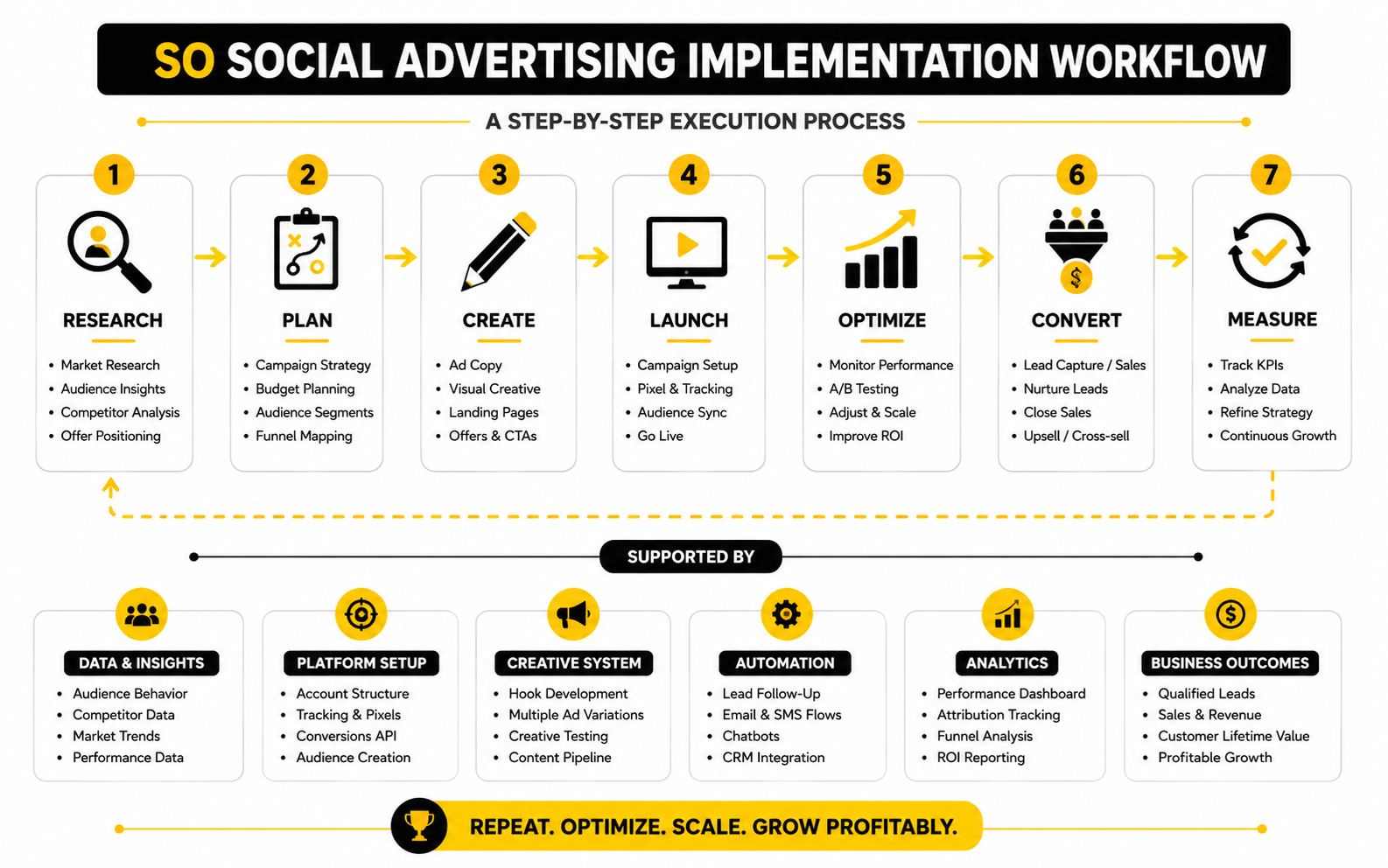
A clean launch process gives the campaign enough structure to learn without making it rigid. The goal is not to predict the perfect ad before launch. The goal is to create a testing environment where the winners become obvious quickly.
A simple launch sequence looks like this:
This process keeps execution focused. You are not testing everything at once. You are testing the core message, the creative angle, and the conversion path in a way that gives you something usable after the first learning cycle.
Creative Production Should Be Systematic
Creative production is where many advertisers move too slowly. They wait for the perfect concept, over-polish the asset, and launch with too few variations. Then they blame the platform when one or two ads cannot carry the entire campaign.
A better system separates creative into repeatable parts: hook, problem, promise, proof, mechanism, offer, and call to action. Once you have those parts, you can create many variations without starting from zero every time. This is especially useful for short-form video, where small changes in the first three seconds can completely change performance.
TikTok’s own creative guidance emphasizes making ads feel native to the platform, including a more natural style and trend-aware execution through its creative best practices. That principle applies beyond TikTok. On every social platform, the ad has to earn attention before it earns a click.
Match Creative Angles To Awareness Levels
Not every buyer is equally aware. Some people know the problem and are comparing solutions. Others feel the symptoms but do not have a name for the problem yet. Some are already aware of your brand and only need a reason to act now.
Cold audiences usually need stronger framing. They need to understand why the problem matters, why the old way is not working, and why your approach is worth attention. Warm audiences can usually handle more direct offers because trust already exists.
This is where so social advertising becomes more precise. Instead of running one generic ad to everyone, you build creative for different stages of awareness. That does not mean the account has to become complicated, but it does mean the message should respect where the buyer is mentally.
Set Up The Conversion Path Before Traffic Arrives
Traffic should never arrive before the conversion path is ready. The landing page, form, checkout, calendar, CRM, email follow-up, SMS follow-up, and sales notification process should be tested before the campaign goes live. Otherwise, the first wave of spend becomes quality assurance, and that is a bad use of budget.
For lead generation, the form should ask for enough information to qualify the prospect without creating unnecessary friction. A simple form tool like Fillout can work well when you need flexible forms, quizzes, applications, or intake flows that connect to the rest of the system. For appointment-led funnels, a scheduling tool like Cal.com can reduce back-and-forth and make the next step easier for serious prospects.
The real implementation question is not “Can people convert?” It is “Can the right people convert with minimal confusion?” When the path is clean, campaign data becomes easier to trust because fewer results are being lost to avoidable friction.
Use Automation Without Removing The Human Element
Automation should make the buyer journey faster and clearer, not colder. A fast confirmation email, helpful reminder, smart routing rule, or direct message flow can improve the experience. A robotic sequence that ignores context can damage trust just as quickly.
For service-based businesses, GoHighLevel can help centralize lead capture, pipeline movement, booking, email, SMS, and follow-up so fewer opportunities fall through the cracks. For conversational campaigns, ManyChat can help structure replies when people comment on ads, ask questions, or enter a direct message flow from social content.
The key is to automate the repetitive parts and keep the human parts human. A prospect should feel guided, not trapped inside a machine. That distinction matters more as social advertising becomes more automated across every major platform.
Launch With Guardrails
A professional launch has guardrails before spend begins. You should know the daily budget, the maximum test budget, the target cost per lead or purchase, the minimum acceptable lead quality, and the point where you will pause or change direction. Without those rules, decisions become emotional.
Guardrails also protect the team from false conclusions. A campaign that spends too little may not have enough data to judge. A campaign that spends too much too quickly can burn cash before the creative and conversion path have been proven.
The right approach is controlled pressure. Spend enough to learn, but not so much that one flawed assumption becomes expensive. Once the signal is clear, you can increase budget with more confidence because the system has already shown where the opportunity is.
Statistics And Data
Statistics are useful only when they change a decision. A benchmark should help you understand whether the campaign has a traffic problem, a conversion problem, a tracking problem, or a business model problem. Random averages do not make a campaign more carefully.
This is especially true in so social advertising, where platform, product category, offer type, funnel depth, audience temperature, and creative quality can completely change what “good” looks like. A LinkedIn lead gen campaign for enterprise software should not be judged against a TikTok ecommerce campaign. A cold traffic campaign should not be judged against a retargeting campaign aimed at people who already know the brand.
The better way to use data is to build a measurement system around the buyer journey. Each metric should answer one specific question. If the metric does not point to an action, it probably belongs in a report, not in the decision-making process.
The Market Numbers Show Why The Channel Is Competitive
Social advertising keeps growing because attention keeps moving through social platforms. The latest DataReportal figures show 5.79 billion social media user identities worldwide in April 2026, which explains why brands continue to treat social as a primary reach and discovery channel. The opportunity is massive, but that also means the auction is crowded.
The money follows that attention. IAB’s full-year 2025 internet advertising report put U.S. digital ad revenue at $294.6 billion in 2025, with social media revenue reaching $117.7 billion. That growth matters because it tells advertisers something important: better-funded competitors are not leaving the channel.
This does not mean small teams cannot win. It means lazy execution gets punished faster. When more advertisers enter the auction, weak creative, unclear offers, and poor landing pages become more expensive mistakes.
The Metrics That Actually Matter
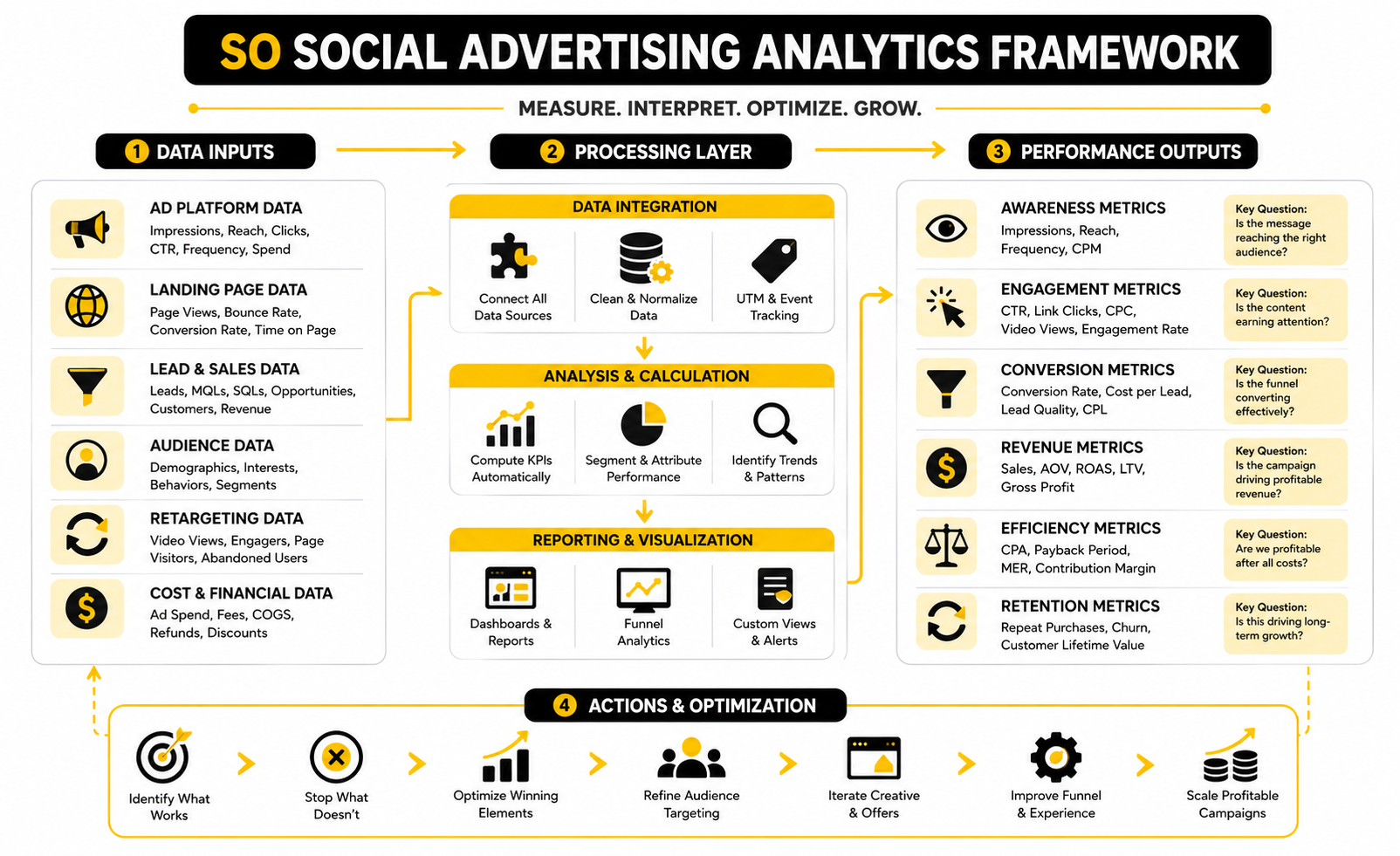
The most useful social advertising metrics sit in a sequence. First, you measure whether people notice the ad. Then you measure whether the right people take action. Then you measure whether that action creates revenue.
At the top of the sequence, impressions, reach, thumb-stop rate, video view rate, hook rate, and click-through rate help diagnose creative strength. These numbers do not prove the campaign is profitable, but they show whether the message is earning attention. If nobody stops, clicks, watches, or engages, the campaign has a creative or positioning problem before it has a conversion problem.
In the middle, landing page view rate, bounce behavior, form starts, form completions, add-to-cart actions, booked calls, and qualified leads show whether the post-click path is doing its job. This is where many campaigns quietly break. The ad creates interest, but the landing experience fails to turn that interest into a serious next step.
At the bottom, cost per acquisition, qualified cost per lead, show-up rate, close rate, average order value, lifetime value, refund rate, payback period, and return on ad spend show whether the campaign deserves more budget. These are the numbers that keep the business honest. A cheap lead is not cheap if sales cannot close it.
Read Metrics As Signals, Not Final Verdicts
A low click-through rate usually means the creative is not creating enough curiosity or relevance. But it can also mean the audience is too broad, the hook is too vague, the visual is weak, or the offer is not interesting enough. The number tells you where to look, not exactly what to do.
A high click-through rate can also be misleading. If people click but do not convert, the ad may be overpromising, attracting the wrong audience, or sending people to a page that does not match the expectation. This is why click quality matters more than click volume.
A strong conversion rate is useful, but it still needs context. A campaign can convert well and still lose money if the average order value is too low or if too many leads are unqualified. The best advertisers do not celebrate isolated metrics. They read the full chain.
Benchmarks Should Create Questions, Not Excuses
Benchmarks are helpful when they give you a starting point. They are dangerous when they become excuses. If your cost per lead is higher than a public average, that does not automatically mean the campaign is bad. It may mean you are selling to a more valuable audience, asking for a higher-intent conversion, or operating in a more competitive market.
WordStream’s 2025 paid search and social benchmark research reported an average Facebook ads click-through rate of 2.53% across industries, but the number varies heavily by category. That matters because averages flatten reality. A local fitness offer, a B2B software demo, and a luxury product campaign should not be expected to behave the same way.
The practical use of benchmarks is simple. Use them to spot obvious underperformance, then compare against your own historical results as quickly as possible. Your best benchmark is not the internet’s average. It is your last campaign, your current economics, and your required profit target.
Separate Platform Metrics From Business Metrics
Platform dashboards are useful, but they are not the whole truth. Meta, TikTok, LinkedIn, YouTube, and other platforms report performance through their own attribution systems. Those systems can help optimize campaigns, but they may not match the numbers inside your CRM, ecommerce backend, payment processor, or sales pipeline.
This is why teams need a source of truth outside the ad account. For ecommerce, that might be revenue, margin, repeat purchase rate, and blended acquisition cost. For lead generation, it might be qualified lead rate, booked call rate, show-up rate, close rate, and revenue per lead.
So social advertising becomes much easier to manage when the dashboard is split into two layers. The platform layer helps you improve delivery and creative. The business layer tells you whether the spend is actually creating profit.
Diagnose Problems In The Right Order
When performance drops, do not immediately rebuild the whole campaign. Start by diagnosing the chain. The problem usually sits in one part of the journey, and guessing wastes time.
A simple diagnostic order works like this:
This order prevents overreacting. If attention is weak, fix creative before changing the funnel. If attention is strong but conversion is weak, inspect the landing page, offer, and form. If conversion is strong but profit is weak, the issue may be pricing, lead quality, sales process, or lifetime value.
Attribution Needs Common Sense
Attribution is messy because people do not buy in a straight line. They may see a video on TikTok, click a retargeting ad on Instagram, search the brand on Google, read reviews, and come back days later from an email. No single dashboard captures that journey perfectly.
That is why attribution should be directional, not religious. Platform data, UTMs, analytics, CRM records, post-purchase surveys, and blended revenue should be read together. When several sources point in the same direction, you can make decisions with more confidence.
This matters even more as privacy rules, browser restrictions, app tracking changes, and modeled conversions affect reporting. The answer is not to ignore data. The answer is to combine platform optimization with business-level measurement so one imperfect report does not control every decision.
Budget Control Depends On Unit Economics
A campaign is scalable only when the unit economics work. That means you know how much you can afford to pay for a lead, booked call, customer, order, or trial. Without that number, optimization has no target.
For ecommerce, the key inputs are gross margin, average order value, contribution margin, repeat purchase behavior, and acceptable payback period. For lead generation, the key inputs are lead-to-call rate, show-up rate, close rate, average deal value, gross margin, and sales capacity. These inputs turn ad data into business decisions.
The simplest rule is this: do not scale because a dashboard looks exciting. Scale because the numbers still work after you include the real cost of acquiring and serving the customer. That is how social advertising becomes controlled growth instead of expensive motion.
Advanced Scaling, Tool Stack, And FAQ
Scaling is not just spending more. That is the fastest way to turn a promising campaign into an expensive lesson. Real scaling means increasing volume while protecting signal quality, creative freshness, conversion rate, and unit economics.
This is where so social advertising becomes more strategic. Early campaign work is about finding proof that the market cares. Scaling is about building a system that can survive more spend, more competition, more creative fatigue, and more operational pressure without breaking.
The goal is not to scale every campaign. The goal is to know which campaigns deserve more pressure, which ones need another testing cycle, and which ones should be shut down before they waste attention, budget, and team energy.
Scale The System, Not Just The Budget
A campaign is ready to scale when the numbers are stable enough to trust. One good day is not enough. A few lucky purchases are not enough. A temporary dip in cost per lead is not enough.
Look for consistency across multiple signals. The creative should still be earning attention, the landing page should still be converting, lead quality should still hold, and the business should still make money after real costs. If any of those pieces weakens under more spend, the campaign is not fully scalable yet.
There are three practical ways to scale. You can raise budget on proven campaigns, expand into new audiences, or create more winning creative from the same core insight. The third option is often the safest because most modern platforms rely heavily on creative signals to find the right people.
Creative Fatigue Is A Scaling Problem
Creative fatigue is not a minor inconvenience. It is one of the main reasons campaigns that looked strong suddenly become unstable. TikTok’s performance ad guidance recommends checking results regularly and refreshing ad group creatives when delivery declines or daily new users become low through its creative best practices.
The deeper point is simple: scaling increases exposure, and exposure burns through novelty. The more people see the same hook, visual, format, and offer, the less efficient the campaign can become. This does not mean the strategy is dead. It may only mean the creative package has been overused.
Professional teams treat creative refresh as part of the media plan, not as an emergency response. They keep a pipeline of new hooks, formats, proof points, objections, product angles, founder videos, customer-led assets, and comparison concepts ready before fatigue becomes obvious. That is how you avoid panic-editing ads after performance already drops.
Automation Increases Leverage, But It Also Increases Risk
Automation can make social advertising more efficient, but it also changes the job of the advertiser. Platforms are increasingly automating audience expansion, placements, bidding, and creative combinations. That can be powerful when the inputs are strong, but dangerous when the campaign has unclear positioning or weak conversion data.
The tradeoff is control versus learning speed. More automation can help platforms find patterns faster, but it can also make it harder to see why performance changed. More manual control can create cleaner tests, but it may limit delivery or slow down learning.
The practical answer is to use automation where it improves execution and keep human judgment where strategy matters. Let automation help with delivery, routing, reporting, and follow-up. Keep humans responsible for the offer, positioning, creative direction, customer insight, and the decision to scale.
AI Should Support Creative Strategy, Not Replace It
AI can help teams move faster, especially when turning one idea into multiple hooks, scripts, headlines, briefs, landing page variations, and follow-up sequences. That speed is useful. But speed without taste creates a different problem: polished sameness.
Recent analysis of AI-generated ads warns that many businesses are creating content that looks professional but feels formulaic, making it harder for smaller brands to stand out in crowded feeds. The issue is not AI itself. The issue is using AI as a substitute for original insight instead of a tool that expands human creative direction.
Use AI to multiply strong thinking, not to avoid doing the thinking. A clear audience insight, sharp offer, specific proof point, and distinctive brand voice still matter. In social feeds where people scroll past generic content all day, specificity is an advantage.
Retargeting Should Add Context, Not Just Repetition
Retargeting is often treated like a reminder machine. Someone visits a page, so the brand follows them around with the same offer. That can work, but it is not the most useful version of retargeting.
Better retargeting answers the next question in the buyer’s mind. If someone watched a product demo, show proof. If someone visited pricing, address value and risk. If someone abandoned a form, simplify the next step or clarify what happens after submission.
This makes retargeting feel less repetitive and more helpful. You are not just chasing people. You are continuing the conversation based on what they have already shown you.
Build A Tool Stack Around The Buyer Journey
The best tool stack is not the biggest one. It is the one that supports the journey from attention to action without creating unnecessary complexity. Every tool should have a job, and every job should connect to a business outcome.
A lean social advertising stack usually needs five layers:
The point is not to use every tool. The point is to remove friction where it actually hurts performance. If a tool does not help you produce better creative, capture better leads, follow up faster, close more deals, or understand the numbers, it may be adding noise.
Protect Brand Trust While Chasing Performance
Performance pressure can make advertisers short-sighted. They exaggerate claims, overuse urgency, push discounts too hard, or create ads that get clicks but weaken trust. That may create short-term movement, but it damages the asset that makes future campaigns easier: credibility.
Brand trust matters because social advertising happens in public. People can visit your profile, read comments, compare reviews, ask peers, and judge whether the brand feels real. A clever ad cannot fully compensate for a weak reputation.
This is why strong social advertisers care about the conversation around the ad, not just the ad itself. They monitor comments, respond to objections, watch sentiment, and use customer language to improve future creative. The ad is not separate from the brand experience. It is part of it.
Know When Not To Scale
Not every campaign deserves more spend. Some campaigns produce cheap leads that never buy. Some generate purchases only because the offer is discounted beyond profitability. Some look good in-platform but fail when measured against blended revenue.
The discipline is knowing when to stop. If lead quality is poor, fix the filter. If sales cannot close, inspect the promise and qualification process. If creative fatigue appears quickly, build a stronger creative pipeline before raising spend.
There is no shame in pausing a campaign that does not have the economics to scale. The expensive mistake is forcing scale because the team wants the campaign to work. Good operators protect capital, learn from the signal, and move budget toward the campaigns with the clearest path to profitable growth.
Final System Check Before You Scale
Before a campaign becomes a serious growth channel, every part of the system needs one final check. The ad account may look healthy, but the real question is whether the whole journey can handle more demand. More clicks will not help if leads are ignored, sales calls are underprepared, checkout is clunky, or reporting cannot separate good revenue from noisy activity.
This is where so social advertising becomes an ecosystem. The creative brings people in, the platform distributes the message, the landing experience handles intent, the follow-up carries the conversation, the sales or checkout process creates revenue, and the analytics layer decides what deserves more budget. When those parts are connected, the campaign stops depending on luck.
That final system view also protects you from over-optimizing one piece at the expense of the whole business. A higher click-through rate is not always better if it lowers lead quality. A cheaper lead is not always better if the sales team wastes time on people who were never serious. A higher ROAS is not always better if it comes from discounting too aggressively and weakening margin.
What is so social advertising?
So social advertising is the practical use of paid ads on social platforms to create attention, trust, leads, sales, or other measurable business outcomes. It includes the ad itself, but it also includes creative strategy, audience understanding, landing pages, follow-up, tracking, and optimization. The best campaigns are built as systems, not isolated posts with budget behind them.
Is social advertising the same as social media marketing?
No, but they overlap. Social media marketing includes organic content, community, creator partnerships, customer interaction, and brand presence. Social advertising specifically refers to paid promotion on platforms like Facebook, Instagram, TikTok, LinkedIn, YouTube, Pinterest, Reddit, Snapchat, and others.
Which platform is best for social advertising?
There is no universal best platform. Meta is often strong for ecommerce, local businesses, lead generation, and retargeting because of its scale and mature ad tools. LinkedIn can work well for B2B when job role, company type, or seniority matters, while TikTok and YouTube are often powerful when creative quality and video storytelling are central to the campaign.
How much should a business spend to test social ads?
A test budget should be large enough to collect meaningful signal, but small enough to protect the business if the first version is wrong. The budget depends on the product price, funnel type, platform costs, and conversion goal. A local lead campaign, ecommerce product test, and enterprise demo campaign all need different test budgets because the value of each conversion is different.
What metrics matter most in social advertising?
The most important metrics are the ones connected to business outcomes. At the top of the funnel, watch attention and engagement signals such as hook rate, video view rate, click-through rate, and cost per landing page view. Deeper in the funnel, focus on qualified lead cost, booked call rate, close rate, cost per acquisition, average order value, lifetime value, payback period, and profit.
Why do social ads stop working after a few days or weeks?
Social ads often decline because the audience has seen the same creative too many times, the algorithm has exhausted the easiest conversions, or the initial learning signal was too narrow. TikTok recommends refreshing creatives when performance shows a consistent decline or daily new users are low through its creative best practices. The fix is usually not one tiny edit, but a stronger creative pipeline with new hooks, angles, formats, and proof points.
Do I need a landing page for social advertising?
Not always, but most serious campaigns need a dedicated conversion path. Some campaigns can convert inside native lead forms, direct messages, shops, or app flows. Still, a strong landing page gives you more control over the message, proof, offer, and next step, especially when the product needs explanation or trust.
Should I use lead forms or send people to a website?
Use native lead forms when speed and low friction matter most. Use a website or landing page when you need more education, qualification, proof, pricing context, or offer framing before someone converts. The key is not choosing the easiest form of conversion, but choosing the path that produces the best combination of volume, quality, and revenue.
How does retargeting fit into social advertising?
Retargeting helps continue the conversation with people who already showed interest. That might include website visitors, video viewers, social engagers, abandoned checkout users, email subscribers, or past customers. The strongest retargeting does not just repeat the first ad; it answers the next likely objection, adds proof, or gives the person a clearer reason to act.
How important is creative testing?
Creative testing is one of the most important parts of social advertising because the creative often determines who pays attention and what the platform learns. Testing should compare different angles, hooks, formats, proof points, objections, and offers. Small design tweaks can matter later, but early testing should focus on big differences that reveal what the market actually cares about.
Can AI help with social advertising?
Yes, AI can help with research, creative briefs, hook variations, scripts, ad copy, reporting summaries, landing page drafts, and follow-up sequences. It should not replace customer insight or strategic judgment. AI is most useful when it speeds up a clear strategy, not when it produces generic content with no real point of view.
What is the biggest mistake businesses make with social ads?
The biggest mistake is treating social advertising like a traffic problem when it is really a system problem. Businesses often launch ads before the offer is sharp, the landing page is clear, the tracking is clean, or the follow-up is ready. Then they blame the platform instead of fixing the broken parts of the buyer journey.
How do I know when a campaign is ready to scale?
A campaign is ready to scale when performance is stable across the full funnel. That means the creative is still earning attention, conversion rates are holding, lead or customer quality is acceptable, and the unit economics still work after real costs. Do not scale because one dashboard looks good for one day; scale because the system has shown repeatable strength.
What tools are useful for social advertising?
Useful tools depend on the campaign model. A simple stack might include Buffer for content coordination, Replo for ecommerce landing pages, ClickFunnels or Systeme.io for funnel flows, Fillout for forms, Cal.com for bookings, GoHighLevel for CRM and follow-up, and ManyChat for social message automation.
How should businesses handle compliance in social advertising?
Businesses should avoid misleading claims, hidden sponsorships, fake urgency, manipulated reviews, and unclear influencer relationships. The FTC’s guidance on endorsements, influencers, and reviews makes clear that material connections should be disclosed in ways people can notice and understand. Compliance is not just legal protection; it also protects trust, which is one of the most valuable assets in paid social.
Build a stronger local presence with BAAM AI
Turn your website, Google profile, social channels, and AI visibility into one growth engine
Most businesses do not need more random marketing activity. They need a consistent presence system that helps the right people find them, trust them, and take action. BAAM AI brings strategy, local SEO, website updates, Google Maps visibility, social content, AI-search readiness, media production, and reporting into one practical monthly engine.
If you want your marketing to keep working after the campaign ends, start with a free BAAM AI presence audit. See how your business shows up today and where the fastest visibility wins are at BAAM AI.