
BAAM AI Blog
SMM Social Media: A Practical Framework For Turning Attention Into Growth
SMM social media is the practice of using social platforms to build awareness, earn trust, create demand, support customers, and drive measurable business outcomes. It is not just posting content, chasing trends, or...

SMM social media is the practice of using social platforms to build awareness, earn trust, create demand, support customers, and drive measurable business outcomes. It is not just posting content, chasing trends, or trying to “go viral.” Done well, it connects audience research, content strategy, community management, paid distribution, analytics, and conversion systems into one operating model.
That matters because social media is no longer a side channel. Global social media user identities reached 5.66 billion in October 2025, meaning social platforms now reach more than two-thirds of the world’s population, based on DataReportal’s global social media statistics. At the same time, organic reach is harder to earn, engagement benchmarks are under pressure, and buyers increasingly use social content to research brands before they ever visit a website.
The mistake most businesses make is treating social media marketing like a content calendar problem. The real problem is usually strategic alignment. The content may be frequent, but the message is vague, the audience is too broad, the offer is unclear, the reporting is shallow, and the team has no repeatable system for learning what actually works.
this guide breaks SMM social media into a practical six-part framework. The goal is not to make the topic sound complicated. The goal is to give you a usable structure for building a professional social media engine that can attract attention, convert interest, and improve over time.
Why SMM Social Media Matters Now
SMM social media matters because attention has become fragmented, expensive, and algorithmically filtered. People do not move neatly from ad to website to purchase anymore. They discover a brand on TikTok, check its Instagram, search YouTube for reviews, read comments, compare alternatives, and only then decide whether the brand feels credible.
This makes social media a trust layer, not just a traffic source. The 2025 Sprout Social Index found that its research covered more than 4,000 consumers, 900 social practitioners, and 300 marketing leaders, showing how seriously brands now treat social as a business function rather than a publishing task, as shown in Sprout Social’s 2025 Index. Buyers expect brands to be visible, responsive, useful, and consistent across the platforms where they already spend time.
The hard part is that more activity does not automatically create more growth. Rival IQ’s 2025 benchmark report found that engagement rates fell across major platforms, including Facebook, Instagram, TikTok, and X, based on its 2025 Social Media Industry Benchmark Report. That does not mean social media is dying. It means weak content, unclear positioning, and random posting are getting punished faster.
The Core Shift In SMM Social Media
The old version of social media marketing was built around posting more often and hoping the algorithm rewarded consistency. The newer version is built around sharper positioning, better creative, stronger community signals, more carefully paid amplification, and clearer measurement. This is why professional SMM social media now sits closer to growth strategy than simple content production.
Brands also need to understand that social platforms are becoming search engines, recommendation engines, entertainment feeds, storefronts, customer service desks, and reputation systems at the same time. HubSpot reports that about 73% of global internet users aged 16+ use social media to research brands and products, citing DataReportal data in its 2026 marketing statistics collection. That behavior changes what content needs to do.
A post is no longer just a post. It may be the first impression, the objection handler, the proof point, the product explainer, the customer support shortcut, or the final confidence boost before someone buys. That is why the framework here starts with strategy before it moves into execution.
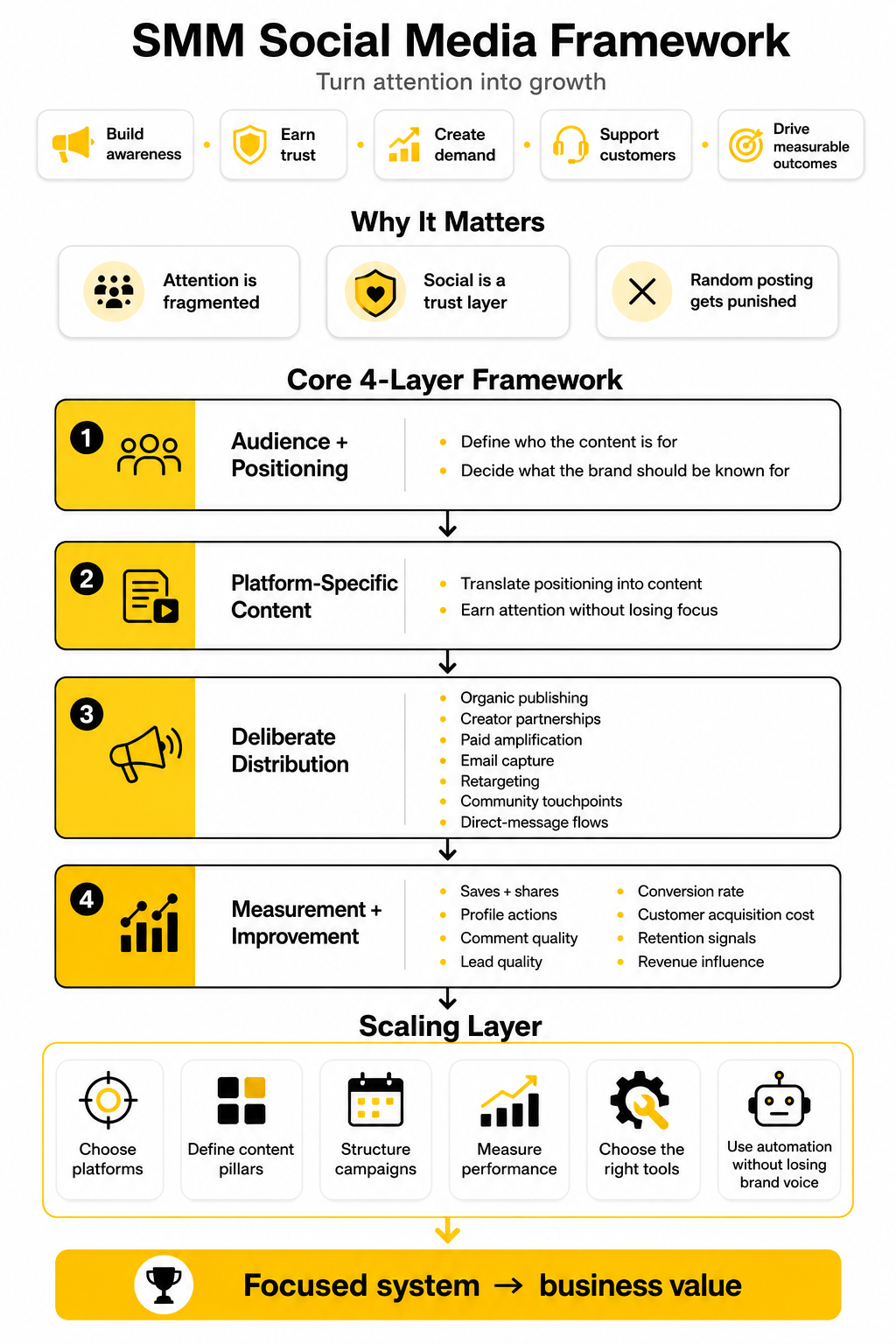
The SMM Social Media Framework At A Glance
A strong SMM social media system has four layers. First, you define who the content is for and what the brand needs to become known for. Second, you translate that positioning into platform-specific content that earns attention without losing strategic focus.
Third, you build distribution deliberately. That includes organic publishing, creator partnerships, paid amplification, email capture, retargeting, and community touchpoints. When social conversations start turning into leads, tools such as ManyChat can help automate direct-message flows without making the experience feel cold or robotic.
Fourth, you measure the right things and improve the system. Vanity metrics still have a place because reach and engagement show whether people care enough to react. But professional implementation also looks at saves, shares, profile actions, comment quality, lead quality, conversion rate, customer acquisition cost, retention signals, and revenue influence.
What this guide Will Help You Build
By the end of the full article, you will have a practical way to think about SMM social media from strategy to execution. You will know how to choose platforms, define content pillars, structure campaigns, measure performance, and decide which tools belong in your workflow. The point is not to be everywhere. The point is to build a focused system that can earn attention and turn that attention into business value.
You will also see where automation fits without letting automation take over the brand voice. Scheduling platforms such as Buffer can support consistency, while broader systems such as GoHighLevel can connect social leads with CRM, email, funnels, and follow-up. Tools are useful only when the strategy is clear first.
The best social media marketing feels simple from the outside because the message is clear, the content is useful, and the brand shows up with confidence. Behind the scenes, though, there is structure. That structure is what the next five parts will build.
The SMM Social Media Framework Overview
A useful SMM social media framework has to do more than organize content ideas. It needs to connect audience insight, platform behavior, creative execution, distribution, conversion, and measurement into one clear operating system. Without that structure, teams usually end up reacting to trends, copying competitors, and measuring whatever looks good in a report.
The framework works best when you think in layers. Each layer has a job, and each job supports the next one. Strategy gives the content direction, content creates attention, distribution expands reach, conversion captures demand, and measurement tells you what to improve next.
This is where most brands need to slow down before they speed up. Posting more often can help only when the message is already clear. If the positioning is weak, more content simply spreads confusion faster.
Layer 1: Strategy Before Content
The first layer is strategy, and it answers the most important question: why should this audience care? That question sounds simple, but it forces you to define the buyer, the problem, the emotional trigger, the category context, and the promise your brand can make credibly. If you skip this part, the content will usually become generic because there is no sharp point of view behind it.
Strong strategy also decides what the brand should become known for. In SMM social media, that matters because algorithms may distribute content, but people remember patterns. A brand that talks about everything becomes hard to place in the buyer’s mind.
The practical move is to define three things before creating content: the audience segment, the core problem, and the content promise. The audience segment tells you who you are speaking to. The core problem tells you what tension your content should address. The content promise tells people why following you is worth their time.
Layer 2: Platform Fit
The second layer is platform fit. Every platform has its own culture, pace, format bias, and discovery behavior. A strong LinkedIn post can feel painfully stiff on TikTok, while a fast TikTok concept may need more context before it works on YouTube or LinkedIn.
This is why professional SMM social media does not mean copying one post across every channel. It means adapting the same strategic idea into the native language of each platform. The message can stay consistent, but the delivery should change.
Platform fit also protects your team from wasting effort. DataReportal’s 2025 social media analysis shows that 97.3% of connected adults use at least one social network or messaging platform each month, but that does not mean every brand needs every platform, as shown in Digital 2025’s state of social media report. The better question is where your buyers already pay attention, where your content format can compete, and where your business model can actually convert that attention.
Layer 3: Content Systems
The third layer is the content system. This is where strategy becomes visible. A content system defines the repeatable themes, formats, hooks, angles, and calls to action that keep the brand consistent without making every post feel the same.
Good content systems usually include a mix of education, proof, perspective, product relevance, and community interaction. Education helps the audience understand the problem. Proof builds confidence. Perspective separates the brand from competitors. Product relevance connects the content to commercial outcomes. Community interaction keeps the channel from feeling like a one-way broadcast.
This is also where consistency becomes realistic. You do not need a new strategy every week. You need a set of content pillars strong enough to support many posts, short videos, carousels, emails, landing pages, and sales conversations.
Layer 4: Distribution And Amplification
The fourth layer is distribution. Organic content is important, but organic alone is not a complete growth strategy for most businesses. Engagement benchmarks have become more difficult across many platforms, with Rival IQ’s 2025 report showing platform-wide engagement rate declines across Facebook, Instagram, TikTok, and X in its social media industry benchmark report.
That means distribution has to be intentional. A strong SMM social media plan may include employee advocacy, creator collaborations, paid boosts, retargeting, newsletter promotion, community sharing, search optimization, and direct-message follow-up. The point is not to force every post into a campaign. The point is to make sure your best ideas do not die after one feed cycle.
This is where simple tools can create leverage. A scheduling workflow through Buffer can help keep publishing organized, while direct-message automation through ManyChat can help turn high-intent comments or replies into guided conversations. The tool is not the strategy, but the right tool can make a good strategy easier to execute.
Layer 5: Conversion Paths
The fifth layer is conversion. Social media attention has to go somewhere. If people like the content but never understand the next step, the business ends up with visibility but very little commercial value.
A conversion path can be simple. It may send people to a lead magnet, a product page, a booking page, a webinar, a free trial, a newsletter, or a direct conversation. What matters is that the next step matches the temperature of the audience.
Cold viewers usually need education and proof. Warm followers may need comparison, objection handling, or a clearer offer. High-intent prospects need speed, clarity, and a frictionless path to act, which is why funnel builders such as ClickFunnels or broader CRM systems such as GoHighLevel can be useful when social media starts producing consistent demand.
Layer 6: Measurement And Learning
The final layer is measurement, but measurement should not be treated like a monthly reporting chore. It is the feedback loop that tells you what the market is responding to. If you read the data properly, it becomes a creative advantage.
The mistake is measuring every platform with the same shallow scorecard. Reach, impressions, engagement, clicks, leads, sales, saves, shares, watch time, comment quality, and retention all tell different parts of the story. A post with fewer likes may still be more valuable if it attracts better prospects or creates stronger buying intent.
The best SMM social media teams look for patterns rather than isolated wins. They ask which hooks earned attention, which topics created trust, which formats produced saves or shares, which offers moved people to act, and which channels created the best downstream results. That is how social media becomes a compounding system instead of a constant scramble.
Audience, Positioning, And Platform Strategy
Before implementation becomes tactical, SMM social media needs a sharp strategic base. This is the part where you decide who you are trying to reach, what you want them to believe, and where your brand has the best chance of earning meaningful attention. Without that base, execution becomes a guessing game dressed up as productivity.
The goal is not to define the entire market. The goal is to choose the specific audience segment that has the strongest fit with your offer, your message, and your content strengths. A broad audience may look attractive on paper, but broad targeting usually creates weak content because it forces the brand to speak in safe, generic language.
Strong positioning makes the rest of the process easier. It tells you which problems to talk about, which objections to answer, which proof points to show, and which platforms deserve serious effort. That is why the implementation process starts here, not inside a scheduling tool.
Define The Audience You Can Actually Win
The first practical step is to define the audience with enough detail to guide decisions. Demographics matter, but they are not enough. You also need to understand the audience’s current pain, desired outcome, buying trigger, trust barrier, and preferred way of consuming information.
For SMM social media, this means looking beyond “small business owners,” “coaches,” “ecommerce brands,” or “B2B buyers.” Those labels are too wide to shape useful content. A stronger audience definition would clarify the business model, maturity level, decision maker, urgency, and the reason they would pay attention now.
This matters because platform behavior changes by audience. Pew Research Center’s 2025 data shows that 84% of U.S. adults use YouTube, 71% use Facebook, and 50% use Instagram, based on its social media use research. But those broad numbers do not tell you where your best buyers are most receptive. You still need to match your audience to the environment where they are willing to learn, compare, ask questions, and act.
Turn Positioning Into Content Direction
Once the audience is clear, positioning turns that audience insight into a practical content direction. Positioning is not a slogan. It is the mental space your brand wants to own in the audience’s mind.
A useful positioning statement should make three things obvious: the audience, the problem, and the advantage. It should help your team understand what to say yes to and what to ignore. If a post idea does not support the position, it may still be interesting, but it probably does not belong in the core strategy.
This is where many brands make social media harder than it needs to be. They create posts around random tips, trends, holidays, and platform prompts instead of building around a clear market point of view. Strong SMM social media uses content to repeat the brand’s strategic truth from different angles until the audience starts remembering it.
Choose Platforms Based On Fit, Not Fear
Platform selection should be deliberate. You do not need to be everywhere, and you definitely do not need to chase every new feature the moment it appears. The better move is to choose platforms based on audience fit, content fit, buying journey fit, and operational capacity.
Audience fit asks whether your buyers are active and receptive there. Content fit asks whether your team can consistently produce the formats that work on that platform. Buying journey fit asks whether the platform can realistically influence awareness, consideration, trust, or conversion.
Operational capacity matters more than people admit. A small team can run one or two platforms well, but five platforms poorly will drain energy fast. It is better to build depth on the platforms that match your strategy than to create a thin presence everywhere.
Build The Implementation Process
The implementation process should turn strategy into a repeatable workflow. This is where SMM social media becomes tangible. You are no longer talking about “being consistent”; you are defining exactly how ideas move from research to published content to measurable learning.
A simple process works best because complex systems break under real workload. The workflow should show who owns strategy, who researches topics, who creates content, who approves it, who publishes it, who responds to engagement, and who reviews performance. If those responsibilities are unclear, delays and inconsistent quality are almost guaranteed.
The process should also create a rhythm. Weekly planning keeps the team focused, daily execution keeps the channels active, and monthly review keeps the strategy from drifting. This rhythm is what turns social media from a reactive task into a disciplined growth function.
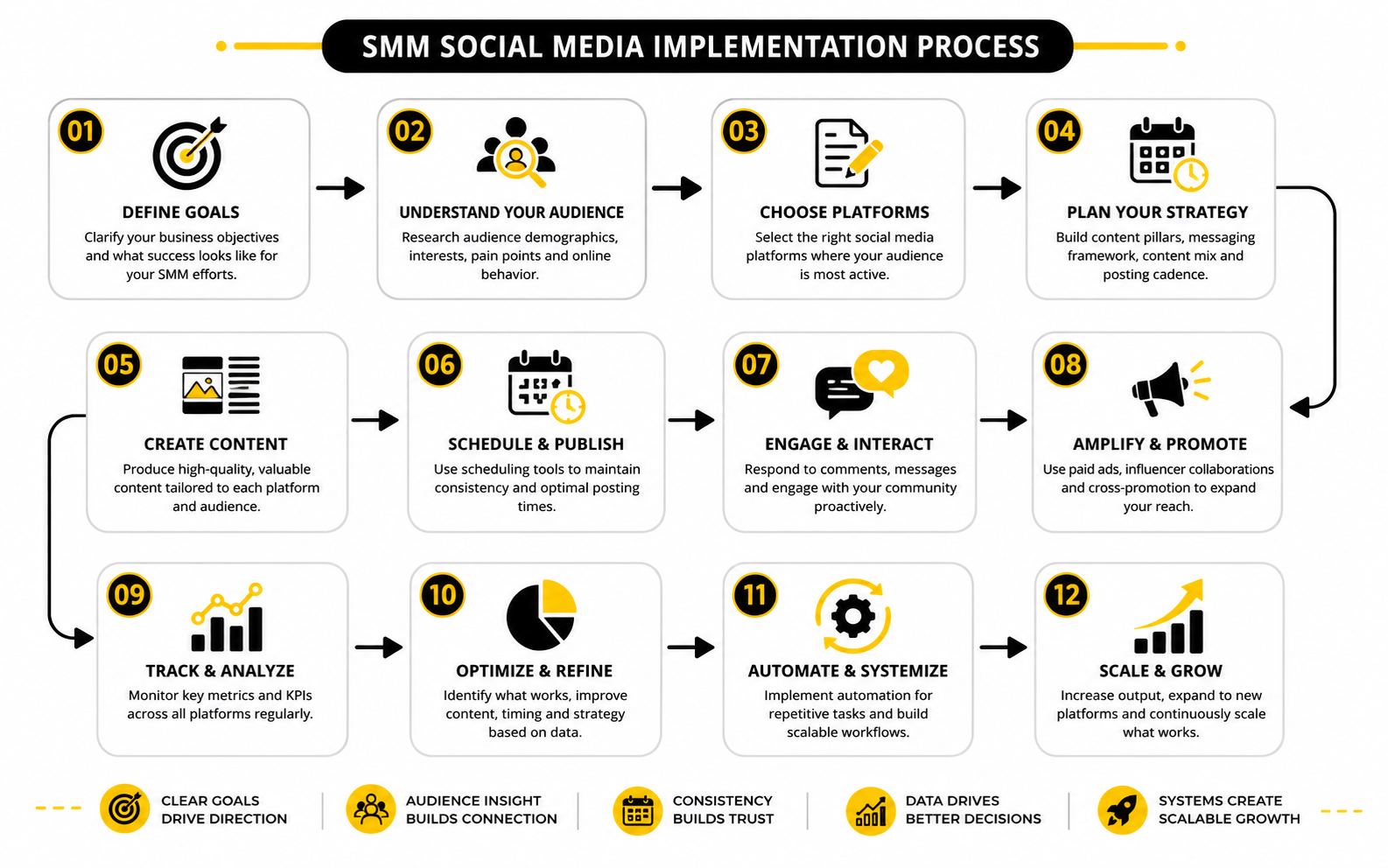
A Practical SMM Social Media Workflow
A practical workflow can start with six repeatable steps. Each step has a specific job, and skipping one usually creates problems later. The point is not to create bureaucracy. The point is to make execution easier, faster, and more reliable.
This workflow gives your team a practical way to move without overthinking every post from scratch. It also makes performance easier to diagnose. If a post underperforms, you can look at the audience insight, the angle, the format, the creative, the distribution, or the offer instead of blaming the algorithm immediately.
Set Content Pillars That Support The Buyer Journey
Content pillars should not be random categories. They should reflect the buyer journey and the belief shifts your audience needs before they are ready to act. The strongest pillars help people understand the problem, trust the brand, see the product’s relevance, and feel confident about the next step.
For most businesses, four to six pillars are enough. More than that usually creates confusion. Each pillar should have a clear purpose, a clear audience need, and enough depth to produce many pieces of content.
A useful set of pillars might include problem education, practical how-to content, proof and credibility, product context, opinion or category perspective, and community conversation. The exact mix depends on the business, but the principle stays the same. Every pillar should earn attention while also moving the audience closer to trust.
Create A Platform Role Map
Each platform should have a role in the broader SMM social media system. One platform may be best for discovery, another for credibility, another for community, and another for conversion support. When each channel has a role, the team stops expecting every platform to do everything.
For example, YouTube may support search-driven education and long-term authority. Instagram may support visual trust, short-form storytelling, and community touchpoints. LinkedIn may support B2B credibility, founder perspective, and professional proof. TikTok may support discovery, fast testing, and cultural relevance when the audience fit is strong.
This role map also makes reporting more honest. A discovery platform should not be judged only by last-click revenue. A conversion-support channel should not be judged only by reach. Measure the platform against the job it is supposed to do.
Connect Social Activity To The Next Step
Implementation is incomplete unless every important content path has a next step. That next step does not need to be aggressive, but it does need to be clear. If the audience is interested, they should know where to go, what to do, or how to continue the conversation.
For simple lead capture, a form builder such as Fillout can help turn social traffic into structured inquiries, applications, surveys, or waitlists. For service businesses and agencies, GoHighLevel can connect social leads with CRM pipelines, follow-up messages, appointment booking, and automation. For brands that need a focused funnel path, ClickFunnels can help create a dedicated conversion journey.
The important thing is intent matching. A cold viewer may need a guide, checklist, video, or newsletter before a sales call makes sense. A warm prospect who has been engaging for weeks may be ready for a demo, consultation, or offer page. Good SMM social media respects that difference instead of pushing everyone into the same funnel.
Statistics And Data
Data only helps when it changes a decision. In SMM social media, numbers should not be collected to decorate a report or make a dashboard look busy. They should tell you what is working, what is weak, what deserves more budget, and what should be stopped.
The most important shift is moving from isolated metrics to connected interpretation. A post with high reach but no profile actions may have attracted the wrong audience. A post with modest reach but strong saves, shares, comments, and qualified clicks may be far more valuable because it moved the right people closer to trust.
This is why benchmark data should be used carefully. Benchmarks help you understand whether performance is unusually strong, weak, or normal for the platform and category. They should not become a lazy excuse for copying industry averages, because your offer, audience, creative quality, and funnel all change what “good” actually means.
What The Social Media Numbers Really Mean
The first number to understand is audience scale. Social media is still one of the largest attention markets in the world, with DataReportal reporting 5.24 billion active social media user identities worldwide in early 2025 in its Digital 2025 social media overview. That scale matters because it confirms the opportunity, but it does not guarantee easy growth.
The second number to understand is platform pressure. Rival IQ’s 2025 benchmark report found that engagement rates declined across major platforms, including a 36% drop on Facebook, 16% drop on Instagram, 34% drop on TikTok, and 48% drop on X, based on its 2025 Social Media Industry Benchmark Report. That matters because teams cannot assume that the same content quality from two years ago will still earn the same response today.
The third number to understand is buyer behavior. Social platforms are not just entertainment feeds; they influence discovery, research, trust, and purchase decisions. When people use social content to evaluate brands, your measurement system needs to look beyond likes and include deeper signals such as saves, shares, comments, clicks, lead quality, and assisted conversions.
Separate Attention Metrics From Trust Metrics
Attention metrics show whether people noticed the content. These include reach, impressions, video views, hook retention, watch time, and follower growth. They are useful because without attention, nothing else happens.
Trust metrics show whether people cared enough to engage more deeply. These include saves, shares, meaningful comments, direct messages, profile visits, repeat engagement, and branded search lift. These signals usually matter more than surface-level reactions because they show that the content created enough value for someone to pause, remember, or pass it along.
A healthy SMM social media report separates these two groups instead of blending everything into one vague engagement number. If attention is low, the hook, format, timing, or distribution may be weak. If attention is high but trust signals are low, the content may be entertaining but not strategically useful.
Measure Each Platform By Its Real Job
Each platform should be measured against the role it plays in the system. A discovery platform should be judged by reach quality, retention, new audience growth, and the topics that attract fresh attention. A trust-building platform should be judged by comments, saves, shares, repeat engagement, and profile actions.
A conversion-support platform should be judged by clicks, inquiries, booked calls, form submissions, email signups, demo requests, sales conversations, and pipeline contribution. This distinction matters because one platform may rarely create last-click revenue but still influence buyers before they convert somewhere else. If you judge every channel by the same final-click metric, you may cut the channel that is quietly building the trust your funnel depends on.
This is where social media reporting becomes more useful and less political. Instead of arguing whether Instagram, LinkedIn, TikTok, YouTube, or Facebook is “best,” you define the job of each platform and measure whether it is doing that job. That gives the team a cleaner way to decide what to improve.
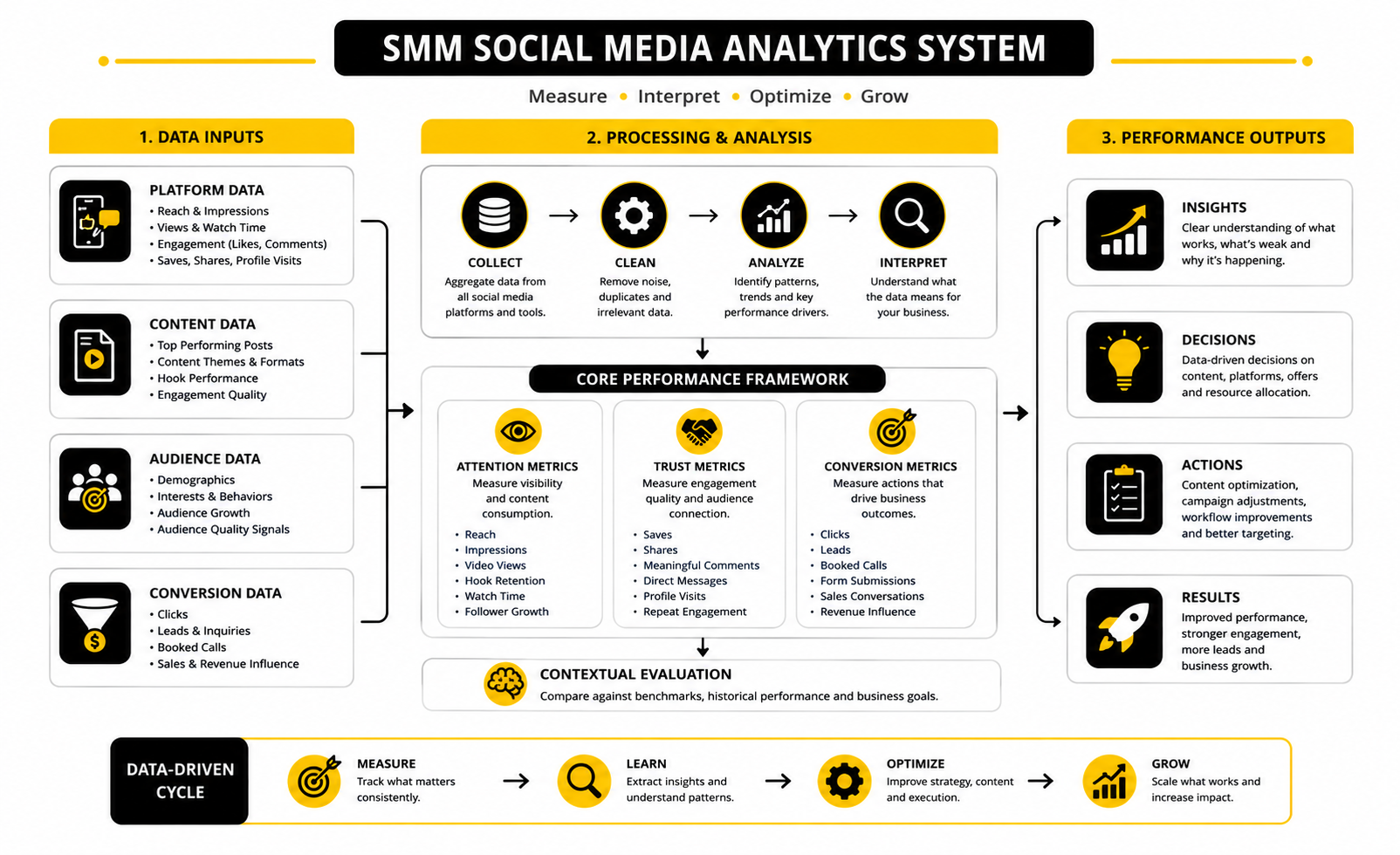
Build A Simple Analytics System
A practical analytics system should connect platform data, content data, audience data, and conversion data. Platform data tells you where attention is happening. Content data tells you which topics and formats are working. Audience data tells you whether the right people are responding. Conversion data tells you whether attention is turning into business value.
You do not need a complicated dashboard to start. A simple weekly review can track reach, engagement quality, saves, shares, profile actions, clicks, leads, and the top-performing content themes. The key is to record enough context so the team can understand why something worked, not just that it worked.
For teams that want cleaner reporting and follow-up, a CRM-connected workflow helps. A system like GoHighLevel can connect social leads with pipelines, follow-up messages, appointment booking, and revenue tracking. A publishing workflow through Buffer can also help teams keep campaign timing and post performance organized without relying on scattered spreadsheets.
Use Benchmarks Without Becoming Average
Benchmarks are useful only when they create better questions. If your engagement rate is below the industry average, the next step is not panic. The next step is to diagnose whether the issue is audience relevance, creative quality, posting format, platform selection, distribution strength, or offer clarity.
If your numbers are above benchmark, that is not the finish line either. Strong engagement may still fail to create business value if the content attracts the wrong audience or never connects to a next step. The real question is whether stronger engagement is also improving qualified traffic, leads, sales conversations, or retention.
This is why SMM social media teams should compare performance in three ways. Compare against industry benchmarks to understand the market. Compare against your own historical performance to see whether the system is improving. Compare against business outcomes to make sure the social media work is actually supporting growth.
Read Performance Signals In Context
Not every metric means the same thing in every situation. A high save rate on educational content may show that the topic is valuable and worth turning into a longer asset. A high share rate may show that the content expresses something people want to be associated with publicly.
A high comment rate can be powerful, but only if the comments are relevant. Ten thoughtful comments from buyers may be more useful than hundreds of low-quality reactions from people who will never buy. That is why qualitative review still matters, even when the dashboard looks precise.
Low performance also needs context. A post may fail because the idea was weak, but it may also fail because the opening was unclear, the format was wrong, the platform was mismatched, or the post was not distributed properly. Good measurement helps you find the real cause instead of making emotional decisions after one disappointing result.
Turn Data Into Action
The best analytics review ends with decisions. If a topic earns strong saves and shares, turn it into a content series, webinar, lead magnet, or sales enablement asset. If a format consistently underperforms, either improve the creative execution or stop forcing it.
If a platform drives attention but no qualified action, tighten the call to action and test a better next step. A form built with Fillout can help capture structured inquiries from social traffic, while an email platform such as Brevo can help nurture people who are interested but not ready to buy immediately. The goal is to avoid wasting high-intent attention.
The strongest SMM social media teams do not worship data. They use it to make sharper creative decisions, cleaner platform choices, and better commercial moves. That is the difference between reporting activity and improving performance.
Advanced Scaling And Professional Implementation
Once the basic SMM social media system is working, the next challenge is scale. Scaling does not mean posting twice as much or hiring more people immediately. It means increasing output, learning speed, and business impact without losing strategic clarity.
This is where the tradeoffs become real. More content can create more chances to win, but it can also dilute the brand if the quality drops. More automation can improve speed, but it can also make the brand feel generic if every interaction starts sounding like a template.
Professional implementation is about controlled leverage. You want the system to move faster, but you still need the brand to feel human, sharp, and trustworthy. That balance is the difference between a social media engine and a content factory.
Scale The Message Before You Scale The Volume
The first rule of scaling is simple: scale what already has signal. If a topic consistently earns saves, shares, qualified comments, clicks, or sales conversations, it deserves more creative variations. If a topic gets ignored, producing more versions of it will not magically fix the problem.
This is why advanced SMM social media teams build from proven themes. A strong post can become a short-form video, carousel, newsletter section, webinar topic, sales enablement point, landing page angle, or paid ad test. The idea compounds because the team is expanding a validated message instead of constantly starting from zero.
This approach also protects the brand from trend-chasing. Trends can be useful when they fit your positioning, but they are dangerous when they pull the brand away from what buyers actually need to understand. The question is not “Can we use this trend?” The better question is “Does this trend help us say something strategically useful?”
Use AI Carefully Without Losing The Human Edge
AI can support SMM social media, but it should not replace judgment. It can help with research organization, idea expansion, caption variations, content repurposing, reporting summaries, and workflow speed. The risk starts when teams outsource the thinking and publish content that sounds correct but has no lived insight, no point of view, and no real audience understanding.
This matters more now because AI-generated content is flooding feeds. Nielsen’s 2025 marketing analysis found that 59% of global marketers see AI for campaign personalization and optimization as the most impactful industry trend, based on its AI and marketing outlook. That does not mean AI makes strategy automatic. It means the teams with better inputs, better judgment, and better creative standards will get more leverage from the same tools.
The practical rule is to use AI for acceleration, not substitution. Let it help you draft, organize, summarize, and test options. Keep positioning, claims, voice, proof, customer insight, and final judgment in human hands.
Protect Brand Trust As You Grow
Trust becomes harder to protect as more people, platforms, creators, tools, and campaigns enter the system. A small team can maintain quality through informal judgment. A larger system needs standards.
Those standards should cover voice, claims, visual style, response behavior, disclosure rules, customer privacy, creator partnerships, and escalation processes. This is not bureaucracy for the sake of it. It is how you prevent one rushed post, one careless reply, or one unclear claim from damaging the credibility you worked hard to build.
Brand safety is also becoming more complex because social platforms, creator content, AI-generated media, and paid amplification now overlap. eMarketer’s 2025 brand safety analysis notes that platform moderation changes and user-based moderation models have created a new risk environment for advertisers in its brand safety on social media report. The action is straightforward: define what your brand will not appear next to, what it will not say, and how fast the team should respond when something goes wrong.
Decide What To Automate And What To Keep Manual
Automation works best when the task is repeatable, rules-based, and low-risk. Scheduling posts, routing leads, tagging contacts, sending reminders, collecting form responses, and triggering follow-up sequences are good candidates. Strategic messaging, public replies to sensitive comments, creator selection, crisis response, and final approval should stay much closer to human judgment.
This distinction is important because automation can quietly shape the customer experience. A fast reply is useful only if it is relevant. A follow-up sequence is helpful only if it respects intent. A chatbot is valuable only if it gives people a better next step instead of trapping them in a robotic loop.
For direct-message workflows, ManyChat can be useful when the goal is to respond to clear triggers such as keyword comments, lead magnet requests, or product questions. For broader lead management, GoHighLevel can connect social responses with CRM stages, appointment booking, pipeline tracking, and follow-up. The expert move is not automating everything. The expert move is automating the parts that make the human parts easier.
Build Governance Without Killing Speed
Governance sounds boring until the team gets bigger and the mistakes get more expensive. A good governance system defines who can publish, who can approve, who can respond, who can pause a campaign, and who owns final decisions during sensitive moments. It gives the team freedom because everyone knows the boundaries.
The key is to make governance practical. You do not need a twenty-page approval process for every caption. You need clear rules for normal posts, higher-risk posts, paid campaigns, creator collaborations, customer complaints, legal claims, and crisis situations.
This is especially important for regulated industries, healthcare-adjacent offers, finance-related content, B2B software, agencies managing client accounts, and brands with public-facing founders. When the stakes are higher, the workflow needs more review. Speed is valuable, but reckless speed is not a strategy.
Manage Creator And Partner Risk
Creators can add reach, trust, and fresh creative energy to SMM social media. They can also create risk if the partnership is poorly defined. The brand needs clarity on creative control, usage rights, disclosure, approval, performance expectations, exclusivity, payment terms, and what happens if the creator’s public behavior becomes a problem.
Creator partnerships work best when the creator actually understands the audience and can communicate naturally. Over-scripted content often feels like an ad wearing a costume. Under-briefed content can miss the message entirely.
The better approach is to give creators a strategic brief, not a word-for-word script. Define the audience, offer, key claims, forbidden claims, proof points, and call to action. Then give them enough creative room to make the message feel native to their voice and platform.
Prepare For Paid Amplification
At some point, strong organic content should feed paid testing. Paid amplification helps proven messages reach more of the right people and gives the team faster feedback on hooks, angles, audiences, and offers. It also reduces dependency on unpredictable organic reach.
The important word is “proven.” Boosting weak content usually makes the weakness more expensive. Boosting content that already has strong organic signals can help identify which messages deserve a full campaign, funnel, or retargeting sequence.
This is also where landing page quality starts to matter more. If social content creates intent but the page does not continue the same promise, conversion drops. A dedicated funnel in ClickFunnels, a lean offer page in Systeme.io, or a product landing page built with Replo can help keep the journey focused when paid traffic enters the system.
Know When The System Is Ready To Scale
A social media system is ready to scale when it has repeatable signals. You should know which audience responds, which content pillars work, which platforms play which roles, which offers convert, and which workflows keep quality consistent. If those pieces are still unclear, scaling will usually magnify the confusion.
The signs are practical. The team can publish consistently without panic. The reporting shows patterns, not random spikes. The strongest content themes can be repurposed across formats. The next step from social attention to lead capture or sales conversation is clear.
That is when scaling makes sense. Add more output, more distribution, more creative testing, more automation, more paid amplification, or more team capacity only after the core system has proven it can learn. SMM social media rewards momentum, but only when that momentum is pointed in the right direction.
Optimization, Tool Stack, And FAQ
At this stage, the SMM social media system should be clear. Strategy defines the audience and message, execution turns that message into platform-native content, measurement shows what is working, and scaling adds leverage without losing quality. The final step is building an ecosystem that can keep improving after the first campaign, first month, or first good result.
Optimization is not about changing everything every week. It is about improving the right parts of the system in the right order. If the audience is wrong, better editing will not save the content. If the offer is unclear, more reach will only send more people into a weak conversion path.
The smartest teams optimize from the outside in. They start with the market signal, then refine the message, then improve the creative, then adjust distribution, then improve conversion. That order keeps the work grounded in buyer behavior instead of internal opinions.
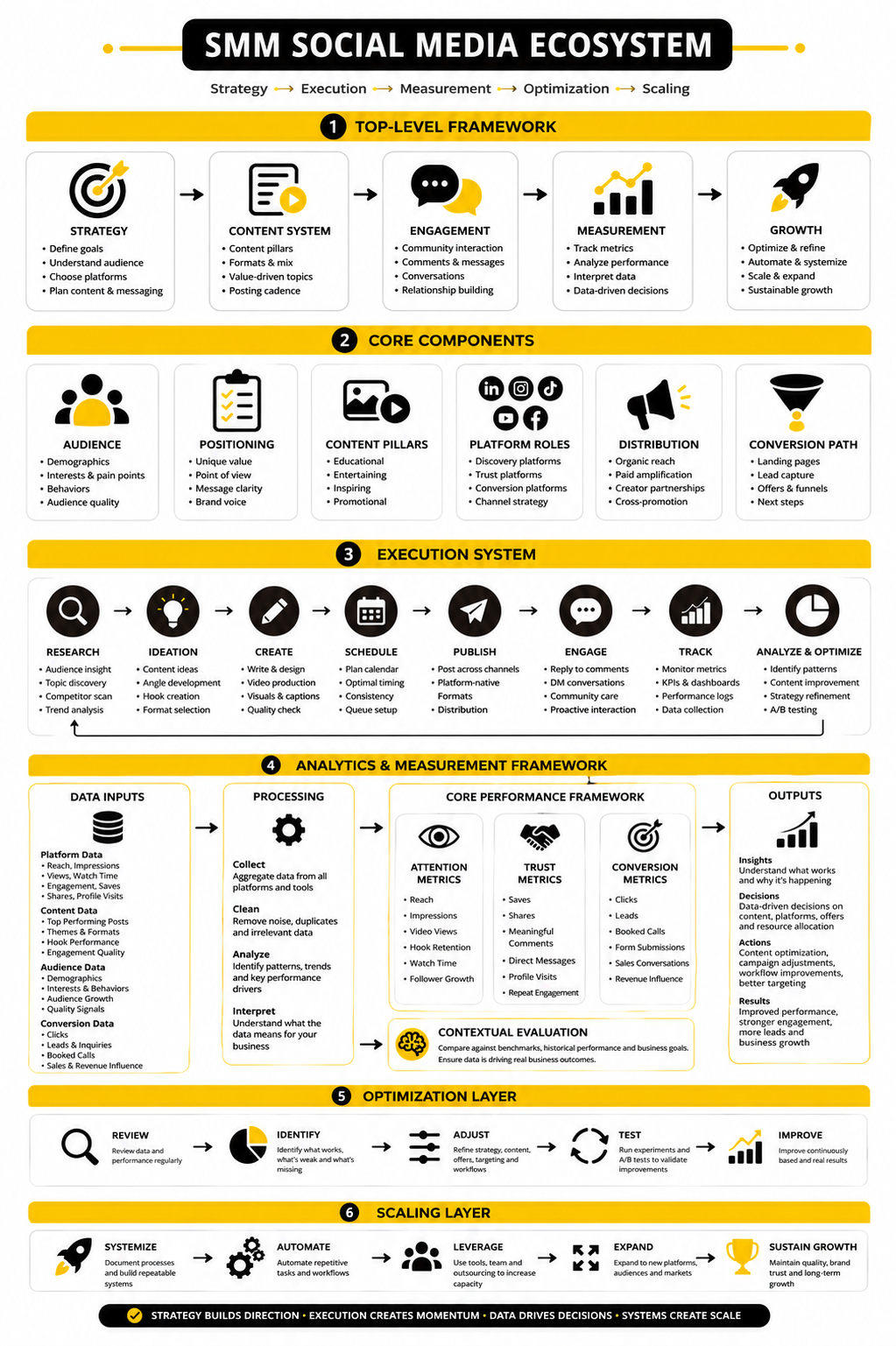
Build The Final SMM Social Media Ecosystem
A complete SMM social media ecosystem connects content, conversations, offers, data, and follow-up. Each part should make the next part easier. Content earns attention, comments and messages reveal intent, landing pages capture demand, email and CRM systems nurture the relationship, and analytics show what to improve.
This ecosystem should not feel complicated to the user. From the outside, it should feel natural: someone discovers useful content, explores the brand, gets a relevant next step, and receives helpful follow-up. Behind the scenes, the team needs enough structure to make that experience reliable.
The practical tool stack depends on your business model. A lean creator or consultant may only need scheduling, forms, email, and a booking page. An agency, local service business, or high-ticket offer may need CRM pipelines, automations, social inboxes, funnels, call tracking, and reporting.
Choosing The Right Tools Without Overbuilding
Tools should support the strategy, not distract from it. Start with the workflow you need, then choose the tool that removes friction. Buying software before the process is clear usually creates a bigger mess with a nicer dashboard.
For publishing and planning, Buffer can help keep social content organized across channels. For direct-message lead capture and conversational automation, ManyChat can support clear trigger-based flows when people comment, reply, or ask for a resource. For service businesses that need CRM, appointment booking, follow-up, pipelines, and automation in one place, GoHighLevel can become the operational backbone.
For conversion paths, the right tool depends on the offer. ClickFunnels can help when you need focused funnel pages. Systeme.io can work for simpler funnels, emails, and digital products. Fillout is useful when the next step is an inquiry, application, quiz, survey, or structured intake form.
Final Optimization Checklist
Before you call the system complete, check the basics honestly. Most performance problems are not mysterious. They usually come from a weak audience definition, unclear positioning, inconsistent execution, poor creative packaging, missing follow-up, or measurement that does not connect to the business.
Use this checklist as a practical final review. It is simple, but it catches the issues that quietly drain social media performance.
What does SMM social media mean?
SMM social media means social media marketing. It is the use of social platforms to build awareness, attract the right audience, create trust, generate demand, and support business goals. In a professional setup, it includes strategy, content, community, paid amplification, analytics, automation, and conversion paths.
Is SMM social media the same as posting on social media?
No, posting is only one part of SMM social media. Posting creates visible activity, but marketing requires a clear audience, message, offer, process, and measurement system. A business can post every day and still have a weak social media strategy if the content does not build trust or move people toward a useful next step.
Which platforms are best for SMM social media?
The best platforms depend on your audience, content strengths, and business model. YouTube can be strong for search-driven education, LinkedIn for B2B authority, Instagram for visual trust and community, TikTok for discovery, and Facebook for groups, local reach, and certain demographics. The right choice is not the most popular platform; it is the platform where your buyers pay attention and your content can compete.
How often should a business post on social media?
A business should post as often as it can maintain quality, consistency, and strategic relevance. Three strong posts per week are usually better than ten weak ones that say nothing useful. The real goal is to create a publishing rhythm that your team can sustain while still reviewing performance and improving the content.
What metrics matter most in SMM social media?
The most useful metrics depend on the goal of the content. Reach, impressions, and views show attention. Saves, shares, comments, direct messages, and profile visits show trust and relevance. Clicks, leads, booked calls, purchases, and pipeline activity show whether the attention is creating business value.
Why do some posts get likes but no leads?
Likes often show light interest, not buying intent. A post may be entertaining, relatable, or easy to react to without making the audience want to take the next step. If posts get likes but no leads, review the audience fit, content topic, call to action, offer clarity, and conversion path.
Should small businesses use automation in SMM social media?
Yes, but only where automation improves the experience. Scheduling, form routing, simple direct-message flows, reminders, email follow-up, and CRM updates can save time. Sensitive replies, brand voice, final approvals, and strategic decisions should stay close to human judgment.
How does paid social fit into SMM social media?
Paid social helps amplify proven messages and reach more of the right people faster. It works best when organic content has already revealed which hooks, topics, and offers get a response. Paid traffic should send people to a clear next step, not a vague homepage that breaks the journey.
What is the biggest mistake brands make with SMM social media?
The biggest mistake is treating social media like a volume game. More posts do not fix unclear positioning, weak creative, poor audience fit, or a missing conversion path. The better move is to build a system where every post has a job and every result teaches the team something useful.
How long does SMM social media take to work?
SMM social media usually takes time because trust, creative learning, and audience signals compound gradually. Some campaigns create fast results, especially with paid support or an existing audience, but most brands should expect to test messages, formats, and offers before the system becomes predictable. The goal is not instant certainty; the goal is steady improvement based on real response.
Do hashtags still matter?
Hashtags can help with categorization and discovery in some contexts, but they are rarely the main driver of performance. Strong hooks, clear topics, useful content, watch time, saves, shares, comments, and platform-native formatting matter more. Use hashtags when they help the platform and audience understand the content, but do not rely on them to rescue weak ideas.
Can AI create a full SMM social media strategy?
AI can help with research, ideation, repurposing, drafts, reporting summaries, and workflow speed. It should not fully own the strategy because strategy requires market judgment, customer insight, positioning, proof, and brand taste. The best setup is human-led and AI-assisted.
What should a beginner focus on first?
A beginner should focus on audience clarity, one or two platforms, consistent content pillars, and a simple next step. Trying to master every platform, format, and tool at once creates unnecessary complexity. Build one clean system first, then expand after you see real signals.
How do you know when your SMM social media strategy is working?
You know it is working when the right people start responding in useful ways. That may show up as better comments, more saves and shares, qualified profile visits, direct messages, email signups, booked calls, sales conversations, or revenue influence. The strongest signal is not one viral post; it is repeatable traction from the audience you actually want.
Build a stronger local presence with BAAM AI
Turn your website, Google profile, social channels, and AI visibility into one growth engine
Most businesses do not need more random marketing activity. They need a consistent presence system that helps the right people find them, trust them, and take action. BAAM AI brings strategy, local SEO, website updates, Google Maps visibility, social content, AI-search readiness, media production, and reporting into one practical monthly engine.
If you want your marketing to keep working after the campaign ends, start with a free BAAM AI presence audit. See how your business shows up today and where the fastest visibility wins are at BAAM AI.