
BAAM AI Blog
Small Business Marketing Plan: A Practical Framework for Growth
A small business marketing plan is not a pretty document you create once and forget. It is the operating system for how your business attracts the right people, earns trust, turns attention into leads, and converts...
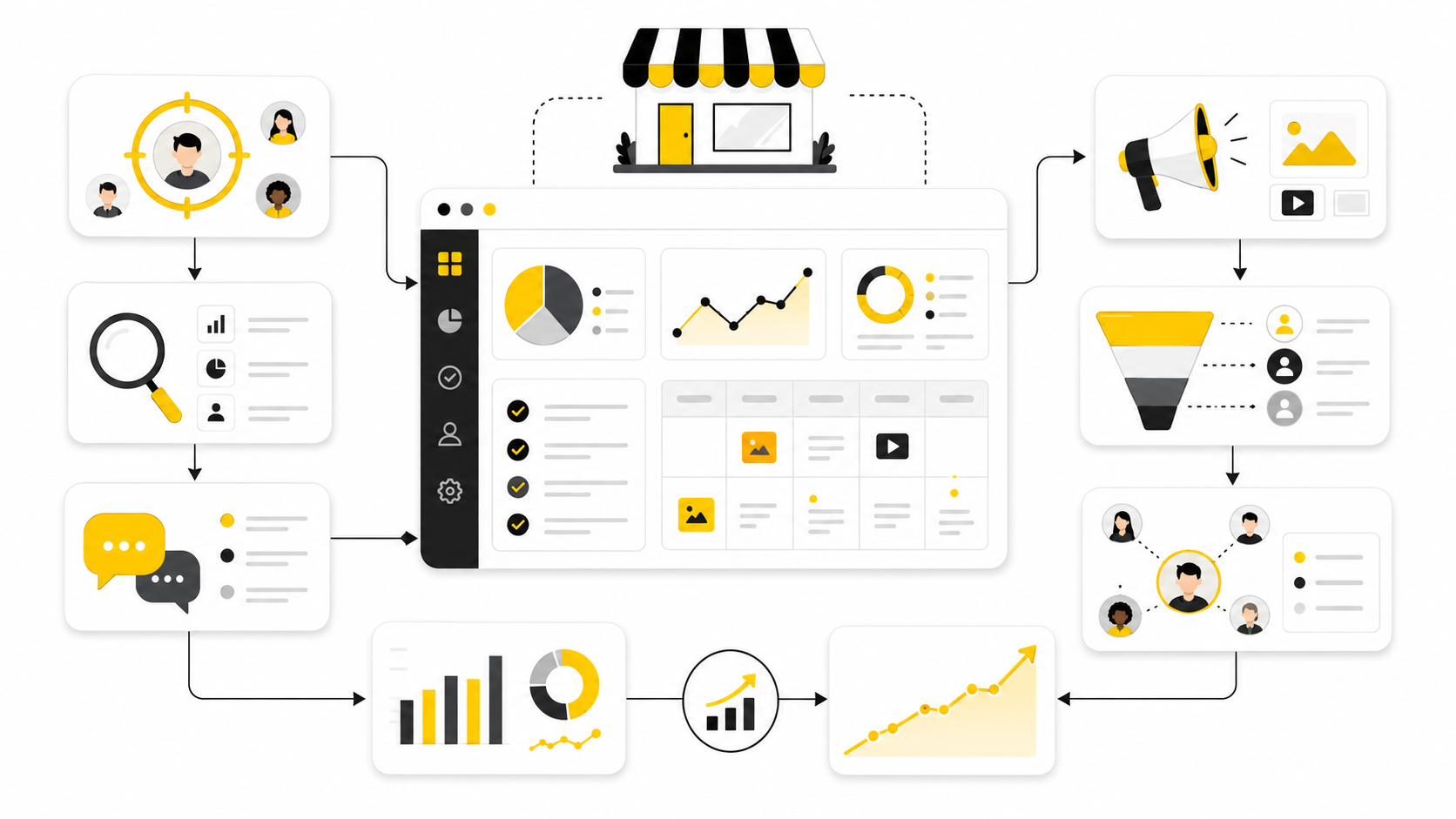
A small business marketing plan is not a pretty document you create once and forget. It is the operating system for how your business attracts the right people, earns trust, turns attention into leads, and converts those leads into revenue. Without one, marketing becomes a pile of disconnected posts, emails, offers, ads, and “we should try this” ideas that are hard to measure and even harder to improve.
That matters because small businesses usually do not have unlimited time, budget, or staff. Many owners are still doing sales, operations, customer service, and delivery themselves, so every marketing decision has to earn its place. The businesses that grow more predictably are usually not the ones doing the most marketing; they are the ones working from a clear plan.
A strong small business marketing plan answers four simple questions. Who are we trying to reach? Why should they choose us? How will we reach them consistently? How will we know whether it is working? Once those answers are clear, marketing becomes less emotional, less random, and much easier to manage.
this guide is split into six connected parts so the strategy builds in the right order. Part 1 sets the foundation and gives you the full framework. The next parts go deeper into each section so you can turn the plan into something your business can actually use.
Why a Small Business Marketing Plan Matters
Marketing feels expensive when there is no plan behind it. You can spend money on ads, tools, content, email software, freelancers, and social media without knowing which part of the customer journey each piece is supposed to support. That is where small businesses get stuck: not because they are lazy, but because effort is being scattered instead of directed.
The need for structure is not theoretical. The U.S. Small Business Administration treats a marketing plan as a practical document for defining customers, competitors, pricing, promotion, and sales strategy, and its own marketing plan example is built around those decisions. That is the right way to think about it: not as “branding homework,” but as a decision-making tool.
The pressure is also getting higher. Small businesses are competing in markets where customers research quickly, compare alternatives instantly, and expect a consistent experience across search, social, email, messaging, reviews, and the sales process. Salesforce’s small business research highlights the gap clearly: 65% of customers expect companies to adapt to their changing needs and preferences, while many still feel treated like a number.
A small business marketing plan helps close that gap. It turns customer understanding into positioning, positioning into offers, offers into campaigns, and campaigns into measurable results. That is the difference between “doing marketing” and building a marketing system.
The Small Business Marketing Plan Framework
A useful plan should be simple enough to follow and detailed enough to guide real decisions. Most small businesses do not need a 70-page strategy deck. They need a clear framework that connects the market, message, channels, budget, execution, and measurement.
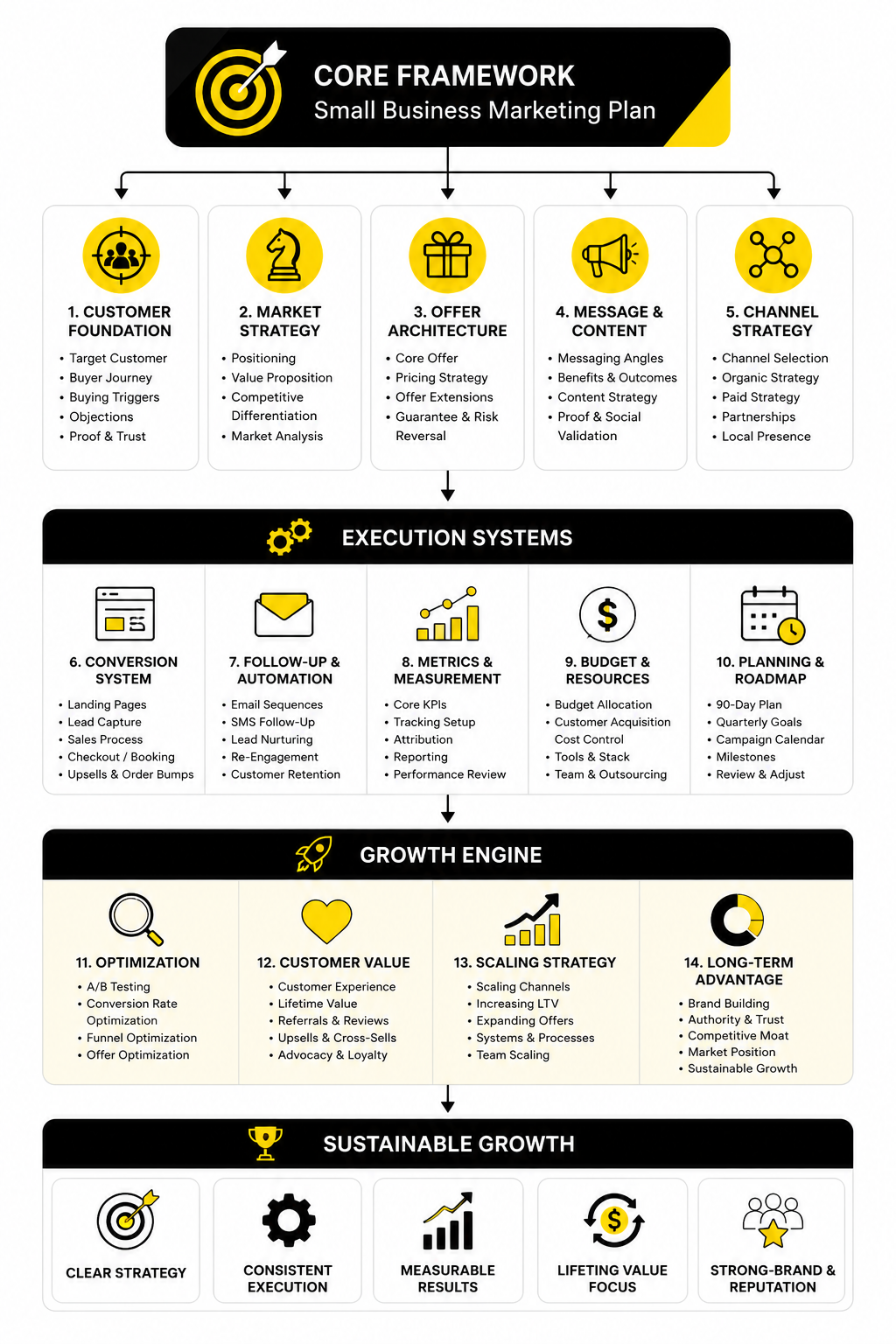
This order matters. You should not choose channels before you understand the customer. You should not write ads before you know the offer. You should not scale campaigns before you know what the numbers are telling you.
Core Components of a Small Business Marketing Plan
The first core component is positioning. This defines where your business fits in the market, who it is best for, and why someone should choose you instead of another option. Good positioning makes every later decision easier because it gives your marketing a point of view.
The second component is customer research. This includes the customer’s problems, buying triggers, objections, decision criteria, and preferred channels. It also includes what they already believe before they find you, because your marketing has to meet them where they are, not where you wish they were.
The third component is your offer and message. Your offer is the thing you want people to act on, while your message explains why that action makes sense now. A weak offer makes marketing work harder than it should, even when the channel is good.
The fourth component is channel strategy. This is where you decide whether search, email, social media, local partnerships, paid ads, referrals, events, direct outreach, or automation should carry the weight. The goal is not to be everywhere; the goal is to show up consistently where your buyers already pay attention.
The fifth component is measurement. Marketing without tracking turns every decision into a debate. Marketing with tracking gives you a calmer way to improve because you can see what is attracting attention, generating leads, creating sales opportunities, and producing revenue.
Professional Implementation Starts With Focus
Professional implementation does not mean making everything complicated. It means building the plan in a way that a real team, even a tiny one, can actually execute. For most small businesses, that means fewer priorities, tighter messaging, cleaner follow-up, and a simple rhythm for reviewing results.
This is where tools can help, but only after the strategy is clear. A CRM and automation platform such as GoHighLevel can support lead capture, follow-up, pipeline management, and campaign workflows, but it cannot fix unclear positioning or a weak offer. The tool should serve the plan, not replace it.
The same principle applies to social scheduling, email marketing, landing pages, chat, forms, and reporting. Software can save time and improve consistency, but the business still needs to know what it is saying, who it is saying it to, and what action it wants next. That is why this guide starts with strategy before moving into campaigns and implementation.
Part 2 begins with the foundation most small businesses rush past too quickly: market positioning and customer research. That is where the plan stops being generic and starts becoming specific to your business, your customers, and your path to growth.
Market Positioning Comes Before Promotion
Before you choose channels, build campaigns, or write content, you need to know where your business sits in the market. Positioning is the clear answer to one uncomfortable question: why should a specific type of customer choose you instead of another option? If that answer is vague, the rest of the small business marketing plan becomes harder than it needs to be.
Strong positioning is not just a slogan. It connects your audience, category, difference, proof, and offer into one practical direction. A local accounting firm, a boutique fitness studio, a home services company, and a B2B consultant can all use the same marketing channels, but they should not sound the same or compete on the same promise.
This is where many small businesses accidentally weaken their own marketing. They try to appeal to everyone because they do not want to miss opportunities. In reality, broad positioning usually creates bland messaging, and bland messaging makes customers work too hard to understand why the business is relevant.
Define the Customer You Actually Want
A useful small business marketing plan does not start with “people who need our product.” That is too wide. It starts with the customers who are most likely to buy, easiest to serve well, profitable enough to support the business, and aligned with where the company wants to grow.
You can define that customer using simple but specific filters. For consumers, that might include location, life stage, urgency, budget, buying motivation, and common objections. For business buyers, it might include industry, company size, role, current workflow, pain level, decision process, and budget ownership.
The goal is not to create a cute persona with a fake name and stock-photo personality. The goal is to make better decisions. When you know who the plan is built for, you can choose sharper offers, write clearer messages, and avoid wasting time on audiences that look busy but rarely convert.
Study the Problem From the Customer’s Side
Most businesses describe their offer from the inside out. They talk about features, services, credentials, tools, packages, and years of experience. Customers usually enter the conversation from the opposite direction: they have a problem, frustration, deadline, risk, desire, or decision they need to make.
That difference matters. A customer searching for help may not use the same language your business uses internally. Google’s guidance on helpful content emphasizes creating content for people first, which means the planning process should start with the real questions, needs, and expectations customers bring into the buying journey through people-first content principles.
Good customer research looks for patterns in what people already say. Review customer emails, sales calls, reviews, support conversations, search queries, consultation notes, and social comments. You are looking for repeated phrases, repeated hesitations, repeated outcomes, and repeated moments where people finally decide they need help.
Research the Buying Journey, Not Just the Audience
Knowing who your customer is helps, but knowing how they buy is even more useful. A small business marketing plan should map the steps someone takes before they become a lead or customer. That includes what triggers the search, what alternatives they compare, what proof they need, and what could stop them from moving forward.
For local businesses, that journey often includes search, maps, reviews, websites, photos, pricing signals, calls, messages, and referrals. BrightLocal’s consumer review research shows that most consumers read online reviews for local businesses, which means reputation is not a separate marketing activity. It is part of the decision path.
For service businesses and B2B companies, the journey may involve more education before contact. Buyers may compare methods, read guides, ask peers, check LinkedIn, review case studies, and look for signs that the business understands their specific situation. Your plan should reflect that journey instead of assuming every prospect is ready to buy the first time they see your offer.
Analyze Competitors Without Copying Them
Competitor research is not about copying what everyone else is doing. That is how small businesses end up with identical websites, identical social posts, and identical claims. The point is to understand what customers are already seeing so you can decide where to match expectations and where to stand apart.
Start by reviewing competitors across the channels where buyers actually compare options. Look at their websites, Google Business Profiles, reviews, offers, pricing signals, ads, landing pages, email opt-ins, social content, and sales process when visible. Pay attention to what they emphasize, what they ignore, and what customers praise or complain about.
Then look for gaps you can credibly own. Maybe competitors are fast but impersonal. Maybe they are premium but unclear. Maybe they have strong reviews but weak follow-up. Positioning gets stronger when it is based on a real market gap, not a random adjective like “better,” “trusted,” or “innovative.”
Build a Clear Positioning Statement
Once the research is done, turn it into a simple positioning statement your business can actually use. This is not necessarily public copy. It is an internal sentence that keeps the team aligned when creating offers, campaigns, content, and sales conversations.
A practical format looks like this:
This statement should be plain, not clever. If your team cannot understand it quickly, customers probably will not understand the public-facing version either. Clarity wins here because the rest of the marketing plan depends on it.
Turn Research Into Message Angles
Customer research becomes useful when it changes what you say. After reviewing search behavior, reviews, sales conversations, objections, and competitor claims, you should be able to create a small set of message angles. These are the themes your marketing will return to again and again.
A message angle might focus on speed, risk reduction, convenience, expertise, local trust, affordability, premium outcomes, simplicity, customization, or long-term support. The right angle depends on what the customer values and what the business can honestly deliver. Do not choose an angle just because it sounds good; choose it because it matches the market.
This is also where proof becomes important. If you claim convenience, show what makes the process easier. If you claim expertise, explain the method. If you claim better outcomes, support that with real reviews, customer results, certifications, process details, or transparent standards.
Collect Better Customer Inputs
Small businesses often have more research available than they think. The problem is that it is scattered across inboxes, call notes, social comments, reviews, contact forms, and conversations that never get documented. A good plan turns those inputs into something reusable.
Simple tools can help here. A form builder like Fillout can be useful for post-purchase surveys, consultation forms, lead qualification, and customer feedback collection. The point is not to over-survey people; the point is to capture the information that helps you improve marketing and sales decisions.
Keep the questions direct. Ask what problem brought them in, what alternatives they considered, what almost stopped them, why they chose you, and what outcome mattered most. Those answers are often more valuable than generic demographic data because they reveal the actual decision logic behind the purchase.
Create the Research Foundation for the Rest of the Plan
By the end of this stage, your small business marketing plan should have a clear market position and a grounded understanding of the customer. You should know who the plan is for, what problem they care about, how they compare options, what proof they need, and how your business can stand apart. That foundation keeps the rest of the plan from becoming guesswork.
The next step is to turn that foundation into offers and messaging. This is where the plan becomes more visible to the market. Your research tells you what customers care about; your offer and message decide how you present the solution in a way that earns action.
Turn Research Into a Strong Offer
Once the market position and customer research are clear, the next job is to turn that insight into an offer people can understand quickly. An offer is not just the product or service you sell. It is the packaged reason someone should take action now instead of delaying, comparing forever, or choosing the cheaper option.
A strong offer usually combines the outcome, the method, the scope, the timeline, the risk reversal, and the next step. That does not mean every offer needs a discount or a dramatic guarantee. It means the customer should be able to look at it and immediately understand what they get, why it matters, and what happens after they respond.
This is where many small businesses make marketing harder than it needs to be. They promote a service category instead of a clear next step. “We do marketing,” “we offer bookkeeping,” or “we provide home renovation services” is not enough because it forces the customer to figure out the value on their own.
Build Offers Around Buying Intent
Not every customer is ready to buy today, so your small business marketing plan should include offers for different levels of intent. Someone who is just becoming aware of a problem needs a different next step than someone comparing providers. If you push the same sales message to every stage, you will either feel too aggressive or too vague.
A simple structure works best. Use educational offers for early-stage buyers, diagnostic offers for people trying to understand their situation, and direct conversion offers for prospects who are ready to talk or purchase. This keeps your marketing useful without turning every message into a hard pitch.
For example, a service business might use a checklist, calculator, guide, or short consultation as the first step. A local business might use a booking page, quote request, limited-time package, or new customer offer. An ecommerce business might use a bundle, quiz, comparison page, or email sequence to help people choose the right product.
Clarify the Message Before Choosing More Channels
Messaging is the bridge between your research and your campaigns. It turns what you know about the customer into words they can recognize, trust, and act on. If the message is unclear, adding more channels usually just spreads the confusion faster.
A good message should make the customer feel understood before it tries to persuade them. It should name the problem in plain language, explain the cost of leaving it unsolved, show the desired outcome, and make the next step feel reasonable. The best small business messaging is not flashy; it is specific.
Your message also needs proof. Proof can come from reviews, before-and-after context, process details, credentials, guarantees, transparent pricing, customer outcomes, response speed, or a clear explanation of how the service works. Without proof, even a good promise can feel like another marketing claim.
Create a Practical Messaging System
Do not try to write every piece of copy from scratch. That is slow, inconsistent, and exhausting. Instead, build a small messaging system that gives you reusable language for your website, landing pages, emails, ads, social posts, sales conversations, and follow-up sequences.
The system should include your main promise, your strongest customer pain points, your proof points, your objections, your differentiators, and your calls to action. Once those pieces are clear, content becomes easier to produce because you are not inventing the strategy every time. You are adapting the same core message to different formats.
This also keeps your small business marketing plan consistent. A customer might first see a social post, then check your website, then read reviews, then submit a form, then receive a follow-up email. If each touchpoint sounds like it came from a different business, trust drops.
Choose Channels Based on the Customer Journey
Channel strategy should follow the customer, not your personal preference. Some businesses need local search and reviews because buyers are actively looking for a nearby provider. Others need email, webinars, outbound, content, or paid ads because the buying journey requires education before action.
Start with the places where demand already exists. Search, Google Business Profile, directories, reviews, referrals, comparison pages, and marketplace platforms often capture people who are already looking for a solution. These channels are powerful because the customer has intent before they find you.
Then add channels that create or nurture demand. Social media, email newsletters, short-form video, partnerships, community events, lead magnets, and retargeting can keep your business visible before the customer is ready to buy. The goal is not to do everything at once; the goal is to choose the few channels that match how your best customers actually make decisions.
Map the Execution Process
This is where the plan becomes tangible. You have the customer, the position, the offer, the message, and the channels. Now you need a repeatable process that turns those decisions into weekly action.
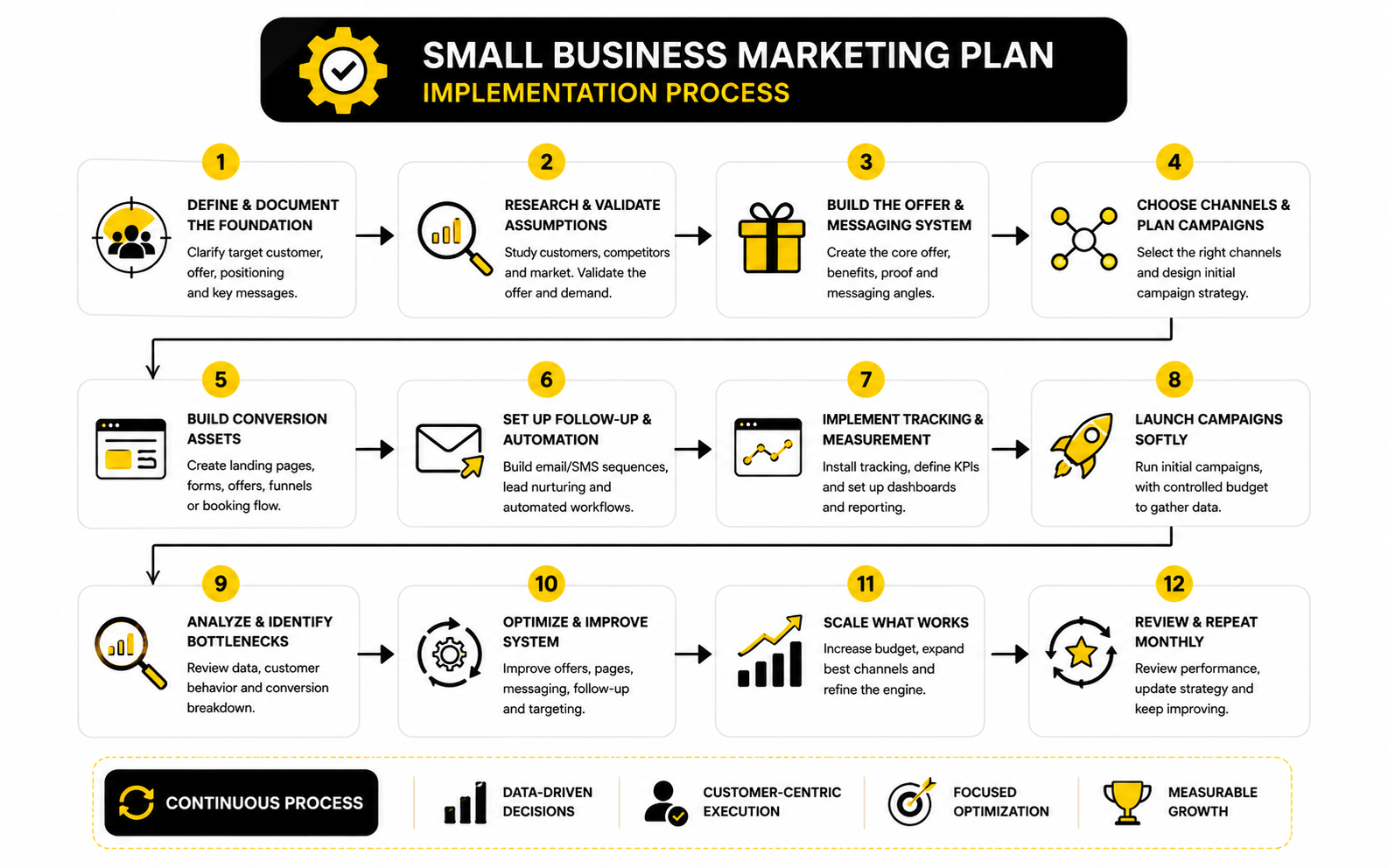
A simple execution process can look like this:
This process keeps implementation from becoming chaotic. You are not just posting, emailing, advertising, and hoping something works. You are building a path from attention to action, then improving that path with evidence.
Build the Path From Click to Customer
The biggest mistake in implementation is treating the campaign as the whole system. A campaign creates attention, but the follow-up path creates revenue. If someone clicks, visits, calls, messages, or submits a form, the next steps need to be fast, clear, and easy.
That path might include a landing page, a short form, a calendar booking page, a confirmation message, an email sequence, a text reminder, a sales call, a proposal, and a follow-up workflow. For small teams, automation can help prevent leads from slipping through the cracks. A platform like GoHighLevel can be useful here because it connects funnels, CRM, messaging, automation, calendars, and pipeline tracking in one place.
The important part is not the software itself. The important part is that every lead has a next step. When someone raises their hand, your business should know what happens immediately, what happens later that day, and what happens if they do not respond.
Match Tools to the Marketing System
Tools should support the plan, not distract from it. A small business does not need a huge tech stack just to look sophisticated. It needs the minimum set of tools that helps capture leads, communicate clearly, follow up consistently, publish content, and measure results.
For landing pages and funnels, ClickFunnels can fit businesses that want a direct path from offer to conversion. For simpler funnel and email needs, Systeme.io can work well when the business wants to keep the setup lean. For social scheduling, Buffer can help maintain consistency without forcing the owner to post manually every day.
For messaging-based lead capture, ManyChat can support automated conversations across social and chat channels. For email marketing, Brevo or Moosend can support newsletters, campaigns, and automated sequences. Pick tools based on the workflow you need, not based on whatever looks exciting this week.
Create Campaigns With One Primary Job
Every campaign needs one primary job. It might generate calls, book consultations, collect emails, sell a product, drive repeat purchases, win reviews, reactivate old leads, or promote a seasonal offer. When a campaign tries to do five things at once, performance becomes harder to understand.
This is why the offer, message, channel, and follow-up path should be connected before launch. A campaign promoting a consultation should lead to a booking flow, not a generic homepage. A campaign promoting a guide should lead to a simple opt-in and a useful nurture sequence, not an immediate sales pitch that feels disconnected.
Keep the first version focused. Launch with one audience, one offer, one main message, one conversion path, and one success metric. After that, you can test variations instead of guessing what went wrong.
Use Follow-Up as a Competitive Advantage
Many small businesses lose leads because follow-up is too slow, too generic, or too inconsistent. The customer shows interest, then nothing meaningful happens. By the time the business replies properly, the prospect has already found another option or lost momentum.
Follow-up should be planned before the campaign goes live. Decide what the lead receives immediately, what happens if they do not book, what happens after a call, and what happens if they say “not now.” This is not about annoying people; it is about making the buying process easier for someone who already showed interest.
The best follow-up feels helpful and timely. It answers questions, reduces uncertainty, reminds the customer why they cared, and gives them a clear next step. In a small business marketing plan, follow-up is not admin work. It is part of the revenue system.
Prepare the Plan for Budget and Campaign Planning
At this stage, the strategy has moved from research into implementation. You know who the business is targeting, how it is positioned, what offer it will lead with, what message it will use, which channels matter most, and how leads should move through the system. That is a real foundation.
The next part turns that foundation into budget, campaign planning, and content systems. This is where the plan becomes more disciplined. Instead of asking “what should we post this week?” or “should we run ads?” the business can decide what deserves time, money, and attention based on the role each activity plays in growth.
Budget and Campaign Planning Need Numbers
A small business marketing plan becomes much stronger when the budget is tied to specific goals instead of vague ambition. “We should do more marketing” is not a plan. “We need 40 qualified leads per month at a target cost per lead of $80 or less” is a plan you can actually manage.
Budget planning should start with revenue targets, average order value, gross margin, close rate, and customer lifetime value. If you know those numbers, you can work backward into how many leads, calls, bookings, purchases, or repeat orders the business needs. If you do not know those numbers yet, the first job is to start tracking them before making big spending decisions.
This is why measurement belongs inside the plan, not after it. The data tells you whether the business needs more traffic, a better offer, stronger follow-up, a higher close rate, or a different channel mix. Without that visibility, budget decisions become emotional, and emotional marketing budgets usually get cut the moment results feel uncertain.
Statistics and Data
The point of marketing data is not to collect impressive-looking numbers. The point is to make better decisions. A small business owner does not need 40 dashboards; they need a small set of metrics that show whether attention is turning into revenue.
Marketing budgets also need context. Gartner’s 2025 CMO Spend Survey found that marketing budgets stayed flat at 7.7% of company revenue, which is useful as a reference point, not a rule. A new business may need to invest more aggressively to build awareness, while a mature referral-driven business may need less paid acquisition and more retention work.
Email, search, local visibility, and reviews continue to matter because they support different parts of the customer journey. BrightLocal’s 2025 local review research shows that consumers still use reviews heavily when evaluating local businesses through local consumer review behavior. HubSpot’s 2026 marketing data also shows that marketers continue to rank content formats such as blogs among high-ROI activities through current marketing statistics and trends, but the real takeaway is not “write blogs.” The takeaway is that useful content can compound when it answers real buyer questions and connects to a conversion path.
Email benchmarks should be interpreted carefully too. HubSpot’s 2025 email benchmark data places average open rates across industries at 42.35%, but an open rate alone does not prove revenue impact. A smaller list with high intent and strong follow-up can outperform a large list that rarely clicks, replies, books, or buys.
Track the Metrics That Match the Funnel
The cleanest way to measure a small business marketing plan is to separate metrics by funnel stage. Top-of-funnel metrics show whether people are noticing you. Middle-of-funnel metrics show whether they are engaging and considering you. Bottom-of-funnel metrics show whether marketing is creating sales opportunities and revenue.
At the top of the funnel, track impressions, reach, website sessions, search visibility, profile views, and content engagement. These numbers matter because they show whether the business is getting enough attention in the right places. But they should not be treated as success by themselves because attention without movement is just noise.
In the middle of the funnel, track email signups, form submissions, message starts, guide downloads, pricing page visits, repeat website visits, review reads, and consultation page views. These signals show that people are moving from casual awareness into active consideration. This is where many businesses discover that traffic is not the real problem; the problem is that the offer or page does not give people a clear reason to take the next step.
At the bottom of the funnel, track booked calls, quote requests, purchases, qualified leads, show-up rate, close rate, average deal size, cost per acquisition, and revenue by channel. These are the numbers that decide whether the plan is working commercially. They also show where the real bottleneck is, which is much more useful than guessing.
Build a Simple Analytics System
A good analytics system should make the business calmer, not more confused. It should show what is happening, where leads are coming from, what they do next, and which campaigns create actual opportunities. For most small businesses, that means combining website analytics, CRM data, call tracking, booking data, email performance, ad reporting, and sales outcomes into one practical review process.
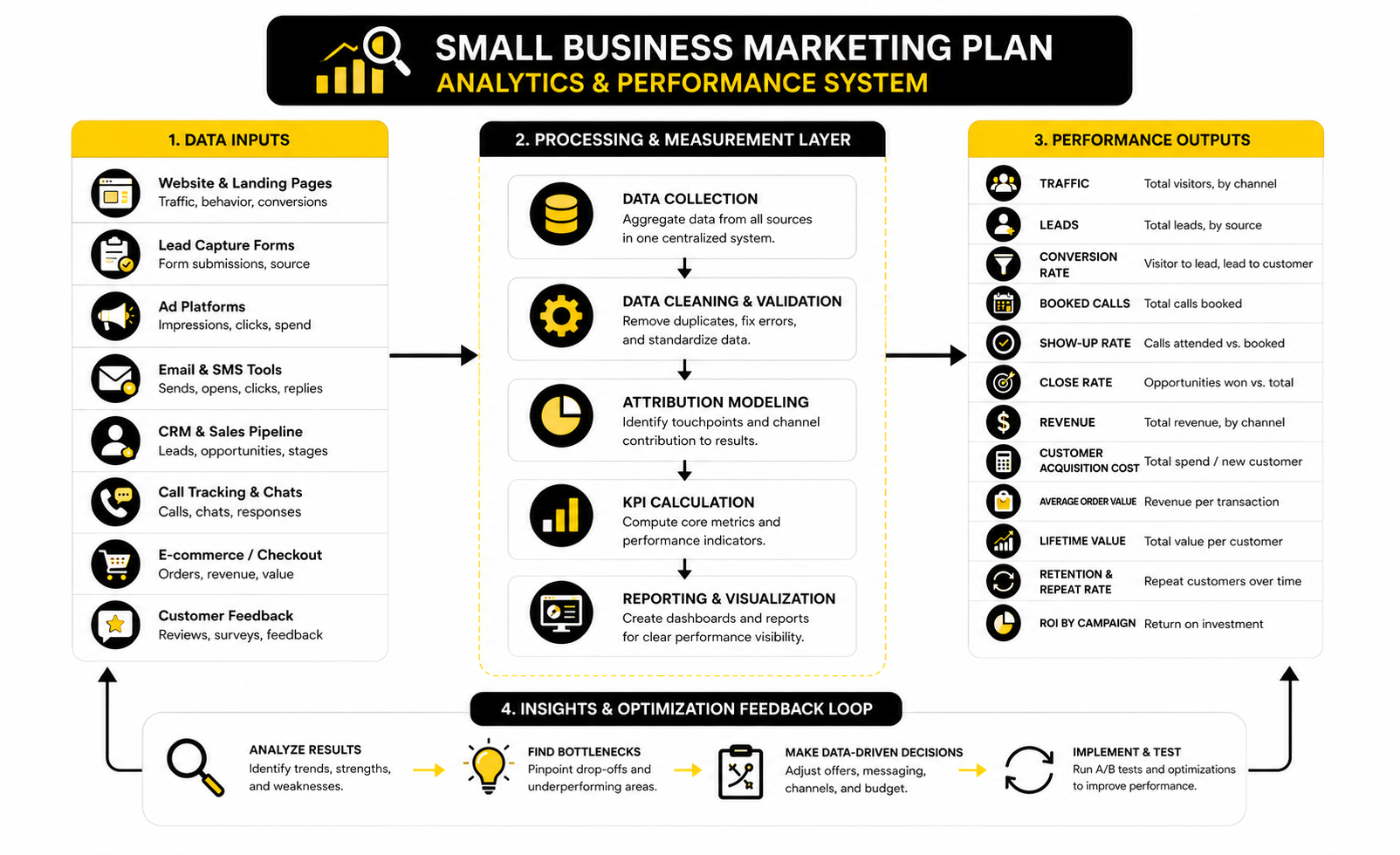
Start with five core questions:
These questions keep measurement connected to action. If a channel creates lots of leads but few customers, you may have a qualification problem. If a campaign creates clicks but no leads, you may have a landing page or offer problem. If leads come in but disappear, you probably have a follow-up problem.
A CRM can make this easier because it connects marketing activity to pipeline stages instead of leaving everything trapped in separate tools. For small businesses that want automation, lead tracking, calendars, pipelines, and follow-up in one system, GoHighLevel can support that workflow. The tool matters less than the discipline: every lead should have a source, a stage, an owner, and a next action.
Understand What Benchmarks Can and Cannot Tell You
Benchmarks are useful for orientation, but they can also become a trap. A benchmark can tell you whether your numbers are wildly outside a normal range. It cannot tell you whether your offer is strong, whether your audience is right, or whether your sales process is doing its job.
For example, a low email click rate might mean the subject line was weak, but it might also mean the audience was wrong, the offer was unclear, or the email was sent at the wrong point in the buying journey. A high social engagement rate might look good, but if it does not create leads, bookings, sales, or retention, it may not deserve more budget. Context always matters.
Use benchmarks as a starting point, then compare against your own trendline. Your most important question is not “Are we above the industry average?” It is “Are we improving the numbers that matter for this business?”
Diagnose Performance by Bottleneck
When performance is weak, do not change everything at once. That is one of the fastest ways to lose the lesson. A better approach is to identify the bottleneck and improve one part of the system at a time.
If reach is low, the business may need better distribution, more consistent publishing, stronger local visibility, partnerships, SEO, or paid traffic. If clicks are low, the message may not be specific enough or the audience may not care about the angle. If leads are low, the offer, page, form, or call to action probably needs work.
If leads are coming in but sales are not, the issue may be qualification, speed-to-lead, sales follow-up, pricing, proof, or trust. This distinction is critical. A business with a sales conversion problem should not automatically spend more on ads, because more traffic will only create more leakage.
Measure Content by Its Job
Content should not all be judged by the same metric. A how-to article, a customer story, a short social post, a comparison page, a pricing page, and an email sequence all play different roles. If you measure them the same way, you will misunderstand what is working.
Educational content should be measured by qualified traffic, engagement, email signups, assisted conversions, and repeat visits. Conversion content should be measured by form submissions, bookings, purchases, quote requests, and sales conversations. Retention content should be measured by repeat purchases, referrals, upgrades, reviews, and customer engagement.
This is especially important for small teams. You do not have time to produce content just to fill a calendar. Every content asset should support awareness, trust, conversion, retention, or reactivation.
Review Results on a Practical Rhythm
A small business marketing plan needs a review rhythm that is frequent enough to catch problems but not so frantic that every small fluctuation causes panic. Weekly reviews are useful for campaign health, lead flow, follow-up, and obvious issues. Monthly reviews are better for trends, budget allocation, channel performance, and message improvements.
The weekly review should be simple. Look at leads, bookings, sales activity, campaign spend, urgent follow-up gaps, and anything that clearly broke. This keeps the business responsive without overanalyzing every metric.
The monthly review should ask deeper questions. Which channels produced qualified opportunities? Which offers converted best? Which messages created the strongest response? Which activities should be increased, paused, simplified, or improved next month?
Turn Data Into Action
Data only matters if it changes behavior. If the numbers show that a landing page gets traffic but no leads, improve the page or the offer. If reviews influence buyer confidence, build a review request process instead of hoping happy customers remember to leave one.
If email engagement is strong but sales are weak, add clearer calls to action, better segmentation, or stronger follow-up sequences. An email platform like Brevo or Moosend can support that work when the business needs newsletters, automations, and campaign tracking. The key is to use the data to improve the sequence, not just admire the dashboard.
The same rule applies to social media. If scheduled posts keep the business visible but do not create action, review the message, offer, and conversion path before blaming the platform. A scheduling tool like Buffer can help with consistency, but consistency only compounds when the content is connected to a clear business goal.
Prepare for Optimization and Professional Implementation
By this point, the small business marketing plan has moved from strategy into measurable execution. The business has a target customer, a clear position, a working offer, a channel strategy, a follow-up path, and a way to read performance. That gives the next stage something solid to improve.
The next part focuses on optimization and professional implementation. This is where the plan becomes more efficient over time. Instead of constantly chasing new tactics, the business starts tightening what already exists: better offers, cleaner funnels, faster follow-up, stronger reporting, and more carefully decisions from the data.
Optimize Before You Scale
Scaling a small business marketing plan too early is expensive. If the offer is unclear, the follow-up is slow, the landing page is weak, or the close rate is poor, more traffic will only magnify the problem. Growth should come after the core system is working, not before.
Optimization starts with the parts closest to revenue. Improve the offer before increasing ad spend. Improve the booking flow before chasing more clicks. Improve speed-to-lead before blaming the channel. These changes are not glamorous, but they usually create more leverage than adding another platform or campaign.
The goal is to make each stage of the system stronger before pushing more volume through it. When the business can turn attention into qualified leads, qualified leads into real conversations, and real conversations into profitable customers, scaling becomes much safer. Until then, the smartest move is usually refinement.
Know the Tradeoff Between Simplicity and Sophistication
A simple marketing system is easier to execute, but it can eventually limit growth. A sophisticated system can create better segmentation, automation, personalization, and reporting, but it can also become too heavy for the team running it. The right choice depends on the business stage, budget, staff, sales cycle, and operational capacity.
For an early-stage or owner-led business, simplicity usually wins. One strong offer, one primary audience, one or two reliable channels, and one clear follow-up path is enough to create momentum. Adding too many campaigns too early creates complexity without enough data to justify it.
As the business grows, more sophistication starts to make sense. You may need separate campaigns for different customer segments, different lifecycle stages, different locations, or different service lines. The key is to add complexity only when it solves a real constraint, not because the plan looks more professional with more moving parts.
Protect the Brand While Chasing Performance
Performance marketing can create fast feedback, but it can also push a business into short-term thinking. Discounts, urgency, aggressive retargeting, overpromising, and constant promotional messaging may lift response in the moment while weakening trust over time. That tradeoff matters, especially for businesses that rely on referrals, reviews, repeat customers, or local reputation.
A strong small business marketing plan balances direct response with brand trust. Direct response asks for action now. Brand trust makes that action feel safe, credible, and aligned with the customer’s expectations. You need both.
This is why every campaign should still sound like the business. Do not let ad copy, AI-generated content, or funnel templates pull the brand into a voice that feels fake. Customers can feel the gap when the marketing sounds polished but the actual business experience feels different.
Use AI Carefully, Not Lazily
AI can help small businesses move faster, especially with research, content drafts, campaign variations, customer support, and workflow automation. HubSpot’s 2025 AI marketing research is based on input from more than 1,500 marketers worldwide, which reflects how mainstream AI has become in marketing teams. The practical takeaway is simple: AI is no longer a novelty, but it still needs direction.
The risk is using AI to produce more average work instead of better work. More posts, more emails, more landing pages, and more ads do not automatically improve the plan. If the strategy is weak, AI just helps you publish weak marketing faster.
Use AI for leverage, not replacement. Let it help organize customer research, draft variations, summarize sales notes, create content outlines, identify objections, and speed up repetitive work. But keep human judgment in charge of positioning, promises, proof, tone, and final decisions.
Personalization Has to Be Earned
Customers increasingly expect businesses to understand their needs, but personalization can easily become creepy, shallow, or operationally messy. McKinsey’s personalization research notes that 71% of consumers expect personalized interactions, which creates a real opportunity for small businesses that can use customer context well. The opportunity is not to fake intimacy; it is to make the experience more relevant.
Good personalization can be simple. Send different follow-up emails based on what someone requested. Route leads differently based on service type. Show different offers to new customers, repeat customers, and inactive customers. Use past behavior to make the next step easier.
Bad personalization feels like a trick. It uses data without adding value, or it over-segments before the business has enough traffic, content, or operational support. Keep it useful, transparent, and manageable.
Build Systems Around Retention, Not Just Acquisition
A small business marketing plan should not stop when someone becomes a customer. Acquisition gets most of the attention because it feels like growth, but retention often creates the profit. Repeat purchases, referrals, reviews, renewals, upgrades, and customer education can make the entire marketing system more efficient.
Retention requires a different rhythm than acquisition. It is less about convincing strangers and more about continuing the relationship after the first transaction. That can include onboarding emails, post-service check-ins, review requests, maintenance reminders, loyalty offers, referral prompts, useful education, or periodic reactivation campaigns.
This is where many small businesses leave money on the table. They work hard to win a customer, deliver the service, then disappear until they need another sale. A professional marketing plan keeps the relationship warm without being pushy.
Make Sales and Marketing Work Together
Marketing creates opportunities, but sales usually turns those opportunities into revenue. If the two sides are disconnected, performance data becomes misleading. A campaign can look weak because the sales follow-up is poor, or a sales process can look weak because the marketing is attracting the wrong people.
The handoff needs to be clear. Sales should know where the lead came from, what offer they responded to, what problem they mentioned, and what next step was promised. Marketing should know which leads are qualified, which objections appear most often, which offers convert, and which customer segments are most profitable.
A CRM such as Copper can help service businesses keep customer relationships, opportunities, and follow-up organized. For businesses that want the CRM connected more tightly with campaigns, automations, forms, calendars, and pipeline stages, GoHighLevel can be a stronger all-in-one option. The system matters because dropped context creates dropped revenue.
Decide What Not to Do
Strategy is not just choosing priorities. It is also choosing what to ignore. A small business with limited time cannot run every channel, test every offer, attend every event, build every funnel, and post on every platform without creating operational chaos.
This is why the plan should include a “not now” list. Maybe TikTok is not a priority this quarter. Maybe paid ads wait until the landing page and follow-up are fixed. Maybe the business pauses a low-margin offer so the team can focus on a higher-value service line. These decisions protect focus.
Saying no is not a lack of ambition. It is how you create enough consistency for the plan to work. Most small businesses do not fail because they have too few ideas. They struggle because too many ideas compete for the same limited attention.
Manage Risk Before It Becomes Expensive
Marketing risk usually shows up in a few predictable places. The business becomes too dependent on one channel. Lead quality drops as campaigns scale. The team cannot respond fast enough. Tracking breaks. The offer attracts customers the business does not actually want.
These risks are manageable when they are visible early. Channel dependence can be reduced by building owned assets like email lists, referral systems, customer databases, and search visibility. Lead quality can be protected with stronger qualification, clearer messaging, and better targeting. Operational strain can be reduced by automating routine follow-up while keeping human touch where it matters.
Privacy and consent also deserve attention. If the plan uses email, SMS, chat, retargeting, forms, analytics, or customer data, the business should handle consent, unsubscribe options, and data access responsibly. Strong marketing should make customers feel more confident, not exploited.
Scale With Capacity, Not Ego
More leads are not always better. If the business cannot fulfill well, respond quickly, or maintain quality, marketing can create a customer experience problem. Growth that breaks delivery is not real growth.
Before increasing demand, check capacity. Can the team handle more calls, consultations, orders, projects, appointments, or support requests? Can the business maintain response times, service quality, communication, and reviews as volume increases? If not, scaling marketing may create more damage than benefit.
This is especially important for local and service-based businesses. Reputation compounds when delivery is strong. It also turns against you quickly when marketing brings in more customers than the operation can serve well.
Create a Professional Review System
Professional implementation depends on a review system that is consistent and honest. The business should know what gets reviewed weekly, what gets reviewed monthly, and what gets reviewed quarterly. Without that rhythm, the plan slowly becomes outdated while everyone stays busy.
Weekly reviews should focus on active campaigns, new leads, follow-up gaps, booked calls, urgent issues, and short-term fixes. Monthly reviews should focus on channel performance, conversion rates, content performance, budget allocation, and offer quality. Quarterly reviews should focus on positioning, customer segments, market changes, strategic priorities, and whether the plan still matches the business goals.
This rhythm prevents two common mistakes. The first is changing direction too quickly because one week looked bad. The second is waiting too long to fix a pattern that has been obvious for months.
Prepare the Final Execution Checklist
At this stage, the small business marketing plan is no longer just a strategy document. It has a position, audience, offer, message, channel strategy, implementation process, measurement system, optimization rhythm, and scaling logic. That is what makes it useful.
The final part brings everything together into a practical execution checklist, common mistakes, and FAQ. This matters because a plan only creates results when it becomes behavior. The closing section will help turn the full framework into a working routine your business can follow, review, and improve.
Turn the Plan Into a Working Marketing System
The final version of a small business marketing plan should feel like a system, not a document. Every part should connect: the customer research shapes the offer, the offer shapes the message, the message shapes the channel strategy, the channel strategy shapes the campaign, and the campaign creates data that improves the next decision. When those pieces work together, marketing stops feeling random.
This system does not need to be massive. A small business can run a strong plan with one clear audience, one strong offer, one primary acquisition channel, one follow-up sequence, and one monthly review rhythm. What matters is that the business knows what it is doing and why.
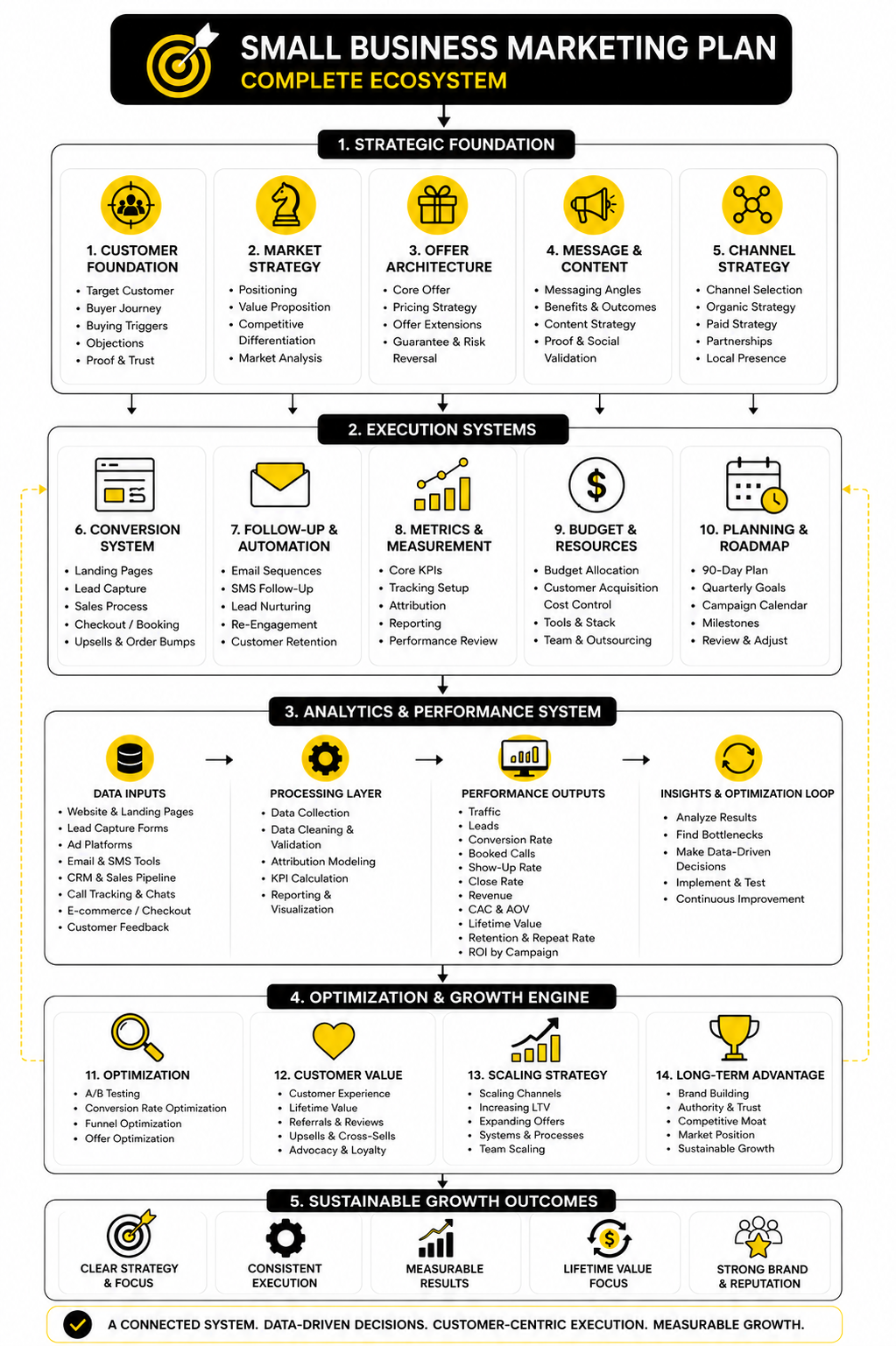
The full ecosystem should also protect the customer experience. If the plan attracts leads the team cannot serve well, it is not a good plan yet. If campaigns create attention but the sales process loses trust, the plan needs tightening before it needs more traffic.
Final Execution Checklist
Use this checklist to turn the strategy into action. Do not treat it like a one-time worksheet. Treat it like a working control panel you can review, update, and improve as the business grows.
This checklist is intentionally practical. A small business marketing plan only works when people can actually follow it. If the system is too complex for the team’s time, budget, and skill level, simplify it until execution becomes realistic.
Common Mistakes to Avoid
The first mistake is starting with tactics before strategy. A business jumps into ads, social posts, email campaigns, or funnels without knowing the real customer, the strongest offer, or the main conversion path. That creates activity, but it rarely creates consistent growth.
The second mistake is measuring the wrong thing. Views, likes, impressions, and open rates can be useful signals, but they are not the whole story. The plan should connect those signals to qualified leads, sales conversations, revenue, retention, and customer quality.
The third mistake is scaling before fixing the leaks. If the page does not convert, the follow-up is slow, the offer is unclear, or the sales handoff is messy, more traffic just creates more waste. Fix the system before increasing pressure on it.
The fourth mistake is letting tools become the strategy. A funnel builder, CRM, social scheduler, chatbot, or email platform can support the plan, but none of them can replace customer understanding. Tools create leverage only when the business already knows what process they are supposed to support.
Build a Lean Marketing Stack
A lean stack is better than a bloated one. Most small businesses need tools for lead capture, communication, scheduling, content publishing, automation, customer management, and reporting. They do not need five overlapping platforms doing the same job.
For all-in-one campaign and CRM workflows, GoHighLevel can work well when the business wants pipelines, automations, calendars, funnels, and follow-up in one place. For simple funnel building and offer pages, ClickFunnels or Systeme.io can support a more direct sales path.
For ongoing communication, Brevo and Moosend can support email campaigns and automations. For social consistency, Buffer can help keep content moving without turning posting into a daily scramble. The stack should be chosen around the workflow, not around hype.
What is a small business marketing plan?
A small business marketing plan is a practical roadmap for attracting, converting, and retaining customers. It defines the target customer, market position, offer, message, channels, budget, follow-up process, and measurement system. The best plans are simple enough to execute and specific enough to guide real decisions.
Why does a small business need a marketing plan?
A small business needs a marketing plan because time, money, and attention are limited. Without a plan, marketing becomes reactive and scattered. With a plan, the business can focus on the customers, channels, offers, and actions most likely to create growth.
How long should a small business marketing plan be?
A useful plan does not need to be long. For many small businesses, 5 to 15 pages is enough if the thinking is clear. The length matters less than whether the plan can guide weekly execution and monthly decisions.
What should be included in a small business marketing plan?
A strong plan should include customer research, positioning, competitor context, offers, messaging, channel strategy, campaign planning, budget, follow-up process, metrics, and review rhythm. It should also define what the business will not focus on right now. That keeps the plan realistic instead of overloaded.
How often should a small business update its marketing plan?
The plan should be reviewed monthly and updated more deeply every quarter. Weekly reviews are useful for active campaigns and lead flow, but strategic changes should not happen every few days. Give campaigns enough time to produce usable data before changing direction.
What is the biggest mistake in small business marketing?
The biggest mistake is confusing activity with strategy. Posting more, spending more, or trying more platforms does not automatically create better results. The business needs a clear offer, clear message, clear audience, and clear conversion path before more activity makes sense.
How much should a small business spend on marketing?
There is no perfect percentage for every business. Gartner’s 2025 CMO Spend Survey found that marketing budgets were 7.7% of company revenue, but that figure is a benchmark, not a rule. A newer business may need more investment to build demand, while a mature referral-driven business may focus more on retention and conversion efficiency.
Which marketing channels are best for small businesses?
The best channels depend on how customers buy. Local service businesses often need search visibility, reviews, referrals, and fast response. Online businesses may rely more on content, email, paid campaigns, funnels, partnerships, and social proof.
Should small businesses use paid ads?
Paid ads can work well when the offer, landing page, tracking, and follow-up are already solid. They can also waste money quickly when those pieces are weak. Start with a focused campaign, measure the full path from click to customer, and improve the bottleneck before increasing spend.
Is social media enough for a small business marketing plan?
Social media can support awareness, trust, education, and community, but it should not be the whole plan. A business also needs a way to capture leads, follow up, convert interest into revenue, and retain customers. Social media works best when it connects to a larger system.
How important are reviews in a small business marketing plan?
Reviews are very important for local and service-based businesses because they influence trust at the point of decision. BrightLocal’s 2026 review research shows that 68% of consumers will only use a business with four or more stars, which makes reputation a real marketing asset. Review generation, response, and monitoring should be part of the plan, not an afterthought.
What metrics should a small business track?
Track metrics that show movement through the customer journey. That includes traffic, leads, conversion rate, booked calls, show-up rate, close rate, customer acquisition cost, average order value, lifetime value, repeat purchases, and revenue by channel. Avoid obsessing over vanity metrics unless they connect to a business outcome.
How can a small business improve marketing without increasing budget?
Start by improving conversion and follow-up. Make the offer clearer, simplify the landing page, reply faster to leads, strengthen proof, ask for reviews, reactivate past customers, and clean up the sales handoff. These improvements often create better results before the business spends more money.
Should a small business hire marketing help or do it in-house?
It depends on skill, time, and complexity. In-house execution can work when the plan is simple and the team has capacity. Professional support makes sense when the business needs strategy, campaign management, tracking, copywriting, automation, or specialized channel expertise.
What makes a small business marketing plan successful?
A successful plan is clear, focused, measurable, and consistently executed. It connects customer insight to offers, channels, campaigns, follow-up, and revenue. Most importantly, it helps the business make better decisions instead of chasing random tactics.
Build a stronger local presence with BAAM AI
Turn your website, Google profile, social channels, and AI visibility into one growth engine
Most businesses do not need more random marketing activity. They need a consistent presence system that helps the right people find them, trust them, and take action. BAAM AI brings strategy, local SEO, website updates, Google Maps visibility, social content, AI-search readiness, media production, and reporting into one practical monthly engine.
If you want your marketing to keep working after the campaign ends, start with a free BAAM AI presence audit. See how your business shows up today and where the fastest visibility wins are at BAAM AI.