
BAAM AI Blog
Simple Email Marketing: A Practical Framework For Sending Emails People Actually Want
Simple email marketing is not about sending random newsletters whenever you remember your list exists. It is the practice of building a clear permission-based email system that attracts the right subscribers, sends...
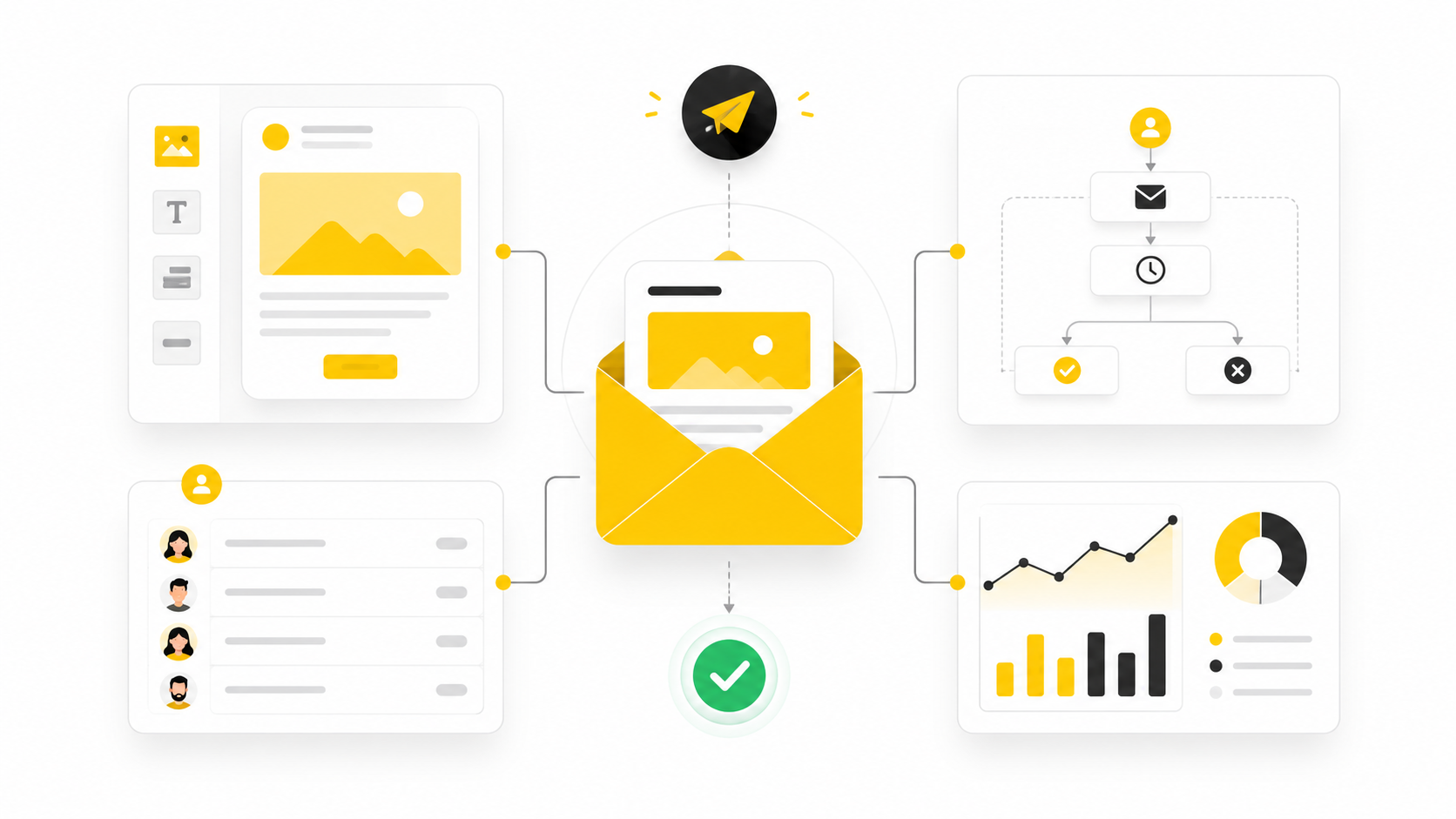
Simple email marketing is not about sending random newsletters whenever you remember your list exists. It is the practice of building a clear permission-based email system that attracts the right subscribers, sends useful messages, and turns attention into measurable business results without making the process unnecessarily complicated.
That matters because email is still one of the few marketing channels where you can build a direct relationship with your audience. Social platforms can change reach overnight, ad costs can move fast, and search traffic can become less predictable, but an email list gives you a channel you can keep improving over time. The latest DMA Email Benchmarking Report shows delivery rates reached 98% in 2024, while open rates rose to 35.9% and unique click rates climbed to 2.3%, which is a strong reminder that email still works when the basics are handled well.
The mistake is assuming email marketing needs to be complex to be effective. Most businesses do not need a giant automation map, ten lead magnets, and weekly campaign meetings before they can start. They need a simple email marketing system that explains who the list is for, what the subscriber gets, when messages are sent, and how results are measured.
this guide is split into six parts so the full system can build naturally instead of jumping straight into tactics. Part 1 sets the foundation and defines the framework. The following parts will move from strategy into execution, measurement, and frequently asked questions.
Why Simple Email Marketing Still Matters
Simple email marketing matters because attention is expensive, but trust is even more expensive to rebuild once you lose it. A clean email system helps you stay present with people who already showed interest instead of constantly chasing cold traffic. It also gives you a practical way to turn website visitors, buyers, leads, webinar attendees, and content followers into an audience you can serve repeatedly.
The channel is also more measurable than many beginners realize. Email lets you track list growth, delivery, opens, clicks, conversions, unsubscribes, spam complaints, and revenue attribution when your setup supports it. Recent Litmus email ROI research found most companies reporting email ROI between 10:1 and 36:1, which is why the channel keeps getting investment even while newer platforms get more attention.
The other reason simplicity matters is deliverability. Google now requires all senders to use SPF or DKIM, while bulk senders need SPF, DKIM, and DMARC, and Google also tells senders to keep user-reported spam rates below 0.1% and avoid reaching 0.3% or higher in its email sender guidelines and sender FAQ. That means email marketing is no longer just a copywriting game; it is a trust, relevance, and technical hygiene game too.
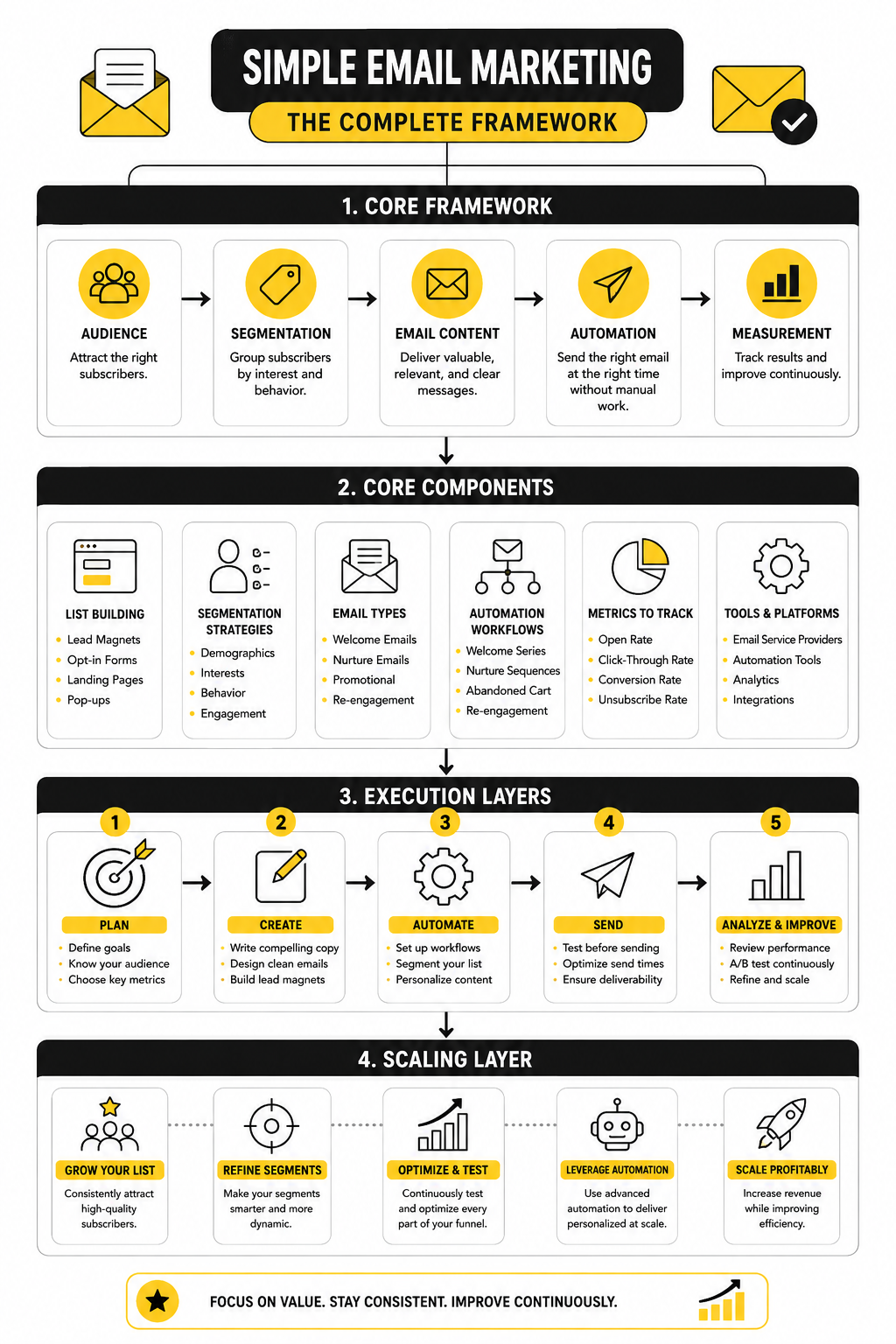
The Simple Email Marketing Framework
A useful email system has four layers: audience, offer, message, and measurement. The audience layer defines who should join your list and why they would care. The offer layer gives people a reason to subscribe, buy, book, reply, or take the next step.
The message layer is where most people spend all their time, but it only works when the first two layers are clear. Your emails need a consistent reason to exist, whether that is education, product discovery, customer onboarding, launch communication, or retention. A simple sequence can often outperform a messy “advanced” setup because every email has a job.
The measurement layer keeps the system honest. You are not sending because a guru said to send daily, weekly, or monthly. You are watching whether people stay subscribed, click, reply, buy, book calls, or move deeper into your funnel.
What Simple Does Not Mean
Simple does not mean basic, lazy, or low-effort. It means the system is easy to understand, easy to maintain, and easy to improve. A professional email program can still be simple if every automation, campaign, and segment has a clear business reason.
Simple also does not mean sending the same message to everyone forever. Segmentation can stay practical by starting with obvious groups such as new leads, active buyers, inactive subscribers, recent webinar registrants, or people who clicked a specific offer. Tools like Brevo, Moosend, or GoHighLevel can help with this, but the strategy has to come before the software.
The real goal is to remove friction. You want fewer moving parts, clearer messages, better data, and a rhythm you can actually maintain. That is what makes simple email marketing practical for creators, consultants, ecommerce brands, service businesses, agencies, and small teams that need results without drowning in complexity.
Core Components Of A Simple Email Marketing Strategy
A simple email marketing strategy starts with a few decisions that make every future email easier to write. You need to know who you are speaking to, why they joined, what they should receive first, and what action makes sense next. Without those decisions, email becomes a guessing game, and guessing is where most messy campaigns begin.
The core components are not complicated, but they do need to be intentional. A strong setup usually includes a clear audience, a useful signup reason, a welcome flow, a regular sending rhythm, a simple offer path, and basic measurement. When those pieces work together, you can keep the system lean while still making it professional.
This is also where simplicity protects you from chasing every tactic. You do not need every automation possible. You need the few automations and campaigns that match your business model, your audience, and your current stage.
A Clear Audience
The first component is knowing who the email list is actually for. Not in a vague way like “business owners” or “people interested in fitness,” but in a practical way that helps you decide what to send. A simple email marketing system gets easier when you can describe the subscriber’s problem, goal, buying stage, and reason for trusting you.
This matters because relevance drives engagement. The GDMA International Email Benchmark 2025 found that smaller, more targeted campaigns under 5,000 recipients produced stronger open and click performance than very large batch sends. That does not mean every business needs advanced segmentation on day one, but it does mean “send everything to everyone” is usually not the smartest long-term plan.
Start with one primary reader. Define what they want, what they already know, what they are skeptical about, and what outcome they are trying to reach. Once that is clear, your emails stop sounding generic because you are no longer writing to a crowd; you are writing to a specific person with a specific reason to care.
A Strong Reason To Subscribe
People do not join email lists because a signup form exists. They join because the promise feels useful enough to trade their attention for it. That promise can be a discount, checklist, guide, private training, quiz result, waitlist, newsletter, template, or simple product updates, but it has to feel concrete.
The best signup reason matches what the subscriber already wants. If someone is comparing tools, a buying guide may work better than a broad newsletter. If someone is trying to solve a painful operational problem, a checklist or short email course may feel more valuable than a generic PDF.
This is where many businesses overthink the lead magnet. The asset does not need to be huge. It needs to be specific, relevant, and connected to the next step you eventually want the reader to take.
A Welcome Flow
The welcome flow is the first real relationship-building moment after someone joins. It should confirm the signup, deliver what was promised, explain what kind of emails the subscriber can expect, and guide them toward one useful next action. This does not need to be a 12-email automation with complex branching.
A simple welcome flow can be three to five emails. The first email delivers the promised resource or confirms the subscription. The next few emails can teach something useful, introduce your point of view, answer a common objection, and lead naturally toward a product, service, call, demo, or deeper piece of content.
The important part is timing and clarity. Do not wait two weeks to introduce yourself after someone joins. They are warmest right after the signup, so use that moment to make the relationship feel clear, useful, and human.
A Consistent Sending Rhythm
Consistency is not the same as frequency. You can send once a week, twice a month, or during specific campaigns and still run a healthy email program. What matters is that subscribers understand why they are hearing from you and that the emails remain worth opening.
A simple email marketing rhythm should fit your capacity. If you can write one genuinely useful email per week, do that. If one strong email every two weeks is more realistic, that is better than forcing weak content just to hit an arbitrary schedule.
The bigger risk is disappearing and then showing up only when you want money. That trains people to ignore you. A balanced rhythm gives value between promotions, so your sales emails do not feel like they came out of nowhere.
A Practical Offer Path
Every email list needs a destination. That does not mean every message should sell aggressively, but it does mean the reader should have a clear path from subscriber to customer when the timing is right. If there is no offer path, email becomes content with no commercial direction.
For service businesses, the path might lead to a consultation, audit, booking page, or application. For creators, it might lead to a course, membership, paid newsletter, or digital product. For ecommerce brands, it might lead to a first purchase, repeat purchase, replenishment reminder, product education sequence, or seasonal campaign.
This is where the tool stack should support the journey instead of becoming the strategy. A funnel builder like ClickFunnels, an all-in-one system like GoHighLevel, or a simpler platform like Systeme.io can help connect landing pages, email sequences, and offers, but the path itself has to be clear first.
Basic Segmentation
Segmentation sounds technical, but the simple version is just sending more relevant emails to different groups. New subscribers should not always receive the same message as loyal customers. People who clicked a product link may deserve a different follow-up than people who ignored the campaign completely.
The simplest segments usually come from behavior and relationship stage. You can separate new leads, customers, inactive subscribers, recent buyers, webinar registrants, abandoned checkout contacts, or people who clicked a specific topic. That gives you enough context to improve relevance without building a monster system.
This is especially useful when your list starts to grow. A small list can sometimes survive broad messaging because the relationship is still personal. A larger list usually needs better targeting, or engagement slowly drops because too many people receive emails that do not match their intent.
Permission And Compliance
Permission is not a boring legal detail. It is the foundation of trust and deliverability. If people did not clearly expect your emails, they are more likely to ignore them, unsubscribe, or mark them as spam.
For U.S. commercial email, the FTC’s CAN-SPAM compliance guide explains requirements such as truthful header information, non-deceptive subject lines, a clear opt-out method, and honoring unsubscribe requests. In the EU, email marketing must also respect GDPR principles, and the GDPR email marketing guidance makes consent or another valid legal basis central to processing personal data. The exact rules depend on where you operate and where your subscribers live, so this is not something to treat casually.
Simple email marketing should make compliance easier, not harder. Use clear signup language, avoid purchased lists, make unsubscribing easy, and keep records of how people joined when your platform supports it. That keeps your list cleaner and your brand safer.
Deliverability Basics
Deliverability is what determines whether your emails actually reach the inbox. Copywriting matters, but it cannot save a broken sending setup. If your domain authentication, spam complaints, list hygiene, or sending behavior is poor, your best email may never get seen.
Google’s sender rules now require authentication with SPF or DKIM for all senders, while bulk senders must use SPF, DKIM, and DMARC, publish a DMARC policy, support one-click unsubscribe for marketing messages, and keep spam complaints low in line with its email sender guidelines. Yahoo has similar bulk sender expectations, and the industry has clearly moved toward stricter authentication and easier unsubscribes. That is good for subscribers, but it also means sloppy email operations get punished faster.
The simple version is this: authenticate your domain, send only to people who expect your emails, remove dead contacts over time, and avoid manipulative subject lines. You do not need to become a deliverability engineer to start. You do need to respect the inbox.
A Small Set Of Useful Metrics
You do not need to stare at twenty metrics to know whether your email system is working. Start with list growth, delivery rate, open rate, click rate, unsubscribe rate, spam complaints, replies, conversions, and revenue or pipeline created. Those numbers tell you whether people are joining, receiving, engaging, staying, and taking action.
Open rates are still useful, but they are not perfect. Privacy features can make opens less reliable, so clicks, replies, conversions, and unsubscribe behavior often give you a clearer picture of real engagement. The DMA Email Benchmarking Report showed delivery rates at 98% in 2024, with open rates at 35.9% and unique click rates at 2.3%, which gives useful context without turning benchmarks into absolute rules.
The goal is not to beat every benchmark. The goal is to understand your own baseline and improve it. A small list with strong buyer intent can outperform a huge list that barely cares.
The Simple Stack
Your email stack should match the stage of your business. A beginner does not need enterprise-level complexity. A growing agency, ecommerce brand, or service business may need stronger automation, CRM, pipeline tracking, and multi-channel follow-up.
For a straightforward newsletter and basic campaigns, Brevo or Moosend can be enough. For businesses that want CRM, funnels, appointments, SMS, pipelines, and email under one roof, GoHighLevel can make more sense. For creators and lean businesses that want pages, emails, and selling tools in one place, Systeme.io is worth considering.
The mistake is buying software before deciding how the system should work. Pick the tool after you define the audience, signup reason, welcome flow, offer path, and metrics. That way, the platform supports your simple email marketing strategy instead of becoming an expensive place to store confusion.
Building Your List Without Making It Complicated
Once the strategy is clear, the next job is implementation. This is where simple email marketing becomes practical instead of theoretical. You are not trying to build the perfect machine on day one; you are trying to create a clean path from first attention to first useful email.
The process starts with one focused entry point. That might be a landing page, checkout opt-in, webinar registration page, embedded blog form, quiz, free resource, or booking funnel. The best choice depends on what your audience already wants and what next step makes sense for your business.
The key is to avoid building five disconnected signup paths before one of them works. Pick one audience, one promise, one form, one welcome flow, and one next action. Then improve from real subscriber behavior instead of assumptions.
The Simple Implementation Process
Implementation should feel boring in the best possible way. Every step should answer a clear question: who is joining, why are they joining, what happens after they join, and how do you know the system is working? If you cannot answer those questions in plain language, the setup is probably too vague.
A useful simple email marketing process usually follows this sequence:
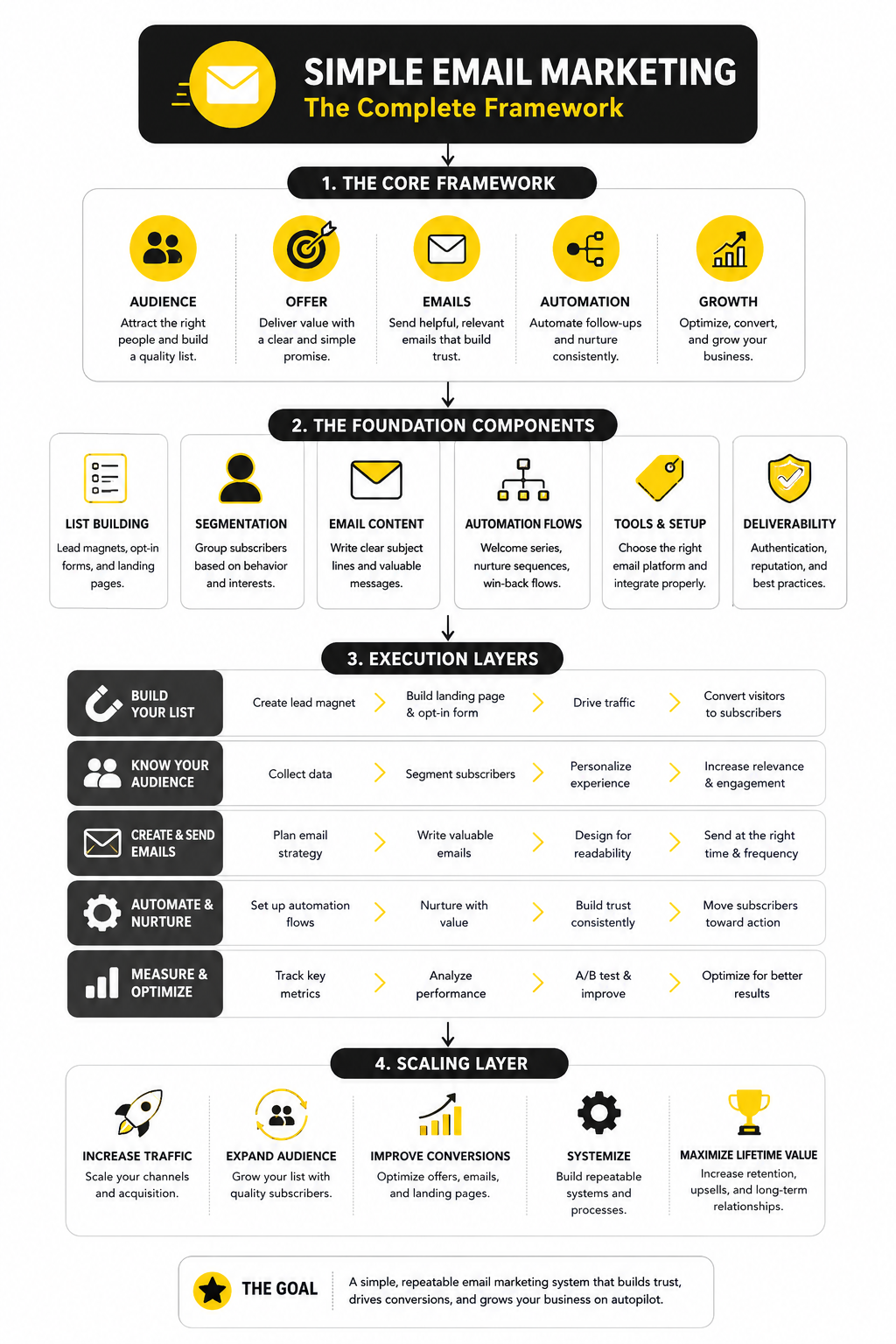
This sequence matters because each step depends on the one before it. A welcome flow is weak if the signup promise is unclear. A beautiful landing page is useless if the form does not trigger the right email. A great offer can underperform if deliverability basics are ignored.
Step 1: Define The Signup Promise
Your signup promise is the reason someone gives you their email address. It should be specific enough that the reader immediately understands the value. “Join my newsletter” can work for a known brand or creator, but most businesses need a stronger reason than that.
A better promise answers one practical question for the subscriber. It might help them compare options, avoid a mistake, get a discount, learn a process, book a useful call, or receive a resource that saves time. The clearer the promise, the easier it becomes to write the signup page and welcome email.
This is also where you should keep the promise connected to the business outcome. If you sell marketing services, do not attract people with a generic productivity checklist unless that checklist leads naturally into your offer. Good list building is not just about more subscribers; it is about attracting people who are likely to care about what comes next.
Step 2: Build One Signup Page Or Form
You do not need a complicated website rebuild to start collecting subscribers. One clean landing page or embedded form can be enough. The page should explain the promise, show who it is for, reduce friction, and make the call to action obvious.
For simple funnels, tools like ClickFunnels, Systeme.io, or GoHighLevel can help connect pages, forms, and email follow-up without forcing a large custom build. For ecommerce pages that need stronger landing page control, Replo can make sense when the signup offer is tied to a product campaign or promotional page. The tool is secondary, though; the page still needs one clear job.
Keep the form short at the beginning. An email address is often enough, and a first name can be useful if you genuinely plan to personalize. Asking for too much information too early can reduce signups, especially when the value of joining is not yet obvious.
Step 3: Connect The Form To The Right Segment
After someone subscribes, they should land in the right place inside your email platform. That means the form should apply the correct list, tag, segment, source, or automation trigger. This sounds small, but it prevents a lot of future mess.
At minimum, track where the subscriber came from and what they requested. A person who downloaded a buyer checklist has different context from someone who joined a general newsletter. A customer who opted into post-purchase education should not be treated like a brand-new cold lead.
This is one of the easiest places to keep simple email marketing organized from the start. Use clear naming conventions for forms, tags, and automations. Six months later, “Lead Magnet - Pricing Checklist - May 2026” will make a lot more sense than “New Form 7.”
Step 4: Write The First Email Before The Full Sequence
Do not build the whole automation before writing the first email. The first email carries the highest expectation because it arrives right after the signup. It should deliver the promised value, confirm what happens next, and make the reader feel like subscribing was a smart decision.
A strong first email usually includes a direct subject line, a short welcome, the promised link or information, and one simple next step. That next step could be reading a guide, replying with a question, booking a call, watching a short training, or checking out a relevant offer. Do not overload it with five links and three competing calls to action.
Once the first email is clear, the rest of the sequence becomes easier. You can build the next emails around the subscriber’s likely questions, objections, and next decision. That is more effective than writing random content just because an automation template told you to send five emails.
Step 5: Build A Short Welcome Flow
A welcome flow should move the relationship forward without overwhelming the subscriber. Three to five emails are usually enough for a simple starting point. You can always expand later when the data shows where people need more help.
A practical welcome flow might look like this:
The sequence should feel like a guided path, not a sales ambush. Each email should have a reason to exist. If you cannot explain the job of an email in one sentence, cut it or rewrite it.
Step 6: Handle Consent And Unsubscribes Properly
Consent should be clear at the point of signup. The subscriber should understand what they are signing up for, especially if the form is connected to promotional emails. This builds trust and reduces the chance of people feeling tricked later.
For commercial email in the United States, the FTC’s CAN-SPAM guide explains requirements such as accurate header information, honest subject lines, a visible opt-out method, and honoring unsubscribe requests. For businesses reaching people in the EU or UK, privacy and consent rules can be stricter, so the signup process should be reviewed with that in mind. This is not the exciting part of email marketing, but it is one of the parts that protects the business.
Unsubscribes should be easy. Hiding the unsubscribe link may keep someone on the list technically, but it can push frustrated people toward spam complaints. That is a terrible trade.
Step 7: Authenticate Your Sending Domain
Before sending campaigns seriously, authenticate your domain. SPF, DKIM, and DMARC help inbox providers verify that your emails are legitimate. This is now a basic requirement, not an advanced optimization.
Google’s current email sender guidelines require authentication for senders, and bulk senders must meet stricter standards around SPF, DKIM, DMARC, one-click unsubscribe, and spam complaint levels. That means a simple email marketing setup should include technical trust from the beginning. You do not want to discover deliverability problems after you have already built the list.
Most email platforms provide setup instructions for DNS records. Follow them carefully, send a few internal tests, and check whether the platform shows your domain as verified. If this part feels technical, it is worth getting help because poor authentication can quietly damage results.
Step 8: Test The Full Subscriber Path
Testing is where you catch the embarrassing stuff before subscribers do. Use a personal email address and go through the entire process as if you were a real visitor. Sign up, confirm the form works, read the thank-you page, check the first email, click every link, and make sure the right tags or segments apply.
Look for simple problems. Is the promised resource delivered? Does the subject line match the signup expectation? Are links working? Does the sender name look trustworthy? Does the email display well on mobile?
This step is boring until it saves you from sending traffic to a broken funnel. Never skip it. A simple system still needs quality control.
Step 9: Send Focused Traffic
Once the path works, you need traffic. Start with the channels where you already have attention. That could be your website, blog posts, YouTube descriptions, social profiles, podcast notes, checkout pages, paid ads, partner promotions, or existing customer touchpoints.
The traffic source should match the signup promise. A discount popup may work well for ecommerce visitors who are already shopping. A webinar registration page may work better for a high-ticket service where people need education before they book a call.
You can also use social scheduling and content repurposing to make promotion more consistent. A tool like Buffer can help distribute the signup offer across social channels, but the content still needs a clear reason for people to click. Promotion works better when the post speaks to a real pain point instead of simply saying “join my list.”
Step 10: Improve One Variable At A Time
After the system is live, resist the urge to change everything at once. If signups are weak, improve the headline, promise, traffic source, or form placement. If people subscribe but do not click the first email, improve the subject line, first paragraph, link placement, or offer relevance.
Simple measurement keeps the process clean. Track signup conversion rate, first-email delivery, first-email click rate, unsubscribes, spam complaints, and the next business action that matters. The DMA Email Benchmarking Report 2025 shows delivery rates at 98%, open rates at 35.9%, and unique click rates at 2.3%, but your own baseline is what matters most.
The point is not to chase benchmarks blindly. The point is to build a system you can understand and improve. When you change one thing at a time, you learn what actually moved the result.
Common Implementation Mistakes
The most common mistake is building too much before proving the basic path. People create ten forms, four lead magnets, seven automations, and a dashboard before they have one signup source that consistently works. Complexity feels productive, but it often hides the fact that the core promise is not strong enough.
Another mistake is making the welcome flow too promotional too quickly. Selling is fine when the next step is relevant, but the subscriber should not feel like they were tricked into a pitch sequence. Give them the value they requested, establish trust, and then make the next step feel natural.
The third mistake is ignoring list quality. A smaller list of people who expect and want your emails is more valuable than a bigger list full of random contacts. Simple email marketing works best when the system respects attention from the first signup to every future send.
Statistics And Data That Actually Matter
Measurement is where simple email marketing either becomes a real business system or stays as guesswork. The goal is not to collect random numbers because a dashboard makes them available. The goal is to understand what each number says about the relationship between your audience, your message, your offer, and your sending habits.
A good email metric should help you make a decision. If a number does not change what you write, send, segment, test, or stop doing, it probably does not deserve much attention. You want fewer metrics with clearer meaning, not a giant report that nobody acts on.
Benchmarks are useful, but only when they are treated as context. The DMA Email Benchmarking Report 2025 reported 98% delivery rates, 35.9% open rates, and 2.3% unique click rates for 2024, which gives a helpful reference point. But your own baseline matters more than someone else’s average because your list quality, industry, offer, source of subscribers, and sending frequency all change the numbers.
The Measurement System
A simple measurement system should follow the subscriber journey from signup to business result. Start with whether people are joining. Then look at whether emails are delivered, opened, clicked, replied to, and converted.
That flow matters because each metric diagnoses a different part of the system. A weak signup rate usually points to the page, offer, traffic source, or form. A weak click rate usually points to message relevance, email structure, call to action, or offer fit.
Simple email marketing analytics should answer five questions:
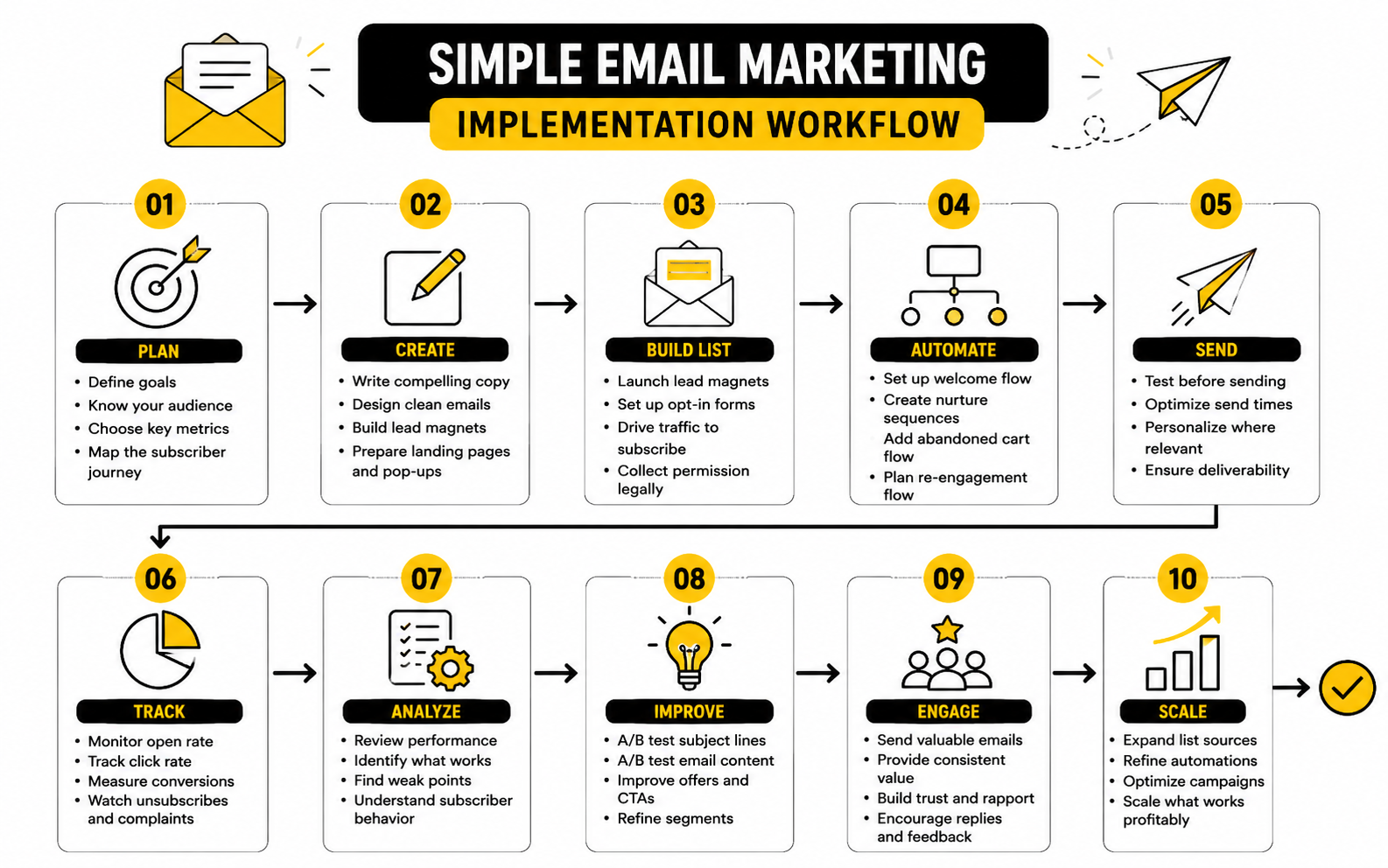
This is the cleanest way to avoid vanity metrics. Opens alone do not prove the email worked. Clicks alone do not prove the offer worked. Revenue alone does not tell you where the journey broke before the sale.
List Growth Rate
List growth rate tells you whether your audience-building system is moving in the right direction. A list can grow through organic content, paid traffic, checkout opt-ins, events, referrals, lead magnets, or customer touchpoints. The important part is knowing which sources bring subscribers who actually engage later.
A high growth rate is not automatically good. If you attract low-intent people with a vague giveaway, your list may grow while engagement drops. That creates the illusion of progress while deliverability and conversion quality get worse.
Track list growth by source whenever possible. A smaller source that brings buyers, replies, or booked calls can be more valuable than a large source that brings passive subscribers. Quality beats volume, especially when inbox providers are watching engagement signals.
Delivery Rate
Delivery rate shows whether your emails were accepted by receiving servers. It is not the same as inbox placement, but it still matters because it tells you whether emails are bouncing or being rejected before subscribers can even see them. If delivery is weak, your copy and offer are not the first problem.
The DMA benchmark report showing 98% delivery rates gives a useful reference for healthy programs. If your delivery rate is far below that, look at bounce rates, old contacts, purchased data, domain authentication, and sudden sending spikes. Those are usually operational problems, not creative problems.
Delivery issues need to be handled quickly. Continuing to send to bad addresses or disengaged contacts can hurt sender reputation. A clean list with steady sending behavior is usually stronger than a bloated list full of dead contacts.
Open Rate
Open rate can still be useful, but it should not be treated like the final truth. Privacy features and image loading behavior can distort opens, so the number is best used as a directional signal. It can help you compare your own campaigns, but it should not be the only performance metric you trust.
If open rates are weak, look at sender name, subject line, preview text, list quality, send timing, and subscriber expectations. Sometimes the issue is not the subject line at all. The issue is that people joined for one thing and you started sending something else.
The smartest use of open rate is pattern recognition. If a certain topic consistently gets more opens from the same list, that tells you something about demand. If opens decline over several sends, that may signal weak relevance, too much frequency, or subscriber fatigue.
Click Rate
Click rate is one of the clearest engagement signals because it shows that someone moved from passive attention to active interest. A subscriber had to open, read enough to care, and click. That makes clicks more useful than opens when judging whether the email created action.
The DMA Email Benchmarking Report 2025 reported unique click rates of 2.3%, while MailerLite’s 2025 benchmark data reported an average click rate of 2.09% across its customer data. Those numbers are not targets you blindly chase, but they show that email clicks are usually a small, high-intent slice of the audience.
If clicks are low, do not immediately rewrite everything. First check whether the email had one clear action, whether the link was visible, whether the offer matched the message, and whether the email gave enough reason to click. Small changes in clarity often beat big redesigns.
Click-To-Open Rate
Click-to-open rate compares clicks to opens. It helps you understand whether the email content persuaded people after they opened. This is useful because a strong subject line can create opens, but the body of the email still has to earn the click.
A low click-to-open rate usually points to a mismatch. The subject line may have promised one thing while the email delivered another. Or the email may be interesting but not action-oriented enough.
Use this metric carefully because open tracking can be imperfect. Still, when measured consistently inside the same platform, it can help you compare one campaign against another. That makes it useful for improving message structure, call-to-action clarity, and offer positioning.
Conversion Rate
Conversion rate is where email connects to the business outcome. The conversion might be a purchase, booked call, demo request, webinar attendance, quote request, form completion, reply, trial start, renewal, or repeat order. The right conversion depends on the job of the email.
This is where many businesses under-measure. They look at opens and clicks but never connect the campaign to sales, appointments, or pipeline. That creates a gap between marketing activity and business value.
A simple setup can still track conversions well. Use tagged links, platform reporting, CRM stages, checkout attribution, or booking links that show which emails created action. Tools like GoHighLevel, ClickFunnels, and Systeme.io can help connect email follow-up with funnels, bookings, and sales paths when the tracking is set up intentionally.
Revenue Per Subscriber
Revenue per subscriber is one of the cleanest business metrics for simple email marketing. It shows how much value the list creates relative to its size. This is especially useful because a larger list is not always a better list.
A list of 2,000 people that generates consistent sales can be healthier than a list of 50,000 people that barely clicks. Revenue per subscriber helps you avoid being impressed by audience size alone. It forces you to look at quality, intent, and monetization.
Track this over time, not just after one campaign. If revenue per subscriber rises, your audience, offers, and follow-up are likely becoming more aligned. If it falls while the list grows, you may be attracting weaker leads or sending less relevant emails.
Unsubscribe Rate
Unsubscribes are not always bad. Sometimes they are healthy list cleaning. A person who no longer wants your emails should be able to leave easily instead of ignoring every message or marking it as spam.
The problem is when unsubscribes spike after specific emails. That usually means the topic, tone, frequency, or offer did not match subscriber expectations. The number becomes useful when you connect it to the exact email and ask what changed.
Do not panic over normal unsubscribes, but do not ignore patterns either. If every sales email causes a sharp exit, the list may not understand your offer path. That means you need better expectation-setting earlier in the subscriber journey.
Spam Complaint Rate
Spam complaints are much more serious than unsubscribes. A complaint tells inbox providers that someone did not just want to leave; they felt the email was unwanted enough to report it. This can damage deliverability faster than most beginners realize.
Google’s sender guidance tells senders to keep user-reported spam rates below 0.1% and avoid reaching 0.3% or higher, while its sender FAQ says bulk senders above 0.3% remain ineligible for mitigation until spam rates stay below that level for seven consecutive days. That is why permission, relevance, and list hygiene are not optional.
If complaints rise, stop treating it as a copywriting problem only. Review the source of subscribers, signup language, sending frequency, segmentation, and whether people clearly expected promotional emails. The safest complaint is the one you prevent before it happens.
Bounce Rate
Bounce rate shows how many emails could not be delivered to addresses on your list. Hard bounces usually mean the address is invalid or no longer exists. Soft bounces can happen for temporary reasons, but repeated soft bounces should still be watched.
High bounce rates usually come from old lists, imported contacts, poor form validation, fake addresses, or low-quality acquisition sources. This is why buying lists is such a bad move. It may look like growth, but it often creates deliverability problems before any real relationship exists.
Clean your list regularly and remove invalid contacts. Many email platforms handle obvious bounces automatically, but you should still monitor the trend. A simple list is not just easy to send to; it is healthy enough to protect your sender reputation.
Reply Rate
Reply rate is underrated because it does not always show up neatly in email marketing dashboards. But replies are powerful because they show real human engagement. They can reveal objections, buying intent, confusion, praise, complaints, and language your audience actually uses.
For service businesses, replies can be more valuable than clicks. A thoughtful reply can turn into a sales conversation, partnership, testimonial, or product insight. Even for creators and ecommerce brands, replies help you understand what subscribers care about beyond the dashboard.
Add reply-driven emails into your system occasionally. Ask a simple question. Invite feedback. Let people tell you what they are stuck on. That turns the list from a broadcast channel into a relationship channel.
ROI And Business Impact
ROI is the metric executives and business owners ultimately care about. It connects email cost to business return. That includes platform cost, creative time, strategy, design, deliverability work, list growth spend, and the revenue or pipeline created from email.
The Litmus email ROI analysis found that most companies report email ROI between 10:1 and 36:1, with customer engagement emails, promotional emails, and newsletters among the highest ROI email types. That is exactly why email deserves serious attention even when the setup is simple. The channel can be lean, but it should not be treated casually.
The mistake is only measuring ROI after big promotions. Welcome flows, retention emails, reactivation campaigns, abandoned cart messages, post-purchase education, and customer onboarding can all create value. Simple email marketing becomes more powerful when you measure the full lifecycle, not just campaign blasts.
How To Interpret The Numbers
The data should tell a story. If people are joining but not opening, the issue may be expectation, sender trust, or subject relevance. If they are opening but not clicking, the issue may be message clarity or offer alignment.
If they click but do not convert, the problem may be on the landing page, pricing page, booking page, checkout, or sales process. That matters because many businesses blame email for problems that happen after the click. Email can create intent, but the next step still has to convert.
Use metrics as a diagnostic chain:
This keeps your decisions focused. You do not need to redesign the whole system every time one metric dips. You need to identify where the journey broke and fix that specific part.
Benchmarks Without Benchmark Chasing
Benchmarks are useful when you need perspective. They help you see whether your numbers are wildly outside a normal range. They also help you set realistic expectations, especially when someone expects half the list to click every email.
But benchmarks can become a distraction. A niche B2B list with 700 high-intent subscribers may behave completely differently from a retail list with 70,000 shoppers. A post-purchase education email should not be judged the same way as a cold reactivation campaign.
The better approach is to use external benchmarks as context and internal benchmarks as the real scoreboard. Compare your newsletter against your past newsletters. Compare your welcome email against your previous welcome email. Compare your offer emails against emails with the same purpose.
Turning Data Into Action
Data only matters when it changes what you do next. If your signup page gets traffic but few opt-ins, improve the promise before changing the email sequence. If the first email gets clicks but the offer page does not convert, improve the page before rewriting the entire campaign.
A simple weekly review is enough for many small teams. Look at the latest campaign, the active automation, list growth, unsubscribes, complaints, clicks, and conversions. Then choose one improvement for the next send or sequence update.
This is where simplicity becomes an advantage. When the system has fewer moving parts, you can see cause and effect more clearly. That makes improvement faster, calmer, and much less random.
Professional Implementation Without Overcomplication
At some point, simple email marketing has to mature without becoming messy. The goal is not to keep everything tiny forever. The goal is to add sophistication only when it helps the subscriber journey, improves measurement, protects deliverability, or creates a clearer business outcome.
This is where many teams get it wrong. They confuse advanced with complicated, so they add more automations, more tags, more campaigns, more tools, and more reporting before the current system is stable. A professional setup should feel easier to manage as it grows, not harder.
The real upgrade is control. You want better targeting, cleaner data, stronger creative decisions, safer compliance, and a tighter connection between email and revenue. That is how a simple email marketing system scales without turning into a fragile machine.
The Tradeoff Between Simplicity And Personalization
Personalization can improve relevance, but it can also create operational debt. Using a first name is easy. Building separate journeys based on customer stage, product interest, behavior, and engagement requires cleaner data and better rules.
The smart move is to personalize where intent is obvious. A subscriber who clicked a pricing link, abandoned checkout, attended a webinar, or bought a specific product has given you useful context. That behavior can guide better follow-up without guessing too much.
Do not personalize just because the software can. Personalization should make the email more useful, not creepier or more confusing. If the subscriber would not understand why they are receiving a message, the segmentation logic probably needs to be clearer.
When To Add More Segments
Segmentation should grow from real behavior, not from a desire to look sophisticated. The first useful segments are usually based on relationship stage, such as new subscriber, active lead, customer, repeat customer, inactive subscriber, or high-intent prospect. Those groups have genuinely different needs.
The next layer can be based on interest. If someone repeatedly clicks content about a specific product, service, topic, or use case, you can send more relevant follow-up. This is especially useful for businesses with multiple offers or audience types.
The warning sign is when nobody can explain what a segment means anymore. If your platform has dozens of tags with unclear names, old campaign labels, and overlapping rules, you are not scaling strategy. You are accumulating confusion.
When To Add More Automations
Automation should remove repetitive work and improve timing. It should not replace thinking. A useful automation sends the right message at a moment when manual follow-up would be slower, less consistent, or impossible at scale.
The strongest automations usually come from clear lifecycle events. Welcome flows, abandoned cart reminders, post-purchase education, onboarding sequences, renewal reminders, reactivation campaigns, and sales follow-up can all make sense when the business has enough volume. These automations work because the trigger is meaningful.
Do not build automations for every tiny action. If every click creates a new branch, the system becomes hard to test and harder to trust. Start with high-impact moments, then add complexity only when the data proves a real gap.
Managing Frequency Without Burning The List
Frequency is one of the hardest scaling decisions because there is no universal right answer. Some audiences welcome frequent emails when the content is valuable and expected. Others fatigue quickly if every message feels promotional.
The best approach is to manage frequency by subscriber context. New leads may need a focused welcome sequence. Active buyers may need product education and post-purchase support. Long-term newsletter readers may prefer a predictable rhythm with occasional campaigns.
Watch behavior instead of relying on opinions. If opens, clicks, replies, and conversions stay healthy while unsubscribes and complaints remain low, the frequency may be fine. If engagement drops and opt-outs rise after you increase sending, the list is telling you something.
Protecting Deliverability As You Grow
Deliverability gets more important as your list grows because mistakes become louder. A small list can sometimes recover quickly from sloppy sending. A large list with poor hygiene, unclear consent, or high complaints can create serious inbox problems.
The basics still matter most: authenticated domains, permission-based acquisition, clean suppression rules, easy unsubscribes, and consistent sending behavior. Google’s email sender guidelines and Yahoo’s sender best practices make it clear that authentication, low complaints, and easy unsubscribe options are now standard expectations. This is not advanced anymore; it is the cost of sending responsibly.
As you scale, treat deliverability like infrastructure. Review bounce trends, spam complaints, inactive contacts, domain reputation signals, and list sources. The bigger the list becomes, the more expensive bad habits get.
Deciding When To Clean The List
List cleaning sounds painful because nobody wants to remove subscribers they worked hard to acquire. But inactive contacts are not free. They can lower engagement, increase platform costs, and weaken deliverability over time.
The practical move is to run a reactivation path before removing people. Give inactive subscribers a clear reason to stay, ask whether they still want the emails, and make the choice easy. People who re-engage stay; people who ignore the sequence can be suppressed or removed based on your policy.
This is where simple email marketing becomes more disciplined. A smaller list of people who expect and engage with your emails is usually stronger than a large list full of silent contacts. Vanity list size does not pay the bills.
Balancing Campaigns And Automated Flows
Campaigns and automations do different jobs. Campaigns are timely messages sent around launches, promotions, content, events, updates, or seasonal moments. Automated flows are evergreen systems triggered by subscriber behavior or lifecycle stage.
A healthy email program usually needs both. Automations create consistency and capture important moments. Campaigns keep the brand current, responsive, and connected to what is happening now.
The risk is letting one side dominate. If you only send campaigns, important follow-up moments get missed. If you only rely on automations, the brand can feel static and disconnected from current context.
Using AI Without Losing The Human Voice
AI can help with drafts, subject line variations, segmentation ideas, summaries, repurposing, and research. It can make email production faster, especially for small teams. But it should not become the voice of the business without human judgment.
The danger is generic output. Email is a relationship channel, and subscribers can feel when a message has no point of view. AI-assisted emails still need specific insight, real customer language, clear positioning, and a reason to exist.
Use AI as a production assistant, not a strategy replacement. A platform with AI features, such as GoHighLevel AI, can support faster workflows, but the message still needs a human filter. Simple email marketing works because it feels useful and direct, not because it sounds automatically generated.
Choosing Tools For The Next Stage
The right platform depends on what your email system needs to do next. If the goal is simple newsletters and basic automations, a lean email platform may be enough. If the goal is sales follow-up, appointment booking, CRM tracking, SMS, funnels, and pipeline visibility, an all-in-one system may make more sense.
For service businesses and agencies, GoHighLevel can be useful when email needs to connect with CRM stages, calls, forms, automations, and bookings. For creators and small businesses that want a lighter funnel-and-email setup, Systeme.io can be a practical option. For businesses that rely heavily on dedicated landing pages and funnel testing, ClickFunnels may fit the workflow better.
Do not choose software based only on features. Choose based on the bottleneck. If your bottleneck is message clarity, no tool fixes that. If your bottleneck is disconnected follow-up, then platform consolidation can genuinely help.
Keeping The Data Clean
Clean data is what makes advanced email marketing possible. If names, tags, source fields, purchase data, consent records, and engagement signals are messy, your segmentation will be messy too. Bad data turns automation into a liability.
Start with naming conventions. Use clear labels for forms, campaigns, automations, products, sources, and lifecycle stages. Make sure someone else could open the account and understand what each field or tag means.
Then review old data regularly. Remove duplicate logic, retire old tags, document important automations, and keep source tracking consistent. This is not glamorous work, but it is what separates a professional email system from a pile of campaigns.
Handling Multiple Offers
Multiple offers can increase revenue, but they also increase confusion if the subscriber journey is not clear. Someone who joined for one topic should not suddenly receive unrelated promotions without context. The more offers you have, the more carefully you need to manage relevance.
The simplest approach is to map offers by audience stage. A beginner may need education before buying. A warm lead may need comparison content, proof, or a consultation path. A customer may need onboarding, usage tips, cross-sells, or retention-focused emails.
This prevents random promotion. Every offer has a place in the journey. That makes email feel helpful instead of noisy.
Planning Launches Without Exhausting Subscribers
Launches can work well through email because urgency and explanation both matter. But launch campaigns can also create fatigue if every message feels like another push. The stronger the relationship before the launch, the better the launch usually performs.
A good launch sequence should not begin with “buy now.” It should build context, explain the problem, show the cost of inaction, present the offer, answer objections, and give people a clear deadline. The sales message feels more natural when the earlier emails have done useful work.
After a launch, give the list room to breathe. Send value, recap useful lessons, support new customers, and avoid immediately jumping into another aggressive promotion. The long-term list relationship is more valuable than squeezing one extra campaign too hard.
Managing Risk
Email risk usually comes from four places: poor permission, weak deliverability, bad data, and unclear messaging. Each one compounds the others. A poorly sourced list with vague messaging and no cleanup process can damage performance quickly.
There is also strategic risk. If email becomes the only channel driving revenue, the business may become too dependent on one asset. If email is ignored because social or paid ads feel more exciting, the business may miss one of the most controllable relationship channels it has.
The balanced approach is to treat email as the center of owned audience development, not the entire marketing strategy. Use content, search, social, paid ads, partnerships, and referrals to bring people in. Use email to deepen the relationship and guide them toward the next step.
Scaling Without Losing Simplicity
Scaling simple email marketing means improving the system without burying the team. Add one layer at a time. Document what each automation does, who it is for, what triggers it, what success looks like, and when it should be reviewed.
The rule is simple: every new layer must earn its place. A new segment should improve relevance. A new automation should improve timing or reduce manual work. A new campaign type should support a clear business goal.
This is how you keep email practical as the business grows. You do not protect simplicity by refusing to evolve. You protect it by making every addition intentional.
Measuring, Improving, And Scaling The Full System
By this point, simple email marketing is no longer just a signup form and a few messages. It is an ecosystem. The list, promise, welcome flow, campaigns, offers, analytics, compliance, and deliverability all affect each other.
That is why the final stage is not about adding more tactics. It is about keeping the system healthy as it grows. The best email programs stay simple at the core while becoming more precise around timing, relevance, testing, and business impact.
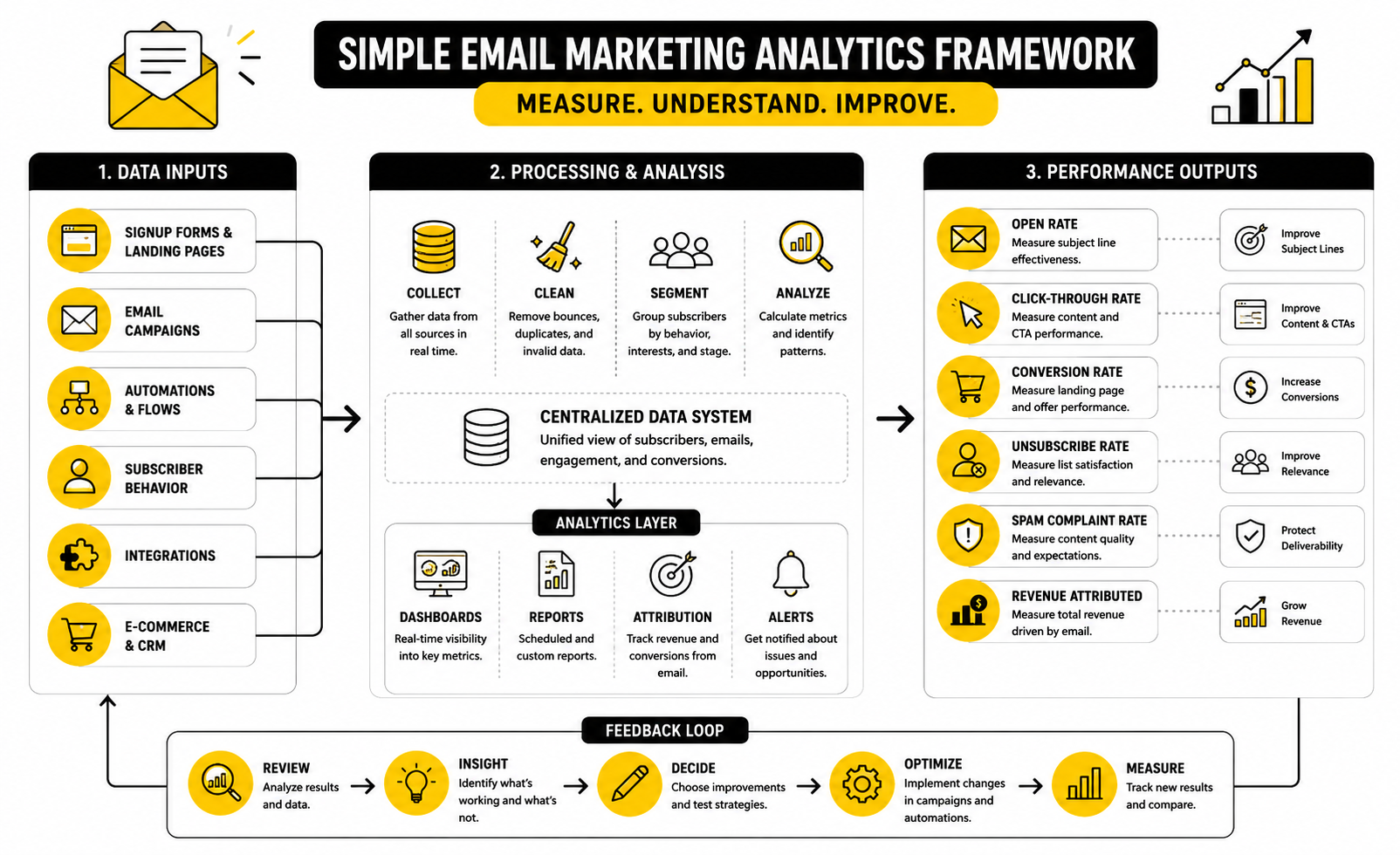
A strong final system should be easy to explain. New people join for a clear reason, receive useful emails, move toward relevant offers, and stay on the list because the relationship is worth it. When something breaks, the metrics show where to look instead of forcing you to guess.
The Improvement Loop
The improvement loop is simple: review, decide, change, measure, and repeat. You do not need to rebuild the whole system after every campaign. You need a steady habit of improving the weakest part of the journey.
Start with the biggest constraint. If people are not subscribing, improve the signup promise or traffic source. If they subscribe but do not click, improve message clarity and the next step. If they click but do not convert, improve the page, offer, checkout, booking flow, or sales process.
This is where discipline matters. Change one meaningful thing at a time when possible. That way, your simple email marketing system teaches you what actually works instead of creating another pile of opinions.
What To Review Monthly
A monthly review keeps the system sharp without turning reporting into a full-time job. Look at the health of the list, the performance of active automations, recent campaign results, and the business outcomes created by email. You are looking for patterns, not isolated drama.
Review these areas:
This gives you a practical view of the whole system. If the list is growing but revenue is not, the issue may be offer fit or subscriber quality. If revenue is strong but complaints rise, the offer may be working while the relationship is getting strained.
What To Stop Doing
Growth often comes from subtraction. Stop sending emails with no clear job. Stop adding tags nobody understands. Stop importing contacts who never asked to hear from you.
Also stop treating every metric as equally important. A slightly lower open rate on an email that creates more sales is not a failure. A big list that does not click, reply, or buy is not an asset just because the number looks impressive.
The simplest rule is this: if an email, segment, automation, or report does not help the subscriber or the business, it should be fixed, paused, or removed. Clean systems are easier to scale.
What Is Simple Email Marketing?
Simple email marketing is a practical system for collecting permission-based subscribers, sending useful emails, and guiding people toward relevant actions without unnecessary complexity. It usually includes a clear signup promise, a welcome flow, a consistent sending rhythm, basic segmentation, and measurement. The point is not to do less work forever; the point is to focus on the work that actually moves the relationship and the business forward.
Is Email Marketing Still Worth It?
Yes, email marketing is still worth it when the list is built with permission and the emails are relevant. The channel remains strong because it gives businesses direct access to people who asked to hear from them. The Litmus ROI research found many companies reporting email returns between 10:1 and 36:1, but that kind of return depends on list quality, offer fit, and proper tracking.
How Often Should I Send Marketing Emails?
The right frequency depends on your audience, offer, and email quality. Weekly can work well for education, newsletters, and relationship-building, while campaign-heavy businesses may send more often during launches or seasonal promotions. The safest approach is to start with a rhythm you can maintain, then watch clicks, replies, unsubscribes, complaints, and conversions to see whether the list is responding well.
What Should My First Email Say?
Your first email should deliver the promise that made someone subscribe. It should also set expectations, introduce your tone, and give the reader one clear next step. Keep it direct because the first email is not the place for a long, confusing pitch.
Do I Need A Lead Magnet?
You do not always need a lead magnet, but you do need a reason to subscribe. A lead magnet can be useful when the reader needs a specific resource, checklist, guide, discount, template, quiz result, or training before they are ready to take the next step. A simple newsletter can also work if your content promise is strong enough on its own.
What Is A Good Email Open Rate?
A good open rate depends on your industry, list source, and type of email. The DMA Email Benchmarking Report 2025 reported a 35.9% open rate for 2024, while MailerLite’s benchmark data showed higher average opens across its customer base. Use those numbers as context, but judge your emails against your own baseline.
What Is A Good Email Click Rate?
A good click rate is one that leads to meaningful action for your business. The DMA report reported a 2.3% unique click rate, and MailerLite’s benchmark data reported an average click rate around 2.09%. If your click rate is low, check whether the email has one clear call to action, a relevant offer, and enough reason for the reader to move forward.
What Is The Difference Between A Campaign And An Automation?
A campaign is usually a one-time or scheduled email sent to a selected group of subscribers. An automation is triggered by behavior or lifecycle stage, such as subscribing, buying, abandoning checkout, booking a call, or becoming inactive. Simple email marketing usually needs both because campaigns handle timely communication while automations handle predictable moments.
Which Email Marketing Tool Should I Use?
Choose the tool based on the job your system needs to do. For simple newsletters and campaigns, Brevo or Moosend may be enough. If you need funnels, CRM, bookings, pipeline tracking, SMS, and email in one place, GoHighLevel, Systeme.io, or ClickFunnels may fit better.
How Do I Avoid Spam Complaints?
Avoid spam complaints by using clear permission, honest signup language, relevant content, easy unsubscribes, and clean list sources. Google tells senders to keep spam rates below 0.10% and avoid reaching 0.30% or higher in its email sender guidelines. If complaints rise, review how subscribers joined, what they expected, how often you send, and whether your emails match the promise.
Should I Buy An Email List?
No, buying an email list is a bad idea for almost every legitimate business. Purchased contacts did not ask to hear from you, which increases the risk of low engagement, spam complaints, poor deliverability, and brand damage. Build the list through content, offers, checkout opt-ins, referrals, events, partnerships, and clear signup paths instead.
How Long Should A Welcome Sequence Be?
A simple welcome sequence can be three to five emails. That is usually enough to deliver the promised value, introduce your point of view, teach something useful, handle one or two objections, and point toward the next logical action. Longer sequences can work, but only when each email has a clear job.
What Metrics Should Beginners Track First?
Beginners should track list growth, delivery rate, open rate, click rate, unsubscribe rate, spam complaints, replies, and conversions. That is enough to understand whether people are joining, receiving, engaging, staying, and taking action. Once the system matures, you can add revenue per subscriber, lifecycle performance, attribution, and segment-level reporting.
How Do I Know When To Clean My List?
Clean your list when a meaningful group of subscribers has stopped opening, clicking, replying, or buying for a long period. Before removing them, send a reactivation sequence that gives them a clear reason to stay. If they still do not engage, suppressing or removing them can protect deliverability and reduce platform costs.
Can Small Businesses Do Email Marketing Without A Big Team?
Yes, and small businesses often benefit most from a simple setup. One clear signup path, one welcome flow, one regular sending rhythm, and one practical offer path can create real results without a large team. The key is to avoid copying enterprise-level complexity before the basics are working.
What Is The Biggest Mistake In Simple Email Marketing?
The biggest mistake is building complexity before clarity. Businesses often buy tools, create automations, and chase templates before defining the subscriber, the promise, the offer path, and the measurement system. Get those basics right first, then add sophistication only when it improves the journey.
Build a stronger local presence with BAAM AI
Turn your website, Google profile, social channels, and AI visibility into one growth engine
Most businesses do not need more random marketing activity. They need a consistent presence system that helps the right people find them, trust them, and take action. BAAM AI brings strategy, local SEO, website updates, Google Maps visibility, social content, AI-search readiness, media production, and reporting into one practical monthly engine.
If you want your marketing to keep working after the campaign ends, start with a free BAAM AI presence audit. See how your business shows up today and where the fastest visibility wins are at BAAM AI.