
BAAM AI Blog
Shopify Social Media Marketing: A Practical Framework For Turning Attention Into Sales
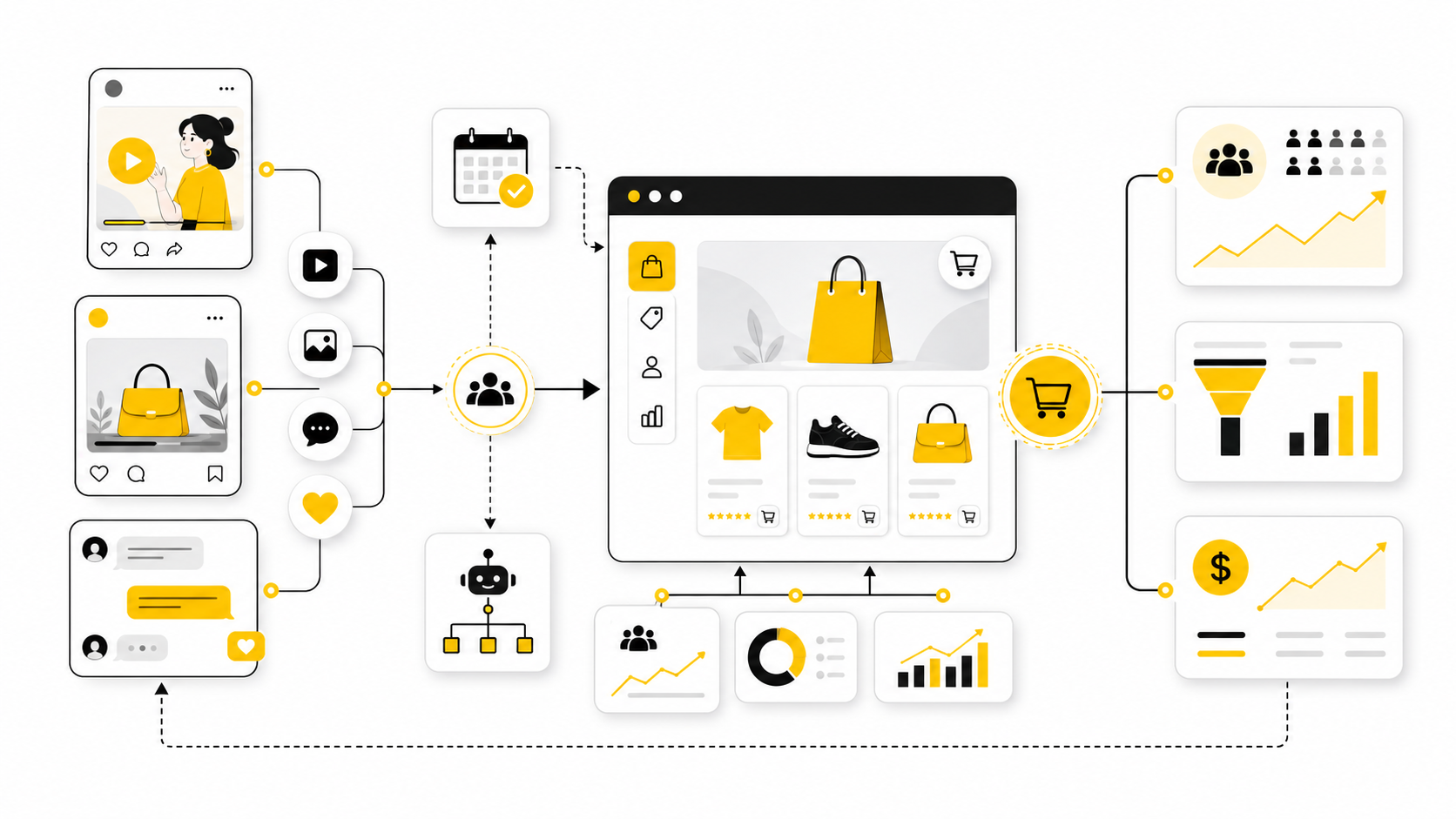
Shopify social media marketing is not about posting more. It is about building a repeatable system that turns discovery, trust, content, community, and conversion into one connected growth engine. When your store...
Affiliate disclosure: this article may include compensated links. Recommendations should still be evaluated against your use case, budget, and current provider terms.
Should you choose Shopify?
Shopify is worth considering when the use case, budget, and implementation effort match what you actually need to do next.
teams that want a practical tool decision without reading another generic feature list
Check ShopifyShopify social media marketing is not about posting more. It is about building a repeatable system that turns discovery, trust, content, community, and conversion into one connected growth engine. When your store, product pages, creative, offers, email flows, and social channels work together, social media stops feeling like a content treadmill and starts behaving like an acquisition and retention channel.
That matters because social media is now one of the places where shoppers discover products, compare options, watch real customers use them, ask questions, and decide whether a brand feels trustworthy. Global social media adoption has continued to grow, with DataReportal reporting that social platforms now reach billions of users worldwide in its Digital 2026 Global Overview Report. Shopify has also kept expanding as a commerce platform, reporting strong 2025 growth in its Q4 2025 financial results, which shows why merchants need marketing systems that can turn attention into measurable revenue.
For Shopify brands, the mistake is treating social media as a separate activity from ecommerce. A TikTok video, Instagram Reel, Pinterest pin, YouTube Short, creator post, Messenger conversation, or paid ad is not just “content.” It is often the first step in a buying journey that should eventually lead to a product page, email signup, SMS opt-in, abandoned cart flow, retargeting audience, post-purchase sequence, or repeat purchase campaign.
this guide is structured as a six-part guide so each piece of the system gets enough space. Part 1 sets the strategy and framework. The remaining parts move from audience and positioning into content, channels, automation, measurement, and scaling.
Why Shopify Social Media Marketing Matters Now
Shopify stores live in a crowded market where shoppers have more choices than ever. A clean theme and a good product are not enough if people never see the brand, understand the offer, or trust the store enough to buy. Social media helps solve that visibility problem, but only when it is used with a clear commercial purpose.
The biggest shift is that social media is no longer just a top-of-funnel awareness tool. Shopify’s own social commerce coverage notes that US social commerce retail earnings were expected to reach nearly $80 billion in 2025, which shows how closely content and buying behavior are now connected through platforms like Instagram, TikTok, YouTube, Pinterest, and Facebook. The point is not that every Shopify merchant should chase every platform; the point is that customers increasingly expect to discover, research, and interact with products before they ever land on a store.
There is also a strategic reason to take this seriously. A 2025 ecommerce study on multi-platform social media strategy found that companies with more diversified social media activity saw higher web sales than those focused on fewer platforms, with the lift tied to repeated exposure across channels in the research summary on arXiv. For Shopify merchants, that supports a practical idea: social media works best when the message is consistent, but the format is adapted to each platform.
The Framework Overview
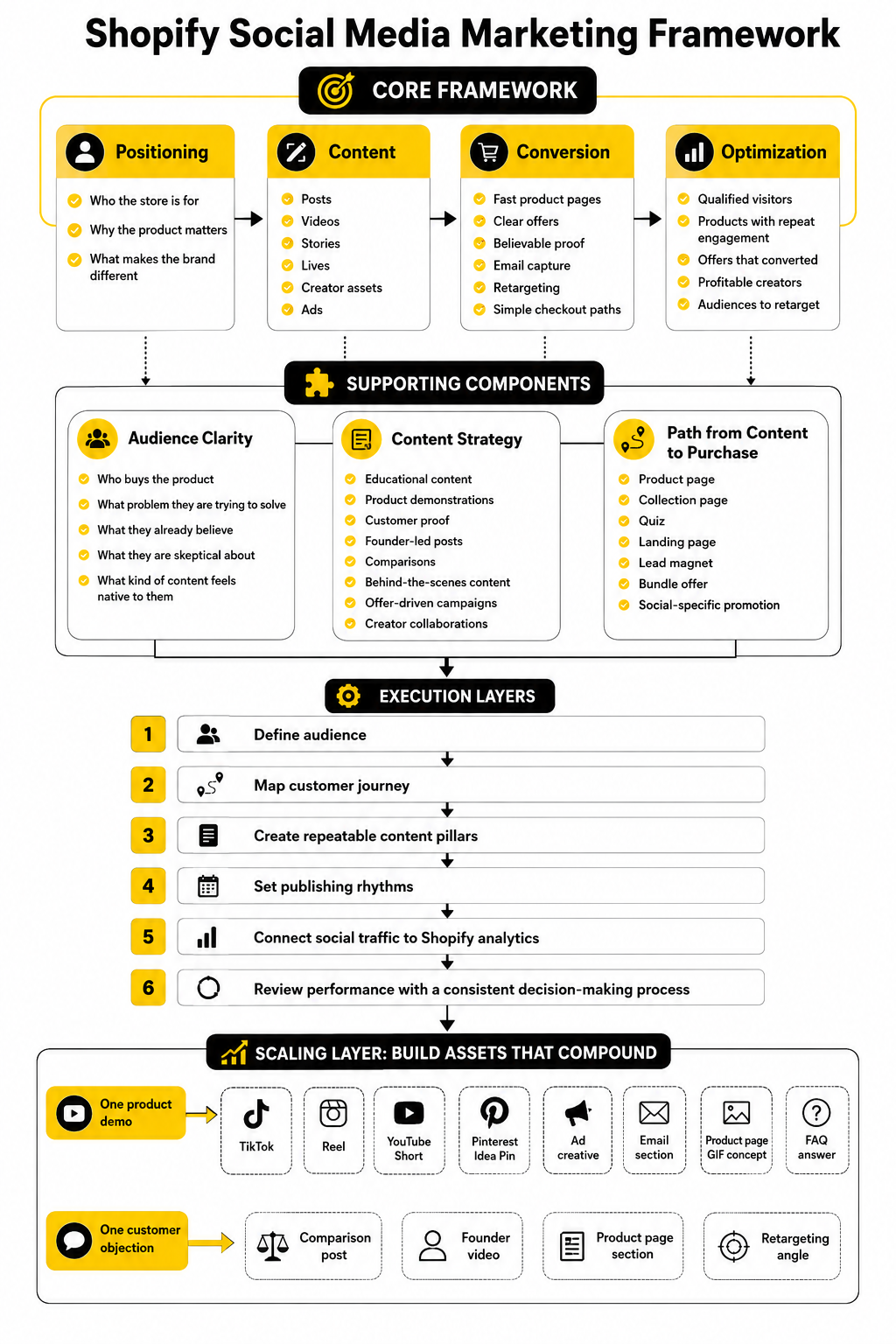
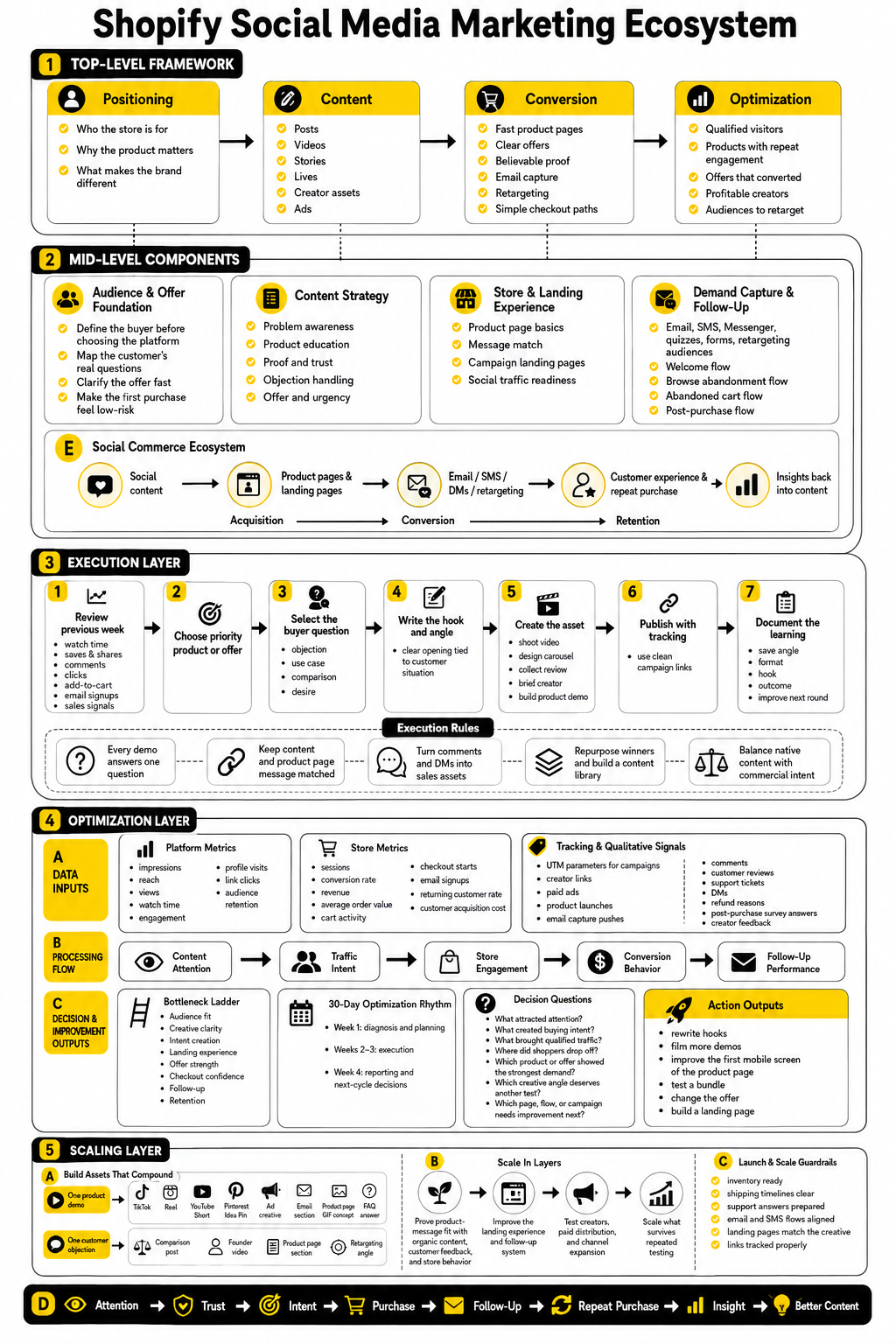
A strong Shopify social media marketing system has four layers: positioning, content, conversion, and optimization. Positioning defines who the store is for, why the product matters, and what makes the brand different. Content turns that positioning into posts, videos, stories, lives, creator assets, and ads that people actually want to engage with.
Conversion is where many brands fall apart. A post may generate attention, but the store still needs fast product pages, clear offers, believable proof, strong email capture, retargeting, and simple checkout paths. Shopify merchants can connect the social journey to owned channels with tools like ManyChat for automated conversations or Buffer for planning and publishing, but the tool only helps when the underlying strategy is clear.
Optimization closes the loop. Instead of asking, “Did this post get likes?” a serious Shopify marketer asks which content brought qualified visitors, which products attracted repeat engagement, which offers converted, which creators drove profitable traffic, and which audiences should be retargeted. That is the difference between social media activity and social media marketing.
Core Components Of A Shopify Social Media Marketing System
The first component is audience clarity. You need to know who buys the product, what problem they are trying to solve, what they already believe, what they are skeptical about, and what kind of content feels native to them. Without that, the brand usually defaults to generic product posts that look like ads and feel easy to ignore.
The second component is content strategy. Good social content does not only show the product; it explains the problem, demonstrates the outcome, reduces doubt, builds familiarity, and gives people reasons to come back. For a Shopify store, that often means mixing educational content, product demonstrations, customer proof, founder-led posts, comparisons, behind-the-scenes content, offer-driven campaigns, and creator collaborations.
The third component is the path from content to purchase. If someone clicks from a Reel, TikTok, pin, YouTube video, or creator post, the landing experience has to match what they just saw. That may mean sending traffic to a product page, collection page, quiz, landing page, lead magnet, bundle offer, or social-specific promotion instead of dumping everyone on the homepage.
Professional Implementation Starts With Systems
Professional implementation means you stop guessing every week. You define the audience, map the customer journey, create repeatable content pillars, set publishing rhythms, connect social traffic to Shopify analytics, and review performance with a consistent decision-making process. This makes the work less emotional because you are no longer judging the brand by one post that did well or badly.
It also means you build assets that compound. One product demo can become a TikTok, Reel, YouTube Short, Pinterest Idea Pin, ad creative, email section, product page GIF concept, and FAQ answer. One customer objection can become a comparison post, a founder video, a product page section, and a retargeting angle.
That is the mindset behind the rest of this guide. Shopify social media marketing is not a pile of disconnected tips. It is a system for attracting the right shoppers, earning trust before the click, improving the buying journey after the click, and using the data to make the next campaign sharper.
Building The Foundation Before You Post
Before you create another post, fix the foundation. Shopify social media marketing works much better when your audience, offer, product pages, tracking, and follow-up system are already aligned. Otherwise, even good content sends people into a weak buying journey, and the problem gets blamed on the platform instead of the system.
This is where many stores waste time. They post consistently, try random trends, change captions, switch hashtags, and test new tools, but they never answer the basic strategic questions. Who is this for? Why should they care now? What proof do they need before buying? What happens after they click?
A strong foundation does not make social media easy, but it makes it far less chaotic. It gives every post a job. It also helps you spot whether the real bottleneck is content quality, offer clarity, landing page performance, audience fit, or follow-up.
Define The Buyer Before Choosing The Platform
The buyer comes before the channel. A skincare brand selling to ingredient-conscious women in their thirties will not communicate the same way as a streetwear brand selling limited drops to Gen Z buyers. Both may use Instagram, TikTok, Pinterest, or YouTube, but the content style, proof, objections, and buying triggers will be different.
Start with the customer’s current situation. What are they trying to improve, avoid, express, replace, simplify, or prove? Shopify social media marketing gets much easier when you understand the emotional and practical reason someone would stop scrolling and pay attention.
Then look at the buying context. Some products are impulse-friendly because the price is low, the outcome is easy to understand, and the visual appeal is immediate. Others need more education, comparison, reviews, demonstrations, or email follow-up before the customer feels ready.
Map The Customer’s Real Questions
Every buyer has questions before they buy. Some are obvious, like price, sizing, shipping, ingredients, compatibility, quality, and returns. Others are quieter, like whether the product will work for someone like them, whether the brand is trustworthy, or whether they will regret the purchase later.
Your content should answer those questions before the customer has to ask. A product demo can answer “how does it work?” A comparison post can answer “why this instead of the cheaper option?” A customer review can answer “do real people like me actually use this?”
This gives you a better content strategy than simply rotating through product photos. You are not just filling a calendar. You are removing friction from the buying decision one post at a time.
Clarify The Offer So People Understand It Fast
A weak offer makes social media work harder than it should. If someone needs ten seconds to understand what the product is, who it is for, and why it is worth buying, you are already losing people. Social platforms move quickly, so the offer has to be clear without sounding cheap or desperate.
That does not mean every post needs to scream a discount. A good offer can be a bundle, starter kit, free shipping threshold, limited drop, quiz recommendation, subscription benefit, bonus item, guarantee, or seasonal campaign. The key is that the customer immediately understands the value.
For Shopify stores, the offer should also match the product page. If a Reel promotes a bundle, the click should not land on a generic homepage. If a creator talks about one specific product benefit, the landing page should reinforce that benefit quickly and clearly.
Make The First Purchase Feel Low-Risk
New customers do not trust your brand as much as you do. That is normal. Your job is to reduce the risk they feel before the first order.
Risk can be reduced with clear return policies, honest reviews, product education, shipping transparency, strong photography, comparison content, and simple support options. It can also be reduced through a first-order offer that makes the initial decision easier without training customers to wait for constant discounts.
This matters because social traffic often includes people who are early in the buying journey. They may like the product, but they still need reassurance. The smoother that reassurance feels, the more useful your social traffic becomes.
Build Content Pillars Around Buying Intent
Content pillars are not just categories for your calendar. They are the recurring themes that help customers move from attention to trust to action. For Shopify social media marketing, the best pillars usually connect directly to product education, customer problems, lifestyle context, proof, and offers.
A simple structure works well. Use one pillar to show the problem, one to demonstrate the product, one to prove the result, one to handle objections, and one to show the brand personality. That gives your content variety without making it random.
This also keeps your team focused. Instead of asking, “What should we post today?” you ask, “Which part of the buying journey needs support?” That one shift improves the quality of your ideas fast.
Use A Practical Content Pillar Mix
A Shopify store can start with five core pillars. Keep them simple enough that anyone on the team can understand them and specific enough that they actually guide content production.
This mix gives the brand enough range to stay interesting. It also prevents the common mistake of posting only polished product shots and then wondering why people are not buying. People need context before they convert.
Prepare The Store For Social Traffic
Social traffic behaves differently from search traffic. Search visitors often arrive with clear intent because they typed a specific query. Social visitors may click because a video caught their attention, which means the Shopify store has to continue the story immediately.
The landing page should feel connected to the content that brought them there. If the post focuses on a pain point, the page should address that pain point near the top. If the post shows a product in use, the page should make that same use case obvious without forcing the shopper to hunt for it.
This is where dedicated landing pages can help. A tool like Replo can be useful when a Shopify brand wants campaign-specific pages for creator traffic, paid social, seasonal offers, or product launches without rebuilding the whole theme every time. The goal is not to make the page fancy; the goal is to make the buying path feel obvious.
Check The Product Page Basics
Your product page does not need to be complicated, but it does need to answer the right questions quickly. A strong page usually explains what the product is, who it is for, what makes it different, what is included, how it works, and why the customer can trust it. It should also make the next step clear on mobile.
Look closely at the first screen on a phone. The product title, image, price, benefit, review signal, variant selector, and add-to-cart path should not feel confusing. Most social traffic will be mobile, so desktop beauty means very little if the mobile experience is slow or unclear.
Also check message match. If your social content says “the easiest way to organize your travel skincare,” the product page should not lead with vague brand language. It should continue the same promise and make the product feel like the natural next step.
Set Up Tracking Before Scaling Content
You cannot improve what you cannot see. Before scaling Shopify social media marketing, make sure your store has clean tracking, clear campaign links, and a basic reporting rhythm. This does not need to be overbuilt, but it does need to be consistent.
Use UTM parameters for campaigns, creators, paid ads, email clicks, and major social pushes. Keep the naming simple so you can compare performance later. If every link is named differently by every person on the team, reporting becomes a mess.
Track more than purchases. Look at sessions, add-to-cart rate, checkout starts, conversion rate, email signups, revenue, average order value, returning customer rate, and assisted performance where possible. A social campaign may not always convert immediately, but it should still create useful signals.
Separate Content Metrics From Business Metrics
Likes, comments, saves, shares, watch time, and clicks matter because they show how people respond to content. But they are not the whole story. A post can get attention and still attract the wrong visitors.
Business metrics tell you whether that attention is useful. Revenue, conversion rate, email capture, cart activity, product page engagement, and repeat purchases show whether your social media is helping the store grow. You need both types of metrics because they answer different questions.
The danger is optimizing only for what the platform rewards. Funny content may get reach, but if it does not connect to the product or audience, it may not help the store. Strong Shopify marketing keeps entertainment, education, and commercial intent in balance.
Capture Demand Instead Of Letting It Disappear
Not every social visitor will buy on the first visit. That is not a failure. It only becomes a failure when you have no way to continue the conversation.
This is why email, SMS, Messenger, quizzes, forms, and retargeting audiences matter. A visitor who is interested but not ready can still become a customer later if you capture demand properly. A visitor who leaves without any follow-up path is usually gone.
For simple lead capture, Fillout can help with quizzes, forms, surveys, and product recommendation flows. For email follow-up, Brevo can support campaigns and automations that keep the relationship moving after the first click. These tools are useful because social attention is temporary, but owned follow-up gives you another chance to convert.
Create A Simple Follow-Up Path
Start with the basics. Build a welcome flow for new subscribers, an abandoned cart flow for shoppers who leave, a browse abandonment flow for product viewers, and a post-purchase flow for new customers. These flows do not need to be aggressive; they need to be helpful and relevant.
The welcome flow should explain the brand, reinforce the offer, show bestsellers, and answer common objections. The abandoned cart flow should remind customers what they considered, reduce friction, and make returning easy. The post-purchase flow should improve the customer experience and encourage repeat buying when the timing is right.
This turns social media into part of a larger system. The post creates attention. The store creates clarity. The follow-up creates another opportunity. That is how you stop depending on one click to do all the work.
Create A Publishing System You Can Actually Maintain
Consistency matters, but only if it is sustainable. A small Shopify team should not copy the posting schedule of a large brand with a full content department. The better approach is to create a realistic rhythm that can be maintained without destroying quality.
Plan content in batches. Shoot multiple product demos in one session, turn customer questions into several posts, repurpose one strong idea across different formats, and keep a simple library of hooks, proof points, objections, and offers. This reduces the daily pressure of starting from zero.
A scheduling tool like Buffer can help keep publishing organized across channels, especially when you are testing multiple platforms. The real benefit is not just scheduling. It is giving the team a calmer workflow so content quality does not collapse when the week gets busy.
Build A Repeatable Weekly Workflow
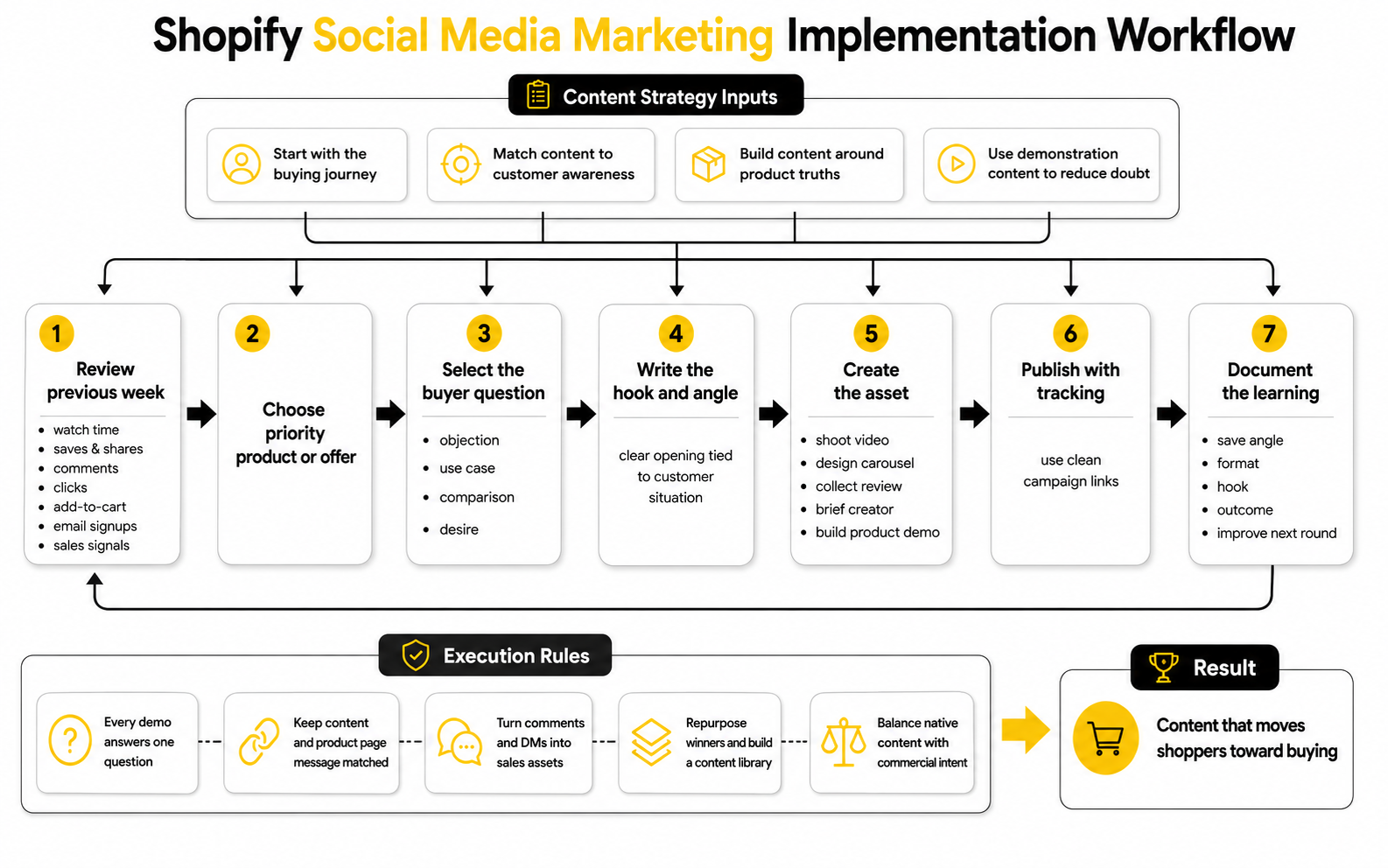
A simple weekly workflow is enough for most stores. Review performance, choose the priority products or offers, plan the content angles, create the assets, schedule the posts, and document what you learned. Keep it boring on purpose.
The workflow should also include time for listening. Read comments, DMs, reviews, support tickets, and customer questions because those are content ideas hiding in plain sight. Your customers will often tell you exactly what they are confused about, excited by, or hesitant to buy.
Once the foundation is in place, the next step is creating content that actually moves people. That is where the work gets more creative, but it should still stay connected to the buying journey. Social content works best when it feels native to the platform and useful to the customer, while quietly doing the commercial job your Shopify store needs it to do.
Creating Content That Moves Shoppers Toward Buying
Once the foundation is clear, content becomes easier to produce and much easier to judge. The question is no longer “What should we post?” The better question is “What does the buyer need to believe, understand, or feel before buying from this Shopify store?”
That is the whole point of this part. Shopify social media marketing should not turn your team into full-time entertainers with no commercial direction. The content should still feel native to the platform, but it also needs to create product understanding, trust, urgency, and desire.
Good content does not force the sale too early. It helps the customer take the next natural step. Sometimes that step is watching another video, saving a post, clicking through to the product page, joining the email list, asking a question, or buying immediately.
Start With The Buying Journey, Not The Content Format
Too many brands start with formats. They ask whether they should make Reels, TikToks, carousels, Shorts, Lives, or creator posts before they know what job the content needs to do. That usually leads to a messy content calendar full of activity but very little direction.
Start with the buying journey instead. A customer may first need to recognize the problem, then understand the product, then compare it with alternatives, then trust the brand, then feel confident enough to buy. Each stage needs different content.
This keeps your Shopify social media marketing from becoming random. A product demo is useful when people do not understand how the product works. A comparison is useful when people are deciding between options. A customer review is useful when the buyer likes the idea but needs proof.
Match Content To Customer Awareness
A cold viewer does not need the same message as someone who has visited the product page three times. Cold viewers usually need relevance and curiosity first. Warm prospects usually need clarity, proof, and reassurance.
For low-awareness audiences, focus on the situation around the product. Show the problem, the moment, the frustration, the desire, or the before-state. This makes the content feel less like an ad and more like something the customer recognizes from their own life.
For high-awareness audiences, be more direct. Show the product, explain the offer, answer objections, compare options, and make the next step obvious. The closer someone is to buying, the less vague your content should be.
Build Content Around Product Truths
The best ecommerce content usually comes from real product truths. What does the product actually do well? What makes it different? What does the customer notice after using it? What objection disappears once they see it in action?
This is much stronger than chasing trends with no connection to the product. Trends can help with packaging, pacing, humor, and reach, but the message still has to be rooted in something real. A trend that gets attention but does not make the product more desirable is not a strategy.
Product truths can come from reviews, support tickets, returns data, customer interviews, founder insight, manufacturing details, ingredient choices, design decisions, or repeated customer questions. These are the raw materials for content that feels specific instead of generic.
Turn Reviews Into Content Angles
Reviews are not just proof. They are research. They show you the words customers use when they describe the product, the result they wanted, and the reason they felt the purchase was worth it.
Look for repeated phrases in your reviews. If several customers mention that a bag fits more than expected, that becomes a content angle. If people keep saying a skincare product feels lightweight, that becomes a demonstration. If customers mention fast setup, durability, comfort, sizing accuracy, or packaging, each one can become its own post.
Do not fake or exaggerate the claim. Use the review to identify the angle, then prove it with honest content. That is how you create posts that feel believable and useful at the same time.
Use Demonstration Content To Reduce Doubt
Demonstration content is one of the most valuable formats for Shopify stores. It shows the product being used, worn, opened, assembled, compared, cleaned, packed, applied, styled, or tested. That matters because buyers often need to see the product in context before they trust the product page.
A good demo does not need expensive production. It needs clarity. Show the product from the customer’s point of view, focus on one use case at a time, and make the benefit obvious without overexplaining.
This is especially useful for products where size, texture, fit, speed, ease of use, or transformation matters. Static product photos can only do so much. Social content can show the moment the product starts to make sense.
Make Every Demo Answer One Question
A weak demo tries to show everything at once. A strong demo answers one specific question. Can it fit in a carry-on? Does it work on curly hair? How fast does it assemble? What does the fabric look like in daylight?
This keeps the content focused. It also makes the hook easier because the question itself can become the opening. Instead of saying “Check out our new product,” say something closer to what the customer is already wondering.
Use simple structures. Show the question, show the product in action, show the result, and give the next step. That is enough for many high-performing ecommerce posts because the customer does not need drama; they need confidence.
Create A Practical Execution Process
The easiest way to make content consistent is to turn it into a repeatable process. You do not need a huge team. You need a clear workflow that helps you move from customer insight to content idea to finished asset to published post to performance review.
The process should be simple enough to run every week. If it takes five meetings, three approvals, and a perfect studio setup, it will break. Shopify brands need a content engine that can move quickly without becoming sloppy.
A practical process also protects the brand from random posting. Every asset should connect to a product, a customer question, a campaign, an offer, or a buying-stage goal. That makes creativity more useful because it is pointed at something measurable.
Follow A Simple Weekly Content Workflow
A weekly workflow gives your Shopify social media marketing structure without making it rigid. It helps the team know what to create, why it matters, and how success will be reviewed. Keep the system tight and repeatable.
This workflow is intentionally simple. The power is not in complexity. The power is in repeating it long enough to see patterns.
Write Hooks That Attract The Right Buyer
The hook is not just a clever first line. It is a filter. It should pull in the people who are likely to care about the product and let everyone else keep scrolling.
A strong hook usually speaks to a problem, desire, belief, mistake, comparison, result, or curiosity gap. For a Shopify store, the best hooks are often specific to the customer’s real situation. “This saves space in your suitcase” is usually stronger than “You need this travel essential.”
Avoid hooks that create attention but disconnect from the product. If the opening promises drama, gossip, or a shocking reveal, but the product has nothing to do with that promise, people may watch but not buy. That is a bad trade when the goal is profitable growth.
Use Clear Hook Categories
You do not need to reinvent hooks every day. Use categories so your team can produce faster without becoming repetitive. The wording can change, but the underlying structure stays useful.
These categories keep content tied to buyer intent. They also make it easier to brief creators, freelancers, and internal team members. Everyone can work from the same strategic language.
Make Product Pages And Content Feel Connected
The content and the product page should feel like one continuous conversation. If a post sells the product through a specific use case, the landing page should support that use case. If the post handles a major objection, the product page should not ignore it.
This is where many campaigns lose money. The social content creates interest, but the landing page feels generic. The buyer clicks because of one promise and lands on a page that starts talking about something else.
You can fix this with better page sections, campaign-specific landing pages, clearer product copy, stronger above-the-fold messaging, and better proof placement. For stores that run creator campaigns or paid social, building dedicated landing pages with Replo can make the journey more consistent from first impression to checkout.
Keep The Message Match Tight
Message match means the promise in the content matches the promise on the page. If the video shows “a desk setup that hides cable clutter,” the landing page should immediately reinforce organization, clean setup, and before-and-after clarity. Do not make the shopper connect the dots alone.
This applies to visuals too. If the content uses creator footage, lifestyle shots, or a specific product bundle, the landing page should reflect that same context where possible. Familiarity reduces friction because the customer feels they arrived in the right place.
This is also useful for testing. When one content angle performs well, you can build a matching page section or landing page around that angle. Now the insight from social media improves the store itself.
Turn Comments And DMs Into Sales Assets
Comments and DMs are not just engagement. They are live customer research. They show what people are confused about, what they want more of, what they do not believe yet, and what might stop them from buying.
Read them carefully. A repeated question in the comments should become a post, a product page section, an email, and maybe even a pinned reply. A strong objection in a DM might reveal a missing detail on the product page.
This is where social media becomes more than broadcasting. It becomes a feedback loop between the market and the store. The brands that listen closely often create sharper content because they stop guessing what customers care about.
Use Automated Conversations Carefully
Automation can help when the same questions appear again and again. For example, a customer may ask about sizing, shipping, restocks, bundles, discount codes, or product recommendations. A good automated flow can answer quickly and move the buyer toward the right next step.
A tool like ManyChat can be useful for comment-to-DM flows, product recommendation paths, launch reminders, and simple customer conversations connected to social campaigns. The key is to keep the experience helpful instead of pushy.
Do not automate everything. Some conversations need a human response, especially when the customer is frustrated, confused, or asking something specific. The best setup uses automation to handle repeatable moments and human support to protect trust.
Repurpose Content Without Making It Feel Lazy
Repurposing is not copying and pasting the same post everywhere. It is adapting one strong idea for different platforms, formats, and customer moments. This lets a Shopify store get more value from each insight without making the brand feel stale.
A single product demo can become a short-form video, a carousel, an email section, a product page clip idea, a paid ad variation, and a creator brief. The core idea stays the same, but the packaging changes. That is smart leverage.
The trick is to respect the platform. A TikTok may need a faster opening and more native pacing. A Pinterest pin may need clearer visual search intent. An Instagram carousel may need a stronger educational sequence. Repurposing works when the idea travels but the format is adjusted.
Build A Content Library
A content library saves time and improves quality. Store hooks, product claims, proof points, objections, demo ideas, creator assets, customer questions, best-performing posts, and campaign learnings in one place. This prevents good ideas from disappearing after one post.
The library also helps new team members and creators understand the brand faster. Instead of briefing from scratch every time, you can show what has worked, what language customers use, and which angles are approved. That makes execution smoother.
Over time, the library becomes one of the brand’s most valuable marketing assets. It shows what the market responds to. It also gives you a stronger starting point for paid ads, email campaigns, landing pages, and future product launches.
Balance Native Content With Commercial Intent
The best Shopify social media marketing does not feel like a catalog feed. It feels useful, interesting, specific, and easy to engage with. But it still has a business purpose.
That balance matters. If every post pushes a sale, the brand becomes easy to ignore. If every post entertains without connecting to the product, the account may grow while revenue barely moves.
Aim for content that earns attention and makes the product easier to buy. Teach something, show something, prove something, compare something, or make the customer feel understood. Then connect that moment to a clear next step.
Know When To Be Direct
Not every post needs to hide the offer. When someone is warm, familiar with the brand, or already engaging with product content, direct selling is appropriate. Launches, bundles, seasonal campaigns, restocks, limited drops, and bestsellers deserve clear promotion.
The mistake is being direct without earning the right to be direct. If the audience has not seen the product, does not understand the value, and has no reason to trust the brand, a sales post will feel premature. But after enough education, proof, and demonstration, direct offers can work extremely well.
This is why the content system matters. Each post does not have to do everything. Some posts attract, some educate, some prove, some answer objections, and some sell. Together, they move the customer forward.
Prepare Content For Channel Selection
Before choosing the exact channel mix, you need content that can travel. Strong product truths, clear hooks, good demonstrations, customer proof, and tight landing page alignment will help on almost any platform. Weak content will struggle no matter where you post it.
That does not mean every platform is the same. TikTok, Instagram, Pinterest, YouTube, Facebook, LinkedIn, and X all reward different behaviors and formats. But the underlying message still needs to come from the buyer and the product.
The next step is choosing where your Shopify store should actually show up. That choice should be based on customer behavior, product fit, creative capacity, and the role each platform plays in the buying journey. Social media works better when every channel has a reason to exist.
Statistics And Data That Actually Matter
Data should make your Shopify social media marketing calmer, not more confusing. The goal is not to collect every possible number from every dashboard. The goal is to understand which signals show attention, which show buying intent, which show revenue impact, and which ones are mostly noise.
This matters because social media metrics can be seductive. A post with high reach can feel like a win even if it sends poor traffic. A post with modest reach can be more valuable if it attracts the right people, drives product page views, creates email signups, or helps retargeting audiences convert later.
The data only becomes useful when it leads to a decision. Keep the content, improve the hook, change the landing page, test a stronger offer, brief more creators, pause the campaign, increase spend, or build a follow-up flow. If a metric does not help you make a better decision, it probably does not deserve much attention.
Start With The Role Of Each Metric
Every metric has a job. Reach tells you how many people saw the content. Watch time tells you whether the creative held attention. Saves and shares suggest that people found the content useful, interesting, or worth returning to.
Clicks show that the content created enough intent for someone to leave the platform. Add-to-cart activity shows stronger product interest. Purchases show that the social journey, landing page, offer, checkout, and follow-up worked well enough to turn attention into revenue.
Do not judge every post by the same metric. A product education post may be successful because it increases saves, comments, and product page visits. A launch post may be judged by revenue, conversion rate, and cost per purchase. A creator post may be judged by both direct sales and the quality of reusable creative assets.
Separate Platform Metrics From Store Metrics
Platform metrics live inside TikTok, Instagram, YouTube, Pinterest, Facebook, or X. These include impressions, reach, views, watch time, engagement, followers, profile visits, link clicks, and audience retention. They are useful because they show how the content performs inside the social environment.
Store metrics live inside Shopify, analytics tools, email platforms, and attribution reports. These include sessions, conversion rate, revenue, average order value, cart activity, checkout starts, email signups, returning customer rate, and customer acquisition cost. These are closer to the money.
You need both views because neither tells the full story alone. Platform data explains whether the content earned attention. Store data explains whether that attention had commercial value. The best decisions happen when you compare the two instead of treating one dashboard as the truth.
Use Benchmarks Without Worshipping Them
Benchmarks are useful for orientation, not for strategy. Shopify notes that a good ecommerce conversion rate depends heavily on context, while average ecommerce conversion rates often sit around the 2% to 3% range. That gives you a rough reference point, but it does not tell you whether your specific product, price, traffic source, country, device mix, or offer should perform above or below that range.
Social traffic often converts differently from search, email, or referral traffic. Someone coming from a high-intent Google search may be much closer to buying than someone who clicked from a funny short-form video. That does not make social traffic bad; it means social media needs the right content, landing page, retargeting, and follow-up system.
Social commerce is also becoming too large to ignore. EMARKETER projects that US social commerce sales will surpass $100 billion in 2026, and Shopify’s social commerce analysis notes that social networks were expected to account for over 17% of total online sales in 2025. The action is not “copy every social trend.” The action is to make social measurable enough that you can see which channels and content types deserve more investment.
Interpret Benchmarks By Product Type
A low-priced impulse product, a premium skincare bundle, a subscription consumable, a custom product, and a high-ticket home item should not be measured in the exact same way. The buying cycle, trust requirement, margin profile, repeat purchase behavior, and customer objections are different. That changes what a “good” number looks like.
For a low-price product, you may care more about click-through rate, conversion rate, and average order value because the purchase decision can happen quickly. For a higher-consideration product, you may care more about email capture, product page engagement, returning visitors, retargeting performance, and assisted conversions. For a repeat-purchase product, first-order profitability may not tell the full story if customer lifetime value is strong.
This is why blind benchmark chasing is dangerous. A 1.5% conversion rate might be weak for one store and acceptable for another if the second store has a higher average order value, stronger margins, and better repeat purchase behavior. The data has to be interpreted through the economics of the business.
Build A Simple Analytics System
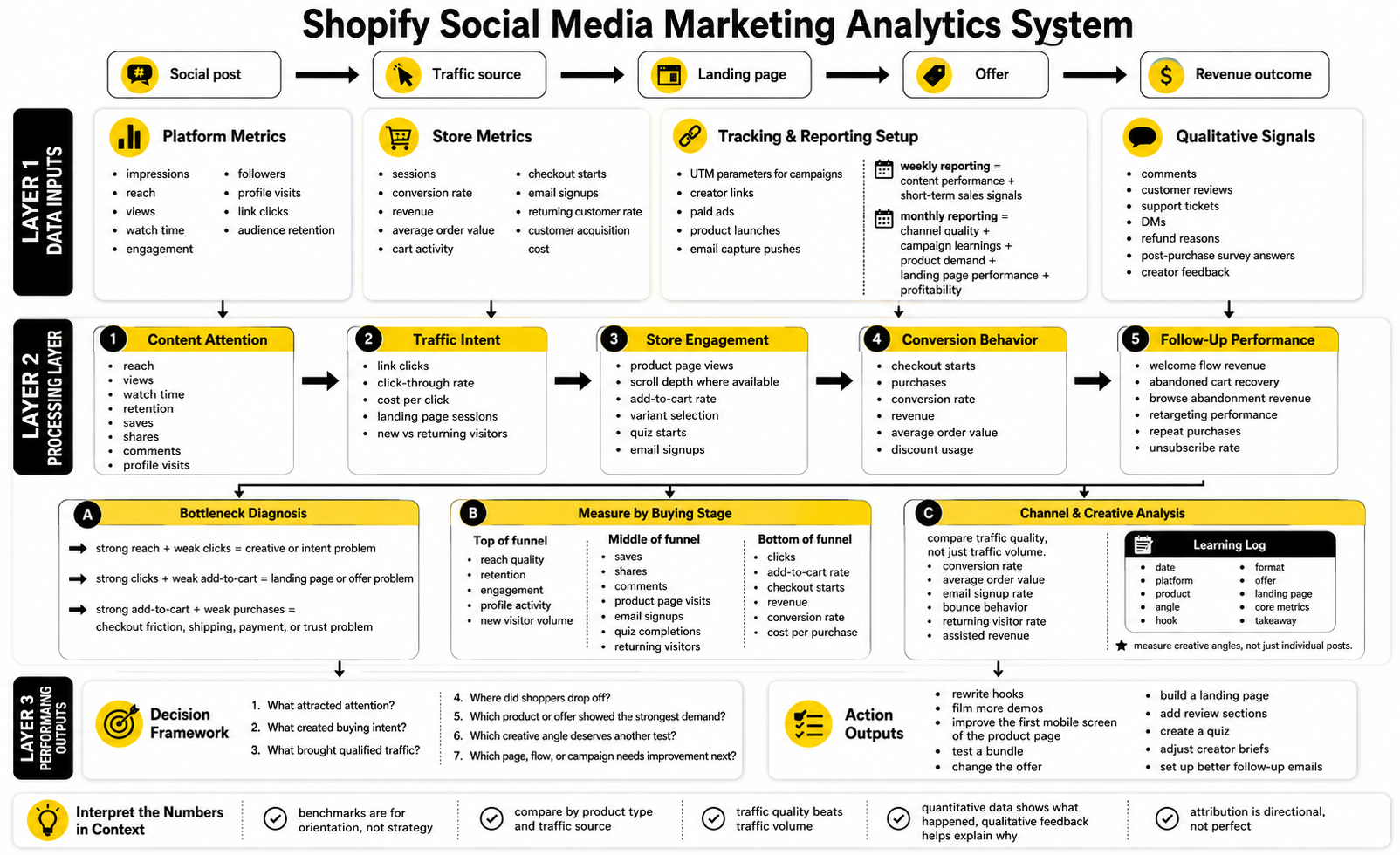
A practical analytics system does not need to be complicated. It should connect the social post, the traffic source, the landing page, the offer, and the revenue outcome. That way, you can see the path from content to purchase instead of staring at disconnected numbers.
Start with consistent campaign naming. Use UTM parameters for major social campaigns, creator links, paid ads, product launches, and email capture pushes. Keep the naming simple enough that the team can actually follow it every week.
Then build a reporting rhythm. Weekly reporting should focus on content performance and short-term sales signals. Monthly reporting should focus on channel quality, campaign learnings, product demand, landing page performance, and whether social media is helping the store grow profitably.
Track The Full Social-To-Store Journey
A good Shopify social media marketing report should follow the customer path. Start with the content, then the click, then the store behavior, then the purchase or follow-up action. This gives you a clearer view of where the system is strong and where it is leaking.
This structure prevents you from blaming the wrong part of the system. If reach is strong but clicks are weak, the creative may not create enough intent. If clicks are strong but add-to-cart is weak, the landing page or offer may be the problem. If add-to-cart is strong but purchases are weak, checkout friction, shipping cost, payment options, or trust may need attention.
Read Performance Signals In Context
No single metric should control the strategy. A high click-through rate can be misleading if the traffic does not convert. A low click-through rate can still be acceptable if the content is building trust with warm audiences or supporting retargeting.
Watch time is powerful because it shows whether people stay with the message. But watch time without buying intent can still become entertainment with no revenue. The best content usually combines retention with relevance, so people not only watch but also understand why the product matters.
Comments are also tricky. A high-comment post can mean strong interest, confusion, controversy, or low-quality debate. Read the comments manually before deciding what they mean. The words people use often matter more than the count.
Diagnose The Bottleneck Before Changing The Strategy
When performance is weak, do not immediately change everything. Find the bottleneck first. A broken landing page will not be fixed by posting more often, and a weak hook will not be fixed by a better abandoned cart email.
If impressions are low, the issue may be creative packaging, platform consistency, posting frequency, or paid distribution. If views are decent but retention drops quickly, the hook or pacing probably needs work. If retention is solid but clicks are low, the product connection or call to action may be unclear.
If clicks are strong but conversion is weak, look at message match, page speed, price clarity, product photos, reviews, shipping costs, and offer strength. If purchases happen but profit is poor, the issue may be discounting, product margin, ad cost, fulfillment cost, or average order value. This is where data becomes practical instead of theoretical.
Measure Content By Buying Stage
A common mistake is expecting every post to drive immediate sales. That sounds disciplined, but it can actually distort the strategy. Some content earns attention, some builds trust, some answers objections, and some closes the sale.
Top-of-funnel content should be measured by reach quality, retention, engagement, profile activity, and new visitor volume. Middle-of-funnel content should be measured by saves, shares, comments, product page visits, email signups, quiz completions, and returning visitors. Bottom-of-funnel content should be measured by clicks, add-to-cart rate, checkout starts, revenue, conversion rate, and cost per purchase.
This makes your reporting fairer and more carefully. A customer education post should not be judged only by direct revenue if its job is to reduce confusion before a launch. A direct offer post should not be praised for likes if it fails to generate buying activity.
Assign A Job Before You Publish
Every post should have a job before it goes live. This does not make content robotic. It makes performance easier to understand.
A post can attract new people, explain a product, prove a claim, handle an objection, promote an offer, collect leads, start conversations, or support retargeting. Once the job is clear, the success metric becomes clearer too. That keeps the team from arguing about the wrong numbers.
For example, a comparison carousel might be judged by saves, shares, comments, and product page clicks. A restock announcement should be judged by clicks, revenue, and conversion rate. A founder video may be judged by retention, comments, and improved trust signals rather than immediate purchases.
Use Channel Data To Decide Where To Focus
Each social channel should earn its place in the strategy. A platform can be valuable because it creates discovery, supports product education, drives direct sales, improves retargeting audiences, helps customer support, or strengthens brand trust. But not every channel deserves the same effort.
For visual discovery products, Pinterest, Instagram, TikTok, and YouTube Shorts may be more useful than text-heavy channels. For products that require education, YouTube, Instagram carousels, TikTok explainers, and email follow-up may carry more weight. For products with strong community behavior, Instagram, TikTok, Facebook Groups, or creator-led content may matter more.
Use data to decide, not ego. If a channel creates poor traffic for three months despite consistent testing, either change the approach or reduce the effort. If a smaller channel consistently attracts better buyers, give it more attention even if it feels less glamorous.
Compare Traffic Quality, Not Just Traffic Volume
Traffic volume can fool you. A channel that sends 20,000 visitors with almost no buying intent may be less valuable than a channel that sends 2,000 visitors who view products, join the email list, and convert later. Quality beats volume when your goal is profitable growth.
Compare channels by conversion rate, average order value, email signup rate, bounce behavior, returning visitor rate, and assisted revenue where possible. Also compare the type of products each channel helps sell. One platform may be great for bestsellers, while another may be better for education-heavy products.
This also helps with budget allocation. If paid social is amplifying creator content, you need to know which creators and angles attract the best traffic, not just the cheapest clicks. Cheap traffic is expensive when it does not buy.
Measure Creative Angles, Not Just Individual Posts
Individual posts matter, but patterns matter more. One post can overperform because of timing, platform randomness, creator fit, or a lucky hook. A repeated creative angle that performs across several posts is much more valuable.
Track angles like “travel organization,” “before-and-after setup,” “ingredient explanation,” “gift guide,” “premium versus cheap,” “customer mistake,” “founder story,” or “how to use it.” Over time, you will see which angles create attention, which create clicks, and which create purchases.
This is especially useful when briefing creators or building paid ads. Instead of saying “make a video about our product,” you can say “our comparison angle consistently creates high-intent clicks, so build your video around that.” That is a much better brief.
Create A Learning Log
A learning log is a simple document where you record what worked, what did not, and what you want to test next. It does not need to be fancy. It just needs to be used consistently.
Include the date, platform, product, angle, hook, format, offer, landing page, core metrics, and takeaway. After a few weeks, the log will show patterns that are hard to see inside platform dashboards. It will also stop the team from repeating failed ideas just because nobody remembers the results.
This is where a scheduler or planning tool can support the process. A platform like Buffer can help organize publishing, while your learning log captures the strategic insight behind the posts. The tool keeps the calendar moving; the log makes the strategy more carefully.
Connect Analytics To Action
Data without action is just decoration. A report should end with decisions, not just screenshots. Keep the action list short enough that the team can actually execute it before the next review.
Useful actions might include rewriting hooks, filming more demos, improving the first mobile screen of a product page, testing a bundle, changing the offer, building a landing page, adding review sections, creating a quiz, adjusting creator briefs, or setting up better follow-up emails. The point is to turn the signal into a next move.
This is where Shopify social media marketing becomes more professional. You stop reacting emotionally to every post and start improving the system piece by piece. The numbers do not replace judgment, but they make your judgment sharper.
Use A Simple Decision Framework
When reviewing performance, ask the same questions every time. This creates discipline and keeps the team from chasing random ideas. The goal is not to make reporting complex; the goal is to make action obvious.
These questions are simple, but they force the right conversation. They connect creative, ecommerce, and revenue instead of treating them as separate worlds. That is what makes the data useful.
Know What The Numbers Cannot Tell You
Analytics will not tell you everything. They can show behavior, but they cannot always explain motivation. They can show that people dropped off, but not always why they hesitated.
That is why qualitative research still matters. Read comments, customer reviews, support tickets, DMs, refund reasons, post-purchase survey answers, and creator feedback. These inputs often explain the numbers better than another dashboard ever will.
The strongest Shopify brands combine both. Quantitative data shows what happened. Qualitative feedback helps explain why. Together, they tell you what to improve next.
Do Not Let Attribution Make You Passive
Attribution will never be perfect, especially across social platforms, mobile browsers, privacy changes, creator content, organic discovery, and delayed purchases. That does not mean you ignore it. It means you use attribution as a guide, not a religion.
Look for directional truth. Did the campaign increase traffic, branded search, email signups, retargeting pool size, product page views, and revenue during the same period? Did a creative angle perform across organic, paid, email, and landing page tests? Did customers mention a creator, video, or platform in surveys?
Those signals matter. You may not always get a perfect line from one post to one purchase, but you can still make smart decisions. The goal is not perfect certainty. The goal is better judgment, stronger execution, and a system that improves every cycle.
Turning Social Attention Into Automated Sales Systems
At this stage, the strategy should be bigger than posting, measuring, and hoping. The real leverage comes when your Shopify social media marketing connects content, conversations, email, retargeting, customer support, product pages, and repeat purchases into one system. That is where a brand becomes harder to copy.
Automation does not mean removing the human touch. It means making sure interested shoppers do not fall through the cracks just because your team is busy, the algorithm shifts, or someone clicked at the wrong time. Good automation protects momentum.
The tradeoff is simple. If you automate too little, social attention disappears too fast. If you automate too aggressively, the brand feels pushy and mechanical. The goal is to build helpful systems that guide people toward the right next step without making the experience feel forced.
Build The Owned Audience Behind The Social Audience
Your social following is useful, but it is not fully yours. Platforms control reach, formats, rules, algorithms, ad costs, and account enforcement. That does not make social media bad; it means you should use it to build assets the business can control more directly.
Email, SMS, customer lists, quiz responses, purchase history, and first-party behavior are more durable. A Shopify store that turns social visitors into subscribers and customers is in a much stronger position than one that only chases views. Social reach can start the relationship, but owned channels help continue it.
This is especially important when content performance becomes unpredictable. One month a format works, the next month reach drops, and the team starts panicking. An owned audience gives the brand more stability because every good social campaign can also grow a list, improve segmentation, and create future revenue opportunities.
Use Lead Capture With A Real Reason
People do not join your list because your popup exists. They join because the reason feels valuable enough. That reason could be a first-order incentive, product quiz, size guide, waitlist, launch alert, educational guide, private drop, bundle recommendation, or back-in-stock notification.
The best lead capture matches the product and the shopper’s buying stage. A quiz can work well when customers need help choosing the right product. A waitlist works well for drops, restocks, or limited collections. A guide works well when the product requires education before purchase.
This is where a tool like Fillout can support quizzes, surveys, product recommendation forms, and customer research flows. The form is not the strategy, though. The strategy is turning social curiosity into useful customer data and a better follow-up path.
Design Follow-Up Around Buying Intent
Not every subscriber should receive the same message. Someone who joined from a product quiz has different intent from someone who entered a giveaway. Someone who clicked from a creator review may need reassurance, while someone who abandoned checkout may need a practical reminder.
Segmenting by intent makes follow-up feel more relevant. You can segment based on product viewed, quiz answer, content source, collection interest, purchase history, cart behavior, or campaign. Even simple segmentation is better than blasting the same message to everyone.
For Shopify social media marketing, this matters because social traffic is often mixed. Some visitors are ready to buy now. Some are curious but cold. Some are comparing options. The follow-up should respect that difference.
Start With Four Core Automations
A Shopify store does not need a complex automation map on day one. It needs the few flows that catch the most common buying moments and support the customer experience. Once those are working, the system can become more advanced.
These flows should not sound like a desperate countdown timer repeated forever. They should be useful, clear, and commercially focused. A good automation makes the shopper feel guided, not hunted.
Use Conversations To Shorten The Buying Path
Social media is not only a publishing channel. It is also a conversation channel. Comments, DMs, story replies, creator questions, and product inquiries can all reveal buying intent before a customer ever reaches checkout.
The challenge is that conversations are hard to manage manually as volume grows. If your team misses questions about sizing, shipping, bundles, restocks, or product fit, you lose sales that were already close. Speed matters, but quality matters too.
A conversation system can answer repeat questions, route shoppers to the right product, collect emails, send reminders, and notify the team when a human response is needed. That is useful because many social buyers want quick answers before they commit.
Automate The Repeatable Questions
Start by identifying the questions that appear again and again. These might include “Which size should I get?”, “Does this ship to my country?”, “When is it back in stock?”, “Is this safe for sensitive skin?”, “Can I buy this as a gift?”, or “Which product is best for beginners?”
Once the repeated questions are clear, create simple flows that answer them directly. A tool like ManyChat can help connect comments, DMs, keywords, and product paths into structured conversations. Used well, this can reduce support load and help buyers move faster.
Do not overbuild the flow. Give people clear choices, short answers, and an easy way to reach a real person. The best automation feels like good service, not a maze.
Think Carefully Before Scaling Paid Social
Paid social can make a working system bigger, but it rarely fixes a broken one. If the offer is weak, the product page is confusing, or the creative does not create buying intent, spending more money usually exposes the problem faster. That can be useful, but it can also be expensive.
The right time to scale paid social is when organic content, creator assets, landing pages, and follow-up flows have already shown useful signals. You want evidence that people care, click, add to cart, subscribe, or buy. Paid distribution then amplifies what the market has already started validating.
The tradeoff is control versus learning speed. Paid campaigns can give you faster data, but they also require cleaner tracking, stronger creative testing, and tighter budget discipline. Do not treat ad spend like a magic lever. Treat it like fuel.
Scale Creative Before Scaling Budget
Most paid social problems are creative problems disguised as media buying problems. If the same few ads are carrying the account, performance will eventually fatigue. If the team cannot produce new angles, hooks, demos, creator clips, and offer variations, budget increases become risky.
Build a creative pipeline before pushing spend aggressively. Use organic performance, customer questions, reviews, and creator content to identify angles worth testing. Then create multiple variations around the same proven idea instead of constantly starting from scratch.
This is also where landing page alignment becomes more important. If a paid ad focuses on a specific use case, the landing page should reinforce it immediately. The more money you spend, the less you can afford a sloppy message match.
Use Creators As A Strategic Channel, Not A Random Tactic
Creator marketing works best when creators are treated as partners in customer education, not just rented attention. A creator can show the product in real life, explain how it fits their routine, answer audience questions, and produce assets the brand can reuse. That can be more valuable than a single sponsored post.
The risk is choosing creators only by follower count. A smaller creator with a trusted niche audience, strong video skill, and real product fit can outperform a larger creator with weak relevance. Audience quality matters more than surface-level popularity.
For Shopify social media marketing, creator briefs should be clear but not suffocating. Give creators the product truth, customer insight, required claims, usage guidance, and key objections. Then leave room for their voice, because that is what their audience trusts.
Build Creator Briefs Around Angles
A useful creator brief should not just say, “Please make a video about this product.” That is lazy and usually produces generic content. The brief should give the creator a specific angle to explore.
Good angles might include a first-use reaction, problem-and-solution demo, comparison against an old habit, routine integration, gift use case, packing test, durability test, styling idea, or honest objection handling. The angle gives the content a purpose. The creator gives it personality.
Also decide whether the content is meant for organic posting, whitelisted ads, product page assets, email creative, or all of the above. Usage rights matter. If you plan to reuse creator content in ads or on landing pages, handle that clearly before the campaign starts.
Protect Brand Trust While Chasing Growth
Growth tactics can damage trust when they are used carelessly. Fake scarcity, exaggerated claims, aggressive discounting, misleading before-and-after content, spammy DMs, and low-quality creator partnerships can create short-term clicks while weakening the brand. That tradeoff is not worth it.
Trust is especially important for Shopify stores because many visitors are encountering the brand for the first time through social media. They are looking for signals that the store is real, the product is legitimate, and the experience will be safe. If anything feels off, they leave.
This is why clear policies, real reviews, honest product demonstrations, transparent shipping information, and consistent messaging matter. They are not boring details. They are conversion assets.
Avoid Overpromising In Content
A strong claim can help a product stand out, but an unsupported claim creates risk. Be careful with health, beauty, financial, performance, environmental, and transformation claims. If the product cannot consistently deliver the promise, do not build the content around it.
This also applies to creator content. Creators may naturally use dramatic language, but the brand still needs guardrails. Give them clear guidance on what they can say, what they should avoid, and which claims need proof.
The practical rule is simple. Make the product desirable without making the customer feel tricked later. A disappointed customer costs more than a missed click.
Manage Discounts Without Training Bad Behavior
Discounts can work, but they are not a strategy by themselves. If every social campaign depends on a bigger discount, customers learn to wait. Margins shrink, urgency weakens, and the brand becomes harder to position at full value.
Use discounts intentionally. A first-order incentive, bundle savings, seasonal campaign, VIP drop, or launch offer can make sense. Constant random couponing usually does not.
There are other ways to increase conversion without cutting price. You can improve product education, add bundles, strengthen reviews, clarify shipping, offer gifts with purchase, improve page speed, create better landing pages, or build stronger follow-up flows. Sometimes the discount is not the problem. The buying path is.
Use Offers To Shape Customer Behavior
An offer should encourage the behavior you want. If you want a higher average order value, a bundle or free shipping threshold may be more carefully than a flat discount. If you want repeat purchases, a subscription benefit or post-purchase incentive may be better than a one-time coupon.
If you want customers to try a new product, a starter kit can reduce hesitation. If you want to create urgency around limited inventory, a waitlist or early-access campaign can work better than shouting “sale” all the time. The offer should match the business goal.
This is where a funnel builder like ClickFunnels or a leaner system like Systeme.io may fit specific campaign needs outside the standard Shopify store experience. Use them when the campaign needs a focused path, not because every product needs a complicated funnel.
Watch For Operational Bottlenecks
Marketing can create demand faster than operations can handle it. That sounds like a good problem, but it can become ugly quickly. Late shipments, stockouts, poor support response, unclear tracking, and rushed fulfillment can turn a successful campaign into a trust problem.
Before scaling a social campaign, check inventory, shipping capacity, support coverage, return handling, product documentation, and customer communication. If a creator post or paid campaign suddenly works, the store needs to deliver. The customer does not care that the marketing team was excited.
This is where social media connects directly to operations. A viral product demo can expose weak inventory planning. A successful launch can overwhelm support. A high-volume sale can reveal packaging or fulfillment issues.
Build A Launch Readiness Checklist
A launch or campaign should not go live just because the content is ready. The store, team, and systems need to be ready too. A simple checklist can prevent avoidable problems.
This is not glamorous work, but it matters. Scaling is not just getting more reach. Scaling is making sure the business can absorb more demand without breaking the customer experience.
Decide What To Keep In-House And What To Outsource
As Shopify social media marketing grows, the team has to decide what should stay internal and what can be outsourced. This is a strategic decision, not just a budget decision. Some work requires deep brand knowledge, while other work can be handled well by specialists.
Brand positioning, customer insight, offer strategy, product knowledge, and final creative judgment usually need strong internal ownership. Content editing, paid media buying, creator sourcing, landing page building, analytics setup, and automation implementation may be outsourced when the right systems are in place. The problem comes when a brand outsources strategy before it understands its own customer.
A good partner can speed things up. A weak partner can create noise, generic content, and expensive confusion. The clearer your internal strategy is, the easier it is to manage outside help.
Keep The Customer Voice Close
Even if you outsource production, do not outsource customer understanding completely. Your team should still read reviews, comments, support tickets, DMs, post-purchase surveys, and refund reasons. That is where the best content and offer insights come from.
If an agency or freelancer never hears the customer’s real words, the content often becomes polished but empty. It may look professional while missing the emotional trigger that makes someone buy. That is a silent performance killer.
Keep a shared customer insight document and update it regularly. Give creators, editors, media buyers, and landing page builders access to the same core insights. Everyone should understand what the customer wants, fears, doubts, and values.
Use AI Without Letting The Brand Sound Generic
AI can help speed up social media workflows. It can summarize reviews, group customer objections, generate hook variations, outline creator briefs, repurpose content, and help organize campaign ideas. Used well, it saves time and gives the team more creative options.
The risk is sameness. If every caption, hook, and carousel sounds like generic AI marketing copy, the brand loses its edge. Shopify shoppers do not need more bland content. They need useful, specific, believable communication.
Use AI as an assistant, not the voice of the brand. Feed it real customer language, product details, review themes, support questions, and brand positioning. Then edit hard. The final content should sound like a human who understands the product and the buyer.
Automate Research, Not Judgment
AI can help find patterns, but it should not make strategic decisions alone. It can show that customers often mention sizing, but the team still needs to decide whether the solution is a new product page section, a sizing video, a quiz, or a creator demo. Judgment still matters.
The same applies to performance analysis. AI can summarize which posts performed well, but the team must interpret why. Was it the hook, the product angle, the creator, the offer, the timing, or the landing page?
A tool like Chatbase can support customer-facing answers or internal knowledge workflows when the brand has enough documented information to make responses useful. But the quality of the output depends on the quality of the inputs. Bad documentation creates bad automation.
Build A Scaling Model That Fits The Business
Scaling does not mean doing more of everything. It means identifying what works, protecting what makes it work, and expanding it without losing efficiency. That requires discipline.
For one store, scaling may mean more creator content and better paid amplification. For another, it may mean improving email capture and lifecycle marketing. For another, it may mean building landing pages for each product category, expanding to Pinterest, or turning a strong organic series into ads.
The right scaling model depends on margin, inventory, content capacity, product complexity, customer lifetime value, and operational strength. Do not copy a brand with different economics. Copy the thinking, not the tactics.
Scale In Layers
A smart scaling path usually moves in layers. First, prove product-message fit with organic content, customer feedback, and store behavior. Then improve the landing experience and follow-up system. Then test creators, paid distribution, and channel expansion.
After that, scale what survives repeated testing. Increase budget on proven angles. Brief more creators around winning concepts. Build better landing pages for high-performing campaigns. Add automation where repeated behavior shows demand.
This layered approach reduces waste. It also keeps the business from becoming dependent on one platform, one creator, one ad, or one offer. That matters because any single channel can change quickly.
Prepare For The Final Optimization Loop
By now, the system has several moving parts: content, channels, analytics, automations, creators, offers, landing pages, support, and operations. The final step is learning how to optimize all of it without creating chaos. That is where many brands either become disciplined or get stuck.
The key is to make optimization routine. Do not wait for a crisis to review performance. Do not rebuild the whole strategy every time one campaign underperforms. Improve the system in focused cycles.
The next part closes the article by bringing the measurement, optimization, scaling, and FAQ pieces together. The goal is simple: make Shopify social media marketing feel less like guessing and more like a repeatable growth process.
Measuring, Optimizing, And Scaling Your Social Media Marketing
The final stage is not about adding more tactics. It is about turning everything into a repeatable optimization loop. Shopify social media marketing works best when the team can look at the whole system, find the weakest point, improve it, and repeat that process without constantly starting over.
This is where the strategy becomes mature. Content is no longer judged in isolation. Landing pages are no longer treated as static. Email flows, creator briefs, product positioning, offers, and customer support all become part of the same revenue system.
The brands that win here are not always the loudest. They are the brands that learn faster, document what they learn, and make sharper decisions each cycle. That is less glamorous than chasing the newest platform feature, but it is much more profitable.
Build The Final Social Commerce Ecosystem
A complete Shopify social media marketing ecosystem has several connected parts. Social content creates discovery and demand. Product pages and landing pages turn that interest into clarity. Email, SMS, DMs, and retargeting continue the conversation when people are not ready to buy immediately.
Then the customer experience feeds the next cycle. Reviews, support questions, returns, post-purchase surveys, and repeat purchase behavior all create insight for future content. This is how the system compounds instead of resetting every week.
The goal is not to make everything complicated. The goal is to make every part of the journey support the next part. When that happens, your social content does not have to carry the entire business on its back.
Connect Acquisition, Conversion, And Retention
Acquisition gets people into the brand’s world. Conversion helps them make a confident first purchase. Retention turns that first purchase into a stronger customer relationship.
Most Shopify stores focus too heavily on acquisition because it feels visible. More views, more followers, more creators, more ads, more posts. But if conversion and retention are weak, acquisition becomes expensive fast.
A healthier model looks at the whole customer path. A social campaign that brings fewer visitors but more repeat buyers can be more valuable than a viral post that brings thousands of low-intent clicks. That is the kind of judgment the final ecosystem needs.
Optimize In Focused Cycles
Optimization should happen in cycles, not random reactions. Pick one major bottleneck, improve it, measure the change, and then move to the next bottleneck. This protects the team from changing too many things at once and learning nothing.
For example, one cycle might focus on improving hooks for product education videos. Another might focus on building landing pages for creator traffic. Another might focus on improving abandoned cart recovery after social campaigns. Each cycle has a clear target.
This makes progress easier to track. If everything changes at once, you cannot tell what worked. If one part changes at a time, the system teaches you.
Use A 30-Day Optimization Rhythm
A 30-day rhythm works well for many Shopify brands because it gives enough time to test without dragging decisions forever. The first week can focus on diagnosis and planning. The second and third weeks can focus on execution. The fourth week can focus on reporting and next-cycle decisions.
Keep the cycle specific. Do not set a vague goal like “improve social.” Set a focused goal like “increase product page click-through from demonstration content” or “improve conversion rate from creator landing pages.” Specific goals create specific action.
This rhythm also helps with accountability. The team knows what is being tested, why it matters, and what decision will be made afterward. That is how a messy marketing operation becomes a real growth process.
Improve The Customer Journey One Constraint At A Time
Every Shopify store has constraints. Some have weak creative. Some have unclear offers. Some have poor landing pages. Some have low repeat purchase rates. Some have operational issues that marketing keeps exposing.
The smart move is not to fix everything at once. Find the constraint that creates the biggest drag on growth and work there first. If the content does not create enough qualified clicks, fix content. If traffic is strong but conversion is weak, fix the page or offer. If first purchases are fine but repeat buying is poor, fix retention.
This is practical and important. A team with limited time needs leverage. Fixing the right constraint can improve the whole system faster than making small changes everywhere.
Use The Bottleneck Ladder
A simple bottleneck ladder helps you decide what to fix next. Move through it in order and look for the first weak point. That is usually where the next improvement should happen.
This ladder keeps the conversation grounded. Instead of guessing, you locate the weakest link. Then you fix that link before moving on.
Know When To Add More Channels
More channels can create growth, but they also create complexity. Every platform needs content adaptation, audience understanding, reporting, and operational attention. Adding a channel before the current system works can spread the team too thin.
A new channel makes sense when there is a clear strategic reason. Maybe Pinterest fits a visual product with search-driven discovery. Maybe YouTube supports a product that needs education. Maybe TikTok gives the brand strong creator leverage. Maybe Instagram remains the best place for community, proof, and customer conversations.
Do not add a platform just because competitors are there. Add it because your customer is there, your product can be shown well there, and your team can support it consistently.
Expand From A Proven Content Core
The safest way to expand is to start with a proven content core. If demos, comparisons, creator reviews, or educational posts already work on one platform, adapt those ideas for another platform. Do not begin from zero when you already have market feedback.
This is different from duplicating posts blindly. A winning TikTok concept may need a different edit for Instagram Reels, a different structure for YouTube Shorts, and a different visual layout for Pinterest. The core idea travels, but the execution changes.
Expansion should also be measured separately. A new platform needs enough testing time to be judged fairly, but not unlimited patience. Give it a clear role, a realistic test window, and a decision point.
Keep The Brand Human As The System Grows
The more advanced the system becomes, the easier it is to sound mechanical. Dashboards, automation, templates, workflows, AI tools, and content calendars are useful. But customers still buy from brands that feel trustworthy, specific, and human.
This matters even more as social platforms become crowded with generic content. If your posts sound like everyone else, your product pages say nothing specific, and your emails feel automated in the worst way, the customer has no reason to remember you. Efficiency should not erase personality.
Keep the human layer visible. Founder commentary, real customer language, behind-the-scenes details, honest product education, creator voices, and useful support all help the brand feel alive. That is hard to fake.
Protect The Customer Experience At Scale
Scale should improve the customer experience, not weaken it. If automation answers faster, great. If it traps people in irrelevant flows, fix it. If creator content brings demand, great. If the store cannot ship on time, slow down and repair the operation.
The customer does not separate marketing from fulfillment, support, product quality, and returns. To them, it is one brand experience. That means every growth decision has to respect the full journey.
This is the final expert-level point: social media does not save a weak business. It amplifies what is already there. Build something worth amplifying.
What is Shopify social media marketing?
Shopify social media marketing is the process of using platforms like TikTok, Instagram, YouTube, Pinterest, Facebook, and creator channels to attract shoppers, build trust, drive traffic, and increase sales for a Shopify store. It includes organic content, paid social, creator partnerships, social commerce features, community engagement, DMs, retargeting, and follow-up through email or SMS. The best version is not just posting; it is connecting social attention to the entire buying journey.
Which social media platform is best for Shopify stores?
The best platform depends on your product, audience, content capacity, and buying journey. TikTok and Instagram are often strong for visual discovery and short-form video, Pinterest can work well for visual search and planning behavior, YouTube is useful for education and demonstration, and Facebook can still matter for retargeting, groups, and older buyer segments. The right answer is the platform where your customers already spend time and where your product can be shown clearly.
How often should a Shopify store post on social media?
A Shopify store should post as often as it can maintain quality, consistency, and strategic focus. For many small teams, that may mean a few strong posts per week on one or two priority platforms instead of daily posting everywhere. A sustainable rhythm beats an aggressive schedule that collapses after two weeks.
What kind of content works best for Shopify social media marketing?
The best content usually helps shoppers understand the product, trust the brand, and imagine themselves using it. Product demonstrations, customer proof, comparisons, problem-solution videos, creator reviews, founder-led explanations, objection-handling posts, and offer-driven campaigns can all work well. The format matters, but the angle matters more.
Should Shopify brands use influencers or creators?
Yes, when the creator has real audience fit, strong content skill, and a believable connection to the product. Creator marketing is risky when brands choose people only by follower count or force generic scripts that do not match the creator’s voice. A better approach is to brief creators around specific product angles, customer questions, and usage moments while giving them room to sound natural.
How do you measure social media success for a Shopify store?
Measure social media by the job each piece of content is supposed to do. Awareness content may be judged by reach, retention, saves, shares, and profile activity. Conversion content should be judged by clicks, add-to-cart rate, checkout starts, revenue, conversion rate, and customer acquisition cost. The strongest reporting connects platform metrics with Shopify store behavior.
What is a good conversion rate for Shopify social traffic?
There is no universal number because traffic source, price, product type, offer, device mix, and brand trust all change the result. Shopify’s ecommerce conversion guidance explains that average conversion rate benchmarks often sit around the 2% to 3% range, but social traffic may perform above or below that depending on intent and landing page quality. Use benchmarks for context, then focus on improving your own baseline.
How can Shopify stores turn social followers into customers?
Turn followers into customers by creating content that answers buying questions, sending traffic to relevant product pages or landing pages, capturing email or SMS leads, using retargeting, and building follow-up flows. The customer should not have to figure out the next step alone. Make the path from interest to purchase clear and low-friction.
Do Shopify stores need paid ads for social media marketing?
Paid ads are not required at the beginning, but they can help scale what already works. Organic content and creator testing can reveal which angles, hooks, products, and offers create demand. Paid social can then amplify the best-performing ideas. Spending money before the offer, creative, landing page, and follow-up system are ready usually makes the problems more expensive.
How important are landing pages for Shopify social campaigns?
Landing pages are extremely important when the social content has a specific promise, use case, creator angle, or offer. A generic homepage often breaks the momentum created by a strong post. A focused product page or campaign landing page can continue the story, reduce confusion, and make buying easier.
Should Shopify brands automate DMs and comments?
Automation can be useful when it answers repeat questions, sends product recommendations, collects emails, shares restock alerts, or routes shoppers to the right page. It becomes a problem when it feels spammy, irrelevant, or impossible to escape. Use automation for repeatable moments and keep human support available for specific or sensitive questions.
How long does it take for Shopify social media marketing to work?
Some campaigns can produce quick sales, especially with a strong product, clear offer, good creative, and warm audience. A durable system usually takes longer because the brand needs time to test content angles, understand customer objections, improve landing pages, build follow-up flows, and identify profitable channels. The goal is not one lucky viral post. The goal is a repeatable process that improves over time.
What are the biggest mistakes Shopify stores make on social media?
The biggest mistakes are posting without a strategy, copying trends that do not fit the product, ignoring the landing page, measuring only likes, using weak offers, failing to capture leads, and scaling paid ads before the system is ready. Another major mistake is treating social media as separate from the store. Social content, product pages, email, support, and operations all affect performance.
Can a small Shopify store compete with bigger brands on social media?
Yes, but it needs focus. A small store can compete by being more specific, more personal, faster at testing, closer to customers, and better at using real product insight. Big brands may have bigger budgets, but small brands can often move faster and sound more human.
Build a stronger local presence with BAAM AI
Turn your website, Google profile, social channels, and AI visibility into one growth engine
Most businesses do not need more random marketing activity. They need a consistent presence system that helps the right people find them, trust them, and take action. BAAM AI brings strategy, local SEO, website updates, Google Maps visibility, social content, AI-search readiness, media production, and reporting into one practical monthly engine.
If you want your marketing to keep working after the campaign ends, start with a free BAAM AI presence audit. See how your business shows up today and where the fastest visibility wins are at BAAM AI.