
BAAM AI Blog
Shopify Copywriting: A Practical Framework For Turning Store Traffic Into Buyers
Shopify copywriting is not just writing nicer product descriptions. It is the work of turning product value, customer research, brand positioning, search intent, objection handling, and conversion strategy into words...
Affiliate disclosure: this article may include compensated links. Recommendations should still be evaluated against your use case, budget, and current provider terms.
Should you choose Shopify?
Shopify is worth considering when the use case, budget, and implementation effort match what you actually need to do next.
teams that want a practical tool decision without reading another generic feature list
Check ShopifyShopify copywriting is not just writing nicer product descriptions. It is the work of turning product value, customer research, brand positioning, search intent, objection handling, and conversion strategy into words that help shoppers make confident buying decisions.
That matters because Shopify stores rarely fail from a lack of buttons. They fail because the page does not make the value clear enough, fast enough, or specifically enough. A product page can have beautiful images, a clean theme, and plenty of traffic, but if the copy leaves shoppers wondering “Is this for me?”, “Why this one?”, “Will it work?”, or “Can I trust this brand?”, the sale is already slipping away.
Good Shopify copywriting sits between ecommerce UX, CRO, SEO, and brand strategy. Shopify’s own guidance on conversion copywriting frames it as customer research and focused messaging that moves people toward action, while its product detail page guidance makes clear that PDPs need product descriptions, images, pricing, reviews, and calls to action working together. Baymard’s product page UX research also shows how much opportunity still exists, with only 48% of leading desktop ecommerce sites and 38% of mobile sites reaching “decent” or “good” product page UX performance.
this guide is built as a six-part framework for writing Shopify copy that sounds human and sells without sounding desperate. We will look at the role of copy across the store, the research behind strong messaging, the page-level structure that helps shoppers decide, and the implementation process that makes copy consistent across products, collections, landing pages, ads, email, and retention flows.
Why Shopify Copywriting Matters
Shopify copywriting matters because ecommerce shoppers are usually comparing, skimming, doubting, and deciding at the same time. They are not reading your store like a brochure. They are moving through a decision, and every headline, product description, benefit bullet, review prompt, size note, shipping line, and CTA either lowers friction or adds more of it.
The numbers make this practical, not theoretical. Shopify reports that average ecommerce conversion rates often sit around 2.5% to 3%, while IRP Commerce’s March 2026 ecommerce benchmark shows an average conversion rate of 1.64% for its tracked ecommerce market. Even when benchmarks vary by industry, price point, device, traffic source, and brand strength, the lesson is the same: most visitors do not buy, so the words on the page need to do serious work.
The copy also has to work harder because Shopify is no longer a tiny-store platform. Shopify reported 2025 GMV of $378.4 billion, which means buyers are used to seeing everything from solo-founder stores to enterprise-level commerce experiences on the same platform. That raises the standard. A generic product description that reads like a supplier catalog is not just boring; it makes the store feel less trustworthy than the alternatives one tab away.
Strong Shopify copywriting helps close that trust gap. It clarifies who the product is for, what problem it solves, why the product is different, what the buyer gets, what could go wrong, and why the next step is safe. That does not mean every page needs loud persuasion or fake urgency. It means the copy should remove uncertainty before uncertainty becomes abandonment.
The Shopify Copywriting Framework
Shopify copywriting works best when it follows a repeatable framework instead of relying on inspiration. The framework here is simple: understand the buyer, define the offer, structure the page, handle objections, guide the action, and improve the copy based on behavior. That gives you a practical system for writing one product page or improving a full catalog without losing consistency.
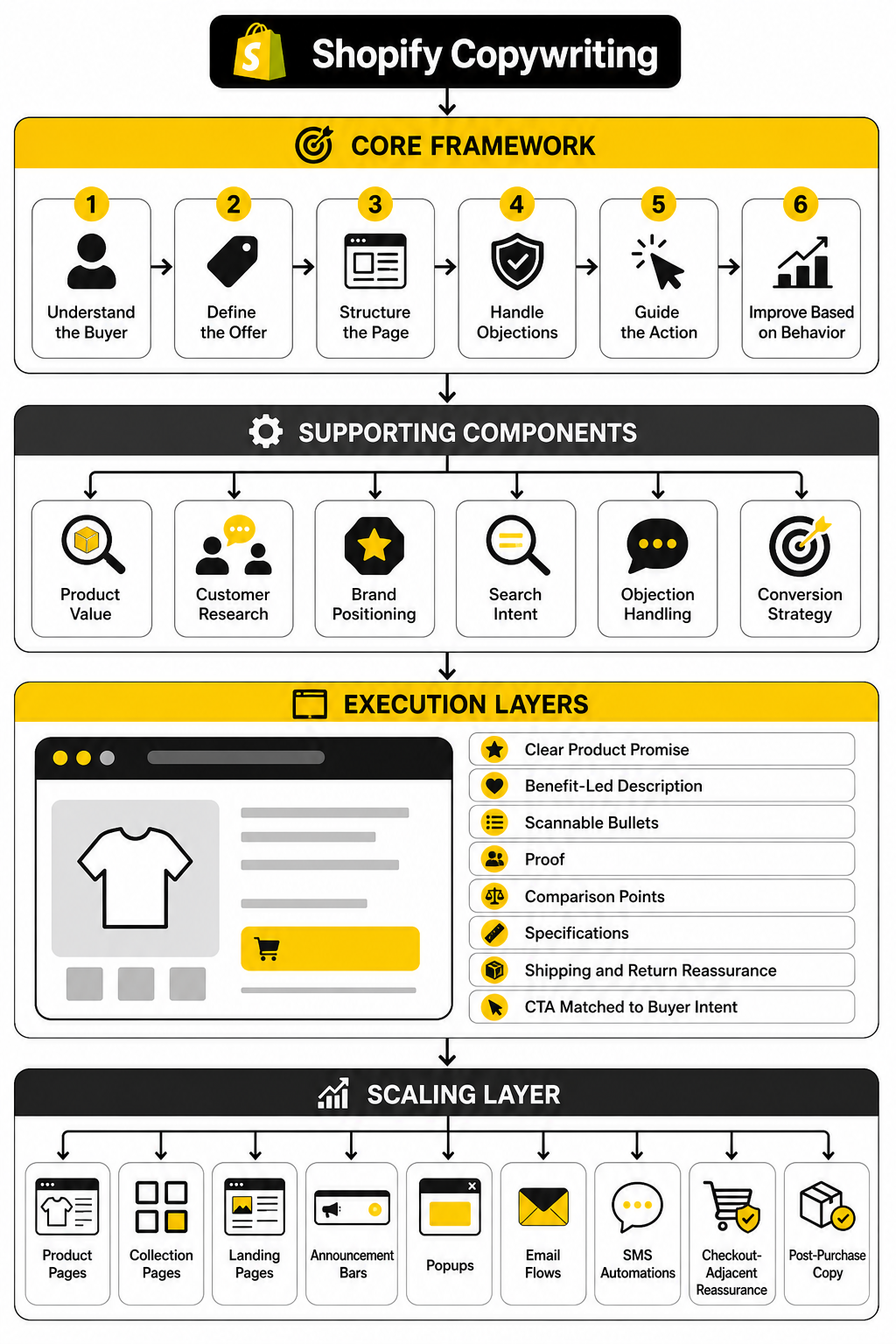
The framework begins with research because the best copy usually comes from the customer’s language, not the brand’s internal vocabulary. Reviews, support tickets, live chat transcripts, post-purchase surveys, search queries, competitor pages, and product usage patterns all reveal what buyers care about before they buy. Nielsen Norman Group’s ecommerce research emphasizes giving customers product information at the right time and level of detail, which is exactly what Shopify copy needs to do.
The next layer is structure. A Shopify page has to communicate quickly above the fold, explain deeply enough for serious buyers, and keep the purchase path visible without making the page feel pushy. That usually means a clear product promise, benefit-led description, scannable bullets, proof, comparison points, specifications, shipping and return reassurance, and a CTA that matches the buyer’s level of intent.
Finally, the framework has to be implemented across the store, not trapped on one hero section. Product pages, collection pages, landing pages, announcement bars, popups, email flows, SMS automations, checkout-adjacent reassurance, and post-purchase copy all shape how confident the shopper feels. For teams building more advanced Shopify landing pages, tools like Replo can support faster page implementation, but the page builder does not replace the strategy. The copy still needs to carry the offer.
The Shopify Copywriting Framework
The easiest mistake in Shopify copywriting is starting with the page instead of the buyer. A product page is only the visible layer. Underneath it, you need a clear view of who the customer is, what they are trying to solve, what makes the product believable, and what might stop them from buying.
That is why the framework starts before the first headline. You are not just filling empty theme sections with words. You are building a decision path that helps the right shopper move from interest to confidence without feeling pushed.
A practical Shopify copywriting framework has six moving parts:
Each part has a different job. Buyer clarity tells you what to say. Offer positioning tells you why the product deserves attention. Page structure decides where each message should appear. Objection handling removes doubt. Action guidance makes the next step obvious. Continuous improvement keeps the copy from going stale after launch.
Buyer Clarity
Buyer clarity means knowing who the product is actually for, not who the brand hopes will buy it. This sounds basic, but it is where many Shopify stores lose their edge. When the copy tries to speak to everyone, it usually becomes too vague to persuade anyone.
Good buyer clarity starts with the customer’s current situation. What are they frustrated by? What have they already tried? What do they believe they need, and what do they not understand yet? The copy should meet them at that point instead of jumping straight into features.
For example, a skincare store should not only know that the buyer wants “hydrated skin.” It should understand whether the buyer is worried about sensitivity, breakouts, aging, price, ingredient safety, or whether the product will fit into an existing routine. Those are different buying situations, and each one needs different copy.
This is where customer language becomes valuable. Reviews, support messages, surveys, social comments, and live chat transcripts often reveal the exact words buyers use when they describe the problem. Your job is not to copy those words blindly. Your job is to notice the patterns and turn them into clear, useful messaging.
Offer Positioning
Offer positioning answers one uncomfortable question: why should someone buy this product from this store instead of choosing another option? If the answer is only “because it is high quality,” the copy is not ready yet. Almost every brand says that, so it does not create much contrast.
A strong offer is specific. It can be built around a better product design, a more useful bundle, faster setup, a stronger guarantee, better education, a more convenient buying experience, or a clearer transformation. The point is not to invent a fake differentiator. The point is to identify the real reason the product deserves a place in the buyer’s shortlist.
This matters even more on Shopify because shoppers often arrive from ads, search, social posts, influencers, or email campaigns. They may not know the brand yet. The copy has to quickly explain what the offer is, who it helps, and why it is worth taking seriously.
Positioning also controls tone. A premium product needs copy that makes the value feel justified without begging for the sale. A practical everyday product needs copy that makes the benefit feel obvious and easy. A technical product needs copy that simplifies complexity without dumbing it down.
Page Structure
Once the buyer and offer are clear, the page needs a structure that matches how people actually shop. Most visitors will not read from top to bottom like a book. They scan, pause, compare, scroll, check proof, look for deal-breakers, and then decide whether to continue.
That means your Shopify copy should be layered. The top of the page should make the core promise clear quickly. The middle of the page should explain the product, translate features into benefits, and show why the offer is credible. The lower sections should answer deeper questions for buyers who need more reassurance before they act.
A useful product page structure usually includes:
This structure should not feel like a rigid template. A simple impulse-buy product may need fewer words. A higher-priced or technical product may need more explanation. The goal is not to make every page long; the goal is to make every page complete enough for the decision being made.
Objection Handling
Objection handling is where Shopify copywriting becomes more than description. Buyers rarely leave because they hate the product. More often, they leave because something is unclear, unconvincing, risky, or annoying.
Common objections include price, fit, quality, shipping time, returns, durability, compatibility, taste, sizing, ingredients, maintenance, and whether the product will work for their specific situation. If the copy ignores those doubts, the shopper has to solve them alone. That is a bad strategy.
The best objection handling feels helpful, not defensive. Instead of shouting “risk-free” everywhere, explain the return policy in plain language. Instead of saying “premium materials,” explain what the material does for the customer. Instead of hiding limitations, make the right-fit criteria clear so buyers trust the recommendation.
This is especially important for products with personal fit or performance expectations. Apparel needs sizing confidence. Supplements need responsible clarity and compliant language. Tech accessories need compatibility details. Home products need dimensions, care instructions, and real-life usage context.
Action Guidance
Action guidance is the part of the copy that makes the next step feel obvious. A call to action is not just a button label. It is the combined effect of the surrounding message, page flow, offer clarity, and trust signals.
For most Shopify stores, “Add to cart” is fine as a button label. The bigger issue is what happens around it. Does the copy near the button remind the shopper what they are getting? Does it reduce last-second anxiety? Does it make shipping, returns, discounts, bundles, or subscriptions easy to understand?
This is where many stores overcomplicate things. They add popups, timers, sticky bars, cross-sells, subscription options, upsells, and bundles before the main offer is clear. Tools can help, but they cannot rescue a confused message. If you use landing page builders like Replo, the copy still has to guide the decision instead of just filling more sections.
For email, SMS, and chat follow-up, action guidance becomes even more direct. A cart abandonment message should not repeat the entire product page. It should address the most likely reason the buyer paused and give them a simple reason to return. For stores using conversational automation, ManyChat can fit naturally when the store has a clear post-click conversation strategy, not when it is used as another place to blast generic promos.
Continuous Improvement
The first version of your Shopify copy is a strong hypothesis, not a permanent asset. Once traffic starts moving through the store, behavior will show where the copy is doing its job and where it is creating friction. The smartest brands treat copy as something to improve, not something to publish once and forget.
You can learn a lot from basic signals. High traffic and low add-to-cart rates may point to weak product positioning, unclear benefits, poor pricing justification, or insufficient proof. Strong add-to-cart rates but weak checkout completion may point to shipping, trust, payment, or returns friction. High scroll depth with low action may mean people are interested but still unconvinced.
The copy should improve in controlled steps. Change one major message at a time when possible. Test clearer headlines, sharper benefit bullets, better objection handling, more specific proof, or a stronger offer explanation. Do not rewrite everything randomly and then pretend you know what caused the result.
This is also where documentation matters. Keep a record of the buyer insights, page changes, test results, and winning messages. Over time, that becomes a messaging asset for ads, emails, landing pages, collection pages, and retention campaigns. Shopify copywriting gets much easier when every new page does not start from zero.
Customer Research And Message Strategy
The implementation process starts with research because Shopify copywriting gets weak when it is based on guesses. You cannot write strong product copy from a product spec sheet alone. Specs tell you what the product is, but customers tell you why it matters, what they fear, what they compare it against, and what finally makes them buy.
The goal is not to collect endless data. The goal is to find the language, patterns, objections, and decision triggers that should shape the store’s messaging. Shopify’s own product description guidance emphasizes researching the words customers use and writing for the target customer instead of describing products in generic terms through product descriptions that sell.
This is where a lot of stores get impatient. They want better headlines immediately, but they skip the work that makes headlines sharper. If you do the research properly, the writing becomes much easier because you are no longer forcing ideas onto the page.
Start With The Buyer’s Real Situation
Before writing a product page, define the situation the buyer is in when they arrive. Are they replacing something that disappointed them? Are they buying for a specific occasion? Are they comparing several similar products? Are they trying to avoid making an expensive mistake?
This matters because the same product can need different messaging depending on the buyer’s context. A premium travel backpack can be positioned around durability, organization, carry-on convenience, daily commuting, or minimalist design. The product has not changed, but the buying reason has.
Write down the buyer’s current state in plain language. Avoid vague personas like “busy professionals” unless that label leads to useful copy decisions. A better version would be “people who travel with tech gear and hate digging through one big compartment at airport security.” That is the kind of clarity that can turn into useful Shopify copy.
Collect Customer Language Before Writing
Customer language is the raw material. Pull it from product reviews, competitor reviews, support tickets, pre-sale questions, return reasons, social comments, Reddit discussions, YouTube comments, search queries, and post-purchase surveys. Look for repeated phrases, not one-off opinions.
The most useful language usually appears when customers describe a frustration, a hesitation, a comparison, or a pleasant surprise. Those moments reveal what the product page must explain. Nielsen Norman Group’s ecommerce research found that incomplete or unclear product information contributed to 20% of task failures, which is a blunt reminder that unclear copy is not harmless.
Do not paste customer language into the page without thinking. Some phrases are emotional but too messy for polished copy. Your job is to preserve the insight, clean up the wording, and turn it into a message that sounds credible on a real Shopify store.
Sort Research Into Message Buckets
Once you collect the raw material, sort it into buckets. This prevents research from becoming a messy document nobody uses. The best buckets are simple because the copy needs to be usable by founders, marketers, designers, and developers.
Useful message buckets include:
This step turns research into strategy. Instead of having a pile of quotes, you have a map of what the page must communicate. That makes the writing process faster and keeps the final copy focused.
The Shopify Copywriting Implementation Process
Once the research is sorted, the next step is turning it into page-level copy. This is where Shopify copywriting becomes operational. You are moving from insight to structure, from structure to draft, and from draft to implementation.
A clean implementation process protects the store from random copy decisions. It also makes collaboration easier because everyone can see why each section exists. The goal is not to make the copy sound clever; the goal is to make the buying decision easier.
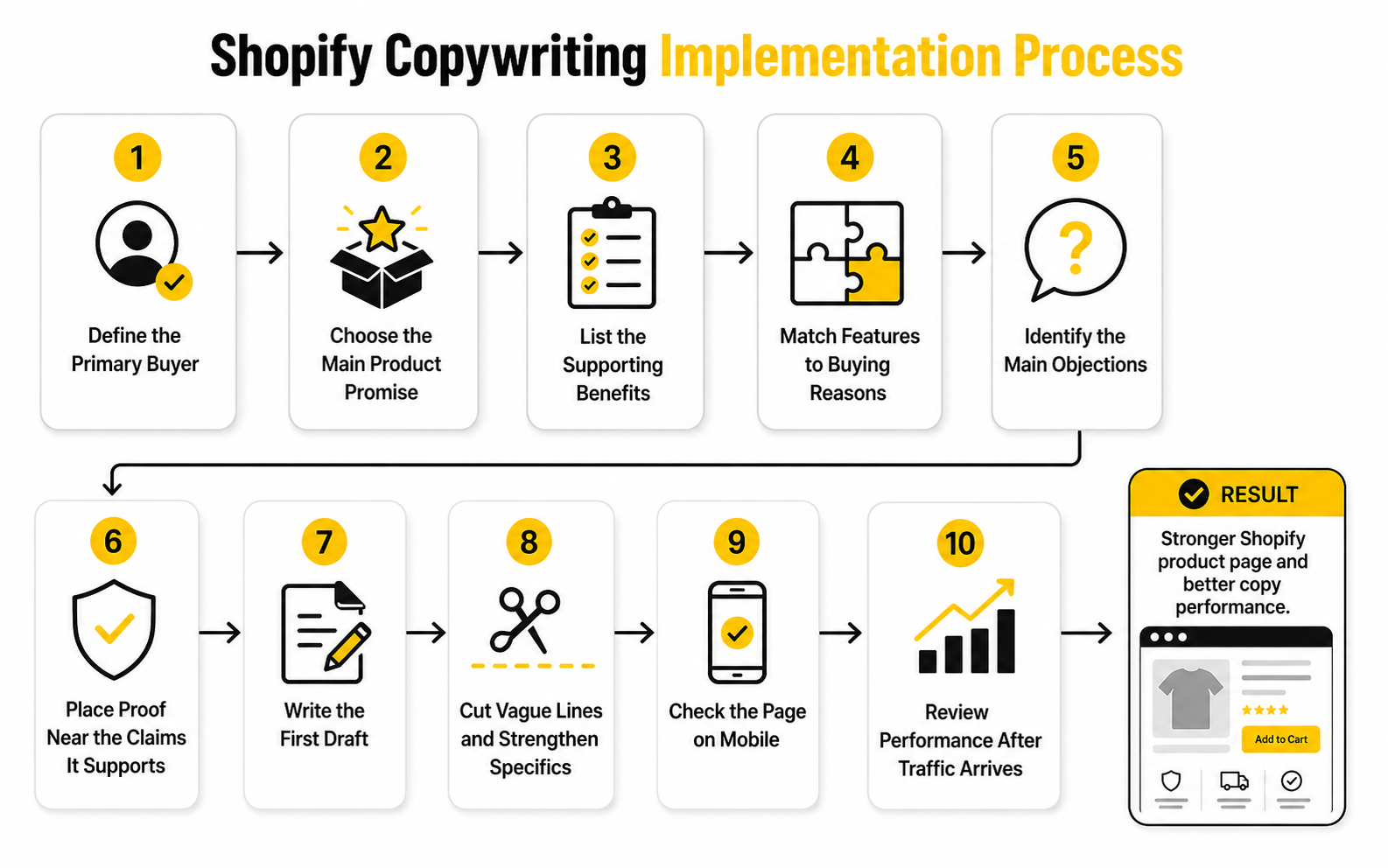
Use this process when writing a new product page, rewriting an old one, or building a landing page for a campaign:
Each step should leave the copy sharper than before. If a sentence does not clarify the offer, reduce doubt, or help the buyer act, it probably does not need to be there.
Define The Primary Buyer
Start with one primary buyer for the page. A Shopify store can serve multiple customer types, but one product page should usually prioritize the most likely or most valuable buyer. When you try to give equal attention to every possible audience, the page becomes bloated.
The primary buyer should be specific enough to guide decisions. For example, “new parents buying a stroller” is still broad. “First-time parents who live in apartments and need a compact stroller that folds quickly” gives the copy something useful to work with.
This choice affects the whole page. It changes the opening promise, the benefit order, the objection handling, the proof, and even the FAQ later in the article. Good Shopify copywriting starts by choosing who the page is really speaking to.
Choose The Main Product Promise
The main product promise is the central reason to keep reading. It should be clear, specific, and believable. It does not have to be dramatic, but it does need to make the product’s value obvious quickly.
A weak promise describes the product category. A stronger promise explains the useful result. “Organic cotton sheets” is a category description. “Soft, breathable sheets made for cooler sleep without synthetic fabrics” gives the buyer a reason to care.
The promise should also match what the product can honestly deliver. Overstated claims create disappointment, refunds, and bad reviews. Confident copy is good; inflated copy is not.
Build Benefit Bullets From Real Buying Reasons
Benefit bullets are often where Shopify product pages become lazy. Stores write lines like “premium quality,” “easy to use,” and “perfect for everyday life” because they sound safe. The problem is that safe copy usually says nothing.
A useful benefit bullet connects a product detail to a customer outcome. It explains why the feature matters in real life. Instead of “stainless steel bottle,” the copy might say “keeps your drink protected from lingering plastic smells and everyday dents.” That is more concrete because it translates the feature into a buyer-relevant reason.
Keep the bullets scannable, but do not strip them down until they lose meaning. Short is useful only when it is still specific. If a bullet could appear on almost any competitor’s page, rewrite it.
Match Features To Buying Reasons
Features still matter. The mistake is assuming shoppers will automatically understand the benefit behind every feature. They often will not, especially when the product is technical, premium, unfamiliar, or compared against cheaper options.
A simple feature-to-benefit map fixes this. Put the feature on one side and the customer reason on the other. Then write the copy from the customer reason while keeping the feature available as proof.
For example, a page builder, quiz tool, or email platform may have many technical features, but buyers usually care about speed, clarity, personalization, conversion, or less manual work. If a Shopify brand is building campaign-specific pages, Replo fits naturally when the copy needs a flexible page layout around a specific offer, bundle, launch, or advertorial. The feature is the builder; the buying reason is faster execution without waiting on a full development cycle.
Place Proof Where Doubt Appears
Proof should not be dumped into one section and forgotten. It should appear near the claim it supports. If the page says the product is durable, show durability proof near that claim. If the copy says customers love the fit, place review snippets or fit data near the sizing explanation.
This matters because shoppers do not evaluate a page in a perfectly linear way. They scan a claim, feel a question, and look for reassurance. Baymard’s product page research highlights how product pages need enough relevant product information and support across the decision journey, with its 2026 benchmark showing that only 48% of desktop ecommerce sites and 38% of mobile sites achieved decent or good product page UX performance.
Proof can include reviews, ratings, certifications, before-and-after context where compliant, warranty terms, comparison charts, press mentions, customer photos, ingredient transparency, manufacturing details, or clear product specifications. The key is relevance. Proof works best when it answers the doubt the buyer is already having.
Write The First Draft Without Polishing Too Early
The first draft should be focused, not perfect. Start by putting the research and structure into the right order. Do not spend twenty minutes polishing one sentence while the rest of the page is still missing the core offer.
A strong first draft usually includes the opening promise, a short product description, benefit bullets, detail sections, objection handling, proof placement, and CTA support copy. It should be complete enough to evaluate as a page, not just as isolated lines. Copy is contextual, so a sentence that sounds good alone may not work inside the full page flow.
Once the draft is complete, read it like a skeptical shopper. Ask whether the page explains what the product is, who it is for, why it is different, what the buyer gets, what could go wrong, and what to do next. If any answer is fuzzy, the copy needs another pass.
Cut Vague Copy And Strengthen Specifics
Editing is where the copy becomes useful. Remove filler lines that sound polished but do not help the buyer. Words like “premium,” “innovative,” “elevated,” and “important” are not automatically bad, but they are weak when they are unsupported.
Replace vague claims with concrete details. If the product is comfortable, explain what creates that comfort. If it saves time, explain where the time is saved. If it is easier than alternatives, explain what has been simplified.
This is also the stage where you check for overclaiming. Shopify copywriting should be persuasive, but it should not create expectations the product cannot meet. Long-term conversion is not just the first purchase; it includes reviews, repeat orders, referrals, and fewer refund problems.
Check The Page On Mobile
Mobile review is not optional. The copy may look clean on desktop and still feel heavy on a phone. Long paragraphs, oversized blocks, vague headings, and buried CTAs can make the page harder to use when the buyer is scrolling with one thumb.
Review the page section by section on mobile. The opening should make sense without needing a long scroll. Bullets should be easy to scan. Product details should not feel like a wall. Shipping, returns, sizing, or compatibility information should be findable before doubt turns into exit.
Baymard’s product list and mobile ecommerce findings continue to show that many ecommerce experiences still underperform on mobile, including a 2025 product list benchmark where 78% of mobile ecommerce sites had mediocre or worse product list UX performance. That is not only a design issue. Copy clarity, label clarity, and information hierarchy all affect how usable the buying path feels.
Review Performance After Launch
After implementation, the page needs real-world review. Look at add-to-cart rate, conversion rate, scroll behavior, search queries, customer questions, returns, review language, and support tickets. The point is to identify where the copy is answering questions well and where buyers still hesitate.
Do not change copy randomly every time performance moves. Traffic quality, seasonality, promotions, price, inventory, and product demand can all affect results. Look for patterns before making big changes.
When the patterns are clear, improve one meaningful area at a time. Tighten the opening promise, reorder benefits, add missing proof, clarify sizing, improve shipping reassurance, or rewrite the comparison section. That is how Shopify copywriting becomes a repeatable growth process instead of a one-time writing task.
Statistics And Data
Measurement is where Shopify copywriting stops being a taste debate. Without data, one person likes the headline, another person hates it, and the loudest opinion usually wins. With data, the conversation changes to something more useful: where are shoppers hesitating, what are they missing, and which copy changes are most likely to improve the buying path?
The numbers are not there to make the article look more carefully. They are there to help you decide what to fix first. A 1.5% conversion rate can be healthy for one store and weak for another, depending on product price, traffic source, buying cycle, returning customer mix, device split, and how much education the product needs.
That is why benchmarks should be treated as context, not commandments. Shopify’s CRO guidance puts average ecommerce conversion rates around 2.5% to 3%, while IRP Commerce’s March 2026 benchmark shows conversion rate as transactions divided by sessions, which matters because returning visitors can create multiple sessions before one purchase. If you compare your store to a benchmark without understanding how the metric is calculated, you can end up fixing the wrong thing.
What Conversion Rate Actually Tells You
Conversion rate tells you the percentage of sessions that become orders. It is useful because it gives you a quick read on how efficiently the store turns traffic into revenue. But it does not tell you why people bought, why they left, or whether the copy is the main problem.
A low conversion rate can point to weak copy, but it can also point to poor traffic quality, pricing mismatch, slow pages, weak product-market fit, bad merchandising, confusing shipping, or checkout friction. That is why copy should never be judged by conversion rate alone. You need supporting signals before deciding what to rewrite.
For Shopify copywriting, conversion rate becomes more useful when you segment it. Compare conversion rate by traffic source, product, collection, device, new versus returning visitors, and campaign. If paid social traffic converts poorly but branded search converts well, the issue may be the promise in the ad-to-page journey, not the product page itself.
The Metrics That Matter Most For Copy
Good copy measurement focuses on behavior signals that connect to the customer’s decision. The goal is not to track everything. The goal is to track the few numbers that reveal where the message is working and where the buyer still feels uncertain.
The most useful copy-related metrics are:
Each metric should lead to a question. If add-to-cart rate is low, ask whether the opening promise, price justification, proof, or product clarity is weak. If checkout completion is low, ask whether shipping, returns, payment trust, discounts, or delivery timing are causing doubt. If returns are high, ask whether the copy oversold the product or failed to explain fit, sizing, compatibility, materials, or limitations.
How To Build A Simple Analytics System
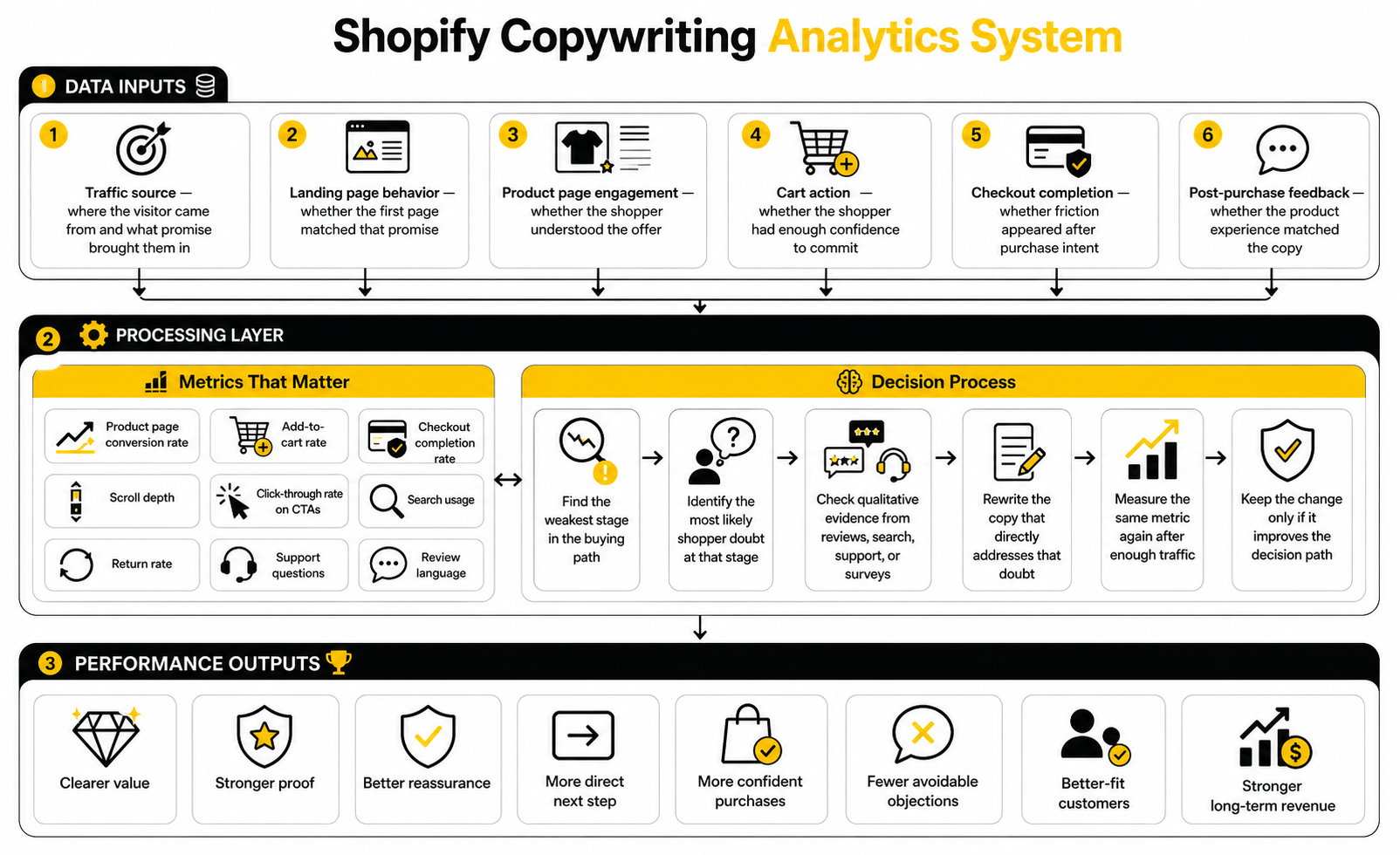
A useful analytics system does not need to be complicated. Start with a few stages in the buying journey and connect each stage to the copy questions that matter. This keeps your reporting practical instead of turning it into a dashboard nobody uses.
The system can be simple:
This structure helps you find the broken handoff. If the ad promises one outcome and the product page leads with a different angle, rewrite the top section. If the product page gets strong engagement but weak add-to-cart behavior, strengthen the offer, proof, and objection handling. If customers buy but later return or complain, check whether the copy created expectations the product could not satisfy.
How Benchmarks Should Guide Action
Benchmarks are useful when they stop you from guessing. They can tell you whether a metric looks unusually weak, whether the problem is common across ecommerce, and whether your store may have more room to improve. They should not make you panic just because your store is below a broad average.
Baymard’s checkout UX research shows that checkout still has major room for improvement, with its 2025 benchmark reporting that 64% of desktop sites and 63% of mobile sites had mediocre or worse checkout UX performance. That does not mean every Shopify store should rewrite product copy first. It means you should check whether buyers are losing confidence after they already showed intent.
Baymard’s cart abandonment research also shows why interpretation matters. Its long-running benchmark places the average documented cart abandonment rate at around 70%, but that number should not be treated as a single diagnosis. Some abandonment comes from comparison shopping, some from unexpected costs, some from account creation, some from delivery timing, and some from unclear checkout steps.
For Shopify copywriting, the action is straightforward: use benchmarks to prioritize investigation, then use your own store data to choose the fix. If your cart abandonment is high and support questions mention shipping surprises, improve shipping clarity earlier. If visitors scroll heavily but do not add to cart, rewrite the product promise and proof sections. If mobile conversion is far weaker than desktop, review the mobile copy hierarchy before blaming the offer.
Reading Add-To-Cart Rate Correctly
Add-to-cart rate is one of the clearest signals for product page copy. It tells you whether visitors are moving from interest to intent. When this number is weak, the page may not be making the product feel clear, desirable, trustworthy, or worth the price.
But again, context matters. A high-ticket product may naturally have a lower add-to-cart rate than a low-cost impulse product. A product with many variants may see hesitation if sizing, colors, bundles, or compatibility are unclear. A product with strong education needs may require more proof before the visitor is ready to act.
The copy response should match the likely cause. If shoppers do not understand the value, improve the opening promise and benefit bullets. If they worry about risk, strengthen guarantees, returns, and proof. If they are comparing alternatives, add a comparison section that is honest, specific, and useful.
Reading Scroll Depth Correctly
Scroll depth can show whether people are reaching important information, but it can also mislead you. A low scroll depth is not always bad if the page converts well near the top. A high scroll depth is not always good if shoppers are scrolling because they cannot find what they need.
Use scroll depth together with clicks, add-to-cart behavior, and section-level engagement. If many shoppers reach reviews but few add to cart, the reviews may not be answering the right doubts. If shoppers never reach shipping and returns content, move key reassurance higher on the page.
For copy, the main question is whether important messages appear before the buyer needs them. Do not bury critical fit details, delivery expectations, compatibility notes, or risk reducers near the bottom just because the theme has a convenient section there. Put the copy where it supports the decision.
Reading Checkout Completion Correctly
Checkout completion tells you whether shoppers who showed intent actually finished the purchase. If product page copy creates desire but checkout copy creates doubt, revenue still leaks. This is why Shopify copywriting should include the full buying path, not only the product description.
Checkout issues often come from surprises. Unexpected shipping costs, unclear delivery timing, discount confusion, account requirements, payment concerns, and weak return reassurance can all interrupt the purchase. Copy cannot fix every checkout limitation, but it can reduce uncertainty before the buyer reaches that point.
The action is to bring key checkout information forward. Explain shipping thresholds, delivery timing, return windows, subscription terms, bundle rules, and payment options before the cart whenever they affect the decision. The best checkout copy is often the copy that prevents checkout anxiety from appearing in the first place.
Reading Search And Support Questions
Site search and support questions are underrated copy research tools. They show what shoppers could not find, did not understand, or did not trust. That makes them more useful than another round of internal brainstorming.
If shoppers search for “size chart,” “returns,” “ingredients,” “replacement parts,” “shipping time,” or “compatible with,” those topics should probably be easier to find on the product page. If support gets repeated pre-sale questions, the page is leaving money on the table. Every repeated question is a copy improvement opportunity.
Do not hide these answers in a generic FAQ unless the question belongs there. Put answers near the relevant buying moment. Size clarity belongs near variant selection. Ingredient clarity belongs near product benefits and details. Shipping reassurance belongs near the purchase area and cart.
Turning Data Into Copy Changes
Data only matters if it changes what you do. The point is not to admire dashboards. The point is to choose better copy changes with less guessing.
Use this decision process:
This keeps optimization grounded. You are not rewriting a page because someone wants it to sound more exciting. You are rewriting because the evidence shows shoppers need clearer value, stronger proof, better reassurance, or a more direct next step.
What Not To Measure In Isolation
Some metrics look important but become dangerous when used alone. Bounce rate, time on page, average session duration, and raw traffic volume can all lead to bad decisions if you treat them as copy verdicts. A short visit can be good if the shopper quickly finds what they need and buys. A long visit can be bad if the shopper is confused.
Revenue per visitor, conversion rate, add-to-cart rate, checkout completion, and return behavior usually give a stronger picture when combined. Even then, you still need context. A copy change that increases conversion but also increases returns may not be a real win.
This is where discipline matters. Shopify copywriting should not chase vanity metrics. It should improve the quality of the buying decision, which means more confident purchases, fewer avoidable objections, better-fit customers, and stronger long-term revenue.
Storewide Copy, SEO, And Funnel Alignment
By this point, the product page is no longer the only place that matters. Shopify copywriting has to work across the full store because shoppers rarely move in a perfect straight line. They may land on a collection page, open a product, leave, return through an email, compare another item, search the site, read reviews, and only then buy.
That creates a strategic problem. If every page sounds like it was written in isolation, the customer has to rebuild trust at every step. The better approach is to make the store feel consistent, while still adapting the copy to each page’s job.
Storewide copy has three main responsibilities. It must help shoppers find the right product, understand the difference between options, and stay confident as they move closer to purchase. That means collection pages, navigation labels, filters, product cards, announcement bars, popups, emails, SMS, and checkout-adjacent copy all need to support the same buying logic.
Collection Pages Need More Than Product Grids
Collection pages are often treated like visual shelves. The store adds a title, drops in products, and hopes the shopper figures it out. That is a missed opportunity because collection pages are often where buyers decide which product type, style, bundle, size, or price range makes sense.
Good collection copy should quickly explain what the category is, who it is for, and how to choose. It does not need to be long. It needs to give enough context so the shopper does not feel dumped into a grid with no guidance.
This matters for SEO too. Google’s ecommerce search guidance makes product data, structured product information, pricing, availability, and merchant listing eligibility important for how products can appear across search experiences through product structured data and merchant listing structured data. The copy on the page still needs to be useful for humans, but the store also needs clean product information that search engines can understand.
Product Cards Carry More Weight Than They Get Credit For
Product cards are tiny, but they do a lot of work. A shopper may decide whether to open a product page based on the product name, image, price, rating, badge, short descriptor, color label, or variant hint. If the card is unclear, the product page may never get a chance to persuade.
This is where Shopify copywriting becomes very precise. You do not have room for long explanations, so the copy has to help the shopper compare quickly. A good product card can show the product type, main differentiator, use case, bundle size, or key material without turning the grid into a paragraph wall.
The tradeoff is speed versus clarity. Too little copy makes products hard to compare. Too much copy makes the collection page feel crowded. The best answer depends on the category, but the principle stays the same: product cards should reduce comparison friction, not just display inventory.
SEO Copy Should Serve Search Intent, Not Just Keywords
SEO copy for Shopify should not feel like a keyword dump under the product grid. That kind of content may technically mention the right terms, but it often creates a bad user experience. Worse, it can make the brand feel less trustworthy because the page stops sounding like a store and starts sounding like an SEO template.
The better move is to match search intent. Someone searching for a broad category may need buying guidance, comparison help, and links into subcategories. Someone searching for a specific product type may need proof, specs, compatibility, sizing, or use-case clarity. Someone searching with commercial intent may need a faster path to the right product.
Google’s documentation on creating helpful content has consistently pushed toward content made for people rather than content created primarily to attract search traffic through people-first content guidance. For Shopify copywriting, that means SEO should strengthen the customer journey instead of interrupting it. Use the keyword naturally, answer the buyer’s real question, and keep the page useful.
Brand Voice Must Stay Consistent Across The Funnel
Brand voice is not just a creative preference. It is part of trust. If the homepage sounds premium, the product page sounds generic, the popup sounds desperate, and the email sounds like a discount robot, the customer feels the inconsistency even if they cannot name it.
A practical brand voice guide should define how the store explains value, handles objections, talks about price, uses urgency, describes quality, and asks for action. This does not need to be a massive document. It needs to be clear enough that a product page, email flow, ad landing page, and customer support macro sound like they came from the same brand.
Consistency does not mean every sentence has the same rhythm. A cart recovery email can be more direct than a brand story page. A technical product detail section can be more precise than a homepage hero. The voice should flex by context, but the underlying personality and standards should stay recognizable.
Funnel Copy Needs Message Match
Message match means the promise that brings someone to the store should connect cleanly to the page they land on. If an ad talks about solving one problem but the landing page leads with a different benefit, the shopper has to work too hard. That disconnect can make even strong copy underperform.
This applies across paid ads, organic search, influencer traffic, email campaigns, SMS, affiliates, and retargeting. Each traffic source brings a different level of awareness. A returning email subscriber may need a sharper offer, while a cold paid social visitor may need more context and proof before taking the same action.
For campaign-specific pages, a dedicated landing page can be stronger than sending everyone to the default product page. Tools like Replo can help build Shopify landing pages around a specific campaign angle, but the strategy still matters most. The page should continue the exact promise that created the click and then guide the shopper toward the product with proof, clarity, and a clean CTA.
Email And SMS Copy Should Not Repeat The Product Page
Email and SMS copy should extend the buying journey, not copy and paste the product page into a smaller format. A subscriber who abandoned a cart, browsed a product, or bought once already has context. The follow-up copy should respond to that context.
Cart recovery copy should address the most likely hesitation. Browse abandonment copy should remind the shopper why the product was relevant. Post-purchase copy should reinforce the decision, reduce buyer’s remorse, and guide the customer toward successful product use.
For stores building lifecycle campaigns, platforms like Brevo can fit when email and automation need to support the customer journey after the store visit. For conversational flows, ManyChat can help when the store has a clear reason to use chat, such as product selection, reminders, or support-style pre-sale guidance. The tool is not the strategy; the message is.
Scaling Copy Across Large Catalogs
Scaling Shopify copywriting gets harder when the store has dozens, hundreds, or thousands of products. Writing every product page from scratch may be unrealistic. But relying entirely on manufacturer descriptions, duplicate templates, or generic AI output creates a different problem: the pages start sounding interchangeable.
The solution is to build reusable copy systems without making every page identical. Start with product category templates, message buckets, benefit libraries, objection libraries, proof modules, and tone rules. Then customize the parts that actually matter for each product: use case, differentiator, fit, compatibility, materials, sizing, bundle logic, or buyer concern.
This is where a copy database becomes valuable. Instead of asking a writer to reinvent every product page, give them structured inputs and clear rules. The page can still sound human because the template supports judgment rather than replacing it.
The Risk Of Over-Optimization
Over-optimization is real. A store can become so focused on squeezing every click that the copy starts to feel manipulative. Fake urgency, exaggerated claims, aggressive popups, unclear subscriptions, and hidden conditions may lift short-term action while damaging trust.
That tradeoff matters because ecommerce growth is not only about the first order. It is also about review quality, repeat purchase, customer support load, refund rates, chargebacks, and word of mouth. Copy that wins the click but creates disappointment is not good copy.
The safer path is to be persuasive and precise. Show the benefit clearly. Make the offer attractive. Use urgency only when there is a real reason. Explain limitations honestly. A confident store does not need to trick people into buying.
The Risk Of Under-Selling
The opposite mistake is under-selling. Some brands are so afraid of sounding pushy that they barely make a case for the product. The copy becomes polite, minimal, and forgettable.
This is especially common with premium, technical, handmade, sustainable, or founder-led products. The brand may have real advantages, but the page does not explain them strongly enough. If the buyer cannot see why the product costs more, looks different, or deserves trust, they will compare only on price.
Under-selling is not humility. It is unclear communication. If the product is genuinely better in a specific way, the copy should say so and prove it.
Managing Copy Across Teams
As a Shopify store grows, more people touch the message. Founders, marketers, designers, agencies, developers, support teams, media buyers, SEO specialists, and lifecycle marketers may all create customer-facing copy. Without a shared system, the store slowly becomes inconsistent.
A simple messaging document can prevent this. It should include the core promise, target buyer, main objections, proof points, product terminology, tone rules, approved claims, compliance notes, and examples of copy that should not be used. This makes the brand faster, not slower.
The most useful teams treat copy as a shared growth asset. Support feeds objections into product pages. Reviews feed benefit language into ads. Search queries feed collection copy. Returns feed expectation-setting improvements. When the system works, every customer interaction makes the next version of the copy sharper.
Advanced Shopify Copywriting Priorities
Advanced Shopify copywriting is mostly about knowing what to prioritize. Not every page needs the same level of effort. Not every metric deserves the same attention. Not every clever idea should make it onto the store.
Use these priorities when deciding where to focus:
This is how Shopify copywriting becomes strategic instead of reactive. You stop rewriting random sections because they feel old. You improve the copy where better clarity can actually change buyer behavior.
Professional Implementation And Optimization
Professional Shopify copywriting is not just about producing better words. It is about building a system that helps the store sell more clearly across every customer touchpoint. By the final stage, the work should connect research, product positioning, page structure, analytics, SEO, lifecycle messaging, and brand voice into one practical operating system.
That system matters because copy decisions compound. A stronger product promise can improve product page performance. Better objection handling can reduce support questions. Clearer post-purchase copy can reduce buyer’s remorse. More accurate product expectations can support stronger reviews, fewer preventable returns, and better customer fit.
The final goal is simple: make every important message easier to understand, easier to trust, and easier to act on. That is what separates professional implementation from random copy tweaks. You are not chasing clever lines; you are creating a store that helps serious buyers say yes with confidence.
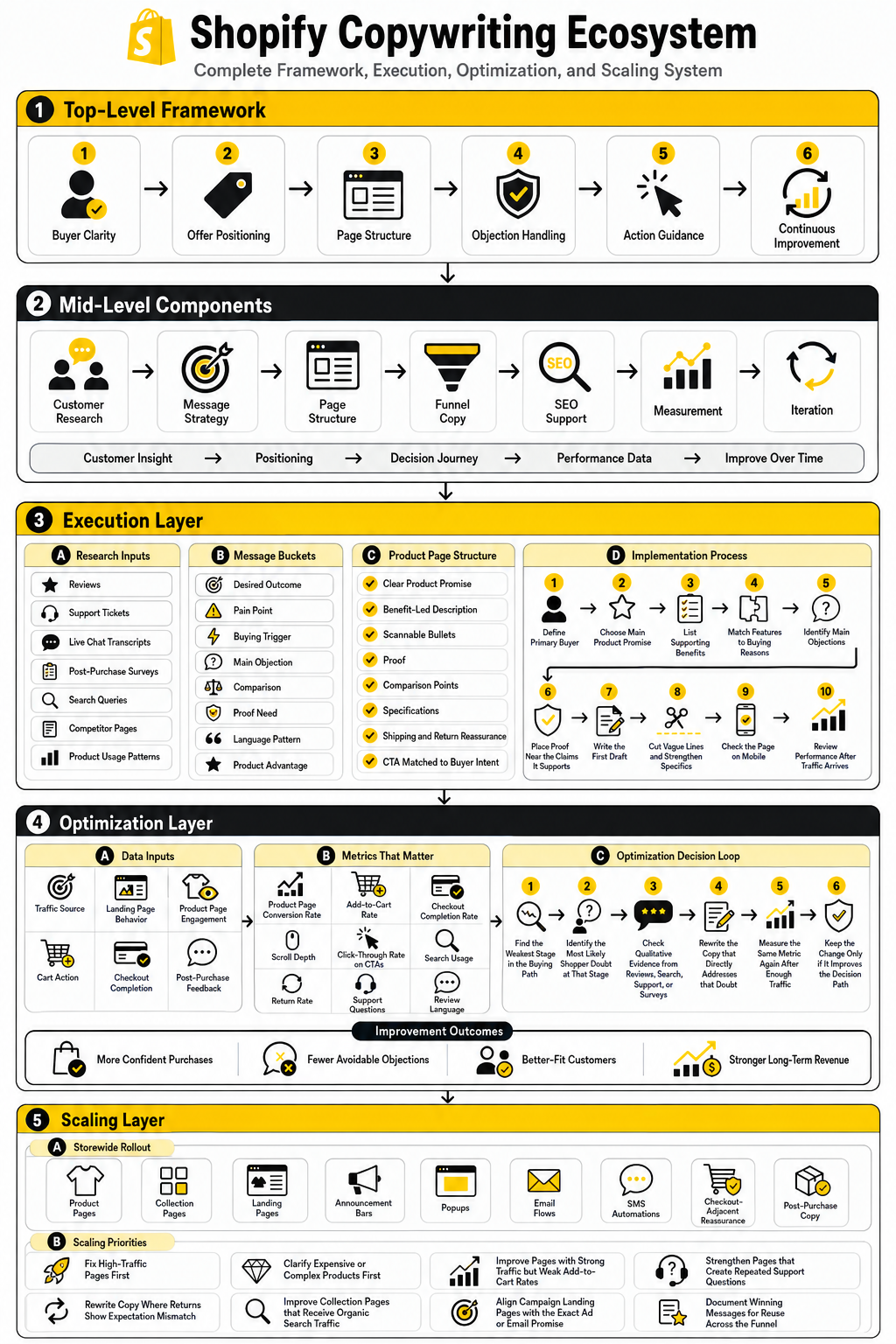
The Final Shopify Copywriting System
A strong final system has a clear flow from research to execution. It starts with customer insight, turns that insight into positioning, shapes the page around the decision journey, and then uses performance data to improve the message over time. Nothing sits alone.
The system should include:
This is the part many stores skip. They write copy, publish it, and move on. The better approach is to treat every important page as a living asset that can get sharper as the store learns more about its buyers.
When To Hire A Shopify Copywriter
Hiring a Shopify copywriter makes sense when the store has traffic, products people want, and a clear need to improve how the offer is communicated. If the store has no demand, copy alone will not save it. But if people are visiting, clicking, asking questions, comparing products, or abandoning carts, better copy can remove friction.
A professional copywriter is especially useful when the product is expensive, technical, differentiated, new to the market, or difficult to explain quickly. Those situations require more than polished descriptions. They require positioning, buyer research, objection handling, and page strategy.
You should also consider outside help when internal teams are too close to the product. Founders often know too much, which makes it hard to explain the product simply. A good copywriter translates internal knowledge into buyer-facing clarity.
What A Strong Copy Brief Should Include
A weak brief produces weak copy. If you give a writer only a product link and ask for “better copy,” you are forcing them to guess. That leads to generic output, endless revisions, and pages that sound fine but do not solve the real problem.
A strong brief should include:
This does not need to be fancy. It needs to be honest and specific. The better the input, the better the Shopify copywriting output.
The Role Of AI In Shopify Copywriting
AI can help with Shopify copywriting, but it should not replace strategy. It is useful for organizing research, generating first drafts, summarizing reviews, rewriting variations, and scaling copy across similar products. It becomes risky when it invents claims, exaggerates benefits, ignores compliance, or produces generic copy that sounds like every other store.
Use AI like an assistant, not the final authority. Feed it real product information, real customer language, real objections, and clear tone rules. Then have a human review the copy for accuracy, credibility, brand fit, and commercial logic.
This is especially important for regulated or sensitive categories. Skincare, supplements, wellness, finance, children’s products, medical-adjacent products, safety equipment, and technical products need careful claim control. Fast copy is not helpful if it creates legal, trust, or refund problems.
Final Optimization Checklist
Before publishing or updating Shopify copy, run one final pass. This checklist keeps the page practical and prevents the most common mistakes. It is simple, but it catches a lot.
Use this checklist before launch:
If the answer is no to several of these, do not blame the buyer. Fix the page. The store should make the decision easier.
What Is Shopify Copywriting?
Shopify copywriting is the process of writing store copy that helps shoppers understand products, trust the offer, and take action. It includes product descriptions, collection page copy, landing pages, homepage messaging, cart copy, email flows, SMS messages, popups, and post-purchase communication. The goal is not just to sound good; the goal is to make buying easier and more confident.
Why Is Shopify Copywriting Important?
Shopify copywriting is important because most shoppers arrive with questions, doubts, and alternatives. If the page does not explain the product clearly, they may leave even if the product is good. Strong copy reduces confusion, communicates value, handles objections, and supports better conversion across the store.
What Makes Shopify Copy Different From Regular Copywriting?
Shopify copy has to work inside a buying experience. It needs to fit product pages, collection pages, variants, filters, reviews, carts, checkout expectations, and follow-up campaigns. Regular copywriting may focus on persuasion, but Shopify copywriting also has to support ecommerce usability, product clarity, SEO, and measurable buying behavior.
How Long Should A Shopify Product Description Be?
A Shopify product description should be as long as the buying decision requires. A simple low-cost product may only need a short description, clear bullets, and basic reassurance. A higher-priced, technical, personal-fit, or unfamiliar product may need more detail, proof, comparisons, and objection handling.
Should Shopify Copywriting Focus More On Benefits Or Features?
It should use both, but benefits should lead. Features explain what the product has or does, while benefits explain why the buyer should care. The strongest copy connects the two so the customer understands the practical value behind each product detail.
How Do You Write Shopify Copy That Converts?
Start with customer research, choose a clear product promise, write for one primary buyer, explain the benefits, support claims with proof, answer objections, and make the next step obvious. Then measure the page after launch and improve the copy based on real behavior. Conversion-focused copy is built from clarity, not hype.
How Does Shopify Copywriting Help SEO?
Shopify copywriting helps SEO by matching search intent, using relevant keywords naturally, explaining products clearly, and supporting useful category and product pages. Good SEO copy should help shoppers choose, compare, and understand products. It should not read like keyword stuffing added to the bottom of a page.
What Are The Biggest Shopify Copywriting Mistakes?
The biggest mistakes are vague product descriptions, weak positioning, unsupported claims, unclear shipping or return details, generic benefit bullets, poor mobile readability, and copy that does not match the ad or email that brought the shopper to the page. Another common mistake is copying supplier descriptions, which makes the store sound like everyone else.
Can AI Write Shopify Product Copy?
AI can help draft and organize Shopify product copy, but it should not be used blindly. It needs accurate product details, real customer insights, brand voice rules, and human review. The final copy should be checked for accuracy, originality, compliance, and whether it actually helps the buyer decide.
How Do You Measure Shopify Copywriting Performance?
Measure Shopify copywriting with conversion rate, add-to-cart rate, checkout completion, scroll behavior, CTA clicks, site search data, support questions, return reasons, and review language. No single metric tells the whole story. The best approach is to combine quantitative data with qualitative customer feedback.
When Should A Shopify Store Rewrite Its Copy?
A store should rewrite its copy when traffic is strong but conversion is weak, when shoppers ask repeated pre-sale questions, when returns suggest expectation mismatch, when product pages sound generic, or when campaigns do not match the landing page. Copy should also be reviewed when the product, market, pricing, or customer segment changes.
What Pages Need Shopify Copywriting Besides Product Pages?
Collection pages, homepage sections, landing pages, product cards, navigation labels, announcement bars, popups, cart pages, checkout-adjacent messages, email flows, SMS flows, and post-purchase pages all need copy. Product pages are important, but the full buying journey needs consistent messaging.
How Often Should Shopify Copy Be Updated?
Shopify copy should be reviewed regularly, especially for high-traffic and high-revenue pages. It does not need constant rewriting, but it should improve when data shows friction or when customer feedback reveals missing information. The best stores update copy based on evidence, not boredom.
What Should Be Included In A Shopify Copywriting Brief?
A strong brief should include the target buyer, product details, main differentiator, customer research, objections, proof points, competitor context, brand voice, claim restrictions, page goals, and performance issues. The brief gives the writer the raw material needed to create useful copy instead of generic descriptions.
Is Shopify Copywriting Worth Paying For?
Shopify copywriting is worth paying for when the store has real traffic, a product with demand, and a buying journey that needs clearer messaging. It is especially valuable for premium products, technical products, large catalogs, new product launches, and stores with conversion or support friction. Good copy can improve how efficiently existing traffic turns into confident buyers.
Build a stronger local presence with BAAM AI
Turn your website, Google profile, social channels, and AI visibility into one growth engine
Most businesses do not need more random marketing activity. They need a consistent presence system that helps the right people find them, trust them, and take action. BAAM AI brings strategy, local SEO, website updates, Google Maps visibility, social content, AI-search readiness, media production, and reporting into one practical monthly engine.
If you want your marketing to keep working after the campaign ends, start with a free BAAM AI presence audit. See how your business shows up today and where the fastest visibility wins are at BAAM AI.