
BAAM AI Blog
SEO Website Copywriting That Converts: A Complete Framework
SEO website copywriting isn’t just about stuffing keywords into pages and hoping for traffic. At its core, it’s the practice of writing content that attracts organic search traffic and converts that traffic into...

SEO website copywriting isn’t just about stuffing keywords into pages and hoping for traffic. At its core, it’s the practice of writing content that attracts organic search traffic and converts that traffic into engaged users, leads, or customers. When you master this balance, your site becomes both more visible in search engines and more persuasive to real human readers. That dual purpose is what sets SEO copywriting apart from basic content writing.
Most businesses struggle to write copy that actually ranks and drives conversions because they treat SEO and copywriting as separate disciplines. In reality, they’re two sides of the same coin: the search engines help people find your content, but the copy itself has to resonate once they get there. That’s why a structured framework for SEO website copywriting is essential for sustainable growth.
this guide is organized into six clear parts you’ll follow from start to finish, beginning with why SEO copywriting matters, through the practical components that make it effective, and ending with professional implementation tactics you can use right now.
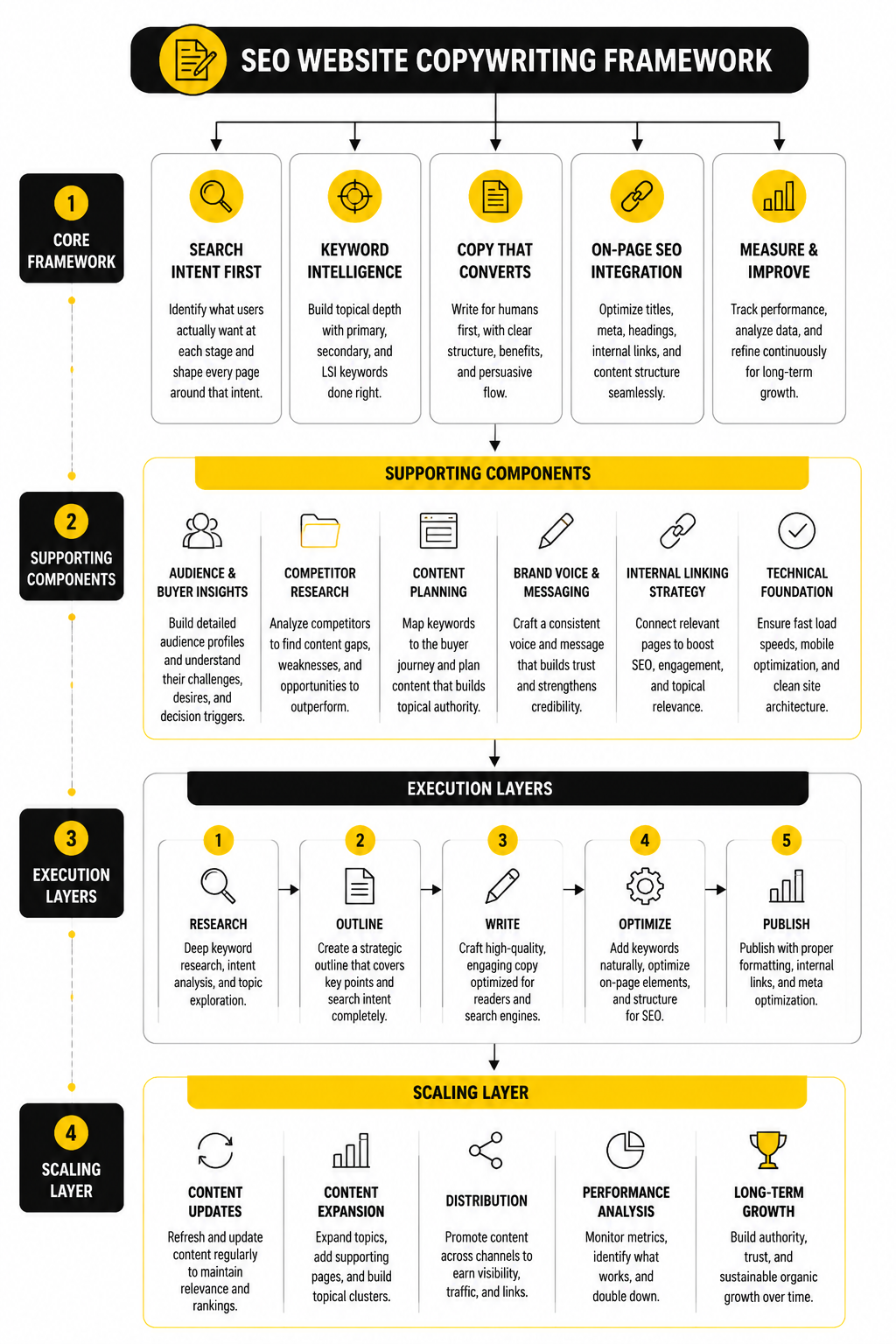
In the next sections, you’ll discover a proven framework that combines keyword strategy, audience research, on‑page writing techniques, and conversion principles. Whether you’re writing your first homepage or optimizing existing pages for better performance, this framework will give you a roadmap for results.
Core Components of Great SEO Website Copywriting
To write SEO website copywriting that actually works, you need to understand the core components that bridge both search visibility and human engagement. The best content doesn’t happen by accident - it’s built on a set of essential elements that make your words rankable and persuasive.
Strategic Keyword Placement
Effective SEO copywriting begins with smart keyword integration. This isn’t about repeating the primary keyword wherever possible - it’s about placing it in the right spots so search engines can understand your content and readers feel the text flows naturally. That includes using your main keyword in the page title tag, H1 heading, URL slug, and early in the body content, with supporting keywords in subheadings and throughout the text. Search engine crawlers use these signals to determine relevance, and humans use them to instantly grasp what your page is about.
High‑Value Content That Answers Intent
Your copy must satisfy user intent - the reason behind the search query. If someone types a query into Google, they expect a clear, useful response that answers their question, solves a problem, or delivers insight. Pages that do this well tend to rank higher and engage readers longer, which sends positive engagement signals back to search engines. Quality content should be comprehensive, organized logically, and split into digestible sections with descriptive headers.
Optimized On‑Page Elements
Aside from the text itself, certain on‑page elements act as structural signals to both users and search engines. These include:
These elements help search bots parse your page structure and help readers scan and understand content faster.
Internal Linking and Site Architecture
SEO website copywriting isn’t just about individual pages - it’s about how those pages connect within your website. Internal links guide readers to related content and distribute authority throughout your site. Strategic internal linking can improve page rankings and keep users exploring your content longer, which again boosts engagement metrics.
Readability and Formatting
Great copy is easy to read. This means:
Search engines increasingly reward pages with strong engagement metrics, and readers are more likely to stay on pages that are easy on the eyes and quick to digest.
Continuous Optimization and Updating
SEO copywriting doesn’t end when the page goes live. Search trends, user behavior, and ranking opportunities change over time. Monitoring performance data - such as rankings, organic traffic, and user engagement - allows you to refine your copy, adjust keyword focus, and improve calls to action to keep your content competitive and relevant.
Together, these components form the backbone of SEO website copywriting that attracts clicks, keeps readers engaged, and drives conversions. Done right, this balanced approach creates content that satisfies both search engines and human users - the ultimate goal of any effective SEO strategy.
How to Implement SEO Website Copywriting Step by Step
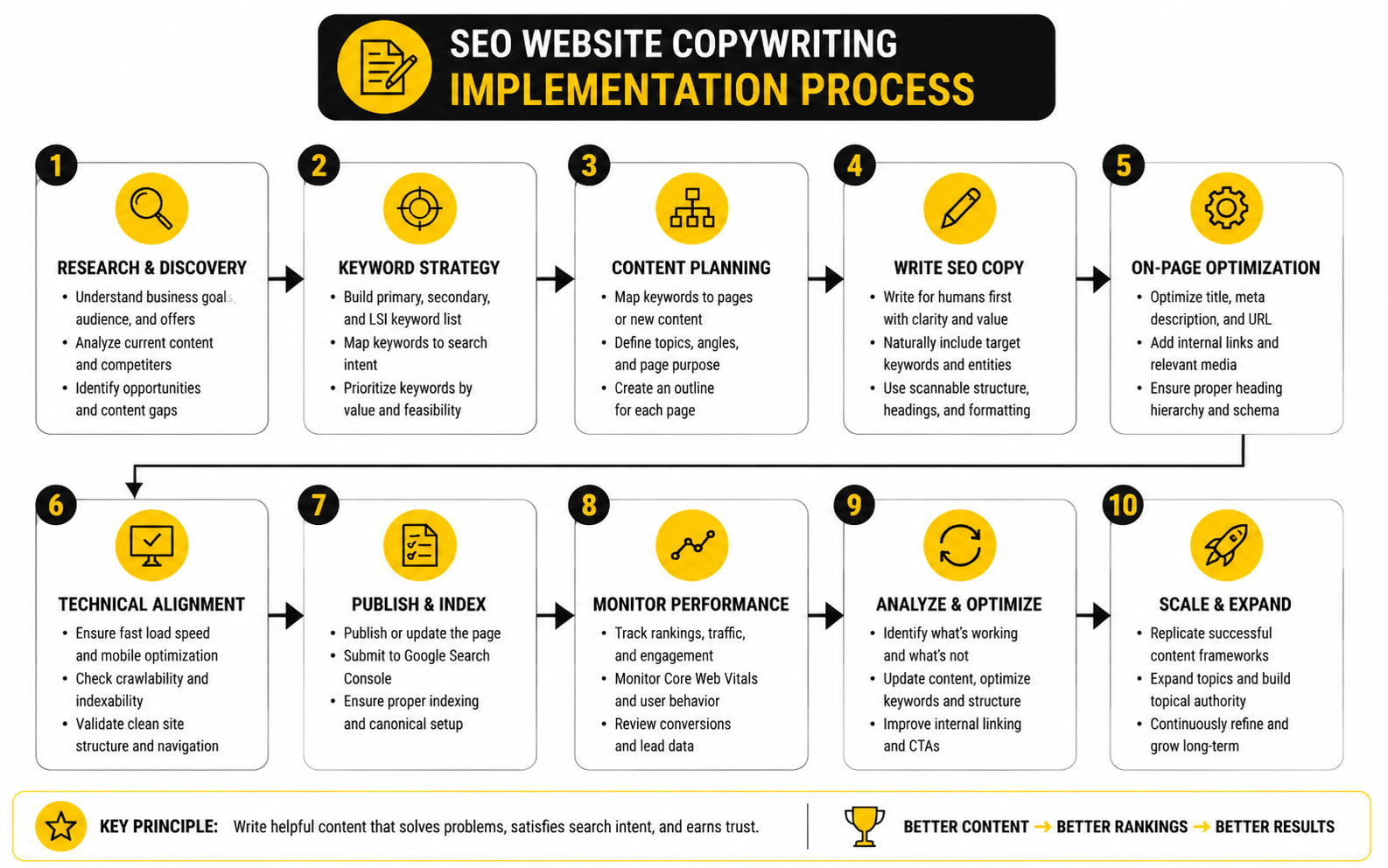
Now that you understand the why and what of SEO website copywriting, let’s make it tangible. Implementation is where the strategy becomes action - and where careful execution separates mediocre pages from content that ranks and converts.
Follow this structured process to consistently produce content that performs.
Step 1: Deep Audience and Intent Research Before Writing
Before touching a keyword list or outline, your first task is to understand what your audience is really searching for and why. This means investigating:
This early investment ensures every line of your SEO website copywriting speaks to the real needs behind search queries.
Step 2: Build a Keyword and Topic Map
Once you know the intent, pick your primary keyword and related terms to shape your content plan. Create a keyword map that includes:
This becomes the foundation of your layout and ensures your copy covers related concepts that search engines and readers expect.
Step 3: Draft a Detailed Outline Based on SERP Signals
A great SEO outline isn’t guesswork - it’s evidence‑based. Scan the top ranking pages:
Your outline should then organize content logically, using headings to signal hierarchy and build a flow that feels intuitive to read and relevant to search platforms.
Step 4: Write the First Draft With Reader‑First Focus
Now comes the actual writing, and the rule here is simple: write for humans first.
Your draft should:
This approach improves engagement metrics - a key ranking signal - while keeping content clear and persuasive.
Step 5: Optimize On‑Page Elements Before Publishing
Once your draft is solid, it’s time for on‑page SEO optimization. This includes:
These refinements help search engines understand, index, and surface your page appropriately.
Step 6: Review, Edit, and Polish
Before going live, edit not just for grammar but for clarity, accuracy, and value. Check that:
This phase ensures your SEO copywriting reads naturally and meets expectations once people arrive.
Step 7: Publish and Monitor Performance
Publishing is not the end - it’s the beginning of real performance insights. Use analytics tools to track:
Monitor how your SEO website copywriting performs in real conditions, and refine underperforming pages by updating content, adjusting keywords, or enhancing calls to action.
This structured, execution‑oriented workflow turns SEO website copywriting from a hopeful effort into a repeatable process that drives visibility, engagement, and results.
Metrics That Show Whether SEO Website Copywriting Is Working
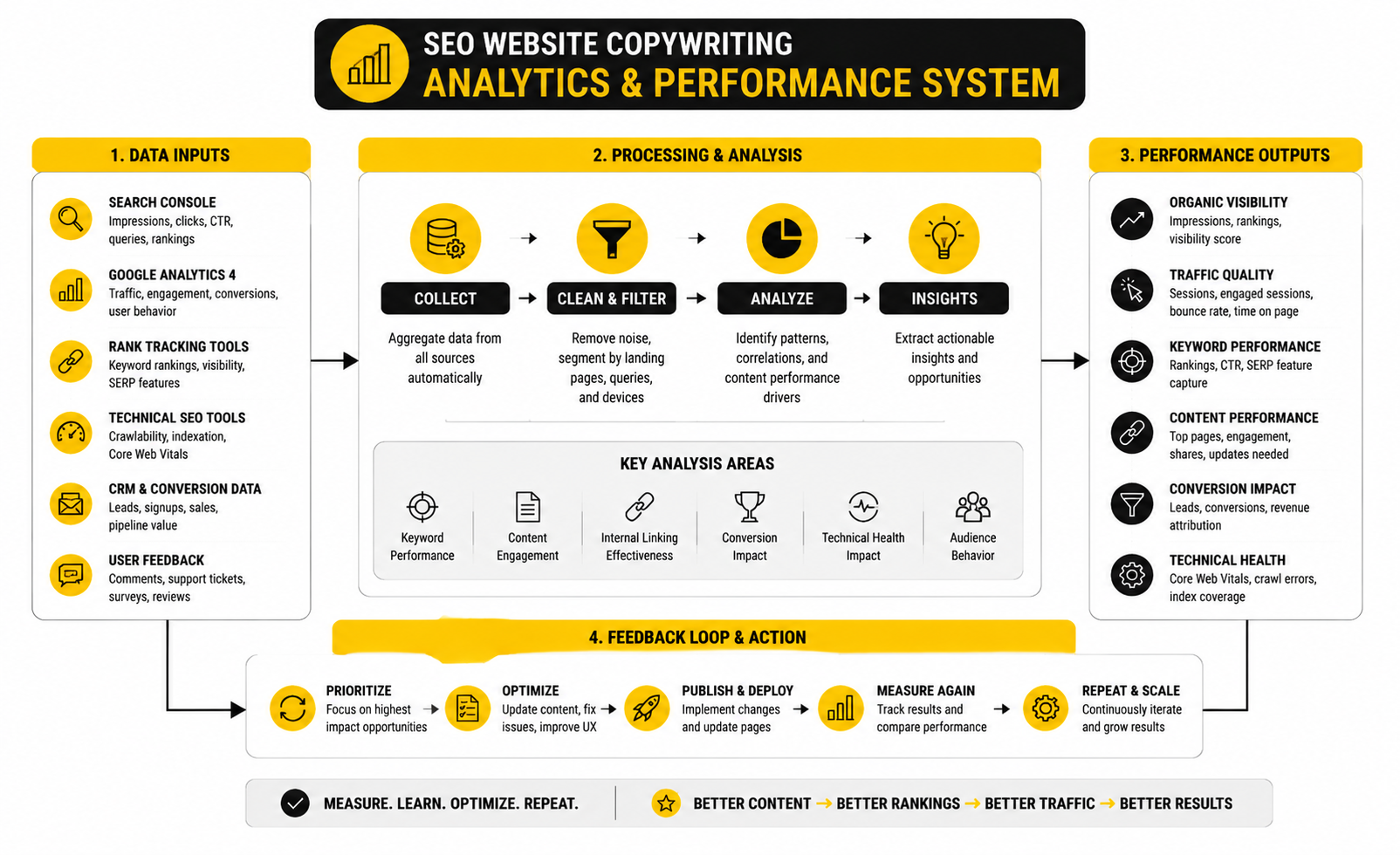
Measurement is the bridge between effort and proof. Without tracking performance, SEO website copywriting becomes guesswork, not strategy. The right data tells you what’s working, what isn’t, and where to adjust so your pages actually move the needle - not just generate noise.
What Metrics Really Tell You
Different SEO numbers serve different purposes. Some show visibility (how often people see your content in search results), others show engagement (whether people stay and interact), and the most important ones show value (whether your SEO copy is driving business goals). Proper interpretation helps you prioritize improvements that lead to real outcomes.
For example, a high page ranking with low click‑through rate (CTR) suggests your titles or meta descriptions aren’t persuasive enough - that’s fixable without rewriting the whole page. On the other hand, strong CTR but low engagement time might mean your content doesn’t deliver on the promise you made in search results. These nuances are only visible when you look beyond basic traffic numbers.
Key Performance Indicators You Should Track
Below are the core metrics that connect SEO website copywriting to results you care about:
Making Sense of the Numbers
Good benchmarks depend on your industry and content type, but here are actionable interpretations rather than raw scores:
How to Use This Data to Improve Your SEO Copy
Once you have these metrics in hand, they should inform specific adjustments:
Understanding these numbers - not just collecting them - allows your SEO website copywriting to evolve from art to measurable performance. That’s how you go beyond traffic and make every word earn its place on the page.
Advanced Considerations for SEO Website Copywriting
Once you’ve mastered the fundamentals of seo website copywriting and understand how to measure performance, the next frontier is strategic refinement and scaling without losing quality. At an expert level, the focus shifts from just producing content to orchestrating your content system in a way that maximizes long‑term success and avoids common pitfalls.
Balancing Quality and Quantity Strategically
One of the most sophisticated tradeoffs in SEO strategy is balancing content quality with publishing velocity. Many teams fall into the trap of thinking they must either scale content output or focus on depth and expertise. In reality, quality is the minimum standard - content must meet a high baseline to satisfy both users and search engines before volume even enters the picture. Websites that dominate competitive niches tend to combine both quality and volume: they publish content that is consistently above the quality threshold and do so at a cadence that builds topical authority over time.
For brands with limited resources, this means deciding where to invest effort:
This tiered approach lets you scale quality - not just quantity - without overwhelming your team or diluting your brand voice.
Managing Content Decay and Refresh Cycles
Even well‑written content loses traction over time. Search engines constantly update their algorithms and competitors refresh similar topics, which means pages that once ranked well can slip. Leading indicators of content decay include declining impressions, lower CTR relative to competitors, or a drop in average positions. Spotting these trends early enables targeted updates rather than entire rewrites.
Making legacy content part of your editorial workflow - reviewing, updating, and expanding evergreen articles - can often deliver better ROI than always creating new pages from scratch. This content refresh cycle is a key component of scaling seo website copywriting effectively.
Navigating Risks of Scaling Content Production
Scaling publishing comes with risks. Rapid increases in output can lead to inconsistent quality, internal keyword cannibalization, or a bloated site architecture that confuses crawlers and users alike. When content teams focus too much on velocity, they may inadvertently weaken the very signals Google uses to measure expertise and relevance.
To mitigate this:
This disciplined approach prevents quantity from becoming a liability.
Leveraging AI Without Compromising Value
AI tools can accelerate parts of the seo website copywriting process, such as research, topic expansion, or first‑draft creation. But scaling with AI demands strong editorial oversight. The most effective teams use AI to handle repetitive or data‑heavy tasks while reserving human writers for crafting insights, narratives, and value propositions that resonate with audiences.
When applied thoughtfully, AI can help maintain consistent quality even as output increases - enabling teams to publish more without sacrificing the depth or relevance that search engines reward.
Strategic Review and Prioritization
At scale, not all content issues are equal. High‑impact topics, often tied to business objectives or high‑value customer segments, deserve disproportionate attention. These flagship pieces should be continuously optimized based on performance data and competitive benchmarking. Lower‑impact content, while still meeting quality standards, can follow more streamlined production and review cycles.
This prioritization ensures that resources - whether time, editorial budget, or technical SEO support - are allocated where they produce the strongest returns.
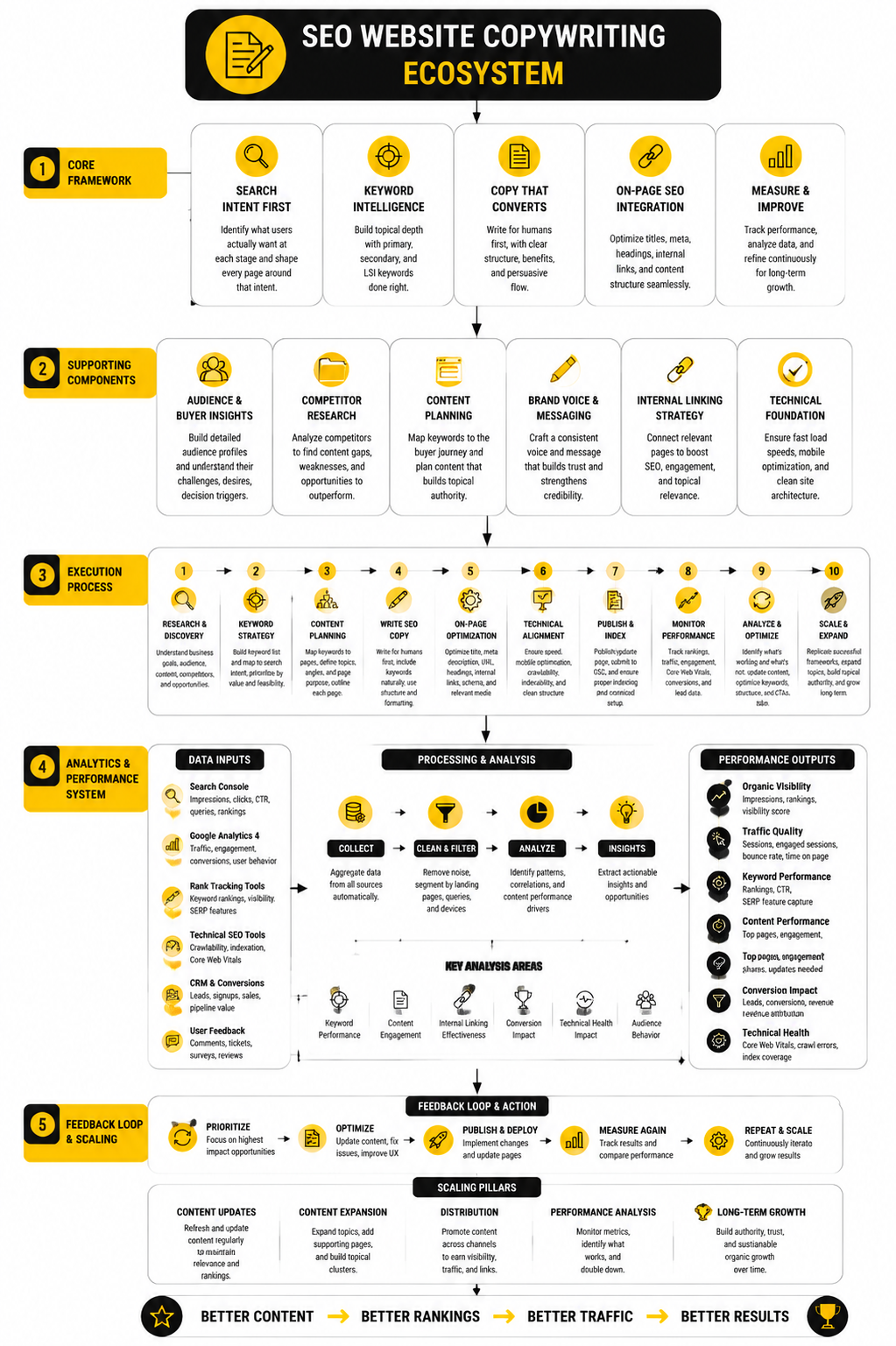
By bringing these advanced considerations into your seo website copywriting strategy, you move from tactical execution to strategic content leadership - the level where organic performance becomes predictable, scalable, and aligned with broader business goals.
What is seo website copywriting?
SEO website copywriting is the practice of writing web content that is both optimized for search engines and compelling to human readers. It balances keyword strategy with clarity, relevance, and persuasion so pages rank well and drive action.
How is seo website copywriting different from regular copywriting?
Regular copywriting focuses primarily on brand voice and persuasion. SEO website copywriting adds the layer of search intent, keyword relevance, and structural optimization so content gets found by organic search and resonates with users once they arrive.
Do I need to use keywords exactly as searched?
Not necessarily. Search engines understand related terms and context, so the goal is to use the primary keyword naturally while including semantically related phrases that reflect how people actually search.
How often should I update my SEO content?
Pages that target competitive terms or show performance decay should be reviewed at least quarterly. Evergreen content can be refreshed annually or when significant changes in topic, intent, or data occur.
Can small websites compete with larger ones through SEO copy?
Yes - by focusing on niche topics with clear intent, answering questions more thoroughly than competitors, and building internal linking that reinforces authority within your site structure.
How long should SEO website copy be?
There’s no fixed word count. Optimal length depends on intent: informational articles may be longer, while transactional pages may be concise. The guiding principle is completeness - cover the topic fully enough to satisfy both search engines and reader expectations.
Do I need analytics tools to measure performance?
Yes. Tools like search console and analytics platforms provide the data needed to interpret visibility, engagement, and conversion metrics. Without data, it’s impossible to determine whether your SEO copywriting is effective.
How do I avoid keyword stuffing?
Write for humans first, then refine. If the keyword doesn’t fit naturally in a sentence, don’t force it. Overuse for the sake of ranking signals can degrade readability and may trigger search engine penalties.
What role do headlines play in SEO website copywriting?
Headlines guide both readers and search engines. Clear, descriptive headings organize content, signal relevance to crawlers, and make long pieces easier for users to scan.
Can AI help with SEO copywriting?
AI tools can assist with topic research, outline generation, and first drafts, but the highest‑impact copy always includes human insight, editorial judgment, and contextual nuance that machines alone can’t provide.
Build a stronger local presence with BAAM AI
Turn your website, Google profile, social channels, and AI visibility into one growth engine
Most businesses do not need more random marketing activity. They need a consistent presence system that helps the right people find them, trust them, and take action. BAAM AI brings strategy, local SEO, website updates, Google Maps visibility, social content, AI-search readiness, media production, and reporting into one practical monthly engine.
If you want your marketing to keep working after the campaign ends, start with a free BAAM AI presence audit. See how your business shows up today and where the fastest visibility wins are at BAAM AI.