
BAAM AI Blog
SEO PPC Agency: How To Choose, Brief, And Manage The Right Growth Partner
Hiring an SEO PPC agency sounds simple until you realize how many agencies sell the same promise with completely different operating models. Some are strong at technical SEO but weak on paid media. Others can scale...
Hiring an SEO PPC agency sounds simple until you realize how many agencies sell the same promise with completely different operating models. Some are strong at technical SEO but weak on paid media. Others can scale Google Ads fast but do not understand content, landing pages, or pipeline quality.
That matters because search is no longer a clean split between “free traffic” and “paid traffic.” Organic visibility, paid search, AI search surfaces, landing page quality, conversion tracking, and CRM feedback all affect the same commercial outcome: qualified demand. Digital ad revenue reached a record $294.6 billion in 2025, while Google Ads search benchmarks show an average search CPC of $5.26 in 2025, so sloppy execution gets expensive quickly.
A good agency does not just “run SEO” or “manage PPC.” It builds a connected search system where SEO lowers long-term acquisition cost, PPC captures demand immediately, and conversion data tells both channels what is actually making money.
Why An SEO PPC Agency Matters Now
Search has become more competitive, more automated, and less forgiving. Paid search can produce results quickly, but every weak keyword, poor landing page, or broken conversion event burns budget. SEO can compound over time, but it takes technical discipline, content quality, authority building, and patience.
The reason businesses look for an SEO PPC agency is usually not because they lack tools. It is because they lack a system. They need someone to connect keyword strategy, campaign structure, website experience, reporting, and revenue feedback into one operating rhythm.
This is especially important now because organic clicks are under pressure from richer search results and AI-driven answer experiences. At the same time, PPC platforms keep pushing automation, which means the quality of your inputs matters more than ever. The agency that wins is not the one that clicks the most buttons; it is the one that feeds the system better data and makes more carefully commercial decisions.
The Search Growth Framework
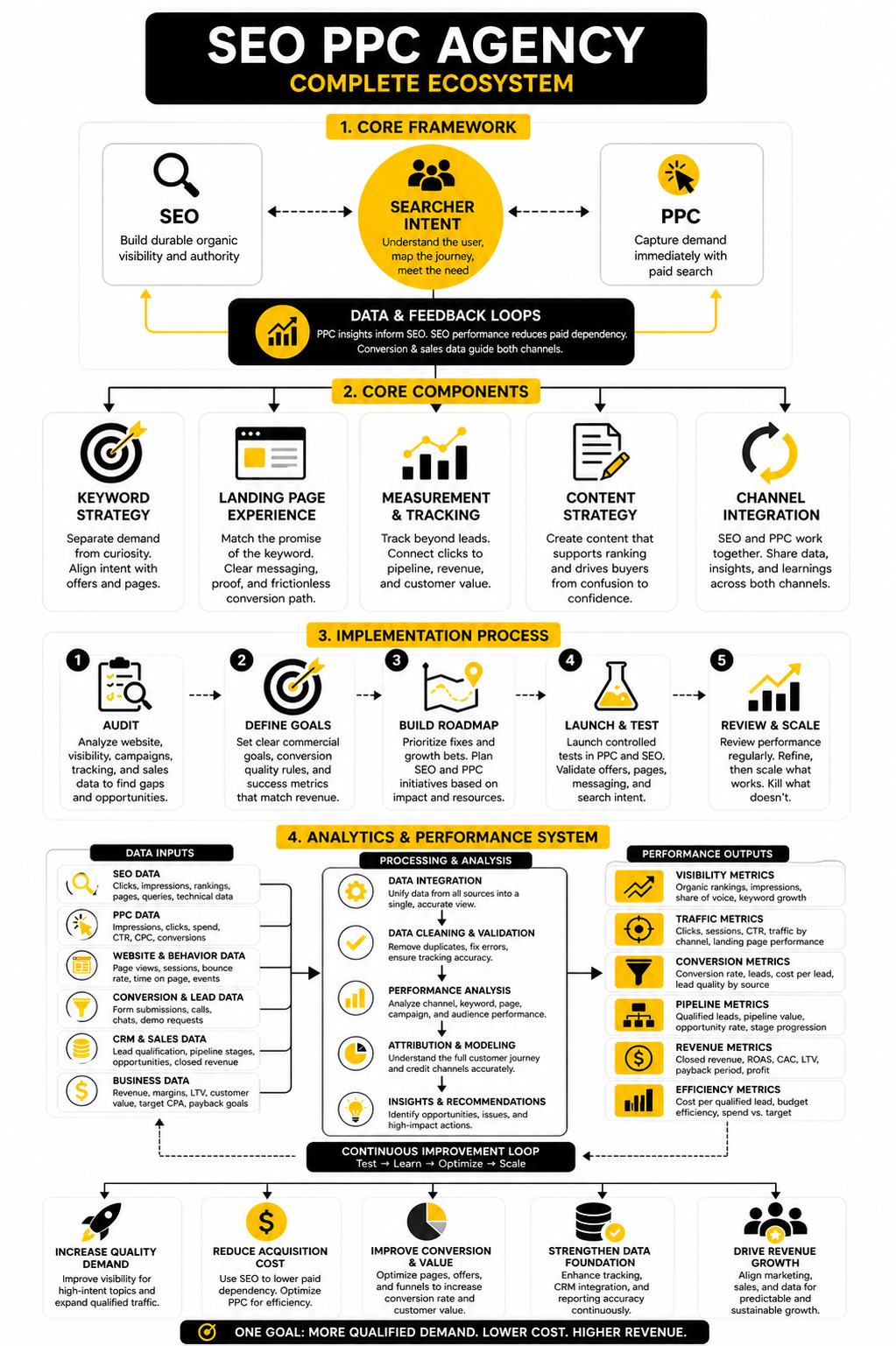
A practical search growth framework starts with one simple idea: SEO and PPC should not fight for budget in separate silos. They should inform each other. PPC shows which terms, offers, and landing pages convert now, while SEO builds durable visibility around the themes that deserve long-term investment.
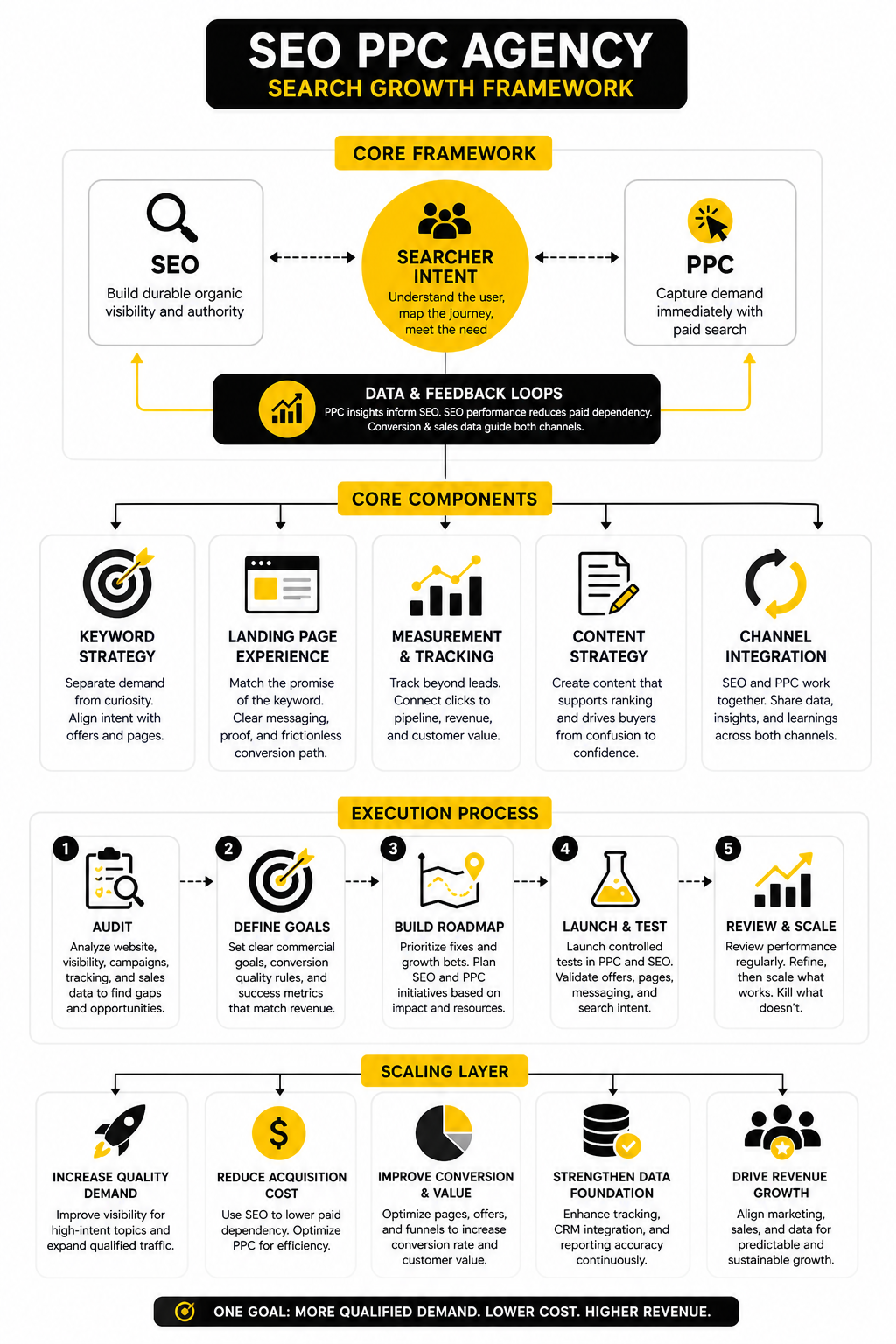
The framework works best when the agency maps the full journey from search intent to revenue. That means separating informational, comparison, local, commercial, and high-intent transactional searches before deciding whether SEO, PPC, or both should handle them. Not every keyword deserves a paid campaign, and not every topic deserves a 2,500-word article.
The real advantage comes from feedback loops. Paid search data can reveal profitable queries before an SEO program commits months of work. Organic rankings can reduce paid dependency on expensive terms. Conversion and sales data can stop both channels from chasing traffic that looks impressive in reports but does not create pipeline.
Core Components Of A Strong SEO And PPC Program
A serious SEO PPC agency starts with the market, not the campaign dashboard. Before anyone writes ads or publishes content, the agency needs to understand what buyers search for, how urgent that intent is, what alternatives they compare, and what proof they need before they act. Without that groundwork, both SEO and PPC become guesswork with a nicer-looking report.
The strongest programs usually have four layers working together. The first is search intent: what the user is trying to solve. The second is offer fit: whether the page gives them a reason to convert now. The third is measurement: whether the business can see which clicks become leads, customers, and revenue. The fourth is iteration: whether the agency improves based on real performance instead of defending the original plan.
This is where many campaigns break. A PPC account can show conversions while the sales team complains about lead quality. An SEO report can show traffic growth while revenue stays flat. A good agency does not hide behind channel metrics; it connects activity to commercial outcomes.
Keyword Strategy That Separates Demand From Curiosity
Not every keyword deserves the same treatment. Some searches show clear buying intent, such as people looking for a provider, pricing, comparison, demo, or local service. Other searches are useful earlier in the journey, but they need a different content format and a softer conversion path.
For PPC, the agency should protect budget by separating high-intent searches from research-heavy searches. That means campaign structure, match types, negative keywords, audience signals, and landing page alignment all matter. Search advertising is not cheap, with 2025 benchmark data showing an average Google Ads cost per lead of $70.11, so the goal is not more clicks; the goal is better-qualified opportunities.
For SEO, keyword strategy should build topical authority instead of chasing random volume. A strong agency groups terms into clusters, maps them to the buyer journey, and decides which pages should rank for which intent. This keeps your site from producing scattered content that competes with itself or attracts visitors who were never likely to buy.
Landing Pages That Turn Search Intent Into Action
Traffic does not fix a weak page. If a person clicks an ad or organic result and lands on a slow, vague, or generic page, the budget was wasted before the form even loaded. This is why landing page strategy belongs inside the search program, not as an afterthought passed to another team.
A proper landing page matches the promise of the keyword. If someone searches for an SEO PPC agency, they should not land on a broad “digital marketing services” page that makes them hunt for relevance. They should see the problem, the offer, the proof, the process, and the next step without friction.
For ecommerce or direct-response teams, dedicated page builders can help move faster when testing offers and layouts. Tools like Replo or ClickFunnels can make sense when the team needs landing pages without waiting weeks for development. The tool is not the strategy, though. The strategy is message match, clarity, proof, and a conversion path that respects the visitor’s intent.
Measurement That Goes Beyond Leads
Basic conversion tracking is not enough anymore. Platforms optimize toward the data they receive, so bad tracking teaches the system to find more bad leads. That becomes dangerous when automated bidding and AI-driven campaign types are making more decisions inside the ad account.
Google’s own Performance Max documentation makes the direction clear: the system uses Google AI across bidding, budget optimization, audiences, creative, attribution, and more, guided by the advertiser’s conversion goals and inputs. That means the agency must care deeply about conversion quality, offline conversion imports, CRM stages, call tracking, form spam, consent mode, and value-based bidding. If the data going in is messy, the automation will scale the mess.
This is where a platform like GoHighLevel can be useful for agencies and service businesses that need CRM, funnels, follow-up, and pipeline visibility in one place. For leaner email and CRM workflows, Brevo can also fit. The key is simple: your SEO and PPC decisions should be informed by what happens after the click, not just before it.
Content That Supports Both Ranking And Conversion
Content should not exist just because an SEO calendar says it is time to publish. It should help the buyer move from confusion to confidence. That means some content should educate, some should compare options, some should explain process, and some should support conversion on high-intent pages.
The best agencies use PPC data to sharpen SEO content decisions. If a paid keyword consistently produces qualified leads, that may be a strong candidate for organic investment. If an ad angle improves conversion rate, that language can often improve title tags, page copy, and calls to action.
The reverse is also true. SEO content can reveal objections, comparison terms, and long-tail questions that deserve paid testing. When content and PPC teams share insights, the whole search program gets more carefully instead of operating like two disconnected vendors.
How Professional Implementation Actually Works
Professional implementation is where strategy stops being a slide deck and starts becoming a weekly operating system. This is the part where an SEO PPC agency proves whether it can execute, prioritize, and adapt when real data starts coming in. Pretty reports are easy; controlled execution is harder.
The process should not begin with random campaign launches or a content calendar filled with whatever keywords look popular. It should begin with an audit of the business model, the website, analytics, ad account history, search visibility, conversion paths, CRM data, and sales feedback. Once that foundation is clear, the agency can decide what to fix first, what to test first, and what should wait.
A strong implementation process usually moves through five phases:
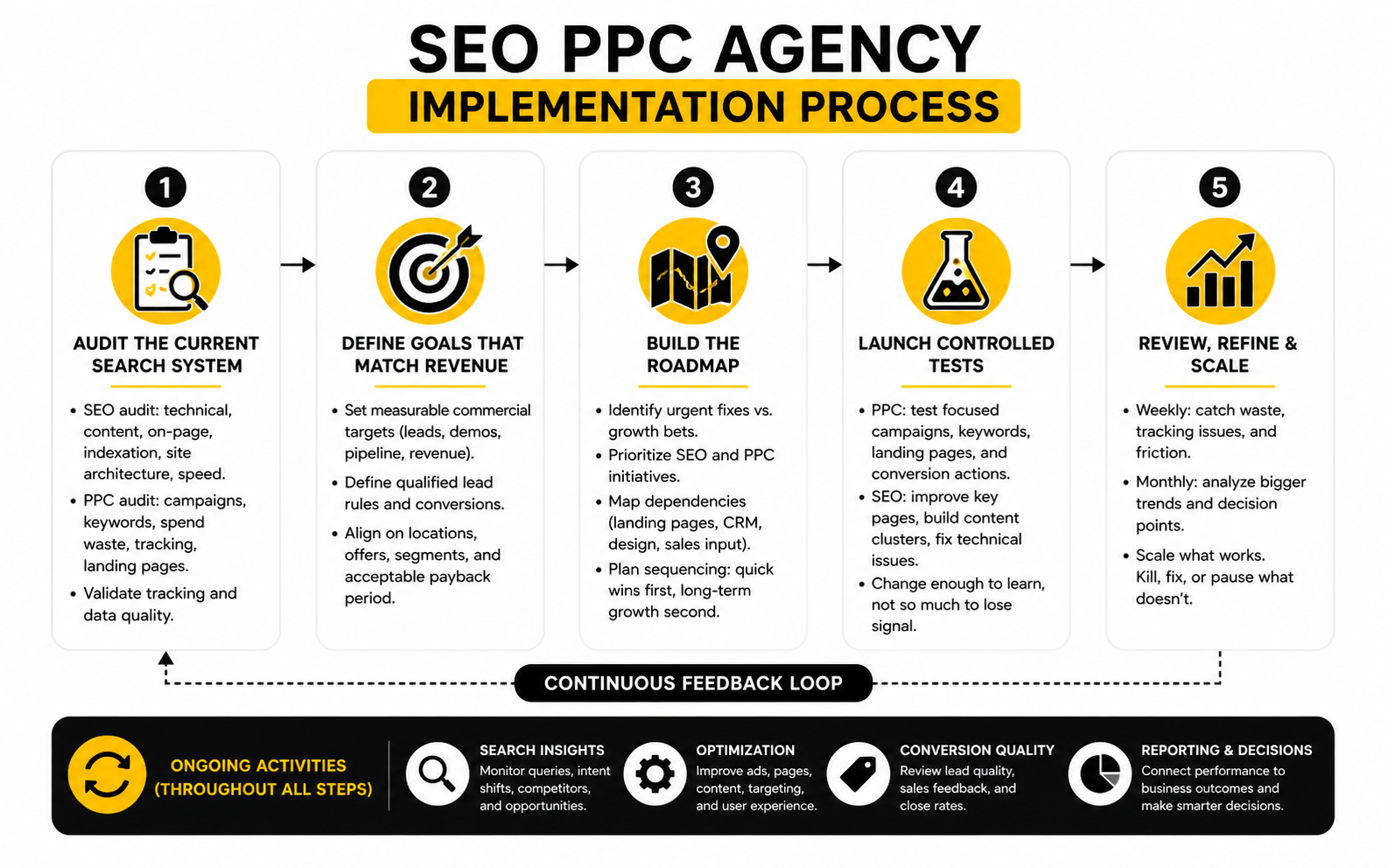
Phase 1: Audit The Current Search System
The first phase is diagnostic. The agency needs to understand where revenue is currently coming from, which search terms are already visible, which campaigns are wasting spend, and where tracking is unreliable. This protects the business from paying for a strategy built on assumptions.
For SEO, the audit should cover crawlability, indexation, site architecture, internal links, content quality, search intent alignment, page speed, structured data, and existing rankings. Google’s own SEO documentation is clear that search visibility depends on helping search engines crawl, index, and understand content properly, which is why technical cleanup cannot be skipped. If the site is confusing to users or search engines, publishing more content will not magically fix the foundation.
For PPC, the audit should review campaign structure, search terms, negative keywords, conversion actions, bidding strategy, budget allocation, ad assets, landing pages, and lead quality. The agency should also check whether the account is optimizing for real business outcomes or shallow events like button clicks. That distinction matters because automated ad systems increasingly optimize based on the conversion signals they receive.
Phase 2: Define Goals That Match Revenue
The next step is turning broad goals into measurable commercial targets. “Get more leads” is not specific enough. A useful target might focus on qualified demo requests, booked calls, ecommerce purchases, pipeline value, cost per qualified lead, or revenue from organic and paid search.
This is where the business and agency need to agree on definitions. What counts as a qualified lead? Which locations, services, products, or customer segments matter most? What is the acceptable payback period, and how much can the company afford to spend before a campaign has enough data?
A good SEO PPC agency will push for clarity here because vague goals create messy optimization. If the only target is form volume, the campaign may produce more forms while sales quality drops. If the target includes pipeline or customer value, the agency has a much better chance of building a search program that actually supports growth.
Phase 3: Build The Roadmap
Once the audit and goals are clear, the agency should build a roadmap that separates urgent fixes from growth bets. Urgent fixes might include broken tracking, poor landing pages, wasted ad spend, thin high-intent pages, duplicate content, or technical issues blocking important pages from performing. Growth bets might include new SEO content clusters, expanded search campaigns, comparison pages, local landing pages, or remarketing flows.
The roadmap should show what will happen first and why. This matters because SEO and PPC move at different speeds. PPC can generate fast learning, while SEO usually needs more time to earn visibility, so the two channels should be sequenced intelligently instead of treated like identical workstreams.
The best roadmap also includes dependencies. If the agency needs landing page support, CRM access, design input, or sales feedback, that should be visible early. Tools like GoHighLevel, Fillout, or Replo can help teams move faster, but only when the process around them is clear.
Phase 4: Launch Controlled Tests
Execution should begin with controlled tests, not chaotic scaling. For PPC, that may mean testing a small set of high-intent campaigns, tight keyword groups, specific landing pages, and clear conversion actions. For SEO, it may mean improving a few important pages, building one strong content cluster, or fixing technical issues that affect revenue-critical sections of the site.
Controlled testing keeps the business from confusing activity with progress. If every campaign, page, and offer changes at once, nobody knows what caused the result. A disciplined agency changes enough to learn, but not so much that the data becomes useless.
This is especially important with automated campaign types. Google’s Performance Max uses AI to optimize bids and placements around conversion goals, but it also depends on the advertiser’s inputs, assets, audience signals, and conversion data. In plain English, the machine needs good instructions, good creative, and good feedback.
Phase 5: Review, Refine, And Scale
After launch, the agency should move into a consistent review rhythm. Weekly reviews can catch waste, tracking issues, search term problems, and obvious landing page friction. Monthly reviews should focus on bigger decisions: budget shifts, content priorities, conversion quality, ranking movement, pipeline impact, and which tests deserve more investment.
Scaling should be earned. If a campaign produces qualified leads at an acceptable cost, it may deserve more budget. If a content cluster starts ranking and attracting the right visitors, it may deserve supporting pages, internal links, and stronger conversion paths.
This is where strong agencies separate themselves from average ones. Average agencies report what happened. Strong agencies explain what changed, what they learned, what they are doing next, and what decision they need from the client.
Statistics And Data
Data should make decisions clearer, not make reports heavier. A good SEO PPC agency does not throw every metric into a dashboard and call it strategy. It separates performance signals from vanity signals, then uses those numbers to decide what to fix, scale, pause, or test next.
The market context matters because competition is rising. Digital advertising revenue reached $294.6 billion in 2025, and search remained one of the largest growth engines inside that spend. That does not mean every business should spend more on ads. It means the businesses with cleaner tracking, sharper landing pages, and better search intent mapping have a stronger chance of making paid and organic search work together.
Benchmarks are useful, but only when they are treated as reference points. 2025 Google Ads benchmark data showed an average search CPC of $5.26, an average conversion rate of 7.52%, and an average cost per lead of $70.11. Those numbers are not targets by themselves. They are context for asking better questions about your own account.
What The Core Metrics Actually Mean
Click-through rate tells you whether the ad or search result is earning attention, but it does not prove the traffic is valuable. A high CTR with weak lead quality usually means the message is too broad, too promotional, or attracting the wrong intent. For SEO, the same logic applies to titles and meta descriptions: more clicks only help if the page satisfies the right searcher.
Cost per click tells you how expensive the auction is, but it does not tell you whether the click is worth buying. A $20 click can be profitable if it leads to a strong sales opportunity. A $2 click can be expensive if it attracts people who never buy.
Conversion rate shows whether visitors are taking the next step, but it needs context. A gated checklist may convert easily while sales-ready demo requests convert at a lower rate but produce more revenue. This is why the best agencies look beyond form submissions and ask what happened after the lead entered the pipeline.
The Analytics System That Keeps SEO And PPC Honest
The measurement system should connect four layers: traffic source, landing page behavior, conversion event, and revenue outcome. Without all four, the agency is forced to optimize from partial truth. That is how teams end up celebrating traffic while the business quietly wonders where the money went.
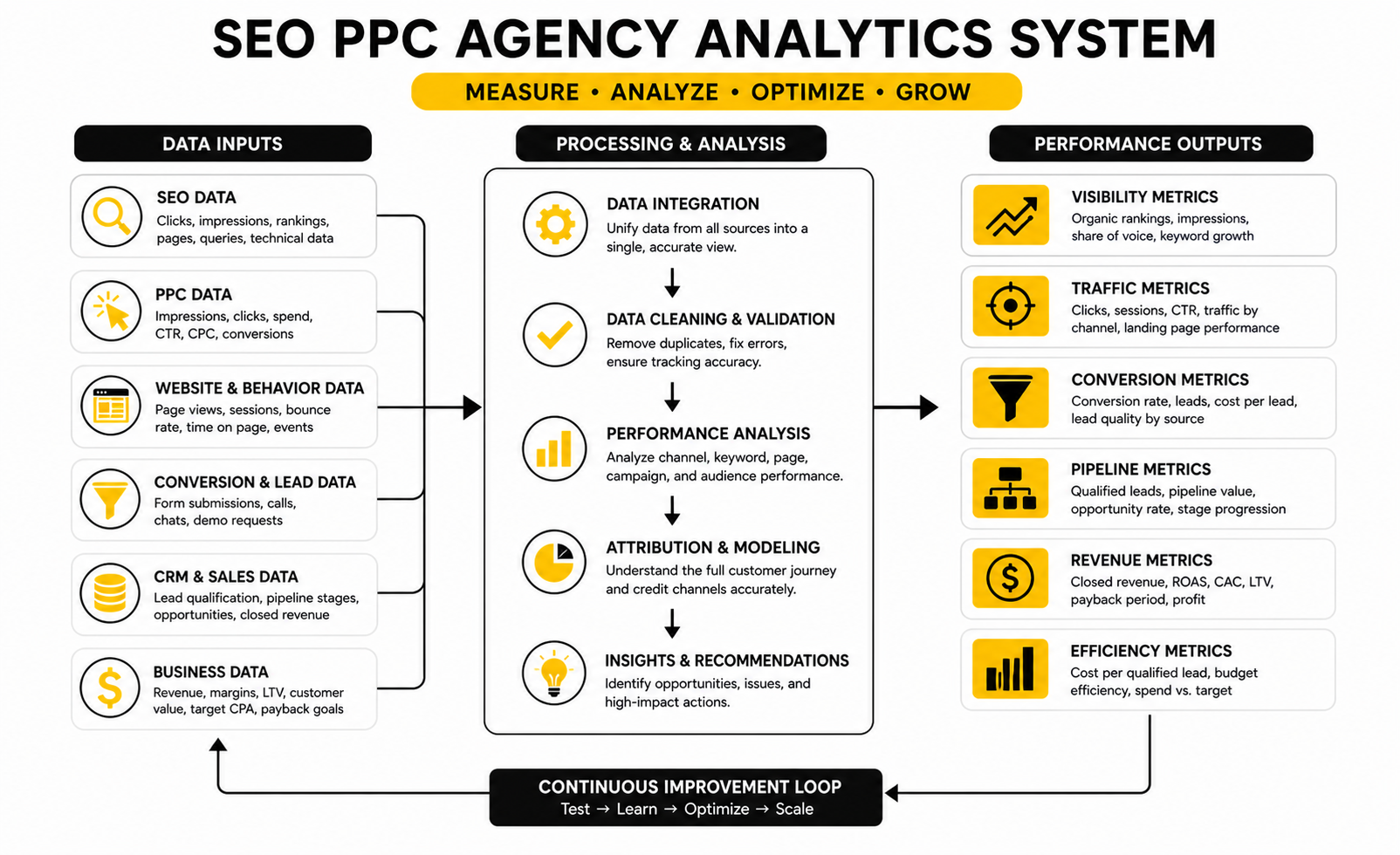
At the first layer, source data tells you whether a visitor came from paid search, organic search, remarketing, branded search, non-branded search, or another channel. At the second layer, engagement and page behavior show whether the page matched the visitor’s expectation. At the third layer, conversion tracking records the action. At the fourth layer, CRM or ecommerce data confirms whether that action became revenue.
This is where technical setup matters. Google’s enhanced conversions can improve measurement accuracy by using hashed first-party data, while offline conversion imports can help ad platforms learn which leads became real opportunities. For service businesses, this often means connecting form fills, calls, booked appointments, sales stages, and closed deals instead of stopping at the first conversion event.
SEO Metrics That Deserve Attention
Organic traffic is useful, but it is not the whole story. A page can gain visits from low-intent searches and still fail commercially. The agency should look at rankings, impressions, click-through rate, landing page conversions, assisted conversions, content decay, internal link strength, and visibility across high-intent topics.
Impressions can reveal whether Google is testing your pages for more searches. Clicks show whether your result earns attention. Conversions show whether the page deserves more investment. When these signals are reviewed together, the agency can decide whether to rewrite the title, improve the content, strengthen internal links, build authority, or change the offer.
The most important SEO question is not “Are rankings up?” It is “Are we becoming more visible for searches that can create business?” That one question keeps the program grounded.
PPC Metrics That Deserve Attention
Paid search metrics need to be read in sequence. Impression share shows whether budget or rank is limiting reach. CTR shows whether the message is competitive. CPC shows auction pressure. Conversion rate shows landing page and offer fit. Cost per qualified lead shows whether the traffic is commercially useful.
A good SEO PPC agency will not panic over one expensive day or celebrate one cheap lead. It will look for patterns. Are certain search terms wasting spend? Are branded campaigns masking weak non-branded performance? Are broad match campaigns finding valuable queries or drifting into irrelevant traffic?
The action depends on the diagnosis. If CTR is weak, the agency may test positioning, assets, or tighter intent groups. If conversion rate is weak, the landing page or offer needs work. If lead quality is weak, the problem may be targeting, conversion definitions, form friction, or poor CRM feedback.
Benchmarks Should Trigger Questions, Not Blind Targets
Benchmarks become dangerous when teams use them as universal goals. A legal services campaign, a local home services campaign, a SaaS demo campaign, and an ecommerce search campaign should not be judged by the same cost per lead. Different margins, sales cycles, lifetime value, and competition levels change what “good” looks like.
The right benchmark is your own historical performance plus realistic industry context. If your CPC is above average but your close rate and customer value are strong, the campaign may be healthy. If your CPL is below average but the sales team rejects most leads, the campaign is not efficient; it is just cheap.
This is why measurement has to end in decisions. The data should tell the agency where to reduce waste, where to improve conversion quality, where SEO can replace paid dependency, and where paid search deserves more budget because the economics work.
How To Evaluate, Brief, And Manage An Agency
Choosing an SEO PPC agency is not just a marketing decision. It affects budget, sales quality, website priorities, reporting, and how quickly the business learns what actually drives revenue. The wrong agency can keep everyone busy while quietly wasting months of momentum.
The evaluation process should focus on how the agency thinks, not how polished the sales deck looks. A strong agency asks difficult questions about margins, sales cycles, lead quality, tracking, positioning, and internal constraints. A weak agency jumps straight into deliverables before understanding the economics.
The best client-agency relationships are built around clarity. The agency needs access, context, and decision-making speed. The business needs transparency, accountability, and a clear reason behind every major recommendation.
What A Strong Agency Should Be Able To Explain
A serious agency should be able to explain how SEO and PPC will work together for your specific business. Not in theory. Not with generic channel language. Specifically for your market, your offer, your competitors, your sales process, and your current website.
They should be able to show which searches deserve paid coverage, which topics deserve organic investment, and where both channels should support the same page. They should also explain what they will not do. That matters because restraint is often a sign of experience.
Watch how they talk about performance. If they only mention traffic, rankings, impressions, and leads, push deeper. You want to hear how they think about qualified pipeline, close rates, customer value, payback period, and budget allocation.
Red Flags That Should Make You Pause
Some warning signs show up early. If an agency guarantees specific rankings, promises instant SEO results, or claims they can scale PPC without discussing tracking and landing pages, be careful. Search is measurable, but it is not magic.
Another red flag is channel isolation. If the SEO team never talks to the PPC team, insights get trapped. Paid search can reveal high-converting language, while SEO can reveal objections and long-tail demand that paid campaigns miss.
Be cautious when the agency cannot explain what happens after the lead. If they stop reporting at form fills, they may optimize for volume instead of quality. That is how businesses end up with busy sales teams, messy pipelines, and disappointing revenue.
How To Brief The Agency Properly
A good brief saves weeks of confusion. It gives the agency enough context to make sharp decisions instead of guessing from the outside. You do not need a 40-page document, but you do need the right information.
A practical brief should include:
This is also where you should be honest about what has failed before. If previous agencies produced bad leads, say that. If tracking is messy, say that. If sales follow-up is slow, say that too, because the agency cannot fix what nobody admits.
Strategic Tradeoffs You Need To Understand
There is always a tradeoff between speed and compounding. PPC gives faster learning, but the traffic stops when the budget stops. SEO takes longer, but strong pages can keep producing value after the original investment.
There is also a tradeoff between control and automation. Manual structure can give more visibility into search intent, while automated campaigns can find scale when the account has enough clean conversion data. The right choice depends on budget, conversion volume, tracking quality, and how much risk the business can tolerate.
Then there is the tradeoff between volume and quality. More leads are not always better. A good SEO PPC agency should be willing to reduce low-quality volume if it improves pipeline efficiency and revenue per lead.
Scaling Without Breaking The System
Scaling search is not just increasing the budget. It means expanding only after the offer, tracking, landing pages, and follow-up process can handle more demand. Otherwise, the business pays for traffic that leaks out of the system.
For PPC, scaling might mean expanding keyword coverage, testing new campaign types, increasing budgets on profitable segments, or improving conversion value signals. For SEO, scaling might mean building new content clusters, strengthening internal links, improving authority, refreshing older pages, or creating stronger commercial pages.
The mistake is scaling everything at once. Better agencies scale in layers. They protect what is working, isolate new tests, and keep enough control to know whether performance changed because of budget, intent, creative, landing pages, seasonality, or sales follow-up.
Tools Should Support The Process, Not Replace It
Software can make execution faster, but it cannot replace strategy. A CRM like GoHighLevel, a landing page builder like ClickFunnels, or an email platform like Brevo can help when the team already knows what it is trying to improve. Without that clarity, tools just create more places to hide confusion.
The same applies to AI and automation. They can speed up research, reporting, creative testing, and workflow management. But they still need human judgment around positioning, search intent, customer psychology, compliance, margins, and sales reality.
The agency you want is not the one with the longest tool stack. It is the one that knows which tools matter for your bottleneck right now. That is a very different thing.
What does an SEO PPC agency do?
An SEO PPC agency manages organic search and paid search together instead of treating them as separate channels. The SEO side improves visibility, content, technical performance, and long-term search authority. The PPC side uses paid campaigns to capture demand faster, test messaging, and generate measurable leads or sales.
Is SEO or PPC better for growth?
Neither is automatically better. PPC is usually faster because you can launch campaigns and collect data quickly, while SEO is better for compounding visibility over time. The smart move is often using PPC for speed and SEO for durability.
When should a business hire an SEO PPC agency?
A business should consider hiring an agency when search is important but internal execution is inconsistent. If tracking is messy, paid spend is rising, organic growth is flat, or the sales team doubts lead quality, outside expertise can help. The key is hiring before wasted spend becomes normal.
How long does SEO take compared with PPC?
PPC can start producing data almost immediately after launch, but it still needs testing before performance stabilizes. SEO usually takes longer because rankings depend on site quality, content depth, competition, and authority. A strong agency should explain the expected timeline without promising overnight organic results.
How much should an SEO PPC agency cost?
Cost depends on scope, competition, ad spend, content needs, technical complexity, and reporting depth. A small local campaign will not require the same budget as a national SaaS or ecommerce program. The better question is whether the agency can connect its fees and media spend to qualified pipeline or revenue.
What should be included in the first 90 days?
The first 90 days should usually include audits, tracking cleanup, priority landing page improvements, campaign restructuring, keyword and content planning, and early tests. The goal is not to do everything at once. The goal is to create a clean foundation and start learning from real search behavior.
How do I know if an agency is actually good?
A good agency explains tradeoffs clearly, asks about revenue, and challenges weak assumptions. It should be comfortable discussing lead quality, tracking gaps, landing page friction, and sales follow-up. If the conversation stays only on clicks, rankings, and impressions, that is not enough.
Should one agency handle both SEO and PPC?
One agency can handle both if it has real expertise in both disciplines and a process for sharing insights. The advantage is alignment: PPC data can guide SEO priorities, and SEO research can improve paid campaigns. The risk is hiring a generalist agency that is average at both, so you need to evaluate the team behind the offer.
What metrics matter most?
The most useful metrics are the ones closest to business outcomes. Qualified leads, cost per qualified lead, pipeline value, revenue, conversion rate, and search visibility for commercial topics matter more than raw traffic alone. Traffic is useful only when it attracts the right people.
Can SEO reduce PPC costs?
SEO can reduce paid dependency over time by earning organic visibility for valuable searches. That does not always mean PPC spend should disappear. In many cases, the best result is using SEO to cover durable demand while PPC focuses on competitive, high-intent, or fast-testing opportunities.
What should I avoid when hiring an agency?
Avoid agencies that guarantee rankings, avoid talking about tracking, or push tactics before understanding your business. Also be careful with agencies that hide behind vague reporting. You need clear priorities, honest performance reviews, and direct explanations of what is working and what is not.
What tools should an SEO PPC agency use?
The exact tool stack matters less than the process. Agencies may use platforms for analytics, CRM, landing pages, reporting, email, automation, and call tracking. Tools like GoHighLevel, ClickFunnels, Brevo, or Fillout can help, but only when they support a clear strategy.
Build a stronger local presence with BAAM AI
Turn your website, Google profile, social channels, and AI visibility into one growth engine
Most businesses do not need more random marketing activity. They need a consistent presence system that helps the right people find them, trust them, and take action. BAAM AI brings strategy, local SEO, website updates, Google Maps visibility, social content, AI-search readiness, media production, and reporting into one practical monthly engine.
If you want your marketing to keep working after the campaign ends, start with a free BAAM AI presence audit. See how your business shows up today and where the fastest visibility wins are at BAAM AI.