
BAAM AI Blog
SEO Marketing Digital: A Practical Framework For Turning Search Visibility Into Revenue
SEO marketing digital is no longer just about ranking blog posts and waiting for traffic. Search has become a discovery layer across Google, YouTube, Reddit, marketplaces, AI assistants, local results, and comparison...
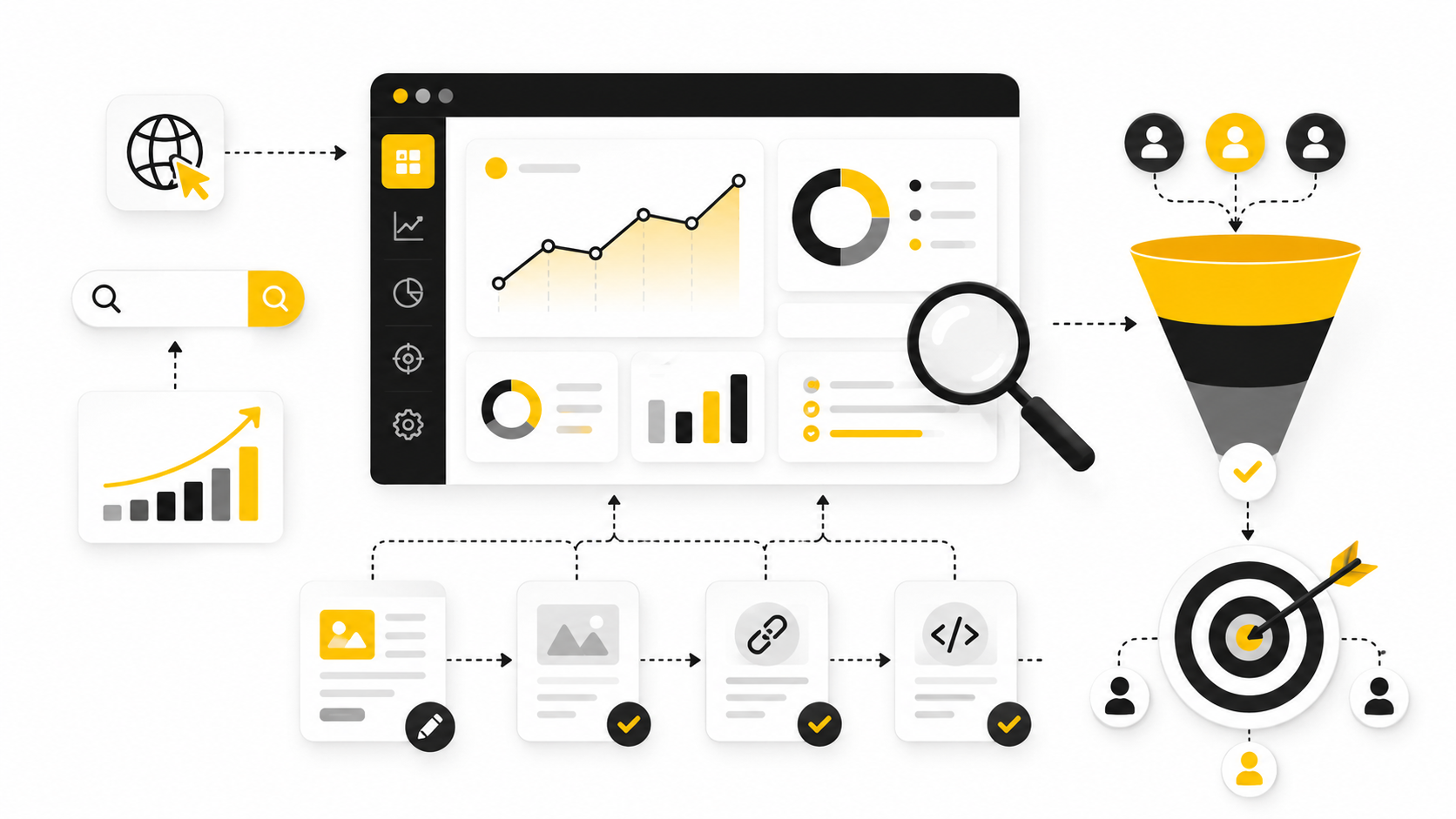
SEO marketing digital is no longer just about ranking blog posts and waiting for traffic. Search has become a discovery layer across Google, YouTube, Reddit, marketplaces, AI assistants, local results, and comparison pages. That means the brands that win are not simply the ones that publish the most content; they are the ones that build the clearest, most trusted answer system around what their buyers already want.
This matters because search behavior is getting more fragmented while buyer expectations are getting sharper. Google’s own SEO guidance still frames SEO around helping search engines understand content and helping users decide whether to visit a site through search, but the modern version of that job now stretches across technical health, brand authority, conversion paths, content quality, and AI-shaped search experiences. At the same time, zero-click behavior has changed the economics of search, with SparkToro’s 2024 study showing that only 374 of every 1,000 EU Google searches and 360 of every 1,000 U.S. Google searches sent a click to the open web.
So the goal is not “get more rankings” in isolation. The goal is to build a search-driven digital marketing system that earns visibility, captures the right demand, and converts that demand into measurable business outcomes. Rankings still matter, but they only become valuable when they connect to intent, credibility, offers, funnels, email, retargeting, sales pages, and customer experience.
Why SEO Marketing Digital Still Matters
SEO matters because people still search when they have problems, questions, urgency, curiosity, or buying intent. Paid ads can interrupt demand, but search often captures demand that already exists. That makes SEO one of the few digital marketing channels that can support awareness, evaluation, and purchase intent at the same time.
The catch is that search is not as simple as it used to be. AI summaries, featured snippets, maps, videos, forums, shopping modules, and “people also ask” results can all appear before a traditional organic result gets attention. A 2026 academic study on Google AI Overviews and Wikipedia found that AI Overview exposure reduced daily traffic to affected English Wikipedia articles by about 15% across 161,382 matched article-language pairs, which reinforces a practical point: brands cannot rely on rankings alone when answer engines increasingly satisfy some searches without a click.
That does not make SEO weaker. It makes weak SEO weaker. Strong SEO marketing digital work now has to answer three questions at once: can search engines understand you, can buyers trust you, and can your website turn attention into action?
The Search Visibility Framework
A useful SEO framework starts with intent, not keywords. Keywords are the language people use, but intent is the reason they search in the first place. When you understand the reason, you can decide whether the right asset is a guide, a comparison page, a landing page, a product page, a calculator, a video, a local page, or a sales funnel.
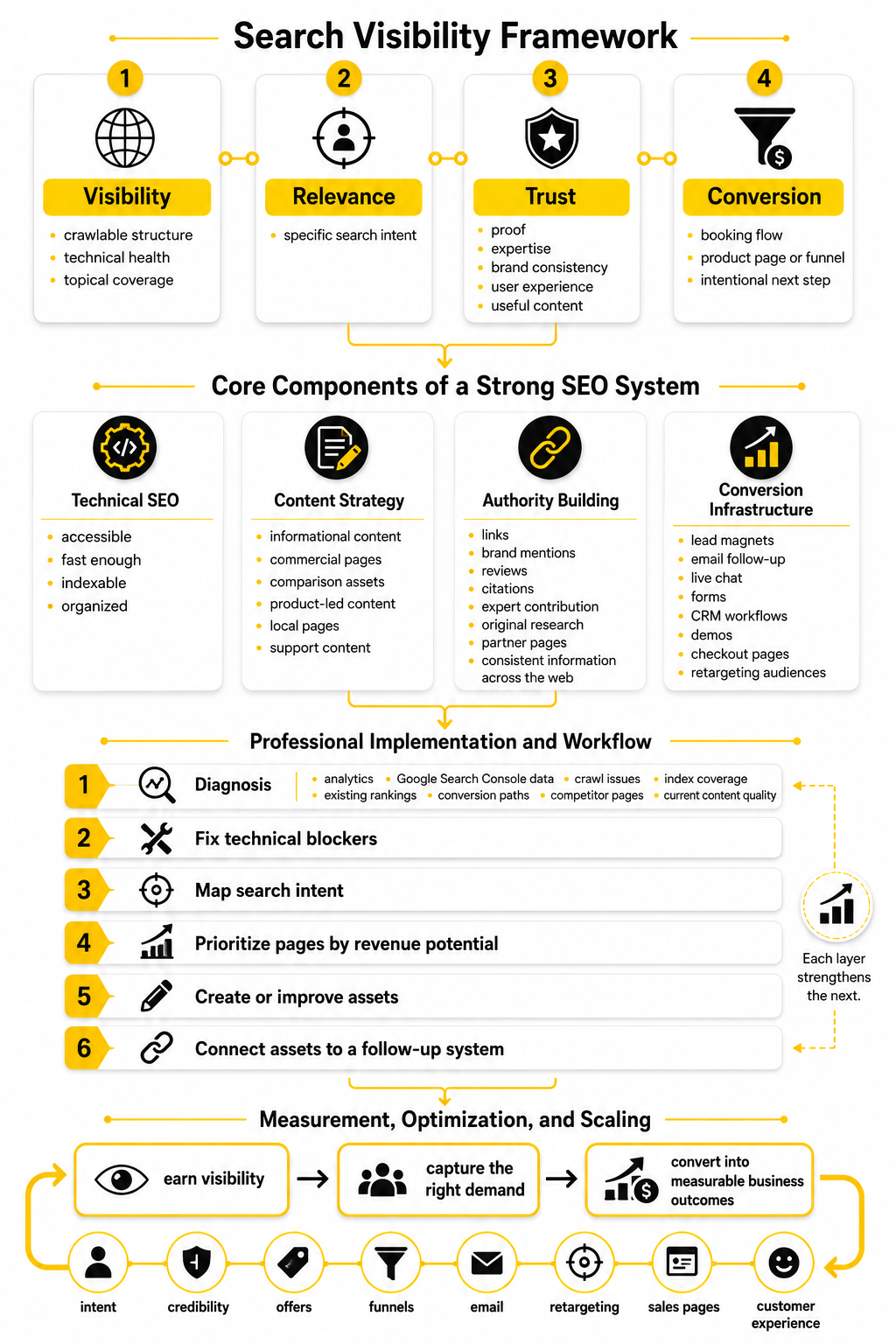
The framework for this guide has four layers: visibility, relevance, trust, and conversion. Visibility helps your pages get discovered through crawlable structure, technical health, and topical coverage. Relevance connects the page to a specific search intent, while trust comes from proof, expertise, brand consistency, user experience, and useful content that deserves to be cited or recommended.
Conversion is where many SEO campaigns fall apart. Traffic without a next step is just attention leaking out of the business. For service brands, that next step may be a booking flow through a tool like Cal.com. For ecommerce or landing-page-heavy campaigns, it may be a focused product page or funnel built with tools such as Replo or ClickFunnels, but the principle is the same: search visibility should lead somewhere intentional.
Core Components Of A Strong SEO System
A strong SEO system has four core components: technical SEO, content strategy, authority building, and conversion infrastructure. Technical SEO keeps the site accessible, fast enough, indexable, and organized so search engines can crawl and understand it. This is the foundation, and Google’s SEO Starter Guide keeps the focus practical: help search engines understand your content while making it easier for users to find and evaluate it through search.
Content strategy is where the business connects its expertise to buyer demand. This includes informational content, commercial pages, comparison assets, product-led content, local pages, and support content that removes friction before a purchase. The best content strategy does not chase every keyword; it builds topical depth around the problems the business can actually solve.
Authority building is the trust layer. It includes links, brand mentions, reviews, citations, expert contribution, original research, partner pages, and consistent information across the web. Conversion infrastructure then turns that trust into action through lead magnets, email follow-up, live chat, forms, CRM workflows, demos, checkout pages, and retargeting audiences.
Professional Implementation And Workflow
Professional implementation starts with diagnosis. Before creating new content, you need to know what is already working, what is blocking growth, and where search demand overlaps with business value. That means reviewing analytics, Google Search Console data, crawl issues, index coverage, existing rankings, conversion paths, competitor pages, and the quality of current content.
From there, the workflow should move in order: fix the technical blockers, map search intent, prioritize pages by revenue potential, create or improve assets, then connect those assets to a follow-up system. A CRM and automation platform such as GoHighLevel can make sense when SEO leads need to be routed into pipelines, reminders, SMS, email sequences, or sales workflows. For simpler email capture and nurture, tools like Brevo or Moosend can support the conversion side without overcomplicating the stack.
The important part is sequencing. Do not publish endlessly on a broken site. Do not build funnels for traffic that does not exist. Do not chase backlinks before your best pages clearly deserve attention. SEO marketing digital works best when each layer strengthens the next one, instead of creating random activity that looks productive but never compounds.
From Search Traffic To Search Demand
The next step is understanding the difference between traffic and demand. Traffic is a number in analytics. Demand is the reason someone searched, clicked, compared, subscribed, booked, or bought. SEO marketing digital becomes more profitable when you stop treating every visit as equal and start asking what that visitor was trying to solve.
This is especially important now because not every search creates a website visit. SparkToro’s zero-click research showed that only 360 of every 1,000 U.S. Google searches produced a click to the open web. That does not mean search is dead; it means your search strategy has to earn the clicks that are still worth winning.
The best SEO strategy now works like demand capture and demand shaping at the same time. You capture demand with pages that match clear intent, such as pricing, comparisons, services, product categories, and location searches. You shape demand with educational assets that help people understand the problem, trust your point of view, and move closer to a decision.
Why Intent Comes Before Keywords
Keywords are useful, but they are not the strategy. A keyword tells you what someone typed. Intent tells you what they probably need next, and that is where the money is.
For example, someone searching “seo marketing digital” may be looking for a definition, a strategy, a service provider, a course, a checklist, or a tool stack. Those are different needs, even when the keyword looks similar. If one page tries to serve every intent at once, it usually becomes vague, bloated, and less persuasive.
A professional workflow separates intent into practical groups. Informational intent needs clear explanations and useful frameworks. Commercial intent needs comparisons, proof, positioning, and objections handled directly. Transactional intent needs clean landing pages, strong calls to action, fast loading, trust signals, and minimal friction.
The Four Intent Layers That Drive SEO Revenue
Most SEO campaigns become easier to manage when you organize search intent into four layers. The first layer is awareness, where people are trying to understand a problem or opportunity. These pages do not always convert immediately, but they build brand familiarity and create future retargeting, email, and nurture opportunities.
The second layer is evaluation. This is where people compare approaches, tools, agencies, platforms, pricing models, or methods. These searches are usually more valuable than broad educational searches because the user is already filtering options and looking for confidence.
The third layer is action. This includes searches around demos, pricing, consultations, templates, local services, software trials, or specific providers. For these searches, the page should not hide the next step. If the visitor is ready, make the action obvious.
The fourth layer is retention and expansion. This includes support content, onboarding guides, implementation tutorials, troubleshooting pages, and customer education. These pages often get ignored in SEO plans, but they reduce churn, improve customer experience, and can attract high-intent users who are unhappy with another solution.
Building Topic Clusters That Actually Help
A topic cluster is not a pile of blog posts connected by random internal links. It is a structured group of pages that helps a reader move from basic understanding to confident action. The central page should explain the main topic clearly, while supporting pages answer specific questions, comparisons, objections, and use cases.
This is where many brands make a costly mistake. They publish ten articles that all say nearly the same thing, then wonder why none of them rank well. Search engines do not need more thin variations of the same answer, and readers definitely do not.
A stronger cluster around SEO marketing digital would include a strategic pillar page, service pages, technical SEO guides, content strategy articles, measurement guides, tool comparisons, and conversion-focused landing pages. Each page should have a distinct job. When every page has a role, internal linking becomes useful instead of forced.
Search Visibility Beyond Google Rankings
Traditional rankings still matter, but search visibility is wider now. People discover brands through Google results, YouTube videos, Reddit discussions, LinkedIn posts, TikTok searches, AI tools, review sites, podcasts, newsletters, and niche communities. A buyer may search on Google first, check Reddit second, watch a YouTube review third, and only then visit your site.
That changes how SEO should be planned. Your website remains the asset you control, but the signals around your brand also matter. Reviews, mentions, expert contributions, social proof, third-party comparisons, and consistent messaging all help buyers feel safer before they take action.
BrightEdge’s 2025 research found that AI search visits were growing quickly, but still represented less than 1% of referral traffic across the data it analyzed. That is the practical balance. You should prepare for AI discovery, but you should not abandon traditional organic search while it is still doing the heavy lifting.
Making Content Useful Enough To Deserve Visibility
Useful content answers the real question behind the search. It does not dance around the point, bury the answer, or stretch a simple idea into 2,000 words just to hit an arbitrary length. Google’s guidance on helpful content emphasizes creating material for people first, with SEO used to help search engines discover and understand that content through people-first content practices.
That means the content has to do a job. It should clarify, compare, teach, guide, prove, simplify, or help someone make a better decision. If a section does none of those things, it probably does not need to exist.
The strongest pages usually combine experience, structure, and next-step clarity. They explain the issue in plain language, show the decision criteria, address risks, and connect the reader to a logical action. That action could be booking a call, joining an email list, using a calculator, starting a trial, downloading a checklist, or viewing a relevant offer.
Connecting SEO Content To Conversion Paths
SEO content should never feel like a dead end. When someone lands on a page, the next step should match the intent of the page. A beginner guide might invite the reader to join an email sequence, while a service page should move them toward booking or requesting a quote.
This is where digital marketing infrastructure matters. A good article can attract the visitor, but the follow-up system turns that visit into a business opportunity. Forms, booking pages, lead magnets, email automation, CRM stages, and retargeting audiences all help SEO work harder.
For agencies, consultants, and local service businesses, connecting organic leads into a pipeline through GoHighLevel can make the difference between “we got traffic” and “we followed up with every qualified lead.” For simpler creator or small-business funnels, Systeme.io can fit when the goal is to connect pages, email, and offers without building a complicated tech stack. The tool is not the strategy, but the right system prevents good traffic from disappearing.
Professional Implementation And Workflow
Professional SEO starts with restraint. The temptation is to open a keyword tool, export thousands of phrases, and start producing content as fast as possible. That looks busy, but it usually creates a bloated site full of weak pages competing with each other.
A better implementation process starts with business value. Before writing anything, decide which services, products, offers, locations, categories, or customer segments matter most. SEO marketing digital should support the business model first, then the content calendar second.
This is where the work becomes practical. The process below keeps SEO from turning into random publishing, because every step has a clear purpose and a clear handoff into the next one.
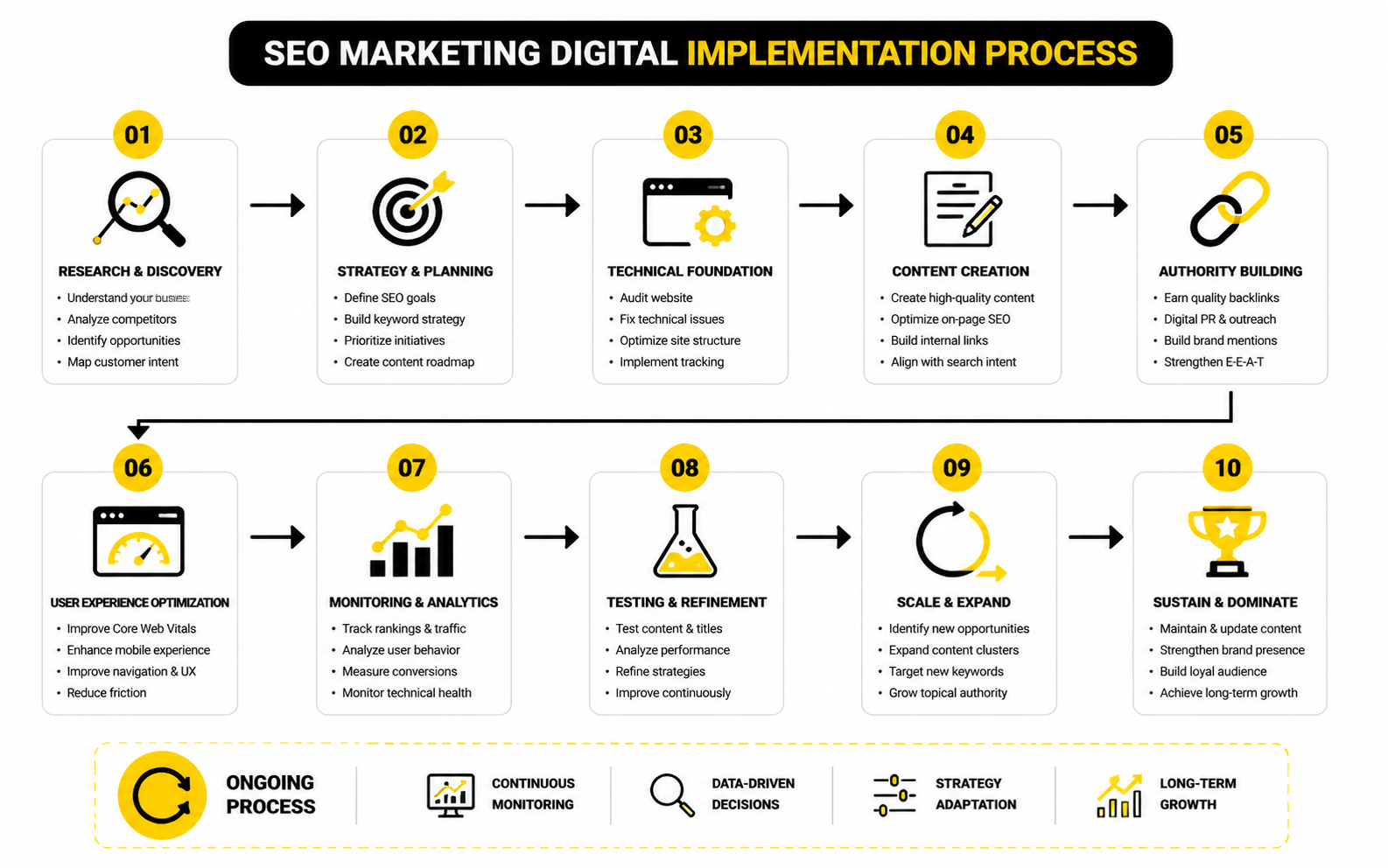
Step 1: Audit The Current Search Foundation
Start by finding what already exists. Review indexed pages, crawl errors, duplicate pages, broken links, redirects, thin content, missing metadata, internal linking gaps, slow templates, and pages that receive impressions but few clicks. Google’s SEO Starter Guide frames the basics clearly: SEO is about improving a site’s presence in search by making content easier for search engines and users to understand through practical search improvements.
This audit should not become an endless technical report. The goal is to separate urgent blockers from nice-to-have fixes. If important pages cannot be crawled, load poorly, target the same intent, or fail to explain the offer, those issues come before another batch of articles.
The strongest audits also look at conversion paths. A page can rank and still waste the opportunity if the call to action is unclear, the form is too long, the page lacks trust signals, or the next step feels disconnected from the search intent. SEO implementation is not complete until the visitor knows what to do next.
Step 2: Map Intent To Pages
Once the foundation is visible, map search intent to actual pages. Each important intent should have one primary page, not five similar pages fighting for the same query. This prevents cannibalization and makes internal linking much easier.
A simple intent map should include the keyword theme, the user’s likely goal, the best page type, the funnel stage, the offer connection, and the next action. For example, a broad educational query may deserve a detailed guide, while a comparison query may need a page that directly explains tradeoffs. A high-intent service query should lead to a page built for confidence, proof, and conversion.
This is also where you decide what not to create. Not every keyword deserves a page. If a term has no business value, no realistic ranking path, or no clear next step, it can distract the team from work that actually compounds.
Step 3: Build Pages Around Jobs, Not Word Counts
A page should be as long as it needs to be to satisfy the intent. That may mean 700 words for a focused service page or 4,000 words for a deep strategic guide. The mistake is treating word count as the target instead of usefulness.
Google’s helpful content guidance keeps the standard simple: content should be made for people first, with SEO used in a way that helps discovery rather than manipulating attention through people-first content practices. In practice, that means the page should answer the real question, remove confusion, and help the reader make a better decision. If a paragraph exists only to repeat the keyword, cut it.
Strong pages usually include a clear opening answer, specific subtopics, decision criteria, objections, proof, internal links, and a natural next step. They do not need fluff. They need clarity.
Step 4: Strengthen Technical And Structured Signals
Technical SEO is not glamorous, but it protects everything else. If search engines cannot crawl the site cleanly, understand the structure, or identify the main content, the best writing in the world has a weaker chance of performing. This is why implementation should include crawl management, canonical tags, redirects, XML sitemaps, internal links, schema where appropriate, and clean page templates.
For ecommerce and product-led sites, structured data can help search engines understand products, reviews, prices, availability, breadcrumbs, and other page details through relevant ecommerce structured data. It is not magic, and it does not guarantee rich results. But it makes the page easier to interpret, which is exactly what technical SEO is supposed to do.
User experience also belongs here. Pages should load quickly, behave predictably on mobile, and avoid layouts that frustrate people before they can read or act. Technical SEO is not just about bots; it is about removing friction from the entire search visit.
Step 5: Create A Content Production System
Content production needs a repeatable system, not heroic one-off effort. Each page should move through research, brief, draft, review, optimization, publishing, internal linking, indexing checks, and performance review. When that workflow is clear, quality becomes easier to maintain.
The brief matters more than most teams think. A strong brief defines the search intent, target reader, core angle, required sections, internal links, proof points, conversion goal, and what the page should not cover. This prevents generic content and keeps writers focused on the business outcome.
For teams publishing across search and social, a scheduling layer can help keep distribution consistent. A tool like Buffer can support the promotion side when an SEO asset deserves to be repurposed into LinkedIn posts, short updates, or campaign reminders. Search content should not live alone if it can also fuel other channels.
Step 6: Connect Forms, Chat, Email, And CRM Follow-Up
The implementation process is not finished when the page goes live. A good SEO page should connect to a follow-up mechanism that matches the reader’s stage of awareness. Someone reading a beginner guide may need a checklist or email sequence, while someone on a pricing or service page may be ready to book.
Forms, chat widgets, lead magnets, booking links, and CRM workflows turn organic attention into a managed pipeline. A simple form built with Fillout can work well for audits, lead qualification, calculators, and intake flows. A conversational layer such as Chatbase can also help visitors find relevant answers faster when a site has a lot of content.
The key is to avoid dead ends. If a visitor arrives from search, reads the page, and has no obvious next step, the implementation is incomplete. SEO marketing digital should create a smooth path from question to trust to action.
Step 7: Publish, Measure, And Improve In Cycles
SEO implementation is never a one-time launch. After publishing, watch impressions, rankings, click-through rate, engagement, conversions, assisted conversions, and lead quality. The goal is not to panic over every movement, but to identify where the page is gaining traction and where it needs improvement.
A page with impressions but low clicks may need a stronger title, clearer meta description, or better alignment with the search result. A page with traffic but weak conversions may need a better offer, stronger proof, simpler form, or more direct call to action. A page with no impressions may need better internal links, stronger topical support, or a more realistic keyword target.
This cycle is where SEO becomes a compounding asset. Publish, measure, improve, link, refresh, and expand only when the data supports it. That discipline beats random content volume every time.
Statistics And Data
Measurement is where SEO marketing digital becomes honest. Strategy can sound impressive in a document, but the data shows whether search visibility is turning into qualified attention, leads, customers, and revenue. The trick is knowing which numbers matter, because SEO dashboards can easily become a graveyard of charts nobody acts on.
Start with one principle: every metric should answer a business question. Impressions answer whether the page is being seen in search. Clicks answer whether the result is compelling enough to earn a visit. Conversions answer whether the visit created business value. Revenue, pipeline, retention, and customer quality answer whether the SEO work deserves more investment.
Random statistics do not help. A benchmark only matters when it gives you context for a decision. If zero-click searches are rising, the action is not to panic; the action is to make your pages more click-worthy, strengthen branded demand, and measure visibility beyond visits alone.
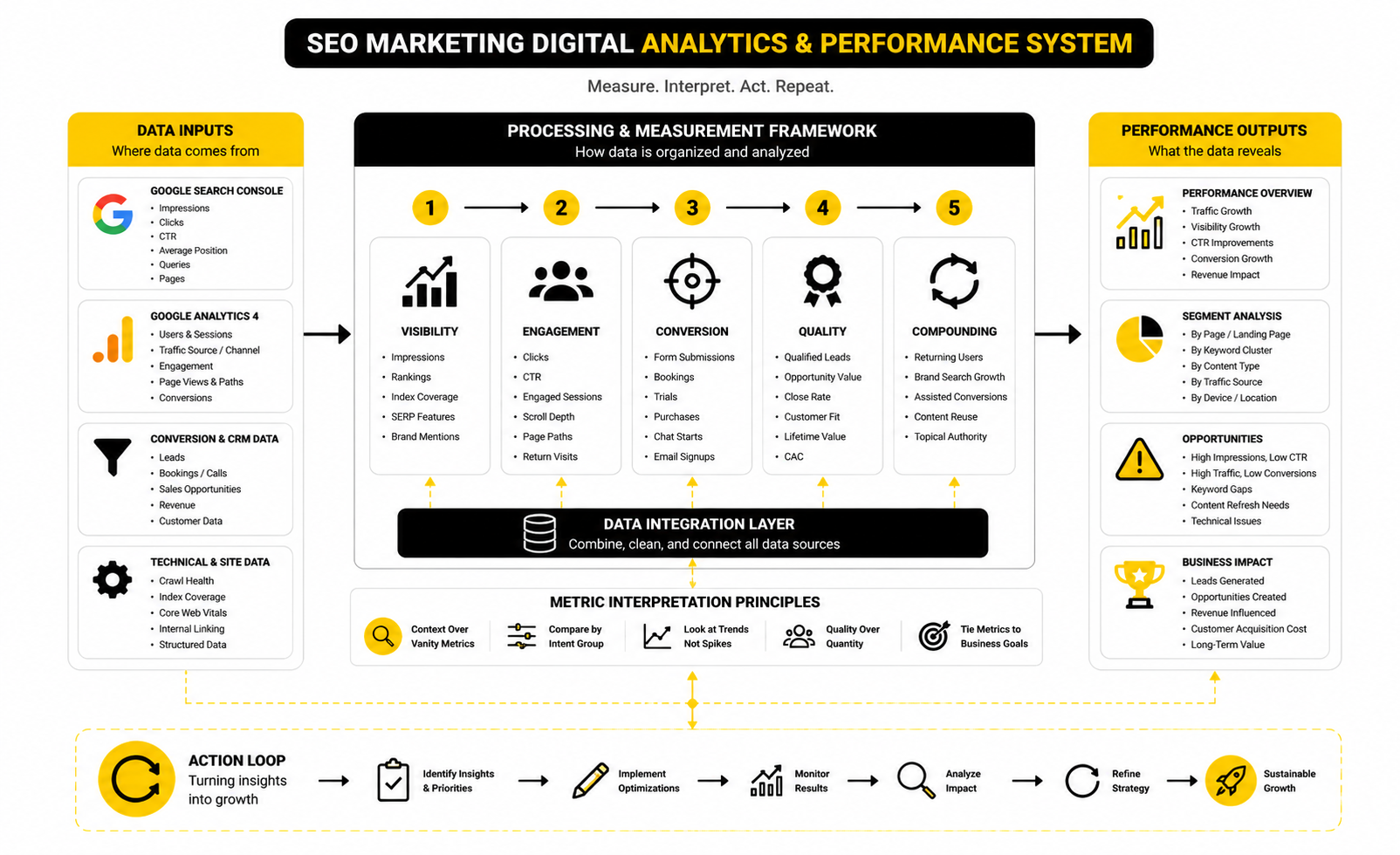
The Metrics That Actually Matter
The first layer is search visibility. In Google Search Console, impressions show how often a result appeared, clicks show visits from search, click-through rate shows the relationship between those two, and average position estimates where the result appeared across searches through Google’s own Search Console metric definitions. These numbers are not perfect, but they are practical enough to show whether a page is gaining search exposure.
The second layer is behavior. Once visitors land on the site, analytics should show whether they engage with the page, continue to related pages, complete forms, start chats, book calls, subscribe, or buy. Google Analytics 4’s traffic acquisition report is useful here because it shows where new and returning users come from through channel-level acquisition reporting.
The third layer is commercial impact. This includes leads, qualified leads, sales opportunities, revenue, close rate, customer acquisition cost, and lifetime value. If SEO is measured only by rankings, the team will optimize for visibility. If SEO is measured against pipeline and revenue, the team will optimize for business outcomes.
How To Read Search Console Without Fooling Yourself
Search Console data is powerful, but it is easy to misread. A rising impression count can mean your page is getting stronger, but it can also mean Google is testing it across broader queries that may not be relevant. A lower average position can happen even while clicks grow, because the page may be appearing for many more long-tail searches.
Click-through rate needs context too. A branded query usually has a higher CTR because the searcher already knows you. A broad informational query may have a lower CTR because the results page includes ads, AI summaries, featured snippets, videos, or other elements competing for attention. So do not judge every page by one universal CTR target.
The better method is to compare pages by intent group. Compare service pages with service pages, guides with guides, comparison pages with comparison pages, and local pages with local pages. That gives you a cleaner read on whether the page is underperforming because of the title, intent mismatch, weak positioning, or SERP layout.
Benchmarks Are Context, Not Targets
Benchmarks can help you understand the market, but they should not become blind targets. SparkToro’s 2024 zero-click study found that 58.5% of U.S. Google searches and 59.7% of EU Google searches ended without a click. That matters because it explains why impressions may rise faster than visits, especially for simple informational searches.
BrightEdge also found that AI search visits were growing quickly in 2025, but still made up less than 1% of referral traffic in its analyzed data. That matters because it keeps the conversation grounded. AI visibility is worth tracking, but organic search still deserves serious attention because it remains a major source of qualified traffic for many websites.
Benchmarks should trigger questions, not excuses. If search is sending fewer clicks in some categories, you need stronger titles, clearer offers, more branded demand, and content that deserves to be chosen over instant answers. If AI referral traffic is still small, you should monitor it without letting it hijack the entire strategy.
Measuring The Full SEO Funnel
The full funnel starts before the click. A user may see your brand in search results several times before they visit. They may also see a social post, a YouTube video, a Reddit mention, a comparison page, or an AI-generated answer before they ever reach your website.
That is why SEO measurement should include both leading and lagging indicators. Leading indicators include impressions, indexed pages, ranking movement, internal link coverage, crawl health, branded search growth, and content refresh velocity. Lagging indicators include demo requests, sales calls, revenue, customer acquisition cost, retention, and expansion.
A simple measurement model can look like this:
What Good Performance Signals Look Like
Good SEO performance does not always look like a straight upward line. New pages may take time to earn impressions. Older pages may grow, flatten, dip, and recover after updates. Seasonal topics may look weak during quiet months and surge when demand returns.
A healthy SEO system usually shows several signals at once. More relevant pages begin earning impressions. A few pages start pulling in long-tail clicks. Internal links help important pages move up gradually. Branded searches increase as people encounter the brand across more touchpoints.
The most important signal is not just traffic growth. It is the quality of the actions that follow the traffic. If organic visitors are booking calls, starting trials, completing forms, or returning later through branded searches, the SEO system is working even if some vanity metrics look ordinary.
What Bad Performance Signals Usually Mean
Bad data is useful when you interpret it correctly. High impressions with low clicks often means the page is visible but not compelling enough in the results. The title may be vague, the angle may be weak, or the search result may be dominated by elements that reduce organic clicks.
Traffic with poor conversions usually means the page attracted the wrong audience or failed to match the next step to the visitor’s intent. A broad guide should not be judged the same way as a pricing page, but every page should still have a logical next action. If people arrive, read, and leave with no movement, something in the path is missing.
Rankings without revenue can signal a strategy problem. The team may be targeting keywords because they have volume, not because they map to buying intent. This is one of the most common mistakes in SEO marketing digital: celebrating visibility while ignoring whether the visibility can ever become demand.
Building A Practical SEO Reporting System
A useful SEO report should be short enough to read and clear enough to act on. It should show what changed, why it probably changed, what it means, and what the team will do next. Anything else is noise.
The best reporting rhythm separates weekly monitoring from monthly decisions. Weekly checks can catch technical issues, traffic drops, indexing problems, and conversion tracking errors. Monthly reviews should focus on trends, winners, losers, business impact, and next priorities.
For lead-based businesses, connect organic forms, bookings, and sales opportunities into one pipeline. A CRM like Copper can help teams track relationship-driven opportunities, while GoHighLevel can work well when SEO leads need automation, follow-up, pipeline stages, and campaign reporting in one place. The point is not to collect more software; the point is to stop losing the business context behind organic leads.
Turning Data Into Action
Data only matters when it changes behavior. If a page has impressions but no clicks, rewrite the title and meta description, improve the angle, and check whether the page truly matches the query. If a page has clicks but no conversions, improve the offer, shorten the path, add proof, and make the next step more obvious.
If a topic cluster has one strong page and several weak pages, consolidate, refresh, or redirect instead of producing more overlap. If a service page is ranking but attracting poor-fit leads, tighten the positioning and qualify the call to action. If branded search is growing, support it with better comparison pages, stronger review assets, and clearer bottom-of-funnel content.
This is the discipline that separates serious SEO from content activity. Measure what matters, interpret it in context, and take action. Then repeat the cycle until search visibility becomes a reliable business channel, not just a reporting line.
Scaling SEO Without Losing Quality
Scaling SEO marketing digital is not about publishing faster. It is about creating more useful search assets without lowering the standard that made the first pages work. That distinction matters because scale can either compound authority or create a mess that takes months to clean up.
The safest way to scale is to expand from proven intent. If a service page converts, build supporting comparison pages, implementation guides, objection-handling pages, and customer education content around it. If a guide earns qualified traffic but weak conversions, improve the offer and internal path before creating ten more guides like it.
Quality control becomes more important as output increases. Every page should still have a clear reader, a unique purpose, a search intent, a business reason, and a next step. If the team cannot explain why a page should exist, the page probably should not be published.
The Tradeoff Between Volume And Depth
There is always a tradeoff between publishing more pages and making fewer pages stronger. Volume can help when a site has many distinct products, locations, use cases, or customer segments. Depth wins when the market is competitive, the topic is complex, or trust is the main barrier to conversion.
The danger is shallow scale. A site with hundreds of thin pages may look bigger, but it often becomes harder for search engines and users to understand what matters most. Google’s guidance keeps returning to the same core idea: create content that helps people, not content that exists mainly to attract search engine visits through people-first content practices.
A practical rule works well here. Scale only after the core pages are strong, the internal linking is clean, and the measurement system can show whether new content is creating business value. Otherwise, more content simply creates more uncertainty.
Managing AI Content Without Damaging Trust
AI can speed up research, outlining, clustering, editing, repurposing, and production workflows. Used well, it gives marketers leverage. Used badly, it fills the internet with generic paragraphs that sound polished but say almost nothing.
This is a serious risk because search is already becoming more answer-driven. Early 2026 academic research on Google AI Overviews and Wikipedia found that AI Overview exposure reduced daily traffic to affected English Wikipedia articles by about 15% across 161,382 matched article-language pairs. If basic informational answers are increasingly satisfied inside search results, generic content becomes even less defensible.
The better use of AI is operational, not lazy. Let it help structure briefs, extract themes, compare SERP patterns, rewrite unclear passages, and repurpose expert material. But the judgment, examples, positioning, proof, and final point of view need to come from people who understand the customer and the business.
Protecting The Brand In AI And Answer-First Search
AI search does not replace SEO, but it changes what visibility means. People may discover a brand through a generated answer, a cited source, a forum summary, a comparison result, or a mention inside a tool. That means brand clarity matters more than ever.
A 2026 study on AI search across 24,000 queries found a rapid expansion of Google AI Overview exposure from 2024 to 2025, while also finding that AI search surfaced fewer long-tail information sources and less response variety than traditional search through large-scale analysis of AI search results. The practical takeaway is simple: if fewer sources get surfaced, being clear, trusted, and easy to cite becomes a strategic advantage.
That affects how you build content. Pages should define the brand’s position clearly, answer questions directly, include structured information where useful, and make facts easy to verify. A vague brand with scattered messaging is harder for humans to trust and harder for answer systems to represent accurately.
Avoiding Cannibalization As The Site Grows
Cannibalization happens when multiple pages compete for the same intent. It usually starts innocently. One team publishes a guide, another creates a landing page, someone updates an old post, and suddenly the site has several pages trying to rank for the same thing.
This confuses prioritization. Search engines may rotate pages in and out of rankings, internal links may send mixed signals, and users may land on a weaker page instead of the one built to convert. The fix is not always deleting content, but it does require making a decision.
For each important intent, choose the primary page. Then merge overlapping content, redirect pages that no longer have a unique role, or reposition weaker pages around a different angle. Serious SEO marketing digital requires editorial discipline, not just creation.
Balancing SEO With Paid, Social, And Email
SEO should not operate in a silo. Search tells you what people want when they are actively looking. Paid campaigns test offers quickly. Social reveals language, objections, angles, and emotional triggers. Email turns attention into repeated contact.
When these channels work together, the whole system gets more carefully. A high-performing paid ad can inspire a search landing page. A strong organic guide can become an email sequence or social content. Search queries from Google Search Console can reveal language that improves ads, sales pages, and nurture campaigns.
This is where simple distribution tools become useful. A platform like Buffer can help repurpose SEO assets into social posts, while Brevo can support email follow-up when organic visitors join a list. The point is not to be everywhere; the point is to make one strong idea work harder across the channels that matter.
When To Build Funnels Instead Of More Blog Content
Sometimes the next best SEO move is not another article. It is a better funnel. If the site already attracts qualified traffic but does not convert well, the bottleneck is probably the offer path, not the content calendar.
A funnel is useful when the visitor needs a guided sequence before taking action. That may include a landing page, lead magnet, email follow-up, booking page, webinar, checkout flow, or product demo. For offer-driven campaigns, tools like ClickFunnels or Systeme.io can help connect the conversion path without forcing every page to do every job.
This is especially important for commercial intent. If someone searches for a solution, comparison, pricing clue, or provider, they may not need more education. They may need proof, a clear offer, risk reversal, and a direct next step.
The Risk Of Optimizing For The Wrong Audience
More traffic can make a bad strategy look successful. If the wrong people arrive, consume content, and never become qualified leads or customers, the numbers are misleading. This is why audience fit must be part of SEO planning from the beginning.
The easiest mistake is chasing high-volume informational keywords that attract beginners, students, competitors, or people with no buying power. Those visitors are not useless, but they should not dominate the strategy if the business needs pipeline. A smaller keyword with buying intent can be more valuable than a large keyword that never converts.
The fix is sharper positioning. Make the page clear about who it is for, what level of problem it solves, and what action makes sense next. Good SEO should attract the right people and quietly repel the wrong ones.
Building Authority Without Chasing Tricks
Authority is not built by chasing shortcuts. It comes from being useful, visible, referenced, trusted, and consistent over time. Links still matter, but links are only one expression of authority.
The strongest authority signals usually come from assets worth referencing. Original research, practical tools, expert explanations, clear comparison pages, templates, data-backed resources, and strong brand opinions all give other people a reason to mention or cite you. Thin listicles and generic definitions rarely do that.
Partnerships also matter. Podcasts, newsletters, guest contributions, communities, customer stories, integrations, and industry collaborations can all create discovery paths that support search. The advanced move is not “build links”; it is build reasons for the market to talk about you.
Deciding What To Refresh, Merge, Or Retire
As the site matures, maintenance becomes as important as creation. Old pages can lose accuracy, overlap with newer content, or drift away from the current offer. Leaving everything untouched creates clutter.
Refresh pages that still have a unique role and some search potential. Merge pages that cover the same intent and would be stronger together. Retire or redirect pages that are outdated, irrelevant, thin, or no longer aligned with the business.
This is not glamorous, but it is powerful. A leaner site with stronger pages often performs better than a larger site full of weak assets. Scaling SEO is not just about adding more; it is also about removing what no longer deserves to stay.
Final Action Plan For A Strong SEO System
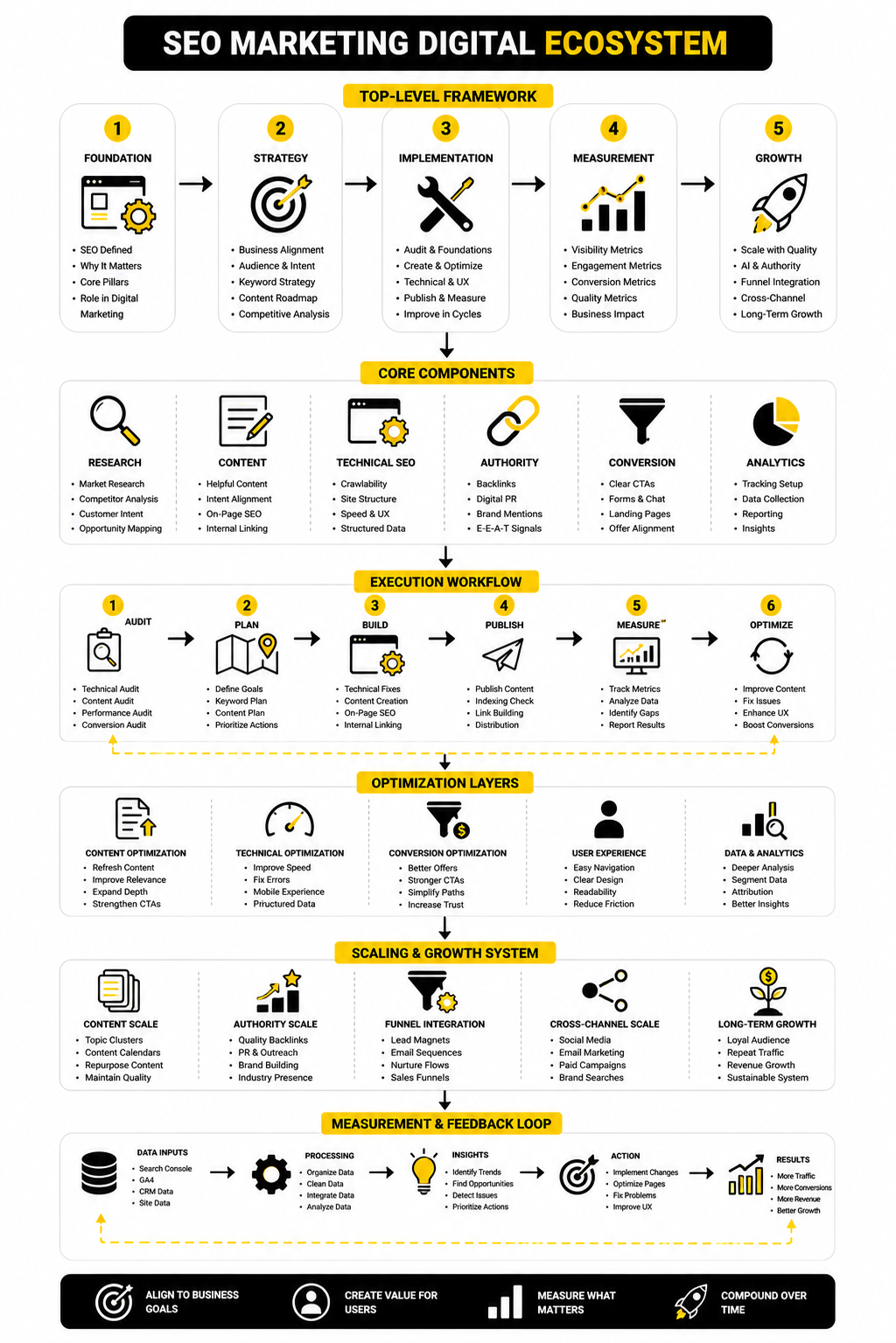
A mature SEO marketing digital strategy should feel like an ecosystem, not a folder of isolated pages. Search visibility brings the right people in. Content earns trust. Technical structure keeps the site understandable. Conversion paths capture demand. Measurement tells you what to improve next.
This is the final shift: stop treating SEO as a publishing task and start treating it as a business system. The brands that win are not always the ones with the biggest content teams. They are the ones that make every page, link, offer, and follow-up step work together.
What To Do First
Start with the pages closest to money. These are usually service pages, product pages, comparison pages, local pages, pricing-adjacent pages, and high-intent landing pages. If those pages are unclear, slow, thin, or disconnected from conversion paths, fix them before expanding the blog.
Then build support around them. Create content that answers objections, clarifies decision criteria, compares options, and helps buyers understand the problem before they contact you. That is how SEO becomes a trust-building machine instead of just a traffic source.
Finally, make sure every important page has a clear next step. That could be a booking link, trial, form, email signup, calculator, product demo, or guided funnel. The action should match the intent of the page, not interrupt it.
What To Avoid
Avoid chasing keywords just because they have search volume. High-volume keywords can look attractive, but they often attract people who are not ready, not qualified, or not relevant. A smaller search term with stronger commercial intent can be far more valuable.
Avoid publishing pages that overlap with existing content. Cannibalization creates confusion, weakens internal signals, and makes reporting harder. Every page should have a distinct role in the ecosystem.
Avoid measuring SEO only by rankings. Rankings matter, but they are not the finish line. The real question is whether search visibility is helping the business earn trust, generate qualified demand, and convert that demand into revenue.
What Is SEO Marketing Digital?
SEO marketing digital is the process of using search visibility as part of a broader digital marketing system. It includes technical SEO, content strategy, authority building, conversion paths, analytics, and ongoing optimization. The goal is not only to rank pages, but to attract the right audience and turn that attention into business results.
Why Is SEO Still Important If AI Search Is Growing?
SEO still matters because organic search remains a major discovery and conversion channel, even as AI search grows. BrightEdge’s 2025 research found that AI search visits were growing quickly but still represented less than 1% of referral traffic. The practical move is to keep improving traditional organic search while also making content clearer, more authoritative, and easier for AI systems to understand.
How Long Does SEO Marketing Digital Take To Work?
SEO usually takes time because search engines need to crawl, understand, test, and trust your pages. The timeline depends on site authority, competition, technical health, content quality, and how close the target keywords are to existing topical strength. A new site in a competitive niche will usually need more patience than an established site improving pages that already have impressions.
What Should I Measure First In SEO?
Start with impressions, clicks, click-through rate, indexed pages, conversions, and lead quality. Google Search Console explains how impressions, clicks, CTR, and average position work through its performance reporting definitions. Once those basics are visible, connect SEO performance to bookings, forms, trials, purchases, pipeline, and revenue.
Is Keyword Research Still Useful?
Yes, keyword research is still useful, but it should not control the whole strategy. Keywords show how people search, while intent explains what they want. The best SEO work combines keyword data with customer research, sales objections, competitor analysis, product positioning, and conversion goals.
How Many Blog Posts Should A Business Publish Per Month?
There is no universal number. A business should publish only as much content as it can research, write, review, optimize, internally link, and improve properly. One strong page tied to a real business goal is better than ten weak posts created only to fill a calendar.
What Is The Difference Between SEO Content And Helpful Content?
SEO content is content designed to be discoverable through search. Helpful content is content designed to genuinely serve the reader. The best pages do both, which matches Google’s guidance around creating people-first content that is useful while still being easy for search engines to discover and understand.
Should I Use AI To Write SEO Content?
AI can help with briefs, outlines, clustering, editing, summarizing research, and repurposing content. It should not replace expert judgment, customer insight, original thinking, proof, or final editorial review. Generic AI content is easy to produce and easy to ignore, especially as answer-first search reduces the value of shallow informational pages.
What Is The Biggest SEO Mistake Businesses Make?
The biggest mistake is separating SEO from the business model. Many teams chase traffic, publish content, and report rankings without asking whether the audience is qualified or whether the page has a clear conversion path. SEO marketing digital works best when the page, offer, follow-up system, and measurement all point toward the same business outcome.
How Do I Know If A Page Should Be Refreshed Or Rewritten?
Refresh a page when the intent is still relevant, the page has some visibility, and the structure can be improved. Rewrite it when the angle, format, or offer no longer matches what searchers need. Merge or retire it when another page already serves the same intent better.
Do Backlinks Still Matter?
Backlinks still matter, but they should not be treated as a shortcut. Strong links usually come from useful assets, credible relationships, original research, media mentions, partnerships, and content worth referencing. The goal is to build authority naturally, not collect random links that add no trust.
What Tools Are Useful For SEO Marketing Digital?
The essential tools are analytics, search performance tracking, crawling, keyword research, content planning, conversion capture, and follow-up. Google Search Console and GA4 are foundational. For conversion infrastructure, tools like GoHighLevel, Systeme.io, ClickFunnels, Fillout, and Brevo can help connect organic traffic to leads, bookings, and nurture.
How Does SEO Fit With Social Media?
SEO captures active demand, while social media can create awareness, build trust, and distribute ideas. A strong SEO article can become several social posts, emails, short videos, or sales assets. This makes the original research and thinking work harder across the whole marketing system.
Should Local Businesses Use SEO Marketing Digital?
Yes, local businesses can benefit heavily from SEO when search intent is tied to location, urgency, trust, and service selection. Local pages, Google Business Profile optimization, reviews, service-area content, and clear booking paths all matter. The key is to connect local visibility to real calls, appointments, forms, and revenue.
What Is The Best Next Step After Reading This Guide?
Start with a simple audit. Identify your most important money pages, check whether they match search intent, review their technical health, and confirm that each page has a clear conversion path. Then improve what already exists before creating more content.
Build a stronger local presence with BAAM AI
Turn your website, Google profile, social channels, and AI visibility into one growth engine
Most businesses do not need more random marketing activity. They need a consistent presence system that helps the right people find them, trust them, and take action. BAAM AI brings strategy, local SEO, website updates, Google Maps visibility, social content, AI-search readiness, media production, and reporting into one practical monthly engine.
If you want your marketing to keep working after the campaign ends, start with a free BAAM AI presence audit. See how your business shows up today and where the fastest visibility wins are at BAAM AI.