
BAAM AI Blog
SEO Emails: How Search And Email Work Together To Create A Better Growth System
Most marketers treat SEO and email like separate channels. SEO brings in visitors, email follows up with subscribers, and the two teams usually meet only when someone needs a landing page promoted. That setup works...
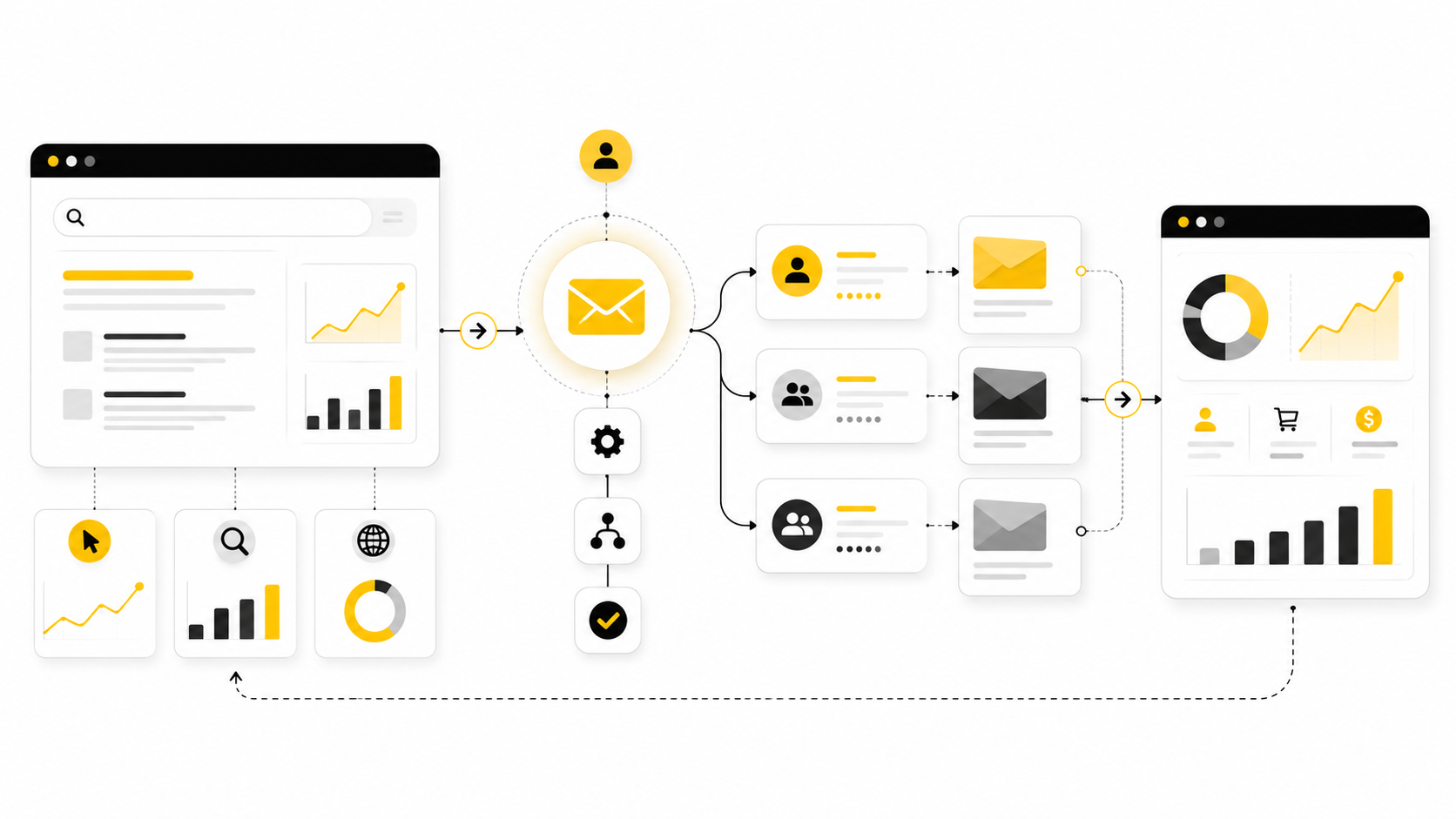
Most marketers treat SEO and email like separate channels. SEO brings in visitors, email follows up with subscribers, and the two teams usually meet only when someone needs a landing page promoted. That setup works, but it leaves a lot of money and insight on the table.
SEO emails are the bridge between search intent and inbox conversion. They turn search-driven traffic into an owned audience, use email behavior to sharpen content strategy, and help brands stay present after the first click. That matters because search is excellent at discovery, while email is still one of the most reliable channels for relationship-building and repeat action.
The point is not to stuff keywords into newsletters. That is the fastest way to make your emails sound weird and your readers stop caring. The real opportunity is to build a system where your SEO content, lead magnets, segmentation, automations, and email campaigns all support the same buyer journey.
Why SEO Emails Matter
SEO is powerful because it captures people while they are actively looking for answers. Google’s own SEO guidance frames search optimization around helping search engines understand your content and helping users find what they need, which is exactly where good email strategy should begin too: with user intent. When someone lands on your site from search, they are not just traffic; they are a signal.
Email matters because it lets you continue the conversation after that search visit ends. Recent email ROI research from Litmus shows many companies seeing returns between $10 and $36 for every $1 spent, which explains why email remains hard to ignore even as paid acquisition gets more expensive. But that return usually comes from relevance, not volume.
This is where SEO emails become useful. Search tells you what people care about before they know your brand, and email gives you a way to keep helping them after they leave the page. When those two channels are connected, your content stops acting like a one-time visit machine and starts acting like a relationship engine.
The SEO Email Framework
A strong SEO email system starts with search intent, not with a newsletter calendar. Someone reading a comparison article needs a different follow-up than someone reading a beginner guide. Someone downloading a checklist from a commercial landing page needs a different sequence than someone who only skimmed a top-of-funnel blog post.
The framework is simple: attract the right visitor through search, offer a relevant next step, segment based on intent, and send emails that move the reader toward a clearer decision. That does not mean every article needs a complicated funnel. It means every important SEO page should answer one practical question: what should this reader receive next if they are interested but not ready to buy?
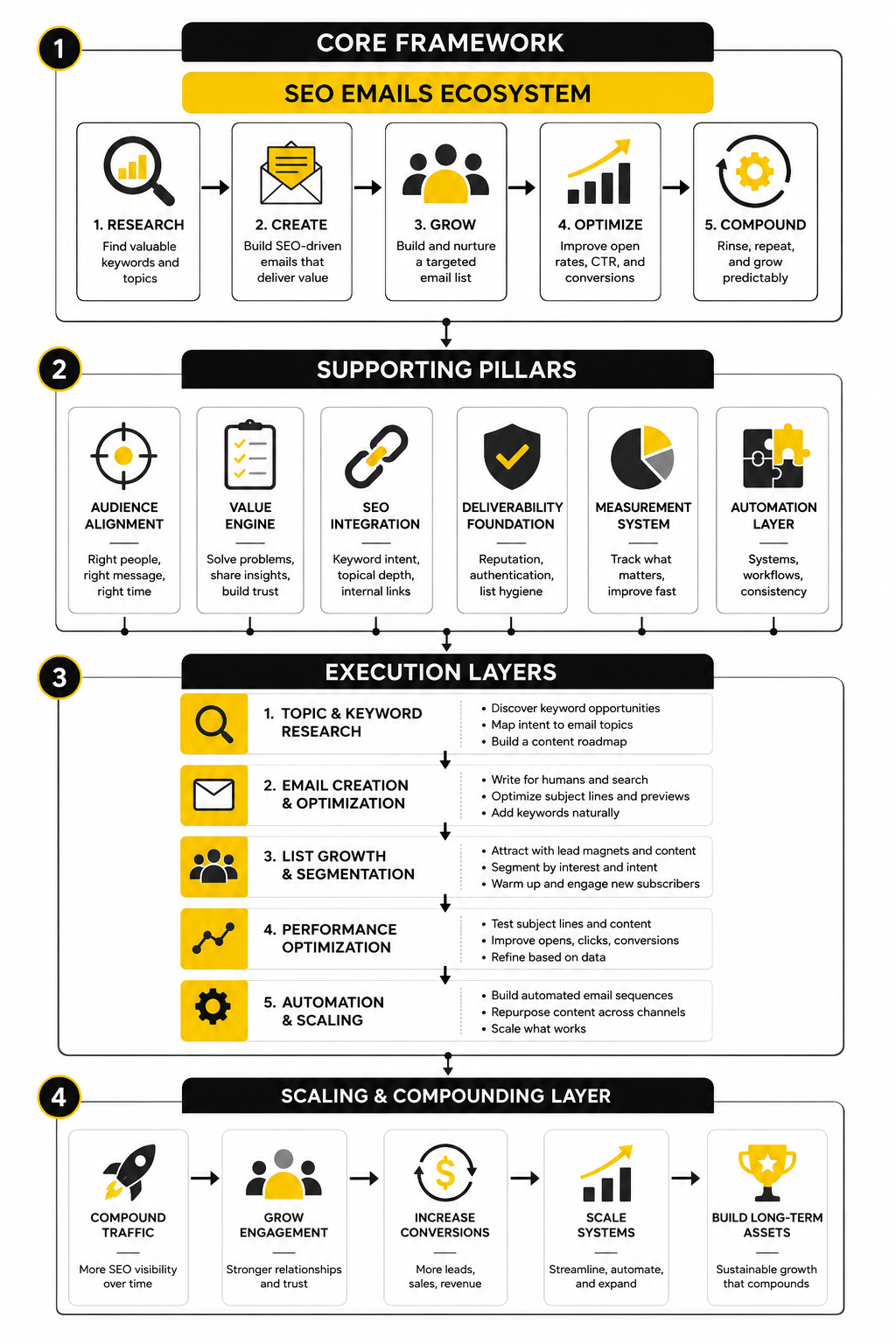
This approach also protects the quality of your email list. Instead of collecting random subscribers with generic popups, you collect people around specific problems, topics, and buying stages. That gives you cleaner segmentation, better messaging, and a much easier path to writing emails people actually want to open.
Core Components Of High-Performing SEO Emails
The first component is the search page itself. If the page does not satisfy intent, no email capture tactic will fix the problem. Your SEO content needs to earn attention before it asks for an email address.
The second component is the conversion asset. This could be a checklist, template, audit, calculator, mini-course, comparison guide, or demo path, but it has to match the reason the person came to the page. For example, a visitor reading about technical SEO probably does not want a generic “join our newsletter” box; they are more likely to respond to a site audit checklist or a crawl issue template.
The third component is the follow-up sequence. This is where many teams get lazy. They capture the lead, send one welcome email, and then dump the subscriber into a general broadcast list. A better sequence continues the original search journey by expanding on the topic, removing objections, showing the next step, and making the call to action feel natural.
Professional Implementation
Professional implementation starts with mapping your SEO pages by intent. You do not need to do this for every single URL on day one. Start with your pages that already bring in qualified traffic, especially pages ranking for commercial, comparison, how-to, and problem-aware keywords.
Then match each page type to an email goal. Informational pages may push readers toward education and trust. Comparison pages may lead into product education, buyer criteria, or a consultation. Bottom-of-funnel pages may work best with direct offers, demos, trials, or a shorter automation built around decision support.
The tools matter less than the logic, but the right stack can make execution much easier. For creators and small teams, platforms like Brevo, Moosend, and ScaledMail can support email campaigns without overcomplicating the workflow. For agencies and businesses that need CRM, funnels, automation, and pipeline tracking in one place, GoHighLevel is often a more complete fit.
The key is to avoid buying tools before defining the system. SEO emails are not a software category; they are a strategy. The software only helps when the intent map, lead capture offer, segmentation logic, and email sequence are already clear.
Mapping Search Intent To Email Intent
The first serious step with SEO emails is matching the searcher’s intent to the email journey that follows. A person searching “what is email deliverability” is not in the same mindset as someone searching “best email platform for agencies.” One is trying to understand a problem, while the other is probably comparing options and getting closer to a decision.
That difference changes everything. The educational searcher needs clarity, confidence, and a next step that does not feel aggressive. The comparison searcher needs criteria, trade-offs, proof, and a reason to move now instead of endlessly researching.
This is why generic email capture performs worse than intent-based capture. A broad “subscribe to our newsletter” offer asks the visitor to care about your brand before you have earned that attention. A search-aligned offer continues the exact journey they already started, which feels much more natural.
Informational Intent
Informational intent is where most SEO traffic starts. These visitors are looking for definitions, explanations, tutorials, templates, mistakes to avoid, or step-by-step help. They may not be ready to buy, but they are showing you what problem is active in their mind.
For these visitors, your email goal should be trust-building. Do not rush them into a sales pitch after one blog visit. Give them a useful resource, then use the next few emails to deepen the lesson, explain common mistakes, and introduce your solution only when it makes sense.
The best SEO emails for informational intent feel like a continuation of the article. If the page explains how to improve email open rates, the follow-up can walk through subject line testing, list quality, segmentation, and deliverability. The reader should feel like they are getting the next logical lesson, not being pulled into a random promotion.
Commercial Intent
Commercial intent is where email becomes more directly tied to revenue. These visitors are comparing tools, looking for alternatives, checking pricing, reviewing features, or searching for workflows that solve a business problem. They are not always ready to buy today, but they are clearly closer than a casual reader.
For this intent stage, your emails should help the reader make a better decision. That means buyer guides, comparison checklists, implementation timelines, objection-handling emails, and clear calls to action. This is also where product education becomes useful, because the reader is already thinking about options.
For example, if someone lands on a page about building funnels and email sequences, it can make sense to introduce tools like ClickFunnels, Systeme.io, or GoHighLevel as part of the decision path. The key is context. The link should help them act on the problem they already came to solve.
Transactional Intent
Transactional intent is the sharpest stage. These visitors are searching for trials, demos, pricing, setup help, templates, migration support, or very specific solution terms. They need less education and more confidence.
SEO emails for this group should remove friction. That might mean a short onboarding sequence, a direct demo invite, a trial-start email, a setup checklist, or a message that compares the cost of waiting with the benefit of implementation. Long nurturing sequences can work against you here because the reader is already close to action.
This is where timing matters. A transactional-intent visitor should not wait two weeks before seeing the strongest call to action. Your email sequence should make the next step obvious while the problem is still fresh.
Building The Capture Path
Once intent is clear, the next job is building a capture path that fits the page. This is not just about adding a popup. It is about giving the reader a reason to move from anonymous search visitor to known subscriber.
A strong capture path has three parts: the page promise, the opt-in promise, and the email promise. The page promise is what brought the person in from search. The opt-in promise is the extra value they get for sharing their email. The email promise is what they will continue receiving after they join.
If those three promises do not match, the system feels broken. A visitor who reads a practical SEO guide should not be pushed into a vague business newsletter. A visitor who downloads an email automation checklist should not receive unrelated social media tips the next day.
Lead Magnets That Fit SEO Traffic
The best lead magnet is usually not the biggest one. It is the most relevant one. A short checklist that helps the reader apply the article can outperform a long ebook that feels like homework.
For SEO emails, practical assets tend to work well because search visitors are already problem-solving. Templates, swipe files, audit sheets, calculators, decision trees, mini-courses, and setup guides all give the reader a concrete next step. The more closely the asset matches the search intent, the easier the opt-in becomes.
This is also where many teams overbuild. They spend weeks creating a massive PDF when a simple implementation checklist would be more useful. Start with the smallest useful resource that helps the reader act on the page they just read.
Forms, Popups, And Embedded Offers
The form should match the seriousness of the offer. If you are offering a simple checklist, asking only for an email address is usually enough. If you are offering a consultation, audit, demo, or custom recommendation, asking for more details can make sense because the commitment is higher.
Embedded offers often work well on SEO pages because they appear inside the context of the article. A mid-article box can offer the next step right when the reader understands the problem. A bottom-of-page offer can catch people who finished the content and want to go deeper.
Popups can still work, but they need restraint. A popup that appears before the reader has consumed the page often feels like an interruption. A popup triggered by scroll depth, exit intent, or time on page usually respects the journey better.
Segmenting Subscribers By Search Behavior
Segmentation is where SEO emails start getting powerful. When someone subscribes from a specific page, category, or keyword cluster, you learn something about their interests before they ever click an email. That information should shape what they receive next.
At a basic level, you can segment by topic. Someone who joins from an SEO article receives SEO-related follow-up. Someone who joins from an email automation article receives email automation follow-up. This alone is already better than treating every subscriber the same.
At a more advanced level, you can segment by funnel stage. Beginner guides, comparison pages, product pages, and pricing-related searches all suggest different levels of awareness. The more accurately you segment, the less pressure each individual email has to do everything.
Topic-Based Segments
Topic-based segments are the easiest place to start. You group subscribers based on the content category or lead magnet that brought them in. For example, SEO, email marketing, funnels, automation, ecommerce, agencies, or local business growth could each become separate segments.
This keeps your messaging relevant without requiring complicated automation. If someone joined through content about seo emails, they should receive more content about search-driven list growth, email sequences, content upgrades, and conversion strategy. That is obvious, but many lists still ignore it.
The benefit is better reader trust. People stay subscribed when they feel the emails match what they originally asked for. Relevance is not a fancy tactic; it is basic respect.
Stage-Based Segments
Stage-based segments help you avoid selling too early or teaching too long. A beginner needs education. A comparison shopper needs decision support. A trial user needs activation.
You can infer stage from the page type, the offer they claimed, and the actions they take after subscribing. A visitor who downloads a beginner checklist is probably earlier in the journey than someone who requests a demo or clicks a pricing-related CTA. Your emails should respond to those signals.
This does not require a huge automation map from day one. Start with three stages: learning, comparing, and deciding. That simple structure is enough to make your SEO emails more relevant than most generic nurture sequences.
Turning The Framework Into A Working System
Once your intent map and segments are clear, the next move is execution. This is where SEO emails become real instead of theoretical. You are no longer saying “we should connect SEO and email”; you are deciding which pages get offers, which subscribers enter which sequences, and which actions prove the system is working.
Start with pages that already have traffic and business relevance. You do not need to rebuild your whole site at once. Pick the pages where search visitors already show useful intent, then add the email layer in a controlled way.
The goal is to create a repeatable process. When a new SEO page starts ranking, you should know how to assign it to a segment, what type of offer belongs on it, and what sequence should follow. That is how this turns from a one-off campaign into a growth asset.
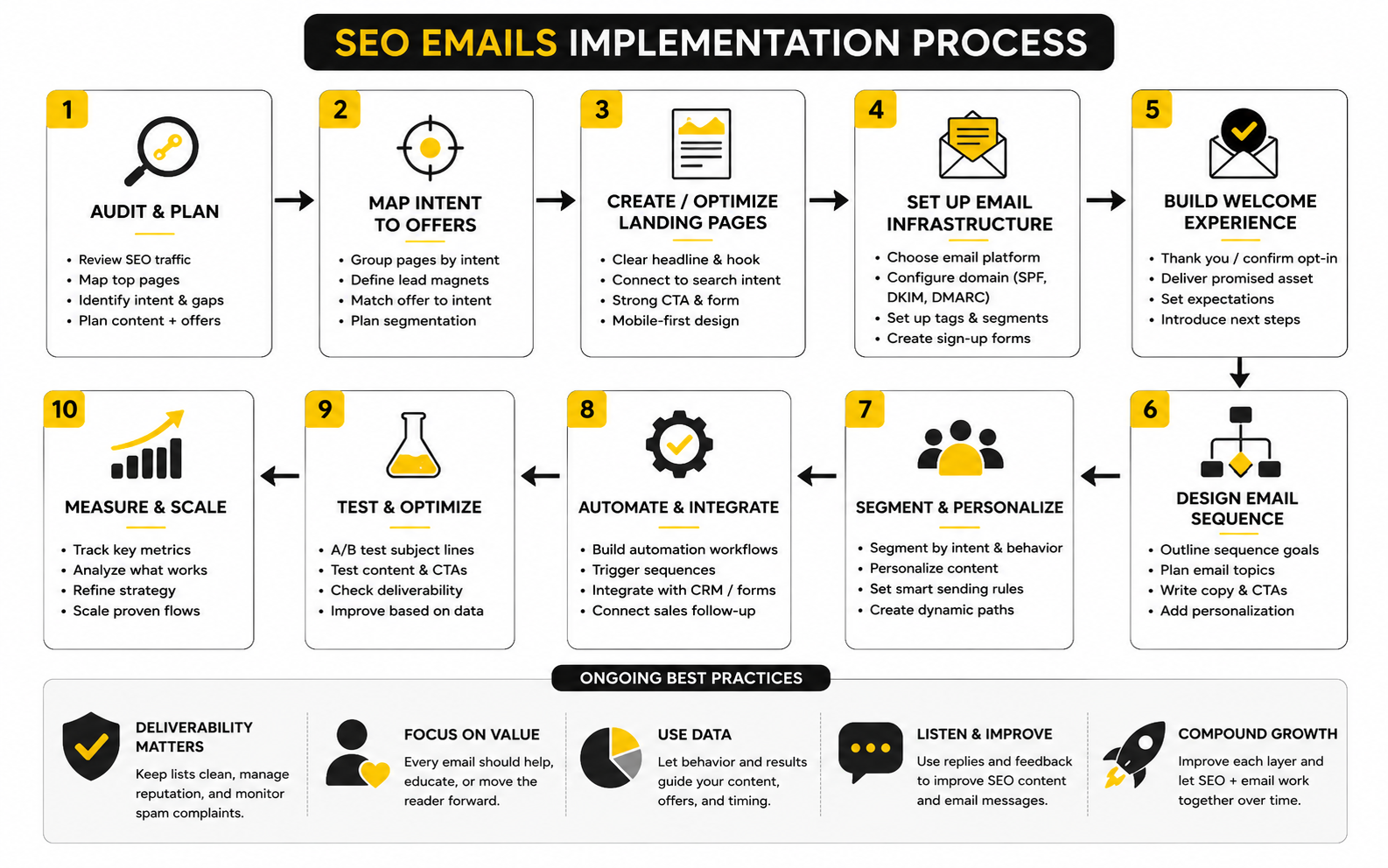
Step 1: Audit Your Existing SEO Pages
Begin with a simple content audit. Pull your important SEO pages and group them by topic, search intent, and business value. You are looking for pages that attract the right reader and create a natural reason to continue the conversation by email.
Do not judge pages only by traffic. A page with lower traffic but stronger buying intent can be more valuable than a broad article that brings in thousands of unqualified visitors. For SEO emails, relevance beats volume almost every time.
Mark each page with a next-step opportunity. Some pages need a checklist. Some need a comparison guide. Some need a demo CTA, a consultation form, or a short educational sequence. The audit should make the next move obvious.
Step 2: Choose The Right Offer For Each Page
The offer should feel like the natural next sentence after the article. If the article teaches strategy, the offer can help the reader apply it. If the article compares options, the offer can help the reader choose. If the article explains a painful problem, the offer can help the reader diagnose it.
This is where most weak funnels break. They put the same lead magnet everywhere because it is easier to manage. Easier for the team, yes, but usually worse for the reader.
A better system uses a small set of reusable offer types. You might have one checklist for educational pages, one buyer guide for comparison pages, one setup template for implementation pages, and one direct booking path for high-intent pages. That gives you personalization without creating chaos.
Step 3: Build The First Email Sequence
Your first sequence does not need to be long. In many cases, three to five emails are enough to continue the journey and guide the subscriber toward the next step. The important part is that every email has a job.
A simple sequence can look like this:
That structure works because it respects the reader’s original intent. It does not jump straight from a search visit to a hard pitch. It builds context first, then makes the offer when the reader understands why it matters.
Step 4: Connect Tags, Forms, And Automations
This is the technical layer, but it should not be overcomplicated. Each form should apply a tag or segment that tells your email platform where the subscriber came from and what they likely care about. Without that data, your SEO emails quickly become generic again.
For example, a subscriber from an article about SEO content planning might receive a tag like “SEO Content Strategy.” A subscriber from a funnel comparison page might receive a tag like “Funnel Buyer Intent.” The names do not need to be fancy; they need to be clear enough that your future self understands them.
Tools like GoHighLevel, Brevo, Moosend, and ScaledMail can all support this kind of workflow depending on how advanced your system needs to be. The platform matters, but the tagging logic matters more. Bad strategy inside expensive software is still bad strategy.
Writing SEO Emails That Do Not Sound Like SEO Content
Emails are not blog posts. That sounds obvious, but many brands still write nurture sequences like shortened articles. The result is usually too much explanation, not enough momentum, and a reader who never feels pulled toward action.
A good email should have one clear point. It can teach, challenge, clarify, compare, or invite, but it should not try to cover the entire topic. The article did the heavy lifting; the email should move the reader forward.
This is especially important with seo emails because the source page may already be detailed. The email should not repeat the article. It should add a sharper angle, a practical next step, or a useful decision point.
Start With The Reader’s Situation
The best opening line usually comes from the reader’s current problem. They searched because something was unclear, broken, expensive, slow, confusing, or risky. Start there.
For example, if someone joined from a page about turning SEO traffic into leads, the email should not begin with a generic line about your company. It should speak to the moment they are in: they have traffic, but not enough of it turns into owned contacts. That is the tension.
Once the reader feels understood, the rest of the email becomes easier. You can explain the mistake, show the fix, and introduce the next step without sounding pushy. Relevance does a lot of the selling before the CTA ever appears.
Keep One CTA Per Email
Every email should have one main action. That action might be reading a related guide, downloading a template, booking a call, starting a trial, replying with a question, or checking a comparison. But it should not be five different things at once.
Multiple CTAs often feel helpful to the marketer and confusing to the reader. When the reader has too many options, the easiest option is doing nothing. Keep the path simple.
This is where funnel tools can help if your business depends on clear conversion paths. A focused landing page built in ClickFunnels, Systeme.io, or Replo can work well when the email has one job and the page continues that same job. The email creates the click; the page handles the decision.
Use Keywords For Alignment, Not Stuffing
The primary keyword matters because it keeps the topic focused, but email copy should never read like an SEO draft. People do not open their inbox hoping to read keyword variations. They open emails when the subject, sender, and message feel relevant.
Use the language of the original search naturally. If the subscriber came from content about seo emails, it makes sense to mention search-driven email strategy, SEO lead capture, email sequences, and intent-based follow-up. It does not make sense to force the exact phrase into every paragraph.
The better rule is simple: write like a person continuing a useful conversation. If the phrase fits, use it. If it sounds awkward, rewrite the sentence.
Setting Up Measurement Before You Scale
Measurement should be built before you expand the system. Otherwise, you end up with traffic numbers in one place, email numbers in another, and no clear answer about what is actually producing revenue. That makes optimization slow and political.
At minimum, track the page, offer, form, segment, sequence, and final conversion. You want to know which SEO pages create subscribers, which subscribers engage, and which journeys lead to sales opportunities. Without that chain, you are guessing.
The first dashboard can be simple. Track organic visits, opt-in rate, sequence open rate, click rate, reply rate, booking rate, trial starts, purchases, or pipeline value depending on your model. The exact metrics depend on the business, but the principle is the same: connect search behavior to email outcomes.
Page-Level Metrics
Page-level metrics tell you where the system starts. Look at organic traffic, rankings, engagement, and conversion rate for each SEO page. A page with strong traffic but weak opt-ins may need a better offer or better placement.
Do not assume the article is the problem immediately. Sometimes the offer is too generic. Sometimes the form appears too late. Sometimes the CTA does not match the reader’s stage.
This is why testing one variable at a time matters. Change the offer, placement, or copy, then compare performance. Random edits create random lessons.
Email-Level Metrics
Email-level metrics show whether the follow-up is doing its job. Opens can help diagnose subject line and sender strength, but clicks and replies usually reveal more about intent. A sequence with decent opens but weak clicks may be interesting without being persuasive.
Look at each email individually. If email two gets engagement but email three drops sharply, the issue may be the transition, the offer, or the timing. Do not blame the whole sequence when one weak email is creating the drag.
Also watch unsubscribe and spam complaint patterns. SEO emails should feel expected because they follow from a specific page or offer. If people leave quickly, the promise you made on the page may not match what arrives in the inbox.
Revenue-Level Metrics
Revenue-level metrics are where the strategy earns its place. This does not always mean immediate sales, especially for higher-ticket offers or B2B services. It can mean demo requests, consultations, qualified pipeline, trial activations, or repeat purchases.
The mistake is stopping measurement at the email platform. Opens and clicks are useful, but they are not the full story. You need to connect the email journey to the business outcome.
This is also where a CRM becomes valuable. If your SEO emails are generating leads for a sales process, the team needs to see source, topic, segment, and engagement history. Otherwise, sales conversations start cold even when the marketing journey was warm.
Statistics And Data
Data should make your SEO emails easier to improve, not harder to understand. The point is not to collect every possible metric or obsess over industry averages. The point is to see where search traffic becomes subscribers, where subscribers become engaged readers, and where engaged readers become pipeline or revenue.
Benchmarks are useful only when they give you context. For example, MailerLite’s 2025 email benchmark data reported an average open rate of 43.46%, an average click rate of 2.09%, and an average unsubscribe rate of 0.22%. Those numbers do not mean your campaign is automatically good or bad; they give you a reference point for asking better questions.
The mistake is treating benchmarks like rules. A high-intent B2B sequence may have fewer subscribers but stronger conversion quality. A broad newsletter may have more opens but weaker business impact. With seo emails, the real question is not “are we average?” but “are we moving the right people from search intent to the next useful action?”
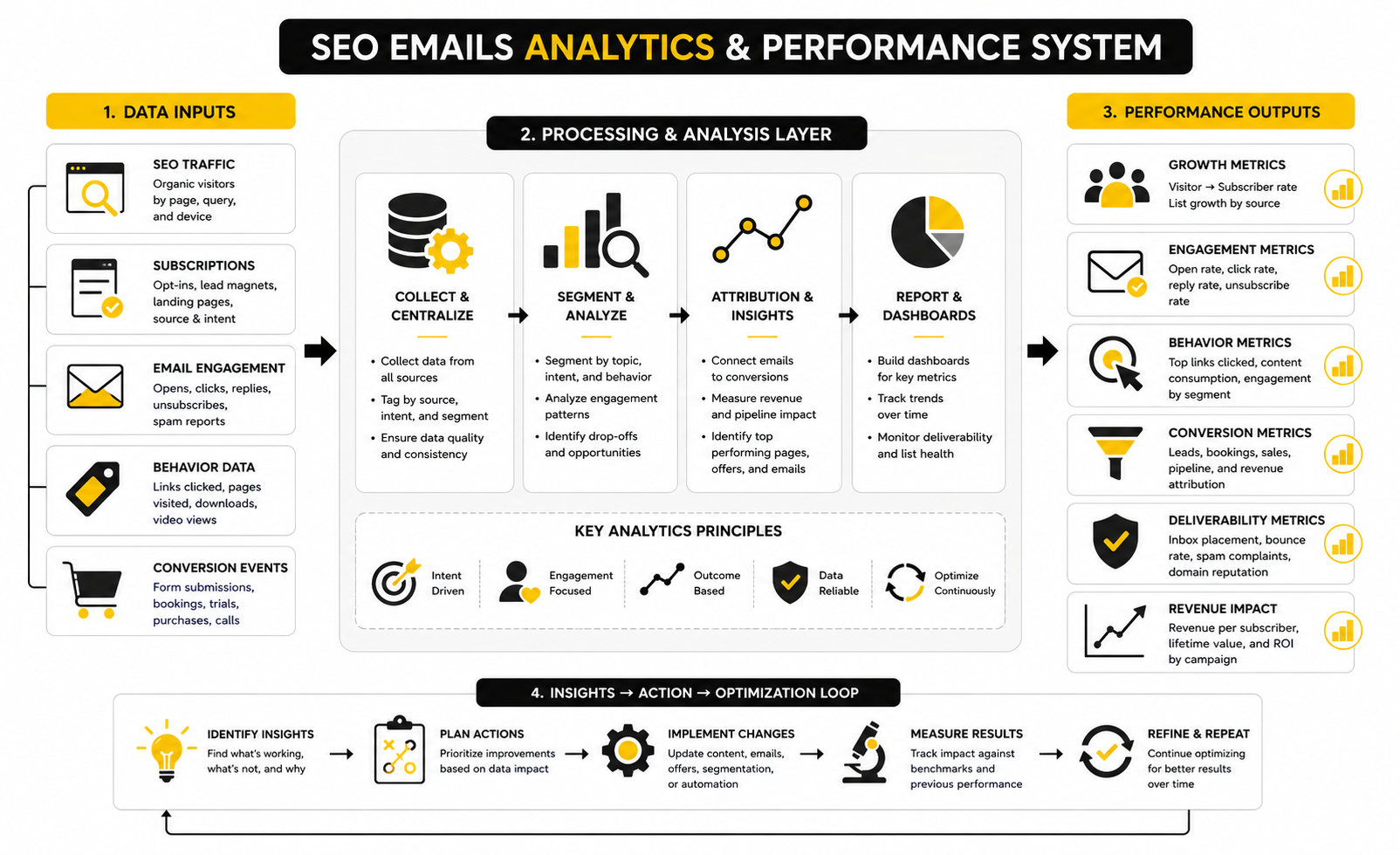
The Metrics That Actually Matter
The most important metric at the start is organic visitor-to-subscriber conversion rate. This tells you whether your SEO page is creating an email opportunity or simply attracting anonymous traffic. If a page ranks well but converts poorly, the problem may be offer relevance, form placement, CTA clarity, or a mismatch between search intent and the next step.
The second metric is subscriber-to-engaged-reader rate. Opens can help, but clicks, replies, and return visits usually say more. A subscriber who clicks a related guide, books a call, starts a trial, or replies with a question is showing deeper intent than someone who only opens emails because the subject line was interesting.
The third metric is engaged-reader-to-business outcome. This could mean purchases, demos, consultation requests, trial activations, qualified leads, or booked calls. Do not stop at email platform metrics if the real goal is revenue. Your analytics system should connect the original SEO page to the final action that matters.
How To Read Open Rates Without Overreacting
Open rates are useful, but they are not as clean as they used to be. Privacy changes, automated inbox behavior, and bot activity can make opens less precise than many marketers assume. That does not make open rates useless; it just means they should be interpreted carefully.
Use open rates mainly to diagnose subject line relevance, sender trust, and list quality. If a specific segment opens consistently better than another, the topic or promise may be stronger. If open rates drop sharply after the first email, the welcome message may not be setting the right expectation.
Do not optimize your SEO emails only for opens. A curiosity-driven subject line can lift opens while attracting the wrong attention. A slightly lower open rate with stronger clicks and conversions is often the better business outcome.
How To Read Click Rates
Click rate is usually a stronger signal than open rate because it shows action. The reader did not just notice the email; they chose to continue. For SEO-driven subscribers, that click should usually connect back to the original intent that brought them in.
If click rates are weak, look at the email’s promise before blaming the CTA button or link text. The reader may not understand why the next step matters. The email may be teaching too much without creating momentum. Or the CTA may be asking for a bigger commitment than the reader is ready to make.
A useful way to diagnose this is by matching CTA type to intent stage. Early-stage subscribers may click educational assets more readily than booking links. Comparison-stage subscribers may respond better to buyer guides, calculators, demos, or implementation resources. Transactional-stage subscribers should see direct paths because they are already closer to action.
How To Read Unsubscribes And Complaints
Unsubscribes are not always bad. Some people joined for one resource, got what they needed, and left. That is normal, and it is healthier than keeping an inflated list of people who never engage.
The problem is when unsubscribes cluster around specific pages, offers, or emails. That usually means the promise on the SEO page did not match the inbox experience. If someone signs up for a practical SEO checklist and then receives broad promotional emails, the disconnect is obvious.
Complaints are more serious. They can damage deliverability and signal that the recipient did not expect your message. Your job is to make every opt-in clear, every first email recognizable, and every sequence relevant to the reason the person subscribed.
Building A Simple Analytics System
A good analytics system does not need to be complex. It needs to be connected. You should be able to trace a subscriber from the SEO page they visited, to the offer they claimed, to the emails they received, to the action they eventually took.
At the simplest level, use UTM parameters, form tags, email segments, and CRM fields. The page tells you where the relationship started. The tag tells you what the person likely cares about. The sequence tells you what they were shown next. The CRM or checkout system tells you whether the journey produced a real outcome.
This is why tools with CRM and automation features can be useful once the strategy gets serious. GoHighLevel can make sense for agencies or service businesses that need contact records, pipeline tracking, automations, and follow-up in one place. Lighter email tools can work too, but the reporting has to connect back to the page and segment level somehow.
Track The Source Page
Every SEO email journey should store the source page when possible. This lets you see which articles, comparisons, or landing pages create valuable subscribers. Without this, you only know that email produced results, not which search intent started the relationship.
Source-page tracking also helps you improve content priorities. If one article brings fewer subscribers but more qualified calls, it may deserve more internal links, updates, and promotion. If another article brings lots of subscribers who never engage, it may need a sharper offer or a clearer audience filter.
This is where SEO and email data start helping each other. SEO tells you where demand exists. Email tells you whether that demand turns into actual relationship and revenue.
Track The Offer
The offer is often the biggest conversion lever. Two pages with similar traffic can perform very differently because one has a relevant next step and the other has a generic form. Tracking offer performance helps you see what your audience actually values.
Do not only track opt-in volume. Track what happens after the opt-in. A lead magnet that gets many subscribers but weak engagement may be too broad, too shallow, or attracting the wrong reader.
A smaller offer can be better if it attracts people with clearer intent. This matters especially for seo emails because search visitors arrive with a specific problem. The offer should sharpen that problem, not dilute it.
Track The Sequence
Your email sequence should be measured email by email. Look at opens, clicks, replies, unsubscribes, and conversions for each message. A sequence often has one weak point that drags down the whole journey.
If the first email performs well but later emails drop, the transition may be poor. If the educational emails perform but the offer email fails, the pitch may feel disconnected. If the offer email gets clicks but no conversions, the landing page or sales process may be the issue.
This is why you should avoid changing everything at once. Improve one part of the sequence, then measure the effect. Clean testing beats random tinkering.
Benchmarks Versus Your Own Baseline
Industry benchmarks are helpful, but your own baseline is more important. A SaaS company, local agency, ecommerce store, creator business, and B2B consultant will not see the same numbers. Different audiences behave differently, and different offers create different levels of commitment.
Start by measuring your current performance for 30 to 90 days. Look at traffic, opt-ins, email engagement, and business outcomes by page and segment. That gives you a baseline you can actually improve against.
Then use external benchmarks as context, not judgment. Litmus research reported email ROI ranges between 10:1 and 36:1, but the same research also highlighted that many teams struggle to prove ROI clearly. That is the real lesson: the channel can perform extremely well, but only if measurement connects email activity to business value.
When A Number Is Good
A number is good when it supports the goal of that stage. A high opt-in rate is good only if the subscribers are relevant. A strong click rate is good only if the clicks lead to meaningful next steps. A low unsubscribe rate is good only if the list is still active and engaged.
This sounds basic, but it prevents bad decisions. If you optimize only for opt-ins, you may create clickbait lead magnets. If you optimize only for opens, you may write exaggerated subject lines. If you optimize only for immediate sales, you may ignore subscribers who need more education before they trust you.
Good measurement respects the journey. SEO emails work because they connect multiple steps, not because one isolated metric looks impressive.
When A Number Is Warning You
A weak opt-in rate on a strong SEO page usually means the offer is not aligned. A weak click rate in the sequence usually means the email is not creating enough reason to continue. A strong click rate with weak conversions usually means the landing page, sales page, or next step is not carrying the promise forward.
A sudden spike in unsubscribes deserves attention. It may come from sending too frequently, changing topics too aggressively, or promoting something that does not match the segment. The data is not there to make you panic; it is there to point you toward the friction.
The best operators treat numbers like signals, not verdicts. One campaign does not define the system. Patterns do.
Turning Data Into Action
Data only matters when it changes what you do next. If the numbers sit in a dashboard and nobody makes a decision, they are decoration. A practical SEO email system should create clear actions from the metrics.
If a page has traffic but low opt-ins, test a more specific lead magnet. If a segment opens but does not click, sharpen the email angle and CTA. If subscribers click but do not convert, improve the destination page or reduce the commitment required.
Make this a monthly review, not a random emergency task. Look at your top SEO pages, best and worst opt-in rates, strongest email clicks, biggest drop-offs, and highest-value conversions. Then choose one or two improvements instead of trying to fix everything.
What To Optimize First
Start closest to the source of the problem. If traffic is weak, the SEO page may need content updates, internal links, better search alignment, or stronger technical foundations. If traffic is strong but opt-ins are weak, the offer and form placement come first.
If opt-ins are strong but email engagement is weak, fix the promise and sequence. The subscriber expected one thing and received another. That is usually a messaging issue, not a platform issue.
If email engagement is strong but revenue is weak, look at the offer, sales page, booking process, pricing clarity, and follow-up speed. Tools like Cal.com can help simplify booking when the next step is a call, but the page and email still need to make the reason clear. Friction at the end of the journey can waste all the good work that happened before it.
What To Ignore At First
Ignore vanity dashboards that do not change decisions. You do not need twenty charts to improve a simple SEO email system. You need a clear view of where people enter, where they engage, where they drop, and where they convert.
Ignore tiny sample sizes too. If ten people saw an offer, the conversion rate is not a lesson yet. Wait for enough activity to see a pattern before making big changes.
Also ignore the urge to compare every number to someone else’s benchmark. Your baseline, audience, offer, price point, and sales cycle matter more. Benchmarks can guide you, but your own data should lead.
Common Mistakes And Optimization
The biggest mistake with SEO emails is treating the system like a traffic capture trick instead of a reader journey. If the page earns attention through search and the email sequence immediately changes the topic, trust drops fast. People do not mind being marketed to when the next step is relevant, but they notice instantly when the follow-up feels disconnected.
The second mistake is trying to automate too much before the core message works. Automation can scale a good journey, but it can also scale confusion. If your offer, segment, and email angle are weak, adding more branches will only make the system harder to fix.
The third mistake is ignoring deliverability until there is a problem. SEO can send you strong visitors, but email still has to reach the inbox. If your domain setup, list quality, sending patterns, and complaint rates are weak, the best sequence in the world may never get seen.
Mistake 1: Using The Same Offer Everywhere
A single generic lead magnet is easy to manage, but it rarely matches every search intent. Someone reading a beginner SEO article and someone comparing funnel platforms should not see the same email offer. Their questions, urgency, and level of trust are different.
This does not mean you need dozens of custom assets. It means you need a small offer library matched to intent categories. One educational checklist, one buyer guide, one implementation template, and one direct conversion path can cover a surprising amount of ground.
The optimization move is simple. Review your top organic pages and ask whether the offer truly continues the page. If the answer is “not really,” that page is leaking qualified attention.
Mistake 2: Writing Emails Like Blog Posts
Blog posts can be broad because they are designed to answer a search query in depth. Emails should be sharper. One email should create one clear movement in the reader’s thinking.
When SEO emails become mini articles, they often lose momentum. The reader already consumed the main content or requested the resource. Now they need a clear angle, a useful next step, and a reason to keep going.
The fix is to give each email a specific job. One email can deliver the asset. One can explain the hidden mistake. One can show the decision criteria. One can invite the reader to act. Do that, and the sequence feels guided instead of bloated.
Mistake 3: Optimizing For Opens Instead Of Outcomes
Open rates can help you understand attention, but they are not the finish line. A subject line that gets curiosity opens but attracts weak clicks can make the dashboard look better while the business gets nothing. That is not optimization; that is theatre.
For seo emails, the stronger question is whether the email moves the reader closer to the reason they searched in the first place. Did they click the next resource? Did they request a demo? Did they book a call? Did they reply with a problem worth solving?
Use opens as a signal, not a scoreboard. If clicks, replies, conversions, and retention are improving, you are moving in the right direction. If only opens are improving, look deeper before celebrating.
Deliverability Risks You Cannot Ignore
Deliverability is not a technical detail you can push to the end. It is part of the customer experience. If people asked to hear from you but your messages land in spam, your SEO email system is broken at the infrastructure level.
Modern inbox providers care about authentication, engagement, complaints, and sending behavior. Yahoo’s sender guidance says bulk senders should keep spam complaint rates below 0.3%, which is a useful reminder that relevance is not just a copywriting issue; it is an inbox placement issue too. If people do not expect or want your emails, your reputation suffers.
Authentication also matters. Mailgun’s 2025 deliverability guidance notes that bulk senders need SPF and DKIM for Gmail and Yahoo requirements, with DMARC becoming a core part of responsible sending. This is not exciting marketing work, but it is the foundation that lets the exciting work perform.
List Quality Beats List Size
A bigger list is not automatically a better list. If your subscribers are poorly matched, inactive, or confused about why they are receiving emails, the list becomes a liability. It can lower engagement, increase complaints, and make future campaigns harder to deliver.
SEO traffic can create this problem when the lead magnet is too broad. A high-volume article may attract people who are curious but not relevant. If you capture everyone with a vague offer, your list grows while your quality drops.
The better move is to qualify through specificity. Make the offer clear enough that the right people lean in and the wrong people move on. That may reduce raw opt-ins, but it often improves everything that matters after the opt-in.
Consent And Expectations Matter
Consent is not just a legal checkbox. It is the beginning of the relationship. The reader should understand what they are signing up for and why the first email is arriving.
This is especially important when SEO is the entry point. A visitor may not know your brand yet. The opt-in copy, confirmation message, and first email all need to connect clearly to the page or resource that created the subscription.
Do not hide the nature of the follow-up. If they will receive a short educational sequence, say that. If they will receive product recommendations or implementation tips, make it clear. Clear expectations reduce friction later.
Cleaning Your List Is Strategic
List cleaning feels negative because it removes subscribers. In reality, it protects performance. Keeping people who never engage can distort your metrics and hurt deliverability over time.
A practical cleanup process looks at inactivity, bounce behavior, and engagement history. Before removing people, you can run a re-engagement sequence that gives them a clear reason to stay. If they still do not respond, letting them go is usually the right move.
This is not about being aggressive. It is about respecting the inbox and focusing on people who still want the conversation. A smaller engaged list will usually outperform a larger indifferent one.
Strategic Tradeoffs As You Scale
Scaling SEO emails creates new choices. At the beginning, you can manually review pages, write a few sequences, and track performance in a simple dashboard. As the system grows, the hard part becomes maintaining relevance without creating operational mess.
The tradeoff is personalization versus simplicity. More segmentation can improve relevance, but too many segments can make reporting, writing, and maintenance painful. The best system is not the most complex one; it is the most useful one your team can actually run.
Another tradeoff is speed versus quality. You can launch quickly with a basic sequence and improve it from data, or you can spend months designing an elaborate system before a single subscriber enters it. Most teams should start lean, learn fast, and expand only where the data supports it.
When To Add More Segments
Add a new segment when behavior or intent clearly differs from an existing group. If two subscriber groups click different offers, ask different questions, or convert through different paths, segmentation probably makes sense. If the difference is only theoretical, keep the system simple.
Topic segmentation is useful early. Stage segmentation becomes useful when you have enough volume to see patterns. Behavior segmentation becomes useful when subscribers start taking actions that clearly signal readiness or lack of interest.
Do not create segments just because your email platform allows it. Every segment creates work. It needs copy, rules, reporting, and maintenance. If you cannot explain how a segment will change the emails someone receives, you probably do not need it yet.
When To Add More Automations
Automation should remove repetition, not judgment. A welcome sequence, resource delivery, consultation follow-up, trial activation path, or re-engagement flow can save time and improve consistency. But automation should not replace strategic thinking.
Add automation when the same situation happens often enough to deserve a repeatable response. If hundreds of people download a specific checklist every month, automate the follow-up. If three people a quarter take a niche action, manual follow-up may be better.
Platforms like GoHighLevel, Brevo, and Moosend can all support automation, but the rule stays the same. Automate proven journeys first. Do not automate confusion.
When To Split Funnels
A separate funnel makes sense when the audience, offer, or buying journey is meaningfully different. For example, an agency owner and an ecommerce founder may both care about email growth, but their implementation needs may be completely different. If the same landing page cannot speak clearly to both, splitting the funnel can improve relevance.
The danger is splitting too early. Separate funnels require separate pages, offers, emails, reporting, and optimization. If you do not have enough traffic or conversion data, you may create extra work without learning faster.
A good rule is to split only when the current funnel is clearly serving two different jobs. If one group consistently converts and another consistently drops, study the difference. Then decide whether the answer is better copy, better segmentation, or a separate path.
Advanced Optimization For SEO Emails
Advanced optimization is not about adding clever tricks. It is about improving the match between intent, message, offer, and timing. Small changes can create meaningful gains when they remove friction at the exact point where readers hesitate.
One useful approach is message matching. The keyword theme, page headline, lead magnet promise, first email subject, and first CTA should feel like one continuous thought. When that chain is tight, the reader never feels like they changed context.
Another advanced move is using email engagement to improve SEO priorities. If subscribers from one topic cluster consistently engage and convert, that cluster deserves more content, internal links, updates, and possibly productized offers. Email data can show which SEO topics create real business momentum, not just traffic.
Use Behavior To Adjust Timing
Not every subscriber should receive the same pace of emails. A person who clicks every message may be ready for a stronger CTA sooner. A person who does not engage may need a softer re-entry or fewer messages.
Behavior-based timing keeps the sequence responsive. Clickers can receive deeper resources, demos, or product education. Non-clickers can receive a clearer problem-framing email or a simpler next step.
This does not need to become complicated. Start with simple rules. If someone clicks a high-intent link, move them closer to the offer. If someone ignores the sequence, slow down or send a re-engagement message later.
Use Search Clusters To Plan Campaigns
Your SEO clusters can guide your email calendar. If you have a cluster around email automation, the broadcast strategy can reinforce that topic with implementation tips, case comparisons, templates, and offer angles. This creates consistency across search and inbox.
The benefit is compounding. SEO brings new readers into the topic. Email deepens the relationship. Future content gives you more assets to link, test, and promote.
This also makes content planning less random. Instead of asking “what should we send this week?” you can look at the topics already bringing qualified search traffic. Then build emails around proven interest.
Use Replies As Qualitative Data
Replies are underrated. A reply tells you what people are confused about, what they are considering, what they object to, and what language they naturally use. That is gold for both SEO and email.
If several subscribers ask the same question after reading a sequence, that question probably deserves a better email, a new section on the page, or a dedicated article. If people use a phrase you would not have written yourself, that phrase may belong in your copy. Real language beats internal brainstorming.
Do not treat replies as support noise. Treat them as research. The inbox can reveal what analytics cannot.
Tools And Workflow Choices
The tool stack should support the workflow, not define it. You need a way to capture leads, tag them by source and intent, send relevant sequences, track behavior, and connect outcomes back to the business. Everything else is secondary.
For simple newsletter-style follow-up, a focused email platform may be enough. For service businesses, agencies, and local businesses that need sales pipelines, bookings, forms, automations, and CRM tracking, GoHighLevel can be a stronger central system. For landing pages and funnels, ClickFunnels, Systeme.io, and Replo can be useful depending on the site and offer structure.
The wrong choice is buying complexity before you need it. If you do not have a clear intent map, offer plan, and first sequence, software will not save you. Build the strategy, then choose the tool that makes execution cleaner.
Keep Your Workflow Maintainable
A maintainable workflow is one your team can understand six months from now. Tags should be named clearly. Sequences should have obvious purposes. Reports should answer practical questions without needing a detective.
Document the system as you build it. List which pages feed which offers, which tags are applied, which sequences trigger, and which conversion events matter. This becomes more important as your SEO footprint grows.
Messy systems are expensive because every change becomes risky. Clean systems are faster to improve. That is a competitive advantage most teams underestimate.
Know When Manual Follow-Up Wins
Automation is useful, but manual follow-up can still beat it in high-value situations. If someone replies with a serious problem, clicks a high-intent link multiple times, or requests specific help, a human response can create trust faster than another automated email. The more expensive or consultative the offer, the more this matters.
This is where CRM context helps. A salesperson or founder should see the source page, lead magnet, emails clicked, and key actions before reaching out. That turns the conversation from cold outreach into informed help.
Do not automate away the moments where personal attention creates the most value. Use automation to create signal. Then use judgment where the signal is strong.
Final System Checklist
By this stage, the full SEO email system should feel connected from end to end. Search brings in people with a specific problem, the page helps them understand it, the offer gives them a reason to subscribe, and the email sequence continues the journey with useful next steps. When that chain is tight, the reader never feels like they moved from helpful content into random marketing.
The strongest systems are not built from one tactic. They combine content strategy, conversion strategy, email copy, segmentation, deliverability, analytics, and sales follow-up. Each piece supports the next one, and that is why seo emails work better when they are treated as a growth system instead of a newsletter add-on.
Before scaling, check the basics. Your pages should match intent, your offers should match pages, your emails should match the subscriber’s original reason for joining, and your reporting should show what happens after the first click. If those foundations are clean, optimization becomes much easier.
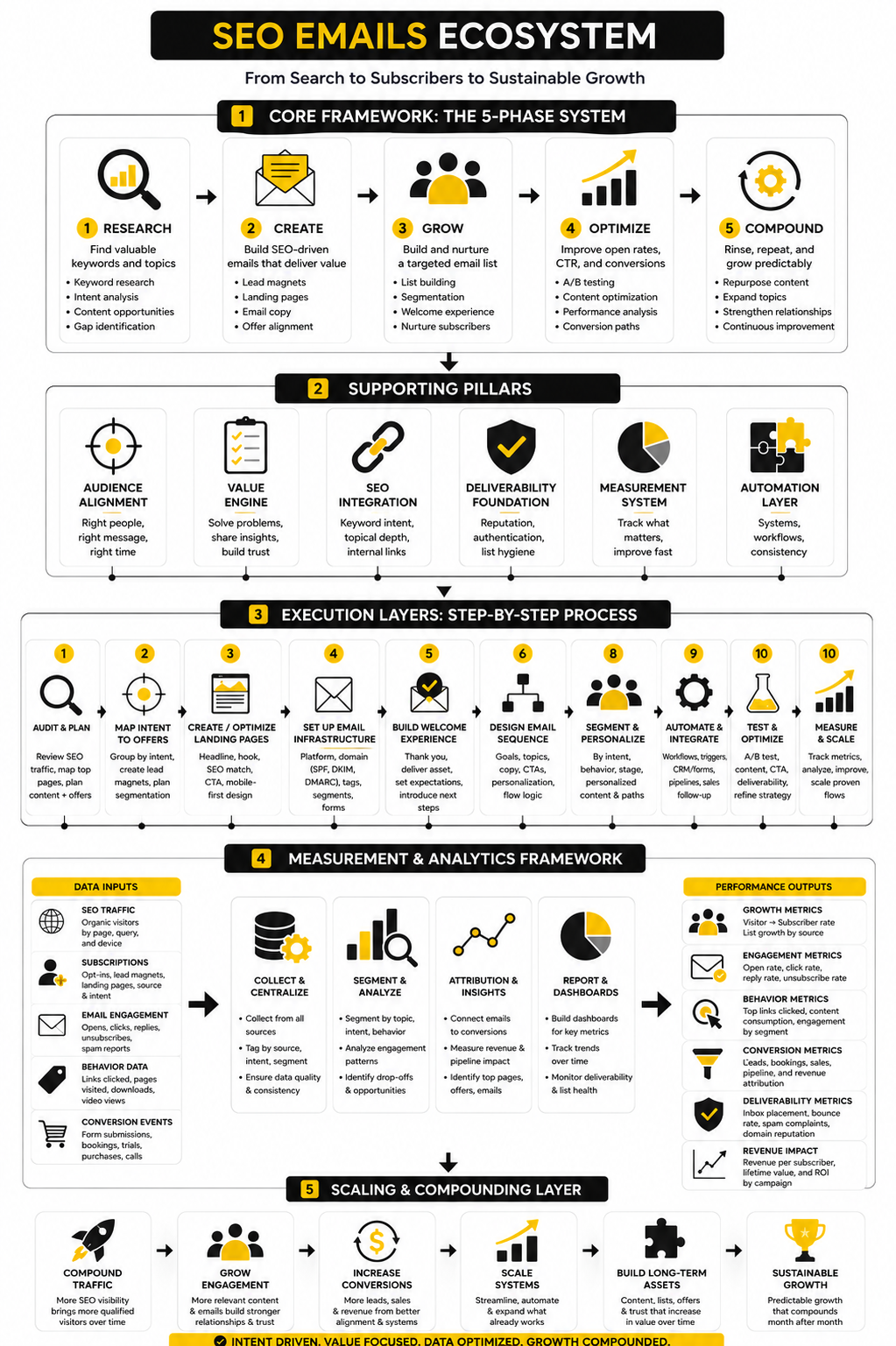
What Are SEO Emails?
SEO emails are email campaigns built around search intent. Instead of sending the same generic follow-up to everyone, you connect your SEO pages, lead magnets, segments, and email sequences into one journey. The goal is to turn search traffic into a warmer audience that keeps moving toward a useful next step.
Do SEO Emails Help Rankings Directly?
SEO emails do not directly improve rankings in the same way backlinks, content quality, technical SEO, or search relevance can. Their main value is what happens after someone finds you through search. They help you capture the relationship, bring readers back to useful content, and turn organic visitors into subscribers, leads, customers, or sales conversations.
How Are SEO Emails Different From Normal Newsletters?
A normal newsletter usually starts with what the brand wants to send. SEO emails start with what the reader searched for before joining the list. That makes the follow-up more relevant because the email topic, offer, and CTA are connected to the visitor’s original intent.
What Is The Best Lead Magnet For SEO Traffic?
The best lead magnet is the one that helps the reader act on the page they just read. For educational pages, that might be a checklist, worksheet, template, or short email course. For commercial pages, it might be a buyer guide, comparison sheet, calculator, demo path, or implementation plan.
How Many Emails Should An SEO Email Sequence Have?
Most first sequences can start with three to five emails. That is enough to deliver the promised resource, build context, address one or two key mistakes, and offer the next step. Longer sequences can work, but they should be earned by the complexity of the decision, not added just because automation makes it easy.
Should Every Blog Post Have Its Own Email Sequence?
No, and trying to do that usually creates maintenance chaos. Start with your most valuable SEO pages, especially the ones with qualified traffic, strong intent, or clear commercial relevance. Over time, you can group similar pages into shared topic-based sequences instead of building a separate sequence for every URL.
What Metrics Matter Most For SEO Emails?
The most useful metrics are organic visitor-to-subscriber rate, subscriber engagement, email clicks, replies, conversions, and revenue or pipeline impact. Open rates can still help, but they should not be treated as the final measure of success. The real goal is to understand whether search visitors are becoming more qualified, more engaged, and more likely to take action.
How Do You Segment SEO Email Subscribers?
Start with simple segmentation based on topic and intent stage. A subscriber from a beginner guide should receive different follow-up than someone from a comparison or pricing-related page. As the system grows, you can add behavior-based segmentation using clicks, replies, demo interest, trial activity, or repeated engagement.
Can SEO Emails Work For Local Businesses?
Yes, and they can be especially useful when the buying cycle involves trust. A local business can capture organic visitors with service guides, checklists, estimates, or appointment-related offers. The follow-up can answer objections, explain the process, share practical preparation steps, and make booking easier.
Can SEO Emails Work For Ecommerce?
Yes, but the execution is different from a service business. Ecommerce SEO emails often work best when they connect buying guides, comparison pages, category content, quizzes, discounts, product education, and cart or browse behavior. The key is still intent: a visitor reading a buying guide needs different emails than someone looking at a specific product.
How Often Should You Email SEO Subscribers?
The right frequency depends on the promise you made when they subscribed. A short educational sequence can send more frequently in the first few days because the reader requested a specific resource. After that, the cadence should slow into useful updates, offers, or topic-based campaigns that still match their interests.
What Is The Biggest Risk With SEO Emails?
The biggest risk is breaking trust after the opt-in. If someone subscribes from one topic and receives unrelated promotions, the system feels careless. That hurts engagement, increases unsubscribes, and makes the brand look less credible.
What Tools Do You Need For SEO Emails?
You need a way to capture subscribers, tag them by source or topic, send automated sequences, track engagement, and connect outcomes to your business. A simple email platform can be enough for a small setup. A more complete CRM and automation system can make sense when you need forms, pipelines, bookings, sales follow-up, and reporting in one place.
How Do You Improve A Weak SEO Email Sequence?
Start by finding the exact weak point. If people do not subscribe, the offer probably needs work. If they subscribe but do not click, the email angle or CTA may be weak. If they click but do not convert, the destination page, offer, or sales process likely needs improvement.
Are SEO Emails Worth Building Before You Have A Lot Of Traffic?
Yes, but keep the system simple. If you wait until traffic is huge, you may waste months or years of visitors who could have joined your audience earlier. Start with one strong page, one relevant offer, and one short sequence, then expand when the data shows where the opportunity is.
Build a stronger local presence with BAAM AI
Turn your website, Google profile, social channels, and AI visibility into one growth engine
Most businesses do not need more random marketing activity. They need a consistent presence system that helps the right people find them, trust them, and take action. BAAM AI brings strategy, local SEO, website updates, Google Maps visibility, social content, AI-search readiness, media production, and reporting into one practical monthly engine.
If you want your marketing to keep working after the campaign ends, start with a free BAAM AI presence audit. See how your business shows up today and where the fastest visibility wins are at BAAM AI.