
BAAM AI Blog
SEO Copywriting For Beginners: A Practical Six-Part Guide To Writing Content That Ranks And Converts
SEO copywriting for beginners is not about stuffing keywords into paragraphs and hoping Google rewards the page. It is the skill of writing useful, search-friendly content that helps the reader understand a topic...

SEO copywriting for beginners is not about stuffing keywords into paragraphs and hoping Google rewards the page. It is the skill of writing useful, search-friendly content that helps the reader understand a topic, trust the page, and take the next logical step.
That matters more now because search has changed. Google’s own guidance keeps pushing creators toward helpful, reliable, people-first content, not pages made only to manipulate rankings through tricks or volume publishing Google Search Central. At the same time, readers still scan pages heavily instead of reading every word, which means your structure, headings, opening lines, and examples need to do real work Nielsen Norman Group.
The beginner mistake is thinking SEO and copywriting are separate. SEO helps the right person find the page. Copywriting helps that person stay, understand, believe, and act. When both work together, your content becomes easier for search engines to understand and easier for humans to use.
This guide is split into six parts so you can build the skill properly, without jumping straight into templates before you understand the logic. Part 1 gives you the big picture and the article structure. The next parts will move into intent, keyword use, page structure, writing techniques, optimization, and practical implementation.
Why SEO Copywriting Matters
SEO copywriting matters because rankings alone do not pay you. A page can attract impressions, clicks, and visitors, but if the message is vague, thin, or confusing, people leave without subscribing, booking, buying, or trusting the brand. Good SEO copywriting turns search demand into useful content and useful content into business outcomes.
The search results page is also more crowded than it used to be. SparkToro’s 2024 zero-click study found that a majority of Google searches in both the United States and the European Union ended without a click, which means every click you do earn has become more valuable SparkToro. Beginners need to understand this clearly: you are not just competing for rankings, you are competing for attention, trust, and usefulness.
That is why the old version of SEO copywriting feels outdated. Repeating the primary keyword ten times is not a strategy. A better strategy is to understand what the reader wants, answer it clearly, support your claims, structure the page well, and guide the reader toward the next step without sounding desperate.
The SEO Copywriting Framework
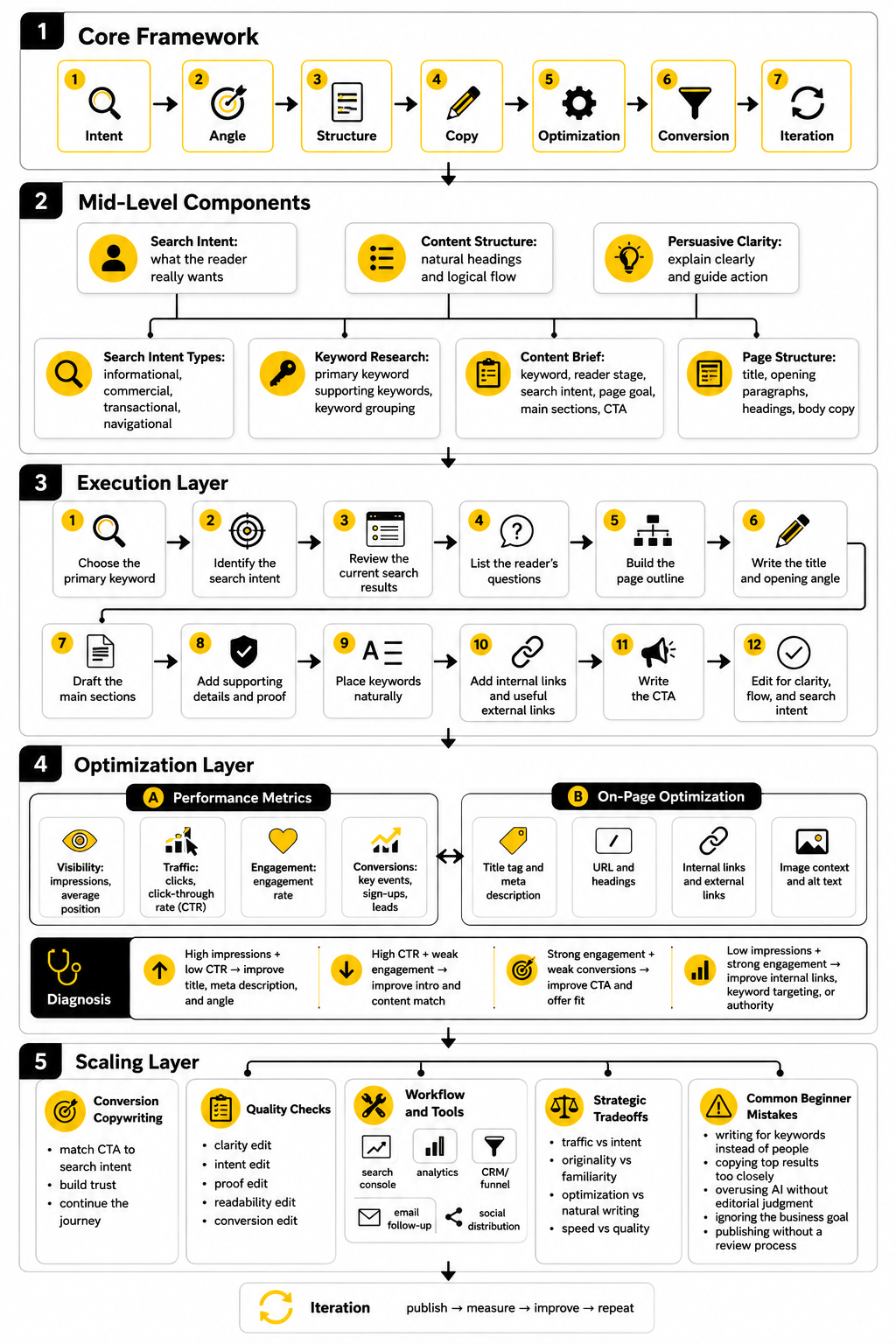
A simple framework makes SEO copywriting much easier to learn. You start with the reader’s search intent, choose the right angle, build a logical structure, write clear copy, optimize the page, and then improve it after publishing. Each step has a job, and skipping one usually creates weak content.
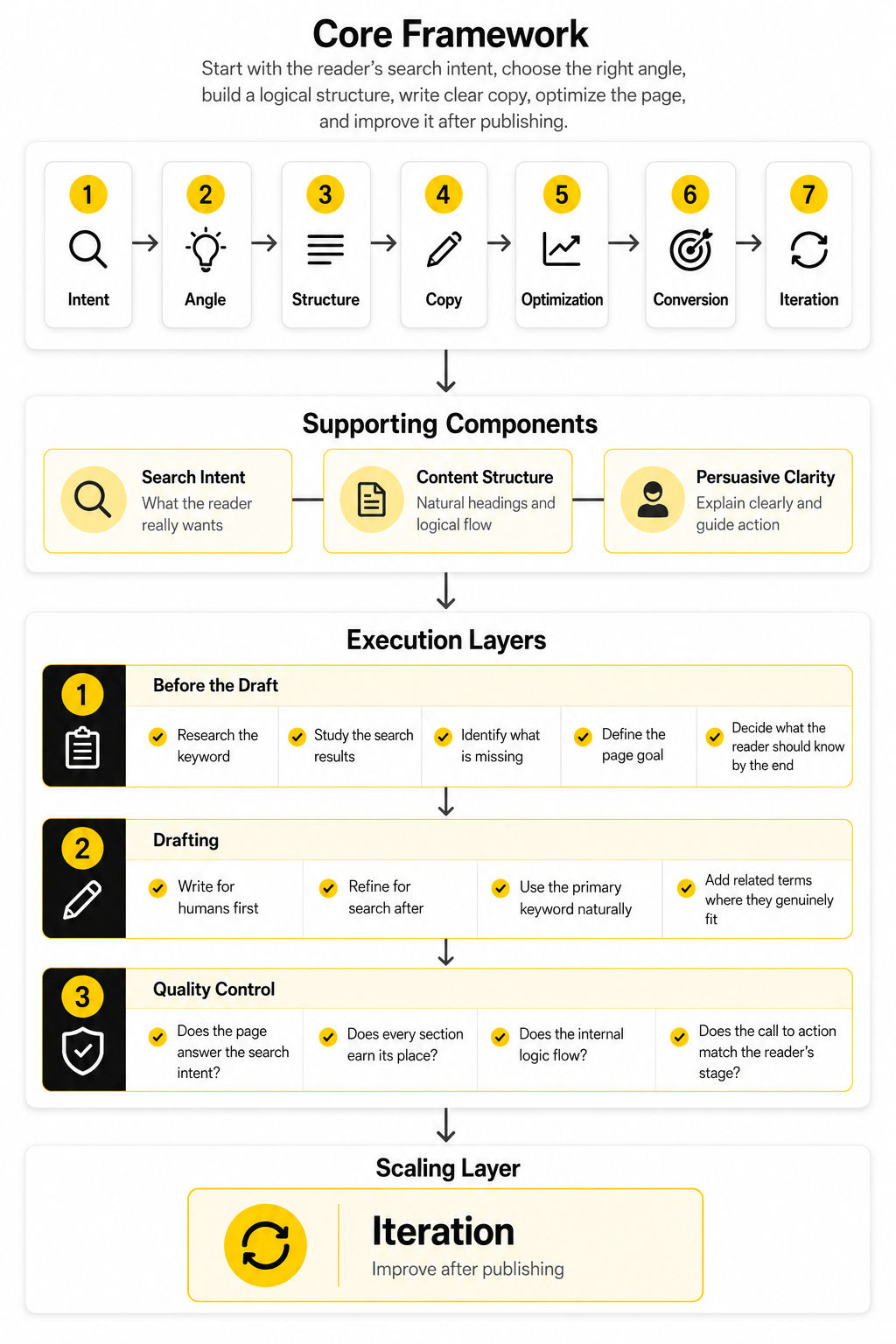
The framework looks like this:
This is practical because beginners often obsess over tools too early. Tools can help, but they cannot decide what the reader needs, whether your argument makes sense, or whether your page deserves trust. If you want a simple workflow later, platforms like GoHighLevel can help connect content with lead capture, follow-up, and campaigns, but the copy itself still has to be clear.
Core Components Of SEO Copywriting
The first core component is search intent. Before you write, you need to know whether the reader wants a definition, a tutorial, a comparison, a checklist, a product, or a decision-making guide. A beginner searching for SEO copywriting usually does not want advanced theory first; they want plain language, examples, process, and confidence.
The second component is content structure. Your headings are not decoration. They tell readers what is coming, help scanners find useful parts quickly, and give search engines a clearer map of the page. This is why strong SEO copy uses natural headings, short sections, and a logical flow instead of dumping everything into one long wall of text.
The third component is persuasive clarity. Copywriting is not hype. It is the discipline of making the next step feel obvious because the reader understands the problem, the solution, the benefit, and the reason to trust you. For SEO content, that persuasion has to feel helpful first, because the reader arrived with a question, not necessarily with buying intent.
Professional Implementation
Professional SEO copywriting starts before the draft. You research the keyword, study the search results, identify what is missing, define the page goal, and decide what the reader should know by the end. This prevents the common beginner problem where the page technically covers the topic but never builds momentum.
The draft should then be written for humans first and refined for search after. That does not mean ignoring SEO. It means using the primary keyword naturally, adding related terms where they genuinely fit, and making the page easy to understand without making every paragraph sound like it was written for a bot.
The final step is quality control. Check whether the page answers the search intent, whether every section earns its place, whether the internal logic flows, and whether the call to action matches the reader’s stage. Beginner-friendly SEO copywriting is not about writing more words; it is about writing the right words in the right order.
Search Intent And Reader Psychology
Search intent is the reason behind the keyword. It is what the person actually wants when they type a phrase into Google. For seo copywriting for beginners, the intent is usually educational, but there is also a quiet practical need underneath it: the reader wants to know how to write pages that rank without sounding awkward.
That means the content should not start with advanced theory, agency jargon, or a giant list of ranking factors. A beginner needs plain explanations, simple decisions, and a repeatable process. The page should make them feel like SEO copywriting is learnable, not like they need ten tools and five years of experience before they can write a decent article.
The best way to understand intent is to ask what the reader is trying to do next. Are they trying to write their first blog post? Improve a landing page? Get organic traffic for a small business? Learn a freelance skill? The answer changes the structure, examples, CTA, and depth of the copy.
The Four Common Search Intent Types
Most SEO keywords fall into four broad intent types: informational, commercial, transactional, and navigational. These categories are not perfect, but they are useful because they stop you from writing the wrong kind of page. A beginner keyword usually leans informational, while a tool comparison or software pricing keyword usually leans commercial or transactional.
Informational intent means the reader wants to learn. Commercial intent means they are comparing options before making a decision. Transactional intent means they are close to taking action, such as signing up, buying, booking, or downloading. Navigational intent means they are trying to reach a specific brand, product, or page.
The mistake beginners make is treating every keyword like a sales page. If someone searches “what is SEO copywriting,” they probably do not want a hard pitch in the first paragraph. If someone searches “best SEO copywriting tool,” they are much closer to comparing solutions, so practical recommendations and decision criteria make more sense.
Matching The Page To The Reader’s Stage
A strong SEO page meets the reader where they are. Beginners often need definitions, examples, warnings, and step-by-step instructions before they are ready for a tool or offer. If you rush the sale before the reader understands the value, the copy feels pushy instead of helpful.
For seo copywriting for beginners, the reader’s stage is usually early awareness. They know SEO matters, they know writing matters, and they suspect there is a more carefully way to combine the two. Your job is to turn that vague interest into a clear path.
That path should feel natural. First, explain the concept. Then show the framework. Then teach the skill. Then introduce tools, templates, or services only when they solve a specific problem the reader now understands.
Reading The Search Results Before Writing
Before writing any SEO copy, search the keyword and study what already ranks. Do not copy the pages. Look for patterns. The top results tell you what Google currently sees as useful for that query, and the gaps show where your article can be better.
Pay attention to the type of pages ranking. Are they beginner guides, checklists, templates, service pages, videos, or tool roundups? Also look at the section headings, depth, examples, and level of language. If every strong result explains search intent early, skipping that topic would make your article feel incomplete.
The goal is not to create a longer version of the same page. The goal is to create a clearer, more useful version. That might mean better structure, simpler examples, stronger editing advice, more practical workflow steps, or a more honest explanation of what beginners should ignore at first.
Keyword Research For Beginners
Keyword research is not just finding phrases with search volume. It is the process of choosing topics people care about and understanding how those topics should be written. If you choose the wrong keyword, even excellent writing can struggle because the page is answering a question people are not asking.
For beginners, keyword research should stay simple. Start with one primary keyword, then collect related questions and supporting phrases that help explain the topic fully. You do not need to force every variation into the copy. You need enough context to write naturally and cover the subject properly.
The primary keyword gives the page a clear focus. Supporting keywords help you understand the edges of the topic. Together, they help you avoid thin content and give the reader a more complete answer.
Choosing A Primary Keyword
A primary keyword should be specific enough to guide the article but broad enough to support a useful page. “Copywriting” is too broad for a beginner article because it could mean sales pages, ads, emails, product pages, or brand messaging. “SEO copywriting for beginners” is much better because it tells you the reader’s skill level and the topic angle.
The keyword should also match the kind of content you plan to write. If the search results are mostly long educational guides, a short landing page probably will not satisfy the query. If the results are mostly product pages, a purely educational article might attract readers who are not ready to act.
A good beginner test is simple: can you explain exactly who is searching this and what they want by the end of the page? If the answer is vague, the keyword may be too broad. If the answer is clear, the page will be much easier to structure.
Finding Supporting Keywords
Supporting keywords are the related phrases, questions, and subtopics that help complete the page. For this topic, supporting ideas might include search intent, meta titles, headlines, keyword placement, content structure, on-page SEO, readability, calls to action, and editing. These are not random additions. They are the pieces a beginner needs to understand the whole skill.
You can find supporting keywords by reviewing search results, autocomplete suggestions, “people also ask” questions, competitor headings, and your own customer questions. The point is to see how real people describe the problem. Beginners rarely use perfect marketing language, so your content should translate expert ideas into language they already understand.
Do not treat supporting keywords like a checklist you must cram into the page. Use them as signals. If a related phrase helps the reader, include it naturally. If it distracts from the flow, leave it out.
Understanding Keyword Difficulty Without Overcomplicating It
Keyword difficulty is useful, but beginners often give it too much power. A keyword can look difficult because big websites rank for it, but that does not always mean you should avoid the topic. Sometimes you still need the page because it is strategically important for your site, your funnel, or your internal linking structure.
The better question is whether you can create a genuinely useful page and support it over time. Can you write something clearer than what already exists? Can you add original perspective, better examples, or a stronger workflow? Can you link to it from related pages and update it when needed?
For beginners, the safest approach is to mix broader educational keywords with more specific long-tail keywords. The broad topics build topical authority. The specific topics often bring more focused readers. That balance gives your site a stronger foundation than chasing only high-volume phrases.
Grouping Keywords Into One Page Or Several Pages
Not every keyword needs its own article. If two keywords have the same intent, they can usually live on the same page. If the intent is different, they may need separate pages.
For example, “SEO copywriting for beginners” and “how to learn SEO copywriting” can likely fit inside one beginner guide. But “SEO copywriting services” deserves a different page because the reader is probably evaluating a provider, not learning the basics. “SEO copywriting examples” could be a separate article if the search results show people want sample copy and breakdowns.
This matters because publishing several weak pages around nearly identical keywords can create confusion. One strong page is usually better than five thin pages fighting each other. Clean keyword grouping helps your content feel organized to readers and easier to understand for search engines.
How To Connect Intent And Keywords Before Drafting
Before writing, combine the intent and keyword research into a simple content brief. This does not need to be complicated. You just need a clear decision document that tells you what the page is about, who it is for, what it must cover, and what action the reader should take next.
A useful brief includes the primary keyword, reader stage, search intent, page goal, main sections, internal links, external proof points, and CTA. If the article is connected to a funnel, this is where you decide whether the next step should be a newsletter signup, consultation, template, software trial, or product page. For a beginner guide, the CTA should usually feel helpful, not aggressive.
This is also where tools can support the workflow. A simple form builder like Fillout can collect content brief inputs from clients or team members, while a platform like GoHighLevel can connect published content to lead capture and follow-up. The tool is not the strategy, but it can keep the process from turning into scattered notes and forgotten next steps.
The Beginner Content Brief
A beginner content brief should answer these questions before the first draft starts:
These questions save time because they remove guesswork. Instead of opening a blank document and hoping the article comes together, you build the page around a clear purpose. That is how SEO copywriting starts to feel professional.
The brief also protects the reader. It keeps you from drifting into unrelated advice, overloading the article with tools, or adding sections only because competitors included them. Every section should have a job, and the brief tells you what that job is.
The Right Next Step For The Reader
Every SEO page should lead somewhere, but the next step must match the reader’s readiness. A beginner reading an educational guide may not be ready to buy software immediately. They may be ready to download a checklist, join an email list, save the article, or read the next guide.
This is where SEO copywriting becomes different from ordinary content writing. You are not just explaining a topic. You are designing a journey from search query to useful action. The more natural that journey feels, the stronger the page becomes.
The best next step is usually specific and low-friction. Do not ask for a huge commitment when the reader is still learning the basics. Give them a practical step that fits the moment, then build trust from there.
How To Structure An SEO Page
A good SEO page is built like a guided path, not a pile of paragraphs. The reader should feel that each section answers the next question in their head. That is especially important for seo copywriting for beginners, because the audience is still learning the language, the workflow, and the reason behind each step.
The structure should make the page easier to scan, easier to trust, and easier to act on. Research on web reading behavior has consistently shown that people scan digital pages rather than reading every word, so headings, opening sentences, bullets, and visual breaks matter Nielsen Norman Group. If the page looks hard to process, many readers will leave before they discover the useful parts.
Search engines also need structure. Google’s SEO Starter Guide emphasizes creating content that is compelling and useful, while also making pages easy for search engines to understand Google Search Central. That is the balance you want: write for the reader, organize for both the reader and the crawler.
Start With The Page Goal
Before you write headings, decide what the page is supposed to achieve. A beginner guide should teach, build trust, and move the reader toward a practical next step. A service page should qualify the reader, explain the offer, remove objections, and make contact feel safe.
This decision affects everything. If the page goal is education, the structure should prioritize clarity and sequence. If the page goal is conversion, the structure should still be helpful, but it needs stronger proof, sharper positioning, and clearer calls to action.
Do not start with “how many words should this be?” Start with “what does the reader need to understand, believe, and do?” Word count is an output of the job the page has to perform, not the strategy itself.
Build The Page Around Reader Questions
The simplest way to structure SEO content is to write down the reader’s questions in order. What is this? Why does it matter? How does it work? What steps should I follow? What mistakes should I avoid? What should I do next?
This creates a natural flow because the article mirrors the reader’s thinking. Beginners usually do not need clever structure. They need an article that answers questions in the order those questions actually appear.
For example, a page about SEO copywriting should not jump straight into meta descriptions before explaining intent and structure. That would feel technical too early. The reader needs the foundation first, then the implementation details.
Use Headings Like Signposts
Headings should help readers understand the page before they read every paragraph. They should be specific, natural, and useful. A heading like “Keyword Placement” is better than “Optimization,” because it tells the reader exactly what the section covers.
Good headings also improve accessibility and navigation. W3C guidance explains that headings help communicate page structure and relationships, which matters for both visual readers and assistive technologies W3C Web Accessibility Initiative. Clear structure is not just an SEO habit. It is a usability habit.
Avoid vague headings that sound impressive but say nothing. “using Growth Through Strategic Content Excellence” might sound polished, but it is useless as a section heading. “How To Place Keywords Naturally” is simpler and much better.
Writing Titles, Intros, Headings, And Body Copy
Once the structure is clear, the writing becomes much easier. You are no longer trying to invent the article as you go. You are filling a logical framework with clear explanations, useful transitions, and copy that keeps the reader moving.
The title, intro, headings, and body copy all have different jobs. The title earns the click. The intro confirms the reader is in the right place. The headings help the reader navigate. The body copy delivers the value and builds trust.
Beginners often try to make every sentence clever. Do not do that. SEO copywriting works better when the writing is clear, direct, and useful before it tries to be memorable.
Writing The SEO Title
The SEO title should make the page’s promise obvious. It should include the primary keyword when it fits naturally, but it should not sound mechanical. A title like “SEO Copywriting For Beginners: A Practical Guide To Writing Content That Ranks” is clear because it names the audience, the topic, and the outcome.
Google’s title link guidance recommends writing descriptive and concise title elements that accurately represent the page Google Search Central. That sounds basic, but it is where many pages fail. They either overpromise, become too vague, or cram in keywords until the title feels unnatural.
A strong beginner title usually does three things. It tells the reader the topic. It signals the skill level. It gives a reason to click. If the title cannot do those three things cleanly, rewrite it.
Writing The Opening Paragraphs
The opening paragraphs should quickly prove that the page understands the reader. Do not begin with a dictionary definition unless the keyword genuinely demands it. Start with the problem, the misconception, or the outcome the reader cares about.
For this topic, the opening should make one thing clear: SEO copywriting is not keyword stuffing. It is writing useful content that matches intent, earns trust, and guides action. That framing helps beginners unlearn bad advice before they start copying bad habits.
The intro should also set expectations. Tell the reader what they will learn and why it matters, but keep it tight. A bloated intro delays the value, and online readers are not patient with delay.
Writing Headings That Carry The Argument
Headings should not be random labels. They should carry the argument forward. Each heading should make the reader feel like the article is progressing toward a useful conclusion.
A weak article often has headings that could be rearranged in any order without changing much. A strong article has sequence. The reader can feel that one section prepares them for the next.
When writing headings, use the language a beginner would understand. “Semantic Optimization Considerations” may be technically interesting, but “Use Related Terms Naturally” is more useful for the audience. Clear beats clever almost every time.
Writing Body Copy That Sounds Human
Body copy should explain one idea at a time. Start with the point, explain why it matters, then show how to apply it. This keeps the writing practical and prevents the article from becoming a list of disconnected tips.
Use the primary keyword where it belongs, but do not force it into every section. A natural article about seo copywriting for beginners will include the phrase a few times because the topic requires it. It does not need to appear in every heading, every paragraph, or every anchor text.
The best body copy feels like a helpful expert sitting next to the reader. It does not show off. It does not hide behind jargon. It helps the reader make better decisions.
The Step-By-Step SEO Copywriting Process
Now the process becomes practical. You have the intent, the keyword, the structure, and the basic writing principles. The next step is turning those decisions into a repeatable workflow you can use every time you write an SEO page.
A beginner-friendly workflow should be simple enough to follow without slowing you down. If the process has too many steps, you will skip it. If it has too few steps, you will miss important decisions.
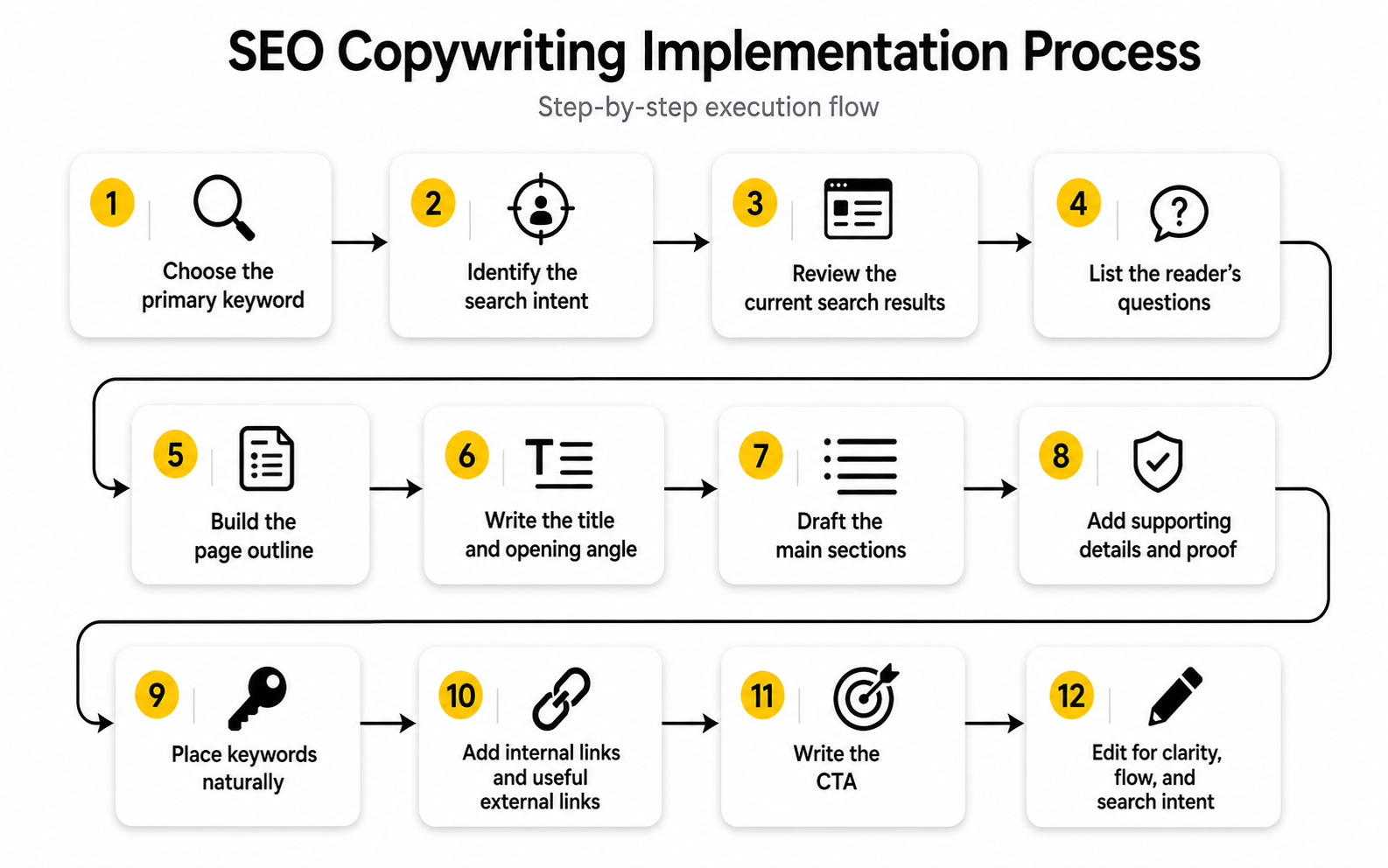
Use this process as your baseline:
This is not complicated, and that is the point. SEO copywriting becomes much less intimidating when every step has a clear purpose. You are not guessing your way through the page. You are making one solid decision after another.
Step 1: Choose The Primary Keyword
The primary keyword gives the page focus. It tells you what the page is about and helps you avoid drifting into unrelated ideas. Without that focus, the article can become broad, vague, and difficult to rank.
Choose a keyword that matches the reader you actually want. If you are writing for beginners, do not pick a keyword that attracts advanced specialists unless that is intentional. The wrong keyword brings the wrong expectations.
Once the primary keyword is chosen, write it at the top of your brief. Every major section should support that topic. If a section does not help the reader understand or act on the keyword, cut it or save it for another article.
Step 2: Identify The Search Intent
Search intent decides the shape of the page. A beginner guide needs teaching. A comparison page needs evaluation. A product page needs proof and action.
To identify intent, look at the top-ranking pages and ask what format dominates. If most results are guides, the searcher likely wants education. If most results are product pages, the searcher may be closer to buying.
Intent also affects the CTA. A beginner guide might lead to a checklist, email signup, or next article. A high-intent page might lead to a demo, trial, or consultation.
Step 3: Build The Outline Before Drafting
The outline is where you create the logic of the page. Start with the reader’s first question and move toward the action you want them to take. Do not use headings just because competitors use them.
A practical outline should include the main topic, necessary subtopics, proof points, objections, and next step. It should also remove anything that does not belong. Good SEO copywriting is as much about exclusion as inclusion.
This is where many beginner articles improve instantly. Instead of writing from a blank page, you write into a structure. The structure keeps the copy focused and helps every section earn its place.
Step 4: Draft Without Over-Optimizing
The first draft should focus on clarity. Explain the topic in normal language. Make the reader feel more carefully after each section. Do not stop every two sentences to worry about exact keyword frequency.
Over-optimizing too early makes the writing stiff. You start choosing phrases for search engines instead of readers, and the article becomes less persuasive. That is the opposite of good SEO copywriting.
Write the draft first, then optimize. You can always adjust headings, add related terms, improve internal links, and tighten the title later. It is much harder to rescue copy that was robotic from the first sentence.
Step 5: Add Proof And Practical Detail
Proof makes the article more trustworthy. It can come from official documentation, original experience, reputable research, product documentation, or clear reasoning. For beginner content, proof should support the point without overwhelming the reader.
Practical detail makes the article useful. Instead of saying “write better headings,” explain what better means. Instead of saying “match search intent,” show how to identify whether the reader wants a guide, comparison, checklist, or product page.
This is where the article starts to separate itself from generic content. Anyone can publish surface-level advice. Fewer people take the time to explain the decision behind the advice.
Step 6: Edit For Flow And Usefulness
Editing is where SEO copywriting gets sharper. Read the article from the reader’s perspective and look for friction. Where does the copy feel slow? Where does it repeat itself? Where does it make a claim without enough support?
Then check whether each section moves the reader forward. If a paragraph does not explain, prove, clarify, or persuade, it probably needs to be cut or rewritten. This is the part beginners skip, and it shows.
A strong edit also checks the page against the original intent. The question is not “does this guide sound good?” The better question is “does this guide satisfy the search better than the page the reader would otherwise click?” That standard will make your copy much stronger.
Statistics And Data
Data matters in SEO copywriting because it separates opinion from performance. A draft can feel strong, sound professional, and still fail because it targets the wrong intent, earns weak clicks, or brings visitors who never engage. Measurement shows you what the page is actually doing after it meets real readers in search.
But numbers are only useful when you know what they mean. A low click-through rate is not automatically bad. A high average position does not always mean the page is winning. A traffic increase can still be weak if the visitors do not take the next step.
For seo copywriting for beginners, the goal is not to memorize every SEO metric. The goal is to understand which numbers reveal visibility, which numbers reveal engagement, which numbers reveal conversion, and which numbers are just noise. Once you know that, analytics becomes a decision-making system instead of a confusing dashboard.
The Four Metrics That Matter First
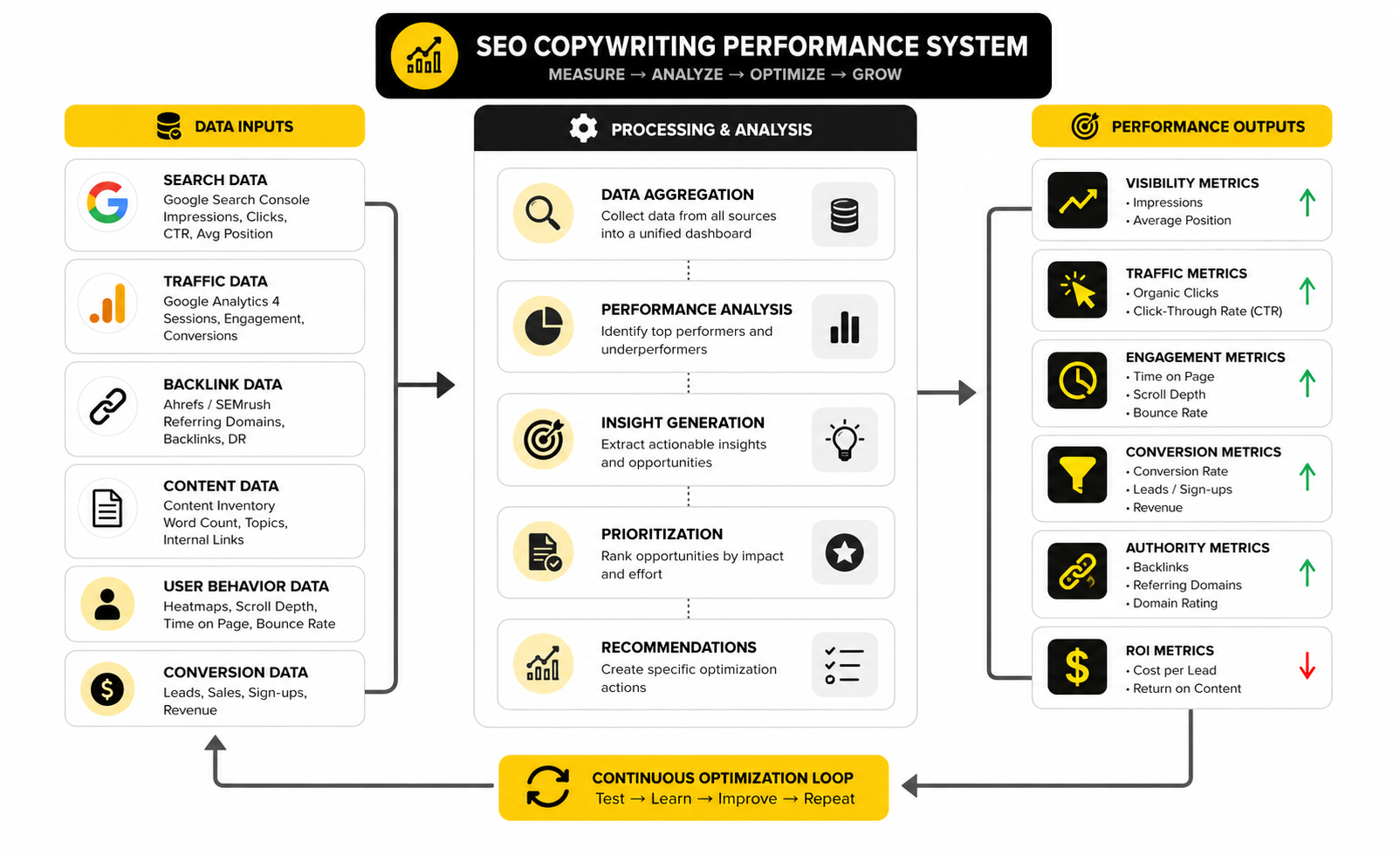
Start with four basic metrics: impressions, clicks, click-through rate, and average position. Google Search Console uses these metrics in the Performance report to show how search traffic changes over time, which queries bring users to your site, and which pages have stronger or weaker CTR Google Search Console Performance report. These numbers tell you how your page is performing before and after the searcher lands on it.
Impressions show how often your page appeared in search results. Clicks show how often people chose your result. CTR shows the percentage of impressions that became clicks. Average position gives you a broad view of where the page tends to appear, but it should not be treated as a perfect ranking number because rankings vary by query, device, location, and search result layout.
The action is simple. If impressions are growing but clicks are weak, improve the title, meta description, angle, and search-result promise. If clicks are growing but engagement is poor, the page may not match the promise made in search. If neither impressions nor clicks are moving, the issue may be keyword targeting, content quality, indexing, internal links, or competition.
Why Impressions Are Not The Same As Success
Impressions are useful because they show visibility, but they do not prove the copy is working. A page can earn impressions for many related searches and still fail to attract qualified traffic. That is why beginners should avoid celebrating impressions alone.
High impressions with low clicks usually means the page is showing up but not earning the searcher’s choice. The title may be too vague, the angle may look generic, or the page may appear below stronger results. Sometimes the page is ranking for queries where the intent does not match what you wrote.
The action is to inspect the queries behind those impressions. If the queries are relevant, rewrite the title and meta description to make the benefit clearer. If the queries are not relevant, adjust the content so Google better understands the page or create a separate page for the intent that is appearing in the data.
Why CTR Needs Context
CTR is one of the most misunderstood SEO metrics. A low CTR can mean your title is weak, but it can also mean the page ranks lower on the results page, appears for broad informational searches, or competes with ads, AI answers, videos, featured snippets, and other SERP features. You need context before you decide what to change.
This matters because search behavior is changing. SparkToro’s 2024 zero-click research found that 59.7% of European Union Google searches and 58.5% of American Google searches ended without a click, which means organic clicks are not guaranteed even when visibility exists SparkToro zero-click search study. That makes your search snippet more important, not less.
The action is to compare CTR by query type and page position, not just as one sitewide average. A beginner guide may naturally have different CTR behavior than a high-intent comparison page. When CTR is low for relevant queries where the page has decent visibility, test a clearer title, stronger benefit, or more specific angle.
Measuring Engagement After The Click
Once the visitor lands on the page, Search Console is no longer enough. You need analytics data to see whether people actually engage. In Google Analytics 4, engagement rate and bounce rate are built around engaged sessions, which helps you understand whether sessions show meaningful activity rather than just raw visits Google Analytics engagement rate and bounce rate.
Engagement data tells you whether the page delivers on the promise made in search. If the title promises a practical beginner guide but the page opens with vague theory, visitors may leave quickly. If the structure is confusing, people may not reach the sections that would have helped them.
The action is to connect engagement problems to page sections. Weak engagement near the top suggests the intro, layout, or first few headings need work. Good engagement but poor conversion suggests the article may be useful but not persuasive enough, or the next step may not match the reader’s stage.
Tracking Key Events And Conversions
Traffic is not the final goal. The page should help the business, whether that means email signups, lead forms, product trials, bookings, purchases, or qualified inquiries. GA4 lets you mark important user actions as key events, which helps you measure the actions that matter to your business Google Analytics key events.
This is where SEO copywriting becomes measurable beyond rankings. If two articles bring the same number of visitors, the better article is often the one that attracts more qualified readers and moves them to the right action. A smaller page with stronger intent can outperform a bigger traffic page in actual business value.
The action is to define one primary conversion for each important SEO page. A beginner educational page might track newsletter signups, checklist downloads, or visits to a related service page. A commercial page might track demos, trials, or contact form submissions.
What Benchmarks Can And Cannot Tell You
Benchmarks are useful for orientation, but they are dangerous when treated as universal targets. CTR benchmarks vary by industry, device, position, brand awareness, search intent, and SERP layout. Engagement benchmarks vary by site type, traffic source, content format, and how analytics is configured.
A broad benchmark can tell you whether a number is worth investigating. It cannot tell you whether your specific page is good or bad without context. For example, an informational article may have lower conversion intent but higher assisted value because it introduces new readers to the brand early in their journey.
The action is to build your own baseline. Compare similar pages against each other, not every page against some generic industry average. Your beginner guides should be compared with beginner guides, service pages with service pages, and product-led pages with product-led pages.
Reading Performance Signals Together
The real skill is reading metrics together. One number rarely gives the full answer. Impressions, clicks, CTR, engagement, conversions, and assisted outcomes need to be interpreted as a chain.
A healthy SEO copywriting page usually shows a logical pattern. It earns relevant impressions, attracts clicks with a clear promise, keeps readers engaged, answers the intent, and moves a portion of those readers toward a next step. If one part of that chain breaks, you know where to investigate.
Use this simple diagnosis:
This is why SEO copywriting cannot be judged only by rankings. Rankings are useful, but they are not the whole game. The best pages create a clean path from search visibility to reader value to business action.
On-Page SEO Copywriting Elements
On-page SEO copywriting is where the written page gets refined so both readers and search engines understand it clearly. This does not mean turning the article into a technical checklist. It means making the important parts of the page obvious.
The main elements are the title, meta description, URL, headings, internal links, external links, image context, and body copy. Each element should support the same promise. If the title says the article is for beginners, the headings and explanations should actually feel beginner-friendly.
This is also where measurement improves the draft. If Search Console shows impressions but weak CTR, the title and meta description deserve attention. If analytics shows weak engagement, the opening, layout, and section order deserve attention. Data tells you where to look, but the copy still has to be fixed by thinking like a reader.
Title Tags And Meta Descriptions
The title tag is often the first piece of copy a searcher sees. It should be accurate, specific, and compelling without becoming clickbait. Google’s title link guidance recommends descriptive title text that represents the page well Google title link guidance.
A meta description does not directly solve everything, but it can influence how the page is understood and clicked when it appears in search. Treat it like a short promise. Tell the reader what the page helps them do, who it is for, and why it is worth opening.
For a beginner guide, avoid vague titles like “Complete SEO Guide.” A stronger option would be closer to “SEO Copywriting For Beginners: How To Write Pages That Rank And Convert.” It is clearer, more specific, and better aligned with the reader’s intent.
Internal Links And Reader Flow
Internal links help readers continue their journey and help search engines understand how your content is connected. They should feel like helpful next steps, not random links dropped into paragraphs. A good internal link answers the question, “What would the reader naturally need after this?”
For example, after a beginner learns the basics of SEO copywriting, they may need a keyword research guide, content brief template, landing page copywriting guide, or conversion optimization article. That link should appear where the need naturally comes up. Forced links feel distracting and often reduce trust.
Anchor text should be clear. “Read our keyword research guide” is better than “click here.” The reader should know what they will get before they click.
External Links And Trust
External links should support claims, clarify technical guidance, or send readers to a genuinely useful resource. They are not decoration. When you cite Google documentation, analytics guidance, or credible research, you make the page more useful and easier to trust.
Use external links when the reader benefits from the source. Link to documentation for definitions, studies for statistics, and original sources for data. Do not use weak sources just to make the page look researched.
For tools, only link when there is real click intent. If a reader is ready to connect SEO pages with landing pages, lead capture, or follow-up, a platform like GoHighLevel may fit naturally. If the section is purely educational, forcing a software link weakens the article.
Image Context And Accessibility
Images can support SEO copywriting when they explain a process, framework, or comparison. They should not be added just to make the page look longer. A good image helps the reader understand something faster than text alone.
Every important image should have useful context around it. The surrounding copy should explain why the visual exists and what the reader should notice. This matters because images do not automatically create understanding; the copy still has to guide interpretation.
Alt text should describe the image in a useful way, especially when the image communicates information. Keep it natural and specific. Do not stuff keywords into alt text, because that makes the page worse for accessibility and does not create real value.
Turning Data Into Better Copy
Analytics should lead to action. If data does not change what you write, edit, or prioritize, it is just reporting theater. The point is not to stare at dashboards; the point is to improve the page.
Start by choosing one problem to solve. Do not rewrite the entire article because one metric looks weak. Diagnose the weakest part of the chain, make one focused improvement, then give the page time to collect new data.
This is the professional loop:
That loop keeps SEO copywriting practical. You publish, learn, improve, and repeat. Beginners who master that habit will beat writers who only publish and hope.
Conversion Copywriting Inside SEO Content
SEO copywriting should not stop at getting the click. Once the reader lands on the page, the copy has to guide them toward a useful next step. That next step might be reading another article, joining an email list, booking a call, starting a trial, downloading a checklist, or comparing a product.
This is where beginners often get nervous. They either avoid calls to action completely because they do not want to sound salesy, or they push too hard and make the page feel like a pitch disguised as education. The better approach is simple: make the CTA match the reader’s stage.
A beginner learning seo copywriting for beginners is usually not ready for a hard sell in the first few paragraphs. They are still building trust. Give them value first, then offer the next step when it naturally helps them continue.
Match The CTA To Search Intent
A CTA should feel like the next logical action, not an interruption. If the article is educational, the CTA should help the reader apply what they just learned. If the page is commercial, the CTA can ask for a stronger commitment because the reader is already comparing options or preparing to act.
For example, a beginner guide could lead to a content brief template, an SEO checklist, or a newsletter about practical content systems. A landing page about SEO copywriting services could lead to a consultation or proposal request. A software comparison page could lead to a trial, demo, or pricing page.
The mistake is using the same CTA everywhere. “Book a call” might work on a service page, but it may feel too aggressive on an early-stage educational article. “Download the checklist” might work in a guide, but it may feel too weak on a high-intent page where the reader is ready to buy.
Build Trust Before Asking For Action
Conversion copywriting depends on trust. Readers need to believe that you understand the problem, that your advice is useful, and that the next step will not waste their time. If the page has not earned that trust, the CTA will feel premature.
Trust is built through clarity, specificity, proof, and restraint. Clear explanations show competence. Specific advice shows experience. Credible sources support important claims. Restraint shows that you are not trying to force every visitor into the same funnel.
This matters even more now because search quality systems continue to prioritize helpful, reliable, people-first content rather than content built mainly to manipulate rankings Google Search Central. A page that helps first and converts second will usually age better than a page that treats the reader like a lead before treating them like a person.
Use CTAs That Continue The Journey
The strongest CTAs are connected to the article’s purpose. If the reader just learned how to structure SEO copy, the next step could be a template. If they learned how to measure content performance, the next step could be an audit. If they learned how to connect content to leads, the next step could be a funnel or CRM workflow.
For businesses that want to connect organic content with lead capture, follow-up, and pipeline tracking, GoHighLevel can fit naturally as a next-step system. For creators or small teams that want a lightweight funnel builder, ClickFunnels may fit the part of the journey where content needs to turn attention into opt-ins or offers. The tool should appear only when the reader has a clear reason to care.
Do not hide the CTA under vague language. Say what the reader gets and why it helps. A clear CTA is not pushy when it is relevant.
Editing, Optimization, And Quality Checks
Editing is where beginner SEO copy becomes professional. The first draft is usually where you get the ideas down. The edit is where you make the page sharper, clearer, more useful, and more aligned with the search intent.
Good editing is not just grammar. It is structure, logic, usefulness, credibility, readability, and conversion. You are checking whether the page actually does the job it was created to do.
This is also where you protect the page from becoming generic. A lot of content sounds fine at first glance, but says nothing a reader could not find on twenty other pages. Your edit should remove vague advice and replace it with decisions, examples, steps, and useful explanations.
The Clarity Edit
The clarity edit asks one question: can the reader understand this quickly? Every paragraph should have a point. Every section should answer a real question. Every transition should make the next section feel natural.
Remove filler phrases, bloated openings, and sentences that sound polished but do not help. Beginners often write more because they want the article to feel complete. Professionals cut more because they know the reader values momentum.
This does not mean every sentence has to be short. It means every sentence has to earn its place. Clear writing can still have rhythm, personality, and confidence.
The Intent Edit
The intent edit checks whether the article still matches the original search. This is important because drafts drift. You may start writing a beginner guide and accidentally turn it into an expert essay, a tool review, or a sales page.
Go back to the keyword and ask what the searcher wanted. Then check whether the article satisfies that need better than the reader’s other options. If the answer is no, the page needs more than a few keyword tweaks.
For seo copywriting for beginners, the intent edit should protect simplicity. The article can include advanced guidance, but it should not make the reader feel lost. Advanced ideas should be translated into practical decisions.
The Proof Edit
The proof edit checks whether important claims are supported. If you mention a trend, metric, ranking issue, or search policy, use a credible source or remove the claim. Unsupported claims weaken trust quickly.
Google’s spam policies are especially important for anyone scaling content, because practices such as scaled content abuse, site reputation abuse, and other manipulative tactics can violate Search policies Google Search spam policies. That matters because modern SEO copywriting is not just about what you can publish. It is also about what you should not publish.
Proof should be used naturally. Do not stack statistics just to sound authoritative. Use data when it changes how the reader thinks or what they should do next.
The Readability Edit
The readability edit checks whether the page is easy to move through. Look at paragraph length, section length, heading clarity, bullet use, and the opening sentence of each section. A page can contain strong information and still fail because it feels heavy.
Digital readers scan, compare, pause, jump, and return. Your copy should support that behavior. Clear headings, concise paragraphs, and specific opening lines help readers find value faster.
This is not about dumbing down the article. It is about respecting the reader’s time. The easier your page is to use, the more likely the reader is to stay with it.
The Conversion Edit
The conversion edit checks whether the next step is clear and appropriate. The CTA should be visible, relevant, and connected to the section around it. It should not feel like it was pasted in after the article was finished.
Ask whether the reader has enough context to act. If not, add clarity before the CTA. If the CTA feels too aggressive, soften the step or move it later in the page.
Conversion editing is about alignment. The offer, the page, the keyword, and the reader’s stage should all make sense together. When they do, the CTA feels helpful instead of forced.
SEO Copywriting Tools And Workflow
Tools can make SEO copywriting faster, but they cannot replace judgment. A tool can help you collect keywords, draft outlines, check technical issues, build landing pages, capture leads, or automate follow-up. It cannot decide what the reader needs better than a thoughtful writer can.
The best workflow uses tools for leverage, not laziness. Use software to reduce repetitive work, organize inputs, and measure performance. Use human judgment for positioning, structure, accuracy, tone, and the final copy.
This is especially important when AI is part of the process. Google’s guidance says generative AI can be useful for researching and structuring original content, but using AI or similar tools to generate many pages without adding value may violate the scaled content abuse policy Google Search guidance on generative AI content. In plain English: AI assistance is fine when the result is genuinely useful. Low-value mass publishing is the risk.
A Practical Beginner Workflow
A simple beginner workflow should help you move from idea to published page without overcomplicating the process. Start with the keyword and intent. Build the brief. Write the outline. Draft the content. Edit for clarity. Optimize the on-page elements. Publish. Measure. Improve.
That sounds basic, but it is powerful because it creates consistency. Most weak SEO content comes from skipping steps, not from missing secret tricks. A consistent workflow helps you produce better pages without reinventing the process every time.
Use this workflow as a repeatable system:
This workflow keeps the focus where it belongs. You are not writing for a plugin score. You are writing for a reader and refining the page so search engines can understand it.
Where AI Helps And Where It Hurts
AI can help with brainstorming, outlining, clustering keywords, summarizing research, generating first-draft angles, and checking whether a section is clear. That can save time. Used well, it gives you momentum.
AI hurts when it replaces thinking. If the content has no real perspective, no verification, no specific audience understanding, and no editorial judgment, it becomes generic. Generic content is easy to publish and hard to trust.
The safest approach is to use AI as an assistant, not the author of record. You still need to verify claims, improve examples, remove bland phrasing, and make decisions based on the reader. That is where the quality comes from.
Scaling Without Creating Thin Content
Scaling SEO copywriting is not just publishing more pages. It is building a system that produces consistently useful pages without losing quality. That requires briefs, templates, review standards, data checks, and clear ownership.
The risk is that scaling turns into mass production. When teams chase volume without editorial discipline, content becomes repetitive, shallow, and disconnected from actual reader needs. That may create a temporary publishing spike, but it rarely creates durable trust.
Scale only after the process works manually. First prove that your pages satisfy intent, earn engagement, and support business goals. Then build templates and systems around what already works.
Managing Content Across A Funnel
SEO content should not live alone. It should connect to the rest of the customer journey. A beginner article might lead to a checklist, then an email sequence, then a webinar, then a product or service conversation.
Email and automation tools can help when the strategy is clear. For newsletter follow-up and email campaigns, Brevo or Moosend can support the follow-up layer after the reader opts in. For social distribution around published content, Buffer can help repurpose and schedule posts without turning promotion into a daily scramble.
The key is to connect the tool to a real reader action. Do not add software because it sounds impressive. Add it when it removes friction from the journey you already designed.
Strategic Tradeoffs Beginners Need To Understand
SEO copywriting always involves tradeoffs. You cannot optimize everything equally at the same time. A page that is too broad may attract more searches but convert poorly. A page that is too narrow may convert well but have limited traffic potential.
Beginners need to learn these tradeoffs early because they prevent bad decisions. The goal is not maximum traffic at any cost. The goal is the right traffic, the right reader experience, and the right business outcome.
This is where SEO becomes more strategic. You stop asking, “Can this page rank?” and start asking, “What role should this page play in the business?”
Traffic Versus Intent
High-volume keywords are attractive, but they are not always the best place to start. A broad keyword can bring visitors who are curious but not ready to act. A more specific keyword can bring fewer visitors but stronger intent.
For example, a broad beginner guide can introduce many readers to your brand. A more specific article about “SEO copywriting checklist for service pages” may attract fewer people, but those readers may be closer to implementation. Both can be valuable, but they play different roles.
The smart move is to build a mix. Use broad educational content to create awareness and specific intent-driven content to capture action. Do not expect one page to do every job.
Originality Versus Familiarity
SEO pages need to match what readers expect from the query, but they also need a reason to exist. If your page ignores the common questions, it may feel incomplete. If it only repeats the same advice as every other result, it feels unnecessary.
This is the tension between familiarity and originality. Familiarity helps the page satisfy intent. Originality helps the page stand out.
The solution is to cover the expected topic clearly, then add better framing, stronger process, clearer examples, sharper warnings, or a more practical workflow. You do not need to be weird to be original. You need to be more useful.
Optimization Versus Natural Writing
Optimization should support the copy, not suffocate it. Titles, headings, internal links, and related terms matter. But if every sentence sounds engineered for search, the reader will feel it.
Natural writing builds trust because it sounds like a human explaining something with confidence. Over-optimized writing creates friction because it sounds like the article is trying too hard to rank. That is a bad tradeoff.
Use the primary keyword where it belongs. Use related terms when they help explain the topic. Then stop. The reader should never feel like the keyword is more important than their understanding.
Speed Versus Quality
Publishing speed matters, especially when you are building a content library. But speed without standards creates cleanup work later. Every weak article becomes another page to update, merge, redirect, or delete.
Quality does not mean perfection. It means the page has a clear purpose, satisfies intent, uses credible support, and helps the reader take the next step. That level of quality is achievable without turning every article into a six-month project.
The tradeoff is managed through process. Templates, briefs, checklists, and review rules let you move faster without dropping the standard. That is how professionals scale without turning the site into a content landfill.
Common Beginner Mistakes
The final layer of learning seo copywriting for beginners is knowing what to avoid. Most beginner mistakes are not dramatic. They are small choices that make a page less useful, less trustworthy, or less connected to the reader’s intent.
The good news is that these mistakes are fixable. Once you can see them, you can edit them out before publishing. That alone puts you ahead of a lot of content that looks optimized on the surface but does not actually help the reader.
Writing For Keywords Instead Of People
The most common mistake is treating the keyword like the audience. A keyword is not a person. It is a signal that a person has a problem, question, goal, or decision to make.
When writers focus only on the phrase, the article becomes stiff. The same words show up too often, sections feel forced, and the reader can tell the page was built to rank before it was built to help. Google’s current guidance is clear that people-first content should leave readers feeling they have learned enough to achieve their goal Google Search Central.
Use the keyword to choose the topic, then write for the human behind it. That shift changes everything. The copy becomes clearer, the structure becomes more natural, and the page feels like it has a real reason to exist.
Copying The Top Results Too Closely
Studying search results is smart. Rewriting the same article everyone else wrote is not. If your page has the same headings, same points, same examples, and same generic advice, the reader has no reason to choose your version.
This is where beginners confuse research with imitation. Research shows you what the reader expects. Your job is to satisfy that expectation while adding clearer explanations, better sequencing, more useful decisions, and stronger practical guidance.
Before publishing, ask what your article adds. If the answer is only “it is longer,” that is not enough. Length is not value unless the extra content improves the reader’s outcome.
Overusing AI Without Editorial Judgment
AI can speed up parts of the workflow, but it can also make content bland at scale. The risk is not that AI exists. The risk is publishing unverified, repetitive, low-value copy because it was easy to generate.
Google’s guidance on generative AI content focuses on whether content is helpful and whether automation is being used to manipulate rankings rather than serve users Google Search Central. That distinction matters. AI-assisted content can still be useful when it is edited, verified, and shaped by real judgment.
Use AI for support, not responsibility. Let it help with outlines, drafts, angles, or checks. Then bring the human work: accuracy, examples, structure, positioning, tone, and the final decision on what deserves to be published.
Ignoring The Business Goal
A page can rank and still be strategically weak. If it attracts the wrong audience, leads nowhere, or teaches without creating any next step, it may produce traffic but little business value. That is why SEO copywriting has to connect search intent with the wider funnel.
This does not mean every article should hard-sell. It means every important article should have a role. Some pages build awareness. Some build trust. Some capture leads. Some help readers compare solutions. Some support sales conversations.
Before publishing, decide the job of the page. If the job is unclear, the CTA will probably feel unclear too. A page without a role is just content inventory.
Publishing Without A Review Process
A weak review process creates weak pages. Beginners often publish as soon as the draft is finished, but finishing the draft is not the same as finishing the article. The final review is where quality becomes visible.
Check the intent, headline, opening, section order, claims, links, CTA, and readability. Make sure the page does not repeat earlier points too heavily. Make sure every section earns its place.
This is especially important when publishing more content over time. Google’s spam policies warn against scaled content abuse, including producing many pages primarily to manipulate rankings rather than help users Google Search Central. A review process is not bureaucracy. It is protection.
What Is SEO Copywriting?
SEO copywriting is the process of writing content that helps people find a page through search and then helps them understand, trust, and act on the message. It combines search intent, keyword use, structure, clarity, and persuasion. The goal is not just to rank, but to make the page useful once someone clicks.
Is SEO Copywriting Good For Beginners?
Yes, SEO copywriting is a strong skill for beginners because it teaches both marketing strategy and practical writing. You learn how people search, how pages are structured, and how copy influences action. It is also useful across blogs, landing pages, service pages, product pages, email funnels, and content marketing campaigns.
How Is SEO Copywriting Different From Normal Copywriting?
Normal copywriting focuses on persuasion, while SEO copywriting adds search visibility and intent matching. A sales page may only need to persuade a visitor who is already there. An SEO page also has to earn the visit by matching what people search for and presenting the content in a way search engines can understand.
How Is SEO Copywriting Different From SEO Content Writing?
SEO content writing often focuses on educational content, topic coverage, and organic traffic. SEO copywriting adds a stronger focus on persuasion, positioning, and action. In practice, the best pages use both because they need to answer the query and guide the reader toward the next step.
Where Should I Put Keywords In SEO Copy?
Use the primary keyword naturally in important places such as the title, opening section, at least one relevant heading when it fits, and the body copy. You can also use related phrases throughout the article when they help explain the topic. Do not force the keyword into every paragraph because that makes the page harder to read.
How Many Times Should I Use The Primary Keyword?
There is no perfect number. Use the keyword enough that the topic is clear, but not so much that the writing sounds unnatural. A good test is to read the article out loud. If the phrase feels repeated for the search engine instead of the reader, edit it down.
Do Meta Descriptions Help SEO?
Meta descriptions can help explain the page in search results and may influence whether someone clicks when Google uses them as the snippet. They are not a magic ranking lever. Treat them as short copy that clarifies the page’s promise and gives the searcher a reason to open it.
What Makes A Good SEO Title?
A good SEO title is clear, accurate, specific, and aligned with the search intent. It should usually include the main keyword when it sounds natural. It should also make the benefit obvious so the reader understands why this page is worth choosing.
Should Beginners Use AI For SEO Copywriting?
Beginners can use AI for brainstorming, outlining, editing suggestions, and workflow support. They should not blindly publish AI drafts without checking accuracy, usefulness, tone, and originality. AI can help you move faster, but judgment is still the part that makes the content worth reading.
How Long Should An SEO Article Be?
An SEO article should be as long as needed to satisfy the search intent without adding filler. Some topics need a short answer. Others need a guide with examples, steps, and supporting sections. The better question is whether the page fully helps the reader accomplish what they came to do.
How Do I Know If My SEO Copy Is Working?
Start with Search Console and analytics. Check impressions, clicks, CTR, engagement, and key events. If the page earns visibility but not clicks, improve the search snippet. If it earns clicks but weak engagement, improve the intro, structure, and content match. If it earns engagement but no action, improve the CTA and offer fit.
What Is The Biggest SEO Copywriting Mistake?
The biggest mistake is writing for the algorithm before writing for the reader. That usually creates stiff, generic, keyword-heavy content that does not build trust. Strong SEO copy starts with the reader’s intent, then uses optimization to make the page easier to find and understand.
Can SEO Copywriting Help Service Businesses?
Yes, SEO copywriting can be especially useful for service businesses because it turns expertise into search-friendly pages that educate and qualify potential clients. A good service article can answer common questions, build trust, and lead readers toward a consultation or inquiry. The key is to match the page to the reader’s stage instead of turning every article into a hard pitch.
What Tools Help With SEO Copywriting?
Useful tools depend on the workflow. Search Console and analytics help measure performance. A CRM or funnel platform like GoHighLevel can help connect content to leads and follow-up. Funnel tools like ClickFunnels can help when the next step is an opt-in, offer, or landing page. The tool should support the strategy, not replace it.
What Should I Learn After SEO Copywriting Basics?
After the basics, learn content strategy, conversion optimization, analytics, internal linking, and offer positioning. These skills turn SEO copywriting from a writing task into a growth system. The more you understand the full journey, the better your pages will perform.
Build a stronger local presence with BAAM AI
Turn your website, Google profile, social channels, and AI visibility into one growth engine
Most businesses do not need more random marketing activity. They need a consistent presence system that helps the right people find them, trust them, and take action. BAAM AI brings strategy, local SEO, website updates, Google Maps visibility, social content, AI-search readiness, media production, and reporting into one practical monthly engine.
If you want your marketing to keep working after the campaign ends, start with a free BAAM AI presence audit. See how your business shows up today and where the fastest visibility wins are at BAAM AI.