
BAAM AI Blog
SEM Digital Marketing: A Practical Guide To Search Ads That Actually Convert
SEM digital marketing is the work of using paid search campaigns to put your offer in front of people who are already looking for a solution. That is why it is different from most awareness channels. You are not...
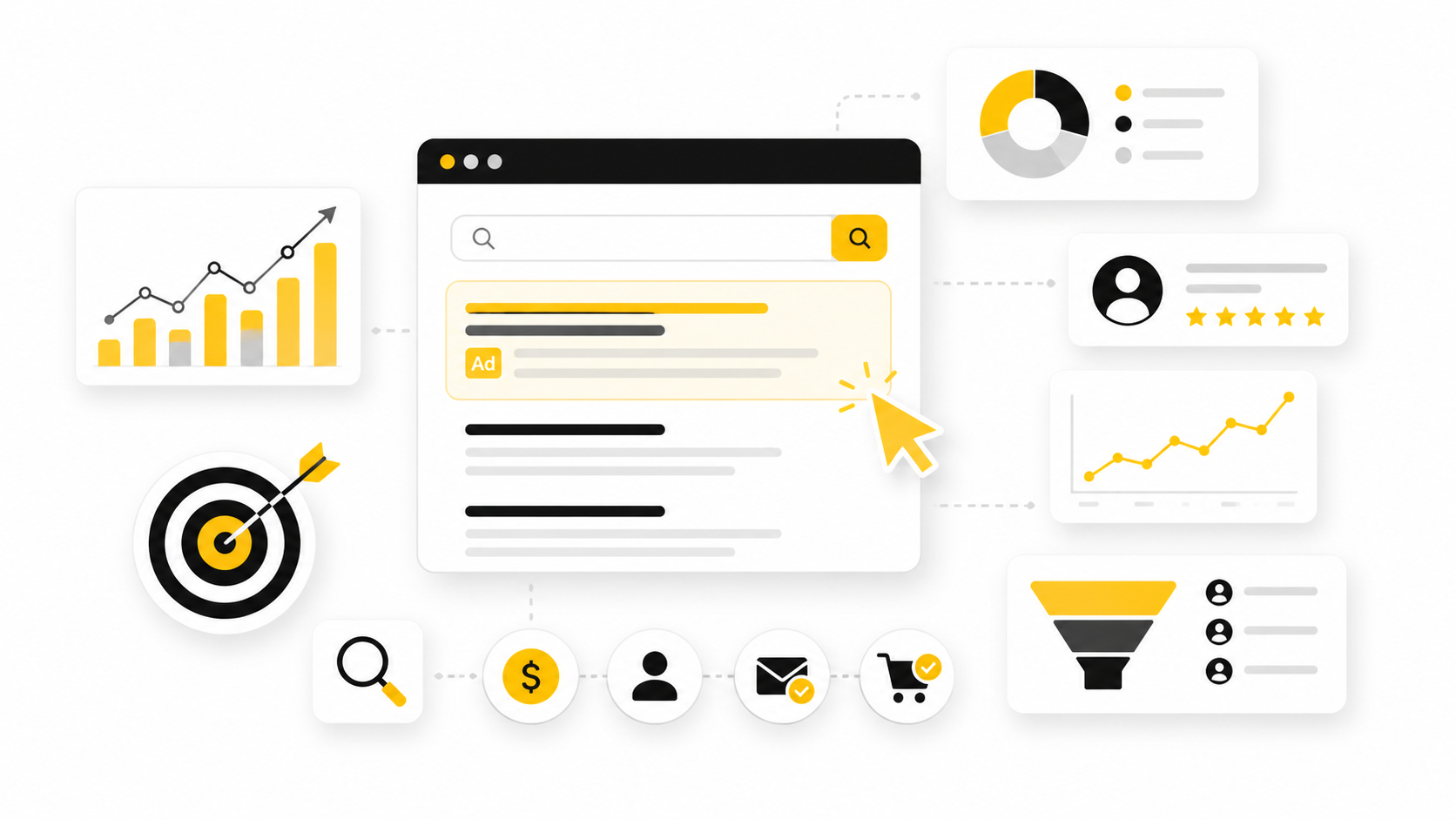
SEM digital marketing is the work of using paid search campaigns to put your offer in front of people who are already looking for a solution. That is why it is different from most awareness channels. You are not trying to interrupt someone’s day; you are trying to show up at the exact moment they raise their hand.
That timing is powerful, but it also makes SEM unforgiving. Search revenue remained the largest digital ad category in 2025, reaching $114.2 billion in U.S. revenue, which means competition is real. Average Google Ads conversion rates reached 7.52% across industries in 2025, but averages do not pay your bills. The account structure, keyword intent, landing page, tracking, and follow-up system decide whether your budget becomes revenue or noise.
Why SEM Digital Marketing Still Matters
SEM matters because search captures demand that already exists. Someone typing “emergency plumber near me,” “best CRM for agencies,” or “book accounting consultation” is not casually browsing. They are usually comparing options, checking prices, or getting ready to act.
That is why SEM digital marketing works best when it is treated as a revenue system, not just an ad platform. Google’s own Quality Score guidance focuses on how useful and relevant your keyword, ad, and landing page are to the searcher, which is the heart of profitable SEM. Better alignment does not magically fix a weak offer, but it gives a strong offer a much better chance to win the click and convert.
The mistake many businesses make is launching campaigns before the back end is ready. They buy traffic, but the landing page is vague, the form is too long, the follow-up is slow, and the conversion tracking is incomplete. In that setup, paid search does not fail; the system around it fails.
The SEM Digital Marketing Framework
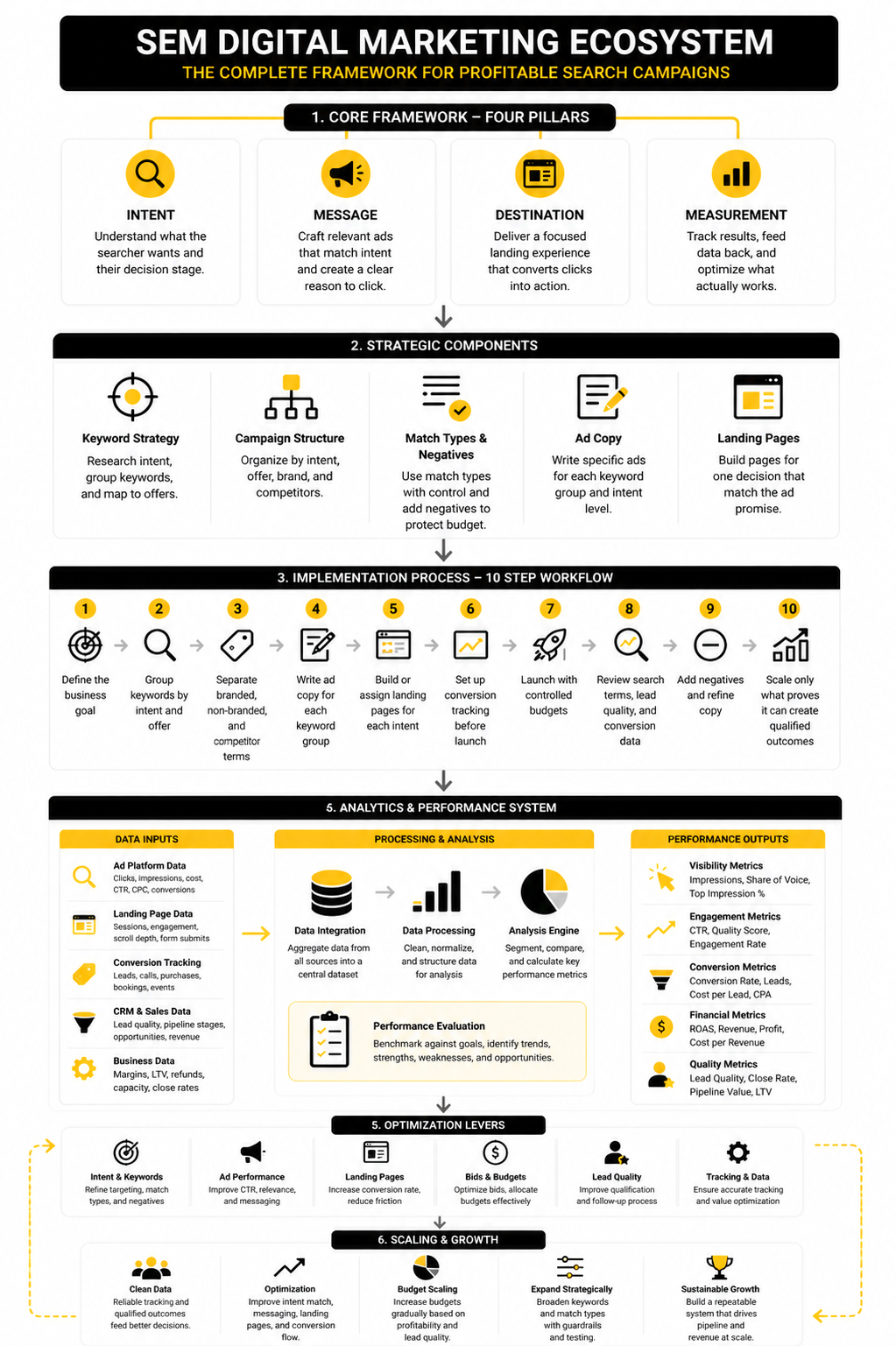
A strong SEM system has four moving parts: intent, message, destination, and measurement. Intent tells you what the searcher wants. Message turns that intent into a clear reason to click. Destination turns the click into a lead, sale, booking, or qualified next step. Measurement tells you what is actually working.
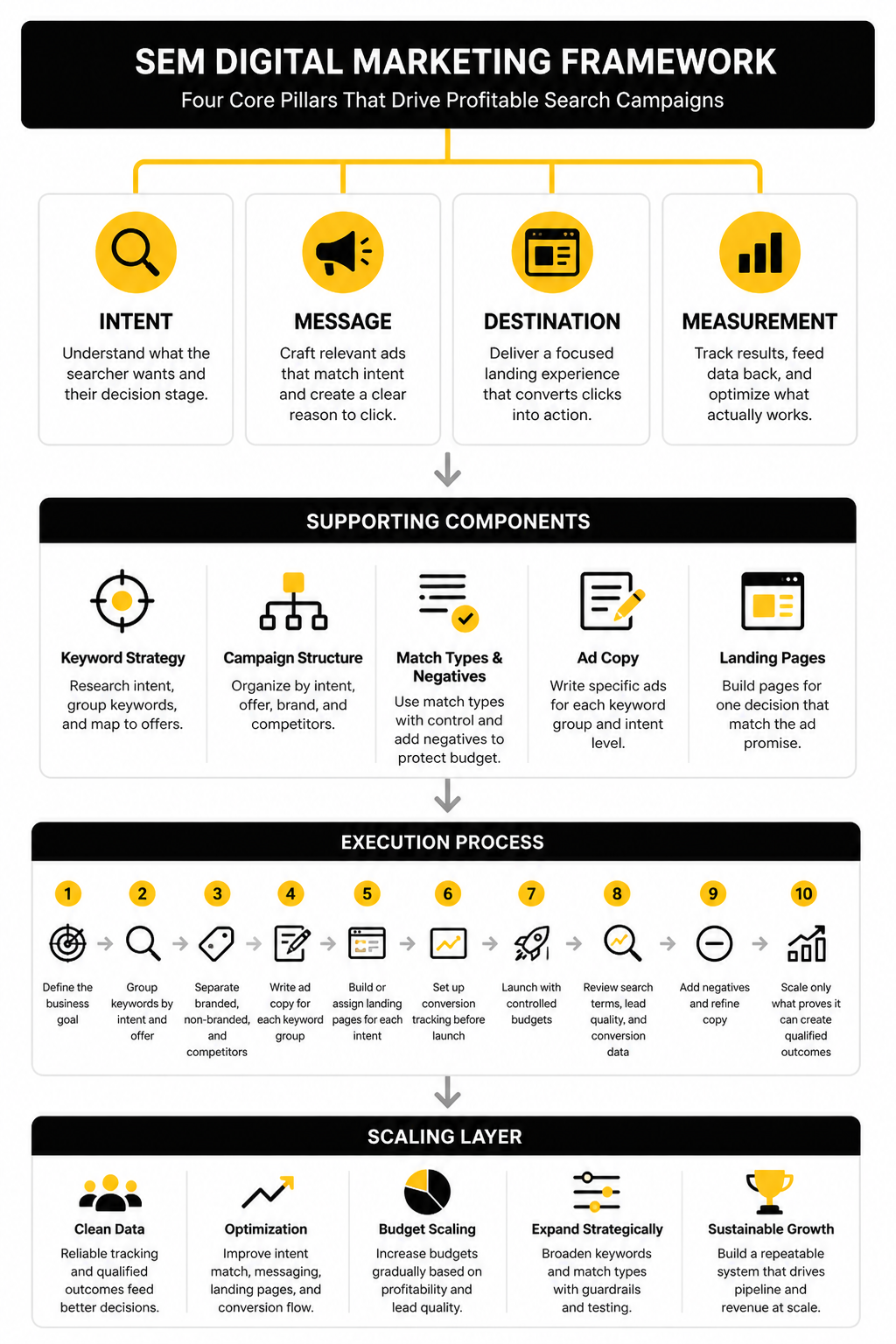
This framework keeps campaigns grounded. You are not guessing which keywords “feel good.” You are matching search terms to buyer stages, writing ads that make a specific promise, sending traffic to pages built for that promise, and feeding conversion data back into the account.
For service businesses and agencies, the follow-up layer matters just as much as the click. A tool like GoHighLevel can fit naturally when the SEM goal is lead capture, pipeline tracking, SMS follow-up, booking, and attribution in one place. The ad gets attention, but the follow-up system often decides whether that attention turns into money.
Keyword Intent And Campaign Structure
This is where SEM digital marketing starts becoming practical. Before you write ads or build landing pages, you need to understand what the searcher is trying to do. A keyword is not just a phrase; it is a signal of urgency, awareness, budget, and decision stage.
Some keywords show research intent. The person is still comparing options, learning vocabulary, and trying to understand the market. Other keywords show commercial intent, where the person is looking at vendors, prices, reviews, demos, or alternatives. Then you have transactional intent, where the searcher is ready to book, buy, call, sign up, or request a quote.
A clean campaign structure separates these intent levels instead of dumping everything into one campaign. This matters because a “what is SEM” search should not get the same budget, ad copy, landing page, or conversion goal as “hire Google Ads agency.” When those terms sit together, reporting becomes blurry and optimization becomes guesswork.
Build Campaigns Around Business Outcomes
The easiest way to ruin an SEM account is to structure it around convenience instead of outcomes. One campaign for everything might look tidy, but it usually hides the truth. You need to know which search themes are creating pipeline, which are creating cheap but weak leads, and which are burning budget without a serious path to revenue.
Start by grouping campaigns around the main outcomes your business wants. That might mean separate campaigns for booked consultations, product signups, local service calls, ecommerce purchases, or high-intent demo requests. Each campaign should have a clear purpose, because search advertising becomes much easier to manage when every campaign has a job.
This also makes budget control more rational. If a campaign is built around a high-margin offer, it can tolerate a higher cost per click than a campaign built around a low-value lead magnet. With average search CPC sitting around $5.26 across industries in 2025, sloppy budget allocation gets expensive fast.
Separate Branded, Non-Branded, And Competitor Search
Branded search should usually live in its own campaign. People searching your brand already know you, so their behavior is different from cold searchers who are comparing multiple options. Mixing branded and non-branded traffic can make the whole account look better than it really is, because branded clicks often convert at a stronger rate.
Non-branded search is where you test whether the market wants your offer without relying on existing brand awareness. These keywords are often more competitive, but they also reveal how well your positioning works against the rest of the market. If non-branded campaigns cannot convert profitably, the issue may be the offer, the page, the sales process, or the intent match.
Competitor campaigns need extra discipline. They can work, but they often attract comparison shoppers and people who are already leaning toward another provider. If you run them, the landing page has to explain the difference clearly without being petty, vague, or legally risky.
Use Match Types With Control, Not Blind Trust
Match types are not just technical settings. They decide how much control you keep over the search terms that can trigger your ads. Exact match gives you the tightest control, phrase match gives you some flexibility, and broad match gives the system more room to find related searches.
Broad match can be useful when the account has strong conversion tracking and enough clean data. Without that, it can quickly chase weak intent because the algorithm has no reliable definition of a good lead. This is why tracking setup is not a boring technical step; it changes how aggressively you can use automation.
A practical starting point is to use exact and phrase match for your highest-intent terms first. Once you know which themes convert, you can test broader coverage with guardrails. Search term reviews, negative keywords, and conversion quality checks should be part of the routine, not something you do only after the budget feels wasted.
Negative Keywords Protect Your Budget
Negative keywords are one of the simplest ways to improve account quality. They stop your ads from showing on searches that look related on the surface but do not match your actual offer. For example, a premium agency probably does not want to pay for searches containing “free,” “jobs,” “course,” or “template” unless those terms fit a deliberate strategy.
This is not about blocking every informational query. Some early-stage searches can still be valuable if you have the right funnel behind them. The point is to avoid paying for intent that your business has no realistic plan to convert.
Good negative keyword work comes from reviewing real search terms, not guessing once during setup. The market will always surprise you with phrasing, edge cases, and irrelevant searches. Tightening that list over time is one of the quiet habits that separates profitable SEM digital marketing from expensive traffic buying.
Ads, Landing Pages, And Conversion Flow
Once the keyword structure is clean, the next job is execution. This is where SEM digital marketing stops being a spreadsheet exercise and becomes a real customer journey. The searcher sees a keyword-triggered ad, clicks because the promise matches their intent, lands on a page that continues the same promise, and takes the next step without confusion.
That sounds simple, but most campaigns break somewhere in that chain. The ad says one thing, the landing page says another, the form asks for too much, and the confirmation page does nothing useful. Google’s Quality Score system evaluates expected click-through rate, ad relevance, and landing page experience, so weak alignment can hurt both performance and efficiency.
Write Ads That Match The Searcher’s Moment
Good search ads do not try to sound clever first. They make the searcher feel understood quickly. If someone searches for a same-day service, the ad should make speed, availability, and trust obvious. If someone searches for a software alternative, the ad should speak to comparison, migration, pricing, or a better workflow.
The best ad copy usually has three jobs. First, it mirrors the intent behind the search without sounding robotic. Second, it gives a concrete reason to choose you. Third, it makes the next action feel obvious and low-friction.
Do not write one generic ad and expect it to carry every keyword group. A campaign built around high-intent consultation searches should not use the same message as a campaign built around early comparison terms. SEM rewards specificity because the searcher is already telling you what matters.
Build Landing Pages For One Decision
A landing page should help the visitor make one clear decision. That decision might be booking a call, requesting a quote, starting a trial, downloading a guide, or buying a product. The page should not feel like a random homepage with ten competing paths.
This is why dedicated landing pages often beat general website pages for paid search. They can match the ad promise, remove distractions, answer the immediate objections, and make the call to action obvious. If you are running SEM to a funnel or offer page, platforms like ClickFunnels, Systeme.io, or Replo can fit when you need faster page creation without waiting on a full development cycle.
The page itself should continue the conversation started by the search query and the ad. A visitor who clicked because of “pricing” should not have to hunt for pricing context. A visitor who clicked because of “near me” should immediately see location, availability, proof, and a simple way to act.
Use A Simple Implementation Process
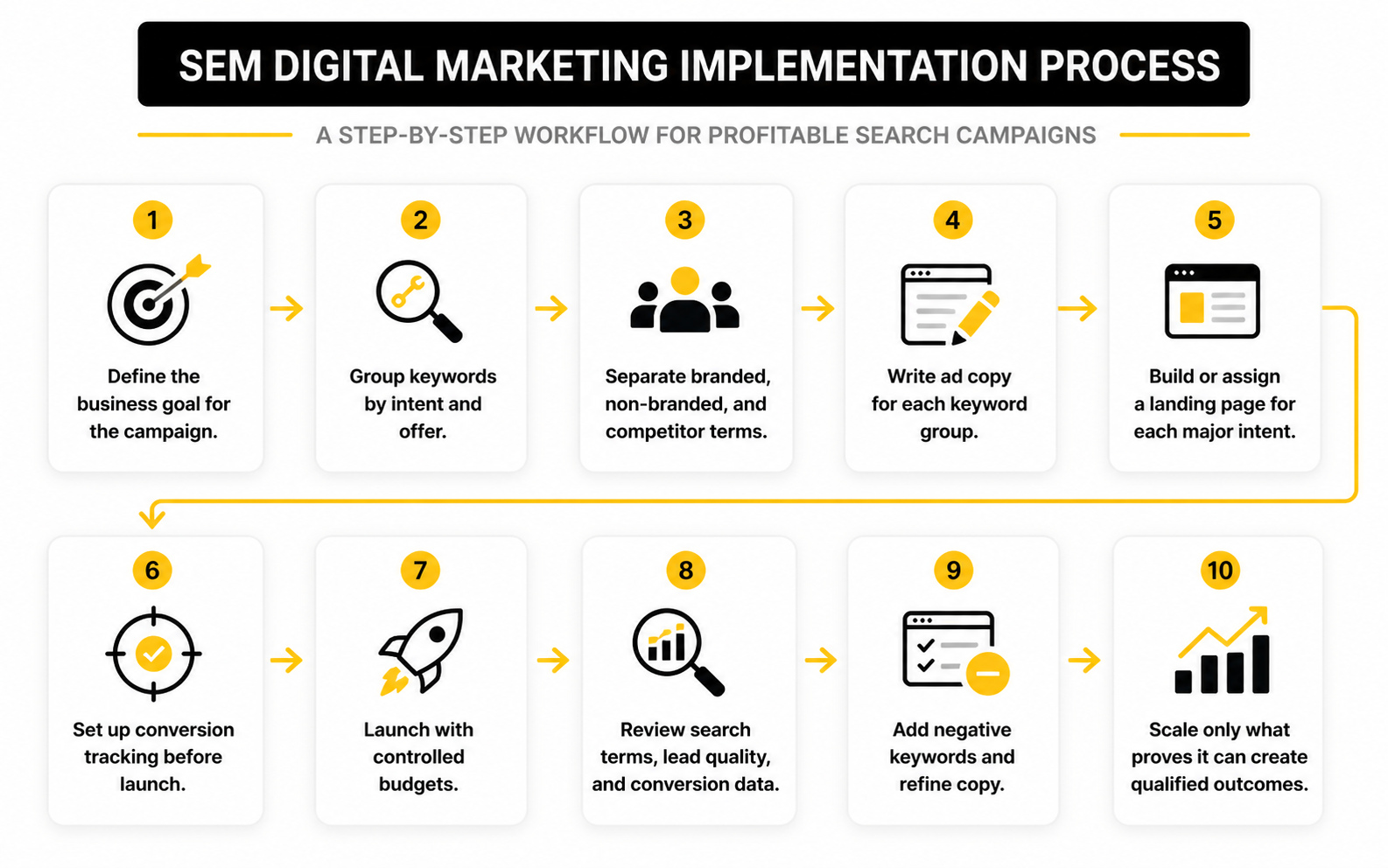
The cleanest SEM implementation process is not complicated, but it does need discipline. You move from intent to structure, then from structure to message, then from message to page, then from page to tracking. Skipping steps usually creates expensive ambiguity later.
A practical process looks like this:
This process protects you from the most common paid search trap: optimizing for clicks before proving the offer converts. Click volume feels good, but it is not the goal. The goal is profitable action.
Make The Conversion Path Easy To Complete
Every extra step in the conversion path creates friction. Long forms, unclear buttons, slow-loading pages, weak mobile layouts, and vague next steps all reduce the value of the click you already paid for. With 2025 Google Ads cost-per-lead benchmarks around $70.11 across industries, small conversion leaks can become very expensive.
For lead generation, ask only for the information needed to start the next step. Name, email, phone, and one qualifying field are often enough for the first conversion. More complex qualification can happen after the lead enters your CRM or booking flow.
For booked-call funnels, the calendar experience matters. A tool like Cal.com can make sense when the campaign goal is to turn high-intent search traffic into scheduled conversations. The fewer gaps between click, page, form, and booking, the better your SEM system usually performs.
Tracking, Optimization, And Scaling
Measurement is the part of SEM digital marketing that separates serious operators from hopeful spenders. Anyone can launch campaigns, buy clicks, and watch impressions move. The hard part is knowing which clicks became qualified leads, which leads became customers, and which campaigns deserve more budget.
The numbers should not be treated like a scoreboard you glance at once a week. They are instructions. If click-through rate is weak, the market may not be responding to your message. If conversion rate is weak, the landing page or offer may be the problem. If lead volume looks good but sales quality is poor, the campaign is probably optimizing for the wrong action.
SEM Digital Marketing Statistics And Data
Search advertising remains one of the biggest digital channels because it captures measurable intent. In 2025, U.S. digital ad revenue reached $294.6 billion, with search continuing to represent one of the largest performance-driven categories. That matters because SEM is not a fringe tactic; it is a mature, competitive market where weak execution gets punished quickly.
Benchmarks are useful, but only when you interpret them correctly. The average search advertising CPC was $5.26 across industries in 2025, while average Google Ads conversion rate was 7.52%. Those numbers do not mean your account is healthy or broken by default. They give you a starting point for asking better questions.
Cost per lead is even more dangerous when viewed alone. A campaign producing $30 leads can still be terrible if the leads never close, while a campaign producing $150 leads can be excellent if the customers are worth thousands. The average Google Ads cost per lead reached $70.11, but your real benchmark should be tied to margin, close rate, lifetime value, and sales cycle.
Track The Full Path, Not Just The Form Submit
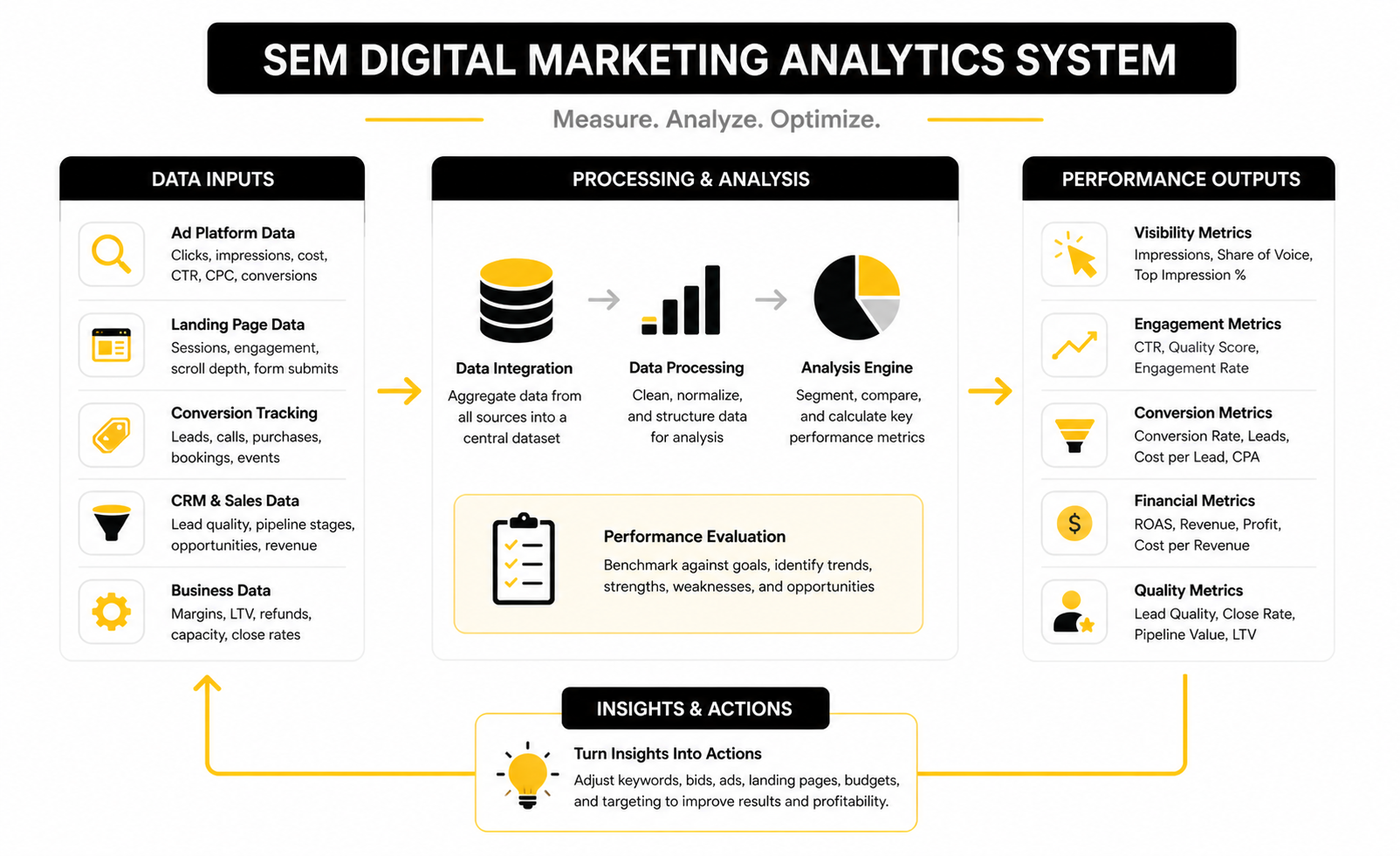
Basic conversion tracking tells you when someone submitted a form, booked a call, called the business, or completed a purchase. That is necessary, but it is not enough for serious optimization. A form submission is not automatically a qualified lead, and a booked call is not automatically revenue.
The next level is tracking the lead after the first conversion. You want to know which campaigns produced sales-qualified leads, attended calls, proposals, deals, retained customers, or repeat purchases. Without that layer, the ad platform may optimize toward people who convert easily but never buy.
Google’s enhanced conversions can improve measurement by using privacy-safe hashed first-party data to support more accurate attribution and bidding signals. That is useful, but the strategic point is bigger than one feature. Your data must reflect business value, not just front-end activity.
Read Performance Signals In Context
Click-through rate shows whether your ad earns attention for the search it appears on. A low CTR can point to weak copy, poor keyword alignment, uncompetitive positioning, or irrelevant search terms. But a high CTR is not automatically good if the clicks are cheap curiosity instead of buyer intent.
Conversion rate shows how well the landing page and offer turn visitors into action. If CTR is strong but conversion rate is poor, the promise may be breaking after the click. The ad creates expectation, and the page either confirms it or loses trust.
Cost per conversion tells you what the first action costs, but it should never be the final decision metric for lead generation. For ecommerce, revenue and profit can be tied more directly to purchase data. For service businesses, you need CRM feedback so the campaign can be judged by qualified opportunities and closed deals.
Optimize With A Decision Framework
Optimization should follow a simple rule: diagnose before changing. Random edits create random outcomes. If you change keywords, ads, budgets, and landing pages at the same time, you will not know what caused the result.
Use a clean decision framework:
This is why tools that connect ads, CRM, booking, and follow-up can be useful when the business depends on lead quality. GoHighLevel fits this role for many agencies and service businesses because the campaign data can be connected to pipeline stages, appointment activity, and follow-up outcomes. SEM works better when the ad account is not isolated from the sales process.
Scale Only After The Signal Is Clean
Scaling too early is one of the fastest ways to turn a promising SEM campaign into an expensive mess. You do not scale because a campaign has clicks. You scale because the campaign has repeatable evidence that the traffic can turn into qualified outcomes at an acceptable cost.
Clean signal means the conversion tracking is reliable, the search terms are relevant, the lead quality is acceptable, and the landing page has enough data to justify more spend. It also means you understand which campaign or keyword theme is driving the result. If you cannot explain why performance is good, you are probably not ready to scale it.
When the signal is clean, scaling becomes controlled. Increase budgets gradually, expand keyword coverage carefully, test broader match types with conversion guardrails, and add new landing page variants only when there is a clear hypothesis. More spend should amplify what already works, not cover up what is still unclear.
Advanced SEM Strategy, Tradeoffs, And Risks
At a basic level, SEM digital marketing is about showing ads to people who are searching for something relevant. At an advanced level, it is about making tradeoffs. You are constantly balancing control against automation, volume against quality, short-term leads against long-term profit, and platform data against what your sales team actually sees.
This is where many campaigns get uncomfortable. The easy wins have already been captured, the obvious negative keywords have already been added, and the best-performing landing page is no longer improving every week. Growth now depends on better strategy, not just more button-clicking inside the ad account.
Automation Needs Better Inputs, Not Blind Trust
Modern ad platforms are built around automation. Smart bidding, broad match, Performance Max, and AI-assisted campaign tools can help advertisers find more opportunities, but they also depend heavily on the quality of the data being fed into the system. If your account tells the algorithm that every form submission is equally valuable, it will optimize toward more form submissions, even when some of those leads are weak.
That is the real tradeoff. More automation can create more reach, but less manual control means your conversion data has to be cleaner. If the campaign cannot distinguish between a junk lead and a sales-qualified opportunity, automation may scale the wrong behavior.
Use automation when the account has enough conversion volume, clear tracking, strong negative keyword discipline, and a defined value signal. Do not use it as a shortcut for poor strategy. Automation can amplify a good system, but it can also amplify a messy one.
Profit Matters More Than Platform Metrics
The ad platform cares about conversions, conversion value, and spend efficiency inside its own measurement window. Your business cares about profit, cash flow, capacity, refund rates, sales cycle length, and lifetime value. Those two views overlap, but they are not the same thing.
A campaign with a higher cost per lead can still be the winner if it attracts better customers. A campaign with a lower CPA can still be dangerous if it fills the pipeline with people who never buy, churn quickly, or require too much support. This is why SEM reporting should include business metrics, not just ad metrics.
The strongest accounts usually connect paid search data to CRM and revenue outcomes. For agencies and service businesses, GoHighLevel can be useful when you need ads, forms, booking, pipeline stages, and follow-up workflows tied together. The point is not to collect more data for fun; the point is to stop making budget decisions with half the picture missing.
Budget Scaling Changes The Game
A campaign that works at $50 per day may behave differently at $500 per day. Once you raise budgets, the platform often has to reach into less efficient auctions, broader queries, weaker time slots, or colder segments. That does not mean scaling is bad, but it does mean scaling changes the environment.
The mistake is assuming performance will grow in a straight line. It rarely does. More spend can expose bottlenecks in the landing page, sales team, offer, call booking process, or follow-up speed.
A more carefully scaling path is gradual. Increase budget in controlled steps, watch search terms closely, monitor lead quality, and compare marginal cost against marginal revenue. You are not just asking, “Did we get more leads?” You are asking, “Did the next layer of spend produce leads worth buying?”
The Landing Page Becomes A Growth Lever
At a certain point, keyword tweaks and bid changes produce smaller gains. The landing page becomes the bigger lever because it affects every paid click after the ad. A stronger page can make the same traffic more profitable without increasing CPC.
This is where message testing becomes serious. You can test headline angles, proof placement, form length, pricing context, call-to-action wording, page speed, mobile layout, and objection handling. The goal is not to redesign the page every week. The goal is to isolate the friction that is stopping qualified visitors from acting.
For ecommerce and Shopify-style landing pages, Replo can make sense when teams need faster page testing without waiting on developers for every change. For funnel-heavy offers, ClickFunnels or Systeme.io can support quick offer-page iteration. What matters is speed with discipline, not random experimentation.
Brand Demand And SEM Work Together
SEM is often treated as a bottom-of-funnel channel, but brand demand affects its performance. People are more likely to click, trust, and convert when they have seen the brand before. That means organic content, social proof, reviews, email, referrals, YouTube, and social media can all influence paid search outcomes.
This does not mean every business needs a giant brand campaign before running SEM. It means you should not judge search ads in isolation. A cold non-branded click has to do more work than a branded click from someone who already knows the business.
For teams building demand outside search, tools like Buffer can help keep social publishing consistent, while Brevo or Moosend can support email follow-up after the first interaction. SEM captures demand, but the rest of the marketing system can make that demand easier to convert.
Know When Not To Scale SEM
Not every campaign deserves more budget. If the offer is unclear, margins are thin, sales follow-up is slow, or the market is too small, scaling paid search can make the problem louder. More traffic will not fix a weak conversion path.
There are also situations where SEO, partnerships, outbound, organic social, or retention work may produce better leverage than forcing SEM harder. Paid search is powerful, but it is not magic. It works best when there is existing demand, a clear offer, a strong page, reliable tracking, and a team ready to handle the leads.
The expert move is knowing when to push and when to pause. If the data is clean and the unit economics work, scale with confidence. If the data is noisy or the economics are weak, fix the system before spending more.
SEM Digital Marketing FAQ
What is SEM digital marketing?
SEM digital marketing is the practice of using paid search ads to reach people when they search for specific products, services, solutions, or comparisons. It usually includes keyword research, campaign structure, ad copy, landing pages, tracking, bidding, and ongoing optimization. The goal is not just to get clicks, but to turn search intent into qualified leads, sales, bookings, or other measurable business outcomes.
Is SEM the same as SEO?
SEM and SEO both involve search, but they are not the same. SEM usually refers to paid search advertising, while SEO focuses on earning organic rankings without paying for each click. The strongest search strategies often use both because SEM can create faster visibility while SEO builds long-term organic traffic.
How much does SEM cost?
SEM costs depend on your industry, location, competition, offer, and conversion path. Recent Google Ads benchmark data shows average CPC around $5.26, but your real number can be much lower or much higher. The better question is whether your cost per qualified lead or customer makes sense based on your margins and lifetime value.
What makes a good SEM campaign?
A good SEM campaign has clear intent targeting, relevant ad copy, a focused landing page, accurate tracking, and a follow-up system that turns interest into revenue. The campaign should be structured around business goals instead of random keyword groups. It should also be reviewed regularly so wasted search terms, weak ads, and poor-quality leads are removed before they drain the budget.
How long does SEM take to work?
SEM can start generating traffic as soon as campaigns are approved and launched. Real performance clarity usually takes longer because you need enough clicks, conversions, and lead-quality feedback to make smart decisions. Early results show direction, but scaling should wait until the data proves the campaign can produce qualified outcomes consistently.
What is the most important SEM metric?
There is no single metric that tells the full story. Click-through rate shows ad relevance, conversion rate shows landing page effectiveness, cost per lead shows acquisition efficiency, and revenue tells you whether the system works commercially. For lead generation, qualified pipeline and closed revenue matter more than cheap form submissions.
Why do SEM campaigns fail?
SEM campaigns usually fail because the system is misaligned. The keywords attract the wrong intent, the ads make a weak promise, the landing page does not continue the message, or the tracking cannot separate good leads from bad ones. Sometimes the campaign is fine, but the offer, pricing, sales process, or follow-up speed is the real problem.
Should small businesses use SEM?
Small businesses can use SEM very effectively when they focus on high-intent searches and tight geographic or service targeting. The danger is trying to compete too broadly against larger brands with bigger budgets. A focused campaign around profitable services, strong local intent, and fast follow-up is usually a more carefully starting point.
Do I need a landing page for SEM?
You do not always need a separate landing page, but you usually need a page built for the specific search intent. Sending paid search traffic to a generic homepage often creates friction because visitors have to search for the next step. A dedicated page works better when it matches the ad promise, answers key objections, and makes one action obvious.
How does Quality Score affect SEM performance?
Quality Score is based on expected click-through rate, ad relevance, and landing page experience. Those factors matter because they reflect whether your ad and page are useful for the searcher. Better alignment can improve efficiency, while poor alignment can make you pay more for weaker results.
When should I scale an SEM campaign?
Scale when tracking is reliable, lead quality is proven, search terms are relevant, and the campaign can produce qualified outcomes at an acceptable cost. Do not scale just because clicks or front-end conversions look good. More budget should amplify a working system, not hide a broken one.
What tools help with SEM digital marketing?
The right tools depend on the business model. For funnels and landing pages, ClickFunnels, Systeme.io, and Replo can help teams move faster. For CRM, booking, pipeline, automation, and follow-up, GoHighLevel can support the operational side that turns paid search leads into actual revenue.
Build a stronger local presence with BAAM AI
Turn your website, Google profile, social channels, and AI visibility into one growth engine
Most businesses do not need more random marketing activity. They need a consistent presence system that helps the right people find them, trust them, and take action. BAAM AI brings strategy, local SEO, website updates, Google Maps visibility, social content, AI-search readiness, media production, and reporting into one practical monthly engine.
If you want your marketing to keep working after the campaign ends, start with a free BAAM AI presence audit. See how your business shows up today and where the fastest visibility wins are at BAAM AI.