
BAAM AI Blog
Sales Copy Writing: The Practical Guide To Turning Attention Into Action
Sales copy writing is not about sounding clever. It is about helping a specific reader understand why an offer matters, why now is the right time to care, and why the next step is worth taking. When it works, the...
Sales copy writing is not about sounding clever. It is about helping a specific reader understand why an offer matters, why now is the right time to care, and why the next step is worth taking. When it works, the copy feels simple on the surface because the hard thinking has already happened underneath.
The problem is that most sales copy fails before the first draft is finished. It starts with features instead of buyer tension, uses vague benefits instead of concrete outcomes, and asks for action before the reader feels enough clarity or confidence. That is why strong sales copy writing is less about “wordsmithing” and more about diagnosis, positioning, proof, structure, and conversion intent.
This guide will break the topic into six practical parts so the process feels usable, not theoretical. We will look at why sales copy still matters, how to structure persuasive messaging, how to write the core sections of a sales page or funnel, and how to implement the copy professionally across real marketing assets.
The full article is structured as a complete sales copy writing system, not a loose collection of tips. Each part builds on the previous one, moving from strategic foundations to practical execution. By the end, you should have a clear model for writing copy that supports landing pages, emails, ads, funnels, product pages, and sales conversations.
Why Sales Copy Writing Still Matters
Sales copy writing matters because buyers are surrounded by options, claims, and distractions. A product can be useful, fairly priced, and well-designed, but if the message does not make the value obvious, people hesitate. Good copy reduces that hesitation by turning a messy offer into a clear decision.
The need for clarity has become even more important as marketing channels get noisier. The 2025 Nielsen Annual Marketing Report shows how much pressure marketers now place on performance, measurement, and effective messaging across channels. That matters because copy is often the layer that connects the campaign strategy to the buyer’s actual decision.
Sales copy also matters because conversion is rarely about one sentence or one button. The page headline, product explanation, proof, objections, offer framing, guarantee, call to action, and follow-up sequence all work together. When those pieces are aligned, the reader does not feel pushed; they feel guided.
The Sales Copy Writing Framework
A useful sales copy writing framework starts with the reader, not the offer. Before writing the headline, you need to know what the buyer wants, what they doubt, what they have already tried, and what would make them believe this option is different. Without that research, even polished copy becomes guesswork.
The framework this guide will use has four layers: buyer insight, offer clarity, persuasion structure, and conversion execution. Buyer insight defines the real problem and motivation. Offer clarity explains the value in plain language, persuasion structure organizes the message, and conversion execution turns the copy into pages, emails, ads, and follow-up assets that can be tested.
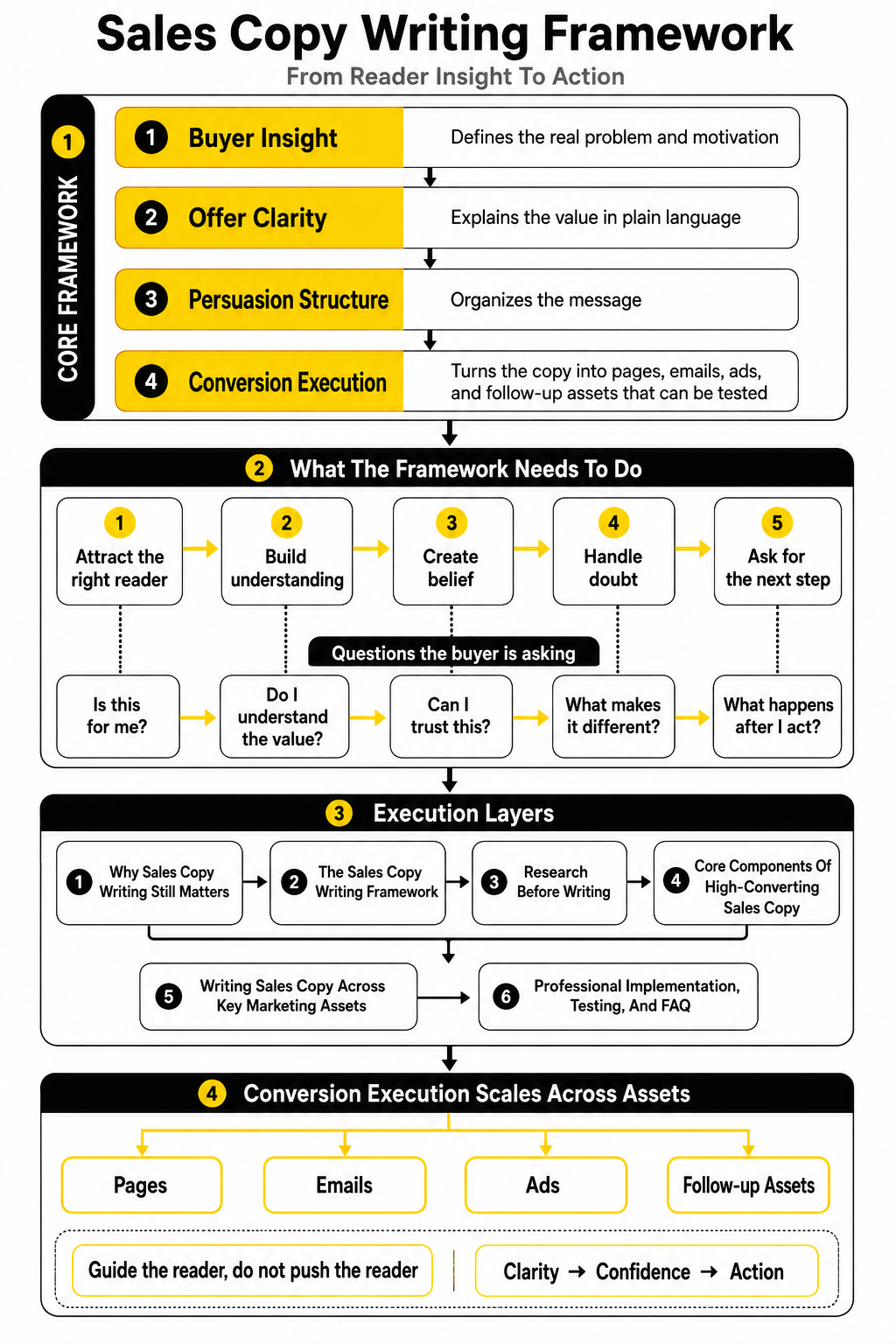
This structure keeps the work grounded. It prevents the common mistake of jumping straight into “catchy” headlines before the message is clear. It also makes sales copy writing easier to review because each section has a job: attract the right reader, build understanding, create belief, handle doubt, and ask for the next step.
What The Framework Needs To Do
The framework needs to move the reader from attention to confidence. Attention alone is cheap; confidence is what gets someone to click, book, buy, reply, or sign up. That is why the best copy does not just describe an offer, it answers the invisible questions forming in the buyer’s mind.
Those questions usually sound like this: Is this for me? Do I understand the value? Can I trust this? What makes it different? What happens after I act? Strong copy answers those questions in a natural order instead of dumping information onto the page.
This is where professional tools can help, but only after the strategy is clear. For example, a funnel builder like ClickFunnels, an all-in-one CRM and automation platform like GoHighLevel, or a landing page tool like Replo can support implementation. But the software cannot rescue weak positioning, unclear proof, or copy that does not understand the buyer.
The Role Of Research In Sales Copy
Research is the part many people skip because it does not feel like writing. In reality, it is where the strongest copy usually comes from. Buyer interviews, reviews, support tickets, sales call notes, competitor pages, search behavior, and objections all reveal language that is more useful than anything invented from a blank page.
This is especially important because copy must sound like the buyer’s world, not the company’s internal vocabulary. A founder may describe a product as “an integrated optimization platform,” while a customer may say, “I just want to stop losing leads after they fill out the form.” The second version is usually closer to the copy that sells.
Research also protects the copy from exaggeration. If a claim cannot be supported, it should not be used. That keeps the message sharper, more credible, and easier to prove later with testimonials, case studies, screenshots, demos, or measurable outcomes.
Where The Article Goes Next
The next part will go deeper into the first major section: Why Sales Copy Writing Still Matters. It will explain how copy affects perceived value, trust, conversion behavior, and the quality of leads or customers a business attracts. This matters because better copy is not just about increasing clicks; it is about making the right people more confident before they act.
After that, the article will move into the framework in detail. We will break down how to research the buyer, clarify the offer, structure the message, write each core component, and adapt the copy across landing pages, emails, ads, and sales funnels. The goal is simple: make sales copy writing practical enough that you can use it, review it, and improve it without relying on random inspiration.
Why Sales Copy Writing Still Matters
Sales copy writing still matters because people do not buy the best-described product. They buy the offer they understand, trust, and feel ready to act on. That difference sounds small, but it is the difference between a page that gets traffic and a page that produces revenue.
Most businesses do not have a traffic problem first. They have a clarity problem. More visitors, more ads, and more email sends will not fix a message that makes the reader work too hard to understand why the offer matters.
This is why copy sits so close to business performance. It shapes how buyers interpret the product, how much risk they feel, and whether the next step seems obvious. When the copy is vague, everything downstream becomes harder: ads cost more, sales calls drag, emails get ignored, and landing pages underperform.
Copy Turns Attention Into Understanding
Attention is only the first step. A headline can stop the scroll, but the copy still has to explain the problem, frame the value, and make the reader care enough to continue. Without that, attention disappears almost immediately.
Modern buyers are trained to filter aggressively. They scan, compare, doubt, and leave when the message feels generic. Sales copy writing helps by making the value specific enough that the right person can quickly say, “This is relevant to me.”
That relevance matters because marketing is moving toward clearer, more measurable communication. The 2025 Nielsen Annual Marketing Report was built from responses from 1,400 global marketing professionals and focuses heavily on clarity, measurement, and performance across media channels. In practical terms, that means the words on the page cannot be treated like decoration. They are part of the conversion system.
Copy Builds Trust Before The Sale
Trust is not created by saying “trusted by thousands” and moving on. It is built through clear claims, believable proof, honest limitations, and a message that matches what the buyer already suspects, wants, or fears. The reader should feel like the business understands the situation before it asks for anything.
That is where weak copy gets exposed. If the promise sounds inflated, the proof feels thin, or the offer is hard to compare, the buyer protects themselves by doing nothing. No click, no reply, no booked call, no checkout.
Brand trust has become even more connected to buying behavior as people use search, reviews, social content, and AI tools to compare options. The 2025 Edelman Trust Barometer special report on brands found that among people using generative AI platforms, many use them for shopping activities such as researching brands, comparing products, and summarizing reviews. That makes sales copy writing more important, not less, because the message has to survive comparison outside your own website.
Copy Increases Perceived Value
A product’s value is not only what it does. It is what the buyer understands it can do for them. Sales copy writing increases perceived value by connecting features to outcomes, outcomes to pain points, and pain points to the reader’s current reality.
This does not mean exaggerating. It means making the real value easier to see. A CRM is not just a database. It can be the difference between leads being followed up within minutes or disappearing into a spreadsheet nobody checks.
The same applies to funnels, email automation, landing pages, and service offers. A tool like GoHighLevel may support CRM, automation, pipelines, booking, and follow-up in one place, but the sales copy still has to explain why that matters to a specific agency, consultant, or local business. The feature list is not the value. The business result is.
Copy Reduces Friction
Friction is anything that makes the buyer pause for the wrong reason. Confusing pricing, unclear next steps, missing proof, vague guarantees, weak calls to action, and unanswered objections all create friction. The buyer may still want the outcome, but uncertainty slows them down.
This matters a lot near the point of action. Baymard’s checkout research has repeatedly shown that checkout friction is a serious revenue leak, with its 2025 checkout UX guidance noting that many users abandon purchases after adding products to cart and that large ecommerce sites can often recover meaningful conversion gains by improving the checkout experience through clearer, easier flows. The copy around forms, guarantees, shipping, payment, and calls to action is part of that flow.
Sales copy writing reduces friction by making the next step feel safe and logical. It explains what happens after someone clicks, what they get, what they do not get, and why the action is worth taking now. The goal is not pressure. The goal is confidence.
Copy Improves Lead Quality
Bad copy can still generate leads. That is the problem. If the message is too broad, too hype-driven, or too unclear, it attracts people who are curious but not qualified.
Good copy filters. It tells the right people, “This is for you,” and it quietly tells the wrong people, “This may not be the best fit.” That saves time, lowers sales friction, and makes the entire funnel healthier.
This is especially important for service businesses, agencies, coaches, consultants, and B2B companies. A landing page built in ClickFunnels or Systeme.io can collect leads, but the copy determines whether those leads understand the offer before they enter the pipeline. More leads are not automatically better. Better-fit leads are better.
Copy Makes Marketing Assets Work Together
Sales copy writing is not limited to long sales pages. It affects ads, emails, landing pages, product descriptions, webinar pages, onboarding sequences, follow-up messages, and retargeting campaigns. Each asset should feel like part of the same conversation.
When the copy is aligned, the buyer experiences momentum. The ad introduces a relevant problem, the landing page expands the promise, the email sequence builds trust, and the sales page makes the offer clear. When the copy is misaligned, every click feels like starting over.
This is why teams that care about conversion should document their messaging. The core promise, audience, proof points, objections, differentiators, and calls to action should not be reinvented for every campaign. Tools can help distribute the message, but the strategy has to be consistent first.
Copy Helps You Compete Without Racing To The Bottom
If buyers cannot understand the difference between two offers, price becomes the easiest comparison. That is dangerous. Competing only on price usually means thinner margins, weaker positioning, and less room to deliver a great customer experience.
Strong sales copy writing makes the difference visible. It explains the mechanism, the process, the support, the speed, the risk reduction, the specialization, or the outcome in a way the buyer can value. That gives the business a better chance to compete on relevance and trust instead of discounts.
This is not about pretending the offer is unique when it is not. It is about finding the real reason a specific buyer should choose it. Sometimes that reason is speed. Sometimes it is simplicity. Sometimes it is proof, specialization, support, or the ability to replace multiple tools with one workflow.
Copy Still Needs Strategy Behind It
The most important thing to understand is that copy is not magic. It cannot fix a weak offer, unclear audience, poor delivery, or broken funnel economics. It can only communicate the strategy that exists.
That is why the next section of the article moves from importance to structure. Once you understand why sales copy writing matters, the next job is building a repeatable framework. You need a way to go from research to message to page structure without relying on random inspiration.
That framework starts with the buyer. Not the product. Not the tool. Not the clever headline. The buyer.
The Sales Copy Writing Framework
A reliable sales copy writing framework gives you a way to move from messy information to a message that can actually convert. Without a framework, the writing process becomes a guessing game. You start with a headline, rewrite it ten times, add a few benefits, and hope the page somehow works.
That is not professional implementation. Professional implementation starts before the draft. It turns research, positioning, proof, objections, offer details, and calls to action into a clear sequence that the reader can follow.
The framework used here has four practical layers: buyer insight, offer clarity, persuasion structure, and conversion execution. Each layer has a different job. When they are handled in order, the copy becomes easier to write, easier to review, and much easier to improve.
Buyer Insight Comes First
Buyer insight is the foundation of sales copy writing because the buyer decides what matters. Not the founder. Not the marketer. Not the designer. The buyer.
This step is about understanding the reader’s current situation in plain language. What are they trying to fix? What have they already tried? What is frustrating them? What would make them feel confident that this offer is the right next step?
Good buyer insight usually comes from real customer language. Reviews, sales call notes, support tickets, onboarding surveys, community posts, customer interviews, and competitor comments can all reveal how people describe the problem before they see your solution. This matters because copy that mirrors the buyer’s actual thinking feels sharper than copy written from inside the company bubble.
Offer Clarity Turns Features Into Reasons To Act
Once you understand the buyer, the next job is to make the offer clear. This is where many pages fall apart. They list what the product includes, but they do not explain why those things matter or what outcome they help create.
Offer clarity means answering three questions before writing the full page. What does the buyer get? Why is that valuable? Why should they believe this offer can deliver it? If you cannot answer those three questions cleanly, the copy will probably feel vague.
This is especially important when the offer has multiple features. A platform may include CRM, automations, forms, landing pages, calendars, payments, and reporting, but the reader does not wake up wanting a feature pile. They want fewer missed leads, faster follow-up, cleaner operations, better visibility, or a simpler way to run the business.
Persuasion Structure Gives The Message Order
Persuasion structure is the sequence that turns a pile of points into a convincing argument. The order matters. If you introduce pricing before value, the offer feels expensive. If you ask for action before proof, the reader hesitates. If you lead with features before context, the message feels cold.
A strong structure usually starts with relevance. The reader needs to quickly understand that the page is speaking to them. Then the copy expands the problem, presents the desired outcome, explains the offer, proves the promise, handles objections, and makes the next step simple.
This is not manipulation. It is organization. You are taking the natural questions a buyer already has and answering them in the order they are likely to appear.
Conversion Execution Makes The Copy Usable
Conversion execution is where the strategy becomes real. This is the point where the framework turns into headlines, page sections, emails, ads, form copy, buttons, follow-up messages, and sales enablement assets. The goal is to make the message work across the full buyer journey, not just in one isolated draft.
A practical execution process keeps the work focused. It prevents you from polishing sentences before the core message is clear. It also gives teams a cleaner way to review copy because everyone can see which part of the journey each section is supposed to support.
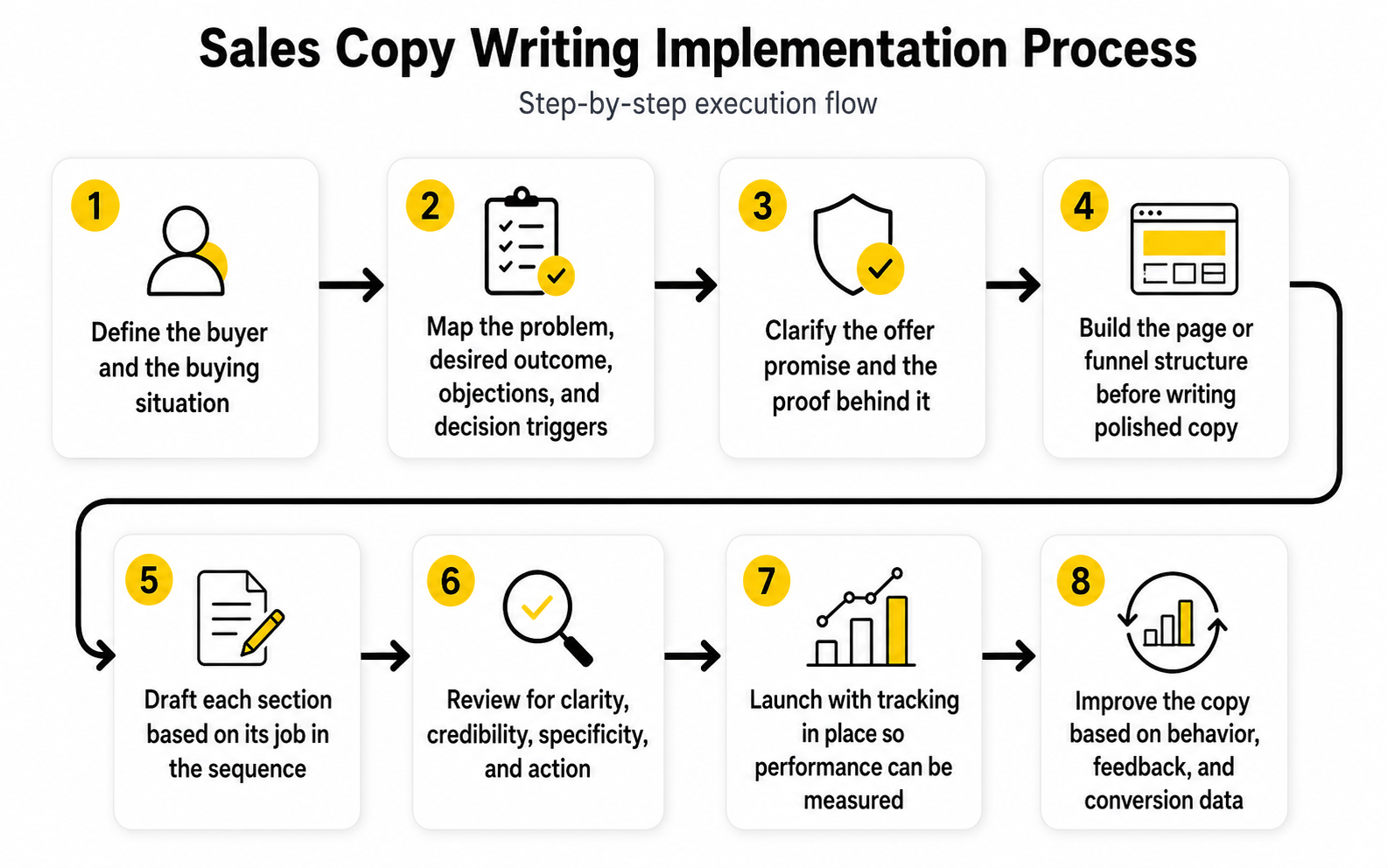
Here is the execution process in a simple order:
Step 1: Define The Buyer And The Buying Situation
Defining the buyer is not the same as writing a generic persona. A persona might say the reader is a small business owner, a marketing manager, or an ecommerce founder. That is a start, but it is not enough for strong sales copy writing.
You need the buying situation. What is happening now that makes the reader care? A person who is casually exploring automation software needs different copy from someone who is losing leads every week because follow-up is slow. The second reader has urgency, pain, and a clearer reason to act.
This is where specificity makes the copy stronger. Instead of writing for “business owners,” write for local service businesses that get leads from ads but do not respond fast enough. Instead of writing for “creators,” write for newsletter operators who need a simple way to turn subscribers into buyers. The sharper the buying situation, the sharper the copy.
Step 2: Map The Problem And Desired Outcome
Once the buyer is clear, map the problem in more detail. Do not stop at the surface issue. A business may say it wants more conversions, but the deeper problem might be that the offer is unclear, the funnel has too many steps, or the follow-up sequence does not answer objections.
The desired outcome also needs to be concrete. “Grow faster” is not enough. “Turn more demo requests into qualified sales conversations” is stronger because it gives the copy a more precise direction. The more concrete the outcome, the easier it becomes to write useful benefits.
This is also where you separate emotional outcomes from practical outcomes. Practical outcomes might include saving time, generating leads, reducing abandoned forms, or improving follow-up. Emotional outcomes might include feeling in control, looking professional, or finally trusting the marketing system. Strong copy often needs both.
Step 3: Identify The Real Objections
Objections are not annoyances to hide from. They are buying questions that need honest answers. If the reader is thinking about price, difficulty, time, trust, risk, switching costs, or whether the offer will work for their situation, the copy should address it.
The mistake is treating objections as negative. They are not negative. They are signs that the reader is engaged enough to evaluate the offer seriously. If the copy ignores them, the reader has to resolve the uncertainty alone, and that usually means leaving.
This is why professional sales copy includes proof, comparison, guarantees, process explanations, and expectation setting. It gives the reader enough information to keep moving without feeling like they are being rushed. Clear objection handling is one of the fastest ways to make copy feel more mature.
Step 4: Clarify The Offer Promise
The offer promise is the central reason to keep reading. It should be specific enough to matter and believable enough to trust. If the promise is too soft, the reader will not care. If it is too big without proof, the reader will not believe it.
A strong promise connects the buyer’s problem to a desirable result. It does not need to be loud. In fact, many strong promises are calm and specific because they feel easier to believe.
For example, a funnel platform should not only say it helps you “build pages.” The stronger promise is that it helps you move a visitor from interest to action through a structured flow. That is why a tool like ClickFunnels fits naturally when the copy strategy is built around offers, pages, checkout, upsells, and follow-up instead of isolated website sections.
Step 5: Build The Structure Before Writing The Draft
Do not start by writing the final copy. Start by building the structure. Decide which sections the page, email, or funnel needs and what each section must accomplish.
For a sales page, the structure might include a headline, problem section, outcome section, mechanism, offer breakdown, proof, objections, guarantee, pricing, and call to action. For an email sequence, the structure might move from problem awareness to belief building, then proof, then offer, then urgency. For an ad, the structure may be much tighter, but the same thinking still applies.
This approach prevents one of the most common writing mistakes: beautiful copy in the wrong order. A clever line cannot save a confused sequence. Get the order right first, then polish.
Step 6: Draft For Clarity Before Style
The first draft should be clear before it is clever. Write the plain version first. Say what the offer is, who it is for, what problem it solves, why it works, what proof supports it, and what the reader should do next.
After that, improve the rhythm. Tighten long sentences. Replace vague claims with specific ones. Remove anything that sounds impressive but does not help the reader make a decision.
This matters even more now that AI writing tools have made generic content easier to produce. The 2025 State of Marketing AI Report surveyed 1,882 respondents between February and April 2025, which shows how widely AI has entered marketing workflows. That does not reduce the need for skilled sales copy writing. It raises the bar for human judgment, specificity, and message strategy.
Step 7: Match The Copy To The Asset
The same core message should adapt to the asset. A landing page needs depth. An ad needs speed. An email needs momentum. A checkout page needs reassurance. A sales call follow-up needs clarity and next steps.
This is where execution tools can support the copy. A landing page builder like Replo can help ecommerce teams turn product and offer messaging into focused pages. A CRM and automation platform like GoHighLevel can help service businesses connect copy to forms, booking flows, pipelines, and follow-up sequences.
But again, the tool is not the strategy. The page still needs a clear promise. The form still needs the right microcopy. The follow-up still needs to answer the buyer’s next question. Execution works best when the copy has already done the thinking.
Step 8: Measure What The Copy Is Supposed To Improve
Copy should be judged against the job it was hired to do. A headline may need to improve scroll depth. A product section may need to reduce confusion. A proof section may need to increase form submissions. A checkout section may need to reduce abandonment.
This is why tracking matters. Without data, copy reviews become opinion contests. With data, you can compare performance before and after changes and look for patterns in behavior.
The right metrics depend on the asset. For a landing page, look at conversion rate, scroll depth, button clicks, form starts, form completions, and source quality. For emails, look at replies, clicks, conversions, unsubscribes, and the quality of leads generated. For checkout copy, pay attention to abandonment points because checkout usability research from Baymard Institute shows that design and flow issues can be a direct cause of people leaving before purchase.
Step 9: Improve The Copy In Layers
Do not rewrite everything at once unless the message is completely broken. Improve the copy in layers so you know what changed. Start with the biggest strategic issues first: audience, promise, proof, offer clarity, and section order.
Then move into section-level improvements. Tighten the headline, strengthen the opening, clarify the offer breakdown, improve proof placement, and make the call to action more specific. After that, polish sentence-level flow.
This order matters because small edits cannot fix a weak argument. A better button label will not save a confusing offer. A sharper headline will not help if the rest of the page fails to build belief. Work from strategy to structure to sentences.
How The Process Connects To The Next Section
At this point, the framework is in place. You know why the buyer comes first, how the offer promise should be clarified, why structure matters, and how execution turns the message into usable marketing assets. That gives you the operating system for sales copy writing.
The next section goes deeper into research before writing. This is where the best raw material comes from. If the research is weak, the copy will sound generic no matter how many formulas you use.
Good research gives you the buyer’s words, the market’s objections, the competitor gaps, and the proof needed to support the promise. That is the difference between writing copy that sounds polished and writing copy that actually helps someone make a decision.
Statistics And Data
Data should make sales copy writing more precise, not more complicated. The goal is not to collect every number available or obsess over industry averages. The goal is to understand what the copy is doing, where buyers are slowing down, and which part of the message needs to be improved next.
This matters because copy performance is easy to misread. A landing page with a low conversion rate might have a weak headline, but it might also have poor traffic quality, a confusing offer, a slow page, or a form that asks for too much too soon. The number tells you where to look. It does not automatically tell you what to change.
Benchmarks are useful only when they create context. The Unbounce conversion benchmark report analyzes more than 57 million conversions across more than 41,000 landing pages, which makes it useful for understanding how widely conversion rates can vary by industry and intent. But your own baseline still matters more than someone else’s average because your offer, audience, traffic source, price point, and funnel depth are different.
What Copy Metrics Actually Tell You
Every metric is a signal, not a verdict. A low click-through rate may mean the promise is weak, but it may also mean the audience is wrong. A strong open rate with weak conversions may mean the subject line worked, but the email body did not create enough belief or urgency.
This is why you need to connect metrics to specific parts of the buyer journey. Top-of-page engagement tells you whether the message earns attention. Scroll depth tells you whether the page keeps interest. Clicks tell you whether the offer creates enough motivation to act. Form completion tells you whether the next step feels clear and safe.
Sales copy writing becomes easier to improve when you stop asking, “Is the copy good?” and start asking, “Where is the buyer losing confidence?” That question is far more useful. It turns analytics into diagnosis instead of decoration.
The Core Measurement System
A simple measurement system should follow the same path as the reader. Start with traffic quality, then measure attention, engagement, action, and revenue quality. If you skip any of those layers, you can easily optimize the wrong thing.
Traffic quality matters because copy cannot convert the wrong audience consistently. Attention matters because the headline and opening section need to prove relevance fast. Engagement matters because the body copy must keep the reader moving through the argument. Action matters because the call to action, form, checkout, or booking flow must feel worth completing.
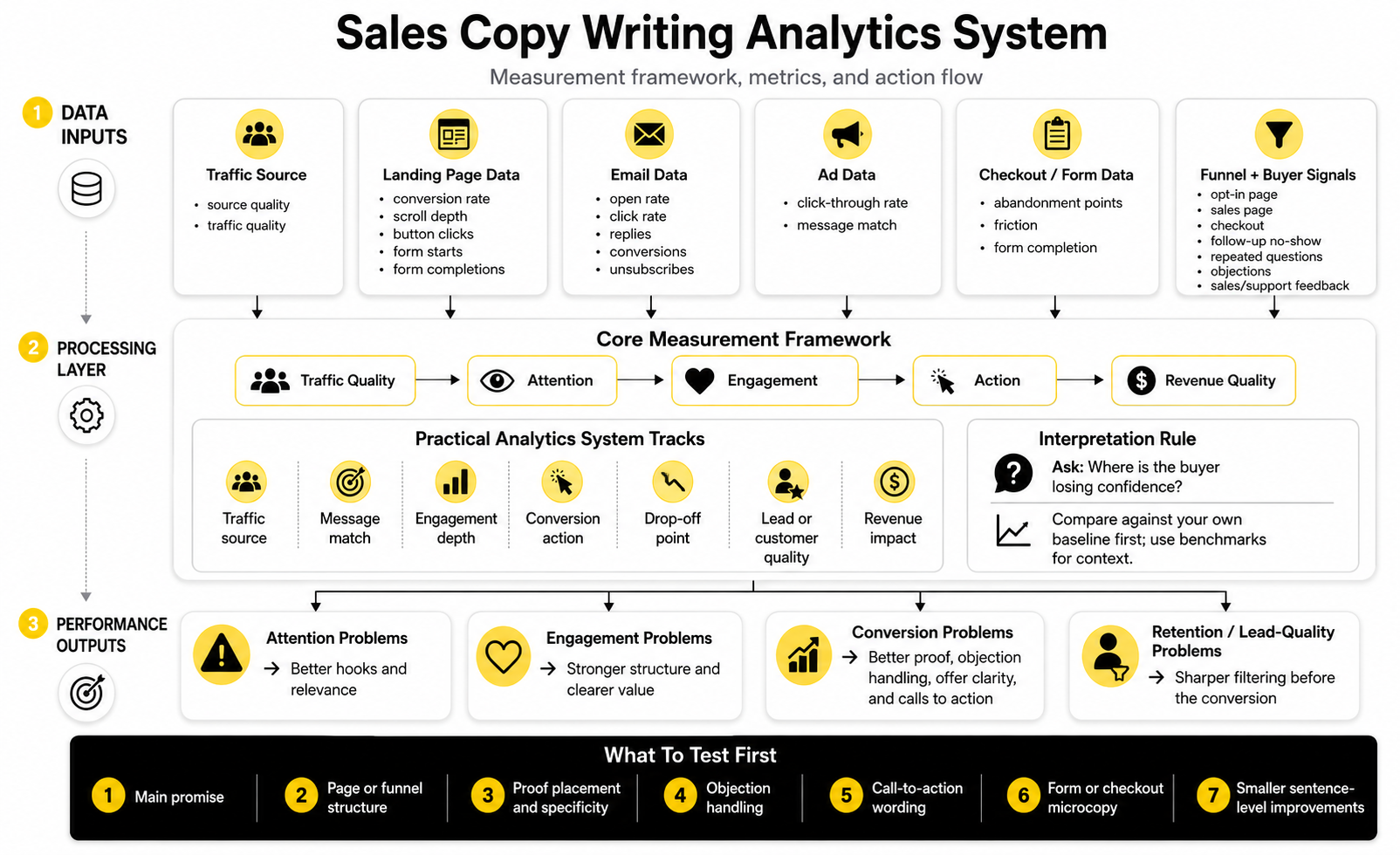
A practical analytics system for sales copy writing should track:
This is the part that matters. A copy change that increases clicks but attracts worse-fit leads is not automatically a win. A lower conversion rate can still be better if the leads are more qualified, easier to close, and more likely to stay.
Landing Page Benchmarks Need Context
Landing page benchmarks are helpful because they show what is possible across different markets. They are not helpful when people treat them like universal targets. A free checklist, a $29 product, a $3,000 service, and an enterprise demo request should not be judged by the same conversion expectation.
The Unbounce benchmark data is useful because it separates performance by industry instead of pretending all landing pages behave the same. That distinction matters because buyer intent, price sensitivity, sales cycle length, and trust requirements change from one market to another. A page asking for an email address has a different job than a page asking someone to schedule a sales call.
When reviewing landing page copy, compare performance against your own baseline first. If the page converts at 3 percent today and a stronger offer explanation moves it to 4 percent, that is a meaningful improvement. If the same page gets more clicks but fewer qualified leads, the message may be attracting curiosity instead of serious buying intent.
Checkout And Form Data Reveal Friction
Checkout and form analytics are some of the clearest places to find copy problems. When someone reaches a form or checkout, they already have intent. If they leave there, the problem is often uncertainty, perceived risk, surprise costs, too many fields, unclear next steps, or weak reassurance.
The Baymard Institute cart abandonment research compiles 50 different cart abandonment studies and reports an average documented cart abandonment rate of 70.19 percent. That number should not be used to scare people with random statistics. It should remind you that even high-intent buyers can disappear when the final steps feel unclear, risky, or annoying.
For sales copy writing, this means microcopy matters. Button text, form labels, payment reassurance, shipping notes, privacy explanations, guarantee language, and confirmation-page copy all affect confidence. These details are not glamorous, but they often sit closest to the money.
Email Metrics Show Message Strength Over Time
Email analytics show whether your sales copy can build momentum, not just capture attention once. Open rate gives you a rough signal about the sender, subject line, and timing. Click rate gives you a stronger signal about the body copy, offer relevance, and call to action. Replies and conversions tell you whether the message actually moved the reader toward a decision.
The Brevo 2025 email marketing benchmarks show that email performance varies heavily by industry and campaign type, which is exactly why one “good” benchmark is not enough. A newsletter, abandoned cart sequence, sales nurture campaign, and post-demo follow-up all have different jobs. The copy should be judged against the job it is supposed to do.
This is where many businesses misread their email data. A campaign can have a strong open rate and still fail because the message does not create desire or remove doubt. A lower-open sequence can still perform well if it reaches a more qualified segment and produces better replies, bookings, or purchases.
Ad Metrics Measure The Promise Before The Page
Ad metrics are useful because they test the promise before the reader reaches the landing page. If people are not clicking, the hook may not feel relevant enough. If they click but do not convert, the landing page may not match the ad, or the ad may be attracting the wrong intent.
This is why message match is so important. The ad should set up the same promise the page delivers. If an ad promises a simple way to generate leads, but the page opens with a broad company description, the buyer feels a disconnect. That disconnect lowers trust immediately.
For practical sales copy writing, review ad and landing page copy together. Do not optimize the ad in isolation. A higher click-through rate can become expensive if the page cannot convert the traffic or if the leads are not qualified.
Funnel Metrics Show Where Belief Breaks
A funnel is not one conversion point. It is a sequence of small decisions. The reader decides whether to click, whether to keep reading, whether to enter information, whether to show up, whether to buy, whether to accept an upsell, and whether to continue after the first interaction.
This is where a tool like ClickFunnels can be useful because funnel structure makes each step easier to see and improve. A broader platform like GoHighLevel can also help connect forms, bookings, pipelines, automations, and follow-up so the copy does not end at the first conversion. The point is not just to build pages. The point is to measure the full path from interest to revenue.
When reviewing funnel data, look for the step where belief breaks. Maybe the opt-in page works, but the sales page does not. Maybe the sales page works, but the checkout does not. Maybe people book calls, but poor follow-up copy causes them to no-show. Each drop-off points to a different copy problem.
Benchmarks Should Lead To Better Questions
Benchmarks are most useful when they help you ask better questions. If your landing page conversion rate is below your own historical average, ask what changed in the offer, traffic, page structure, or market. If your email click rate drops, ask whether the promise is still relevant to that segment. If your checkout abandonment rises, ask whether the final step introduced friction.
Do not use benchmarks to shame the copy. Use them to prioritize. A page with high traffic and low conversion deserves attention before a page with almost no traffic. An email sequence that drives replies but few purchases may need stronger offer framing. A checkout page with heavy drop-off may need clearer reassurance rather than a new headline.
The action should always match the signal. Attention problems need better hooks and relevance. Engagement problems need stronger structure and clearer value. Conversion problems need better proof, objection handling, offer clarity, and calls to action. Retention or lead-quality problems need sharper filtering before the conversion.
Performance Signals Worth Watching
Not every useful copy signal appears in a dashboard. Some of the best signals come from what buyers say and do after they convert. Sales teams, support teams, customer success teams, and founders often hear patterns that analytics alone cannot explain.
Watch for repeated questions. If prospects keep asking how pricing works, the pricing section is unclear. If they ask whether the offer works for their situation, the targeting or proof is too broad. If they ask what happens next, the call to action and onboarding copy need work.
These qualitative signals should feed directly back into the copy. Strong sales copy writing is not a one-time document. It is a living system that gets sharper as you learn what buyers misunderstand, doubt, ignore, and respond to.
What To Test First
Testing everything at once creates noise. Start with the copy elements most likely to affect the buyer’s decision. Usually, that means the headline, core promise, offer explanation, proof placement, call to action, and objection handling.
Small wording changes can matter, but they should not be the first priority if the strategic message is weak. Changing “Get Started” to “Start Today” will not fix a page that never explains why the offer is valuable. A stronger promise, clearer proof, or better offer structure will usually have more impact than cosmetic edits.
A sensible testing order looks like this:
This order keeps the work focused on buyer confidence. It also prevents teams from wasting time on tiny edits while the real conversion blocker remains untouched.
Data Should Make Copy More Human
The best use of analytics is not to make copy colder. It is to make it more relevant. Data shows where people hesitate, but the copy still has to speak to real human concerns.
If readers leave before the offer section, maybe the opening does not make the problem feel important enough. If they read the page but do not click, maybe the proof is not strong enough. If they click but do not complete the form, maybe the next step feels too heavy or unclear.
That is the balance. Use data to find the weak point, then use human judgment to improve the message. Sales copy writing is both analytical and emotional because buying is both analytical and emotional.
How Measurement Connects To The Next Section
Now the article has covered why copy matters, how the framework works, how implementation should happen, and how data should guide improvement. The next step is to look at the core components of high-converting sales copy. This is where the structure becomes more specific.
The sections that matter most are the headline, opening, problem framing, offer explanation, proof, objection handling, call to action, and follow-up. Each has a different job. Each should be measured differently.
That is why the data in this section matters. It gives you a way to judge each component by function, not opinion. The next section will break those components down so the copy can be built with purpose from the first line to the final action.
Core Components Of High-Converting Sales Copy
High-converting sales copy is not one magic paragraph. It is a chain of decisions that helps the reader move from curiosity to clarity, then from clarity to action. Each component has a job, and the copy gets weaker when one part tries to do everything.
The headline should create relevance. The opening should make the reader feel understood. The offer section should make the value obvious. The proof should reduce doubt. The call to action should make the next step feel simple and worthwhile.
This is where advanced sales copy writing becomes more strategic. You are not just writing persuasive sentences. You are deciding what the buyer needs to believe before the next section can work.
The Headline Must Earn The Next Five Seconds
The headline does not need to explain everything. It needs to make the right person stop and believe the page is worth another five seconds. That is the real job.
A weak headline usually tries to sound impressive instead of being useful. It says things like “build your potential” or “Transform your business” without explaining what kind of transformation is on offer. The reader has heard that language too many times, so it loses power quickly.
A stronger headline connects the audience, problem, outcome, or mechanism in a way that feels specific. It does not have to be long. It just needs to answer the reader’s first silent question: “Is this relevant to me?”
The Opening Should Prove You Understand The Buyer
The opening section is where the reader decides whether the message has substance. If the copy jumps straight into the product, it can feel premature. If it spends too long describing a generic pain point, it can feel padded.
A strong opening shows that you understand the buyer’s situation with precision. It should describe the real tension behind the problem, not just the obvious surface issue. For example, a business does not only need better follow-up because it wants automation. It needs better follow-up because slow response times waste paid traffic, weaken trust, and make good leads harder to close.
This is why research matters so much. The opening should sound like it came from listening, not brainstorming. When the reader feels accurately understood, they are more willing to keep reading.
Problem Framing Should Create Urgency Without Drama
Problem framing is not about exaggerating pain. It is about making the cost of inaction visible. The reader needs to understand what continues to happen if the problem stays unsolved.
This has to be handled carefully. If the copy becomes too dramatic, it starts to feel manipulative. If it is too soft, the reader may agree with the problem but feel no urgency to act.
Good problem framing connects the issue to real business consequences. Missed leads, unclear positioning, weak trust, low conversion rates, inconsistent follow-up, and poor handoffs are not abstract annoyances. They affect revenue, time, confidence, and growth.
The Offer Explanation Must Be Concrete
The offer section should remove confusion. It should explain what the reader gets, how it works, who it is for, and what makes it different from the alternatives. This is where vague copy gets punished fast.
A good offer explanation does not dump every feature at once. It groups the offer into meaningful parts so the buyer can understand the value. For a service, that might mean strategy, implementation, optimization, and reporting. For software, that might mean capture, nurture, conversion, and measurement.
This is also where tools should be positioned carefully. A platform like GoHighLevel can support CRM, automation, calendars, funnels, and follow-up, but the copy should not turn into a feature checklist. The stronger angle is what those features help the buyer do faster, cleaner, or with less operational drag.
Proof Needs To Match The Claim
Proof is not decoration. It is the support system for the promise. If the claim is specific, the proof should be specific too.
This is where many sales pages make a mistake. They use broad testimonials to support precise claims, or they place proof too late after the reader has already started doubting the offer. Proof should appear where doubt naturally shows up.
Different claims need different proof. A claim about speed may need before-and-after timelines. A claim about quality may need samples, process details, or expert validation. A claim about business results may need case studies, customer data, screenshots, or verified outcomes. The 2025 Edelman brand trust research reinforces a practical point here: buyers increasingly evaluate brands through credibility, transparency, and personal relevance, so proof cannot feel vague or inflated.
Objection Handling Should Feel Like Guidance
Objection handling is one of the most underrated parts of sales copy writing. It is where the copy respects the buyer’s caution instead of pretending caution does not exist. That respect matters.
The best objection handling feels like guidance, not defense. It answers the questions the reader is already thinking about: Will this work for my situation? How long does it take? Is it hard to set up? What happens if I need help? Why is this better than doing nothing or using a cheaper alternative?
This section should be honest. If the offer is not right for everyone, say so. Clear boundaries can increase trust because they show the business is not trying to force every reader into the same decision.
Calls To Action Should Reduce Decision Weight
A call to action is not just a button. It is the moment where the reader decides whether the next step feels worth the effort. That means the copy around the call to action matters as much as the button itself.
Weak calls to action are often too vague. “Submit” tells the reader nothing. “Get started” is better, but it still may not explain what happens next. A stronger call to action gives the reader a clear expectation, especially when the action involves a call, checkout, demo, quote, trial, or application.
The best CTAs reduce decision weight. They make the next step feel specific, low-friction, and connected to the value already explained. If the offer needs a funnel or checkout flow, a tool like ClickFunnels can help structure that action path, but the words still need to tell the reader why clicking is worth it.
Writing Sales Copy Across Key Marketing Assets
Sales copy changes depending on where it appears. A landing page, email, ad, product page, webinar page, checkout flow, and follow-up message all have different constraints. The core message should stay consistent, but the execution should change.
This is where many teams accidentally create friction. The ad says one thing, the landing page says another, the email sequence uses a different promise, and the sales call follow-up introduces new language again. The buyer may still be interested, but the journey feels disconnected.
Strong sales copy writing keeps the message aligned across assets. The buyer should feel like each step continues the same conversation, not like they are being handed from one disconnected campaign to another.
Landing Page Copy Needs Depth And Direction
A landing page has to do more than look clean. It needs to create enough understanding and belief for the reader to take action. That means the structure matters as much as the words.
For simple offers, the page can be short. For complex, expensive, or high-trust offers, the page usually needs more depth. The reader may need problem framing, a clear mechanism, proof, comparison, process explanation, objections, and reassurance before acting.
This is why landing page builders are useful only when the message is ready. A tool like Replo can help ecommerce teams build focused product and campaign pages, but the layout still needs strong copy logic behind it. Design can support the sale, but it cannot replace the argument.
Email Copy Needs Momentum
Email copy has a different job from landing page copy. It often needs to move the reader one step at a time instead of closing the full sale immediately. That means each email should have a focused purpose.
One email might reframe the problem. Another might explain the mechanism. Another might share proof. Another might answer objections. Another might make the offer direct and simple.
The MoEngage 2025 email benchmark report highlights how triggered and personalized email campaigns can perform very differently from one-off sends, which is the key point for copy strategy. The message should respond to context. A new subscriber, abandoned cart visitor, demo lead, and inactive customer should not receive the same sales argument.
Ad Copy Needs Message Discipline
Ad copy has very little room to work. It has to create relevance fast, but it also has to attract the right click. This is the tradeoff most advertisers ignore.
A broad claim may generate cheaper clicks, but it can weaken the funnel if the landing page attracts the wrong people. A more specific claim may reduce click volume, but improve lead quality and conversion intent. That tradeoff matters more than a vanity click-through rate.
Good ad copy should set up the landing page honestly. It should not overpromise just to win the click. If the page cannot satisfy the expectation created by the ad, the conversion problem starts before the visitor even arrives.
Product Page Copy Needs Decision Support
Product page copy has to help the buyer compare, understand, and decide. It should not simply describe the product. It should explain why the product is the right fit for the job the buyer needs done.
This means benefits, specifications, use cases, proof, shipping details, returns, guarantees, and frequently raised objections all matter. The more uncertainty the buyer feels, the more support the page needs. This is especially true when the product is expensive, technical, unfamiliar, or hard to evaluate from images alone.
The Baymard checkout and ecommerce UX research is useful here because it shows how much friction can come from missing or unclear information throughout ecommerce journeys. For sales copy writing, the lesson is straightforward: product pages should answer decision questions before those questions become exit points.
Follow-Up Copy Protects The Conversion
The sale does not always happen on the first visit. Follow-up copy is what keeps the conversation alive after the first click, form fill, abandoned cart, booked call, or trial signup. This is where a lot of revenue quietly gets won or lost.
Follow-up should not feel like random reminders. It should continue the sales argument based on what the buyer has already done. Someone who downloaded a guide needs a different message from someone who viewed pricing, started checkout, booked a call, or stopped using a trial.
This is where automation can be extremely useful when it is used with restraint. Platforms like Brevo, Moosend, and ManyChat can help deliver follow-up across channels, but the sequence still needs a clear reason to exist. Automation without useful copy just sends weak messages faster.
Advanced Considerations In Sales Copy Writing
At a higher level, sales copy writing becomes less about individual sections and more about strategic tradeoffs. You are constantly deciding between clarity and curiosity, specificity and reach, urgency and trust, persuasion and restraint. These tradeoffs determine the quality of the message.
The wrong choice can hurt performance even when the copy sounds good. Too much curiosity can make the offer unclear. Too much detail can overwhelm the reader. Too much urgency can reduce trust. Too much caution can make the offer feel forgettable.
This is where judgment matters. Frameworks are useful, but they do not replace thinking. The best copywriters know why they are making a choice, what risk it creates, and what signal will show whether the choice worked.
Specificity Beats Broad Appeal
Broad copy feels safer because it seems like it can speak to more people. In reality, it often connects with fewer people because nobody feels directly addressed. Specific copy may narrow the audience, but it increases relevance for the people most likely to act.
This is especially important in competitive markets. If every company says it saves time, grows revenue, improves performance, or simplifies work, those phrases stop meaning much. The copy needs to show which time, which revenue problem, which performance bottleneck, and which kind of simplification.
Specificity also improves qualification. The right reader should recognize themselves quickly. The wrong reader should understand that the offer may not be designed for them. That is not a weakness. That is clean positioning.
Urgency Should Be Earned
Urgency can increase action, but only when it is believable. Fake countdowns, vague scarcity, and constant “last chance” messaging may create short-term clicks, but they train buyers to distrust the brand. That cost is too high.
Earned urgency comes from real constraints or real consequences. A cohort start date, limited implementation capacity, expiring bonus, seasonal deadline, pricing change, or genuine business cost can all create urgency. The key is that the reason must be true.
Sales copy writing should make urgency feel logical, not forced. The reader should understand why acting now is better than waiting. When urgency is grounded in reality, it supports the decision instead of pressuring it.
Personalization Should Not Become Noise
Personalization can make copy more relevant, but only when it reflects meaningful context. Using someone’s first name is not strategy. Showing that you understand their situation, behavior, segment, or intent is much more powerful.
The challenge is that personalization can become messy at scale. More segments mean more copy variations, more QA, more tracking, and more chances for inconsistent messaging. If the team cannot maintain the system, personalization becomes a liability.
The practical move is to personalize where the buying context genuinely changes. Segment by intent, lifecycle stage, industry, role, use case, or objection when those differences affect the sales argument. Do not create copy variations just because the tool allows it.
AI Can Speed Up Drafting, But It Cannot Own The Message
AI can help with research organization, first drafts, variations, summaries, and repurposing. That is useful. But AI should not be responsible for the core strategy without human judgment.
The risk is generic confidence. AI-generated copy can sound polished while missing the actual buyer tension, proof limitations, market nuance, or offer differentiation. That kind of copy is dangerous because it feels finished before it is strategically correct.
The 2025 State of Marketing AI Report shows how deeply AI is now embedded in marketing workflows, which makes editorial judgment more important, not less. Use AI to accelerate the process, but keep the positioning, proof, claims, and final message under human control.
Scaling Copy Requires A Message System
As a business grows, the copy problem changes. The issue is no longer one page or one campaign. The issue becomes consistency across teams, channels, offers, launches, ads, emails, sales scripts, onboarding, and customer communication.
This is why scaling sales copy writing requires a message system. The business needs a central source of truth for the audience, promise, differentiators, proof, objections, approved claims, tone, and calls to action. Otherwise every campaign slowly drifts.
A message system does not make copy rigid. It makes the important parts stable so each asset can adapt without losing the core argument. That is how a brand can move faster without sounding fragmented.
The Biggest Risks To Avoid
The biggest copy risks are not always obvious. Some are hidden inside copy that looks polished. That is why a professional review should look beyond grammar and tone.
The first risk is unsupported claims. If the copy makes a promise the proof cannot support, trust drops. The second risk is message mismatch, where the ad, page, email, and offer all say slightly different things. The third risk is over-optimization, where teams chase a metric while hurting lead quality, retention, or brand trust.
There is also a risk in copying competitors too closely. Competitor research is useful, but imitation makes the brand easier to ignore. The point is to understand the market, then sharpen your own position.
How Expert Copywriters Review A Draft
An expert review starts with the argument, not the adjectives. The first question is whether the copy gives the right buyer a clear reason to act. If that answer is no, polishing language will not fix the problem.
The second question is whether the sequence matches the buyer’s decision process. Does the copy create relevance before explaining the offer? Does it build value before price? Does it provide proof before asking for trust? Does it handle objections before the reader has to leave and research elsewhere?
Only after that should the review move into sentence-level editing. Tighten the language, remove filler, improve rhythm, and make the call to action cleaner. But do not mistake editing for strategy. They are related, but they are not the same.
How This Leads Into Professional Implementation
At this stage, the article has moved from why sales copy writing matters into the framework, process, data, components, asset-specific execution, and strategic tradeoffs. The final step is putting all of this into a professional implementation system. That means turning the thinking into workflows, reviews, tests, and repeatable improvement.
Professional implementation is where the copy becomes part of the business instead of a one-off task. The message gets documented. The assets get built. The analytics are watched. The objections are collected. The copy improves as the market responds.
The final part will bring everything together with implementation guidance, practical closing advice, and FAQ. That is where the full system becomes easiest to apply.
Professional Implementation, Testing, And FAQ
Professional implementation is where sales copy writing stops being a document and becomes a system. The message needs to live inside the business: on pages, in emails, in ads, in sales follow-up, in onboarding, and in the way the team explains the offer. If the copy only exists as a finished draft, it will age quickly.
The better approach is to treat copy as a working asset. You launch it with a clear hypothesis, measure the right signals, collect buyer feedback, and improve it in controlled passes. That turns sales copy writing into a repeatable growth function instead of a one-time creative task.
This is also where leadership matters. Someone has to protect message clarity, approve claims, maintain proof, and make sure every new asset still matches the buyer, offer, and promise. Without that ownership, the copy slowly fragments across channels.
Build A Message Library
A message library is the easiest way to keep sales copy consistent as the business grows. It gives the team one place to store the core promise, buyer segments, pain points, proof points, objections, differentiators, approved claims, and calls to action. This matters because every campaign should not start from zero.
The message library should be practical, not bloated. It should help a marketer write a landing page faster, help a salesperson explain the offer clearly, and help a founder review copy without relying only on instinct. If nobody uses it, it is too complicated.
A strong message library usually includes:
This library becomes more valuable over time. Each sales call, support question, review, failed campaign, and winning test can improve it. That is how the copy gets sharper without the team constantly reinventing the message.
Turn Copy Into A Review Workflow
Copy reviews often fail because everyone gives opinions at the same time. One person comments on tone, another wants a shorter headline, another asks for more features, and another wants a bigger promise. The result is usually a safer but weaker draft.
A better review workflow separates strategy, structure, proof, and polish. First, check whether the message is aimed at the right buyer and buying situation. Then check whether the offer is clear and the section order makes sense. After that, review claims, proof, objections, and calls to action. Only then should the team polish wording.
This order prevents cosmetic feedback from hiding strategic problems. If the promise is wrong, a cleaner sentence will not fix it. If the proof is weak, a stronger adjective will not make it believable. Review the argument before editing the language.
Keep Claims Believable
Sales copy writing gets risky when the promise grows faster than the proof. This is especially common when teams want the page to sound more exciting. They add stronger language, bigger outcomes, and sharper urgency, but the evidence does not keep up.
That is a mistake. The copy should be persuasive, but it should not ask the reader to believe more than the business can support. Trust is too valuable to trade for a slightly louder headline.
The safest rule is simple: the stronger the claim, the stronger the proof needs to be. A small convenience claim may only need a clear explanation. A performance claim needs data, customer evidence, or a transparent process. A financial claim needs extra caution, because buyers will inspect it more closely.
Create A Testing Rhythm
Testing should be consistent enough to create learning, but not so frantic that the team loses track of what changed. A weekly or biweekly review rhythm is usually enough for many small teams, while high-traffic businesses may test faster. The point is not speed for its own sake. The point is learning.
Start with the biggest copy levers. Test the promise, page structure, offer explanation, proof placement, objection handling, and call to action before obsessing over tiny wording changes. Microcopy can matter, but it should not distract from the main sales argument.
The Unbounce conversion benchmark report is useful because it shows that conversion performance varies across industries, page types, and visitor intent. That means the smartest benchmark is still your own before-and-after data. Improve from your baseline, then compare broader benchmarks only for context.
Connect Copy To The Full Sales Ecosystem
Sales copy writing does not work alone. It sits inside a larger ecosystem that includes traffic, targeting, page experience, offer design, sales follow-up, automation, analytics, and customer experience. If one part breaks, the copy may get blamed even when the real issue is somewhere else.
This is why the final system should connect copy to the complete buyer path. The ad should match the landing page. The landing page should match the follow-up. The follow-up should match the sales conversation. The onboarding should match the promise that convinced the buyer to act.
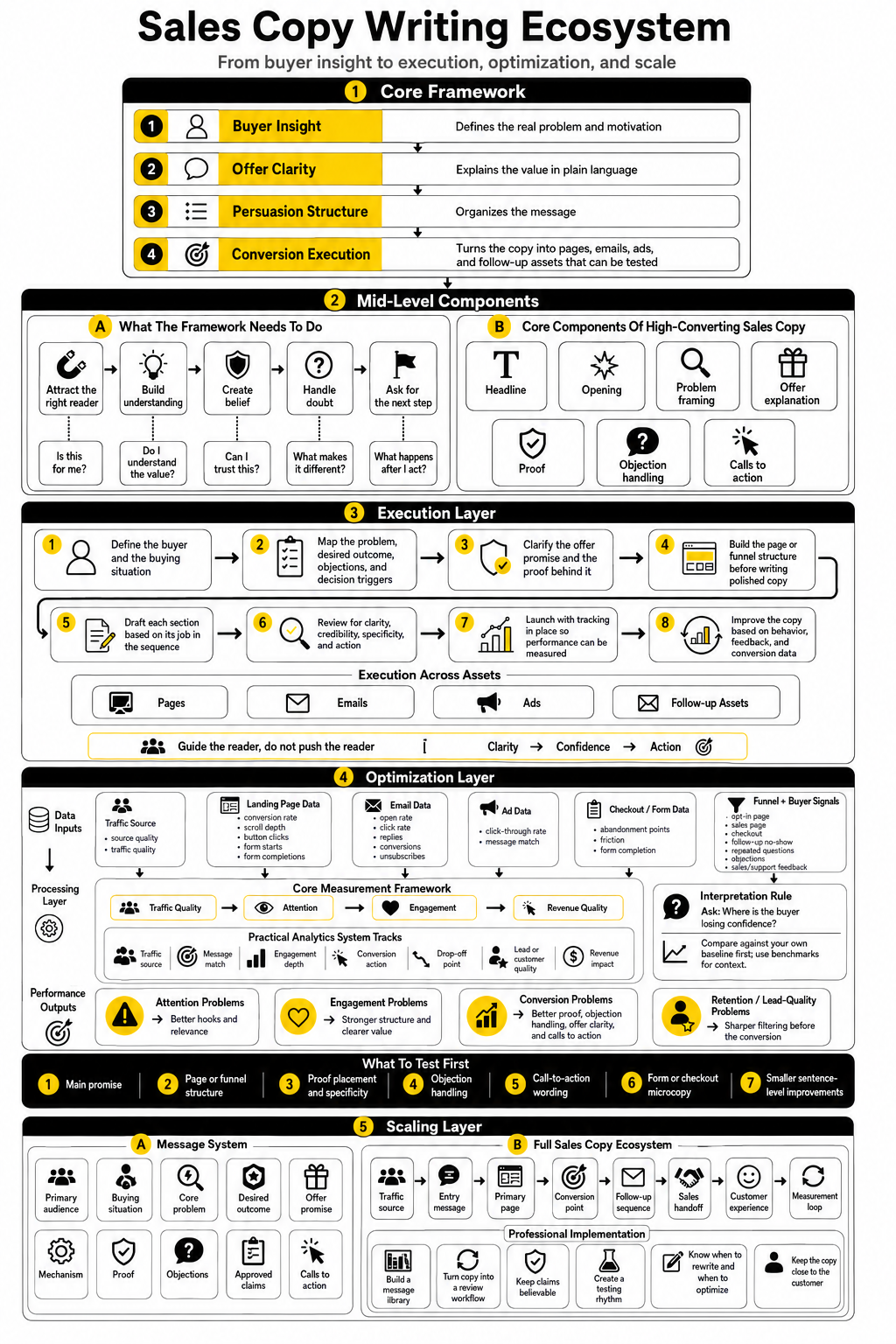
A clean sales copy ecosystem usually includes:
Tools can help make this system easier to manage. GoHighLevel can support CRM, pipelines, forms, booking, automation, and follow-up in one environment. ClickFunnels can help structure offers, pages, checkout flows, and funnel paths. Brevo and Moosend can support email follow-up when the message strategy is already clear.
The tool is never the strategy. But once the strategy is clear, the right tool can help deploy the copy faster, measure it better, and keep the buyer journey consistent.
Know When To Rewrite And When To Optimize
Not every underperforming asset needs a full rewrite. Sometimes the strategy is right, but one section is unclear. Sometimes the offer is strong, but the proof is buried. Sometimes the page works, but the traffic quality changed.
A full rewrite makes sense when the buyer is wrong, the offer promise is unclear, the structure is broken, or the copy no longer matches the market. Optimization makes sense when the message is mostly working but one part of the journey is leaking performance. Knowing the difference saves a lot of time.
Use the data from earlier sections to decide. If people leave immediately, review relevance and opening clarity. If they read but do not click, review proof, offer strength, and objections. If they click but do not complete the action, review friction, reassurance, and next-step copy.
Keep The Copy Close To The Customer
The best sales copy stays close to the customer. That means the team keeps listening after launch. Sales calls, demo objections, support tickets, reviews, cancellation reasons, survey responses, and live chat transcripts all contain copywriting material.
This is where many businesses get lazy. They write the page once and then only update it when the design changes. Meanwhile, the buyer’s objections, competitors, expectations, and language keep moving.
Keep a simple feedback loop. Every month, collect the top buyer questions, the most common objections, the strongest customer phrases, and the places where people seem confused. Then update the message library and improve the highest-impact assets first.
What is sales copy writing?
Sales copy writing is the process of writing persuasive marketing and sales messages that help a specific reader take a specific action. That action could be buying a product, booking a call, signing up for a trial, joining a list, replying to an email, or requesting a quote. The goal is not to write fancy words; the goal is to make the value clear enough that the right person feels confident moving forward.
Why is sales copy writing important?
Sales copy writing is important because buyers rarely act just because an offer exists. They need to understand the problem, the value, the proof, the risk, and the next step. Strong copy connects those pieces so the decision feels easier.
What makes sales copy effective?
Effective sales copy is clear, specific, believable, and focused on the buyer’s situation. It explains what the offer does, why it matters, who it is for, and why the reader should trust it. It also answers objections before they become reasons to leave.
How is sales copy writing different from content writing?
Content writing usually educates, informs, or attracts an audience over time. Sales copy writing is more directly tied to conversion. It still needs to be useful and honest, but it is written to guide the reader toward a business action.
What should I research before writing sales copy?
Before writing sales copy, research the buyer, the problem, the desired outcome, competing alternatives, objections, proof, and the language customers already use. Reviews, sales calls, support tickets, surveys, competitor pages, and customer interviews are all useful. The goal is to write from evidence, not imagination.
How long should sales copy be?
Sales copy should be as long as needed to create clarity, belief, and action. A simple low-cost offer may only need a short page or email. A complex, expensive, or high-trust offer may need deeper explanation, stronger proof, and more objection handling.
What is the most important part of a sales page?
The most important part depends on where the buyer is losing confidence. The headline may be the issue if people leave quickly. The offer section may be the issue if people do not understand the value. The proof or objection-handling sections may be the issue if readers engage but do not act.
How do I know if my sales copy is working?
You know sales copy is working when it improves the action it was designed to support. That might mean more qualified leads, more purchases, more booked calls, better email replies, higher checkout completion, or stronger sales conversations. Do not judge copy only by clicks if those clicks do not produce better business outcomes.
Should sales copy include storytelling?
Sales copy can include storytelling when the story is real, relevant, and useful to the buyer’s decision. A story should not be added just to make the page longer. If the story does not prove a point, build trust, or clarify the offer, it is probably not needed.
Can AI write good sales copy?
AI can help draft, organize, summarize, and generate variations, but it should not own the strategy. Strong sales copy writing still needs human judgment around buyer insight, positioning, proof, claims, tone, and market context. AI is useful as an assistant, not as the final decision-maker.
What are the biggest mistakes in sales copy writing?
The biggest mistakes are vague promises, weak proof, unclear audience targeting, unsupported claims, too much focus on features, poor objection handling, and calls to action that do not explain the next step. Another major mistake is treating copy as a one-time task instead of improving it from data and customer feedback.
How often should sales copy be updated?
Sales copy should be reviewed whenever the offer, audience, traffic source, pricing, proof, or competitive landscape changes. It should also be reviewed when performance drops or when sales and support teams hear the same questions repeatedly. Copy should evolve as the market teaches you what buyers care about.
What tools help with sales copy implementation?
The best tools depend on the asset. Funnel tools can help with sales pages and checkout flows. CRM and automation tools can help with lead capture, follow-up, and pipelines. Email platforms can help with nurture sequences. But the tool should come after the message strategy, not before it.
Is sales copy writing only for online businesses?
No. Sales copy writing applies to online and offline businesses because every business needs clear persuasive communication. Websites, brochures, proposals, ads, sales emails, landing pages, product descriptions, and follow-up messages all rely on copy. The channel changes, but the buyer still needs clarity and trust.
What is the best way to improve sales copy fast?
The fastest way to improve sales copy is to clarify the buyer, sharpen the promise, strengthen the proof, and remove confusion around the next step. Start with the biggest decision points before editing small words. Better strategy usually beats prettier phrasing.
Build a stronger local presence with BAAM AI
Turn your website, Google profile, social channels, and AI visibility into one growth engine
Most businesses do not need more random marketing activity. They need a consistent presence system that helps the right people find them, trust them, and take action. BAAM AI brings strategy, local SEO, website updates, Google Maps visibility, social content, AI-search readiness, media production, and reporting into one practical monthly engine.
If you want your marketing to keep working after the campaign ends, start with a free BAAM AI presence audit. See how your business shows up today and where the fastest visibility wins are at BAAM AI.