
BAAM AI Blog
ROAS Marketing: A Practical Guide to Measuring and Improving Return on Ad Spend
ROAS marketing is the discipline of using return on ad spend to make better decisions about paid acquisition, creative, landing pages, offers, budgets, and growth. At its simplest, ROAS tells you how much revenue you...
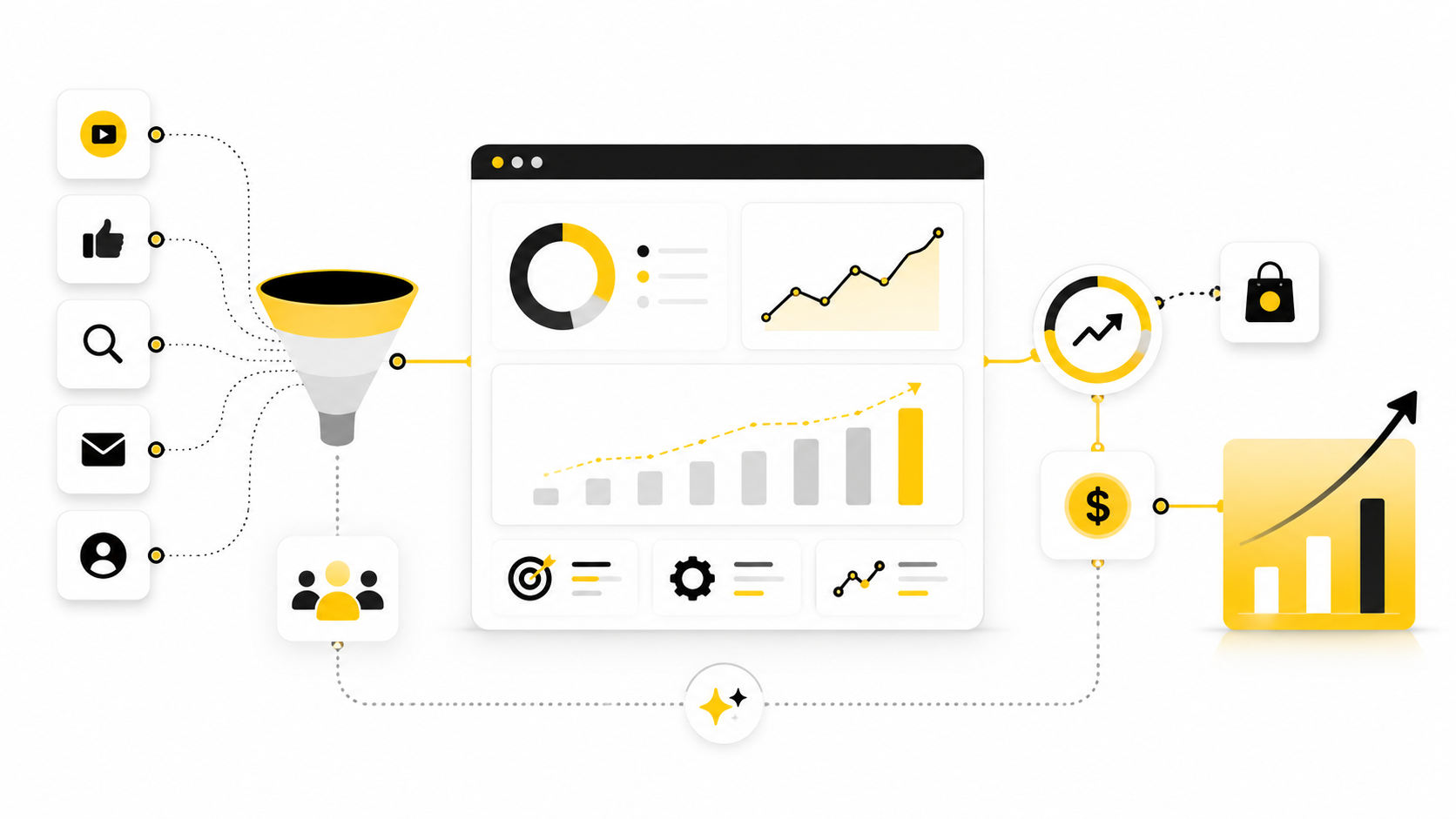
ROAS marketing is the discipline of using return on ad spend to make better decisions about paid acquisition, creative, landing pages, offers, budgets, and growth. At its simplest, ROAS tells you how much revenue you generated for every dollar spent on advertising. If a campaign spends $1,000 and produces $4,000 in attributed revenue, the campaign shows a 4.0 ROAS.
That sounds clean, but real marketing is messier. Platform dashboards do not always show true profit. Attribution windows can over-credit ads. A campaign can look strong on ROAS while quietly losing money after product costs, discounts, shipping, payment fees, refunds, and team costs are included. That is why good ROAS marketing is not just about chasing a bigger number. It is about knowing which numbers deserve your trust.
The stakes are higher now because paid media is bigger, more automated, and more competitive. U.S. internet advertising revenue reached $258.6 billion in 2024, and the platforms pushing that growth increasingly rely on automated bidding, conversion value, and modeled attribution. Google’s own guidance for Target ROAS bidding shows how changing a ROAS target can affect volume and conversion value, while Meta defines purchase ROAS around attributed purchase value inside its advertising systems through purchase ROAS reporting.
This guide treats ROAS as a decision tool, not a trophy metric. The goal is to help you understand what ROAS actually means, where it helps, where it misleads, and how to build a practical system for improving it without starving the business of growth. A higher ROAS is not automatically better if it comes from under-spending, weak scaling, poor new-customer acquisition, or over-reliance on retargeting.
The full article will continue across six parts using this structure:
ROAS Marketing Fundamentals and Article Roadmap
ROAS stands for return on ad spend. The basic formula is revenue attributed to advertising divided by advertising cost. Many teams express it as a ratio, such as 4:1, while others express it as a number, such as 4.0, or as a percentage, such as 400%.
The useful part of ROAS is that it connects media spend to revenue in a way that is easy to compare. You can compare one campaign against another, one channel against another, or one offer against another. That makes it a practical operating metric for media buyers, ecommerce founders, agencies, SaaS teams, and local businesses running paid ads.
The dangerous part is that ROAS can look more precise than it really is. Academic work on advertising measurement has repeatedly shown that estimating incremental ad returns is difficult because targeting, selection bias, and attribution can distort results, especially when observational dashboard data is treated as proof of causality. Research on paid search bias correction and incremental ROAS through geo experiments makes the same core point: measuring true advertising lift is harder than reading a platform column.
Why ROAS Marketing Matters
ROAS matters because paid traffic turns cash into attention, clicks, leads, and customers. When that machine is measured poorly, businesses either overspend on campaigns that do not create real profit or cut campaigns that were actually helping growth. Both mistakes are expensive.
This is especially important for businesses with thin margins. A 3.0 ROAS might be excellent for a high-margin digital product, acceptable for a subscription business with strong retention, and terrible for an ecommerce brand with high cost of goods sold and heavy discounting. The number only becomes useful when it is interpreted through margin, customer lifetime value, cash flow, and acquisition strategy.
ROAS also matters because ad platforms now optimize around the data you feed them. If your tracking is incomplete, your purchase values are wrong, or your funnel has weak conversion events, automated bidding has less reliable information to work with. That is why ROAS marketing is partly a measurement problem, partly a funnel problem, and partly an execution problem.
Framework Overview
A practical ROAS marketing framework starts with one question: what are we trying to optimize for? Some campaigns should maximize immediate revenue. Others should acquire new customers, fill the pipeline, launch a product, test creative, or expand into a new market. ROAS is useful in all of those cases, but it should not be judged the same way in each one.
The framework here uses four layers. First, you define the economics of the business so you know the break-even ROAS. Second, you clean up measurement so the data is directionally useful. Third, you improve the funnel so more ad clicks become profitable revenue. Fourth, you scale carefully so ROAS does not collapse as spend increases.
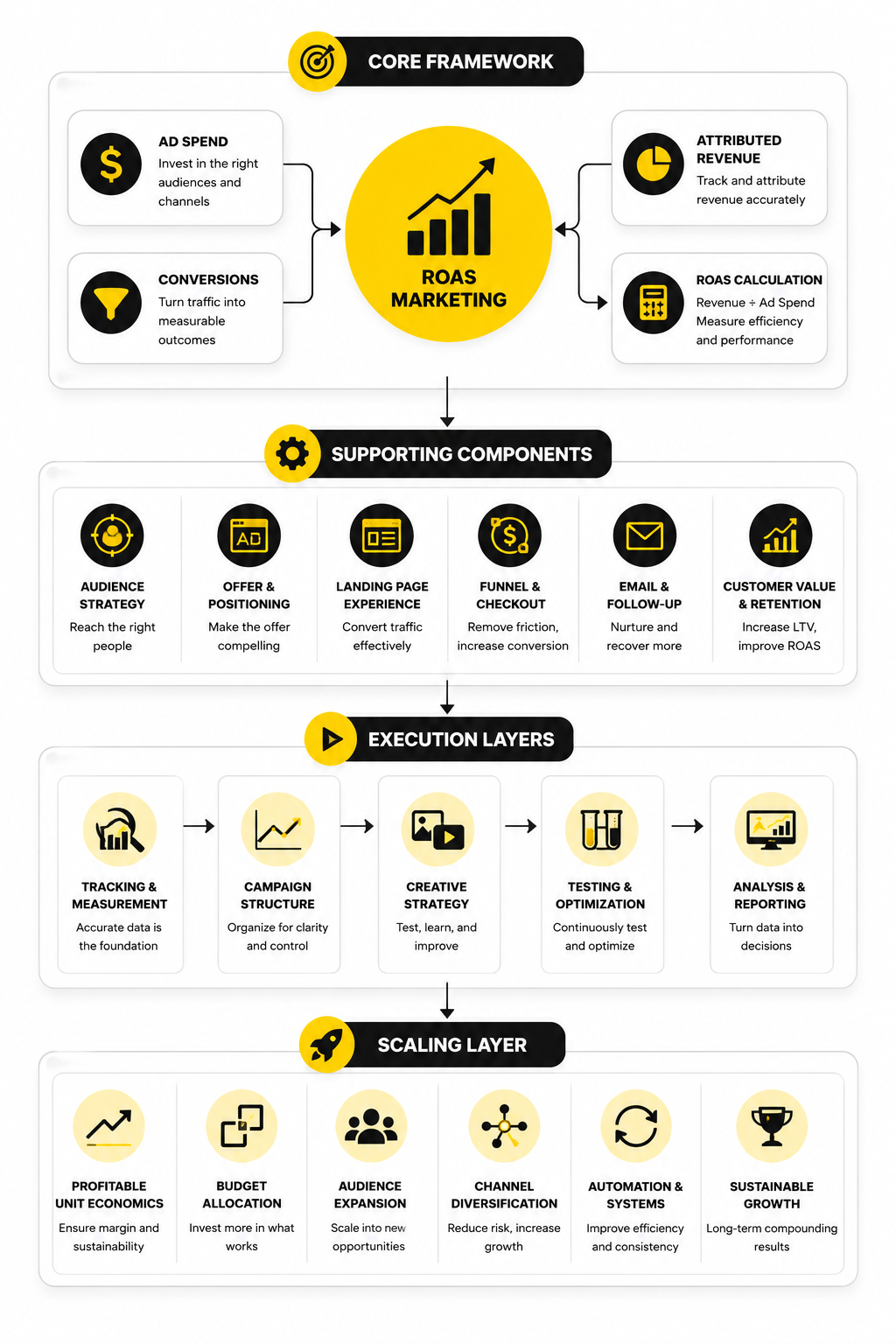
This is where many businesses get stuck. They try to improve ROAS only inside the ad account, adjusting bids, budgets, and audiences while ignoring the offer, landing page, follow-up, retention, and average order value. Better ROAS usually comes from the full system working together, not from one clever campaign setting.
Core Components of ROAS Marketing
The first core component is accurate revenue tracking. Without clean conversion tracking, every ROAS calculation becomes shaky. This includes purchase events, lead values, offline conversions, refunds where possible, and consistent attribution settings across platforms.
The second component is unit economics. You need to know gross margin, contribution margin, average order value, repeat purchase behavior, and customer lifetime value. ROAS by itself tells you revenue efficiency, but margin tells you whether that revenue is worth buying.
The third component is conversion infrastructure. Ads do not create profit alone. Landing pages, checkout pages, lead forms, email flows, SMS flows, sales calls, and retargeting sequences all influence whether paid traffic becomes revenue. For ecommerce landing pages, tools like Replo can fit naturally when the bottleneck is page testing and conversion-focused storefront experiences.
The fourth component is follow-up and lifecycle marketing. Many campaigns look weak when judged only on the first purchase but become profitable when email, SMS, chat, and sales follow-up are included. For example, a brand using conversational automation might use ManyChat to turn paid social traffic into subscribers, conversations, and recovered sales instead of relying only on the first click.
Professional Implementation
Professional ROAS marketing starts by separating dashboard ROAS from business ROAS. Dashboard ROAS is what Google, Meta, TikTok, or another ad platform reports. Business ROAS is what remains after you account for the economics of the actual company.
That distinction changes how you make decisions. A campaign with a lower platform ROAS may still be valuable if it brings in first-time buyers with strong repeat purchase behavior. A campaign with a high platform ROAS may be less impressive if it mainly retargets warm visitors who were already likely to buy.
The professional move is to build a simple operating model before scaling spend. Define your break-even ROAS, target ROAS, acceptable payback period, attribution assumptions, and testing budget. Once those rules are clear, ROAS becomes a useful steering wheel instead of a vanity metric.
How ROAS Works and What the Number Really Means
ROAS works by comparing attributed revenue against advertising cost. The standard formula is simple: ROAS = revenue from ads ÷ ad spend. If you spend $2,000 on ads and those ads are credited with $8,000 in revenue, the campaign has a 4.0 ROAS.
That number means the campaign generated four dollars in attributed revenue for every one dollar spent on media. It does not mean the campaign generated four dollars in profit. That distinction matters because roas marketing gets dangerous when teams treat revenue efficiency as the same thing as business profitability.
A useful ROAS number needs three things behind it: clear ad spend, reliable revenue attribution, and a realistic understanding of margin. If one of those inputs is wrong, the final number can still look clean while pointing you in the wrong direction. That is why experienced marketers use ROAS as a decision signal, not as absolute truth.
The Basic ROAS Formula
The cleanest version of ROAS uses this calculation:
ROAS = attributed revenue ÷ advertising cost
For example, a campaign that spends $5,000 and receives credit for $20,000 in sales has a 4.0 ROAS. The same result can be written as 4:1 or 400%. All three formats describe the same relationship between ad spend and attributed revenue.
The formula is easy, but the interpretation is where the work begins. If a business has strong margins, a 4.0 ROAS may leave plenty of room for profit. If the business has weak margins, heavy discounts, expensive fulfillment, or high refund rates, that same 4.0 ROAS may be far less attractive.
This is why the number should never be judged in isolation. A campaign’s ROAS should be compared against break-even economics, customer quality, payback period, and the role of that campaign in the wider funnel. The question is not just “is ROAS high?” The better question is “is this ROAS good enough for what this campaign is supposed to do?”
ROAS vs ROI
ROAS and ROI are related, but they are not the same metric. ROAS focuses on advertising revenue compared with advertising spend. ROI looks at profit compared with total investment.
That means ROAS is narrower. It usually answers, “How much revenue did our ads generate for each dollar of ad spend?” ROI asks a bigger business question: “After costs, did this investment actually make money?” Both are useful, but they are useful at different levels.
For day-to-day campaign management, ROAS is often faster and easier to use. Media buyers can compare ad sets, campaigns, keywords, audiences, products, and creative angles without rebuilding a full profit model every time. But for budget planning, cash flow, and leadership decisions, ROI or contribution margin usually gives the more honest answer.
A campaign can have strong ROAS and weak ROI if the underlying economics are poor. That happens when product costs are high, discounts are aggressive, fulfillment is expensive, or the campaign attracts low-quality customers. In practical roas marketing, the best teams watch both numbers instead of forcing one metric to do every job.
Platform ROAS vs Business ROAS
Platform ROAS is the number shown inside an ad platform. Google, Meta, TikTok, Pinterest, and other platforms calculate it based on their own tracking, attribution windows, modeled conversions, and reporting rules. That makes the number useful, but not neutral.
Business ROAS is the number you calculate from the company’s actual financial reality. It can include net revenue, refunds, cancellations, cost of goods sold, shipping costs, sales team costs, payment fees, and customer lifetime value. It is usually harder to calculate, but it is much closer to the truth.
The gap between platform ROAS and business ROAS is where many bad decisions happen. A platform may credit a sale to an ad because the customer clicked or viewed that ad within the attribution window. The business still has to ask whether that sale was incremental, profitable, and worth scaling.
This is especially important in retargeting. Retargeting campaigns often show strong platform ROAS because they reach people who already visited the site, viewed a product, joined a list, or added something to cart. Those campaigns can absolutely be valuable, but a high ROAS there does not automatically prove the ads created all of the revenue they are claiming.
Attributed ROAS vs Incremental ROAS
Attributed ROAS measures revenue credited to ads by a tracking system. Incremental ROAS measures the additional revenue actually caused by the advertising. Those are not always the same thing.
This matters because attribution systems can assign credit even when a customer may have purchased anyway. A returning customer might click a branded search ad before buying. A warm email subscriber might see a retargeting ad and convert later. A loyal customer might buy after seeing several ads, but the true lift from those ads could be smaller than the dashboard suggests.
Research on incremental return on ad spend through geo experiments highlights why causal measurement is difficult, especially when markets are heterogeneous and budgets create interference between test regions. More recent work on predictive incrementality for ad measurement also shows why randomized experiments can produce different conclusions from observational measurement methods.
That does not mean platform ROAS is useless. It means you should know what kind of number you are looking at. Attributed ROAS is helpful for daily optimization. Incremental ROAS is stronger for deciding whether a channel, campaign type, or budget increase is truly creating new value.
Break-Even ROAS
Break-even ROAS is the minimum ROAS needed before advertising becomes financially acceptable. The simplest way to estimate it is:
Break-even ROAS = 1 ÷ gross margin
If your gross margin is 50%, your rough break-even ROAS is 2.0. That means you need two dollars in revenue for every dollar of ad spend before gross profit covers the media cost. If your gross margin is 25%, your rough break-even ROAS is 4.0.
This simple version is useful, but it is still incomplete. Real break-even analysis should account for payment fees, shipping, fulfillment, returns, discounts, customer support, agency fees, creative production, sales commissions, and any other costs directly tied to acquiring and serving the customer. The more precise your cost model, the more useful your ROAS target becomes.
Break-even ROAS also changes when customer lifetime value is included. A subscription business may accept a lower first-purchase ROAS if customers retain well and pay back quickly. An ecommerce brand with strong repeat purchase behavior may do the same. But this only works when retention data is real, not wishful thinking.
Good ROAS Depends on the Business Model
There is no universal “good ROAS” that applies to every business. A 2.0 ROAS may be strong for a company with high lifetime value and predictable retention. A 6.0 ROAS may be required for a low-margin product with high fulfillment costs.
This is why generic benchmarks can mislead people. Benchmarks may help you understand the market, but they cannot replace your own economics. Your target should come from your margin, offer, sales cycle, customer value, cash position, and growth goals.
A local service business might care more about qualified leads, booked appointments, and closed revenue than ecommerce purchase ROAS. A SaaS company may judge campaigns by pipeline, trial quality, activation, payback period, and retention. An ecommerce brand may care about first-order ROAS, new customer ROAS, blended ROAS, MER, and lifetime value.
The key is to match the metric to the business model. ROAS marketing works best when the metric is connected to how the company actually makes money. Otherwise, you end up optimizing for a dashboard instead of a business.
Why Attribution Windows Change the Number
Attribution windows define how long a platform can credit an ad after someone views or clicks it. A longer attribution window usually gives the platform more opportunities to claim revenue. A shorter window usually makes ROAS look more conservative.
This can change campaign decisions fast. A campaign might look profitable on a 7-day click and 1-day view window, but weaker on a 1-day click window. Another campaign with a longer buying cycle may look worse in short-window reporting even if it influences valuable customers over time.
The point is not that one attribution window is always correct. The point is that you need consistency when comparing performance. If one campaign is judged with a different attribution setup than another, the comparison becomes muddy.
For serious analysis, keep platform settings stable and supplement them with your own reporting. Look at blended revenue, total ad spend, new customers, repeat customers, contribution margin, and payback. The platform number is one lens. It should not be the only lens.
How Bidding Systems Use ROAS
Modern ad platforms do more than report ROAS. They also use conversion value and ROAS targets to guide automated bidding. Google’s Target ROAS bidding documentation explains that lowering a ROAS target can help increase conversion volume, while raising the target can push the system toward higher efficiency.
This is powerful, but it creates a tradeoff. If the target is too aggressive, the campaign may restrict delivery and miss profitable volume. If the target is too loose, the campaign may spend more freely but drift away from the economics the business needs.
That is why ROAS targets should not be chosen emotionally. A founder wanting a 10.0 ROAS does not make a 10.0 ROAS scalable. A media buyer wanting more spend does not make a low target safe. The target should come from the business model, the campaign role, and the quality of conversion value data.
Conversion value rules can also influence bidding because Google says conversion value rules are used by Smart Bidding for Target ROAS and Maximize conversion value strategies. That means bad value inputs can train the system toward bad outcomes. Clean value tracking is not a technical detail. It is part of the growth strategy.
Why a Higher ROAS Is Not Always Better
A higher ROAS feels good because it looks efficient. But efficiency can become a trap. If you keep pushing for a higher and higher ROAS target, spend may shrink, reach may narrow, and growth may slow.
This happens because the easiest conversions are usually limited. Warm audiences, branded search, returning customers, and bottom-of-funnel retargeting often produce strong ROAS. But once you try to reach colder audiences, enter new markets, or scale spend, ROAS often falls because the campaign is doing harder work.
That does not automatically mean the campaign is bad. It may mean you are buying growth instead of harvesting existing demand. The right question is whether the lower ROAS is still profitable, strategic, and sustainable.
This is one of the biggest mindset shifts in roas marketing. You are not trying to make every campaign report the highest possible ROAS. You are trying to allocate spend where it creates the best business outcome. Sometimes that means protecting efficiency. Sometimes it means accepting a lower ROAS to acquire better customers and build future revenue.
The ROAS Numbers Worth Watching Together
ROAS becomes more useful when it sits inside a small group of related metrics. Looking at it alone creates blind spots. Looking at it with the right supporting numbers gives you a clearer operating picture.
The most useful supporting metrics usually include:
You do not need a complicated dashboard to start. A simple spreadsheet with spend, revenue, margin, new customers, repeat customers, and payback can already reveal what the ad platform cannot. The professional move is to make ROAS one part of a decision system, not the whole system.
Why ROAS Matters for Profitable Growth
ROAS matters because it gives paid marketing a financial language. Without it, ad performance turns into a pile of disconnected numbers: impressions, clicks, CPM, CPC, CTR, conversion rate, and cost per purchase. Those metrics are useful, but they do not answer the bigger question: did the spend create enough revenue to justify the risk?
That is why roas marketing sits between media buying and business strategy. It helps you decide where to spend, where to cut, where to test, and where to slow down before the business starts buying growth it cannot afford. The point is not to worship one metric. The point is to make paid acquisition easier to manage with real money on the line.
This is becoming more important because advertising budgets are large, automated, and increasingly value-based. U.S. digital ad revenue reached a record $259 billion in 2024, which means more brands are competing inside systems where small measurement mistakes can turn into expensive budget mistakes. When ad platforms optimize toward conversion value and Target ROAS, your tracking, values, and economics shape the machine you are feeding.
ROAS Helps You Protect Cash Flow
Cash flow is the first reason ROAS matters. A business can be growing on paper and still run into trouble if paid acquisition eats cash faster than customers pay it back. This is especially true for ecommerce brands carrying inventory, agencies funding labor before invoices clear, and subscription companies waiting months for lifetime value to materialize.
A ROAS target gives you a guardrail. It helps define how much revenue must come back for every dollar spent before the campaign is considered healthy. That does not make the business risk disappear, but it gives the team a clear threshold for deciding whether a campaign deserves more budget, more testing, or a hard stop.
The cash flow view also keeps you honest about time. A campaign that pays back in seven days is different from one that pays back in six months. Both can be good, but they require different levels of capital, confidence, and patience.
ROAS Connects Creative to Commercial Results
Creative performance is not just about which ad gets the most likes, clicks, or comments. The creative has to attract the right buyer, set the right expectation, and drive the right kind of conversion. ROAS helps connect the message people see to the revenue the business actually earns.
This is where many campaigns get confusing. One ad may produce cheap clicks but low-quality traffic. Another may have a higher CPC but bring in buyers with stronger intent, better order value, and fewer refunds. ROAS gives you a better way to compare those outcomes because it ties the front-end ad experience to money.
That does not mean every creative test should be judged only by immediate ROAS. Early tests may need enough spend to learn, and some angles may influence future demand instead of closing today’s sale. Still, when a creative angle consistently brings in profitable revenue, it deserves attention.
ROAS Shows When Scaling Starts to Break
Scaling paid ads is not just spending more money. As budgets increase, campaigns usually move beyond the easiest buyers and start reaching colder, less certain audiences. That is why ROAS often falls as spend rises.
This is not automatically a problem. A lower ROAS at higher spend may still create more total profit than a tiny campaign with a beautiful ROAS. The mistake is assuming that the highest ROAS campaign is always the best business decision.
The better approach is to watch how ROAS changes at each budget level. If spend rises and ROAS stays above your acceptable threshold, the business may have room to scale. If spend rises and ROAS falls below break-even, the campaign is probably telling you that the offer, audience, creative, landing page, or follow-up system needs work before more budget goes in.
ROAS Clar
Statistics and Data
ROAS marketing data is only useful when it helps you make a decision. A benchmark that does not change your budget, creative direction, offer, landing page, tracking setup, or retention strategy is just decoration. The point is not to collect more numbers. The point is to understand what the numbers are telling you to fix.
Paid media is also too competitive to manage by gut feel. U.S. digital advertising revenue reached $258.6 billion in 2024, which means more brands are fighting for attention, clicks, and conversion-ready demand. When the auction gets more crowded, weak measurement becomes more expensive because every wrong assumption gets multiplied by spend.
The best ROAS analysis connects platform performance to business performance. That means looking beyond campaign ROAS and asking what happened to blended revenue, new customer acquisition, gross margin, contribution margin, and payback. If the platform looks healthy but the business does not, the dashboard is not telling the whole story.
The Metrics That Explain ROAS
ROAS is the headline number, but it rarely explains itself. If ROAS goes down, the cause could be higher CPMs, weaker click-through rate, lower conversion rate, lower average order value, worse attribution, weaker traffic quality, or a shift toward colder audiences. Each of those problems requires a different action.
That is why every ROAS dashboard should separate the inputs. You want to see what changed before you decide what to do. A lower ROAS caused by rising CPMs may require stronger creative or better audience expansion. A lower ROAS caused by poor conversion rate may require landing page work, offer testing, checkout improvements, or better follow-up.
The core diagnostic metrics are:
When you view those metrics together, ROAS becomes easier to interpret. You stop saying “ROAS is down” and start saying “ROAS is down because click costs rose while conversion rate stayed flat.” That is a much better sentence because it points to the next move.
Benchmarks Are Context, Not Targets
Benchmarks can help you understand whether your numbers are wildly out of range. They should not become your strategy. A business with strong margins, strong retention, and a long customer lifetime value can often tolerate lower first-order ROAS than a business selling low-margin products with little repeat purchase behavior.
Search advertising benchmarks are a good example. The average Google Ads conversion rate across industries was reported at 7.52% in 2025, but that average hides massive differences between industries, offers, intent levels, landing pages, and sales processes. A legal lead, a dentist appointment, a software demo, and a $40 ecommerce purchase should not be judged by the same conversion expectation.
Social advertising benchmarks need the same caution. A paid social campaign optimized for cold audience discovery will usually behave differently from retargeting, lead generation, or catalog sales. If a benchmark makes you ask better questions, use it. If it pressures you into copying another company’s target without understanding your own economics, ignore it.
Blended ROAS Keeps You Honest
Blended ROAS compares total revenue against total ad spend across the business. It is usually calculated as total revenue ÷ total ad spend for a specific period. This does not replace platform ROAS, but it gives you a cleaner view of whether paid media is actually supporting the company’s top-line revenue.
The reason blended ROAS matters is simple. Platform dashboards can double count, undercount, over-credit retargeting, miss offline revenue, and shift when attribution settings change. Blended ROAS will not tell you which campaign deserves credit, but it will tell you whether the whole paid engine is moving in the right direction.
This is especially useful when budgets increase. If platform ROAS looks stable but blended ROAS gets worse, you may be shifting spend into campaigns that look good in-platform but are not creating enough incremental business value. If platform ROAS falls while blended revenue and new customers improve, the campaign may still be doing useful acquisition work.
Blended ROAS works best when you review it with margin. A business can grow revenue while weakening profitability. That is why the stronger version of this metric is contribution-margin ROAS, where you compare contribution profit against ad spend instead of comparing gross revenue against ad spend.
New Customer ROAS Shows Acquisition Quality
New customer ROAS separates revenue from first-time customers from revenue generated by returning customers. This matters because blended revenue can hide a business that is mostly selling to people who already know the brand. That may look efficient, but it does not always create enough future growth.
For acquisition campaigns, new customer ROAS is often more useful than total purchase ROAS. If a campaign brings in a high number of first-time buyers at an acceptable payback period, it may deserve more budget even if its total ROAS is lower than retargeting. Cold acquisition is harder work, so it should be judged with the right expectations.
This does not mean returning customers are less valuable. Repeat purchases are often what make paid acquisition profitable over time. The point is to avoid mixing two different jobs into one number. Acquisition campaigns should be evaluated on customer creation, while retention and retargeting campaigns should be evaluated on profitable revenue recovery and relationship depth.
Contribution Margin Changes the Story
Revenue-based ROAS can make a campaign look better than it is. Contribution margin brings the analysis closer to reality by accounting for variable costs. These may include product costs, fulfillment, payment processing, shipping subsidies, discounts, sales commissions, and refund rates.
A campaign with a 4.0 ROAS is not automatically healthy. If the gross margin is 20%, the economics are very different from a campaign with the same ROAS and a 70% gross margin. This is where many businesses get hurt because they scale revenue without realizing the cash engine is weak.
A simple contribution view can change decisions fast. Instead of only asking how much revenue the campaign produced, ask how much money remained after variable costs and ad spend. If the answer is thin or negative, the campaign may need a better offer, higher AOV, stronger retention, lower fulfillment cost, or a tighter acquisition target.
This is also where funnel tools become more relevant. If the real bottleneck is conversion rate, a cleaner sales page or landing page can raise ROAS without touching the ad account. For funnel-driven offers, ClickFunnels or Systeme.io can fit when the team needs a practical way to test offer flow, checkout steps, upsells, and lead capture without waiting on a full development cycle.
Attribution Data Needs a Reality Check
Attribution tells you which ads receive credit. It does not always tell you which ads created the sale. That difference matters because roas marketing decisions get risky when attribution is treated as proof instead of evidence.
Modern ad measurement is harder because privacy changes, modeled conversions, cross-device behavior, and delayed purchases all affect reporting. Research on differentially private ad conversion measurement shows how privacy-preserving systems create a careful balance between attribution rules, contribution limits, and measurement validity. In plain English, the industry is moving toward measurement that is less perfect at the user level and more dependent on models, aggregation, and experiment design.
This is why serious teams use multiple views. They look at platform ROAS for tactical optimization, blended ROAS for business reality, incrementality tests for causal confidence, and cohort analysis for customer quality. None of these views is perfect alone. Together, they reduce the chance that one misleading dashboard drives the whole strategy.
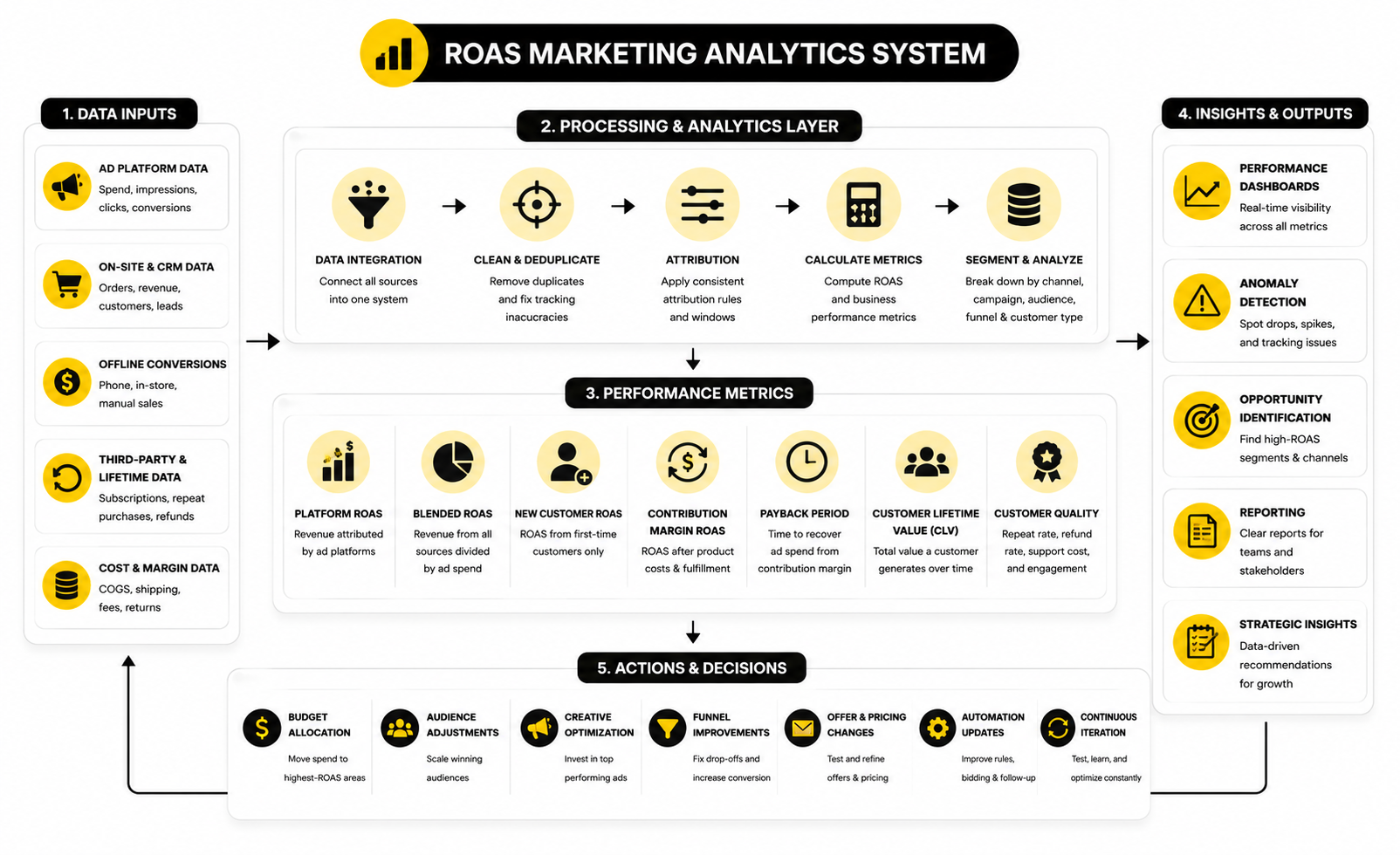
A practical analytics system should answer five questions:
If your reporting cannot answer those questions, do not rush to scale. Fix the measurement base first. Scaling unclear data is not bold. It is expensive guessing.
Performance Signals That Should Trigger Action
Not every metric movement deserves a reaction. Paid media is noisy, and daily ROAS swings can happen because of seasonality, delayed attribution, small sample sizes, stock issues, competitor behavior, or normal auction volatility. The professional move is to separate noise from signal.
A useful signal usually has three traits. It lasts long enough to matter, it appears across enough spend or conversion volume to trust, and it connects to a specific business outcome. If ROAS drops for one day on low spend, that may mean nothing. If ROAS drops for two weeks while CPC rises and conversion rate falls, that deserves attention.
These are the signals worth acting on:
The action should match the signal. Do not rewrite the offer when the issue is tracking. Do not blame the ad platform when the checkout is broken. Do not cut acquisition just because retargeting looks prettier in the dashboard.
Sample Size and Time Windows Matter
ROAS can be misleading when there is not enough data. A campaign with three purchases can show a huge ROAS if one customer places a large order. That does not mean the campaign is scalable. It means the sample is too small to trust.
Time windows matter for the same reason. Some businesses get most conversions within a few hours. Others need days or weeks because customers compare options, talk to a spouse, request approval, book a call, or wait for payday. If you judge a campaign too early, you may cut something that would have matured into profitable revenue.
Use shorter windows for tactical monitoring and longer windows for strategic decisions. Daily data helps you catch broken tracking, budget spikes, landing page problems, or sudden creative fatigue. Weekly and monthly views are better for budget allocation, offer decisions, and scaling calls.
This is especially important with automated bidding. If you make major changes too often, the system has less stable data to learn from. ROAS marketing is not about touching the account every time you feel nervous. It is about making clean decisions at the right interval.
How to Turn ROAS Data Into Decisions
The simplest way to turn ROAS data into action is to classify campaigns by role. Not every campaign should be expected to hit the same target. A branded search campaign, a retargeting campaign, a cold prospecting campaign, and a launch campaign are doing different jobs.
Start by assigning each campaign one primary purpose. Is it meant to acquire new customers, recover warm demand, test creative, validate an offer, expand a market, or maximize profitable revenue? Once the purpose is clear, the ROAS target becomes easier to judge.
Then connect each campaign to a decision rule. If a cold acquisition campaign is below target but producing strong new-customer cohorts, you may keep testing rather than cut it. If a retargeting campaign has great ROAS but limited spend capacity, you may protect it but stop pretending it can carry growth. If a campaign has weak ROAS, weak margin, and weak customer quality, you cut or rebuild it.
A simple decision system looks like this:
That process keeps emotion out of the account. You are not scaling because the dashboard looks exciting for two days. You are not cutting because one metric dipped. You are using ROAS marketing as an operating system for better decisions.
The Analytics Stack Should Stay Practical
You do not need a massive analytics stack to make better ROAS decisions. You need clean tracking, consistent definitions, and a reporting rhythm the team will actually use. Fancy dashboards are useless if nobody trusts the numbers or knows what action to take from them.
For many small teams, a practical setup starts with ad platform reporting, ecommerce or CRM revenue, a spreadsheet model for margin, and a weekly review. As the business grows, it may add server-side tracking, customer cohort reporting, offline conversion imports, attribution modeling, and incrementality testing. The stack should mature with the business, not bury the team in complexity from day one.
Lead-driven businesses need especially tight follow-up reporting. If paid traffic turns into form fills, booked calls, pipeline, and closed deals, the ROAS picture depends on what happens after the click. A CRM and automation platform like GoHighLevel can fit when the business needs to connect ad leads with pipeline tracking, follow-up, appointments, and revenue instead of judging campaigns only by cost per lead.
The real goal is not more software. The goal is fewer blind spots. When spend, revenue, margin, customer type, and follow-up performance are visible in one operating rhythm, ROAS becomes much more useful.
Core Components That Improve ROAS
Once the measurement system is in place, the next job is improvement. This is where roas marketing becomes less about reporting and more about leverage. You are not staring at a dashboard hoping the number goes up. You are pulling the few levers that actually change the economics.
The strongest ROAS gains usually come from improving the whole commercial system, not one isolated campaign setting. Better creative can lower click costs. Better landing pages can raise conversion rate. Better offers can increase average order value. Better follow-up can recover more revenue from the same traffic. Better retention can make a lower first-order ROAS acceptable because the customer becomes more valuable over time.
This is also where discipline matters. If you change everything at once, you will not know what worked. If you change nothing because you are afraid of hurting current results, performance slowly decays. The professional approach is controlled pressure: keep testing the highest-impact parts of the funnel while protecting the campaigns that already work.
Offer Quality Comes Before Media Efficiency
A weak offer makes ROAS expensive. You can have strong targeting, polished creative, and a clean account structure, but if the offer does not feel valuable enough, the campaign has to work too hard. The market does not reward technical setup when the value proposition is unclear.
A strong offer usually does three things. It makes the outcome obvious, reduces the buyer’s perceived risk, and gives the customer a reason to act now without relying on fake urgency. That can come from better positioning, stronger guarantees, clearer bundles, sharper pricing, bonuses, flexible payment terms, or a more compelling first-step conversion.
This does not mean every business needs discounts. Discounts can raise conversion rate while quietly destroying margin, attracting weaker customers, and training people to wait. The better move is to improve perceived value first, then use incentives carefully when they support the economics.
Creative Is a ROAS Lever, Not Just a Branding Asset
Creative affects ROAS before the customer ever lands on the site. It shapes who stops scrolling, who clicks, what they expect, and how qualified they are when they arrive. That means creative is not just “content.” It is one of the biggest filters in the entire acquisition system.
Good creative does more than look nice. It communicates the problem, the promise, the proof, the mechanism, and the next step quickly enough for a distracted buyer to care. If the creative attracts the wrong people, the campaign may get cheap clicks and weak revenue. If it attracts the right people but sets the wrong expectation, conversion rate suffers later.
Creative fatigue is also real. When CPM rises, CTR weakens, and ROAS drops without a major landing page or offer change, the creative is often losing strength. The fix is not always a tiny copy tweak. Sometimes you need new angles, new hooks, new formats, new proof, and a clearer reason for the buyer to believe the offer now.
Landing Pages Turn Paid Attention Into Revenue
A landing page has one job: convert the right visitor into the next profitable action. For ecommerce, that may be a product purchase, bundle purchase, quiz completion, or email capture. For lead generation, it may be a booked appointment, form submission, call, or application. For SaaS, it may be a trial, demo, or sales conversation.
The page has to continue the promise from the ad. If the ad sells one angle and the page opens with a different message, the buyer feels friction immediately. That friction shows up as lower conversion rate, higher bounce rate, wasted spend, and weaker ROAS.
The highest-impact page improvements usually come from clarity. Make the promise obvious. Show who it is for. Explain why it is different. Address objections before they become exits. Make the call to action easy to find. Remove unnecessary distractions that do not help the visitor decide.
For teams that need to test ecommerce landing pages quickly, Replo can fit when the goal is to build conversion-focused pages without waiting on a heavy development queue. For offer funnels, ClickFunnels or Systeme.io can make sense when the priority is testing lead capture, checkout flow, order bumps, upsells, or simple sales paths.
Average Order Value Creates More Room to Acquire Customers
Average order value is one of the cleanest ways to improve ROAS because it increases revenue per conversion. If conversion rate stays the same and AOV rises, the same ad traffic can produce more revenue. That gives the business more room to bid, test, and scale.
AOV can improve through bundles, quantity breaks, subscriptions, order bumps, cross-sells, upsells, free shipping thresholds, and better merchandising. The key is to make the increase feel useful to the customer, not forced. A bundle should solve a fuller problem. An upsell should make the original purchase better. A threshold should feel like a smart next step, not a trick.
AOV work should always be checked against margin. A bigger order is not better if it comes from over-discounting or adding low-margin products that create fulfillment headaches. The goal is not just larger carts. The goal is more profitable carts.
Follow-Up Converts Revenue That Ads Already Paid For
Paid traffic is expensive, so letting visitors disappear after one session is lazy money management. Many customers need more than one touch before they buy. They compare, get distracted, wait, ask questions, abandon carts, or need reassurance before they commit.
Follow-up gives you a second chance without paying for the same click again. Email, SMS, chat, retargeting, sales calls, and appointment reminders can all improve the revenue created from the original ad spend. This is one of the most practical ROAS levers because it increases monetization from traffic you already bought.
The follow-up should match the buying journey. Ecommerce brands may need welcome flows, browse abandonment, cart recovery, post-purchase cross-sells, and winback campaigns. Service businesses may need speed-to-lead automation, missed-call text back, appointment reminders, review requests, and pipeline follow-up. A business using paid social conversations can use ManyChat when chat automation is the right bridge between attention and conversion.
Speed to Lead Matters in Lead-Based ROAS
For lead generation, ROAS depends heavily on what happens after the form submission. A cheap lead is not valuable if nobody follows up quickly, qualifies the prospect, books the call, and closes the sale. The ad account may be blamed for a sales process problem.
This is why lead-based businesses should track the full chain from click to closed revenue. Cost per lead is only the first signal. You also need booked-call rate, show rate, close rate, average deal value, sales cycle length, refund rate, and repeat revenue. Without those numbers, roas marketing becomes a guessing game.
The faster the team responds, the more likely the lead is still in the moment that created the inquiry. Automation helps here because it removes delay from the first touch. A CRM and follow-up system like GoHighLevel can fit when the business needs to connect paid leads with pipeline stages, appointment booking, automated reminders, and revenue attribution.
Scaling ROAS Requires Accepting Some Efficiency Loss
Scaling almost always changes the numbers. The first profitable audience is usually easier than the next one. The first winning creative angle is usually stronger before fatigue sets in. The first budget level may reach the highest-intent buyers before the campaign has to work harder.
This is why a lower ROAS at higher spend is not automatically a failure. It may be the natural cost of reaching more people. The question is whether the new spend still meets the business target after margin, payback, and customer quality are considered.
The mistake is demanding small-budget efficiency at large-budget volume. That usually forces the account to stay trapped in warm audiences, branded demand, or overly narrow targeting. You get a beautiful ROAS number and a business that cannot grow.
A better scaling approach is gradual and economic. Raise budgets in controlled steps, watch blended revenue, monitor contribution margin, and compare new customer quality over time. If efficiency drops but profit and customer acquisition improve, the business may be moving in the right direction.
Over-Optimization Can Hurt Growth
ROAS targets can become too strict. When that happens, campaigns may stop exploring, budgets may underspend, and the algorithm may chase only the safest conversions. You protect efficiency, but you also reduce learning.
This is especially risky when a business is launching new products, entering new markets, or trying to build demand. Early data may look messy because the campaign is still finding the right audience, message, and offer. Cutting too aggressively can kill useful learning before it has time to mature.
That does not mean you should tolerate bad economics forever. It means you should separate test budgets from scale budgets. Test budgets are allowed to gather learning. Scale budgets must meet clearer economic rules. Mixing those two categories creates confusion and bad decisions.
The Hidden Risk of Retargeting Dependence
Retargeting often looks great in the dashboard because it reaches people who already know the brand. That can make it useful, but also misleading. If too much of the account’s reported ROAS comes from retargeting, the business may be harvesting demand instead of creating it.
This becomes a problem when top-of-funnel acquisition weakens. Retargeting pools shrink, new customer growth slows, and the business becomes dependent on an audience that is not being replenished. The dashboard may look efficient for a while, but the growth engine is getting weaker underneath.
A healthy account usually has a balance. Prospecting creates new demand and fills the funnel. Retargeting recovers warm demand and improves conversion efficiency. Retention increases lifetime value after purchase. If one layer is carrying all the reported ROAS, the system needs a closer look.
Seasonality Can Distort ROAS Decisions
ROAS changes with seasonality, buying intent, competitor activity, inventory, promotions, and macro conditions. A campaign that performs well during peak demand may struggle during a slower month. A campaign that looks weak outside a holiday period may still be useful when demand returns.
This is why year-over-year and period-over-period comparisons matter. A 3.0 ROAS in a weak buying season may be stronger than it looks. A 6.0 ROAS during peak promotional demand may not be repeatable. Context protects you from overreacting.
Seasonality should influence budget planning, not just reporting. Strong periods may justify higher spend, broader reach, and more aggressive creative testing. Slower periods may require better offers, stronger lead capture, retention pushes, or lower-risk testing instead of forcing the same scale expectations.
Automation Needs Better Inputs, Not Blind Trust
Automated bidding can be powerful, but it is not magic. It optimizes toward the conversion data and value signals you provide. If those inputs are shallow, delayed, duplicated, or disconnected from profit, the system can optimize toward the wrong outcome very efficiently.
Google’s Target ROAS strategy is designed to get as much conversion value as possible at the ROAS target you set, and its documentation notes that some conversions may come in above or below the target while the strategy works toward the average Target ROAS goal. That is useful, but it also means the target has to be grounded in real economics. A random target creates random pressure.
Google also explains that conversion value rules can adjust conversion values for reporting and Smart Bidding based on factors such as location, device, and audience. That matters because not all conversions are equally valuable. If one customer segment has better margin or retention, your value inputs should eventually reflect that.
Automation works best when the business gives it better signals. That can mean importing offline conversions, assigning more accurate values, excluding low-quality conversion events, improving event match quality, and feeding the system cleaner customer data. The less the platform has to guess, the better your odds.
Incrementality Becomes More Important as Spend Grows
At small spend levels, platform ROAS may be enough to make practical decisions. As spend grows, the cost of being wrong gets bigger. That is when incrementality, geo tests, holdout tests, and marketing mix modeling become more important.
Incrementality asks whether the ads created revenue that would not have happened otherwise. This is the uncomfortable question, but it is the right one. A campaign can have strong attributed ROAS and weak incremental impact if it mostly reaches people who were already going to buy.
Meta’s Conversion Lift testing is one example of a platform-native way to estimate incremental impact by comparing people exposed to ads with a holdout group. Academic research on predictive incrementality by experimentation also shows why randomized experiments can produce different decision quality than observational attribution methods. The practical takeaway is simple: when the stakes get high, do not rely on attribution alone.
Budget Allocation Should Follow Marginal Return
The most advanced ROAS decision is not “which campaign has the highest ROAS?” It is “where will the next dollar create the best return?” That is marginal thinking, and it matters because channels saturate.
A campaign with a 7.0 ROAS may have no room to scale. Another campaign with a 3.0 ROAS may have room to spend much more while staying profitable. If the business only chases the highest historical ROAS, it may underinvest in the channel with the better next-dollar opportunity.
This is why budget allocation should combine efficiency and capacity. You want campaigns that can spend meaningfully while staying inside the economic guardrails. The best growth opportunities often sit in the middle: not the prettiest ROAS, not the worst ROAS, but the best balance of return, volume, and customer quality.
Customer Quality Is the Advanced ROAS Multiplier
Not all revenue is equal. Some customers buy once and disappear. Others repeat, refer, subscribe, upgrade, leave reviews, and become easier to serve over time. A campaign that attracts the second type may deserve more budget even if first-order ROAS looks average.
This is why cohort analysis matters. Track customers by acquisition source, campaign, first product purchased, discount level, and first-order value. Then compare repeat purchase rate, refund rate, support burden, lifetime value, and payback over time. That tells you whether a campaign is buying good customers or just cheap revenue.
Advanced roas marketing is really customer-value marketing. The ad account is only the front door. The real win is acquiring customers the business can profitably keep.
The Best ROAS Strategy Is Usually Boring
The best ROAS strategy is rarely a secret hack. It is usually a set of boring habits executed consistently. Clean tracking. Clear economics. Better creative. Stronger pages. Higher AOV. Faster follow-up. Better retention. Controlled tests. Fewer emotional budget moves.
That may sound simple, but simple is not the same as easy. Most businesses struggle because they jump between tactics before fixing the fundamentals. They change campaign settings when the offer is weak. They blame attribution when the sales team is slow. They chase a higher ROAS target when the real problem is low customer value.
The expert move is to keep the system honest. Know what each campaign is supposed to do. Know the economics it must hit. Know which bottleneck is limiting performance. Then improve that bottleneck with enough patience to learn something real.
Professional Implementation, Mistakes to Avoid, and FAQ
Professional ROAS marketing is not about making every campaign look perfect. It is about building a system where spend, tracking, creative, funnel performance, follow-up, and customer value all work together. When those pieces connect, ROAS becomes a useful business signal instead of a fragile dashboard metric.
The final layer is operational discipline. Someone needs to own the numbers, someone needs to own the funnel, someone needs to own creative testing, and someone needs to turn findings into action. If every team looks at a different version of performance, the business ends up debating reports instead of improving results.
That is why a mature ROAS system should have a clear operating rhythm. Weekly reviews should focus on campaign performance, funnel bottlenecks, margin, new customer quality, and the next set of tests. Monthly reviews should focus on budget allocation, scaling decisions, customer cohorts, and whether the paid media engine is creating the kind of growth the business actually wants.
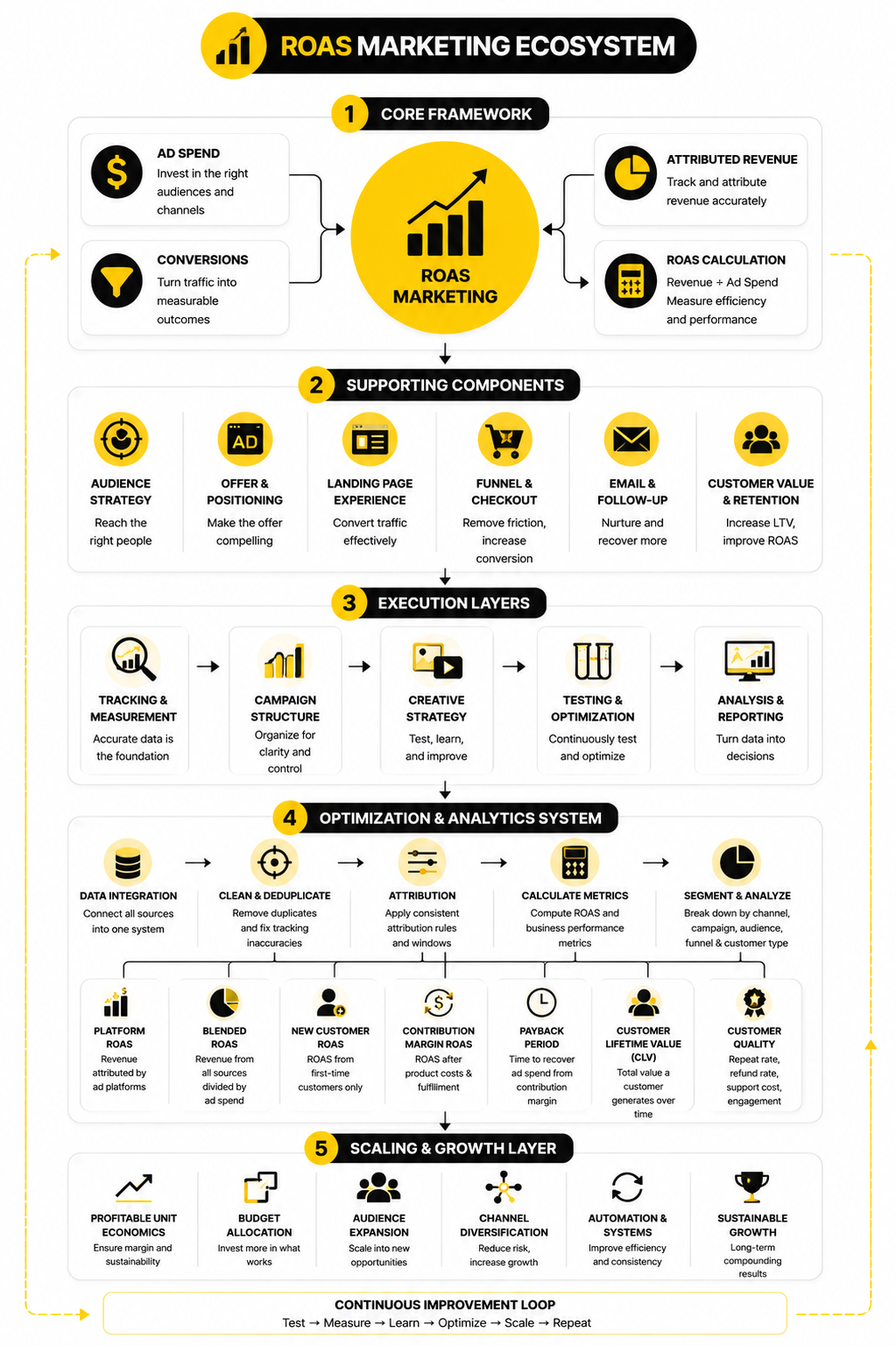
Build a ROAS Operating System
A ROAS operating system is a simple set of rules for how the business measures, interprets, and acts on paid performance. It should define which numbers matter, who owns them, how often they are reviewed, and what actions happen when performance changes. Without that system, every ROAS discussion becomes reactive.
Start with definitions. Decide how the business calculates platform ROAS, blended ROAS, new customer ROAS, contribution-margin ROAS, payback period, and customer lifetime value. The definitions do not need to be perfect on day one, but they do need to be consistent enough for the team to make decisions without arguing over the basics every week.
Then build the review process. A weekly ROAS review should not be a long tour through every campaign. It should focus on what changed, why it changed, whether the change matters, and what action follows. Keep the meeting practical, because the goal is better decisions, not prettier reporting.
Separate Testing Budgets From Scaling Budgets
One of the cleanest ways to improve ROAS decisions is to separate testing money from scaling money. Testing budgets are used to learn. Scaling budgets are used to expand what already has evidence behind it.
This matters because early tests often look messy. New creative, new offers, new audiences, and new landing pages need room to gather signal. If every test is forced to hit the same ROAS target as proven campaigns immediately, the business will kill learning before it has a chance to pay off.
Scaling budgets should be held to a higher standard. Once a campaign has enough data, the question becomes whether it can spend more while staying inside margin, payback, and customer-quality requirements. This separation keeps the business from confusing exploration with execution.
Avoid the Most Common ROAS Mistakes
The first big mistake is treating ROAS as profit. ROAS is revenue divided by ad spend, not profit divided by total cost. If margin is weak, a strong-looking ROAS can still create a cash problem.
The second mistake is comparing campaign types as if they do the same job. Retargeting, branded search, cold prospecting, lead generation, and product launch campaigns have different roles. Judging them by one universal ROAS target usually leads to bad budget allocation.
The third mistake is reacting too quickly. Daily performance can swing because of attribution delay, sample size, seasonality, auction conditions, inventory, or normal randomness. A professional team knows when to act and when to let the data mature.
Know When to Bring in Specialists
ROAS problems are not always ad problems. Sometimes the issue is tracking. Sometimes it is creative. Sometimes it is pricing, positioning, landing page conversion, sales follow-up, retention, or margin. A good specialist can diagnose the real constraint instead of endlessly tweaking the ad account.
Bring in help when the business is spending enough that mistakes are becoming expensive. If monthly ad spend is meaningful, weak tracking or a poor funnel can burn more money than the cost of expert support. This is especially true when the team cannot confidently explain why ROAS is rising or falling.
The best specialists do not just “run ads.” They connect paid media to business economics. They should be able to talk about attribution, margin, creative testing, conversion rate, offer strategy, and customer quality in plain language.
What is ROAS in marketing?
ROAS stands for return on ad spend. It measures how much revenue is attributed to advertising compared with how much was spent on the ads. In roas marketing, the metric helps teams judge whether campaigns are producing enough revenue to justify the spend.
How do you calculate ROAS?
The formula is ROAS = attributed revenue ÷ ad spend. If a campaign spends $1,000 and generates $5,000 in attributed revenue, the ROAS is 5.0. That means the campaign produced five dollars in revenue for every dollar spent on advertising.
What is a good ROAS?
A good ROAS depends on your margin, pricing, customer lifetime value, fulfillment costs, and growth goals. A 3.0 ROAS might be excellent for one business and unprofitable for another. The right target should come from your break-even ROAS and the role of the campaign.
Is ROAS the same as ROI?
ROAS and ROI are not the same. ROAS compares advertising revenue with advertising spend, while ROI compares profit with total investment. ROAS is useful for campaign management, but ROI is usually better for judging total business profitability.
Why can platform ROAS be different from real business performance?
Platform ROAS is based on each ad platform’s attribution rules, tracking setup, conversion windows, and modeled data. Business performance includes total revenue, margin, refunds, customer quality, repeat purchases, and actual cash flow. The two can move differently, which is why platform ROAS should be checked against blended and margin-based reporting.
Why does ROAS drop when ad spend increases?
ROAS often drops during scaling because the easiest conversions are usually captured first. As spend increases, campaigns may reach colder audiences, broader segments, and less immediate demand. That does not automatically mean scaling is wrong, but it does mean the business needs to watch margin, payback, and customer quality closely.
Should every campaign have the same ROAS target?
No, every campaign should not have the same ROAS target. A retargeting campaign, cold acquisition campaign, branded search campaign, and launch campaign all do different jobs. Strong roas marketing assigns targets based on campaign purpose, customer intent, and economic expectations.
How can I improve ROAS without cutting ad spend?
You can improve ROAS by increasing conversion rate, improving creative quality, raising average order value, strengthening the offer, improving checkout flow, and adding better follow-up. Cutting spend may raise efficiency temporarily, but it can also reduce growth. The better move is to improve how much revenue the same traffic produces.
Why is new customer ROAS important?
New customer ROAS shows how efficiently paid media is acquiring first-time buyers. This matters because blended ROAS can look strong when repeat customers are carrying revenue. If acquisition is weak, the business may look healthy in the short term while future growth slows down.
What is break-even ROAS?
Break-even ROAS is the minimum return needed for ad spend to make economic sense. A simple estimate is 1 ÷ gross margin, but a more complete version should include variable costs, discounts, refunds, shipping, payment fees, and fulfillment. Once you know break-even ROAS, you can set targets that are grounded in real business economics.
How often should ROAS be reviewed?
ROAS should be monitored frequently, but major decisions should not be made from tiny samples. Daily checks are useful for spotting tracking issues, spend spikes, or obvious performance problems. Weekly and monthly reviews are better for budget allocation, scaling decisions, and strategic changes.
Can automated bidding improve ROAS?
Automated bidding can improve ROAS when the tracking, conversion values, and campaign structure are strong. It can also optimize toward the wrong outcome if the data is incomplete or low quality. Automation is most useful when the business gives the platform accurate value signals and clear economic targets.
What is the biggest ROAS mistake marketers make?
The biggest mistake is optimizing for a dashboard instead of the business. A campaign can show strong ROAS while producing weak margin, poor customers, or limited incremental growth. The best marketers use ROAS as one signal inside a wider system that includes profit, payback, retention, and customer quality.
Build a stronger local presence with BAAM AI
Turn your website, Google profile, social channels, and AI visibility into one growth engine
Most businesses do not need more random marketing activity. They need a consistent presence system that helps the right people find them, trust them, and take action. BAAM AI brings strategy, local SEO, website updates, Google Maps visibility, social content, AI-search readiness, media production, and reporting into one practical monthly engine.
If you want your marketing to keep working after the campaign ends, start with a free BAAM AI presence audit. See how your business shows up today and where the fastest visibility wins are at BAAM AI.