
BAAM AI Blog
ROAS Digital Marketing: How to Measure Paid Growth Without Fooling Yourself
ROAS digital marketing sounds simple: spend money on ads, track the revenue that comes back, and scale what works. In reality, it gets messy fast. Platforms report different numbers, attribution windows change the...
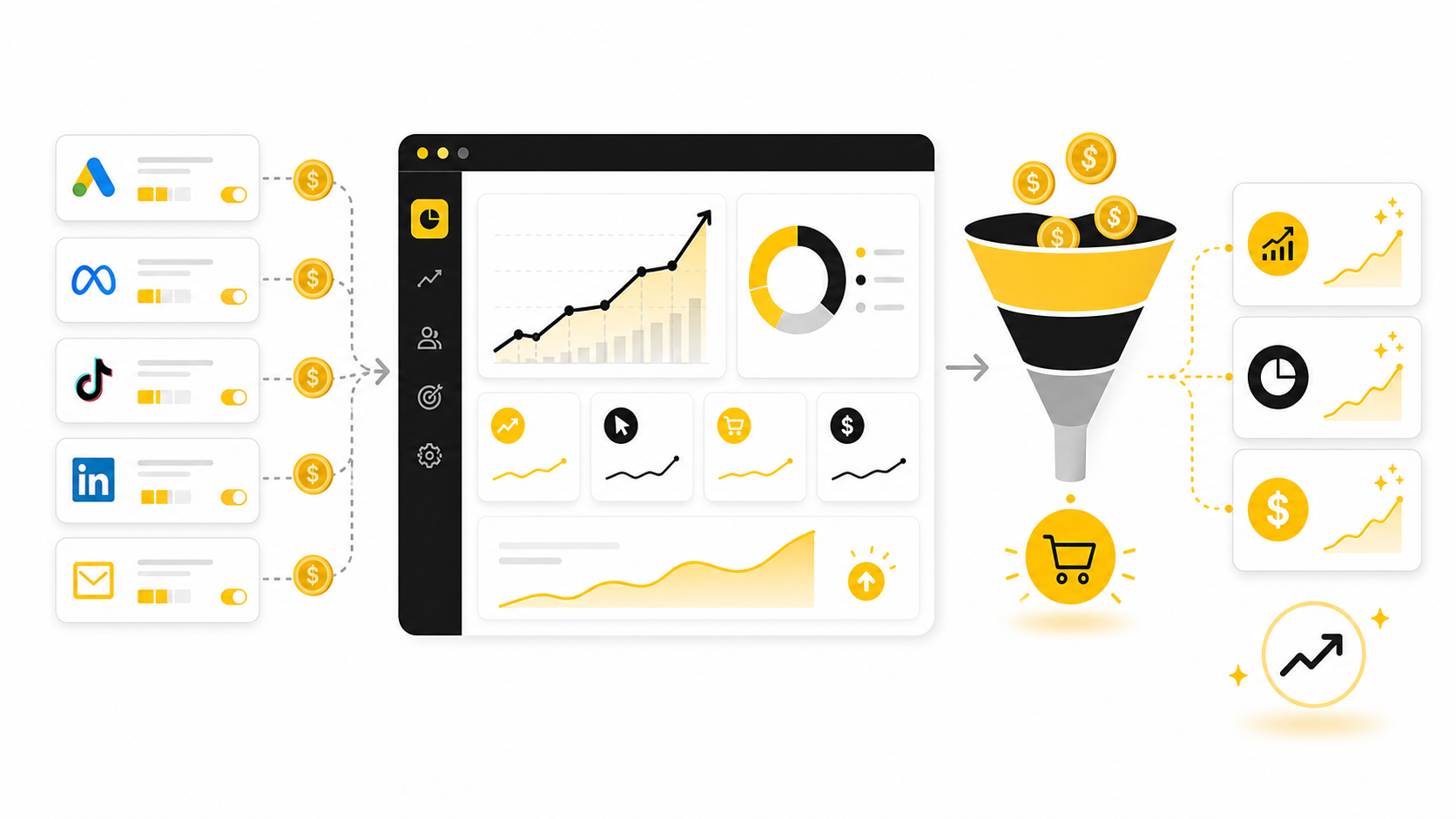
ROAS digital marketing sounds simple: spend money on ads, track the revenue that comes back, and scale what works. In reality, it gets messy fast. Platforms report different numbers, attribution windows change the story, discounts can hide weak profit, and a campaign with a beautiful ROAS can still be bad for the business if it only captures customers who were already going to buy.
That is why ROAS should not be treated as a trophy metric. It should be treated as a decision tool. The real job is not to chase the highest possible number; the real job is to understand which ad spend creates profitable, incremental growth and which ad spend only looks good inside a dashboard.
this guide breaks ROAS into a practical operating system for digital marketing teams, founders, agencies, and ecommerce operators. We will look at the formula, the measurement traps, the levers that improve performance, and the way professionals turn ROAS into budget decisions without guessing.
Why ROAS Matters in Digital Marketing
ROAS matters because paid traffic creates pressure immediately. The second you turn on a campaign, money starts leaving the business, and you need a clean way to judge whether that spend is helping or hurting. ROAS gives marketers a fast read on revenue efficiency, which makes it useful for campaign management, budget allocation, and scaling decisions.
The problem is that many teams use ROAS as if it answers every question. It does not. A 4x ROAS can be excellent for a high-margin digital product, average for a subscription funnel, or terrible for a low-margin ecommerce brand with heavy shipping costs and frequent returns.
That is why ROAS digital marketing needs context. You need to know your margins, customer lifetime value, payback period, conversion tracking quality, and whether the revenue is actually incremental. Without that context, ROAS becomes a number people argue about instead of a metric that helps the business make better decisions.
What ROAS Really Measures
ROAS measures the revenue generated for every unit of ad spend. If a campaign spends $1,000 and produces $4,000 in tracked revenue, the campaign has a 4x ROAS. That makes it easy to compare campaigns, channels, offers, audiences, and creative angles at a basic efficiency level.
But ROAS does not automatically measure profit. It does not subtract product costs, agency fees, platform fees, refunds, payment processing, shipping, discounts, or the cost of fulfilling the order. It also does not prove that the customer would not have purchased without the ad.
This is the key distinction. ROAS tells you what the ad platform or your attribution setup credited to the campaign. A professional marketer then asks the harder question: did this spend create profitable growth the business would not have captured otherwise?
The ROAS Framework for more carefully Paid Growth
A strong ROAS framework has four layers: tracking, economics, optimization, and incrementality. Tracking tells you what happened. Economics tells you whether the result is profitable. Optimization tells you what to improve next. Incrementality tells you whether the ads actually caused new business.
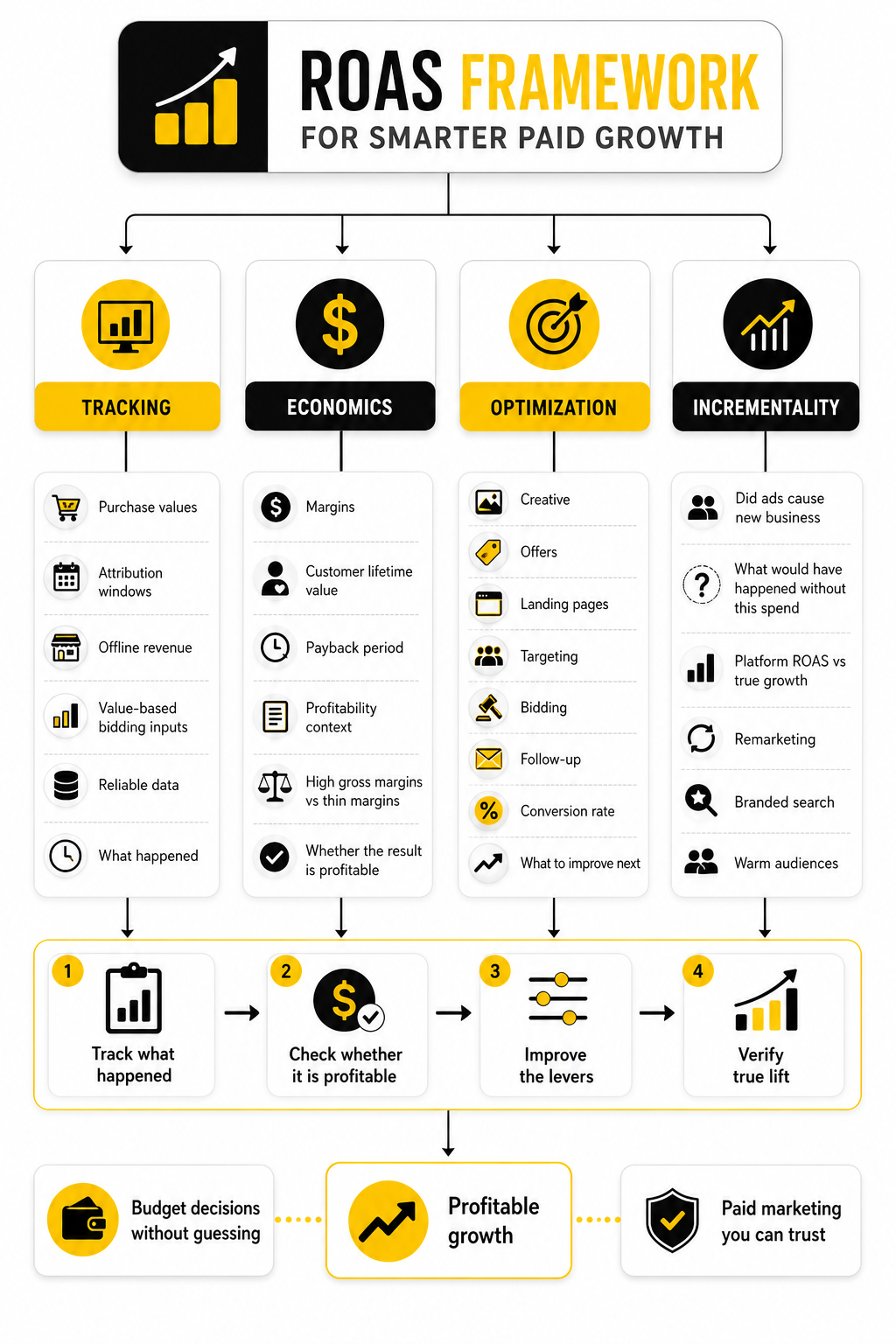
The first layer is tracking because bad data ruins every decision after it. If purchase values are missing, attribution windows are inconsistent, or offline revenue never gets passed back into the ad platform, the ROAS number becomes unreliable. This is especially important when campaigns use value-based bidding, because the algorithm can only optimize toward the values it receives.
The second layer is economics. A campaign can have strong revenue efficiency while still being weak after costs. For example, an ecommerce brand with thin margins may need a much higher ROAS than a SaaS company with high gross margins and strong retention.
The third layer is optimization. This is where marketers improve creative, offers, landing pages, targeting, bidding, follow-up, and conversion rate. Tools such as Replo can help teams build and test higher-converting landing pages, while platforms like GoHighLevel can support lead capture, follow-up, pipeline tracking, and automation when the ROAS model depends on turning paid leads into sales conversations.
The fourth layer is incrementality. This is where mature teams stop asking only, “What did the platform report?” and start asking, “What would have happened without this spend?” That shift matters because remarketing, branded search, and warm-audience campaigns often look extremely efficient while contributing less new demand than the dashboard suggests.
How the Rest of this guide Will Build the Argument
The next section will define ROAS more precisely and separate it from similar metrics that people often confuse. That matters because ROAS, ROI, CPA, MER, and profit all answer different questions. When those metrics get blended together, teams end up scaling campaigns for the wrong reason.
After that, the article will move into calculation, tracking, and attribution. This is where ROAS digital marketing gets practical, because small setup mistakes can change the number dramatically. A campaign can look successful or broken depending on how conversion value, attribution windows, and blended revenue are handled.
The later sections will focus on improving ROAS without killing growth. That means we will cover landing pages, creative testing, offer structure, audience quality, automation, retention, and budget decisions. The goal is not to make ROAS look better on paper; the goal is to build a system where paid marketing creates profitable growth you can trust.
ROAS vs ROI, CPA, MER, and Profit
ROAS is useful because it isolates ad revenue against ad spend. That makes it a clean campaign-level metric, especially when you are comparing paid search, paid social, shopping campaigns, retargeting, or creative tests. The basic idea is simple: revenue attributed to ads divided by the cost of those ads.
But ROAS digital marketing gets dangerous when teams treat it like ROI. ROI looks at return after costs, while ROAS usually looks at revenue before costs. That difference matters because revenue is not the same thing as profit, and a business can grow revenue while quietly shrinking cash.
CPA is different again. Cost per acquisition tells you how much it costs to generate one customer, lead, trial, booked call, or purchase. It is extremely useful when each conversion has a similar value, but it becomes weaker when one campaign brings in $40 customers and another brings in $400 customers.
MER, or marketing efficiency ratio, zooms out even further. Instead of looking at one campaign or platform, MER compares total revenue against total marketing spend. That makes it helpful when attribution gets messy, especially because tools like Shopify note that marketing performance data can have reporting delays and discrepancies between ad services and store analytics.
Profit is the metric that keeps everyone honest. A campaign can show strong ROAS, acceptable CPA, and decent MER, but still fail after product costs, payment processing, shipping, discounts, refunds, sales labor, or software costs are included. When the goal is real growth, profit is not optional context; it is the guardrail.
What ROAS Really Measures
ROAS measures attributed revenue efficiency. That word attributed is doing a lot of work. It means the revenue has been credited to an ad, campaign, channel, or platform based on a measurement system, not necessarily proven by a perfect causal test.
For example, Google describes target ROAS as a bidding strategy that tries to maximize conversion value while reaching the return goal you set. In plain English, that means the system needs conversion values, historical data, and a realistic target to optimize effectively. If the inputs are weak, the bidding strategy can still work mechanically, but it will optimize toward the wrong business signal.
Meta’s version of ROAS reporting also depends on purchase value and attribution rules. Website purchase ROAS is based on the value of website purchases attributed to ads compared with the amount spent. That can be helpful, but it still leaves the marketer responsible for understanding whether the revenue is new, profitable, and reliable.
This is where a lot of teams get stuck. They look at platform ROAS and assume it is the truth. A better approach is to treat platform ROAS as one view, then compare it against blended performance, customer quality, payback period, and margin.
The Basic ROAS Formula
The standard ROAS formula is:
Revenue attributed to advertising divided by advertising cost.
If you spend $2,000 on ads and those ads are credited with $8,000 in revenue, your ROAS is 4.0. Some teams write that as 4x, while others write it as 400%. Both mean the same thing: for every $1 spent on ads, the campaign generated $4 in attributed revenue.
The formula is easy, but the inputs are where the real work begins. You need to decide which revenue source you trust, which attribution window you are using, whether tax and shipping are included, whether refunds are removed, and whether the spend number includes only media spend or all paid acquisition costs. Without those definitions, two marketers can calculate different ROAS numbers from the same campaign and both think they are right.
A practical team writes the definition down before using the number in decisions. For example, “Meta seven-day click ROAS excluding refunds” is very different from “blended paid media ROAS using net revenue after refunds.” Clear definitions prevent dashboard arguments and make trend analysis more useful.
How to Calculate Break-Even ROAS
Break-even ROAS is the minimum ROAS you need before ads stop losing money on the first purchase. It is one of the most important numbers in paid marketing because it connects ad performance to unit economics. Without it, you are basically guessing whether a campaign is actually healthy.
The simple version is:
Break-even ROAS equals 1 divided by gross margin.
If your gross margin is 50%, your break-even ROAS is 2x. If your gross margin is 25%, your break-even ROAS is 4x. This is why the same reported ROAS can be great for one business and painful for another.
But gross margin alone is not always enough. You may also need to include shipping subsidies, payment fees, returns, sales commissions, fulfillment costs, and discounts. The more complete your cost stack is, the more realistic your break-even ROAS becomes.
For ecommerce brands, this matters a lot. A store with aggressive discounting may see strong revenue in the ad account but weak contribution margin after the order is fulfilled. A subscription business may accept a lower first-purchase ROAS if retention is strong, but only if customer lifetime value is measured honestly.
Why ROI and ROAS Get Confused
ROAS and ROI get confused because both talk about return. The difference is that ROAS is usually a media efficiency metric, while ROI is a business profitability metric. One helps you manage campaigns; the other helps you judge whether the investment made financial sense.
ROAS asks: how much revenue did the ads generate compared with ad spend? ROI asks: how much profit did the investment generate compared with the total cost? That means ROI should include more cost layers than ROAS.
This distinction is not academic. If an agency reports only ROAS, the client may think the campaign is profitable when it is really only generating revenue. If an internal team reports only ROI, they may miss useful campaign-level signals that help them optimize faster.
The cleanest setup uses both. ROAS helps you manage the day-to-day performance of paid channels. ROI helps you decide whether the overall investment deserves more budget.
When CPA Is Better Than ROAS
CPA is often better than ROAS when the conversion value is consistent. Lead generation is the obvious example. If every booked appointment has roughly the same expected value, cost per qualified lead or cost per booked call may be more useful than ROAS.
CPA is also easier to use when revenue happens later. A B2B company may generate leads from ads, qualify them in a CRM, close them weeks later, and collect revenue after onboarding. In that situation, campaign ROAS may lag too far behind the buying journey to guide daily decisions.
That does not mean ROAS is irrelevant. It means ROAS needs to be connected to downstream data. A lead campaign with a low CPA is not automatically good if the leads never buy, and a campaign with a higher CPA may be better if it attracts higher-quality prospects.
This is where follow-up systems matter. If paid traffic drives leads into a funnel, tools such as GoHighLevel can help connect forms, pipelines, appointment booking, automation, and sales follow-up so the team can see more than just the first conversion.
When MER Gives You a Better View
MER becomes useful when attribution is noisy. It compares total revenue to total marketing spend, so it gives you a broader read on whether the whole marketing system is becoming more or less efficient. This is especially valuable when customers see multiple ads, click through different channels, use discount codes, wait before buying, or convert on another device.
The tradeoff is that MER is less precise. It will not tell you which exact campaign deserves credit. It will not show which creative should be paused tomorrow. It is a business-level efficiency metric, not a campaign optimization tool.
That is why MER works best next to ROAS, not instead of it. ROAS helps you understand channel and campaign behavior. MER helps you check whether the total business result supports what the platforms are telling you.
If platform ROAS improves but MER gets worse, something is off. It may be over-attribution, rising spend on low-incrementality audiences, weaker organic demand, heavier discounting, or a mismatch between reported revenue and actual store revenue. That gap is a signal worth investigating.
Why Profit Has to Sit Above ROAS
Profit should sit above ROAS because businesses do not survive on attributed revenue. They survive on cash, margin, retention, and operational discipline. This is the part many paid media dashboards do not show clearly enough.
A campaign that produces a 5x ROAS on low-margin products might be weaker than a campaign producing a 2.5x ROAS on high-margin products. The first campaign looks better in the ad account, but the second may create more contribution profit. If your team does not track margin by product, offer, or customer segment, ROAS can push budget toward the wrong place.
Profit also changes how you think about scaling. When you increase spend, ROAS often falls because you move beyond the easiest buyers. That does not automatically mean scaling is bad. If contribution profit increases, a lower ROAS may still be the more carefully business decision.
This is the mindset shift. The goal is not to protect ROAS like a fragile vanity metric. The goal is to use ROAS digital marketing as one layer in a profit-first decision system.
The Core Components Behind Strong ROAS
Strong ROAS does not come from one magic campaign setting. It usually comes from several boring pieces working together: clean tracking, a clear offer, high-intent traffic, strong creative, a focused landing page, disciplined follow-up, and realistic budget control. When one of those pieces breaks, the campaign may still get clicks, but revenue efficiency usually starts to slip.
The first component is conversion value. Google’s target ROAS bidding works by trying to maximize conversion value while reaching the return target you set, which means the system needs reliable value data before it can make good bidding decisions. If your tracking sends the same value for every purchase, misses upsells, ignores refunds, or fails to capture lead quality, your ROAS digital marketing system is already working with blurry inputs.
The second component is offer quality. A weak offer makes every other part of the campaign work harder. Better targeting can help, but it cannot fully compensate for a confusing promise, poor pricing, unclear guarantee, weak urgency, or a landing page that fails to make the next step feel obvious.
The third component is conversion flow. This is the path from ad click to purchase, booked call, trial, form submission, or checkout. A smooth flow makes ROAS easier to improve because more of the traffic you already paid for turns into revenue.
How to Calculate ROAS Correctly
ROAS calculation starts with a simple formula, but professional implementation starts with definitions. Before the number goes into a report, decide whether you are using gross revenue, net revenue, revenue after refunds, first-purchase revenue, or lifetime value. Also decide whether ad cost means only media spend or includes creative production, agency fees, tracking software, landing page tools, and sales labor.
For day-to-day campaign optimization, it is normal to use platform ROAS. For business decisions, it is safer to use a second view that connects ad spend to actual store, CRM, or payment data. Shopify warns that analytics data can occasionally be incomplete or delayed, which is exactly why teams should avoid making aggressive decisions from one dashboard snapshot alone.
A practical ROAS calculation process looks like this:
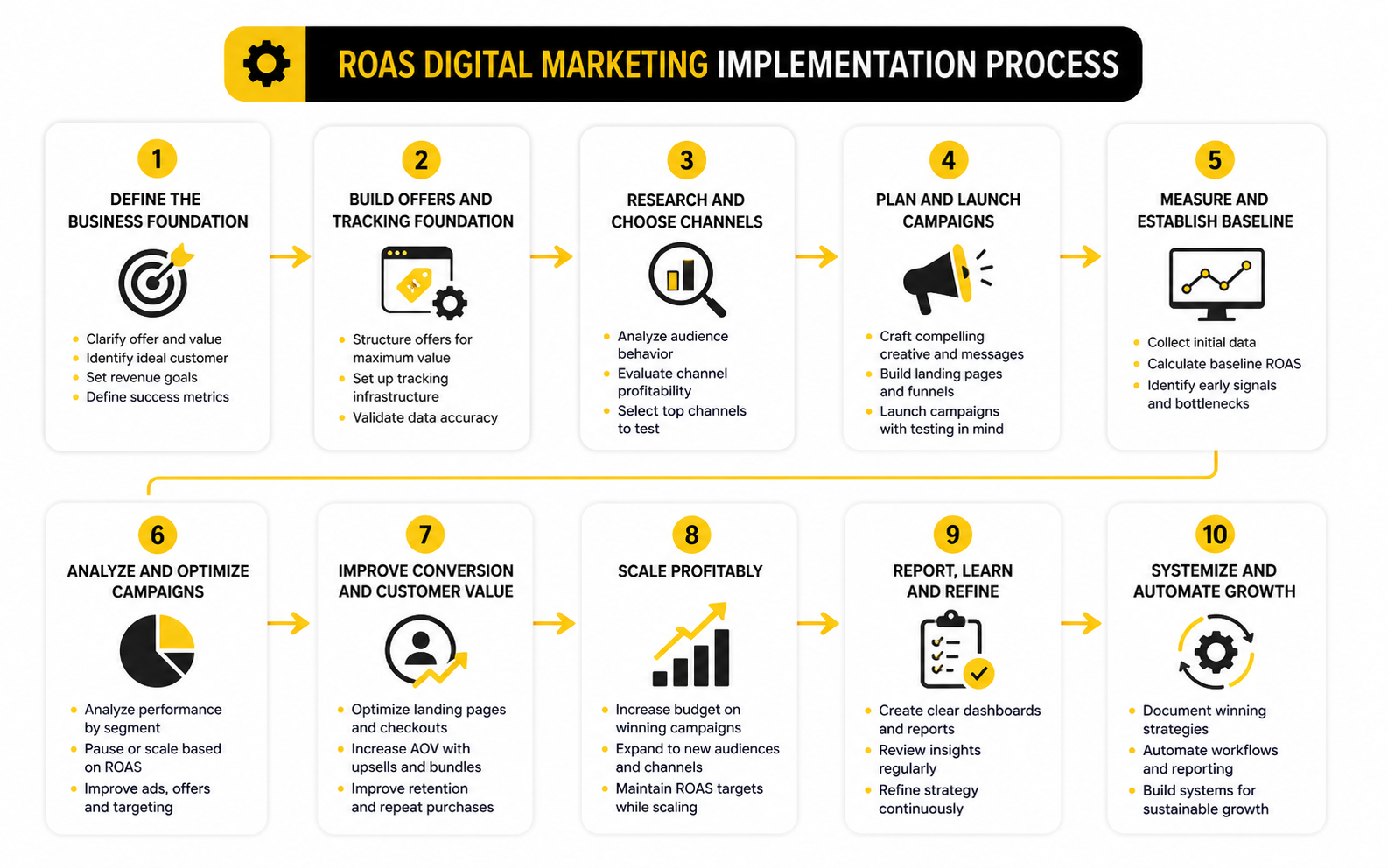
This process is not complicated, but it requires discipline. The mistake is not that marketers forget the formula. The mistake is that they calculate ROAS from whatever number is easiest to grab and then use it to make expensive decisions.
Attribution, Tracking, and the Measurement Problem
Attribution is where ROAS becomes messy. A customer might see a Meta ad on Monday, search Google on Wednesday, click a branded search ad on Thursday, open an email on Friday, and buy on Sunday. Depending on the platform and attribution settings, more than one channel may claim influence over the same sale.
Meta’s website purchase ROAS is based on purchase value recorded through the Meta Pixel or Conversions API and attributed to ads. That is useful, but Meta also notes that the metric may be estimated in some cases. So the number can help you manage campaigns, but it should not be treated as a perfect financial statement.
This is why tracking architecture matters. The cleaner your pixel events, server-side events, UTM structure, CRM stages, checkout data, and refund handling are, the better your decisions become. If tracking is broken, optimization becomes theater.
Good tracking also protects you from false confidence. A campaign can look amazing because it captures branded demand, remarkets to existing customers, or gets credit for people who were already close to buying. That does not mean the campaign is useless, but it does mean reported ROAS and true incremental ROAS are not always the same thing.
Platform ROAS vs Blended ROAS
Platform ROAS tells you what a specific ad platform credited to itself. Blended ROAS compares total revenue against total ad spend across channels. Both are useful, but they answer different questions.
Platform ROAS helps with tactical decisions. It can show which campaign, ad set, keyword group, product feed, or creative angle is producing stronger attributed revenue. If you are managing Google Ads, Meta Ads, TikTok Ads, or YouTube campaigns, you need this level of detail to optimize efficiently.
Blended ROAS helps with business reality. It answers a broader question: when we spend more on paid media overall, does total revenue rise enough to justify it? That view becomes more important as the media mix gets more complex.
The warning sign is when platform ROAS looks strong but blended ROAS weakens. That often means the platform is taking too much credit, the campaign is leaning heavily on warm audiences, discounting is inflating revenue, or paid spend is cannibalizing traffic that would have converted anyway. At that point, the right move is not panic; the right move is measurement cleanup.
Professional ROAS Implementation
Professional ROAS implementation is not just reporting. It is a working process that connects strategy, data, execution, and review. The goal is to build a system where campaign decisions can be made quickly without ignoring business economics.
Start with the business model. Ecommerce brands need product margin, average order value, return rate, discount rate, and fulfillment costs. Lead generation teams need lead-to-call rate, show rate, close rate, average deal value, and sales cycle length. Subscription businesses need payback period, churn, expansion revenue, and lifetime value.
Then build the measurement layer around those numbers. If the business depends on leads, route paid traffic into a CRM and track quality beyond the first form fill. If the business depends on ecommerce purchases, make sure product-level revenue and refunds are visible. If the business depends on booked calls, use scheduling and pipeline data so the team can see whether paid leads are actually moving toward revenue.
Tools can help here, but only when they fit the process. A funnel builder like ClickFunnels can be useful when you need dedicated conversion flows for paid traffic, while Systeme.io can make sense for simpler funnels, email sequences, and digital product offers. The tool is not the strategy, but the right setup can make the strategy much easier to execute.
A Practical ROAS Operating Process
A useful ROAS operating process should be simple enough to repeat every week. If the process is too complex, people stop using it. If it is too shallow, it turns into dashboard watching.
Start with a weekly review of spend, attributed revenue, blended revenue, CPA, conversion rate, average order value, and contribution margin. Look at trends instead of obsessing over one-day swings. Paid media data is noisy, so a calm review rhythm usually beats emotional campaign changes.
Then separate decisions into three buckets:
This keeps the team focused. Instead of saying “ROAS is down” and guessing, you identify which layer is actually causing the problem. That is how ROAS digital marketing becomes operational instead of emotional.
Setting ROAS Targets Without Guessing
A good ROAS target starts with margin, not vibes. If your gross margin is low, your break-even ROAS is higher. If your lifetime value is strong and cash flow can support a longer payback period, your first-purchase ROAS target may be lower.
Do not copy benchmarks blindly. A brand selling high-margin software, a local service business booking consultations, and an ecommerce store selling low-margin physical products should not use the same target. Even inside one business, different campaigns may deserve different targets depending on whether they are prospecting, retargeting, launching a product, clearing inventory, or acquiring customers with strong repeat purchase potential.
Google also warns that setting a target ROAS too high may limit traffic. That matters because an unrealistic target can make the campaign look “efficient” while starving it of volume. Sometimes the more carefully move is to accept a lower ROAS if it creates more total contribution profit.
The target should be reviewed as the business changes. New pricing, new margins, new fulfillment costs, stronger retention, better sales follow-up, or improved landing pages can all change what you can afford to pay for a customer. A static ROAS target eventually becomes outdated.
Statistics and Data
The data behind ROAS digital marketing should help you make decisions, not decorate a report. A useful analytics setup answers three practical questions: what happened, why it likely happened, and what should change next. If the numbers do not lead to a budget, creative, offer, tracking, or funnel decision, they are probably noise.
The first number to watch is ad spend because it controls the risk. The second is attributed revenue because it shows what the platform or analytics system credited to paid media. The third is profit contribution because it tells you whether the revenue was actually worth buying.
This matters more now because paid media budgets are large, competitive, and still growing. U.S. internet advertising revenue reached $258.6 billion in 2024, which means more brands are competing in the same auctions, feeds, search results, and social placements. In that environment, weak measurement gets expensive quickly.
The Analytics System That Makes ROAS Useful
A clean ROAS analytics system has three layers. The first layer is platform data from tools like Google Ads, Meta Ads, TikTok Ads, or other media channels. This is where you see campaign-level spend, impressions, clicks, conversions, conversion value, and platform-reported ROAS.
The second layer is business data. This usually comes from your ecommerce platform, CRM, payment processor, booking system, or subscription analytics tool. It gives you the numbers that platforms often miss, such as refunds, sales-qualified leads, close rate, average deal value, repeat purchases, churn, and actual collected revenue.
The third layer is decision data. This is where you combine platform performance with margin, inventory, sales capacity, lead quality, and cash flow. A campaign does not deserve more budget just because the ad account likes it; it deserves more budget when the business data supports the platform signal.
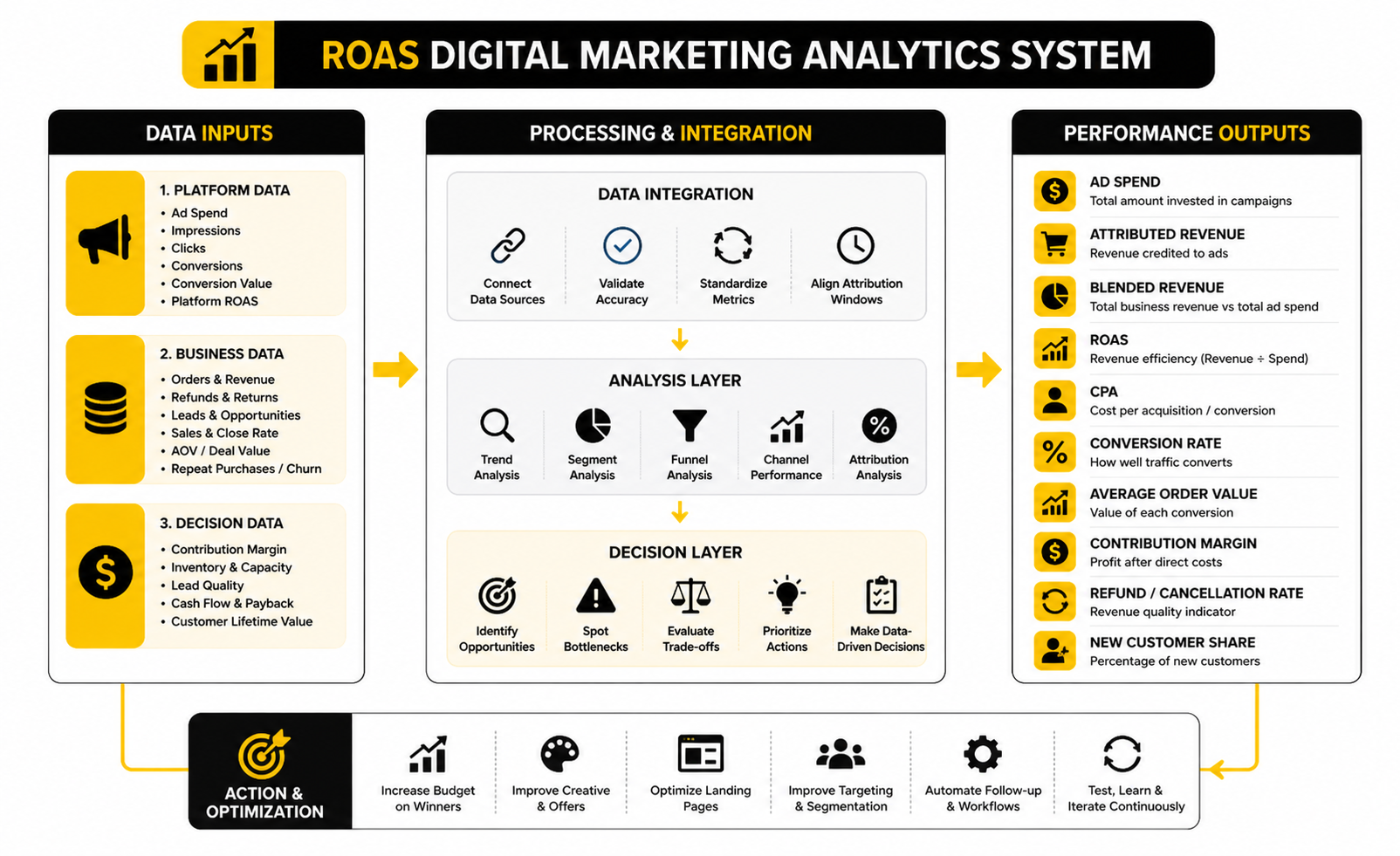
The system does not need to be fancy. It needs to be consistent. If the team reviews Meta seven-day click ROAS one week, Google Ads conversion value the next week, and Shopify net sales the week after that, nobody is really managing performance.
ROAS Benchmarks and How to Use Them Carefully
Benchmarks can be useful, but only as a starting point. A “good” ROAS depends on margin, pricing, sales cycle, channel mix, repeat purchase behavior, and how much of the spend is prospecting versus retargeting. A brand with 80% gross margin can profit at a lower ROAS than a brand with 25% gross margin.
The common 3x to 4x ROAS target is often repeated because it feels safe, but it is not a universal rule. If your gross margin is 50%, a 2x ROAS may cover product cost before other expenses. If your gross margin is 20%, a 2x ROAS is usually not enough unless customer lifetime value is very strong and the business can support the payback period.
This is why break-even ROAS is more useful than a generic benchmark. Once you know your break-even point, you can create targets by campaign type. Prospecting may be allowed to run lower if it brings in new customers with strong repeat purchase behavior, while retargeting should usually be held to a higher standard because those customers are already warmer.
Performance Signals That Actually Matter
ROAS is the outcome, not the diagnosis. When ROAS changes, you need to inspect the signals underneath it. The most useful signals are conversion rate, average order value, cost per click, cost per acquisition, click-through rate, refund rate, and contribution margin.
If ROAS falls but conversion rate stays stable, traffic may be getting more expensive or average order value may be dropping. If ROAS falls because conversion rate is down, the issue may be landing page fit, offer clarity, checkout friction, lead quality, or a mismatch between ad promise and page experience. If ROAS looks strong but refund rate climbs, the campaign may be attracting the wrong buyers.
Google’s target ROAS documentation makes this relationship clear in practice: the target you set can influence traffic volume, and setting the target too high may limit the amount of traffic ads receive. That means a very high ROAS target can make a campaign look efficient while quietly limiting growth. Efficiency without volume is not always a win.
Attribution Windows Change the Story
Attribution windows can completely change how ROAS looks. A one-day click view may make a campaign look weak if customers need time to compare, ask questions, or wait for payday. A longer attribution window may make the same campaign look stronger because more delayed purchases are credited back to the ad.
Neither view is automatically right. Short windows are useful when the buying decision is quick and the team wants a conservative read. Longer windows can be useful for higher-consideration products, lead generation, subscriptions, or B2B offers where the sales cycle is naturally slower.
The problem starts when teams compare numbers from different attribution windows without realizing it. Meta website purchase ROAS, Google Ads conversion value, GA4 revenue, and store revenue can each tell a different version of performance. That does not make the data useless, but it does mean the team needs one reporting standard for decisions.
Platform Data Needs a Reality Check
Platform ROAS is helpful, but it should not be the only source of truth. Ad platforms are built to optimize campaigns inside their own systems. Your business needs to know whether total revenue, profit, cash flow, and customer quality are improving outside the platform.
Shopify warns that admin analytics can sometimes be temporarily incomplete or delayed, which means teams should be cautious when using affected reports for business decisions. That is not a reason to ignore Shopify data. It is a reason to compare platform data, store data, and finance data before making big budget changes.
The same logic applies to CRM-based businesses. A campaign may produce cheap leads, but the CRM may show that those leads rarely answer calls, book appointments, or close. In that case, ROAS is not the right first diagnostic; lead quality and pipeline conversion are.
What the Numbers Should Make You Do
Good analytics should drive action. If a campaign has strong ROAS, strong contribution margin, and stable volume, the next move may be a controlled budget increase. If ROAS is strong but volume is tiny, the next move may be testing a lower target, broader audience, or new creative angle.
If ROAS is weak but click-through rate is strong, the ad may be creating interest while the landing page or offer fails to convert. A dedicated landing page builder like Replo can help ecommerce teams test page structure, product storytelling, bundles, and conversion sections without waiting on a full development cycle. For service businesses and agencies, GoHighLevel can help connect paid leads to forms, calendars, pipelines, follow-up sequences, and sales outcomes.
If ROAS is weak and click-through rate is weak, the first fix is probably creative or audience-message fit. If ROAS is weak but average order value is rising, the campaign may still be worth improving because the buyers have value. If ROAS is strong but profit is weak, the issue is likely margin, discounting, fulfillment cost, refund rate, or the product mix being pushed by the ads.
A Simple ROAS Scorecard
A useful scorecard keeps the team out of dashboard chaos. You do not need 40 metrics to make better paid media decisions. You need the right few metrics reviewed consistently.
Track these every week:
The point is not to make reporting longer. The point is to make it harder for one attractive number to fool the team. ROAS digital marketing works best when the scorecard shows both efficiency and business quality.
How to Improve ROAS Without Breaking Growth
Improving ROAS is not the same as cutting spend until the dashboard looks cleaner. Anyone can raise reported ROAS by pausing prospecting, shrinking audiences, lowering bids, and leaning harder into retargeting. The problem is that this can make the business smaller while making the metric look better.
A better approach is to improve the quality of the system. That means increasing conversion rate, raising average order value, improving lead quality, tightening follow-up, reducing waste, and protecting margin. When those pieces improve, ROAS digital marketing becomes healthier because the business is genuinely getting more value from the same or slightly higher spend.
The tradeoff is important. If you only optimize for efficiency, you may stop reaching new buyers. If you only optimize for scale, you may burn cash. The professional move is to manage ROAS and growth together, not treat them like enemies.
Scaling Paid Campaigns Without Killing Efficiency
Scaling usually puts pressure on ROAS. The easiest buyers are often reached first, and the next layer of spend has to work harder. That does not mean scaling is bad; it means you should expect efficiency to change as budget increases.
Google’s target ROAS guidance is clear that a target set too high can limit traffic, which is a useful reminder for scaling decisions. If the ROAS target is too aggressive, the campaign may protect efficiency by avoiding volume. That can look disciplined in the ad account while quietly slowing growth.
The solution is controlled scaling. Increase budgets gradually, monitor conversion value, watch blended revenue, and compare new customer volume against contribution margin. A lower ROAS can still be a good decision if total profit grows and the campaign brings in customers the business would not have reached otherwise.
The Risk of Over-Optimizing for ROAS
Over-optimizing for ROAS creates a subtle trap. The campaign starts favoring people who are already close to buying, products that already sell easily, and audiences that already know the brand. The dashboard improves, but the marketing system becomes less useful for creating new demand.
This is especially dangerous with retargeting and branded search. These campaigns often produce strong reported ROAS because they touch buyers late in the journey. They can still be valuable, but they should not receive unlimited credit for demand that other channels created.
A practical way to reduce this risk is to separate campaign roles. Prospecting campaigns should be judged on new customer acquisition, qualified traffic, first-purchase economics, and long-term value. Retargeting campaigns should be judged on efficiency, frequency control, conversion assistance, and whether they are genuinely lifting conversion rates instead of just claiming credit.
Incrementality Is the Advanced Layer
Incrementality asks the question ROAS alone cannot answer: what happened because of the ads that would not have happened otherwise? This is where advanced measurement starts. It is also where a lot of comfortable dashboard narratives get challenged.
The basic idea is simple. Compare a group that is exposed to advertising with a similar group that is not exposed. The difference between the groups gives you a better estimate of causal lift than platform attribution alone.
This matters because modern customer journeys are messy. People move between search, social, email, creators, marketplaces, review sites, and direct visits before buying. Standard attribution can show useful signals, but incrementality helps reveal whether paid media is creating new outcomes or just collecting credit along the way.
You do not need to run complex experiments every week. But you should test incrementality when spend is meaningful, when a campaign looks suspiciously efficient, when retargeting is taking too much budget, or when leadership is deciding whether to scale a channel.
Creative Strategy Has More Leverage Than Tiny Bid Tweaks
Small bid adjustments can help, but creative usually has more upside. Better creative improves click quality, conversion intent, audience expansion, and algorithmic learning. Weak creative makes every campaign more expensive because the platform has fewer strong signals to work with.
Creative testing should not mean changing button colors or swapping one generic headline for another. Test different angles: problem-aware, product-led, comparison, proof, objection handling, founder-led, customer-led, offer-led, and education-led. Each angle teaches you something about why people buy or ignore the offer.
The key is to connect creative tests to business outcomes. A creative with a high click-through rate but poor conversion rate may be attracting curiosity instead of buyers. A creative with fewer clicks but stronger order value or lead quality may be more valuable than it first appears.
Landing Pages Decide Whether Paid Traffic Gets Wasted
Paid traffic is rented attention. Once the click happens, the landing page has to earn the conversion. If the page is slow, vague, generic, or disconnected from the ad, ROAS suffers because the business pays for interest it fails to turn into action.
A strong paid landing page keeps the promise from the ad and removes friction. It explains the offer clearly, shows proof, handles objections, makes the next step obvious, and avoids sending people into unnecessary distractions. The page does not need to be loud; it needs to be persuasive.
For ecommerce teams, Replo can help build and test campaign-specific landing pages without waiting on a full development queue. For funnel-based offers, ClickFunnels or Systeme.io can make sense when the goal is a focused path from ad click to opt-in, checkout, booking, or upsell.
Follow-Up Can Save or Destroy ROAS
ROAS does not end at the first click or form submission. For lead generation, follow-up often determines whether paid traffic becomes revenue or just a spreadsheet of names. Slow response times, weak qualification, missed calls, and generic email sequences can ruin campaigns that looked promising at the top of the funnel.
This is why service businesses, agencies, coaches, consultants, and local businesses should not judge paid campaigns only by lead cost. A cheap lead is not useful if it never books, never shows, or never closes. The better question is how much it costs to create a qualified sales opportunity and how often that opportunity becomes revenue.
Automation can help, but it should feel human and timely. A setup using GoHighLevel can connect forms, calendars, SMS, email, pipeline stages, and sales tasks so paid leads are not left sitting untouched. For ecommerce and creator-led brands, ManyChat can be useful when social conversations, comments, DMs, and automated product flows are part of the conversion path.
Budget Allocation Should Follow Marginal Returns
The most advanced ROAS decision is not “which campaign has the highest ROAS?” It is “where does the next dollar create the best marginal return?” That is a different question, and it leads to better budget decisions.
A small retargeting campaign may have the highest ROAS in the account, but adding more money to it may not create many new sales. A prospecting campaign may have a lower ROAS, but the next $1,000 may create more total new customers and more future value. This is why budget allocation needs marginal thinking.
Look for the point where additional spend starts producing weaker returns. That does not mean stop immediately. It means compare the extra revenue, margin, and customer quality against other places the money could go.
This is also why blended performance matters. If you scale a channel and total business revenue barely moves, platform ROAS may be overstating the channel’s impact. If you scale a channel and total revenue, new customer volume, and contribution profit rise together, the lower campaign ROAS may still be a smart tradeoff.
Common ROAS Mistakes
The first common mistake is ignoring margins. Revenue efficiency is not enough when product cost, fulfillment, discounts, refunds, and sales labor eat the profit. A campaign can look strong in the ad account and still weaken the business.
The second mistake is comparing channels as if they do the same job. Paid search, paid social, retargeting, creator ads, email capture, and shopping campaigns often influence different stages of demand. Judging all of them by the same ROAS target can push budget away from channels that create demand and toward channels that harvest it.
The third mistake is reacting too quickly. Daily ROAS swings can happen because of delayed conversions, attribution windows, reporting lag, small sample sizes, or normal auction volatility. Cutting campaigns too fast can reset learning, reduce volume, and prevent the system from collecting enough data.
The fourth mistake is scaling before the funnel is ready. More traffic will not fix a weak offer, slow follow-up, broken tracking, poor landing page, or bad product-market fit. Scaling makes every weakness louder.
The fifth mistake is treating ROAS as the final answer. It is not. ROAS is a powerful metric when paired with profit, incrementality, customer quality, and growth context. Used alone, it can make you feel confident while the business moves in the wrong direction.
Expert-Level ROAS Guidance
The more advanced your marketing gets, the less you should worship one number. You still need ROAS, but you also need a clear view of customer acquisition cost, lifetime value, contribution margin, payback period, incrementality, and blended efficiency. That is how you avoid optimizing yourself into a smaller business.
For smaller accounts, keep the system simple. Track spend, revenue, ROAS, CPA, conversion rate, average order value, and margin. Improve the offer, page, creative, and follow-up before chasing complicated attribution models.
For larger accounts, add more structure. Separate prospecting from retargeting, test incrementality, build channel-level targets, use holdouts when possible, and review marginal returns before budget shifts. This is where ROAS digital marketing becomes less about reporting and more about capital allocation.
The best marketers are not the ones with the prettiest dashboards. They are the ones who know which numbers to trust, which numbers to challenge, and which actions the data should drive.
Tools That Help Improve ROAS
The best tools do not magically fix ROAS. They remove friction from the parts of the system that affect ROAS: tracking, landing pages, follow-up, customer conversations, reporting, and testing. A weak offer with bad economics will still struggle, even if the tech stack looks impressive.
Start with the bottleneck. If paid traffic clicks but does not convert, focus on landing pages and offer presentation. If leads arrive but do not close, focus on CRM, speed-to-lead, appointment booking, and sales follow-up. If the numbers do not match across dashboards, focus on analytics, UTMs, event tracking, and revenue reconciliation before scaling anything.
This is the final system view: traffic, offer, conversion flow, follow-up, revenue data, margin, and budget decisions all need to work together. ROAS digital marketing becomes reliable when every part of that ecosystem has a clear job.
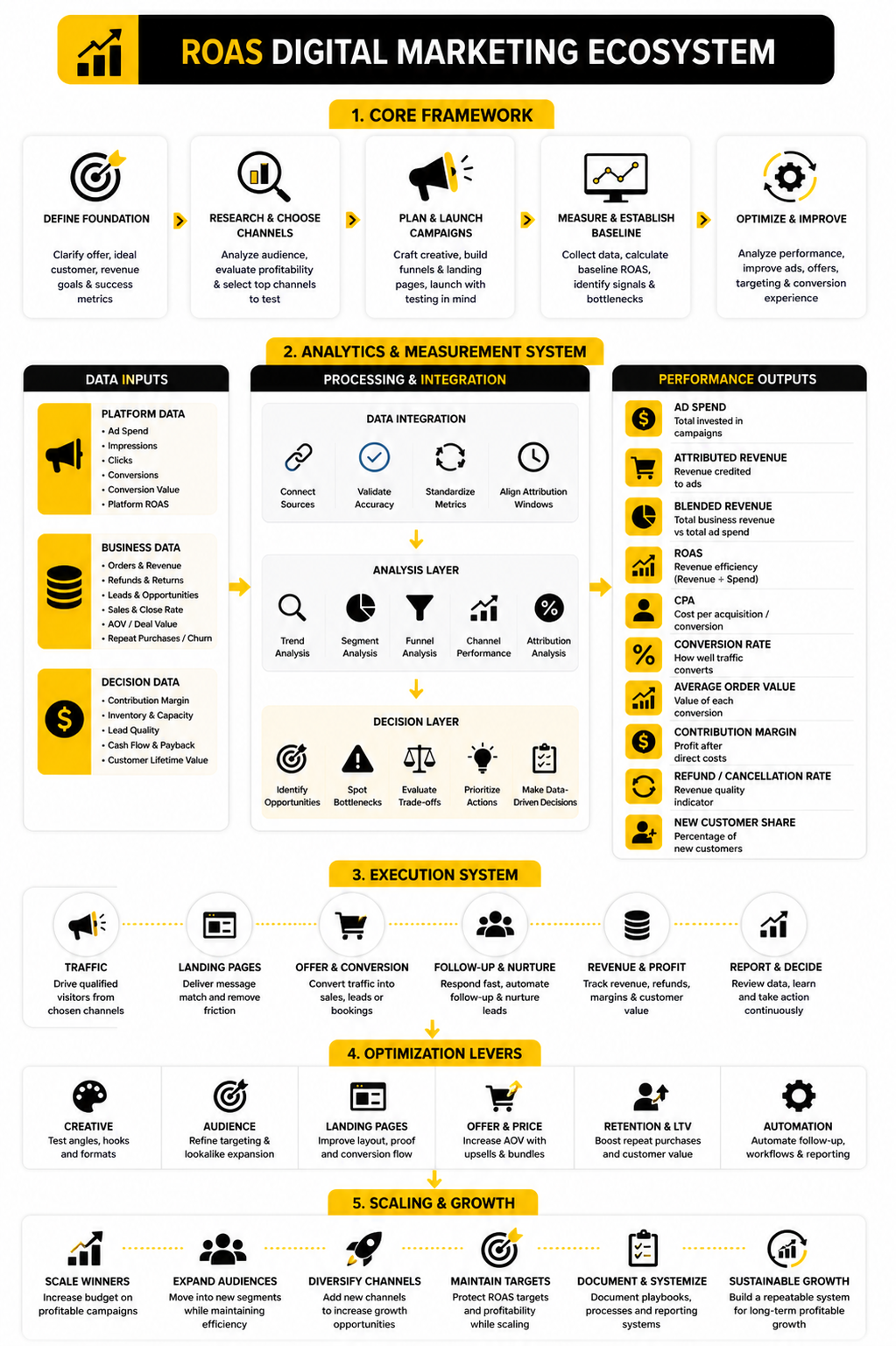
A practical stack might include a landing page builder for campaign-specific conversion paths, a CRM for lead and sales tracking, an email or SMS platform for follow-up, and analytics tools that connect spend to revenue. For ecommerce landing pages, Replo can help teams test page angles and product storytelling faster. For service businesses, agencies, and local lead generation, GoHighLevel can help connect funnels, forms, calendars, automations, pipelines, and reporting in one operating layer.
For simpler funnel builds, Systeme.io can make sense when the goal is to connect landing pages, email, digital products, and basic automation without overcomplicating the setup. For more aggressive funnel testing, ClickFunnels can be useful when the campaign needs dedicated opt-in, sales, upsell, and checkout flows. For social commerce and DM-driven conversion paths, ManyChat can help turn comments, messages, and automated conversations into measurable follow-up.
What does ROAS mean in digital marketing?
ROAS means return on ad spend. It measures how much revenue is attributed to advertising compared with how much money was spent on those ads. In simple terms, if you spend $1,000 and the campaign is credited with $4,000 in revenue, the ROAS is 4x.
What is a good ROAS?
A good ROAS depends on your margins, costs, sales cycle, and customer lifetime value. A 3x ROAS might be excellent for one business and unprofitable for another. The more carefully question is whether the ROAS clears your break-even point and supports profitable growth.
How do you calculate ROAS?
ROAS is calculated by dividing revenue attributed to ads by ad spend. If a campaign produces $10,000 in revenue from $2,500 in ad spend, the ROAS is 4x. For better decisions, define whether you are using gross revenue, net revenue, first-purchase revenue, or revenue after refunds.
Is ROAS the same as ROI?
No, ROAS and ROI are not the same. ROAS usually measures revenue efficiency against ad spend, while ROI measures profit against total investment. ROAS is useful for campaign management, but ROI is better for judging whether the business actually made money.
Why can a high ROAS still be bad?
A high ROAS can still be bad if margins are weak, refunds are high, discounting is heavy, or the campaign is mostly capturing customers who were already going to buy. It can also be misleading if the attribution window gives too much credit to ads. That is why ROAS should be checked against profit, blended revenue, and new customer quality.
Why does ROAS drop when campaigns scale?
ROAS often drops during scaling because the campaign moves beyond the easiest-to-convert buyers. As budgets rise, the platform may need to reach colder audiences, broader segments, or more expensive auctions. A lower ROAS is not automatically bad if total contribution profit and new customer volume increase.
Should I optimize for ROAS or CPA?
Use ROAS when conversion values vary and revenue quality matters. Use CPA when every conversion has a similar value, such as a booked call, lead, trial, or appointment. In many real campaigns, you should watch both because CPA shows acquisition cost while ROAS shows revenue efficiency.
What is break-even ROAS?
Break-even ROAS is the minimum ROAS needed before advertising stops losing money on the first transaction. A simple version is 1 divided by gross margin. If your gross margin is 50%, your basic break-even ROAS is 2x before considering extra costs like refunds, fees, shipping, labor, and software.
Why do Meta, Google, Shopify, and GA4 show different ROAS numbers?
Different platforms use different attribution rules, reporting windows, event sources, processing times, and definitions of revenue. One platform may credit a purchase to an ad, while another may credit it to organic, direct, email, or another channel. The fix is not to chase a perfect number; the fix is to define a reporting standard and compare platform data against business data.
How often should ROAS be reviewed?
ROAS should be monitored regularly, but big decisions should usually be made from trends instead of one-day swings. Daily checks can help spot tracking issues or sudden performance problems. Weekly reviews are usually more useful for budget, creative, landing page, and offer decisions.
Can automation improve ROAS?
Automation can improve ROAS when the bottleneck is follow-up, lead handling, abandoned carts, appointment booking, or sales pipeline management. It cannot fix a bad offer or poor economics by itself. The best automation makes the conversion path faster, clearer, and more consistent after the click.
What is the biggest mistake marketers make with ROAS?
The biggest mistake is treating ROAS as the final answer. ROAS is a useful metric, but it needs context from margin, profit, attribution, incrementality, and customer quality. When marketers use ROAS alone, they often protect the metric while weakening the growth system.
How can beginners improve ROAS quickly?
Beginners should start by improving the offer, landing page, tracking setup, and follow-up process. Small changes to bidding rarely beat a clearer promise, a stronger page, better proof, faster response times, and cleaner conversion data. Once the basics are working, creative testing and budget allocation become much more effective.
Is ROAS digital marketing only relevant for ecommerce?
No, ROAS digital marketing applies to ecommerce, SaaS, lead generation, local services, agencies, info products, and many other business models. The difference is how revenue gets measured. Ecommerce usually tracks purchases directly, while lead generation and B2B campaigns often need CRM data to connect ad spend to closed revenue.
Build a stronger local presence with BAAM AI
Turn your website, Google profile, social channels, and AI visibility into one growth engine
Most businesses do not need more random marketing activity. They need a consistent presence system that helps the right people find them, trust them, and take action. BAAM AI brings strategy, local SEO, website updates, Google Maps visibility, social content, AI-search readiness, media production, and reporting into one practical monthly engine.
If you want your marketing to keep working after the campaign ends, start with a free BAAM AI presence audit. See how your business shows up today and where the fastest visibility wins are at BAAM AI.