
BAAM AI Blog
Red Bull Marketing: How A Drink Became A Media, Sports, And Culture Machine
Red Bull marketing is not famous because the company runs clever ads. It is famous because Red Bull built a brand world so strong that the product often feels like the souvenir, not the main event.
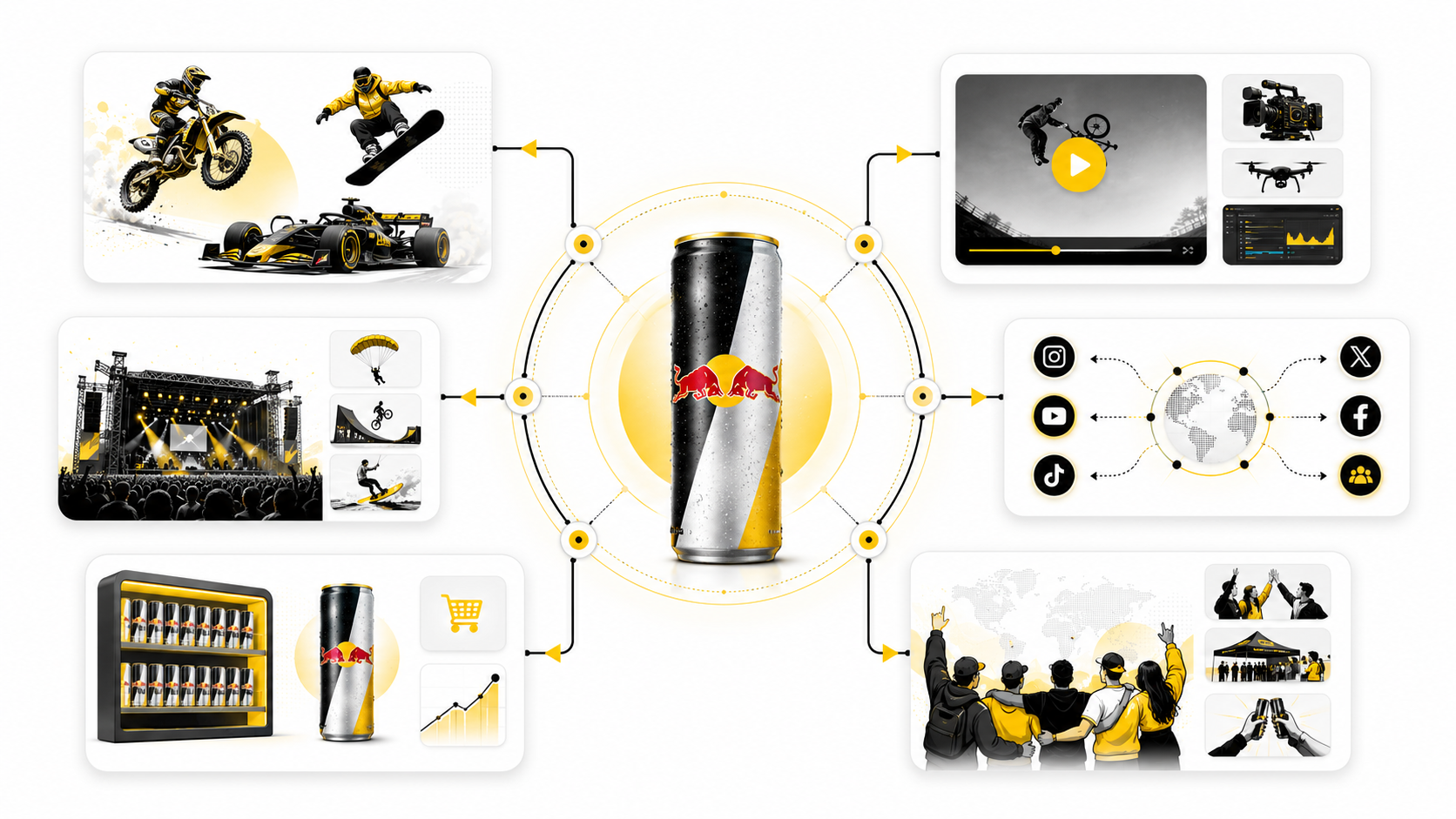
Red Bull marketing is not famous because the company runs clever ads. It is famous because Red Bull built a brand world so strong that the product often feels like the souvenir, not the main event.
That is the part most businesses miss. Red Bull does not simply promote an energy drink. It creates moments, athletes, teams, events, films, stunts, and cultural properties that make the brand feel useful before anyone even opens a can.
The scale is hard to ignore. Red Bull says it sold 13.969 billion cans in 2025, operated in 178 countries, and employed 21,924 people by the end of that year, which shows how far the brand has expanded beyond its Austrian launch in 1987 through a marketing concept built around energy, performance, and identity (Red Bull company profile). Brand Finance also valued Red Bull at €8.7 billion in 2025, calling it Austria’s most valuable brand in the Global 500 ranking (Brand Finance).
this guide breaks down the system behind that growth. Not the surface-level “sponsor extreme sports” answer. The real lesson is how Red Bull connects product positioning, media ownership, athlete partnerships, live experiences, distribution, and brand consistency into one machine.
Why Red Bull Marketing Matters
Red Bull matters because it changed the role of marketing. Most brands use content to support sales. Red Bull uses content to build a world people want to enter, then places the product inside that world naturally.
That distinction is everything. A normal beverage brand competes for shelf space, taste preference, and price. Red Bull competes for meaning: energy, courage, movement, risk, focus, nightlife, sport, creativity, and performance.
This is why Red Bull marketing is studied by founders, agencies, creators, and brand strategists. The company shows that a brand can become more durable when it owns attention instead of renting it. Its media operation is not a side project either; Red Bull Media House describes its content ecosystem as spanning editorial services, media partnerships, and a global content pool used by distribution partners across TV, digital, film, and other channels (Red Bull Media House).
For smaller companies, the lesson is not to copy Red Bull’s budget. That would be useless advice. The practical lesson is to build a repeatable marketing system where every channel reinforces the same positioning instead of producing random campaigns that die after a few weeks.
The Red Bull Marketing Framework At A Glance
Red Bull’s framework starts with a clear emotional promise: energy. Not just physical energy, but the feeling of being more alive, more capable, more daring, and closer to the edge of what is possible. That promise gives the brand permission to show up in sports, music, gaming, nightlife, entrepreneurship, and culture without feeling scattered.
The second layer is proof. Red Bull does not only claim to support high-performance people. It funds athletes, creates competitions, owns teams, produces films, publishes stories, and builds events that make the promise visible.
The third layer is distribution. Red Bull turns those proof points into media, social content, earned press, retail demand, and cultural memory. A stunt, race, documentary, or athlete partnership is not treated as a one-off campaign; it becomes reusable brand infrastructure.
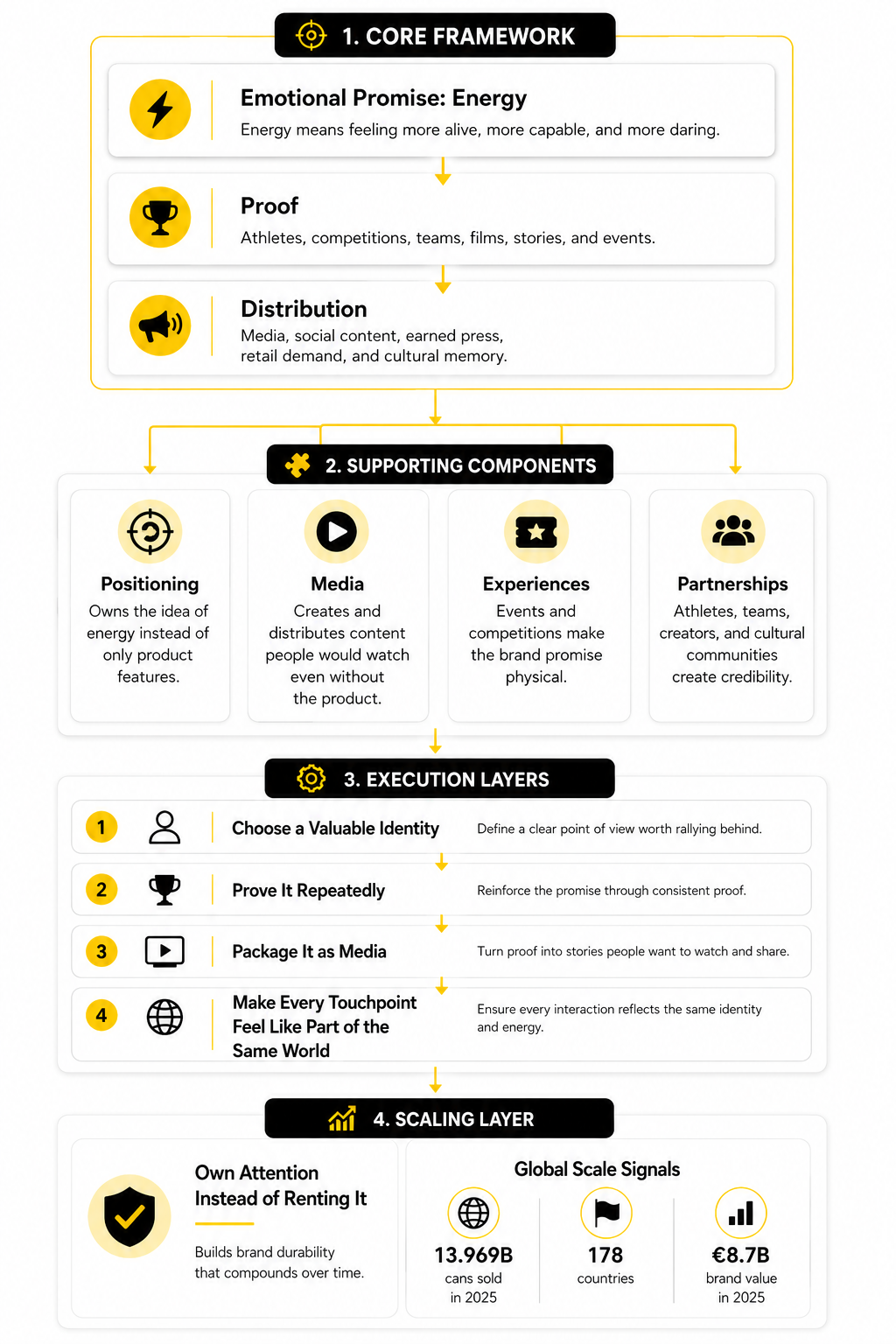
Core Components We Will Break Down
Red Bull’s marketing system can be understood through four connected components. Each one is powerful alone, but the real advantage comes from how they work together. That is why the brand feels consistent even when it appears in very different places.
The rest of the article will unpack these components in a practical way. The goal is not to worship Red Bull or pretend every brand should act like a global beverage company. The goal is to understand the mechanics clearly enough that you can apply the useful parts to your own marketing strategy.
How To Read This Breakdown
The first half of the article focuses on how Red Bull built the machine. That includes the strategic choices behind its positioning, its content ecosystem, and its use of sports and culture as long-term brand assets. These sections are important because Red Bull’s success is not the result of one viral moment.
The second half focuses on implementation. This is where the lessons become more useful for operators, marketers, founders, and agencies. A small business cannot recreate Formula 1 ownership or global event production, but it can recreate the principles: clear positioning, audience-first content, proof through action, and consistent distribution.
By the end, Red Bull marketing should feel less mysterious. It is bold, yes. But underneath the spectacle is a disciplined system: choose a valuable identity, prove it repeatedly, package it as media, and make every touchpoint feel like part of the same world.
The Red Bull Marketing Framework
The Red Bull marketing framework works because it is built around a simple idea that never gets boring: energy in action. The brand does not spend all its time explaining caffeine, taurine, serving size, or flavor. It shows people doing things that feel intense, ambitious, creative, dangerous, focused, or culturally alive.
That is why Red Bull can move between Formula 1, cliff diving, snowboarding, music, gaming, dance, entrepreneurship, and student life without losing the plot. The product promise is broad enough to travel, but specific enough to stay recognizable. That balance is hard to build, and it is the reason the brand feels bigger than the category it helped create.
A useful way to study Red Bull marketing is to separate the system into four layers: positioning, proof, media, and distribution. Positioning defines what the brand means. Proof makes that meaning believable. Media turns the proof into content people actually want. Distribution makes sure the content does not depend on one platform, one campaign, or one lucky viral moment.
Layer 1: Positioning Around Energy, Not Just A Drink
Red Bull’s positioning is not “we sell an energy drink.” That would be too small. The brand positions itself around giving people energy for moments where they want to perform, explore, focus, compete, create, or push themselves.
You can see this in the way Red Bull talks about everyday use cases. Its official consumer messaging connects the drink to studying, gaming, commuting, and busy workdays, not only to professional athletes or extreme sports (Red Bull Energy Drink). That matters because the brand needs to feel aspirational and accessible at the same time.
This is the first big lesson. Red Bull uses spectacular marketing to create desire, but it keeps the product relevant to normal life. A student, driver, gamer, office worker, DJ, athlete, or founder can all understand the same core promise without needing a different brand story.
The positioning also gives Red Bull room to stay consistent across decades. Products change, platforms change, and sports trends change. The idea of energy does not go out of date.
Layer 2: Proof Through Real World Assets
The second layer is proof. Red Bull does not only say it belongs in high-energy environments. It builds, funds, owns, sponsors, and documents those environments.
That is the difference between a brand claim and a brand asset. A claim is something you put in an ad. An asset is something the audience can experience, watch, attend, follow, and remember.
Oracle Red Bull Racing is a perfect example of this layer. The Formula 1 team is not just a sponsorship logo placed on someone else’s property; it is a full competitive sports organization with its own fans, drivers, content, merchandise, partners, and history. Oracle describes the team’s recent era as including more than 50 Grand Prix victories, 90 podiums, three Drivers’ World Championships, and two Constructors’ World Championships since 2022 (Oracle Red Bull Racing).
That level of proof changes the way the brand is perceived. Red Bull is not borrowing performance culture from the outside. It is participating in it directly.
Layer 3: Media That People Choose To Watch
The third layer is media. This is where Red Bull marketing becomes especially different from a traditional advertising model. The brand creates content that can stand on its own, even when the viewer is not actively shopping for an energy drink.
Red Bull Media House describes its operation as spanning brand partners, editorial services, content licensing, and media partnerships. Its media network includes relationships with more than 1,000 distribution partners across TV, digital, VOD, OTT, FAST, film, and other channels (Red Bull Media House). That is not a normal content calendar. That is a distribution business wrapped around a brand.
This approach gives Red Bull an advantage most brands never build. Instead of asking for attention only through paid ads, it produces stories, event coverage, athlete content, and entertainment that can earn attention on their own merit. The drink still benefits, but the viewer does not feel like they are being interrupted every second.
For a smaller brand, this does not mean you need to launch a media company. It means your best marketing should be useful, entertaining, or valuable before the pitch arrives. That is the practical move.
Layer 4: Distribution Across Culture, Retail, And Community
The fourth layer is distribution. Red Bull is strong because the same brand idea appears in many places at once: shelves, events, social platforms, athlete profiles, team channels, streaming content, college programs, nightlife, and sports media.
This creates a compounding effect. Someone might first notice Red Bull through Formula 1. Another person might find it through a snowboarding clip, a music event, a gaming activation, or a convenience store fridge. The entry points are different, but the brand memory points back to the same idea.
Distribution is also where many companies weaken their marketing. They create a decent campaign, post it a few times, and move on. Red Bull stretches assets across formats and contexts, so one event or partnership can become clips, interviews, broadcast content, social posts, editorial coverage, behind-the-scenes material, and long-term brand equity.
That is the real framework: Red Bull does not treat marketing as isolated campaigns. It treats marketing as an ecosystem where each asset feeds the next.
Why The Framework Works
The framework works because every layer supports the others. Positioning gives the brand a clear meaning. Proof makes the meaning credible. Media makes the proof visible. Distribution makes the visibility repeatable.
This is why Red Bull marketing feels so consistent even when the surface changes. A Formula 1 race, a mountain bike film, a campus sampling campaign, and a music event are not the same tactic. But they can all express the same brand idea.
The system also protects Red Bull from becoming too dependent on one channel. If social reach drops, the brand still has events, athletes, teams, retail presence, media partners, and cultural memory. If one sport loses momentum, the wider platform still stands.
That is a serious strategic advantage. Most brands are channel-dependent. Red Bull is meaning-dependent, and then it uses channels to express that meaning.
What Smaller Brands Can Learn From The Framework
The practical lesson is not “go sponsor athletes.” That is too shallow. The better lesson is to build a marketing system where every activity proves the same promise from a different angle.
For example, a software company should not randomly publish thought leadership, run ads, sponsor podcasts, and post social clips with no connection between them. It should define the core belief it wants to own, create proof around that belief, package the proof into content, and distribute it repeatedly. That is much closer to the Red Bull model.
This is also where marketing tools can help, but only after the strategy is clear. A brand that wants to turn content into repeatable campaigns might use a platform like Buffer for social publishing or ManyChat for conversational follow-up, but the tool is not the strategy. The strategy is knowing what promise you are proving and why the audience should care.
Red Bull’s framework is powerful because it is simple underneath the spectacle. Pick a position people want to identify with. Prove it in the real world. Turn that proof into media. Distribute it until the market starts associating the idea with you.
Core Components Of Red Bull’s Brand System
The core of Red Bull marketing is not one tactic. It is a system of choices that all point in the same direction. The brand decides what it wants to mean, proves that meaning through action, captures the action as content, and distributes the content through channels where the audience already spends time.
That sounds simple, but most brands do the opposite. They start with channels, trends, and campaigns, then hope a clear brand meaning appears later. Red Bull starts with the meaning first, which is why the execution feels connected even when the formats are completely different.
This is the part where the strategy becomes practical. If you want to borrow anything from Red Bull, do not start by asking, “What should we post?” Start by asking, “What should people believe about us after seeing us show up consistently for a year?”
Start With A Position People Can Feel
Red Bull’s position is emotional before it is technical. The product may sit in the energy drink category, but the brand owns a broader feeling: momentum, intensity, courage, focus, and action. That gives Red Bull marketing more room than a narrow product-benefit message ever could.
The official company story says Dietrich Mateschitz spent nearly three years working on the formula, positioning, packaging, and marketing concept before Red Bull launched in Austria in 1987, when the company says it created a new energy drink category (Red Bull company profile). That detail matters because the marketing was not an afterthought. The brand concept and the product were built together.
A smaller company should treat this as the first implementation rule. Your positioning cannot be a slogan you invent after the offer is done. It should shape your product, content, partnerships, sales experience, and the way people talk about you.
Turn The Position Into Proof
Once the position is clear, the next job is proof. Red Bull does not rely only on claims about energy. It puts the brand near people and moments where energy is visible.
That is why athletes, teams, creators, events, and competitions matter so much to the brand system. They give the audience something to point at. The brand becomes easier to believe because people can see the promise being acted out in public.
The key is that proof should match the position. If a brand says it helps people grow faster, it needs case studies, experiments, customer wins, benchmarks, or public builds. If a brand says it helps people simplify operations, it needs clean workflows, before-and-after examples, and useful implementation content.
Build Owned Assets Instead Of One-Off Campaigns
One of the smartest parts of Red Bull marketing is that the brand keeps creating assets it can reuse. A one-off ad disappears when the budget stops. A strong event, athlete relationship, documentary, race team, content library, or community platform can keep generating value.
Red Bull Media House is a clear example. Its media operation includes a global content pool, brand partner services, editorial services, and relationships with more than 1,000 distribution partners across TV, digital, VOD, OTT, FAST, film, and other channels (Red Bull Media House partnerships). That means Red Bull is not only making content for its own feeds. It is building a machine that can package and distribute brand-relevant stories at scale.
Most businesses do not need anything close to that level of infrastructure. But the principle still applies. A good webinar can become articles, clips, email sequences, sales enablement, retargeting angles, and social proof. A good customer story can become a landing page, ad creative, onboarding material, and founder content.
The Execution Process
This is where the Red Bull marketing model becomes tangible. The process is not “create cool content.” It is a sequence that turns positioning into repeatable market presence.
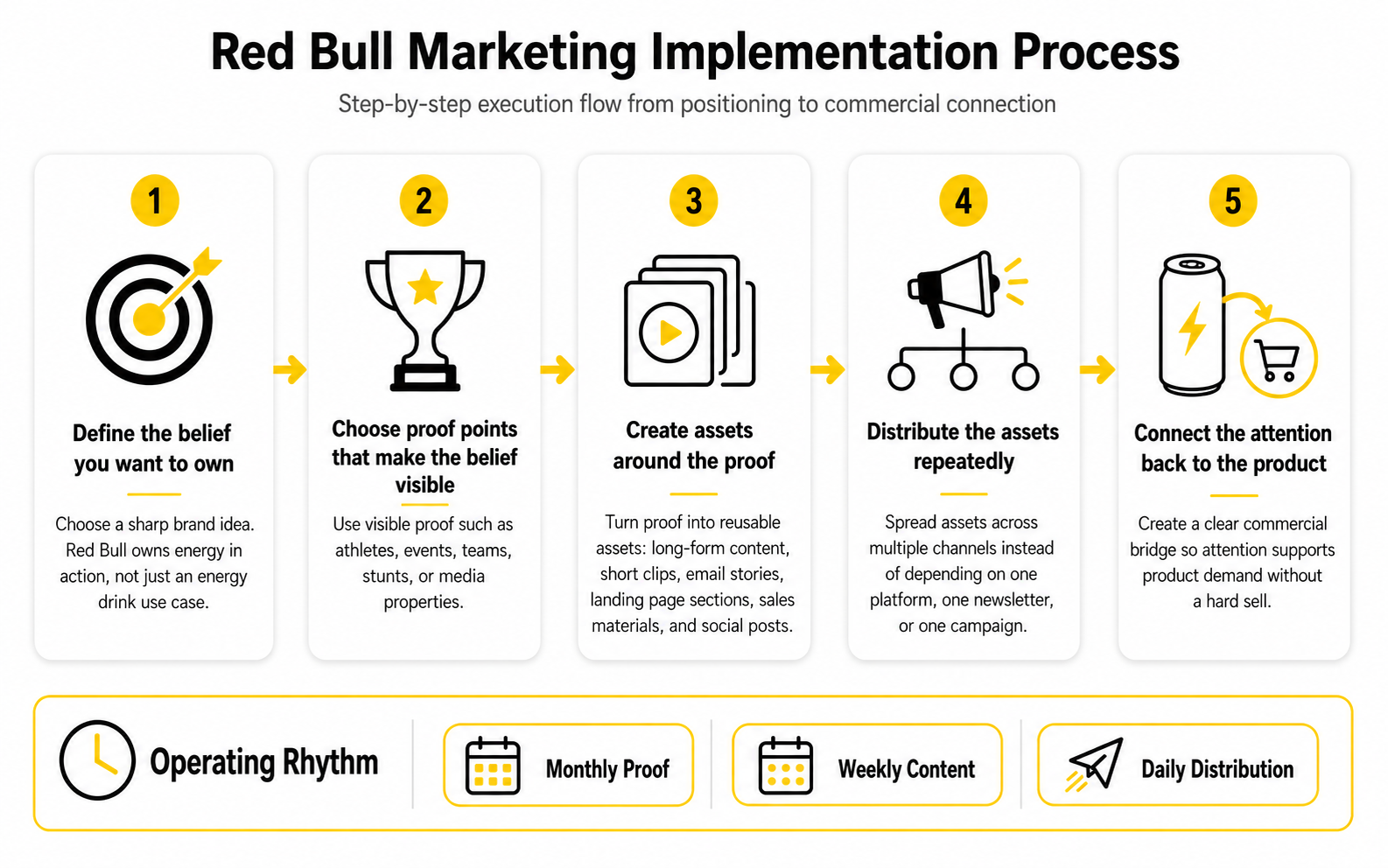
This process works because it avoids random marketing. Every activity has a job. Positioning gives direction, proof creates credibility, assets create leverage, distribution creates reach, and the product connection turns attention into business value.
Make The Product Easy To Remember
Red Bull’s product design is part of the marketing system. The slim can, blue-and-silver color scheme, two-bull logo, and “gives you wings” idea all help the brand stay recognizable in fast-moving environments. That consistency matters because the brand often appears in busy places where people are not studying the packaging closely.
The product also benefits from a simple mental shortcut. When people think of needing energy, Red Bull wants to be one of the first names that comes to mind. The marketing does not need to explain every ingredient every time because the brand has spent decades building that association.
For modern brands, this means your product should have memory hooks. That could be a clear visual identity, a repeatable phrase, a signature process, a named framework, or a distinctive way of presenting results. Without memory hooks, even good marketing becomes easy to forget.
Use Content To Expand The Category
Red Bull marketing does not only compete inside the beverage aisle. It expands the meaning of the category by showing more occasions where the product could belong. That is why its content universe includes sport, music, gaming, dance, culture, and work.
This is a strong move because categories are partly shaped by usage occasions. If the audience sees Red Bull only as a late-night drink, the market is smaller. If they associate it with studying, driving, training, gaming, performing, and creating, the number of relevant moments grows.
Other brands can use the same thinking without copying the aesthetic. A project management tool can expand from “task tracking” into “calmer team operations.” A landing page tool can expand from “page builder” into “faster campaign testing.” A CRM can expand from “contact database” into “follow-up discipline that actually drives revenue.”
Connect Community To Identity
Red Bull’s strongest communities are not built around the drink itself. They are built around identities people care about: athletes, fans, creators, gamers, dancers, motorsport followers, music scenes, and people who like ambitious physical performance.
That is a better community strategy than trying to make people gather around a product category. Most people do not want to join a “beverage community.” They may want to follow a racing team, watch a snowboard film, attend a music event, or support an athlete who represents a lifestyle they admire.
This is an important implementation lesson. Build community around the audience’s identity, not your internal product category. The product can support the community, but it should not suffocate it.
Keep The System Commercially Grounded
The Red Bull approach is creative, but it is not random creativity. The company still sells cans, expands distribution, builds partnerships, and protects brand recognition. The cultural layer exists because it supports the commercial engine.
This is where smaller brands need to be careful. It is easy to look at Red Bull marketing and think the answer is bigger content, louder stunts, or more entertainment. That misses the discipline underneath.
Every brand asset should eventually connect to a business outcome. That outcome might be awareness, qualified demand, stronger retention, better sales conversations, or higher trust before a purchase. If the content earns attention but never helps the business, it is not a strategy yet.
Turn The Model Into A Practical Operating Rhythm
A realistic Red Bull-inspired operating rhythm starts with monthly proof, weekly content, and daily distribution. That does not require a massive team. It requires discipline and a clear point of view.
A lean team might choose one strong proof asset per month, such as a customer result, expert interview, product experiment, or field report. Then it can turn that asset into a blog post, short videos, email angles, social posts, and sales snippets. Tools like GoHighLevel can help connect campaigns, follow-up, and lead management once the message is clear, but the real advantage comes from the system behind the tool.
The important part is consistency. Red Bull did not build its brand by producing one impressive campaign and disappearing. It built a recognizable world through years of aligned execution, and that is exactly why the model is worth studying.
Statistics And Data
Red Bull marketing looks creative on the surface, but the numbers show why the system matters commercially. This is not just a brand that gets attention. It is a brand that has turned attention into global distribution, brand value, content reach, and product demand.
The mistake is to treat these numbers like trivia. A useful benchmark should tell you what the business is proving, what the marketing system is producing, and what action the team should take next. Red Bull’s data is useful because it connects brand strength to real-world scale.
Red Bull says it sold 13.969 billion cans in 2025, was available in 178 countries, and employed 21,924 people by the end of the year (Red Bull company profile). Those numbers matter because they show the marketing system is not only good at awareness. It supports physical availability, repeat purchase, and long-term market presence.
What The Sales Numbers Really Mean
The can sales number is the cleanest signal because it reflects actual consumption. Red Bull is not simply building a famous brand that people admire from a distance. People are still buying the product at enormous scale.
That matters for interpretation. If a brand gets views but does not move product, the marketing may be entertaining but commercially weak. Red Bull’s sales volume shows that its cultural engine still connects back to the core business.
The better takeaway is not “be famous.” The better takeaway is “make attention useful.” Every event, media asset, athlete partnership, and retail touchpoint should make the product easier to remember, easier to trust, and easier to choose when the buying moment appears.
Brand Value Shows The Power Of Memory
Brand value is not the same as revenue, but it is still useful. It reflects how much economic strength the market associates with the brand name itself. In Red Bull’s case, that matters because the product category is competitive, retail-driven, and easy for consumers to compare.
Brand Finance valued Red Bull at €8.7 billion in 2025, with an 11% increase from the previous year, making it Austria’s most valuable brand in its Global 500 coverage (Brand Finance Global 500 2025 release). That number matters because it suggests the brand is still gaining strength even after decades in the market.
The action here is simple. Track whether people remember you for the thing you want to own. If your campaigns create short-term spikes but your brand association stays weak, you are not building memory. You are renting attention.
Media Reach Is A Distribution Asset
Red Bull Media House says it has relationships with more than 1,000 distribution partners across regional, national, and global channels including TV, VOD, OTT, FAST, digital, film, and innovation (Red Bull Media House partnerships). This matters because distribution is one of the most underrated parts of Red Bull marketing.
Most companies think content performance means platform metrics: views, likes, shares, comments, and click-through rates. Those numbers matter, but they are not the whole picture. Red Bull’s advantage is that it can move stories through many environments instead of depending on one algorithm.
That is the measurement lesson. Do not only ask, “How did this post perform?” Ask, “How many useful places can this asset travel?” A strong asset should be able to support social, search, email, sales, partnerships, PR, community, and paid distribution.
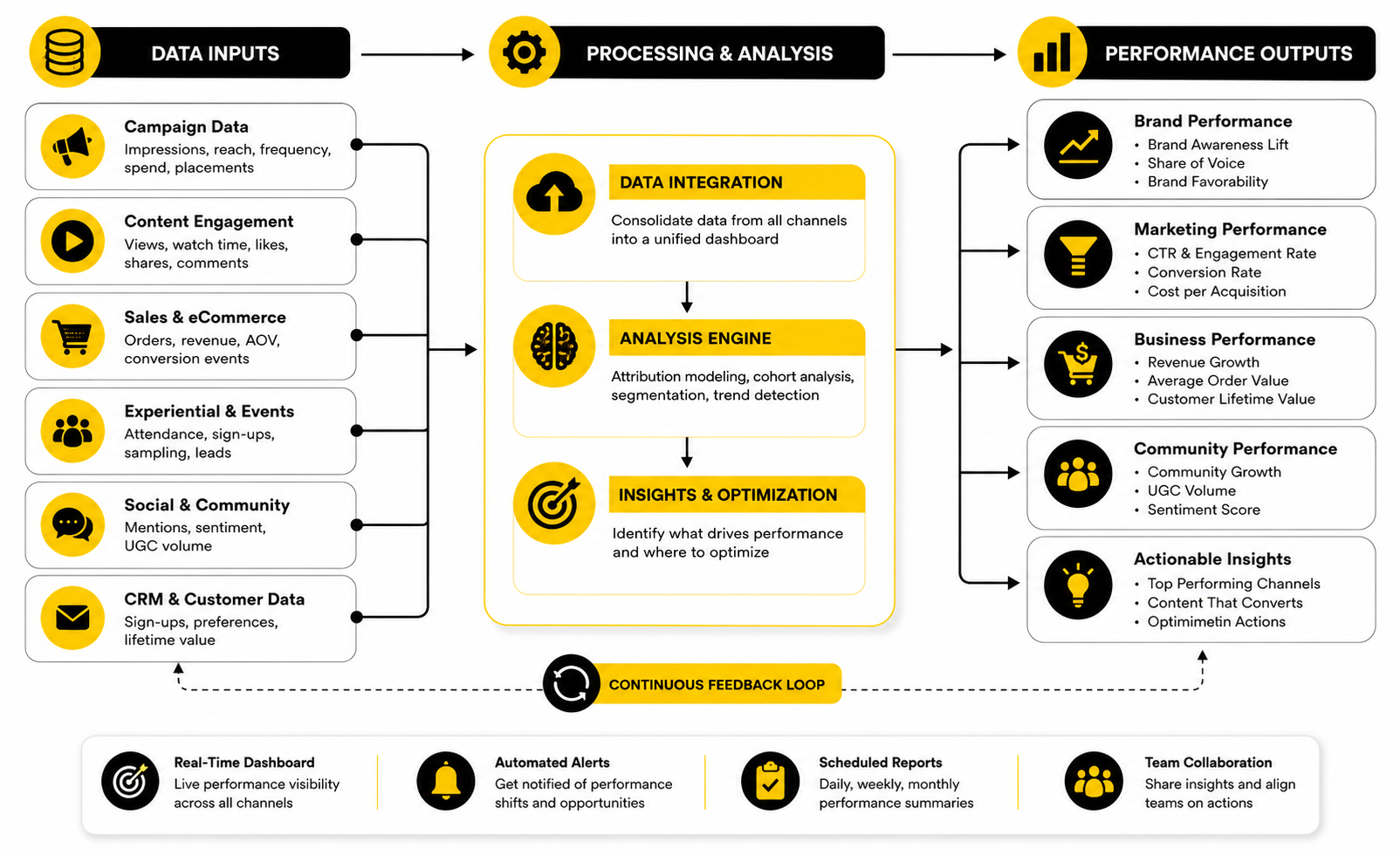
The Measurement System Behind The Strategy
A Red Bull-inspired measurement system should not start with vanity metrics. It should start with the role each asset plays in the brand system. Some assets create reach, some build trust, some drive search demand, some support conversion, and some strengthen retention.
This is where marketing teams need discipline. A live event should not be judged by the same metrics as a product landing page. A documentary-style video should not be judged only by direct-response clicks. A retail sampling program should not be measured like a newsletter campaign.
A practical measurement system can use four levels:
The point is not to track everything. The point is to know what each campaign is supposed to prove. If the goal is memory, do not panic because immediate conversions are low. If the goal is conversion, do not hide behind “brand awareness” when sales are flat.
Benchmarks That Actually Matter
Red Bull’s numbers are too large for most brands to use as direct benchmarks. A startup, agency, local business, creator brand, or ecommerce company should not compare itself to billions of cans sold or thousands of media partners. That kind of comparison creates bad strategy.
The more carefully benchmark is the ratio between inputs and compounding assets. For every major marketing activity, ask whether it creates something reusable. If a campaign creates one post and then dies, the leverage is low. If it creates a case study, clips, emails, ads, sales proof, partner content, and search traffic, the leverage is much higher.
This is where Red Bull marketing becomes useful for smaller teams. You can benchmark the quality of your system instead of the size of your budget. The question becomes: are you building assets that make the next campaign easier, stronger, and more credible?
How To Read Social And Content Performance
Social metrics can help, but they can also mislead. A high-view post may not change what people believe about the brand. A smaller post may be more valuable if it reaches the right audience and reinforces the right association.
For Red Bull, a clip of an athlete, race, stunt, or event is not only a content unit. It is a reminder of the brand’s world. The content keeps teaching the audience what Red Bull stands for without forcing a product pitch every time.
For your own brand, measure content by asking three questions. Did it reach the right people? Did it strengthen the right belief? Did it create an action or asset that can be used again? If the answer is no, the numbers may look good while the strategy stays weak.
How To Measure Brand Search
Branded search is one of the clearest signs that marketing is creating memory. When more people search for your brand name, product name, campaign name, or signature framework, it usually means your market has started to remember you. This is especially valuable because it captures demand that was created before the search happened.
Red Bull benefits from huge brand recognition, but the same principle applies at any size. If your content, partnerships, and campaigns are working, you should see more people looking for you directly. That is different from ranking for generic keywords, where you may be borrowing demand that already exists.
For smaller companies, branded search should be reviewed alongside direct traffic, repeat visitors, email list growth, and assisted conversions. If those signals move together, the marketing is probably building real demand. If only impressions increase, you may be getting seen without being remembered.
How To Measure Events And Partnerships
Events and partnerships are difficult to measure because their value often appears across several touchpoints. A person may first see an event clip, then follow the brand, then search later, then buy somewhere completely different. If you only measure last-click attribution, you will undercount the impact.
Red Bull’s event and sports ecosystem shows why this matters. A racing team, cliff diving competition, bike event, or music activation may produce content, press, fan engagement, retail relevance, and long-term brand association. The event is not just the event. It is a content engine and trust signal.
A practical measurement approach should include both direct and indirect signals. Direct signals include attendance, signups, scans, redemptions, leads, and sales tied to the event. Indirect signals include press mentions, social content output, branded search lift, partner reach, and reusable assets created from the experience.
What The Data Should Make You Do
Data should drive better decisions, not prettier reports. If content gets attention but does not improve memory, sharpen the positioning. If memory grows but demand does not, improve the bridge between content and offer. If demand grows but sales do not, fix conversion, distribution, or follow-up.
This is where many teams overcomplicate analytics. They build dashboards before they know what decisions the dashboard should support. Red Bull marketing is a useful reminder that measurement should connect back to the system: positioning, proof, media, distribution, and product demand.
For a lean team, the operating rhythm can be simple. Review attention weekly, memory monthly, demand monthly, and commercial outcomes quarterly. Tools like GoHighLevel, Brevo, or Buffer can help organize campaigns and reporting, but the real work is deciding which numbers actually change your next move.
The Most Important Performance Signal
The strongest signal is not one metric. It is consistency between metrics. Red Bull’s public numbers point in the same direction: massive global sales, strong brand value, broad distribution, and a media system built to keep attention flowing.
That alignment is the goal. You want your awareness metrics, brand signals, demand indicators, and commercial outcomes to support the same story. When they do, marketing stops feeling like scattered activity and starts acting like a business asset.
That is the real data lesson from Red Bull marketing. Do not chase numbers because they look impressive. Use numbers to see whether your brand is becoming easier to remember, easier to trust, and easier to buy.
Professional Implementation For Modern Brands
The advanced lesson from Red Bull marketing is that strategy has to survive scale. It is relatively easy to look bold when a brand is small, fast, and founder-led. It is much harder to keep the same energy when the business has global distribution, multiple teams, legal scrutiny, retail pressure, content operations, and partner expectations.
That is where Red Bull becomes especially useful to study. The brand has grown into a global organization while still protecting a recognizable point of view. It can sell billions of cans, run elite sports properties, publish media, and activate local markets without making the brand feel like a generic beverage company.
For a modern brand, the challenge is not copying Red Bull’s activities. The challenge is building a system that can expand without becoming diluted. Growth creates more opportunities, but it also creates more ways to lose focus.
The Tradeoff Between Brand Control And Cultural Reach
Red Bull gets cultural reach because it lets the brand live inside communities that already have their own language, heroes, and standards. That is powerful, but it also creates a tradeoff. The more a brand enters culture, the less it can control every interpretation.
This is why credibility matters so much. If a brand enters a community only to extract attention, people notice quickly. Red Bull’s strongest moves work because the brand often supports the activity itself, not just the advertising space around it.
Smaller brands should treat this seriously. If you want to build around creators, athletes, operators, founders, artists, or local communities, you need to give before you ask. Sponsorship without real contribution becomes decoration, and decoration does not build trust.
The Risk Of Confusing Spectacle With Strategy
Red Bull marketing includes spectacle, but the spectacle is not the strategy. The strategy is the consistent connection between energy, proof, media, distribution, and product demand. The spectacular moments work because they sit inside that system.
This distinction matters because many brands copy the loud part and ignore the structure. They launch a stunt, sponsor an event, or produce a big piece of content without a clear belief, a reusable asset plan, or a path back to the business. That can generate attention, but attention without direction disappears fast.
A better rule is simple: do not create a big moment unless you know what it is supposed to prove. If the moment does not strengthen the brand’s core association, it is probably a distraction. If it does, then the next question is whether the team can capture, package, distribute, and reuse it.
Scaling Requires A Clear Brand Operating System
As a company grows, brand consistency cannot depend on one person’s taste. It needs a clear operating system. Red Bull’s public-facing consistency suggests a disciplined set of choices around energy, action, youth culture, performance, and high-intensity experiences.
That does not mean every campaign looks the same. It means every campaign feels like it belongs to the same world. That is the difference between consistency and repetition.
A strong brand operating system should define:
Without this kind of system, scale creates noise. More channels, more partners, and more campaigns start pulling the brand in different directions. With it, scale creates compounding recognition.
The Partnership Filter Matters More Than The Partner List
Red Bull’s partnership world is large, but the important lesson is not the number of partners. It is the filter behind them. The brand can work across sports, music, lifestyle, and entertainment because each partnership has to make sense inside the broader idea of energy in action.
Red Bull Media House describes brand partnerships as long-term, strategic, and global, ranging from on-site activation at Red Bull events to native product integration in premium content productions (Red Bull Media House brand partnerships). That wording matters because it points to integration, not just logo placement.
For smaller brands, the best partner is rarely the biggest name you can afford. It is the partner who makes your positioning more believable. A niche expert, customer community, podcast host, event organizer, or creator can outperform a bigger partner if the fit is sharper.
Category Leadership Creates Legal And Competitive Pressure
Strong marketing can create a stronger business, but stronger businesses face more scrutiny. That is one of the less glamorous parts of category leadership. When a brand becomes powerful in retail, distribution, media, or partnerships, its decisions attract attention from regulators, competitors, and the public.
This matters for Red Bull because the European Commission opened a formal antitrust investigation in November 2025 to examine whether Red Bull may have restricted competition in the energy drinks sector, including concerns around retail visibility and larger competing energy drinks (European Commission investigation coverage). An investigation is not the same as a finding of wrongdoing, but it is still a reminder that market power brings risk.
The practical lesson is clear. Do not build a growth system that depends on tactics you would be uncomfortable explaining publicly. Retail incentives, exclusivity, category management, partnership terms, and competitive positioning all need governance as the brand becomes more influential.
Sustainability Is Part Of Brand Risk Now
Energy drink marketing does not exist in a vacuum. Packaging, sourcing, transportation, recycling, and environmental expectations all shape how people judge large beverage brands. This is especially important when a brand sells at global volume.
Red Bull says that since 2025 it has exclusively sourced ASI Aluminum for its beverage cans and notes that aluminum recycling is central to reducing the need for primary aluminum production (Red Bull sustainability). That kind of information matters because sustainability claims now sit close to brand trust, not just operations.
For modern brands, the takeaway is not to turn every campaign into an environmental message. The takeaway is to avoid a gap between the world your brand celebrates and the responsibilities your business creates. If the gap gets too wide, the marketing starts to feel less credible.
Advanced Measurement Needs Attribution Discipline
As marketing becomes more brand-led, attribution gets harder. A person may watch a video, follow an athlete, see an event clip, notice the product in a store, search the brand later, and buy offline. Last-click analytics will never explain that journey properly.
That does not mean measurement is impossible. It means the team needs to separate direct-response measurement from brand-system measurement. Direct-response campaigns can be judged by immediate conversion. Brand assets should be judged by reach, memory, search lift, engagement quality, earned visibility, and their ability to support future campaigns.
This is where a modern tech stack can help, but it cannot replace judgment. Tools like GoHighLevel, Brevo, ManyChat, and Buffer can organize follow-up, email, messaging, and publishing. The strategic decision is still deciding which activities should be measured for demand now and which should be measured for brand memory over time.
The Cost Of Consistency
Consistency is powerful, but it has a cost. A brand that commits to a strong position must say no to many attractive opportunities. Red Bull cannot chase every cultural trend without weakening the meaning it has spent decades building.
This is where discipline becomes a competitive advantage. Saying yes to everything makes a brand look active, but not necessarily stronger. Saying yes only to the right things builds a clearer memory in the market.
For smaller brands, this can feel uncomfortable. Turning down a campaign idea, partnership, or content trend may feel like lost reach. But if the opportunity does not reinforce the brand’s core belief, the hidden cost is confusion.
When Not To Use The Red Bull Model
The Red Bull model is powerful, but it is not the right answer for every business. Some companies need direct-response efficiency more than cultural expansion. Others operate in categories where trust, compliance, or technical proof matter more than entertainment.
A high-consideration B2B brand, for example, should not force an extreme sports aesthetic just because Red Bull made it work. It should translate the principle, not the surface. The equivalent might be original research, expert-led events, customer implementation content, or a strong industry community.
The test is whether the model helps buyers believe the right thing faster. If a brand-led content system improves trust, memory, and demand, it is worth building. If it only creates noise, it is not strategy.
The Expert-Level Takeaway
The expert-level takeaway is that Red Bull marketing works because the brand is willing to invest in meaning before asking for conversion. That is rare. Most companies want the benefits of brand without the patience required to build one.
But patience does not mean vague marketing. Red Bull’s system is practical because it turns meaning into assets, assets into distribution, and distribution into commercial strength. The creative work is connected to the business work.
That is the standard to aim for. Build a brand world that your audience actually wants to spend time in, but make sure every part of that world strengthens the same commercial engine. When that balance is right, marketing stops being a cost center and starts becoming infrastructure.
Key Lessons And Mistakes To Avoid
Red Bull marketing works because the brand does not treat attention as the finish line. Attention is only useful when it reinforces a memory, proves a promise, and creates more reasons to choose the product later. That is the difference between a flashy campaign and a compounding brand system.
The biggest lesson is that marketing becomes stronger when it behaves like infrastructure. Red Bull has product distribution, media assets, sports properties, cultural partnerships, retail presence, and a consistent brand idea all pushing in the same direction. That is why its public business signals are so strong: 13.969 billion cans sold in 2025, availability in 178 countries, and 21,924 employees by the end of that year (Red Bull company profile).
The mistake to avoid is copying the visible style while ignoring the operating logic. Red Bull is not successful because it chose extreme sports as a theme. It is successful because it chose a clear emotional territory, proved it repeatedly, packaged the proof into media, and distributed that media through a system built for longevity.
The Final Red Bull Marketing System
A complete Red Bull-inspired system has five parts. Each part has to connect to the next one, or the strategy starts to leak. This is where many brands fail because they build isolated campaigns instead of a connected engine.
The first part is meaning. The brand needs a clear idea people can remember and repeat. The second is proof, because the audience needs evidence that the brand actually lives that idea.
The third is media, where the proof becomes something people can watch, read, share, and revisit. The fourth is distribution, where the content moves across owned, earned, paid, partner, community, and sales channels. The fifth is commercial connection, where all that attention eventually makes the product easier to buy, trust, and recommend.
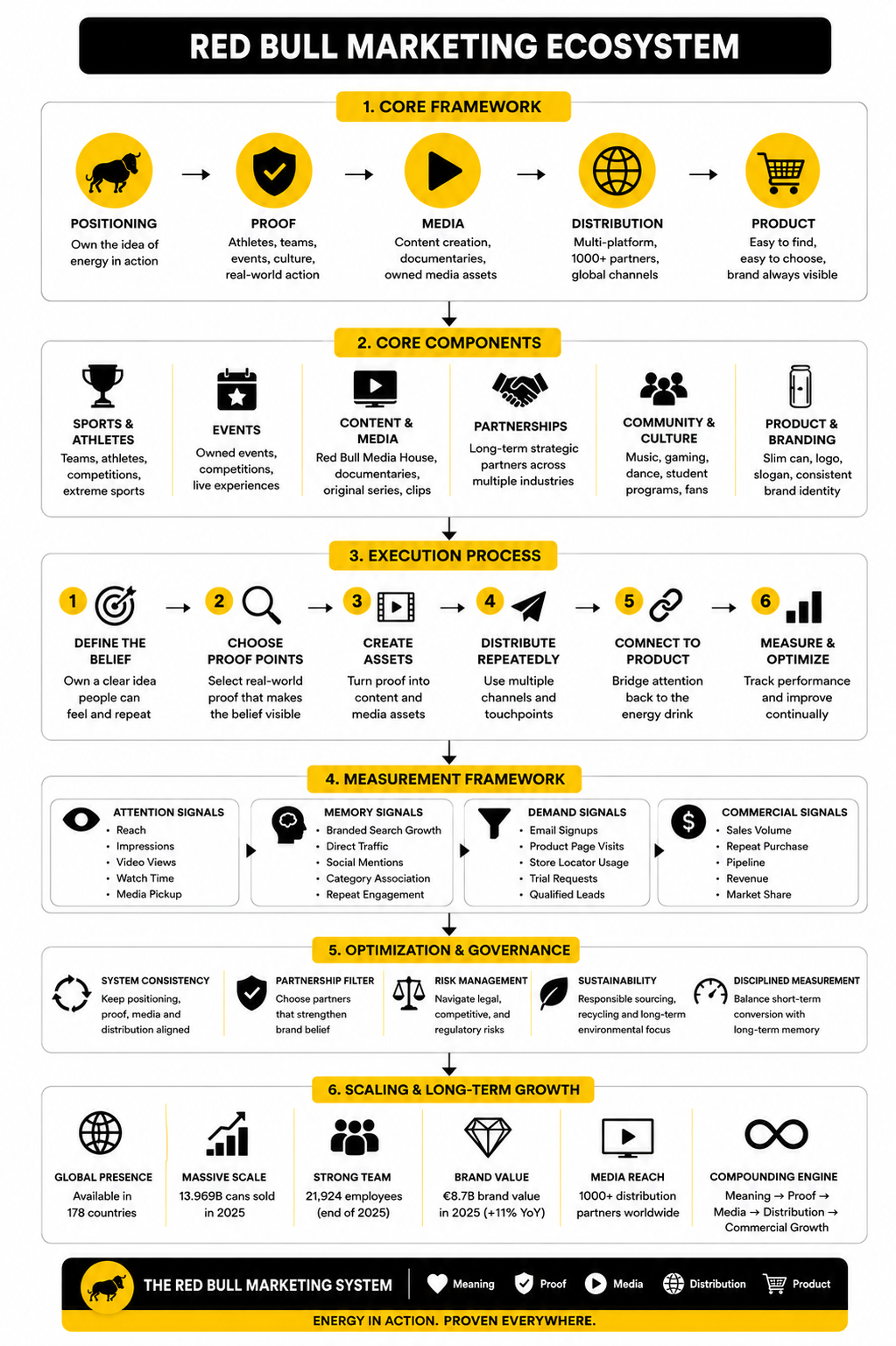
The order matters. If you start with distribution before meaning, you get noise. If you start with content before proof, you get weak storytelling. If you start with conversion before trust, you usually get expensive acquisition and low brand memory.
Practical Takeaways For Your Own Brand
The practical move is to shrink the Red Bull marketing model until it fits your reality. You do not need a racing team, global media house, or extreme sports budget. You need a repeatable way to prove what your brand stands for.
Start with one belief your audience wants to identify with. Then choose one proof format you can produce consistently. That might be customer transformations, expert breakdowns, field tests, original research, creator collaborations, public challenges, or community-led events.
From there, build a simple content loop. Capture the proof, turn it into useful assets, distribute those assets through several channels, and measure whether people are remembering you for the right thing. If they are not, the answer is usually sharper positioning, stronger proof, or better distribution.
Mistakes That Weaken The Model
The first mistake is chasing attention without a clear brand association. A campaign can get views and still fail if nobody remembers what the brand stands for. Reach is useful only when it leaves a meaningful trace.
The second mistake is treating every channel as a separate strategy. Social, email, search, partnerships, events, and sales content should not feel like disconnected departments. They should all express the same belief from different angles.
The third mistake is over-measuring short-term conversion and under-measuring memory. Some brand assets are not designed to produce immediate sales. They are designed to make future sales easier, and that requires a wider view of performance.
The fourth mistake is entering communities without giving anything back. Red Bull’s strongest cultural moves work because the brand supports the activity, not just the advertisement around it. A smaller brand has to earn that same right at its own scale.
What is Red Bull marketing?
Red Bull marketing is the brand system Red Bull uses to connect its energy drink with performance, sport, culture, media, and high-energy experiences. It goes far beyond traditional advertising because the brand creates events, owns teams, funds athletes, produces content, and distributes stories people want to watch. The result is a marketing model where the product benefits from a much larger cultural ecosystem.
Why is Red Bull marketing so successful?
Red Bull marketing is successful because it is consistent, emotional, and asset-driven. The brand owns a clear idea around energy in action, then proves that idea through sports, media, events, and partnerships. That consistency helps people remember the brand before they reach the buying moment.
What is the main strategy behind Red Bull marketing?
The main strategy is to build a brand world around energy rather than only promoting drink features. Red Bull uses positioning, proof, media, distribution, and product availability as one connected system. This makes the brand feel bigger than the beverage category while still supporting product demand.
Does Red Bull rely more on content or advertising?
Red Bull uses advertising, but its more distinctive advantage is content and cultural infrastructure. Red Bull Media House describes itself as a globally distributed multi-platform media company, and its partnerships page highlights relationships with more than 1,000 distribution partners across TV, VOD, OTT, FAST, digital, film, and other channels (Red Bull Media House). That makes content a central part of the brand system, not just a support channel.
What can small businesses learn from Red Bull marketing?
Small businesses can learn to build proof before promotion. Instead of posting random content, they should define a clear belief, prove it through real work, package that proof into reusable assets, and distribute it consistently. The lesson is not to copy Red Bull’s budget; the lesson is to copy the discipline behind the system.
How does Red Bull use sports in marketing?
Red Bull uses sports as proof of its brand promise. The brand connects with performance, risk, discipline, competition, and physical energy through athletes, teams, events, and media coverage. Sports are not just decoration for the brand; they make the positioning visible.
Why does Red Bull create its own events?
Red Bull creates events because events turn brand meaning into lived experience. An event can generate attention, content, media coverage, community engagement, partner value, and long-term memory. This is more powerful than a campaign that appears once and disappears.
How should a brand measure a Red Bull-style marketing strategy?
A brand should measure attention, memory, demand, and commercial outcomes separately. Attention includes reach and engagement, memory includes branded search and direct traffic, demand includes signups or product interest, and commercial outcomes include revenue or sales volume. The point is to judge each asset by its role instead of forcing every campaign into the same conversion metric.
What is the biggest risk of copying Red Bull marketing?
The biggest risk is copying the spectacle without the strategy. Big stunts, flashy videos, and sponsorships are not useful if they do not reinforce a clear brand position. Without meaning, proof, distribution, and commercial connection, the campaign may get attention but fail to build business value.
Is Red Bull marketing only about extreme sports?
No. Extreme sports are one visible part of the system, but Red Bull marketing also extends into Formula 1, music, gaming, dance, student programs, media, lifestyle, and everyday energy occasions. The real theme is not extreme sports specifically. The real theme is energy in action.
How does Red Bull connect brand marketing to sales?
Red Bull connects brand marketing to sales by keeping the product close to the world it creates. The content and events build memory, while distribution makes the product easy to find when the buying moment appears. That bridge between cultural attention and physical availability is one reason the system works commercially.
What makes Red Bull different from other beverage brands?
Red Bull behaves less like a beverage advertiser and more like a media, sports, and culture company attached to a beverage product. Its brand value reached €8.7 billion in 2025, with an 11% year-over-year increase, making it Austria’s most valuable brand in Brand Finance’s Global 500 coverage (Brand Finance). That brand strength comes from years of consistent meaning, not just product availability.
Can B2B companies use Red Bull marketing principles?
Yes, but they should translate the principles instead of copying the style. A B2B company might use original research, customer proof, expert content, implementation events, and founder-led media instead of sports or entertainment. The goal is the same: own a valuable belief, prove it publicly, and distribute the proof repeatedly.
What is the simplest way to apply this strategy?
The simplest way is to choose one promise, one proof format, and one distribution rhythm. For example, a company could publish one strong customer proof asset per month, break it into multiple content formats, and use tools like Buffer, Brevo, or GoHighLevel to keep publishing and follow-up organized. The tool helps, but the real leverage comes from the repeatable proof system.
Build a stronger local presence with BAAM AI
Turn your website, Google profile, social channels, and AI visibility into one growth engine
Most businesses do not need more random marketing activity. They need a consistent presence system that helps the right people find them, trust them, and take action. BAAM AI brings strategy, local SEO, website updates, Google Maps visibility, social content, AI-search readiness, media production, and reporting into one practical monthly engine.
If you want your marketing to keep working after the campaign ends, start with a free BAAM AI presence audit. See how your business shows up today and where the fastest visibility wins are at BAAM AI.