
BAAM AI Blog
PSG Digital Marketing: The Practical Playbook Behind a Global Football Brand
PSG digital marketing is not just about posting goals, player photos, and matchday graphics. It is the business engine that helps Paris Saint-Germain turn football attention into global fandom, partner value...
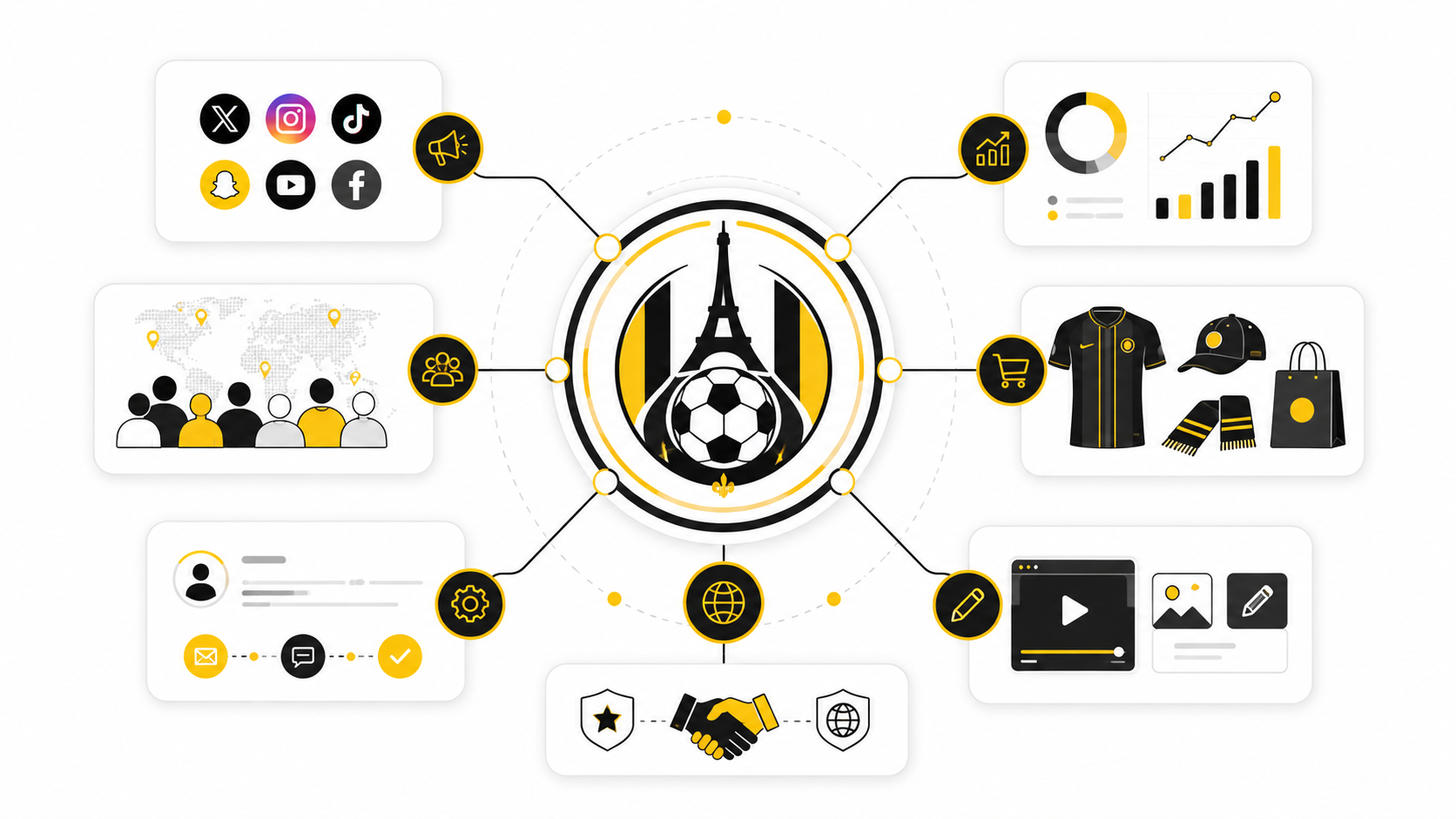
PSG digital marketing is not just about posting goals, player photos, and matchday graphics. It is the business engine that helps Paris Saint-Germain turn football attention into global fandom, partner value, merchandise demand, ticketing momentum, app engagement, and cultural relevance. That matters because modern clubs no longer compete only on the pitch; they compete every day in feeds, inboxes, apps, search results, creator ecosystems, and commerce journeys.
Paris Saint-Germain is a useful case study because the club sits at the intersection of sport, fashion, entertainment, and international brand building. The club reported €837 million in revenue for the 2024–25 season, with commercial revenue reaching €367 million, showing how far its business model extends beyond matchday income alone through sponsorships, brand partnerships, and global fan monetization PSG record financial season. Deloitte also ranked Paris Saint-Germain fourth in the 2026 Football Money League, noting the club’s ability to use brand equity and culture-led partnerships to drive commercial growth Deloitte Football Money League 2026.
The lesson is not “copy PSG.” Most brands do not have Champions League nights, superstar athletes, or a global fanbase already waiting. The real lesson is more useful: PSG digital marketing works because it connects attention, identity, community, content, partnerships, and commerce into one system.
Why PSG Digital Marketing Matters
PSG digital marketing matters because football attention is fragmented now. A fan might discover a club through a TikTok clip, follow a player on Instagram, buy a shirt because of a fashion collaboration, watch highlights on YouTube, join a matchday conversation on X, and later download the club app. The customer journey is no longer linear, so the marketing system has to meet fans wherever their relationship with the club begins.
This is especially important for a club like Paris Saint-Germain because its brand is not limited to local supporters in Paris. PSG has spent years building international relevance through football performance, lifestyle positioning, and partnerships that reach audiences who may care about sport, fashion, music, gaming, or street culture before they care about Ligue 1. That broader positioning gives the club more ways to grow revenue, but it also raises the standard for consistency across every digital touchpoint.
The commercial stakes are real. Deloitte’s recent football revenue analysis shows that top clubs increasingly rely on commercial growth alongside matchday and broadcast income, with elite clubs using brand strength to expand beyond traditional football economics Deloitte Football Money League. PSG’s own 2024–25 financial update reinforces that point: commercial revenue was one of the club’s biggest revenue pillars, which means digital marketing is not a side activity; it is part of the business model.
The PSG Digital Marketing Framework
A strong PSG digital marketing framework starts with one simple idea: attention is only valuable when it moves somewhere. A viral post is useful, but it becomes more powerful when it leads to fan registration, app usage, merchandise sales, sponsor exposure, ticket interest, or long-term community growth. This is where many brands get digital marketing wrong; they chase reach without building the next step.
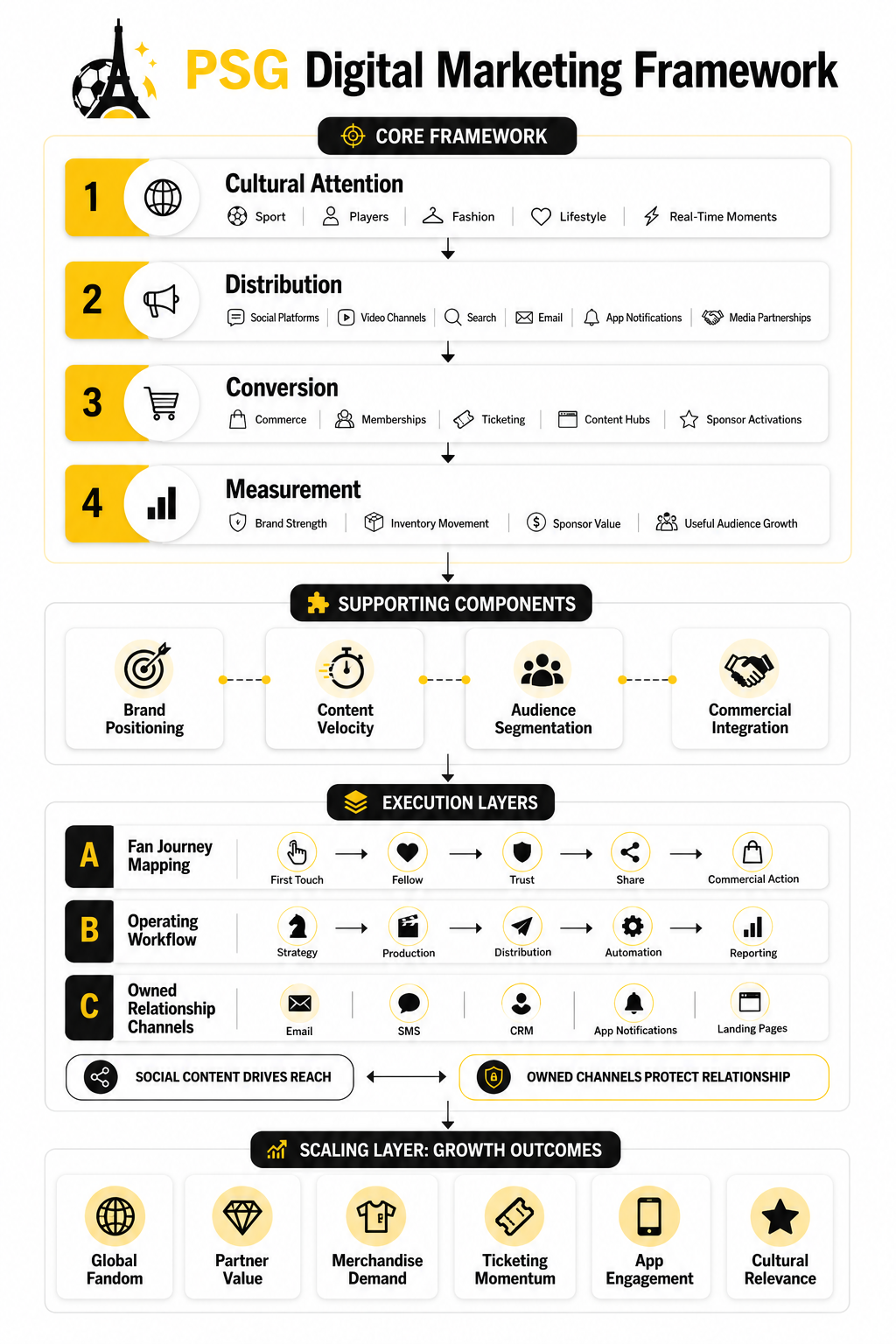
PSG’s model can be understood as a connected system with four layers. First, the club creates cultural attention through sport, players, fashion, lifestyle, and real-time moments. Then it distributes that attention through social platforms, video channels, search, email, app notifications, and media partnerships. After that, it converts interest into owned audiences and revenue opportunities through commerce, memberships, ticketing, content hubs, and sponsor activations.
The final layer is measurement. A professional digital marketing team cannot rely on likes alone, because likes do not explain whether a campaign strengthened the brand, moved inventory, improved sponsor value, or grew a useful audience segment. For a club with global scale, the more carefully question is not “Did this post perform?” but “What did this moment do for the fan journey?”
The Core Components of the Framework
The first component is brand positioning, because every channel needs a clear identity. PSG has built a brand that does not behave like a traditional football club only; it behaves like a Paris-based sports and culture platform. That positioning gives its digital team more creative range than a club that only speaks in fixtures, scores, and press releases.
The second component is content velocity, because football moves fast. Matchdays, transfers, training sessions, injuries, trophies, player milestones, and fan reactions create a constant stream of moments. PSG digital marketing benefits when the team can turn those moments into content quickly without losing quality or brand control.
The third component is audience segmentation, because PSG does not speak to one type of fan. A lifelong supporter in Paris, a new fan in Asia, a fashion-driven buyer in the United States, and a young fan following a single player all need different entry points into the brand. The message can stay consistent, but the format, language, platform, and call to action should change.
The fourth component is commercial integration. This includes sponsor campaigns, merchandise drops, ticketing pushes, app growth, email capture, and partner storytelling. The key is making these commercial moments feel native to the fan experience rather than bolted on after the creative idea is finished.
Professional Implementation Starts With System Thinking
Professional implementation of PSG digital marketing would not start with “post more content.” It would start with mapping the full fan journey from first touch to repeat engagement. That means defining where fans discover the brand, what makes them follow, what earns their trust, what gets them to share, and what eventually moves them toward a commercial action.
The practical workflow should connect strategy, production, distribution, automation, and reporting. Social content brings reach, but owned channels protect the relationship. Email, SMS, CRM, app notifications, and landing pages give a sports brand more control than rented social platforms alone, especially when algorithms shift or platform reach becomes less predictable.
This is where marketing tools can help, but only when the strategy is already clear. A club, agency, or sports brand building fan journeys might use a platform like ManyChat for automated social messaging, Buffer for organized publishing workflows, or GoHighLevel for CRM-style campaign infrastructure. The tool is never the strategy, though; the tool simply helps the team execute the system with less chaos.
Brand Positioning: Turning a Football Club Into a Cultural Platform
The next layer of PSG digital marketing is brand positioning, and this is where the club becomes much more interesting than a normal sports marketing case study. Paris Saint-Germain does not position itself only as a team that plays in Paris. It positions itself as a Paris-born cultural brand that happens to operate through elite football, and that distinction changes almost everything about its digital strategy.
That positioning gives PSG more room to speak to different audiences without sounding confused. A football-first supporter can connect through match content, academy updates, player interviews, and competition narratives. A fashion-led audience can connect through kits, capsules, pop-ups, and lifestyle campaigns, especially when collaborations make the club feel relevant outside the stadium.
This is why the PSG brand can show up in places where many clubs would feel forced. Its long-running work with Jordan Brand has helped connect football, basketball, streetwear, and Parisian identity into a recognizable lifestyle lane, with the 2025 Jordan Wings x Paris Saint-Germain collection framed around sport, style, and culture Jordan Wings x Paris Saint-Germain collection. That does not happen by accident. It works because PSG has spent years making the club badge mean more than ninety minutes of football.
Paris Is the Brand Advantage
Paris gives PSG a positioning asset that most clubs cannot manufacture. The city already carries global associations with fashion, luxury, art, design, food, nightlife, and aspiration. PSG digital marketing becomes stronger when it uses those associations carefully instead of treating the city as simple background scenery.
That is why the club’s visual identity often matters as much as the message itself. The badge, the Eiffel Tower symbol, the navy-red-white palette, the stadium atmosphere, and the Paris lifestyle references all help the club communicate before a caption is even read. Strong digital brands do this well: they make the audience feel the world of the brand instantly.
The mistake would be using Paris as decoration only. The better move is using Paris as a strategic filter. If a campaign, partnership, content series, or merchandise drop does not feel connected to performance, ambition, taste, culture, or the energy of the city, it probably weakens the brand instead of strengthening it.
Lifestyle Partnerships Expand the Audience
The reason lifestyle partnerships matter is simple: they let PSG enter conversations that football content alone may never reach. Someone might not watch Ligue 1 every week, but they may notice a Jordan x PSG piece, a Paris pop-up, a music-led campaign, or a fashion collaboration. That first touch can become the beginning of a fan relationship.
Recent PSG brand activity shows this clearly. The club’s La Maison concept was presented as an immersive cultural project rather than a standard retail activation, with events and collaborations designed to connect PSG with younger, culture-driven audiences PSG La Maison lifestyle brand coverage. That matters because modern fandom is not always inherited through family or geography anymore. Sometimes it starts with identity, aesthetics, creators, and shared cultural signals.
For marketers, the lesson is practical. Partnerships should not be chosen only because the partner is famous. They should expand the brand’s meaning, create content people actually want to share, and make the commercial offer feel like part of the story rather than an interruption.
The Badge Has to Travel Without Losing Its Meaning
Global football brands face a hard problem: they need to grow internationally without becoming generic. PSG has to speak to fans in Europe, Asia, North America, the Middle East, Africa, and Latin America while still feeling unmistakably Parisian. That balance is difficult, and it is one of the biggest strategic challenges in PSG digital marketing.
The club’s international content can adapt language, platform behavior, player focus, and cultural references, but the brand core needs to stay stable. If every market gets a completely different PSG, the brand becomes fragmented. If every market gets the exact same message, the content can feel distant and lazy.
The better approach is controlled flexibility. Keep the identity consistent, then localize the entry point. A Japanese fan, a French season-ticket holder, and a U.S. streetwear buyer may all care about different things, but each should still feel they are interacting with the same Paris Saint-Germain.
Content Strategy: How PSG Keeps Global Fans Engaged
Content is the visible part of PSG digital marketing, but it is not the whole machine. The public sees posts, videos, player graphics, behind-the-scenes clips, and matchday reactions. Behind that, a serious digital team needs editorial planning, creative production, rights management, channel strategy, localization, approvals, analytics, and commercial coordination.
PSG has a natural content advantage because football creates constant drama. Every match has stakes, every goal creates emotion, every transfer window creates speculation, and every player has a personal audience. The job of the digital team is not to invent excitement from nothing; it is to capture the right moments, package them well, and guide fans toward the next interaction.
This is where discipline matters. A club can easily flood channels with content and still fail to build a stronger brand. Good PSG digital marketing is not just frequent; it is intentional, with clear roles for short-form video, long-form storytelling, photography, website content, email, app experiences, and commerce pages.
Matchday Content Creates the Emotional Peak
Matchday is the highest-intensity content window because attention is concentrated. Fans want lineups, warmups, stadium atmosphere, live updates, tactical context, goals, reactions, interviews, and emotional closure. A strong matchday content system gives them that journey without making the experience feel mechanical.
The best matchday content usually has a rhythm. Before the match, the focus is anticipation. During the match, the focus is immediacy and emotion. After the match, the focus shifts to meaning: what the result changes, who stood out, what the players said, and what fans should care about next.
For PSG, this rhythm also supports commercial opportunities when handled carefully. A post-match shirt push, sponsor integration, ticket reminder, or app-exclusive clip can work if it fits the moment. But timing matters. Push too hard at the wrong emotional point, and the brand sounds like it is selling instead of sharing the experience.
Player-Led Content Extends the Club’s Reach
Players are distribution channels now. That is not a cynical statement; it is just how modern football attention works. A player’s personal following can introduce PSG to people who may not yet follow the club directly, which makes player-led storytelling a major part of the digital marketing mix.
The smartest approach is not to treat players as billboards. Fans respond better when content shows personality, preparation, humor, pressure, recovery, ambition, and human detail. Training-ground clips, short interviews, dressing-room reactions, and personal milestones can all make the club feel closer without turning everything into a polished advertisement.
There is also a risk here. If the club brand depends too heavily on individual stars, the audience can leave when the player leaves. PSG digital marketing has to benefit from player reach while still building loyalty to the club itself, the city, the badge, and the wider community.
Long-Form Storytelling Builds Deeper Fan Value
Short-form content wins quick attention, but long-form storytelling builds deeper memory. Documentaries, extended interviews, YouTube features, academy stories, tactical explainers, and behind-the-scenes series give fans a reason to spend more time with the brand. That matters because time spent is often a stronger relationship signal than a casual like.
PSG’s YouTube growth shows why long-form and premium video matter. The club passed 10 million YouTube subscribers in 2026, with more than 1.7 billion cumulative views and strong subscriber growth since July 2024 PSG YouTube subscriber milestone. That kind of channel gives the club more than visibility. It creates an owned media habit inside a platform where fans already consume sports, entertainment, and creator content.
For brands studying PSG, the point is not “start a YouTube channel and upload everything.” The point is to understand which stories deserve depth. A great behind-the-scenes feature can support trust, loyalty, and brand meaning in ways that a dozen disposable clips cannot.
Social Media, Community, and Creator-Led Growth
Social media is where PSG digital marketing becomes visible at scale, but the real work is not simply being active on every platform. The club has to turn global attention into recognizable patterns of engagement: fans watching, commenting, sharing, subscribing, buying, and returning. That requires a channel system, not random posting.
Paris Saint-Germain’s own 2025–26 business update said the club had reached 235 million social media followers, with 40% under the age of 24, while also ranking first on Twitch, second on TikTok for the season, and passing 1 billion TikTok views since July 2025 PSG record financial season. Those numbers matter because they show the club is not only speaking to legacy football audiences. It is building with younger fans who often discover clubs through short-form video, creators, gaming culture, and personality-led content.
The practical takeaway is clear. PSG digital marketing works best when each platform has a job. TikTok can create discovery, Instagram can build identity and visual culture, YouTube can deepen attention, Twitch can support live community energy, X can serve real-time conversation, and the club’s owned platforms can capture higher-value relationships.
Platform Roles Come Before Posting Volume
A professional digital team should never start with the question, “How many times should we post?” That question comes later. The better starting point is, “What role does this channel play in the fan journey?”
For PSG, short-form platforms are ideal for speed, emotion, humor, player moments, training clips, and matchday reactions. YouTube is better suited to longer stories, premium series, exclusive access, documentaries, and content that fans intentionally search for. Community platforms and messaging channels are different again because they can create more direct interaction instead of passive consumption.
This distinction matters because posting the same asset everywhere usually weakens the result. A dramatic tunnel clip might work on TikTok with fast editing, on Instagram as a polished Reel, on YouTube Shorts with a stronger title, and inside an email as part of a matchday recap. Same moment, different packaging, different purpose.
Community Turns Attention Into Belonging
Attention is temporary. Community is stickier. That is why PSG digital marketing cannot depend only on reach metrics, even when the numbers look impressive.
Community-led channels create a different kind of relationship because fans are not just watching the club; they are participating with each other. PSG’s Discord initiative, developed with WePlay, was built around interactive experiences such as trivia, live events, gamified engagement, and rewards systems, placing the club closer to sports, gaming, and entertainment culture PSG Discord fan engagement. That kind of environment gives younger fans a reason to return between matches.
The mistake many brands make is treating community like another broadcast channel. It is not. A real community needs prompts, rituals, moderation, rewards, recognition, and a reason for fans to feel seen.
Creators Help Translate the Brand
Creators can do something a club account cannot always do: translate the brand into specific communities. A club account speaks with authority, but creators speak with familiarity. That makes creator-led growth especially useful when PSG wants to reach fans who care about football culture, fashion, gaming, travel, lifestyle, or local-language content.
This does not mean handing the brand to anyone with a large audience. Creator fit matters more than follower count. The right creator should understand the emotional language of football, the cultural weight of Paris, and the difference between authentic enthusiasm and sponsored noise.
For implementation, creators should be briefed around the moment, not micromanaged into sounding like the brand account. Give them the context, the guardrails, the key message, and the desired action. Then let them create in the format their audience already trusts.
The PSG Digital Marketing Execution Process
This is where the framework becomes tangible. PSG digital marketing can look glamorous from the outside, but behind the scenes it needs process, ownership, timing, and feedback loops. Without that, the team ends up reacting all day and calling it strategy.
The execution process should move from objectives to audience, from audience to content, from content to distribution, and from distribution to measurement. Each step should answer a real business question. What are we trying to grow? Who are we speaking to? What moment are we using? Where will the fan go next? How will we know if it worked?
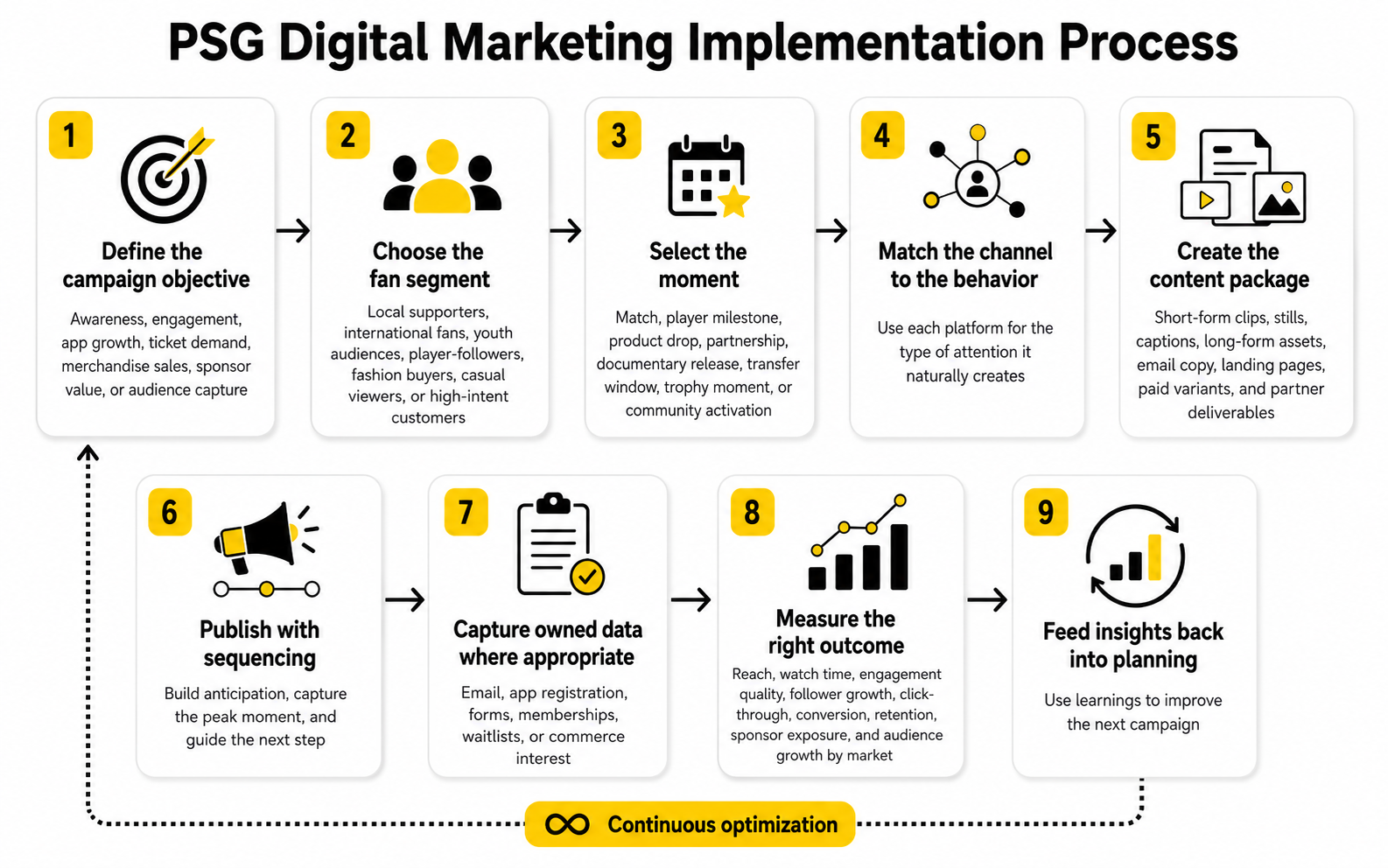
A practical execution flow looks like this:
This kind of process is not only useful for PSG. It is useful for any sports brand, creator-led business, or agency trying to turn attention into a stronger commercial system. The difference is scale, not the logic.
Campaign Planning Needs One Clear Owner
When a campaign touches social, video, paid media, commerce, sponsors, CRM, and content production, confusion becomes expensive. Someone has to own the campaign outcome, not just their individual channel. Otherwise every team can technically do its job while the overall campaign still feels disconnected.
A strong campaign owner keeps the brief clean. They define the core message, the audience, the timeline, the approval path, the channel mix, and the success metrics. They also protect the campaign from becoming bloated, because sports brands often have too many stakeholders trying to add one more message.
For PSG digital marketing, this matters even more because the brand often works across languages, territories, partners, competitions, and talent schedules. The more complex the organization, the more valuable a simple campaign operating system becomes. Clear ownership is not bureaucracy; it is how good ideas survive execution.
Content Production Should Be Built Around Moments
Football content is time-sensitive. A post that would be perfect ten minutes after full-time can feel stale the next morning. That is why production workflows need to be built around moments, not only around calendar slots.
The team should know in advance which moments need pre-produced assets and which moments need live capture. Lineups, fixtures, player birthdays, partnership drops, and ticket reminders can be planned ahead. Goals, injuries, emotional reactions, viral fan moments, and match outcomes need faster editorial judgment.
This is where asset libraries matter. A good system gives the team quick access to player photos, brand templates, sponsor rules, approved captions, localization notes, historical stats, and product links. The creative work still needs taste, but the process removes avoidable friction.
Automation Should Support the Fan Journey
Automation is useful when it makes the fan experience smoother. It becomes harmful when it makes the brand feel cold. PSG digital marketing should use automation to support high-intent actions, not to replace human storytelling.
For example, a fan who comments on a campaign post could be guided toward a relevant experience through ManyChat, especially when the next step is a merch drop, a ticket waitlist, or a downloadable piece of content. A team managing many campaign assets could use Buffer to organize publishing across channels without losing visibility. A club, agency, or sports business that needs CRM, funnels, follow-up, and campaign automation in one place could build that operating layer with GoHighLevel.
The key is restraint. Automation should help fans get what they asked for, remind them at the right moment, and route them to the right next step. It should not spray generic messages at everyone just because the tool makes it easy.
Landing Pages and Forms Complete the Loop
Social platforms create demand, but landing pages and forms convert demand into something usable. This is one of the most overlooked parts of sports marketing. If a fan is excited enough to click, the next page must respect that intent immediately.
A campaign landing page should be focused, fast, mobile-first, and specific to the moment. If the campaign is about a shirt drop, the page should move people toward the product. If it is about a fan event, the page should make registration simple. If it is about a sponsor activation, the page should explain the value without burying the fan in corporate copy.
Tools such as Fillout can help teams collect registrations, preferences, survey responses, and waitlist demand without overcomplicating the setup. For commerce-focused campaign pages, a platform like Replo can be useful when the priority is building polished, conversion-focused landing experiences. Again, the tool is secondary; the real win is connecting fan attention to a clean next action.
Turning Engagement Into Owned Audience Growth
The biggest weakness in many social strategies is dependency. A club can build huge audiences on social platforms and still have limited control over the relationship. Algorithms change, reach fluctuates, platform behavior shifts, and paid distribution gets more expensive.
Owned audience growth reduces that risk. Email lists, app users, registered members, SMS subscribers, community profiles, and customer records give the brand more control. They also make it easier to personalize communication based on location, language, purchase behavior, content preference, and fan maturity.
For PSG digital marketing, owned audience growth is the bridge between entertainment and business value. A viral clip is great, but a registered fan who buys, attends, watches, shares, and returns is more valuable. The practical goal is not to pull fans away from social platforms; it is to use social attention to build a relationship the club can continue beyond the feed.
Data Capture Has to Feel Worth It
Fans do not hand over data because a brand wants it. They do it when the value exchange is obvious. That could mean early access, exclusive content, ticket priority, limited merchandise, matchday rewards, community status, or personalized updates.
The value exchange should be specific. “Sign up for updates” is weak. “Get early access to the drop” is stronger. “Join the Paris presale list before general release” is stronger again because it connects the action to a clear benefit.
This matters because trust is fragile. PSG digital marketing should treat data capture as a relationship step, not a trick. When fans feel the club respects their attention, they are more likely to keep engaging.
Segmentation Makes Follow-Up Feel Relevant
Once a fan enters the owned audience, the follow-up should not be generic. A fan who registered for a youth academy content series should not receive the same journey as someone who clicked on a limited fashion drop. Different intent needs different messaging.
Useful segmentation can be simple at first. Segment by location, language, preferred content type, purchase history, ticket interest, community activity, and platform source. Even basic segmentation can make campaigns feel more relevant and reduce the sense that every fan is receiving the same blast.
This is also where PSG’s global nature becomes a real operational challenge. The club needs enough localization to feel personal without creating a separate strategy for every market. Smart segmentation gives the team that middle ground.
Reporting Should Connect Content to Commercial Outcomes
Engagement data is useful, but it is not the finish line. A post can perform well and still do little for the business. Another post can generate fewer likes but drive stronger registrations, sales, sponsor exposure, or app usage.
The reporting layer should connect content metrics with downstream outcomes. Track which formats create followers, which channels drive clicks, which markets convert, which creators bring qualified traffic, which landing pages hold attention, and which campaigns improve repeat behavior. That is how digital marketing becomes a decision system instead of a highlight reel.
This is the professional line. Amateur reporting celebrates big numbers without context. Professional PSG digital marketing asks what the numbers actually changed.
Statistics and Data: What PSG Digital Marketing Numbers Actually Mean
The problem with digital marketing data is that big numbers can make teams feel smart while hiding weak strategy. Follower counts, video views, likes, impressions, and engagement rates all matter, but only when they are connected to a clear business question. For PSG digital marketing, the point is not to collect impressive stats; the point is to understand what those stats reveal about attention, loyalty, commercial strength, and future growth.
PSG’s scale is already obvious. The club has reported a global social community of 235 million followers, with 40% of that audience under 24, plus more than 1 billion TikTok views since July 2025 PSG digital growth update. Those figures are not just vanity metrics if they are interpreted correctly. They show that PSG has strong access to younger global audiences, which is valuable for sponsors, merchandise, media distribution, creator partnerships, and long-term fan development.
The financial context matters too. Paris Saint-Germain reported €837 million in 2024–25 revenue, including €367 million in commercial income and €175 million in matchday revenue, while Reuters also noted the club’s 170 consecutive Parc des Princes sellouts Reuters PSG revenue report. This is the important connection: digital performance should not sit in a separate reporting world. It should help explain how global attention supports commercial revenue, retail demand, sponsor value, ticketing pressure, and owned audience growth.
The First Measurement Layer Is Reach Quality
Reach is useful, but only when the audience is relevant. A post seen by millions of casual scrollers can be less valuable than a smaller campaign that reaches buyers, local fans, high-intent travelers, or supporters in a strategic growth market. That is why reach quality should be judged by geography, age, platform, watch behavior, referral source, and downstream action.
For PSG digital marketing, reach quality matters because the club operates globally. A video that performs well in France may support local loyalty and matchday culture, while a video that performs in Brazil, India, Indonesia, Egypt, Morocco, or the United States may support international brand expansion. PSG’s YouTube milestone showed that France remained the leading subscriber country, while Brazil, India, Indonesia, and Egypt were also among the top follower countries PSG YouTube milestone.
The action this should drive is more carefully localization. If a market is growing quickly, the team should not only celebrate the views. It should study which players, formats, languages, posting windows, and cultural angles caused the growth, then decide whether that market deserves more dedicated content, creator support, commerce targeting, or CRM segmentation.
Engagement Should Be Read as Intent, Not Applause
Engagement is often treated as applause, but that is too shallow. A like can mean mild approval, a share can mean identity, a save can mean future intent, a comment can mean participation, and a click can mean curiosity strong enough to leave the platform. These signals should not be placed in one generic bucket.
A smart PSG digital marketing dashboard would separate light engagement from high-intent engagement. Light engagement includes likes, quick reactions, and short views. Higher-intent engagement includes long watch time, profile visits, link clicks, repeat comments, community participation, email signups, app opens, cart activity, and purchases.
This changes the way content is judged. A funny training clip may be excellent for discovery even if it does not drive sales. A product-drop post may get fewer reactions but create better purchase intent. A long-form YouTube feature may not go viral but may increase loyalty because fans spend real time with the club’s story.
Commercial Revenue Gives Digital Teams a Harder Standard
Commercial growth raises the bar for digital teams because sponsors and partners care about more than exposure. They want relevance, audience quality, brand safety, content performance, market access, and proof that the partnership created measurable value. That means PSG digital marketing has to translate cultural attention into partner outcomes.
Deloitte’s 2026 Football Money League showed top clubs generated €12.4 billion in combined revenue, with commercial revenue reaching €5.3 billion and becoming the largest revenue stream among Money League clubs Deloitte Football Money League 2026. This is why digital channels are now tied so closely to club economics. Sponsorship inventory is no longer limited to shirt logos, stadium boards, and broadcast visibility; it also lives inside content series, social formats, community activations, creator collaborations, app placements, and commerce journeys.
The action is straightforward. Every major partner campaign should have a measurement plan before it launches. Define the target audience, content formats, required deliverables, paid support, organic benchmarks, brand-lift questions, traffic goals, conversion events, and post-campaign learning agenda before the first asset is published.
A Practical Analytics System for PSG Digital Marketing
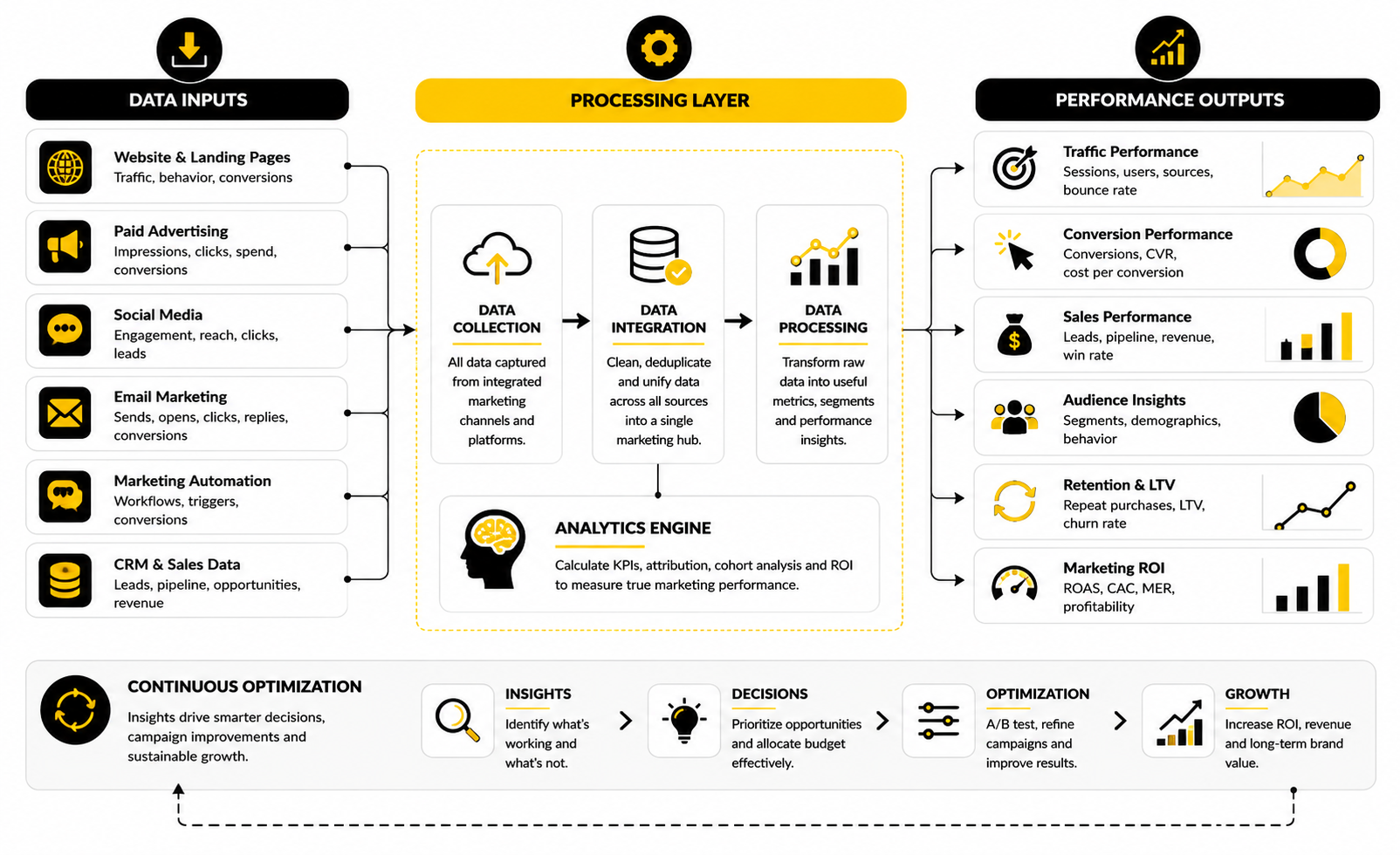
The cleanest analytics system has four levels. The first level measures attention, which includes impressions, reach, views, watch time, completion rate, and audience growth. This tells the team whether the campaign entered the market with enough force.
The second level measures interaction, which includes comments, shares, saves, community activity, direct messages, poll responses, and creator engagement. This tells the team whether people cared enough to participate instead of simply scrolling past.
The third level measures movement, which includes clicks, app installs, account registrations, email signups, form completions, landing-page visits, product views, and ticketing interest. This is where PSG digital marketing begins to show whether content is creating useful fan behavior.
The fourth level measures value, which includes purchases, average order value, repeat visits, member retention, sponsor outcomes, customer lifetime value, and market-level revenue contribution. This is the layer that turns digital reporting into business reporting. It is also the layer that exposes weak campaigns quickly, because attention without movement eventually becomes expensive noise.
Benchmarks Should Compare Similar Moments
Benchmarks are useful only when the comparison is fair. A Champions League knockout win should not be compared to a routine training post. A transfer announcement should not be compared to a partner recap. A kit launch should not be compared to a community poll.
For PSG digital marketing, benchmarks should be grouped by content type and campaign purpose. Matchday content should be compared against matchday content. Product drops should be compared against previous product drops. Sponsor activations should be compared against similar sponsor campaigns. Youth-content performance should be compared with youth-content performance, not the biggest viral clip of the season.
This keeps the team honest. It prevents overreacting to naturally lower-performing but strategically important content. It also helps identify the real outliers, which are the posts, formats, markets, creators, and moments that beat a fair benchmark and deserve deeper analysis.
Platform Metrics Need Different Interpretations
A view does not mean the same thing on every platform. A short-form video view, a YouTube view, a livestream viewer, a website session, and an app open all represent different levels of attention. Treating them as equal creates bad decisions.
On TikTok and Instagram Reels, early retention and replay behavior can reveal whether a creative hook works. On YouTube, watch time, subscriber growth, search traffic, and returning viewers tell a deeper story about content value. On community platforms, repeat participation and conversation quality matter more than raw member count.
This is why reporting should be channel-specific before it becomes executive-level. The channel team needs detail, but leadership needs meaning. The bridge between both is a clear explanation of what the metric suggests and what the team will do next.
The Dashboard Should Lead to Decisions
A dashboard that does not change decisions is decoration. It may look professional, but it is not doing the job. Every PSG digital marketing report should end with a practical answer: continue, stop, test, scale, localize, redesign, retarget, or rebuild.
The best reports are not overloaded with every available metric. They show the few numbers that matter for the objective, explain what changed, and recommend the next action. A campaign built for discovery should not be judged mainly by sales. A campaign built for commerce should not hide behind impressions.
For teams building similar systems, tools such as GoHighLevel can help connect campaign follow-up, CRM activity, and conversion tracking when the goal is turning audience interest into pipeline or customer data. A form tool like Fillout can help capture fan preferences and campaign registrations cleanly. For content scheduling and performance review, Buffer can support a more organized publishing workflow, especially when multiple channels and markets are involved.
The Most Important Signal Is Repeat Behavior
The most valuable fan is rarely the person who sees one viral post. It is the person who comes back. Repeat behavior is where casual attention starts turning into loyalty.
For PSG digital marketing, repeat behavior can show up as returning YouTube viewers, app opens after matchday, repeat purchases, email engagement over several campaigns, community participation, ticket interest, and continued interaction after a star player leaves. This last point is crucial. A club brand has to outlive individual player cycles.
That is the real measurement challenge. PSG should absolutely use star power, cultural collaborations, and viral moments to create attention. But the data should always ask a harder question: did this make people more attached to Paris Saint-Germain itself?
Advanced Strategy: Scaling PSG Digital Marketing Without Diluting the Brand
The advanced challenge in PSG digital marketing is not getting attention. The club already has massive visibility, world-class creative assets, and a cultural platform most brands would love to own. The harder challenge is scaling that attention without making the brand feel over-commercialized, over-automated, or disconnected from football.
Scale creates pressure. More markets want content, more partners want visibility, more platforms want native formats, more fans expect personalization, and more stakeholders want proof of value. If the operating model is weak, the brand starts to stretch in too many directions at once.
That is why PSG needs a clear strategic hierarchy. Football performance and club identity should sit at the center. Culture, commerce, creators, data, and partners should expand the brand from that center, not pull it away from it.
The Main Tradeoff Is Reach Versus Meaning
Reach is seductive because it is easy to show in a report. A campaign with millions of impressions looks successful before anyone asks what those impressions actually did. But PSG digital marketing cannot be judged by reach alone because the club is not trying to become a generic entertainment page.
Meaning is harder to measure, but it is more valuable over time. It shows up when fans recognize the brand instantly, care about the badge beyond one player, trust the club’s voice, and see PSG as part of their identity. That kind of attachment supports merchandise, ticket demand, sponsorship value, media consumption, and community participation.
The tradeoff is practical. A highly viral format may bring huge discovery but weaken the brand if it feels cheap, random, or disconnected from PSG’s world. A more premium story may reach fewer people but deepen loyalty with the fans who matter most. The smart move is not choosing one forever; it is knowing which job each campaign is supposed to do.
Star Power Should Feed the Club Brand
PSG has benefited from some of the biggest player brands in world football. That kind of star power can accelerate awareness, social growth, media attention, and merchandise demand. It also creates a strategic risk if the audience becomes more attached to individuals than to Paris Saint-Germain.
This is not theoretical. Modern football fans often follow players across clubs, and platform algorithms amplify recognizable faces faster than institutional identity. PSG digital marketing has to use player-led attention while constantly bringing the story back to the club, the city, the supporters, the shirt, the academy, the history, and the future.
The safest approach is brand transfer. When a player performs, the content should celebrate the player, but it should also connect the moment to PSG’s wider story. When a player leaves, the brand should still have enough emotional equity to keep fans watching, buying, and participating.
Sponsorship Integration Needs Restraint
Commercial revenue is a major part of elite football economics, and PSG is clearly operating in that reality. The club reported €367 million in commercial revenue for the 2024–25 season, while Deloitte’s 2026 Football Money League showed commercial revenue had become the largest revenue stream among the top clubs, reaching €5.3 billion across the Money League group PSG financial results Deloitte Football Money League 2026. That makes partner value essential, not optional. But sponsor content still has to earn attention.
The risk is clutter. If every big moment becomes a sponsor message, fans start tuning out. Worse, the brand can feel like it is selling access to emotion rather than sharing emotion with the community.
The better model is integration by relevance. A partner should enhance a fan moment, not interrupt it. That could mean useful access, better content, rewards, live experiences, exclusive drops, travel benefits, interactive games, or a campaign idea that genuinely fits the sponsor’s role.
Global Growth Requires Local Intelligence
PSG has a global audience, but global does not mean uniform. Fans in different markets discover the club through different players, platforms, languages, cultural references, and product interests. Treating every international audience as the same is lazy marketing.
The club’s YouTube milestone showed that France, Brazil, India, Indonesia, and Egypt were among its leading subscriber markets, which points to a broad international audience base with different behaviors and motivations PSG YouTube subscriber milestone. A serious PSG digital marketing strategy should use that type of market signal to decide where deeper localization is worth the effort. Not every market needs a full dedicated content team, but high-potential markets deserve more than translated captions.
Local intelligence can include creator partnerships, language-specific edits, regional publishing windows, local fan events, market-specific commerce tests, and culturally relevant campaign angles. The key is consistency. PSG should feel local enough to matter without losing the Parisian identity that makes the brand desirable in the first place.
Owned Platforms Reduce Platform Risk
Social platforms are powerful, but they are rented land. Algorithms change, organic reach moves, platform demographics shift, and content rules evolve. A club that depends entirely on third-party platforms is always one policy update away from losing control of its distribution.
This is why owned platforms matter. PSG’s app, website, email, community systems, commerce environment, and first-party data strategy give the club more direct ways to build relationships with fans. PSG Labs also points toward a wider innovation agenda, with the club using startup collaboration to explore fan engagement, digital experiences, and new technology around the PSG ecosystem PSG Labs innovation update.
The expert move is not abandoning social. That would be ridiculous. The move is using social as the top of the relationship, then moving high-intent fans into channels the club can control, personalize, and measure over time.
Risks That Can Weaken PSG Digital Marketing
Every strong digital brand has weak points. PSG’s strengths are obvious, but the same strengths can become risks if they are not managed carefully. Scale, celebrity, commercial ambition, cultural partnerships, and global growth all create strategic tension.
The first risk is brand dilution. If PSG chases every trend, every meme, every creator format, and every commercial opportunity, the brand can become noisy. The club should be culturally fluent, but it should not behave like it is desperate to be everywhere.
The second risk is data without judgment. A dashboard can show what happened, but it cannot always explain what should happen next. If PSG digital marketing becomes too dependent on short-term metrics, it may overproduce shallow content and underinvest in long-term brand equity.
Platform Dependency Is a Real Business Risk
A huge social following is an asset, but it is not fully owned. Reach can fall without warning. A platform can change its recommendation system. A video format can stop working. A market can move from one app to another faster than brand teams expect.
That is why the platform mix should be reviewed constantly. PSG should know which channels create discovery, which ones deepen loyalty, which ones move traffic, which ones support sponsors, and which ones produce measurable commercial value. Each platform should earn its place in the system.
This also affects staffing. A team built only around today’s dominant platforms will always be late to the next behavior shift. A better team is built around transferable capabilities: storytelling, editing, analytics, community management, paid media, CRM, localization, and conversion strategy.
Premium Positioning Can Clash With Mass Reach
PSG has a premium brand advantage because Paris gives the club cultural weight. But premium positioning can clash with the logic of mass social media, where speed, humor, casualness, and trend participation often drive performance. That tension has to be managed carefully.
If the club becomes too polished, it may feel distant from younger audiences. If it becomes too casual, it may lose the taste level that separates PSG from ordinary sports content. The answer is not choosing one tone for everything.
The better approach is range with boundaries. Matchday emotion can feel raw. Fashion campaigns can feel elevated. Community content can feel warmer. Sponsor activations can feel useful. The brand should flex by context without losing its core personality.
Fan Trust Is the Long-Term Asset
Trust is easy to underestimate because it does not show up as neatly as views or clicks. But fans notice when a club over-sells, ignores local supporters, uses creators awkwardly, or treats community as a marketing funnel. They may not use marketing language to describe it, but they feel the difference.
PSG digital marketing should protect fan trust by being clear about value. If fans are asked to register, they should receive something worth registering for. If they are invited into a community, the community should not become a dumping ground for promotions. If a sponsor is involved, the activation should feel relevant enough to deserve the fan’s attention.
This is where restraint becomes a growth tactic. Not every moment needs a call to action. Not every emotional post needs a partner tag. Not every fan interaction should be automated. Sometimes the best marketing decision is to let the football breathe.
Expert-Level Guidance for Teams Studying PSG
The real value of studying PSG digital marketing is not copying the club’s budget, players, or global reach. The value is understanding the operating principles. PSG shows how a sports brand can become a media brand, a lifestyle brand, a community brand, and a commercial engine at the same time.
For smaller clubs, agencies, creators, or sports businesses, the practical lesson is to build the system in the right order. Start with positioning, then content pillars, then channel roles, then fan capture, then measurement, then partnerships. If you skip straight to tools and tactics, you get activity without leverage.
The professional standard is simple. Every campaign should know who it is for, what moment it owns, what channel behavior it is using, what fan action it wants, and what business result it supports. That is how PSG digital marketing becomes a repeatable system rather than a collection of posts.
Build Around Moments, Not Just Calendars
A calendar keeps the team organized, but moments create emotion. Football marketing is strongest when it captures the feeling around a match, a comeback, a debut, a trophy, a farewell, a new kit, or a fan experience. Those moments are what people remember.
The calendar should prepare the team for predictable moments while leaving space for live opportunity. That means templates, pre-approved assets, flexible briefs, clear escalation paths, and enough creative trust to move fast. Slow approval kills sports content.
The best teams plan deeply so they can react naturally. That sounds contradictory, but it is true. Preparation gives the team freedom when the moment arrives.
Use Technology to Remove Friction
Technology should make the marketing system easier to run. It should not become the center of the strategy. The stack should help teams publish faster, collect cleaner data, follow up with fans, personalize experiences, and measure what actually happened.
A practical stack might include scheduling, CRM, forms, landing pages, email, messaging automation, analytics, and creative production tools. For teams building fan journeys outside a full enterprise setup, GoHighLevel, Brevo, ManyChat, and Fillout can support pieces of that workflow.
But the warning is important. A messy strategy with better software is still messy. Tools amplify the operating model you already have, so fix the logic before you automate it.
Protect the Brand While Expanding the Funnel
The funnel matters because revenue matters. But the brand matters because the funnel gets weaker without trust, desire, and identity. PSG’s advantage is that it can create demand before the offer appears.
This means every commercial journey should still feel like PSG. A landing page should carry the same quality as the social campaign. An email should sound like it belongs to the club. A product page should make the fan feel closer to the brand, not simply closer to checkout.
That is the final advanced point before moving into the closing section. PSG digital marketing is strongest when brand and performance are not treated as enemies. Brand creates the reason people care; performance gives them the next step.
The Final PSG Digital Marketing Ecosystem
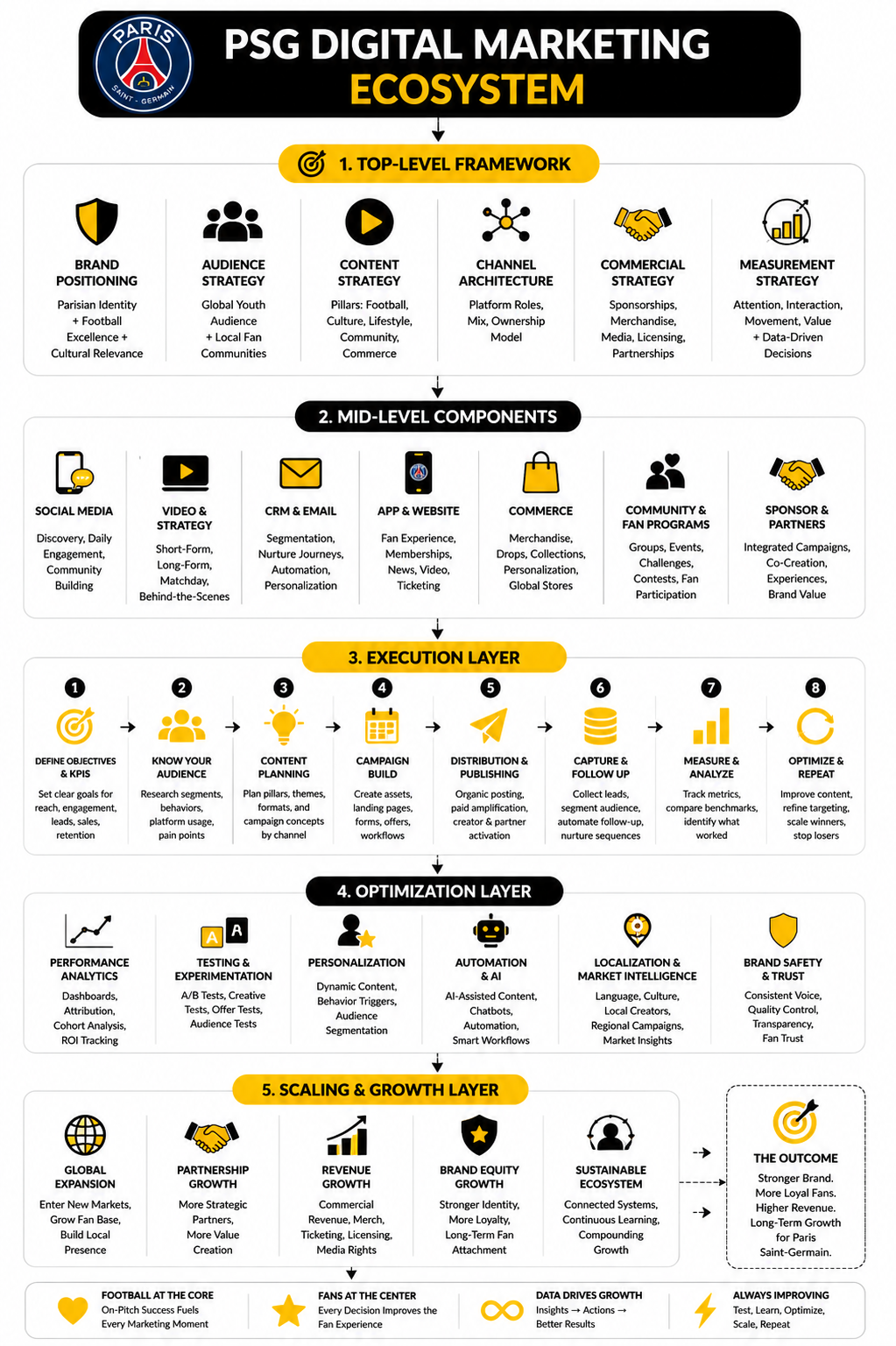
The full PSG digital marketing system is bigger than content, bigger than social media, and bigger than campaign reporting. It is an ecosystem where brand positioning, cultural relevance, fan data, owned channels, partnerships, commerce, and matchday emotion all support each other. When the system works, every major touchpoint gives the fan a clearer reason to care and a smoother path to act.
The strongest version of this ecosystem does not treat marketing as a department that promotes what the club already decided. It treats marketing as the connective layer between football, business, culture, and community. That is why PSG can turn a kit launch into a lifestyle moment, a matchday into a global content event, a player story into audience growth, and a sponsor activation into something fans might actually choose to engage with.
This is also where the strategy becomes useful for people outside PSG. A smaller sports brand, agency, creator, or marketing team can apply the same logic without needing the same budget. Start with a strong identity, build content around real moments, capture the audience you earn, measure behavior beyond vanity metrics, and keep improving the system.
The Ecosystem Has to Stay Connected
The mistake is treating each marketing channel as a separate island. Social media wants reach, email wants clicks, commerce wants sales, sponsors want exposure, and leadership wants proof. If these teams are not connected, the fan experience becomes fragmented.
A connected PSG digital marketing ecosystem gives each channel a role and a handoff. A TikTok clip can create discovery, a YouTube feature can deepen attention, an app notification can bring fans back, a landing page can convert intent, and a CRM journey can continue the relationship. The system becomes stronger because no single channel is forced to do every job.
This is the core principle. Digital marketing should not be a pile of assets. It should be a journey that makes sense from the fan’s first interaction to their next meaningful action.
The Future Is More Personalized, but It Still Needs Taste
The future of PSG digital marketing will likely involve more personalization, more automation, more AI-assisted production, more interactive fan experiences, and more first-party data. That can be powerful, especially when fans expect relevant content in the right language, at the right time, on the right channel. But personalization without taste quickly becomes noise.
Taste still matters because PSG is not selling utility alone. It is selling emotion, identity, belonging, aspiration, and culture. The club cannot automate its way into those things without protecting creative quality and brand judgment.
The strongest teams will use technology to move faster while keeping human taste in control. AI can help with research, drafts, tagging, segmentation, localization, and reporting. But the final standard should still be simple: does this feel like PSG, does it respect the fan, and does it move the relationship forward?
What Marketers Should Take From PSG
The main lesson from PSG digital marketing is that modern sports marketing is no longer just promotion. It is brand architecture, media strategy, community design, data management, and commercial execution working together. That is why the club is such a useful model for marketers who want to understand where digital brand building is going.
The second lesson is that attention must be converted carefully. You can win views and still lose strategic focus. You can grow followers and still fail to build owned audience value. You can sell sponsorship inventory and still weaken fan trust if the activation feels forced.
The third lesson is the most important. Brand and performance should not fight each other. Brand gives people a reason to care, and performance gives them a clear next step.
What Is PSG Digital Marketing?
PSG digital marketing is the system Paris Saint-Germain uses to grow attention, engagement, fan relationships, commercial value, and global brand equity through digital channels. It includes social media, video, content strategy, CRM, email, app engagement, website experiences, commerce, sponsorship activations, creator partnerships, and fan community programs. The important point is that these channels should work together rather than operating as disconnected campaigns.
Why Is PSG Digital Marketing Important?
PSG digital marketing is important because modern football fandom is global, mobile, and platform-driven. Many fans discover clubs through short-form video, player content, fashion collaborations, gaming communities, or viral matchday moments before they ever watch a full match. A strong digital strategy helps PSG turn that scattered attention into deeper loyalty, stronger partner value, and more measurable business outcomes.
What Makes PSG Different From Other Football Clubs Online?
PSG stands out because it combines football with Parisian culture, lifestyle positioning, fashion, entertainment, and international brand building. Many clubs focus mainly on sporting heritage, local identity, and match coverage. PSG still needs those things, but its digital marketing has a wider cultural lane because the brand is tied to Paris and to partnerships that reach beyond football.
How Does PSG Use Social Media in Its Marketing Strategy?
PSG uses social media to create discovery, maintain daily fan engagement, distribute matchday content, promote players, support partner campaigns, and move fans toward deeper channels. Each platform should have a different job instead of receiving the same generic content. Short-form video can create reach, YouTube can build deeper viewing habits, community platforms can drive participation, and owned channels can turn attention into a more stable relationship.
What Can Smaller Brands Learn From PSG Digital Marketing?
Smaller brands should not try to copy PSG’s budget, celebrity power, or production scale. They should copy the logic behind the system. Build a clear brand position, create content around real moments, use each channel intentionally, capture first-party audience data, measure meaningful behavior, and protect trust while selling.
How Should PSG Measure Digital Marketing Success?
PSG should measure digital marketing success across attention, interaction, movement, and value. Attention includes reach, views, impressions, and watch time. Interaction includes comments, shares, saves, community participation, and direct messages, while movement and value include clicks, registrations, purchases, app usage, sponsor results, repeat engagement, and market-level growth.
Are Follower Counts Enough to Judge PSG Digital Marketing?
Follower counts are useful, but they are not enough. A large following shows reach potential, but it does not automatically prove loyalty, purchase intent, sponsor value, or owned audience strength. The better question is whether followers keep returning, engaging, registering, buying, watching, sharing, and building attachment to PSG beyond individual viral moments.
How Does PSG Turn Social Engagement Into Revenue?
PSG can turn social engagement into revenue by connecting content to commerce, ticketing, memberships, sponsor activations, app downloads, and owned audience journeys. A strong post creates attention, but the next step has to be clear and relevant. That could mean a product drop, a registration form, a ticketing page, an app-exclusive experience, or a partner campaign that gives fans a real reason to act.
What Role Do Players Play in PSG Digital Marketing?
Players play a major role because they bring personal audiences, emotional stories, and global recognition. Their content can create discovery faster than many club-led campaigns, especially when fans follow individuals across leagues and platforms. The strategic challenge is making sure player attention strengthens the PSG brand rather than replacing it.
Why Are Brand Partnerships So Important to PSG?
Brand partnerships matter because PSG operates as both a football club and a global cultural brand. The right partnerships help the club enter conversations around fashion, lifestyle, technology, travel, gaming, and entertainment. The best partnerships do more than add a logo; they create experiences, content, products, or access that fans can actually value.
How Should PSG Avoid Over-Commercializing Its Digital Channels?
PSG should avoid over-commercialization by making sure every commercial message fits the fan moment. Sponsor content should enhance the experience rather than interrupt it. The club should also leave space for pure football emotion, community connection, and brand storytelling without forcing a call to action into every post.
What Is the Biggest Risk in PSG Digital Marketing?
The biggest risk is brand dilution. PSG has huge opportunities across social media, creators, fashion, partnerships, commerce, and technology, but chasing every trend can weaken the identity that made the brand valuable in the first place. The club needs growth, but growth should still feel unmistakably connected to Paris Saint-Germain.
How Will AI Affect PSG Digital Marketing?
AI will likely help PSG and similar brands with content operations, audience segmentation, localization, creative testing, reporting, and fan service. It can make teams faster and more precise, especially when campaigns run across many markets and languages. But AI should support the brand system, not replace the creative judgment that makes PSG feel premium, emotional, and culturally relevant.
What Is the Best Practical Framework for PSG Digital Marketing?
The best practical framework is simple: define the brand position, identify the fan segment, choose the moment, match the channel to the behavior, create the content package, publish in sequence, capture owned data, measure meaningful outcomes, and feed the learning back into the next campaign. This framework keeps the work focused and prevents teams from confusing activity with strategy. It also works for smaller brands because the logic is scalable even when the budget is not.
Build a stronger local presence with BAAM AI
Turn your website, Google profile, social channels, and AI visibility into one growth engine
Most businesses do not need more random marketing activity. They need a consistent presence system that helps the right people find them, trust them, and take action. BAAM AI brings strategy, local SEO, website updates, Google Maps visibility, social content, AI-search readiness, media production, and reporting into one practical monthly engine.
If you want your marketing to keep working after the campaign ends, start with a free BAAM AI presence audit. See how your business shows up today and where the fastest visibility wins are at BAAM AI.