
BAAM AI Blog
Promotional Email Marketing: A Practical Guide To Campaigns That Sell Without Burning Trust
Promotional email marketing is the practice of sending focused, timely messages that encourage people to take a specific commercial action. That action might be buying a product, booking a call, using a discount...
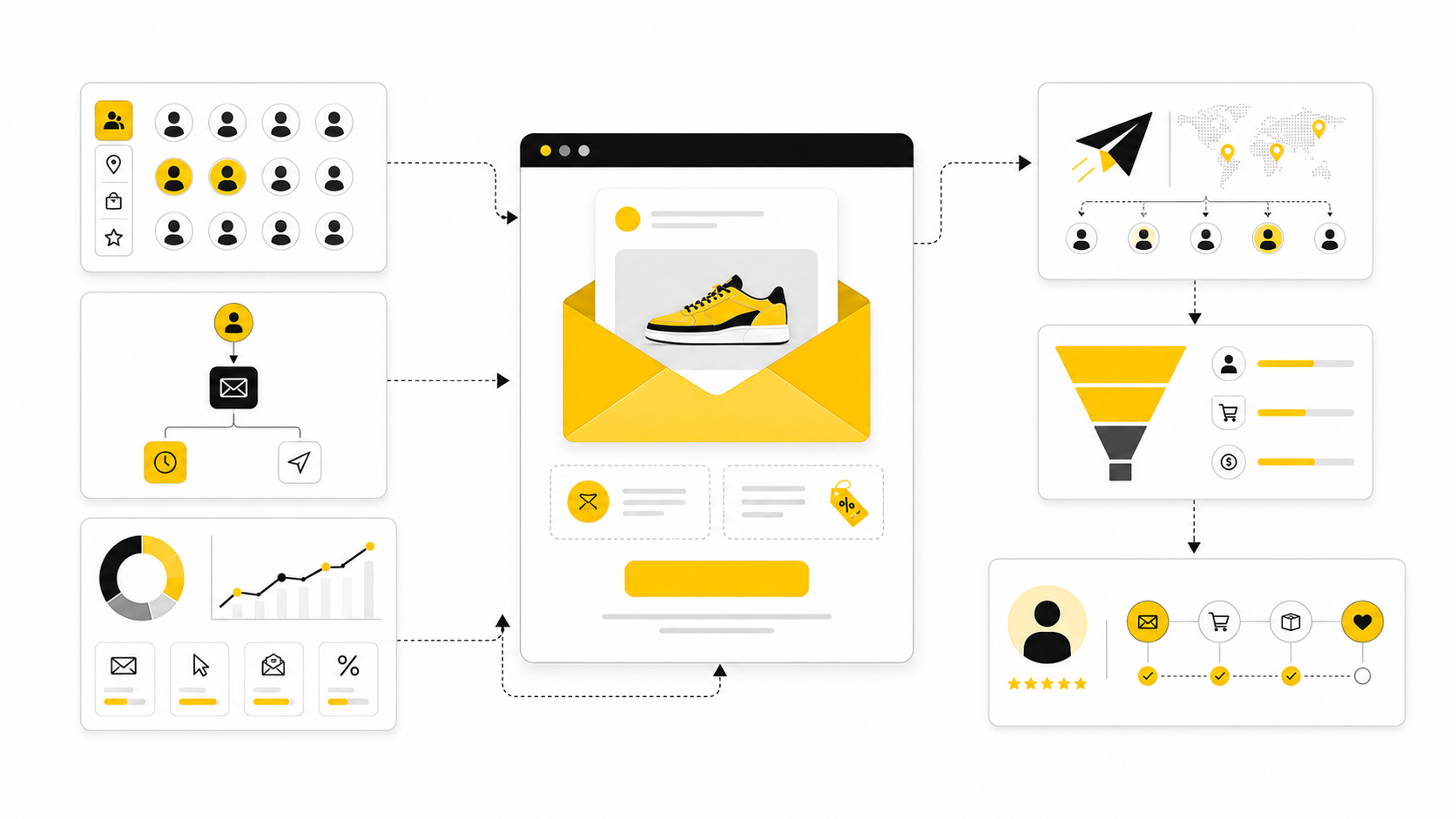
Promotional email marketing is the practice of sending focused, timely messages that encourage people to take a specific commercial action. That action might be buying a product, booking a call, using a discount, joining a launch list, upgrading a plan, returning to an abandoned cart, or engaging with a limited-time offer. Done well, it does not feel like random broadcasting. It feels like a useful nudge from a brand the reader already understands.
The problem is that most promotional emails are treated like announcements. A business has something to sell, so it pushes the same message to everyone and hopes the list converts. That approach can work once in a while, but it usually creates weak clicks, lazy segmentation, poor deliverability, and a list that slowly stops trusting the sender.
Strong promotional email marketing works differently. It starts with the reader’s intent, matches the offer to the right segment, builds the message around one clear action, and measures whether the campaign actually moved revenue. The best campaigns are not louder. They are sharper.
Why Promotional Email Marketing Still Matters
Promotional email marketing matters because it gives businesses a direct line to people who have already shown some level of interest. Unlike social posts, ads, or marketplace listings, email does not depend entirely on an algorithm deciding whether your audience gets to see the message. That does not mean every email will land, get opened, or drive action, but it does mean the channel gives you more control than most rented platforms.
It also matters because promotional emails sit close to buying intent. A subscriber may not be ready to purchase when they first join a list, but the right campaign can connect their current need with a relevant offer at the right moment. That is where email becomes more than a newsletter tool. It becomes a revenue system.
The key is to respect the relationship. Every promotional campaign either increases trust, spends trust, or damages trust. If you only send discounts, your list learns to wait for discounts. If you only send urgency, your urgency stops meaning anything. If you combine useful context, clear positioning, and honest offers, promotional email becomes a channel your audience expects rather than avoids.
The Promotional Email Marketing Framework
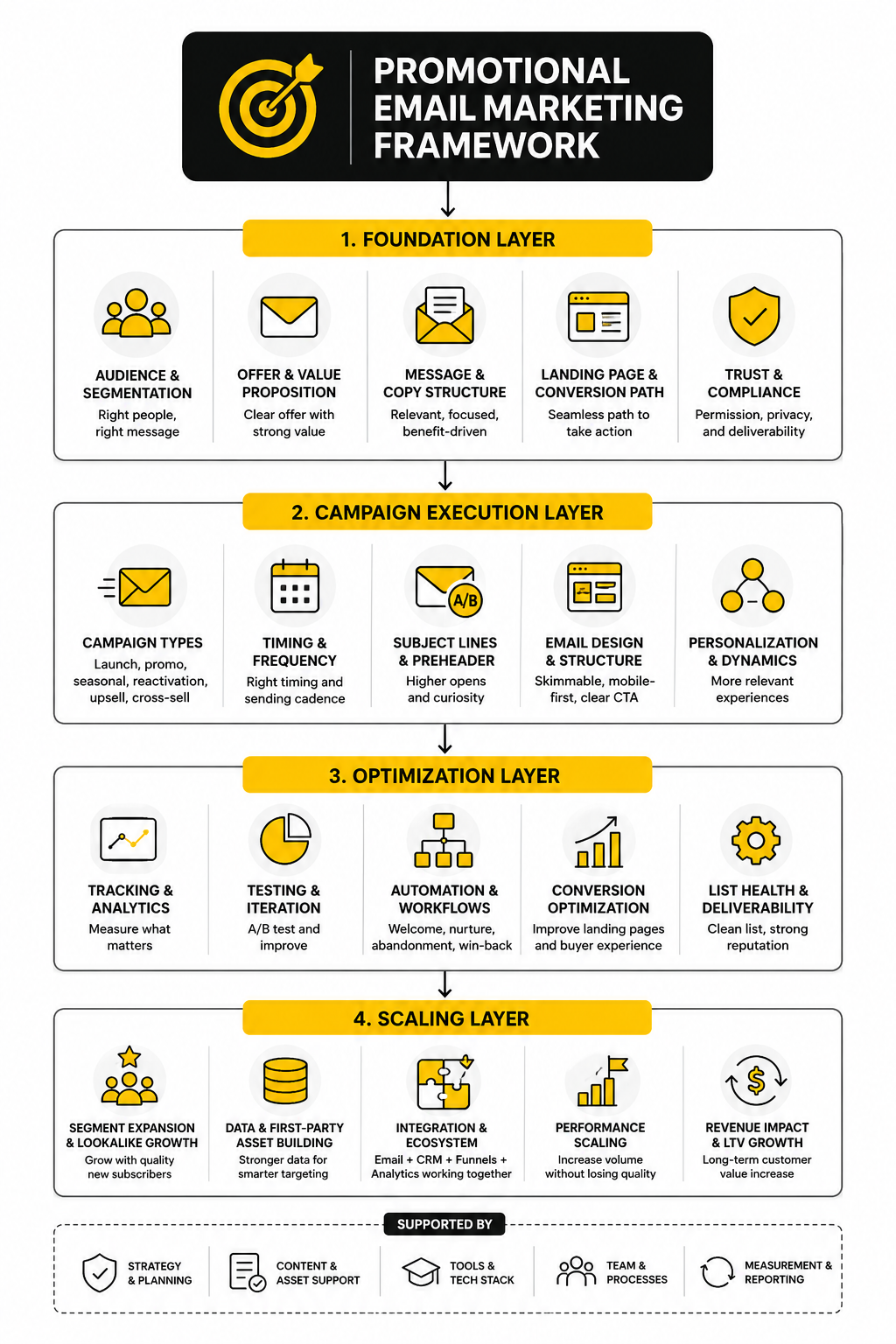
A practical framework keeps promotional campaigns from becoming random blasts. The campaign should begin with the business objective, move into audience segmentation, clarify the offer, shape the message, define the conversion path, and then measure what happened after the send. That sequence matters because weak campaigns usually fail before the email is written.
The objective answers the first important question: what should this campaign actually accomplish? A product launch email, a flash sale, a win-back sequence, and an upgrade offer may all be promotional, but they should not be planned the same way. Each one needs a different audience, promise, timing, and follow-up logic.
The audience step decides who should receive the campaign and who should not. This is where promotional email marketing becomes more professional. Instead of sending every offer to the whole list, you match the offer to behavior, interest, lifecycle stage, purchase history, or engagement level. That single shift can make the difference between a campaign that feels relevant and one that feels like noise.
Start With The Commercial Goal
Every promotional campaign needs one clear commercial goal before anyone writes a subject line. That goal might be first-time purchases, repeat orders, booked appointments, webinar registrations, trial upgrades, cart recovery, or reactivation. Without that goal, the campaign becomes a general announcement, and general announcements are easy to ignore.
This is where promotional email marketing gets practical. The email is not the strategy by itself. It is the message that connects a specific audience to a specific offer through a specific next step.
A simple goal also protects the copy from becoming overloaded. When one email tries to promote a sale, introduce a new product, explain a feature, ask for feedback, and push a social follow, the reader has to work too hard. The better move is to decide what matters most, then make the entire campaign serve that action.
Build Campaigns Around Buyer Readiness
Not every subscriber is at the same stage of the buying journey. Some people just joined your list and still need context. Some have compared products, clicked pricing pages, or abandoned checkout. Others bought months ago and may only need a relevant reason to come back.
That is why buyer readiness matters so much. A cold subscriber usually needs a softer promotional angle, such as a useful offer, a low-risk trial, or a clear explanation of the problem being solved. A warm subscriber can handle a more direct pitch because they have already shown buying intent.
The mistake is treating the whole list like it has the same urgency. Promotional email marketing works best when the message matches the reader’s current level of awareness. The more accurately you match that timing, the less pressure you need to use in the copy.
Match The Offer To The Segment
Segmentation is not just a technical feature inside an email platform. It is the discipline of deciding who should receive an offer, who should receive a different version of it, and who should not receive it at all. That decision has a direct effect on clicks, conversions, unsubscribes, and deliverability.
A basic promotional segmentation model can start with four groups:
Each group needs a different reason to act. New subscribers may need confidence and clarity. Engaged subscribers may need proof and urgency. Existing customers may respond better to upgrades, bundles, replenishment reminders, or loyalty offers. Inactive subscribers often need a reset, not another aggressive discount.
This is also where the right software setup matters. A business using a CRM and automation platform like GoHighLevel can connect contact records, pipeline stages, forms, appointments, and campaigns so promotional emails are based on behavior rather than guesswork. For ecommerce or creator-led businesses, an email platform like Brevo can also make sense when the priority is sending segmented campaigns without overcomplicating the stack.
Choose The Right Promotional Campaign Type
A promotional campaign is not always a discount email. Discounts are only one tool, and overusing them can train people to wait instead of buying at full value. The better approach is to choose the campaign type based on the business goal and the reader’s situation.
Common promotional campaign types include:
Each campaign type needs a different rhythm. A product launch may need multiple emails that build anticipation, explain the offer, answer objections, and close the buying window. A cart abandonment sequence usually needs fewer emails because the intent already exists. A win-back campaign should be careful, because inactive subscribers are more likely to ignore the message or unsubscribe if the offer feels irrelevant.
The campaign type should also influence how direct the copy becomes. A flash sale can be short and urgent because the value is obvious and time-sensitive. A higher-ticket service promotion usually needs more explanation, stronger proof, and a clearer reason to act now.
Keep The Conversion Path Simple
A promotional email should not send people into a confusing maze. The reader clicks because the email creates interest, but the landing page, checkout flow, booking page, or product page has to finish the job. If the next step feels disconnected, slow, or unclear, the campaign leaks revenue.
That means the email and destination page should share the same promise. If the email promotes a limited-time bundle, the page should immediately show the bundle. If the email promotes a consultation, the booking page should make scheduling obvious. If the email promotes a product benefit, the landing page should reinforce that benefit before asking for the sale.
For funnel-based businesses, tools like ClickFunnels can be useful when the campaign needs a dedicated sales path instead of sending traffic to a general website. For leaner operators who want email, funnels, and simple automation in one place, Systeme.io can fit campaigns where speed and simplicity matter more than a heavily customized stack.
Protect Trust While You Sell
The best promotional email marketing does not hide the fact that it is selling. It simply sells with relevance, timing, and respect. Readers do not hate offers when those offers make sense. They hate being pushed into offers that feel random, exaggerated, or detached from what they actually need.
Trust is built through consistency. The sender name should be recognizable, the subject line should reflect the real message, and the offer should be explained without bait-and-switch tactics. The reader should never feel tricked into opening or clicking.
This matters even more as inbox providers keep raising expectations for senders. Google’s sender guidance says bulk senders should make unsubscribing easy and support one-click unsubscribe for marketing messages above certain sending volumes through Gmail sender requirements. Yahoo also tells senders to keep spam complaint rates below 0.3% in its sender best practices. The practical takeaway is simple: permission, relevance, and clean execution are no longer optional.
Core Components Of A High-Converting Promotional Email
A promotional email has a few moving parts, but they all need to work together. The subject line gets attention, the opening creates relevance, the body builds desire, the offer makes the value clear, and the call to action moves the reader forward. If one piece feels disconnected, the whole campaign becomes weaker.
The goal is not to make the email clever. The goal is to make the next step feel obvious. A strong promotional email should answer three questions quickly: why this, why now, and what should I do next?
This is where many campaigns get too complicated. They try to explain every feature, include every possible benefit, and speak to every type of buyer in one message. That usually creates a heavier email, not a better one.
Subject Line And Preview Text
The subject line should create a reason to open without pretending the email is something it is not. It can lead with a benefit, a deadline, a product update, a customer problem, or a specific offer. What matters is that the subject line matches the email that follows.
Preview text gives you a second chance to clarify the value. Many brands waste it with generic text like “view this email in your browser” or a repeated subject line. That space should support the subject line and make the reader feel like opening the email is worth their time.
A simple way to write stronger subject lines is to remove vague hype. “Big news” is weak because it says nothing. “Save 20% on your first automation setup” is stronger because the value is clear before the reader opens.
Opening Paragraph
The opening paragraph should connect the offer to the reader’s situation. This is not the place for a long brand story or a slow build-up. The reader opened the email because something caught their attention, so the first few lines need to confirm they are in the right place.
A strong opening usually does one of three things. It names a problem the reader already recognizes, introduces a timely opportunity, or explains what changed and why it matters. The faster the email creates relevance, the easier it is to keep the reader moving.
For promotional email marketing, the opening should also set the tone for the sale. If the campaign is urgent, the opening should make the timing clear. If the campaign is educational, the opening should create context before presenting the offer.
Offer And Value Proposition
The offer is not just the product being sold. It is the reason the reader should act now instead of later. That reason might be a discount, bonus, deadline, limited availability, improved outcome, faster setup, exclusive access, or a specific transformation.
The value proposition should be concrete. A vague promise like “grow your business faster” is easy to ignore because every tool says something similar. A sharper promise explains what the reader gets, what problem it solves, and why this version of the offer is worth attention.
This is especially important when promoting software, services, or higher-ticket products. The more expensive or complex the decision, the more clearly the email needs to connect the offer to a real business outcome. People do not buy because a feature exists. They buy because the feature helps them get something they already want.
Proof And Risk Reduction
Promotional emails need enough proof to make the offer feel believable. That proof can come from customer reviews, product usage, recognizable clients, guarantees, transparent pricing, clear demos, or direct explanations of how the offer works. The point is to reduce doubt before it blocks the click.
Risk reduction matters because readers are naturally skeptical. They have seen fake urgency, exaggerated claims, and offers that sounded better than they were. A campaign that explains the terms clearly can often outperform one that tries to manufacture excitement.
This does not mean every email needs a wall of testimonials. Sometimes the strongest proof is simple clarity. Show what is included, who it is for, who it is not for, and what happens after the reader clicks.
Call To Action
The call to action should be direct and specific. “Learn more” can work in some cases, but it is often weaker than action-based language like “Claim the offer,” “Book your demo,” “Start your trial,” or “See the bundle.” The CTA should tell the reader exactly what happens next.
A good promotional email can include the same CTA more than once, but it should not include competing actions. When one button asks people to buy, another asks them to read a blog post, and another asks them to follow on social media, the campaign loses focus. One campaign should usually have one primary action.
The CTA also needs to match the level of commitment. A cold subscriber may respond better to “See how it works” than “Buy now.” A warm subscriber who abandoned checkout may be ready for a stronger CTA because the buying intent is already there.
Professional Implementation: From Planning To Launch
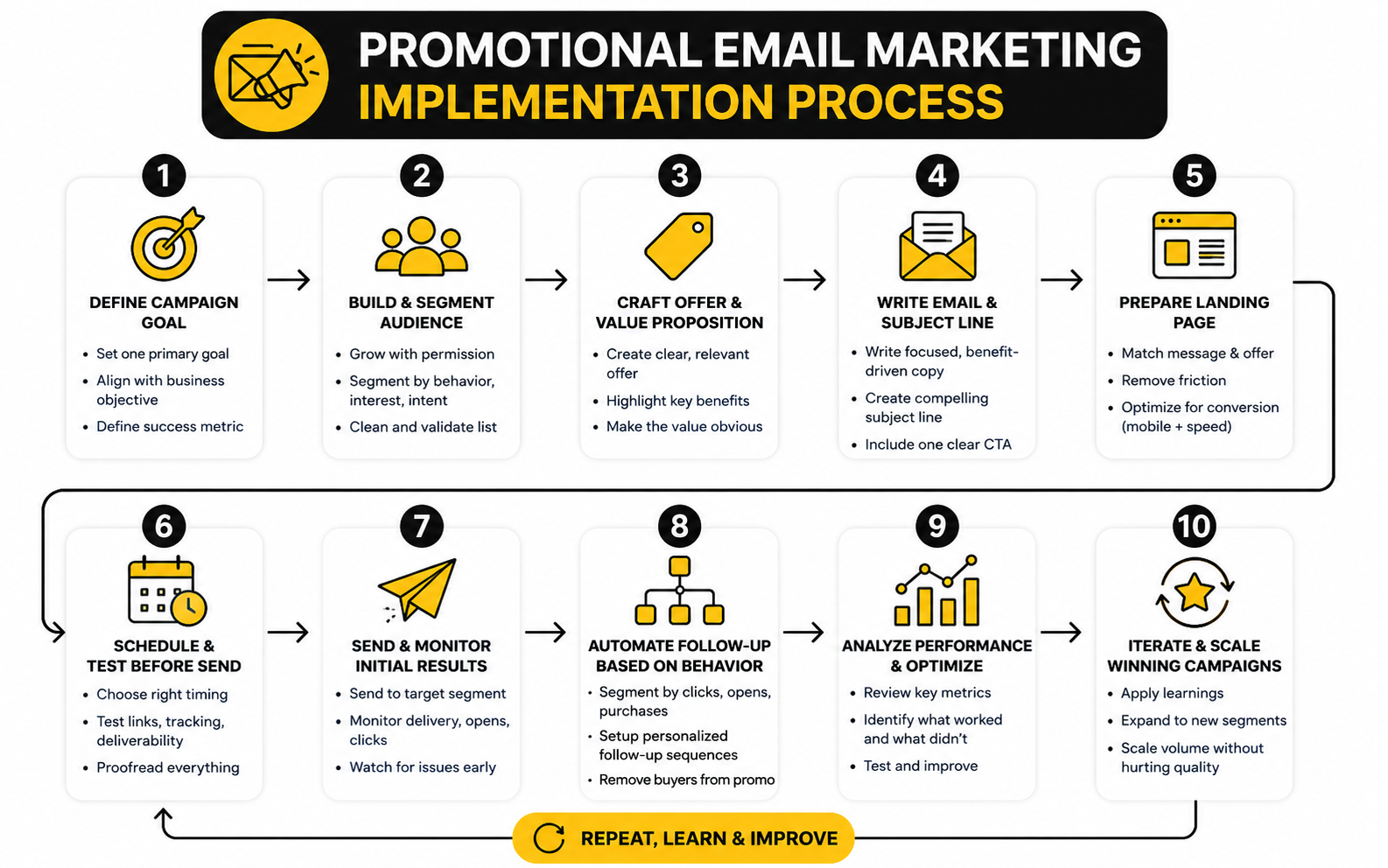
Professional implementation turns a promotional idea into a campaign that can actually be sent, tracked, and improved. This is where strategy becomes execution. You are not just writing an email; you are building a short conversion system.
The process should be simple enough to repeat. If every campaign starts from scratch, the team wastes time, makes avoidable mistakes, and struggles to compare performance. A repeatable workflow makes promotional email marketing easier to scale because each campaign follows the same decision path.
The implementation process should cover planning, audience selection, offer setup, copywriting, design, technical checks, scheduling, tracking, and post-send review. Skipping any of these steps can create problems that are hard to fix after the campaign is live.
Step 1: Define The Campaign Brief
The campaign brief is the source of truth. It should explain the campaign goal, target segment, offer, deadline, landing page, main message, exclusions, and success metric. This prevents the campaign from drifting once copy, design, and automation work begin.
A good brief does not need to be long. It needs to be clear. The best version is usually a one-page document that anyone on the team can read and understand in a few minutes.
The brief should also identify the main objection the email needs to handle. If people are likely to hesitate because of price, explain value. If they are likely to hesitate because of complexity, explain simplicity. If they are likely to hesitate because they do not trust the result, add proof.
Step 2: Prepare The Audience Segment
The audience segment should be built before the email is written. This forces you to think about who the message is for instead of writing a generic promotion and hoping it fits. Better segmentation leads to sharper copy because the writer knows exactly who they are speaking to.
Start with basic criteria like subscriber status, purchase history, engagement, location, product interest, or lifecycle stage. Then add exclusions so the campaign does not annoy the wrong people. For example, someone who already bought the promoted product should not receive the same first-purchase offer unless the campaign has a specific repeat-purchase angle.
This is where connected customer data becomes valuable. A platform like GoHighLevel can help service businesses connect forms, appointments, pipelines, and email campaigns in one place. That makes it easier to send promotional emails based on actual contact behavior instead of static list assumptions.
Step 3: Build The Offer Page Or Conversion Path
The email should not be finished before the destination is ready. The conversion path needs to support the exact promise made in the message. If the reader clicks and lands somewhere confusing, the email did its job but the campaign still failed.
For ecommerce, the destination might be a product page, collection page, cart, or custom landing page. For service businesses, it might be a booking page, application form, webinar registration page, or sales page. For creators and coaches, it might be a checkout page, offer page, or waitlist.
A dedicated funnel builder like ClickFunnels can make sense when the promotional path needs a focused landing page, checkout, upsell, or lead capture flow. A simpler all-in-one setup like Systeme.io can work well when the priority is launching quickly without stitching together too many tools.
Step 4: Write The Email Sequence
Not every promotion should be a single email. A simple offer may only need one send, but launches, limited-time campaigns, and higher-ticket promotions often need a sequence. The sequence lets you introduce the offer, explain the value, answer objections, remind people of the deadline, and close the campaign with clarity.
A basic promotional sequence can look like this:
Each email should have its own job. Do not copy and paste the same pitch five times with a different subject line. That feels lazy, and readers notice.
Step 5: Design For Clarity
Email design should make the message easier to understand, not harder. A promotional email does not need to look like a magazine spread to convert. It needs readable copy, clear hierarchy, enough spacing, mobile-friendly formatting, and an obvious CTA.
For many campaigns, a clean hybrid format works best. Use a short plain-text style message when the offer is personal, direct, or relationship-driven. Use a more visual layout when the product needs imagery, comparison, or scannable sections.
The most important design rule is simple: do not hide the offer. If the reader has to scroll through a huge header image, multiple banners, and a pile of decorative blocks before understanding the point, the design is working against the campaign.
Step 6: Set Up Tracking And Attribution
Tracking should be planned before the campaign goes out. At minimum, you need to know which email drove clicks, which page received the traffic, and which conversions came from the campaign. Without that, you are guessing.
Use clean campaign naming so results are easy to compare later. The name should include the offer, audience, date, and campaign type. This sounds boring, but it saves serious time when you are reviewing performance across multiple promotions.
The tracking setup should also match the business model. Ecommerce teams may care most about revenue, average order value, and repeat purchases. Service businesses may care more about booked calls, show-up rates, qualified opportunities, and closed deals.
Step 7: Run Pre-Send Quality Checks
Pre-send checks are not optional. A broken link, wrong segment, expired coupon, missing unsubscribe link, or incorrect personalization field can damage the campaign fast. The bigger the list, the more expensive a small mistake becomes.
A practical pre-send checklist should include:
This is one of those unglamorous steps that separates professionals from amateurs. The reader never sees the checklist, but they absolutely feel the difference when the campaign lands cleanly.
Step 8: Schedule The Send And Follow-Up Logic
The send time should be chosen based on audience behavior, not superstition. Some lists respond better in the morning, others during lunch, and others in the evening. The only reliable answer is the one your own data gives you over time.
Follow-up logic matters just as much as the first send. People who clicked but did not buy may need a different reminder than people who never opened. Customers who purchased should be removed from the promotional sequence or moved into a post-purchase flow.
This is where automation can protect the customer experience. Instead of blasting everyone repeatedly, you can branch the campaign based on behavior. That keeps the promotion relevant and avoids pushing people who already took action.
Statistics And Data That Actually Matter
The point of measurement is not to collect pretty numbers. The point is to understand where the campaign is creating momentum, where it is leaking revenue, and what should change before the next send. Promotional email marketing becomes much easier to improve when every metric has a job.
A benchmark can help you spot whether performance is wildly off, but it should not become the target by itself. Lists vary by industry, offer type, audience quality, sender reputation, and buying cycle. A campaign to warm subscribers during a launch will not behave the same way as a discount email to recent cart abandoners.
That is why the smartest marketers read email data in layers. Start with deliverability, then engagement, then click intent, then conversion, then revenue quality. If you jump straight to revenue without understanding the earlier signals, you may miss the real reason the campaign underperformed.
The Measurement System
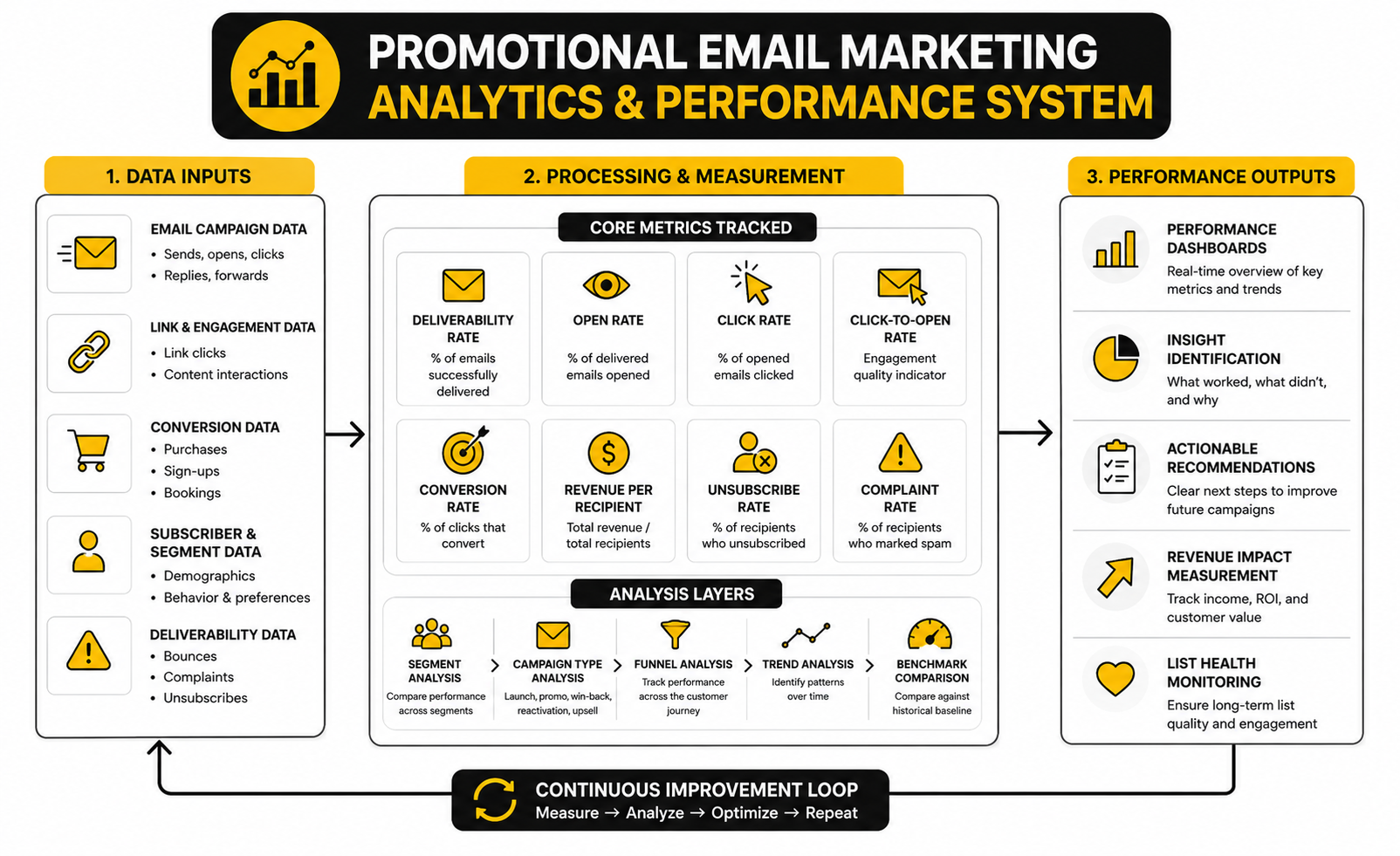
A promotional campaign should be measured like a funnel, not like a single email. The email has to reach the inbox, get opened, earn the click, send people to a relevant page, and convert that attention into the goal you defined before launch. Each step tells you something different.
Open rate gives you a rough read on sender recognition, subject line strength, timing, and inbox placement. Click rate tells you whether the offer, copy, CTA, and audience match created enough intent. Conversion rate shows whether the destination page and offer completed the job.
Revenue metrics then show whether the campaign attracted the right kind of action. A campaign can generate lots of orders but weak profit if the discount is too aggressive. It can also generate fewer purchases but stronger long-term value if it brings in better-fit customers.
Deliverability Comes First
Deliverability is the foundation because nothing else matters if the email does not reach the inbox. A low open rate may look like a subject line problem, but it can also be a sender reputation problem. Before rewriting copy, check bounce rate, spam complaints, authentication, list quality, and engagement trends.
Gmail’s sender guidance tells bulk senders to keep spam rates below 0.10% and avoid reaching 0.30% or higher through its email sender guidelines FAQ. Yahoo’s sender guidance also says senders should keep spam complaint rates below 0.3% in its sender best practices. That matters because a campaign that creates complaints is not just losing subscribers; it can reduce future inbox placement.
The practical action is simple. If complaints rise, reduce sending to cold segments, tighten targeting, make unsubscribe easy, and review whether the offer matches the audience. Do not try to brute-force your way through a deliverability problem with more email volume.
Open Rate Is A Signal, Not The Finish Line
Open rate still matters, but it should be treated carefully. Privacy changes, image loading behavior, and mailbox filtering can make opens less precise than they used to be. A strong open rate is useful, but it does not prove the campaign made money.
Recent benchmark reports show how much open rates can vary by dataset. Brevo’s 2025 benchmark analysis of more than 44 billion emails reported an average open rate of 21% and a click-through rate of 3.96% through its email marketing benchmarks. MailerLite’s 2025 benchmark data reported a 43.46% average open rate, 2.09% average click rate, and 0.22% unsubscribe rate in its industry benchmark report. The difference is a reminder that your own baseline matters more than any single public average.
Use open rate to diagnose the top of the campaign. If opens are weak but clicks among openers are strong, the message may be good but the subject line, sender name, timing, or inbox placement needs work. If opens are strong but clicks are poor, the email earned curiosity but failed to create enough buying intent.
Click Rate Shows Offer-Market Fit
Click rate is one of the most useful promotional email metrics because it measures action. The reader did not just glance at the message; they cared enough to move toward the offer. That makes click rate a cleaner signal than open rate for understanding whether the campaign matched the audience.
A low click rate usually points to one of five problems. The offer is not compelling, the audience is too broad, the copy is unclear, the CTA is weak, or the email is asking for too many actions. Fixing clicks often requires better positioning, not just a brighter button.
Click-to-open rate can also be useful because it looks at how many openers clicked. If the open rate is healthy but click-to-open rate is low, the email probably did not deliver on the subject line’s promise. That gap is a serious warning sign because it means you won attention without converting it into intent.
Conversion Rate Reveals The Real Campaign
Conversion rate tells you what happened after the click. This is where many promotional campaigns expose the truth. The email can look successful inside the email platform, but the full campaign may still fail if the landing page, checkout, booking flow, or form does not convert.
That is why email analytics should never live alone. You need campaign data connected to website analytics, checkout data, CRM activity, or booking outcomes. A tool like GoHighLevel can be useful for service businesses because it connects promotional campaigns to pipelines, appointments, and follow-up automation. For lean email reporting and campaign tracking, Brevo can fit teams that want email performance, automation, and basic customer activity in one place.
When conversion rate is weak, do not automatically blame the email. Compare the message, landing page headline, offer terms, page speed, pricing clarity, and CTA continuity. The user experience after the click has to keep the same promise the email made.
Benchmarks Should Drive Decisions
Benchmarks are useful when they help you ask better questions. They are not useful when they become a scoreboard that ignores your business model. A B2B agency promoting consultation calls should not judge itself by the same numbers as an ecommerce brand sending replenishment offers.
The better approach is to create internal benchmarks by campaign type. Track launches separately from flash sales. Track cart recovery separately from win-back campaigns. Track customer campaigns separately from prospect campaigns.
Over time, this gives you numbers that actually mean something. You will know what a healthy launch email usually does, what a normal unsubscribe rate looks like for a sale, and which segments consistently produce profitable clicks. That makes optimization much more practical.
What To Do When Open Rate Drops
A falling open rate can come from list fatigue, weak subject lines, poor timing, sender reputation issues, or audience mismatch. The first step is to check whether the drop happened across all segments or only one group. If inactive subscribers are dragging down the average, the fix is different than if your best customers suddenly stop opening.
If the issue is list fatigue, slow down the sending frequency and tighten segmentation. If the issue is subject lines, test clearer angles rather than louder ones. If the issue is sender reputation, review authentication, complaint rate, bounce rate, and recent spikes in volume.
Do not panic after one weak send. Look for patterns across several campaigns. One bad subject line is normal; a multi-campaign decline is a system problem.
What To Do When Click Rate Drops
A click rate drop usually means the offer or message is not landing. The subject line may have attracted attention, but the body did not create enough desire to act. This is where you review the offer before you start tweaking tiny design details.
Start by asking whether the campaign gave the reader a strong enough reason to click now. Then check whether the CTA was visible, specific, and repeated at natural points in the email. Finally, compare performance by segment because the same offer may be strong for warm buyers and weak for new subscribers.
The action should match the diagnosis. If the audience was too broad, segment tighter next time. If the offer was weak, improve the incentive or reposition the value. If the copy was confusing, simplify the promise and remove competing links.
What To Do When Unsubscribes Rise
Unsubscribes are not always bad. Some people leaving your list is normal, and a cleaner list can improve long-term performance. The problem is when unsubscribes rise sharply after a campaign or stay elevated across multiple sends.
A rising unsubscribe rate usually points to over-sending, irrelevant offers, poor expectation setting, or weak segmentation. MailerLite’s 2025 data reported an average unsubscribe rate of 0.22% in its benchmark report, while Brevo’s industry tables show unsubscribe rates varying by category through its benchmark analysis. The number matters less than the trend inside your own list.
If unsubscribes climb, review the promise people saw when they subscribed. Then compare that promise to what you are sending now. A list that joined for practical education will not tolerate constant hard selling forever.
Revenue Metrics Need Context
Revenue per recipient is one of the cleanest ways to compare promotional campaigns because it connects performance to list size. Revenue per click helps you understand the quality of traffic the email created. Average order value, refund rate, show-up rate, and close rate add even more context depending on the business model.
A campaign with a high click rate and low revenue per click may be attracting curiosity but not buyers. A campaign with fewer clicks and higher revenue per click may be speaking to a smaller but better-fit audience. That is why chasing clicks alone can lead to bad decisions.
Promotional email marketing should ultimately be judged by profitable action. Opens and clicks are useful signals, but the real question is whether the campaign moved the business forward without damaging list health. That balance is the whole game.
Optimization, Testing, And Campaign Measurement
Optimization is where promotional email marketing moves from “we sent something” to “we are building a repeatable revenue channel.” The difference is discipline. You are not changing random pieces because a campaign felt flat; you are testing specific assumptions about the audience, offer, message, timing, and conversion path.
The best optimization work usually starts after you understand the campaign type. A launch sequence needs different testing priorities than a cart recovery flow. A win-back campaign needs different guardrails than a customer upgrade offer. When you compare campaigns that do not share the same purpose, the data gets noisy fast.
Good testing also protects the customer experience. The goal is not to squeeze every possible click out of the list today. The goal is to improve performance while keeping the list healthy enough to sell to again next month.
Test One Meaningful Variable At A Time
Testing works when the variable is clear. If you change the subject line, offer angle, CTA, layout, send time, and segment all at once, you may get a different result, but you will not know why. That creates motion without learning.
A clean test starts with one practical question. Does a benefit-led subject line beat a deadline-led subject line? Does a bonus outperform a discount? Does a shorter email get more qualified clicks than a longer one? These are the kinds of questions that can improve future campaigns, not just the current send.
The bigger the list, the easier it is to run meaningful tests. Smaller lists should still test, but they should be careful about overreacting to small sample sizes. If only a few people click, the result may be directionally useful, not definitive.
Optimize The Offer Before The Button
Most teams test design too early. They change button colors, templates, or small copy details before asking whether the offer is strong enough. That is backwards.
The offer is usually the biggest lever in a promotional campaign. A clearer bonus, better guarantee, stronger bundle, more relevant deadline, or sharper positioning can change performance more than any layout tweak. If the offer does not matter to the reader, the design will not rescue it.
This is why campaign reviews should start with the offer-market match. Did the right people receive the right promise at the right moment? If the answer is no, fix that before polishing the email.
Balance Automation With Human Judgment
Automation is powerful because it lets you react to behavior quickly. A subscriber who clicks a pricing link can receive a different follow-up than someone who ignores the campaign. A customer who buys can be removed from the promo and moved into a post-purchase flow. That is basic respect, and it also improves performance.
But automation can also become a mess. Too many triggers, overlapping sequences, and poorly managed exclusions can create a bad experience fast. The reader should never feel like they are being chased by a machine that does not understand what they just did.
A practical rule is to audit automation from the subscriber’s perspective. Join the list, click the links, abandon the cart, book the call, make the purchase, and see what happens. If the journey feels awkward to you, it probably feels worse to a real customer.
Use AI Carefully In Promotional Campaigns
AI can help with research, first drafts, subject line variations, segmentation ideas, and campaign planning. That can save time, especially when the team is managing multiple offers or audiences. Used well, it helps marketers move faster without starting from a blank page.
The risk is that AI-generated promotional copy often sounds generic unless someone sharp edits it. It may use vague claims, over-polished phrasing, or urgency that does not match the actual offer. That kind of copy can fill an email quickly, but it does not automatically create trust.
AI is useful as a production assistant, not a replacement for positioning. The human work is deciding what the audience actually cares about, what the offer is worth, and what the brand can honestly promise. A tool like GoHighLevel AI can support teams that already have a clear campaign strategy, but the strategy still needs to come from someone who understands the business.
Watch For Promotion Fatigue
Promotion fatigue happens when the audience gets too many sales messages without enough relevance or value. At first, the damage may be subtle. Opens soften, clicks slow down, unsubscribes tick upward, and the best buyers become less responsive.
The fix is not to stop selling. The fix is to sell with more intention. That means using stronger segmentation, clearer campaign calendars, better exclusions, and more thoughtful timing between major promotions.
A good promotional calendar should leave room for education, proof, customer success content, product usage, and relationship-building. If every message screams urgency, urgency becomes background noise. When you save the strongest promotional pressure for moments that genuinely deserve it, people take it more seriously.
Manage Discounts Like A Pricing Strategy
Discounts are useful, but they are not harmless. They can move hesitant buyers, clear inventory, reactivate old customers, and create urgency around a campaign. They can also reduce perceived value, compress margins, and train customers to wait for the next sale.
The better move is to use discounts strategically. A first-purchase incentive may make sense for a list-building funnel. A loyalty offer may make sense for repeat customers. A limited seasonal offer may make sense when demand naturally peaks. But constant discounting is usually a sign that the offer, positioning, or audience quality needs work.
You can also promote value without cutting price. Bonuses, bundles, free setup, extended access, priority support, limited seats, or added templates can make the offer more attractive while protecting the core price. That is often healthier than teaching the market that your normal price is negotiable.
Build A Promotion Calendar
A promotion calendar keeps campaigns from colliding with each other. It shows when launches, sales, webinars, product updates, seasonal pushes, and nurture campaigns are going out. Without it, teams often over-send in some weeks and disappear in others.
The calendar should include more than send dates. It should include audience segments, exclusions, offer windows, creative deadlines, landing page deadlines, and review dates. This makes the whole system easier to manage before the pressure hits.
A simple calendar also makes scaling safer. As the list grows, small planning mistakes become bigger. A missed exclusion might annoy thousands of existing customers. A broken landing page might waste a major campaign. The calendar gives the team one shared view of what is happening and why.
Scale By Segment, Not Just Volume
Sending more email is not the same as scaling promotional email marketing. Real scaling comes from making campaigns more relevant to more parts of the list. That usually means better segments, better automations, and better offers for different customer stages.
Volume can help when the list is healthy, engaged, and properly permissioned. But if the list is cold or poorly targeted, more volume can increase complaints, hurt deliverability, and lower future performance. Scale the quality of the system before you scale the pressure.
A stronger scaling path looks like this:
Connect Email With The Rest Of The Customer Journey
Promotional emails work better when they are not isolated from the rest of the marketing system. A subscriber may discover the brand through social content, join through a lead magnet, attend a webinar, compare offers on a landing page, and only then buy through an email promotion. The email matters, but it is only one touchpoint.
That is why the message should stay consistent across channels. If the ad promises one thing, the landing page says another, and the email pushes a third angle, the buyer has to rebuild trust at every step. Consistency makes the whole journey feel more credible.
For brands that use social content to warm up demand before a campaign, scheduling tools like Buffer can help keep supporting content organized around the promotion window. For businesses that rely on conversations before purchase, tools like ManyChat can support chat-based follow-up when the audience expects faster interaction than email alone can provide.
Know When Not To Send
One of the most underrated skills in promotional email marketing is knowing when not to send. If the offer is weak, the segment is wrong, the landing page is not ready, or the list has been hit too hard recently, sending anyway can cost more than waiting. Not every campaign deserves inbox space.
This does not mean becoming overly cautious. It means respecting the list as an asset. Every send should have a clear reason, a relevant audience, and a real next step.
A good final question before scheduling is simple: would this email still make sense if the reader received nothing else from us this week? If the answer is yes, the campaign is probably focused enough. If the answer is no, tighten it before it goes out.
Promotional Email Marketing FAQ And Final Checklist
By this point, the system should feel clear. Promotional email marketing is not just writing a sales email, pressing send, and hoping revenue shows up. It is the combination of audience fit, offer quality, message clarity, deliverability, conversion flow, measurement, and long-term trust.
The final layer is the ecosystem around the campaign. Email needs clean data, a reliable sending platform, a focused landing page, a CRM or checkout path, and a review process that turns each campaign into learning. When those pieces work together, every promotion becomes easier to plan and easier to improve.
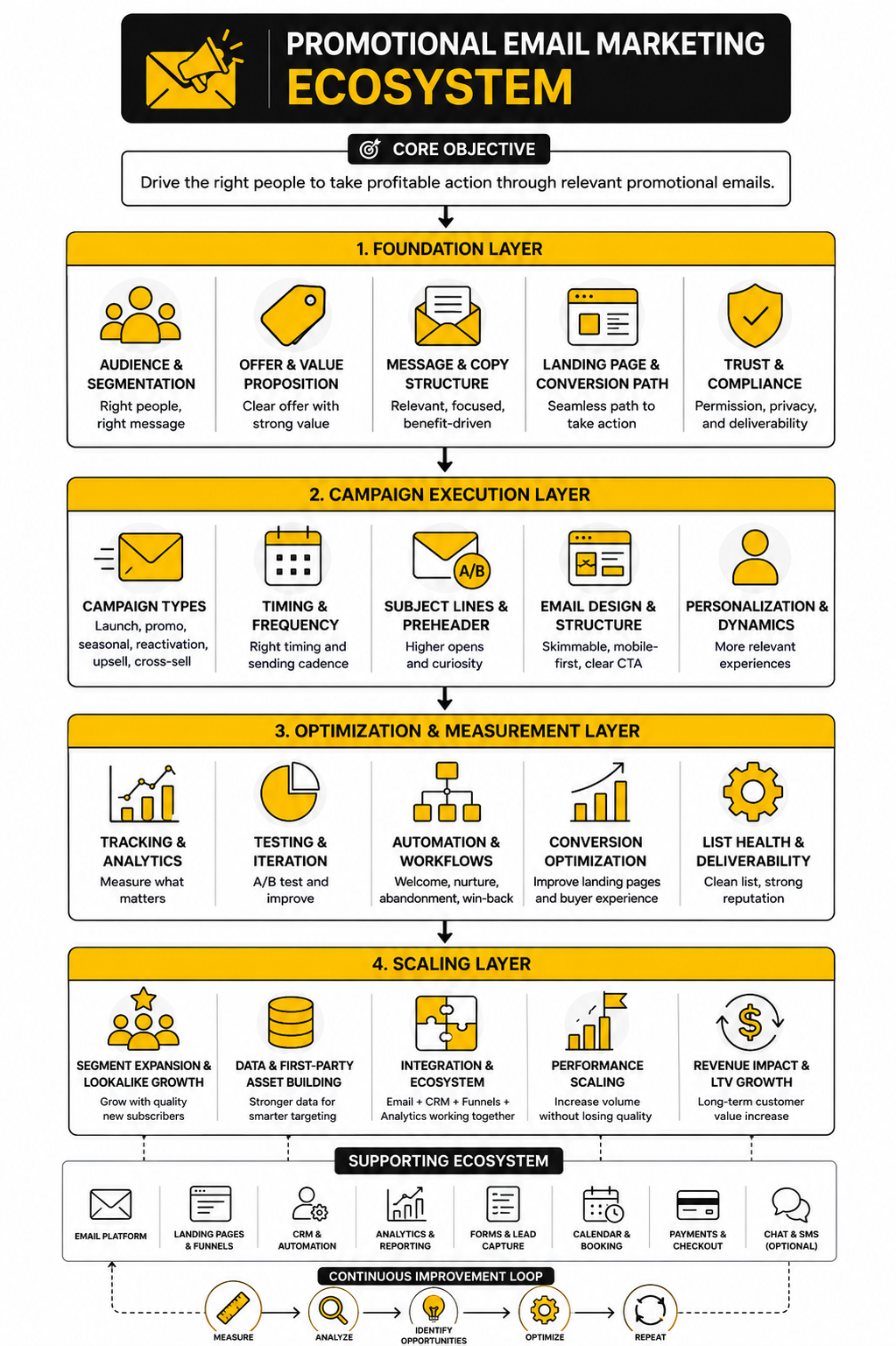
Before a campaign goes live, check the basics one more time. The audience should be specific, the offer should be relevant, the next step should be obvious, and the measurement plan should already be in place. If any of those pieces are vague, fix them before the send.
A practical final checklist looks like this:
What Is Promotional Email Marketing?
Promotional email marketing is the use of email campaigns to drive a specific commercial action. That action might be a purchase, booking, registration, upgrade, renewal, or return visit. The goal is not just to communicate with subscribers, but to move the right people toward an offer that makes sense for them.
The best promotional emails are specific. They do not try to say everything about the brand. They focus attention on one relevant opportunity and make the next step easy.
How Is Promotional Email Marketing Different From A Newsletter?
A newsletter usually exists to educate, update, nurture, or stay top of mind. A promotional email exists to create action around an offer. Both can build trust, but they play different roles in the customer journey.
The difference is intent. A newsletter may include multiple topics and links, while a promotional campaign should usually focus on one primary conversion goal. That focus is what makes promotional email more directly tied to revenue.
How Often Should I Send Promotional Emails?
There is no universal sending frequency that works for every business. A brand with frequent product drops may promote more often than a high-ticket service business with a longer buying cycle. The right frequency depends on audience expectations, offer quality, engagement, and list health.
A good starting point is to watch trends instead of guessing. If opens, clicks, replies, purchases, and complaints stay healthy, your rhythm may be working. If unsubscribes and complaints rise while engagement falls, the list is telling you to slow down or segment better.
What Metrics Matter Most In Promotional Email Marketing?
The most useful metrics are deliverability, open rate, click rate, conversion rate, revenue per recipient, unsubscribe rate, complaint rate, and revenue quality. Each one explains a different part of the campaign. Looking at only one number can lead to bad decisions.
Open rate can show whether the subject line and sender reputation are working, but clicks and conversions tell you more about buying intent. Revenue per recipient is especially useful because it connects performance to the size of the audience. Complaint rate matters because Gmail and Yahoo sender guidance both place serious weight on keeping spam complaints low.
What Is A Good Open Rate For Promotional Emails?
A good open rate depends on the list, industry, campaign type, and measurement method. Public benchmarks vary widely, which is why your own internal baseline matters more than one generic average. Brevo’s 2025 benchmark data reported an average open rate of 21% in its email marketing benchmarks, while MailerLite’s 2025 benchmark report showed a higher average open rate across its dataset in its industry benchmarks.
Use benchmarks as reference points, not as the final target. Compare promotional emails against similar promotional emails in your own account. A launch email, discount email, and win-back campaign should not all be judged the same way.
What Is A Good Click Rate For Promotional Emails?
A good click rate is one that creates profitable action from the right segment. Public benchmark reports can help you understand the general range, but the real question is whether the clicks turn into purchases, booked calls, upgrades, or qualified opportunities. A high click rate with poor conversion can still be a weak campaign.
Click rate should be reviewed alongside the offer and landing page. If opens are strong but clicks are weak, the email may not be making the offer clear enough. If clicks are strong but conversions are weak, the problem may be after the click.
Should Promotional Emails Be Short Or Long?
Promotional emails should be as long as they need to be and no longer. A simple discount, restock, or deadline reminder can be short. A higher-ticket offer, product launch, or complex service may need more explanation, proof, and objection handling.
The deciding factor is buyer friction. If the reader already understands the offer, keep the email tight. If the reader needs context before acting, give them enough information to feel confident.
Should I Use Discounts In Promotional Emails?
Discounts can work, but they should be used with intention. They are useful for first-purchase incentives, seasonal campaigns, inventory pushes, and reactivation offers. They become dangerous when the brand relies on them so heavily that customers stop buying at normal prices.
Consider other forms of value before cutting price. Bonuses, bundles, extended access, free setup, limited seats, or priority support can make an offer stronger without weakening the core price. The best promotion increases urgency without making the product feel cheaper than it is.
How Do I Avoid Sounding Too Salesy?
You avoid sounding too salesy by making the offer relevant, honest, and clear. Readers usually do not mind being sold to when the offer matches their needs. They mind exaggerated claims, fake urgency, vague promises, and messages that ignore their context.
Write like a real person. Explain what the offer is, who it is for, why it matters now, and what happens after they click. That alone makes the email feel more trustworthy than most over-polished sales copy.
What Should Every Promotional Email Include?
Every promotional email should include a recognizable sender, a relevant subject line, a clear opening, one main offer, enough proof or context, and a specific CTA. It should also include required unsubscribe and sender information where applicable. The reader should never have to guess what the email is about or what to do next.
The strongest emails also make exclusions clear. If the offer is only for new customers, say that. If the sale ends on a specific date, say that. Clear terms reduce frustration and protect trust.
How Do I Improve Promotional Email Deliverability?
Deliverability improves when you send wanted email to people who gave permission and continue to engage. Technical setup also matters, including SPF, DKIM, DMARC, list hygiene, easy unsubscribe, and low complaint rates. Gmail’s bulk sender guidance emphasizes authentication, easy unsubscribe, and low spam complaint rates in its email sender guidelines.
Do not ignore list quality. Sending to cold subscribers again and again can drag down performance for everyone. A smaller engaged list is often more valuable than a large list that barely responds.
What Is The Biggest Mistake In Promotional Email Marketing?
The biggest mistake is sending a promotion before the strategy is clear. If the audience, offer, CTA, landing page, and follow-up logic are weak, better copy will only help so much. The campaign needs a solid commercial reason to exist.
Another major mistake is treating every subscriber the same. A new lead, repeat customer, cart abandoner, and inactive subscriber should not always receive the same message. Better segmentation makes the campaign feel more relevant and usually makes the performance easier to improve.
What Tools Do I Need To Run Promotional Email Campaigns?
At minimum, you need an email sending platform, a way to collect subscribers legally, a landing page or checkout path, and analytics. Many businesses also need a CRM, automation builder, form tool, calendar tool, or funnel builder depending on the sales process. The right stack depends on whether you sell ecommerce products, services, software, courses, memberships, or appointments.
For service businesses that need CRM, pipelines, automation, and booking workflows, GoHighLevel can fit well. For simple funnels and checkout paths, ClickFunnels or Systeme.io may be useful depending on the level of complexity you need.
Build a stronger local presence with BAAM AI
Turn your website, Google profile, social channels, and AI visibility into one growth engine
Most businesses do not need more random marketing activity. They need a consistent presence system that helps the right people find them, trust them, and take action. BAAM AI brings strategy, local SEO, website updates, Google Maps visibility, social content, AI-search readiness, media production, and reporting into one practical monthly engine.
If you want your marketing to keep working after the campaign ends, start with a free BAAM AI presence audit. See how your business shows up today and where the fastest visibility wins are at BAAM AI.