
BAAM AI Blog
Promotion Strategy: A Practical Framework for Turning Attention Into Revenue
A promotion strategy is the plan that connects what you sell with the people most likely to care, buy, return, and recommend it. It decides which offers you put in front of the market, which channels you use, how you...
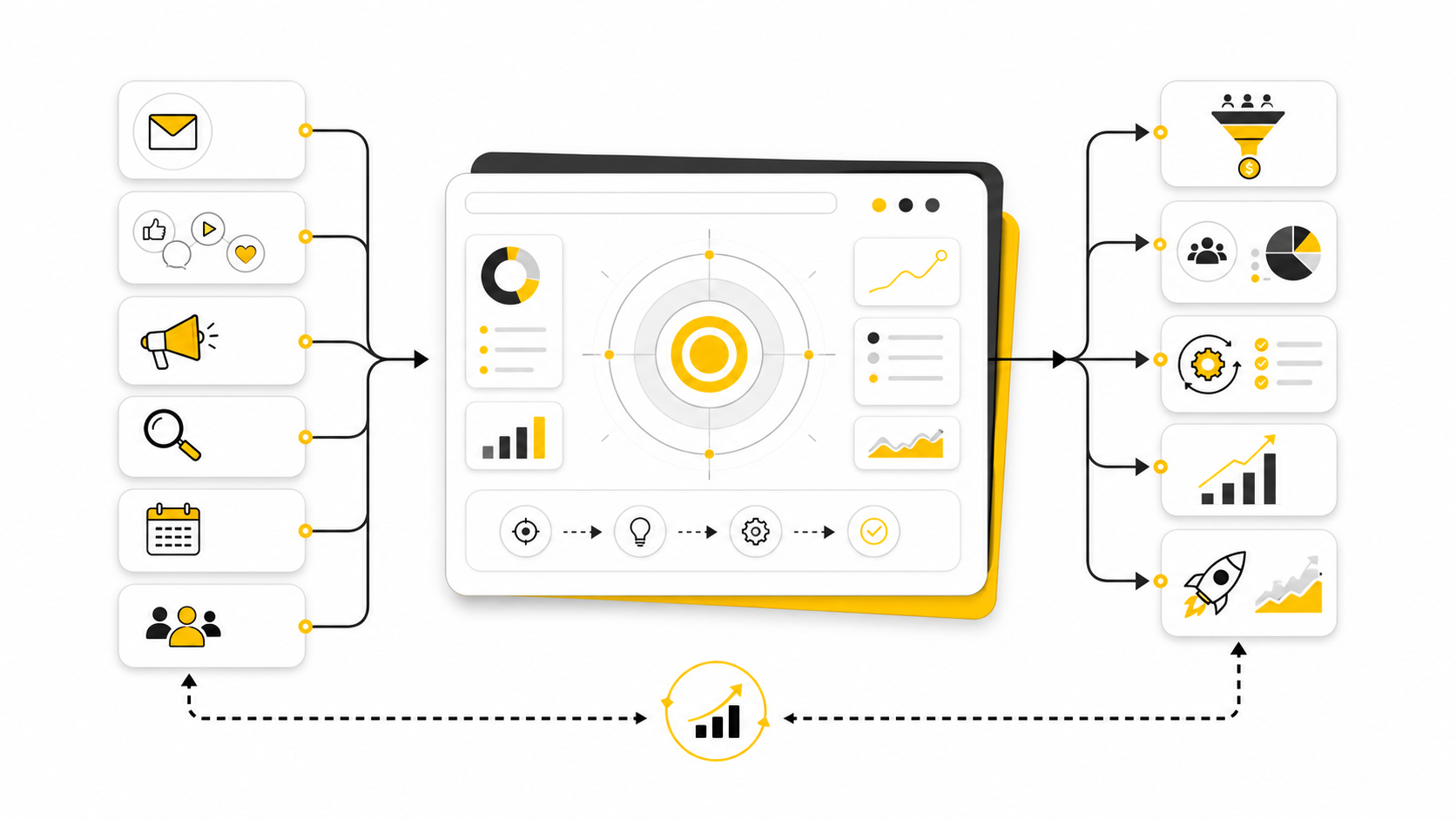
A promotion strategy is the plan that connects what you sell with the people most likely to care, buy, return, and recommend it. It decides which offers you put in front of the market, which channels you use, how you sequence messages, and how you measure whether the work is producing real business outcomes. Without that structure, promotion becomes noise: more posts, more ads, more discounts, more campaigns, but not necessarily more momentum.
The hard part is that promotion is no longer one channel, one launch, or one clever campaign. Buyers discover brands through search, social, creators, email, communities, review sites, events, recommendations, and retargeting before they ever speak to sales or click “buy.” That is why a strong promotion strategy has to work as a system, not as a collection of disconnected tactics.
Budgets make this even more important. Marketing teams are being asked to grow while spending carefully, with Gartner reporting that 2025 marketing budgets stayed flat at 7.7% of company revenue. At the same time, digital advertising keeps getting more competitive, with the IAB and PwC reporting nearly $300 billion in U.S. internet ad revenue in 2025. The takeaway is simple: promotion has to be sharper, more measurable, and more aligned with the customer journey.
Why Promotion Strategy Matters Now
Promotion used to be easier to separate from the rest of marketing. A business could create a product, choose a campaign angle, buy attention, and wait for the market to respond. That model still exists in pieces, but it is weaker now because buyers compare more options, ignore more messages, and expect a more relevant experience before they act.
A modern promotion strategy matters because it gives every campaign a role. Some promotions should create awareness, some should educate, some should convert, some should reactivate, and some should deepen loyalty. When those jobs are mixed together, teams often judge the wrong metric, kill useful campaigns too early, or scale campaigns that look good on the surface but do not create profitable customers.
The pressure is also coming from channel fragmentation. HubSpot’s 2025 social media research highlights micro-influencers, community, social commerce, customer experience, and AI-assisted content as major social trends, which shows how far promotion has moved beyond simple posting. Meanwhile, Content Marketing Institute’s 2025 B2B research found that 61% of B2B marketers expected higher investment in video and 52% expected higher investment in thought leadership. Promotion is becoming more content-led, more trust-led, and more journey-led.
That does not mean every business needs to be everywhere. In fact, the opposite is usually true. A good promotion strategy helps you say no to channels, offers, and campaigns that do not fit your market, budget, sales cycle, or operational capacity.
Promotion Strategy Framework Overview
A practical promotion strategy starts with four questions: who are we trying to reach, what do we want them to do, why would they act now, and where can we reach them with enough repetition to matter. These questions sound basic, but they prevent most expensive mistakes. They force you to connect audience, offer, message, channel, and measurement before money and time get wasted.
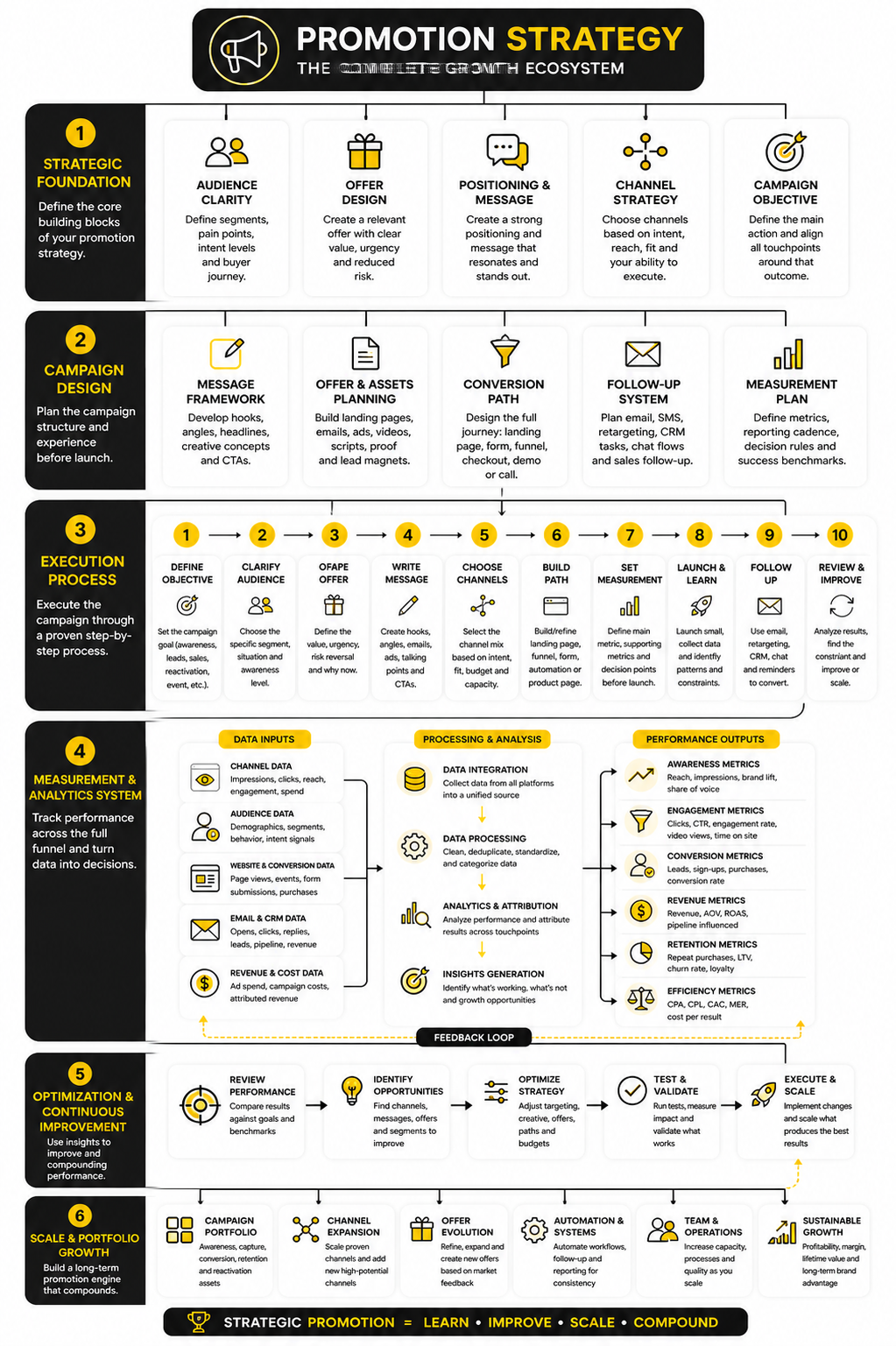
The framework here treats promotion as a sequence, not a single campaign. First, you define the market and the buyer’s current level of awareness. Then you shape the offer and message around the buyer’s real motivation. After that, you choose channels based on fit, build campaign assets, measure performance, and optimize the system over time.
This matters because promotion is not only about reach. Reach without relevance creates weak engagement, and relevance without distribution creates invisible work. The goal is to build a promotion strategy where the right people see the right message often enough, in the right context, with a clear reason to take the next step.
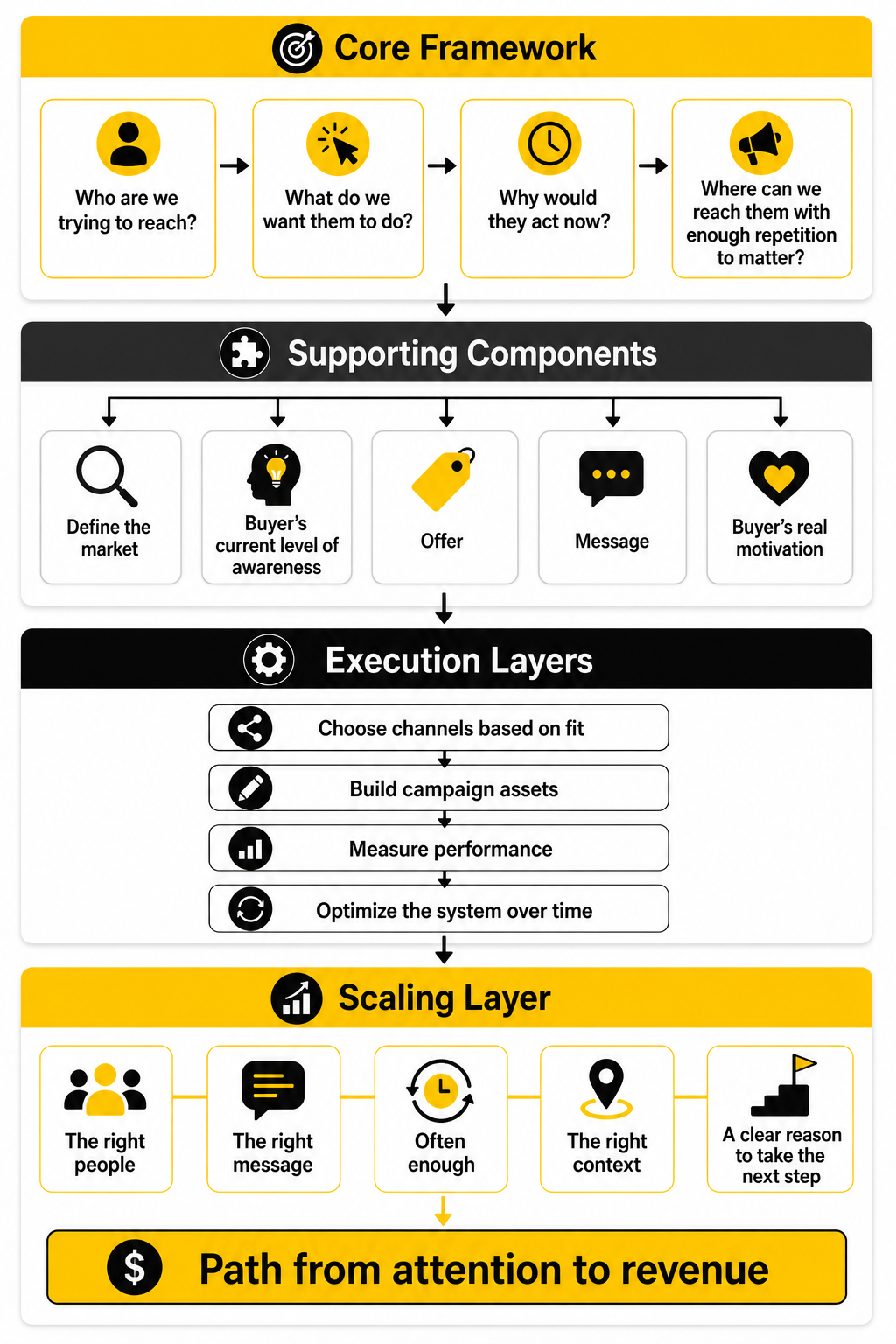
The framework also protects you from chasing trends blindly. AI, creators, short-form video, paid ads, email automation, search, webinars, events, affiliates, and communities can all work. None of them automatically work. The channel only becomes valuable when it supports the buyer journey and gives you a measurable path from attention to revenue.
In the next part, we will move from the overview into the first major building block: the core components of a strong promotion strategy. That is where the strategy becomes more concrete, because promotion only works when the audience, offer, positioning, message, timing, and conversion path are designed to support each other.
Core Components of a Strong Promotion Strategy
A strong promotion strategy is built from connected decisions, not random campaign ideas. The easiest mistake is to start with the channel because the channel feels tangible. You can open an ad account, post on LinkedIn, build a landing page, launch an email sequence, or create a webinar, but none of that matters if the foundation is weak.
The core components are audience, offer, positioning, message, channel, timing, conversion path, and measurement. Each piece changes the performance of the others. A great message sent to the wrong audience fails, a strong audience with a weak offer stalls, and a high-traffic campaign with a broken conversion path leaks money.
This is why promotion has to be planned like a revenue system. You are not just trying to “get the word out.” You are trying to move a specific person from low awareness to meaningful action with enough clarity, trust, and motivation to make the next step feel obvious.
Audience Definition
Audience definition comes first because promotion is only persuasive when it reflects what people already care about. A vague audience creates vague messaging, and vague messaging forces you to rely on volume. That usually means spending more money to get weaker results.
A useful audience definition includes more than demographics. You need to know the buyer’s problem, urgency, sophistication, objections, triggers, alternatives, and buying context. A founder buying CRM software, a marketing manager choosing an email platform, and a creator looking for automation may all need “marketing tools,” but they do not respond to the same promise.
The practical move is to define your audience by situation. What changed in their world that makes the offer relevant now? What pain are they tired of tolerating? What result would make them feel like the purchase was worth it?
Offer Clarity
The offer is the center of the promotion strategy because it gives the market a reason to act. A promotion can make people aware, interested, or curious, but the offer decides whether that attention turns into action. If the offer is confusing, too broad, or disconnected from the buyer’s current problem, better promotion only exposes the weakness faster.
Offer clarity means the buyer understands what they get, who it is for, why it matters, and what action to take next. This applies to every type of business. A SaaS trial, ecommerce bundle, agency audit, coaching call, webinar, free checklist, paid workshop, seasonal sale, and product launch all need a clear exchange of value.
The best offers also reduce friction. That might mean a lower-risk entry point, a clearer guarantee, a stronger onboarding flow, a more specific promise, or a better explanation of what happens after someone signs up. For funnel-based promotions, tools like ClickFunnels, Systeme.io, and GoHighLevel can help structure that path, but the tool does not fix a weak offer. The offer has to be sharp before the funnel can perform.
Positioning and Message
Positioning explains why your offer should matter compared with every other option competing for the buyer’s attention. Messaging turns that positioning into words, hooks, angles, pages, ads, emails, videos, and conversations. Promotion gets expensive when positioning is unclear because every campaign has to work harder to explain why the buyer should care.
Good positioning usually answers three questions. What problem do you solve better than the obvious alternatives? Who is the offer especially right for? What belief does the buyer need to accept before the offer feels valuable?
Once those answers are clear, messaging becomes much easier. You can write with more confidence because you are not trying to persuade everyone. You are speaking directly to the person who already has the problem, already wants movement, and only needs enough trust and clarity to act.
Channel Fit
Channel fit is where many promotion strategies get messy. A channel is not good because it is popular, and it is not bad because someone else failed with it. A channel is good when your audience uses it, your message fits the format, your team can execute it consistently, and the economics make sense.
For example, short-form video can create fast reach, but it may not be enough by itself for a complex B2B sale. Email can be extremely valuable, but only if you have a list, a reason to send, and a sequence that respects where the buyer is in the journey. Paid search can capture demand, but it cannot create much demand if nobody is already looking for the solution.
This is where a promotion strategy becomes disciplined. You choose channels based on intent, reach, cost, creative requirements, speed of feedback, and conversion path. Then you decide what each channel is supposed to do instead of expecting every channel to create awareness, trust, leads, sales, and retention all at once.
Timing and Campaign Rhythm
Timing matters because buyers do not make decisions in a vacuum. Their urgency changes around launches, seasons, budgets, events, deadlines, trends, personal triggers, and business pressure. A smart promotion strategy uses timing to make the message feel relevant now, not someday.
Campaign rhythm is the operating cadence behind that timing. It decides when you create awareness, when you educate, when you make the offer, when you follow up, and when you stop pushing. Without rhythm, promotion often becomes either too passive or too aggressive.
A healthy rhythm usually includes evergreen promotion and focused campaigns. Evergreen promotion keeps the market warm through content, email, search, retargeting, and community touchpoints. Focused campaigns create urgency around a launch, event, seasonal offer, limited bonus, new feature, or specific business moment.
Conversion Path
The conversion path is the route someone takes after the promotion gets their attention. This could be an opt-in page, product page, checkout, booking page, quiz, demo form, webinar registration, chatbot, email sequence, or sales call. The path has to match the buyer’s level of intent.
Low-intent traffic usually needs education before a sales ask. High-intent traffic usually needs proof, clarity, and a smooth next step. Mixing those up is one of the fastest ways to waste promotion spend.
This is also where automation can help, as long as it supports the buyer instead of overwhelming them. A business running social promotions might use ManyChat to guide people from comments or messages into a more structured follow-up flow. A service business might use GoHighLevel to connect landing pages, forms, CRM, email, SMS, and appointment booking so leads do not disappear after the first click.
Measurement and Feedback
Measurement turns promotion from guesswork into learning. You need enough data to know what is working, what is stuck, and what deserves more investment. The key is to measure the role of the campaign, not just the easiest number to see.
Awareness campaigns should not be judged only by immediate sales. Conversion campaigns should not be praised only because they attracted cheap clicks. Retention campaigns should not be ignored because they look smaller than acquisition campaigns.
A strong measurement system connects leading indicators with business outcomes. That means looking at reach, engagement, click-through rate, cost per lead, conversion rate, sales-qualified opportunities, customer acquisition cost, repeat purchase, payback period, and revenue where relevant. You do not need every metric for every campaign, but you do need the right metrics for the job the campaign was supposed to do.
Channel Selection and Campaign Design
Once the foundation is clear, the next step is choosing where the promotion strategy will actually show up. This is where strategy becomes execution. You move from audience, offer, and message into the real campaign environment: channels, assets, timing, budget, follow-up, and measurement.
Channel selection should not start with “Where should we post?” It should start with “Where does this buyer already pay attention when they are thinking about this problem?” That question changes everything because it forces you to match the campaign to buyer intent instead of chasing whatever platform looks exciting this month.
A promotion strategy becomes much stronger when every channel has a specific job. Search can capture active demand. Social can create familiarity and proof. Email can nurture and convert. Partnerships can borrow trust. Paid ads can accelerate testing. Events and webinars can deepen understanding when the offer needs more explanation.
Start With Buyer Intent
Buyer intent tells you how close someone is to taking action. Some people are problem-aware but not solution-aware. Others are comparing vendors, waiting for budget approval, looking for a discount, or trying to justify a decision internally.
Your campaign should respect that difference. A cold audience usually needs useful content, problem education, proof, and a low-friction next step. A warmer audience can handle a stronger offer because they already understand the problem and have some reason to trust you.
This is why one promotion cannot do everything. A short social post may create attention, but it might not close a high-ticket service. A webinar may build trust, but it might be too heavy for someone who only needs a simple product page. The right channel depends on what the buyer needs to believe before the next step makes sense.
Match Channels to Campaign Roles
A clean promotion strategy assigns every channel a role before the campaign begins. This prevents the team from judging every activity by the same metric. It also stops the common mistake of expecting awareness content to convert like a sales page.
For awareness, the best channels are usually the ones with reach and shareability. Social media, creator partnerships, PR, short-form video, community content, and educational search content can all work here. The goal is not immediate conversion every time; the goal is to create enough relevant exposure that the buyer starts recognizing the brand and the problem.
For conversion, the channels need stronger intent and a clearer path to action. Paid search, retargeting, email, landing pages, webinars, demos, booking pages, product pages, and direct sales follow-up usually matter more here. This is where tools like ClickFunnels, Systeme.io, or GoHighLevel can help organize the campaign flow if the offer depends on pages, forms, follow-up, and automation.
Build the Campaign Around One Main Action
Every campaign needs one primary action. That action might be booking a call, joining a webinar, downloading a guide, starting a trial, buying a bundle, claiming a limited offer, or replying to a message. If the campaign asks for too many actions, people hesitate.
This does not mean the campaign can only have one touchpoint. It means the touchpoints should point toward the same next step. Your ad, post, email, landing page, chatbot, and follow-up sequence should all make the same action feel logical.
The main action should also match the buyer’s level of commitment. Asking a cold audience to book a sales call may work for urgent, high-intent problems, but it often creates resistance. Asking a warm list to read another general blog post may be too soft when they are ready for a direct offer.
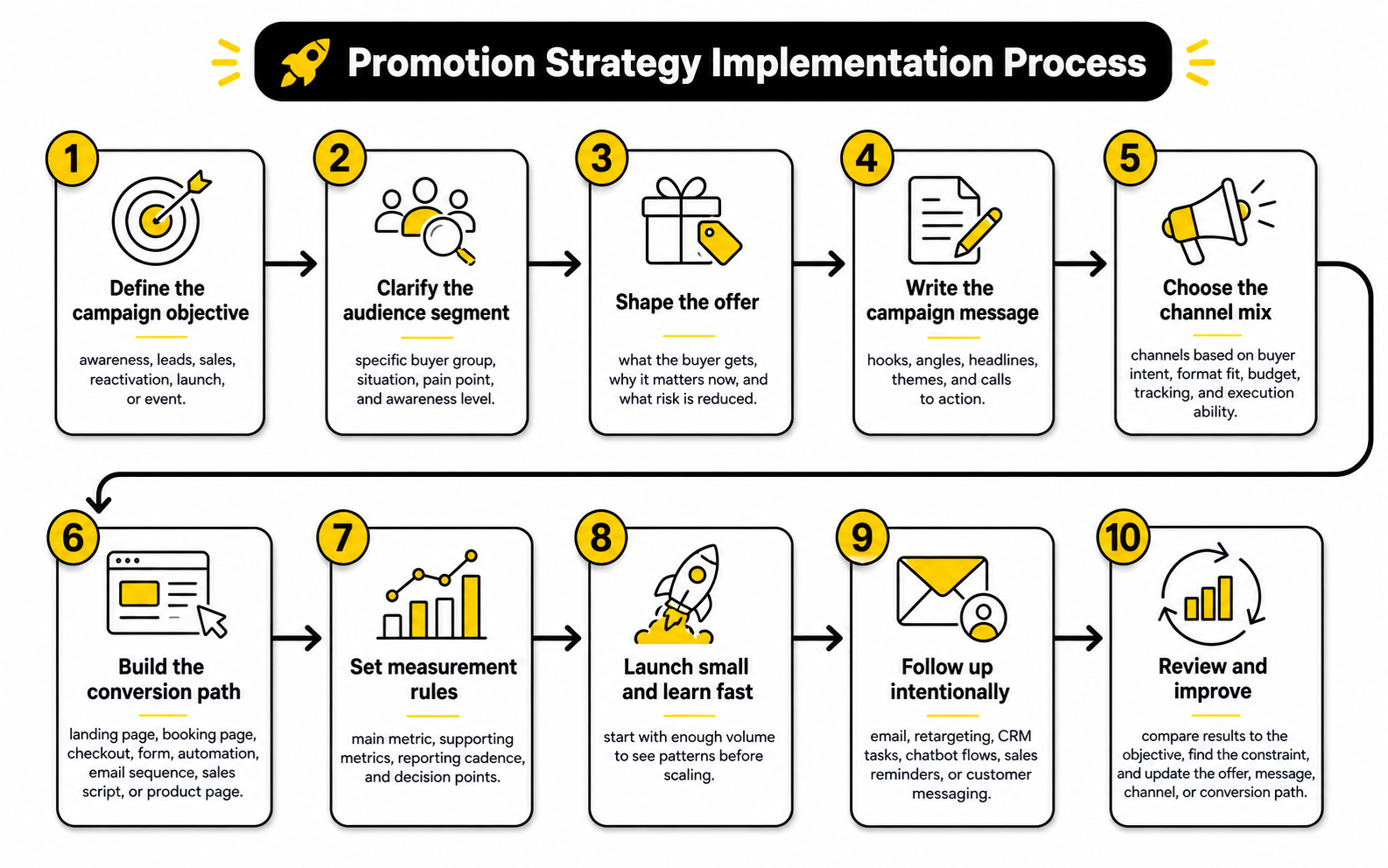
Use a Step-by-Step Execution Process
A promotion strategy becomes easier to manage when the process is visible. The goal is not to make the plan complicated. The goal is to remove confusion so every person involved knows what is being promoted, who it is for, where it will run, and how success will be measured.
A practical execution process looks like this:
This process keeps execution grounded. It also makes the campaign easier to troubleshoot because you can see where the problem is. Weak reach, weak clicks, weak leads, weak sales, and weak retention are not the same problem, so they should not get the same fix.
Plan Assets Before Launch
Campaign assets are the pieces people actually see, hear, click, read, or respond to. They include landing pages, emails, ads, organic posts, videos, sales decks, checkout pages, lead magnets, scripts, webinar slides, product images, testimonials, and follow-up messages. If these are built in a rush, the whole promotion strategy feels rushed.
The best asset planning starts with the buyer journey. What does someone need to see first? What proof do they need before they trust the offer? What objections should be handled before the call to action? What happens if they are interested but not ready today?
This is where many campaigns quietly fail. The team launches the front-end promotion but forgets the middle and back end. They get clicks but no follow-up, leads but no nurturing, demos but no reminders, or purchases but no onboarding sequence.
Create Message Variations Without Losing Focus
A campaign needs message variation because different buyers respond to different angles. One person may care about speed. Another may care about risk reduction. Another may care about cost, convenience, status, simplicity, proof, or control.
Variation does not mean saying random things. It means testing different ways to express the same core promise. The campaign should still feel like one campaign, not ten unrelated ideas stitched together.
For example, a promotion strategy for a marketing automation offer might test angles around missed leads, faster follow-up, lower admin work, better reporting, and more consistent client communication. Those are different messages, but they can all support the same offer. The campaign stays focused because every angle leads back to the same problem, same audience, and same next step.
Connect Organic, Paid, and Owned Channels
Organic, paid, and owned channels should not operate like separate departments. Organic content can test messaging before paid spend increases. Paid ads can amplify proven angles. Owned channels like email, SMS, CRM, and community can turn attention into repeat contact.
This matters because most buyers do not convert from one touch. They notice, ignore, come back, compare, hesitate, ask someone, read more, and then act when the timing feels right. A promotion strategy should create enough connected touchpoints to support that natural behavior.
For social scheduling and content distribution, Buffer can help keep publishing consistent. For email-led campaigns, tools like Brevo and Moosend can support newsletters, automations, and segmented follow-up when the strategy depends on repeated communication.
Build for Follow-Up From the Beginning
Follow-up is not something you add after the campaign launches. It is part of the campaign. If someone clicks, opts in, replies, abandons checkout, watches a webinar, books a call, or visits a pricing page, the promotion strategy should already know what happens next.
This is especially important because attention is expensive. If you paid for the click, earned the view, or convinced someone to raise their hand, you cannot afford to let that interest disappear. The follow-up system should make the next step easier, not louder.
A good follow-up plan includes timing, message sequence, owner, and exit rules. Timing decides when people hear from you. Message sequence decides what they hear. Owner decides whether marketing automation, sales, support, or the founder handles the next step. Exit rules prevent people from getting irrelevant messages after they buy, decline, unsubscribe, or move into a different stage.
Keep the Campaign Simple Enough to Execute
A promotion strategy can be sophisticated without being bloated. In fact, simple campaigns often win because the team can execute them cleanly. The danger is building a plan with too many channels, too many offers, too many messages, and too many metrics before the core idea has been proven.
Start with the smallest campaign that can produce a meaningful signal. Choose one audience segment, one offer, one primary action, and a focused channel mix. Then measure what happens and improve the constraint.
This is the practical way to scale. You do not scale by making the campaign bigger on day one. You scale by proving the path, improving the weak points, and then increasing volume with confidence.
Professional Implementation and Measurement
The promotion strategy is only useful if the team can measure what is happening and make better decisions from the data. This is where a lot of campaigns break down. They launch with energy, collect numbers from different platforms, and then nobody is completely sure what the numbers mean.
Measurement is not about building a giant dashboard for the sake of looking sophisticated. It is about knowing whether attention is moving toward revenue, whether the offer is strong enough, whether the message is landing, and whether the next step is easy enough. Good analytics should make decisions clearer, not create more debate.
That means every campaign needs a measurement plan before it goes live. The plan should define the campaign objective, the main success metric, the supporting signals, the reporting rhythm, and the decision rules. Without those pieces, the team usually reacts emotionally to the first few numbers instead of interpreting performance with context.
Statistics and Data
The data around promotion is clear on one thing: competition for attention is not getting lighter. U.S. internet advertising revenue reached nearly $300 billion in 2025, which means more brands are paying to reach the same buyers across digital channels. That number matters because it explains why weak promotion gets punished faster now.
The same report shows that social media advertising reached $117.7 billion in 2025, with major growth tied to creators, commerce integration, and performance improvements. This does not mean every brand should pour money into social ads. It means social has become a serious commercial environment, so the creative, offer, follow-up, and measurement have to be treated seriously too.
Budgets are not expanding endlessly to absorb sloppy execution. Marketing budgets remained flat at 7.7% of company revenue in Gartner’s 2025 CMO Spend Survey, which makes efficiency more important. When budgets are flat and media costs keep pressure on performance, a promotion strategy has to show which campaigns deserve more investment and which ones need to be fixed or stopped.
The point is not to collect these statistics and panic. The point is to understand the environment. Promotion is becoming more expensive, more measurable, and more connected to business outcomes, so the businesses that win are usually the ones that learn faster from their own data.
Measure the Campaign by Its Actual Job
Every campaign should be judged by the job it was designed to do. Awareness campaigns should be measured differently from lead generation campaigns. Sales campaigns should be measured differently from retention campaigns.
For awareness, useful signals include reach, qualified impressions, video completion, branded search lift, direct traffic movement, social saves, shares, comments, and audience growth. These numbers do not prove revenue by themselves, but they show whether the market is being exposed to the message. If awareness is the goal, the first question is whether the right people are actually seeing and remembering the promotion.
For conversion, the measurement has to move closer to money. Click-through rate, landing page conversion rate, cost per lead, cost per booked call, checkout conversion, sales conversion, customer acquisition cost, and revenue per visitor become more important. These metrics reveal whether the campaign is turning attention into action at a cost the business can handle.
For retention and reactivation, the numbers change again. Repeat purchase rate, churn, expansion revenue, email engagement, win-back conversion, customer lifetime value, and referral activity matter more than cold reach. A promotion strategy that ignores existing customers usually leaves money on the table because it keeps paying to create demand while underusing the trust it already earned.
Build a Simple Analytics System
An analytics system should connect the campaign from first touch to business result as cleanly as possible. It does not have to be perfect to be useful. It does have to be consistent enough that the team can compare performance across campaigns and spot real patterns.
The system should include three layers. The first layer tracks exposure, which shows whether the campaign is reaching people. The second layer tracks engagement, which shows whether the message is creating enough interest. The third layer tracks conversion, which shows whether the promotion is producing the action that matters.
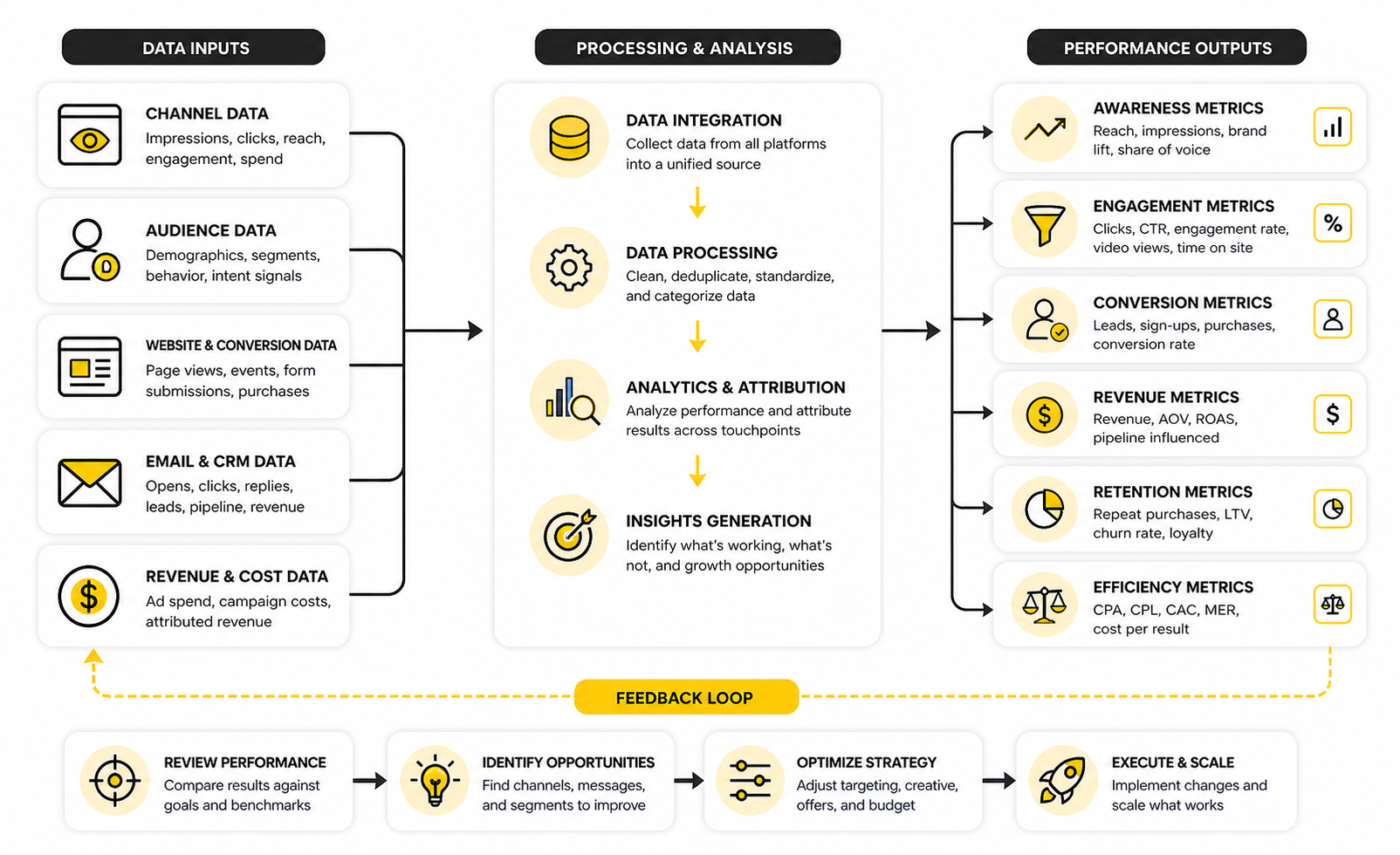
A simple analytics setup might track impressions, reach, clicks, opt-ins, booked calls, sales, revenue, and follow-up outcomes. For ecommerce, that path may run from ad or content to product page, cart, checkout, purchase, and repeat purchase. For service businesses, it may run from traffic to form fill, booked call, qualified opportunity, proposal, close, and onboarding.
The most important part is keeping the chain visible. If clicks are strong but leads are weak, the issue may be the landing page, offer, or audience mismatch. If leads are strong but sales are weak, the issue may be qualification, sales process, pricing, trust, or follow-up. If sales are strong but profit is weak, the issue may be acquisition cost, discounting, fulfillment cost, or retention.
Know the Difference Between Signals and Outcomes
A signal tells you something might be happening. An outcome proves the campaign produced a meaningful result. Both matter, but they are not the same.
Likes, impressions, open rates, video views, and comments can be useful signals. They help you understand whether people are noticing and reacting to the promotion. But they should not be confused with revenue, qualified pipeline, profitable customers, or retained accounts.
This distinction matters because teams often optimize for the easiest number to improve. A post can get engagement without attracting buyers. An ad can get cheap clicks from people who will never purchase. An email can get opens because of curiosity but still fail to move people toward the offer.
The fix is to connect early signals with later outcomes. If a content angle creates high engagement and later produces more qualified traffic, it may be worth expanding. If an ad gets cheap leads but those leads never book, buy, or qualify, the campaign is not working as well as the platform dashboard suggests.
Use Benchmarks Carefully
Benchmarks are useful for orientation, but they are dangerous when treated as universal targets. A conversion rate that looks low in one business might be excellent in another because the price, sales cycle, audience, and channel are different. A cost per lead that looks cheap might still be terrible if those leads never become customers.
The better use of benchmarks is to ask sharper questions. Is our landing page conversion rate improving against our own previous campaigns? Is this channel producing better customers than the alternatives? Is the campaign profitable after follow-up, sales costs, refunds, churn, and fulfillment are included?
External benchmarks can help you spot obvious problems, but internal benchmarks are usually more valuable. Your own data shows how your audience behaves with your offer, your price point, your market, and your conversion path. That is the comparison that should guide most decisions.
This is especially important when testing new channels. Early performance may look weak because the team has not learned the creative style, targeting, or follow-up rhythm yet. But if the data shows improving cost, better qualification, and stronger downstream outcomes, the channel may deserve more time before being judged.
Diagnose the Constraint Before Changing the Campaign
When a campaign underperforms, do not change everything at once. That creates confusion because you cannot tell which change helped or hurt. A better promotion strategy isolates the constraint and fixes the highest-impact problem first.
If reach is weak, the issue may be budget, distribution, targeting, creative volume, posting consistency, or partnership access. If clicks are weak, the issue may be the hook, creative, headline, audience mismatch, or unclear promise. If leads are weak, the issue may be the landing page, offer, form friction, trust, or call to action.
If sales are weak after leads come in, the problem is usually deeper in the conversion path. The offer may attract curiosity instead of commitment. The follow-up may be too slow. The sales call may not handle objections. The pricing may not match perceived value.
This is why the analytics system has to separate the journey into stages. A blended number like “campaign performance” is too vague to diagnose. You need to know where the buyer is dropping off so the team can fix the real issue.
Track Speed, Quality, and Profit
Most teams track volume because volume is visible. More impressions, more clicks, more leads, and more sales feel good. But volume without quality can quietly damage the business.
A strong measurement plan looks at speed, quality, and profit together. Speed shows how quickly the campaign produces a signal. Quality shows whether the people responding are the right fit. Profit shows whether the promotion creates value after costs are counted.
For lead generation, quality might mean lead source, qualification rate, show-up rate, sales acceptance, close rate, and average deal size. For ecommerce, quality might mean average order value, refund rate, repeat purchase, margin, and customer lifetime value. For SaaS, quality might mean activation, product usage, expansion, churn, and payback period.
This is where CRM and automation tools can help if they keep the data connected. A business using GoHighLevel can track leads, pipeline stages, appointments, follow-up, and conversion activity in one workflow. A business using Copper may care more about sales relationship tracking and pipeline visibility when promotion feeds a consultative sales process.
Turn Reporting Into Decisions
Reporting should not be a monthly performance theater. It should help the team decide what to continue, what to improve, what to scale, and what to stop. If a report does not lead to decisions, it is probably too bloated or too disconnected from the campaign objective.
A useful campaign review answers five questions. What did we expect to happen? What actually happened? Where did the journey perform well? Where did people drop off? What is the next test or decision?
That last question matters most. Promotion improves through controlled learning, not vague optimism. Each review should create a practical next move: rewrite the hook, simplify the landing page, adjust the audience, improve the offer, change the follow-up timing, increase budget, reduce budget, or move the campaign into a new stage.
The goal is not perfect attribution. Perfect attribution is rarely realistic because buyers move across devices, channels, conversations, and timeframes. The goal is enough clarity to make better decisions than you would make by guessing.
Advanced Promotion Strategy Decisions
At this stage, the promotion strategy is no longer about simply launching campaigns and reading reports. The bigger question becomes how to make strategic tradeoffs. You have to decide which audiences deserve more investment, which channels are worth scaling, which offers should be retired, and which campaigns are creating short-term activity without building long-term advantage.
This is where experience matters. A beginner looks at a campaign and asks, “Did it work?” A stronger operator asks, “What did it teach us, what constraint did it reveal, and what should we do differently next?” That shift is important because growth is rarely a straight line from more promotion to more revenue.
The best promotion strategies are built around tradeoffs. You cannot optimize for speed, margin, reach, trust, retention, and simplicity all at the same time. You choose the priority that fits the business model, then build the campaign system around that priority.
The Tradeoff Between Reach and Relevance
Reach gives the campaign more surface area. Relevance gives the campaign more depth. Both matter, but they do not behave the same way.
A broad campaign can help a brand become familiar in the market, especially when the offer has wide appeal. The risk is that broad reach can create weak engagement and waste budget if the message is too general. A narrow campaign usually converts better because the message feels more personal, but it can run out of audience quickly if the segment is too small.
A mature promotion strategy usually balances both. You might use broader content to educate the market, then use sharper offers and retargeting to move qualified buyers toward action. The mistake is expecting the broad campaign to behave like a bottom-of-funnel sales asset or expecting a narrow conversion campaign to build the whole market by itself.
The Tradeoff Between Speed and Trust
Some promotions are designed to create action now. Limited-time offers, seasonal campaigns, launch windows, bonuses, events, and direct-response ads all depend on urgency. They can work extremely well when the buyer already understands the value and only needs a reason to move.
But speed has a cost if it is overused. Too much urgency trains people to wait for discounts, ignore deadlines, or question the brand’s credibility. If every promotion is framed like an emergency, the market eventually stops believing the message.
Trust-building promotion moves slower, but it compounds. Educational content, customer proof, comparison pages, founder-led communication, community engagement, and helpful email sequences may not create immediate spikes every time. They make the direct offer easier to believe when the moment comes.
The Tradeoff Between Automation and Human Touch
Automation is useful because it protects consistency. It can route leads, send reminders, segment audiences, trigger follow-up, collect form responses, and prevent opportunities from slipping through the cracks. For many businesses, automation is not optional anymore because manual follow-up becomes unreliable as volume grows.
The danger is treating automation as a replacement for judgment. A lead who asks a serious question does not always need another generic email. A high-value prospect may need a personal reply, a better diagnosis, or a more thoughtful sales conversation.
The right promotion strategy uses automation to handle repetition and humans to handle nuance. For example, ManyChat can help turn social conversations into structured follow-up, while GoHighLevel can centralize forms, pipelines, booking, email, SMS, and CRM workflows. But the message, timing, segmentation, and handoff still need strategic thinking.
Scaling Without Breaking the System
Scaling promotion does not simply mean spending more money. More budget increases volume, but it also exposes every weakness in the system. A small leak becomes a serious problem when traffic increases.
Before scaling, check the campaign from end to end. Can the landing page handle more traffic? Can the sales team respond quickly? Can fulfillment support more customers? Can customer support maintain quality? Can the offer remain profitable at higher acquisition costs?
This is where many businesses get trapped. They scale the front end because the first numbers look promising, then discover that lead quality drops, response time slows, refunds increase, or operations become messy. Promotion creates demand, but the business has to be able to absorb that demand without damaging the customer experience.
When to Add More Channels
Adding channels can increase growth, but it can also create distraction. Every new channel needs creative, tracking, management, testing, and a different understanding of buyer behavior. If the current campaign system is not working clearly, adding more channels usually adds more confusion.
A new channel makes sense when the current channel is stable, the audience fit is strong, and the business has a clear hypothesis. You should know why the channel is being added. Maybe it reaches a different buying committee, captures demand that social cannot, supports retargeting, builds authority, or shortens the sales cycle.
The practical rule is simple: add channels when you have the capacity to learn them properly. Do not add them just because competitors are there. A focused promotion strategy executed well usually beats a scattered strategy stretched across too many platforms.
When to Refresh the Offer
Sometimes the problem is not the channel, the creative, or the landing page. Sometimes the offer has gone stale. The market has seen it too many times, the urgency is weak, the promise feels generic, or the value exchange no longer feels strong enough.
Offer refreshes can take several forms. You can change the bundle, add a bonus, improve the guarantee, create a better entry point, narrow the audience, reposition the outcome, update the proof, or package the same value in a more compelling way. The goal is not to manipulate people; the goal is to make the value easier to understand and act on.
Be careful with constant offer changes, though. If the offer changes too often, the team never learns what is actually working. A strong promotion strategy gives an offer enough time and traffic to produce a real signal before replacing it.
Managing Promotion Risk
Promotion creates risk because it changes what the market expects from the business. A heavy discount can pull revenue forward but weaken future pricing power. An aggressive claim can increase clicks but hurt trust if the experience does not match. A viral campaign can create attention that the business is not ready to handle.
Risk also shows up in compliance, platform dependency, audience fatigue, and reputation. Paid accounts can get restricted. Organic reach can change. Email deliverability can suffer if the list is overused. A campaign angle that performs well in the short term can create the wrong perception long term.
The safest promotion strategy is not boring. It is controlled. You can test bold angles, stronger offers, new channels, and faster follow-up, but you need guardrails around claims, customer expectations, brand fit, and operational capacity.
Protecting Margin While Growing
Revenue growth looks good until margin disappears. A campaign can generate sales and still be unhealthy if discounts are too deep, acquisition costs are too high, retention is weak, or fulfillment is too expensive. That is why promotion should be measured against contribution, not just top-line revenue.
Margin protection starts with knowing the economics of the offer. You need to understand average order value, gross margin, cost per acquisition, payback period, refund rate, repeat purchase, and customer lifetime value. Without those numbers, scaling becomes guesswork.
This is especially important in paid promotion. As spend increases, costs often rise because the easiest buyers are reached first. A campaign that works at a small budget may need stronger creative, better conversion rates, better upsells, or better retention to remain profitable at scale.
Building a Promotion Portfolio
A strong business does not depend on one promotion type forever. It builds a portfolio of promotion assets that work together. Some assets create demand, some capture demand, some convert demand, and some reactivate demand.
This portfolio might include search content, social content, email sequences, paid ads, webinars, partner campaigns, referral offers, landing pages, comparison content, case studies, demos, product launches, seasonal campaigns, and customer campaigns. The mix depends on the business model, but the principle is the same. You want multiple paths to attention and revenue, not one fragile source.
The portfolio mindset also helps with planning. Instead of asking, “What campaign should we run this week?” you ask, “Which part of the promotion system needs strengthening?” That is a much better question because it points to the real gap.
Using AI Without Losing the Strategy
AI can make promotion faster, but it can also make it more generic. This is the real tension. The market does not need more average content, more average emails, or more average ad variations.
Use AI for speed, structure, research organization, creative variations, summarization, repurposing, and workflow support. Do not let it replace the hard thinking around audience insight, positioning, offer design, proof, and judgment. Those are the parts that make the promotion strategy distinct.
The better approach is human-led and AI-assisted. You define the buyer, the offer, the angle, and the decision criteria. Then AI can help you produce more variations, organize campaign assets, and speed up execution without flattening the brand voice.
Building the Team Around the Strategy
Promotion often fails because ownership is unclear. One person runs ads, another writes emails, another builds pages, another handles sales, and nobody owns the full journey. The buyer experiences one path, but the team manages it in disconnected pieces.
A serious promotion strategy needs clear roles. Someone must own the objective, someone must own the message, someone must own the channel execution, someone must own the conversion path, and someone must own measurement. In small businesses, one person may cover several of these roles, but the responsibilities still need to be clear.
The team should also agree on decision rules before the campaign starts. What result is good enough to scale? What result means the offer needs work? What result means the channel is not ready? When these rules are defined early, the team makes calmer decisions when real data arrives.
The Promotion Strategy Maturity Ladder
Most businesses move through stages as their promotion becomes more mature. At the first stage, promotion is reactive. Campaigns happen when sales slow down, a launch is coming, or someone feels pressure to post more.
At the second stage, promotion becomes planned. The business has campaigns, channels, offers, calendars, and reporting. This is better, but it can still become mechanical if the team only executes tasks without learning from the market.
At the third stage, promotion becomes a learning system. The business tests messages, studies buyer behavior, improves conversion paths, and uses data to make better strategic decisions. This is where promotion starts compounding because every campaign makes the next one more carefully.
At the fourth stage, promotion becomes an advantage. The brand understands its audience deeply, owns valuable channels, has repeatable campaign systems, and knows how to create demand without starting from zero every time. That is the level worth aiming for.
Optimization, FAQ, and Next Steps
The final stage of a promotion strategy is not the launch. It is the operating system that keeps improving after launch. That means taking everything from the earlier parts of the article and turning it into a repeatable cycle: plan, promote, measure, learn, improve, and scale.
This is where promotion becomes a real business asset. A single campaign can generate sales, but a promotion system creates market learning. The more you run it, the better you understand the audience, the sharper the offer becomes, and the easier it gets to choose channels with confidence.
The point is not to make promotion complicated. The point is to make it intentional. Once audience, offer, message, channels, assets, follow-up, analytics, and decision rules work together, promotion stops feeling like constant guessing and starts becoming a practical growth engine.
What is a promotion strategy?
A promotion strategy is the plan a business uses to communicate an offer to the right audience through the right channels with the goal of creating a specific action. That action might be awareness, a lead, a sale, a booking, a repeat purchase, or a referral. The strategy connects message, timing, distribution, conversion path, and measurement so promotion supports business growth instead of becoming random activity.
Why is promotion strategy important?
Promotion strategy matters because attention is expensive and buyers are distracted. Without a clear strategy, businesses often spend time and money on campaigns that look active but do not create meaningful results. A strong strategy helps you focus on the audience, offer, and channels that are most likely to move people toward action.
What are the main parts of a promotion strategy?
The main parts are audience definition, offer clarity, positioning, messaging, channel selection, campaign design, conversion path, follow-up, measurement, and optimization. Each part affects the others. If the audience is wrong, the message struggles; if the offer is weak, the funnel struggles; if measurement is unclear, the team struggles to improve.
How do you create a promotion strategy from scratch?
Start by choosing one specific audience and one specific business goal. Then define the offer, write the core message, choose the channels that match buyer intent, build the conversion path, and decide how results will be measured. Keep the first version simple enough to execute because the strategy will improve once real market feedback comes in.
What is the difference between marketing strategy and promotion strategy?
Marketing strategy is broader. It includes market selection, positioning, product, pricing, distribution, customer experience, and long-term growth direction. Promotion strategy is the part focused on communicating offers, creating demand, moving buyers through campaigns, and measuring promotional performance.
What channels should a promotion strategy include?
The right channels depend on the buyer, offer, sales cycle, budget, and team capacity. Common channels include organic social, paid ads, search, email, SMS, partnerships, webinars, events, referral programs, creators, affiliates, direct outreach, and retargeting. The key is not using every channel; the key is choosing the few channels that match the buyer’s attention and intent.
How often should a promotion strategy be updated?
A promotion strategy should be reviewed after every meaningful campaign cycle. That does not mean changing everything constantly. It means looking at what the data revealed, deciding whether the issue is audience, offer, message, channel, or conversion path, and making focused improvements before the next campaign.
What metrics should be tracked in a promotion strategy?
Track metrics based on the campaign’s job. Awareness campaigns may track reach, qualified impressions, video completion, engagement, branded search movement, and audience growth. Conversion campaigns should track clicks, landing page conversion, leads, booked calls, sales, customer acquisition cost, revenue, and profit. Retention campaigns should track repeat purchase, churn, expansion revenue, referral activity, and customer lifetime value.
How do you know if a promotion strategy is working?
A promotion strategy is working when it moves the right people toward the right action at a cost and quality level the business can sustain. That means looking beyond surface metrics. Clicks, views, and leads are useful signals, but the real test is whether the campaign creates qualified opportunities, profitable customers, repeat buyers, or measurable business momentum.
What is the biggest promotion strategy mistake?
The biggest mistake is starting with tactics before strategy. Many businesses choose a platform, create content, run ads, or launch a funnel before they are clear on the audience, offer, message, and conversion path. When that happens, the campaign may generate activity, but it becomes difficult to diagnose why results are weak.
Should small businesses use paid promotion?
Small businesses can use paid promotion, but they should start carefully. Paid ads amplify whatever already exists, so a weak offer, unclear landing page, or poor follow-up system can waste money fast. It is usually more carefully to test the message and conversion path on a small budget before scaling spend.
How does content fit into a promotion strategy?
Content helps create trust, educate buyers, answer objections, and support the journey before and after the offer is made. It can also test messaging before paid campaigns receive more budget. The best content is not created just to fill a calendar; it supports a clear campaign goal and helps the buyer take the next logical step.
How does email support promotion strategy?
Email gives the business a direct way to follow up with people who have already shown interest. It can nurture leads, announce offers, support launches, recover abandoned carts, reactivate past buyers, and deepen customer relationships. The strength of email is not just sending more messages; it is sending more relevant messages based on where the buyer is in the journey.
How do you scale a promotion strategy?
Scale only after the core path is proven. That means the audience is responding, the offer is converting, the follow-up is working, and the economics make sense. Once that is true, you can increase budget, expand channels, create more campaign assets, add automation, improve sales capacity, and build a larger promotion portfolio.
What tools help with promotion strategy?
Tools can help with funnels, email, automation, CRM, scheduling, analytics, forms, chatbots, content workflows, and landing pages. The right tool depends on the business model and campaign path. For example, ClickFunnels, Systeme.io, and GoHighLevel can support funnel and automation workflows, while Buffer can support social publishing consistency.
Can AI improve a promotion strategy?
AI can improve speed, variation, organization, and execution support. It can help draft campaign angles, summarize research, repurpose content, generate email variations, and organize workflows. But AI should not replace human judgment around audience insight, positioning, offer design, proof, ethics, and customer experience.
How long does it take for a promotion strategy to work?
It depends on the offer, price, channel, audience size, sales cycle, and existing trust. Some campaigns produce signals quickly, especially with warm audiences or high-intent channels. Others need more time because they are building awareness, trust, or demand before conversion becomes visible.
What should you do when a promotion strategy fails?
Do not assume the whole strategy is broken. Find the constraint first. If reach is low, look at distribution and budget; if clicks are weak, look at hooks and audience fit; if leads are weak, look at the offer and landing page; if sales are weak, look at qualification, follow-up, pricing, trust, and sales process.
What makes a promotion strategy professional?
A professional promotion strategy has clear goals, defined audiences, focused offers, consistent messaging, intentional channels, built-in follow-up, measurable conversion paths, and decision rules. It is not based on hope or platform trends. It is built to create learning, revenue, and long-term market advantage.
Build a stronger local presence with BAAM AI
Turn your website, Google profile, social channels, and AI visibility into one growth engine
Most businesses do not need more random marketing activity. They need a consistent presence system that helps the right people find them, trust them, and take action. BAAM AI brings strategy, local SEO, website updates, Google Maps visibility, social content, AI-search readiness, media production, and reporting into one practical monthly engine.
If you want your marketing to keep working after the campaign ends, start with a free BAAM AI presence audit. See how your business shows up today and where the fastest visibility wins are at BAAM AI.