
BAAM AI Blog
Promoting Products On Social Media: A Practical Framework For Turning Attention Into Sales
Promoting products on social media used to mean posting nice photos, adding a few hashtags, and hoping people clicked through. That version is gone. Social platforms are now discovery engines, review hubs, search...
Affiliate disclosure: this article may include compensated links. Recommendations should still be evaluated against your use case, budget, and current provider terms.
Should you choose this tool?
this tool is worth considering when the use case, budget, and implementation effort match what you actually need to do next.
teams that want a practical tool decision without reading another generic feature list
Check this toolPromoting products on social media used to mean posting nice photos, adding a few hashtags, and hoping people clicked through. That version is gone. Social platforms are now discovery engines, review hubs, search tools, entertainment channels, and storefronts all at once.
That does not mean every brand needs to dance on TikTok or chase every trend. It means the job has become more strategic. People see products in feeds, compare them in comments, save them for later, check creator opinions, search for alternatives, and often make the buying decision before they ever land on a website.
The opportunity is obvious, but the mistake is just as obvious. Many businesses still treat social media like a loudspeaker. They post product features, discount codes, and launch announcements, then wonder why engagement is flat. The brands that win are not simply “posting more.” They are building a system that connects attention, trust, content, conversation, and conversion.
this guide breaks that system into six parts. Each part builds on the last, so the full strategy feels practical instead of scattered.
Why Promoting Products On Social Media Matters Now
Social media matters because product discovery has moved closer to the point of purchase. People are not only using platforms to stay entertained; they are using them to research what to buy, who to trust, and which products feel worth their money. The global social user base is massive, and the latest Digital 2026 Global Overview Report shows that social media advertising spend continues to grow because brands are following consumer attention.
The bigger shift is behavioral. A product post is no longer just an awareness touchpoint. It can start a search, answer an objection, create a saved post, trigger a direct message, or lead directly into a checkout flow. That is why promoting products on social media needs to be planned as a buyer journey, not a content calendar.
The stakes are higher because audiences are more skeptical. The 2025 Sprout Social Index found that consumers expect brands to show up with relevance, originality, and real value instead of lazy trend-chasing. That matters because social product promotion is public. Every claim, comment, complaint, and response becomes part of the sales experience.
The Product Promotion Framework
A strong product promotion strategy has four layers: positioning, content, conversation, and conversion. Positioning makes the product easy to understand. Content earns attention. Conversation builds trust. Conversion gives people a clear next step when they are ready to act.
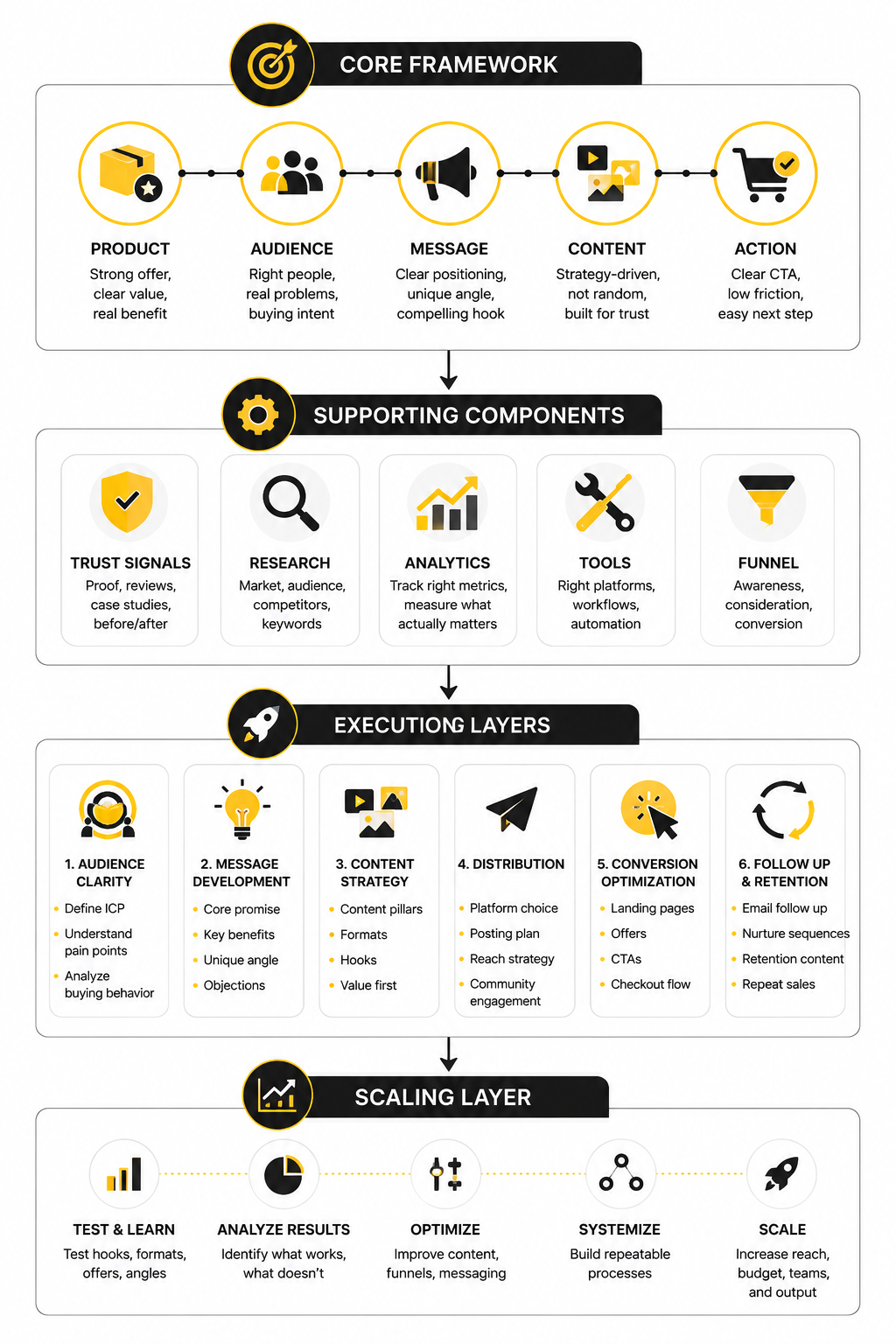
This framework keeps the strategy grounded. Without positioning, content feels random. Without content, the product stays invisible. Without conversation, interest leaks away. Without conversion, attention becomes vanity metrics instead of revenue.
The point is not to turn every post into a sales pitch. The point is to design a social presence where every useful post has a role. Some posts attract new people, some educate warm prospects, some handle objections, some show proof, and some invite the sale directly.
Core Components Of A Social Product Promotion Strategy
The first component is a clear product promise. People should understand who the product is for, what problem it solves, and why it is different without needing a long explanation. This is especially important on fast platforms where users decide in seconds whether to keep watching, scroll away, or click.
The second component is platform-fit content. A product demo that works on YouTube Shorts may need a different hook on TikTok, a different caption on Instagram, and a more educational angle on LinkedIn. The product stays the same, but the packaging changes because user intent changes by platform.
The third component is a follow-up system. Comments, direct messages, saved posts, email captures, retargeting audiences, and landing pages all matter because most buyers do not purchase the first time they see a product. Tools like ManyChat can help turn social engagement into structured conversations, while platforms like Buffer can help keep publishing consistent across channels.
Professional Implementation Starts With A System
Professional implementation means you stop asking, “What should we post today?” and start asking, “Which part of the buying journey needs support?” That one shift changes the quality of the entire strategy. It moves the work away from random content ideas and toward repeatable growth.
A practical system should include product messaging, content pillars, posting workflows, response rules, tracking links, offer pages, and a review rhythm. For ecommerce brands, a focused landing page built with a tool like Replo can help connect social traffic to a product-specific buying experience. For service businesses or agencies, a CRM and automation platform like GoHighLevel can help manage leads that start as social interactions.
This is where promoting products on social media becomes a real business function. It is not only creative. It is creative plus operations. The brands that understand that combination are usually the ones that turn views into customers instead of just more content.
The Product Promotion Framework
The strongest social product strategies are built around one simple idea: people do not move from seeing a post to buying a product in one clean step. They notice, compare, question, save, forget, return, ask, click, and then decide. That is why promoting products on social media works best when each post has a specific job inside a larger system.
A useful framework has four moving parts: attention, education, trust, and action. Attention gets the right people to stop scrolling. Education helps them understand the product and its value. Trust reduces doubt. Action gives them a clear, low-friction next step.
This matters because social commerce is no longer a side channel. U.S. social commerce sales were projected to reach $87.02 billion in 2025 and surpass $100 billion in 2026, which shows how quickly social platforms are becoming serious buying environments. But that growth does not reward random posting. It rewards brands that understand how people actually make decisions.
Attention Comes First, But It Is Not The Goal
Attention is the entry point, not the finish line. A product post can get views because it is funny, beautiful, controversial, or attached to a trend, but views alone do not prove buying intent. The real question is whether the attention is coming from people who could genuinely want the product.
This is where many brands get sloppy. They chase broad reach when they need qualified attention. A skincare brand, a local service business, a B2B software company, and a fitness coach should not judge success by the same content signals because their buyers behave differently.
Good attention starts with a specific buyer tension. What is the person trying to fix, improve, avoid, simplify, prove, or feel? When the hook connects to that tension, the product feels relevant before it ever gets pitched.
Education Makes The Product Easier To Buy
People rarely buy what they do not understand. If a product has a learning curve, a premium price, a new category, or a meaningful point of difference, education becomes part of the sales process. That does not mean long lectures. It means clear content that answers the questions buyers already have in their heads.
Educational product content can explain use cases, compare options, show before-and-after context, clarify who the product is not for, or break down how it works. The best version feels helpful even to someone who is not ready to buy yet. That is important because helpful content gets saved, shared, revisited, and trusted.
This is especially useful when promoting products on social media because social content can meet buyers before they actively search. The 2025 Sprout Social Index highlights how consumers expect brands to contribute value and relevance, not just appear in the feed with another generic promo. Education turns that expectation into an advantage.
Trust Turns Interest Into Consideration
Trust is the bridge between “that looks interesting” and “I might buy this.” On social media, trust does not come from one perfect post. It comes from repeated signals that the product is real, the brand understands the customer, and the buying experience will not feel risky.
Those signals can include customer reviews, creator content, transparent product demos, thoughtful replies, clear policies, and consistent messaging across platforms. DHL’s 2025 ecommerce research found that 62% of shoppers say customer reviews on social media influence their buying decisions, which makes social proof more than a nice bonus. It is part of the buying environment.
The important detail is that trust should be specific. “Customers love us” is weak. A comment showing how someone used the product, a demo that reveals the exact result, or a creator explaining why the product fits a certain situation is much stronger. Specific proof beats vague praise almost every time.
Action Must Be Obvious
Once someone is interested, the next step should be easy to find and easy to understand. That sounds basic, but it is one of the most common leaks in social product promotion. Brands create strong content, then send people to a confusing homepage, an overloaded bio link, or a product page that does not match the promise made in the post.
A good action step matches the buyer’s stage. Cold viewers may need a guide, quiz, demo, or comparison. Warm prospects may need a product page, checkout link, discount, consultation, or direct message flow. Ready buyers need the fastest path to purchase with as little friction as possible.
This is where the backend matters. If comments and direct messages are part of the sales path, a tool like ManyChat can help structure follow-up without forcing every conversation to stay manual. If social traffic needs a dedicated product experience, Replo can help ecommerce teams build landing pages that match the exact campaign instead of relying on generic store pages.
Understanding The Buyer Before You Create Content
Before creating content, you need to know what the buyer already believes. Do they know the problem exists? Are they comparing solutions? Are they skeptical because they have been disappointed before? Are they price-sensitive, time-sensitive, status-driven, convenience-driven, or results-driven?
This is not abstract branding work. It directly shapes the content you create. A buyer who does not understand the problem needs different posts than a buyer who already wants the category and is comparing options. A buyer who trusts the category but not your brand needs proof. A buyer who trusts your brand but hesitates on price needs value framing.
Strong product promotion starts by mapping the buyer’s mental state. The product does not exist in isolation. It sits inside the buyer’s routines, frustrations, alternatives, objections, and desired outcome.
Identify The Real Buying Trigger
People do not buy products just because brands explain features. They buy because something creates urgency, desire, discomfort, or aspiration. The buying trigger is the moment a person starts caring enough to pay attention.
For a productivity tool, the trigger might be missed deadlines or messy workflows. For a beauty product, it might be a specific skin concern, an upcoming event, or frustration with products that did not work. For a coaching offer, it might be the realization that free advice is no longer enough.
When you know the trigger, your content becomes sharper. You can lead with the moment the buyer recognizes instead of starting with the product. That is usually the difference between content that feels like an ad and content that feels personally relevant.
Separate Curiosity From Intent
Curiosity and intent are not the same thing. A person can watch a product video because it is satisfying, surprising, or entertaining without having any plan to buy. Another person might quietly save a plain comparison post because they are seriously evaluating options.
This is why you should not judge content only by visible engagement. Comments and likes are useful, but saves, shares, clicks, direct messages, product page views, and repeat visits often tell a better story. Promoting products on social media gets much easier when you stop treating every engagement metric as equal.
A balanced content mix should attract curiosity and then create paths for intent. Curiosity expands reach. Intent creates revenue. You need both, but you should know which one each post is designed to generate.
Build Around Objections Early
Every product has objections. Price, trust, quality, complexity, timing, shipping, fit, support, and proof can all slow people down. Ignoring those objections does not make the product feel more desirable. It just leaves buyers alone with their doubts.
The best brands handle objections before they become deal-breakers. They show how the product works, explain what makes it different, compare it honestly, answer common questions, and make the buying process feel safe. This kind of content is not defensive. It is useful.
Objection-based content also performs well because it feels grounded. People appreciate brands that do not pretend every buyer is already convinced. A clear answer to a real hesitation can do more for sales than another polished lifestyle post.
Building Product Content That Earns Attention
Once you understand the buyer, the next job is turning that understanding into content people actually want to watch, read, save, click, or respond to. This is where promoting products on social media becomes practical. You are no longer guessing what to post; you are creating content around the moments that move someone closer to buying.
The mistake is trying to make every post do everything. One post cannot introduce the problem, explain the product, prove the result, answer every objection, and close the sale without becoming heavy. Strong product content works better when each piece has one clear role.
Think of your content as a sequence, not a pile of posts. Some content should create awareness. Some should educate. Some should prove. Some should invite action. When those pieces work together, the product starts showing up in the buyer’s mind from multiple angles without feeling repetitive.
Start With The Product Promise
Every content plan needs a product promise before it needs content ideas. The product promise is the simple, buyer-focused explanation of what the product helps someone do, achieve, avoid, or improve. It should be clear enough that a stranger can understand it quickly.
A weak product promise sounds like a feature list. A strong product promise connects the product to an outcome the buyer already cares about. For example, “automated Instagram replies” is a feature, but “turn interested commenters into guided product conversations” is closer to a real promise.
This matters because social content moves fast. If the promise is unclear, the creative has to work too hard. When the promise is sharp, hooks become easier, captions become cleaner, and calls to action feel more natural.
Turn Buyer Questions Into Content Pillars
The easiest way to build content pillars is to start with the questions buyers ask before they purchase. What is this? Who is it for? Why should I trust it? How does it compare? What happens after I buy? What makes it worth the price?
Those questions can become practical content categories. You might have one pillar for product education, one for proof, one for comparisons, one for use cases, and one for behind-the-scenes trust building. This keeps the content organized without making it stiff.
Promoting products on social media gets much easier when your pillars are based on buyer thinking instead of platform trends. Trends can still help with packaging, but the substance should come from customer intent. That is how you avoid posting content that gets attention but does not support sales.
Match The Format To The Message
Not every message belongs in the same format. A quick objection might work best as a short video or carousel. A detailed comparison may need a longer caption, landing page, email, or YouTube-style explanation. A visual transformation may need before-and-after content, while a complex service may need a simple breakdown of the process.
The format should make the message easier to understand. Do not choose video just because video is popular. Do not choose carousels just because someone said they drive saves. Choose the format that makes the buyer’s next thought feel obvious.
This is also where platform behavior matters. A TikTok viewer may expect speed and personality. An Instagram user may respond well to visual proof and creator-style content. A LinkedIn audience may need a more direct business case. The same product can be promoted across all three, but the execution should not be copied and pasted.
The Step-By-Step Content Execution Process
A practical execution process keeps your team from drifting into random posting. It gives you a repeatable way to move from strategy to published content without losing the buyer logic. This is where the work becomes tangible.
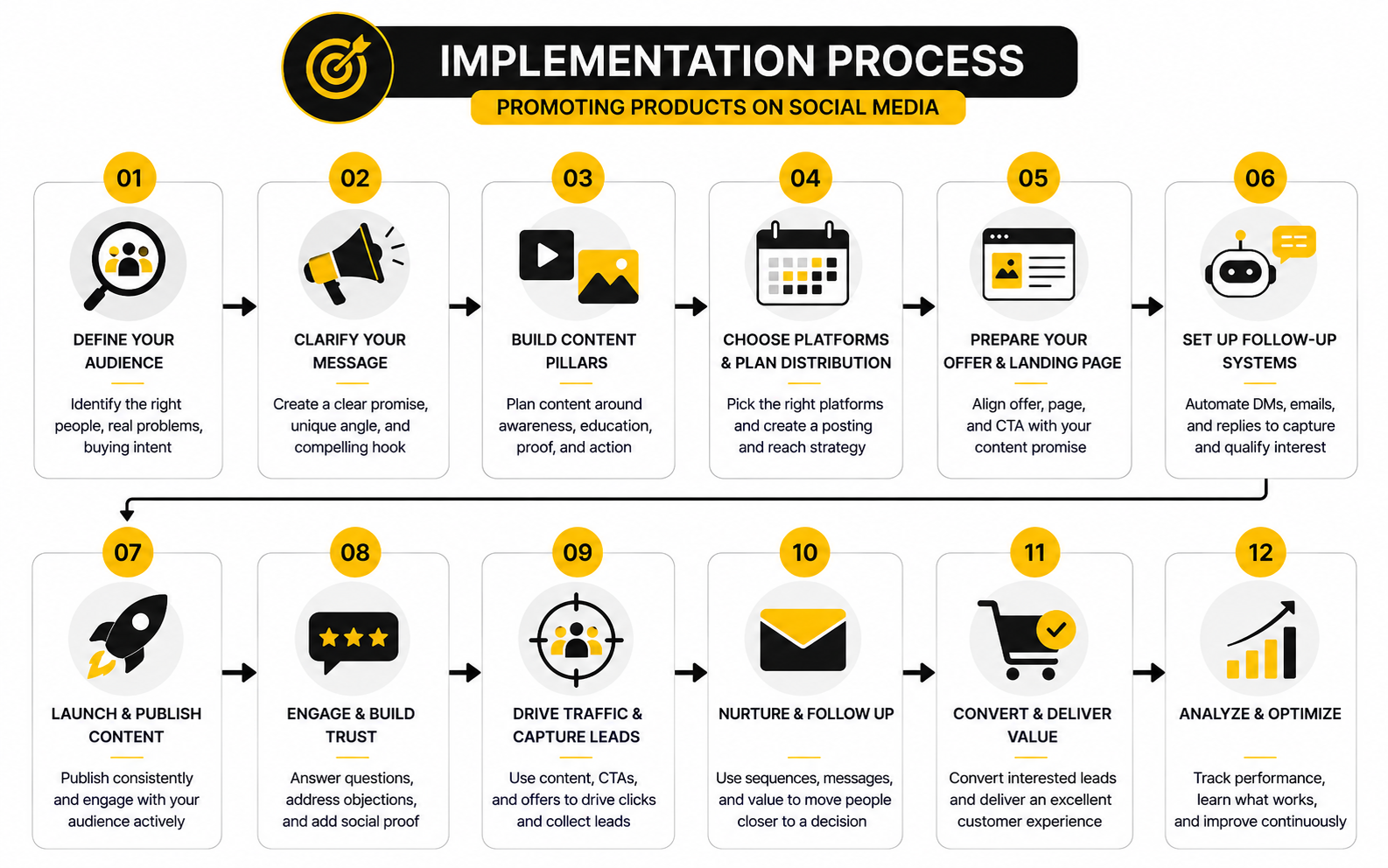
The process should be simple enough to use every week. If it requires a huge strategy document every time, it will not survive real operations. The goal is a workflow that helps you create consistently while still protecting quality.
Choose One Buyer Stage Per Post
Every post should support one main stage of the buyer journey. If the goal is awareness, the post should make the problem or desire instantly recognizable. If the goal is education, it should make the product easier to understand. If the goal is trust, it should reduce perceived risk. If the goal is action, it should make the next step clear.
This keeps the content focused. A common problem with product posts is that they try to attract cold audiences and close hot buyers at the same time. The result is usually a post that feels too salesy for new people and too shallow for serious prospects.
When you choose the stage first, the creative decisions become cleaner. The hook, proof, caption, and CTA all work toward the same job. That is how you create content that feels intentional without sounding overproduced.
Build Hooks From Real Buyer Tension
A good hook does not just grab attention. It grabs the right attention. The best hooks usually come from a real tension the buyer already feels, not from a random viral formula.
Buyer tension can sound like frustration, curiosity, urgency, comparison, doubt, or aspiration. A person might wonder why their current solution is not working. They might want a faster way to get a result. They might be comparing your product against a cheaper alternative. Each of those tensions can become a hook.
This is why customer research is so useful. Reviews, comments, sales calls, support tickets, and direct messages often contain better hooks than brainstorming sessions. Real buyer language usually beats clever marketing language because it already sounds familiar to the audience.
Use Proof Without Making It Feel Forced
Proof is essential, but it should not feel pasted onto the end of a post. The proof should match the claim being made. If the claim is about speed, show time saved. If the claim is about quality, show the detail. If the claim is about ease, show the process. If the claim is about results, show the result in context.
Proof can come from customer reviews, product demonstrations, creator content, screenshots, expert explanations, user-generated content, or transparent behind-the-scenes content. The strongest proof is specific because it answers a specific doubt. Generic praise does not do enough work.
This also applies to software, services, and digital products. A walkthrough, checklist, template preview, workflow example, or before-and-after process can make the offer feel more concrete. If the product needs explanation, proof should help the buyer picture themselves using it.
Make The Call To Action Fit The Moment
A call to action should match the buyer’s readiness. Asking someone to buy immediately can work when the product is simple, affordable, familiar, or already desired. But if the product is complex, expensive, or new to the buyer, the next step may need to be softer.
For cold audiences, the CTA might be to save the post, comment a keyword, watch a demo, take a quiz, or read a comparison. For warm audiences, it might be to view the product page, book a call, start a trial, or claim an offer. For hot audiences, it should remove friction and point directly to purchase.
This is where tools can support the process without replacing the strategy. A comment-to-message workflow in ManyChat can turn engagement into a guided next step. A focused funnel in ClickFunnels or Systeme.io can give social traffic a cleaner path than sending everyone to a generic homepage.
Creating A Weekly Promotion Workflow
A weekly workflow keeps product promotion moving even when the team is busy. Start by choosing the product focus for the week, then decide which buyer questions need content. From there, assign formats, write the core messages, and schedule the posts.
A simple weekly plan might include one awareness post, one educational post, one proof post, one objection-handling post, and one direct offer post. That gives you enough variety without losing the product thread. It also prevents the feed from becoming either all entertainment or all sales.
Scheduling tools can help maintain consistency, especially when multiple platforms are involved. Buffer is useful when the main problem is planning and publishing across channels. The bigger point is not the tool itself; it is having a rhythm that keeps the product visible without scrambling every day.
Repurpose Without Duplicating Everything
Repurposing is not copying one post everywhere. It is taking one strong idea and reshaping it for different contexts. A product demo can become a short video, a carousel, a comparison post, a story sequence, an email section, and a landing page block.
This works because most buyers will not see every piece of content. Even when they do, repetition from different angles can help the message sink in. The key is to change the packaging so the content feels native to the platform and useful in the moment.
Repurposing also helps you learn faster. If the same product angle performs well in multiple formats, you may have found a strong message. If it only works in one format, you may have found a platform-specific creative win. Both insights are useful.
Keep The Offer Connected To The Content
The landing experience should match the content that created the click. If a post talks about one product benefit, the page should reinforce that benefit quickly. If a video answers a specific objection, the next page should not make the buyer hunt for the relevant information.
This is a major conversion issue. Social traffic often has less patience than search traffic because the visitor did not always begin with a strong buying mission. The page has to reconnect them to the reason they clicked.
For ecommerce campaigns, a tailored landing page in Replo can help keep the message consistent from post to page. For lead generation, GoHighLevel can help connect forms, calendars, follow-ups, and pipeline tracking so social interest does not disappear after the first click.
Review The Right Metric For Each Post
You cannot judge every post by the same number. An awareness post might be measured by reach, watch time, profile visits, or shares. An educational post might be measured by saves, completion rate, or click-through. A conversion post might be judged by leads, purchases, booked calls, or revenue.
This sounds obvious, but it is where many teams lose confidence. They publish a trust-building post, see fewer likes than usual, and assume it failed. But if that post helps warmer buyers overcome hesitation, it may be doing its job.
The practical move is to decide the metric before publishing. When you know what the post is supposed to accomplish, performance becomes easier to interpret. That is how promoting products on social media becomes a learning system instead of an emotional reaction to likes.
Statistics And Data That Actually Matter
Measurement should not turn into a pile of disconnected numbers. The goal is not to prove that social media is “working” because one post got more likes than usual. The goal is to understand which signals show buyer movement, which signals only show casual attention, and which signals should change your next decision.
That distinction matters because promoting products on social media creates different types of value at different moments. A top-of-funnel video might never generate direct sales on the same day, but it can build retargeting audiences, improve product familiarity, and increase branded search later. A lower-reach post might look unimpressive publicly but still drive qualified clicks, direct messages, or purchases.
The practical rule is simple: measure the job of the content, not just the visibility of the content. If the post was designed to create awareness, judge awareness signals. If it was designed to answer objections, judge deeper engagement and sales-assisted behavior. If it was designed to sell, judge conversion, revenue, and cost efficiency.
Social Commerce Growth Shows Why Measurement Has To Get Serious
Social commerce is too large to treat casually now. The U.S. social commerce market was estimated to reach $114.7 billion in 2025, and global social commerce is expected to keep expanding as platforms make discovery, messaging, checkout, and creator content more connected. That does not mean every brand should expect instant sales from every post, but it does mean social can no longer be measured like a branding side project.
The more serious the channel becomes, the more disciplined the measurement needs to be. If social is influencing discovery, consideration, conversations, and purchase, then looking only at likes is obviously too shallow. You need a view of how content contributes across the full path.
This is especially important for teams investing in creators, paid amplification, live shopping, automated direct messages, or social-first funnels. Those efforts can create value in different places, so the measurement system has to capture more than final-click sales. Otherwise, you will cut content that is helping and overfund content that only looks good in a dashboard.
Benchmarks Are Useful, But They Are Not Your Strategy
Benchmarks help you understand whether your performance is broadly healthy, but they should not become the strategy. A general engagement benchmark can tell you if your content is far below category norms, but it cannot tell you whether your product positioning is sharp, your offer is compelling, or your landing page is doing its job. Benchmarks are context, not instructions.
Industry benchmark reports are still useful when you interpret them carefully. Sprout Social’s 2025 benchmark data separates inbound engagement per day from engagement per post, which is helpful because a brand can look active overall while individual posts are weak, or have fewer posts that perform much harder individually. That difference changes the action you take.
If engagement per post is low, the issue may be creative quality, hook strength, or audience fit. If total engagement per day is low, the issue may be publishing volume, distribution, or consistency. If both are weak, the strategy probably needs a deeper reset instead of another batch of small caption tweaks.
The Analytics System Should Follow The Buyer Journey
A clean analytics system connects each content role to the right performance signal. Attention content should be measured by reach quality, watch time, retention, shares, profile visits, and audience growth. Education content should be measured by saves, completion, link clicks, carousel swipes, replies, and time spent on the next page. Trust content should be measured by comments, review engagement, creator performance, repeat visitors, direct messages, and assisted conversions.
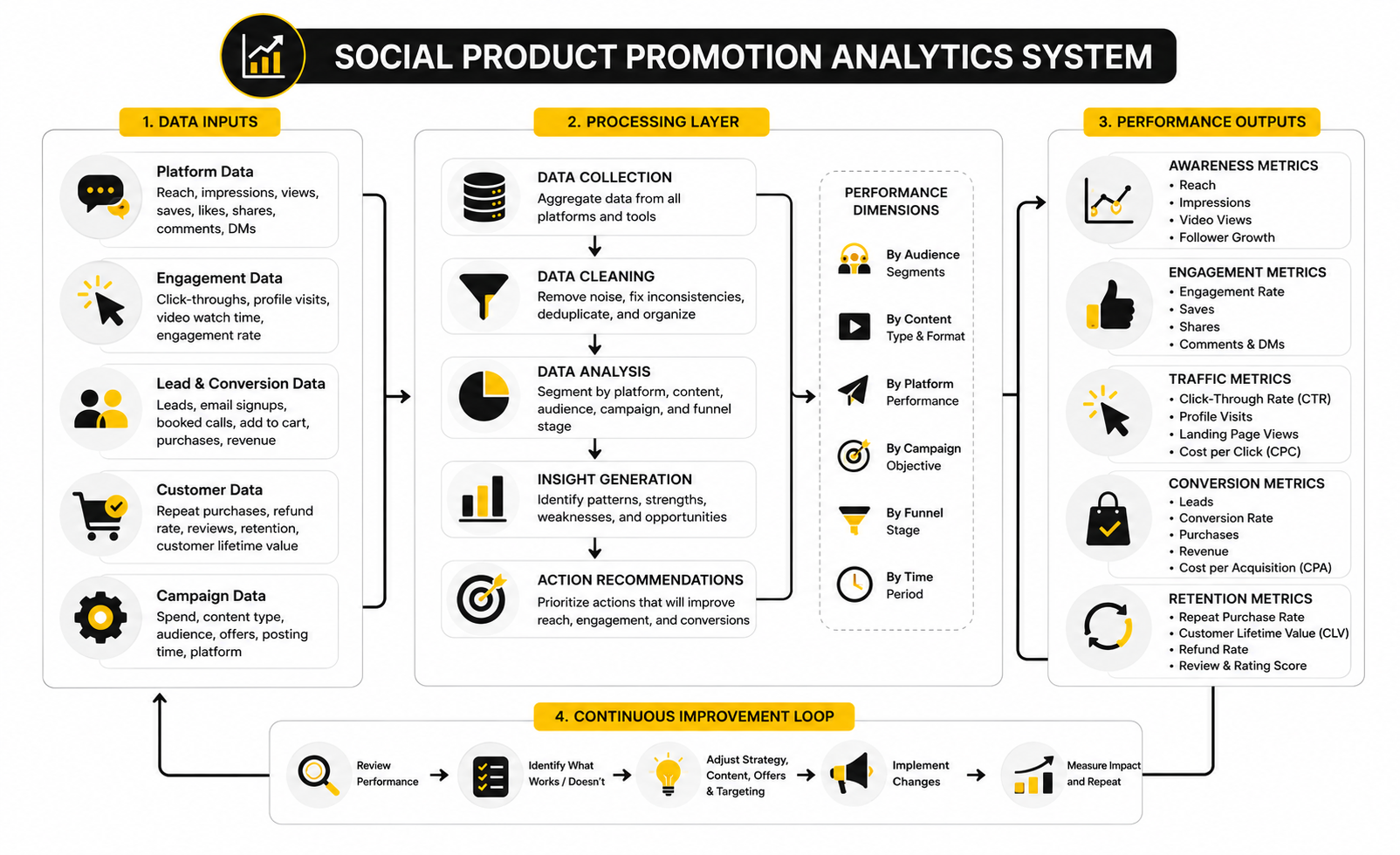
Action content needs a stricter lens. This is where you look at click-through rate, product page conversion rate, lead form completion, booked calls, checkout starts, purchase conversion, revenue, cost per acquisition, and return on ad spend when paid media is involved. These numbers are closer to money, so they should drive sharper decisions.
The point is not to build a complicated dashboard for the sake of it. The point is to stop judging every post by the same public metric. A post that earns fewer likes but drives high-intent clicks may be more valuable than a viral post that attracts the wrong audience.
Measure Attention Quality, Not Just Reach
Reach is useful, but reach alone can lie. A product video can reach a large audience because it is entertaining, controversial, or attached to a trend, while still attracting people who have no real connection to the product. That is not useless, but it is not the same as qualified attention.
Better attention signals include average watch time, retention, saves, shares with relevant commentary, profile visits, website clicks, and follower growth from the right audience. If a post reaches fewer people but creates stronger downstream behavior, it may be a better product promotion asset. This is why looking at one metric in isolation can push you toward bad decisions.
When promoting products on social media, pay close attention to the gap between views and intent signals. If views are high but clicks, saves, replies, and profile visits are weak, the hook may be too broad. If reach is modest but intent signals are strong, you may have a message worth amplifying with paid distribution or repurposing into new formats.
Track Engagement By Depth
Engagement is not one thing. A like is light. A comment takes more effort. A save suggests future value. A share can create social proof and distribution. A direct message can signal real buying interest. Treating all of those actions as equal makes the data less useful.
This is why the quality of engagement matters more than the raw total. A product post with 50 serious questions may be more valuable than a post with 500 low-intent reactions. A creator video with fewer comments but stronger click-through can outperform a post that looks louder on the surface.
A simple way to read engagement is to group it into light, medium, and high-intent actions. Likes and basic reactions are light. Saves, shares, and meaningful comments are medium. Direct messages, product clicks, form fills, add-to-carts, and purchases are high intent. That structure keeps the analysis practical.
Use Conversion Data To Find Leaks
Conversion data tells you where interest is leaking. If social posts get strong engagement but weak clicks, the call to action may be unclear or the audience may not be ready. If clicks are strong but page conversions are weak, the landing page may not match the content promise. If add-to-carts are strong but purchases are weak, pricing, shipping, trust, or checkout friction may be the issue.
This is where product promotion becomes a full-funnel exercise. You cannot fix every problem by changing the creative. Sometimes the post is doing its job and the page is failing. Sometimes the page is fine but the offer is not strong enough. Sometimes the offer is good but the audience from the post is too broad.
For campaigns where social traffic needs a dedicated path, a focused landing page builder like Replo can help keep the post-to-page message consistent. For lead-based businesses, GoHighLevel can help track contacts, follow-ups, booked calls, and pipeline movement so social performance is not judged only by front-end clicks.
Watch Assisted Conversions And Repeat Exposure
Not every sale from social will show up as a clean direct conversion. Someone may see a Reel, search the brand later, read reviews, click an email, and then buy from a retargeting ad. If your measurement only gives credit to the final click, social content can look weaker than it really is.
This is why assisted conversions, repeat visitors, branded search lift, email signups, and retargeting audience growth matter. They show whether social is building demand even when it does not close the sale immediately. For higher-priced products or services, these assisted signals are especially important because the buying cycle usually takes longer.
Research on multi-platform social media strategy has also found that ecommerce retailers using a more diversified social presence can see stronger web sales because repeated exposure across platforms reinforces awareness and intent. That supports a practical takeaway: consistency across channels is not just a visibility play. It can help buyers remember, compare, and return.
Build A Simple Weekly Reporting Rhythm
A weekly report should answer three questions: what attracted qualified attention, what moved people closer to buying, and what created revenue or sales opportunities. If the report cannot answer those questions, it is probably too focused on surface metrics. Keep it simple, but make it useful.
A practical weekly review can include:
This rhythm keeps the team focused on decisions instead of reporting for reporting’s sake. You do not need a giant dashboard to improve. You need a clear way to spot patterns and choose the next move.
Turn Data Into Action
Data is only useful when it changes behavior. If a product demo gets strong watch time but weak clicks, test a clearer CTA or a stronger offer transition. If a comparison post drives saves, turn it into a landing page section, email, or retargeting ad. If direct messages are increasing but sales are not, improve the response flow and objection handling.
This is also where automation can help. A platform like ManyChat can organize comment-triggered conversations, while email tools like Brevo or Moosend can help follow up with people who need more time before buying. The point is not to automate everything. The point is to keep interested people from slipping through the cracks.
The best measurement system makes promoting products on social media less emotional. You stop guessing whether a post was “good” because it got applause. You start asking whether it moved the right people toward the right next step. That is the difference between content activity and a real product promotion engine.
Scaling Without Breaking The Strategy
Scaling social product promotion is not just “post more” or “spend more.” That usually creates noise faster than it creates revenue. Real scale happens when the message, content system, offer path, and follow-up process can handle more attention without becoming messy.
The main risk is that growth exposes weak points. A campaign that works manually with a small audience may fall apart when comments, direct messages, customer questions, fulfillment issues, and support requests increase. That is why promoting products on social media needs operational discipline before aggressive scaling.
The better approach is to scale in layers. First, prove the message. Then prove the content format. Then prove the offer path. Then add volume, creators, paid amplification, automation, and additional platforms.
Do Not Scale A Weak Message
A weak message does not get fixed by more distribution. If people do not understand the product, do not believe the promise, or do not see why it matters now, bigger reach just spreads confusion. That can be worse than low reach because it teaches the algorithm and the audience to ignore the product.
Before scaling, look for message-market signals. Are people asking useful questions? Are they saving comparison content? Are they clicking from product demos? Are direct messages showing buying intent? Are returning visitors converting better after seeing social content?
If those signals are weak, work on positioning before budget. Tighten the promise, change the angle, show clearer proof, or pick a more specific buyer segment. Scale should amplify a working message, not compensate for a vague one.
Balance Organic, Paid, And Creator Content
Organic content is useful for learning because it shows what people respond to without forcing distribution. Paid content is useful for reach, testing, and consistency because it lets you put proven messages in front of more people. Creator content is useful because it can add trust, relatability, and native platform language that brand accounts often struggle to create alone.
The tradeoff is control. Organic gives you direct brand voice, but reach can be unpredictable. Paid gives you targeting and volume, but costs expose weak creative quickly. Creator partnerships bring borrowed trust, but the content needs clear guidelines without becoming over-scripted.
Creator investment keeps growing because brands want product messages delivered through people audiences already watch. U.S. creator ad spending was projected to hit $37 billion in 2025, which shows how seriously marketers are treating creator-led distribution. The smart move is not to hire creators because everyone else is doing it. The smart move is to use creators where trust, demonstration, and audience fit make the product easier to believe.
Treat Creators Like Distribution Partners, Not Just Content Vendors
A creator is not just a person who records a video. The right creator brings audience understanding, platform instincts, credibility, and a style that can make the product feel more natural. If you reduce the relationship to “read this script,” you usually lose the reason you hired the creator in the first place.
Good creator briefs should define the product promise, required claims, disclosure requirements, audience context, and offer details. They should not over-control every sentence unless compliance requires it. The creator needs room to explain the product in language their audience trusts.
At the same time, loose briefs can create risk. Claims can become exaggerated, disclosures can be missed, and product positioning can drift. The strongest creator programs balance creative freedom with clear boundaries.
Keep Compliance Visible And Boring
Compliance is not the exciting part of promoting products on social media, but it matters. Endorsements, affiliate links, free products, paid partnerships, and creator incentives need clear disclosure. The FTC’s endorsement guidance makes the basic principle simple: if there is a material connection between the brand and the endorser, people should be able to notice and understand it.
This is not only a legal issue. It is a trust issue. If people feel tricked after discovering that a recommendation was paid, the brand loses credibility even if the product is good. Clear disclosure protects the buyer, the creator, and the brand.
Make disclosure part of the process instead of treating it like a last-minute caption add-on. Put it in creator briefs, approval checklists, affiliate instructions, and internal review steps. Boring is good here. Boring means nobody is guessing.
Watch For Platform Dependency
Social platforms are powerful because they concentrate attention. They are risky for the same reason. Algorithms shift, organic reach changes, ad costs move, accounts get restricted, formats rise and fall, and a channel that worked last quarter can become less reliable quickly.
This does not mean you should avoid platforms. It means you should avoid building the entire business on one platform’s mood. If one account, one content format, or one paid channel drives most of your product promotion, you have a concentration risk.
A stronger strategy turns social attention into owned or more durable assets. Email subscribers, SMS subscribers where appropriate, CRM contacts, community members, search demand, customer lists, and retargeting audiences give you more control. Tools like Brevo and Moosend can help capture and nurture people who are interested but not ready to buy the first time they see the product.
Build A Follow-Up System Before You Need It
Follow-up becomes more important as volume grows. When a campaign is small, you can answer comments manually, remember warm leads, and send individual links. When a campaign starts working, that manual system gets slow fast.
A follow-up system should cover the most common paths people take after engaging. Someone comments a keyword and gets the right resource. Someone asks a price question and gets a useful answer. Someone clicks but does not buy and receives a relevant reminder. Someone books a call and gets pre-call context.
This is where automation should feel helpful, not robotic. ManyChat can support direct message flows from comments or story interactions, while GoHighLevel can help service businesses manage leads, appointments, pipelines, and follow-up. The goal is not to remove human judgment. The goal is to make sure serious buyers do not disappear because the backend was not ready.
Avoid Over-Automating Trust
Automation can speed up response, but it cannot replace trust. A buyer can usually tell when a brand is forcing every interaction through a generic bot flow. That becomes a problem when the product needs nuance, reassurance, or a real conversation.
Use automation for routing, qualification, reminders, delivery of resources, and simple next steps. Use human support for edge cases, emotional objections, high-value leads, complex questions, and complaints. This balance keeps the experience efficient without making the brand feel cold.
The practical test is simple. If the interaction affects trust, do not hide behind automation. Make the handoff to a person easy, clear, and fast.
Advanced Strategic Tradeoffs
At a higher level, product promotion always involves tradeoffs. You cannot optimize for everything at once. You need to decide when to prioritize reach, when to prioritize trust, when to prioritize conversion, and when to slow down because the brand experience is not ready for more demand.
This is where experienced marketers separate themselves from content operators. They do not just ask, “What performed best?” They ask, “Best for what, at what cost, and with what second-order effect?” That question prevents a lot of bad scaling decisions.
A viral post can create sales and support pressure at the same time. A heavy discount can improve short-term conversion but train buyers to wait. A creator partnership can create awareness but also dilute the brand if the fit is wrong. Strategy is knowing which tradeoff you are making before the data forces you to notice it.
Reach Versus Relevance
Reach feels good because it is visible. Relevance pays better because it attracts people who actually care. The danger is assuming bigger reach automatically means better promotion.
For simple, mass-market products, broad reach can work well. For niche products, premium offers, technical products, or services with a specific buyer profile, relevance matters more. A smaller audience with a stronger problem can outperform a huge audience with mild curiosity.
The best approach is usually to use broad content carefully. Let broad content introduce the problem or desire, then use retargeting, follow-up, and deeper content to qualify interest. That way reach becomes a doorway instead of a distraction.
Discounts Versus Value
Discounts can work, but they are not a strategy by themselves. If every social promotion relies on a discount, buyers may start waiting for the next offer instead of valuing the product at full price. That creates margin pressure and weakens positioning.
Value framing is different. It explains why the product is worth the money, what problem it solves, what it replaces, what outcome it supports, and why delaying the purchase may cost more than buying. This is especially important for premium products, subscriptions, and services.
Use discounts with intention. They can help with launches, seasonal campaigns, inventory movement, bundles, or limited-time urgency. But the core content strategy should still make the product desirable without needing price cuts every time.
Consistency Versus Creative Fatigue
Consistency builds recognition, but repetition can become stale. If the same hook, format, claim, or visual style keeps showing up, the audience may start ignoring it. This is especially true when paid campaigns run for long periods.
Creative fatigue does not always mean the offer is dead. It often means the angle needs a refresh. You can keep the same product promise while testing new hooks, proof types, creator voices, formats, landing page sections, or audience segments.
The key is to protect the strategic message while rotating the creative packaging. Do not change everything at once unless the whole campaign is failing. Change one meaningful variable at a time so the results actually teach you something.
Speed Versus Brand Safety
Social media rewards speed, but brands still need judgment. Jumping on every trend can make a product feel current, but it can also create tone problems, compliance issues, or awkward audience mismatch. Not every viral moment deserves your brand’s participation.
A good brand safety filter is simple. Does the trend fit the product? Does it fit the audience? Does it fit the brand voice? Could it be misread? Would the post still make sense if the trend disappeared tomorrow?
This does not mean you should be slow or stiff. It means you should be selective. Fast, relevant, and on-brand is strong. Fast, forced, and confusing is not.
Attribution Versus Reality
Attribution will never be perfect. Social content influences people in ways dashboards do not fully capture. Someone may watch three videos, read comments, search the brand later, ask a friend, click an email, and then buy from a different device.
That does not mean measurement is pointless. It means you should avoid pretending one attribution model tells the whole truth. Use platform data, website analytics, CRM data, post-purchase surveys, coupon codes, UTM links, and customer conversations together.
The best teams look for directional truth. They ask whether social activity is increasing qualified traffic, better conversations, stronger retargeting pools, higher branded search, more assisted conversions, and more efficient sales. That broader view is much closer to how buyers actually behave.
Preparing To Scale The Next Phase
Before scaling, tighten the system. Make sure your best product messages are documented, your content roles are clear, your landing pages match the campaigns, and your follow-up flows are working. If those pieces are loose, more traffic will only create more leaks.
Then decide what kind of scale you want. More organic output requires creative systems and scheduling discipline. More paid distribution requires stronger testing and budget control. More creator content requires briefs, approvals, usage rights, and performance tracking. More sales conversations require automation, CRM structure, and human support.
This is the point where promoting products on social media becomes less about posting and more about building a revenue engine. Content creates the first movement. Systems capture and compound it. Scaling works when both sides are ready.
Measuring, Optimizing, And Scaling Your Social Product Strategy
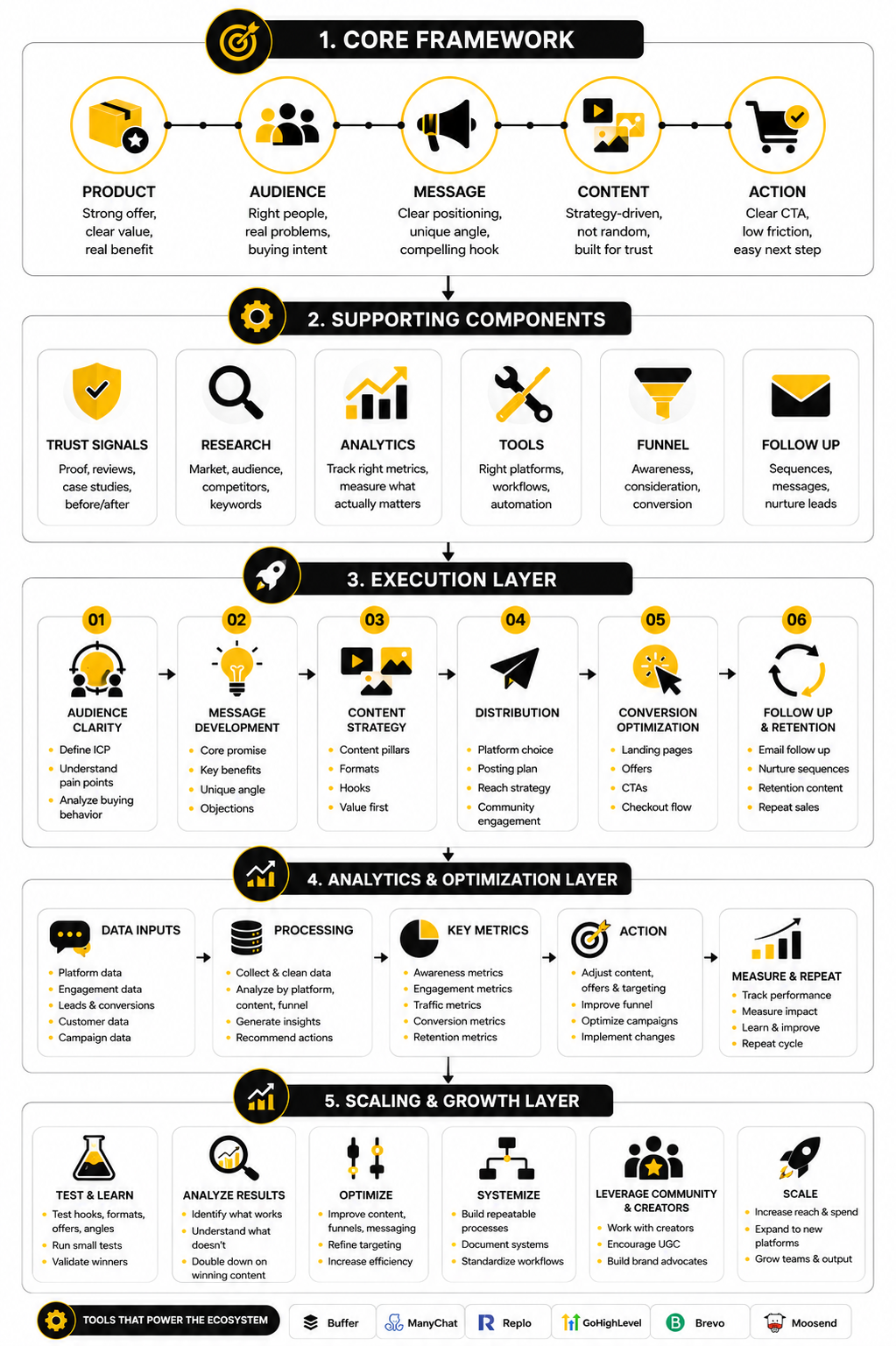
By this point, the strategy has moved from product promise to content execution, measurement, and scale. The final step is connecting everything into one operating system. That system should help you plan campaigns, publish better content, capture demand, follow up with interested buyers, and improve based on real signals instead of guesswork.
This is where promoting products on social media becomes a serious growth channel. Not because every post sells instantly, and not because every trend matters. It becomes serious when the brand knows what each piece of content is supposed to do, how each buyer signal should be handled, and which parts of the system need improvement.
The complete ecosystem has five layers: product positioning, content creation, distribution, conversion, and retention. Positioning makes the message clear. Content earns attention and trust. Distribution gets the message in front of the right people. Conversion turns interest into action. Retention turns customers into repeat buyers, advocates, reviewers, and referral sources.
Connect Social Content To A Real Customer Journey
A strong social strategy does not end when someone clicks. The click is only one handoff in the journey. The buyer may need a landing page, a product page, a quiz, a booking calendar, a checkout flow, an email sequence, a direct message, or a sales conversation before they are ready.
This is why disconnected tools create problems. If content is in one place, leads are in another, customer questions are somewhere else, and sales data is reviewed separately, the team cannot see the full journey. They end up optimizing isolated pieces instead of improving the system.
A cleaner setup connects the path from post to purchase. For example, social posts can drive comments and direct messages into ManyChat, product traffic into dedicated pages built with Replo, and service leads into a pipeline managed through GoHighLevel. The tools matter less than the principle: every interested buyer should have a clear next step and a tracked follow-up path.
Make Retention Part Of Product Promotion
Many brands treat social media as a new-customer channel only. That leaves money on the table. Existing customers can become the strongest source of repeat purchases, reviews, user-generated content, referrals, and product education.
Retention content can include product tips, advanced use cases, customer spotlights, troubleshooting help, launch previews, and community prompts. This content keeps customers engaged after the sale and gives prospects more proof that the product is useful beyond the first purchase. It also reduces support friction because common questions can be answered publicly and repeatedly.
This matters because a customer who already trusts the product is easier to re-engage than a cold audience. If the product has repeat purchase potential, subscriptions, add-ons, upgrades, or complementary offers, retention should be built into the content calendar. Promoting products on social media is not only about the first sale; it is about increasing customer value over time.
Create Feedback Loops Between Marketing, Sales, And Support
The best product promotion ideas often come from outside the marketing team. Sales hears objections. Support hears confusion. Customers reveal unexpected use cases. Comments and direct messages show the exact language buyers use when they are interested, skeptical, or stuck.
Those insights should not sit in separate inboxes. They should feed the content system. A repeated support question can become a carousel. A common sales objection can become a comparison video. A customer success detail can become proof content. A confusing product feature can become a short tutorial.
This feedback loop makes the strategy more carefully over time. Instead of inventing content from scratch, the team keeps turning real buyer friction into useful public assets. That is how the brand becomes more relevant while reducing repetitive manual explanations.
Know When To Refresh The Strategy
Even a strong strategy needs refresh cycles. Buyer behavior changes, platform formats shift, competitors copy winning angles, and old creative eventually loses energy. The solution is not to rebuild everything every month. The solution is to know which layer needs attention.
If reach is falling, look at hooks, formats, platform fit, and distribution. If engagement is shallow, look at audience relevance and message depth. If clicks are weak, look at the CTA and offer transition. If conversions are weak, look at landing page match, trust signals, pricing, and checkout friction. If customers are buying once but not returning, look at onboarding, retention content, and post-purchase communication.
This layered diagnosis prevents overreaction. You do not need to change the offer every time a post underperforms. You do not need to abandon a platform because one campaign misses. You need to identify the real bottleneck and fix that part first.
What is the best way to start promoting products on social media?
The best way to start is by choosing one product, one audience, and one clear product promise. Do not begin by trying to post everywhere or copy whatever is trending. Start with the buyer’s problem, the product’s value, and the specific reason someone should care now.
Once that is clear, create a small content mix around awareness, education, proof, and action. This gives you enough variety to learn what people respond to without making the process chaotic. After that, review saves, clicks, comments, direct messages, and conversions so the next round of content is based on evidence.
How often should a brand post when promoting products on social media?
There is no perfect posting frequency for every brand. A small team with strong weekly content will usually do better than a team forcing daily posts that say nothing useful. Consistency matters, but quality and strategic intent matter more.
A practical starting point is three to five strong posts per week on the main platform, supported by stories, short updates, or repurposed content when useful. If the team has more capacity, increase volume carefully and track whether performance improves or simply creates more noise. The goal is sustainable output, not content exhaustion.
Which social media platform is best for product promotion?
The best platform depends on the product, audience, buying cycle, and content format. Visual consumer products often work well on Instagram, TikTok, Pinterest, and YouTube Shorts. B2B products and professional services may perform better on LinkedIn, YouTube, X, or niche communities.
The better question is where the buyer already pays attention and what kind of content helps them make a decision. A product that needs demonstration may benefit from short-form video. A product that needs detailed explanation may need YouTube, LinkedIn, email, or landing pages. Platform choice should follow buyer behavior.
How do you promote a product without sounding too salesy?
The easiest way is to stop making every post about the transaction. Teach people how the product solves a real problem, show it in use, answer objections, compare options honestly, and share specific proof. Sales content feels less pushy when it helps the buyer make a better decision.
Direct offers still matter, but they should sit inside a broader content system. If the audience has already seen useful education, proof, and context, a sales post feels more natural. The problem is not selling. The problem is selling before trust and relevance have been built.
What metrics matter most for promoting products on social media?
The most important metrics depend on the role of the content. Awareness posts should be judged by reach quality, retention, shares, and profile visits. Education posts should be judged by saves, completion, clicks, and replies. Sales posts should be judged by leads, checkout starts, purchases, revenue, booked calls, and conversion rate.
Do not treat likes as the main success metric. Likes can show light interest, but they do not always show purchase intent. A post with fewer likes but more qualified clicks or direct messages may be far more valuable.
Should brands use influencers or creators to promote products?
Creators can be very effective when the product needs trust, demonstration, or native platform storytelling. U.S. creator ad spending was projected to reach $37 billion in 2025, which shows how central creator partnerships have become in modern marketing. But creator marketing only works when the audience fit, product fit, and message fit are strong.
Do not hire creators just because they have large audiences. Look for creators whose followers match the buyer, whose content style fits the product, and whose credibility would make the recommendation feel natural. A smaller creator with a stronger audience match can outperform a bigger creator with weak relevance.
How do affiliate links fit into social product promotion?
Affiliate links work best when they are connected to useful content, not dropped randomly into captions. A creator review, comparison post, tutorial, product roundup, or resource guide can create natural click intent. The link should feel like the next helpful step, not a forced monetization layer.
Disclosure is also important. The FTC’s endorsement guidance explains that material connections, including paid relationships and affiliate incentives, should be clear to consumers. Transparency protects trust, and trust is the whole point of social promotion.
How do you turn comments and direct messages into sales?
Start by treating comments and direct messages as intent signals. A person asking about price, fit, shipping, features, availability, or results is showing more interest than someone who only liked the post. Those interactions should have a response process.
For simple questions, saved replies and automation can help. For higher-intent buyers, the conversation should move toward a product page, checkout link, booking page, demo, or helpful resource. A tool like ManyChat can help structure common flows so interested people are not left waiting.
How should ecommerce brands use landing pages from social traffic?
Social traffic needs fast message match. If someone clicks from a post about one specific benefit, the landing page should reinforce that benefit immediately. Sending every visitor to a generic homepage creates friction because the buyer has to reconnect the dots themselves.
A strong social landing page should show the product, repeat the core promise, answer the most likely objections, include proof, and make the next step obvious. For ecommerce teams, Replo can help build campaign-specific pages that align better with the content that created the click.
How should service businesses promote offers on social media?
Service businesses should focus on buyer pain, proof, process, and trust. The buyer usually needs to understand the problem, believe the provider can solve it, and feel safe taking the next step. That means educational posts, case-style explanations without fake claims, objection handling, and clear calls to action are more useful than constant promotional posts.
The backend matters too. A service lead may need a form, calendar, consultation, proposal, and follow-up sequence. GoHighLevel can help manage that path so social interest turns into a tracked opportunity instead of a loose conversation.
What is the biggest mistake brands make when promoting products on social media?
The biggest mistake is treating social as a posting channel instead of a buying journey. Brands publish content, but they do not connect the content to buyer stages, trust signals, landing pages, follow-up, and measurement. Then they blame the platform when the system was never complete.
The fix is to build the full path. Make the promise clear, create content with specific roles, capture interest, follow up, measure the right signals, and improve the weakest layer. That is much more powerful than simply posting more often.
How long does it take to see results from social product promotion?
Simple products with strong demand and clear offers can generate sales quickly, especially with good creative and a low-friction buying path. More complex products, higher-priced offers, and service businesses usually need more time because trust and comparison play a bigger role. The timeline depends on audience warmth, offer strength, content quality, and follow-up.
Look for early indicators before judging the entire strategy. Saves, comments, direct messages, profile visits, product page clicks, email signups, booked calls, and repeat visitors can show that the market is responding even before revenue becomes predictable. Those signals tell you whether to refine, scale, or reposition.
What tools help with promoting products on social media?
The right tool depends on the bottleneck. If publishing consistency is the problem, Buffer can help plan and schedule content. If direct message follow-up is the problem, ManyChat can help organize conversations. If landing pages are the problem, Replo can help ecommerce campaigns stay focused.
For lead-based businesses, GoHighLevel can connect forms, calendars, CRM, and follow-up. For email nurturing, Brevo and Moosend can help keep interested buyers engaged after they leave the platform. Tools should support the strategy, not replace it.
Build a stronger local presence with BAAM AI
Turn your website, Google profile, social channels, and AI visibility into one growth engine
Most businesses do not need more random marketing activity. They need a consistent presence system that helps the right people find them, trust them, and take action. BAAM AI brings strategy, local SEO, website updates, Google Maps visibility, social content, AI-search readiness, media production, and reporting into one practical monthly engine.
If you want your marketing to keep working after the campaign ends, start with a free BAAM AI presence audit. See how your business shows up today and where the fastest visibility wins are at BAAM AI.