
BAAM AI Blog
Promo Marketing: A Practical Framework for Campaigns People Actually Remember
Promo marketing works best when it does more than shout “discount.” The strongest campaigns give people a reason to notice, act, remember, and come back. That can mean a launch offer, a referral incentive, a branded...
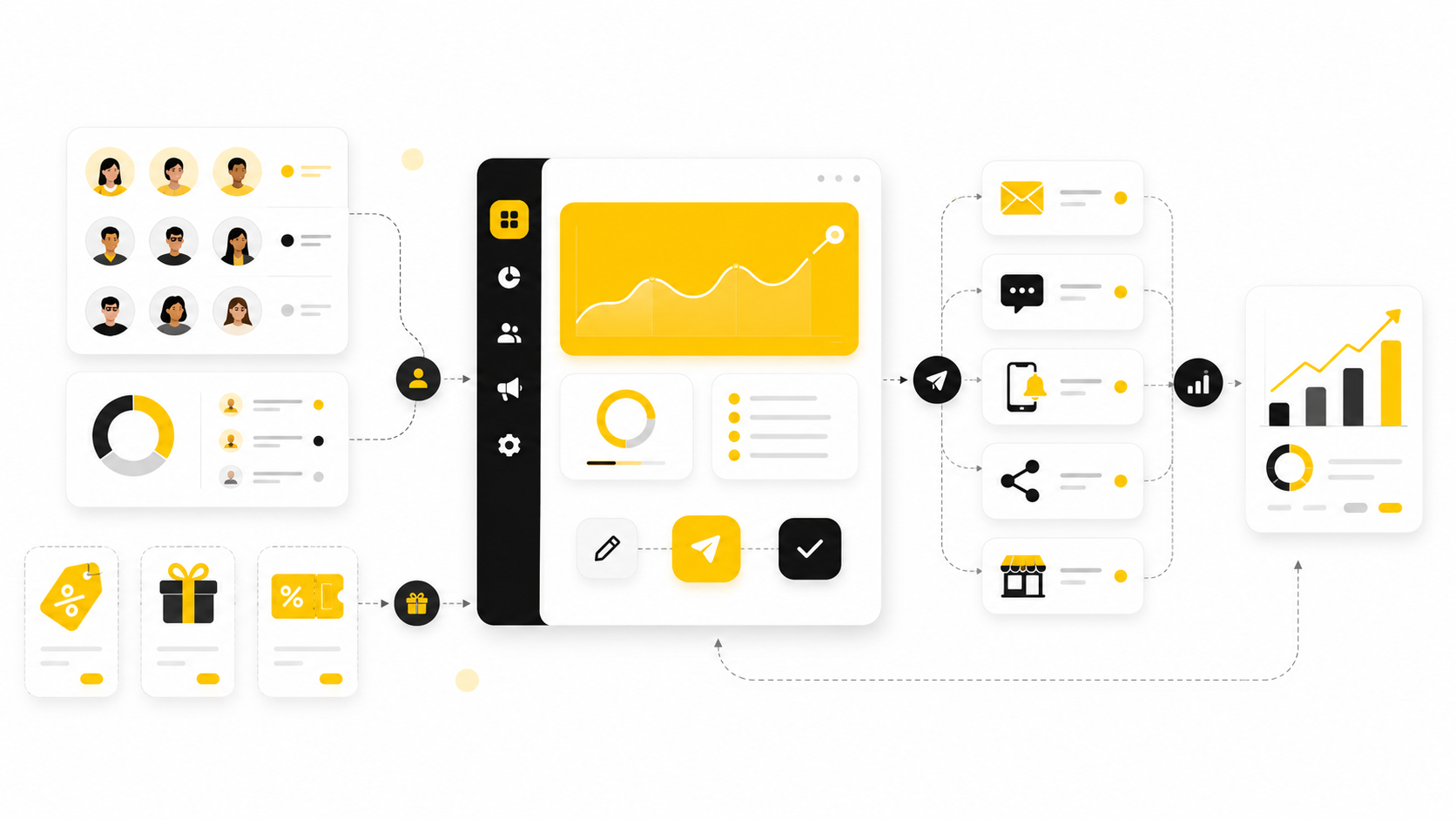
Promo marketing works best when it does more than shout “discount.” The strongest campaigns give people a reason to notice, act, remember, and come back. That can mean a launch offer, a referral incentive, a branded product, a giveaway, a limited-time bundle, a loyalty reward, a creator-led campaign, or a follow-up sequence that turns first-time attention into measurable revenue.
The problem is that most promotional campaigns are built backwards. A business starts with the offer, rushes into channels, then wonders why the result feels random. Better promo marketing starts with the buyer moment: what the person already wants, what friction is stopping them, what incentive would feel useful rather than desperate, and what follow-up system will capture the value after the first click or scan.
This matters because attention is expensive, trust is fragile, and customers are more selective about where they spend. Branded merchandise still creates memory when it is useful, with PPAI research finding that 38% of recipients remembered a brand months or even years after receiving a promo item, and 76% looked up the brand afterward in some cases of curiosity or interest. PPAI’s research on promo product recall shows the same bigger lesson that applies across digital and physical promotions: people remember what feels relevant, timely, and useful.
this guide is split into six parts so the strategy builds in the right order. First, we define what promo marketing is and why it still matters. Then we move into the framework, the core components, the implementation process, measurement, and finally the FAQ.
Promo Marketing Basics and Why It Matters
Promo marketing is the strategic use of incentives, campaigns, and branded experiences to influence a specific customer action. That action might be a first purchase, a demo booking, a referral, a repeat order, an event visit, a social share, or a reactivation from an old customer list. The key word is strategic, because a promotion without a clear action is just noise with a budget attached.
The best promo marketing does not rely on cheap urgency alone. It connects a clear offer with a clear audience, a clear channel, and a clear next step. That is why a useful branded item, a personalized email offer, a social giveaway, and a limited-time service bundle can all belong under the same umbrella when they are designed around behavior instead of random exposure.
Modern buyers also expect promotions to feel more relevant. Deloitte found that 80% of surveyed consumers prefer brands that offer personalized experiences, and those consumers reported spending 50% more with brands that personalize well. Deloitte’s personalization research makes the point clearly: generic promotions are easier to ignore, while relevant ones feel like help at the right moment.
The Big Shift: From One-Off Offers to Connected Campaigns
Old-school promotion often meant printing a coupon, running a sale, or giving away branded merch at an event. Those tactics can still work, but they perform better when they are connected to a system. A QR code on a flyer, a giveaway tied to an email capture, a referral reward linked to a CRM, or a post-purchase offer triggered by behavior can turn a simple promotion into a measurable customer journey.
That shift is especially important because consumers are not moving through neat, linear funnels anymore. McKinsey’s 2025 consumer research covered more than 25,000 consumers across 18 markets, showing how fragmented behavior has become across value-seeking, digital habits, trust, and spending priorities. McKinsey’s State of the Consumer 2025 reinforces why promo marketing needs to be grounded in real customer behavior, not assumptions.
This is where many businesses lose money. They treat the promotion as the campaign, when the promotion is only one part of the campaign. The real system includes audience selection, offer design, creative, timing, delivery, follow-up, sales handling, and measurement.
The Practical Promo Marketing Framework
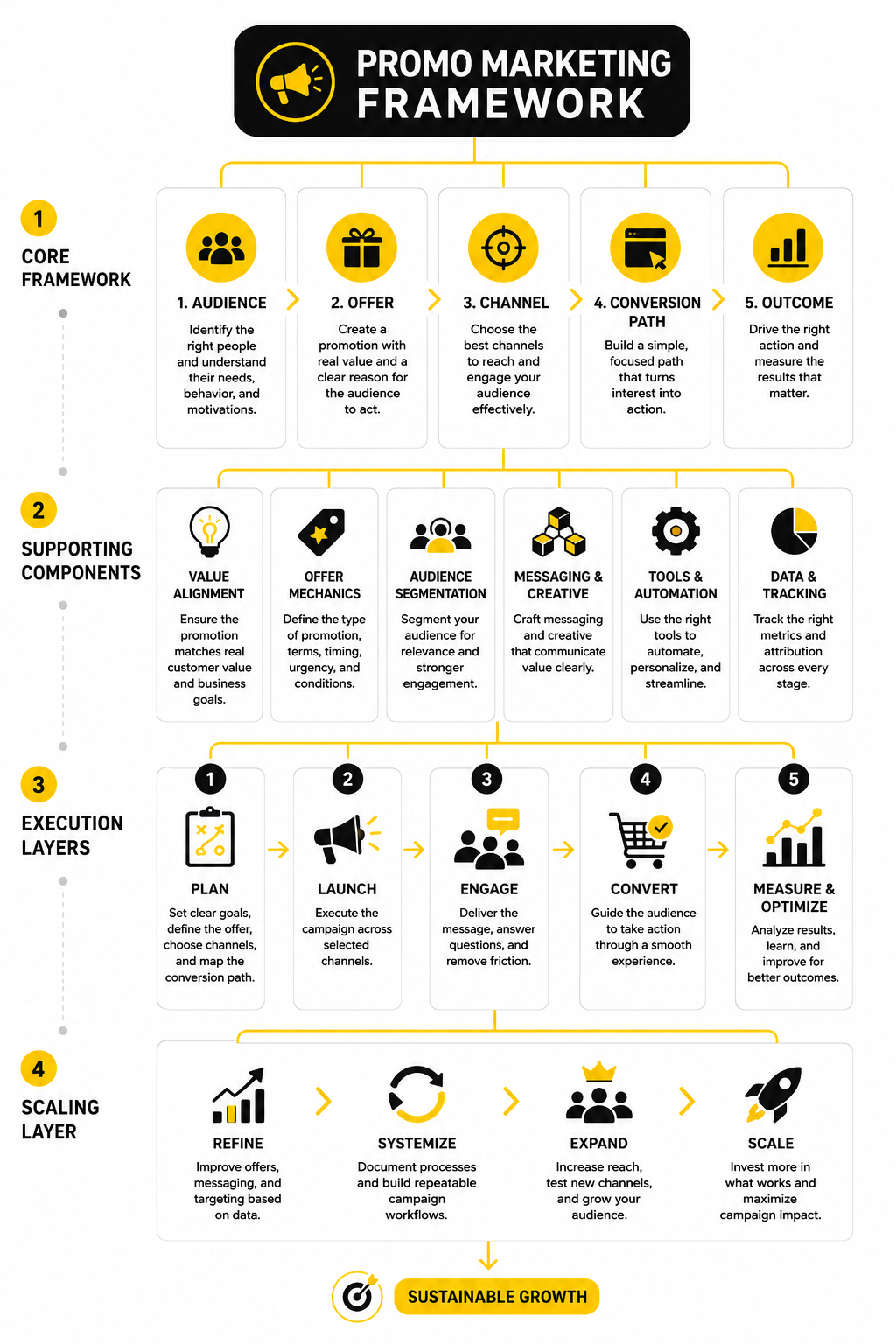
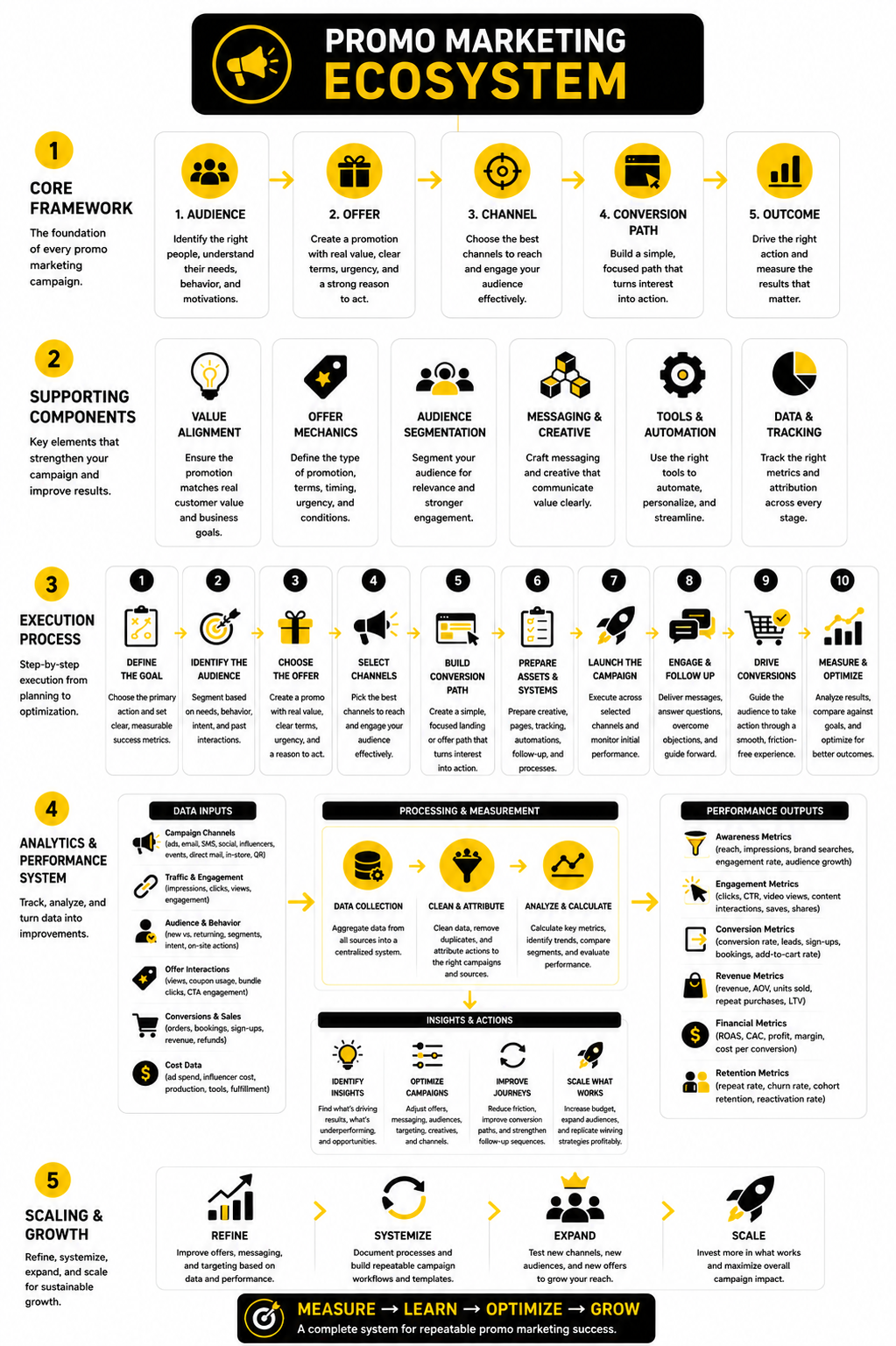
A strong promo marketing campaign has four layers: audience, offer, channel, and follow-up. The audience decides who the campaign is for. The offer decides why they should care now. The channel decides where the message earns attention. The follow-up decides whether the campaign produces lasting value or just a temporary spike.
This framework applies whether you are promoting a local service, an ecommerce product, a SaaS trial, a coaching program, a restaurant event, a trade show booth, or a B2B lead magnet. The tactics change, but the logic stays the same. If the audience is vague, the offer becomes weak; if the channel is wrong, the creative gets ignored; if the follow-up is missing, the campaign leaks revenue.
The next part will break this framework down properly. The goal is not to make promo marketing complicated. The goal is to make it intentional enough that every campaign has a reason to exist, a buyer it speaks to, and a measurable business outcome behind it.
The Promo Marketing Framework
A good promo marketing campaign is not a random offer pushed through a random channel. It is a system that moves a specific audience toward a specific action with a reason that feels timely, useful, and believable. When that system is missing, even a generous promotion can feel weak because the buyer does not understand why they should care now.
The framework has four parts: audience, offer, channel, and follow-up. Each part supports the next one. If the audience is too broad, the offer becomes generic; if the offer is generic, the channel has to work too hard; if the follow-up is weak, the campaign loses value after the first interaction.
This is why promo marketing should be planned like a customer journey, not like a one-off announcement. A customer might first see a short-form video, then click a landing page, then receive a message, then claim a bonus, then get a reminder, then finally buy. The promotion creates the reason to move, but the framework creates the path.
Audience: Who Is This Really For?
The audience decision comes first because every strong promotion is built around a specific buyer situation. A new visitor does not need the same incentive as a returning customer. A cold lead does not need the same message as someone who abandoned checkout, attended a webinar, scanned a QR code, or bought from you six months ago.
This is where many campaigns get lazy. They aim at “everyone who might be interested,” which usually means the creative becomes vague and the incentive becomes expensive. A better approach is to define the audience by behavior, pain, intent, and stage of awareness.
For example, an ecommerce brand might build one promo for first-time visitors, another for repeat buyers, and another for high-intent shoppers who viewed a product multiple times. A service business might separate cold leads, old leads, booked consultations, no-shows, and past clients. The tighter the audience, the easier it becomes to design a promotion that feels relevant instead of forced.
Offer: Why Should They Act Now?
The offer is not just the discount. It is the full reason someone should take action now instead of later. That reason can be financial, practical, emotional, social, or convenience-based.
A weak offer says, “Here is 10% off.” A stronger offer says, “Here is the exact bonus, upgrade, bundle, trial, reward, or deadline that makes this decision easier today.” The difference is important because buyers are trained to ignore generic discounts, especially when every brand is running one.
The best offers reduce friction without damaging trust. That might mean a limited-time bundle, a free setup call, a useful branded item, a referral reward, a sample, a loyalty perk, a bonus template, a free trial, or a simple guarantee. For businesses that need automated follow-up after someone claims an offer, tools like GoHighLevel can help connect forms, pipelines, messages, and reminders into one campaign system.
Channel: Where Will the Promotion Earn Attention?
The channel should be chosen after the audience and offer, not before. Too many campaigns start with “let’s post this on Instagram” or “let’s send an email” without asking whether that is where the buyer is most likely to act. Channel choice is not about where the brand wants attention; it is about where the customer already has intent.
Some channels are better for discovery, while others are better for conversion. Social media can create awareness and participation. Email can drive repeat engagement. SMS can work for timely reminders when permission is clear. Search can capture existing demand. Events and direct mail can create tactile memory when the item or message is genuinely useful.
For social scheduling and campaign consistency, Buffer can fit naturally when a promotion needs coordinated posts across multiple platforms. For chat-based campaigns where people enter through Instagram, Facebook, or messaging flows, ManyChat can help turn attention into a more direct conversation.
Follow-Up: What Happens After the First Click?
Follow-up is where promo marketing usually wins or loses. The first click, scan, reply, or form submission is not the finish line. It is the moment when the campaign finally has a real signal from the customer.
That signal should trigger the next step. Someone who claims a coupon might need a reminder before it expires. Someone who downloads a buyer guide might need a comparison email. Someone who books a call might need confirmation, preparation, and no-show prevention. Someone who receives a branded product might need a QR code, thank-you message, or post-event sequence that keeps the relationship alive.
This is why isolated promotions underperform. They create activity but no continuity. A connected follow-up system turns campaign interest into sales opportunities, repeat purchases, referrals, reviews, or future list value.
Matching Promo Types to Buyer Intent
Different promotions work for different levels of buyer intent. A cold audience usually needs education, curiosity, or low-friction participation. A warm audience can respond to a clearer offer because they already understand the problem. A hot audience often needs urgency, reassurance, or a final reason to act.
For cold audiences, useful content and simple participation often work better than aggressive discounts. A giveaway, checklist, quiz, sample, event invitation, or educational offer can open the relationship without asking too much too soon. The goal is not to squeeze a sale immediately; the goal is to earn permission for the next conversation.
For warm and hot audiences, the offer can become more direct. That might include a limited bonus, consultation, trial, bundle, loyalty reward, financing option, or upgrade. If the campaign sends people to a landing page, tools like ClickFunnels, systeme.io, or Replo can support the page-building side of the campaign, depending on whether the business needs funnels, an all-in-one setup, or ecommerce landing pages.
The Role of Timing and Context
Timing is one of the most underrated parts of promo marketing. The same offer can perform very differently depending on when the customer sees it. A back-to-school promotion, renewal reminder, birthday reward, event follow-up, abandoned-cart incentive, or seasonal bundle works because the timing gives the message a reason to exist.
Context also protects the campaign from feeling spammy. A discount sent immediately after a product view can feel helpful. The same discount sent repeatedly to someone who has shown no interest can feel annoying. Relevance is not only about personalization; it is also about restraint.
This matters even more as brands use more automation. Automation should make the customer experience sharper, not louder. The goal is to send the right prompt at the right moment, then stop when the customer has already acted or clearly moved on.
Why the Framework Comes Before the Tactic
Tactics are easy to copy. Frameworks are harder, but they are what make campaigns reliable. Anyone can run a giveaway, print merch, launch a coupon, send an email, or publish a social post, but the results depend on whether the tactic fits the audience, offer, channel, and follow-up system.
This is the practical difference between busy marketing and useful marketing. Busy marketing creates motion. Useful marketing creates movement toward a measurable action.
Promo marketing becomes much easier when every campaign has to answer four questions before anything is launched:
When those questions are clear, the campaign has structure. The next step is to look at the core components that make the campaign strong enough to work in the real world.
Core Components of a Strong Promo Campaign
Once the framework is clear, the next job is execution. This is where promo marketing becomes practical. You are no longer asking, “Should we run a promotion?” You are asking, “What exactly needs to be built so this promotion can move a real person from interest to action?”
A strong campaign has several moving parts, but they should not feel chaotic. The audience defines the target. The offer creates the reason to act. The channel delivers the message. The follow-up system captures the value. Now the implementation layer turns those ideas into assets, deadlines, responsibilities, and measurable steps.
This is where weak campaigns expose themselves. If nobody knows where the traffic goes, what happens after a form submission, who handles new leads, or how success will be measured, the campaign is not ready. Good promo marketing is not just creative; it is operational.
The Campaign Goal
Every campaign needs one primary goal. Not five goals. Not a vague mix of awareness, engagement, sales, followers, and “brand buzz.” One main goal keeps the entire campaign focused.
That goal might be lead generation, product trials, booked calls, event attendance, repeat purchases, referrals, reviews, or direct revenue. The goal should be specific enough that the team can build around it. “Get more customers” is not a campaign goal; “generate booked consultations from past leads over the next 14 days” is much stronger.
This also protects the campaign from bad measurement. If the goal is booked calls, likes are not the main signal. If the goal is repeat purchases, impressions are not the main signal. Pick the business outcome first, then choose the metrics that actually prove progress.
The Offer Mechanism
The offer mechanism is the structure behind the promotion. It explains what the person gets, what they need to do, when they need to act, and what makes the offer credible. This is where you turn a rough idea into something a buyer can understand in seconds.
For example, a campaign might use a limited-time bundle, a free consultation, a trial, a referral credit, a loyalty reward, a launch bonus, a giveaway entry, or a gift with purchase. Each mechanism creates a different kind of motivation. A giveaway can create reach, a referral credit can create word of mouth, and a free consultation can create sales conversations.
The mechanism should match the buying stage. Cold audiences usually need low-friction offers. Warm audiences can handle more direct calls to action. High-intent buyers may only need one extra reason to move now.
The Conversion Path
The conversion path is the route someone follows after they notice the promotion. It might be a landing page, form, checkout page, calendar booking page, chat flow, QR code destination, or email reply. This path should be simple enough that the customer does not need to think too hard.
In practical terms, the conversion path should answer three questions quickly: what is this, why should I care, and what do I do next? If the page is slow, the form is too long, the offer is unclear, or the call to action is buried, the campaign will leak attention. Small friction points matter because promotional intent is often short-lived.
For landing pages and funnels, ClickFunnels, systeme.io, and Replo can each support this part of the process in different ways. The tool is not the strategy, but the right tool can make the execution faster and cleaner.
The Promo Marketing Implementation Process
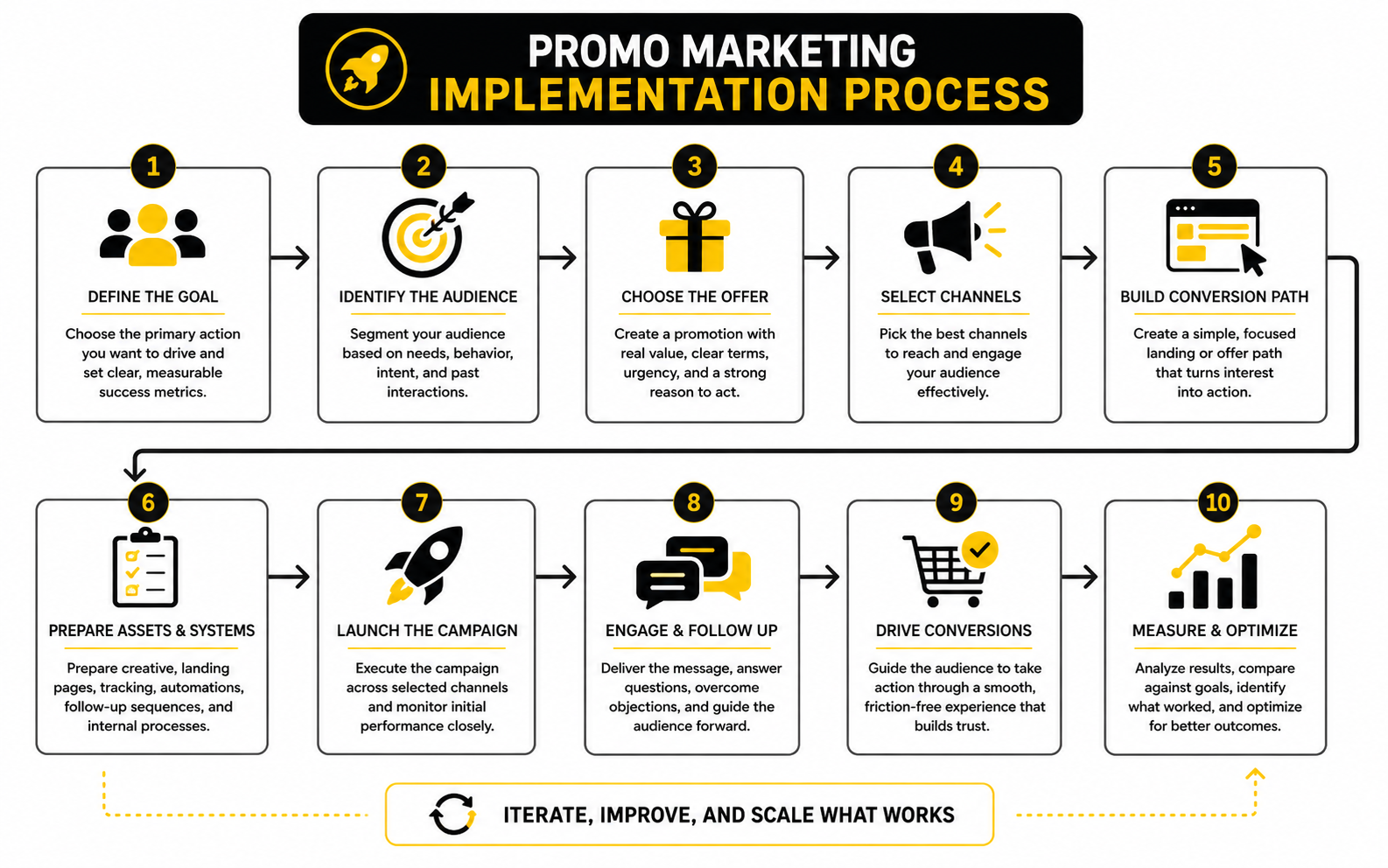
Execution works best when it follows a repeatable process. You do not need a massive team or complicated planning document. You need a clear sequence that prevents missed steps.
The process below keeps promo marketing grounded. It forces the campaign to move from strategy into assets, automation, launch, and review. More importantly, it makes the campaign easier to repeat because every promotion improves the next one.
Step 1: Define the Campaign Goal
Start with the outcome that matters most. A promo campaign for a local service business might focus on booked appointments. A campaign for an ecommerce brand might focus on first purchases, average order value, or repeat purchases. A campaign for a software product might focus on trials, demos, or activation.
The goal should be tied to a business constraint. Maybe the pipeline is too quiet. Maybe first-time buyers are not returning. Maybe a new product needs traction. Maybe an event needs attendance. The clearer the constraint, the easier it is to design a promotion that solves something real.
This is also where you decide what not to chase. A campaign cannot optimize for everything at once. If the goal is revenue, build for revenue. If the goal is list growth, build for qualified list growth, not random subscribers who only wanted a prize.
Step 2: Choose the Audience Segment
The audience segment should be narrow enough that the message can feel personal. You might target past buyers who have not purchased in 90 days, leads who downloaded a guide but never booked, subscribers who clicked a product link, or local prospects near an event. The segment gives the campaign its voice.
This is one reason customer data matters. When a business can separate new leads, active customers, inactive customers, high-value buyers, and referral sources, it can run more carefully promotions. Without segmentation, every campaign becomes a blast.
Segmentation does not have to be complicated at the start. Even a simple split between cold traffic, warm leads, current customers, and past customers can improve campaign quality. The point is to stop speaking to everyone the same way.
Step 3: Build the Offer Mechanism
After the audience is clear, shape the offer around their current friction. If they are curious but hesitant, reduce risk. If they already want the product but have not acted, add urgency or a bonus. If they bought before, make the next purchase feel easy and appreciated.
The offer should be easy to explain in one sentence. A confused buyer does not convert. A confused team also struggles to promote the campaign consistently across channels.
This is where you check the economics. A promo that generates attention but destroys margin is not a win. Build the offer so the customer feels a real benefit and the business can still support the promise.
Step 4: Select the Main Channel and Support Channels
Every campaign needs one main channel. That channel might be email, paid social, organic social, direct mail, SMS, search, influencer content, partnerships, in-store signage, or events. The main channel is where the campaign will do most of its work.
Support channels should reinforce the campaign without creating clutter. For example, an email campaign might be supported by social posts and a retargeting audience. An event promotion might be supported by QR codes, reminder messages, and partner posts. A branded merchandise campaign might be supported by a landing page, thank-you sequence, and referral prompt.
This is where consistency matters. The same offer should not look like five different campaigns across five different channels. The creative can be adapted, but the promise and next step should stay clear.
Step 5: Create the Conversion Path
The conversion path should remove unnecessary decisions. If the action is to book a call, send people directly to a booking page. If the action is to claim a reward, send them to the claim page. If the action is to buy a bundle, send them to the exact offer page.
For service businesses, scheduling tools like Cal.com can help reduce friction when the campaign goal is booked appointments. For forms, quizzes, applications, or claim pages, Fillout can be useful when the promotion needs structured responses before the next step.
Keep the path tight. A campaign that sends people to a homepage and expects them to figure it out is wasting intent. The easier the next step, the more useful the promotion becomes.
Step 6: Prepare the Creative Assets
Creative assets turn the offer into something people notice. That includes the headline, copy, graphics, short videos, product photos, email subject lines, ad variations, QR code signage, event materials, and sales scripts. The creative should make the value obvious fast.
Good creative is not just pretty. It clarifies the promise. It shows who the offer is for, why it matters now, and what action to take. If the creative only looks polished but does not explain the promotion, it is decoration.
For social campaigns, tools like Buffer can help organize publishing across platforms. For campaign copy, voice input, and faster content drafting, Wispr Flow can support the production side when speed matters.
Step 7: Set Up Tracking and Attribution
Tracking should be decided before launch, not after. At minimum, the campaign should track traffic source, conversion action, cost, revenue, lead quality, and follow-up performance. If QR codes, forms, ads, email links, or referral links are involved, each one should be traceable.
This does not mean attribution will be perfect. It rarely is. But imperfect tracking is still better than guessing, especially when campaigns run across multiple channels.
A simple tracking setup can include UTM parameters, unique landing pages, coupon codes, dedicated forms, call tracking, CRM stages, and post-purchase tags. The goal is to understand which part of the promotion created movement and which part only created noise.
Step 8: Build the Follow-Up Sequence
The follow-up sequence should be written before the campaign goes live. This includes confirmation messages, reminder emails, SMS prompts, sales notifications, abandoned-action follow-ups, post-purchase messages, review requests, and referral prompts. Waiting until leads arrive to build follow-up is a costly mistake.
For email and automation, Brevo, Moosend, or GoHighLevel can help manage the sequence depending on the business model. The important thing is not just sending messages. The important thing is sending the right message based on what the person did.
Follow-up should also include internal actions. If a lead needs a call, someone must be notified. If a customer claims a reward, fulfillment needs to be ready. If a campaign creates replies, the team needs a response plan.
Step 9: Launch With a Fixed Start and End Point
A promotion should have a clear launch window. That window creates urgency for the buyer and discipline for the business. Without a start and end point, campaigns often drift, teams lose focus, and measurement becomes messy.
The launch window does not need to be short, but it should be intentional. A three-day flash offer, a two-week reactivation campaign, a seasonal promotion, or a month-long referral push can all work if the timing makes sense. The key is that everyone knows when the campaign starts, when it ends, and what happens after.
Before launch, run a final check. Test the links, forms, automation, coupon codes, calendar availability, payment flow, QR codes, notifications, and mobile experience. This boring step prevents embarrassing losses.
Step 10: Review Results and Document What Changed
The review should happen soon after the campaign ends. Look at the goal first, then the supporting metrics. Do not let vanity metrics distract from the outcome the campaign was built to produce.
A useful review asks what worked, what underperformed, what surprised the team, what should be repeated, and what should be removed next time. This is how promo marketing becomes an asset instead of a guessing game. Each campaign should make the next one sharper.
Document the campaign while the details are still fresh. Save the offer, audience, channel mix, creative, conversion path, follow-up sequence, spend, results, and lessons. Over time, that library becomes one of the most valuable marketing resources in the business.
Statistics and Data
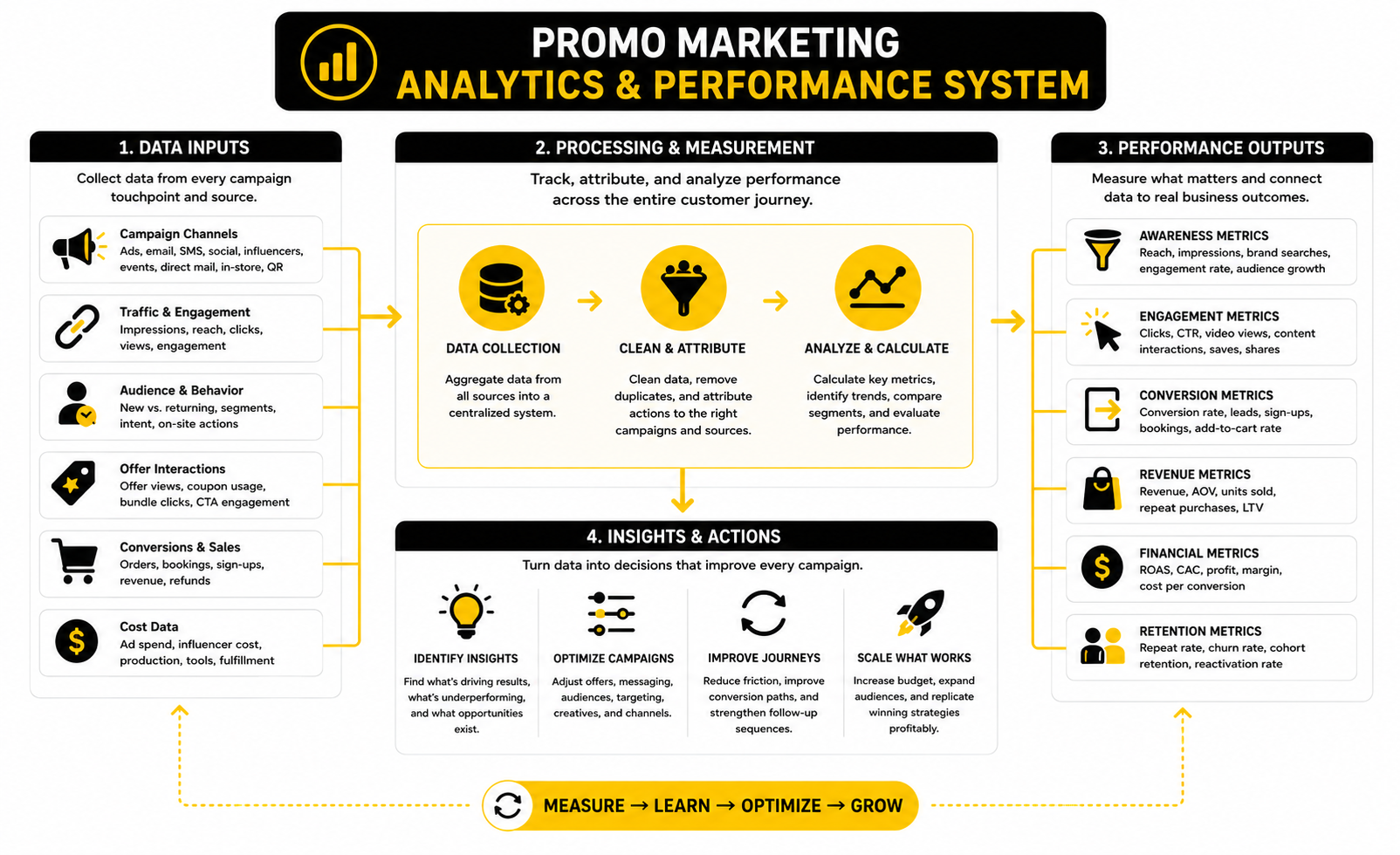
Measurement is where promo marketing stops being opinion and starts becoming a system. A campaign can look busy from the outside and still fail commercially. The only way to know the difference is to track the signals that connect attention, action, revenue, and retention.
The mistake is treating every number as equally important. Impressions, reach, likes, clicks, scans, opens, claims, booked calls, purchases, repeat orders, and referrals all tell you something different. The job is not to collect more data; it is to understand which numbers should change your next decision.
A useful analytics setup answers three questions. Did the right people notice the promotion? Did enough of them take the intended action? Did that action create value after the campaign ended?
What the Numbers Actually Mean
Impressions and reach measure exposure, not success. They tell you how many people could have seen the campaign, but they do not prove that the promotion was understood, remembered, or acted on. This is useful for awareness campaigns, but dangerous when a business pretends exposure equals revenue.
Clicks, scans, replies, and form starts show intent. These signals matter more because the customer did something. Still, intent is not the same as conversion. A campaign with strong clicks and weak conversions usually has a problem with the landing page, offer clarity, trust, price, timing, or follow-up.
Purchases, booked calls, qualified leads, trial activations, redemptions, referrals, and repeat orders are business signals. These are the numbers that should drive real decisions. If a promo marketing campaign generates attention but no valuable action, the campaign needs sharper targeting, a better offer, or a cleaner conversion path.
The Core Metrics That Matter Most
The best metrics depend on the campaign goal, but most promo campaigns should track the same basic chain. Start with exposure, then measure engagement, then conversion, then value. This keeps the team from celebrating shallow wins too early.
A simple promo marketing scorecard can include:
These numbers should be read together, not separately. A high redemption rate can be bad if the discount destroys margin. A lower conversion rate can still be profitable if average order value is strong. A campaign with modest first-purchase revenue can still be valuable if it brings in customers who buy again.
The Analytics System Behind the Campaign
A clean analytics system starts before launch. Every campaign should have a named audience, a named offer, a named channel, and a named conversion action. Without that structure, the data becomes messy because nobody knows which result came from which part of the campaign.
Use unique links, UTM parameters, dedicated landing pages, coupon codes, QR codes, forms, calendar links, and CRM stages wherever possible. If a campaign uses multiple channels, each channel needs its own tracking path. That way, the team can see whether email, social, paid ads, direct mail, partners, or events actually produced the outcome.
For link tracking and cleaner attribution, Dub.co can be useful when campaigns need trackable short links across channels. For service businesses that need lead stages, reminders, and pipeline visibility after someone responds, GoHighLevel can help connect the campaign data to the sales process.
Benchmarks Are Useful, But Only in Context
Benchmarks can help you spot obvious problems, but they should not become the goal. Email open rates, ad click-through rates, landing page conversion rates, SMS response rates, and coupon redemption rates vary heavily by industry, audience quality, offer strength, season, and channel. A benchmark is a reference point, not a verdict.
Email is a good example. Open rates are less reliable than they used to be because privacy features can inflate or obscure open tracking, so clicks, conversions, revenue, and reply quality matter more. Email benchmark research from 2025 is useful for context, but a business should still judge a promo email by whether it created the intended action.
Customer experience data also matters because promotions do not happen in a vacuum. PwC’s 2025 customer experience research found that 29% of consumers stopped buying from a brand because of poor online or in-person experience, while 46% of executives believed their loyalty program could become irrelevant within three years. That matters for promo marketing because a strong incentive cannot fully repair a broken customer experience.
Reading Performance Signals Correctly
When a campaign underperforms, do not immediately blame the channel. The channel is only one part of the system. Weak results usually come from a mismatch between audience, offer, creative, timing, conversion path, or follow-up.
If reach is low, the distribution problem comes first. The audience may be too small, the budget may be too low, the partner list may be weak, or the content may not be earning attention. Fix visibility before rewriting the entire campaign.
If clicks are strong but conversions are weak, the problem is usually after the click. The landing page may not match the promise, the offer may be unclear, the page may load slowly, the form may ask too much, or the call to action may be buried. For landing pages tied to ecommerce campaigns, Replo can be useful when the promotion needs faster page testing and cleaner product-focused layouts.
If conversions are strong but revenue is weak, the economics need attention. The discount may be too aggressive, the promoted product may have poor margin, or the campaign may be attracting bargain hunters who do not return. This is where average order value, margin, repeat purchase, and refund data matter more than surface-level conversion rate.
Measuring Promotional Products and Offline Campaigns
Offline promo marketing needs tracking too. Branded merchandise, event handouts, postcards, packaging inserts, print materials, and in-store promotions can all be measured if the campaign is designed properly. The problem is not that offline cannot be measured; the problem is that many teams forget to build measurement into the asset.
Use QR codes, unique URLs, dedicated coupon codes, event-specific forms, survey questions, and CRM tags. If a branded item is meant to drive a demo, the QR code should go to a demo page. If a postcard is meant to reactivate past customers, the code should identify that audience. If an event giveaway is meant to create leads, the claim process should capture useful information.
Promotional products can still support recall when they are relevant and useful. PPAI and ASI’s 2026 study reported strong brand recall advantages for promotional products compared with several advertising channels, which reinforces the point that physical touchpoints should not be dismissed. But recall is only the first layer; the campaign still needs a path from memory to action.
The Difference Between Campaign ROI and Customer Value
Campaign ROI looks at what happened during or immediately after the promotion. Customer value looks at what happened after the customer entered the business. Both matter, but they answer different questions.
A campaign might look average on first-purchase revenue but become profitable through repeat purchases, subscriptions, referrals, or upsells. The opposite can also happen. A campaign might create a strong first spike but bring in low-quality buyers who never return.
This is why promo marketing should track customer cohorts when possible. Separate customers acquired through different campaigns and compare their repeat purchase rate, average order value, support burden, refund rate, referral behavior, and lifetime value. The best campaign is not always the one with the cheapest lead; it is the one that brings in the right customers at a cost the business can support.
What to Do After the Data Comes In
Data only matters if it changes behavior. After the campaign ends, the team should decide what to keep, what to cut, and what to test next. The review should be practical, not performative.
Start with the campaign goal. If the goal was booked calls, review booked calls, show-up rate, close rate, and revenue. If the goal was repeat purchase, review orders, margin, product mix, and repeat buying behavior. If the goal was awareness, review reach, engagement quality, branded search lift, direct traffic, and assisted conversions.
Then turn the review into the next test. A weak click-through rate might lead to a creative test. A weak conversion rate might lead to a landing page test. A weak redemption rate might lead to a simpler offer. A weak repeat purchase rate might lead to a better post-purchase sequence.
The Practical Measurement Checklist
Before launching the next promo marketing campaign, the measurement plan should be clear enough that anyone on the team can understand it. Complicated dashboards are not the goal. Clear decisions are the goal.
Use this checklist before launch:
This is the part that separates serious promo marketing from guessing. The campaign does not end when the offer expires. It ends when the team understands what happened, why it happened, and what should improve next time.
Advanced Strategy and Scaling Tradeoffs
Once the basic system works, the next challenge is not launching more promotions. It is scaling without weakening the brand, training customers to wait for discounts, or creating operational chaos behind the scenes. This is where promo marketing becomes more strategic.
The question shifts from “Can this campaign drive action?” to “Can this campaign drive the right action without damaging long-term value?” That difference matters. A promotion can create short-term revenue while quietly reducing margin, trust, or customer quality.
This is why advanced promo marketing needs tradeoffs. Strong campaigns balance urgency with credibility, automation with restraint, acquisition with retention, and growth with operational capacity. The goal is not to promote more often; the goal is to promote more intelligently.
The Discount Trap
Discounts can work, but they are dangerous when they become the whole strategy. If customers learn that the brand always runs another sale, the regular price starts to feel fake. Once that happens, every future campaign has to work harder because trust has already been diluted.
This is especially risky for brands that promote too frequently without changing the value story. A limited-time discount can feel helpful when it is tied to a real moment, like a launch, seasonal event, loyalty reward, or inventory reason. The same discount repeated every week starts to feel like noise.
A better approach is to vary the value mechanism. Instead of always cutting price, test bundles, bonuses, priority access, free setup, loyalty perks, gift-with-purchase offers, referral rewards, or personalized recommendations. The customer still gets a reason to act, but the brand is not constantly teaching people to devalue the core offer.
Promotion Fatigue
Promotion fatigue happens when customers see too many offers, too often, with too little relevance. The audience may not unsubscribe immediately, but they stop paying attention. That is worse than it looks because the list still exists while the trust inside the list slowly declines.
The 2025 marketing fatigue research from Optimove found that consumers are especially sensitive to excessive, irrelevant, or poorly timed messages, which is exactly why frequency control matters in promo marketing. Optimove’s 2025 consumer marketing fatigue report reinforces a simple point: more messages do not automatically create more revenue.
The fix is not silence. The fix is better segmentation, cleaner timing, and more useful reasons to communicate. Send fewer generic blasts and more behavior-based messages. That one shift can make promotions feel like service instead of pressure.
Brand Equity Versus Short-Term Revenue
Every promotion sends a signal about the brand. A premium brand that constantly discounts may create confusion. A value brand that never rewards loyalty may feel cold. A service business that overpromises bonuses may look desperate if the actual delivery is weak.
This does not mean premium brands should never promote. It means the promotion has to match the brand promise. A premium campaign might offer early access, private consultation, limited availability, a curated bundle, or an exclusive client reward instead of a blunt discount.
Short-term revenue matters, but brand equity compounds. A campaign that produces a fast sales bump while making the brand feel cheaper can be expensive in a hidden way. The best promo marketing protects the perception that makes future sales easier.
Acquisition Versus Retention
Acquisition campaigns and retention campaigns should not be built the same way. New customers need trust, proof, clarity, and a low-friction reason to start. Existing customers need recognition, relevance, convenience, and a reason to continue.
This distinction matters because retention is often where profit improves. Deloitte’s 2025 loyalty research shows that price, value, and quality remain major loyalty drivers, while loyalty programs can act as an important differentiator when they are designed around real customer value. Deloitte’s research on loyalty programs supports the bigger lesson: loyalty cannot be reduced to points and discounts alone.
For retention-focused campaigns, a CRM matters more than a louder ad. Tools like Copper can help teams manage relationship-driven follow-up, while GoHighLevel can support automated pipelines, reminders, and reactivation sequences. The point is to treat existing customers as assets, not just another audience to blast.
Personalization Without Becoming Creepy
Personalization can make promotions more useful, but it has to be handled carefully. Customers appreciate relevance when it saves time or improves the offer. They dislike it when the message feels invasive, manipulative, or based on data they did not expect the brand to use.
The practical rule is simple: personalize around helpful context, not surveillance. A reminder based on an abandoned cart is understandable. A loyalty reward based on past purchases is useful. A message that reveals too much hidden tracking can feel uncomfortable even if the offer is technically relevant.
Good promo marketing uses data to reduce friction. It does not use data to show off how much the business knows. The best personalization feels obvious after the customer sees it: “Yes, that makes sense for me right now.”
Compliance and Disclosure Risks
Promo marketing often involves claims, urgency, testimonials, influencers, affiliates, contests, referral rewards, and pricing language. That means compliance cannot be treated as an afterthought. The campaign needs to be honest about what the customer gets, what conditions apply, when the offer ends, and whether a creator or partner has a material connection to the brand.
The FTC’s endorsement guidance makes clear that material connections between advertisers and endorsers should be disclosed clearly and conspicuously. The FTC’s endorsement and influencer guidance is especially relevant when promo campaigns use creators, affiliates, ambassadors, gifted products, or paid placements.
This is not just a legal concern. It is a trust concern. Hidden incentives can make a campaign look shady, while clear disclosure can protect the brand and the audience at the same time.
Operational Capacity
A successful promotion can still fail if the business cannot handle the response. This happens more often than people admit. Leads come in but nobody follows up quickly. Orders spike but fulfillment slows down. A calendar fills but the sales team gets overwhelmed. Customer support gets flooded because the offer was not explained clearly.
Before scaling a promo marketing campaign, check the operational load. Can the team fulfill the promise? Can customer support answer the obvious questions? Can inventory, scheduling, onboarding, or delivery handle the spike? Can the sales process keep up without lowering quality?
This is where fixed caps can be useful. A campaign can limit the number of available bonuses, consultation slots, samples, event seats, or discounted packages. Scarcity should never be fake, but real capacity limits are perfectly valid when they protect customer experience.
Creative Wearout
Creative wearout happens when the same message, visual, hook, or offer is shown too many times. Performance drops because the audience has already seen it, ignored it, or acted on it. The campaign may not be bad; it may simply be tired.
The solution is not always a new promotion. Sometimes the same offer needs a new angle. One version can lead with the problem. Another can lead with the outcome. Another can lead with proof, speed, convenience, social participation, or a deadline.
For content-heavy campaigns, Flick Social can help with social planning and hashtag research, while Buffer can help keep publishing organized. Still, do not confuse scheduling with strategy. The creative has to keep earning attention.
Scaling What Works
Scaling should happen after the campaign has proven the core economics. Do not scale because a post got attention. Scale because the promotion attracted the right audience, converted at an acceptable cost, created real revenue, and did not create delivery problems.
The cleanest way to scale is to keep the winning core and expand one variable at a time. Increase budget, add a channel, broaden the audience, test a new creative angle, or extend the follow-up sequence. Do not change everything at once, because then you will not know what caused the result.
A practical scaling path looks like this:
Building a Promotion Calendar
A promotion calendar prevents random campaigns. It helps the business plan around launches, seasons, customer milestones, events, inventory cycles, renewals, and retention windows. More importantly, it prevents the team from stacking too many offers on top of each other.
The calendar should include campaign dates, audiences, offers, channels, creative deadlines, follow-up sequences, and measurement reviews. It should also include quiet periods. Not every week needs a new promotion, and not every customer needs a new incentive.
A useful calendar balances planned campaigns with room for timely opportunities. The business can still react to market moments, competitor moves, or customer behavior. The difference is that reactive campaigns happen inside a strategy instead of replacing one.
When Not to Run a Promotion
Sometimes the smartest promo marketing decision is to wait. If the offer is weak, the audience is unclear, the landing page is broken, the sales team is unprepared, or the business cannot fulfill demand, launching will only expose the gap faster. Promotion amplifies what already exists.
Do not run a campaign just because sales are slow. First ask why sales are slow. If the problem is trust, fix proof. If the problem is conversion, fix the page or sales process. If the problem is retention, fix the customer experience.
A promotion should accelerate a good system, not hide a broken one. That is the standard. When the system is ready, the campaign has something real to multiply.
What is promo marketing?
Promo marketing is the strategic use of offers, incentives, branded experiences, and campaign systems to influence a specific customer action. That action could be a purchase, booking, trial, referral, event registration, repeat order, or product redemption. The important part is that the promotion is connected to a clear business outcome, not just thrown into the market because the brand wants attention.
A simple discount can be promo marketing, but promo marketing is much broader than discounting. It can include branded merchandise, loyalty rewards, creator campaigns, referral offers, giveaways, launch bonuses, bundled offers, QR code campaigns, email sequences, SMS reminders, event activations, and post-purchase incentives. The tactic matters less than the strategy behind it.
Why does promo marketing still work?
Promo marketing still works because people respond to timely value. A strong promotion gives the buyer a reason to pay attention now, especially when the offer solves a real friction point. That might be price hesitation, lack of trust, uncertainty, timing, convenience, or simply needing one extra push to act.
The catch is that buyers are more selective than they used to be. Generic promotions get ignored because customers see them everywhere. Relevant promotions still work because they feel useful, personal, and connected to the buyer’s current situation.
What is the difference between promo marketing and advertising?
Advertising is mainly about paid exposure and message distribution. Promo marketing is about creating a specific action through an incentive, experience, or offer structure. The two often work together, but they are not the same thing.
For example, a paid ad can promote a limited-time bundle. The ad is the distribution channel, while the bundle is the promotional mechanism. Good campaigns connect both pieces so the message, offer, landing page, and follow-up all point toward the same action.
What are the most common promo marketing channels?
Common promo marketing channels include email, SMS, paid ads, organic social, creator partnerships, direct mail, events, in-store signage, referral programs, loyalty programs, landing pages, and branded merchandise. The right channel depends on the audience and the action you want them to take. A cold audience may need education and discovery, while a warm list may respond better to a direct offer.
The best campaigns often use one main channel and a few support channels. That keeps the campaign focused without making it invisible. Too many channels at once can create messy tracking and inconsistent messaging.
How do you choose the right promotion?
Start with the buyer’s friction. If the customer does not trust the product yet, a small discount may not be enough. If they already want the product but hesitate on timing, urgency or a bonus may work better. If they bought before but went quiet, a loyalty reward or reactivation offer may be more appropriate.
The right promotion also has to make financial sense. A campaign can generate sales and still be bad for the business if it destroys margin or attracts customers who never return. The best offer gives the buyer a meaningful reason to act while still protecting the economics of the business.
Are discounts bad for promo marketing?
Discounts are not bad by default. They become a problem when they are overused, poorly timed, or disconnected from a real reason. If customers learn that another discount is always coming, the regular price loses credibility.
A healthier approach is to use discounts selectively and mix them with other value mechanisms. Bundles, bonuses, early access, loyalty perks, free setup, consultations, samples, and referral rewards can all create action without making the entire brand feel cheap. The goal is to increase motivation, not train customers to wait.
How should small businesses use promo marketing?
Small businesses should keep promo marketing simple and measurable. Pick one audience, one offer, one channel, one conversion path, and one follow-up sequence. That is enough to launch a serious campaign without overcomplicating the process.
For a service business, that might mean reactivating old leads with a limited consultation offer and a booking page. For an ecommerce store, it might mean sending a loyalty bundle to past buyers. For a local business, it might mean using a QR code campaign tied to an event, referral reward, or seasonal offer.
How do you measure a promo marketing campaign?
Measure the campaign based on the goal first. If the goal is booked calls, track bookings, show-up rate, close rate, and revenue. If the goal is repeat purchases, track orders, average order value, margin, and repeat purchase behavior. If the goal is awareness, track reach, engagement quality, branded search, direct traffic, and assisted conversions.
Do not stop at clicks. Clicks show interest, but they do not prove that the campaign worked. The numbers that matter most are the ones connected to real customer movement and business value.
What makes a promo offer feel credible?
A credible offer has a clear reason, clear terms, and a believable benefit. Customers should understand what they get, why it is available, when it ends, and what they need to do next. Confusion kills trust fast.
Credibility also depends on restraint. Fake urgency, unclear conditions, exaggerated claims, and constant “last chance” messaging can damage the campaign. Real urgency works best when it is tied to a real deadline, capacity limit, launch window, event date, or seasonal reason.
How often should a business run promotions?
There is no universal frequency that works for every business. A retail brand may run promotions more often than a high-ticket service provider. A subscription business may focus more on retention offers, while a launch-driven business may promote around specific product releases.
The better question is whether each promotion has a real purpose. If a campaign has a defined audience, reason, offer, and follow-up system, it can make sense. If the business is promoting only because sales feel slow, it may be better to fix the underlying issue first.
What are the biggest promo marketing mistakes?
The biggest mistake is launching without a clear goal. When a campaign tries to drive awareness, leads, sales, engagement, and referrals all at once, the message becomes unfocused. The team also struggles to measure success because nobody agreed on what success means.
Other common mistakes include weak audience segmentation, overusing discounts, sending traffic to a generic homepage, forgetting follow-up, ignoring margin, underestimating fulfillment capacity, and measuring vanity metrics instead of business outcomes. None of these mistakes are complicated, but they are expensive when repeated.
How does automation fit into promo marketing?
Automation helps when it improves timing, consistency, and follow-up. It can send reminders, tag leads, trigger email sequences, notify sales teams, update pipelines, deliver coupons, and follow up after purchases. That makes the campaign more reliable because fewer important steps depend on memory.
But automation should not make the brand louder for no reason. A bad message sent automatically is still a bad message. The best automation feels helpful because it responds to what the customer actually did.
What tools are useful for promo marketing?
The right tools depend on the campaign type. For funnel and landing page campaigns, ClickFunnels, systeme.io, or Replo can help build conversion paths. For campaign follow-up, pipeline management, and automation, GoHighLevel can support a more connected system.
For social distribution, Buffer can help keep posts organized. For forms, applications, quizzes, and claim pages, Fillout can be useful. For trackable links across campaigns, Dub.co can help keep attribution cleaner.
Can promo marketing work without paid ads?
Yes, promo marketing can work without paid ads when the business has access to an audience through email, social, partners, affiliates, events, referrals, local traffic, search demand, or existing customers. Paid ads can speed up distribution, but they are not the campaign itself. The offer and follow-up system still matter more than the traffic source.
Organic campaigns can work especially well when the promotion gives people a reason to share, reply, visit, scan, claim, or refer. The key is to design the campaign around action, not just exposure. Free traffic is only valuable when it leads somewhere useful.
What should happen after a promo campaign ends?
After the campaign ends, review the results while the details are still fresh. Look at the primary goal first, then check the supporting signals. The goal is to understand what created value, what created noise, and what should change before the next campaign.
Then document the campaign. Save the audience, offer, channels, creative, conversion path, follow-up sequence, costs, results, and lessons. Over time, that campaign history becomes a practical playbook for better promo marketing decisions.
Final Takeaways
Promo marketing works when it is built like a system. The audience, offer, channel, conversion path, follow-up, and measurement plan all need to support the same goal. When those pieces line up, a promotion becomes more than a temporary push; it becomes a repeatable growth asset.
The strongest campaigns are not always the loudest. They are the clearest, most relevant, and best timed. They give the right person a believable reason to take the next step, then they make that step easy.
Do not treat promotions as random sales events. Treat them as structured moments in the customer journey. That is how promo marketing turns attention into action, action into revenue, and revenue into long-term customer value.
Build a stronger local presence with BAAM AI
Turn your website, Google profile, social channels, and AI visibility into one growth engine
Most businesses do not need more random marketing activity. They need a consistent presence system that helps the right people find them, trust them, and take action. BAAM AI brings strategy, local SEO, website updates, Google Maps visibility, social content, AI-search readiness, media production, and reporting into one practical monthly engine.
If you want your marketing to keep working after the campaign ends, start with a free BAAM AI presence audit. See how your business shows up today and where the fastest visibility wins are at BAAM AI.