
BAAM AI Blog
Professional Copywriter: The Practical Guide To Strategy, Persuasion, And Conversion
A professional copywriter does far more than make words sound good. The real job is to turn customer insight, positioning, offer structure, and business goals into copy that helps people understand why they should...

Affiliate disclosure: this article may include compensated links. Recommendations should still be evaluated against your use case, budget, and current provider terms.
Should you choose this tool?
this tool is worth considering when the use case, budget, and implementation effort match what you actually need to do next.
teams that want a practical tool decision without reading another generic feature list
Check this toolA professional copywriter does far more than make words sound good. The real job is to turn customer insight, positioning, offer structure, and business goals into copy that helps people understand why they should care, why they should trust you, and what they should do next.
That matters even more now because content is easier to produce and harder to believe. Google’s own search guidance emphasizes helpful, reliable, people-first content, while the U.S. Bureau of Labor Statistics projects 4 percent growth for writers and authors from 2024 to 2034. In other words, the work is not disappearing. The weak version of the work is.
A good professional copywriter sits between strategy and execution. They clarify the audience, sharpen the message, remove friction, and write copy that can actually survive contact with real buyers. That includes websites, landing pages, email sequences, ads, sales pages, onboarding flows, case studies, product pages, and sometimes the internal messaging that keeps a team aligned.
This six-part article will follow this structure:
Why A Professional Copywriter Still Matters
The main reason a professional copywriter matters is simple: people do not buy from copy they do not understand, trust, or care about. Clever phrasing can get attention for a second, but clarity carries the sale. A strong copywriter knows how to reduce confusion without flattening the brand into generic corporate language.
The market has also become noisier. Content teams are investing more in formats that need stronger messaging, with B2B marketers increasing focus on areas like video, thought leadership, AI optimization, and paid advertising. None of those channels perform well when the underlying message is vague.
This is where the difference becomes obvious. A low-level writer fills space. A professional copywriter builds a persuasive path from problem to outcome, using the language customers already understand and the proof they actually need.
The Professional Copywriting Framework
A professional copywriter needs a framework because copy is not a guessing game. You are not just asking, “Does this sound good?” You are asking whether the message matches the buyer’s awareness level, the offer, the channel, the promise, the proof, and the next step.
The framework used throughout this guide is built around four practical layers: audience, message, asset, and optimization. Audience defines who the copy is for and what they already believe. Message defines what the copy must make clear, while the asset and optimization layers turn that strategy into live pages, emails, ads, scripts, and tests.
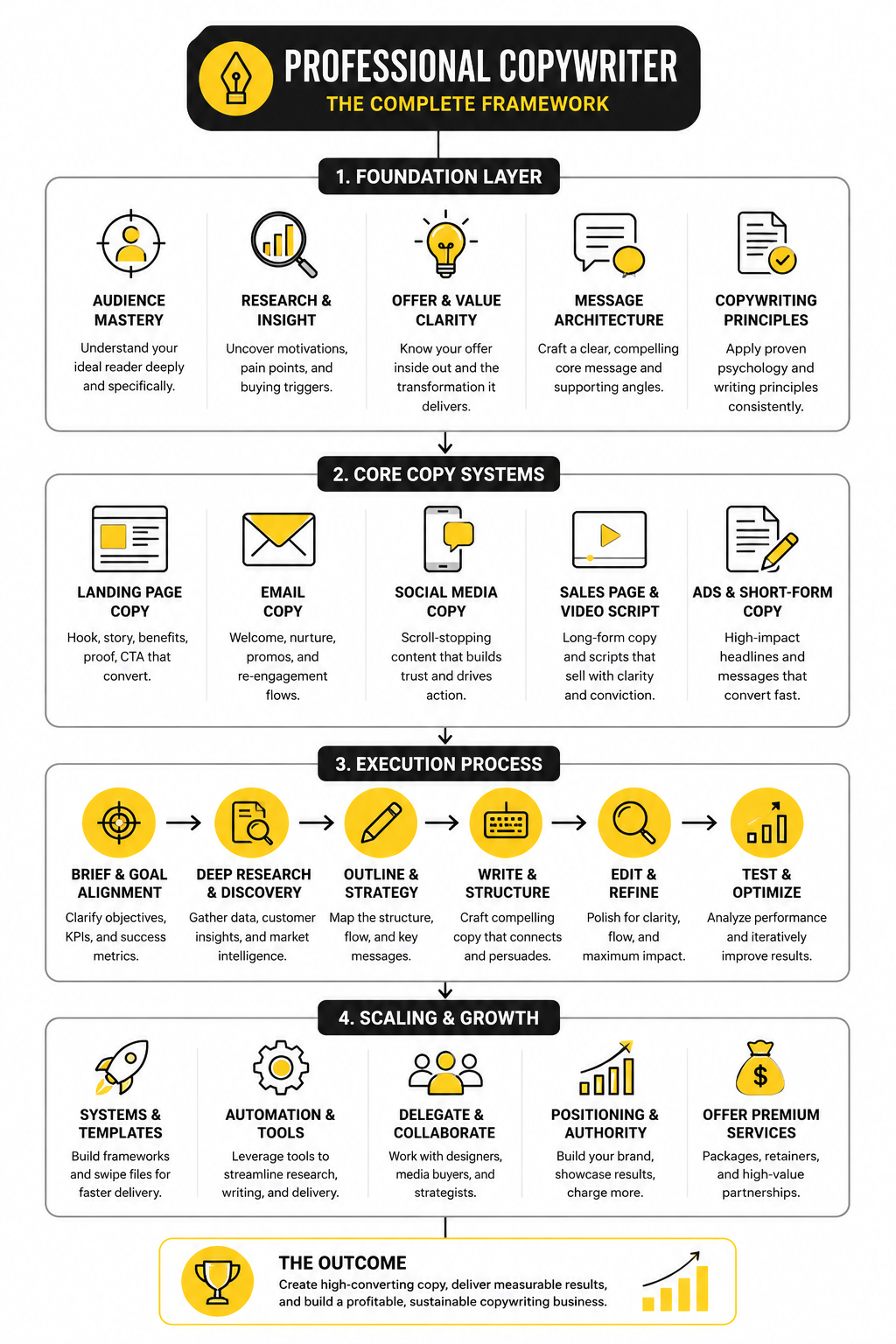
This matters because better copy is rarely created by adding more words. It usually comes from making better decisions before writing begins. The professional copywriter earns their value by knowing what to say, what to leave out, where to place the proof, and how to guide the reader without making the copy feel forced.
Core Components Of Professional Copywriting
The first component is research. A copywriter needs to understand the market, the customer’s current pain, the alternatives they have tried, the objections they carry, and the emotional stakes behind the purchase. Without that, the copy becomes polished guessing.
The second component is positioning. This is where the copywriter defines why this offer is different, who it is best for, and what promise can be made without drifting into hype. McKinsey’s research on personalization shows that stronger relevance can lift revenue and improve marketing ROI, but relevance only works when the message is grounded in real customer understanding.
The third component is conversion structure. That means headlines, leads, proof blocks, calls to action, offer framing, objections, urgency, and follow-up sequences all work together. A funnel builder like ClickFunnels, a CRM and automation platform like GoHighLevel, or a landing page tool like Replo can help publish the assets, but the tool does not replace the thinking behind the message.
Professional Implementation Starts Before Writing
Professional implementation starts with the brief. The brief should define the audience, the offer, the business goal, the traffic source, the objections, the proof available, and the action the reader should take. If those pieces are missing, the copywriter is forced to invent strategy while pretending to write.
The second step is mapping the reader’s decision journey. Someone discovering a problem for the first time needs different copy from someone comparing vendors or looking for a final reason to buy. A professional copywriter adjusts the angle, depth, proof, and call to action based on that stage instead of using one generic message everywhere.
The third step is creating copy that can be used and measured. That means clean structure, clear claims, specific proof, and a handoff that designers, founders, media buyers, email marketers, and sales teams can actually work with. The best copy is not precious. It is built to be launched, read, tested, improved, and reused across the business.
The Professional Copywriting Framework
The professional copywriting framework starts with one uncomfortable truth: people do not read copy the way teams review copy. A founder may inspect every sentence because the product is personal to them. A buyer is usually scanning, comparing, doubting, and deciding whether the page deserves another few seconds of attention.
That is why a professional copywriter does not begin with a blank document. They begin with the buying situation. Who is the reader, what triggered the search, what do they already believe, what are they afraid of wasting, and what would make the offer feel like the obvious next step?
The framework is not there to make copy formulaic. It is there to stop random writing. Strong copy still sounds human, but underneath it there is a clear sequence of decisions.
Start With The Reader’s Current Reality
Before writing a headline, a professional copywriter needs to know what the reader is already dealing with. Not the sanitized version from the company’s pitch deck. The real version, where the buyer has limited attention, internal pressure, competing options, and a quiet fear of making the wrong decision.
This is especially important because trust is not automatic. The 2025 Edelman Trust Barometer surveyed 33,000 respondents across 28 countries and shows how much skepticism now surrounds institutions, leaders, and public messaging. Copy that ignores that skepticism feels detached from reality.
So the first job is not persuasion. The first job is recognition. When the reader feels that the copy understands their situation, they are more willing to consider the promise, the proof, and the offer.
Define The Problem In The Buyer’s Language
A weak copywriter describes the problem from the company’s perspective. A professional copywriter describes it from the buyer’s perspective. That difference changes everything.
For example, a software company may think the problem is “manual workflow inefficiency.” The buyer may think the problem is “my team keeps missing follow-ups, leads go cold, and I have no clean way to see what is happening.” The second version is more specific, more visual, and much closer to the moment where someone decides they need a solution.
This does not mean copying customer language blindly. It means using customer language as evidence. The copywriter still has to shape it into a clear message, but the raw material should come from real conversations, reviews, sales calls, support tickets, surveys, search behavior, and objections.
Connect The Problem To A Meaningful Outcome
Once the problem is clear, the copy has to move toward an outcome that actually matters. People rarely buy a product just because it has features. They buy because they want a better state than the one they are currently in.
That outcome must be concrete enough to feel real. “Save time” is usually too flat. “Stop rebuilding the same campaign from scratch every week” is stronger because the reader can picture the pain and the relief.
This is where a professional copywriter earns their keep. They do not inflate the promise until it becomes unbelievable. They sharpen the promise until the buyer can quickly understand why the offer is relevant.
Build The Message Around Proof
The stronger the claim, the more proof the copy needs. Proof can come from customer results, product screenshots, demos, third-party reviews, benchmarks, guarantees, certifications, process transparency, founder credibility, or a clear explanation of how the mechanism works. The right proof depends on the buyer’s risk level and the type of decision being made.
This is one reason product and landing page copy cannot be treated as decoration. Baymard’s ecommerce research shows that many product experiences still struggle with the basics, with its product page benchmark finding that only 48 percent of desktop ecommerce sites and 38 percent of mobile ecommerce sites reached “decent” or “good” product page UX performance. When the page does not answer enough questions, the buyer has to work harder than they should.
Good proof reduces that work. It helps the reader move from “sounds interesting” to “this might actually work for me.” That is the real bridge between attention and action.
Match The Copy To The Buyer’s Awareness Stage
Not every reader needs the same message. Someone who is problem-aware needs help naming the issue and understanding the cost of leaving it unsolved. Someone who is solution-aware needs comparison, differentiation, and proof that this approach is better than the alternatives.
A professional copywriter adjusts the copy to match that awareness stage. Cold ad copy usually needs more context and curiosity. A pricing page needs clarity, reassurance, and friction removal. An email sequence can build belief over time instead of forcing the whole argument into one page.
This is also why generic copy fails so often. It tries to speak to every awareness stage at once, so it ends up being too broad for serious buyers and too shallow for skeptical ones. Specificity wins because it respects where the reader actually is.
Turn The Offer Into A Clear Decision
The offer is not just the product. It is the product, the promise, the price, the perceived risk, the proof, the timing, the bonus value, the guarantee, the onboarding, and the next step. A professional copywriter looks at the whole decision, not just the sentence above the button.
This is where copy and funnel structure start to overlap. If the offer needs education, a simple one-page checkout may not be enough. If the offer is already understood, adding too many steps can create unnecessary friction.
Tools can help here, but only when the message is clear first. A funnel platform like ClickFunnels, an all-in-one client acquisition system like GoHighLevel, or a simpler funnel setup like Systeme.io can support the flow, but the copywriter still has to make the decision feel obvious.
Make The Call To Action Feel Like The Natural Next Step
A call to action should not feel like a sudden demand. It should feel like the next logical step after the copy has built enough understanding and trust. That means the CTA has to match the level of commitment the reader is ready to make.
For a high-ticket service, “Book a call” may work when the page has handled enough objections. For a colder audience, a guide, demo, calculator, webinar, or short assessment may be better. For ecommerce, the CTA may need stronger support around shipping, returns, fit, payment options, or product comparison.
A professional copywriter thinks about momentum. The question is not only “What button should we use?” The better question is “What does the reader need to believe right before clicking?”
Research, Positioning, And Voice
The next layer of professional copywriting is where the work becomes less glamorous and much more valuable. Before a professional copywriter writes the first draft, they need to understand the market well enough to make the copy feel specific, grounded, and believable. This is where the difference between “nice writing” and revenue-focused copy starts to show.
Research, positioning, and voice are connected. Research gives you the raw truth. Positioning turns that truth into a sharper market angle. Voice makes the message sound like it belongs to the brand instead of being pasted from a template.
Start With Customer Research, Not Internal Assumptions
Internal teams often know the product too well. That sounds like an advantage, but it can create blind spots because the team starts explaining the offer from the inside out. Buyers do not care about internal feature logic until they understand what the product helps them change.
A professional copywriter looks for the words customers use when they are frustrated, comparing options, defending a purchase, or explaining a result to someone else. That language is usually more useful than a polished brand statement because it shows the emotional and practical context around the buying decision. Good research captures what people actually say before the company tries to make it sound impressive.
The strongest inputs usually come from sales calls, support conversations, product reviews, search queries, surveys, win-loss notes, customer interviews, and competitor pages. The goal is not to collect a giant pile of quotes. The goal is to find repeated patterns that reveal what buyers notice, fear, want, misunderstand, and value.
Separate Voice Of Customer From Copy Strategy
Voice of customer research is powerful, but it is not the final copy. This is where many teams get sloppy. They copy raw phrases directly from customers and assume the message will automatically convert because it sounds “authentic.”
A professional copywriter treats customer language as evidence, not as a finished script. The raw language tells you what matters, but the copywriter still has to organize the message, remove noise, prioritize the strongest angles, and connect the customer’s words to the offer. That is the craft.
This step matters even more as AI-generated content becomes common. Content Marketing Institute’s 2025 B2B research found that marketers expected increased investment in areas like video, thought leadership, AI for content optimization, paid advertising, and AI for content creation. When production gets easier, judgment becomes more valuable.
Build A Positioning Angle Before Writing The Asset
Positioning answers the question the reader is silently asking: why this, why now, and why should I believe it? Without that answer, even clean copy feels replaceable. The words may be correct, but the offer will not feel distinct.
A professional copywriter should be able to explain the positioning angle in plain language before writing the page. That angle might be based on speed, simplicity, specialization, risk reduction, depth of support, stronger implementation, a better mechanism, or a clearer business outcome. The important part is that the angle must be true and useful to the buyer.
Weak positioning usually sounds broad. It says the product is powerful, flexible, easy, innovative, or built for modern teams. Strong positioning says who the offer is for, what painful tradeoff it removes, and why that matters in the buyer’s world right now.
Create A Message Map
A message map turns research into a usable writing plan. It keeps the copy from becoming a random collection of benefits, objections, and proof points. More importantly, it gives the team a shared structure before anyone starts arguing about word choice.
The message map should define the primary promise, the supporting benefits, the proof points, the objections, the differentiators, and the next action. It should also separate what must be said above the fold from what can wait until later in the asset. That distinction is critical because early copy has a different job than deeper copy.
A simple message map can include:
Turn The Process Into A Practical Workflow
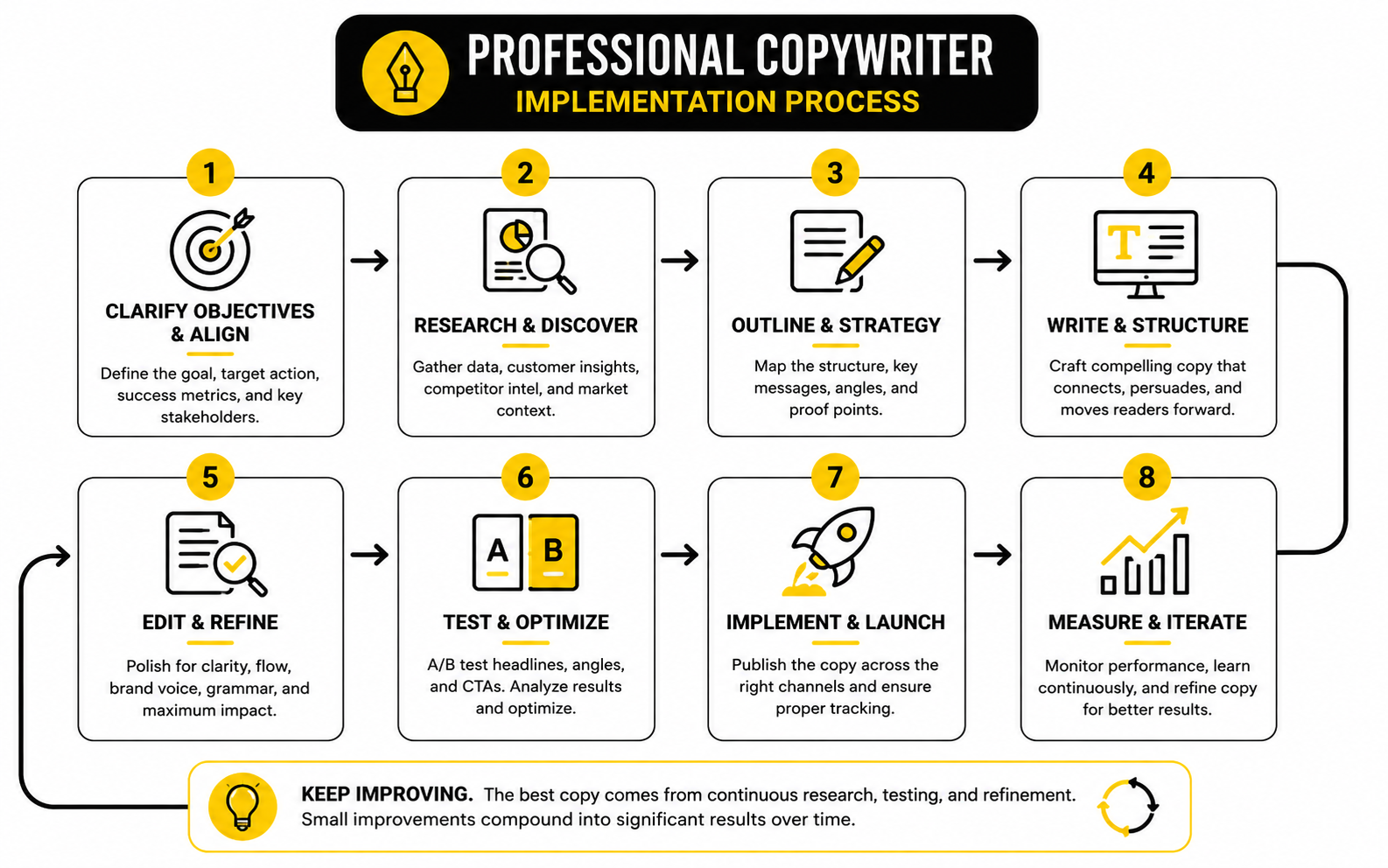
Once the message map is clear, implementation becomes much easier. The professional copywriter can now move from research into structure without guessing what the page, email, or funnel is supposed to accomplish. This is where execution becomes tangible.
A practical workflow looks like this:
This process keeps copy from becoming subjective too early. The team can still debate the final language, but the foundation is not based on personal taste. It is based on the reader, the offer, and the decision the copy needs to support.
Match The Brand Voice To The Buying Moment
Brand voice is not just personality. It is how the company earns attention and trust in a specific situation. A playful voice can work beautifully for one offer and feel completely wrong for another.
A professional copywriter looks at the level of risk in the decision. If the buyer is choosing software for their team, hiring a consultant, changing a workflow, or spending serious money, the copy needs to sound confident and clear before it tries to sound clever. If the decision is lighter, the voice can usually carry more humor, speed, and personality.
The best voice guidelines are practical. They explain what the brand should sound like, what it should avoid, and how that voice changes across channels. A landing page, onboarding email, social post, sales deck, and help article should feel connected, but they should not all sound identical.
Write For Skimming Without Dumbing Things Down
People scan before they commit. Nielsen Norman Group’s long-running usability research on the F-shaped reading pattern shows that users often scan pages instead of reading every word in a neat sequence. That does not mean the copy should become shallow. It means the structure has to carry the reader.
A professional copywriter uses headings, opening lines, bullets, proof blocks, short sections, and clear transitions to make the asset easy to enter. The reader should understand the argument even if they only skim the main sections first. Then, when they slow down, the deeper copy should reward them with substance.
This is why structure matters as much as sentence quality. A brilliant paragraph buried in the wrong place will not save a confusing page. Strong copy makes the next idea easy to find.
Prepare Copy For The Channel Where It Will Live
Copy does not exist in a vacuum. A landing page has different constraints from an email sequence. A product page has different demands from a webinar registration page. A chatbot flow, sales follow-up, or SMS campaign needs even tighter control over sequence and context.
For ecommerce and landing pages, the copy has to work with layout, product images, reviews, comparison sections, and checkout flow. For email, it has to build trust across time without exhausting the reader. For CRM and automation, tools like GoHighLevel, Brevo, or Moosend can help turn the copy into a working follow-up system.
The copywriter’s job is to make sure the message still works after it leaves the document. That means writing with the final asset in mind. Copy that looks good in Google Docs but breaks inside the actual page, funnel, or automation is not finished yet.
Protect Clarity During Review
The review stage is where good copy often gets weakened. Everyone wants to add one more feature, one more caveat, one more internal phrase, or one more “important” detail. The result is usually longer copy with less force.
A professional copywriter has to protect the reader’s experience during review. That does not mean ignoring feedback. It means filtering feedback through the question that matters most: will this make the message clearer, more believable, or more useful for the buyer?
The best review process separates factual accuracy from personal preference. Product teams can confirm claims. Sales teams can flag missing objections. Leadership can check strategic alignment. But the final copy still has to serve the reader, not the meeting.
Statistics And Data
Measurement is where a professional copywriter stops arguing from opinion. The copy either helps the reader move forward, or it creates friction. The job is not to worship dashboards, but to use data to find where the message is weak, unclear, or mismatched to the buyer’s intent.
This is important because copy performance is rarely explained by one number. A low conversion rate might mean the headline is weak, the traffic is wrong, the offer is confusing, the price feels risky, the proof is thin, or the page is asking for too much too soon. Good measurement separates those possibilities instead of treating every problem like a button-color test.
Benchmarks Are A Starting Point, Not The Strategy
Benchmarks help you understand whether performance is roughly healthy, but they are not a universal standard. A cold traffic landing page, a warm email click, a branded search visitor, and a retargeted buyer are not the same situation. Comparing them as if they should convert at the same rate is how teams make bad decisions with clean-looking data.
The better use of benchmarks is diagnosis. If email engagement is far below the market range, the issue may be subject lines, list quality, segmentation, deliverability, or a mismatch between promise and content. If a landing page gets clicks but few form completions, the issue may be perceived risk, unclear value, weak proof, or a form that asks for too much information too early.
Industry reports can still be useful when interpreted properly. For example, MoEngage analyzed 17.3 billion emails for its 2025 email benchmarks, which makes the report useful for directional context. But a professional copywriter should never treat a broad benchmark as more important than the behavior of the actual audience being measured.
Track The Full Decision Path
The most useful analytics system follows the reader from first contact to meaningful action. That means looking at awareness, engagement, intent, conversion, and follow-up instead of judging the copy from a single page view or click. The more expensive or complex the offer is, the more dangerous it becomes to measure only the first conversion point.
A professional copywriter should ask what the reader does before and after the asset. Did the ad attract the right person? Did the page create enough belief? Did the form reduce or increase friction? Did the email sequence turn interest into action? Did the sales call confirm the same objections the copy was supposed to handle?
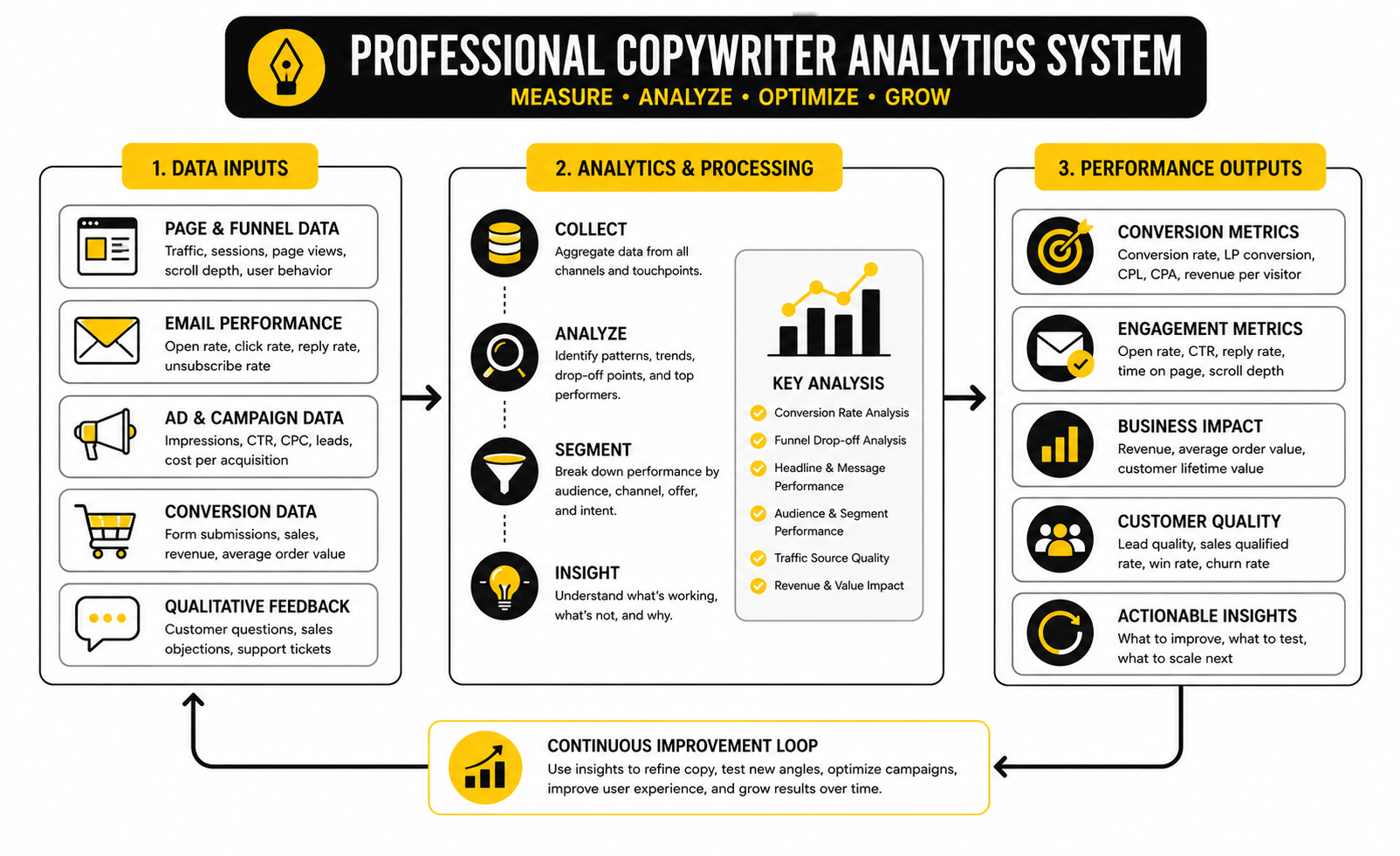
A simple measurement system can be built around five layers:
Each layer tells a different story. Traffic quality shows whether the right people are arriving. Message engagement shows whether the copy earns attention. Conversion intent shows whether the reader is moving closer to action. Revenue impact shows whether the copy is attracting valuable buyers, not just cheap leads. Learning feedback shows what the team should fix next.
Read Performance Signals In Context
A high click-through rate is not always good. If the click is driven by curiosity but the page fails to convert, the copy may be overpromising or attracting the wrong intent. That creates impressive-looking engagement and weak business results.
A low click-through rate is not always bad either. For high-ticket, narrow-fit, or qualification-heavy offers, copy may intentionally repel poor-fit prospects. In that case, fewer clicks can still produce better pipeline quality if the people who do click are more qualified.
This is why the professional copywriter has to look beyond surface metrics. Open rates, click rates, scroll depth, time on page, form starts, form completions, booked calls, show rates, sales-qualified leads, close rates, refunds, and customer quality all tell part of the story. The real skill is knowing which signal matters for the asset being judged.
Use Conversion Data To Find Message Gaps
Conversion data is most useful when it points to a specific message gap. If visitors bounce quickly, the headline, opening promise, page speed, or traffic match may be the first place to inspect. If visitors scroll but do not click, the body copy may be interesting but not decisive enough.
If readers click the CTA but do not finish the form or checkout, the problem is probably not the headline. It may be the offer, the form fields, the payment step, the guarantee, the onboarding promise, or the final trust signals. The copywriter should treat that as a different problem instead of rewriting the whole page blindly.
This is where qualitative feedback matters. Session recordings, heatmaps, survey answers, sales notes, and support questions can explain why the numbers are moving. The number tells you something is happening. The customer language helps explain why.
Measure Email Copy By Sequence, Not One Message
Email copy is often judged too narrowly. One email can underperform because it is weak, but it can also underperform because the sequence around it is doing the wrong job. A professional copywriter looks at the role of each email before deciding what needs to change.
A welcome email may need to confirm the promise and set expectations. A nurture email may need to build belief. A sales email may need to handle objections and create urgency. A reactivation email may need to acknowledge silence and give the reader a clean reason to return.
That is why email benchmarks should be used carefully. Salesforce’s email benchmark guidance frames metrics like click-through rates and conversion rates as tools for understanding campaign effectiveness, but those numbers only become useful when tied to the purpose of the campaign. The question is not “Was the open rate good?” The question is “Did this email move the right people to the next step?”
Measure Landing Pages By Friction And Belief
Landing page measurement should focus on two things: friction and belief. Friction is anything that makes action feel harder than it needs to be. Belief is the reader’s confidence that the offer can deliver the promised outcome.
Baymard’s product page research shows that many ecommerce experiences still struggle with fundamentals, with only 48 percent of desktop sites and 38 percent of mobile sites reaching decent or good product page UX performance. That matters because conversion is not just about persuasive language. It is also about whether the page answers the buyer’s practical questions clearly enough.
For a professional copywriter, this means analytics should be tied to page sections. If people stop before the proof section, the opening may not be strong enough. If people read the proof but still do not act, the offer or risk reversal may need work. If mobile performance lags behind desktop, the message may be fine but the layout may be burying the copy that matters most.
Separate Copy Problems From Offer Problems
Not every performance issue is a copy issue. Sometimes the copy is clear, but the offer is weak. Sometimes the offer is strong, but the audience is wrong. Sometimes both are fine, but the follow-up system leaks leads after the first conversion.
This distinction matters because copywriters often get asked to fix problems that are really pricing, product, traffic, or sales process problems. A professional copywriter can improve how the offer is explained, framed, and supported, but they cannot make an irrelevant offer feel essential forever. Data helps make that boundary clear.
The practical move is to compare copy performance across the funnel. If the page converts leads but sales calls do not close, the copy may be attracting poor-fit prospects or setting the wrong expectations. If sales calls close well but the page produces too few leads, the message may need stronger front-end clarity and proof.
Turn Data Into Better Copy Decisions
The point of measurement is not reporting. The point is better decisions. A useful dashboard should tell the team what to keep, what to test, what to remove, and what to investigate.
A professional copywriter should turn performance data into specific hypotheses. “The page is not converting” is too vague. “Visitors reach the pricing section but do not click because the value comparison is weak” is useful. “Email three has high clicks but low booked calls because the CTA promises a demo while the audience wants a strategy review” is useful.
Good copy optimization is controlled, patient, and practical. You do not change ten things at once and then pretend you learned something. You isolate the biggest friction point, improve the message, measure the result, and repeat. That is how copy gets sharper without becoming random.
Professional Implementation, Tools, And Workflow
By this point, the copy is no longer just a writing project. It is part of a working revenue system. A professional copywriter has to think about how the message moves through pages, emails, ads, forms, sales calls, onboarding, and retention.
That is where advanced copywriting becomes more strategic. The copywriter is not only asking, “Is this persuasive?” They are asking whether the message can scale without becoming inconsistent, whether the claims are safe to use, whether the automation supports the buyer journey, and whether the team can maintain quality when volume increases.
Scale The Message Without Flattening It
Scaling copy does not mean repeating the same headline everywhere. It means keeping the core message consistent while adjusting the angle for different channels, audiences, and levels of intent. A professional copywriter protects the main positioning while making each asset feel native to the moment where the reader sees it.
This is where a message library becomes useful. Instead of writing every page, email, and ad from scratch, the team can build a controlled set of approved promises, objections, proof points, differentiators, calls to action, and voice rules. That gives the brand speed without turning every campaign into a disconnected experiment.
The tradeoff is discipline. A message library only works if it gets maintained. If the company keeps adding new claims without removing weak ones, the library becomes a junk drawer instead of a strategic asset.
Know When To Use AI And When Not To
AI can help a professional copywriter move faster, especially with research organization, outline variations, repurposing, first-draft options, headline angles, and content adaptation. But it should not be treated as the source of strategic truth. AI can remix patterns, but it does not automatically understand the buyer, the risk, the offer, or the internal constraints behind the message.
This matters because marketing teams are under pressure to produce more with the same or smaller relative resources. Gartner’s 2025 CMO Spend Survey found that marketing budgets remained at 7.7 percent of overall company revenue, while Content Marketing Institute’s 2025 B2B research shows that 39 percent of marketers expected increased investment in AI for content creation. The pressure is real, but speed without judgment creates risk.
The smart approach is human-led. Let AI help with variation, summarization, and workflow. Keep positioning, claims, voice, compliance, and final judgment in human hands.
Protect The Brand From Lazy Claims
A professional copywriter has to know the difference between a strong claim and a reckless claim. “Get more qualified leads” may be reasonable if the copy explains the mechanism and the proof supports it. “Double your revenue in 30 days” is a different level of claim and needs serious evidence before it belongs anywhere near a live campaign.
This is not just about sounding responsible. The FTC’s endorsement guidance makes it clear that advertising claims and endorsements must be truthful and not misleading. If the copy relies on testimonials, influencer mentions, affiliate promotions, or performance claims, the business needs to be careful about what is implied as well as what is said directly.
The practical rule is simple: if the copy creates a specific expectation, the business should be able to support it. Strong copy does not need fake certainty. It needs clear value, honest proof, and a promise the company can stand behind.
Build A Workflow That Removes Bottlenecks
Copy slows down when every asset starts from zero and every review becomes a debate. A professional workflow removes that friction by separating strategy, drafting, review, publishing, and optimization. Each stage should have a clear owner and a clear definition of done.
A clean workflow might look like this:
This is especially important when several tools are involved. A team might build landing pages in Replo, automate follow-up in GoHighLevel, send campaigns through Brevo, and schedule social distribution with Buffer. The copywriter does not need to own every tool, but they do need to understand how the message behaves inside the system.
Avoid The “More Copy” Trap
When performance drops, teams often ask for more copy. More emails. More ads. More landing page sections. More social posts. Sometimes that helps, but often it just spreads the same weak message across more surfaces.
A professional copywriter looks for the constraint before adding volume. If the offer is unclear, more emails will not fix it. If the proof is weak, longer landing pages may create more doubt. If the audience is wrong, stronger persuasion may only attract the wrong people faster.
The better question is: what is the smallest message improvement that could create the biggest lift? That might be a sharper headline, a better objection section, a clearer comparison, a stronger onboarding promise, or a more specific CTA. Advanced copywriting is often subtraction before addition.
Make Personalization Useful, Not Creepy
Personalization can improve relevance, but only when it helps the reader. Using someone’s name in a subject line is not strategy. Matching the message to their problem, industry, behavior, stage, or intent is much more useful.
The risk is crossing the line from relevant to intrusive. Qualtrics XM Institute’s 2025 research, based on more than 23,000 consumers, focuses on the tension between personalization and privacy. That tension matters because modern buyers want relevance, but they also want control and transparency.
A professional copywriter should use personalization to reduce effort, not to show off how much data the company has. The message should feel helpful, timely, and context-aware. It should not make the reader wonder why the brand knows so much about them.
Coordinate Copy With Sales And Customer Success
Copy is not finished when the lead converts. If the sales team says something different from the landing page, trust drops. If customer success delivers a different expectation from the sales copy, churn risk increases.
A professional copywriter should treat sales and customer success teams as feedback sources, not just downstream users. Sales hears the objections that prospects do not type into forms. Customer success hears the moments where expectations were clear, unclear, or misaligned.
This feedback helps refine the message over time. If buyers keep asking the same question on calls, the page may need to answer it earlier. If new customers misunderstand what happens after purchase, the onboarding copy may need to set expectations more clearly. The best copy systems keep learning after launch.
Decide What Should Be Standardized And What Should Stay Custom
Not every asset deserves the same level of customization. A core sales page, homepage, webinar funnel, or high-ticket nurture sequence usually needs deeper strategic work. A routine reminder email, social caption, or internal announcement can often use a lighter process.
The mistake is treating everything as either fully custom or fully templated. A professional copywriter knows how to decide which parts need strategic attention and which parts can be systemized. That balance keeps quality high without making the team slow.
Templates are useful when they protect good decisions. They become dangerous when they hide lazy thinking. The goal is not to make every piece of copy unique. The goal is to make every piece of copy appropriate for the decision it supports.
Measurement, Optimization, And Hiring Decisions
The final layer is the system around the copy. A professional copywriter can write a strong page, but the business still needs a way to decide what to publish, what to test, what to keep, and when to bring in more specialized help. That system is what turns copy from a one-off deliverable into a long-term advantage.
This is also where expectations need to stay realistic. Copy can improve clarity, trust, conversion, and sales efficiency, but it cannot replace product-market fit, a strong offer, reliable delivery, or qualified traffic. The best results happen when copy supports a business that is already serious about the customer experience.
Decide What Success Looks Like Before Hiring
Before hiring a professional copywriter, define the result you actually want. “Better copy” is too vague. A stronger goal might be improving landing page conversion, increasing booked calls, clarifying a new offer, rebuilding an email sequence, reducing sales objections, or creating a message system the whole team can reuse.
This matters because different copywriters have different strengths. Some are excellent at direct-response sales pages. Some are stronger in SaaS positioning, ecommerce product pages, lifecycle email, ads, brand messaging, or long-form thought leadership. The right hire depends on the business problem, not just the portfolio.
A good brief should include the audience, offer, current assets, traffic source, conversion goal, proof available, constraints, review process, and timeline. If you cannot explain those basics, the copywriter will have to spend extra time finding the real assignment. That can still work, but it should be treated as strategy work, not just writing.
Watch For The Right Hiring Signals
A serious professional copywriter asks better questions before they promise better copy. They want to know who the buyer is, how the offer sells now, what objections show up, what proof exists, where the traffic comes from, and how success will be measured. That curiosity is a good sign.
Be careful with anyone who guarantees a specific revenue lift without understanding your offer, audience, price, funnel, traffic quality, and baseline data. Strong copywriters can influence performance, but responsible professionals do not pretend they control every variable. The FTC’s truth-in-advertising guidance is clear that advertising should be truthful, not misleading, and supported where needed by evidence, and the same standard should apply to the claims copywriters make about their own services.
A strong copywriter should also be able to explain their process in plain language. You should hear how they research, structure, draft, review, and optimize. If the process is just “I write persuasive words,” that is not enough.
Understand The Tradeoff Between Specialists And Generalists
A generalist copywriter can be valuable when the business needs flexible support across many small assets. They can help with emails, landing pages, social posts, website updates, lead magnets, and basic campaign copy. For earlier-stage companies, that flexibility can be more useful than deep specialization.
A specialist becomes more valuable when the stakes are higher. If a sales page drives paid traffic, an email sequence supports high-ticket sales, or a product page affects large ecommerce revenue, deeper channel experience matters. The more money tied to the asset, the more you want someone who understands that exact type of decision.
The best setup is often a mix. A senior strategist or specialist can define the message architecture, while a capable execution copywriter adapts it across assets. That gives the company both quality and speed.
Know What To Keep In-House
Not every copy task needs to be outsourced. Internal teams usually have faster access to product knowledge, customer conversations, founder opinions, and sales feedback. That makes them useful for ongoing updates, quick iterations, and small channel-specific edits.
However, internal teams can also become too close to the product. They may over-explain features, protect internal language, or assume buyers understand more than they do. An outside professional copywriter can bring sharper perspective because they are closer to the reader’s confusion.
A practical split works well. Keep routine updates, internal enablement, and small edits in-house. Bring in a specialist for positioning, high-value conversion assets, major launches, funnel rebuilds, and messaging systems that multiple teams will use.
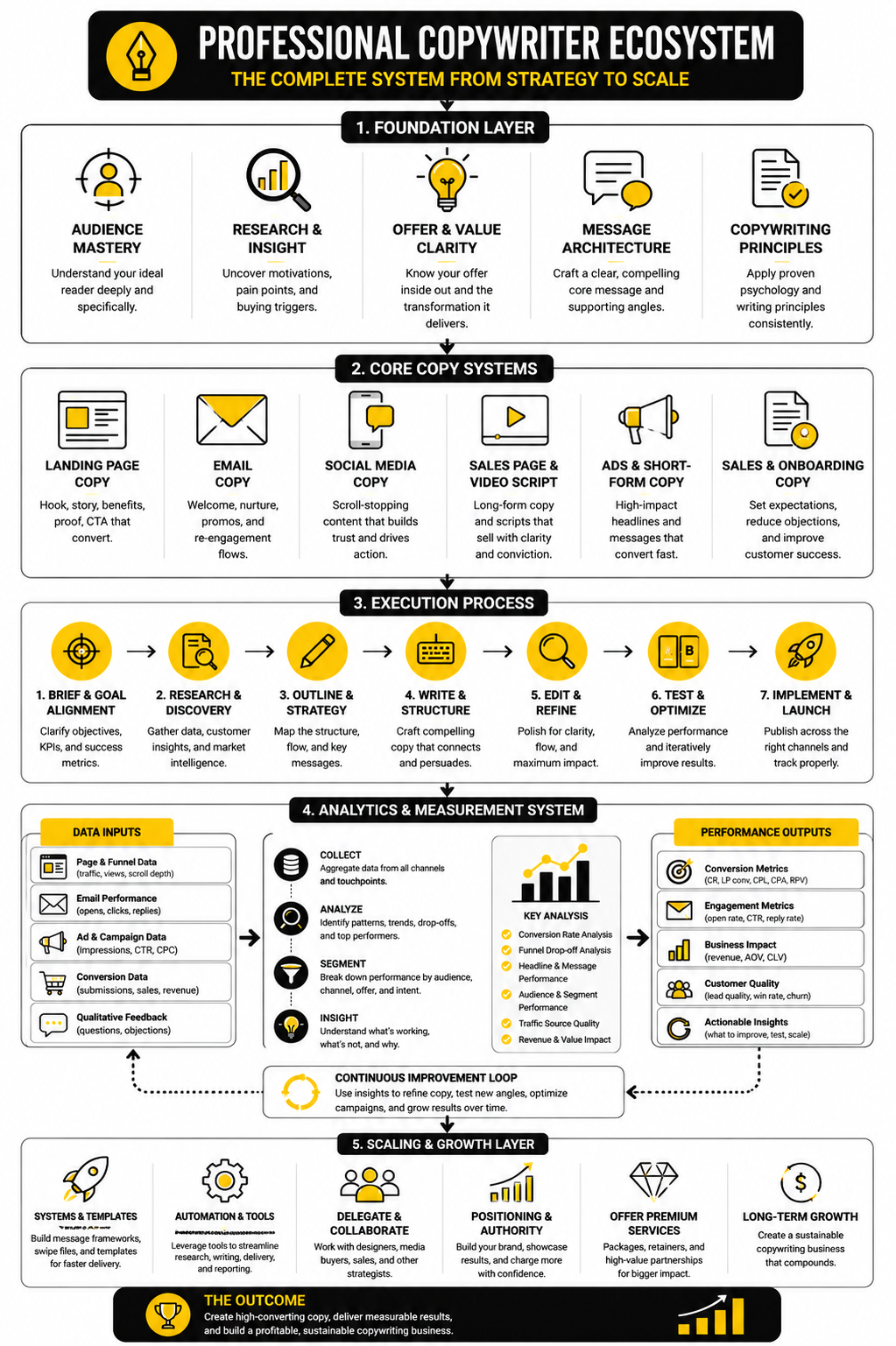
Build A Copy Ecosystem Instead Of Random Assets
A copy ecosystem is the connected set of messages that guide someone from first awareness to purchase and beyond. It includes ads, search snippets, landing pages, product pages, emails, sales scripts, onboarding messages, case studies, FAQs, retargeting, and customer retention campaigns. When those assets align, the buyer feels a consistent story instead of a series of disconnected pushes.
This is where many businesses leave money on the table. They optimize one landing page while the emails tell a different story. They run ads with a bold promise, then send people to a page that softens the message. They close customers with one expectation and onboard them with another.
A professional copywriter helps connect those pieces. The goal is not to make every asset sound identical. The goal is to make the promise, proof, objections, and next steps feel consistent everywhere the buyer interacts with the brand.
What Does A Professional Copywriter Actually Do?
A professional copywriter writes strategic business copy designed to influence action. That can include landing pages, sales pages, email sequences, ads, website copy, product pages, case studies, scripts, lead magnets, and conversion-focused content. The job is not just writing clean sentences; it is turning customer insight and business strategy into copy that helps people make a decision.
Is A Professional Copywriter Different From A Content Writer?
Yes, although the roles can overlap. A content writer usually focuses on education, visibility, engagement, and long-form publishing. A professional copywriter focuses more directly on persuasion, positioning, offer clarity, conversion, and revenue-related actions.
The distinction is not about one being better than the other. It is about the job the asset needs to do. A blog article, nurture guide, and sales page may all need strong writing, but they do not carry the same conversion pressure.
When Should A Business Hire A Professional Copywriter?
Hire a professional copywriter when the message affects revenue, trust, or customer acquisition. That includes new offers, paid traffic campaigns, website redesigns, funnel launches, email sequences, product pages, and high-ticket service pages. It is also smart to hire one when the team keeps explaining the offer differently and needs one clear message system.
Do not wait until everything is broken. Copy is much easier to improve before bad messaging gets spread across ads, pages, emails, sales decks, and automation. Fixing confusion early saves time later.
What Should I Prepare Before Hiring A Copywriter?
Prepare the offer details, audience information, customer research, sales notes, testimonials, product demos, analytics, competitor context, and current copy assets. The copywriter does not need everything to be perfect, but they do need enough raw material to understand the buyer and the business. Better inputs usually lead to better copy.
You should also define the decision you want the reader to make. That could be booking a call, starting a trial, buying a product, joining a list, requesting a demo, or replying to an email. Without that, the copy may sound good but lack direction.
How Much Should A Professional Copywriter Know About Strategy?
A strong professional copywriter should understand strategy well enough to challenge unclear positioning, weak offers, missing proof, and mismatched calls to action. They do not need to replace your entire marketing team, but they should know how copy fits into the funnel. If they only ask for a topic and word count, they may be operating more like a general writer than a conversion-focused copywriter.
Strategy becomes especially important for expensive offers, competitive markets, and paid traffic. In those situations, the words are only one part of the job. The copywriter also needs to understand the buying journey.
Can AI Replace A Professional Copywriter?
AI can help produce drafts, variations, summaries, outlines, and repurposed content. It can speed up parts of the workflow, especially when the user already has strong research and clear direction. But AI does not automatically know the buyer’s real objections, the company’s proof limits, the offer’s strategic context, or the brand’s risk tolerance.
A professional copywriter adds judgment. That includes deciding what claim is worth making, what proof is strong enough, what message should lead, what objections matter, and what should be removed. AI is useful as a tool, but it should not be treated as the strategist.
What Metrics Should Copywriters Care About?
The right metrics depend on the asset. Landing pages may be judged by conversion rate, qualified leads, cost per acquisition, scroll behavior, form completion, and sales quality. Email sequences may be judged by replies, clicks, booked calls, purchases, unsubscribes, and the way each message moves people forward.
The mistake is choosing one metric and pretending it tells the whole story. A high click rate with poor sales quality is not a win. A lower opt-in rate that produces better customers may be exactly what the business needs.
What Makes Copy Sound Professional Without Becoming Boring?
Professional copy is clear, specific, confident, and useful. It does not hide behind jargon, but it also does not rely on hype to create energy. The reader should feel that the brand understands the problem and can explain the solution without wasting time.
The best copy sounds natural because it is built from real buyer language and clean strategic thinking. It can still have personality. It just does not sacrifice clarity to sound clever.
How Long Should Sales Copy Be?
Sales copy should be as long as the decision requires and as short as the reader will allow. A simple, low-risk product may need only a short page. A high-ticket service, complex software product, or unfamiliar offer usually needs more explanation, proof, objection handling, and context.
Length is not the real issue. Relevance is. Long copy that answers real buying questions can perform well, while short copy that leaves the reader uncertain can fail quickly.
What Are The Biggest Mistakes Businesses Make With Copy?
The biggest mistake is writing from the company’s perspective instead of the customer’s reality. Businesses often over-explain features, use vague claims, hide the strongest proof, and ask for action before the reader has enough confidence. That creates friction even when the product is good.
Another common mistake is treating copy as a last-minute polish step. Copy should shape the offer, the funnel, and the buying experience earlier in the process. When it is added at the end, the copywriter is often forced to patch strategy problems instead of building a stronger message from the start.
How Do I Know If My Copy Needs Improvement?
Your copy probably needs improvement if people misunderstand the offer, ask the same basic questions repeatedly, click but do not convert, book calls but arrive unqualified, or compare you mainly on price. Those are signs that the message is not doing enough work before the sales conversation. The problem may be clarity, proof, positioning, offer structure, or audience match.
Look for repeated friction. One confused buyer may not mean much. A pattern of confusion is a message problem.
What Should A Professional Copywriter Deliver?
The deliverable depends on the project, but it should usually include more than polished text. For strategic work, a professional copywriter may deliver research findings, a message map, page wireframe notes, email sequence logic, CTA recommendations, proof placement, and copy ready for design or publishing. For smaller projects, the deliverable may be a cleaner draft with comments and implementation guidance.
The key is usability. The copy should not just look good in a document. It should be ready to become a working asset in the actual marketing system.
Build a stronger local presence with BAAM AI
Turn your website, Google profile, social channels, and AI visibility into one growth engine
Most businesses do not need more random marketing activity. They need a consistent presence system that helps the right people find them, trust them, and take action. BAAM AI brings strategy, local SEO, website updates, Google Maps visibility, social content, AI-search readiness, media production, and reporting into one practical monthly engine.
If you want your marketing to keep working after the campaign ends, start with a free BAAM AI presence audit. See how your business shows up today and where the fastest visibility wins are at BAAM AI.