
BAAM AI Blog
Primary Market Research: A Practical Guide To Getting Answers From Your Market
Primary market research is the process of collecting fresh information directly from the people who matter to your business: customers, prospects, users, buyers, partners, or decision-makers. Instead of relying only...
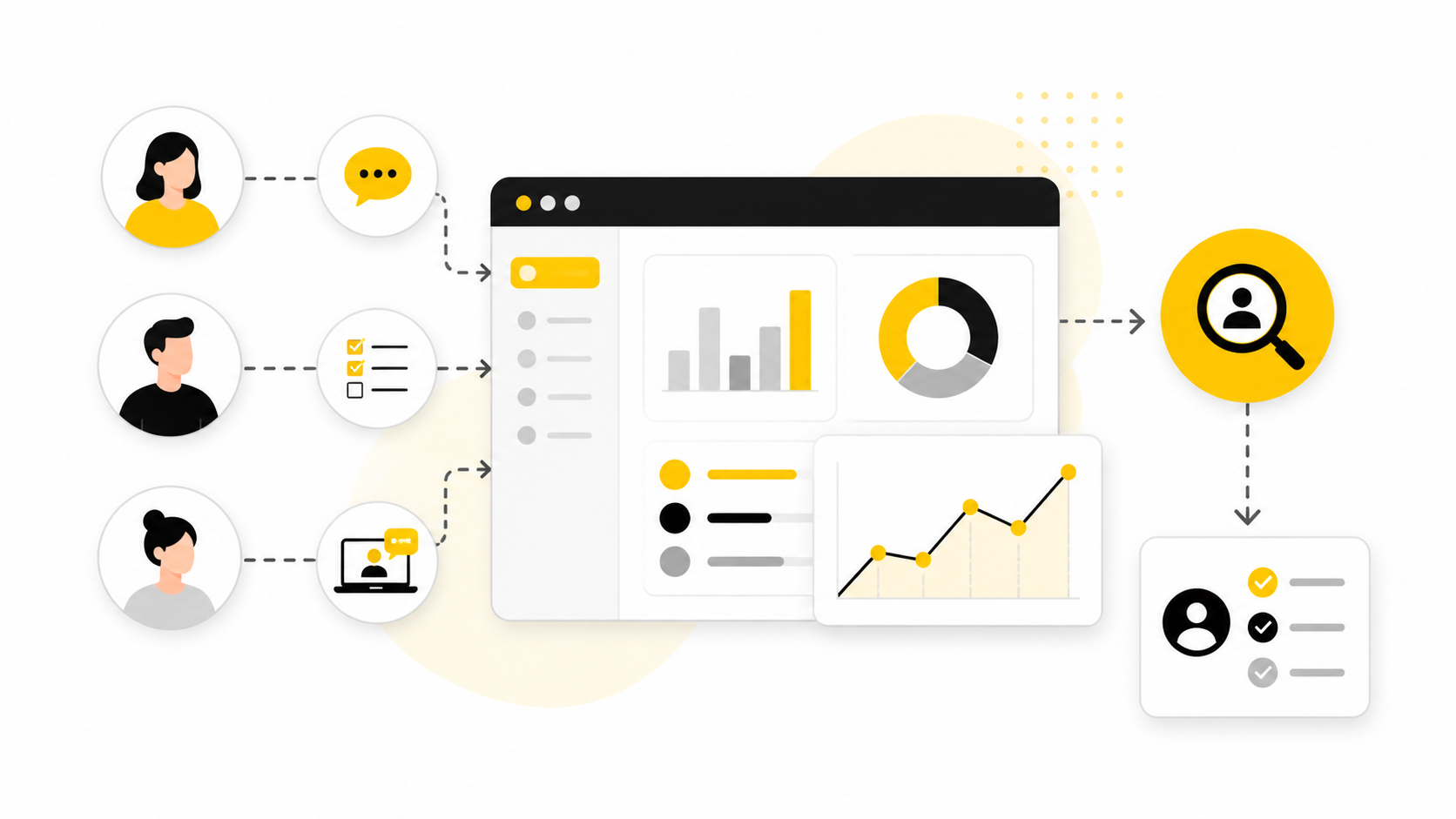
Primary market research is the process of collecting fresh information directly from the people who matter to your business: customers, prospects, users, buyers, partners, or decision-makers. Instead of relying only on old reports, competitor guesses, or recycled industry data, you ask your own questions and gather evidence for your own decisions.
That matters because most bad marketing decisions are not caused by a lack of effort. They are caused by assumptions that were never tested. Primary market research gives you a cleaner way to understand demand, pricing, messaging, buying friction, product gaps, and customer language before you spend serious money.
What Primary Market Research Means
Primary market research is firsthand research designed around a specific business question. You might use surveys, interviews, focus groups, observation, usability testing, customer panels, or controlled experiments. The point is not to “collect data” for the sake of it, but to reduce uncertainty before making a decision.
Secondary research looks at information someone else already gathered. Primary research creates new evidence from the exact audience you care about. That makes it more relevant, but also more demanding, because the quality of the answers depends on how well you design the study.
Why Primary Market Research Matters
Primary market research matters because customers rarely behave exactly the way teams expect. People may say they want one thing, ignore another, resist a price point, misunderstand a message, or choose a competitor for reasons that never appear in analytics dashboards. Direct research helps reveal the “why” behind the behavior.
It also protects teams from overreacting to noisy signals. A few comments on social media, one loud customer, or a temporary dip in conversions can easily distort strategy. Good research gives you a more balanced view before you change positioning, launch a product, rebuild a funnel, or invest in paid acquisition.
The Primary Market Research Framework
A strong primary market research process starts with the decision, not the method. You first define what needs to be decided, then identify what you need to learn, who can answer it, and which research method will produce the most useful evidence. That order matters.
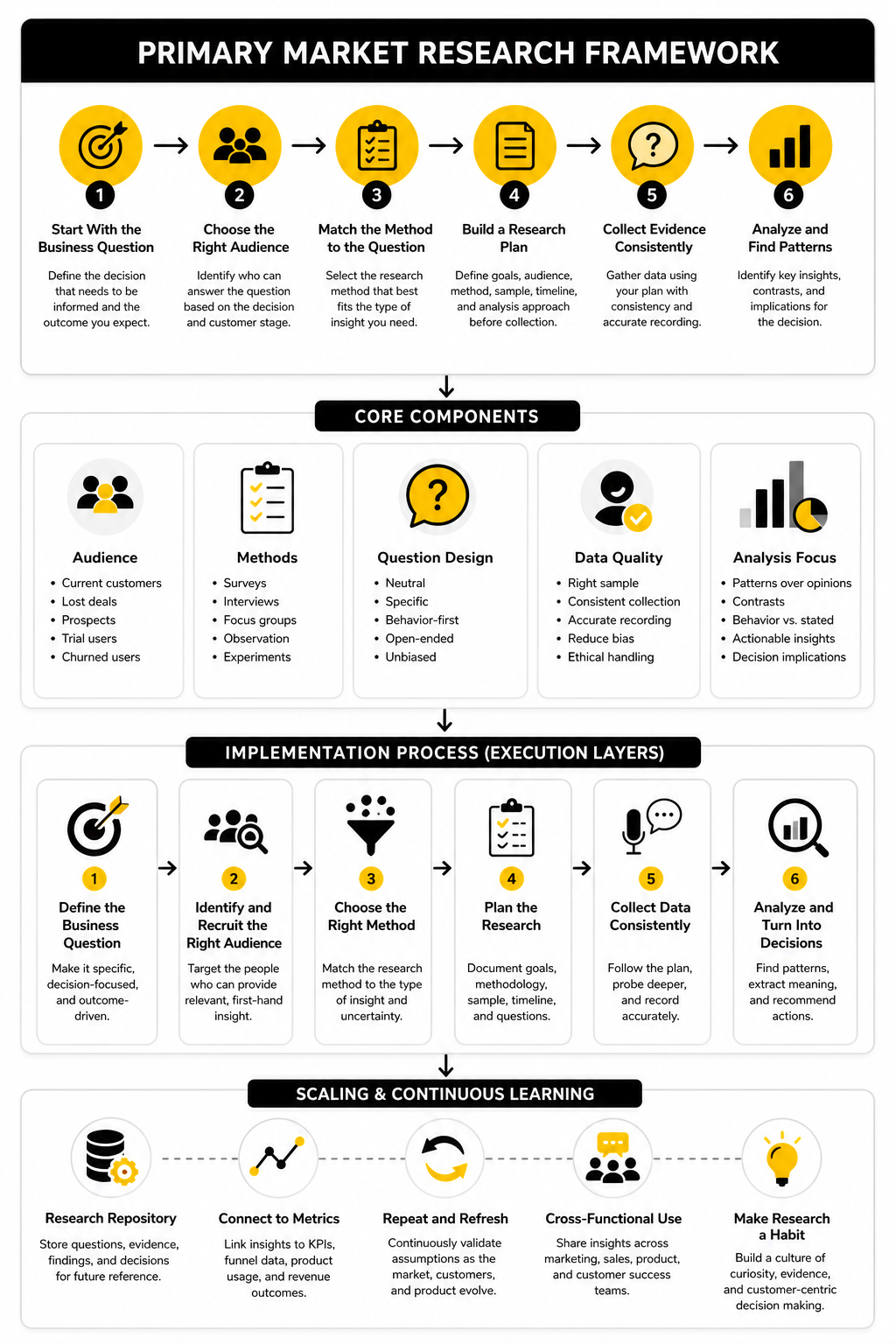
The framework for this guide is simple: clarify the decision, choose the audience, select the method, collect the data, analyze patterns, and turn findings into action. Each step builds on the one before it. Skip one, and the research may still look professional while quietly producing weak conclusions.
Why Primary Market Research Matters
Primary market research matters because markets move faster than internal opinions. A team can have strong analytics, a clear offer, and years of experience, but still miss what customers are actually thinking right now. Fresh research gives you evidence from the people whose behavior decides whether the strategy works.
It is especially useful when the decision carries real cost. Before changing pricing, launching a new product, entering a new segment, or rewriting a sales message, you need more than assumptions. You need direct input from the market, gathered in a way that matches the decision you are about to make.
Modern consumer behavior is also less predictable than it used to be. Large consumer studies such as McKinsey’s 2025 State of the Consumer research show how quickly buying priorities, trust, value perception, and channel behavior can shift across markets. Primary market research helps you catch those shifts before they become expensive surprises.
It Reduces Expensive Guesswork
Most teams do not fail because they never collect information. They fail because they collect the wrong information, interpret it too quickly, or treat internal preference as customer truth. Primary market research slows that down in a useful way.
A founder may believe customers care most about features. A sales team may believe the main objection is price. A marketer may believe the homepage message is clear. Direct research can confirm those beliefs, challenge them, or reveal a completely different problem.
That is the practical value. You are not doing research to feel more carefully. You are doing it to avoid building campaigns, offers, funnels, and products around guesses that sounded good in a meeting.
It Helps You Understand Customer Language
One underrated benefit of primary market research is language. Customers describe problems differently than companies do. They use emotional phrases, simple comparisons, objections, frustrations, and buying triggers that rarely appear in internal strategy documents.
This matters for positioning and conversion. If your messaging sounds polished but does not match how buyers describe the problem, it creates distance. Interviews, open-ended survey answers, sales call reviews, and support conversations can show you the words customers already trust.
This is also where research connects directly to execution. A tool like Fillout can help collect structured survey responses, while a CRM such as Copper can keep customer conversations organized so patterns do not disappear inside inboxes and call notes. The goal is not just to gather responses, but to make the voice of the market usable.
It Makes Strategy More Specific
Weak strategy usually sounds broad. It says things like “improve customer experience,” “target small businesses,” or “create better content.” Those ideas may be directionally right, but they are too vague to guide serious execution.
Primary market research forces specificity. Which customers are struggling most? What problem happens before they search for a solution? What alternatives do they compare? What proof do they need before buying? What makes them hesitate at the final step?
That specificity changes the quality of decisions. Instead of debating abstract opinions, the team can work from evidence. The strategy becomes sharper because it is built around real customer situations, not generic market language.
When Primary Research Becomes Essential
You do not need primary market research for every small decision. Some choices can be made with analytics, secondary research, or simple testing. But when the risk is high, the audience is unclear, or the existing data does not explain the behavior, direct research becomes essential.
It is especially valuable when you are entering a new market, repositioning an offer, improving retention, testing willingness to pay, or trying to understand why qualified prospects are not converting. The Library of Congress guide to primary market research for consumer research frames it as a way to gather information directly from the target audience rather than relying only on existing sources. That directness is the whole point.
The key is to match the research depth to the decision. A quick survey may be enough for a narrow preference question. A major product or positioning decision deserves interviews, behavioral evidence, and a more careful research design.
The Primary Market Research Framework
The framework only works when it starts with a decision. Not a vague curiosity. Not “we should understand customers better.” A real decision, such as whether to launch a new offer, change pricing, reposition a product, enter a new segment, or rebuild a sales process.
That decision shapes everything else. It decides who you need to study, what questions you should ask, how much evidence you need, and which method makes sense. The U.S. Small Business Administration’s guidance on market research and competitive analysis makes the same practical distinction: direct research is useful when you need answers about your specific customers, buying experience, alternatives, and business decisions.
Good primary market research is not a pile of disconnected answers. It is a structured path from uncertainty to action. The cleaner that path is, the easier it becomes to make a decision with confidence instead of dragging the same debate through another meeting.
Start With The Business Question
The first step is to write the business question in plain language. For example, “Why are qualified leads not booking a demo?” is much better than “What do customers think about us?” A sharp question gives the research boundaries, which keeps the project useful.
The question should connect directly to a decision. If the answer will not change what you do next, the research is probably too vague. Primary market research should create movement, not decorate a strategy deck.
A strong research question usually includes the audience, the behavior, and the decision. You want to know who you are studying, what situation you are studying, and what choice the findings will influence. That is how research becomes a business tool instead of an academic exercise.
Choose The Right Audience
Once the question is clear, define who can answer it. Current customers, lost deals, trial users, churned customers, newsletter subscribers, sales-qualified leads, and category buyers may all give different answers. Treating them as one generic “market” is a fast way to blur the findings.
The audience should match the decision. If you are improving onboarding, talk to new users and people who dropped off during setup. If you are testing a premium offer, talk to buyers who already spend in that category, not people who were never likely to buy.
Sampling does not need to be complicated for every project, but it does need to be intentional. Research platforms and professional standards often separate probability and non-probability sampling because the way participants are selected affects what you can safely conclude from the data. Qualtrics’ overview of the marketing research process explains this clearly: your sample depends on the population you want to understand and the method used to select people from it.
Match The Method To The Question
The method should follow the question, not the other way around. Surveys are useful when you need structured answers from a larger group. Interviews are better when you need depth, nuance, objections, motivations, and customer language.
Focus groups can help when you want to explore reactions, shared perceptions, or group discussion around a concept. Observation and usability testing are stronger when what people do matters more than what they say. Experiments are useful when you need to compare behavior between options, such as two landing page messages or two onboarding flows.
This is where many teams go wrong. They pick the method that is easiest, cheapest, or already familiar. But primary market research gets stronger when the method fits the uncertainty you are trying to reduce.
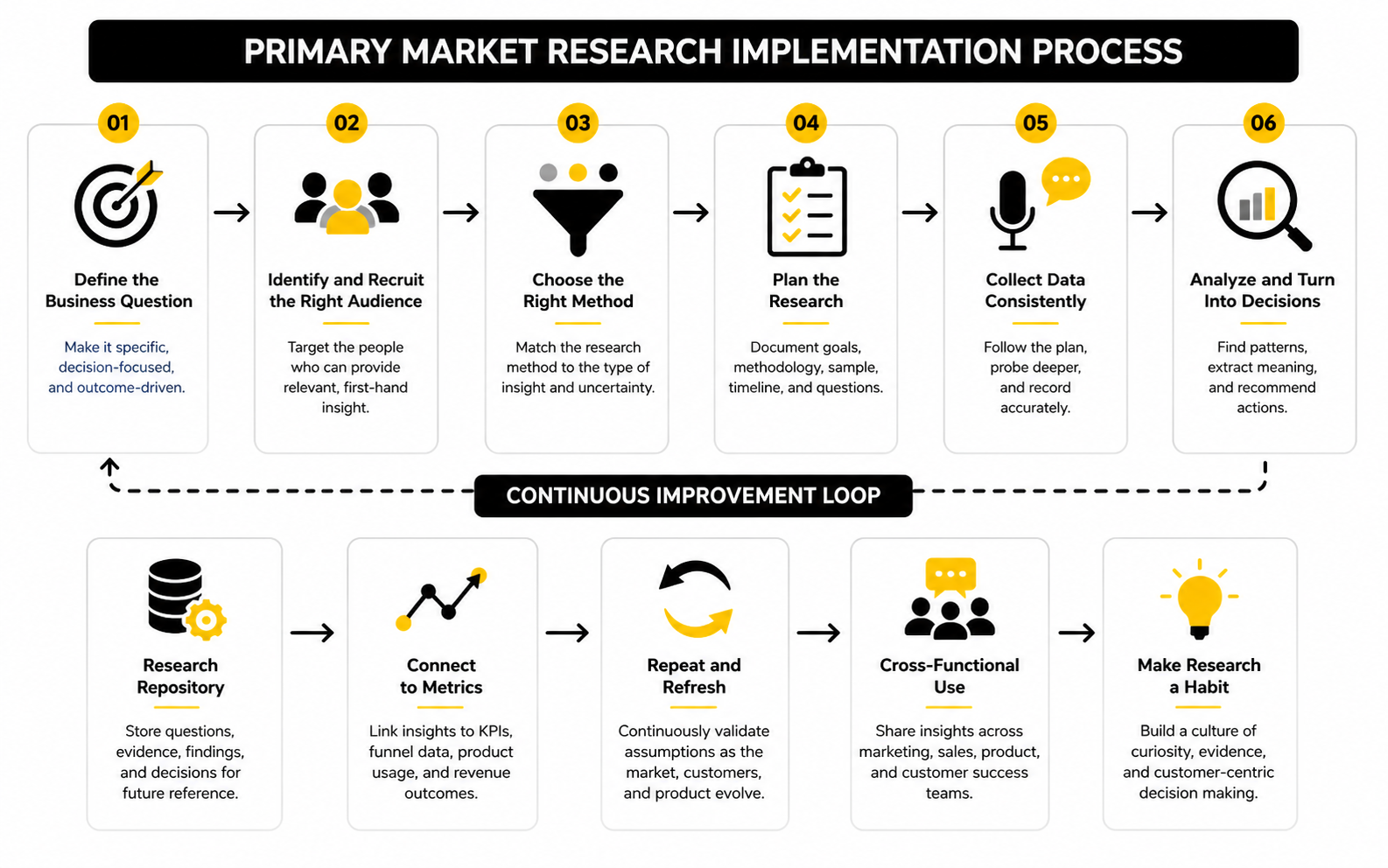
Build A Research Plan Before Collecting Data
A research plan does not need to be huge, but it needs to exist. It should define the decision, the research question, the audience, the method, the sample, the timeline, and the analysis approach. Without that, the project can drift very quickly.
For a simple project, the plan may be one page. For a larger initiative, it may include screener questions, discussion guides, survey logic, participant quotas, incentive rules, and data privacy requirements. The point is to remove ambiguity before the first response comes in.
This also helps prevent biased research. If the team already believes one answer is correct, the questions can quietly push people toward that answer. A written plan makes the process easier to review, challenge, and improve before the data is collected.
Write Questions That Do Not Lead The Respondent
Question quality decides research quality. A biased question can produce confident-looking answers that are almost useless. For example, “How much do you love our new dashboard?” is not research; it is a compliment trap.
Better questions are neutral, specific, and easy to answer. Ask about recent behavior before asking about opinions. Ask people what they did, what they considered, what confused them, and what almost stopped them. Those answers tend to be more useful than broad preference claims.
Professional questionnaire design has been treated as a serious discipline for decades, and ESOMAR’s work on questionnaire design reflects why it matters. The wording, order, response options, and context of a question can all affect the quality of the answer. That is why research should be designed, not improvised.
Collect Evidence In A Consistent Way
Once the plan is ready, collect the data consistently. Use the same interview guide for comparable interviews. Use the same survey structure for the full sample. Keep notes organized, record responses accurately, and separate raw evidence from interpretation.
Consistency does not mean being robotic. In interviews, you can ask follow-up questions when someone says something important. But the core structure should stay stable enough that you can compare answers across participants.
This is where tools can help, as long as they do not replace judgment. Fillout can handle forms and survey collection, Cal.com can simplify interview scheduling, and Wispr Flow can speed up research notes after calls. The process still needs a human brain behind it, but the right setup removes friction.
Analyze Patterns Before Jumping To Conclusions
Analysis starts after collection, not halfway through the first interview. Early reactions can be useful, but they can also become anchors. If one participant says something dramatic, the team may start seeing every later answer through that lens.
Look for repeated patterns, meaningful contrasts, and moments where behavior does not match stated preference. Group answers by audience type, customer stage, buying situation, or research question. Do not just count comments; interpret what they mean for the decision.
The output should be practical. A good research summary does not bury the team in transcripts and charts. It shows what changed, what is still uncertain, and what action should happen next.
Statistics And Data
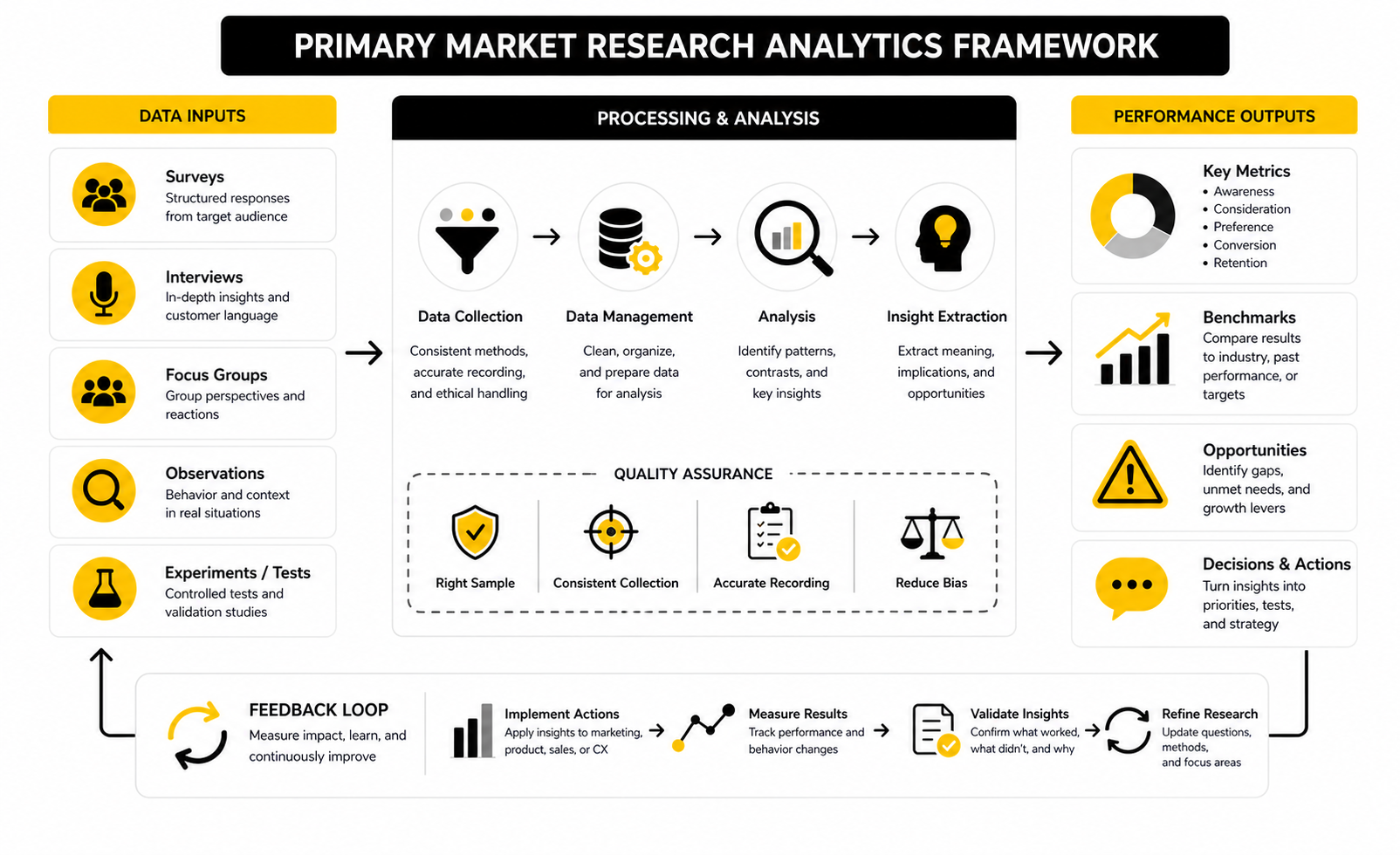
Primary market research gets stronger when the numbers are treated as decision signals, not decorations. A percentage by itself does not mean much until you know who answered, how they were selected, what question they were asked, and what decision the answer should influence. That is why the measurement layer needs the same discipline as the research design.
The goal is not to dump survey charts into a report. The goal is to connect responses, behavior, and business outcomes in a way that shows what to do next. If the data does not change prioritization, messaging, product direction, or customer experience, it is probably just noise with a nice chart.
Recent consumer research makes this point obvious. McKinsey’s 2025 consumer work draws from more than 25,000 consumers across 18 markets, which is useful because it shows how trust, value perception, and spending behavior can vary by market. Your own primary market research should do the same on a smaller, more specific scale: show where behavior changes, why it changes, and what action that should trigger.
What To Measure First
Start with the metrics that connect directly to the decision. If the research is about pricing, measure willingness to pay, perceived value, cheaper alternatives, urgency, and deal-breakers. If the research is about messaging, measure clarity, relevance, believability, recall, and the exact phrases people use when describing the problem.
Do not measure everything just because the survey tool allows it. Too many questions create respondent fatigue and weaker answers. A focused study usually beats a bloated one because the data is easier to interpret and more likely to drive action.
The best measurement plan combines three layers:
Each layer answers a different question. Profile data tells you who the respondent is. Attitude data tells you what they think or feel. Behavior data tells you what actually happened, which is often the most honest signal.
How To Interpret Survey Results
Survey results should be read through the lens of sample quality. A small sample from the right audience may be more useful than a large sample from the wrong one. A survey of random newsletter subscribers cannot safely answer the same questions as a survey of recent buyers, lost deals, or active users.
Sample size also affects confidence. Qualtrics’ sample size guidance explains that researchers usually think about population size, confidence level, and margin of error when deciding how many responses they need for a survey. In plain English, the larger and more representative the sample, the more carefully you can generalize the result.
But do not hide behind math. If 72% of the wrong people prefer an option, that does not make the option right. Primary market research works when the sample matches the decision, not when the chart looks impressive.
Benchmarks Need Context
Benchmarks can be useful, but they are not commandments. A customer satisfaction score, response rate, conversion rate, or awareness measure only becomes useful when you compare it against the right context. Industry averages can show direction, but they cannot tell you what your specific customers need from your specific offer.
This is especially important in marketing measurement. Nielsen’s 2025 Annual Marketing Report focuses heavily on data-driven marketing and holistic measurement because brands are trying to connect activity across channels, audiences, and outcomes. That same principle applies to primary market research: one number rarely tells the full story.
Use benchmarks to ask better questions, not to outsource judgment. If your conversion rate is below a category average, research should help explain whether the issue is traffic quality, offer fit, message clarity, trust, pricing, or buying friction. The benchmark identifies a gap; primary research explains the gap.
Performance Signals That Matter
The most useful signals usually come from combining what people say with what people do. A prospect may say pricing is the issue, but behavior might show they never reached the pricing page. A user may say onboarding was simple, but product data might show repeated setup errors.
That is why primary market research should connect with analytics wherever possible. Interviews can explain the emotion behind churn. Surveys can quantify objections across a broader audience. Funnel analytics can show where the friction appears in the actual buying path.
Tools can help here if they support the workflow instead of distracting from it. A platform such as GoHighLevel can help teams track leads, conversations, pipeline stages, and follow-up activity in one place. For landing page testing and ecommerce-style research, Replo can be useful when the question is whether a message, offer, or layout changes buyer behavior.
Turning Data Into Action
The cleanest way to turn research data into action is to separate findings, implications, and decisions. A finding is what the data shows. An implication is what it means for the business. A decision is what you will change because of it.
For example, “buyers mention implementation anxiety in 41% of interviews” is a finding. “The offer is not just being judged on features; it is being judged on perceived setup risk” is an implication. “Add onboarding proof, clearer implementation steps, and customer support expectations to the sales page” is a decision.
This structure prevents vague reports. It keeps the team focused on what the research actually changes. Primary market research should end with movement: clearer messaging, better targeting, more carefully pricing, stronger onboarding, sharper sales conversations, or a better product roadmap.
Common Measurement Mistakes
The first mistake is treating every data point as equal. A response from a highly qualified buyer is not the same as a response from someone outside the market. Research should weight relevance, not just volume.
The second mistake is confusing correlation with cause. If customers who watch a demo convert more often, the demo may help, or those customers may already have higher intent. Primary market research can help explain the relationship, but it should not pretend to prove causality unless the study was designed for that.
The third mistake is collecting data without a decision owner. When nobody owns the decision, findings get discussed, admired, and forgotten. Assign the owner before the research starts, so the data has a clear path into execution.
Professional Implementation
At a professional level, primary market research becomes less about asking questions and more about building a reliable learning system. The research needs to be repeatable, ethical, and connected to decisions across marketing, sales, product, and customer success. Otherwise, every project starts from zero and the same questions keep coming back.
This is where advanced teams separate themselves. They do not treat research as a one-off campaign before a launch. They build a rhythm for learning from customers, validating assumptions, and turning evidence into better execution.
The challenge is balance. Move too slowly and research becomes a bottleneck. Move too quickly and the team starts making confident decisions from weak evidence.
Know When Speed Is Good Enough
Not every research question deserves a six-week study. Some decisions only need directional evidence. If you are choosing between three headline angles, a small round of message testing may be enough to expose confusion, weak relevance, or obvious preference.
But speed has limits. A fast survey can reveal patterns, but it may not explain why they exist. A few interviews can uncover language and motivations, but they cannot prove how common those patterns are across the full market.
Use speed when the risk is low and reversibility is high. Use deeper research when the decision is expensive, hard to reverse, or likely to affect product strategy, pricing, positioning, or long-term brand perception.
Avoid Research Theater
Research theater happens when the team performs the motions of research without letting the evidence change the decision. They run a survey after the strategy is already chosen. They interview customers but only quote the answers that support the internal favorite. They ask leading questions, then call the result validation.
This is dangerous because it creates false confidence. The team feels data-driven, but the process is really just opinion with decoration. Primary market research should challenge assumptions, not protect them.
A simple safeguard is to write down the decision criteria before collecting data. Define what evidence would support the idea, what evidence would weaken it, and what action the team will take in either case. If no result could change the decision, do not pretend the project is research.
Manage Bias Before It Spreads
Bias does not only appear in bad surveys. It can enter through participant recruitment, question wording, incentive design, interview behavior, analysis, and stakeholder interpretation. Once bias gets into the system, it can quietly shape everything that follows.
Sampling bias is one of the biggest risks. A study based only on happy customers will miss churn reasons, lost-deal objections, and silent frustration. SurveyMonkey’s guidance on sampling bias makes the core point clearly: survey goals and target audience need to be defined before the sample is collected.
Nonresponse bias is another quiet problem. The people who answer may be meaningfully different from the people who ignore the survey. That is why serious research pays attention not only to what respondents say, but also to who did not respond and what that absence might mean.
Protect Trust And Privacy
Research depends on trust. If people believe their answers will be misused, sold to them later, or exposed inside the company without consent, the quality of the research drops. Ethical handling is not a legal footnote; it affects the honesty of the data.
The 2025 ICC and ESOMAR code for market, opinion, social research, and data analytics frames professional research around lawful, ethical conduct and public confidence. That matters even for small teams because the basic principles are universal: be clear about the purpose, respect respondents, protect personal data, and avoid deceptive collection.
This is especially important when research touches sensitive topics, employee feedback, health, finance, children, or vulnerable groups. Keep consent clear. Limit access to raw responses. Do not reveal identities unless participants have explicitly agreed to it.
Build A Research Repository
One of the biggest scaling problems is memory. Teams learn something useful, act on part of it, and then lose the evidence across documents, call recordings, Slack threads, and forgotten survey exports. Six months later, a new team asks the same question again.
A research repository solves that by keeping findings searchable and reusable. It should store the research question, audience, method, raw evidence, key findings, decisions made, and follow-up actions. The goal is not to create a museum of old reports, but to make customer evidence easy to find when new decisions appear.
This becomes more valuable as the company grows. A product team can learn from sales objections. Marketing can learn from support patterns. Leadership can see whether repeated customer signals are being addressed or ignored.
Scale Without Losing The Customer
As research programs grow, the biggest danger is abstraction. Dashboards expand. Segments multiply. Reports get cleaner. But the team can slowly lose the human reality behind the numbers.
Keep direct customer contact in the system. Product managers, marketers, founders, and sales leaders should still hear real customer language regularly. Continuous discovery practices exist for this reason: customer learning works better when it becomes part of the operating rhythm instead of a rare project.
That does not mean everyone needs to interview customers every day. It means the organization needs a steady flow of direct evidence. Research should stay close enough to reality that decisions do not drift into spreadsheet fantasy.
Connect Research To Revenue Decisions
Primary market research becomes more valuable when it is tied to commercial outcomes. The findings should influence how leads are qualified, which objections sales addresses, which segments marketing prioritizes, and which product improvements receive investment. If the research never reaches revenue decisions, it stays trapped as insight.
For agencies, consultants, and service businesses, this connection can be very practical. A CRM and automation platform like GoHighLevel can help connect research insights to follow-up flows, pipeline stages, and lead nurturing. A funnel platform like ClickFunnels can help test whether a new offer angle or buying path actually improves conversion.
The tool is not the strategy. The strategy is turning evidence into action quickly enough that the business benefits. That is the whole point.
Make Research A Decision Discipline
Advanced primary market research is not about having more data than everyone else. It is about making better decisions with the right amount of evidence. The best teams know when to explore, when to measure, when to test, and when to move.
They also know when not to over-research. Some teams use research to delay hard choices. They keep asking for more data because choosing a direction feels risky. At some point, evidence has done its job and leadership has to decide.
That is the professional standard: clear questions, honest methods, ethical collection, practical analysis, and decisive action. When those pieces are in place, primary market research stops being a report and becomes a competitive advantage.
Turning Research Into Decisions
Primary market research is only finished when it changes what the business does next. A report can be beautifully written and still be useless if nobody owns the decision. The final step is to turn the evidence into priorities, experiments, messaging, product changes, sales enablement, or customer experience improvements.
This is where the full system comes together. The business question sets the direction, the audience gives the context, the method produces evidence, the analysis finds patterns, and the decision owner turns those patterns into action. When that loop is working, research becomes part of how the company thinks.
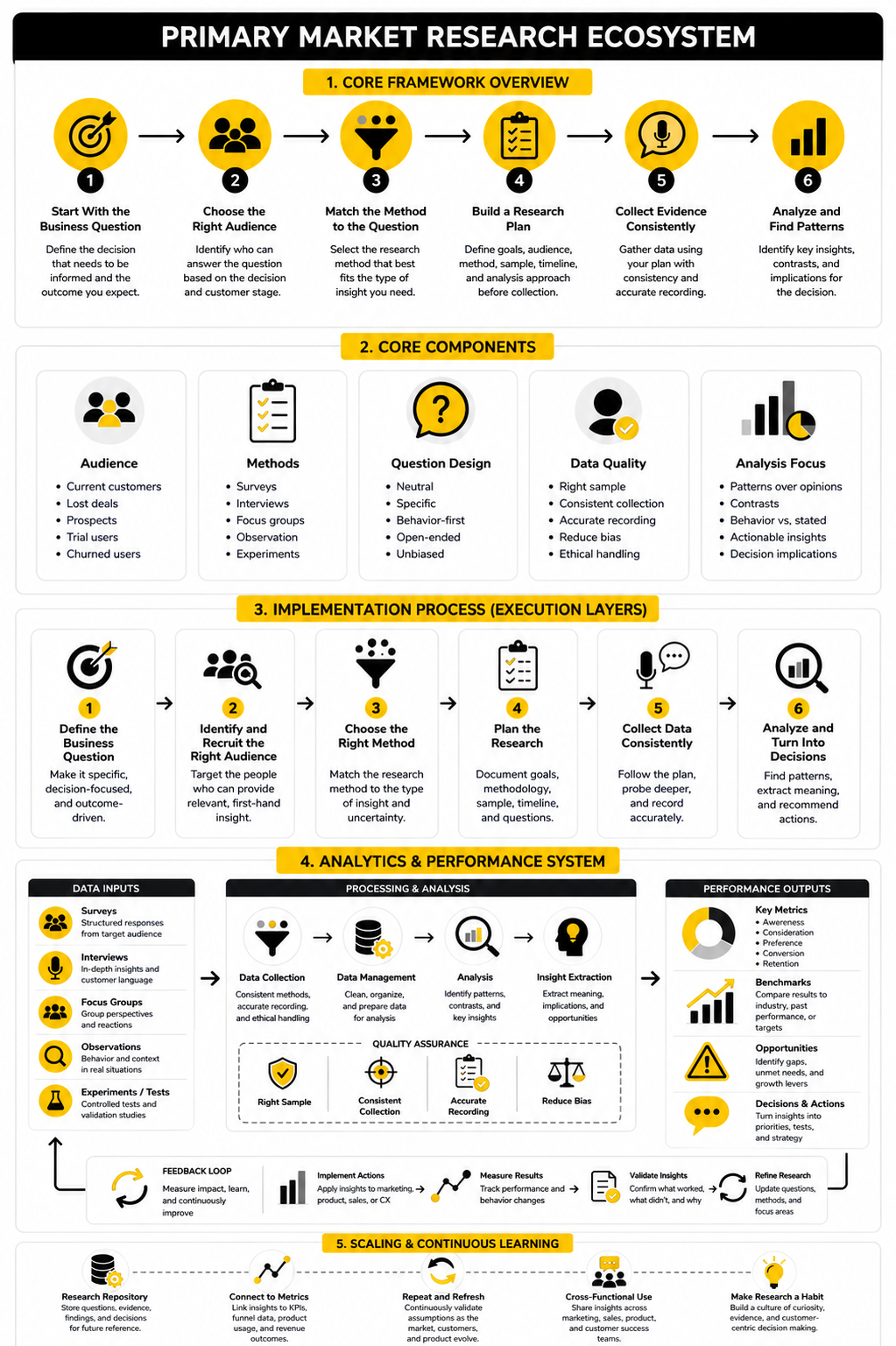
The best teams also keep the loop alive after the first decision. They measure what changed, watch for new friction, and keep collecting direct customer evidence as the market shifts. That matters because even strong research has a shelf life, especially in categories where buying behavior, technology, and customer expectations move quickly.
What is primary market research?
Primary market research is research you collect directly from your target audience for a specific business decision. It can include interviews, surveys, focus groups, observation, usability testing, customer panels, and experiments. The main advantage is relevance, because the data comes from the people connected to your own market, offer, or customer problem.
How is primary market research different from secondary research?
Primary research creates new data, while secondary research uses existing data from reports, databases, articles, public records, or industry studies. Secondary research is usually faster and cheaper, but it may not answer your exact question. Primary market research is more specific, which makes it useful when the decision depends on your actual customers or prospects.
When should a business use primary market research?
Use it when the decision is important, expensive, unclear, or hard to reverse. It is especially useful for pricing, positioning, product development, customer segmentation, churn analysis, sales objections, and new market entry. If the answer could change what you build, sell, say, or prioritize, primary research is worth considering.
What are the main methods of primary market research?
The main methods include surveys, interviews, focus groups, observation, usability testing, field research, customer panels, and controlled experiments. Surveys are useful for structured answers from more people. Interviews are better when you need depth, emotion, context, objections, and the exact language customers use.
How many people do you need for primary market research?
It depends on the method and the decision. A small group of interviews can reveal useful themes, but it cannot prove how common those themes are across a larger market. Surveys need a stronger sample plan if you want to generalize results, and professional research often considers population size, sampling method, confidence level, and margin of error.
What makes primary market research reliable?
Reliable research starts with a clear business question, the right audience, neutral questions, consistent data collection, and honest analysis. The sample needs to match the decision. The questions should not push people toward the answer the team secretly wants.
What is the biggest mistake in primary market research?
The biggest mistake is using research to confirm a decision that has already been made. That creates research theater, not insight. Real primary market research must be able to challenge assumptions and change the next move.
Can small businesses do primary market research?
Yes, and they should. Small businesses can run customer interviews, short surveys, lost-deal reviews, website feedback forms, and simple usability tests without building a full research department. The key is to stay focused on one decision at a time.
How does primary market research improve marketing?
It improves marketing by revealing what customers care about, what they misunderstand, what they compare, what they fear, and what language they already use. That helps with positioning, landing pages, email campaigns, ads, sales scripts, and content strategy. Strong research makes marketing sound less like a company talking at people and more like a solution built for them.
How does primary market research support product development?
It helps product teams understand customer needs before building, during testing, and after launch. Interviews can reveal unmet needs, usability tests can expose friction, and surveys can help prioritize improvements across a broader user base. This reduces the chance of building features that look good internally but do not matter enough to customers.
What tools help with primary market research?
Useful tools depend on the workflow. Fillout can help with forms and surveys, Cal.com can help schedule interviews, Wispr Flow can speed up note-taking, and GoHighLevel can help connect customer insights to sales and follow-up activity. Tools help most when the research question and process are already clear.
How often should primary market research be done?
Do it whenever a meaningful decision needs fresh evidence. For fast-moving markets, customer research should become a regular rhythm rather than a rare project. The point is not to research constantly, but to keep direct customer evidence close enough that decisions stay grounded.
Build a stronger local presence with BAAM AI
Turn your website, Google profile, social channels, and AI visibility into one growth engine
Most businesses do not need more random marketing activity. They need a consistent presence system that helps the right people find them, trust them, and take action. BAAM AI brings strategy, local SEO, website updates, Google Maps visibility, social content, AI-search readiness, media production, and reporting into one practical monthly engine.
If you want your marketing to keep working after the campaign ends, start with a free BAAM AI presence audit. See how your business shows up today and where the fastest visibility wins are at BAAM AI.