
BAAM AI Blog
PPC Management Pricing: What You Should Actually Pay And Why
PPC management pricing looks simple from the outside. You pay for ads, then you pay someone to manage them. In reality, the fee only makes sense when it matches the complexity, risk, and revenue potential of the account.
PPC management pricing looks simple from the outside. You pay for ads, then you pay someone to manage them. In reality, the fee only makes sense when it matches the complexity, risk, and revenue potential of the account.
That matters because paid search is not getting cheaper. The average Google Ads search CPC reached $5.26 in 2025, while average cost per lead reached $70.11. When clicks cost that much, bad management is not “a small inefficiency.” It is a leak.
Why PPC Management Pricing Matters
PPC management pricing matters because the fee is only one part of the real cost. The bigger cost is what happens when targeting, tracking, landing pages, offers, or bidding strategy are weak. A cheap manager can become expensive fast if they waste budget or miss conversion problems.
Most agencies price PPC management as a monthly retainer, a percentage of ad spend, an hourly engagement, or a hybrid model. Current market guides commonly place professional management around 10% to 20% of ad spend or $1,000 to $3,000 per month, while broader agency data shows many PPC projects falling into the $10,000 to $49,999 project range. Those ranges are useful, but they are not the answer by themselves.
The real question is whether the management fee buys better decisions. Good PPC work improves the quality of traffic, protects your budget, and turns advertising into a measurable acquisition channel. Bad PPC work gives you reports, clicks, and excuses.
PPC Management Pricing Framework Overview
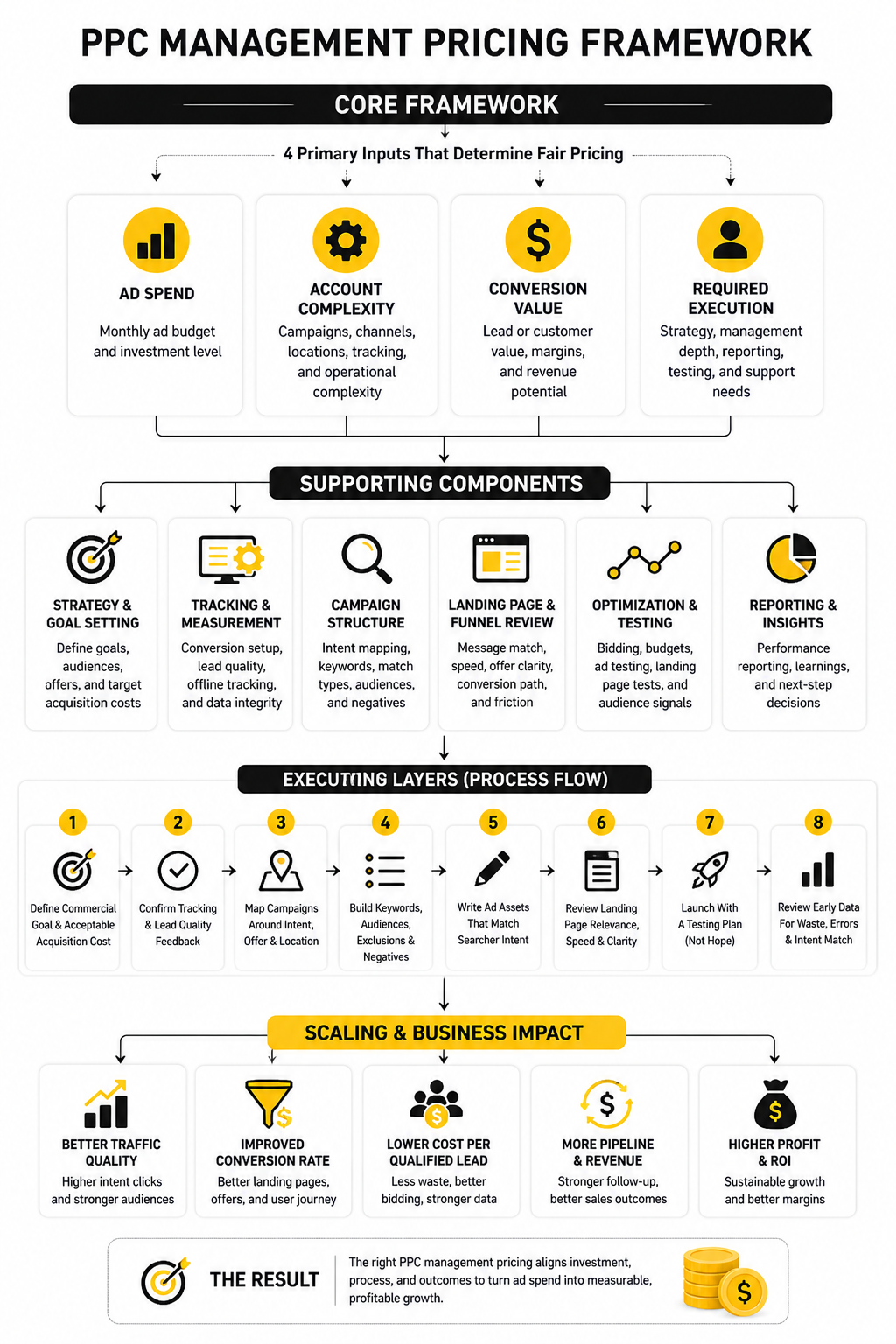
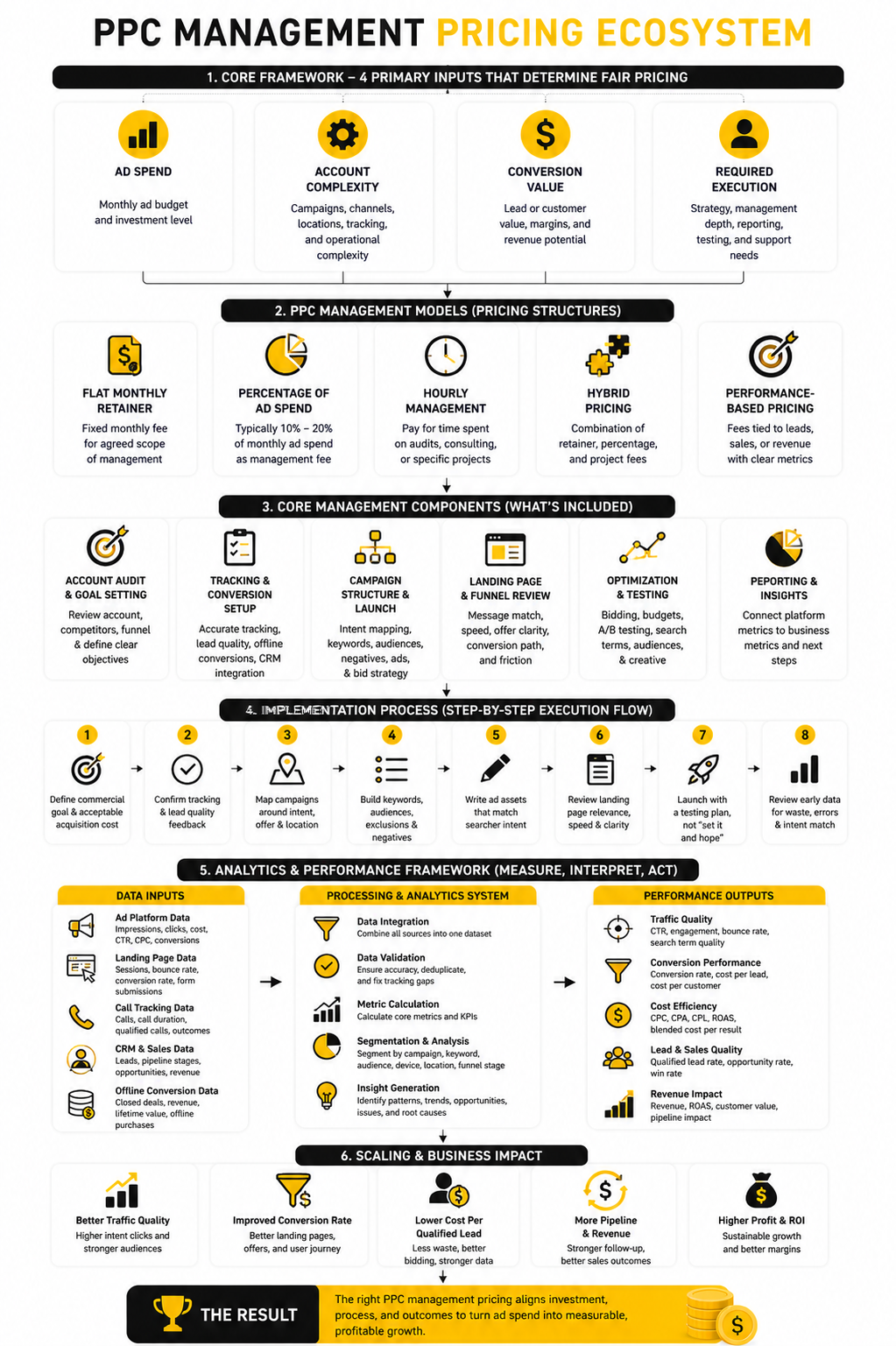
A practical pricing framework starts with four inputs: ad spend, account complexity, conversion value, and required execution. A small local lead generation account with one campaign does not need the same management structure as a multi-location ecommerce brand running search, shopping, remarketing, and landing page tests. Pricing should rise when the work genuinely becomes more strategic, technical, or operationally demanding.
The most common mistake is comparing retainers without comparing scope. One agency may only adjust bids and send reports, while another handles tracking, keyword structure, creative testing, landing page feedback, and weekly strategy. Those are not the same service, even if both are called PPC management.
this guide will treat PPC management pricing as a business decision, not a rate card. The goal is to help you understand what different models mean, what should be included, and when a higher fee is actually justified. That is how you avoid both traps: overpaying for shallow work and underpaying for a channel that needs serious attention.
Core Pricing Models Agencies Use
PPC management pricing usually falls into a few clear models. None of them are automatically good or bad. The right model depends on your budget, campaign complexity, and how much hands-on work the account needs.
Flat Monthly Retainer
A flat monthly retainer is the cleanest model for most businesses. You pay a fixed fee every month, and the agency manages the account within an agreed scope. This works well when the account needs consistent strategy, optimization, reporting, and testing.
The main advantage is predictability. You know what management costs before the month starts, which makes cash flow easier. The downside is that some retainers are vague, so you need to know exactly what is included before you sign.
A fair retainer should match the workload. A simple local campaign may not justify a premium fee, while a complex account with multiple offers, landing pages, audiences, and reporting requirements absolutely can. This is where ppc management pricing becomes less about the number and more about the operational reality behind it.
Percentage Of Ad Spend
The percentage-of-spend model charges a management fee based on your monthly ad budget. A common range is around 10% to 20% of ad spend, which means a business spending $20,000 per month may pay $2,000 to $4,000 in management fees. This model can make sense when larger budgets require more monitoring, testing, and campaign structure.
The problem is incentive alignment. If the agency earns more when you spend more, they need strong reporting discipline to prove that additional spend is profitable. Otherwise, the pricing model can quietly reward budget growth without enough pressure on efficiency.
This model is not a red flag by itself. It becomes risky when there is no minimum performance discussion, no clear testing plan, and no honest conversation about diminishing returns. More spend is only useful when it creates more qualified pipeline or revenue.
Hourly PPC Management
Hourly pricing is common for audits, consulting, account cleanup, and short-term support. Marketplace data shows many PPC providers charging around $100 to $149 per hour, though rates vary by expertise and market. This can be useful when you need a specialist to solve a specific problem rather than manage campaigns every month.
Hourly work gives you flexibility, but it can be harder to forecast. If the account is messy, the hours can climb quickly. That is why hourly PPC work should have a clear brief, clear priorities, and a clear definition of done.
This model is best when you already have someone implementing the work. For example, a consultant can review tracking, campaign structure, bidding, and landing page flow, then hand the fixes to your internal team. If nobody owns execution, hourly advice can turn into an expensive document that never gets used.
Hybrid Pricing
Hybrid pricing combines two or more models. A common version is a base retainer plus a smaller percentage of ad spend. Another version is a fixed management fee with added project fees for landing pages, tracking setup, or conversion rate optimization.
This can be the most practical model when the account has both recurring work and occasional heavy lifts. PPC does not live in isolation, so it often touches analytics, CRM setup, creative, forms, funnels, and sales follow-up. If your campaigns depend on better lead handling, a CRM and automation platform like GoHighLevel can fit naturally into the broader implementation stack.
The key is transparency. Hybrid pricing should not become a junk drawer of random fees. Each component should have a purpose, a scope, and a business reason behind it.
Performance-Based Pricing
Performance-based pricing sounds attractive because the agency gets paid for results. In theory, that creates perfect alignment. In practice, it only works when attribution, margins, sales quality, lead definitions, and close rates are clearly understood.
This model can be dangerous when the metric is too shallow. Paying for leads does not help if those leads are low quality, impossible to contact, or outside your service area. Paying for revenue also gets messy if the agency does not control sales process, pricing, fulfillment, or customer retention.
Performance incentives can work as a bonus layer. They are usually weaker as the entire pricing model. A solid base fee plus a carefully defined upside bonus is often more realistic than pretending one partner controls the whole customer journey.
What Should Be Included In PPC Management
PPC management pricing only makes sense when you know what work is actually included. A monthly fee should not buy random button-clicking inside Google Ads. It should buy a repeatable process that turns budget into measurable demand.
Good PPC management usually starts before a campaign goes live. The manager needs to understand the offer, the margin, the sales process, the conversion path, and the real value of a lead or customer. Without that foundation, the account can look active while quietly optimizing toward the wrong outcome.
Account Audit And Goal Setting
The first step is a serious account audit. That means reviewing campaign structure, search terms, keywords, match types, negative keywords, conversion actions, bidding strategy, landing pages, and reporting. It also means asking a blunt question: are we measuring the thing that actually makes money?
This matters because Google Ads can optimize only around the signals you give it. Smart Bidding uses Google AI to optimize for conversions or conversion value, including strategies like Target CPA, Target ROAS, Maximize Conversions, and Maximize Conversion Value. If the conversion setup is weak, the bidding system may become very efficient at finding low-quality actions.
A proper audit should separate symptoms from causes. High CPC is not always the problem. Sometimes the real problem is poor intent matching, weak landing page relevance, broken tracking, or a sales process that never follows up fast enough.
Tracking And Conversion Setup
Tracking is where a lot of PPC accounts quietly fail. A campaign can have beautiful ads and still be useless if form fills, calls, purchases, booked appointments, or qualified leads are not captured correctly. This is especially important now because privacy changes and browser restrictions have made clean measurement harder.
For lead generation, the tracking setup should distinguish between raw leads and qualified leads. A contact form submission from a student doing research is not the same as a buyer ready to schedule a call. When possible, offline conversion imports or CRM-based lead stages should feed better data back into the ad account.
This is also where the tool stack matters. If your ads generate leads, but your follow-up is slow or scattered, the PPC manager cannot fix the entire revenue system from inside Google Ads. A CRM and automation setup like GoHighLevel can help connect forms, calls, pipelines, reminders, and follow-up so the ad spend has a cleaner path to revenue.
Campaign Structure And Launch Process
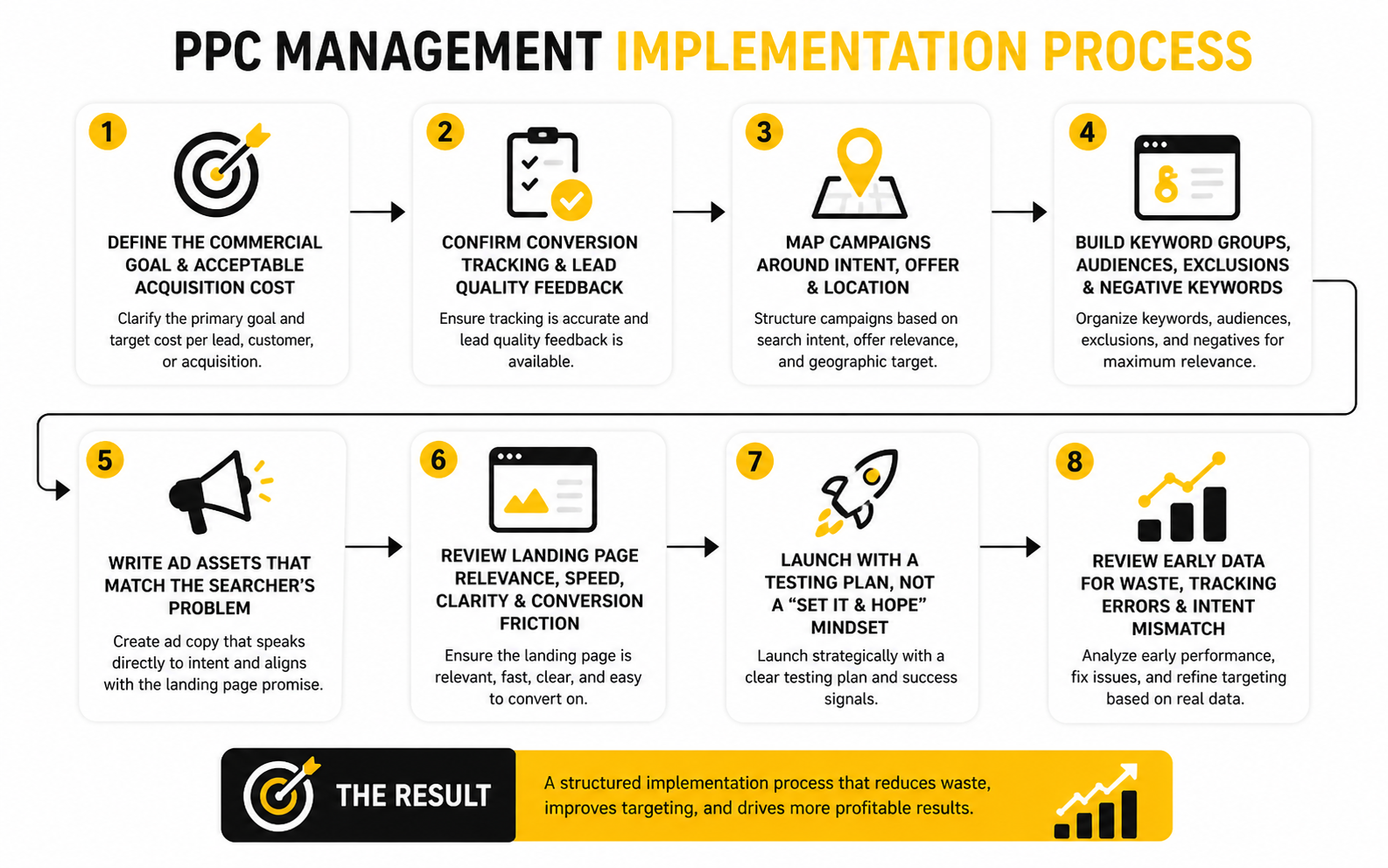
Once tracking is reliable, the account structure can be built with intent in mind. Campaigns should separate different goals, locations, services, product categories, and funnel stages where it makes practical sense. Over-segmentation creates noise, but dumping everything into one campaign usually makes optimization harder.
A clean launch process usually follows this order:
This is where ppc management pricing should reflect real execution. If an agency is only launching campaigns but not checking tracking, landing pages, and lead quality, the price should be lower. If they own the full process from strategy to measurable feedback, the fee has a stronger business case.
Landing Page And Funnel Review
PPC performance does not stop at the click. Google treats landing page experience as part of Quality Score, alongside relevance and expected click-through rate. A page that feels disconnected from the ad can hurt performance before the visitor even becomes a lead.
The landing page review should focus on message match, offer clarity, page speed, proof, friction, and conversion path. If someone searches for emergency plumbing, the page should not make them read a generic company brochure. If someone compares software pricing, the page should not hide the offer behind vague copy.
For ecommerce or offer-driven campaigns, a dedicated funnel builder can make testing easier than relying on a slow development queue. Tools like ClickFunnels or Systeme.io can be useful when the paid traffic strategy needs fast landing page deployment, simple checkout flows, or lead capture pages.
Optimization And Reporting Rhythm
After launch, PPC management becomes a rhythm. The manager should review search terms, conversion quality, budget pacing, bidding performance, audience signals, asset performance, and landing page results. The goal is not to touch every setting every day; the goal is to make better decisions with enough data.
Reporting should connect ad metrics to business metrics. Clicks, impressions, CTR, CPC, and conversion rate matter, but they are not the finish line. The report should explain what changed, why it changed, what was learned, and what happens next.
This is where weak management becomes obvious. A thin report says performance is up or down. A useful report tells you what the account is teaching you about the market, the offer, and the economics of acquisition.
Statistics And Data
PPC data is useful only when it changes what you do next. Benchmarks can show whether your account is wildly out of range, but they should not become your strategy. The goal is not to match an average; the goal is to understand whether your paid traffic is creating profitable customers at a cost your business can handle.
The broad market is getting more expensive. Google Ads search CPC averaged $5.26 in 2025, average conversion rate reached 7.52%, and average cost per lead reached $70.11. Those numbers matter because they give context for ppc management pricing, but they do not tell you whether your agency is doing a good job.
A $70 lead can be amazing for one company and terrible for another. If a lead is worth $2,000 in gross profit, that cost may be healthy. If a lead is worth $90 and needs sales team time, follow-up, and onboarding, the same number can destroy the economics.
The Metrics That Actually Matter
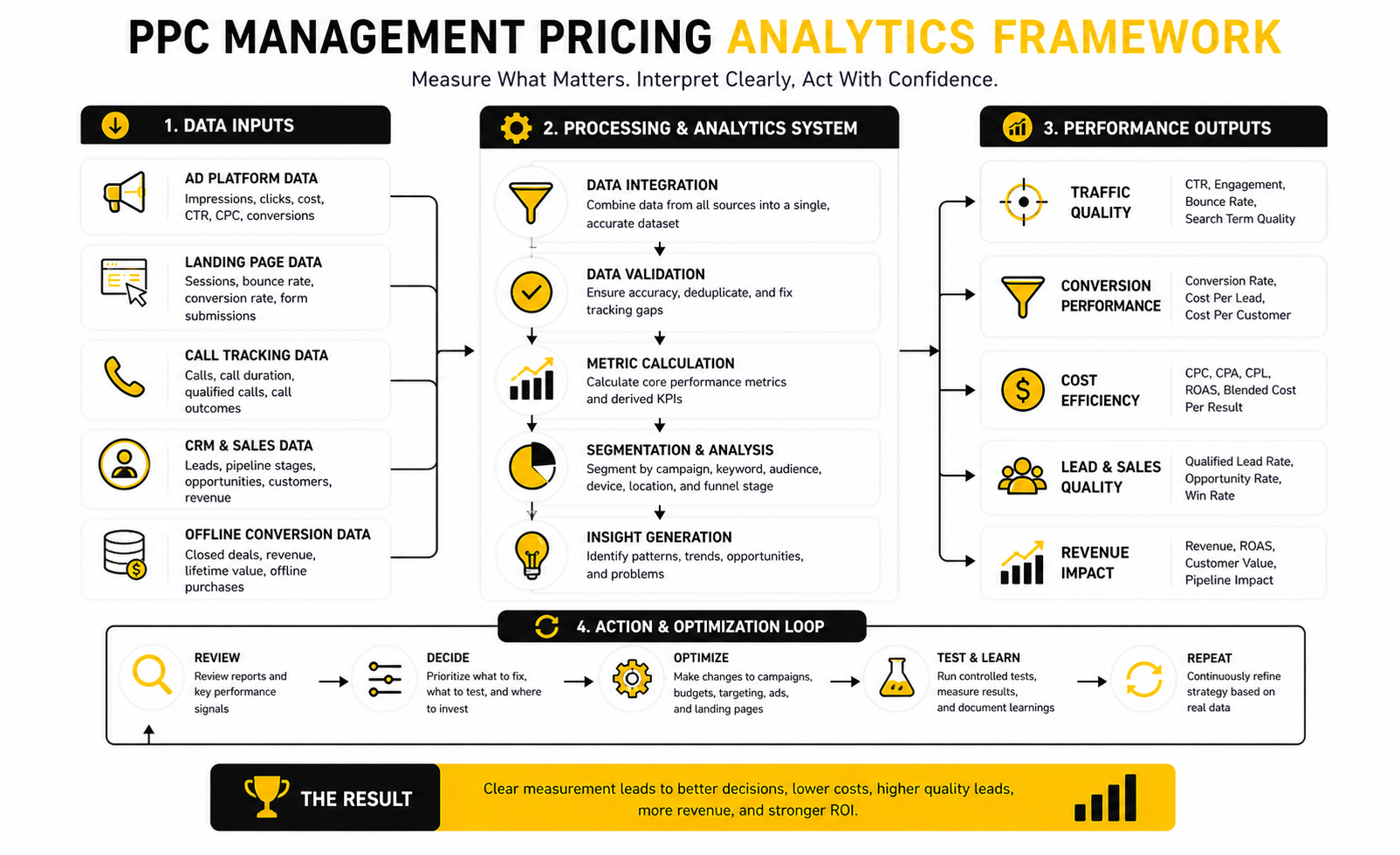
The most useful PPC metrics are the ones that connect spend to business outcomes. CPC tells you how expensive attention is, but it does not tell you whether the traffic is valuable. Conversion rate tells you whether the page and offer are working, but it can be misleading if the conversion action is too soft.
A practical PPC scorecard should include:
This is why ppc management pricing should never be judged only against ad spend. A manager who reduces wasted spend, improves lead quality, and identifies weak landing pages can be worth more than a cheaper provider who simply lowers CPC. Cheap clicks are not the prize. Profitable acquisition is the prize.
How To Read Benchmarks Without Fooling Yourself
Benchmarks are directionally useful, not absolute truth. Industry averages combine different offers, markets, brands, budgets, landing pages, sales teams, and campaign maturity levels. A startup entering a competitive market should not expect the same numbers as a known brand with years of conversion data.
Use benchmarks as a diagnostic tool. If your CPC is far above the market, inspect competition, match types, Quality Score, keyword intent, and bidding strategy. If your conversion rate is far below the market, inspect landing page match, offer clarity, form friction, page speed, and lead source quality.
Google’s own Quality Score system looks at expected click-through rate, ad relevance, and landing page experience. That matters because weak relevance can make you pay more for worse traffic. Better measurement and better structure are not cosmetic improvements; they influence the economics of the account.
What Good Reporting Should Explain
A useful PPC report should not just show charts. It should explain what changed, why it changed, what the account learned, and what action comes next. If a report does not lead to a decision, it is decoration.
The best reporting separates platform metrics from business metrics. Platform metrics show what happened inside Google Ads or Microsoft Ads. Business metrics show whether those clicks became qualified leads, booked calls, customers, revenue, or profit.
For lead generation, offline conversion tracking is especially important because many sales happen after the click, call, form fill, or appointment. Google’s offline conversion imports are designed to measure what happens after an ad interaction when the sale closes later, and enhanced conversions can improve measurement by using hashed first-party data. If the agency can connect ad clicks to real pipeline stages, ppc management pricing becomes much easier to evaluate.
The Data Signals That Should Trigger Action
Data should create movement. If search terms show irrelevant traffic, negative keywords and match type changes should follow. If one campaign spends heavily but produces weak leads, the budget should move toward stronger intent or stronger economics.
If conversion volume is low, the answer is not always to change bids. Sometimes the issue is that the offer is unclear, the page is slow, the market is too narrow, or the budget is too small for the learning period. A professional manager should know when to optimize the campaign and when to challenge the funnel.
The strongest PPC accounts build a feedback loop. Ads create clicks, clicks create leads or sales, sales data improves bidding and targeting, and landing page learnings improve conversion rate. When that loop is working, pricing becomes easier to justify because management is tied to decisions, not activity.
How To Evaluate Fair Pricing For Your Business
Fair ppc management pricing is not the lowest fee you can negotiate. It is the fee that makes sense against your ad spend, revenue model, account complexity, and internal capabilities. A small account with one offer and clean tracking should not pay enterprise-level pricing, but a business with multiple campaigns, locations, funnels, and sales stages should not expect serious management for a bargain-bin retainer.
The easiest way to judge pricing is to ask what the agency is responsible for improving. If they only manage keywords and bids, the scope is narrow. If they also help with tracking, conversion quality, landing page feedback, reporting, and strategic budget allocation, the value is much broader.
Match The Fee To The Risk
The more money you spend on ads, the more expensive mistakes become. A 10% waste problem on a tiny account may be annoying. The same waste problem on a serious monthly budget can become a major profit leak.
This is why larger accounts usually need stronger systems, not just more frequent check-ins. There should be clearer budget controls, cleaner campaign segmentation, better conversion tracking, and more disciplined reporting. When the downside risk is higher, paying for stronger management is usually rational.
The same logic applies to high-ticket lead generation. If one qualified lead can become a large contract, you do not want a manager optimizing for cheap form fills. You want someone who understands lead quality, sales feedback, and the full path from search term to closed revenue.
Know When Cheap Management Becomes Expensive
Cheap PPC management often looks attractive because the monthly fee is easy to understand. The hidden cost is harder to see. It shows up as irrelevant clicks, weak lead quality, poor tracking, missed follow-up, and months of slow learning.
The danger is not that a cheap provider charges less. The danger is that they may not have enough time, skill, or process to diagnose the real problem. PPC accounts do not improve just because someone logs in and changes a few settings.
If the agency cannot explain what they are testing, what they are learning, and how those learnings affect business outcomes, the price is not the main issue. The issue is control. You are funding activity without a clear operating system.
Understand The Scaling Tradeoff
Scaling PPC is not just increasing the budget. As spend rises, you usually move from the easiest conversions into more competitive, less efficient, or less familiar segments of the market. That means your cost per acquisition can rise even when the account is managed well.
A professional manager should help you separate healthy scaling friction from real performance decline. If cost per lead rises because you are expanding into broader keywords, that may be expected. If cost per lead rises because search terms are getting sloppy or landing pages are underperforming, that needs action.
This is where ppc management pricing should reflect strategic judgment. Scaling requires decisions about budget allocation, offer testing, remarketing, funnel quality, and sales feedback. It is not just a bigger spend number inside the ad platform.
Watch For Pricing Red Flags
Some pricing signals should make you slow down before signing. A low fee with a vague scope is risky because you may not know what is actually being managed. A high fee with no clear process is just as risky because expensive does not automatically mean strategic.
Watch closely for these red flags:
The biggest red flag is ownership. You should own your ad account, your data, your landing pages, and your conversion history. If an agency controls everything in a way that makes leaving painful, the management fee is only part of the real cost.
Build The Right Support Stack
PPC works best when the surrounding system is solid. That means fast landing pages, clear offers, accurate tracking, clean CRM stages, and timely follow-up. Without those pieces, even a skilled manager is forced to optimize around incomplete information.
For service businesses and agencies, GoHighLevel can be useful when the bottleneck is lead capture, pipeline visibility, appointment booking, or automated follow-up. For funnel-heavy offers, ClickFunnels or Systeme.io can help teams move faster with landing pages and offer testing.
The point is not to collect tools. The point is to remove friction between the click and the sale. Better management fees are easier to justify when the whole system gives the manager enough data and enough conversion paths to work with.
Professional Implementation And Buying Checklist
By this point, the pattern should be clear. PPC management pricing is not just a fee comparison. It is a decision about who controls your acquisition system, how well they measure results, and whether they can improve the economics of your paid traffic over time.
Before hiring anyone, slow the conversation down and ask for specifics. A serious PPC professional should be able to explain the process, the reporting rhythm, the tracking setup, the testing plan, and the commercial logic behind the fee. If the answer stays vague, the risk is too high.
Use this checklist before you commit:
The best agency relationship feels structured, not mysterious. You should know what is being tested, why it matters, and what decision the data supports. That is the difference between paying for PPC activity and paying for professional management.
How much does PPC management usually cost?
Most PPC management pricing falls into monthly retainers, percentage-of-spend fees, hourly consulting, or hybrid models. Many agencies commonly charge around 10% to 20% of monthly ad spend, while smaller retainers often start around the low four figures. The right number depends on account complexity, spend level, tracking needs, and how much strategic work is included.
Is percentage-of-ad-spend pricing fair?
It can be fair when the account genuinely becomes more complex as spend increases. The risk is that the agency earns more when you spend more, even if the extra spend is not profitable. That is why percentage pricing should be paired with clear performance targets, budget approval rules, and reporting tied to qualified leads, sales, or revenue.
Is a flat monthly retainer better?
A flat retainer is often easier to manage because the cost is predictable. It works well when the scope is clear and the agency has enough time to manage the account properly. The key is making sure the retainer covers real work, not just light monitoring and a monthly report.
What should be included in PPC management?
At minimum, PPC management should include campaign strategy, keyword and audience work, ad creation, conversion tracking review, negative keyword management, bid and budget optimization, search term analysis, and reporting. Stronger engagements may also include landing page feedback, CRM tracking, offline conversion setup, and funnel recommendations. The more business-critical the ad spend is, the more complete the management process should be.
Should PPC management include landing pages?
It should at least include landing page review. PPC performance depends heavily on what happens after the click, so ignoring landing pages creates a major blind spot. The agency does not always need to build the pages, but they should be able to identify friction, weak message match, poor offers, and conversion problems.
How do I know if I am overpaying for PPC management?
You may be overpaying if the agency cannot explain what they are doing, what they are learning, and how their work connects to business outcomes. A high fee can be justified when the account is complex and the process is strong. A high fee is hard to justify when reporting is shallow, tracking is weak, and recommendations are vague.
How do I know if I am underpaying?
You may be underpaying if the fee is too low for the amount of work the account actually needs. Complex accounts require time for analysis, tracking, testing, reporting, and strategic decision-making. If the budget is meaningful but the management fee only allows for surface-level attention, the cheap option can become expensive.
What is a good PPC management fee for a small business?
For a small business, a fair fee depends on whether the account is simple or operationally demanding. A basic local campaign may need a modest retainer, while a lead generation business with call tracking, multiple services, and CRM follow-up may need more support. The better question is whether the fee gives the manager enough time to protect the budget and improve lead quality.
Should I hire a freelancer or an agency?
A freelancer can be a good fit when you need direct expertise, flexible support, and a leaner cost structure. An agency can be better when you need a broader team, more coverage, creative support, reporting systems, and cross-channel execution. Choose based on the actual capability you need, not the label.
Are setup fees normal for PPC management?
Yes, setup fees are normal when the account needs serious initial work. Building campaigns, fixing tracking, auditing the funnel, configuring conversion actions, and cleaning account structure can take meaningful time. The fee should come with a clear setup scope so you know exactly what is being delivered.
How long does it take to judge PPC performance?
You can spot tracking errors and obvious waste quickly, but meaningful performance judgment usually needs enough conversion data to see patterns. Small budgets may take longer because data accumulates slowly. A good manager should explain what early signals matter, what needs more time, and what changes are being made based on the evidence.
What is the biggest mistake businesses make with PPC management pricing?
The biggest mistake is comparing fees without comparing scope. One provider may only manage campaigns inside the ad platform, while another may help improve tracking, landing pages, lead quality, and reporting. Those are not the same service, so they should not be judged as if they are.
Build a stronger local presence with BAAM AI
Turn your website, Google profile, social channels, and AI visibility into one growth engine
Most businesses do not need more random marketing activity. They need a consistent presence system that helps the right people find them, trust them, and take action. BAAM AI brings strategy, local SEO, website updates, Google Maps visibility, social content, AI-search readiness, media production, and reporting into one practical monthly engine.
If you want your marketing to keep working after the campaign ends, start with a free BAAM AI presence audit. See how your business shows up today and where the fastest visibility wins are at BAAM AI.