BAAM AI Blog
Popular Social Media Campaigns: A Practical Framework For Building Campaigns People Actually Share
Popular social media campaigns do not become popular because a brand posts more often, copies a trend faster, or adds a bigger giveaway. They work because the campaign gives people a clear reason to care, an easy way...
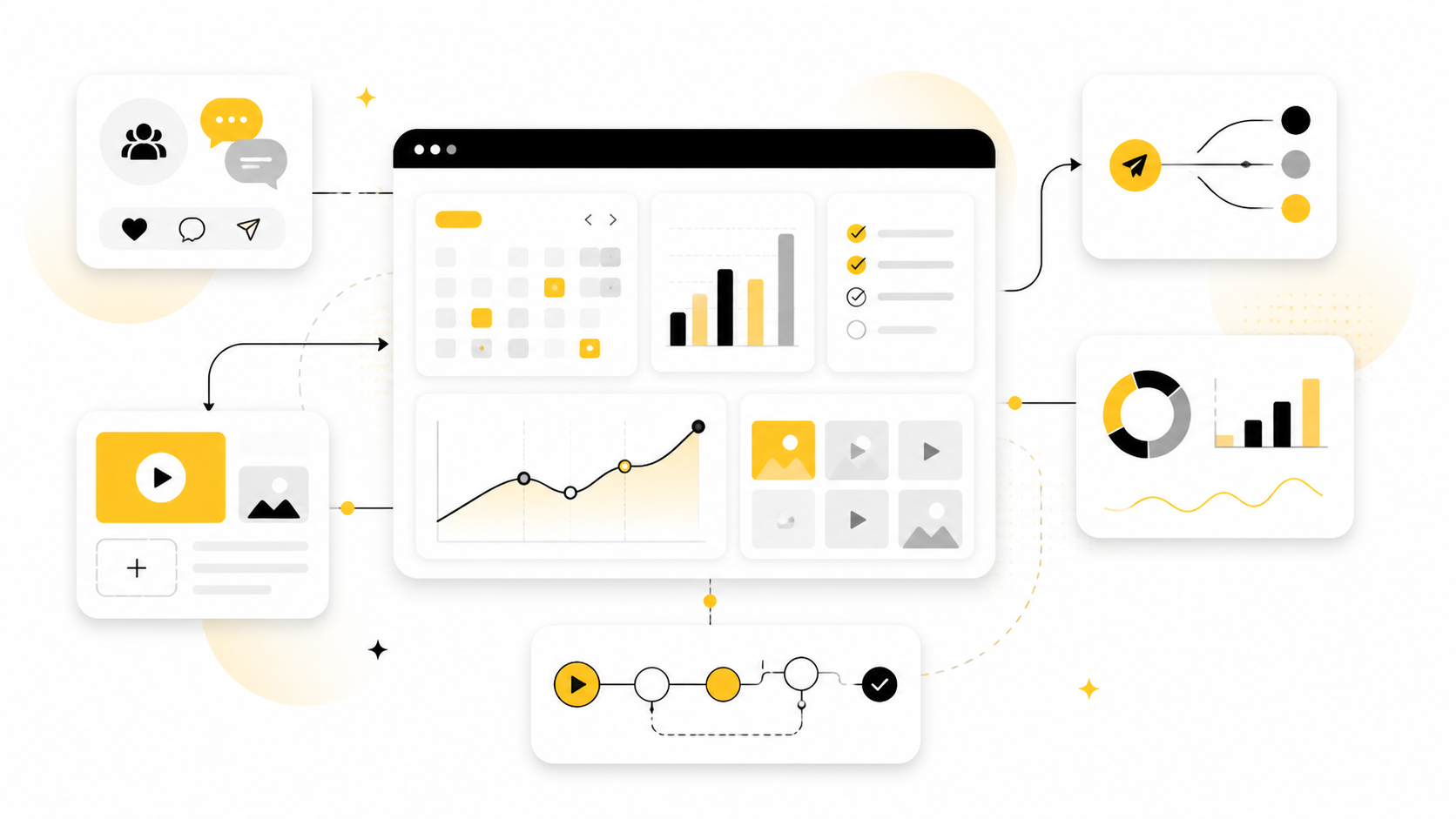
Popular social media campaigns do not become popular because a brand posts more often, copies a trend faster, or adds a bigger giveaway. They work because the campaign gives people a clear reason to care, an easy way to participate, and a social reward for spreading it. That is the difference between “content that gets published” and a campaign that actually moves through culture.
The stakes are high because social media is now too big, too fragmented, and too fast for weak campaign planning. Global social media user identities reached 5.24 billion at the start of 2025, equal to 63.9% of the world’s population, with 206 million more identities added over the previous year in the Digital 2025 global report. That scale sounds exciting, but it also means most campaigns disappear instantly unless the idea is built for a specific audience, platform behavior, and sharing mechanism.
Popular does not always mean massive, either. For a local service business, a popular campaign might mean 200 qualified comments from people in one city. For an ecommerce brand, it might mean creators making product-led videos without being asked twice. For a B2B company, it might mean becoming the reference point in a niche conversation before competitors even notice the shift.
this guide breaks down how popular social media campaigns are actually built, not just what they look like after they win. The goal is to move beyond vague advice like “be authentic” or “go viral” and replace it with a practical structure you can use for planning, creative direction, creator collaboration, distribution, and measurement.
Popular Social Media Campaigns And Why They Matter
Popular social media campaigns matter because attention is no longer won by media spend alone. Paid distribution can still help, but the strongest campaigns earn extra reach because people want to remix, react, save, send, debate, or participate. That matters because the social feed rewards signals from real behavior, not just brand intention.
The best campaigns also compress brand positioning into something people can instantly understand. A strong campaign does not ask the audience to study a product page before engaging. It gives them a simple emotional entry point, then lets the product, message, or brand role become obvious through the experience.
This is why campaign planning has to start with audience behavior, not with a posting calendar. People use social platforms for entertainment, connection, discovery, identity, learning, shopping, news, and community, often within the same session. DataReportal’s 2025 social media analysis shows that adults cite multiple primary reasons for using social platforms, while more than one in three active users say reading news stories is one of those reasons in the state of social media in 2025. A campaign that understands those motives has a much better chance than one that simply announces a message.
The Shift From Posting Content To Building Campaign Systems
A single post can perform well, but a campaign system creates repeated chances for the audience to engage. That system usually includes a central idea, a clear audience insight, multiple content formats, platform-specific adaptations, creator or community participation, and a measurement plan. Without those pieces, brands often mistake activity for momentum.
This matters even more because marketers are under pressure to prove that social media affects real business outcomes. The 2025 Sprout Social Index is based on surveys of more than 4,000 consumers and 1,200 marketers, and its framing is clear: social now sits close to the center of how brands understand customers, build relationships, and demonstrate impact in the 2025 Sprout Social Index. That does not mean every campaign needs to chase direct sales immediately, but it does mean the campaign should have a defined job.
The practical mistake is treating “popular” as a creative accident. In reality, popular social media campaigns usually combine a strong creative hook with a repeatable participation loop. The audience sees the idea, understands what role they can play, and gets something back from taking part, whether that is entertainment, status, belonging, usefulness, or self-expression.
Framework Overview: The Popular Campaign Loop
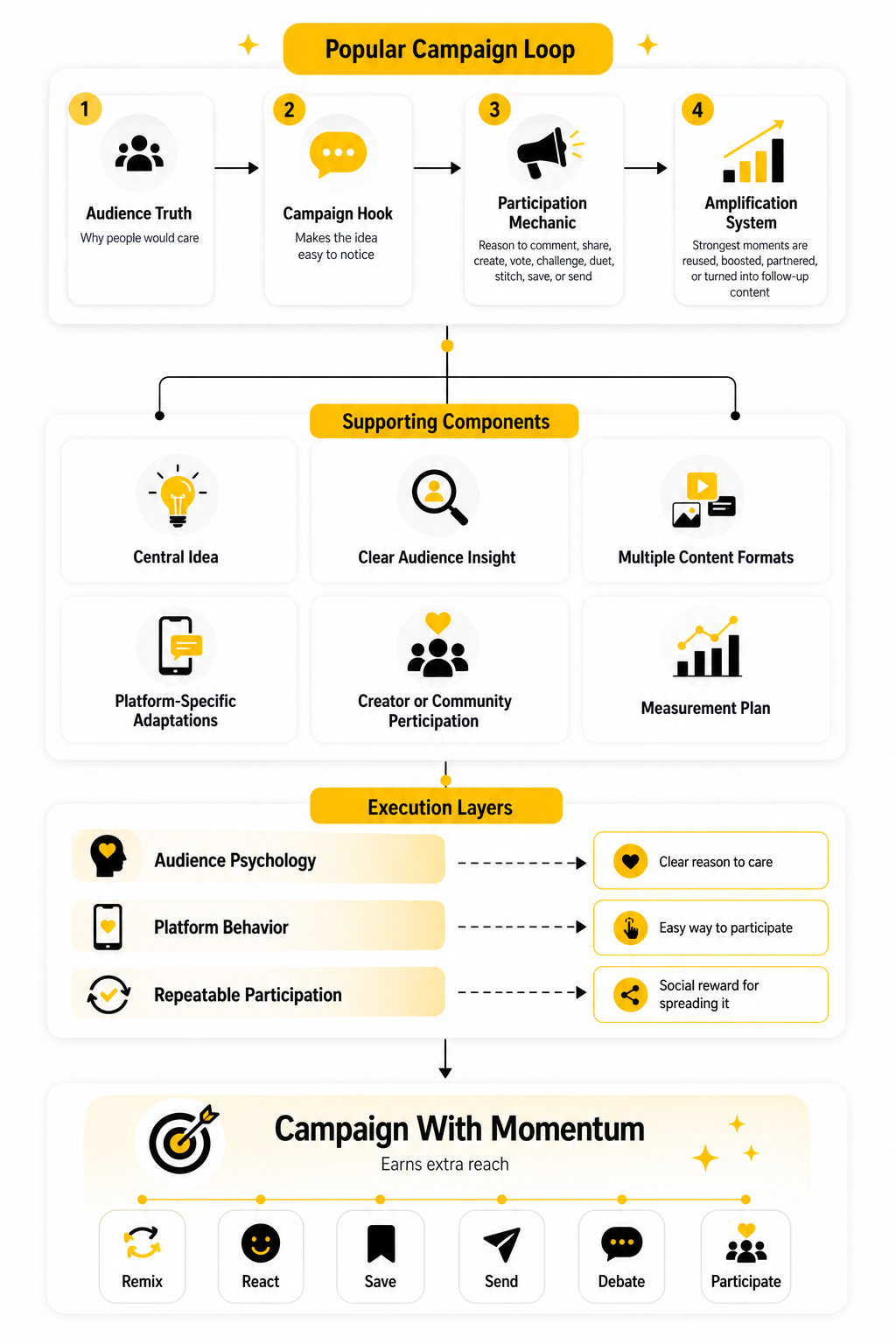
The simplest way to understand a popular campaign is to think in loops rather than posts. A campaign begins with a tension the audience already feels. Then it turns that tension into a creative idea people can recognize, react to, and pass along.
The loop has four parts: audience truth, campaign hook, participation mechanic, and amplification system. Audience truth explains why people would care. The campaign hook makes the idea easy to notice. The participation mechanic gives people a reason to comment, share, create, vote, challenge, duet, stitch, save, or send. The amplification system makes sure the strongest moments are reused, boosted, partnered, or turned into follow-up content.
This framework fits how platforms are evolving. TikTok’s 2025 trend report emphasizes brand participation in community culture, creative bravery, and audience co-creation in the What’s Next 2025 report. YouTube’s 2025 trend coverage also points toward fandom, creator ecosystems, and online franchises as major forces shaping attention in the YouTube Culture and Trends report. The common thread is simple: campaigns spread when people feel like they are part of the moment, not just watching an ad.
Part 1 sets the foundation: popular social media campaigns are not just creative bursts, viral accidents, or trend reactions. They are structured systems built around audience psychology, platform behavior, and repeatable participation. When those pieces line up, social content stops feeling like isolated posts and starts acting like a campaign with momentum.
The next parts will go deeper into the framework, then unpack the core components that make campaigns easier to share. After that, the article will move into platform strategy, professional execution, measurement, and the mistakes that usually kill campaigns before they have a fair chance. The goal is not to make social media feel more complicated, but to make campaign planning more deliberate.
The important shift is this: do not start by asking, “What should we post?” Start by asking, “What would make the right people want to take part?” That one question changes the quality of the entire campaign.
The Campaign Framework That Makes Sharing More Likely
A campaign becomes easier to share when it is built around a clear loop. Someone sees the idea, understands it quickly, feels something about it, and knows what to do next. That sounds simple, but most brands skip one of those steps and then wonder why the campaign never leaves their own account.
Popular social media campaigns usually work because the audience is not treated like a passive viewer. The audience gets a role. They can judge, copy, remix, vote, challenge, answer, reveal, compare, celebrate, complain, or contribute something of their own.
That is the practical difference between a content calendar and a campaign framework. A calendar organizes publishing. A framework organizes behavior.
Start With The Audience Tension
The strongest campaign ideas usually begin with a tension the audience already recognizes. That tension might be frustration, aspiration, confusion, pride, insecurity, curiosity, nostalgia, or a shared joke. When the campaign names something people already feel, the audience does less work to understand why the message matters.
This is why generic campaign goals like “increase awareness” are not enough. Awareness of what, for whom, and why now? A better starting point is to ask what the audience is already thinking but may not have said out loud yet.
For example, a productivity app should not begin with “we need a campaign about our new dashboard.” It should begin with the real human tension: people feel busy all day but still worry they are not making meaningful progress. That tension can lead to sharper creative than a feature announcement ever could.
A useful audience tension usually has three qualities:
This matters because attention is not just scarce; it is defensive. People scroll past anything that looks like work, noise, or another brand trying to extract engagement. But when a campaign reflects something true, people pause because it feels relevant before it feels promotional.
Turn The Tension Into A Simple Campaign Hook
Once the tension is clear, the next job is to turn it into a campaign hook. The hook is the simplest expression of the idea. It is the line, format, challenge, question, contrast, or creative device that makes the campaign easy to understand in seconds.
A good hook does not explain everything. It creates instant entry. People should be able to understand the premise before they read a long caption, watch a full video, or click through to a landing page.
This is where many campaigns get too clever. The internal strategy may be complex, but the public-facing idea should feel clean. If the audience needs a meeting deck to understand the campaign, the hook is not ready.
Strong campaign hooks often use one of these patterns:
The hook should also match the platform. A TikTok hook often needs movement, sound, pace, and a visible premise. A LinkedIn hook may work better as a sharp professional observation or useful framework. An Instagram campaign might depend more on visual identity, creator participation, and shareable design.
The point is not to chase every platform trend. The point is to make the idea native enough that people do not feel like they are watching a brand force itself into the feed. TikTok’s 2025 trend report describes the shift as brands working with creators and communities instead of simply telling consumers what they need in the What’s Next 2025 Trend Report. That is exactly the mindset a strong hook needs.
Build A Participation Mechanic
The participation mechanic is the part of the campaign that tells people how to get involved. This is where popular social media campaigns either start spreading or stay trapped inside brand-owned posts. If participation is unclear, too hard, or socially unrewarding, most people will not bother.
Participation does not always mean user-generated content. It can be as simple as commenting with an opinion, sharing a post with a friend, saving a checklist, voting in a poll, using a branded filter, submitting a question, joining a live event, or responding to a creator prompt. The key is that the action must feel natural for the audience and the platform.
A good participation mechanic lowers friction. People should not need special equipment, a long explanation, or a high level of confidence to take part. The easier the action is to copy, the more likely the campaign is to create momentum beyond the original post.
The best mechanics usually answer four questions:
That fourth question matters more than brands think. When people see that participation leads to recognition, visibility, usefulness, or community reaction, the campaign starts to feel alive. Without that feedback loop, participation feels like unpaid labor.
Design For Platform Behavior, Not Just Brand Messaging
Every platform has its own behavior pattern. People do not use YouTube, TikTok, Instagram, LinkedIn, Reddit, Pinterest, and X in the same mental state. A campaign that ignores that will feel mismatched even if the core idea is strong.
On YouTube, popular campaign thinking often benefits from deeper narrative, creator partnerships, fandom behavior, and searchable long-form value. YouTube’s 2025 culture reporting highlights how creator ecosystems, fandoms, and online formats continue to shape what people follow and discuss in the Global Culture and Trends Report. That does not mean every brand needs a documentary-style campaign, but it does mean YouTube rewards more than quick interruption.
On TikTok, the campaign needs to respect speed, participation, remix culture, and community language. On Instagram, visual identity, creator credibility, comments, Reels, Stories, and shareable assets often carry more weight. On LinkedIn, a strong campaign usually needs professional relevance, a sharp point of view, and something people feel comfortable sharing in front of colleagues.
This is why one campaign idea should become multiple platform-native expressions. The central idea stays consistent, but the execution changes. The mistake is copying and pasting the exact same asset everywhere, then blaming the platform when performance is weak.
Create An Amplification System Before Launch
Amplification should not be an afterthought. If the campaign starts to work, the team needs to know what happens next. Which comments get answered? Which creator posts get boosted? Which user submissions get featured? Which assets get turned into follow-up content?
This is where campaign planning becomes operational. A strong campaign has a response plan, not just a launch plan. The brand should be ready to extend the moments that show traction instead of treating the original post as the finish line.
An amplification system can include:
For brands that want to capture demand from social campaigns, the follow-up path matters. A campaign can create attention, but attention leaks quickly when there is no next step. Tools like ManyChat can make sense when the campaign uses comments, DMs, quizzes, or automated follow-up flows, while platforms like GoHighLevel can fit teams that need social leads to move into pipelines, nurture sequences, booking flows, or sales conversations.
The key is to connect the campaign mechanic to the business outcome without making the public experience feel heavy. People should feel like they are joining something useful or interesting, not being pushed into a funnel too early. The funnel can exist, but the campaign experience still has to earn the click.
Define The Campaign Job Before Measuring Results
Not every campaign should be judged by the same metric. Some campaigns are built for reach. Some are built for participation. Some are built for leads, product education, creator content, community growth, repositioning, sales support, or reputation repair.
The problem starts when teams use one vague scorecard for every campaign. A campaign designed to create conversation may not produce immediate conversions. A campaign designed to drive demo bookings may not generate massive public engagement. Both can be successful if the job was defined properly before launch.
The 2025 Sprout Social Index is based on surveys of more than 4,000 consumers and 1,200 marketers, and it frames social as a business function that now has to prove impact, not just activity, in the 2025 Sprout Social Index. That is the right standard. The campaign should be creative, but the measurement should be disciplined.
A practical campaign scorecard should include one primary goal and a small number of supporting indicators. If everything is the goal, nothing is the goal. The team needs a clear answer to this question: what result would make this campaign worth repeating, scaling, or adapting?
Make The Loop Easy To Repeat
The best campaign framework is not just useful once. It gives the brand a repeatable way to create, test, and improve campaign ideas over time. That matters because one successful campaign is good, but a repeatable campaign system becomes a competitive advantage.
A simple version of the loop looks like this:
This is how popular social media campaigns become less mysterious. You still need taste, timing, creativity, and execution. But you are no longer relying on hope.
The next step is to break down the core components inside the campaign itself. That means looking at the message, offer, creative format, audience role, creator fit, distribution plan, and conversion path. Those pieces decide whether the framework stays theoretical or turns into a campaign people actually want to share.
Core Components Of Popular Social Media Campaigns
The framework only becomes useful when it turns into decisions. A campaign team still has to decide what the campaign says, who it is for, what people should do, which assets need to be produced, where the attention should go, and how the brand will respond once the campaign is live. This is the point where vague creative ambition has to become a working process.
Popular social media campaigns are not built from one magic post. They are built from connected components that make the campaign easier to understand, easier to join, and easier to extend. If one component is weak, the whole campaign can still struggle even when the creative looks polished.
The safest way to implement the framework is to treat the campaign like a system with seven working parts: audience, message, creative format, participation, distribution, conversion, and feedback. Each part should support the same campaign job. If the job is awareness, the system should make the idea spread. If the job is lead generation, the system should make the next step obvious. If the job is community growth, the system should make people feel like staying involved is worth it.
Define The Audience Before Defining The Idea
The first implementation step is audience definition. Not a generic demographic paragraph. A real definition of the people who should care, the situation they are in, and the reason this campaign matters to them now.
This should include what the audience already believes, what they are tired of hearing, what they secretly want, and what would make them feel smart for sharing the campaign. That last point is important. People do not share brand content just because the brand wants reach. They share content when it says something useful, funny, impressive, emotional, or identity-building on their behalf.
A practical audience brief should answer these questions:
This audience work should be based on evidence, not internal guesses. Social comments, customer interviews, sales calls, support tickets, creator feedback, community threads, search data, and competitor engagement patterns can all reveal sharper campaign angles. The best campaign ideas often come from language the audience is already using.
Build The Message Around One Clear Promise
A campaign message should not try to say everything. The more messages you add, the harder the campaign becomes to remember. One strong promise is more useful than five weak talking points.
The promise does not have to be a direct product claim. It can be emotional, practical, cultural, educational, or status-driven. The key is that the audience can understand the value of paying attention.
For example, a campaign could promise:
The message should also match the campaign’s level of proof. If the campaign makes a performance claim, the brand needs evidence. If it makes a cultural claim, the brand needs credibility. If it asks the audience to participate, the brand needs to show why participation benefits them, not just the company.
Choose The Creative Format That Carries The Idea
Creative format is not decoration. It is the container that carries the campaign through the feed. A great idea can underperform when it is forced into the wrong format, and an average idea can look stronger when the format matches how people already consume and share content.
This is why execution has to be platform-aware. Short-form video may be ideal for a challenge, reaction, transformation, or behind-the-scenes campaign. Carousel posts may be better for frameworks, checklists, lessons, and opinion-led content. Long-form video can support deeper storytelling, product education, creator-led proof, and episodic campaigns.
The rise of creator-led formats makes this even more important. WPP Media projected that creator content would overtake traditional media in ad revenue in 2025, with creator-generated revenue expected to grow sharply through 2030 in coverage of the creator advertising shift. That does not mean every brand should hand the entire campaign to influencers. It means the campaign format has to respect the way people now discover, trust, and evaluate ideas through creators.
The format should be selected after the campaign promise is clear. Do not start with “we need Reels.” Start with “what is the most natural way for this idea to be understood, copied, discussed, and acted on?” That question leads to better creative decisions.
Map The Execution Process Before Production Starts
This is where the campaign becomes tangible. Before anyone starts editing videos, writing captions, or briefing creators, the team needs a simple execution map. The map turns the campaign idea into a workflow people can actually follow.
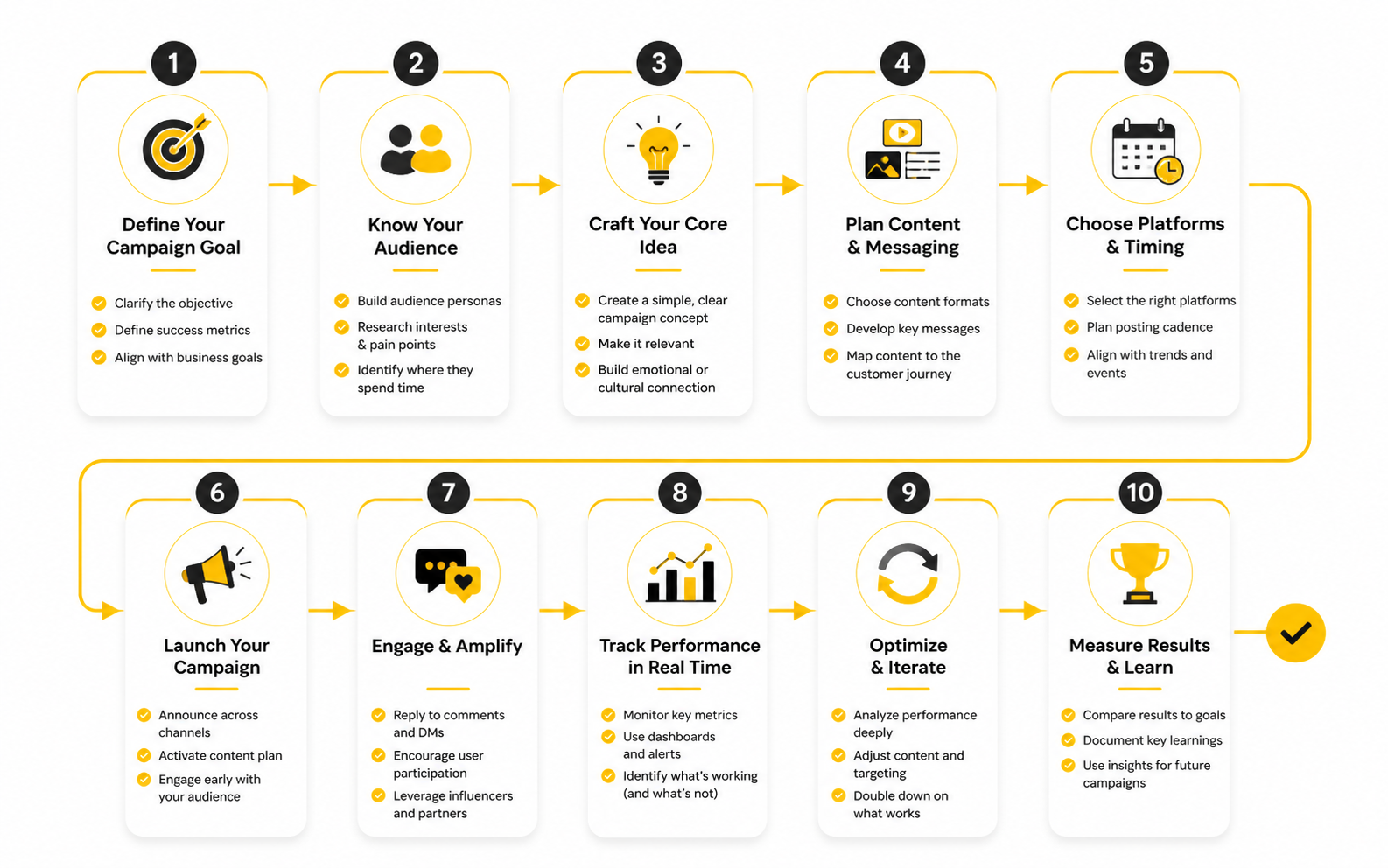
A practical process for popular social media campaigns looks like this:
This process prevents the most common campaign problem: producing assets before the campaign is strategically ready. It also makes team collaboration easier because everyone can see how their work connects to the same goal. Creative, media, social, sales, support, and leadership should not be operating from five different assumptions.
The execution map does not need to be complicated. In fact, it should be simple enough that the team can review it quickly before launch. The value comes from forcing the right decisions early.
Create A Content System, Not Just Campaign Assets
Once the execution map is clear, the next step is building the campaign content system. That system should include launch assets, supporting assets, participation prompts, creator assets, response assets, and follow-up assets. The goal is to avoid treating the campaign like one big reveal with nothing behind it.
Launch assets introduce the campaign. Supporting assets explain, dramatize, or reinforce the idea. Participation prompts tell the audience what to do next. Creator assets bring outside credibility and platform-native energy. Response assets help the brand react quickly when people engage. Follow-up assets keep the campaign moving after the first wave.
For a practical campaign, the content system might include:
This is also where production discipline matters. The campaign needs enough assets to create momentum, but not so many that quality collapses. A lean campaign with sharp assets usually beats a bloated campaign that no one can manage properly.
Connect The Campaign To A Real Next Step
Attention is valuable, but it is not the finish line. If the campaign creates interest, the audience needs somewhere useful to go. That next step could be a product page, waitlist, quiz, booking page, community, email list, live event, resource download, or sales conversation.
The next step should match the audience’s level of intent. Someone who comments on a funny awareness post may not be ready for a demo. Someone who watches a product comparison video might be much closer. The campaign should respect that difference.
This is where the right tools can support the process without taking over the strategy. A brand running comment-based campaigns or DM flows might use ManyChat to automate follow-up without making the experience feel clunky. A service business, agency, or local brand that needs leads to move into booking, pipeline, and nurture workflows might use GoHighLevel to keep campaign demand from getting lost.
For ecommerce campaigns, the next step may need a stronger landing page or product experience. If the campaign drives traffic to a page that feels disconnected from the creative, conversions will suffer. Tools like Replo can be useful when a brand needs campaign-specific landing pages that feel aligned with the creative concept instead of sending every visitor to a generic product page.
Prepare The Team For Live Campaign Management
A campaign is not finished when it goes live. That is when the real feedback starts. Comments, creator posts, saves, shares, objections, questions, complaints, and unexpected reactions can all reveal what the audience actually cares about.
The team should know who monitors the campaign, who approves responses, who handles sensitive issues, who identifies high-performing posts, and who decides when to boost or adapt an asset. Without those responsibilities, opportunities get missed. Worse, the campaign can create attention that the brand is not ready to handle.
Live management should focus on three things: listening, responding, and extending. Listening shows what message is landing. Responding keeps the campaign human. Extending turns strong reactions into new content, new angles, or better distribution.
This is especially important because audiences can detect lazy engagement quickly. Copy-pasted replies, delayed responses, and obvious automation can weaken trust. Automation can help with scale, but the campaign still needs human judgment.
Use Feedback To Improve The Campaign While It Is Running
Popular social media campaigns rarely unfold exactly as planned. The audience may respond more strongly to one angle than another. A creator may explain the idea better than the brand did. A comment may reveal a sharper follow-up post than the original content calendar.
That is not a problem. That is the campaign giving you information.
The team should review early signals daily during the active campaign window. This does not mean panicking over every post. It means looking for patterns in watch time, saves, shares, comments, click quality, creator performance, sentiment, and repeated questions.
Useful feedback questions include:
This is how implementation stays practical. The plan gives the campaign structure, but feedback gives it direction. The brands that win are usually not the ones that predict everything perfectly. They are the ones that learn faster while the campaign is still alive.
Keep The Process Simple Enough To Repeat
The final implementation principle is repeatability. A campaign process should make the next campaign easier, not leave the team exhausted and confused. If the process only works when one person holds everything in their head, it is not a real system yet.
After each campaign, the team should save the brief, winning hooks, best-performing assets, creator notes, audience insights, measurement results, and lessons learned. This turns campaign execution into an internal advantage. Over time, the brand builds a library of what actually works for its audience instead of starting from zero every month.
That is how popular social media campaigns become less random. You still need strong ideas, timing, platform awareness, and creative taste. But with a clear process, the team has a better way to turn those ingredients into campaigns that people can understand, join, and share.
Statistics And Data
Measurement is where popular social media campaigns become easier to improve. Without data, the team is guessing which hook worked, which audience cared, which platform carried the idea, and whether the campaign created business value. With the right data, the campaign becomes a learning system instead of a one-time creative bet.
The trap is treating every number like it has the same meaning. Reach, impressions, views, saves, comments, shares, clicks, leads, purchases, and sentiment all answer different questions. A campaign can get huge reach and still fail commercially, while a smaller campaign can be extremely valuable if it attracts the right people and moves them closer to action.
Good measurement starts by asking what the campaign was supposed to do. If the campaign’s job was awareness, you look for reach quality, video retention, share rate, branded search lift, follower growth, and repeat exposure. If the job was demand generation, you care more about clicks, landing page conversion, qualified leads, booked calls, pipeline, and assisted revenue.
Why Campaign Benchmarks Are Useful But Dangerous
Benchmarks are useful because they tell you whether your campaign is operating in a realistic range. They help you spot underperformance, defend strong results, and avoid judging every post by gut feeling. But benchmarks become dangerous when teams use them as universal rules.
A benchmark is not a strategy. A brand with a small but loyal niche audience may have a higher engagement rate than a large mainstream account. A campaign built for reach may naturally have lower conversion intent than a campaign built for warm retargeting. A campaign on TikTok should not be judged the same way as a LinkedIn thought leadership campaign.
This is why you should use three benchmark layers:
That order matters. Your own trend line is usually more actionable than a generic average. If your share rate doubles compared with your last three campaigns, that is meaningful even if an industry report says another sector performs differently.
What The Current Social Data Actually Means
The social environment is not getting simpler. People are using several platforms, but they are also becoming more selective with attention. That means popular social media campaigns need sharper ideas, not just more content.
Global social users now move across an average of 6.83 platforms per month, while the typical internet user spends 2 hours and 21 minutes per day on social media in the Digital 2025 social media report. The action point is simple: do not assume one channel tells the whole story. A campaign may be discovered on TikTok, researched on YouTube, discussed on Reddit, and converted through email or search.
The same report shows that 50% of adult social media users visit social platforms to learn more about brands and see the content brands publish in the Digital 2025 brand discovery data. That matters because social is not only an entertainment channel. It is also a research environment, a trust-building layer, and a place where people decide whether a brand feels relevant.
There is also a measurement warning here. DataReportal reports that daily social media time has fallen compared with two years earlier in the Digital 2025 usage analysis. So if your campaign gets attention, treat that attention as earned. People are still active, but weaker content has less room to hide.
The Metrics That Matter At Each Campaign Stage
Popular social media campaigns should be measured in stages because the audience does not move from first view to purchase in one clean jump. They notice the campaign first. Then they engage, investigate, participate, and maybe convert. Each stage needs different performance signals.
At the awareness stage, the most useful metrics are reach, impressions, video views, watch time, completion rate, audience growth, and share of voice. These numbers show whether the campaign is being seen and whether the creative earns enough attention to keep people from scrolling. They do not prove revenue by themselves, but they show whether the campaign has enough surface area to create momentum.
At the engagement stage, look at saves, shares, comments, replies, profile visits, creator mentions, and sentiment. Shares usually signal that the content says something people want others to see. Saves often signal practical value. Comments show emotional, social, or intellectual friction, but they need context because not all comments are positive.
At the conversion stage, track click-through rate, landing page conversion rate, lead quality, booked calls, purchases, customer acquisition cost, pipeline created, and assisted revenue. This is where campaign measurement needs to connect social data with web analytics, CRM data, and sales outcomes. Otherwise, the team only sees the top of the funnel.
Build A Measurement System Before Launch
A measurement system should be designed before the campaign goes live. If you wait until the end, you will usually discover that links were not tagged properly, landing pages were not separated, creator posts were not tracked, or the CRM cannot tell which leads came from the campaign. That is painful and avoidable.
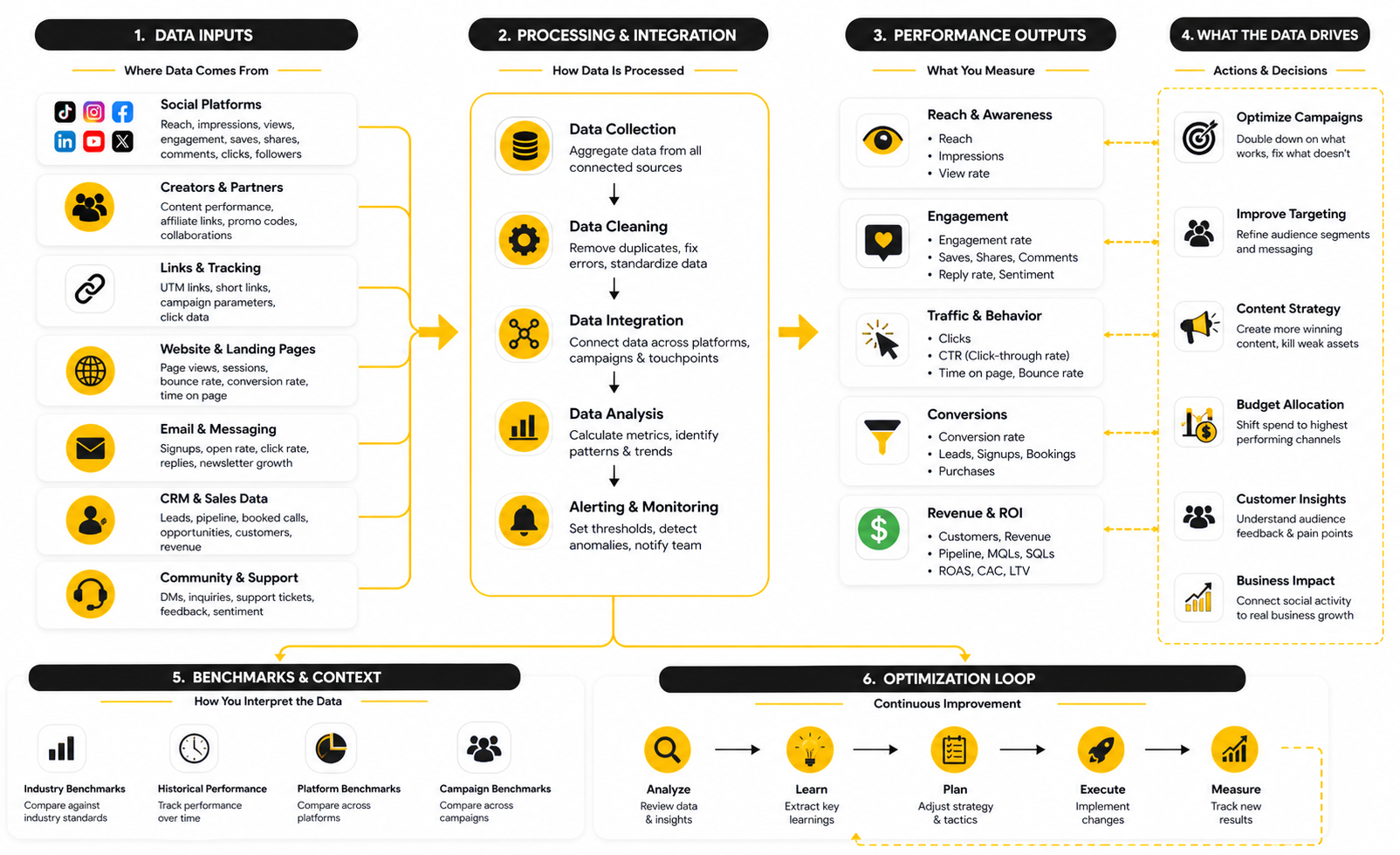
A simple campaign analytics system should include:
This system does not need to be complicated. It needs to be consistent. The goal is to make decisions faster while the campaign is still alive.
For teams running campaigns across multiple channels, a scheduling and reporting tool like Buffer can help organize publishing and performance review. The tool is not the strategy, though. It is only useful when the campaign already has a clear measurement plan.
How To Interpret Reach, Impressions, And Views
Reach tells you how many unique people saw the content. Impressions tell you how many times the content was displayed. Views tell you that a video crossed a platform-defined viewing threshold, which can vary by platform and format.
These are top-of-funnel signals. They matter because popular social media campaigns need enough exposure to create cultural or commercial movement. But they can mislead you if you treat them as proof of quality.
High reach with weak engagement usually means the campaign was shown to people but did not create enough reason to respond. High impressions with low reach can mean the same people saw the content repeatedly, which may be useful for recall but weak for expansion. High views with poor retention can mean the opening frame worked, but the actual content failed to hold attention.
The action is not “get more reach” by default. The action depends on the pattern. If reach is low but engagement is strong, distribution may be the problem. If reach is high but action is weak, the creative or audience match may be the problem.
How To Interpret Engagement Quality
Engagement is not one metric. A like, comment, save, share, stitch, duet, reply, repost, and direct message all show different levels of audience behavior. Treating them equally makes campaign analysis sloppy.
A like is usually a light signal. It can show approval, but it rarely proves deep interest. A save suggests the content has future value. A share suggests the content carries social value. A comment can show strong interest, but the quality of the comment matters more than the count.
For popular social media campaigns, shares and saves often tell you more than raw likes. A campaign that earns saves may be useful. A campaign that earns shares may be socially contagious. A campaign that earns detailed comments may have touched a real belief, objection, or desire.
This is where qualitative analysis matters. Read the comments. Look at the language people use. Identify repeated phrases, objections, jokes, questions, and unexpected interpretations. The audience will often tell you what the next campaign angle should be.
How To Interpret Clicks, Leads, And Revenue
Clicks are not always intent. Some people click because they are curious, some because the creative overpromised, and some because they are ready to buy. This is why click volume alone is not enough.
A good campaign review looks at the quality of traffic after the click. Did visitors stay on the page? Did they scroll? Did they opt in, book, buy, or return later? Did the campaign attract the right segment or just a large amount of low-fit traffic?
Social ROI is also hard because attribution is messy. Sprout’s 2025 ROI analysis notes that leaders want clearer business connections from social, while many teams still struggle to connect social metrics with revenue outcomes in the social media ROI statistics for 2025. The practical takeaway is not to pretend attribution is perfect. The takeaway is to improve the tracking system enough that decisions become better over time.
For service businesses and agencies, this usually means connecting campaign engagement to pipeline stages. For ecommerce brands, it means separating first-click, last-click, retargeting, and returning customer behavior. For B2B brands, it often means tracking assisted influence, not just immediate form fills.
How To Read Creator And Influencer Campaign Data
Creator data needs its own interpretation because creator posts behave differently from brand posts. A creator may generate fewer clicks but stronger trust. Another may create high reach but weak brand recall. A third may create a smaller audience response but produce content the brand can reuse across paid and owned channels.
Creator campaigns should be measured on fit, content quality, audience relevance, engagement quality, cost efficiency, and downstream behavior. Follower count alone is a weak selection metric. A creator with a smaller but more aligned audience can outperform a larger creator who attracts passive attention.
The creator economy is also becoming a serious media channel. U.S. creator economy ad spend was projected to reach $37 billion in 2025, up from $29.5 billion in 2024, in reporting on IAB’s creator economy research by Business Insider. That number matters because creator measurement can no longer be treated like a side project. If creator partnerships are part of the campaign, they need proper tracking, briefs, usage rights, and post-campaign analysis.
The best creator reporting compares performance by angle, format, audience, and stage of funnel. Do not only ask which creator “won.” Ask which message traveled best, which creative style felt most natural, and which creator audience produced the most useful next-step behavior.
Turn Campaign Data Into Decisions
Data is only valuable when it changes what you do next. A dashboard full of numbers is not strategy. A clear decision from the data is strategy.
During the campaign, data should drive fast decisions like:
After the campaign, data should drive bigger decisions. The team should identify what to repeat, what to stop, what to test next, and what audience insight should influence future campaigns. This is how every campaign becomes an input for the next one.
The strongest teams do not use analytics to punish creative work. They use analytics to sharpen it. That mindset matters because popular social media campaigns need both taste and evidence.
A Practical Campaign Scorecard
A practical scorecard keeps the team focused. It should be short enough that people actually use it, but complete enough to show how the campaign performed across the full journey. The best scorecards combine numbers with interpretation.
Use a scorecard like this:
This scorecard keeps measurement connected to action. It prevents the team from celebrating vanity metrics when the business result was weak. It also prevents leadership from dismissing strong upper-funnel campaigns just because the revenue did not appear instantly.
Popular social media campaigns are built creatively, but they are improved analytically. The numbers should not replace human judgment. They should make judgment sharper.
Professional Implementation For Brands, Agencies, And Teams
Once the campaign framework, execution process, and measurement system are in place, the harder question becomes scale. It is one thing to create one strong campaign with a small team and a clear idea. It is another thing to run popular social media campaigns repeatedly without burning out the team, diluting the brand, or chasing every trend until the strategy becomes unrecognizable.
Professional implementation is about making better tradeoffs. Not every campaign needs creators. Not every campaign needs paid amplification. Not every campaign needs a massive production budget. But every serious campaign needs clear ownership, smart risk controls, a strong creative standard, and a plan for what happens if the campaign actually works.
This is where social media starts to look less like posting and more like campaign operations. The creative idea still matters, but the system around it decides whether the idea gets protected, distributed, measured, and improved. Without that system, even good ideas can collapse under approval delays, unclear roles, weak landing pages, poor tracking, or nervous decision-making.
Choose The Right Campaign Model
Not all campaigns should be built the same way. A brand awareness campaign, creator partnership campaign, product launch campaign, lead generation campaign, community campaign, and social commerce campaign all need different planning. The mistake is using one generic playbook for every goal.
A brand awareness campaign should prioritize reach quality, memory, emotional clarity, and shareability. A lead generation campaign should prioritize relevance, intent, landing page alignment, and follow-up speed. A community campaign should prioritize participation, recognition, recurring conversation, and trust.
The campaign model should be chosen before the creative work begins. Otherwise, the team can accidentally build a campaign that is entertaining but commercially weak, or commercially aggressive but socially uninteresting. Both problems are common, and both are avoidable.
A simple way to choose the model is to ask what the audience should do after seeing the campaign:
One campaign can support more than one action, but it should not depend on all of them. The more actions you require, the more friction you create. Popular social media campaigns usually work because the first action feels easy.
Balance Creative Freedom With Brand Control
The more social-native a campaign becomes, the less it can feel like a traditional brand asset. That creates tension. Legal teams want control. Brand teams want consistency. Creators want freedom. The audience wants something that does not feel overproduced or over-approved.
That tension is normal. The answer is not to remove control completely. The answer is to control the right things.
A strong campaign brief should protect the non-negotiables: product truth, legal claims, disclosure requirements, audience boundaries, brand tone, and unsafe topics. It should give flexibility around hooks, delivery style, pacing, references, and creator expression. If the brief controls every word, the creator’s value disappears.
This tradeoff matters because creator-led content keeps becoming more central to social strategy. The creator economy has moved from experimental budget to mainstream media planning, with U.S. creator economy ad spend projected at $37 billion in 2025 in coverage of IAB research by Business Insider. As the channel matures, brands need creator systems that support both performance and authenticity.
The practical rule is simple: control the claim, not the personality. If the product promise, disclosure, and audience fit are right, the creator should have enough room to make the content feel native. That is where trust comes from.
Manage Brand Safety Before The Campaign Is Live
Brand safety is not something to discuss after a campaign goes wrong. It should be part of the planning process. The more visible the campaign becomes, the more likely it is to attract criticism, bad-faith comments, misinterpretation, or unexpected association with sensitive topics.
This does not mean every campaign should be bland. Bland campaigns are usually safe because nobody notices them. The goal is to be bold with awareness, not reckless with risk.
Before launch, the team should review:
Influencer and creator campaigns need extra care. The FTC’s business guidance on endorsements, influencers, and reviews makes clear that material connections between advertisers and endorsers need to be disclosed clearly. That is not just a legal issue. It is a trust issue.
The best teams make compliance easy for creators. They give examples of acceptable disclosures, explain what claims can and cannot be made, and avoid burying important requirements in a long document nobody reads. Clear rules protect the brand, the creator, and the audience.
Decide When To Use Paid Amplification
Paid amplification can help a strong campaign move faster, but it cannot rescue a weak idea. This is one of the biggest strategic tradeoffs in social media. Spend can increase exposure, but it cannot manufacture genuine interest at scale for long.
A useful paid strategy starts after the organic signals show what deserves more distribution. If a post gets strong saves, shares, retention, comments, or qualified clicks, it may be a good candidate for boosting. If the content is flat organically, paid media should not automatically be the next move.
Paid amplification works best when it has a clear role:
The danger is spending too early on the wrong asset. When teams boost before learning, they scale assumptions instead of evidence. A more carefully approach is to let the first wave of content reveal which angle deserves money.
This also protects creative quality. When the team knows that only the strongest assets will receive additional spend, the focus shifts from “publish everything” to “find the winners.” That is a healthier operating model.
Build For Speed Without Losing Judgment
Social campaigns move fast, but speed without judgment creates mistakes. A brand can jump on a trend too late, use the wrong tone, misread the audience, or attach itself to a conversation where it does not belong. That kind of speed does not make the brand look agile. It makes the brand look desperate.
The better approach is prepared speed. The team should know in advance which topics the brand can credibly join, which topics it should avoid, and which approval paths apply to different risk levels. A low-risk comment should not need the same approval process as a public statement on a sensitive issue.
Prepared speed usually requires:
This is where many organizations create their own bottlenecks. They say they want social-native campaigns, but they approve content like a TV commercial. That does not work. The process has to match the pace of the channel.
Scale Campaigns Without Killing What Made Them Work
Scaling a campaign is not the same as repeating it everywhere. If an idea works on one platform, the lazy move is to copy the same post across every channel. The more carefully move is to identify why it worked, then adapt that strength to each environment.
Maybe the hook worked because it named a hidden frustration. Maybe the format worked because it was easy to copy. Maybe the creator worked because the message felt more credible from them than from the brand. Maybe the comments revealed a stronger angle than the original post.
Scaling should preserve the reason the campaign worked. The execution can change. The core insight should not.
Good scaling options include:
Bad scaling usually looks like overexposure. The brand repeats the same phrase until it feels stale. The audience moves on, but the content calendar keeps going. A campaign should be extended while it still has energy, not dragged out because the team is afraid to build the next idea.
Handle AI Carefully In Social Campaigns
AI can make campaign production faster, but it can also make campaigns feel generic. That is the tradeoff. AI can help with research synthesis, concept exploration, caption variations, content repurposing, social listening, reporting, and workflow automation. But it should not replace the human insight that makes a campaign worth sharing.
The risk is sameness. When every brand uses similar prompts, similar templates, and similar trend analysis, the feed fills with polished but forgettable content. Popular social media campaigns still need a human point of view. They need taste, timing, tension, and judgment.
AI also raises trust questions. Some audiences care deeply about whether visuals, testimonials, bodies, creators, or product demonstrations are real. Aerie’s 2025 pledge not to use AI-generated bodies or people in its ads became its most popular Instagram post in over a year, with coverage noting more than 40,000 likes and a significant engagement lift in Business Insider’s report on the campaign response. The bigger lesson is not that every brand must reject AI. The lesson is that transparency can become part of the campaign itself when the audience already cares about the issue.
Use AI where it improves speed and clarity. Do not use it where it weakens trust. That line will vary by category, audience, and campaign promise.
Align Social Campaigns With Sales And Customer Experience
Popular social media campaigns can create demand that the rest of the business is not ready to handle. That sounds like a good problem, but it can become expensive fast. Leads get ignored. DMs go unanswered. Product pages do not match the campaign message. Sales teams do not know what prospects saw. Customer support gets flooded with questions.
This is why professional implementation has to include sales and customer experience. Social should not operate in a corner. If the campaign is designed to create action, the next teams in the journey need to know what is coming.
For service businesses, agencies, and local brands, this may mean connecting campaign leads to booking flows, reminders, pipeline stages, and nurture sequences inside GoHighLevel. For brands running comment or DM-based campaigns, ManyChat can help route interested people into useful follow-up conversations. For ecommerce teams, campaign-specific landing pages built with tools like Replo can help keep the post-click experience aligned with the creative promise.
The tool choice matters less than the handoff. A campaign creates attention. The business has to convert that attention into a good experience.
Protect The Brand From Trend Addiction
Trend participation can work, but trend addiction is dangerous. If every campaign depends on whatever is trending this week, the brand slowly loses its own point of view. The audience may laugh once, but they do not necessarily remember who posted it or why it mattered.
A trend is useful when it gives the brand a sharper way to express something already true. It is weak when the brand has to twist itself into the trend just to appear current. That difference is everything.
Before joining a trend, ask:
This is where discipline matters. Popular social media campaigns are not built by reacting to everything. They are built by choosing the right moments and ignoring the rest.
Make The Campaign Useful Beyond Social
A strong campaign should create assets, insights, and language the business can use beyond the feed. This is one of the most underused advantages of social media. The audience reacts in public, and those reactions can improve marketing, sales, product messaging, customer research, and positioning.
A campaign can reveal:
Those insights should not stay inside the social team. They should be shared with the people building landing pages, email campaigns, sales scripts, product onboarding, and customer support. When that happens, social campaigns become a research engine as well as an acquisition channel.
This is also how a brand gets better over time. Each campaign should leave behind more than a report. It should leave behind sharper audience knowledge.
Know When Not To Scale
The most advanced campaign decision is sometimes restraint. Not every winning post deserves a full campaign. Not every burst of attention should become a brand direction. Not every controversial comment thread should be extended just because engagement is high.
Scale only when the attention supports the brand you are trying to build. A campaign that brings the wrong audience, the wrong expectations, or the wrong reputation can create short-term numbers and long-term damage. That is not a win.
Do not scale when:
This is the part most teams learn late. Growth is not automatically good. The right growth comes from the right audience taking the right action for the right reason.
Build A Campaign Operating Rhythm
The brands that consistently create strong campaigns usually have a rhythm. They are not waiting for inspiration every quarter. They have a repeatable operating model that turns audience insight into campaign ideas, tests those ideas, learns from the data, and keeps improving.
A practical campaign rhythm might look like this:
This rhythm prevents the team from becoming reactive. It also creates space for better creative thinking because the process is not chaotic. Strong social teams are not just more creative. They are more organized around learning.
Popular social media campaigns look exciting from the outside, but inside the business they should feel controlled, deliberate, and repeatable. That is the standard. Creative enough to earn attention, disciplined enough to turn attention into progress.
Measurement, Optimization, Mistakes To Avoid, And FAQ
At this point, the campaign has a strategy, a process, a measurement system, and a professional operating rhythm. The final step is turning everything into a complete ecosystem. Popular social media campaigns are not just creative ideas, analytics dashboards, creator briefs, or landing pages in isolation. They are connected systems where each part strengthens the next.
That ecosystem should be simple enough to explain and strong enough to scale. The audience sees the idea, understands why it matters, engages in a way that feels natural, moves toward a relevant next step, and gives the brand useful feedback. The team then uses that feedback to improve the current campaign and build a more carefully next one.
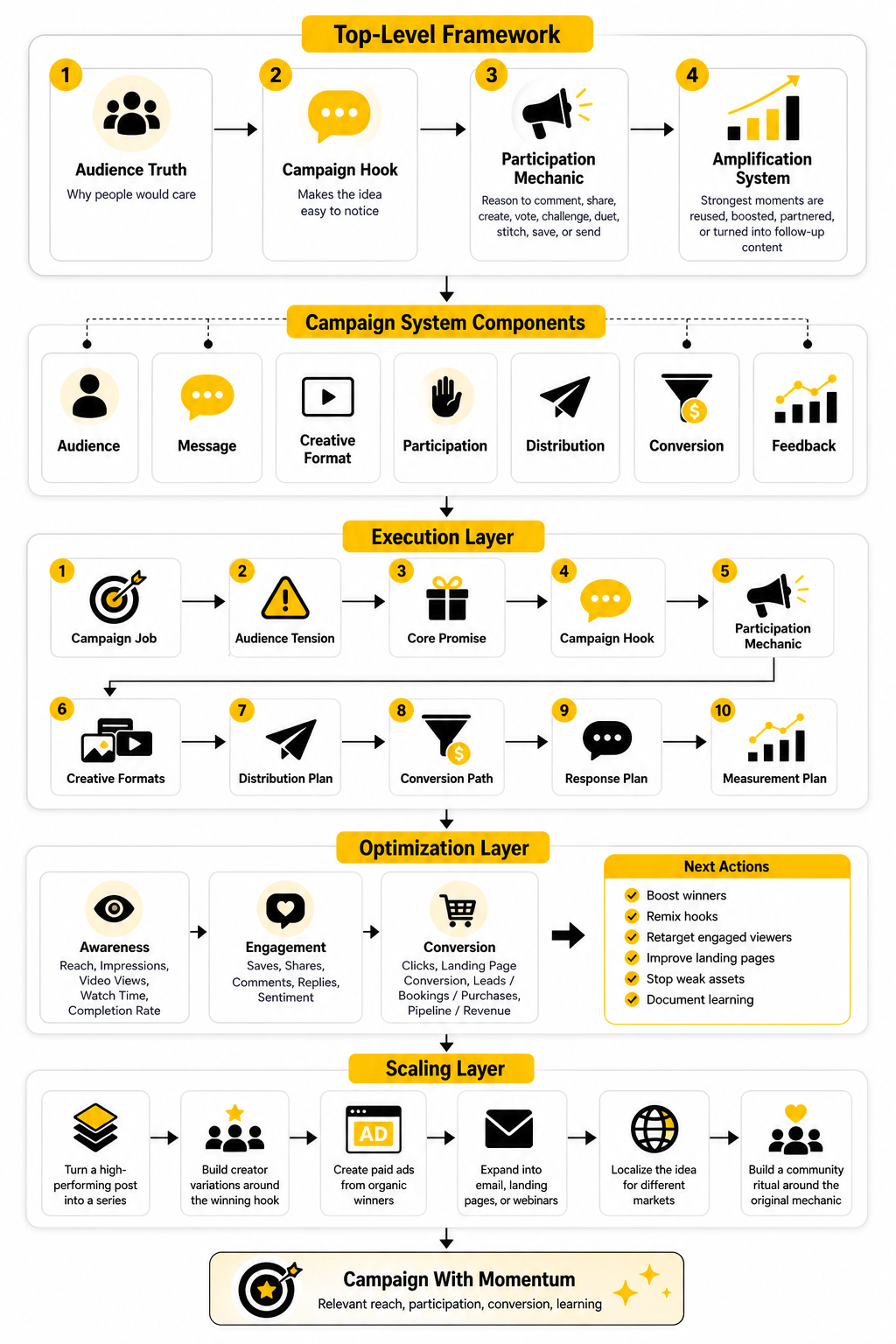
The most important thing is not perfection. It is alignment. The campaign promise, creative format, platform behavior, participation mechanic, tracking setup, and follow-up path all need to point in the same direction.
Final Optimization Checklist
Optimization should not mean changing everything every time one post underperforms. That creates chaos. A better approach is to review the campaign in layers, then fix the part that is actually limiting performance.
Start with the audience. If the wrong people are seeing the campaign, better copy will not solve the core problem. Then review the hook, because the first few seconds or first line often decide whether people even give the campaign a chance.
After that, review the participation mechanic and next step. If people enjoy the content but do not act, the campaign may need a clearer prompt, a better offer, or a smoother landing page. If people click but do not convert, the issue may be message match, page speed, proof, pricing, trust, or follow-up.
Use this checklist before scaling the campaign:
The strongest optimization work is practical. It does not hide behind vague phrases like “increase engagement.” It identifies the exact friction point and fixes it.
Common Mistakes That Hurt Popular Social Media Campaigns
The first major mistake is starting with the format instead of the idea. A team decides it needs Reels, TikToks, carousels, creator videos, or a challenge before defining the audience tension. That usually produces content that looks current but feels empty.
The second mistake is confusing activity with momentum. Publishing more assets does not mean the campaign is gaining strength. Momentum appears when people respond, share, remix, save, click, or talk about the campaign without needing constant brand pushing.
The third mistake is measuring too late. If tracking is added after launch, the team loses valuable context. Campaign links, creator assets, landing pages, CRM fields, and reporting views should be prepared before the first post goes live.
Another common mistake is overcontrolling creator content. The brand wants creator credibility but removes the personality that made the creator valuable in the first place. The result is a post that feels like an ad read, not a native social moment.
The final mistake is chasing popularity at the expense of relevance. A campaign can reach a huge audience and still attract the wrong people. The real goal is not maximum noise. The goal is meaningful attention from people who matter to the brand.
What makes popular social media campaigns different from regular posts?
Popular social media campaigns are built around a connected idea, not just a single piece of content. A regular post may inform, entertain, or announce something, but a campaign gives the audience a reason to keep engaging over time. The difference is structure: audience insight, creative hook, participation mechanic, distribution plan, and measurement system all work together.
A regular post can still perform well, but it usually has a shorter life. A campaign can create repeated moments because it has more than one asset, more than one audience entry point, and more than one way for people to respond. That is why campaign planning matters when the goal is bigger than publishing content.
How do you come up with an idea for a social media campaign?
Start with the audience tension, not the product feature. Look for what your audience is frustrated by, excited about, confused by, proud of, or tired of hearing. Then turn that tension into a simple campaign hook that people can understand quickly.
The best campaign ideas usually feel obvious once you see them. They name something the audience already recognizes and give people a clean way to react. If the idea needs too much explanation, it probably needs to be sharpened.
How long should a social media campaign run?
The right length depends on the campaign job. A trend-based campaign may only need a few days. A product launch campaign may run for several weeks. A brand awareness or community campaign may run in waves over multiple months.
The better question is how long the idea still has energy. If engagement, participation, and conversion quality are improving, the campaign may deserve more time and distribution. If the audience has clearly moved on, extending the campaign can make the brand feel out of touch.
Which metrics matter most for popular social media campaigns?
The most important metric depends on the campaign’s primary goal. For awareness, reach quality, watch time, share rate, and brand search lift may matter most. For engagement, saves, shares, comments, replies, and sentiment are more useful than raw likes.
For conversion-focused campaigns, clicks, landing page conversion rate, lead quality, booked calls, sales, pipeline, and assisted revenue matter more. The mistake is trying to judge every campaign by the same metric. A smart campaign scorecard connects the metric to the job.
Are viral campaigns always good for a brand?
No. Viral attention can help, but it is not automatically valuable. A campaign can go viral with the wrong audience, the wrong message, or the wrong interpretation. That can create short-term visibility and long-term confusion.
A better goal is relevant reach. You want the right people paying attention for the right reason. Popularity only matters when it supports the brand, the offer, and the customer journey.
How important are creators in social media campaigns?
Creators can be extremely valuable when trust, platform fluency, and audience fit matter. Creator content has become a serious media channel, with U.S. creator economy ad spend projected to reach $37 billion in 2025 in reporting on IAB research by Business Insider. That level of investment shows that brands are treating creators as more than optional influencers.
The key is choosing creators for fit, not just follower count. A smaller creator with the right audience and natural credibility can outperform a larger account that only brings passive reach. The campaign brief should protect the claim but leave room for the creator’s personality.
Should every campaign include paid ads?
No. Paid ads should support a strong campaign, not replace one. If the organic signals show that an asset is earning attention, saves, shares, comments, or qualified clicks, paid amplification can help scale it. If the creative is weak, paid spend usually just exposes the weakness faster.
A good approach is to test first, then boost winners. This keeps the team from spending heavily on unproven assumptions. Paid media works best when it extends evidence, not hope.
How do you measure social media campaign ROI?
Start by defining the campaign job and the expected business outcome. Then connect social activity to the next steps in the journey, such as landing page visits, email signups, booked calls, purchases, pipeline, retention, or assisted revenue. Social ROI is rarely perfect, but it can become much clearer with proper tracking.
Use UTM links, platform analytics, CRM source fields, landing page data, and post-campaign reviews. The 2025 Sprout Social Index is based on surveys of more than 4,000 consumers and 1,200 marketers, and it frames social as a business function that must show impact, not just activity, in the 2025 Sprout Social Index. That is the standard teams should work toward.
What role does AI play in popular social media campaigns?
AI can help with research, brainstorming, content repurposing, reporting, social listening, and workflow speed. It can make campaign production more efficient, especially when teams need to create variations for different platforms. But AI should not replace original audience insight or human judgment.
The risk is generic content. If the campaign sounds like every other AI-assisted post in the feed, people will ignore it. Use AI to support the process, but keep the point of view human.
How do you avoid making a campaign feel too promotional?
Lead with the audience’s reason to care. If the campaign starts with the brand’s needs, it usually feels promotional. If it starts with the audience’s problem, belief, identity, or desire, the brand can enter the conversation more naturally.
The product or offer should still matter, but it should not crush the experience. Popular social media campaigns work when the audience gets value before they feel pressure. That value might be entertainment, usefulness, recognition, belonging, or a better way to understand something.
What is the best platform for social media campaigns?
There is no universal best platform. The right platform depends on the audience, campaign idea, creative format, and goal. TikTok may be stronger for remixable short-form ideas, YouTube for deeper creator-led education, Instagram for visual identity and community touchpoints, LinkedIn for professional authority, and Reddit for niche discussion.
The stronger move is to build one campaign idea and adapt it properly for each platform. Do not copy and paste the same asset everywhere. Keep the core idea consistent, but make the execution native to the platform.
How do small brands compete with bigger brands?
Small brands can win by being more specific, faster, and closer to the audience. Big brands often have more budget, but they also have slower approvals and more risk concerns. A smaller brand can listen more closely, respond faster, and build campaigns around sharper audience insight.
The advantage is not acting bigger. The advantage is acting more relevant. A campaign that speaks directly to a specific audience can outperform a broad campaign that tries to please everyone.
What should happen after a campaign ends?
The team should run a post-campaign review and document what worked. Look at the winning hooks, strongest formats, best creator angles, audience comments, conversion quality, objections, and unexpected insights. Then decide what to repeat, adapt, test, or stop.
Do not let the campaign disappear into a report nobody uses. The real value is the learning. Each campaign should make the next one sharper.
Build a stronger local presence with BAAM AI
Turn your website, Google profile, social channels, and AI visibility into one growth engine
Most businesses do not need more random marketing activity. They need a consistent presence system that helps the right people find them, trust them, and take action. BAAM AI brings strategy, local SEO, website updates, Google Maps visibility, social content, AI-search readiness, media production, and reporting into one practical monthly engine.
If you want your marketing to keep working after the campaign ends, start with a free BAAM AI presence audit. See how your business shows up today and where the fastest visibility wins are at BAAM AI.