
BAAM AI Blog
Political Marketing: A Practical Framework For Winning Attention, Trust, And Action
Political marketing is not just campaign ads, slogans, rallies, or last-minute persuasion. It is the disciplined work of understanding voters, shaping a credible message, choosing the right channels, and turning...
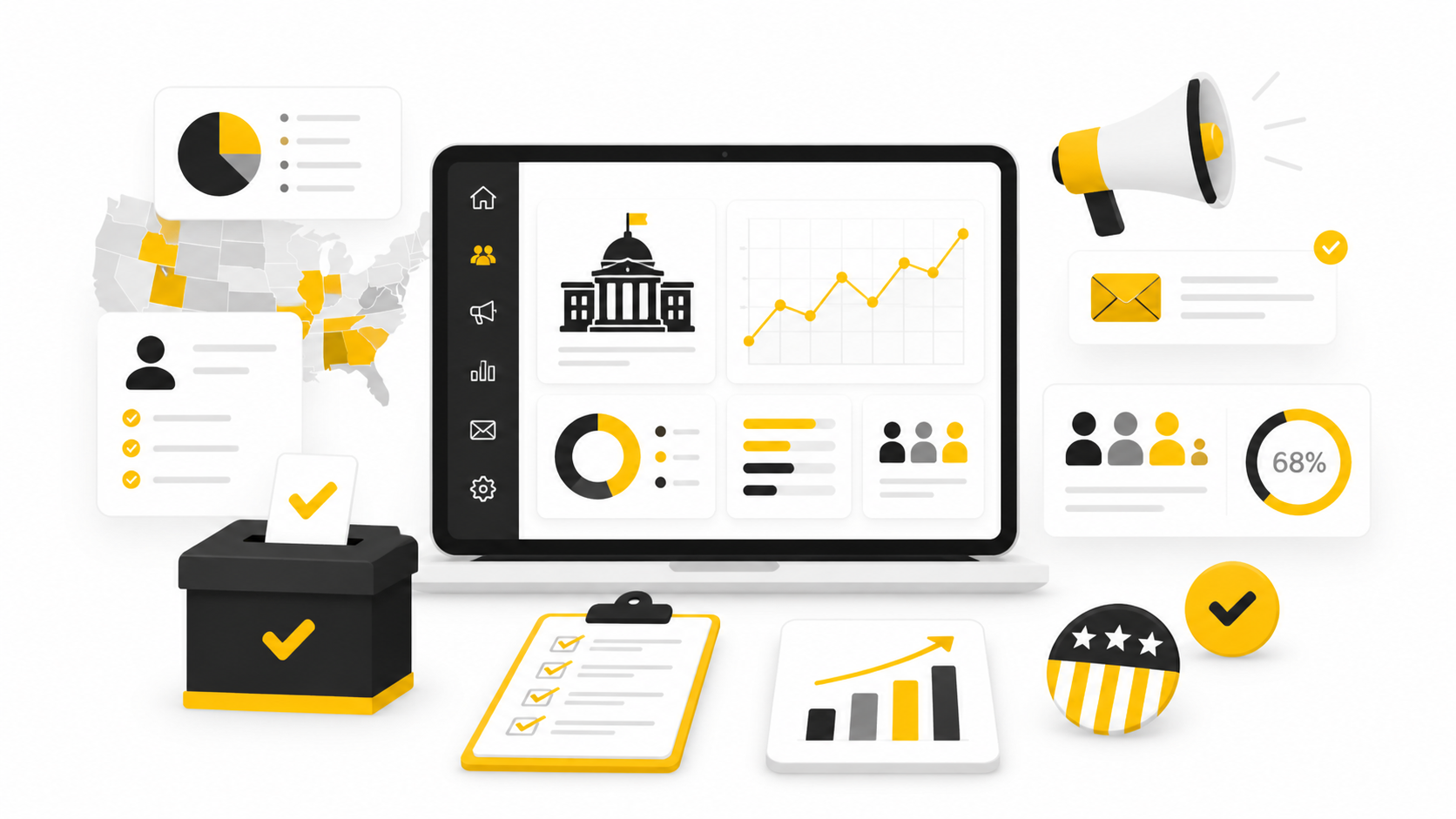
Political marketing is not just campaign ads, slogans, rallies, or last-minute persuasion. It is the disciplined work of understanding voters, shaping a credible message, choosing the right channels, and turning attention into measurable political action.
That matters because the political environment is noisy, fragmented, and skeptical. Voters move between social feeds, podcasts, search, messaging apps, local news, creator content, campaign websites, and private conversations. A strong political marketing strategy connects those moments instead of treating them as separate tactics.
this guide will continue in six parts:
Why Political Marketing Matters Now
Political marketing matters because attention is now one of the hardest resources to earn. Voters are not waiting for campaign messages. They are filtering, ignoring, comparing, doubting, and reacting in real time.
The trust problem makes this even harder. In the U.S., trust in national news organizations dropped to 56% in 2025, while trust in local news remained higher at 70%, based on Pew Research Center’s 2025 trust data. That means political marketers cannot rely on one big media moment to carry the campaign. They need repeated, consistent, credible communication across channels.
Money is also flowing into politics at enormous scale. The FEC reported that congressional candidates raised about $1.5 billion during the first 12 months of the 2025-2026 election cycle, based on its campaign finance summary. When campaigns are this competitive, the winner is rarely the team that simply “posts more.” The winner is usually the team that understands the audience better, frames the choice more clearly, and executes faster.
The Political Marketing Framework
Political marketing works best when it follows a clear framework. Without one, campaigns drift into random content, reactive messaging, and disconnected tools. With one, every decision connects back to the voter, the message, and the desired action.
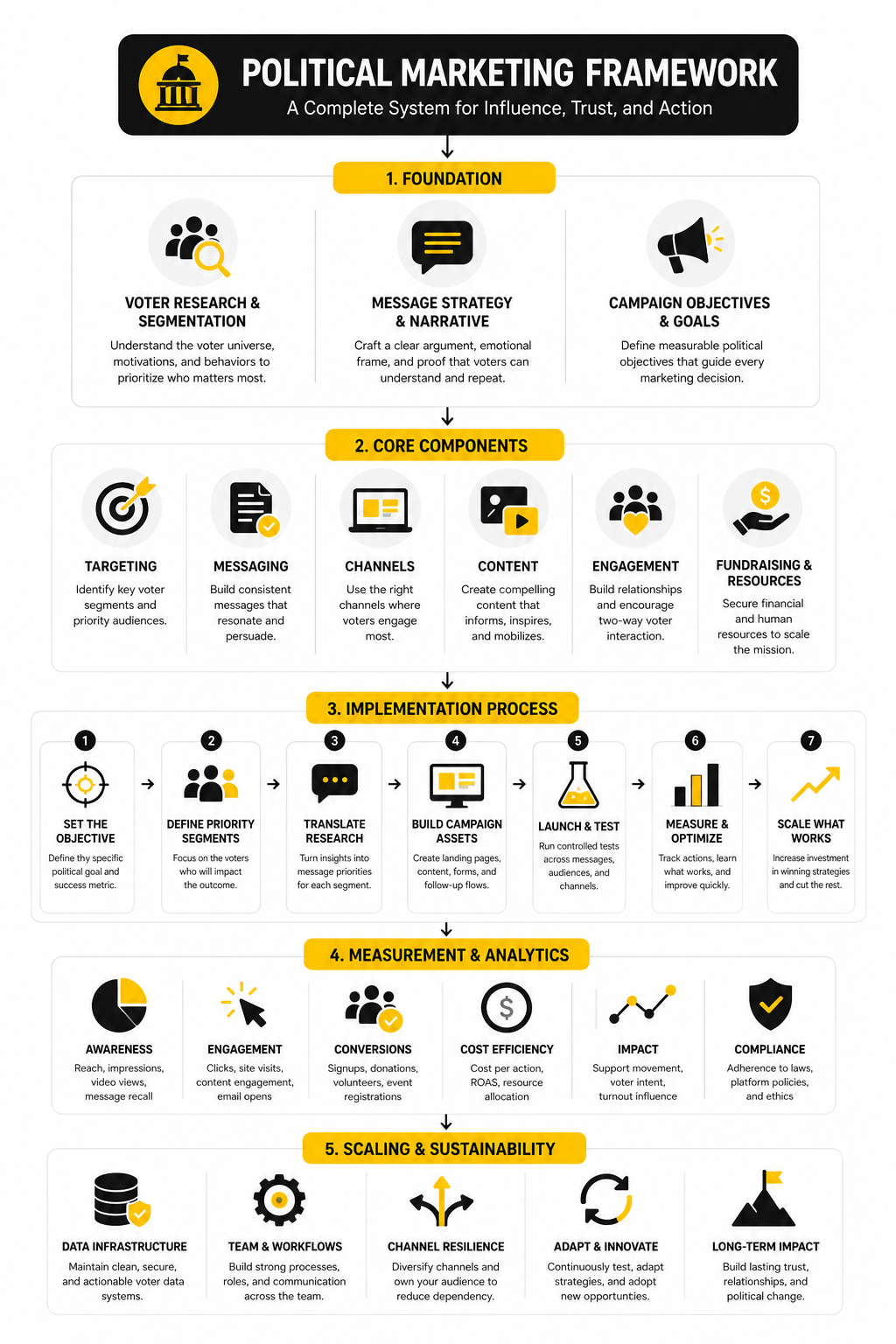
Research shows who the campaign needs to reach and what those people already believe. Positioning turns that insight into a clear political offer. Distribution puts the message where voters actually spend attention. Optimization uses evidence to improve what the campaign says, where it says it, and how it asks people to act.
Core Components Of Political Marketing
The first core component is voter understanding. That includes demographics, geography, issue priority, turnout likelihood, media habits, emotional drivers, and objections. Good political marketing does not treat “the public” as one giant audience.
The second component is message discipline. A campaign needs one central argument that can survive interviews, ads, speeches, debates, emails, SMS, and social posts. If the message changes every week, voters do not see momentum. They see confusion.
The third component is channel execution. Political teams often need websites, landing pages, email, SMS, social publishing, forms, calendars, CRM workflows, and automation working together. Tools such as GoHighLevel, ManyChat, Buffer, and Brevo can support that kind of infrastructure when they fit the campaign’s scale and compliance needs.
Professional Implementation
Professional implementation starts with the campaign’s political goal, not the software stack. A mayoral campaign, issue advocacy campaign, PAC, nonprofit voter education effort, and national candidate campaign all need different levels of research, compliance, creative production, and media buying. The strategy has to match the battlefield.
The practical sequence is simple. First, define the voters who can change the outcome. Second, build a message that gives them a reason to care. Third, create campaign assets that make action easy. Fourth, measure what is actually moving people.
This is where political marketing becomes more than communication. It becomes a system for earning trust, reducing friction, and converting support into votes, donations, volunteers, shares, event attendance, or public pressure. That system is what the next parts will build.
Why Political Marketing Matters Now
Political marketing matters now because voters are not moving through one clean funnel. They see a debate clip on YouTube, a friend’s post on Instagram, a WhatsApp message from a local group, a podcast interview, a search result, a fundraising email, and a doorstep conversation. The campaign that treats those moments as one connected voter journey has a serious advantage.
The scale is huge. DataReportal’s 2026 global overview found that more than 5.66 billion social media user identities now exist worldwide, equal to 68.7% of the global population, based on its 2026 digital report. That does not mean every voter is reachable through the same platform. It means attention is scattered, and political campaigns need sharper audience thinking than ever.
This is where weak campaigns get exposed. They publish generic content, chase trends, and hope something lands. Strong political marketing does the opposite: it identifies who matters, understands what they care about, and builds repeated trust before asking for action.
Voters Are More Fragmented Than Campaigns Want To Admit
The old model was easier to understand. Campaigns could invest heavily in TV, direct mail, local press, and field operations, then assume most voters would receive a similar message. That world still exists, but it is no longer enough by itself.
Pew’s 2025 social media research shows that platform use varies sharply by age, gender, race, ethnicity, education, and party, based on its U.S. social media findings. That matters because a message that works on Facebook may feel completely wrong on TikTok, Reddit, WhatsApp, or YouTube. The audience is not just split by ideology. It is split by media behavior.
Good political marketing respects that reality. It does not water down the campaign until everyone receives the same bland message. It keeps the core argument consistent while adapting format, proof, tone, and call to action for each audience segment.
Trust Is Now A Strategic Asset
Trust is not a soft metric in politics. It affects whether voters believe a claim, share a message, donate money, volunteer time, or show up when turnout matters. If a campaign loses trust, more advertising usually makes the problem louder.
The Reuters Institute’s 2025 Digital News Report describes a continued shift away from traditional media sources and toward social platforms, video networks, and creators, based on its 2025 report overview. That creates opportunity, but it also creates risk. A campaign can reach voters directly, but so can opponents, activists, anonymous accounts, influencers, and misinformation networks.
This is why consistency matters so much. Voters may not remember every policy detail, but they notice whether a campaign sounds stable, specific, and credible. Political marketing gives that trust a structure instead of leaving it to chance.
The Message Has To Survive Multiple Channels
A strong campaign message cannot only work in a speech. It has to work as a headline, short video, email subject line, SMS prompt, landing page section, donor pitch, debate answer, volunteer script, and field conversation. If it breaks when the format changes, the message is probably too fragile.
That does not mean every asset should sound identical. It means every asset should point to the same larger argument. Voters need repetition before they recognize a campaign’s position, and repetition only works when it feels clear instead of robotic.
This is where political marketing becomes practical. A campaign can use tools like Buffer for organized publishing, Brevo for email communication, or ManyChat for conversational follow-up when those tools fit the campaign’s legal and operational setup. The tool is not the strategy. The tool simply helps the strategy move faster.
Political Marketing Turns Attention Into Action
Attention alone does not win campaigns. A viral post can create noise without votes, donations, volunteers, or persuasion. The real job is to turn attention into the next useful action.
That action might be signing up for updates, attending an event, requesting a yard sign, donating, joining a phone bank, sharing a local issue page, or making a plan to vote. Each step needs a clear path. Confused voters do not convert.
Professional political marketing removes that friction. It connects the message to the next action, then measures whether people actually move. That is the bridge between communication and campaign results.
Voter Research And Segmentation
Political marketing gets serious when the campaign stops talking to “everyone” and starts defining the people who can actually change the outcome. That does not mean manipulating voters or reducing people to data points. It means respecting the fact that different voters have different problems, levels of interest, trust signals, media habits, and reasons for acting.
Segmentation should begin with the election math. A campaign needs to know the turnout target, persuasion universe, donor universe, volunteer base, geographic priorities, and issue communities before it builds content. Otherwise, the team ends up with attractive messaging that feels busy but does not move the race.
This is also where political marketing becomes more disciplined than ordinary posting. Pew’s 2025 research found that 42% of social media users say these platforms are important for getting involved with political or social issues, based on its study of social media and political involvement. That number is useful, but it is not a strategy by itself. The strategy comes from knowing which voters use which channels, what they already believe, and what action you need from them next.
Start With The Voter Universe
The voter universe is the group of people the campaign must understand before it spends serious money. It usually includes reliable supporters, persuadable voters, low-propensity supporters, opposition voters, donors, volunteers, endorsers, and local validators. Each group needs a different job inside the campaign.
Reliable supporters need activation. Persuadable voters need proof, contrast, and reassurance. Low-propensity supporters need urgency and convenience. Donors need confidence that their money will be used well. Volunteers need a simple reason to give time.
This prevents one of the most expensive mistakes in political marketing: sending the same message to people with completely different levels of commitment. A supporter does not need the same argument as a skeptical swing voter. A donor does not need the same page as someone who simply wants to check the candidate’s position on one local issue.
Build Segments Around Motivation, Not Just Demographics
Demographics matter, but they are not enough. Age, location, income, education, language, and household status can help a campaign understand context. They do not automatically explain why someone cares, hesitates, shares, votes, donates, or stays home.
Better segmentation includes motivation. Some voters are issue-driven. Some are identity-driven. Some are anti-incumbent. Some want stability. Some care less about politics and more about whether the campaign understands their daily frustration.
That is why voter research should combine multiple inputs. Polling can show measurable patterns. Field conversations can reveal language people actually use. Search behavior can show questions voters are asking. Social listening can surface objections, but it should be treated carefully because loud online communities are not always representative of the full electorate.
Turn Research Into Message Priorities
Research only matters if it changes what the campaign does. A long memo full of charts is useless if the creative team, field team, fundraising team, and candidate never use it. The output should be clear message priorities that everyone can repeat.
A practical message priority should answer three questions. What does this voter care about? What does the campaign need them to believe? What proof would make that belief easier to accept? If the team cannot answer those questions, the campaign is not ready to scale communication.
This is where clarity beats cleverness. Political teams often want a fresh slogan, but voters usually need a stronger reason. A good message priority gives the campaign that reason and makes every channel easier to manage.
Message Strategy And Narrative
Message strategy is the backbone of political marketing. It defines the central argument of the campaign, the emotional frame around that argument, and the proof that makes it believable. Without it, the campaign becomes a collection of content instead of a coherent choice.
The message should not try to say everything. It should make the campaign easy to understand under pressure. Voters are busy, skeptical, and distracted, so the message has to survive a fast scroll, a short conversation, a negative attack, and a last-minute decision.
The Reuters Institute’s 2025 Digital News Report describes a fragmented information environment shaped by video, creators, platforms, and changing news habits, based on its 2025 report overview. That is exactly why the narrative has to be simple enough to travel. If the campaign needs five minutes to explain itself, it will struggle in channels where voters give it five seconds.
Define The Central Campaign Argument
The central campaign argument is the sentence behind everything else. It explains why this candidate, party, policy, or cause deserves support now. It should include a problem, a contrast, and a direction.
For example, a campaign may be built around affordability, public safety, corruption, local services, education, healthcare, climate risk, national identity, or democratic norms. The topic alone is not enough. The campaign has to frame why that topic matters now and why its solution is more credible than the alternative.
This is the difference between a theme and an argument. “Lower costs” is a theme. “Families are working harder but falling behind because leaders ignored the real cost of living, and this campaign has a practical plan to bring costs down” is closer to an argument. One labels the issue. The other creates a choice.
Create Proof That Voters Can Repeat
A campaign message becomes stronger when voters can repeat it in their own words. That requires proof points that are specific, memorable, and easy to verify. Big promises are not enough.
Proof can include voting records, public budgets, local outcomes, candidate experience, endorsements, policy details, community testimonials, or third-party reporting. The strongest proof depends on the race. A local campaign may need neighborhood-level evidence, while a national campaign may need broader policy credibility.
The key is to avoid dumping facts. Facts need structure. A good proof point should support the campaign’s main argument, answer a real objection, and make the voter feel more confident taking the next step.
The Political Marketing Implementation Process
Once research and messaging are clear, execution can become tangible. This is the part where many campaigns either become organized or fall apart. The difference usually comes down to whether the team has a repeatable process.
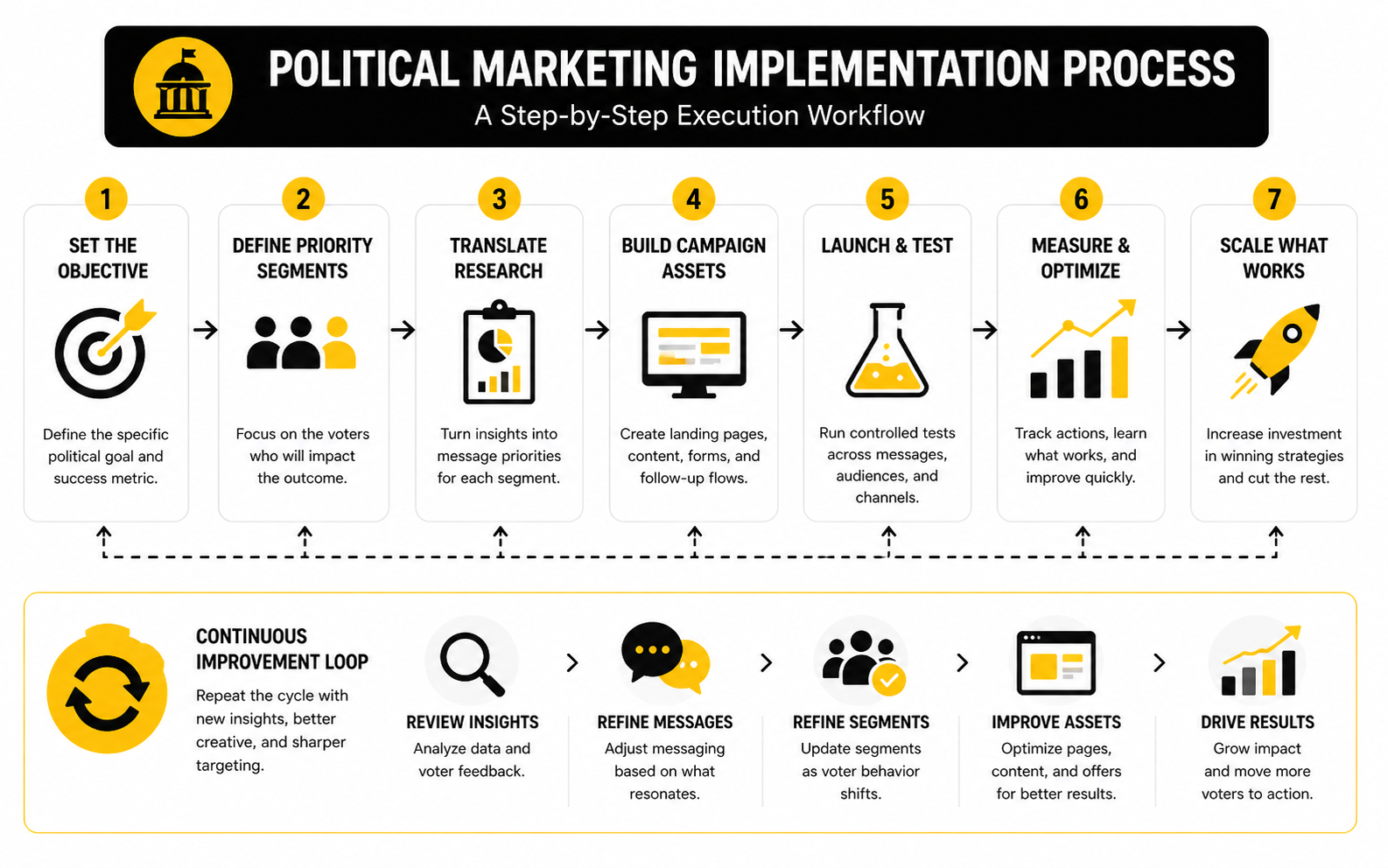
A practical implementation process looks like this:
The order matters. Do not build landing pages before the offer is clear. Do not run ads before the audience is defined. Do not automate follow-up before the campaign knows what action it wants people to take.
Build Campaign Assets Around The Next Action
Every campaign asset should have a job. A homepage should help voters understand the campaign quickly. A donation page should reduce hesitation. A volunteer form should feel easy. A social post should move people toward recognition, trust, or action.
This is where the campaign’s operating system matters. A team may use GoHighLevel for CRM workflows, ClickFunnels for focused funnels, Systeme.io for simple campaign pages and email flows, or Fillout for forms when fast collection matters. The exact stack is less important than the discipline behind it.
The page, message, form, email, and follow-up should all feel connected. If a voter clicks from a public safety ad and lands on a generic homepage with no clear next step, the campaign wastes intent. Small breaks like that quietly kill performance.
Test Before Scaling
Testing is not a luxury. It is how campaigns avoid turning assumptions into expensive mistakes. A message that wins internal praise may fail with voters, while a plain and direct version may outperform the clever one.
Campaigns can test hooks, landing page copy, donation asks, volunteer prompts, email subject lines, video openings, audience segments, and follow-up timing. The goal is not endless optimization for its own sake. The goal is to learn which message-action combination produces the strongest real response.
This matters even more in a crowded digital environment. Tech for Campaigns reported that its 2024 digital voter turnout program tested more than 300 pieces of creative across Meta, YouTube, and Reddit, based on its 2024 digital advertising report. That kind of testing discipline is the difference between guessing and improving.
Keep Compliance In The Workflow
Political marketing cannot ignore compliance. Rules around disclaimers, fundraising, data use, political advertising, consent, and reporting vary by country, state, platform, campaign type, and election context. The team needs legal review inside the process, not as a panic step after assets are already live.
This is especially important as political advertising rules keep changing. The European Commission’s 2025 political advertising rules introduced new transparency requirements for sponsors, providers, and publishers, based on its announcement of the regulation taking effect. Even campaigns outside the EU should pay attention to this direction because platform rules often shift after regulatory pressure.
The practical answer is simple. Build compliance checkpoints into creative approval, landing page review, audience targeting, email and SMS consent, donation flows, and reporting. It is slower upfront, but it prevents chaos later.
Statistics And Data
Measurement is where political marketing becomes accountable. It is easy to confuse activity with progress because campaigns produce so much visible noise: posts, emails, ads, speeches, clips, interviews, events, and donation pushes. The real question is simpler and tougher: did the work move the right people toward the right action?
The FEC reported that U.S. House and Senate candidates raised about $1.5 billion and spent $851.9 million during the first 12 months of the 2025-2026 election cycle, based on its campaign finance summary. That scale matters because it creates a brutal performance environment. When money is everywhere, campaigns cannot afford lazy measurement.
The mistake is treating data as a scoreboard only. Good data is not there to make the team feel good or bad. It tells the campaign what to change next.
Measure The Voter Journey, Not Just The Channel
A campaign should not judge every channel by the same metric. A short video may be doing its job if it increases recognition. A search page may be doing its job if it answers intent. An email may be doing its job if it drives donations, volunteer signups, or event attendance.
That is why political marketing measurement should follow the voter journey. At the top, the campaign tracks reach, frequency, video completion, search visibility, press pickup, and message recall when reliable polling or survey tools are available. In the middle, it tracks site visits, issue page engagement, email signups, form starts, replies, saves, shares, and return visits. At the bottom, it tracks donations, volunteer shifts, vote plan completions, event RSVPs, ballot chase outcomes, and confirmed turnout where legally and operationally possible.
This keeps the team from making bad comparisons. A persuasion video and a donation email are not supposed to produce the same numbers. They should be judged by the action they were designed to create.
The Metrics That Actually Matter
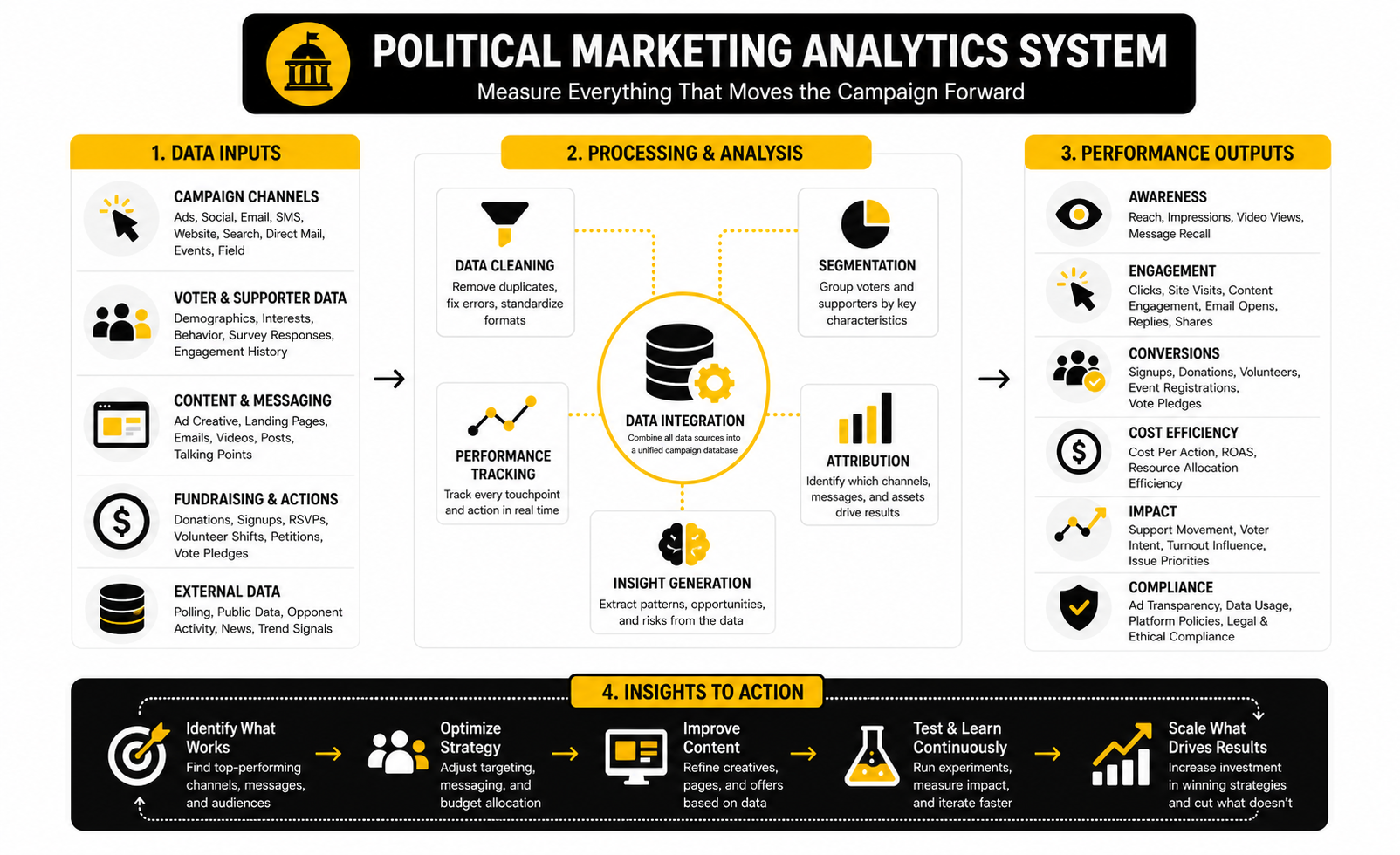
Campaign dashboards should be useful, not decorative. The best ones show the small set of numbers that help the team make decisions quickly. If a metric cannot change a decision, it probably does not deserve prime dashboard space.
Useful political marketing metrics usually include:
The point is not to worship benchmarks. The point is to spot friction. If a page gets traffic but no signups, the offer may be weak. If an email gets opens but no clicks, the body copy or call to action may be unclear. If an ad gets cheap engagement but no useful downstream action, the campaign may be attracting curiosity instead of commitment.
Benchmarks Need Context
Benchmarks are helpful only when they are interpreted honestly. A high engagement rate can look impressive while producing no votes, money, or volunteers. A lower click-through rate can still be valuable if the clicks come from the exact voters the campaign needs.
This is especially important on social platforms. Pew found that about a fifth or more of U.S. adults regularly get news on Facebook, YouTube, Instagram, and TikTok, based on its 2025 social media and news fact sheet. That does not mean every campaign should chase every platform equally. It means platform choice should follow audience behavior, not team preference.
The same applies to creative testing. Tech for Campaigns reached 15.6 million people, helped sign up more than 263,000 people to vote early or by mail, and tested more than 300 pieces of creative across Meta, YouTube, and Reddit in its 2024 digital voter turnout program, based on its 2024 digital ads report. The useful lesson is not “copy their channel mix.” The useful lesson is that serious campaigns test multiple messages and formats before scaling.
Turn Analytics Into Decisions
Data should lead to action. If the campaign learns that one issue page converts volunteers at a higher rate, build more traffic into it. If one county has strong engagement but weak event attendance, fix the local call to action. If one audience segment watches videos but never clicks, use retargeting, follow-up content, or offline outreach to close the gap.
This is where tools can help, but only if the team knows what it wants to measure. GoHighLevel can support CRM and pipeline tracking, Brevo can support email performance, ManyChat can support conversational follow-up, and Fillout can support clean form collection. None of those tools replace strategy. They simply make the feedback loop easier to manage.
A practical campaign review should ask four questions every week. What moved? Why did it move? What did we learn? What are we changing before the next push? That rhythm keeps measurement connected to execution.
Watch For False Signals
Not all data deserves trust. Political content can attract outrage clicks, bot activity, opposition attention, inflated impressions, duplicate signups, and low-quality engagement. If the campaign optimizes for the wrong signal, it can become more visible while becoming less persuasive.
False signals are especially dangerous when the team is under pressure. A viral clip can make everyone feel like the campaign has momentum, but if it reaches the wrong geography or only energizes people who already agree, the practical value may be limited. A fundraising spike can look strong, but if it comes from expensive acquisition with weak donor retention, the economics may not hold.
The fix is simple but uncomfortable. Measure closer to the outcome. In political marketing, attention matters, but action matters more. The campaign should celebrate attention only when it helps build trust, persuade priority voters, or move supporters into useful behavior.
Advanced Strategy, Tradeoffs, And Risk
At this stage, political marketing becomes less about producing more content and more about making better strategic choices. Campaigns have limited time, limited money, limited candidate attention, and limited voter patience. The work is not to do everything. The work is to choose the moves most likely to change the outcome.
That creates tradeoffs. A campaign may need to choose between persuasion and turnout, digital reach and field depth, positive storytelling and sharp contrast, rapid response and message discipline, or fundraising efficiency and donor trust. None of these choices can be solved by a generic template.
This is why senior campaign teams need a decision framework. If every idea feels equally urgent, the campaign becomes reactive. If the team knows the strategic priority, political marketing becomes calmer, sharper, and much more useful.
Balance Persuasion And Mobilization
Persuasion and mobilization are different jobs. Persuasion is about moving someone’s view. Mobilization is about getting someone who already leans your way to act. Confusing the two leads to weak messaging.
A persuadable voter usually needs credibility, contrast, and reassurance. A supporter usually needs urgency, ease, and social proof. A campaign that sends persuasion-heavy content to committed supporters may under-activate them, while a campaign that sends hard mobilization asks to skeptical voters may feel pushy.
The balance depends on the race. A campaign with low name recognition may need more persuasion early. A campaign with strong support but weak turnout may need more mobilization late. Political marketing should match the election math instead of following a fixed content calendar.
Manage The Risk Of Over-Targeting
Targeting is useful, but over-targeting can make a campaign smaller than it needs to be. When every message is sliced too narrowly, the campaign may lose its shared public argument. Voters then hear fragments instead of a clear story.
There is also a trust risk. People can react badly when a campaign appears to know too much, personalize too aggressively, or use sensitive assumptions. Newer political advertising rules in the EU are built around transparency, targeting limits, and public repositories for online political ads, as shown by the European Commission’s political advertising guidance. Even outside the EU, the direction is obvious: campaigns need cleaner data practices and clearer disclosure.
The practical move is to use targeting to improve relevance, not to hide the campaign’s real position. A message can be adapted for audience context while still being honest, public, and defensible. If a campaign would be embarrassed for two segments to compare messages, the strategy needs a rethink.
Build A Rapid Response System Without Losing Discipline
Rapid response is necessary because political narratives can move quickly. A debate moment, news story, opposition attack, platform trend, or local controversy can change the day. Campaigns need a system for responding without sounding panicked.
That system should define who monitors, who drafts, who approves, who publishes, and who decides when silence is stronger than response. Not every attack deserves oxygen. Not every trend deserves a campaign version. Not every comment section deserves staff time.
The best rapid response still reinforces the core argument. If the campaign answers every issue in a new voice, voters see noise. If it responds through the same strategic frame, even reactive moments become part of the larger narrative.
Prepare For Platform And Regulatory Shocks
Political campaigns are exposed to platform decisions they do not control. Ad policies can change. Targeting options can disappear. Accounts can be restricted. Organic reach can drop. Paid political ads can be limited or removed in certain regions.
That is not theoretical. Meta announced it would stop political, electoral, and social issue advertising in the EU from October 2025, citing the region’s new political advertising requirements, based on Meta’s own policy announcement. When a platform changes the rules, campaigns that rely on one channel suddenly lose leverage.
The answer is channel resilience. Build email lists, SMS lists where consent rules allow it, search visibility, direct traffic, creator relationships, press relationships, field capacity, and owned campaign pages. A tool like GoHighLevel can help centralize contact management, while Brevo or Moosend can support email communication when the campaign needs an owned audience channel.
Use AI Carefully, Not Lazily
AI can help political marketing teams move faster, but it should not replace judgment. It can support drafting, summarizing research, repurposing content, organizing scripts, analyzing feedback, and building workflow efficiency. Used badly, it can produce generic copy, factual errors, compliance problems, and messages that sound fake.
The risk is not just quality. It is trust. In politics, a sloppy AI-generated claim can become an attack line within minutes. A synthetic image, voice, or misleading edit can create legal, ethical, and reputational damage.
The safe approach is human review, source discipline, clear approval paths, and strict rules for anything involving claims, identities, images, audio, or voter data. AI should make competent teams faster. It should not make weak strategy louder.
Scale Without Breaking The Campaign
Scaling is where many campaigns expose their operational weaknesses. More ads, more emails, more volunteers, more videos, more events, and more landing pages can create momentum. They can also create confusion if the campaign does not have strong systems.
Before scaling, the campaign should check whether the message is stable, the data is clean, the follow-up works, the donation or signup flow is smooth, and the team knows who owns each channel. A campaign should not pour traffic into a broken funnel. It should fix the friction first.
This is especially important near the end of a race. Pressure rises, judgment gets harder, and teams become tempted to chase every possible opportunity. Strong political marketing keeps the operation focused: reach the right voters, say the clearest thing, remove friction, measure action, and scale only what helps the campaign win.
Measurement, Optimization, Ethics, And FAQs
The final layer of political marketing is the system around the campaign. Research, messaging, content, ads, email, field, fundraising, events, data, and compliance cannot behave like separate departments fighting for attention. They need to support one shared outcome.
That does not mean everything becomes rigid. Politics moves too quickly for that. It means the team has a clear operating rhythm: decide the priority, launch the work, measure meaningful action, learn fast, protect trust, and improve the next move.
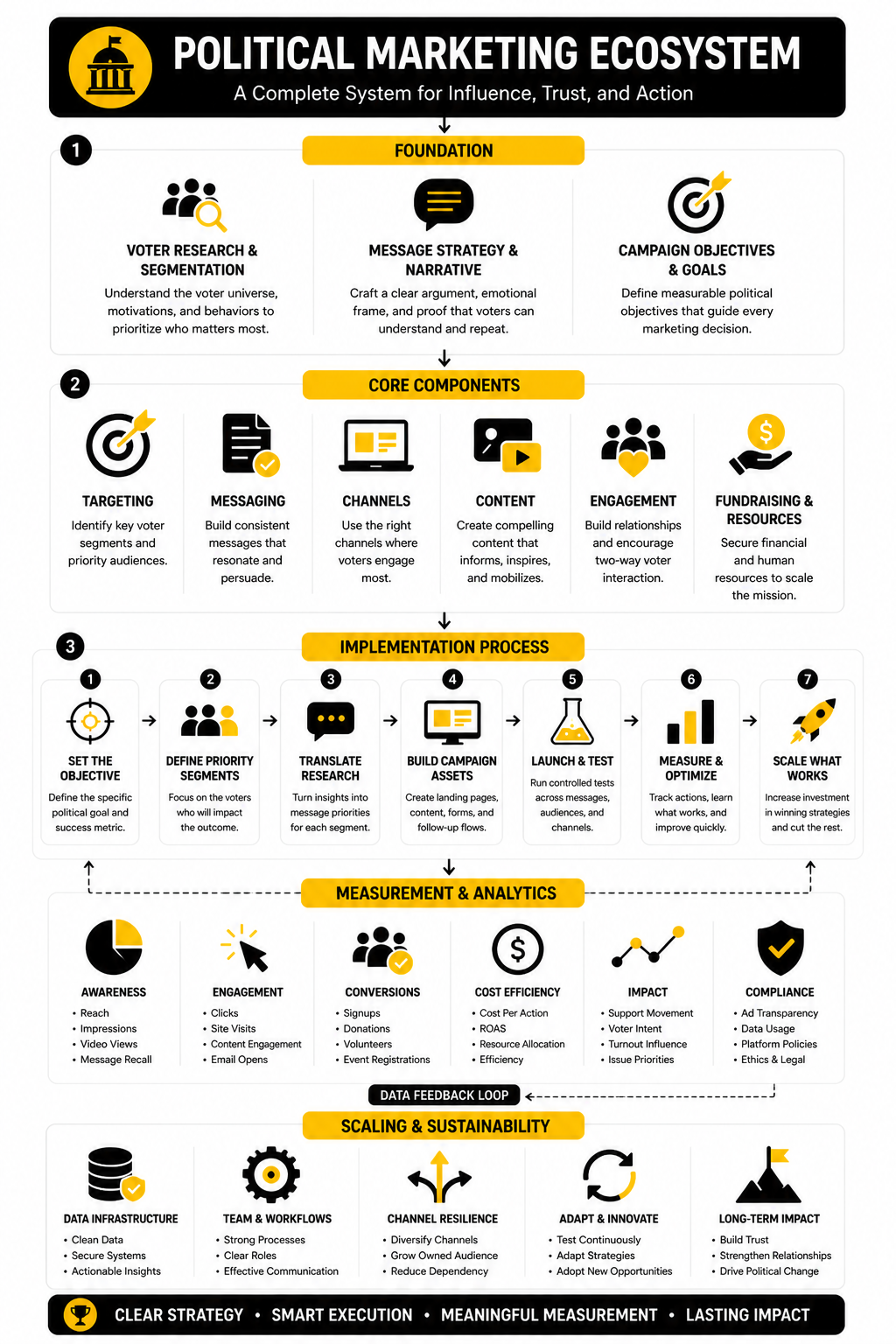
A strong campaign ecosystem is not built around one platform. It is built around voter understanding, message consistency, owned audience growth, careful data use, and disciplined execution. Tools can help, but the system matters more than the tool.
Keep The Feedback Loop Tight
Optimization should happen in cycles. The campaign should not wait until the end of the month to learn that a donation page is weak, a volunteer form is too long, or a message is attracting the wrong audience. Small problems become expensive when they are ignored.
The weekly rhythm should be practical. Review the numbers that connect to real campaign goals, compare them against the previous push, identify the strongest signal, and decide what changes before the next launch. This turns analytics into behavior instead of a report nobody uses.
Political marketing is strongest when the feedback loop includes both quantitative and human input. Dashboards show what happened. Field conversations, replies, calls, comments, and local organizers often explain why it happened.
Protect Trust Until The End
Trust is easy to spend and hard to rebuild. A desperate campaign can damage months of work with misleading creative, lazy claims, sloppy automation, or over-personalized targeting. Do not do that.
Every campaign should have a simple ethics filter before publishing: is the claim supportable, is the targeting defensible, is the voter’s data being handled properly, and would the campaign stand behind this message publicly? If the answer is no, fix it before it goes live. Winning attention is not worth destroying credibility.
Regulation is also moving toward more transparency. The EU’s political advertising rules created new requirements around transparency notices, targeting, and a public repository for online political ads, based on the European Commission’s political advertising framework. Even when a campaign operates elsewhere, this direction matters because voter expectations and platform policies keep tightening.
What Is Political Marketing?
Political marketing is the use of marketing strategy, voter research, positioning, messaging, media, content, data, and campaign operations to influence political behavior. That behavior can include voting, donating, volunteering, attending events, sharing messages, or supporting a policy. It is not just advertising; it is the full system that connects a political offer to public action.
Why Is Political Marketing Important?
Political marketing matters because voters are busy, skeptical, and spread across many channels. A campaign cannot assume people will hear the message just because it exists. The campaign has to earn attention, build trust, repeat the message clearly, and make the next action easy.
How Is Political Marketing Different From Regular Marketing?
Regular marketing usually promotes a product, service, or brand. Political marketing promotes a candidate, party, policy, cause, or public choice. The stakes are different because trust, identity, ideology, regulation, media scrutiny, and public accountability all play a bigger role.
What Are The Main Components Of Political Marketing?
The main components are voter research, segmentation, positioning, message strategy, channel strategy, content production, advertising, field coordination, fundraising communication, analytics, and compliance. The strongest campaigns connect these pieces instead of running them separately. That connection is what turns scattered activity into a real campaign system.
What Makes A Political Marketing Message Effective?
An effective message is clear, believable, repeatable, and connected to a real voter concern. It should explain the problem, show why the campaign is credible, and create a meaningful contrast. The best message is not always the cleverest one; it is the one voters can understand and repeat.
Which Channels Matter Most In Political Marketing?
The right channels depend on the audience and the campaign goal. Social media, email, SMS, search, video, local media, podcasts, direct mail, events, field outreach, and campaign websites can all matter. The mistake is choosing channels because they are trendy instead of choosing them because the target voters actually use them.
How Should Campaigns Measure Political Marketing Performance?
Campaigns should measure performance based on the action each channel is supposed to create. Awareness work should be judged by reach, frequency, recognition, and message recall where possible. Conversion work should be judged by donations, signups, event RSVPs, volunteer shifts, vote plans, and other meaningful actions.
What Is The Biggest Mistake In Political Marketing?
The biggest mistake is confusing activity with strategy. Posting more, emailing more, or launching more ads does not automatically move voters. Political marketing only works when the campaign knows who it is trying to reach, what those people need to believe, and what action should happen next.
How Can Small Campaigns Use Political Marketing?
Small campaigns should focus on clarity before complexity. Define the priority voters, build a simple message, create a clean website or landing page, collect supporter information, follow up consistently, and track useful actions. A smaller campaign does not need every tool; it needs fewer moving parts executed well.
What Tools Are Useful For Political Marketing?
Useful tools depend on the campaign’s size, compliance needs, and workflow. A campaign may use GoHighLevel for CRM and automation, Brevo for email, ManyChat for conversational follow-up, Buffer for social scheduling, or Fillout for forms. The tool should support the strategy, not replace it.
Is AI Useful In Political Marketing?
AI can be useful for drafting, summarizing research, repurposing content, organizing workflows, and speeding up production. It should not be trusted blindly for factual claims, sensitive targeting, legal compliance, or synthetic media. Human review is non-negotiable in political work because one careless output can create serious trust and reputational problems.
How Do Campaigns Avoid Manipulative Political Marketing?
Campaigns avoid manipulation by using truthful claims, transparent intent, responsible data practices, and messages they would be willing to defend publicly. Strong persuasion is not the same as deception. The line matters, and serious campaigns should protect it.
Build a stronger local presence with BAAM AI
Turn your website, Google profile, social channels, and AI visibility into one growth engine
Most businesses do not need more random marketing activity. They need a consistent presence system that helps the right people find them, trust them, and take action. BAAM AI brings strategy, local SEO, website updates, Google Maps visibility, social content, AI-search readiness, media production, and reporting into one practical monthly engine.
If you want your marketing to keep working after the campaign ends, start with a free BAAM AI presence audit. See how your business shows up today and where the fastest visibility wins are at BAAM AI.