
BAAM AI Blog
Pharmaceutical Copywriter: The Practical Guide To Writing Pharma Content That Is Clear, Compliant, And Useful
A pharmaceutical copywriter does more than make medical language sound smoother. The job sits at the intersection of science, regulation, brand strategy, patient understanding, and commercial execution. That is why...

A pharmaceutical copywriter does more than make medical language sound smoother. The job sits at the intersection of science, regulation, brand strategy, patient understanding, and commercial execution. That is why strong pharma copy rarely sounds flashy. It sounds precise, responsible, and easy to act on.
This matters because pharmaceutical communication is not normal marketing with a few medical words added. Prescription drug promotion in the United States must be truthful, balanced, and accurately communicated, which is the stated mission of the FDA’s Office of Prescription Drug Promotion in its materials on prescription drug promotion. Product claim ads must also include key information such as the drug name, at least one approved use, and significant risks, while presenting benefits and risks in a balanced way through the FDA’s own guidance on the basics of drug ads.
That changes the copywriter’s role completely. A consumer brand copywriter can often lead with desire, emotion, and conversion. A pharmaceutical copywriter has to lead with evidence, indication, audience, risk context, and review readiness. The writing still needs to persuade, but it cannot overreach.
Why Pharmaceutical Copywriting Is Different
Pharma writing is different because every claim carries weight. A sentence that feels harmless in ordinary marketing can become a regulatory problem if it implies an unapproved use, overstates efficacy, minimizes risk, or makes a comparison the evidence does not support. Good pharmaceutical copywriting is not about making the strongest possible claim. It is about making the strongest supportable claim.
This is especially important in prescription drug promotion, where the FDA’s rules under 21 CFR Part 202 govern how prescription drug advertising can present information. The copy has to respect approved labeling, risk disclosure, fair balance, and the difference between educational, promotional, and scientific exchange contexts. That is why pharmaceutical copywriters often work closely with medical, legal, regulatory, brand, and compliance teams before anything goes live.
The audience also changes the writing. Healthcare professionals usually need clinical relevance, mechanism, safety context, dosing clarity, and evidence hierarchy. Patients and caregivers need plain language, practical reassurance, and a clear reason to speak with a qualified healthcare professional. Payers, market access teams, and institutional buyers need value evidence, population fit, and operational clarity. One message rarely works for all of them.
The Pharmaceutical Copywriting Framework
A useful way to think about pharmaceutical copywriting is as a four-part framework: audience, evidence, claim, and review. The audience defines what the reader needs to understand. The evidence defines what the copy is allowed to say. The claim turns that evidence into a useful message. The review process makes sure the final asset can survive medical, legal, and regulatory scrutiny.
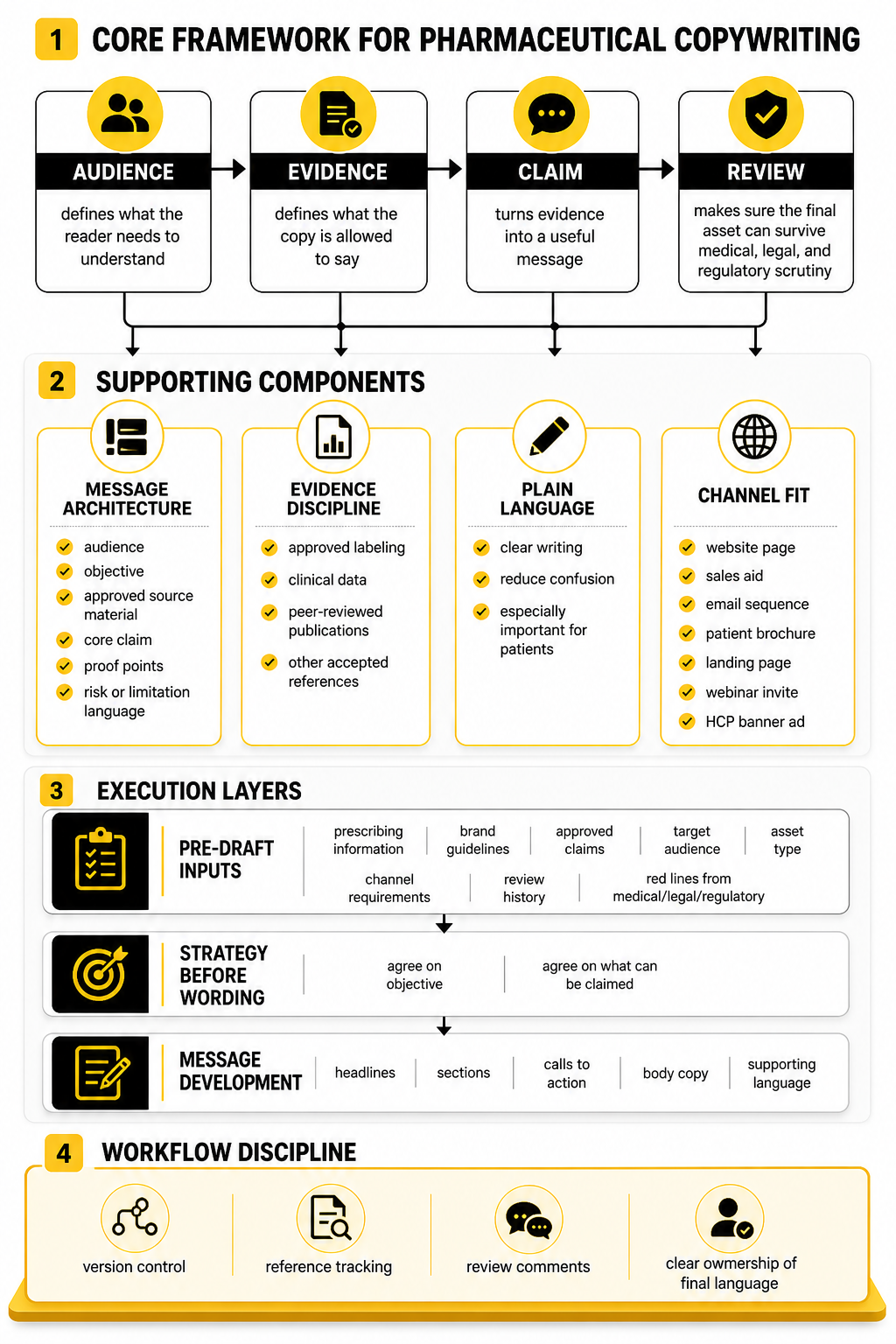
This framework keeps the writing practical. It prevents the copy from drifting into generic brand language that sounds good but says very little. It also prevents the opposite problem: copy that is technically accurate but so dense that no patient, physician, or stakeholder wants to keep reading.
The best pharmaceutical copywriter can move between these demands without losing the reader. They know when a claim needs a qualifier, when a sentence needs a source, when a benefit statement needs risk context nearby, and when a beautiful headline is not worth the review fight. That judgment is where the real value sits.
Core Components Of Effective Pharma Copy
Effective pharma copy usually starts with a clear message architecture. Before writing the asset, the team should know the audience, the objective, the approved source material, the core claim, the proof points, and the risk or limitation language that must travel with the message. Without that structure, copy rounds become messy because everyone is reacting to language instead of aligning on strategy.
The second component is evidence discipline. Pharmaceutical copy should make it easy to trace important statements back to approved labeling, clinical data, peer-reviewed publications, or other accepted references. The FDA’s final guidance on presenting quantitative efficacy and risk information is a useful reminder that numbers in promotional communication are not decoration. They need to be presented in a way that helps the audience understand the information rather than misread it.
The third component is plain language. Clear writing is not “dumbing it down.” It is respecting the reader’s time and reducing the chance of confusion. This is even more important when writing for patients, because health decisions already carry stress, uncertainty, and emotional load.
The fourth component is channel fit. A website page, sales aid, email sequence, leave-behind, patient brochure, landing page, webinar invite, and HCP banner ad all need different levels of depth. A practical content workflow tool like Fillout can help teams collect structured brief inputs before drafting starts, while a CRM and follow-up platform like GoHighLevel may fit agencies that manage compliant intake, segmentation, and lead follow-up workflows outside the regulated claim environment.
How Professional Pharma Copy Gets Implemented
Professional implementation starts before the first draft. The copywriter needs the prescribing information, brand guidelines, approved claims, target audience, asset type, channel requirements, review history, and any known red lines from medical, legal, or regulatory teams. Without those inputs, the draft may look polished but fail in review.
A good process also separates strategy from wording. First, the team agrees on what the asset must accomplish. Then it agrees on what can be claimed. Only after that should the pharmaceutical copywriter shape the message into headlines, sections, calls to action, body copy, and supporting language.
This is where pharma copywriting becomes a workflow discipline, not just a writing service. Teams need version control, reference tracking, review comments, and clear ownership of final language. For digital content operations, tools like Buffer can support scheduling for non-regulated social workflows, while a funnel builder such as ClickFunnels may be relevant for agencies building compliant lead-generation pages in adjacent healthcare or life sciences contexts where claims are carefully controlled. The tool does not create compliance. The process does.
The Claim Has To Match The Evidence
The biggest difference between ordinary marketing and pharmaceutical copywriting is the relationship between the claim and the proof behind it. In most commercial copy, the writer starts with the strongest angle and then finds support. In pharma, that order is dangerous. The pharmaceutical copywriter has to start with approved evidence, then shape the clearest message that the evidence can honestly support.
This is why vague “better life” language can be risky when it implies more than the data proves. A phrase like “helps patients get back to normal” may sound harmless, but it can suggest a quality-of-life outcome, functional improvement, or treatment expectation that may not appear in the approved labeling or supporting study data. Strong pharma copy avoids this by being specific about what was measured, who was studied, and what the treatment is approved to do.
The practical standard is simple: if a reviewer asks, “Where does this come from?”, the answer should be easy to find. The source might be the prescribing information, an approved claim bank, a clinical study, a medical review document, or a referenced publication. The FDA’s guidance on presenting quantitative efficacy and risk information is useful here because it reinforces the same idea: numbers and claims need enough context to prevent readers from drawing the wrong conclusion.
Risk Language Is Part Of The Message
Weak pharma copy treats risk language like a legal burden that gets added at the end. Strong pharma copy treats risk language as part of the reader’s decision-making process. That distinction matters because benefit-only writing can make an asset more persuasive in the short term while making it less credible, less useful, and harder to approve.
Fair balance is not just a formatting issue. It affects how the copy is structured, how close risk context appears to benefit claims, and whether the overall impression feels accurate. Product claim ads in the United States must present benefits and risks in a balanced way, and the FDA’s overview of prescription drug advertising basics explains that promotional communication has to include key risk information alongside approved uses.
A good pharmaceutical copywriter knows how to make this readable without making it sound like a warning label stapled to a brochure. The goal is not to scare the reader or soften the brand. The goal is to help the reader understand the treatment in a complete, responsible way.
Audience Context Changes The Copy
A healthcare professional does not read like a patient. A patient does not read like a payer. A caregiver does not read like a brand manager. That is why the same approved message often needs several versions, each built around a different decision context.
For HCPs, the copy usually needs clinical precision. It may need to explain indication, patient type, study design, endpoints, safety profile, dosing, contraindications, administration, or treatment sequencing. For patients, the same message may need to become simpler, warmer, and more practical, with plain explanations of what the medicine is for and what they should ask their healthcare professional.
This does not mean the writer changes the facts. It means the writer changes the route into the facts. The pharmaceutical copywriter’s job is to protect accuracy while making the message usable for the person actually reading it.
Plain Language Is A Compliance Advantage
Plain language is often treated like a style preference, but in pharma it can be a compliance advantage. Clear writing reduces ambiguity. Ambiguity is where many promotional problems begin, because readers can infer more than the copy technically says.
Patient-facing communication especially benefits from this discipline. The EMA’s product information materials describe product information as including the summary of product characteristics, labeling, and package leaflet, and the agency maintains templates and guidance for human medicine product information. That kind of structure exists because medicine information has to be understandable, consistent, and usable across real patient and professional settings.
A pharmaceutical copywriter should not hide behind technical language to sound credible. Credibility comes from accuracy, structure, and judgment. The best copy makes complex information easier to understand without stripping away the nuance that keeps it true.
The Review Process Shapes The Writing
Medical, legal, and regulatory review is not something that happens after the “real writing” is finished. In pharmaceutical copywriting, review is part of the writing environment from the beginning. The copy has to be built in a way that reviewers can evaluate, challenge, and approve without guessing what the writer meant.
That means drafts should be clean, traceable, and deliberate. Claims should not be scattered randomly across the page. Risk language should not feel disconnected from the benefit message. References should be clear enough that a reviewer can check them without rebuilding the writer’s logic from scratch.
This is why experienced pharma writers usually write with review comments in mind. They anticipate where a claim may be questioned, where a qualifier may be needed, and where the asset may drift too close to an unsupported implication. That saves time, but more importantly, it protects the integrity of the final communication.
Digital Channels Make Precision Even More Important
Digital pharma content creates extra pressure because the format is often short, fast, and easy to misread. A banner ad, search result, social post, email subject line, landing page hero, chatbot answer, or short-form video script may have very little room for context. That makes each phrase carry more regulatory and strategic weight.
This is especially relevant in social and influencer environments. Public enforcement discussions around prescription drug promotion have repeatedly focused on situations where benefit claims appear without adequate risk context, including celebrity and social media promotion. The practical takeaway is simple: short copy does not get a free pass.
A pharmaceutical copywriter working on digital assets has to think beyond the sentence. They need to understand the full user path, including where the reader lands, what risk information is visible, what claims appear above the fold, and how the message could be interpreted when separated from surrounding context. Digital speed does not remove responsibility. It raises the bar.
How Professional Pharma Copy Gets Implemented
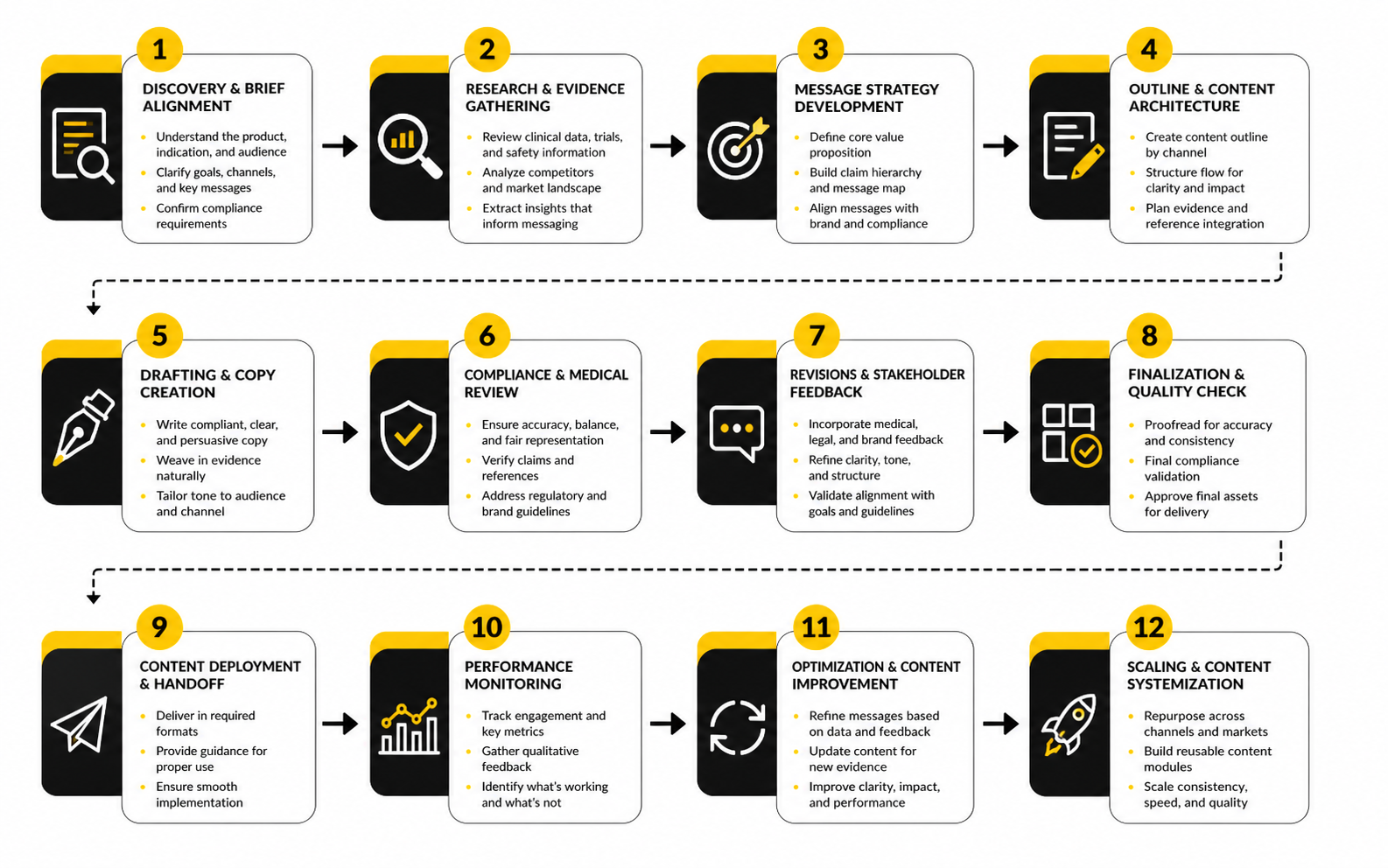
Implementation is where a pharmaceutical copywriter proves whether the strategy is real or just nicely written theory. The work has to move from approved evidence into actual assets that teams can review, revise, launch, and maintain. That requires a process that is boring in the best possible way: clear inputs, clean claims, traceable references, controlled revisions, and no guessing.
The process also needs to protect the team from the two problems that slow pharma content down most often. One is under-briefing, where the writer has to infer the audience, objective, claim boundaries, and channel rules. The other is over-writing, where the first draft tries to be too clever before the scientific and regulatory foundation is stable.
A strong implementation process solves both. It gives the pharmaceutical copywriter enough structure to write confidently and enough flexibility to make the content useful for the reader. That balance is the whole game.
Start With A Controlled Brief
The brief should not be a loose paragraph in an email. It should define the asset before anyone writes a headline. At minimum, it should include the audience, product or therapy area, indication context, approved sources, commercial objective, channel, geography, review pathway, required safety language, and any claims that are already approved or prohibited.
This is not bureaucracy. It is how you stop the draft from becoming a debate about what the project is supposed to be. When the brief is specific, the pharmaceutical copywriter can make better decisions about language, structure, evidence, and level of detail.
A practical brief should answer these questions:
Teams that collect these inputs consistently save themselves a lot of circular review. A form-based intake tool like Fillout can work well for agencies or internal teams that need structured content requests before drafting begins. The tool is not the strategy, but it can force the right questions to be answered before the work gets messy.
Build The Claim Map Before The Draft
A claim map is the bridge between evidence and copy. It lists the message the asset needs to communicate, the approved source that supports it, the exact evidence behind it, the wording limits, and any required risk or qualification language. Without this step, the draft can look polished while still being hard to defend.
This is especially important when the asset includes efficacy, safety, onset, durability, adherence, quality-of-life, economic, or comparative language. Even a small wording change can shift the meaning of a claim. “Reduced symptoms” is not the same as “improved daily life,” and “studied in” is not the same as “proven for.”
The FDA’s materials on prescription drug advertising basics make the standard clear: product claim ads need the drug name, at least one approved use, significant risks, and a balanced presentation of benefits and risks. That is why a claim map should not only capture what the brand wants to say. It should also capture what the reader needs to see so the overall message stays accurate.
Turn The Claim Map Into Message Architecture
Once the claim map is clear, the next step is message architecture. This is where the pharmaceutical copywriter decides what the reader should understand first, what proof should follow, and where risk context belongs. It is not final copy yet. It is the logic of the asset.
For an HCP sales aid, the architecture might begin with a clinically relevant patient type, move into the approved indication, then present study data, safety considerations, dosing, and a practical next step. For a patient webpage, the structure may begin with the condition or treatment conversation, then explain the medicine in plain language, set expectations, and encourage discussion with a healthcare professional. The order changes because the reader’s decision process changes.
This step prevents a common pharma content problem: dumping approved information onto a page without a narrative. Approved facts still need structure. The reader needs a path.
Draft With Review In Mind
The first draft should be written as if medical, legal, and regulatory reviewers are already in the room. That does not mean the copy should sound stiff. It means every important statement should have a reason for being there.
A pharmaceutical copywriter should avoid decorative claims, vague superiority language, unsupported emotional promises, and loose summaries of clinical data. The writing should be clear enough for the reader and traceable enough for the reviewer. That is a hard standard, but it makes the work stronger.
The best drafts also make risk and limitation language feel integrated rather than dumped in after the benefits. If the asset discusses efficacy, the surrounding context should help the reader understand the patient population, endpoint, timeframe, and safety considerations. The FDA’s guidance on quantitative efficacy and risk information reinforces the need to present numbers in a way that supports proper understanding, not just impact.
Create A Clean Review Package
A review package should make approval easier. It should include the draft, references, claim support, prescribing information or relevant source documents, required safety language, and any notes that explain strategic choices. Reviewers should not have to hunt for the logic behind the copy.
This matters because unclear review materials create unnecessary objections. If a reviewer cannot see where a claim came from, they may challenge the sentence even when the underlying idea is supportable. If the writer provides the claim source clearly, the conversation becomes more productive.
For complex teams, workflow tools can help keep comments, tasks, and approvals organized. A CRM or agency operations platform like GoHighLevel can support intake, follow-up, and client management for agencies working around regulated content. The key is to keep regulated claim decisions inside the proper medical, legal, and regulatory process, not buried in casual project chatter.
Revise Without Diluting The Strategy
Review comments are not just edits. They are signals about risk tolerance, evidence interpretation, audience clarity, and internal alignment. A good pharmaceutical copywriter does not treat every comment as a mechanical word swap. They look at what the reviewer is trying to protect, then revise in a way that keeps the asset useful.
This is where inexperienced writers often weaken the copy. They respond to each comment separately until the final asset becomes technically safe but strategically flat. The better approach is to revise the system: adjust the claim, reposition the proof, clarify the qualifier, or restructure the section so the message still lands.
Good revisions should make the copy cleaner, not heavier. If every review round adds more caveats, the team may need to revisit the claim map instead of patching the sentence. Strong pharma implementation is not about squeezing risky language through review. It is about building language that deserves to pass.
Prepare The Asset For Launch And Maintenance
Pharma content does not end at approval. It needs to stay accurate after launch. Label updates, safety changes, new data, indication changes, competitive shifts, and internal claim-bank updates can all affect copy that is already live.
That means every asset should have an owner, approval record, source trail, and review cadence. This is especially important for digital pages, email sequences, automated follow-ups, and reusable sales materials. If the asset can keep running in the background, it needs a maintenance plan.
For non-regulated scheduling and content operations, a tool like Buffer can help teams manage publishing workflows, while landing page tools such as Replo may be useful in adjacent life sciences or healthcare campaigns where approved language, claims, and review controls are handled properly. Again, tools do not make pharmaceutical marketing compliant. A disciplined process does.
Statistics And Data
Measurement in pharmaceutical copywriting is not about chasing the highest click-through rate. That is too shallow. A pharmaceutical copywriter needs to understand whether the content is attracting the right audience, communicating the right message, preserving balance, supporting the next step, and staying within approved claim boundaries.
The numbers matter because pharma content can “perform” in a way that is not actually useful. A sensational headline may lift clicks while creating the wrong expectation. A short landing page may increase form fills while leaving the reader under-informed. A strong measurement system looks beyond surface engagement and asks what the data means for clarity, trust, compliance, and commercial momentum.
That is especially important as healthcare and pharma budgets keep shifting toward digital. Healthcare and pharma digital ad spending in the United States is projected to reach $24.77 billion in 2025, which means more pharma messages are being tested, distributed, and optimized in environments where small wording choices can scale quickly. More distribution is useful only when the message is strong enough to deserve it.
What Pharma Copy Metrics Should Actually Measure
The first layer is visibility. This includes impressions, reach, search rankings, email deliverability, paid media exposure, and page visibility. These metrics tell you whether the message is being seen, but they do not tell you whether the message is working.
The second layer is engagement. This includes click-through rate, scroll depth, time on page, video completion, email opens, email clicks, content downloads, webinar registrations, and repeat visits. These numbers help show whether the reader is paying attention, but they still need context. A long time on page can mean the content is useful, or it can mean the page is confusing.
The third layer is action quality. This includes qualified inquiries, HCP resource requests, patient education downloads, rep-triggered follow-ups, sample requests where allowed, hub enrollment starts, appointment requests, and other meaningful next steps. For a pharmaceutical copywriter, this is where performance becomes more useful because it shows whether the copy helped the reader move forward responsibly.
The fourth layer is message quality. This is harder to measure, but it matters most. Teams should look at claim comprehension, risk comprehension, repeated questions, review objections, adverse-event routing accuracy, search intent alignment, and whether readers are taking the intended next step for the right reason.
The Analytics System Should Follow The Review System
Pharma teams often separate content review from performance measurement, but they should not be treated as unrelated. The claims that reviewers approve are the same claims marketers later measure. If a claim is central to the asset, the analytics plan should help the team understand whether that claim is being seen, understood, and acted on appropriately.
That means every important asset needs a measurement plan before launch. The plan should define the audience, primary objective, approved message, key conversion action, supporting engagement signals, and compliance watchpoints. It should also identify which numbers are directional and which numbers are decision-grade.
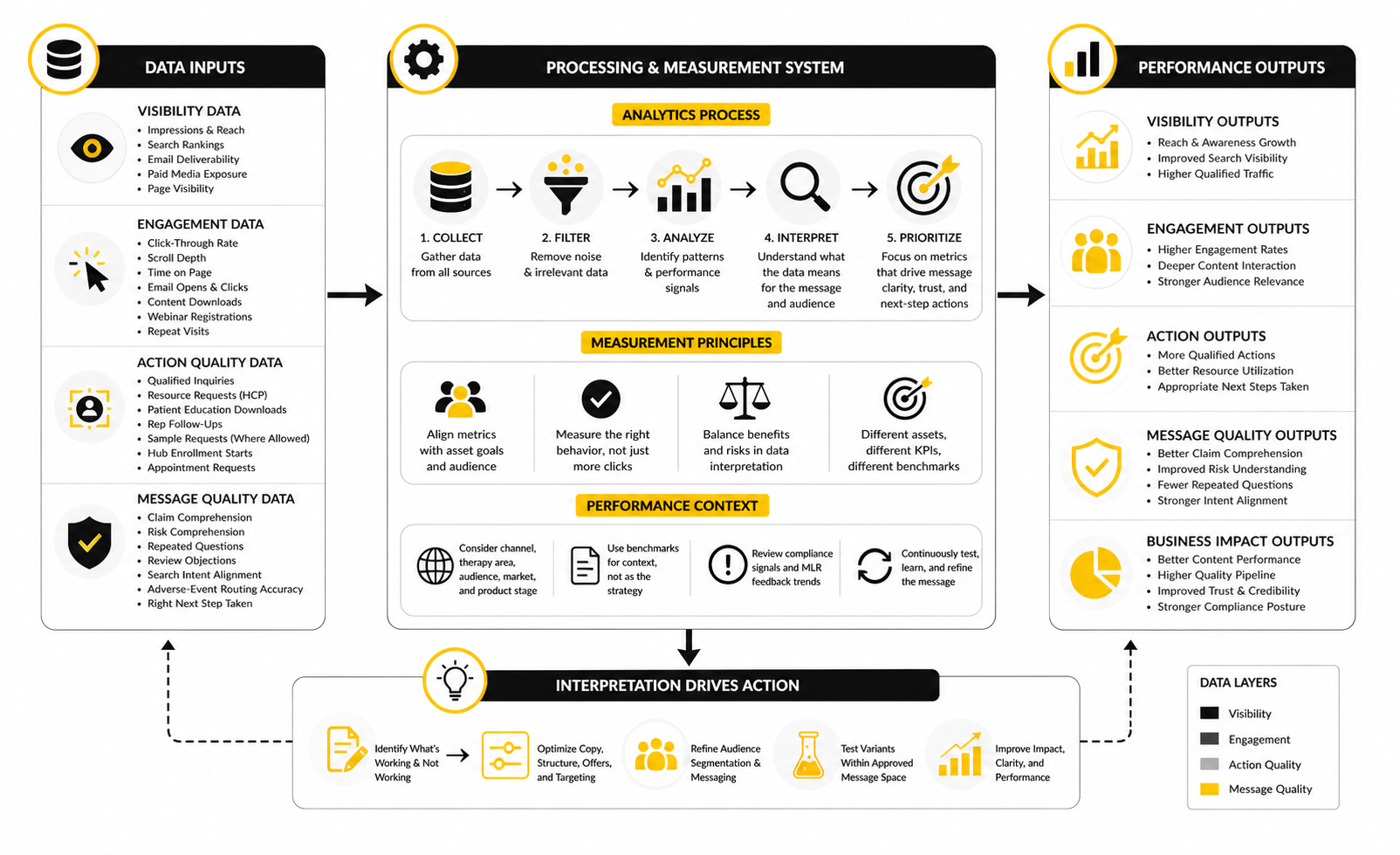
This is where pharma measurement becomes practical. If an HCP landing page has strong traffic but weak resource downloads, the problem may be the offer, the page structure, the audience targeting, or the copy’s relevance to clinical decision-making. If a patient education page has high exits near safety information, the team should not automatically hide or shorten the safety content. They should examine whether the page sets context clearly enough before that section appears.
Benchmarks Are Useful, But They Are Not The Strategy
Benchmarks are helpful when they stop teams from panicking over normal performance variation. They are dangerous when they become the strategy. A pharma campaign should not blindly copy a benchmark from another channel, therapy area, audience, geography, or product maturity stage.
For example, email benchmarks can help teams understand whether an HCP campaign is unusually weak or broadly within range. IQVIA’s Inbox Intelligence 2025 report focuses on 2024 life sciences email performance trends and the importance of aligning KPIs with campaign goals. The useful takeaway is not “hit this one magic number.” The useful takeaway is that broadcast emails, triggered emails, audience relevance, and campaign objective should be measured differently.
The same logic applies to paid media, SEO, webinars, rep-triggered content, and patient education pages. A branded prescription product page, an unbranded disease-awareness article, and an HCP dosing guide should not be judged by the same success metric. The pharmaceutical copywriter needs to know what the asset is supposed to do before anyone decides whether the data is good or bad.
Performance Signals Need Interpretation
A high click-through rate can mean the copy is relevant. It can also mean the headline is too broad, too emotional, or too curiosity-driven for a regulated medical topic. That is why performance data should be reviewed beside the actual language, not in a separate dashboard divorced from the content.
A low conversion rate can also have several meanings. The offer may be weak, the call to action may be unclear, the audience may be wrong, or the copy may have failed to build enough confidence. In pharma, it can also mean the copy did the responsible thing by encouraging a reader to consult a healthcare professional instead of pushing an inappropriate action.
This is why the best pharma teams treat analytics as a diagnostic tool. The question is not only “Did this convert?” The better question is “What did the reader understand, what did they do next, and does that behavior match the goal of the asset?”
Compliance Signals Are Performance Signals Too
Medical, legal, and regulatory feedback should be measured over time. If the same types of comments keep appearing, the team has a process problem, not just a copy problem. Common patterns include unsupported claims, unclear risk placement, overbroad audience language, vague superiority language, and patient-facing wording that is too technical.
FDA enforcement activity is another reminder that promotional performance cannot be separated from promotional responsibility. FDA materials note that warning letters related to pharmaceutical advertising dropped to one in 2023 and zero in 2024, while the agency later announced a renewed crackdown on deceptive drug advertising. Whether a team is working on a large national campaign or a small digital asset, the point is the same: copy quality is not only a marketing issue.
A pharmaceutical copywriter should learn from review outcomes the same way a performance marketer learns from campaign data. If reviewers repeatedly challenge a phrase, remove the ambiguity earlier in the process. If risk language keeps feeling bolted on, fix the message architecture instead of arguing over line edits.
The Best Metrics Depend On The Asset
Different pharma assets need different measurement priorities. A disease-awareness article may be judged by qualified organic traffic, scroll depth, return visits, and movement to an educational next step. A branded HCP page may be judged by clinical content engagement, resource downloads, rep follow-up requests, and interaction with dosing or safety sections.
A patient support page may need a different view again. The team may care about enrollment starts, support-resource engagement, call-center deflection, comprehension signals, and whether users can find practical next steps without confusion. In this context, “more clicks” is not automatically better. Better is better.
A simple measurement map can keep the team honest:
Data Should Drive Better Copy Decisions
The purpose of measurement is not to make every sentence shorter or every CTA louder. The purpose is to improve the match between message, reader, evidence, and action. Sometimes the data will show that the headline needs to be clearer. Sometimes it will show that the page needs stronger proof earlier. Sometimes it will show that the audience targeting is the real issue.
This is where disciplined testing helps. Teams can test structure, call-to-action language, educational framing, page order, email sequencing, and content depth without testing unsupported claims. A pharmaceutical copywriter should know how to improve performance inside the approved message space rather than trying to win by pushing the boundaries.
For operational reporting, agencies may use tools like GoHighLevel to manage pipeline visibility and follow-up workflows, while email platforms such as Brevo can support broader lifecycle communication outside the regulated claim decision itself. The important part is not the dashboard. The important part is whether the team knows which numbers should change the copy and which numbers are just noise.
Advanced Considerations For Serious Pharma Content
At a basic level, pharmaceutical copywriting is about clarity and compliance. At a higher level, it is about making strategic tradeoffs without losing the reader, weakening the science, or creating unnecessary review risk. This is where an experienced pharmaceutical copywriter becomes more valuable than a generalist who can simply write “clean copy.”
The difficult part is that pharma content rarely fails for one obvious reason. It fails because the audience is too broad, the claim is too ambitious, the channel is too compressed, the risk language feels detached, the review team is brought in too late, or the message tries to do five jobs at once. Advanced pharma copywriting is the discipline of spotting those problems before they become expensive.
This matters more now because pharma promotion is being watched more closely across digital channels. The FDA has publicly emphasized that prescription drug ads must not exaggerate benefits, must avoid misleading impressions, and must disclose important risks and limitations in its announcement on deceptive drug advertising enforcement. That does not mean brands should become timid. It means the copy has to be built with stronger judgment from the start.
The Tradeoff Between Persuasion And Precision
The temptation in pharma marketing is to make the copy more emotionally persuasive. That can be useful when the writing helps patients feel understood or helps HCPs recognize a practical treatment challenge. But emotion becomes a problem when it implies a result the evidence does not support.
Precision can create the opposite problem. A page can be so technically careful that the reader cannot tell what matters. That kind of copy may survive review, but it does not help the brand, the clinician, or the patient.
The best work sits between those extremes. A pharmaceutical copywriter should make the message human without making it loose. They should make it clear without making it simplistic. They should make it persuasive without making the claim bigger than the proof.
Off-Label Risk Needs Early Control
Off-label risk should not be handled at the final review stage. It should be controlled in the brief, the claim map, the structure, and the draft. If the content strategy depends on hinting at an unapproved use, the copy problem is really a strategy problem.
This is especially important in disease education, congress content, social media, search campaigns, and thought leadership. These formats can drift into broad clinical conversations where product implications become easy to create unintentionally. A sentence does not have to name the product to create risk if the surrounding context points the reader toward an unsupported use.
A practical safeguard is to define the boundary before drafting. The team should know which conditions, populations, outcomes, endpoints, comparisons, and treatment contexts are allowed. If those boundaries are unclear, the pharmaceutical copywriter should slow the project down before the draft becomes a cleanup job.
Global Content Cannot Be Copied Market To Market
Global pharma content sounds efficient until local rules enter the room. A message that works in the United States may not work in the United Kingdom, the European Union, Canada, Australia, or another market with different rules on prescription medicine promotion, patient information, and public-facing communication. Translation is not localization.
The UK is a clean example. The MHRA explains that general sales list, pharmacy, and over-the-counter medicines can be advertised to the public, while prescription-only medicines cannot be advertised to the public in its guidance on advertising medicines. The ABPI Code also sets standards for promotion to health professionals and relevant decision makers, plus requirements for information provided to patients and the public, as outlined in the 2024 pharmaceutical industry code.
That means a global master asset should be written as a controlled source, not as a finished local campaign. The pharmaceutical copywriter should separate universal scientific language from market-specific promotional language. That makes localization faster, cleaner, and safer.
Influencer And Social Content Needs Extra Discipline
Influencer content is attractive because it feels personal. That is also why it is risky. A patient ambassador, celebrity, clinician creator, or advocacy partner can create a stronger emotional connection than a brand page, but personal storytelling can easily move into unsupported treatment expectations, incomplete risk context, or unclear financial disclosure.
The FTC’s business guidance on endorsements, influencers, and reviews makes disclosure and endorsement practices a serious issue for marketers, while FDA resources on using social media point pharma teams toward guidance on character-limited platforms, misinformation correction, postmarketing submissions, and unsolicited off-label requests. A pharmaceutical copywriter working in this space has to think beyond the caption. They need to think about scripts, claims, comments, disclosures, moderation, screenshots, and what happens when the content gets shared out of context.
The safer approach is not to make influencer content robotic. The safer approach is to define the story boundaries, disclosure requirements, risk language, review process, and escalation rules before the creator starts drafting. In pharma, authenticity without guardrails is not a strategy. It is a liability.
AI Can Help The Workflow, But It Cannot Own The Judgment
AI can speed up research organization, brief drafting, outline development, variant generation, readability checks, and content repurposing. Used carefully, it can help a pharmaceutical copywriter move faster through low-risk drafting tasks. Used carelessly, it can produce confident language that sounds polished but is unsupported, inaccurate, or noncompliant.
This is the tradeoff. AI is useful for expanding options, but dangerous when it becomes the source of truth. Pharma copy still needs human review against approved labeling, scientific references, jurisdictional rules, brand standards, and medical-legal-regulatory requirements.
A good operating rule is simple: AI can assist the workflow, but it should never invent claims, summarize evidence without verification, or make final compliance calls. Tools such as Chatbase can be useful for controlled knowledge-base experiences when the source material and guardrails are carefully managed, and GoHighLevel AI can support broader marketing operations. But in pharmaceutical content, the approved source material still wins. Every time.
Scaling Pharma Content Requires A Content System
Scaling does not mean asking writers to produce more assets faster. That usually creates inconsistency, review overload, and quality drift. Real scaling means building a content system that lets teams reuse approved thinking without copying blindly.
The system should include an approved claim bank, audience-specific message architecture, reusable safety language, channel templates, reference standards, review checklists, and rules for adapting copy across formats. This gives the pharmaceutical copywriter a stronger starting point while keeping each asset tied to the right audience and channel.
A practical content system should include:
This is where workflow matters. A scheduling tool like Cal.com can help teams coordinate expert reviews and stakeholder meetings, while structured data collection through Fillout can keep requests consistent. The real value is not the software itself. The value is creating fewer gaps for bad inputs, vague claims, and late-stage surprises.
Common Mistakes That Create Compliance And Conversion Problems
The most common mistake is trying to make pharma copy sound like consumer tech copy. That usually leads to vague transformation language, overconfident CTAs, and a tone that does not match the seriousness of the topic. Readers can feel when a brand is pushing too hard.
Another mistake is burying the useful point under too much approved language. Compliance does not require confusion. If the reader cannot understand what the page is about, who it is for, and what they should do next, the copy is not doing its job.
A third mistake is treating approval as the finish line. Approval means the asset passed review at a point in time. It does not mean the asset will remain accurate forever, perform well in-market, or still reflect the latest label, evidence, and campaign strategy six months later.
How To Hire, Brief, And Work With A Pharmaceutical Copywriter
Hiring a pharmaceutical copywriter is not only about finding someone with a nice portfolio. You need someone who understands claim support, audience segmentation, review workflows, source discipline, and the difference between persuasive writing and risky overstatement. The writing samples matter, but the process behind the samples matters more.
A strong candidate should be able to explain how they handle prescribing information, claim banks, MLR feedback, patient-friendly language, HCP materials, digital constraints, and revisions. They should also be comfortable asking hard questions before writing. That is a good sign, not a delay tactic.
When you brief them, give them the real materials. Do not ask them to “make it punchy” without showing the evidence, claim boundaries, safety requirements, and review expectations. A pharmaceutical copywriter can only protect the message if they can see the rules of the game.
Final Checks Before Publishing Pharma Copy
Before a pharmaceutical copywriter hands over final copy, the asset needs one last disciplined pass. Not a polish pass. A risk-and-clarity pass. This is where the team checks whether the message still matches the evidence, whether the reader can understand the next step, and whether the content works as a complete system rather than a set of approved sentences.
This final layer matters because pharma content often changes during review. A headline gets softened, a qualifier gets added, a safety statement moves, a claim gets narrowed, and suddenly the page technically passes but no longer flows. The final check makes sure the approved version still communicates clearly.
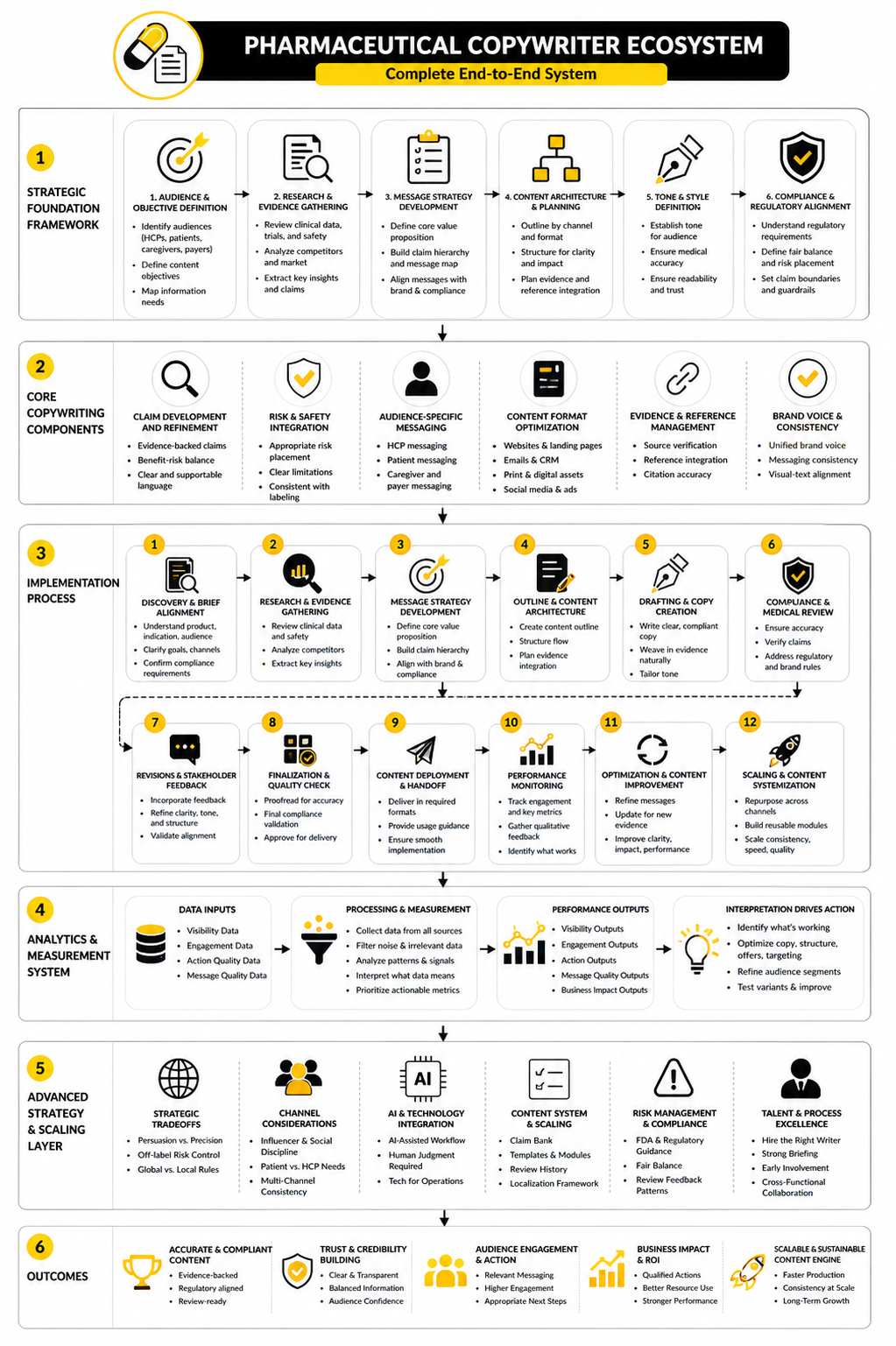
The easiest way to think about it is simple: every asset should be accurate, useful, traceable, balanced, and maintainable. If one of those breaks, the copy is not finished. It is just formatted.
What does a pharmaceutical copywriter do?
A pharmaceutical copywriter writes marketing, educational, and promotional content for pharmaceutical brands, healthcare agencies, life sciences companies, and related medical organizations. Their work can include HCP materials, patient education pages, disease-awareness content, email campaigns, landing pages, sales aids, banner ads, video scripts, brochures, and website copy. The job is not just writing attractive language; it is turning approved evidence into clear, responsible communication.
A good pharmaceutical copywriter understands how to work with prescribing information, claim support, fair balance, medical review, and audience-specific messaging. They know that every important sentence has to be defensible. That is what separates pharma copywriting from ordinary brand copy.
How is pharmaceutical copywriting different from medical writing?
Medical writing often focuses on scientific, clinical, regulatory, or educational documents such as manuscripts, clinical study reports, medical affairs materials, and scientific publications. Pharmaceutical copywriting is usually more focused on persuasive communication, brand messaging, campaign assets, and reader action. The overlap is real, but the purpose is different.
A pharmaceutical copywriter needs enough scientific understanding to write accurately, but they also need commercial judgment. They have to make the message clear, usable, and engaging without overstating what the evidence supports. That combination is rare, which is why experienced pharma writers are valuable.
Does pharma copy always need to go through MLR review?
Promotional pharmaceutical content usually needs medical, legal, and regulatory review before use. The exact process depends on the company, market, product type, channel, and whether the asset is promotional, educational, scientific, or internal. Prescription drug promotion in the United States is governed by rules such as 21 CFR Part 202, so teams should treat review as part of the workflow rather than an afterthought.
The safest assumption is that any external asset involving a product, claim, indication, efficacy, safety, or treatment positioning needs formal review. Even unbranded content can require careful review if it sits close to a brand strategy. When in doubt, clarify the review path before drafting.
What makes a pharma claim risky?
A claim becomes risky when it says or implies more than the approved evidence supports. This can happen through direct wording, comparison, emotional framing, missing context, selective data, vague benefit language, or visuals that create the wrong impression. A claim does not have to be dramatic to be a problem.
For example, “works fast” may require specific onset data. “Helps patients regain control” may imply a quality-of-life result that needs evidence. “Preferred by doctors” may require substantiation and careful context. A pharmaceutical copywriter should catch these issues before reviewers have to.
Can pharma copy be persuasive and compliant at the same time?
Yes, but the persuasion has to come from clarity, relevance, evidence, and reader understanding. It should not come from exaggeration, fear, pressure, or unsupported emotional promises. Strong pharma copy persuades by making the right information easier to understand and act on.
This is where craft matters. A compliant page can still have a strong headline, a clear structure, sharp subheads, useful calls to action, and a confident tone. The copy just has to earn its confidence.
What should be included in a pharma copywriting brief?
A strong brief should include the audience, geography, product or therapy area, indication context, asset type, channel, commercial goal, approved sources, required risk language, review pathway, and any known claim limitations. It should also explain what the reader should do after engaging with the asset. Without that, the writer has to guess.
The brief should also include background materials such as prescribing information, brand guidelines, previous review comments, approved claim banks, clinical references, and market research where available. A pharmaceutical copywriter can write faster and better when the rules are visible from the beginning. Good inputs produce cleaner drafts.
How should pharma teams measure copy performance?
Pharma teams should measure copy performance through a mix of visibility, engagement, action quality, and message quality. Traffic and clicks matter, but they are not enough. The team also needs to know whether the right audience understood the message and took an appropriate next step.
Useful signals can include qualified page visits, scroll depth, section engagement, downloads, HCP resource requests, webinar registrations, patient support actions, email behavior, and repeated questions from users or field teams. Review feedback is also a performance signal. If the same claim issues keep appearing, the copy system needs improvement.
Can AI replace a pharmaceutical copywriter?
AI can support parts of the workflow, but it should not replace the judgment of an experienced pharmaceutical copywriter. It can help organize notes, draft outlines, create variants, simplify language, and check readability. It should not invent claims, interpret clinical evidence without verification, or make compliance decisions.
Pharma content depends on approved sources, regulatory context, medical accuracy, and risk judgment. AI can sound confident while being wrong, incomplete, or too broad. The safest use is controlled assistance under human review, not autonomous pharma copy production.
What is fair balance in pharma copy?
Fair balance means the communication presents benefits and risks in a way that does not mislead the reader. It affects structure, proximity, emphasis, formatting, and the overall impression of the asset. Risk information should not feel hidden, minimized, or disconnected from benefit claims.
The FDA’s explanation of prescription drug advertising basics makes clear that product claim ads must present benefits and risks in a balanced way. In practical terms, a pharmaceutical copywriter should think about fair balance while building the asset, not after the benefit copy is finished.
What types of assets does a pharmaceutical copywriter usually create?
A pharmaceutical copywriter may create branded websites, unbranded disease education, HCP emails, patient brochures, sales aids, landing pages, banner ads, social media copy, video scripts, rep-triggered emails, congress materials, CRM content, and patient support content. The asset mix depends on the brand, lifecycle stage, audience, and market.
The writing style changes by channel. A sales aid needs a different structure than a patient landing page. An HCP email needs a different level of detail than an awareness article. The writer’s job is to adapt the message without changing the approved meaning.
How do you know if a pharmaceutical copywriter is good?
A good pharmaceutical copywriter asks precise questions before writing. They want to know the audience, source material, claim boundaries, risk requirements, review path, channel, and business objective. They do not rush into clever headlines before understanding what can actually be said.
Their samples should show clear structure, evidence discipline, audience awareness, and readable language. Their process should show that they can work with medical, legal, regulatory, brand, and strategy teams. The best ones make the work easier for everyone involved.
What is the biggest mistake pharma brands make with copy?
The biggest mistake is treating copy as decoration instead of strategy. Teams often bring in a writer after the claim, audience, offer, and review logic are already unclear. Then they expect better wording to fix a broken foundation.
A pharmaceutical copywriter can improve language, but they cannot make unsupported claims safe or unclear strategy effective. The work gets better when the writer is involved earlier. That is when they can help shape the message before the asset becomes expensive to revise.
Should patient-facing pharma copy use simple language?
Yes. Patient-facing pharma copy should be clear, direct, and easy to understand without becoming inaccurate. Simple language helps reduce confusion and supports better conversations between patients and healthcare professionals.
That does not mean removing important risk information or oversimplifying clinical facts. It means explaining the point in a way real people can follow. A patient should not need a medical degree to understand what the content is trying to say.
How should pharma copy handle calls to action?
Calls to action should match the audience, channel, and regulatory context. For HCPs, a CTA might invite them to review clinical data, download a dosing guide, request information, or speak with a representative. For patients, it may encourage them to learn more, download a discussion guide, explore support resources, or talk to a healthcare professional.
The CTA should not pressure the reader into an inappropriate decision. It should support the next responsible step. In pharma, a good CTA is clear, useful, and aligned with the role the reader actually plays.
Build a stronger local presence with BAAM AI
Turn your website, Google profile, social channels, and AI visibility into one growth engine
Most businesses do not need more random marketing activity. They need a consistent presence system that helps the right people find them, trust them, and take action. BAAM AI brings strategy, local SEO, website updates, Google Maps visibility, social content, AI-search readiness, media production, and reporting into one practical monthly engine.
If you want your marketing to keep working after the campaign ends, start with a free BAAM AI presence audit. See how your business shows up today and where the fastest visibility wins are at BAAM AI.