
BAAM AI Blog
Persuasive Copywriting: A Practical Framework For Words That Convert
Persuasive copywriting is not about clever lines, pressure tactics, or making a weak offer sound better than it is. It is the work of translating real customer motivation into clear, believable, action-focused...
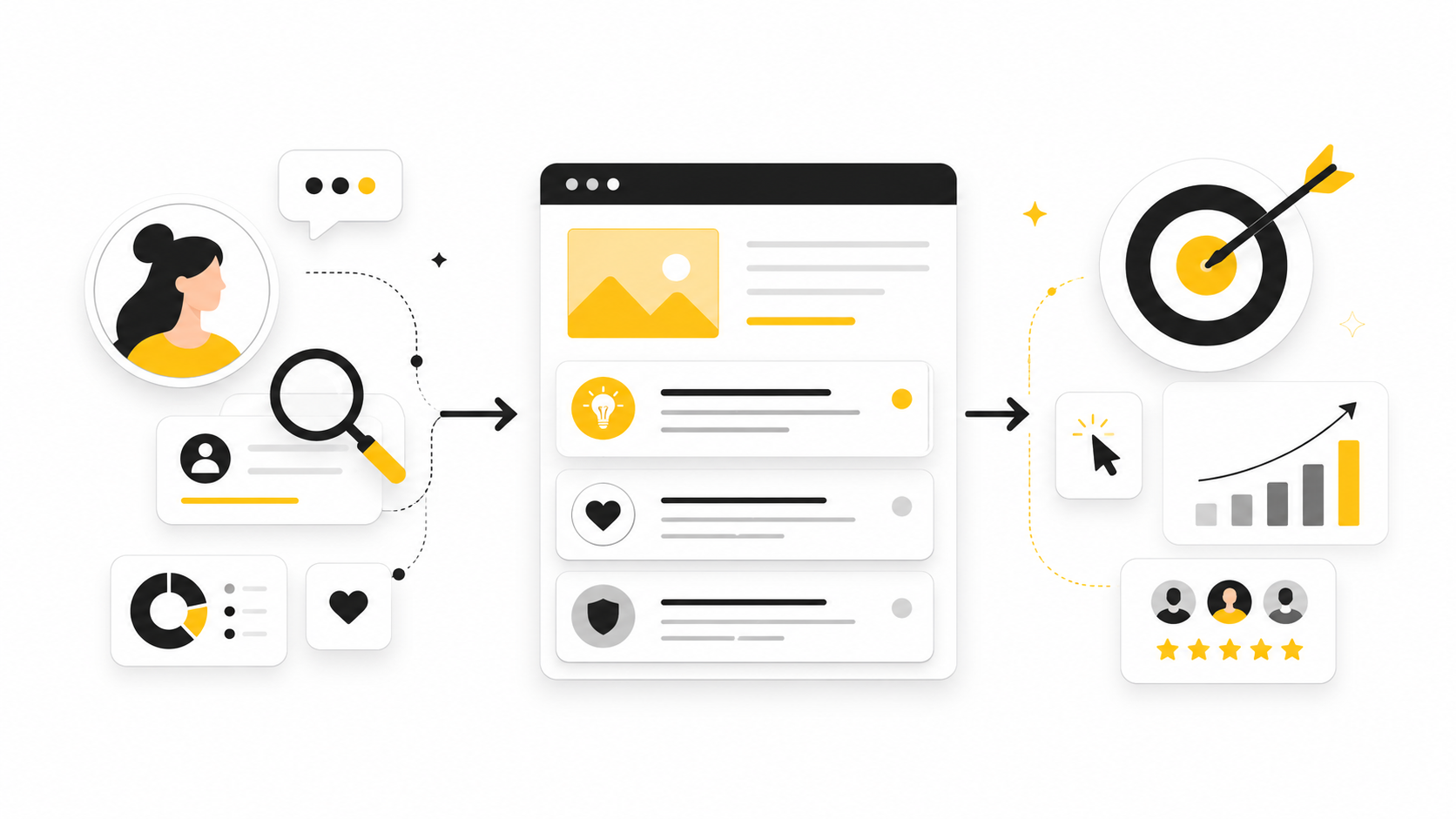
Persuasive copywriting is not about clever lines, pressure tactics, or making a weak offer sound better than it is. It is the work of translating real customer motivation into clear, believable, action-focused language. Done well, it helps the right person understand the value of an offer faster, trust it more deeply, and take the next step with less friction.
That matters because buyers are not reading in a calm, perfect environment. They are scanning pages, comparing options, checking reviews, opening too many tabs, and filtering out anything that feels vague or exaggerated. Nielsen Norman Group’s long-running eye-tracking research found that online reading is heavily shaped by scanning behavior, with its second edition built from studies involving more than 500 participants and over 750 hours of eye-tracking time (Nielsen Norman Group).
The job of persuasive copywriting is to meet that reality directly. It gives people the information they need in the order they need it: problem, relevance, promise, proof, mechanism, offer, risk reduction, and action. When the copy skips one of those steps, the reader may still be interested, but interest alone does not reliably create movement.
Persuasion also has to feel personal without feeling invasive. Buyers expect relevance, but they are increasingly alert to lazy automation and generic personalization. McKinsey’s research found that 71% of consumers expect personalized interactions and 76% get frustrated when that does not happen (McKinsey), while Salesforce reported that 71% of customers feel increasingly protective of their personal information (Salesforce).
That is the tension modern copy has to handle. It must be specific enough to feel relevant, but honest enough to build trust. It must sell clearly, but it cannot rely on hype, because trust is now part of the buying decision itself.
this guide will build persuasive copywriting as a practical system, not a pile of formulas. Each part will handle one layer of the work so the full article moves from strategy to execution to optimization. The section names below are the real sections the rest of the article will continue using.
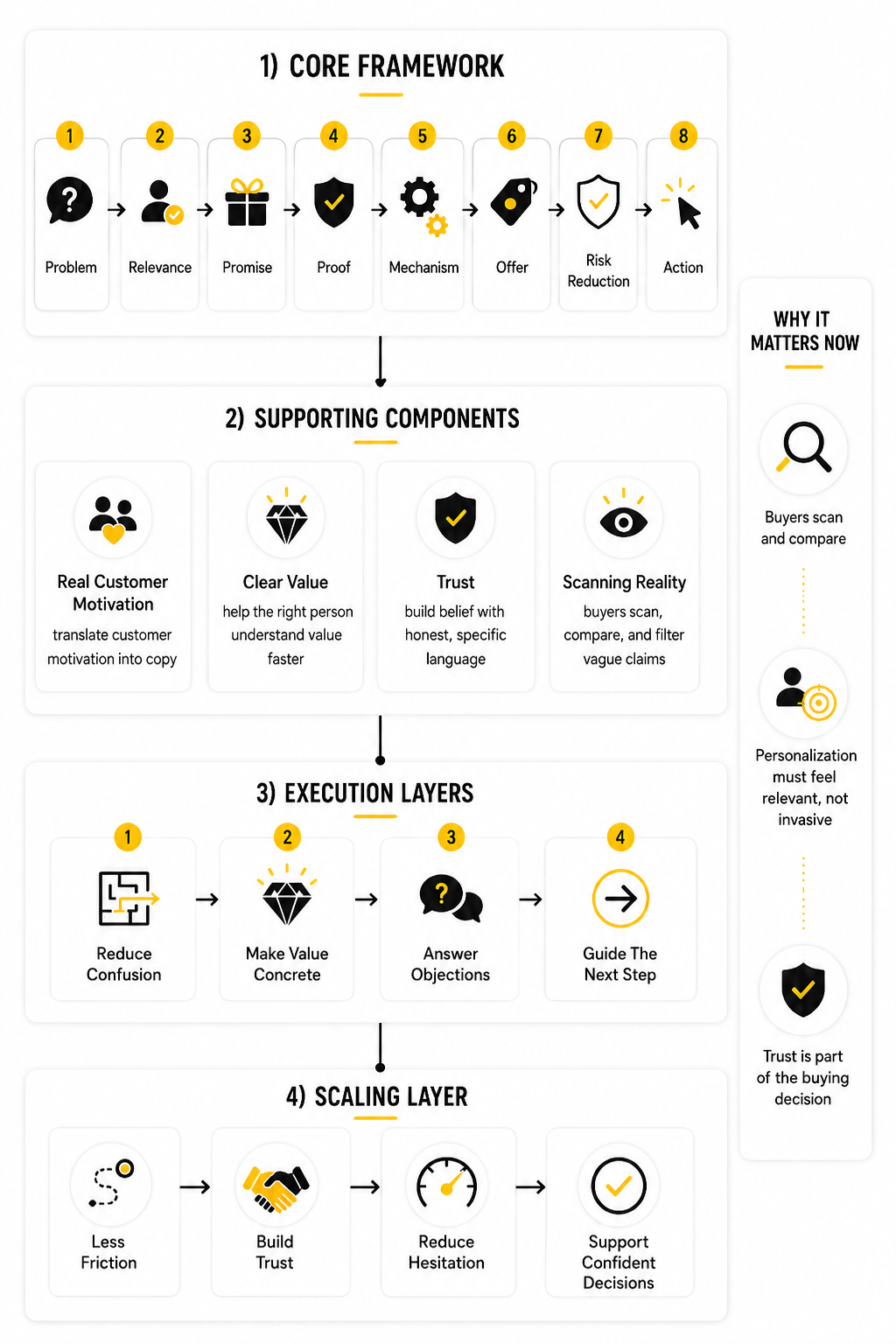
Why Persuasive Copywriting Matters Now
Most marketing problems look like traffic problems at first. The page is not converting, the email is not getting replies, the ad is getting clicks but not sales, or the funnel feels leaky. But often, the real issue is that the words are not doing enough work.
Persuasive copywriting matters because attention is expensive and trust is fragile. Baymard Institute’s ecommerce UX research is grounded in 200,000+ hours of large-scale research and user testing, and its product-page research keeps pointing back to the same practical truth: shoppers need clear, findable information before they feel confident enough to continue (Baymard Institute). Copy is not decoration on top of the experience; it is part of the experience.
This is why better copy rarely comes from “sounding more persuasive.” It comes from reducing confusion, making the value concrete, answering objections before they stall the decision, and guiding the reader toward one obvious next step. Strong persuasive copy does not push harder; it removes the reasons people hesitate.
The Persuasive
Core Components Of Persuasive Copy
Once the research is clear, execution gets much easier. You are no longer trying to sound smart on a blank page. You are assembling the message from the strongest pieces: the reader’s situation, the promise, the mechanism, the proof, the offer, and the next step.
This is where persuasive copywriting becomes practical. Each component has a job. If one component is weak, the whole message feels weaker, even if the writing itself sounds polished.
Think of this section as the working parts of the machine. You can use them for a landing page, a sales email, a product page, a webinar registration page, a checkout flow, or a full funnel. The format changes, but the persuasion logic stays surprisingly consistent.
The Headline Creates Relevance
The headline does not need to be clever. It needs to make the right person stop and think, “This is probably for me.” That is the first win.
A strong headline usually identifies one of three things: the audience, the outcome, or the problem. The best headlines often combine two of them without becoming overloaded. If a headline tries to say everything, it usually says nothing clearly.
This matters because people scan before they commit. Nielsen Norman Group’s eye-tracking work shows that web users often scan pages in patterns rather than reading every word, which means the first visible words carry a heavy burden (Nielsen Norman Group). Your headline has to earn attention before the body copy can earn trust.
The Lead Builds Momentum
The lead is the opening section after the headline. Its job is not to repeat the headline in longer form. Its job is to make the reader feel understood and pull them deeper into the argument.
A good lead usually confirms the problem, sharpens the stakes, and points toward a better way. It should not feel like a slow warm-up. Online readers are impatient, and if the lead is vague, they assume the rest of the page will be vague too.
This is why the first few lines should avoid empty setup. Do not begin with a history lesson unless the history is essential. Do not open with generic statements like “In today’s digital world.” Start where the buyer’s attention already is.
The Problem Section Creates Urgency
The problem section is where you make the reader’s current situation harder to ignore. This does not mean using fear for the sake of fear. It means helping the reader see the real cost of staying where they are.
For a sales page, the problem might be wasted ad spend, poor lead quality, slow follow-up, confusing product pages, or sales calls with people who were never properly qualified. For an email, the problem might be a missed opportunity or a bottleneck that is quietly getting worse. For an ecommerce product page, the problem may be uncertainty about fit, quality, use case, or delivery.
The point is simple: urgency comes from clarity. If the reader cannot see why the problem matters now, the offer can still sound useful, but it will not feel necessary.
The Promise Shows The Desired Change
The promise tells the reader what becomes better after they act. It should be specific enough to create desire and honest enough to remain believable. That balance matters.
A weak promise says something like “grow faster” or “save time.” A stronger promise explains what kind of growth or time savings the reader can realistically expect and why it matters in their context. The more concrete the promise, the easier it is for the reader to picture the outcome.
This is also where restraint helps. Overclaiming may create a short-term spike in attention, but it creates long-term doubt. Persuasive copywriting works best when the reader feels, “That sounds valuable, and I can believe it.”
The Mechanism Makes The Promise Believable
A promise without a mechanism feels like a wish. The mechanism explains how the outcome happens. It gives the reader a reason to believe the offer is different from every other option making similar claims.
For software, the mechanism may be automation, segmentation, AI assistance, templates, analytics, or a workflow that removes manual steps. For a service, it may be a diagnostic process, a research method, a delivery system, or a specialized way of solving a narrow problem. For a course or consulting offer, it may be the framework that turns scattered effort into a repeatable path.
This is especially important when the market is crowded. If you use a platform like GoHighLevel, ClickFunnels, or systeme.io, the copy should not just say “build funnels.” It should explain the specific funnel logic, follow-up sequence, segmentation, and conversion path that make the setup persuasive.
The Proof Reduces Risk
Proof is not there to decorate the page. It exists because the reader is deciding whether to trust you. That decision gets sharper when money, reputation, time, or internal approval is involved.
Proof can include customer testimonials, usage numbers, product screenshots, demos, expert reviews, third-party research, before-and-after comparisons, transparent methodology, or direct evidence inside the product experience. The key is relevance. Proof that does not match the reader’s concern is less useful than a smaller piece of proof that speaks directly to the doubt they actually have.
Trust has become a serious buying factor, not a soft brand metric. Edelman’s 2025 brand trust research found that among people using generative AI platforms, 91% use them for shopping activities such as researching brands, comparing products, or summarizing reviews (Edelman). That means your proof does not only persuade readers on your page; it also has to survive comparison, summaries, reviews, and outside verification.
The Offer Makes The Value Easy To Evaluate
The offer is the complete deal the reader is being asked to consider. It is not just the product, service, or lead magnet. It includes the outcome, deliverables, price, bonuses, support, guarantees, timeline, limitations, and next step.
Many businesses have decent products but weak offers because the value is hard to understand. The reader has to work too hard to figure out what they get, who it is for, how it works, and why it is worth the cost. That friction kills momentum.
A strong offer feels clear. It packages the value in a way that makes comparison easier, not harder. If the reader has to decode the offer, the copy has already made the decision heavier than it needed to be.
The Call To Action Turns Interest Into Movement
The call to action should match the level of commitment the reader is ready for. A cold visitor may need to watch a demo, take a quiz, download a checklist, or start a free trial. A high-intent visitor may be ready to book a call, request pricing, or buy now.
This is where many pages become either too timid or too aggressive. A weak CTA hides the next step. An aggressive CTA asks for too much before the reader has enough confidence.
Good CTAs are direct and specific. They tell the reader what happens next and make the action feel like a natural continuation of the page. If the copy has done its job, the CTA does not need to shout.
Professional Implementation Across Pages, Emails, Ads, And Funnels
Implementation is where strategy either turns into revenue or stays theoretical. You can understand the framework perfectly and still lose conversions if the copy is placed in the wrong order, matched to the wrong audience, or disconnected from the actual buying journey. This is why professional copywriting is part writing, part architecture.
The goal is to make every touchpoint do one clear job. Ads create qualified attention. Landing pages turn that attention into trust and action. Emails continue the conversation. Sales pages deepen the argument. Checkout copy removes final doubt.
Gartner’s B2B buying research shows how important this is in more complex sales environments, where 75% of B2B buyers prefer a rep-free sales experience, but purely self-service digital purchases can increase purchase regret when buyers do not get the right support (Gartner). That is a copy problem as much as a sales problem. The words have to guide people, not just present information.
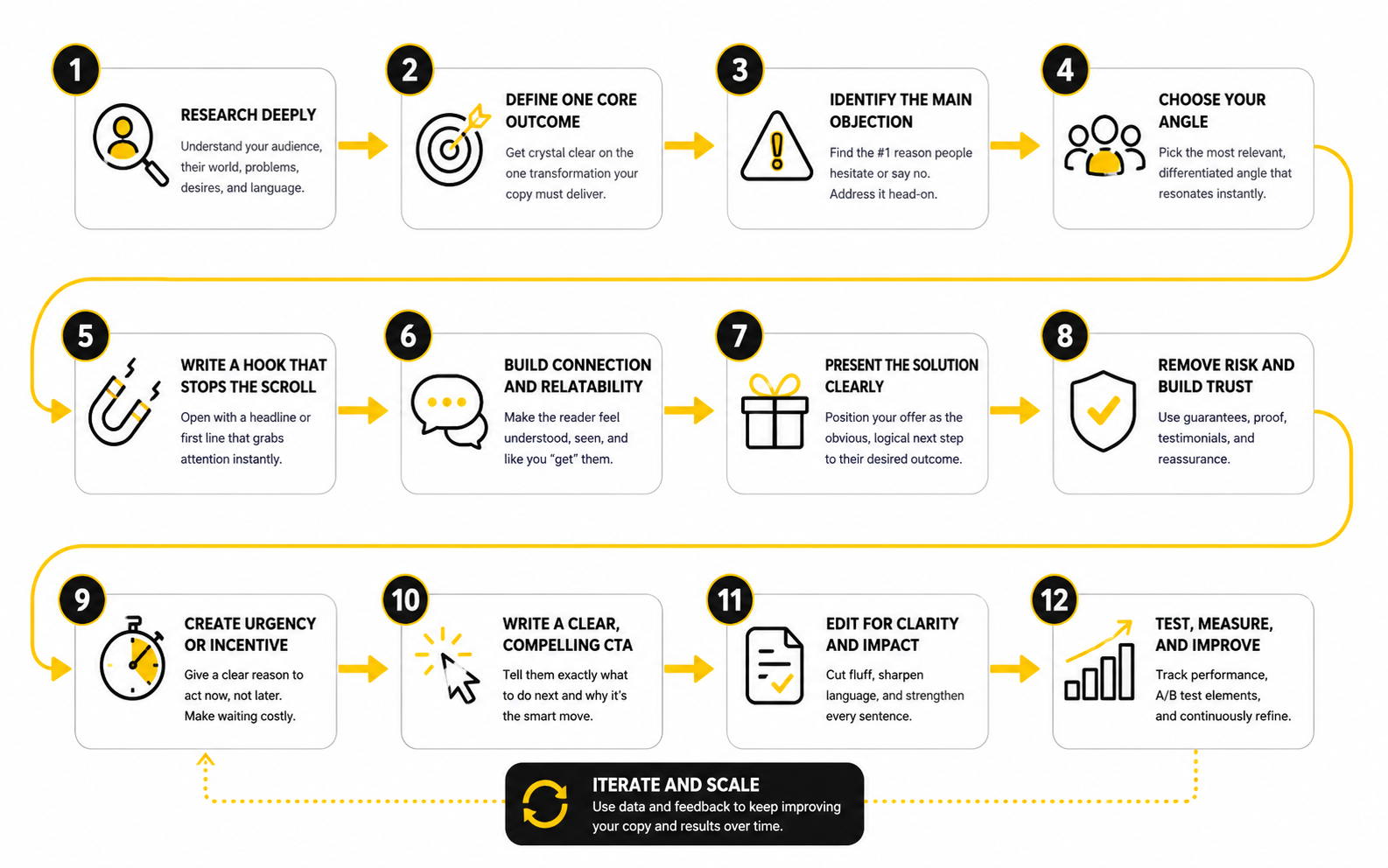
Step 1: Define The Page Or Message Goal
Before writing any asset, define the one action it should create. A landing page might exist to generate booked calls. An email might exist to get replies. An ad might exist to qualify interest. A product page might exist to help the buyer choose with confidence.
This sounds obvious, but it prevents a major mistake: trying to make one piece of copy do every job at once. When the goal is unclear, the message becomes bloated. It includes too many angles, too many CTAs, and too much information in the wrong place.
The goal should be specific enough that you can judge whether the copy worked. “Educate the audience” is vague. “Get qualified agency owners to book a demo after seeing the cost of slow lead follow-up” is useful.
Step 2: Match The Copy To Awareness Level
A reader who knows the problem and wants a solution does not need the same copy as someone who is still unsure what is causing their pain. This is why awareness level matters. It tells you how much context the copy needs before the offer appears.
Problem-aware readers need help naming the issue and understanding the cost of inaction. Solution-aware readers need comparison, differentiation, and proof. Product-aware readers need risk reduction, pricing clarity, objections handled, and a direct next step.
If you mismatch the copy, you create friction. Too much explanation can bore high-intent readers. Too little context can confuse early-stage readers. Persuasive copywriting works better when it respects how ready the reader actually is.
Step 3: Build The Message Before The Draft
Do not open a blank document and try to write the final version immediately. Build the message first. This means listing the main promise, core pain points, proof points, objections, differentiators, and CTA before turning anything into polished copy.
This process keeps the writing honest. It also makes gaps obvious. If you cannot explain the mechanism clearly in rough notes, you will not magically explain it well in the final draft.
The draft becomes easier once the message is built. You are not inventing from scratch. You are choosing the strongest order for ideas that already have a reason to be there.
Step 4: Write For Scanning First
Most readers do not begin by carefully reading every sentence. They scan the headline, subheads, bullets, bolded phrases, page structure, buttons, and proof elements. If those pieces do not create a coherent argument, the full copy may never get read.
This does not mean writing shallow copy. It means making the structure do more work. Subheads should carry meaning. Bullets should be specific. Paragraphs should be short enough to invite reading instead of creating resistance.
Baymard’s ecommerce research repeatedly shows that product pages need clear, accessible information to support decision-making, especially across product details, images, variations, shipping, returns, and compatibility (Baymard Institute). That same principle applies beyond ecommerce. The more easily a reader can find the information they care about, the more persuasive the page becomes.
Step 5: Add Proof At The Point Of Doubt
Do not save all credibility for the bottom of the page. Add proof where the reader needs it. If the headline makes a bold promise, support it early. If the page introduces a new mechanism, show why it works. If the offer asks for a meaningful commitment, reduce risk before the CTA.
This is one of the fastest ways to improve a page without rewriting everything. Look for every moment where the reader might silently ask, “Why should I believe this?” Then place the right proof nearby.
The proof does not always need to be a testimonial. It can be a screenshot, feature explanation, process breakdown, comparison point, data point, guarantee, or demo. The best proof is simply the proof that answers the doubt in that exact moment.
Step 6: Tighten The Copy Around Action
After the first draft, remove anything that does not help the reader move forward. This is not about making copy short for the sake of being short. Long copy can work when the decision needs more context. But every sentence should earn its place.
Look for vague claims, repeated benefits, generic adjectives, and sections that explain the business more than they help the buyer. Replace them with sharper language, clearer structure, or stronger proof. Editing is where a lot of the persuasion actually appears.
The final version should feel easy to follow. The reader should always know where they are in the argument, why the point matters, and what to do next. That is the standard.
Measurement, Optimization, Ethics, And FAQ
Statistics And Data
Persuasive copywriting should be measured by behavior, not by how much the team likes the words. A headline can sound strong in a meeting and still fail on the page. A CTA can feel obvious to the business and still confuse the person reading it for the first time.
The point of analytics is not to turn copywriting into a spreadsheet exercise. The point is to see where belief breaks down. When you understand where people stop, hesitate, click, skim, abandon, reply, or buy, you can improve the message with a much sharper hand.
This is also why benchmarks are useful but dangerous. They can show whether performance is obviously weak, but they cannot tell you what your audience should do, what your offer is worth, or why your page is underperforming. Use benchmarks as a starting point, not as the final judge.
What Conversion Rate Really Tells You
Conversion rate tells you how many people took the action you wanted after seeing the page, email, ad, or funnel step. That makes it important, but it does not make it complete. A higher conversion rate is only good if the action creates the right kind of lead, customer, or revenue.
For example, a landing page that gets more form fills may still be worse if the leads are unqualified. A sales page that gets fewer purchases may still be better if it attracts higher-value buyers with lower refund rates. A checkout page that converts well may still hide a messaging problem earlier in the funnel.
Unbounce’s conversion benchmark research is useful here because it is based on more than 57 million conversions across over 41,000 landing pages (Unbounce). The lesson is not that every business should chase one universal number. The lesson is that conversion performance changes by market, intent, offer type, and page context.
Benchmarks Should Trigger Questions, Not Panic
Benchmarks are best used as diagnostic prompts. If your landing page conversion rate is far below similar pages in your category, that is a signal to investigate. It does not automatically mean the copy is bad, but it does mean the current message may not be matching the visitor’s intent.
The same applies when performance looks unusually high. A strong number can hide weak economics if the leads do not close, the customers churn quickly, or the offer attracts bargain hunters who never buy again. Numbers need context before they become useful.
This is why persuasive copywriting should be judged across the full journey. Look at ad click-through rate, landing page conversion rate, email engagement, booked-call quality, sales close rate, checkout completion, retention, and customer feedback together. One metric rarely tells the whole story.
The Copy Metrics That Actually Matter
The best metrics depend on the asset, but the goal is always the same: find the moment where persuasion is working or failing. For a landing page, that might mean scroll depth, CTA clicks, form starts, form completions, and qualified conversions. For an email, it might mean opens, clicks, replies, conversions, unsubscribes, and revenue per send.
For ecommerce copy, product page engagement and checkout behavior matter heavily. Baymard’s long-running cart abandonment research places the average cart abandonment rate at 70.19% (Baymard Institute), which is a brutal reminder that interest is not the same as purchase intent. People can want the product and still abandon because costs, delivery, trust, returns, or checkout steps create friction.
For sales funnels, the most useful view is stage-by-stage movement. A tool like GoHighLevel, ClickFunnels, or systeme.io can help structure the funnel, but the copy still has to explain why each step is worth taking. The analytics tell you which step deserves attention first.
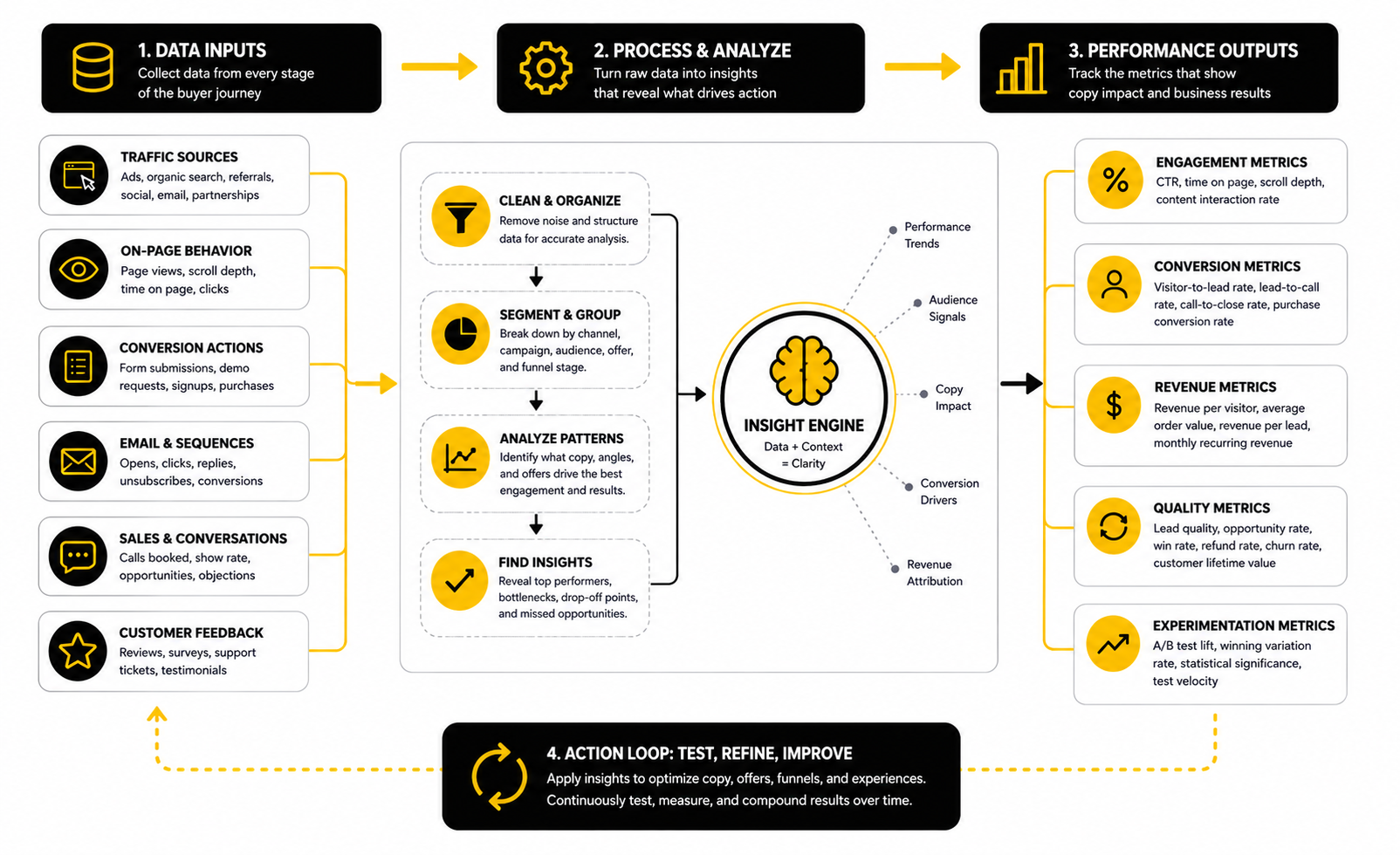
Read The Funnel Like A Conversation
A funnel is not just a sequence of pages. It is a conversation with momentum. Every click is a small yes, and every drop-off is a place where the reader either lost interest, lost trust, got distracted, or decided the next step was not worth it.
That is why funnel analytics should be read in order. If ads get clicks but the landing page does not convert, the problem may be message mismatch. If the landing page converts but sales calls are weak, the page may be attracting the wrong intent. If checkout abandonment is high, the issue may be risk, price clarity, delivery, trust, or surprise costs.
Do not optimize the easiest thing just because it is visible. Optimize the point where the business impact is highest. Sometimes that is the headline. Sometimes it is the offer structure. Sometimes it is the onboarding email after the opt-in, because that is where interest either turns into trust or disappears.
Email Data Needs Better Interpretation
Email metrics are easy to misread. Open rate can be affected by subject lines, sender reputation, inbox behavior, privacy changes, and list quality. Click rate is usually a better signal of interest, but even that needs context because some emails are designed to get replies, not clicks.
MoEngage’s 2025 email benchmark research found that 55% of emails still rely on basic personalization and 75% are not part of a strategic customer engagement flow (MoEngage). That matters because persuasive copy rarely works as one isolated send. The strongest email programs usually build belief across a sequence.
So do not judge one email in isolation unless it was designed as a standalone message. Look at how the sequence performs. Are people moving from curiosity to consideration? Are they clicking the most relevant offer? Are replies showing confusion, interest, or objection? The qualitative feedback inside replies can be just as valuable as the dashboard.
Use Qualitative Data To Explain The Numbers
Quantitative data tells you what happened. Qualitative data helps explain why. You need both if you want to improve copy without guessing.
Heatmaps, session recordings, customer interviews, sales call notes, support tickets, survey responses, reviews, and chat logs can reveal friction that analytics alone cannot show. If many users scroll past the pricing section and then leave, analytics shows the exit. Customer feedback may reveal that they did not understand what was included.
This is where the best copy improvements often come from. Not from inventing new angles, but from listening better. When the same confusion appears in sales calls, customer support, and page behavior, the copy has a real job to do.
Test One Meaningful Change At A Time
Testing is powerful, but only when the test is tied to a real hypothesis. Changing a button from one generic phrase to another is not strategy. Testing a different promise, proof placement, offer explanation, or objection-handling section is much more useful.
A good test starts with a clear reason. For example, “Visitors are clicking the CTA but not completing the form, so we believe the form step creates too much uncertainty.” That hypothesis points toward a specific improvement, such as clearer expectations, fewer fields, stronger privacy reassurance, or a better explanation of what happens next.
Do not test tiny changes when the real problem is structural. If the offer is unclear, a new CTA label will not save it. If the proof is weak, a different subheadline will not create trust out of nowhere.
Watch For Leading And Lagging Signals
Some metrics show early interest. Others show business impact later. You need to separate them.
Leading signals include ad clicks, scroll depth, page engagement, email clicks, video watch time, replies, demo requests, and form starts. Lagging signals include sales-qualified leads, closed deals, customer lifetime value, refund rate, retention, and revenue. Both matter, but they should not be treated as equal.
This distinction prevents bad decisions. A piece of copy may lower low-intent leads while increasing qualified opportunities. On the surface, conversion rate might look worse. In reality, the business may be healthier because the message is filtering better.
Attribution Is Helpful, But Never Perfect
Attribution tries to show which touchpoints contributed to a conversion. It is useful, but it is not the same as truth. Buyers move across search, social, email, referrals, reviews, comparison pages, communities, and direct visits before making decisions.
That means copy should not be judged only by last-click attribution. A blog post may shape the buyer’s thinking weeks before a branded search. A comparison page may reduce fear before a demo request. A nurture email may create urgency even if the final conversion happens somewhere else.
Use attribution to understand patterns, not to pretend the buying journey is cleaner than it is. The more complex the offer, the more important it becomes to measure influence across stages. Good persuasive copy often works before the dashboard gives it full credit.
The Most Useful Optimization Questions
When performance is weak, do not start by asking, “How do we make this more persuasive?” That question is too broad. Ask sharper questions that point to specific copy problems.
These questions make optimization practical. They turn data into decisions. They also keep the team focused on persuasion instead of random edits.
Data Should Make The Copy More Human
The biggest mistake is using data to make copy colder. Analytics should not push you toward robotic language, generic optimization tricks, or endless button tests. It should help you understand the reader more clearly.
If people stop before pricing, explain value better. If they abandon at checkout, reduce uncertainty. If they click but do not book, clarify the next step. If they reply with the same concern again and again, answer that concern earlier.
That is the real role of measurement in persuasive copywriting. It shows you where the reader needs more clarity, more proof, more relevance, or more reassurance. Then the copy becomes sharper because it is responding to real behavior, not internal opinion.
Advanced Persuasive Copywriting Strategy
At this stage, persuasive copywriting becomes less about individual assets and more about strategic judgment. The basics are clear: understand the reader, frame the problem, make a believable promise, explain the mechanism, prove the claim, reduce friction, and guide the next step. The advanced work is knowing what to emphasize, what to leave out, and how to keep the message effective as the business grows.
This is where copy starts affecting positioning, sales quality, retention, and brand trust. A sentence on a landing page can attract better-fit customers or create expensive confusion for the sales team. A stronger promise can lift conversions, but an overextended promise can increase refunds, complaints, and churn.
The goal is not to make every message more aggressive. The goal is to make every message more accurate, more useful, and more aligned with the business model. That is what separates good copy from copy that only looks good in a screenshot.
Positioning Comes Before Persuasion
Copy cannot rescue weak positioning for long. If the offer sounds like every other offer, the copywriter is forced to compete with louder claims, bigger promises, or heavier discounts. That is a bad place to be.
Positioning defines where the offer fits in the buyer’s mind. It answers who the product is for, what problem it solves best, why it is different, and why that difference matters now. Once those answers are clear, persuasive copywriting becomes much sharper because the message has a real strategic foundation.
This also makes editing easier. If a line does not support the position, it probably does not belong. Strong copy has a point of view, and that point of view should be visible in the headline, proof, offer, CTA, and follow-up sequence.
The Strongest Promise Is Not Always The Biggest Promise
A bigger promise can create more attention, but attention is not the same as trust. This is one of the most important tradeoffs in persuasive copy. If the promise stretches beyond what the product, service, or customer experience can reliably deliver, the copy may win the click and lose the customer.
A stronger promise is often narrower. It says exactly what the offer helps with, who it helps, and what conditions make the outcome more likely. That kind of promise may sound less dramatic, but it usually attracts better-fit buyers.
This matters even more when testimonials, reviews, or customer outcomes are involved. The FTC’s endorsement guidance makes it clear that endorsements must reflect honest opinions and that unrepresentative testimonials can be misleading without proper context about typical results (FTC). In plain language: do not use proof in a way that makes an unusual result look normal.
Specificity Beats Intensity
Weak copy often tries to compensate with intensity. It adds more adjectives, more urgency, more emotional language, and more exclamation marks. But if the core message is vague, intensity only makes the vagueness louder.
Specificity does the opposite. It makes the claim easier to understand and easier to believe. Instead of saying a tool “saves time,” say which task it shortens. Instead of saying an agency “improves conversions,” explain which part of the funnel gets fixed. Instead of saying a system “automates growth,” show the actual follow-up, segmentation, or handoff it improves.
This is especially useful when writing for buyers who are skeptical or experienced. They have seen the big claims already. What they want is evidence that you understand the real problem underneath the obvious one.
Persuasion Changes Across Awareness Levels
Advanced copy matches the reader’s level of awareness instead of forcing everyone through the same argument. A cold audience may need education before they care about the offer. A warm audience may need differentiation. A hot audience may only need proof, price clarity, and a reason to act now.
This is why the same product can need several different messages. An ad might lead with the pain. A comparison page might lead with the difference. A retargeting email might lead with proof. A checkout page might lead with reassurance.
Treating every reader the same makes copy feel either too basic or too abrupt. The more mature the funnel becomes, the more the message should adapt to intent. That does not mean changing the truth; it means changing the entry point.
AI Can Help Draft, But It Cannot Own The Message
AI has changed copywriting workflows, but it has not removed the need for strategic thinking. It can help summarize research, generate variations, restructure drafts, and speed up first-pass production. But it can also produce generic language that sounds polished while saying very little.
That risk is real because a lot of AI-generated copy defaults to safe, broad, familiar phrasing. It may produce clean sentences, but clean sentences are not the same as persuasive sentences. The message still needs customer insight, competitive context, proof, and judgment.
Nielsen Norman Group’s research on AI adoption in UX found that writing-related tasks, including copywriting, are among the areas where AI is heavily used (Nielsen Norman Group). That makes the human role more important, not less. The advantage goes to teams that use AI to accelerate production while keeping strategy, verification, and voice under human control.
Personalization Needs Boundaries
Personalized copy can improve relevance, but only when it feels useful. When personalization feels creepy, inaccurate, or overdone, it damages trust. The line between “this is relevant” and “why do they know that?” is thinner than many marketers think.
Good personalization uses information the reader expects you to have and applies it in a way that helps them. Segmenting by industry, role, product interest, lifecycle stage, or previous action can make copy more useful. Pretending to know too much, or using data in a way that feels manipulative, makes the message weaker.
This is why personalization should be treated as a service to the reader, not a trick. If the personalized detail does not make the next decision easier, clearer, or more relevant, it probably does not need to be in the copy.
Scaling Copy Requires Message Governance
As a business grows, copy starts spreading everywhere: landing pages, ads, emails, sales decks, product screens, onboarding flows, support docs, partner pages, webinars, and social posts. Without message governance, every team slowly creates its own version of the story. That creates inconsistency, and inconsistency creates doubt.
A simple message system prevents this. It should define the core promise, audience segments, primary pain points, proof points, approved claims, language to avoid, objection-handling angles, and CTA hierarchy. This gives teams room to create without drifting away from the strategy.
The point is not to make every asset sound identical. The point is to make every asset feel like it came from the same business with the same promise. Consistency compounds trust over time.
Compliance Is Part Of Conversion
Legal and ethical review can feel like a slowdown, but it protects the copy from becoming a liability. This is especially true in categories involving income claims, health claims, financial outcomes, testimonials, guarantees, pricing, or limited-time offers. The more meaningful the claim, the more carefully it needs to be supported.
Clear copy is usually safer copy. If a claim needs a long explanation to avoid being misleading, the claim may need to be rewritten. If a guarantee has conditions, those conditions should be easy to find and easy to understand.
This is not just about avoiding penalties. It is about preserving trust. A buyer who feels misled may never buy again, even if the technical wording was defensible.
Expert Copywriters Think In Systems
A beginner often asks, “What should this page say?” An expert asks, “What belief does this page need to create, and what happens before and after it?” That shift changes everything.
The page is only one part of the journey. The ad sets expectations. The landing page develops belief. The form or checkout collects commitment. The confirmation page reinforces the decision. The follow-up sequence turns action into momentum. Each step needs copy that fits its role.
This is why persuasive copywriting gets stronger when it is connected to funnel strategy, sales process, onboarding, and customer success. The words do not stop working after the click. They keep shaping how the buyer understands the value they just chose.
Better Copy Can Also Filter Buyers
Not every conversion is a win. This is uncomfortable but important. If the copy attracts people who are not ready, not qualified, or not a good fit, it creates problems downstream.
Strong copy should sometimes repel the wrong audience. It can do this by being clear about who the offer is for, what it does not do, what level of effort is required, what the price range looks like, or what kind of customer gets the best result. That kind of clarity may reduce raw conversion volume, but it can improve sales quality.
This is where teams need discipline. If leadership only rewards top-line lead volume, copy will drift toward broader claims and weaker qualification. If the business rewards qualified pipeline, retention, and customer success, the copy can become both more persuasive and more honest.
The Offer And The Copy Must Improve Together
Sometimes the copy is not the bottleneck. Sometimes the offer is confusing, the pricing is misaligned, the proof is thin, the onboarding is weak, or the product does not solve the urgent problem well enough. In those cases, rewriting the page helps only a little.
Advanced copy work often reveals offer problems. If you cannot make the value clear, the offer may be too complicated. If you cannot find strong proof, the delivery may need more documentation. If every CTA feels like too much commitment, the buyer journey may need a lower-friction step.
This is good news. Copy is not just a promotional layer. It is a diagnostic tool. When the words are hard to write clearly, the business usually has something worth fixing.
Use Tools To Support The Strategy, Not Replace It
Platforms can help you build pages, automate follow-up, manage conversations, and test funnels faster. They do not decide what the buyer needs to believe. That is still strategy.
For example, ManyChat can support conversational lead capture, but the messages still need to qualify interest without feeling robotic. Brevo can support email campaigns and automation, but the sequence still needs a clear belief-building path. Replo can help teams build ecommerce landing pages faster, but the page still needs a specific offer, strong proof, and a reason to act.
The tool is the container. The message is the conversion engine. When teams confuse the two, they end up with better-looking funnels that still do not persuade.
The Biggest Risk Is Losing The Human Reader
The more advanced the system becomes, the easier it is to forget the person reading the copy. Teams start talking about segments, cohorts, triggers, heatmaps, attribution models, and optimization cycles. Those things are useful, but they are not the buyer.
The buyer is still a person trying to make a decision with limited time, imperfect information, competing priorities, and some level of risk. They want to know whether the offer is relevant, whether it can work for them, whether they can trust it, and what happens if they act. That is the heart of persuasive copywriting.
So the final standard is simple. Does the copy help the right person make a better decision? If yes, it is doing the job. If no, it does not matter how clever, optimized, automated, or data-backed it looks.
The Final System For Persuasive Copywriting
Persuasive copywriting works best when it becomes part of the whole marketing system. The research informs the positioning. The positioning shapes the offer. The offer gives the copy something real to sell. The analytics show where the message needs to improve.
That is the full loop. It is not just writing, publishing, and hoping. It is a repeatable way to understand buyers, communicate value, test the message, and keep improving the experience around the sale.
The most useful copy does not make people feel tricked into action. It helps the right people make a confident decision. That is the standard to keep coming back to, especially as funnels get more automated, AI gets more involved, and buyers become better at spotting weak claims.
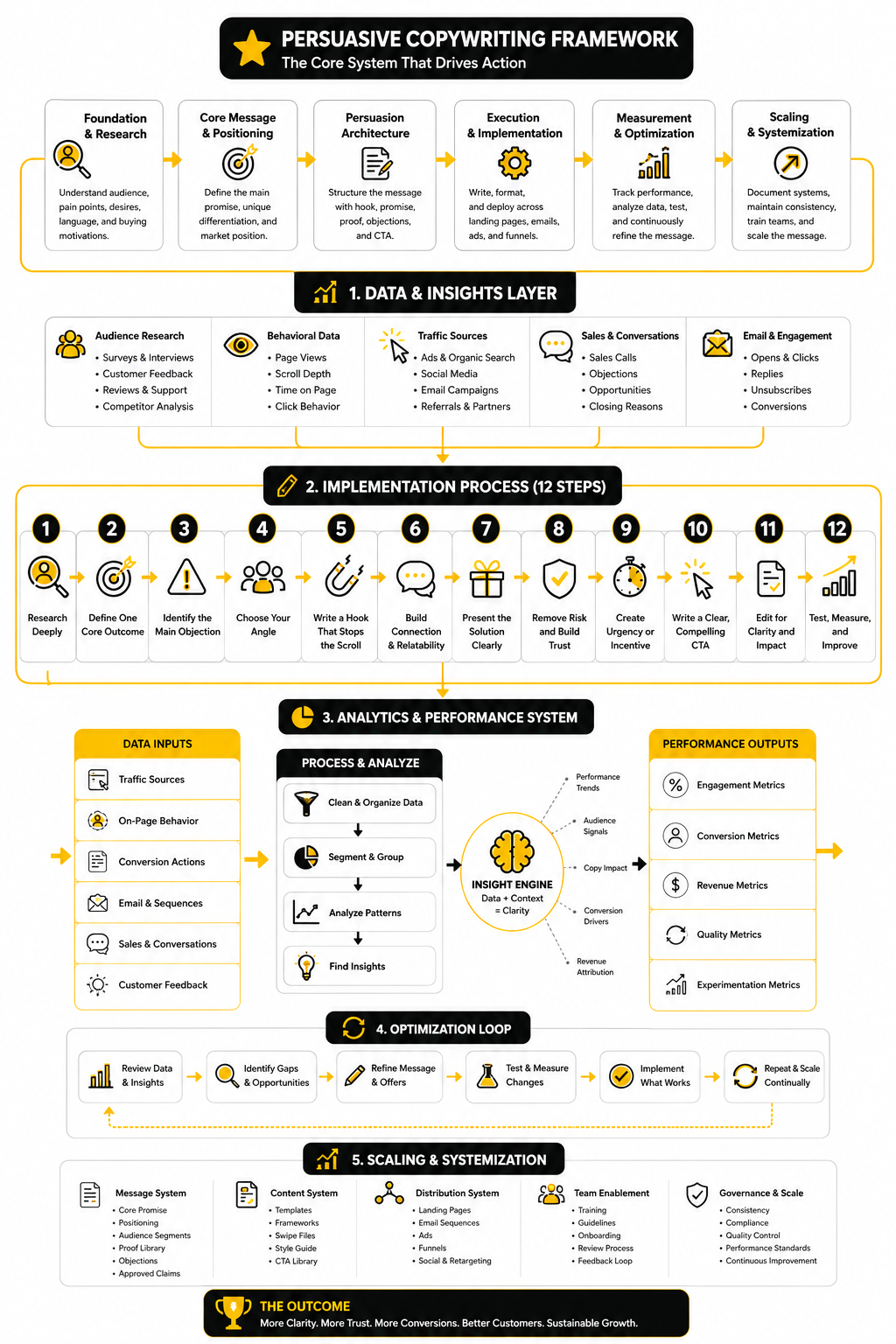
Build A Copy System You Can Reuse
A serious business should not rewrite its message from scratch every time it launches a page, email, ad, or campaign. That creates inconsistency and wastes too much time. Instead, build a copy system that documents the core promise, audience segments, objections, proof points, CTAs, and approved claims.
This system should be practical enough that a marketer, founder, salesperson, or copywriter can use it without needing a strategy meeting every time. It should explain what the brand says, what it avoids saying, and how different offers connect to the main positioning. That gives the team speed without sacrificing clarity.
The system also keeps persuasion honest. When approved claims, proof standards, testimonial rules, and compliance notes live in one place, the team is less likely to drift into exaggeration. That matters because the FTC’s endorsement guidance is built around a simple principle: endorsements must be honest, not misleading, and connected to claims the marketer can legally make (FTC).
Keep Improving The Message After Launch
Launch is not the finish line. It is the first real test. Once the copy is live, the market starts telling you what it understands, what it ignores, what it doubts, and what it needs next.
The best teams treat that feedback seriously. They review analytics, sales conversations, support questions, customer interviews, reviews, and objections. Then they improve the message based on what buyers are actually doing and saying.
This is how persuasive copywriting compounds. The first version creates a baseline. The next version removes confusion. The version after that sharpens proof, clarifies the offer, and improves fit. Over time, the message becomes harder to copy because it is built from real customer learning.
Let The Buyer Feel Respected
The future of persuasive copy is not louder copy. It is more respectful copy. Buyers have more information, more comparison tools, more skepticism, and more control than ever.
That does not mean persuasion is dead. It means lazy persuasion is weaker. Big claims without proof, fake urgency, vague personalization, and over-polished AI copy all become easier to spot.
The better path is simple: be clear, be specific, prove what you can prove, say what happens next, and do not hide the tradeoffs. When copy respects the buyer’s intelligence, it does more than lift conversions. It builds trust that survives after the click.
What Is Persuasive Copywriting?
Persuasive copywriting is the process of writing marketing and sales messages that help the right person take a specific action. It uses audience research, positioning, proof, objection handling, and clear calls to action. The goal is not to manipulate people; the goal is to make value easier to understand and action easier to take.
Why Is Persuasive Copywriting Important?
Persuasive copywriting matters because most buyers are distracted, skeptical, and comparing multiple options. If your message is unclear, they usually will not stop and decode it for you. Strong copy helps people understand the problem, believe the promise, and feel confident about the next step.
What Makes Copy Persuasive?
Copy becomes persuasive when it connects a real problem to a believable outcome. It needs a clear audience, a specific promise, a strong mechanism, relevant proof, and a CTA that makes sense in context. The writing style matters, but the strategy underneath matters more.
Is Persuasive Copywriting The Same As Sales Writing?
Persuasive copywriting and sales writing overlap, but they are not always identical. Sales writing is usually focused directly on conversion, while persuasive copy can also appear in ads, onboarding, emails, product pages, social posts, and brand messaging. Both rely on the same core skill: moving people from uncertainty to action.
How Do You Start Writing Persuasive Copy?
Start by understanding the reader’s current state. Identify what they already believe, what they want, what they have tried, what they doubt, and what they need to know before taking action. Then build the copy around the path from their current belief to the action you want them to take.
What Is The Biggest Mistake In Persuasive Copywriting?
The biggest mistake is trying to write persuasive words before the strategy is clear. If the offer, audience, promise, and proof are weak, better wording will only help so much. Strong copy starts with clear thinking, not clever phrasing.
How Long Should Persuasive Copy Be?
Persuasive copy should be as long as the decision requires and as short as the reader allows. A simple opt-in page may need only a few strong sections. A high-ticket offer, complex software product, or expensive ecommerce purchase may need more context, proof, objections, and risk reduction.
How Do You Measure Persuasive Copywriting?
Measure it by the action the copy is supposed to create. That could mean conversion rate, qualified leads, booked calls, sales, replies, checkout completion, demo requests, or revenue. The best measurement also looks beyond the first conversion to lead quality, retention, refund rate, and customer fit.
Can AI Write Persuasive Copy?
AI can help draft, summarize research, generate variations, and speed up editing. But AI should not own the message because persuasive copy depends on customer insight, positioning, proof, compliance, and judgment. Use AI as a production assistant, not as the strategist.
How Do Testimonials Fit Into Persuasive Copywriting?
Testimonials are useful when they answer a real buyer concern. A strong testimonial should support a specific claim, show a relevant outcome, or reduce a specific doubt. Do not use testimonials to imply results that are not typical or cannot be supported.
What Is The Difference Between A Feature And A Benefit?
A feature explains what the offer has or does. A benefit explains why that feature matters to the buyer. The most persuasive copy often goes one layer deeper and connects the benefit to a real buying reason, such as saving time on a painful task, reducing risk, improving confidence, or helping the buyer reach a specific outcome.
How Do You Make Copy More Specific?
Replace broad claims with concrete details. Instead of saying “save time,” explain which task becomes faster. Instead of saying “increase conversions,” explain which part of the funnel improves. Specific copy feels more credible because the reader can picture the change.
What Role Does Proof Play In Persuasive Copy?
Proof reduces perceived risk. It shows the reader that the claim is not just a claim. Proof can come from testimonials, reviews, screenshots, demos, transparent methodology, research, usage data, customer examples, or clear explanations of how the offer works.
How Should Persuasive Copywriting Change For Different Channels?
The core message should stay consistent, but the format should change. Ads need fast relevance. Landing pages need belief and action. Emails need continuity and timing. Product pages need clarity and reassurance. Funnels need each step to answer the next logical question.
Is Persuasive Copywriting Ethical?
Persuasive copywriting is ethical when it helps people make informed decisions without deception. It becomes unethical when it hides material information, exaggerates outcomes, invents proof, creates fake urgency, or pressures people into decisions that are not right for them. Clear, honest copy can still be highly persuasive.
Build a stronger local presence with BAAM AI
Turn your website, Google profile, social channels, and AI visibility into one growth engine
Most businesses do not need more random marketing activity. They need a consistent presence system that helps the right people find them, trust them, and take action. BAAM AI brings strategy, local SEO, website updates, Google Maps visibility, social content, AI-search readiness, media production, and reporting into one practical monthly engine.
If you want your marketing to keep working after the campaign ends, start with a free BAAM AI presence audit. See how your business shows up today and where the fastest visibility wins are at BAAM AI.