
BAAM AI Blog
Paid Traffic Needs Measurement Before Scale
Paid traffic is where digital marketing gets very honest very quickly. Organic channels can hide weak conversion paths for a while, but paid campaigns expose them because every click has a direct cost. If the offer...
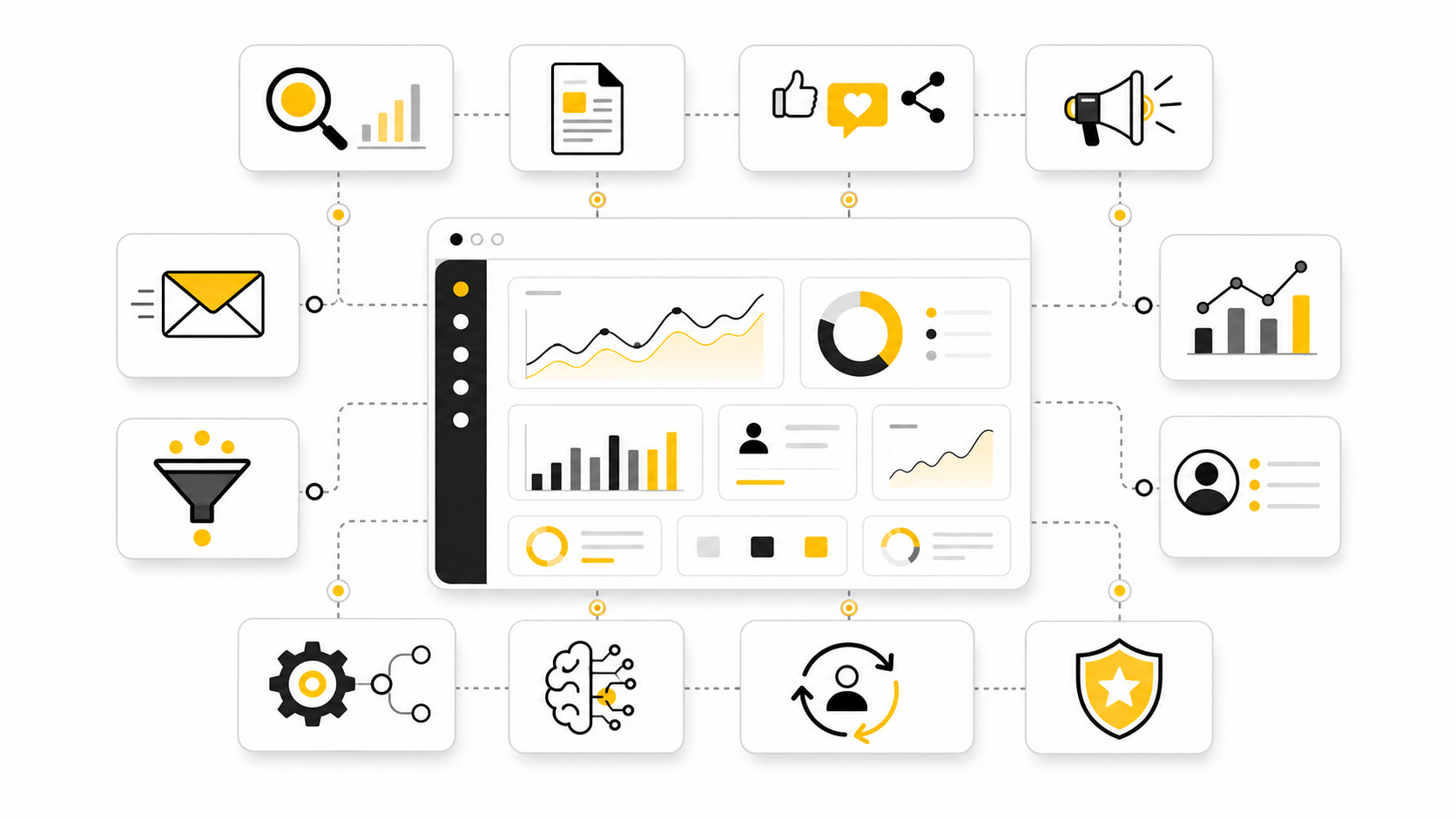
Paid traffic is where digital marketing gets very honest very quickly. Organic channels can hide weak conversion paths for a while, but paid campaigns expose them because every click has a direct cost. If the offer, landing page, tracking, follow-up, and attribution are not ready, the budget disappears before the business learns anything useful.
This is why paid advertising belongs next in the digital marketing all topics list, but with one condition: it should not be treated as a slot machine. Paid media should be a controlled testing and scaling system. You are buying data as much as you are buying traffic.
The market is still moving heavily toward measurable digital channels. U.S. internet advertising revenue reached a record $294.6 billion in 2025, which shows how much budget continues shifting into channels where targeting, optimization, and performance feedback are more visible. That number matters because it proves the opportunity is real, but it also means competition is intense.
Paid Advertising Topics
Paid advertising includes more than boosting posts or launching search campaigns. It covers channel selection, creative testing, audience strategy, bidding, budget control, tracking, landing pages, retargeting, and conversion quality. The best paid media teams think in systems, not isolated ads.
Important paid advertising topics include:
The useful question is not “Which ad platform is best?” The useful question is “Where does my audience already show intent or attention, and can my offer convert that attention profitably?” That question keeps the strategy grounded.
Funnels Connect Traffic To Revenue
A funnel is the path someone takes from first touch to conversion. It may be a simple landing page and thank-you page, or it may include ads, content, lead magnets, webinars, emails, demos, calls, proposals, checkout pages, and onboarding. The shape depends on the offer, price point, buying cycle, and customer risk.
Funnels matter because traffic rarely converts by accident. A visitor needs a clear promise, enough proof, a low-friction next step, and a reason to continue. When that sequence is missing, even good traffic underperforms.
This is where funnel tools can be useful, especially for businesses that need pages, forms, automation, payment steps, and follow-up in one system. ClickFunnels, Systeme.io, and GoHighLevel can all support this layer when the business needs a practical funnel stack. The important part is still the strategy behind the funnel.
Funnel Topics
Funnels should be designed around the customer’s buying stage. A cold audience often needs education and trust before a sales ask. A high-intent audience may need a direct demo, quote, trial, or checkout path.
Core funnel topics include:
The funnel is not a magic structure. It is a decision path. If each step answers the right question at the right moment, conversion improves. If each step adds friction, confusion, or pressure too early, people leave.
Landing Pages Carry The Conversion Burden
Landing pages are where traffic either turns into action or becomes wasted spend. A landing page has one job: make the next step feel clear, relevant, credible, and worth taking. That sounds basic, but many pages fail because they try to explain everything to everyone.
A strong landing page starts with message match. The ad, keyword, email, or social post that brought the visitor in should connect directly to the page headline and offer. If the visitor feels a mismatch, trust drops immediately.
Landing pages also need proof. That can include testimonials, reviews, customer logos, case studies, data points, product visuals, process explanations, guarantees, security details, or clear expectations about what happens next. Proof reduces risk, and risk is one of the main reasons people hesitate.
Landing Page Topics
Landing page optimization should focus on clarity before cleverness. Beautiful design helps, but only if the page also explains the offer, handles objections, and guides action. A page can look premium and still fail if the message is vague.
Important landing page topics include:
For ecommerce teams that need faster page building and testing, Replo can fit naturally into the landing page implementation layer. For service businesses or agencies managing leads, GoHighLevel can help connect pages, forms, pipelines, and follow-up. In both cases, the tool should make execution easier, not replace the thinking.
Statistics And Data
Statistics are useful only when they lead to better decisions. A benchmark can help you spot whether a campaign is unusually weak, unusually strong, or simply normal for the channel and offer type. But a benchmark should never become an excuse to ignore your own economics.
The main data point that matters is profitable movement through the system. Clicks are not enough. Leads are not enough. Even a low cost per lead can be misleading if the leads never become qualified opportunities, customers, or repeat buyers. The right data shows where money enters, where people drop off, and which changes should happen next.
Marketing leaders are under pressure to prove this clearly. The CMO Survey’s 2025 research continues to track marketing spending, performance indicators, brand investment, analytics, AI, and leadership priorities across senior marketers in its Highlights and Insights Report. That matters because measurement is no longer just a reporting task; it is how marketers defend budgets, shift resources, and earn strategic trust.
What Digital Marketing Benchmarks Actually Mean
Benchmarks are directional, not universal laws. A 2% conversion rate may be terrible for a warm referral landing page and excellent for a cold, high-ticket B2B offer. A high click-through rate may signal strong creative, but it can also signal curiosity clicks that never convert.
The right way to interpret benchmarks is to compare them against context. Look at channel, audience temperature, offer price, sales cycle, device, geography, brand awareness, and traffic intent. Without that context, a number can look good while the business is quietly losing money.
Useful benchmark categories include:
The action is what matters. If click-through rate is weak, test angle, audience, hook, and creative. If landing page conversion is weak, test message match, offer clarity, proof, friction, and page speed. If sales conversion is weak, inspect lead quality, qualification, sales process, objection handling, and pricing.
The Analytics System
An analytics system connects actions to outcomes. It tells you where traffic came from, what people did, where they dropped off, which campaigns influenced conversions, and which investments deserve more or less budget. Without that system, marketing decisions become personal opinions with dashboards attached.
A good analytics setup starts with clean event tracking. Google Analytics describes key events as the foundation for conversion measurement and attribution across reports and ad platforms in its Analytics attribution documentation. That matters because if the important actions are not tracked correctly, every later report becomes less useful.
The analytics system should also separate channel performance from business performance. A channel can generate cheap leads but poor customers. Another channel can look expensive on the first touch but produce larger deals, better retention, or stronger lifetime value. If the analytics system cannot show that difference, budget decisions become distorted.
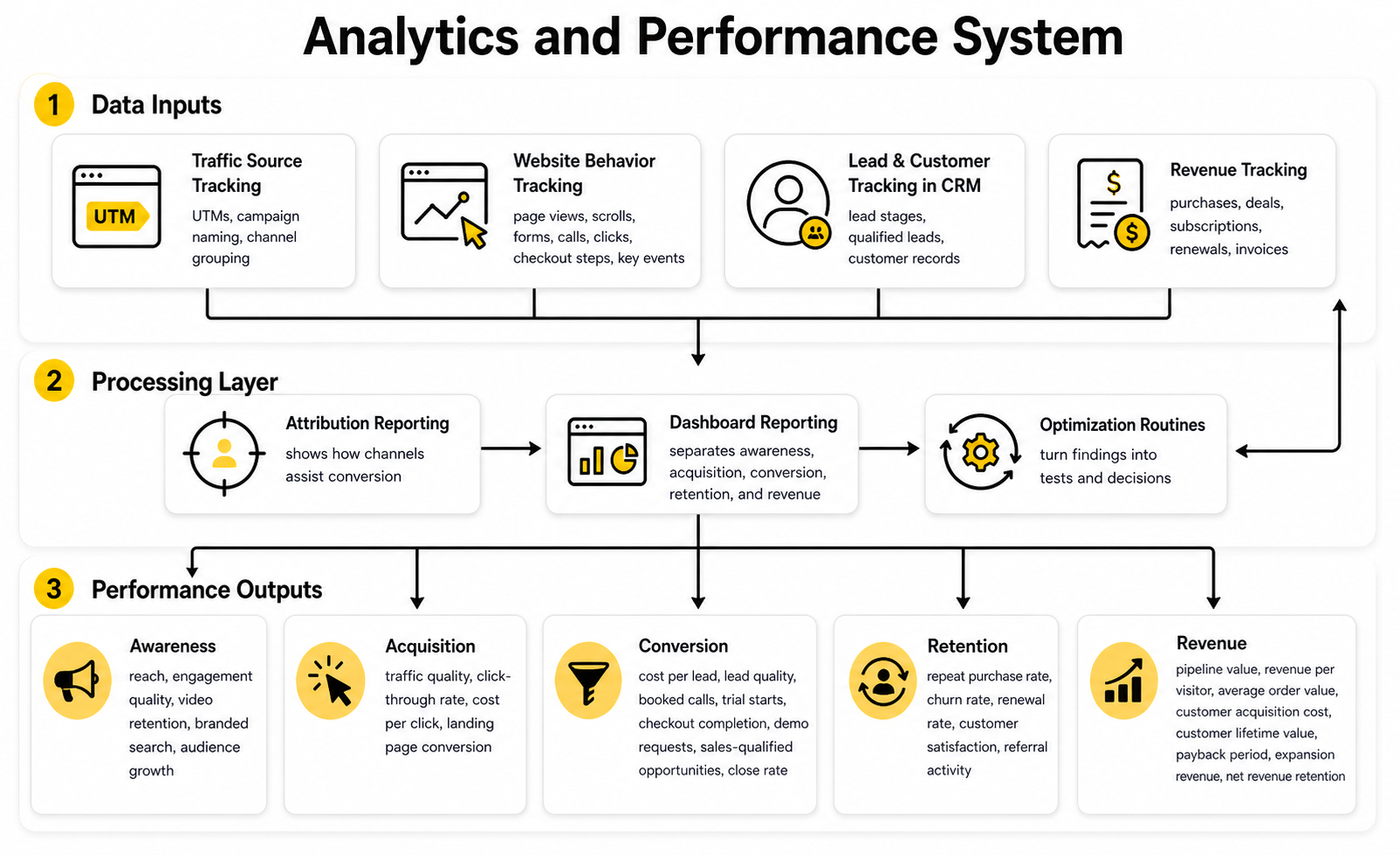
A practical analytics system should connect these layers:
This is where data becomes useful. The point is not to track everything. The point is to track the few things that explain how attention becomes revenue.
Analytics Topics
Analytics should be built before serious scale, not after the budget is already gone. At minimum, a business should know which campaigns bring traffic, which pages convert, which leads are qualified, and which customers generate revenue. Anything less is guessing.
Important analytics topics include:
The biggest analytics mistake is collecting data without a decision process. Every report should answer a question. Every dashboard should support an action. If nobody changes anything after reviewing the data, the reporting system is probably too bloated or too disconnected from the business.
Attribution Shows Influence, Not Perfect Truth
Attribution tries to answer a difficult question: which marketing touchpoints influenced the conversion? The challenge is that customers do not behave neatly. They may see a social post, search the brand, read a comparison page, click a retargeting ad, open an email, talk to sales, and convert days or weeks later.
No attribution model is perfect. First-touch attribution overvalues discovery. Last-touch attribution overvalues the final click. Multi-touch attribution can be more balanced, but it still depends on tracking quality and model assumptions. The job is not to find perfect truth; the job is to make better decisions than blind guessing.
Attribution should be interpreted with business context. For example, paid search may look like the closer, but brand content and social proof may have created the trust. Retargeting may look efficient, but it may mostly capture people who were already likely to convert. A good marketer asks what the model is missing before moving budget too aggressively.
Attribution Topics
Attribution is most useful when it is compared with other evidence. Look at CRM data, sales feedback, customer surveys, branded search, cohort quality, incrementality tests, and channel experiments. This gives a more honest picture than relying on one report.
Key attribution topics include:
Self-reported attribution can be especially useful when tracking misses influence. A simple “How did you hear about us?” field can reveal podcasts, communities, word of mouth, social posts, and referrals that analytics often hide inside direct or branded search traffic. It is not perfect either, but it adds a human layer to the data.
Performance Signals Across The Funnel
Performance signals should be read by funnel stage. At the awareness stage, reach, engagement quality, video retention, branded search, and audience growth can matter. At the acquisition stage, traffic quality, click-through rate, cost per click, and landing page conversion become more important.
At the conversion stage, the numbers get closer to revenue. Cost per lead, lead quality, booked calls, trial starts, checkout completion, demo requests, sales-qualified opportunities, and close rate reveal whether demand is turning into business. At the retention stage, repeat purchase rate, churn, renewal rate, expansion revenue, customer satisfaction, and referral activity show whether the business is keeping what it wins.
This prevents one of the worst reporting habits: judging every campaign by immediate sales. Some campaigns create demand, some capture demand, some convert demand, and some retain demand. A healthy digital marketing system measures each job differently.
Funnel Performance Topics
Funnel performance should be diagnosed from top to bottom. If traffic volume is low, the problem may be reach or distribution. If traffic is high but leads are low, the problem may be intent, offer, page clarity, or friction. If leads are high but sales are low, the problem may be qualification, follow-up, pricing, or sales process.
Useful funnel performance topics include:
The goal is to find the constraint. Do not optimize the entire funnel at once. Find the biggest bottleneck, fix it, and then move to the next one.
Testing Turns Data Into Improvement
Testing is how digital marketing gets better over time. It turns assumptions into experiments and experiments into learning. Without testing, teams often keep debating opinions instead of letting the market respond.
Good tests are specific. Do not test five major changes at once and pretend you know what caused the result. Start with meaningful hypotheses: a clearer headline should improve landing page conversion, a stronger offer should increase qualified leads, or a shorter form should increase volume but may reduce quality.
Testing also needs enough traffic and time to be useful. A tiny sample can produce noise that looks like insight. That is why smaller businesses should often run practical directional tests first, then use stricter statistical methods when the traffic volume supports it.
Testing Topics
Testing should focus on the highest-leverage parts of the system. Headlines, offers, CTAs, forms, pricing presentation, proof, creative angles, audience segments, email subject lines, and checkout flows often matter more than tiny design changes. Test what could actually change behavior.
Important testing topics include:
Testing should not become random tinkering. A strong testing program starts with research, prioritizes by potential impact, documents what changed, and applies the lesson elsewhere. That is how optimization compounds.
Dashboards Should Drive Decisions
Dashboards are only useful if they help people act. A dashboard filled with every possible metric may look impressive, but it usually creates confusion. The best dashboards are simple enough to read quickly and specific enough to guide decisions.
A good marketing dashboard should show what happened, why it likely happened, and what needs attention next. That means separating executive reporting from operator reporting. Leadership needs revenue, pipeline, CAC, LTV, retention, and budget efficiency. Channel managers need campaign, creative, keyword, audience, page, and conversion details.
The dashboard should also include context. A number without a target is just a number. A conversion rate, cost per lead, or return on ad spend becomes useful when it is compared against goals, previous periods, forecast, margin, sales quality, and capacity.
Dashboard Topics
Dashboards should be built around business questions. Are we generating enough qualified demand? Are we converting traffic efficiently? Are paid campaigns profitable? Are customers staying? Are we improving month over month?
Useful dashboard topics include:
Dashboards should create rhythm. Weekly reviews help teams catch performance issues. Monthly reviews help identify trends. Quarterly reviews help decide where budget, effort, and strategy should shift.
What The Data Should Make You Do
Data should change behavior. If it does not, the business is probably reporting for comfort instead of improvement. The numbers should help you decide what to stop, what to fix, what to scale, what to test, and what to ignore.
If acquisition costs are rising, inspect audience fatigue, creative quality, offer strength, landing page conversion, competition, and lead quality. If organic traffic is growing but conversions are flat, review intent alignment, CTAs, internal links, and lead magnets. If email revenue is weak, check segmentation, deliverability, list quality, offer relevance, and lifecycle timing.
This is the practical mindset that makes measurement valuable. Data is not there to impress the team. Data is there to improve decisions, protect budget, and create better customer movement through the system. Part 5 can now build on that by covering email marketing, CRM, automation, retention, and the customer experience layer that turns first conversions into long-term growth.
Build a stronger local presence with BAAM AI
Turn your website, Google profile, social channels, and AI visibility into one growth engine
Most businesses do not need more random marketing activity. They need a consistent presence system that helps the right people find them, trust them, and take action. BAAM AI brings strategy, local SEO, website updates, Google Maps visibility, social content, AI-search readiness, media production, and reporting into one practical monthly engine.
If you want your marketing to keep working after the campaign ends, start with a free BAAM AI presence audit. See how your business shows up today and where the fastest visibility wins are at BAAM AI.