
BAAM AI Blog
Outsource Social Media Marketing: A Practical Guide To Getting Better Results Without Building Everything In-House
Outsource social media marketing when your brand needs consistency, sharper execution, and a wider skill set than your internal team can realistically cover every week. That does not mean handing your voice to...
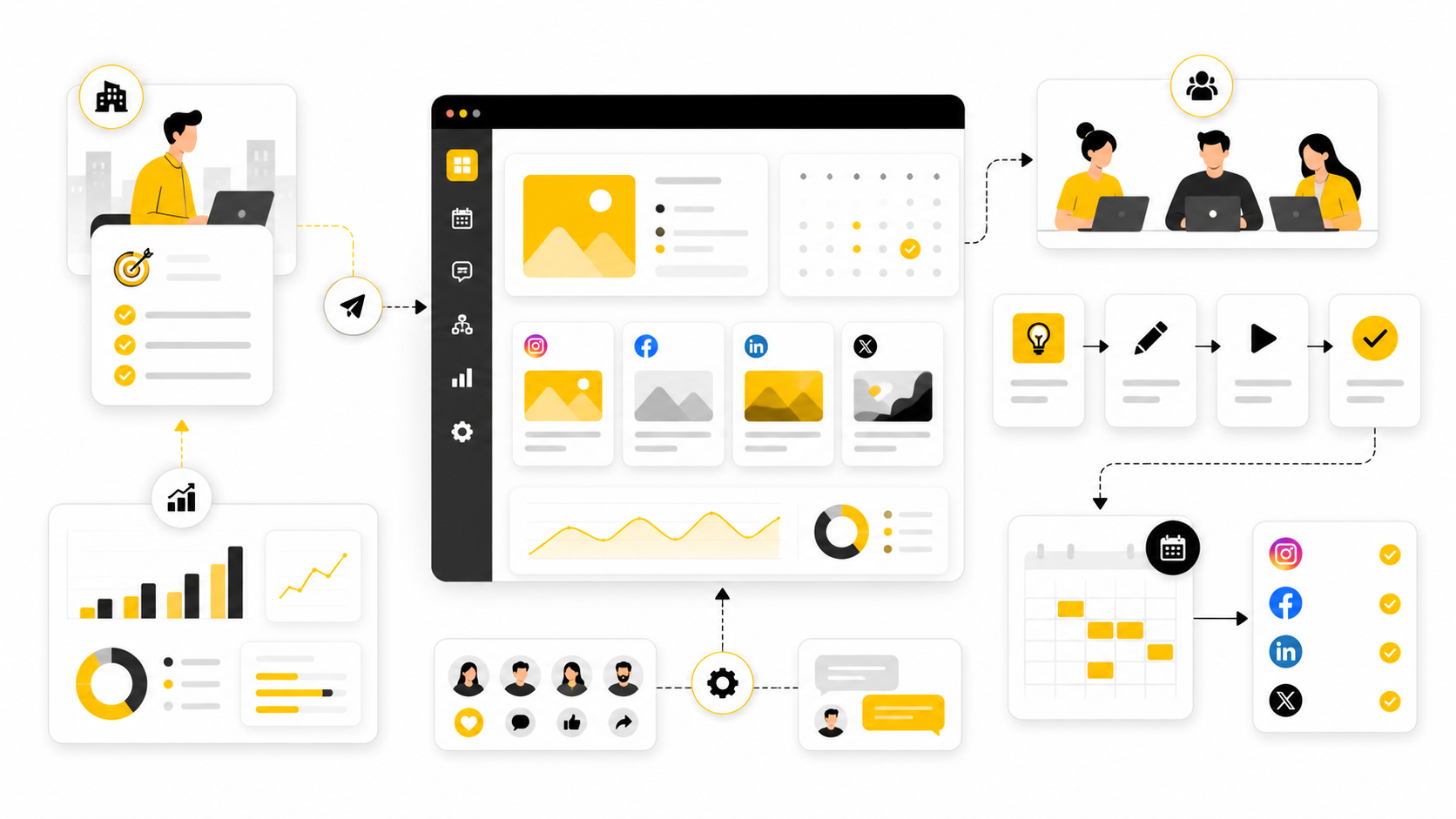
Outsource social media marketing when your brand needs consistency, sharper execution, and a wider skill set than your internal team can realistically cover every week. That does not mean handing your voice to strangers and hoping for the best. It means building a clear operating system where strategy, content, publishing, reporting, and accountability are handled by the right mix of people.
The mistake many companies make is treating outsourcing like a quick fix for being busy. They hire someone to “post more,” then wonder why reach, leads, or sales do not improve. Social media is not just a publishing calendar anymore; it touches brand positioning, customer support, creator partnerships, paid distribution, analytics, community, and sales enablement.
The better approach is more intentional. You decide what should stay close to the business, what can be delegated, what needs specialist help, and how results will be measured. When outsourcing is set up this way, it becomes a growth system instead of another vendor relationship to manage.
Why Outsourcing Social Media Marketing Matters Now
Social media now demands more than occasional posts, polished captions, and a few recycled graphics. A serious presence requires platform-specific creative, short-form video, community response, analytics, testing, paid amplification, and a steady understanding of what the audience actually wants. For many teams, that workload is too broad to manage well without either hiring several specialists or outsourcing part of the function.
The pressure is also rising because buyers expect brands to respond faster and sound more human. A slow, generic, or overly corporate social presence makes a business look disconnected, even if the product is strong. Outsourcing can help when it gives you access to people who already understand content formats, platform behavior, reporting rhythms, and campaign execution.
But outsourcing only works when the business stays strategically involved. Your internal team should still own the brand point of view, customer insight, approvals, commercial priorities, and final accountability. The external partner should bring execution power, creative range, process discipline, and platform expertise.
Framework Overview
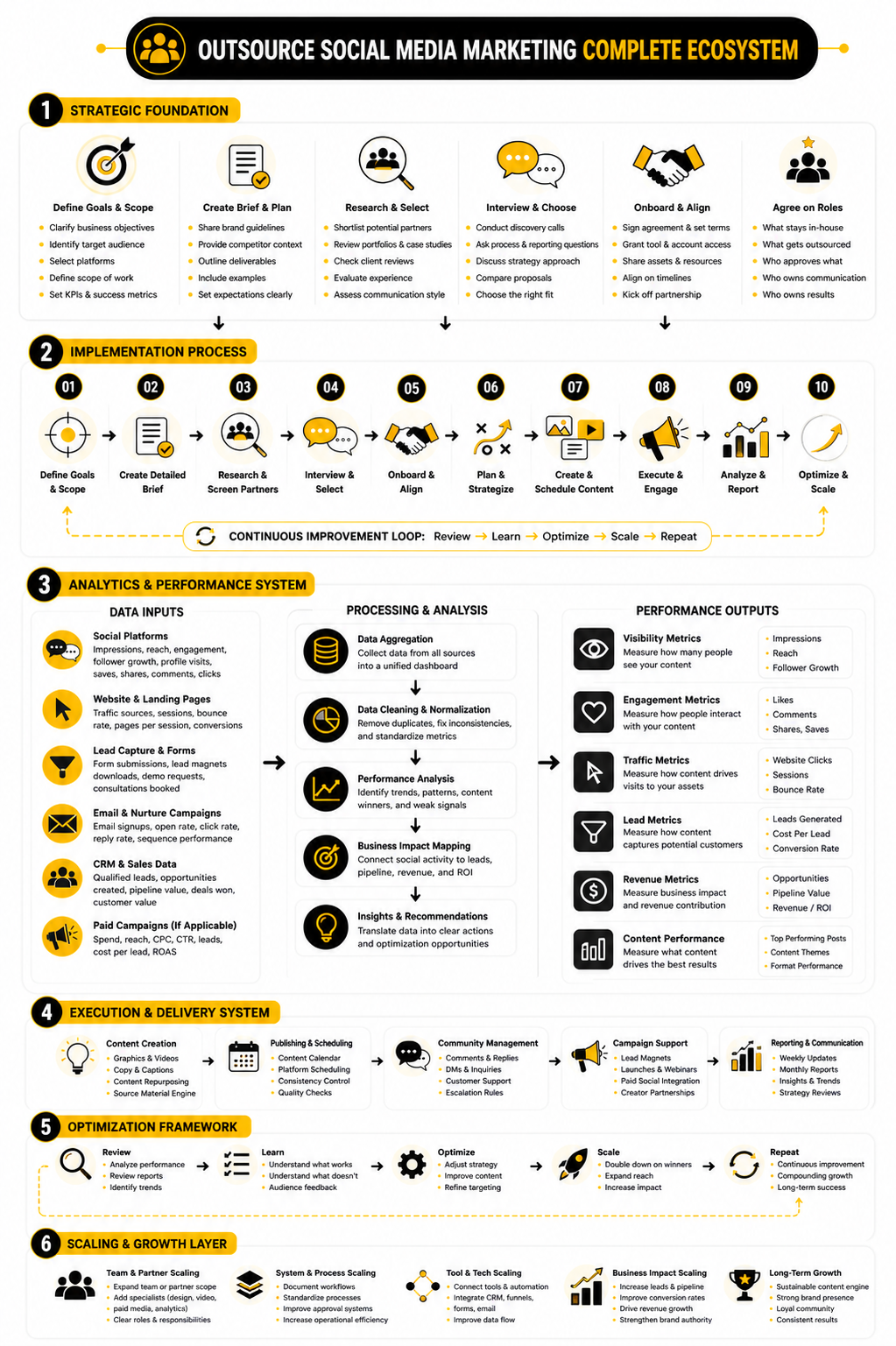
The best way to outsource social media marketing is to separate the work into strategic control, creative production, publishing operations, engagement, and performance analysis. Each layer needs a clear owner. Without that structure, everyone assumes someone else is responsible, and the entire program becomes reactive.
A strong framework starts with business goals, not content ideas. Before anyone writes captions or designs posts, the team should know whether the priority is awareness, lead generation, community growth, customer education, retention, recruitment, or direct sales support. That decision changes the content mix, cadence, platforms, reporting dashboard, and even the type of partner you should hire.
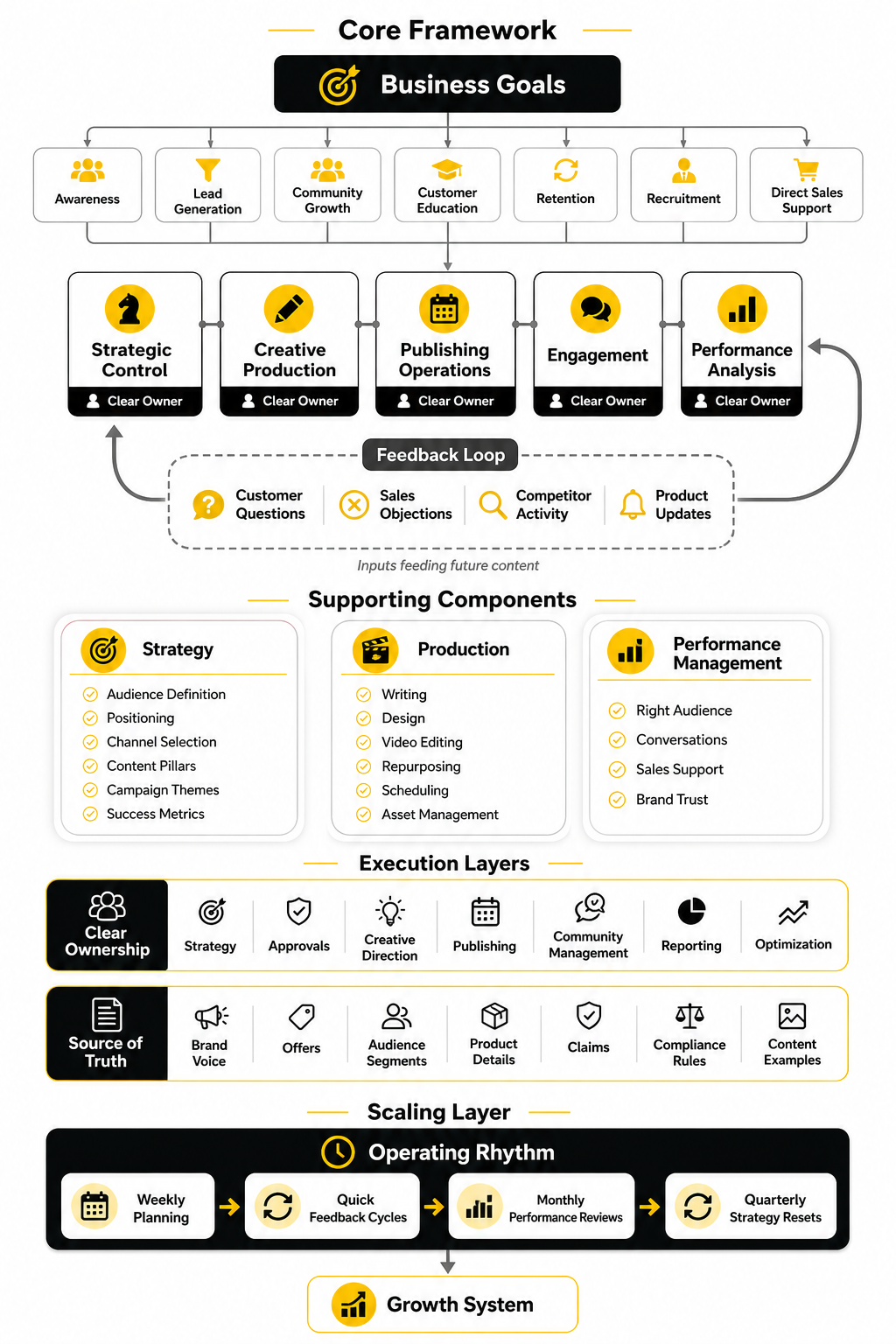
The framework also needs a feedback loop. Social media performance should influence future content, but customer questions, sales objections, competitor activity, and product updates should influence it too. Outsourcing should make that loop faster and cleaner, not hide it inside a monthly report no one reads.
Core Components Of A Strong Outsourced Social Media System
The first component is strategy. This includes audience definition, positioning, channel selection, content pillars, campaign themes, and success metrics. A freelancer, agency, or consultant can help shape the strategy, but your business must provide the raw truth: who you serve, why customers buy, where deals get stuck, and what promises you can actually deliver.
The second component is production. This covers writing, design, video editing, repurposing, scheduling, and asset management. This is often the easiest part to outsource because the deliverables are visible, repeatable, and process-driven once the brand direction is clear.
The third component is performance management. Someone needs to look beyond likes and follower counts to understand whether the work is building the right audience, creating conversations, supporting sales, or improving brand trust. Outsourcing becomes much more valuable when reporting leads to better decisions instead of just documenting what already happened.
Professional Implementation Starts With Clear Ownership
A professional outsourced setup should define who owns strategy, approvals, creative direction, publishing, community management, reporting, and optimization. These responsibilities should be written down before the first content calendar is built. Ambiguity is expensive because it creates delays, duplicated work, weak content, and frustration on both sides.
The business should also create a simple source of truth for brand voice, offers, audience segments, product details, claims, compliance rules, and examples of content that feels right. This does not need to be a giant brand book. A practical working document is often more useful than a polished PDF that nobody opens.
Finally, the relationship needs a rhythm. Weekly planning, quick feedback cycles, monthly performance reviews, and quarterly strategy resets are enough for most teams. The goal is not to micromanage your outsourced partner; the goal is to make sure they have enough context to make smart decisions without waiting on you every day.
What To Outsource And What To Keep In-House
The smartest way to outsource social media marketing is not to hand over everything at once. Some work is perfect for an external partner because it is repeatable, specialist, or time-consuming. Other work should stay close to your team because it depends on customer insight, product knowledge, leadership judgment, or commercial priorities.
Think of outsourcing as a division of labor, not a replacement for internal ownership. Your partner can help you move faster, publish better content, and build a more professional system. But they cannot invent a strong brand from weak direction, and they cannot guess what your sales team hears from prospects every week.
A good setup keeps strategy and business context inside the company while outsourcing execution, production, and specialist support where it makes sense. That balance gives you leverage without losing control. It also makes the relationship easier to manage because everyone knows what they are responsible for.
Keep Strategy Close To The Business
Your company should own the core strategy because your team understands the market, the customer, the product, and the business model better than any outside partner can on day one. This includes positioning, audience priorities, offer direction, campaign goals, and the difference between content that sounds good and content that actually supports growth. An agency or freelancer can challenge your thinking, structure the plan, and turn it into a working social media strategy, but they should not be the only source of truth.
This matters because social media is often where vague positioning gets exposed. If your company cannot clearly explain who it helps, why the offer matters, and what problem it solves, the content will become generic very quickly. Outsourcing will only amplify that weakness unless the strategic foundation is clear.
Keep the big decisions internal. Decide which audiences matter most, which products or services deserve more attention, what claims you are comfortable making, and how bold the brand should sound. Then let your outsourced partner translate those decisions into content angles, campaign ideas, and platform-specific execution.
Outsource Content Production When The Brand Direction Is Clear
Content production is one of the strongest candidates for outsourcing because it requires consistent creative energy. Writing captions, designing graphics, editing short videos, repurposing long-form content, formatting carousels, and scheduling posts can easily drain an internal team. When the brand direction is already clear, an external partner can turn raw ideas into finished assets much faster.
This is especially useful if your team has strong subject-matter expertise but weak production capacity. A founder, consultant, sales leader, or product expert may have excellent ideas but no time to turn them into LinkedIn posts, Reels, Shorts, email snippets, or community prompts. In that case, outsourcing should help capture the thinking and package it properly.
The key is to avoid outsourcing production before you define the voice. Give your partner examples of content that feels right, content that feels wrong, approved phrases, banned phrases, offer language, customer pain points, and proof points. That gives them enough context to create without making every post sound like it came from a template.
Keep Customer Insight And Sales Feedback Internal
Customer insight should never disappear into the hands of an outside vendor. Your internal team hears the real objections, complaints, questions, hesitations, buying triggers, and emotional language that customers use. That information is gold, and it should feed the content calendar every month.
A strong outsourced partner will ask for this feedback because it makes the content sharper. They should want call notes, common objections, support tickets, sales questions, review themes, customer wins, and product updates. If they only ask for brand colors and login details, that is a warning sign.
The best social media content often comes from the messy middle of the business. It comes from the question a prospect asked before buying, the objection that almost killed a deal, the feature customers misunderstand, or the belief your audience needs to unlearn. Keep that insight close, then use your partner to turn it into content people actually want to read or watch.
Outsource Platform Execution And Scheduling
Publishing sounds simple until you have to do it consistently across multiple platforms. Each platform has different formats, posting norms, creative expectations, caption styles, and performance signals. An outsourced social media specialist can manage the operational side so your internal team is not constantly distracted by file sizes, post timing, hashtag choices, resizing, tagging, and calendar maintenance.
This is where tools can help, but tools do not replace judgment. A platform like Buffer can make scheduling and basic workflow easier, especially when multiple posts need to be planned in advance. The real value still comes from having someone who knows what should be published, why it should be published, and how each post fits into the broader content system.
For most teams, scheduling is worth outsourcing once the approval process is clean. Your partner can prepare the calendar, queue the posts, check formatting, and maintain publishing consistency. Your team can then focus on reviewing the ideas, making sure the content is accurate, and adding timely business context when needed.
Keep Brand Voice Approval In-House Until Trust Is Earned
Brand voice is one of the easiest things to damage when outsourcing is rushed. A partner might understand social media trends but still miss your tone, your level of confidence, your industry language, or the way your customers expect you to communicate. That is why approvals should stay internal until the partner has proven they can write and create in your voice consistently.
This does not mean every comma needs executive approval forever. In the early phase, review closely and explain why something feels off. Over time, build a voice guide from those comments so your partner learns the pattern instead of waiting for random feedback.
Once trust is built, you can loosen the process. Low-risk posts may only need light review, while product claims, thought leadership, sensitive topics, and campaign launches still deserve closer attention. The goal is not control for the sake of control; it is protecting the brand while giving the outsourced team enough freedom to move.
Outsource Specialist Work You Cannot Hire For Yet
Some social media work requires skills that are hard to justify as full-time hires. Short-form video editing, paid social creative testing, influencer outreach, community moderation, analytics dashboards, social listening, and automation workflows can all require specialist knowledge. Outsourcing lets you access those skills without building a large internal department.
This is especially useful when the need is real but not constant. You may need a video editor every week, a paid social strategist once a month, or a reporting expert during a campaign cycle. Hiring full-time for each role would be expensive and inefficient, but outsourcing specific pieces can give you the capability when you need it.
Automation is another area where specialist support can help, as long as it is used carefully. For example, a tool like ManyChat can support comment-to-DM flows, lead capture, and simple conversational follow-up. That can be powerful, but only when the offer, compliance rules, and customer experience are thought through first.
Keep Final Accountability Inside The Company
Even if you outsource most of the daily work, accountability stays with your company. You own the brand, the customer promise, the offer, and the business outcome. A partner can recommend, execute, report, and optimize, but they should not become the excuse when the strategy is unclear or the internal process is broken.
This is why performance reviews should include both sides of the relationship. Look at what the partner delivered, but also look at whether your team gave enough input, approved content on time, shared useful insights, and made clear decisions. Many outsourcing relationships fail because the external partner is blamed for problems that started with poor internal ownership.
A clean accountability structure makes the whole system healthier. Your partner owns execution quality, creative output, deadlines, and reporting accuracy. Your team owns strategy, approvals, business context, and final decisions. When those lines are clear, outsourcing becomes much easier to scale.
A Simple Decision Rule For What To Outsource
Use a simple rule: outsource work that is repeatable, specialist, or production-heavy, and keep work that is strategic, sensitive, or deeply tied to customer knowledge. That rule will not answer every edge case, but it will prevent most bad decisions. It also keeps you from outsourcing the parts of social media that should stay connected to leadership, sales, product, and customer experience.
A practical split might look like this:
This shared model is usually the most effective because it respects both sides. Your internal team brings the truth of the business. Your outsourced partner brings the process, creative output, and platform execution needed to turn that truth into consistent social media performance.
The Social Media Outsourcing Framework
Once you know what should stay internal and what can be delegated, the next step is building the actual operating system. This is where many companies get lazy. They hire a person or agency, send a few scattered notes, share login access, and expect a polished social media machine to appear.
That is not how good outsourcing works. A strong framework gives your outsourced partner enough direction to create confidently, enough structure to deliver consistently, and enough feedback to improve over time. Without that framework, every task becomes a one-off request, and the relationship slowly turns into content babysitting.
The goal is simple: make the work repeatable without making it robotic. You want a process that protects the brand, keeps content moving, and still leaves room for timely ideas, creative testing, and platform-specific opportunities. That balance is what separates professional outsourcing from random posting.
Start With A Clear Social Media Brief
Before you outsource social media marketing, create a brief that explains the business in practical terms. This does not need to be a 40-page brand strategy document. It needs to tell your partner what the company does, who it serves, what the audience cares about, what the offer is, and what social media is supposed to support.
A useful brief should include the target audience, main pain points, buying triggers, common objections, competitors, brand voice, content examples, product claims, compliance boundaries, and priority platforms. It should also explain what success looks like in plain language. “Grow the brand” is too vague, but “generate more qualified conversations from LinkedIn and support webinar signups” is much easier to execute.
The brief should also include context about what has not worked before. If your audience ignores generic tips, say that. If polished corporate graphics underperform, say that too. Your outsourced partner can make better decisions when they understand the history behind the current strategy.
Build The Content Pillars Before The Calendar
A content calendar is useful, but it should not come first. If you start with dates and formats before defining the message, you will fill the calendar with random content just to stay active. Content pillars prevent that because they give every post a role.
For most companies, the pillars should connect to audience education, problem awareness, product belief, customer proof, founder or expert perspective, community engagement, and timely commentary. You do not need all of them in equal amounts. You need the mix that fits your business model, sales cycle, and audience maturity.
Your outsourced partner can help turn those pillars into angles, hooks, captions, scripts, carousels, and short-form videos. But the pillars themselves should be agreed before production begins. This keeps the content from drifting into whatever happens to be trending that week.
Turn The Framework Into A Weekly Workflow
The weekly workflow is where outsourcing becomes real. It should show how ideas move from raw input to approved content to published posts to performance review. Keep it simple enough that people actually follow it.
A clean workflow might look like this:
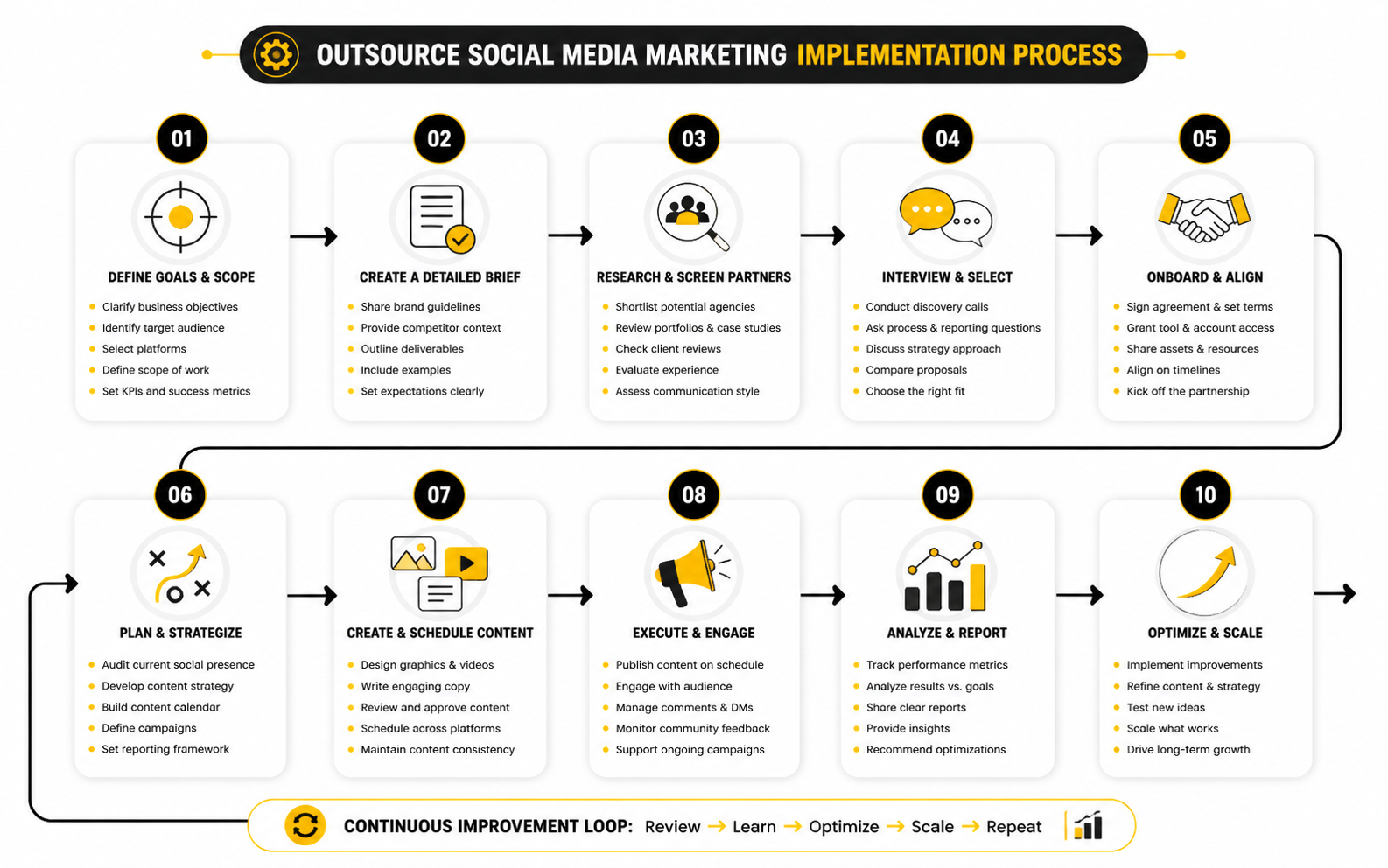
This workflow is not complicated, and that is the point. The simpler it is, the easier it becomes to maintain quality while moving quickly. The real discipline is doing it every week, not reinventing the process every time content is due.
Create One Source Of Truth For Assets And Decisions
Outsourced social media work gets messy when files, feedback, captions, brand rules, and approvals live in five different places. One person comments in Slack, another sends feedback by email, someone edits a Google Doc, and the designer updates a file that nobody can find later. That is how errors happen.
Create one source of truth for the work. It should include the content calendar, approved assets, brand notes, campaign priorities, reusable copy blocks, platform links, reporting dashboards, and decision history. The exact tool matters less than the rule: if it affects the content, it belongs in the shared workspace.
For scheduling and approvals, a tool like Buffer can help centralize planning instead of forcing everyone to manage posts manually. For teams that need landing pages, lead capture, follow-up, and CRM-style campaign management alongside social activity, GoHighLevel can be useful when the outsourced partner is also supporting funnel or appointment workflows. Use tools to reduce friction, not to hide a weak process.
Define Approval Rules Before Content Is Produced
Approvals should be clear before the first batch of content is created. If the outsourced partner does not know who approves what, how long feedback takes, and what requires extra review, production will slow down fast. Worse, urgent content will either miss the moment or go live without the right checks.
A practical approval system separates content by risk. Low-risk educational posts may only need one review. Product claims, customer stories, paid ads, regulated topics, hiring content, and founder opinions may need closer approval. The point is not to create bureaucracy; the point is to protect the business while keeping routine publishing fast.
Feedback also needs standards. “Make it better” is not useful. “This sounds too formal for our voice,” “the claim needs proof,” or “this angle is too broad for our ICP” gives the partner something they can act on. Better feedback makes the next batch stronger, which reduces the amount of feedback needed over time.
Set A Reporting Rhythm That Drives Decisions
Reporting should not be a monthly screenshot dump. It should help the team decide what to do next. If the report does not change the content strategy, campaign plan, or distribution approach, it is probably too shallow.
A strong reporting rhythm looks at content quality, audience response, platform performance, lead indicators, and business relevance. That means reviewing which topics created useful conversations, which formats earned saves or shares, which posts supported offers, and which comments revealed customer questions. Vanity metrics can still be useful, but only when they are interpreted in context.
Your outsourced partner should come to reporting meetings with observations, not just numbers. They should explain what seems to be working, what is weakening, what should be tested, and what needs input from the internal team. That is where the relationship becomes more valuable than basic execution.
Use The First 30 Days To Build The System, Not Chase Perfection
The first month should be treated as setup and calibration. Expect some edits, some awkward drafts, and some process friction. That does not mean the partner is bad; it means they are learning the business, and your team is learning how to delegate clearly.
Use the first 30 days to finalize the brief, define the content pillars, build the shared workspace, agree on approval rules, publish the first controlled batch, and review early signals. Do not judge the entire relationship on one post or one week of results. Judge whether the process is getting clearer and whether the content is moving closer to the brand.
This phase matters because it sets the tone for everything that follows. If you tolerate scattered feedback, unclear ownership, and rushed approvals in month one, that becomes the standard. If you build a clean operating rhythm early, outsourcing becomes easier, faster, and more effective with every cycle.
Statistics And Data
Measurement is where outsourcing becomes honest. A partner can sound strategic, deliver attractive content, and keep the calendar full, but the numbers show whether the work is creating useful movement. Not every useful signal is revenue, and not every weak post means the strategy is wrong, but you still need a clear way to separate activity from progress.
This matters because social media performance is easy to misunderstand. A post can get high reach and produce no commercial value. Another post can look quiet publicly but start strong conversations in DMs, support sales calls, or help warm up a specific audience segment. If you outsource social media marketing, your reporting system needs to explain what the numbers mean, not just collect them.
The right data also protects both sides of the relationship. Your internal team gets visibility into whether the partner is improving the program. Your outsourced partner gets a fair way to show progress, spot bottlenecks, and ask for better inputs when performance is being limited by weak offers, slow approvals, or unclear positioning.
Measure The Funnel, Not Just The Feed
A social media report should not stop at impressions, likes, comments, and followers. Those numbers matter, but they mostly show what happened inside the platform. A stronger system connects social activity to the wider funnel: profile visits, link clicks, lead magnet signups, booked calls, webinar registrations, email subscribers, demo requests, sales conversations, customer questions, and assisted conversions.
This does not mean every post needs to produce a direct sale. That is an unrealistic way to judge organic social, especially for B2B, high-ticket services, or products with longer buying cycles. It means every metric should be tied to a role in the customer journey.
A simple measurement stack might separate performance into four layers:
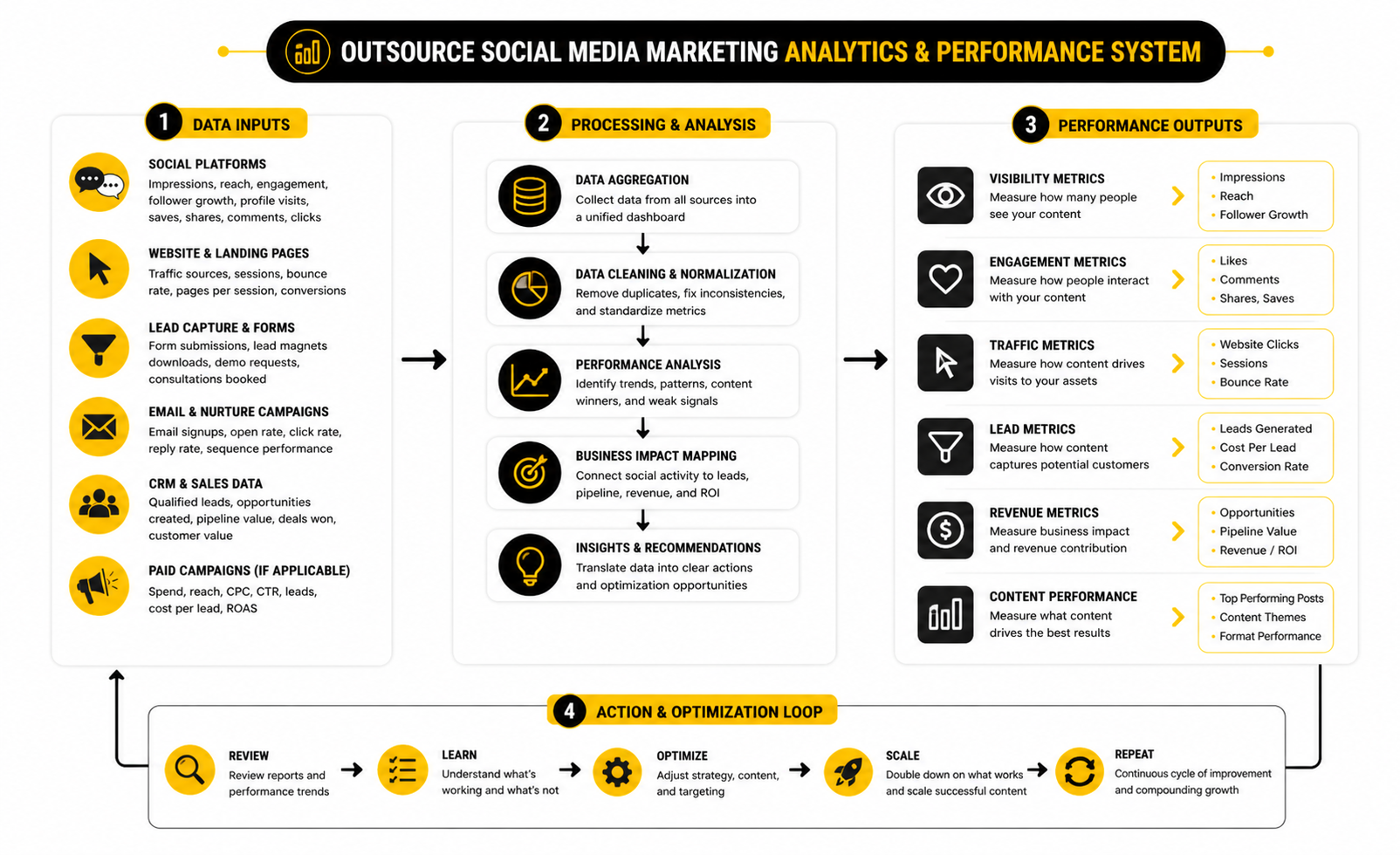
This structure makes reporting more useful because each layer has a different job. Visibility tells you whether enough people are seeing the content. Engagement tells you whether the message is landing. Traffic and capture show whether people are taking the next step. Business movement shows whether social media is supporting the commercial outcome.
Use Benchmarks Carefully
Benchmarks are helpful, but they are not the scoreboard. They give you context, especially when leadership wants to know whether performance is normal, weak, or strong compared with similar brands. They become dangerous when teams use them as a replacement for their own goals.
Industry reports are useful because they show how different platforms behave. For example, Rival IQ’s 2025 benchmark research notes that TikTok engagement remains higher than Instagram, Facebook, and X for many brands, even though the gap has narrowed. That matters because a weak Instagram engagement rate may not mean the partner is failing; it may mean the platform, format, audience, or category needs to be interpreted differently.
Benchmarks should answer one question: “Are we in a reasonable range for our category and platform?” They should not decide your strategy alone. Your own trendline matters more than an average from thousands of unrelated accounts because your offer, audience, price point, brand maturity, and sales cycle are specific to your business.
Track Personal Benchmarks First
The most useful benchmark is your own past performance. Before judging an outsourced partner, capture a baseline for the previous 60 to 90 days. Look at posting frequency, reach, engagement quality, link clicks, content themes, best-performing formats, response time, and any social-driven leads or conversations.
This gives the partner a real starting point. Without a baseline, the first month becomes emotional. One good post can create overconfidence, and one weak week can create unnecessary panic.
Personal benchmarks also help you identify the right kind of improvement. If your brand already has strong engagement but weak lead capture, the outsourced partner should focus on better calls to action, stronger offers, landing page alignment, and DM workflows. If reach is low but conversion is strong, the priority may be creative variety, creator partnerships, paid amplification, or more consistent publishing.
Watch For Quality Signals, Not Just Quantity
Social media reporting often overvalues volume because it is easy to count. More posts, more impressions, more followers, and more comments look good in a spreadsheet. But quantity without quality can create the illusion of progress.
Quality signals are harder to fake. They include comments from the right audience, DMs asking serious questions, saves on educational content, shares from relevant accounts, sales team feedback, repeat engagement from target buyers, and prospects referencing social content on calls. These signals show whether the content is reaching people who may actually matter to the business.
This is especially important when outsourcing because a vendor can optimize for visible activity if the scorecard rewards only volume. If you ask for “more content,” you may get more content. If you ask for stronger buyer conversations, clearer positioning, better education, and measurable next steps, you force the system to improve in a more useful direction.
Interpret Platform Metrics In Context
Each platform rewards different behavior, so the same metric does not mean the same thing everywhere. A save on Instagram may signal educational value. A share on LinkedIn may suggest professional relevance. A comment on TikTok may be lightweight or deeply useful depending on the context. A DM may be a customer support issue, a buying signal, or simply a reaction to a story.
This is why your outsourced partner should not report every platform with the same template. LinkedIn may need analysis around post topics, profile visits, comments from target accounts, and connection requests. Instagram may need attention to Reels retention, story replies, saves, shares, and profile actions. TikTok may need watch time, completion rate, hook performance, and repeatable creative patterns.
The point is not to drown in platform data. The point is to identify which signals actually help you decide what to create next. If a metric does not change your decisions, it probably does not deserve much space in the report.
Connect Social Data To Campaign Data
Social media should not sit in a separate reporting bubble. If your team is running lead magnets, webinars, launches, challenges, product demos, or consultations, social content should be measured against those campaign goals. Otherwise, the outsourced team may optimize the feed while the campaign underperforms.
For example, if social posts drive traffic but the landing page does not convert, the content may not be the problem. The issue could be the offer, page clarity, form friction, audience mismatch, or follow-up sequence. A funnel builder like ClickFunnels or an all-in-one system like GoHighLevel can help connect campaigns, forms, follow-up, and pipeline tracking when social media is part of a broader acquisition system.
That connection matters because it changes the conversation. Instead of asking, “Did the post get enough likes?” you can ask, “Did the campaign create enough qualified next steps?” That is a much better question for any business that wants social media to support growth.
Set Reporting Cadence By Decision Speed
Not every metric needs to be reviewed every day. Daily checking often creates noise, especially with organic content where performance can build over time. The reporting cadence should match the speed of the decision you need to make.
A practical cadence looks like this:
This rhythm keeps the team from reacting too quickly while still catching problems early. It also gives your outsourced partner room to test, learn, and optimize instead of defending every post in isolation.
Ask Better Reporting Questions
The quality of your analytics depends on the quality of your questions. “How many followers did we gain?” is not useless, but it is rarely enough. Better questions reveal whether the strategy is working and where the next improvement should happen.
Useful reporting questions include:
These questions make the outsourced relationship more mature. They move the discussion away from “post more” and toward “make better decisions.” That is where social media starts becoming a real business function instead of a content treadmill.
Know When The Data Says To Change Direction
The hardest part of measurement is acting on it. Many teams collect data, discuss it, and then keep publishing the same kind of content. That defeats the purpose.
Change direction when the same pattern appears across enough posts, platforms, or campaign cycles. If educational content gets saved but never creates clicks, the next step may be stronger offers or clearer calls to action. If opinion-led posts create comments from the wrong audience, the positioning may need tightening. If Reels get reach but no profile action, the creative may be entertaining without building enough interest in the business.
Do not overreact to one post. Do not ignore six weeks of clear signals either. The value of outsourcing is not just that someone else creates content; it is that a capable partner can help you read the market faster and adjust before wasted effort turns into wasted budget.
Managing Content, Workflow, Tools, And Performance
After the strategy, workflow, and measurement system are in place, the next challenge is scale. This is where outsourcing can either become a serious advantage or a quiet mess. More content, more channels, more approvals, more tools, and more stakeholders will expose every weak part of the setup.
The mistake is assuming scale means simply publishing more. In reality, scaling outsourced social media means increasing output without losing voice, quality, judgment, or accountability. That takes stronger systems, not just a bigger content calendar.
If you outsource social media marketing and the work starts to gain traction, treat scale as a new operating phase. The partner who helped you get consistent may not automatically be the partner who can support campaigns, creators, paid distribution, community management, and reporting across multiple teams. Growth changes the job.
Decide Whether You Need A Freelancer, Agency, Or Hybrid Team
A freelancer can be a great fit when you need focused execution, fast communication, and a lean monthly cost. This works well for content writing, design, video editing, scheduling, or one clear platform. The risk is capacity: one person can only handle so much before quality or speed starts to suffer.
An agency usually makes more sense when you need a broader system. That may include strategy, creative production, paid social, reporting, community management, influencer coordination, and campaign support. The tradeoff is that agencies can become slower or more layered if the account structure is not tight.
A hybrid model often works best for growing teams. You might keep one strategic consultant close to the business, use specialist freelancers for production, and bring in an agency only for paid media or campaign launches. This gives you flexibility, but it also requires one internal owner who can keep everyone aligned.
Protect The Brand As More People Touch The Work
The more people involved in social media, the easier it is for the brand voice to drift. One editor writes casually, another designer makes everything look corporate, and a community manager replies in a tone that does not match the company. None of these issues may seem huge on their own, but together they weaken trust.
A strong brand system should include practical examples, not just abstract rules. Show approved hooks, preferred sentence style, common phrases, visual examples, caption formats, comment response examples, and content that should never be copied. Your outsourced team needs to see what “right” looks like in the real world.
This is especially important when content volume increases. A small batch can be reviewed manually with close attention. A larger system needs reusable standards so quality does not depend on one person catching every issue before publishing.
Build A Content Engine Around Source Material
The easiest way to scale content without becoming repetitive is to create from strong source material. This can include founder interviews, sales call themes, customer questions, webinar recordings, podcast episodes, internal training, product updates, research notes, and support conversations. Good source material gives the outsourced team substance to work with.
Without source material, the partner is forced to manufacture ideas from the outside. That usually leads to generic tips, recycled trends, and shallow posts that sound like every other brand in the category. The content may look active, but it will not feel specific.
A better system turns one strong input into multiple useful outputs. A customer objection can become a LinkedIn post, a short video script, a carousel, a sales enablement snippet, and a FAQ answer later in the article or website. Repurposing is not lazy when the original thinking is strong.
Treat Community Management As A Strategic Function
Community management should not be treated as basic inbox cleanup. Comments, replies, mentions, DMs, and tagged posts are where the audience tells you what they care about. If your outsourced partner handles that layer, they need clear rules for tone, escalation, response speed, and commercial handoff.
Some responses can be handled with approved templates, but many need judgment. A complaint, pricing question, partnership request, hiring question, or potential sales inquiry should not be answered casually by someone who does not understand the business. Define what can be answered directly and what needs to be escalated.
This is also where tools can help when the workflow becomes more complex. For example, ManyChat can support structured DM flows when social campaigns need lead capture or follow-up. Just do not automate the parts of the conversation that require human trust.
Be Careful With AI-Assisted Content
AI can help an outsourced social media team move faster, but it should not become the voice of the brand. It is useful for first drafts, content repurposing, idea expansion, transcript cleanup, formatting variations, and campaign brainstorming. It is risky when it replaces customer insight, expert judgment, or real point of view.
This matters because audiences can feel generic content quickly. If every post sounds polished but says nothing specific, the brand becomes forgettable. The problem is not AI itself; the problem is using AI without enough original input.
Set clear rules for AI use with your partner. Decide whether AI can be used for drafts, captions, research organization, creative variations, or reporting summaries. Also decide what must always be human-reviewed, especially claims, statistics, customer references, sensitive topics, and anything tied to the brand’s expertise.
Align Paid Social With Organic Learning
Organic content is a useful testing ground for paid social, but the connection is often missed. If a post consistently earns saves, shares, qualified comments, or strong click behavior, it may reveal an angle worth testing in paid campaigns. If a message falls flat organically, paid spend may only make the weakness more expensive.
That does not mean every organic winner should become an ad. Some posts work because they feel native, personal, or timely, and they may not convert well as paid creative. The outsourced partner should help interpret why something worked before recommending it for amplification.
When paid and organic teams are separate, create a regular exchange between them. Organic can reveal audience language and content themes. Paid can reveal offer response, creative fatigue, and conversion behavior. Together, they create a sharper feedback loop than either channel can produce alone.
Prepare For Creator And Influencer Collaboration
As the program matures, outsourcing may expand into creator partnerships, influencer campaigns, or employee advocacy. This is a different skill set from basic social media management. It involves outreach, negotiation, briefing, usage rights, creative direction, approvals, tracking, and relationship management.
The creator economy keeps attracting brand spend because creators can bring trust, distribution, and cultural fluency that brand channels often lack. Recent industry coverage of IAB research reported that U.S. creator ad spending was projected to reach $37 billion in 2025, which shows why more teams are treating creator work as a serious media channel rather than a side experiment.
If you outsource this area, be very clear about guardrails. Define audience fit, brand safety rules, disclosure expectations, approval rights, content usage terms, and performance tracking before outreach starts. A creator campaign can move fast, but the wrong creator or unclear brief can create brand risk just as quickly.
Watch The Hidden Costs Of Outsourcing
The monthly retainer is only one part of the cost. You also need to account for internal review time, strategy meetings, asset collection, tool subscriptions, ad spend, creator fees, design revisions, legal review, and management overhead. A cheap outsourced option can become expensive if it creates constant rework.
The biggest hidden cost is poor direction. If your team gives vague feedback, misses approvals, changes priorities late, or fails to share campaign context, the partner will waste hours fixing problems that could have been prevented. That cost may not show up as a line item, but it shows up in slower output and weaker performance.
Budget pressure is real for many marketing teams. Gartner’s 2025 CMO Spend Survey reported that marketing budgets had flatlined at 7.7% of company revenue, which makes efficiency more important. Outsourcing should reduce waste and increase capability, not create another expensive layer of confusion.
Scale The Tool Stack Only When The Process Needs It
Tools are useful, but adding too many too early creates noise. A small team does not need a complicated stack just to plan posts, review drafts, and track basic performance. Start with the process, then choose tools that remove friction from that process.
As the system grows, you may need different tools for scheduling, approvals, analytics, landing pages, forms, CRM, automation, and reporting. A scheduling tool like Buffer can help keep publishing organized. A broader platform like GoHighLevel may make sense when social media is connected to lead capture, appointment booking, nurture campaigns, and pipeline tracking.
The rule is simple: every tool should have a job. If nobody owns it, nobody checks it, or it does not improve speed, quality, visibility, or revenue tracking, it probably does not belong in the stack yet. Complexity should earn its place.
Know When To Bring More Work Back In-House
Outsourcing is not always meant to be permanent in the same form. As your company grows, certain responsibilities may become important enough to hire internally. This often happens with strategy, community, creative direction, founder content, customer education, or social-led demand generation.
Bringing work in-house does not mean the outsourcing decision failed. It may mean the channel became important enough to deserve dedicated internal ownership. A good partner can even help you transition by documenting workflows, organizing assets, and training the new hire.
The best long-term model may change over time. Early on, outsourcing gives you speed and capability. Later, internal leadership may give you stronger context and faster decisions. The right answer is the structure that gives the business the best mix of expertise, consistency, control, and momentum.
Mistakes To Avoid, Final Checklist, And FAQ
By this point, the pattern should be clear. Outsourcing is not about removing responsibility from your team. It is about building a sharper system where internal strategy and external execution work together without constant friction.
The final risk is complacency. Once the content calendar is moving and reports look organized, it is tempting to assume the system is handled. That is usually when quality slips, approvals get lazy, performance gets interpreted too generously, and the outsourced partner starts operating on old assumptions.
The best teams keep the relationship active. They review the model, question weak signals, update the brief, improve the workflow, and make sure the partner still fits the next stage of growth. That is how you outsource social media marketing without losing control of the brand.
Common Mistakes To Avoid
The first mistake is outsourcing before the brand has a clear point of view. If your company cannot explain what it believes, who it serves, and why the offer matters, the content will become generic. A partner can help sharpen your message, but they should not be expected to invent the entire business narrative from scratch.
The second mistake is choosing a partner only because they are affordable. Cheap execution can work for simple production tasks, but it becomes expensive when it creates rework, weak content, missed opportunities, or brand risk. Pay attention to thinking quality, process discipline, communication, and whether the partner understands commercial outcomes.
The third mistake is measuring only the easiest numbers. Likes, impressions, and follower growth can be useful, but they do not tell the whole story. The stronger question is whether social media is attracting the right audience, creating useful conversations, supporting campaigns, and giving the business sharper market feedback.
Final Checklist Before You Outsource
Use this checklist before you hire, switch partners, or expand the scope of an outsourced social media relationship. It will not replace judgment, but it will catch the obvious gaps before they become expensive.
This checklist is deliberately practical. The goal is not to create a perfect outsourcing machine on day one. The goal is to make sure the partner is walking into a system that gives them a fair chance to do good work.
What does it mean to outsource social media marketing?
To outsource social media marketing means hiring an external freelancer, agency, consultant, or specialist team to handle part of your social media function. That can include strategy, content creation, design, video editing, scheduling, community management, paid social, analytics, or campaign support. The best setup usually keeps business strategy inside the company while delegating execution and specialist work to outside experts.
Is outsourcing social media marketing a good idea?
It is a good idea when your team lacks time, specialist skills, consistency, or production capacity. It is a bad idea when you expect an outside partner to fix unclear positioning, weak offers, or poor internal communication without giving them enough context. Outsourcing works best when your company stays involved in strategy, approvals, customer insight, and performance decisions.
What social media tasks should I outsource first?
Start with tasks that are repeatable, production-heavy, or specialist. Content repurposing, caption writing, graphic design, short-form video editing, scheduling, reporting setup, and platform formatting are common first choices. Keep positioning, customer insight, offer decisions, and sensitive approvals close to the business until the partner has earned more trust.
What should stay in-house?
Keep the work that depends on deep business context. That includes audience priorities, customer knowledge, brand point of view, product claims, offer strategy, leadership opinions, and final accountability for results. An outsourced partner can support these areas, but your company should not disappear from them.
How much should I pay to outsource social media marketing?
The cost depends on scope, quality, geography, platform mix, content volume, strategy depth, and whether you hire a freelancer or agency. A narrow production role costs less than a full-service partner handling strategy, creative, publishing, community, and analytics. The better question is not just “What does it cost?” but “What capability, speed, and quality does this give us compared with hiring internally?”
How do I choose the right social media partner?
Look for relevant experience, clear thinking, strong communication, good process, and evidence that they understand business goals beyond posting frequency. Ask how they build strategy, collect inputs, manage approvals, report performance, and improve content over time. A good partner should ask sharp questions about your customers, offer, sales process, and positioning before promising results.
Should I hire a freelancer or an agency?
Hire a freelancer when the scope is focused and you want direct communication, flexibility, and lean execution. Hire an agency when you need a broader team, more capacity, strategic depth, paid media, creator coordination, or multi-platform support. A hybrid model can also work well when one person owns strategy and several specialists handle production.
How do I measure whether outsourcing is working?
Measure whether the relationship improves consistency, quality, speed, audience response, campaign support, and business-relevant signals. Track visibility, engagement, traffic, lead capture, qualified conversations, and content insights. Do not judge the entire partnership from one viral post or one weak week; look for patterns over a meaningful period.
How long does it take to see results?
The first 30 days are usually about setup, calibration, workflow, and early publishing. Stronger signals often appear after the partner has enough customer insight, performance data, and feedback to improve the content system. The timeline depends on the starting point, platform, offer, audience size, approval speed, and whether organic social is expected to support awareness, leads, sales, or retention.
Can outsourced social media still sound authentic?
Yes, but only when the partner has access to real source material. Founder notes, sales objections, customer questions, product updates, internal expertise, and strong examples make outsourced content feel specific. If the partner is forced to create from generic prompts, the content will sound generic too.
What tools help manage outsourced social media?
You need tools for planning, approvals, publishing, analytics, assets, and sometimes lead capture. A scheduling tool like Buffer can help organize publishing. For teams connecting social content to funnels, forms, bookings, follow-up, and pipeline tracking, GoHighLevel can support a broader marketing operations setup.
Should I outsource community management too?
You can outsource community management, but only with clear rules. Comments, DMs, complaints, sales questions, and partnership requests need different handling. Give the partner tone guidelines, escalation rules, approved responses, and a clear process for handing important conversations back to the internal team.
What are the biggest risks of outsourcing social media?
The biggest risks are generic content, weak brand voice, poor approvals, unclear accountability, shallow reporting, and overdependence on a partner who does not understand the business. These risks are manageable when you define the brief, workflow, ownership, quality standards, and reporting rhythm early. They become serious when you outsource casually and hope the partner figures everything out alone.
When should I bring social media back in-house?
Bring more work in-house when social media becomes too strategic, too fast-moving, or too closely tied to customer experience for an external partner to manage alone. You may still keep freelancers or agencies for production, paid media, editing, or specialist campaigns. The goal is not to prove outsourcing or in-house is better; the goal is to choose the structure that gives the business the best results at its current stage.
Build a stronger local presence with BAAM AI
Turn your website, Google profile, social channels, and AI visibility into one growth engine
Most businesses do not need more random marketing activity. They need a consistent presence system that helps the right people find them, trust them, and take action. BAAM AI brings strategy, local SEO, website updates, Google Maps visibility, social content, AI-search readiness, media production, and reporting into one practical monthly engine.
If you want your marketing to keep working after the campaign ends, start with a free BAAM AI presence audit. See how your business shows up today and where the fastest visibility wins are at BAAM AI.