
BAAM AI Blog
Outsource Social Media Management: A Practical Guide To Building A Smarter, More Consistent Growth System
Most businesses do not struggle with social media because they lack ideas. They struggle because the work never stays simple for long. One post becomes a calendar, one platform becomes five channels, one campaign...

Most businesses do not struggle with social media because they lack ideas. They struggle because the work never stays simple for long. One post becomes a calendar, one platform becomes five channels, one campaign becomes comments, DMs, reporting, creative testing, community management, short-form video, paid amplification, and constant platform changes.
That is why many founders, agencies, ecommerce brands, coaches, local businesses, and B2B teams eventually consider whether to outsource social media management instead of trying to handle everything in-house. The goal is not to “get posting off your plate” in the cheapest possible way. The real goal is to create a repeatable system that protects your brand voice, publishes consistently, learns from performance data, and turns attention into measurable business outcomes.
The timing matters. Social media is no longer a side channel. The global social audience reached 5.24 billion active social media user identities in early 2025, and social platforms now influence discovery, customer service, reputation, hiring, partnerships, and sales. At the same time, consumers expect brands to respond with more relevance and care, with the 2025 Sprout Social Index showing that social media now sits at the center of how many people interact with companies, creators, and communities.
Outsourcing can be a smart move, but only when it is structured correctly. Hiring a random freelancer to “make posts” without strategy, access rules, approval workflows, brand documentation, and reporting expectations usually creates more chaos. Hiring the right external team with the right operating system can make your content sharper, your publishing rhythm more reliable, and your internal team much less reactive.
This guide breaks the decision down in a practical way. It is written for business owners and marketing leaders who want social media handled professionally without losing control of the brand. You will see where outsourcing fits, what to delegate, what to keep close, how to choose a provider, what tools help, and how to measure whether the partnership is actually working.
Why Outsourcing Social Media Management Matters
Social media management looks easy from the outside because the visible output is simple. People see a post, a reel, a story, a carousel, or a reply. What they do not see is the research, scripting, editing, scheduling, approvals, platform formatting, moderation, reporting, creative testing, and follow-up work sitting behind that single piece of content.
That hidden workload is the first reason outsourcing matters. A founder who spends five scattered hours per week trying to post consistently is not really saving money if the work is rushed, inconsistent, and disconnected from sales goals. A small internal marketing team can also get buried quickly when social media becomes one more responsibility on top of email, paid ads, website updates, launches, events, and customer communication.
The second reason is specialization. Modern social media requires strategy, copywriting, design direction, short-form video instincts, analytics, audience research, community management, and platform-specific judgment. Very few small teams have all of those skills in one person, and even when they do, that person often becomes a bottleneck.
The third reason is consistency. Social media rewards rhythm, but businesses often operate in bursts. They post heavily during launches, disappear during busy operational periods, return with a generic update, and then wonder why engagement feels unpredictable. Outsourcing gives you a dedicated cadence, but only if the partner is managed through clear goals, documented standards, and a real workflow.
The Outsourced Social Media Framework
A strong outsourcing relationship is not built around tasks alone. It is built around a framework that connects business goals to content decisions, channel execution, audience interaction, and measurement. Without that structure, outsourcing becomes a content production expense rather than a growth asset.
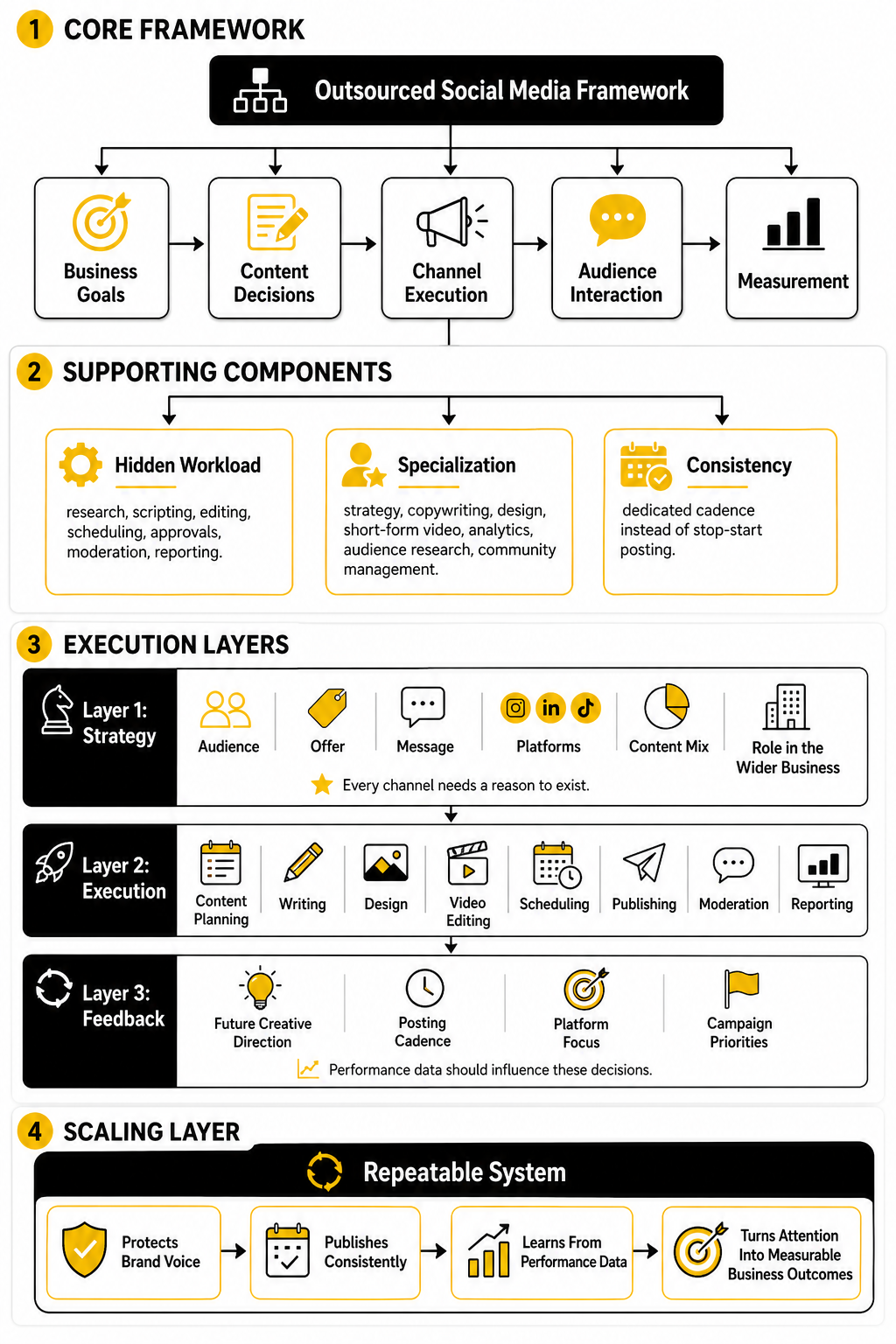
The framework starts with strategy because every channel needs a reason to exist. A local service business may need trust-building content, review amplification, and fast response workflows. An ecommerce brand may need product education, creator-style videos, social proof, offer testing, and campaign coordination with landing pages. A B2B company may need thought leadership, founder-led content, case-study distribution, and LinkedIn relationship building.
The second layer is execution. This includes content planning, writing, design, video editing, scheduling, publishing, moderation, and reporting. Execution is where most businesses focus first, but execution without positioning creates generic content. A professional partner should not only ask what you want posted; they should ask who you are trying to reach, what those people already believe, what objections slow them down, and what action the content should support.
The third layer is feedback. Social media is not a set-and-forget channel. Performance data should influence future creative direction, posting cadence, platform focus, and campaign priorities. A good outsourcing partner does not simply send a monthly report full of screenshots; they explain what changed, what worked, what did not, and what they recommend doing next.
What Social Media Management Actually Includes
Before you outsource social media management, you need to define what “management” means. This is where many businesses get into trouble. They hire someone expecting strategy, content, analytics, engagement, creative direction, and lead generation, while the provider thinks they were hired to schedule posts and send a monthly summary.
Real social media management covers the full operating rhythm behind your brand’s presence. It includes deciding what to say, where to say it, how to package it, when to publish it, how to respond, and how to learn from the results. That is a much bigger job than filling a calendar with motivational quotes, product reminders, and recycled blog snippets.
A professional scope usually includes:
Not every business needs every service immediately. A local accounting firm does not need the same setup as a DTC skincare brand, and a SaaS company does not need the same content engine as a fitness creator. The point is to define the job clearly so the provider is solving the right problem.
Strategy Comes Before Posting
Strategy is the part most people skip because it feels slower than creating content. That is a mistake. If your strategy is weak, outsourcing only helps you publish bad content more consistently.
A good strategy defines the audience, the offer, the message, the platforms, the content mix, and the role social media plays in the wider business. It should answer simple questions with real clarity. Are you trying to build trust before sales calls? Drive traffic to a funnel? Recruit talent? Support existing customers? Create demand for a product category people do not fully understand yet?
This matters because platform behavior keeps changing. HubSpot’s 2025 social media research highlights community, customer experience, AI-assisted content, short-form video, and relatable brand content as major themes for marketers, which means social media now touches more than brand awareness alone. If your outsourced partner only thinks in terms of posts, they will miss the deeper business function of the channel.
Content Planning Turns Ideas Into A System
Content planning is where your strategy becomes a working calendar. This includes themes, campaigns, hooks, formats, deadlines, review dates, and channel-specific adjustments. A good plan creates enough structure to stay consistent without making the brand feel stiff.
The best content calendars are not just lists of posts. They connect content to buyer awareness, objections, events, offers, product launches, seasonal demand, and audience questions. They also leave room for timely posts when something relevant happens in your market.
This is one of the easiest areas to outsource well because an external team can bring discipline to a messy process. They can collect raw ideas from you, turn them into structured campaigns, and keep the publishing rhythm moving. But they still need access to your real business context, because generic content planning produces generic content.
Creative Production Needs Clear Direction
Creative production includes copy, visuals, carousels, reels, thumbnails, captions, stories, and sometimes repurposed long-form content. This is where a lot of outsourcing decisions are made because it is the most visible part of the work. It is also where brand quality can slip fast if you do not provide standards.
You need clear direction on tone, visual style, vocabulary, claims, compliance boundaries, and what your brand should never sound like. This is especially important if your business operates in finance, health, legal, B2B, or any category where trust can be damaged by loose wording. A cheap post that says the wrong thing is expensive.
For simple scheduling and publishing workflows, tools like Buffer can help a small team or outsourced partner keep content organized across channels. The tool does not replace strategy, but it can reduce friction once the strategy is already clear. That distinction matters.
Community Management Is Part Of The Brand Experience
Community management is not just “replying to comments.” It is how your brand behaves when people react, ask questions, complain, praise, misunderstand, compare, or challenge you in public. That behavior becomes part of your reputation.
This is why you should never outsource community management without response guidelines. Your provider needs to know what they can answer directly, what needs escalation, what should be hidden or reported, and when a conversation should move to DM, email, sales, or support. They also need examples of your preferred tone under pressure, not just when everything is positive.
The business case is stronger than most people think. The Sprout Social Index is built around research from thousands of consumers and marketers, and its recent findings show how central social media has become to brand relationships, customer care, and consumer expectations. When your audience treats social as a front door to the business, slow or careless responses are not a small issue.
Reporting Should Lead To Better Decisions
Reporting is where outsourcing either becomes accountable or turns into a vague monthly expense. A useful report does not just list impressions, reach, likes, comments, and follower growth. It explains what those numbers mean and what should change because of them.
The best reports separate vanity metrics from business signals. Reach can matter if the goal is awareness. Saves can matter if the content is educational. Clicks can matter if the offer and landing page are aligned. Comments can matter if they reveal objections, confusion, or demand.
You should expect your partner to explain patterns in plain language. Which topics are gaining traction? Which formats are underperforming? Which hooks create stronger watch time or engagement? Which posts bring the wrong audience? If the report does not improve next month’s decisions, it is just decoration.
What To Outsource And What To Keep In-House
The smartest way to outsource social media management is not to hand over everything blindly. You want to outsource the work that benefits from process, specialization, and consistency while keeping the parts that require deep internal judgment close to the business. That balance protects quality and speeds up execution.
Think of your internal team as the source of truth. You understand the customer, product, offer, margins, sales objections, operational limits, founder perspective, and brand risk. The outsourced team can turn that raw knowledge into strategy, content, publishing, engagement systems, and reporting.
This is the practical split: keep ownership of the message, but outsource the machine that turns the message into consistent market presence.
Tasks You Can Usually Outsource
Most recurring production and execution tasks can be outsourced once the strategy is clear. This includes planning calendars, writing captions, designing graphics, editing short-form videos, scheduling posts, formatting content for each platform, monitoring comments, creating reports, and repurposing existing assets. These tasks require skill, but they do not always require full-time internal headcount.
Outsourcing is especially useful when the work is important but constantly delayed. If your team has strong ideas but weak follow-through, an external partner can create momentum. They can also introduce a cleaner workflow so content does not depend on someone remembering to post between meetings.
Commonly outsourced tasks include:
This works best when you create a repeatable intake process. Your provider should know where to get product updates, customer questions, testimonials, promotions, brand assets, and subject-matter input. Without that input, even a talented team will eventually run out of useful things to say.
Tasks You Should Usually Keep In-House
Some parts of social media should stay close to leadership, sales, product, or customer success. This includes final positioning, sensitive customer issues, controversial topics, legal or compliance decisions, crisis communication, major campaign approvals, and anything involving confidential business information. You can get help preparing the message, but ownership should remain internal.
Founder-led ideas also need internal involvement. A provider can polish, package, and distribute the content, but they cannot invent lived experience you do not share with them. If your audience follows you for point of view, expertise, or trust, your team must feed the system with real insight.
Keep these areas close:
This does not mean your internal team has to do all the writing. It means they must own the judgment. A strong outsourced partner can turn a rough voice note, sales call insight, webinar clip, or customer question into strong content, but they need the raw material first.
The Best Hybrid Model
The best model is usually hybrid. Your internal team provides direction, context, approvals, and subject-matter insight. The external partner handles strategy support, production, scheduling, optimization, and reporting. This creates speed without disconnecting the content from the real business.
For example, your internal team might record a 20-minute monthly briefing covering product updates, customer questions, sales objections, campaign priorities, and market observations. The outsourced team then turns that briefing into a content calendar, post drafts, short-form scripts, carousels, and repurposed clips. Your team reviews the work once, requests edits, and the partner schedules the approved content.
That model is simple, but it solves a huge problem. It prevents the outsourced team from guessing, and it prevents the internal team from getting trapped in daily execution. When you outsource social media management this way, you are not buying random content. You are building a repeatable publishing system around real business intelligence.
How To Choose The Right Social Media Management Partner
Choosing the right partner is where the outsourcing decision becomes real. Plenty of providers can make decent-looking posts. Far fewer can understand your market, protect your brand voice, build a repeatable workflow, and connect content decisions to business outcomes.
Start by looking for thinking, not just output. A strong partner should ask about your offer, audience, sales cycle, customer objections, margins, competitors, approval process, and internal capacity before they talk too much about posting frequency. If they jump straight into package pricing without diagnosing the business, that is a warning sign.
You also want to understand whether they are a strategist, creator, coordinator, or full-service operator. A freelancer may be perfect if you already have strategy and only need production support. An agency may be better if you need planning, creative, publishing, reporting, and coordination across multiple channels. The right answer depends on how much internal marketing infrastructure you already have.
Check Their Strategic Judgment
A good social media partner should be able to explain why a piece of content should exist. They should know the difference between awareness content, trust-building content, product education, sales enablement, customer care content, and campaign support. If every recommendation sounds like “post more reels,” they are thinking too narrowly.
Ask how they would approach your first 90 days. Their answer should include an audit, audience review, competitor scan, content pillar development, workflow setup, testing plan, and reporting cadence. It does not need to be overcomplicated, but it should show that they understand sequence.
This matters because social platforms are crowded and expectations are higher than they used to be. The 2025 Sprout Social Index is based on surveys of more than 4,000 consumers and 1,200 marketers, and it makes one thing clear: social is now tied to brand trust, customer care, culture, and buying behavior. A provider who treats the channel as a basic posting task is not prepared for that reality.
Review Their Process Before You Review Their Portfolio
A portfolio can show taste, but process shows reliability. You need to know how ideas are collected, how drafts are created, how approvals work, how revisions are handled, how urgent posts are managed, and how performance insights are fed back into future content. Beautiful work without a clear workflow will still create stress.
Ask to see how they organize a monthly content cycle. You are not asking for confidential client material. You are asking how the machine works. A professional should be able to walk you through intake, planning, production, review, publishing, engagement, and reporting without sounding vague.
Process is especially important when multiple people are involved. If your outsourced team includes a strategist, copywriter, designer, editor, account manager, and community manager, someone needs to own quality control. Otherwise, your brand voice gets passed around like a file attachment, and that is how mistakes happen.
Ask About Industry Fit Without Overvaluing It
Industry experience helps, but it is not everything. A partner who understands your category may move faster because they already know the audience, language, objections, and compliance risks. That can be useful in industries like healthcare, finance, legal, SaaS, ecommerce, real estate, education, and professional services.
But do not hire based on industry logos alone. Some agencies reuse the same playbook across every client in a niche, which makes the content feel identical. You want category understanding plus original thinking.
The better question is not, “Have you worked in my industry?” It is, “How would you learn our audience, offer, and point of view quickly?” Their answer will tell you whether they can build a content system around your business instead of forcing your business into their template.
Clarify Ownership, Access, And Risk
Outsourcing social media creates practical risk if ownership is unclear. You need full control of your social accounts, ad accounts, brand assets, creative files, analytics access, and published content. The provider can manage the work, but your business should own the infrastructure.
Access should also be controlled. Use role-based permissions wherever possible, avoid sharing personal passwords, and keep a simple offboarding checklist ready before the relationship even starts. This is not paranoia. It is basic operational hygiene.
You should also define approval boundaries. Some posts can be pre-approved through content pillars and templates. Others need review because they mention claims, pricing, partnerships, customer stories, hiring, legal issues, or sensitive topics. The more clearly you define this upfront, the less friction you create later.
Professional Implementation: From First Audit To Scalable System
Once you choose a partner, the first month should not be a scramble to post something immediately. It should be a structured setup period where you build the operating system. You are not just outsourcing tasks; you are installing a content workflow that should become easier and more carefully over time.
The implementation process should move from discovery to documentation, then from production to measurement. That order matters. If you skip documentation, every post requires too much interpretation. If you skip measurement, you keep producing content without knowing what the market is telling you.
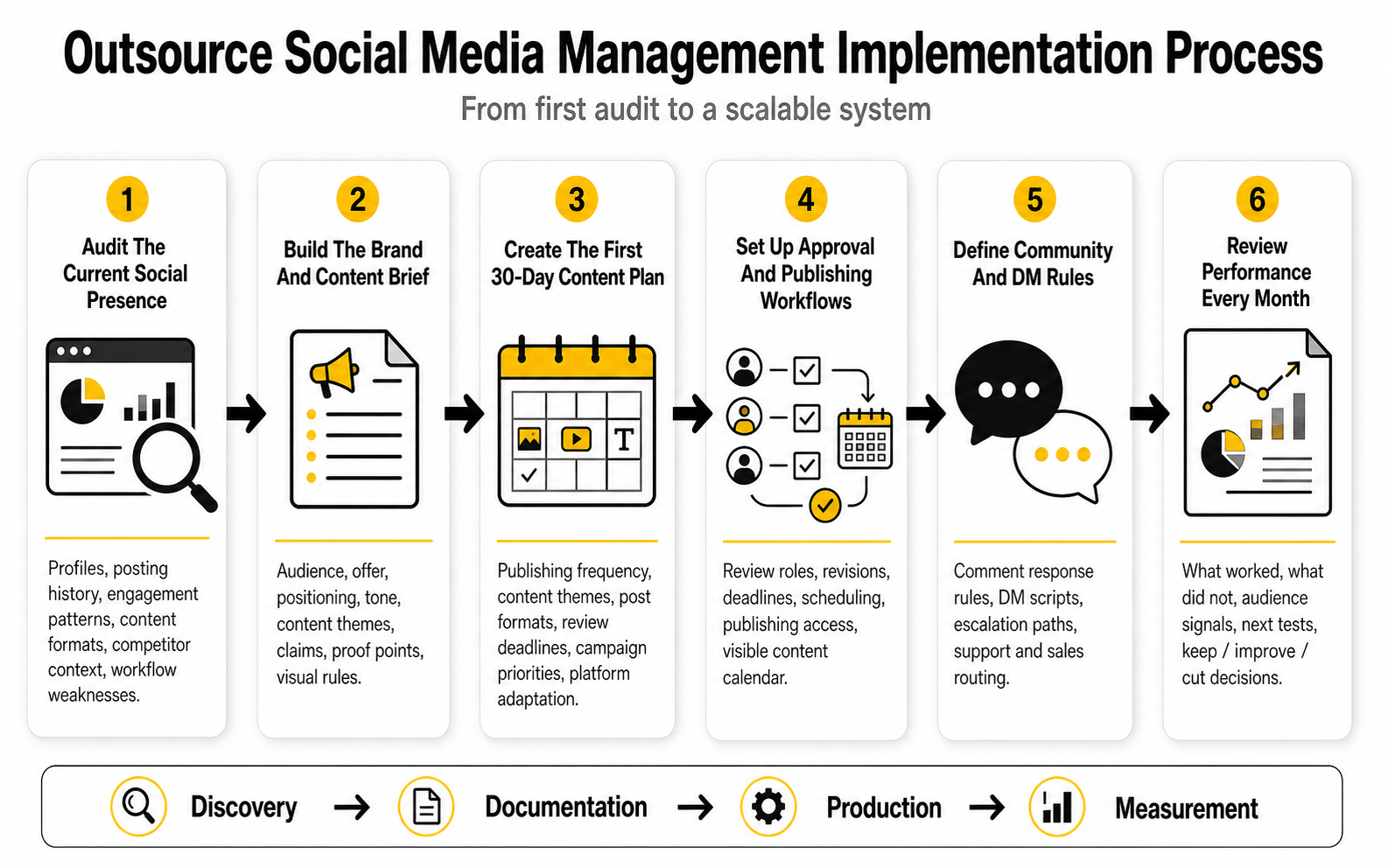
The goal is simple: give the outsourced team enough clarity to move fast without guessing. That requires a clean brief, clear ownership, practical tools, and a rhythm everyone can actually maintain. Overcomplicated workflows die quickly, so keep the system tight.
Step 1: Audit The Current Social Presence
Start with an audit of your existing accounts. This should include profile positioning, bio clarity, pinned content, visual consistency, posting history, engagement patterns, audience signals, content formats, and competitor context. The point is not to criticize old posts. The point is to find the gaps between how the business wants to be perceived and how it currently shows up.
The audit should also look at what is already working. Sometimes a brand has one post format, one recurring topic, or one founder perspective that performs well but was never turned into a repeatable content pillar. A good partner will find those signals instead of starting from zero.
You should also review operational weaknesses. Maybe content approvals are too slow. Maybe nobody knows who answers DMs. Maybe your best customer insights live in sales calls but never reach marketing. These workflow issues matter as much as creative quality.
Step 2: Build The Brand And Content Brief
The brand brief gives your partner the raw material they need to create without constantly asking basic questions. It should explain your audience, offer, positioning, competitors, tone, content themes, claims, proof points, visual rules, and escalation boundaries. This document does not need to be fancy. It needs to be useful.
Include examples of what your brand should sound like and what it should never sound like. This is where you define whether the tone is bold, calm, technical, witty, premium, educational, founder-led, or community-first. Give real examples because vague words like “professional” and “authentic” are not enough.
The content brief should also define your main content pillars. For example, a B2B service company might use market education, problem diagnosis, client objections, behind-the-scenes expertise, case-study lessons, and founder point of view. An ecommerce brand might use product education, customer proof, lifestyle use cases, creator content, offer campaigns, and community questions.
Step 3: Create The First 30-Day Content Plan
The first 30-day plan should be focused, not bloated. You are testing rhythm, workflow, creative direction, and audience response. Trying to launch on every platform with every format in the first month usually creates noise.
A practical first plan should include publishing frequency, content themes, post formats, review deadlines, campaign priorities, and engagement responsibilities. It should also clarify how content is adapted across platforms. A LinkedIn post, Instagram carousel, TikTok script, and Facebook community post should not all be treated as the same asset.
This is also the right time to connect social content to the rest of the funnel. If your posts are meant to drive leads, your landing page, form, email follow-up, and CRM process need to be ready. Tools like GoHighLevel can help agencies and service businesses connect social leads to pipelines, automations, follow-up, and client communication instead of letting interest disappear in a messy inbox.
Step 4: Set Up Approval And Publishing Workflows
Approval workflows should be simple enough to use every week. Decide who reviews content, how comments are left, how many revision rounds are included, and what deadline applies before scheduled publishing. If three people give conflicting feedback with no final decision-maker, the workflow will break.
The best approval systems separate strategic feedback from minor edits. Strategic feedback covers the angle, claim, offer, audience, or positioning. Minor edits cover wording, formatting, grammar, or design details. Mixing those together slows everything down.
Publishing access should be handled carefully. Use platform roles, social scheduling tools, and permission settings instead of giving broad account access to everyone. If your partner uses Buffer, keep internal ownership clear and make sure the publishing calendar is visible to the right people before posts go live.
Step 5: Define Community And DM Rules
Community management needs rules before volume increases. Decide which comments can be answered directly, which ones need internal review, and which ones should be escalated to support, sales, or leadership. This protects the brand and gives the outsourced team confidence.
DMs require even more care because they can involve pricing, complaints, partnerships, refunds, personal information, or sales opportunities. A provider can triage and route messages, but they need scripts and boundaries. They should know what to say, what not to say, and when to stop typing.
For businesses that rely heavily on Instagram, Facebook, or Messenger conversations, ManyChat can support automated replies, lead capture, comment-to-DM flows, and basic qualification. Automation should not replace human judgment, but it can make response handling faster when the rules are clear.
Step 6: Review Performance Every Month
The first monthly review should focus on learning, not blame. You want to know which topics earned attention, which formats created stronger engagement, which posts attracted the right audience, and which parts of the workflow slowed things down. That is how outsourcing improves instead of becoming a static retainer.
Use a short list of metrics tied to the actual goal. If the goal is awareness, look at reach, profile visits, follower quality, and content shares. If the goal is demand generation, look at clicks, replies, lead form starts, booked calls, and CRM movement. If the goal is customer care, look at response time, resolution quality, recurring questions, and sentiment patterns.
The review should end with decisions. Keep what worked, cut what did not, and choose a small number of tests for the next month. That is the difference between reporting activity and managing performance.
Statistics And Data That Actually Matter
Numbers are useful only when they change your decisions. If a report says reach went up, that sounds good, but it does not automatically mean the content attracted the right people. If engagement dropped, that sounds bad, but it may be acceptable if the content moved from broad awareness to stronger sales intent.
This is why measurement has to be built into the outsourcing relationship from the start. When you outsource social media management, you are not paying for random activity. You are paying for a system that should create clearer signals, better decisions, and stronger execution over time.
The scale of the channel explains why this matters. Social media reached 5.24 billion active user identities worldwide in early 2025, and DataReportal’s April 2026 update estimated 5.79 billion social media user identities globally. That size creates opportunity, but it also creates noise. Your analytics system has to separate attention from actual progress.
Start With The Business Goal, Not The Platform Metric
The most common reporting mistake is starting with platform numbers before defining the business goal. A post can earn likes and still do nothing useful for the business. Another post can get modest engagement but bring in qualified sales conversations, customer objections, partner interest, or useful audience feedback.
Start with the role social media is supposed to play. For some businesses, the goal is reach and market visibility. For others, it is lead generation, customer education, recruiting, community building, support deflection, event promotion, or sales enablement. Each goal needs a different measurement lens.
This is the basic rule: measure the behavior you want more of. If you want awareness, track reach, impressions, profile visits, shares, and follower quality. If you want demand, track clicks, DMs, form fills, booked calls, email signups, and CRM movement. If you want trust, track saves, comments with substance, repeat engagement, customer questions, and sentiment.
Use Benchmarks Carefully
Benchmarks are helpful, but they are not targets you should blindly chase. They tell you what is normal in a market, category, or platform. They do not tell you what your audience needs, what your offer requires, or what your sales cycle can realistically support.
For example, Sprout Social’s 2025 benchmark reporting separates inbound engagements by day and by post because those two views answer different questions. Daily engagement helps you understand whether the overall channel is gaining momentum. Per-post engagement helps you judge whether a specific creative angle, format, or message deserves more attention.
Industry benchmarks are most useful when they stop you from overreacting. If your engagement rate is below a broad average, that may reveal a creative or audience problem. But it may also reflect your category, account size, platform mix, posting frequency, or campaign objective. A serious outsourced partner should interpret benchmarks with context, not use them as a scare tactic.
Build A Measurement System Around Four Layers
A simple analytics system should track four layers: visibility, engagement, conversion, and learning. Visibility shows whether more of the right people are seeing the brand. Engagement shows whether the content is creating enough interest for people to react, save, comment, share, or click.
Conversion shows whether social activity is moving people into the next business step. That could mean a lead magnet download, booked consultation, demo request, purchase, webinar registration, newsletter signup, or qualified DM conversation. Learning shows what the audience is telling you through questions, objections, comments, complaints, content saves, and repeated topics.
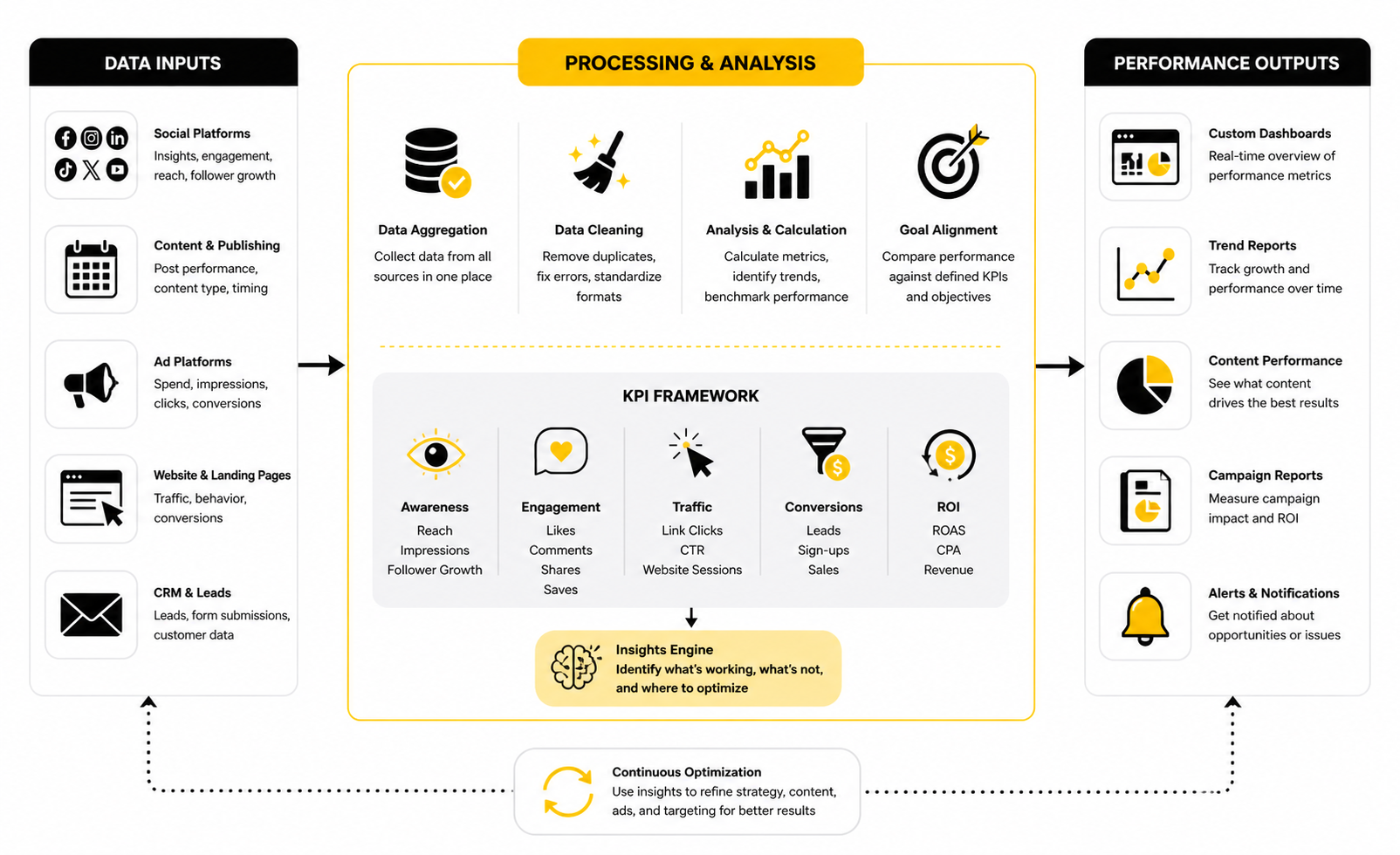
This four-layer system prevents lazy reporting. It stops the conversation from becoming “likes are up” or “reach is down” without context. Instead, each metric has a job, and each report should lead to an action.
A useful monthly analytics review should answer:
Track Leading And Lagging Indicators
Leading indicators show whether your social media system is getting healthier before revenue appears. These include publishing consistency, content quality, profile visits, saves, shares, watch time, comments with intent, click-through behavior, and DM volume. They matter because social media often influences trust before a buyer is ready to act.
Lagging indicators show the business result after the audience takes a meaningful step. These include leads, booked calls, sales conversations, pipeline value, purchases, customer retention signals, and support outcomes. These are closer to revenue, but they can take longer to show movement.
You need both. If you only track lagging indicators, you may kill a strategy before it has enough time to mature. If you only track leading indicators, you may celebrate activity that never becomes business value.
Do Not Treat All Engagement As Equal
Engagement is one of the most misunderstood metrics in social media. A like is not the same as a save. A generic emoji comment is not the same as a detailed objection from a potential buyer. A viral post is not automatically better than a smaller post that attracts the exact people you want to reach.
The quality of engagement matters more than the raw count. A B2B company may get fewer comments than a lifestyle brand, but one thoughtful comment from the right decision-maker can be more valuable than hundreds of casual reactions. An ecommerce brand may care more about saves, product clicks, creator content performance, and repeat questions than broad comment volume.
When you outsource social media management, ask your partner to categorize engagement instead of reporting it as one flat number. Separate audience reactions, customer questions, sales intent, support issues, objections, praise, and irrelevant activity. That gives you better insight into what the market actually cares about.
Measure Response Speed And Conversation Quality
Social media is also a customer communication channel, not just a publishing channel. If people ask questions and nobody responds quickly, the brand feels inactive. If responses are careless, the brand feels unprofessional.
Response speed matters, but quality matters too. A fast reply that ignores the question does not help. A thoughtful reply that routes the person to the right next step can protect trust, create sales opportunities, and reduce friction.
This is where outsourced support needs clear rules. Your partner should report how many comments and DMs came in, how many were answered, how many were escalated, and what themes appeared repeatedly. If the same question keeps showing up, that is not just a support issue. It is a content opportunity.
Connect Social Metrics To The Funnel
Social analytics become far more useful when they are connected to the next step in the customer journey. If a post drives people to a landing page, you need to know whether they clicked, stayed, opted in, booked, or bounced. If a DM campaign creates interest, you need to know whether those conversations moved into the CRM.
This is where tools matter. A scheduling tool can help publish content, but it will not automatically show whether social activity created qualified opportunities. For service businesses and agencies, GoHighLevel can help connect social leads with pipelines, forms, automation, booking, and follow-up so performance does not disappear after the first click.
For ecommerce or offer-driven campaigns, the same principle applies. If social posts are sending traffic to a product page, funnel, or campaign page, the landing experience needs to match the promise made in the post. A strong content campaign can still underperform if the next page is slow, confusing, or disconnected from the message.
Use Platform Data, But Do Not Worship It
Native platform analytics are useful because they show what happened inside each channel. Instagram, TikTok, LinkedIn, Facebook, YouTube, Pinterest, and X all measure performance differently. That means your outsourced partner should understand platform-specific signals instead of forcing every channel into one identical report.
Still, platform data has limits. It can show reach, views, clicks, engagement, audience demographics, and content performance. It may not show the full impact on trust, word of mouth, sales conversations, dark social sharing, or delayed conversions.
Treat platform analytics as directional evidence, not the entire truth. Pair them with website analytics, CRM data, sales team feedback, customer questions, support themes, and qualitative audience signals. The more complete the picture, the better your decisions become.
Watch For The Wrong Metrics
Some metrics look impressive but create bad incentives. Follower count is one of them. More followers can help, but only if those followers match your market and care about your offer. Buying attention from the wrong audience makes reporting look better while making the business weaker.
Posting frequency can also become a vanity metric. Publishing more often is not automatically better if quality drops, approvals break, or the audience starts ignoring repetitive content. Consistency matters, but consistency should support relevance.
The same applies to viral reach. A viral post can be useful when it reaches the right audience and supports the brand. But if it attracts people who will never buy, never engage again, and misunderstand what you do, it may be a distraction disguised as success.
Turn Reporting Into Action
A good report should end with decisions. If educational posts get saves but few clicks, test stronger calls to action or clearer offer bridges. If founder-led posts create better comments, capture more internal perspective and repurpose it into multiple formats. If product posts get reach but weak engagement, improve the angle, proof, or creative format.
This is where a strong outsourcing partner earns their fee. They should not just deliver charts. They should tell you what to continue, what to cut, what to improve, and what to test next.
The simplest monthly decision framework is:
When reporting drives these decisions, outsourcing becomes sharper every month. The content gets less random, the workflow gets easier, and the numbers start telling a useful story. That is the whole point.
Pricing, Tools, Workflows, And Performance Measurement
By this point, the question is no longer whether outsourcing can work. It can. The real question is whether the economics, tools, workflow, and accountability model make sense for your business.
This is where you need to be practical. A cheap provider with weak process can cost more than a premium partner because your team spends hours fixing mistakes, rewriting captions, chasing deadlines, and explaining the same context repeatedly. A higher-priced partner can still be a poor investment if they create polished content that does not support sales, retention, hiring, customer education, or brand trust.
When you outsource social media management, evaluate the full operating cost. That includes the provider fee, internal review time, tools, content assets, video production, paid promotion, landing pages, reporting, and management overhead. The best setup is not always the cheapest. It is the one that creates a reliable content engine without draining your team.
Understand The Main Pricing Models
Most social media management providers price their work through monthly retainers, project-based packages, hourly support, or platform-specific bundles. Retainers usually make the most sense when you need ongoing planning, publishing, engagement, and reporting. Project pricing can work for audits, strategy builds, launch campaigns, or content batch creation.
Hourly pricing can be useful for flexible support, but it can also make the relationship feel transactional. If every small content adjustment becomes a time-tracking issue, the provider may avoid deeper thinking and the client may hesitate to request improvements. That is not a great foundation for a strategic channel.
Platform bundles are common, but they need context. Managing one platform well can be more valuable than posting weak content across five channels. A serious provider should help you choose the right platform mix instead of selling more channels because the package looks bigger.
Match The Budget To The Business Stage
A startup, local business, creator-led company, ecommerce brand, and established B2B firm should not buy the same outsourcing package. The stage of the business determines how much strategy, production, reporting, and experimentation you actually need. Spending too little creates weak execution, but spending too much before the offer is clear can create waste.
Early-stage businesses usually need clarity first. They need messaging, content pillars, proof, founder input, and a manageable posting rhythm. Scaling businesses usually need stronger systems, more formats, better reporting, campaign coordination, and tighter handoff between social content and sales.
Established teams may need a more specialized partner. That could mean executive thought leadership, paid social creative testing, social listening, community management, influencer coordination, or multi-market content governance. The budget should follow the complexity of the job, not someone else’s idea of a standard package.
Choose Tools That Reduce Friction
Tools should make the workflow easier, not heavier. You do not need a bloated tech stack just to publish content consistently. You need a simple set of tools that supports planning, asset sharing, approvals, publishing, analytics, lead capture, and follow-up.
The exact stack depends on your business model. A service business may care more about forms, booking, CRM, automation, and pipeline visibility. An ecommerce brand may care more about campaign pages, product content, creator assets, email capture, and conversion tracking. A B2B team may care more about LinkedIn workflows, content repurposing, sales enablement, and attribution.
Useful tool categories include:
A tool like Buffer can be a clean option for scheduling and organizing social publishing. For businesses that need social leads routed into automations, bookings, and sales pipelines, GoHighLevel can make the post-click process more structured. If social traffic needs to move into a dedicated funnel, ClickFunnels can help package an offer into a focused conversion path.
Know When AI Helps And When It Hurts
AI can speed up social media work, but it should not become the brand. It can help with research summaries, draft variations, content repurposing, topic clustering, caption alternatives, and reporting notes. Used well, it gives your outsourced partner more leverage.
Used badly, it creates bland content, fake authority, generic hooks, inaccurate claims, and a brand voice that sounds like everyone else. That risk is getting bigger as audiences become more skeptical of automated content. Hootsuite’s social trends research has highlighted growing consumer caution around AI-generated marketing, and Gartner’s 2025 consumer research found that trust varies heavily by platform, with YouTube, Reddit, and Instagram earning very different levels of perceived information accuracy.
The solution is not to ban AI from the workflow. The solution is to govern it. Your provider should be clear about where AI is allowed, where human review is mandatory, what data can never be entered into AI tools, and which claims require source verification before publishing.
Protect The Brand With Governance
Governance sounds boring until something goes wrong. Then it becomes the most important part of the whole system. Social media moves fast, and outsourced teams need guardrails before they publish on behalf of your company.
Your governance system should cover access, approvals, escalation, compliance, confidentiality, AI use, crisis response, and brand safety. It should define who can publish, who can approve, who can respond to sensitive comments, and who has final authority when a post involves risk. This does not need to be a 50-page manual. It needs to be clear enough that people know what to do under pressure.
At minimum, document:
This is especially important if your provider uses contractors, white-label partners, or AI-assisted workflows. You need to know who is touching your content, who can access your accounts, and how quality is checked before anything goes live. Trust is good. Controls are better.
Scale Without Losing The Voice
The more content you produce, the easier it is for the brand voice to flatten. Scaling creates more posts, more formats, more contributors, more approvals, and more chances for the message to drift. That is why a bigger content engine needs stronger documentation, not just more production capacity.
The best way to scale is to build from repeatable source material. Founder voice notes, sales call themes, customer questions, webinar clips, product demos, event recordings, internal training, testimonials, and support conversations can all become content inputs. This keeps the content grounded in the real business instead of forcing the outsourced team to invent ideas from the outside.
You can also scale through repurposing. One strong webinar can become short clips, LinkedIn posts, quote graphics, email snippets, carousels, FAQs, sales enablement posts, and community prompts. This is efficient, but only when each format is adapted properly. Copying and pasting the same message everywhere is not repurposing. It is laziness with extra steps.
Decide How Much Control You Really Want
Control is a tradeoff. If you want to approve every caption, image, reply, and minor edit, you will slow the system down. If you give total freedom with no guardrails, you may get speed at the cost of quality or risk.
The right level of control changes over time. In the first month, review more closely. In months two and three, use feedback to tighten the brief. Once the provider understands your standards, shift more routine content into lighter approval while keeping sensitive topics under stricter review.
This is how you move from dependency to trust. You are not trying to micromanage forever. You are trying to train the system until the outsourced team can make good decisions without needing constant hand-holding.
Handle Paid Social And Organic Social Separately
Organic and paid social are connected, but they are not the same job. Organic social builds presence, trust, community, education, and market feedback. Paid social buys distribution, tests offers faster, and pushes content into specific audiences.
Some providers can handle both, but do not assume it. A great organic social manager may not understand media buying, attribution, creative testing, landing page conversion, or campaign economics. A strong paid media buyer may not be good at community, brand voice, or organic content rhythm.
If you combine the two, define the handoff clearly. Organic performance can reveal strong hooks, objections, topics, and creative angles worth testing in paid campaigns. Paid performance can reveal which offers, messages, and audiences deserve more organic support. When the two teams share learning, the whole system gets more carefully.
Build For Retention, Not Just Acquisition
A lot of businesses treat social media as a top-of-funnel channel only. That is too narrow. Social can also support existing customers, reduce confusion, explain product updates, answer recurring questions, showcase community wins, and make customers feel more connected to the brand.
This becomes even more important when your product or service requires education. If customers need to understand how to use your offer well, social content can reinforce onboarding, best practices, new features, and common mistakes. That content may not always produce huge reach, but it can improve the customer experience.
For outsourced teams, this means the content brief should include post-purchase topics, not only sales topics. Customer success, support, and operations can provide some of the best content inputs. They know where people get stuck, what customers love, and which questions repeat every week.
Prepare For Platform Risk
No serious social strategy should depend entirely on one platform. Algorithms change, accounts get restricted, reach drops, formats shift, and audience behavior moves. If your whole content engine depends on a single channel, you are exposed.
That does not mean you should post everywhere. It means you should build assets that can travel. Capture email addresses, move qualified leads into a CRM, repurpose content into owned channels, and keep a record of your best-performing ideas outside the platform.
This is where social media connects to the wider marketing system. Social creates attention and conversation, but email, CRM, communities, funnels, and customer databases give you more control. If your outsourced partner only thinks inside the platform, they are missing the bigger picture.
Know When To Bring Work Back In-House
Outsourcing is not a lifetime commitment for every task. As your business grows, some functions may become important enough to hire internally. This often happens with brand strategy, executive content, community leadership, paid media, creative direction, or customer communications.
Bringing work in-house does not mean the outsourcing relationship failed. It may mean the channel became important enough to deserve dedicated internal ownership. A good partner should make that transition easier by leaving you with documentation, workflows, asset libraries, reporting history, and a clear understanding of what has worked.
You may also keep a hybrid model. Internal leadership owns strategy and voice, while external specialists support production, editing, design, analytics, or campaign overflow. The best setup is the one that gives you quality, speed, and control at the right cost.
Common Mistakes That Make Outsourcing Fail
Outsourcing usually fails for predictable reasons. It is rarely because social media itself does not work. It fails because expectations are vague, inputs are weak, approvals are slow, quality standards are unclear, or the provider is asked to create business insight they were never given.
The good news is that most of these problems are preventable. You do not need a perfect system. You need enough structure to avoid chaos and enough flexibility to keep the content alive.
Mistake 1: Hiring For Posting Instead Of Strategy
Posting is not the strategy. It is the output. If you hire someone only to fill a calendar, you will get a calendar full of content that may or may not matter.
This is especially dangerous when the business has unclear positioning. The provider starts guessing, the content becomes generic, and the client feels disappointed without realizing the root problem. You cannot outsource clarity you have not created.
Fix this by requiring a strategy phase before production. Even a simple audit, content pillar map, audience review, and workflow setup will improve the quality of everything that follows. Slow down at the start so the system can move faster later.
Mistake 2: Giving Too Little Context
External teams cannot read your mind. They need access to customer language, product updates, sales objections, testimonials, internal expertise, market opinions, and brand priorities. Without that, they will create content from surface-level research.
The result is usually content that looks acceptable but feels empty. It may be grammatically correct and visually clean, but it will not carry the weight of real expertise. Audiences can feel that.
Fix this with a monthly content input process. Record a short briefing, share sales call themes, send customer questions, and flag upcoming campaigns. Give the provider real ingredients, and the content gets much better.
Mistake 3: Measuring Everything Except Business Impact
A report full of platform metrics can still hide poor performance. Reach, impressions, likes, and follower growth are useful only when they connect to the goal. If they do not guide decisions, they become noise.
This mistake often happens when the client and provider never agree on what success means. The provider reports activity. The client expects revenue. Both sides get frustrated.
Fix this by defining success by channel role. If the goal is awareness, measure awareness properly. If the goal is leads, connect social activity to lead capture and follow-up. If the goal is customer support, measure response quality and recurring issue reduction.
Mistake 4: Approving Too Slowly
Slow approvals kill momentum. Social content often depends on timing, rhythm, and relevance. If drafts sit untouched for two weeks, the whole system becomes stale.
This is not only a provider problem. Many clients create bottlenecks because too many people want a say, but nobody owns the final decision. The outsourced team then spends more time chasing feedback than improving performance.
Fix this by setting one final approver, clear deadlines, and approval rules by content type. Routine posts should not need the same review process as sensitive announcements. Treat approval like an operating system, not an afterthought.
Mistake 5: Expecting Outsourcing To Fix A Weak Offer
Social media can amplify a strong offer. It can clarify a confusing one. It can educate the market, build trust, and create demand. But it cannot magically fix an offer nobody wants or a funnel that does not convert.
If people click but do not act, the issue may be the landing page, price, promise, proof, audience fit, follow-up, or sales process. Blaming the social team alone can miss the real bottleneck. This is why social reporting should connect to the wider funnel.
Fix this by reviewing the full path from post to purchase or inquiry. Look at the content, call to action, landing experience, form, booking flow, email follow-up, sales response time, and offer clarity. Social is one part of the system, not the whole machine.
Mistake 6: Letting Automation Replace Judgment
Automation is useful when it supports a clear process. It is dangerous when it replaces thinking. Auto-replies, AI drafts, scheduling tools, and content templates can all help, but they can also create robotic interactions and inaccurate messaging.
This matters more now because audiences are increasingly sensitive to synthetic content and low-effort automation. Gartner has reported rising pressure on service leaders to deploy AI, while also showing that human roles remain important in customer support as companies struggle to make fully automated models work as expected. The lesson for social media is simple: use automation for speed, not for judgment.
Fix this by defining where automation is allowed and where a human must step in. Routine routing can be automated. Sensitive complaints, high-value leads, public criticism, nuanced product questions, and brand-risk moments need human review.
Mistake 7: Switching Partners Too Quickly
Sometimes the provider is the problem. But sometimes the system never had enough time or enough input to work. If you switch partners every month, you restart the learning curve repeatedly.
Social media improves through accumulated learning. The team needs to understand your audience, voice, approval style, content themes, and performance patterns. That does not happen instantly.
Fix this by giving the first 90 days a clear structure. Month one builds the system. Month two improves the content and workflow. Month three evaluates performance patterns and decides what to scale. If the partner is still vague, reactive, or careless after that, you have better evidence for a change.
Mistake 8: Ignoring The Offboarding Plan
No one likes thinking about offboarding at the start of a relationship. You should still do it. Clean offboarding protects your accounts, assets, reports, content calendars, passwords, creative files, and continuity.
If a provider relationship ends badly and they control too much, your business can lose momentum fast. You may lose access to files, scheduled posts, reporting history, design templates, or undocumented workflows. That is avoidable.
Fix this by keeping ownership clear from day one. Your business should own the social accounts, ad accounts, domains, CRM, analytics, brand assets, and core content files. The provider can manage the work, but the infrastructure should remain yours.
Final System For Outsourced Social Media Growth
The mature version of outsourcing is not “someone else posts for us.” It is a connected system where strategy, content, community, tools, reporting, and sales follow-up work together. That is the difference between outsourcing social media tasks and building a social media operating model.
At this stage, your outsourced partner should understand your audience, know your approval rules, report on useful signals, and help you make better decisions every month. Your internal team should still own the brand direction, customer insight, offer strategy, and sensitive communication. When both sides respect that split, the relationship becomes much easier to manage.
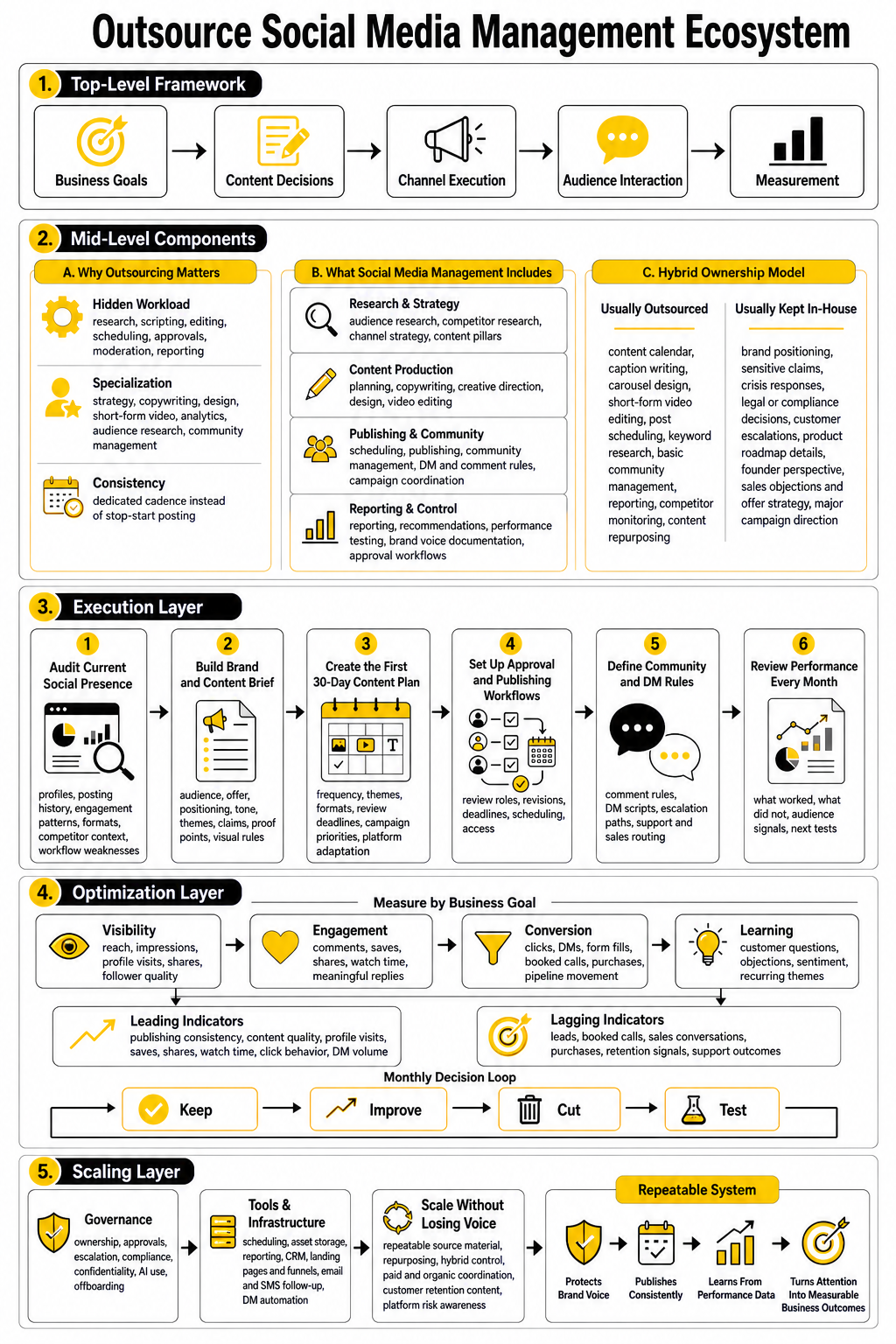
The final system should feel calm. Content ideas have a source. Drafts have a review process. Posts have a purpose. Comments and DMs have rules. Reports lead to decisions. Leads move somewhere useful instead of disappearing into a platform inbox.
That is when it makes sense to outsource social media management for the long term. You are not trying to escape the channel. You are building a better way to run it.
The Social Media Outsourcing Scorecard
Before you commit to a provider, or before you renew with your current one, score the relationship honestly. Do not only ask whether the posts look nice. Ask whether the system is making the business sharper.
Use this scorecard as a practical review:
If several of those answers are weak, do not just ask for more posts. Fix the operating model. More activity will not save a broken system.
When Outsourcing Is The Right Move
Outsourcing is the right move when your business has enough strategic clarity but not enough internal capacity to execute consistently. It is also a strong fit when you need specialist skills, better creative production, a cleaner reporting rhythm, or a more disciplined content calendar. The channel is too visible to be handled casually.
It is not the right move when you expect an external team to invent your positioning, fix a weak offer, or understand your customers without access to real information. That creates disappointment on both sides. A provider can sharpen your system, but they need something real to work with.
The best time to outsource is when you can provide direction, approve decisions quickly, and measure outcomes honestly. That does not mean you need a huge team or a perfect brand book. It means you are ready to treat social media as a business function instead of a random content chore.
What A Good First 90 Days Should Produce
The first 90 days should create more than a pile of posts. It should produce a working rhythm, clearer messaging, better content inputs, cleaner approvals, early performance signals, and a stronger understanding of what the audience responds to. That is the foundation.
By the end of month one, you should have an audit, brand brief, content pillars, workflow, access structure, first content calendar, and reporting baseline. By the end of month two, you should see better creative judgment, smoother reviews, and early signals around topics, formats, and calls to action. By the end of month three, you should know what to keep, what to improve, what to cut, and what deserves a bigger test.
Do not judge the relationship only by one viral post or one quiet week. Judge it by whether the system is becoming more useful. Strong outsourcing compounds because the provider learns your brand, your audience, and your performance patterns over time.
What does it mean to outsource social media management?
To outsource social media management means hiring an external freelancer, agency, consultant, or specialist team to plan, create, publish, manage, and measure your social media activity. The exact scope can include strategy, content calendars, captions, design, video editing, scheduling, community management, analytics, and reporting. The best arrangements are clearly scoped so both sides know what is included and what still belongs to the internal team.
Is outsourcing social media management worth it?
Outsourcing is worth it when the external partner brings consistency, skill, process, and strategic judgment your internal team cannot maintain alone. It is not worth it if you only get generic posts with no connection to your audience, offer, or business goals. The return depends on whether the partner helps you create better content decisions, stronger workflows, and measurable progress.
What should I outsource first?
Start with the recurring work that slows your team down but can be systemized. Content planning, caption writing, creative production, scheduling, repurposing, and reporting are common starting points. Keep final positioning, sensitive claims, crisis responses, and high-risk customer communication closer to your internal team.
How much does outsourced social media management cost?
Pricing depends on scope, market, provider type, number of platforms, content volume, creative complexity, community management needs, and reporting depth. A simple scheduling and content support package costs far less than a full strategy, creative, engagement, analytics, and campaign management service. The useful question is not only “What is the monthly fee?” but “What internal time, quality, consistency, and business outcome does this replace or improve?”
Should I hire a freelancer or an agency?
Hire a freelancer when you need a specific skill, such as copywriting, design, video editing, scheduling, or LinkedIn content support. Hire an agency when you need a broader system with strategy, account management, creative production, publishing, engagement, and reporting handled together. The right choice depends on your internal capacity and how much coordination you want to keep in-house.
How do I know if a social media management provider is good?
A good provider asks smart questions before recommending tactics. They want to understand your offer, audience, sales process, brand voice, approval workflow, and goals. They also explain their process clearly, report on useful signals, protect account ownership, and improve content based on performance data instead of simply repeating the same posts every month.
What should be included in a social media management contract?
A strong contract should define scope, deliverables, timelines, revision rules, approval responsibilities, reporting cadence, fees, cancellation terms, account ownership, content ownership, confidentiality, access rules, and offboarding steps. It should also clarify whether community management, video editing, strategy, paid social, influencer coordination, or weekend monitoring are included. Clear terms prevent awkward assumptions later.
Can I outsource social media management without losing brand voice?
Yes, but only if you document the voice and provide real inputs. Give the provider examples, vocabulary, tone rules, customer language, founder perspective, product details, and content that should never be imitated. Brand voice improves when the external team has access to real business insight, not just a logo folder and a vague request to sound “authentic.”
How often should an outsourced team report results?
Most businesses should review performance monthly, with lighter weekly check-ins during the first few months. Weekly reviews are useful for workflow, campaign coordination, and quick fixes. Monthly reviews are better for spotting patterns, deciding what to repeat, and choosing the next tests.
What metrics should I track when outsourcing social media?
Track metrics based on the job social media is supposed to do. For awareness, look at reach, impressions, profile visits, shares, and follower quality. For engagement, look at comments, saves, shares, watch time, and meaningful replies. For business outcomes, look at clicks, DMs, form fills, booked calls, purchases, pipeline movement, support themes, and customer questions.
Should my outsourced social media team handle DMs?
They can, but only with clear rules. DMs may involve pricing, complaints, refunds, partnerships, personal data, support issues, or high-value leads. Your partner should know which messages they can answer, which ones need escalation, and when the conversation should move to sales, support, email, or a booking page.
How long does it take to see results?
You can usually see workflow improvements within the first month if the partner is organized. Content quality and audience signals often become clearer over the first 60 to 90 days. Revenue impact may take longer because social media often supports trust, education, consideration, and follow-up before a buyer takes action.
Can AI be used in outsourced social media management?
AI can support research, ideation, repurposing, caption drafts, reporting summaries, and workflow speed. It should not replace human judgment, brand voice, source verification, or sensitive customer communication. The safest approach is to define where AI is allowed, where human review is required, and what information should never be entered into AI tools.
What tools help outsourced social media teams work better?
Useful tools depend on your workflow, but most teams need content planning, scheduling, asset storage, approval, reporting, CRM, and lead capture tools. Buffer can help organize publishing across platforms. GoHighLevel can help service businesses connect social interest to bookings, pipelines, automations, and follow-up. ManyChat can help manage comment-to-DM flows and basic conversation automation when the rules are clear.
What is the biggest mistake businesses make when they outsource social media management?
The biggest mistake is outsourcing execution without giving strategic context. If the provider does not understand your audience, offer, positioning, customer objections, and business goals, they will create content from assumptions. That usually leads to generic posts, weak reporting, slow approvals, and frustration.
Should I outsource organic social and paid social to the same team?
You can, but only if the team has real skill in both areas. Organic social and paid social overlap, but they require different judgment. Organic work depends on brand voice, community, consistency, and content relevance, while paid social depends on targeting, creative testing, landing pages, offer economics, and attribution.
How do I safely end a social media outsourcing relationship?
Keep account ownership, admin access, creative files, reports, content calendars, and brand assets under your business from the beginning. When the relationship ends, remove access, transfer files, export reports, document scheduled posts, and confirm ownership of final assets. A clean offboarding process protects continuity and reduces risk.
Build a stronger local presence with BAAM AI
Turn your website, Google profile, social channels, and AI visibility into one growth engine
Most businesses do not need more random marketing activity. They need a consistent presence system that helps the right people find them, trust them, and take action. BAAM AI brings strategy, local SEO, website updates, Google Maps visibility, social content, AI-search readiness, media production, and reporting into one practical monthly engine.
If you want your marketing to keep working after the campaign ends, start with a free BAAM AI presence audit. See how your business shows up today and where the fastest visibility wins are at BAAM AI.