
BAAM AI Blog
Online Social Marketing: A Practical Framework For Building Demand, Trust, And Sales
Online social marketing is not just posting on social media. It is the disciplined use of social platforms, communities, content, conversations, creators, and paid distribution to influence how people discover...
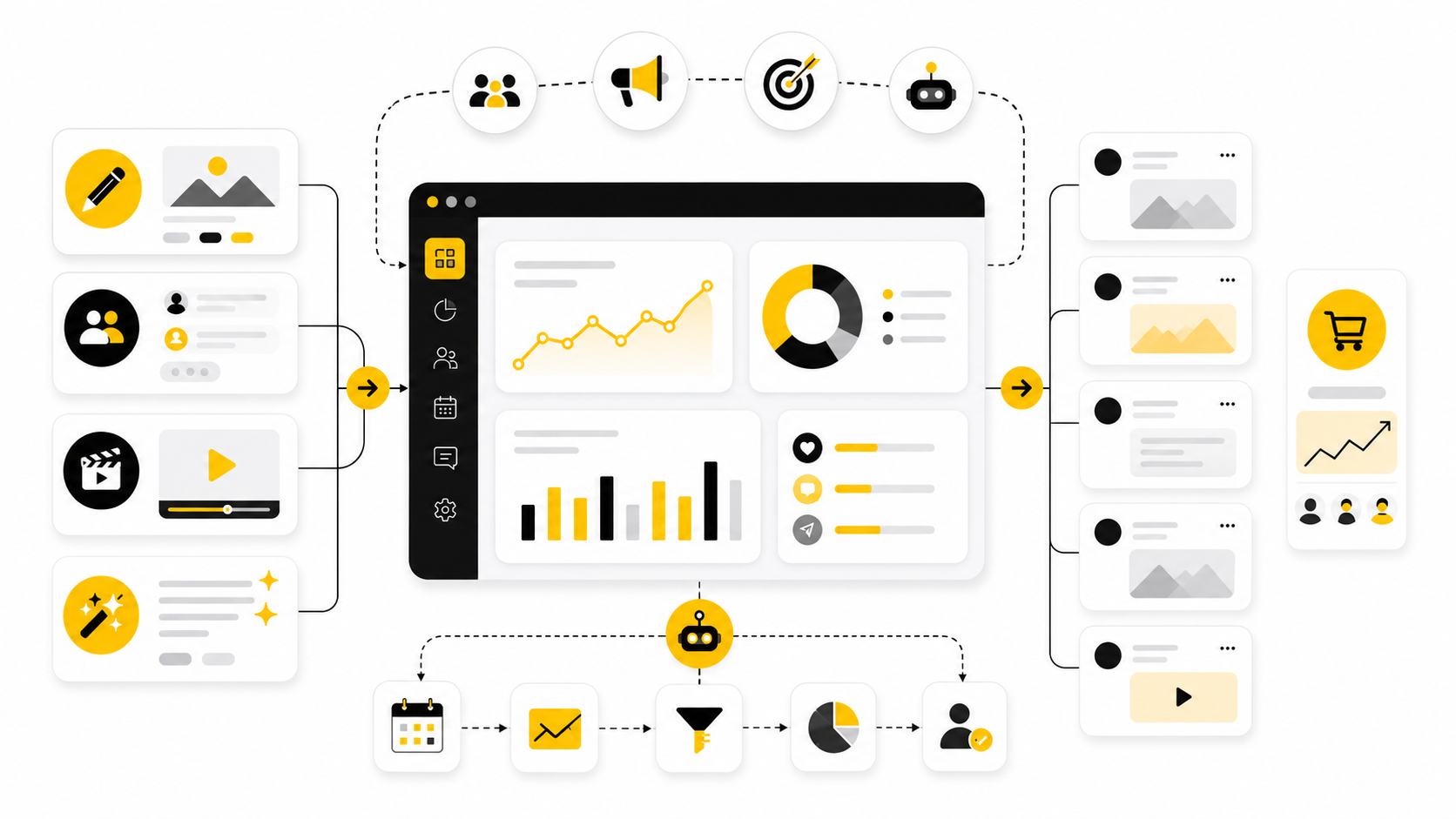
Online social marketing is not just posting on social media. It is the disciplined use of social platforms, communities, content, conversations, creators, and paid distribution to influence how people discover, trust, evaluate, and buy from a brand. Done well, it connects the messy human side of marketing with a measurable business system.
That matters because social platforms have become part of the buying journey, not just the awareness stage. The world now has more than 5.2 billion social media user identities, and the typical internet user spends roughly 2 hours and 21 minutes per day on social platforms. People are not only scrolling for entertainment. They are researching brands, comparing products, checking comments, watching creators, asking friends, and deciding who feels credible enough to trust.
The mistake most businesses make is treating online social marketing as a content calendar. A calendar helps, but it is not the strategy. The real strategy is understanding who you want to reach, what they already believe, what proof they need, what objections block action, and how each social touchpoint moves them closer to a useful next step.
What Online Social Marketing Really Means
Online social marketing is the process of using social channels to create demand, build relationships, and guide people toward action. It includes organic content, community engagement, creator partnerships, paid social campaigns, direct messaging, customer education, social listening, and conversion paths. The strongest programs combine all of these pieces instead of relying on one platform or one content format to do all the work.
It is also different from traditional social media management. Social media management often focuses on publishing, scheduling, replying, and keeping the brand active. Online social marketing goes deeper because it asks what each activity is supposed to change in the customer’s mind or behavior.
That shift matters because attention alone is not enough. A post can get views and still fail commercially if it attracts the wrong audience, says nothing meaningful, or gives people no reason to continue. A useful social marketing system earns attention, turns that attention into trust, and then gives people a clear path to learn more, subscribe, book, buy, or share.
Why Online Social Marketing Matters Now
Online social marketing matters because social platforms are where brand perception is formed in public. A company’s website may explain what it sells, but social content often shows how the brand thinks, behaves, responds, and proves itself. That public layer can strengthen trust quickly, but it can also expose weak positioning, inconsistent messaging, or shallow customer understanding.
The channel mix has also changed. Creator content, short-form video, private communities, AI-assisted workflows, and social search have made discovery more fragmented. U.S. creator ad spend is projected to reach $37 billion in 2025, which shows how seriously brands now treat social influence as part of the media plan.
At the same time, audiences are more selective. They can spot generic content fast, and they are less patient with brands that only broadcast promotions. Online social marketing works best when the brand sounds useful before it asks for anything.
The Online Social Marketing Framework
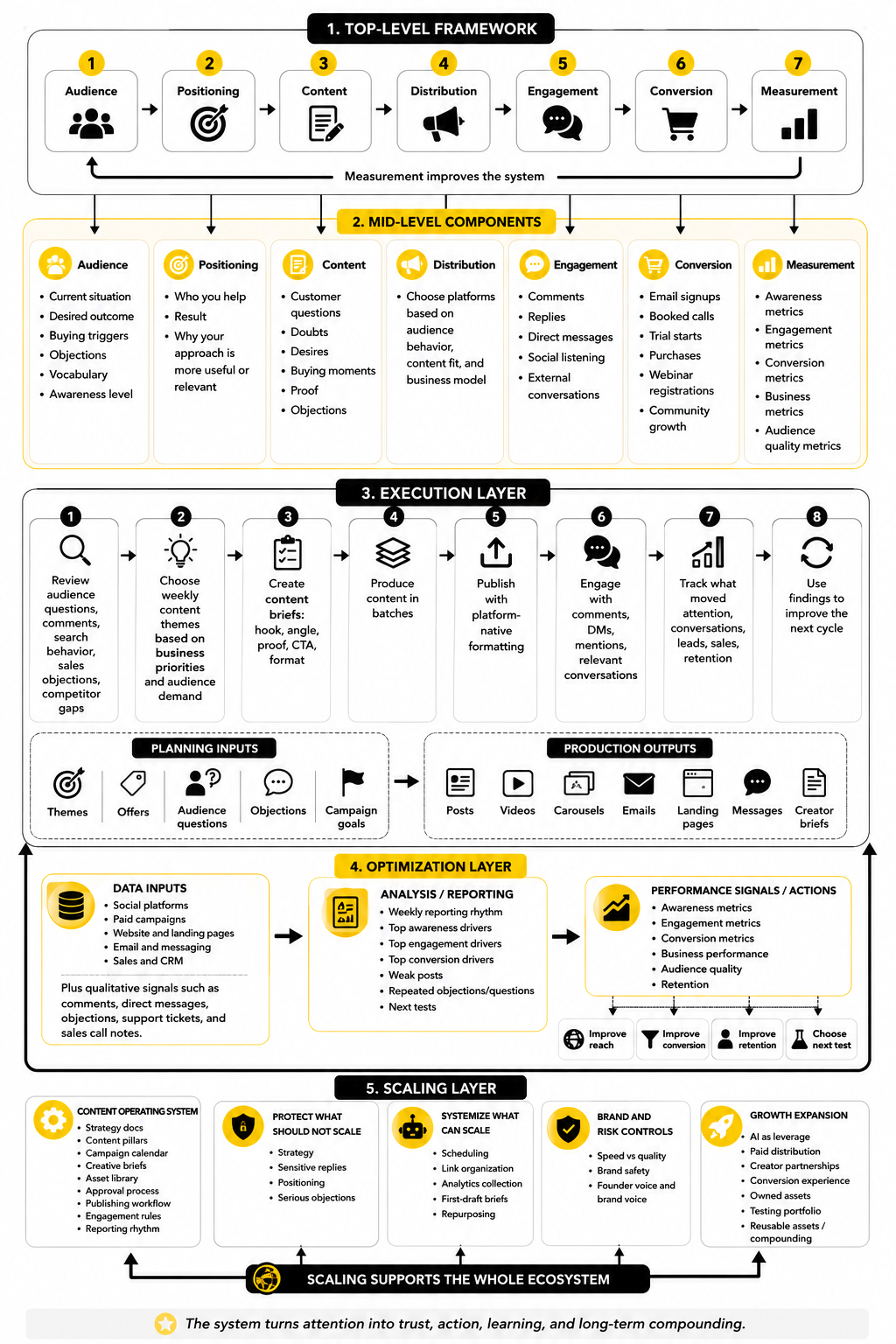
A practical framework keeps social marketing from becoming random. The goal is not to post everywhere every day. The goal is to build a repeatable system that connects audience insight, positioning, content, distribution, engagement, conversion, and measurement.
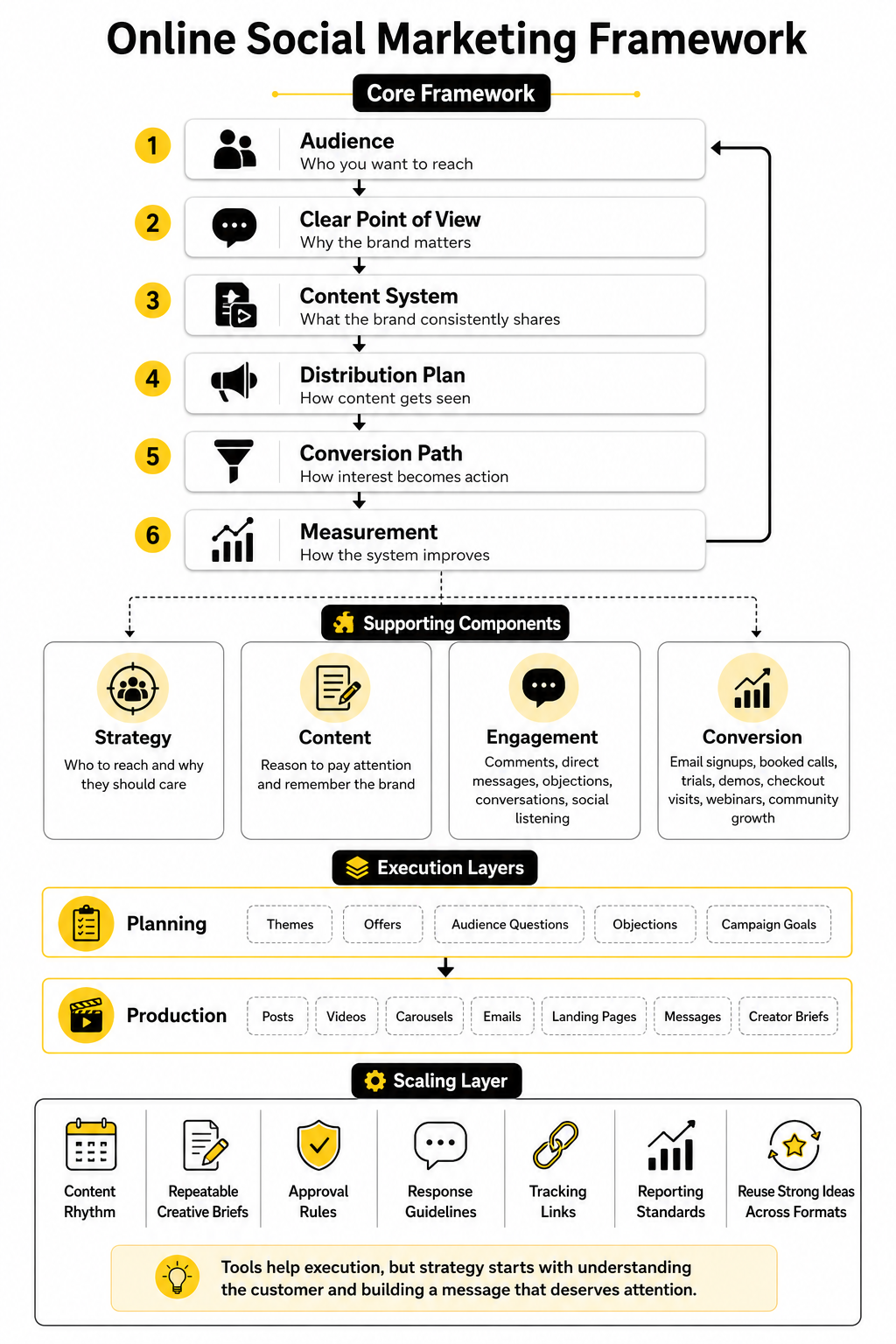
The framework starts with the audience because every useful decision depends on who the message is for. After that, the brand needs a clear point of view, a content system that expresses that point of view, a distribution plan that gets the content seen, and a conversion path that turns interest into measurable action. Finally, measurement closes the loop so the team can improve based on evidence instead of guesses.
This is where many campaigns break. They jump straight into content ideas before defining the audience, the offer, or the role of each platform. That creates busy marketing, not effective marketing.
Core Components Of A Strong Social Marketing System
A strong online social marketing system has four core components: strategy, content, engagement, and conversion. Strategy decides who the brand is trying to reach and why they should care. Content gives the audience a reason to pay attention, remember the brand, and associate it with a specific problem or outcome.
Engagement turns the brand from a publisher into a participant. That includes replying to comments, answering direct messages, learning from objections, joining relevant conversations, and paying attention to what customers say when they are not filling out surveys. Social listening is not a luxury here; it is one of the fastest ways to understand what the market actually cares about.
Conversion connects social activity to business results. That may mean email signups, booked calls, product trials, demo requests, checkout visits, webinar registrations, or community growth. Without this layer, social marketing becomes hard to defend because the team can show activity but not progress.
Professional Implementation
Professional implementation means building a workflow that can survive beyond one inspired campaign. The team needs a clear content rhythm, repeatable creative briefs, approval rules, response guidelines, tracking links, reporting standards, and a way to reuse strong ideas across formats. Without that structure, social marketing becomes dependent on whoever happens to be energetic that week.
The best systems usually separate planning from production. Planning defines themes, offers, audience questions, objections, and campaign goals. Production turns those inputs into posts, videos, carousels, emails, landing pages, messages, and creator briefs.
This is also where tools can help, but tools should not replace thinking. A scheduler, automation platform, analytics dashboard, or AI assistant can speed up execution, but it cannot fix unclear positioning. The work still starts with understanding the customer and building a message that deserves attention.
Why Online Social Marketing Matters Now
Online social marketing matters now because the buying journey has moved into public conversations. People are not waiting for a brand’s sales page before they form an opinion. They are watching how the brand explains ideas, responds to questions, handles criticism, collaborates with creators, and shows proof in real time.
The scale is obvious, but the behavior is more important. Social media reaches 94.2 percent of internet users globally, and half of adult social users now visit social platforms to learn more about brands and the content they publish. That means your audience may be evaluating you before they ever click your website, join your list, or speak to your team.
This is why online social marketing cannot be treated as a side activity. It shapes demand before the funnel starts, reduces friction during evaluation, and keeps customers connected after the sale. If the brand is silent, inconsistent, or vague on social, the market fills in the blanks.
Buyers Research Brands In More Places
Buyers no longer move in a straight line from ad to landing page to checkout. They see a post, search the comments, check the founder’s profile, compare creator opinions, look for reviews, save a video, leave, come back through search, and then ask someone they trust. That path is messy, but it is normal.
This matters because online social marketing has to support discovery and research at the same time. A brand needs content for people who have never heard of it, but it also needs content for people who are already comparing options. Educational posts, customer proof, founder perspectives, behind-the-scenes explanations, objections, demos, and comparison content all play different roles.
The brands that win here do not assume one viral post will do the whole job. They build a body of content that makes the brand easier to understand every time someone runs into it. That repeated clarity is often what moves a buyer from passive interest to active consideration.
Social Platforms Are Becoming Search Engines
People still use traditional search engines, but social search is now part of everyday research. Users search TikTok, YouTube, Instagram, Reddit, LinkedIn, and Facebook because they want opinions, demonstrations, reactions, and lived experience. They are often looking for the human version of the answer, not just the optimized web page version.
That changes how brands need to think about content. A good social post is not only something that appears in a feed for a few hours. It can become a searchable asset that answers a specific question, explains a process, compares options, or shows what a product looks like in use.
This is why vague motivational content usually underperforms as a long-term asset. It may get light engagement, but it does not help someone make a decision. Strong online social marketing creates content that is easy to find, easy to understand, and useful enough to save or share.
Trust Is Built Before The Sales Conversation
Trust is no longer built only through sales calls, case studies, or testimonials. Those still matter, but people often decide whether a brand feels credible long before they become a lead. They judge tone, consistency, transparency, expertise, and how the brand behaves when there is no direct sale on the table.
That is where social becomes powerful. A brand can show its thinking repeatedly through practical content, thoughtful replies, clear explanations, and honest positioning. Over time, this creates familiarity, and familiarity lowers the perceived risk of taking the next step.
The opposite is also true. If a brand’s content is generic, overly polished, or disconnected from customer problems, it creates distance. People do not need more noise in their feeds; they need signals that help them decide who deserves attention.
The Cost Of Attention Has Changed
Attention is not free just because posting is free. The real cost is strategy, creative quality, speed, testing, and consistency. Organic reach is harder to predict, paid social is more competitive, and audiences have more content choices than ever.
The typical internet user still spends 2 hours and 21 minutes per day using social platforms, but that does not mean they are waiting for brand content. They are moving quickly, filtering aggressively, and ignoring anything that feels irrelevant. So the goal is not to post more for the sake of volume; the goal is to become more useful, more specific, and more recognizable.
This is where many teams get stuck. They respond to declining reach by increasing output, but they never improve the message. Better online social marketing starts by tightening the audience, the promise, and the content angle before scaling production.
Social Marketing Connects Brand And Performance
Brand marketing and performance marketing are often treated like separate worlds. Social forces them to work together. A great post can build awareness, generate comments, create retargeting audiences, drive clicks, answer objections, and improve conversion quality all at once.
That does not mean every post needs a hard call to action. In fact, making every post a pitch usually weakens the channel. The better approach is to understand which content builds belief, which content creates proof, which content opens conversations, and which content moves people toward a measurable next step.
This makes online social marketing especially valuable for small teams. A single strong idea can become a short video, a carousel, a LinkedIn post, an email, a landing page section, a sales call talking point, and a paid ad test. When the system is built properly, social content stops being disposable and starts becoming a reusable growth asset.
Community Signals Influence Buying Decisions
Social proof used to mean testimonials on a website. Now it includes comments, shares, stitches, reposts, user-generated content, reviews, creator mentions, public questions, and how other people react to the brand. These signals can either reinforce confidence or create doubt.
That is why community management is not just customer service. It is part of marketing. The way a brand replies to questions, handles objections, thanks customers, and participates in relevant conversations can change how silent observers perceive the business.
Most people watching will never comment. They are still paying attention. A useful reply to one person can answer the hidden concern of hundreds of others, which is why smart online social marketing treats public interaction as content, not admin work.
The Best Brands Learn Faster From Social
Social platforms give brands a live view of customer language. Comments, replies, shares, saves, DMs, and repeated questions show what people care about, what they misunderstand, and what they resist. That feedback is often faster than surveys and more honest than sales-call notes.
The practical value is huge. If the same objection appears under multiple posts, it should influence the next content batch. If a specific phrase gets saved or repeated, it may belong in the website copy, email sequence, or sales script.
This is one of the biggest advantages of online social marketing. It is not only a distribution channel. It is a research engine that helps the business understand the market more clearly, then turn that understanding into better messaging.
Why This Matters For The Rest Of The Strategy
The next step is to turn all of this into a usable framework. The point is not to chase every new platform, trend, or content format. The point is to build a social marketing system that can consistently attract the right people, earn trust, and move attention toward business outcomes.
That system needs structure because social can become chaotic fast. Without a framework, teams overreact to algorithm changes, copy competitors, and confuse activity with progress. With a framework, every channel, post, campaign, and workflow has a job.
That is what the next part will build: a practical online social marketing framework that connects audience insight, positioning, content, distribution, engagement, conversion, and measurement into one working system.
The Online Social Marketing Framework
A good framework makes online social marketing easier to execute because it removes guesswork. Instead of asking, “What should we post today?” the better question is, “What does the audience need to believe next?” That one shift turns social from a content treadmill into a business system.
The framework should connect seven pieces: audience, positioning, content, distribution, engagement, conversion, and measurement. Each piece has a job, and the order matters. When you skip the early parts, the later parts become noisy, expensive, and hard to measure.
This is not about making the process complicated. It is about making it clear enough that a team can repeat it every week without losing the strategy. Simple beats clever when the goal is consistent execution.
Step 1: Define The Audience Clearly
The first step is deciding exactly who the social marketing system is built for. “Business owners,” “creators,” “coaches,” or “ecommerce brands” is not specific enough. You need to understand the audience’s current situation, desired outcome, buying triggers, objections, vocabulary, and level of awareness.
This is where many campaigns fail before the first post goes live. The content may look professional, but it speaks to a vague crowd instead of a real buyer. When the audience is too broad, the message becomes soft, and soft messaging gets ignored.
A useful audience definition should help you make decisions. It should tell you which platforms matter, which problems deserve content, which objections need proof, and which offers make sense. If it does not guide execution, it is not specific enough yet.
Step 2: Build A Strong Positioning Angle
Positioning is the reason someone should pay attention to your brand instead of everyone else in the feed. It is not just a tagline or a clever bio. It is the clear point of view that shapes your content, offer, tone, and proof.
Strong positioning usually answers three questions. Who do you help? What specific result do you help them achieve? Why is your approach more useful, believable, or relevant than the obvious alternatives? If those answers are fuzzy, the content will be fuzzy too.
This matters even more in online social marketing because people compare brands quickly. They do not read every post in order. They catch fragments, patterns, and repeated signals, so your positioning has to show up again and again without sounding robotic.
Step 3: Turn Customer Problems Into Content Pillars
Content pillars should come from customer problems, not internal categories. A brand should not create pillars just because “education,” “inspiration,” and “promotion” sound tidy. The better approach is to map the real questions, doubts, desires, and buying moments that appear before someone becomes ready to act.
For example, a service business might need content that explains the cost of inaction, clarifies the method, shows proof, handles objections, and demonstrates expertise. An ecommerce brand may need content around product use cases, comparisons, customer results, founder story, social proof, and buying confidence. The details change, but the logic stays the same.
Each pillar should have a strategic role. Some content earns attention, some builds trust, some creates desire, and some moves people toward conversion. When every pillar has a job, the content calendar becomes much easier to manage.
Step 4: Choose Platforms Based On Behavior
Platform choice should come from audience behavior, content fit, and business model. Do not choose a platform only because it is trending. Choose it because your audience spends time there, your message can work there, and the platform supports the kind of action you need.
LinkedIn may make sense for B2B expertise, partnerships, recruiting, and high-ticket services. Instagram and TikTok may be better for visual discovery, creator-led education, product demonstrations, and community momentum. YouTube can support deeper education, search demand, and long-term content assets.
The key is to avoid spreading weak content across too many places. It is better to execute strongly on two platforms than to appear everywhere with no real system. Online social marketing rewards focus because focus improves creative quality, response speed, and learning.
Step 5: Create A Repeatable Execution Process
Once the strategy is clear, execution needs a simple operating rhythm. The process should move from research to planning, production, publishing, engagement, conversion, and review. This is where the strategy becomes visible in weekly work.
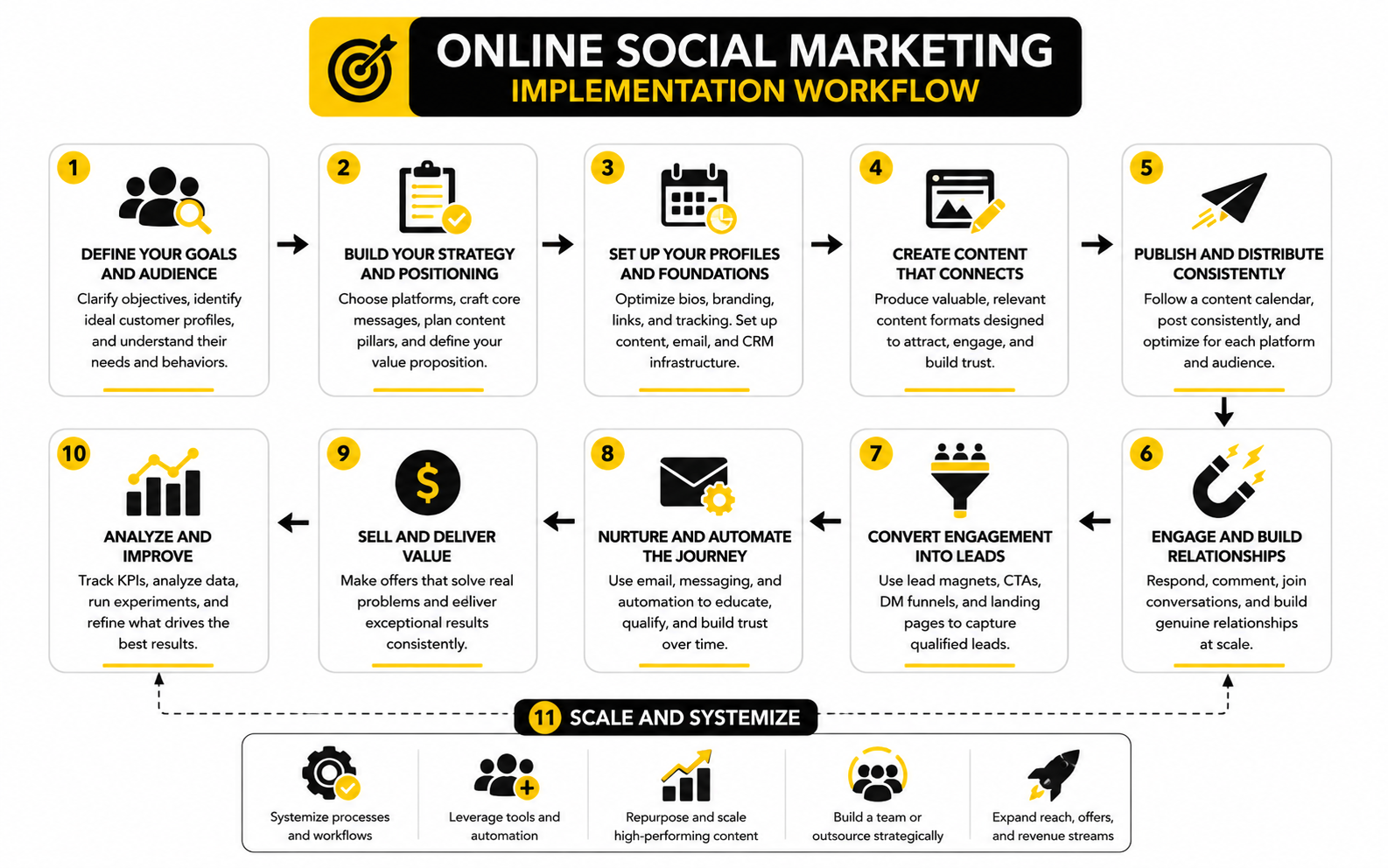
A practical workflow can look like this:
This process is not glamorous, but it works because it creates momentum. It also keeps social marketing connected to real business learning. Every cycle should make the next one sharper.
Step 6: Match Content Formats To The Job
Different formats do different jobs. Short videos can simplify ideas quickly, show personality, and create discovery. Carousels can break down frameworks, comparisons, mistakes, and step-by-step processes in a format people can save.
Text posts can work well for strong opinions, founder perspective, lessons learned, and direct explanations. Live sessions, webinars, and longer videos can build deeper trust because they give the audience more time with the brand’s thinking. Direct messages and automated conversations can help qualify interest when someone is ready for a more personal next step.
This is where tools can support the system. A team might use Buffer to organize publishing, ManyChat to manage social messaging flows, or GoHighLevel when social conversations need to connect with CRM, booking, follow-up, and sales automation. The tool is not the strategy, but the right tool makes the strategy easier to run.
Step 7: Build Conversion Paths Before You Need Them
A social marketing system should not wait until a post performs well to decide what happens next. The conversion path should already be in place. That path may lead to a landing page, email list, booking calendar, product page, webinar, community, quiz, or direct message flow.
The important part is matching the call to action to the buyer’s stage. A cold audience may not be ready to book a call, but they may download a useful guide or watch a deeper training. A warm audience that has engaged repeatedly may be ready for a product comparison, pricing page, consultation, or trial.
For funnel-driven campaigns, platforms like ClickFunnels or Systeme.io can help connect social traffic to structured lead capture and offers. For ecommerce landing pages, Replo can be useful when the social campaign needs a dedicated page that matches the creative angle. The point is simple: attention needs somewhere useful to go.
Step 8: Measure Signals At Each Stage
Measurement should not only happen at the end of the funnel. Social marketing has leading indicators and lagging indicators. Leading indicators show whether the message is earning attention and trust, while lagging indicators show whether that attention is turning into revenue or retention.
At the awareness stage, useful signals include reach quality, profile visits, saves, shares, watch time, and comments that show real interest. At the consideration stage, look at clicks, direct messages, email signups, repeat engagement, product page visits, and questions about price or fit. At the conversion stage, track booked calls, trial starts, purchases, pipeline value, customer acquisition cost, and revenue influenced by social campaigns.
The best teams do not obsess over one metric in isolation. A post with fewer views but stronger buyer intent may be more valuable than a viral post that attracts the wrong crowd. Online social marketing becomes easier to improve when every metric is connected to a stage of the customer journey.
Step 9: Review, Learn, And Tighten The System
The review process is where the framework becomes sharper. Every week or month, the team should look at what worked, what failed, and what changed in the market. This review should lead to decisions, not just reporting.
Useful questions include which topics created the best conversations, which hooks attracted the right audience, which objections appeared repeatedly, and which calls to action produced meaningful movement. The answers should influence the next round of content, not sit in a dashboard nobody uses. Social data is only valuable when it changes behavior.
This is also where discipline matters. Do not abandon the strategy after one weak week, and do not overreact to one lucky post. Look for patterns, then adjust the system with intention.
Statistics And Data
Measurement is where online social marketing becomes real. Without data, teams argue about opinions: the founder likes one post, the social manager likes another, and the sales team only cares about leads. With the right measurement system, the conversation changes from “Did this look good?” to “What did this move?”
The key is not collecting more numbers. The key is knowing what each number means and what action it should drive. A million views can be useful, useless, or actively misleading depending on who watched, what they did next, and whether the content created any commercial movement.
Social media is still massive enough to justify serious attention. Global reports show more than 5.2 billion social media user identities, and adult users spend roughly 2 hours and 21 minutes per day on social platforms. That tells you the audience is there, but it does not tell you whether your strategy is working. For that, you need a tighter measurement model.
Measure The Customer Journey, Not Just The Post
A single post rarely tells the full story. Someone may see your content five times, visit your profile twice, click once, ignore you for a week, then finally convert after a direct message, email, or retargeting ad. If you only judge the first post by likes, you miss the journey.
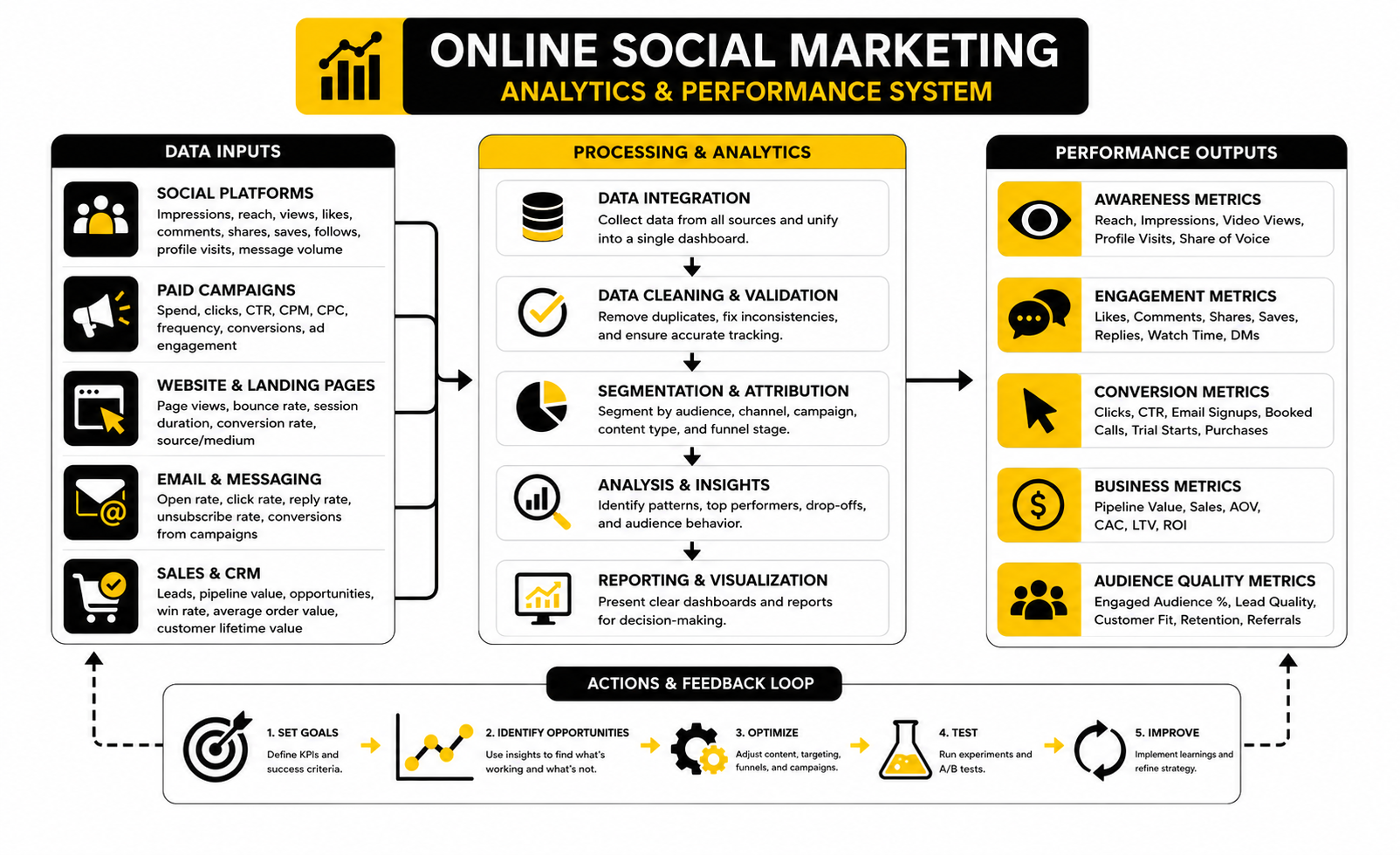
A better system measures stages. Awareness metrics show whether the right people are noticing you. Engagement metrics show whether the message is strong enough to earn a reaction. Conversion metrics show whether attention is turning into leads, sales, bookings, trials, or other business outcomes.
This is why online social marketing needs more than platform analytics. Native dashboards are useful, but they usually show activity inside the platform. Your real job is connecting that activity to what happens after the click, after the message, and after the first conversion.
Awareness Metrics Show Whether You Are Getting Seen
Awareness metrics include reach, impressions, video views, profile visits, follower growth, search visibility, and share of voice. These numbers matter because people cannot buy from a brand they never encounter. But awareness alone is not proof of success.
Reach should be interpreted through audience quality. If a post reaches many people but attracts the wrong audience, the number is inflated. If a post reaches fewer people but pulls in buyers, partners, creators, or decision-makers, it may be far more valuable.
The action here is simple. When reach is low, improve hooks, format, timing, topic relevance, and distribution. When reach is high but downstream action is weak, do not celebrate too quickly. That usually means the content is interesting, but not connected strongly enough to the brand, problem, or next step.
Engagement Metrics Show Message Strength
Engagement metrics include comments, saves, shares, replies, reactions, watch time, completion rate, and direct messages. These numbers matter because they show whether the audience cared enough to do something. They are not perfect, but they are useful signals when interpreted correctly.
Not all engagement is equal. A quick like is lighter than a thoughtful comment. A save may show practical value, while a share may show identity, usefulness, or emotional resonance. A direct message often signals stronger intent because the person is moving from public attention into a private conversation.
Benchmarks can help, but they should not become the strategy. The 2025 Rival IQ benchmark report shows that TikTok engagement rates still tend to outperform Instagram, Facebook, and X for many brand categories, but that does not mean every business should shift blindly to TikTok. The better action is to compare your performance against your own historical baseline, your category, and the role each platform plays in your funnel.
Conversion Metrics Show Business Impact
Conversion metrics include link clicks, landing page views, email signups, form submissions, booked calls, trial starts, purchases, pipeline value, revenue, and customer acquisition cost. These are the numbers that connect social activity to business outcomes. They also expose weak links in the system.
If engagement is strong but conversions are weak, the issue may be the offer, landing page, call to action, audience fit, or buying stage. If clicks are strong but leads are poor, the page may not match the promise of the post. If leads are strong but sales are weak, the problem may be qualification, follow-up, pricing, or trust.
This is where tracking discipline matters. Use UTMs, dedicated landing pages, tagged CRM records, and clear campaign naming. A simple link management tool like Dub can help keep campaign links organized, while a CRM-focused platform like GoHighLevel can help connect social leads to follow-up, booking, pipeline, and revenue tracking.
Benchmarks Are Useful, But Context Wins
Benchmarks are helpful because they stop you from judging performance in a vacuum. If your engagement rate, posting frequency, cost per lead, or conversion rate is far outside the normal range for your platform or industry, that is worth investigating. But benchmarks are not commandments.
A luxury B2B service, a local business, a creator-led product, and a low-ticket ecommerce brand should not expect the same social performance. They have different buying cycles, audience sizes, trust requirements, content formats, and conversion paths. Comparing them too directly creates bad decisions.
Use benchmarks as diagnostic tools. If your numbers are far below the market, study your creative quality, message relevance, consistency, and distribution. If your numbers are above average but revenue is flat, look deeper at conversion intent and offer alignment. The goal is not to win a benchmark chart; the goal is to build a profitable system.
Paid Social Data Needs A Different Lens
Paid social performance should be judged differently from organic performance. Organic content often teaches you what the audience cares about, while paid campaigns test whether that message can scale profitably. Both matter, but they answer different questions.
Paid metrics include CPM, CPC, CTR, cost per lead, cost per purchase, return on ad spend, frequency, creative fatigue, and payback period. A low cost per click is not impressive if the traffic does not convert. A higher CPM may still be profitable if the creative reaches a better audience and produces stronger buyers.
Creator and influencer campaigns also need measurement discipline. U.S. creator ad spend is projected to reach $37 billion in 2025, which makes creator partnerships a serious budget line, not a casual experiment. Brands should track creator content by reach, engagement quality, code usage, assisted conversions, audience fit, reusable creative assets, and lift in branded search or direct traffic where possible.
Social Commerce Metrics Show Buying Friction
For ecommerce and direct-response brands, social marketing increasingly overlaps with commerce. People discover products in content, compare them in comments, watch creators use them, and sometimes buy without leaving the platform. This makes the gap between content and checkout much smaller.
Useful metrics include product clicks, add-to-cart rate, checkout starts, purchase conversion rate, average order value, repeat purchase rate, and refund rate. A campaign that drives many first-time buyers but high refunds may not be as healthy as it looks. A campaign with fewer buyers but stronger repeat purchase behavior may be more valuable.
The action is to study where friction appears. If product clicks are high but carts are low, the product page may be weak. If carts are high but purchases are low, pricing, shipping, trust, or checkout flow may be the issue. If purchases are strong but repeat orders are weak, the problem may be product experience or post-purchase communication.
Qualitative Signals Explain The Numbers
Numbers show what happened, but qualitative signals often explain why. Comments, direct messages, objections, customer phrases, creator feedback, sales call notes, and support tickets can reveal what the dashboard cannot. Ignoring these signals is a mistake.
For example, a post with modest reach may produce comments from exactly the right buyers. A video with average watch time may uncover a painful objection that should become a sales page section. A direct message thread may reveal the phrase your audience uses to describe the problem better than your internal copy ever did.
This is where online social marketing becomes a learning system. The team should collect recurring questions, objections, emotional language, and buying triggers. Those insights should feed content, ads, landing pages, email sequences, product positioning, and sales scripts.
Build A Simple Weekly Reporting Rhythm
A useful report does not need to be long. It needs to create decisions. The best weekly reports usually show what was published, what performed, what was learned, what changed, and what the team will do next.
A simple reporting structure can include:
This keeps reporting practical. The point is not to admire dashboards. The point is to improve the next week of execution.
What Good Performance Actually Looks Like
Good performance is not one viral post. Good performance is a pattern of stronger audience fit, clearer messaging, better conversion paths, and more useful learning over time. If the system is improving, the data should show more than surface-level attention.
You should see better comments, more qualified profile visits, more relevant direct messages, higher-intent clicks, improved landing page conversion, and more efficient follow-up. You should also see your content ideas getting sharper because the audience is teaching you what matters. That is the real compounding effect.
The strongest online social marketing teams use data without becoming robotic. They measure carefully, but they still understand that social platforms are human environments. The numbers guide the work, but the work still has to earn trust.
Professional Implementation And Workflow
Professional online social marketing is not about doing more. It is about building a system that can keep quality high while the workload grows. That means clear decisions, clear ownership, clear feedback loops, and a realistic understanding of what can break when social starts to scale.
The early stage is usually simple because one person can hold the whole strategy in their head. They know the audience, write the posts, reply to comments, check the numbers, and adjust quickly. The problem starts when more people join the process and nobody has documented the thinking behind the work.
That is why workflow matters. Without it, scaling creates inconsistency. With it, the brand can publish more, test faster, involve more people, and still sound like one coherent company.
Decide What Should Not Scale
Not everything in online social marketing should scale. Some activities deserve automation, templates, and batching. Others need human judgment because they shape trust directly.
Scheduling posts, organizing links, collecting analytics, creating first-draft briefs, and repurposing content can often be systemized. Handling sensitive replies, joining high-value conversations, shaping positioning, and responding to serious objections should stay closer to the people who understand the brand deeply. The point is not to keep everything manual; the point is to protect the moments where judgment matters.
This is one of the biggest strategic tradeoffs. If you automate too little, the team gets buried in repetitive work. If you automate too much, the brand starts sounding detached. Good implementation finds the middle: automate the workflow, not the thinking.
Build A Content Operating System
A content operating system is the internal structure that keeps social marketing from becoming chaos. It includes the strategy documents, content pillars, campaign calendar, creative briefs, asset library, approval process, publishing workflow, engagement rules, and reporting rhythm. It does not need to be complicated, but it does need to be used.
The best content systems make decisions easier. A strategist should be able to see which audience problem a post supports. A writer should understand the angle before drafting. A designer should know the intended platform and format. A manager should know what success looks like before the post goes live.
This is also where reusable assets become valuable. Strong hooks, proven explanations, customer language, objections, screenshots, testimonials, product clips, and creator assets should not disappear after one post. They should become part of a living library the team can use to produce better work faster.
Manage The Tradeoff Between Speed And Quality
Speed matters in social because culture moves quickly. A trend, platform update, competitor move, or customer conversation can create a short window where the brand has something useful to say. Teams that move too slowly often miss those moments.
But speed without standards creates messy content. It leads to weak claims, inconsistent tone, rushed visuals, unclear calls to action, and preventable mistakes. The answer is not to choose speed or quality. The answer is to define what can move fast and what needs review.
A practical rule is to separate low-risk content from high-risk content. Educational posts, quick observations, and simple replies can usually move quickly. Product claims, legal topics, pricing, customer stories, competitor comparisons, and sensitive issues need more care. This protects the brand without turning every post into a committee project.
Treat Brand Safety As A Growth Issue
Brand safety is not only about avoiding controversy. It is about protecting trust while the brand becomes more visible. As reach grows, more people will interpret the content differently, take screenshots, challenge claims, and judge how the company responds under pressure.
This matters because social platforms reward strong opinions, emotional hooks, and fast reactions. Those can be useful, but they can also push brands into exaggeration. A strong online social marketing strategy should define what the brand will say, what it will not say, and where it needs evidence before publishing.
The practical move is to create simple guardrails. Define approved claims, risky topics, escalation rules, response standards, and who can approve sensitive content. This does not make the brand boring. It makes the brand safer to scale.
Balance Founder Voice And Brand Voice
Founder-led content can be powerful because people trust people faster than logos. A founder can explain beliefs, tell the truth more directly, and create a stronger emotional connection than a polished brand account. That is why many companies now use founder profiles as serious distribution channels.
But founder voice also creates risk. If the whole social strategy depends on one person, the business can struggle when that person gets busy, tired, unavailable, or less interested in posting. The brand needs to capture the founder’s thinking without making growth dependent on daily personal output.
The smart approach is to turn founder insight into a repeatable system. Record conversations, extract opinions, document language, turn recurring explanations into content, and build a process where the founder reviews high-leverage ideas instead of creating everything from scratch. That keeps the content human without making the workflow fragile.
Use AI Without Losing The Human Edge
AI can speed up online social marketing, but it can also make content painfully generic. It is useful for research summaries, first-draft outlines, repurposing, content variations, transcript cleanup, and organizing ideas. It is weaker when the team expects it to replace customer insight, strong positioning, taste, or lived experience.
The danger is sameness. If every competitor is using similar prompts on similar topics, the output starts to blend together. The brand that wins will not be the one that publishes the most AI-assisted content. It will be the one that adds sharper judgment, better examples, clearer proof, and a more specific point of view.
Use AI as leverage, not camouflage. Let it reduce repetitive work, but keep humans in charge of strategy, claims, stories, tone, and final decisions. The content should still sound like it came from a company that actually understands the customer.
Know When To Add Paid Distribution
Paid social should not be used to rescue weak messaging. If organic content gets no meaningful response from the right audience, putting budget behind it usually just buys more silence. Paid distribution works best when it amplifies messages that already show signs of relevance.
That does not mean every organic winner should become an ad. A post can perform well because it is entertaining, controversial, or timely, but still fail as a conversion asset. Before adding budget, ask whether the message attracts the right person, connects to a clear offer, and gives people a reason to take the next step.
Paid distribution becomes most useful when the funnel is ready. The landing page should match the social angle, the follow-up should be clear, and the tracking should show what happens after the click. If the backend is weak, paid traffic only exposes the weakness faster.
Scale Creators Carefully
Creator partnerships can expand trust because the message comes through someone the audience already follows. But creator marketing should not be treated as a shortcut to credibility. The wrong creator can create reach without relevance, traffic without trust, or sales that do not repeat.
The creator economy is now too large to treat casually, with U.S. creator ad spend projected to reach $37 billion in 2025. That growth makes the channel more competitive, which means brands need stronger briefs, better selection criteria, clearer usage rights, and better performance tracking.
The best creator partnerships usually start with fit. Does the creator’s audience match the buyer? Does their tone match the brand? Can they explain the product naturally? Will the content be useful beyond one post? If the answer is no, the campaign may look active but produce little lasting value.
Protect The Conversion Experience
Social content can create demand, but the conversion experience decides whether that demand becomes revenue. A strong post followed by a weak page, confusing offer, slow follow-up, or generic email sequence wastes attention. This is one of the most expensive mistakes in online social marketing.
Every serious campaign should have a matching next step. If the post teaches a framework, the landing page should continue that idea. If the video addresses a pain point, the offer should feel like the logical solution. If the call to action invites a conversation, the direct message or booking flow should be fast and clear.
This is where the marketing stack matters. A business might use Fillout for clean forms, Cal.com for scheduling, Brevo or Moosend for email follow-up, and GoHighLevel when the process needs CRM, automation, booking, pipeline, and client communication in one place. The stack should make the buyer’s next step easier, not add friction.
Avoid Platform Dependency
Platform dependency is one of the quiet risks of online social marketing. A brand can grow quickly on one channel, then suffer when reach drops, rules change, ad costs rise, or the audience shifts behavior. This is not a reason to avoid social; it is a reason to build owned assets alongside it.
Owned assets include email lists, customer communities, websites, product ecosystems, private databases, and direct customer relationships. Social should feed those assets over time. If every relationship stays trapped inside a platform, the brand is renting attention instead of building leverage.
A simple way to reduce risk is to create regular paths from social to owned channels. Offer useful resources, deeper training, newsletters, communities, product education, or booking flows. The goal is not to pull people away from social immediately. The goal is to make sure the business can keep communicating even when the platform changes.
Create A Testing Portfolio
Advanced social marketing teams do not test randomly. They build a testing portfolio. Some tests improve creative performance, some test positioning, some test offers, some test platforms, and some test conversion paths.
A healthy testing portfolio includes small, medium, and large bets. Small tests might include hooks, thumbnails, posting times, calls to action, and opening lines. Medium tests might include new content series, creator formats, lead magnets, or landing page angles. Large tests might include entering a new platform, launching a community, building a creator program, or shifting the brand narrative.
This prevents the team from overreacting to tiny changes. If every test is small, growth becomes incremental. If every test is huge, execution becomes risky and unfocused. The best teams manage both.
Know The Risks Before They Become Expensive
The biggest risks in online social marketing are usually predictable. The team chases trends that do not fit the brand. The content gets louder but less useful. The reporting rewards vanity metrics. The workflow becomes too slow. The brand over-automates conversations. The conversion path cannot handle the demand social creates.
These problems are easier to prevent than fix. Set standards early, review performance honestly, and keep the strategy connected to customer behavior. When something is not working, diagnose the system instead of blaming the platform immediately.
The strongest teams stay calm. They do not panic when reach changes, and they do not get arrogant when one post takes off. They keep improving the fundamentals: audience clarity, message quality, useful content, human engagement, clean conversion paths, and disciplined measurement.
Prepare The System For Long-Term Compounding
Online social marketing compounds when the work creates assets, not just posts. A strong insight becomes a content series. A useful answer becomes a sales enablement asset. A customer objection becomes a landing page section. A high-performing video becomes an ad angle. A repeated question becomes a lead magnet or webinar topic.
This is the difference between activity and leverage. Activity disappears after publishing. Leverage keeps producing value after the first post is done.
The close of the strategy is simple: build a system that learns. If every week gives you better customer language, stronger proof, sharper content, cleaner conversion data, and more reusable assets, the channel gets stronger over time. That is the real advantage of professional online social marketing.
Measurement, Optimization, Tools, And FAQs
At this point, the system is bigger than content. Online social marketing now includes audience research, positioning, publishing, creator collaboration, community management, paid distribution, conversion paths, analytics, and customer follow-up. The final step is making sure all of those parts work together instead of becoming separate tasks owned by separate people.
A mature system has one simple purpose: turn market attention into useful relationships and measurable business outcomes. That does not mean every post needs to sell. It means every activity should support a clear stage of the journey, whether that stage is discovery, trust, consideration, conversion, retention, or referral.
The strongest teams build an ecosystem, not a pile of disconnected campaigns. Social content feeds email. Email feeds sales. Sales conversations feed content. Customer questions feed product education. Analytics feed better decisions.
Choose Tools Around The Workflow
Tools should support the process you already understand. If the process is unclear, adding more software usually makes the problem harder to see. A tool can help you publish faster, track cleaner, automate follow-up, or manage conversations, but it cannot decide your positioning for you.
For publishing and planning, a platform like Buffer can help keep content organized across channels. For direct message automation, ManyChat can make social conversations easier to manage when people respond to posts, stories, or campaigns. For a broader sales and follow-up system, GoHighLevel can connect CRM, funnels, booking, automation, and client communication.
For conversion pages, ClickFunnels, Systeme.io, and Replo can each make sense depending on the business model. For email follow-up, Brevo and Moosend can support nurturing after social traffic becomes a subscriber or lead.
Build A Practical Optimization Loop
Optimization should be boring in the best possible way. Review the numbers, identify the pattern, choose the next test, make the change, and repeat. The teams that win are usually not the teams with the most complicated dashboard; they are the teams that consistently act on what the dashboard is telling them.
A useful optimization loop looks at three levels. First, creative performance shows which topics, hooks, formats, and angles earn attention. Second, audience quality shows whether the right people are engaging, clicking, asking questions, and moving forward. Third, business performance shows whether social activity is helping generate pipeline, sales, retention, or referrals.
Do not optimize everything at once. If reach is the problem, work on topic selection, hooks, formats, creator distribution, and posting consistency. If conversion is the problem, work on offer clarity, landing pages, follow-up speed, sales enablement, and trust proof. If retention is the problem, work on customer education, onboarding content, community, and post-purchase communication.
Keep The Strategy Human
The more automated marketing becomes, the more valuable human judgment becomes. Audiences can feel when a brand is only publishing because the calendar says so. They can also feel when a brand is listening, responding, and creating from real customer understanding.
This is why online social marketing should never become a machine that only produces content. The system should still make room for observation, taste, empathy, and direct conversations. Those are the inputs that make the content sharper than generic advice.
The goal is not to sound casual for the sake of it. The goal is to sound clear, useful, and believable. A professional brand can still be direct, human, and confident without becoming stiff or overly polished.
What Is Online Social Marketing?
Online social marketing is the use of social platforms, content, community, creators, paid distribution, and messaging to influence how people discover and trust a brand. It is broader than posting because it includes strategy, engagement, conversion, measurement, and customer learning. The goal is to turn social attention into business value without reducing every interaction to a sales pitch.
How Is Online Social Marketing Different From Social Media Marketing?
Social media marketing is often used as a general term for posting, advertising, and engaging on social platforms. Online social marketing is a more complete way to think about the system behind those actions. It connects audience insight, positioning, content, conversations, funnels, analytics, and follow-up so social activity supports the full customer journey.
Why Is Online Social Marketing Important For Businesses?
It matters because customers often form opinions before they visit a website or talk to sales. Social platforms now influence discovery, comparison, trust, and retention, especially when people rely on creators, comments, reviews, and public conversations. With more than 5.2 billion social media user identities globally, ignoring social means ignoring a major part of modern attention.
Which Platforms Are Best For Online Social Marketing?
The best platform depends on your audience, offer, content format, and sales cycle. LinkedIn often works well for B2B expertise and professional services, while Instagram, TikTok, and YouTube can work well for visual education, creator-led discovery, and product demonstrations. The right answer is not the trendiest platform; it is the platform where your audience pays attention and your message can be delivered well.
How Often Should A Business Post On Social Media?
A business should post often enough to learn consistently without sacrificing quality. For some teams, that means daily short-form content. For others, it means fewer but stronger posts supported by deeper content, email, creator partnerships, and paid distribution.
Posting frequency should follow capacity and strategy. If the team can only produce weak content at high volume, slow down and improve the thinking. Consistency matters, but consistency without relevance just creates more noise.
What Metrics Matter Most In Online Social Marketing?
The most useful metrics depend on the stage of the journey. Awareness metrics include reach, impressions, profile visits, video views, and share of voice. Engagement metrics include comments, saves, shares, replies, watch time, and direct messages.
Conversion metrics matter most when social activity needs to connect to revenue. These include clicks, email signups, booked calls, trial starts, purchases, pipeline value, and customer acquisition cost. The real skill is reading these numbers together instead of obsessing over one vanity metric.
Is Organic Social Still Worth It?
Organic social is still worth it when it is used strategically. It helps brands test messaging, build trust, collect customer language, create reusable assets, and stay visible between paid campaigns. It is weaker when the business expects organic reach alone to carry the full growth strategy.
A strong organic system also improves paid performance. When you know which ideas, hooks, and objections matter, your ads become more relevant. Organic social should be treated as both a distribution channel and a research engine.
When Should A Business Use Paid Social?
Paid social makes sense when the message, offer, and conversion path are strong enough to scale. It should not be used as a shortcut for weak positioning or unclear content. If organic signals show that a message attracts the right audience, paid distribution can help expand reach and test performance faster.
The backend must be ready first. That means the landing page, follow-up, tracking, and sales process should already be clear. Otherwise, paid traffic simply exposes the weak parts of the system more quickly.
How Do Creators Fit Into Online Social Marketing?
Creators help brands borrow trust, reach niche audiences, and communicate in a more native voice. Creator campaigns can support awareness, education, product demonstration, social proof, and conversion. U.S. creator ad spend is projected to reach $37 billion in 2025, which shows how central creators have become to modern marketing budgets.
The best creator partnerships are built on audience fit, message fit, and clear expectations. A creator with a smaller but more relevant audience can outperform a larger creator who attracts the wrong people. Brands should also think about how creator content can be reused across ads, landing pages, email, and sales enablement.
What Is The Biggest Mistake Businesses Make With Online Social Marketing?
The biggest mistake is treating social as a posting task instead of a business system. Teams create content without a clear audience, publish without a conversion path, and report numbers without making decisions. That creates activity, but not momentum.
Another common mistake is chasing trends without understanding why they work. A trend can be useful if it carries your message to the right people. If it only creates shallow attention, it is a distraction.
How Long Does Online Social Marketing Take To Work?
Online social marketing usually takes time because trust, positioning, and audience learning compound gradually. Some posts or campaigns can create fast wins, but the deeper value comes from repeated clarity and consistent improvement. The system becomes stronger as the brand learns what the audience cares about, what proof they need, and what makes them take action.
The timeline depends on audience size, offer strength, content quality, distribution, budget, and sales cycle. A low-ticket product may show signals faster than a high-ticket B2B service. The important thing is to track leading indicators early while building toward business outcomes.
Can Small Businesses Compete With Larger Brands On Social?
Small businesses can compete because social rewards relevance, speed, specificity, and trust. A smaller brand can often sound more human, respond faster, and speak more directly to a niche audience. That can be a real advantage against larger competitors with slower approval processes and generic messaging.
The key is focus. A small business should not try to copy the content volume of a major brand. It should choose a clear audience, publish useful content, build direct relationships, and create conversion paths that match its capacity.
What Role Does AI Play In Online Social Marketing?
AI can help with research, outlining, repurposing, summarizing customer language, generating variations, and speeding up production. It is especially useful for reducing repetitive work. Used properly, it gives marketers more time to think strategically and improve the quality of the final output.
The risk is generic content. If AI replaces customer understanding, positioning, and taste, the brand starts sounding like everyone else. AI should support the workflow, while humans stay responsible for insight, judgment, proof, and tone.
How Should A Team Start Building An Online Social Marketing System?
Start with the audience and the offer before choosing formats or platforms. Define who you want to reach, what they already believe, what outcome they want, what blocks them from acting, and what proof they need. Then build content pillars, platform priorities, engagement rules, conversion paths, and a weekly reporting rhythm.
Keep the first version simple. Publish, listen, measure, and improve. A basic system that gets used every week is better than a perfect strategy document that nobody executes.
Build a stronger local presence with BAAM AI
Turn your website, Google profile, social channels, and AI visibility into one growth engine
Most businesses do not need more random marketing activity. They need a consistent presence system that helps the right people find them, trust them, and take action. BAAM AI brings strategy, local SEO, website updates, Google Maps visibility, social content, AI-search readiness, media production, and reporting into one practical monthly engine.
If you want your marketing to keep working after the campaign ends, start with a free BAAM AI presence audit. See how your business shows up today and where the fastest visibility wins are at BAAM AI.