
BAAM AI Blog
Online Reputation Management In Digital Marketing: A Practical Framework For Building Trust Before Buyers Decide
Online reputation management in digital marketing is the work of shaping, monitoring, protecting, and improving how people perceive a brand across search results, review platforms, social media, AI-driven discovery...
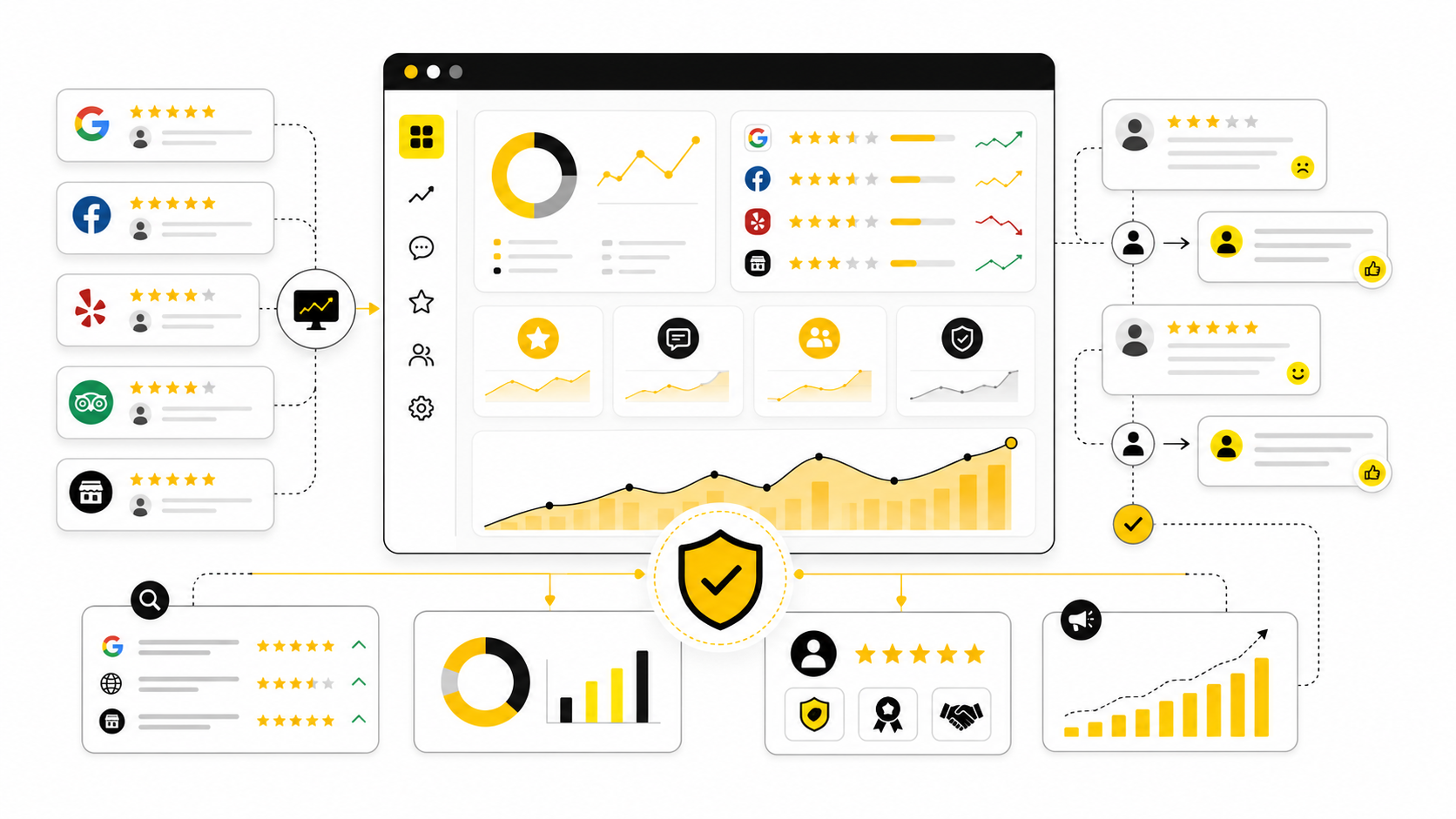
Online reputation management in digital marketing is the work of shaping, monitoring, protecting, and improving how people perceive a brand across search results, review platforms, social media, AI-driven discovery, and owned channels. It is not just “getting more reviews.” It is the system behind what a buyer sees, feels, and believes before they ever book a call, visit a store, request a quote, or add something to cart.
That matters because reputation now sits directly inside the customer journey. People do not move from ad to landing page to purchase in a straight line anymore. They check Google, compare reviews, scan Reddit or TikTok, look at social comments, ask peers, and increasingly use AI tools to summarize what the internet seems to believe about a brand.
The big shift is trust. BrightLocal’s 2025 research shows that only 42% of consumers trust online reviews as much as personal recommendations, down sharply from earlier years. That does not mean reviews stopped mattering. It means buyers are reading more carefully, comparing more sources, and looking for patterns instead of blindly believing a star rating.
For marketers, this changes the job. A good campaign can create attention, but reputation decides whether that attention converts. If your search results look thin, your reviews feel neglected, your social replies sound defensive, or your brand story is inconsistent, the funnel leaks before your analytics dashboard can explain why.
this guide is split into six parts so each piece of online reputation management can be handled properly instead of rushed. The structure follows the real order most brands should use: understand why reputation matters, map the system, build the core assets, respond professionally, use the right tools, and measure what improves. Each section continues the same practical framework, so the full article reads like one complete operating guide.
Why Online Reputation Management Matters In Digital Marketing
Reputation matters because buyers are doing their own research before they trust your claims. Search engines, review platforms, social feeds, and comparison content all act like trust checkpoints. Your brand does not control every checkpoint, but it can influence whether those checkpoints make people feel safer or more doubtful.
This is especially important because trust has become more personal and more fragile. Edelman’s 2025 brand trust research found that 80% of people trust brands they use, which means reputation is strongest when real experience supports the promise. That is the practical lesson: reputation is not built by saying better things about yourself; it is built by making the public evidence match the marketing message.
In digital marketing, this affects conversion rate, local rankings, paid media performance, retention, and referrals. Google also tells businesses to keep profile information complete and accurate because complete business information helps customers understand what a business does, where it is, and when they can visit. That may sound basic, but basic trust signals are often where reputation problems start.
The Reputation Framework At A Glance
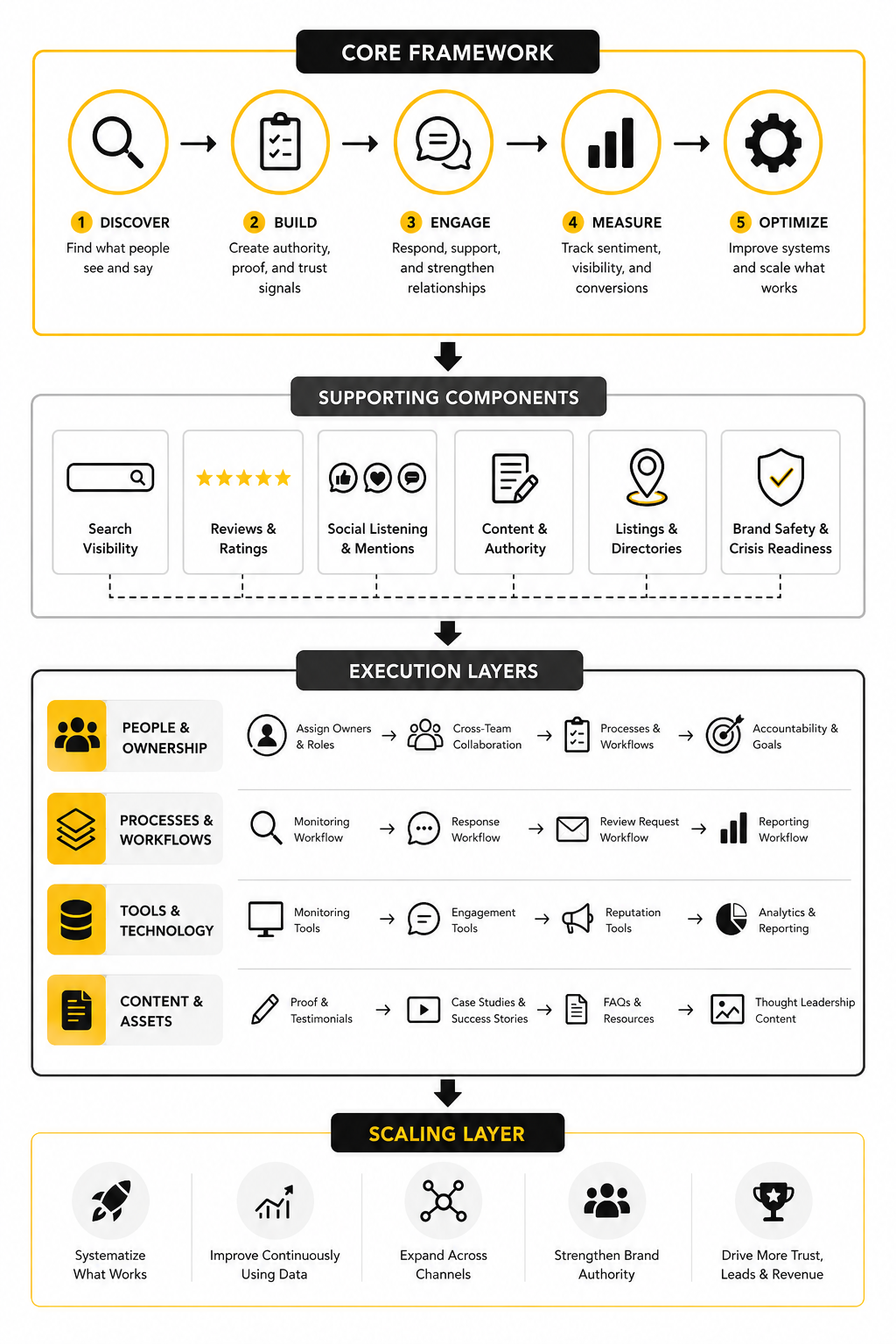
A useful reputation framework has four layers: visibility, credibility, responsiveness, and improvement. Visibility is whether people can find accurate information about the brand. Credibility is whether what they find feels believable, consistent, and current.
Responsiveness is how the brand handles public feedback, especially reviews, complaints, questions, and social comments. Google’s own review guidance notes that verified businesses can reply to reviews on their Business Profile, which makes response quality part of the public trust record. Silence can look careless, but rushed or defensive replies can be worse, so the process needs standards.
Improvement is the layer most brands skip. Online reputation management is not only about reacting to what people say; it is about finding the operational reasons people say it. When review themes, customer support issues, social sentiment, and search visibility are treated as feedback loops, reputation becomes a growth asset instead of a cleanup project.
What This Means For Marketers
The marketer’s role is to connect reputation signals to revenue outcomes. That means looking beyond vanity metrics and asking sharper questions. Are people finding the right brand information, are they seeing recent proof, are objections being answered publicly, and are negative patterns being fixed at the source?
Social media adds another layer because brand perception now forms in public conversations, not just polished posts. The 2025 Sprout Social Index surveyed more than 4,000 consumers and 1,200 marketers and framed social as a central place where consumers interact with brands. That makes social listening, comment quality, response speed, and community tone part of reputation management, not separate “social media tasks.”
The main point is simple: reputation should not sit in a PR folder until something goes wrong. It should be part of the marketing operating system. When the reputation system is strong, every campaign has a better chance to convert because the buyer finds fewer reasons to hesitate.
The Reputation Framework Brands Should Use
A strong reputation framework starts with a simple idea: people trust patterns more than promises. One great ad can get attention, but a pattern of accurate listings, recent reviews, helpful replies, useful content, and consistent brand behavior creates confidence. That is why online reputation management in digital marketing should be treated as a system, not a one-off cleanup task.
The framework has four working layers: visibility, credibility, responsiveness, and improvement. Each layer supports the next one. If people cannot find accurate information, they cannot evaluate you properly; if they do not believe what they find, they hesitate; if you do not respond well, they question your standards; and if you do not improve from feedback, the same reputation issues keep coming back.
This structure also keeps reputation work practical. Instead of chasing every mention, every comment, and every review with the same urgency, you can decide what matters most. The goal is not to look perfect everywhere. The goal is to look real, reliable, current, and professionally managed wherever buyers are likely to check.
Visibility: Make The Right Brand Information Easy To Find
Visibility is the foundation because buyers cannot trust what they cannot confirm. Your business name, location, hours, service areas, offers, contact details, profiles, and brand descriptions should be consistent across the places people use to evaluate you. Google’s local ranking guidance directly emphasizes complete and accurate Business Profile information because it helps customers understand what a business does, where it operates, and when they can visit through complete business information.
This is where many brands quietly lose trust. A prospect sees one phone number on the website, different hours on Google, an old logo on Facebook, and no recent activity on LinkedIn. None of those things may feel dramatic on their own, but together they create doubt.
Visibility also includes search results beyond your own website. Branded search pages, review profiles, directory listings, social bios, marketplace pages, press mentions, podcast appearances, and comparison content all shape the first impression. If the first page of search looks outdated or inconsistent, your marketing has to work harder before the buyer even reaches your funnel.
Credibility: Give Buyers Enough Proof To Believe You
Credibility is where reputation moves from being visible to being persuasive. Buyers want evidence that your claims are true, and they usually look for that evidence in reviews, testimonials, case studies, social proof, expert content, third-party mentions, and the overall quality of your public presence. BrightLocal’s 2025 review research shows that only 42% of consumers trust online reviews as much as personal recommendations, which means people still use reviews, but they read them with more skepticism.
That changes how brands should think about proof. A high rating helps, but it is not enough by itself. Buyers want review depth, recent activity, specific details, realistic language, and signs that the business responds like a real team.
Credibility also comes from consistency between channels. If your ads promise premium service but your review replies sound cold, the brand feels disconnected. If your website talks about fast support but social comments go unanswered, the gap becomes part of your reputation.
Responsiveness: Show That Real People Are Paying Attention
Responsiveness is one of the most visible signs of brand maturity. When someone leaves a review, asks a question, complains publicly, or comments on a post, the response becomes part of the reputation record. Google allows verified businesses to reply to reviews on their Business Profile, which means the way you respond is not hidden support work; it is public marketing.
Good responses do three things. They acknowledge the person, address the issue or compliment directly, and keep the tone calm. That sounds simple, but it requires discipline because reputation problems often show up when emotions are already high.
Responsiveness does not mean arguing with every critic or replying instantly to every low-quality comment. It means having a clear standard for what deserves a response, who owns it, and how the brand should sound. This is where many teams benefit from centralizing messages, review requests, and follow-ups in a CRM or automation platform like GoHighLevel, especially when leads, reviews, and customer conversations are spread across multiple channels.
Improvement: Turn Feedback Into Better Operations
The strongest reputation systems do not stop at public response. They use public feedback to improve the business. If ten reviews mention slow replies, the answer is not just a nicer review response template; the answer is fixing response time.
This is the part that separates reputation management from reputation cosmetics. Cosmetic reputation work tries to bury bad feedback or flood platforms with generic praise. Real online reputation management in digital marketing looks at complaint themes, support tickets, review language, social comments, refund reasons, and sales objections to find what needs to change.
Improvement also protects future marketing performance. When recurring issues are fixed, reviews become more positive naturally, customer stories become easier to collect, and sales conversations start with less resistance. That is the compounding effect: better operations create better reputation signals, and better reputation signals make marketing more efficient.
How The Four Layers Work Together
The framework works best when the layers are connected instead of managed separately. Visibility gets the brand found, credibility helps the buyer believe, responsiveness shows the brand is active, and improvement makes the whole system stronger over time. Remove one layer and the system weakens.
For example, a business can have excellent service but poor visibility, so buyers never see enough proof. Another business can have strong visibility and many reviews, but weak responsiveness makes it look careless. A third business can respond well in public, but if the same complaints keep appearing, people notice the pattern.
That is why the framework should be reviewed regularly. Once a month, a team can check whether key listings are accurate, whether review volume and quality are healthy, whether response standards are being followed, and whether feedback themes are being addressed. This turns reputation into a repeatable operating rhythm instead of a stressful emergency project.
The Practical Reputation Audit
A simple reputation audit gives you a clear starting point. Search the brand name, main product or service, founder name if relevant, and local or industry keywords. Then look at what a buyer would see before they decide whether to trust you.
The audit should not be limited to Google. Review platforms, social profiles, YouTube, Reddit, marketplace pages, AI summaries, directory listings, and competitor comparison pages can all influence perception. The 2025 Sprout Social Index is based on surveys of more than 4,000 consumers and 1,200 marketers, which reflects how central social channels have become to brand perception and customer interaction.
Use the audit to group issues into four categories:
The value of this audit is clarity. You stop guessing and start seeing the exact points where trust is being built or lost. From there, the next step is strengthening the core components that make the reputation system visible, believable, and easier to manage.
Core Components Of A Strong Online Reputation
Once the framework is clear, the next step is building the pieces that make it work in the real world. Online reputation management in digital marketing depends on repeatable assets and habits, not random bursts of activity. The brands that win here usually do the boring work better than everyone else.
The core components are simple: accurate profiles, steady review generation, professional response systems, useful proof assets, social listening, customer feedback loops, and search visibility. Each component plays a different role, but together they create the public evidence buyers use to judge whether a brand feels trustworthy. Miss one piece and the system can still function, but it becomes weaker.
This is where reputation stops being abstract. A founder, agency, or marketing team should be able to look at each component and know exactly what needs to be checked, improved, assigned, and measured. That clarity matters because reputation work often gets ignored until there is a visible problem.
Business Profiles And Listings
Business profiles are often the first reputation asset a buyer sees. Google Business Profile, Apple Business Connect, Bing Places, Facebook, LinkedIn, Yelp, Trustpilot, industry directories, and marketplace profiles can all influence how legitimate a brand looks. If those profiles are incomplete or inconsistent, the brand feels less reliable before the buyer reads a single review.
The practical standard is accuracy first, then completeness. Business name, website, phone number, address, service area, opening hours, categories, descriptions, photos, and booking links should match across the most important platforms. Google’s guidance around complete business information reinforces the same principle: buyers need enough clear information to understand and choose the business.
Listings also need ownership. Someone should know which profiles exist, who has admin access, when they were last updated, and which ones drive meaningful visibility. A messy listing footprint creates operational risk because old information can keep circulating long after the brand has changed.
Review Generation Without Making It Awkward
Review generation should be built into the customer journey, not treated like a desperate favor. The best time to ask is usually after a clear positive moment: a successful delivery, a completed appointment, a resolved support issue, a renewal, or a customer win. That timing makes the request feel natural instead of forced.
The ask should be simple and specific. Tell the customer where to leave the review, why it helps, and what kind of honest detail is useful. BrightLocal’s 2025 research shows consumers are looking for facts and objectivity in reviews, which makes detailed feedback more valuable than vague praise through the Local Consumer Review Survey 2025.
Automation can help, but it should not make the process feel robotic. A platform like GoHighLevel can support follow-up workflows when a business needs review requests, customer messages, and pipeline activity in one place. The key is to automate the reminder, not fake the relationship.
Review Response Standards
Review responses are public trust signals. They show how the brand handles praise, disappointment, misunderstanding, and conflict. A thoughtful response can make a negative review look less damaging because buyers see professionalism in the way the business reacts.
The standard should be clear: respond quickly, personalize the reply, avoid arguing, protect private information, and move complex issues into a direct support channel. Google’s review reply guidance tells businesses to keep replies professional, polite, clear, helpful, and concise through its tips to get more reviews. That is not just platform etiquette; it is reputation strategy.
Positive reviews deserve attention too. A simple thank-you that reflects the customer’s actual comment can reinforce the brand’s strengths. If a review mentions speed, quality, communication, or support, the response can naturally echo that value without sounding scripted.
Proof Assets That Support The Buying Decision
Reviews are powerful, but they should not carry the entire reputation system alone. Strong brands also build proof assets that help buyers understand why customers trust them. These can include testimonials, case studies, before-and-after examples, expert articles, customer interviews, product walkthroughs, comparison pages, and social proof sections on landing pages.
The point is not to overwhelm people with praise. The point is to answer the buyer’s silent question: “Can I believe this?” Good proof assets are specific, current, and connected to real customer outcomes.
Landing pages and funnels should include proof in the right places, especially near claims, pricing, booking forms, and calls to action. Tools like ClickFunnels, Systeme.io, or Replo can help structure those conversion pages, but the tool is not the strategy. The strategy is placing believable proof exactly where hesitation happens.
Social Listening And Public Conversation
Reputation now lives in conversations, not just review platforms. People ask questions in comments, compare brands in communities, share bad experiences in threads, and form opinions from how a company behaves in public. The 2025 Sprout Social Index is based on surveys of more than 4,000 consumers and 1,200 marketers, which shows how central social channels have become to brand interaction and perception.
Social listening helps teams spot sentiment before it becomes a larger issue. This includes tracking brand mentions, founder mentions, product names, competitor comparisons, recurring complaints, support themes, and questions that keep appearing. You do not need to respond to everything, but you do need to notice patterns.
A scheduling and engagement tool like Buffer can help teams stay consistent with publishing and channel management. For brands using Instagram or messaging-heavy acquisition, ManyChat can also support automated conversations when the flow is helpful, transparent, and easy for the customer to exit.
The Step-By-Step Execution Process
This is the point where the reputation system becomes operational. A good process gives the team a rhythm so the work does not depend on memory, mood, or whoever happens to notice a bad review first. Keep it simple enough that people will actually follow it.
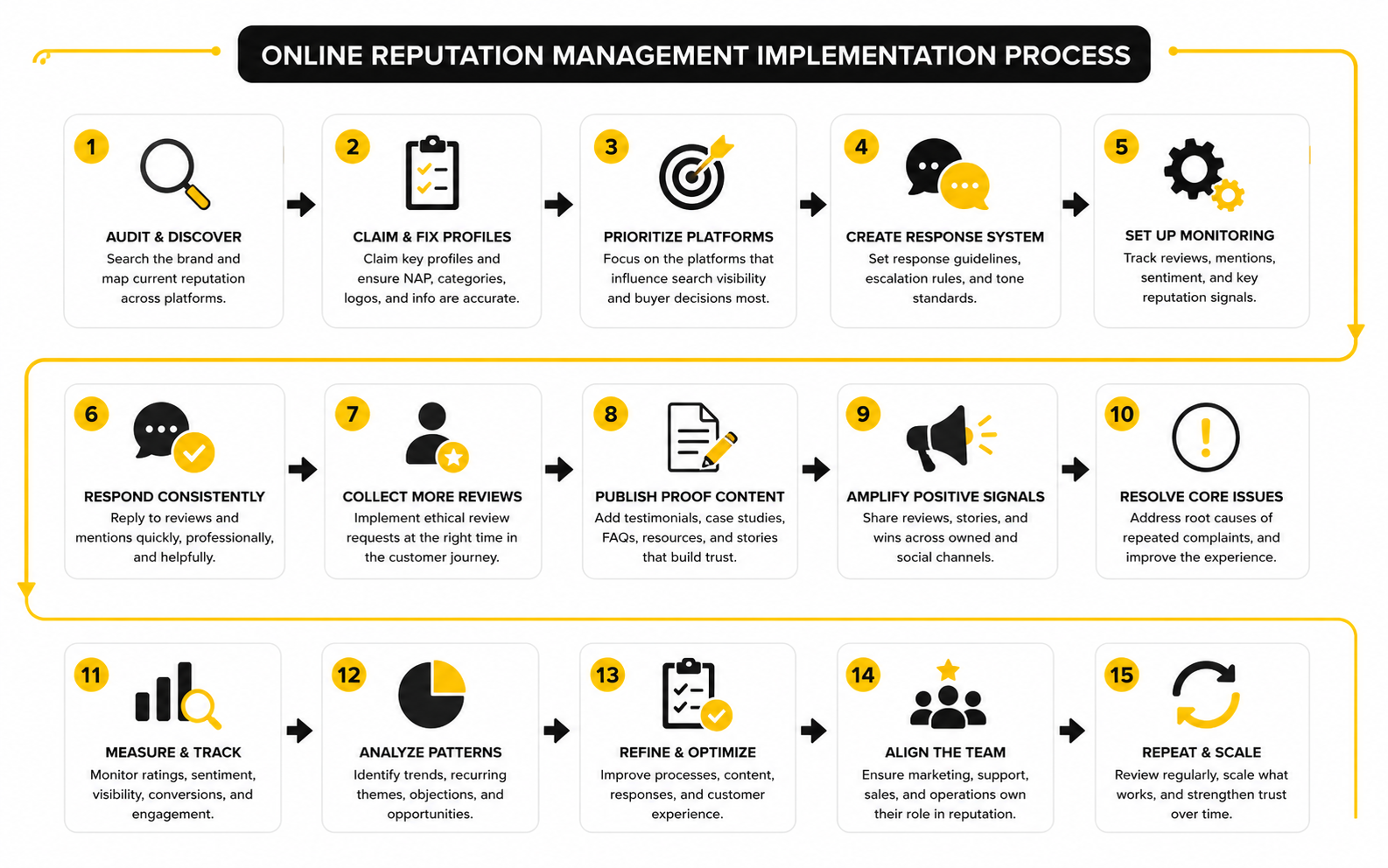
Start with a baseline audit, then prioritize the fixes that affect buyer trust most directly. After that, build review requests into the customer journey, assign response ownership, publish proof assets, monitor public conversation, and review themes every month. The process should feel like maintenance, not chaos.
A practical monthly workflow looks like this:
This workflow is intentionally direct. It avoids the trap of turning reputation management into a giant spreadsheet nobody wants to touch. The goal is to create enough structure that the brand keeps improving every month.
Customer Feedback Loops
Customer feedback loops connect reputation to operations. Without them, marketing teams end up polishing symptoms while the business keeps creating the same complaints. That is exhausting, and it does not work for long.
A good feedback loop pulls from reviews, surveys, support tickets, chat logs, sales objections, cancellation reasons, and social comments. Forms can make this easier when you need structured feedback after onboarding, delivery, support, or purchase, and a tool like Fillout can help collect that information cleanly. The important part is not the form itself; it is what the team does with the answers.
Every month, group feedback into themes. Look for friction around communication, product quality, expectations, pricing, delivery time, support speed, onboarding, and results. Then decide which issues need a marketing clarification, which need a support process, and which need a real operational fix.
Search Visibility And Content Control
Search visibility is part of reputation because branded search results often act like a trust page. When someone searches your brand, they are usually already interested. What they find next can either support the buying decision or slow it down.
The brand should control as many high-quality, accurate, useful search assets as possible. That includes the website, about page, review profiles, social profiles, founder pages, press pages, comparison content, help content, and educational articles. The goal is not to manipulate search results; the goal is to make the most accurate and helpful information easy to discover.
Content also helps answer objections before they become reputation problems. If buyers regularly misunderstand pricing, delivery, results, guarantees, or service scope, publish clear content around those topics. Reputation improves when people know what to expect before they buy.
Turning Components Into A Weekly Habit
The biggest mistake is making reputation management too complicated. If the system requires a huge meeting, five dashboards, and three approvals for every response, people will avoid it. Reputation needs a simple weekly habit supported by a deeper monthly review.
Weekly, check new reviews, important mentions, profile accuracy, and urgent customer-facing issues. Monthly, review patterns and decide which fixes will actually reduce future friction. Quarterly, update proof assets, audit branded search results, refresh profile content, and evaluate whether the reputation system is helping conversion.
This is how online reputation management in digital marketing becomes practical. You are not trying to control every opinion on the internet. You are building a visible, credible, responsive, and improving brand presence that gives buyers fewer reasons to doubt you.
Statistics And Data That Actually Matter
Measurement is where online reputation management in digital marketing becomes honest. Without data, reputation work turns into opinion: someone thinks reviews “look better,” someone feels the brand is “more trusted,” and someone else assumes a few replies fixed the problem. That is not enough.
The right data shows whether buyers are finding the brand, trusting what they see, engaging with proof, and moving closer to action. It also shows which reputation issues are surface-level and which ones are connected to real business problems. A lower rating is not always the biggest issue; sometimes the bigger issue is review recency, unanswered complaints, weak branded search visibility, or a pattern of objections that keeps showing up in sales calls.
This section is not about dumping random statistics. The numbers only matter when they help you make a better decision. Good reputation analytics should tell you what to fix, what to protect, what to amplify, and what to stop overreacting to.
Start With The Reputation Baseline
The baseline is your starting point. Before changing anything, capture how the brand currently appears across search, review platforms, social channels, directories, and owned assets. This gives you a reference point so you can separate real progress from temporary noise.
A useful baseline should include branded search results, average star ratings, review volume, review recency, response rate, response time, profile completeness, social sentiment, traffic from reputation-related pages, and conversion behavior around proof-heavy assets. BrightLocal’s 2026 review research found that 97% of consumers read reviews online, which makes review visibility a serious trust signal, not a decorative metric.
The mistake is treating the baseline like a one-time report. It should become a comparison tool. When you look back after 30, 60, or 90 days, you should be able to see whether the reputation system is becoming stronger or just busier.
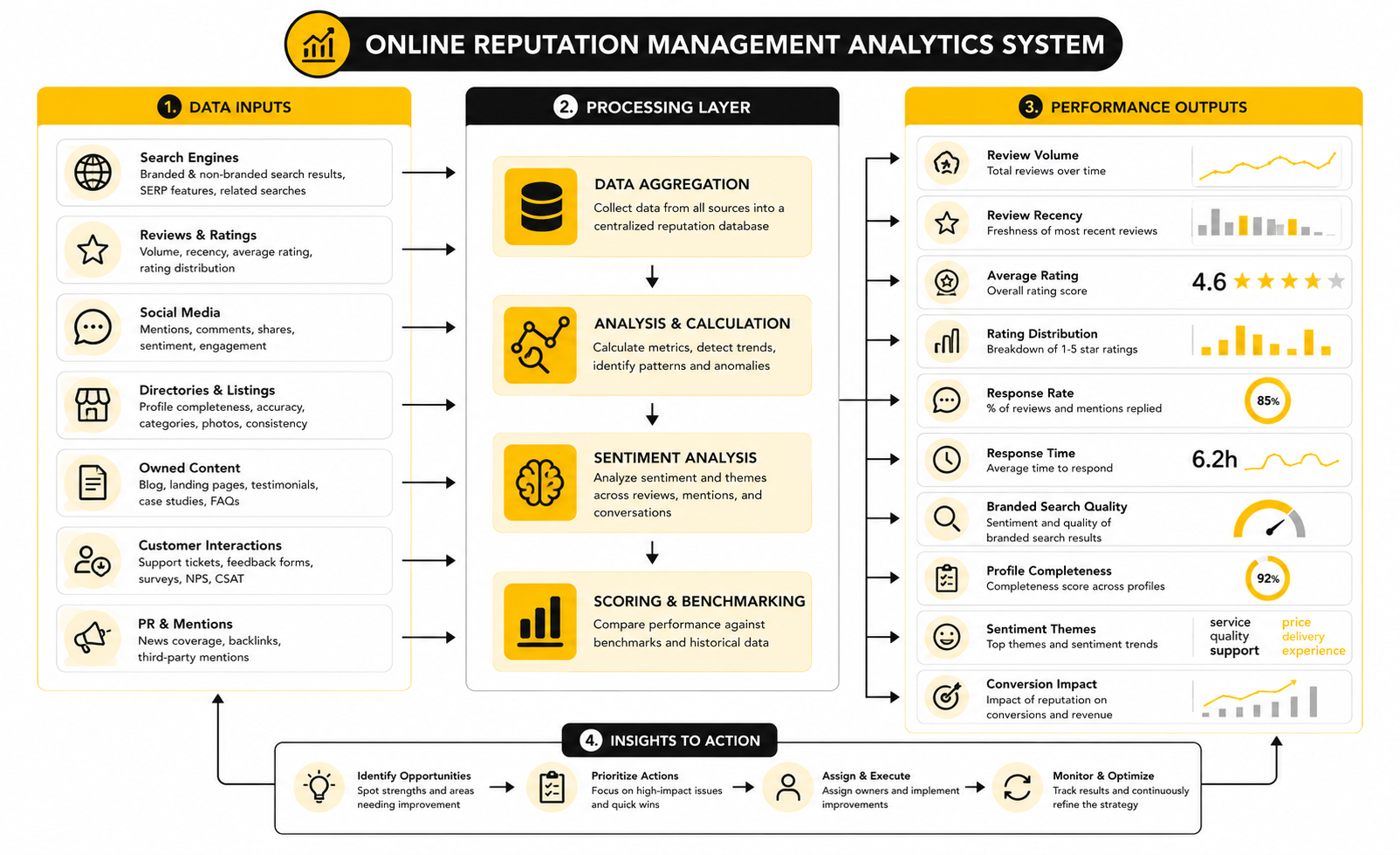
The Five Reputation Metrics Worth Tracking
Not every metric deserves a dashboard. Some numbers look impressive but do not tell you much about trust or buyer behavior. The best measurement system focuses on signals that connect reputation to decisions.
Track these five categories first:
These categories work together because reputation is not one number. A brand can have a strong rating but poor recency. Another brand can have good social engagement but weak search proof. A third can have plenty of reviews but no operational process for handling negative patterns.
How To Interpret Review Data
Review data needs context. A 4.9 rating from 12 reviews is not the same as a 4.6 rating from 900 reviews. A five-star rating with vague comments may be less persuasive than a slightly lower rating with detailed, recent, believable feedback.
Review recency is especially important because buyers want to know what the business is like now. BrightLocal’s 2026 survey shows that 41% of consumers always read reviews when browsing for businesses, which means old or inactive review profiles can make a brand feel less current. The action is clear: review generation should be steady, not sporadic.
The content of reviews also matters. Look for repeated language around speed, communication, quality, reliability, support, pricing, results, or expectations. If the same positive theme keeps appearing, use it in sales pages and ads. If the same complaint keeps appearing, fix the process behind it instead of writing prettier replies.
What Response Metrics Reveal
Response metrics show whether the brand is paying attention. A strong response rate tells buyers the business is active and reachable. A weak response rate can make even a good review profile feel neglected.
Google’s Business Profile support explains that helpful and positive replies can show customers that a business is responsive through its guidance on managing customer reviews. That matters because the response is not only for the person who left the review. It is also for every future buyer reading the exchange silently.
Track response time, but do not worship speed at the expense of quality. A fast defensive reply can damage trust. A slightly slower response that is calm, specific, and useful is often better for the public record.
Social And Sentiment Signals
Social data is useful when it explains perception, not when it turns into vanity reporting. Likes and impressions can show reach, but they do not automatically prove trust. Comments, shares, saves, direct questions, complaints, and repeated themes usually tell you more.
The 2025 Sprout Social Index surveyed 4,044 consumers, 900 social practitioners, and 322 marketing leaders, which reflects how deeply social channels now sit inside brand perception and customer interaction. For reputation work, the key question is not “Did this post perform?” The better question is “What did this interaction reveal about trust, confusion, demand, or hesitation?”
Sentiment should be interpreted carefully. A spike in negative mentions may look bad, but it can also reveal a fixable issue before it spreads further. A spike in positive mentions may look good, but it still needs to be connected to actual outcomes like traffic, leads, sales, retention, or brand search growth.
Search Performance And Branded Demand
Search data shows whether reputation is creating curiosity, confidence, or concern. Branded search volume can rise when awareness grows, but it can also rise during controversy. That is why search performance should be read alongside sentiment, review trends, referral traffic, and conversion data.
Track the search results that appear for the brand name, product names, founder names, and high-intent comparison terms. Look at what the buyer sees before clicking: review snippets, social profiles, news results, Reddit discussions, videos, directories, and competitor pages. This is the public trust layer that sits between awareness and conversion.
Google Search Console, Google Business Profile performance data, analytics platforms, CRM attribution, and rank tracking can all help here. The goal is not to obsess over every keyword movement. The goal is to know whether buyers are finding accurate, persuasive, current information when they search.
Conversion Signals Connected To Reputation
Reputation becomes much easier to defend when it is tied to conversion data. If stronger reviews, better proof assets, and cleaner search results improve calls, bookings, demos, checkouts, or close rates, the business will take reputation work seriously. That is the language leadership understands.
Track conversion behavior around reputation-heavy touchpoints. These include review widgets, testimonial sections, case study pages, comparison pages, Google Business Profile clicks, social profile links, booking pages, and post-review follow-up flows. If you are using a funnel or landing page tool like ClickFunnels, Systeme.io, or Replo, proof placement should be tested near the points where buyers hesitate.
This is where small changes can matter. A stronger testimonial near a pricing section may improve form fills. A clearer review section on a local landing page may increase calls. A better response process may reduce friction before prospects ever speak to sales.
Benchmarks Without Blind Copying
Benchmarks are useful, but they can mislead you if you copy them blindly. A restaurant, SaaS company, local dentist, agency, ecommerce brand, and home services business will not have the same review volume, response expectations, social behavior, or conversion cycle. Context matters.
Use benchmarks to spot gaps, not to define your entire strategy. If competitors have hundreds of recent reviews and your brand has 18 old ones, that is a visibility and credibility gap. If competitors respond to every serious review and your brand ignores complaints, that is a responsiveness gap.
The better benchmark is often your own trend line. Are you getting more specific reviews than last quarter? Are negative themes shrinking? Are branded search results cleaner? Are reputation touchpoints converting better? Those questions are more useful than chasing a generic industry average.
Building A Simple Reputation Dashboard
A reputation dashboard should be simple enough that people actually use it. Do not build a giant report that looks impressive and changes nothing. Build a dashboard that helps the team make decisions quickly.
A practical dashboard should show:
Tools can help centralize this, especially when the business is already managing leads, messages, reviews, and follow-ups through a platform like GoHighLevel. But the dashboard only works if someone owns the decisions. Data without ownership becomes decoration.
What The Data Should Make You Do
The point of measurement is action. If reviews are strong but conversion is weak, improve proof placement and buying-page clarity. If review volume is low, build better request timing into the customer journey. If social sentiment is negative around the same issue every month, fix the issue instead of writing more content.
If branded search results are thin, create stronger owned assets. If response times are slow, assign responsibility and create reply standards. If leads mention the same hesitation on sales calls, turn that objection into content, proof, or a clearer offer explanation.
This is the practical value of online reputation management in digital marketing. The numbers are not there to make the brand feel good. They are there to show where trust is being earned, where it is being lost, and what needs to happen next.
Advanced Reputation Strategy For Growing Brands
Once the basics are working, online reputation management in digital marketing becomes less about checking boxes and more about making smart tradeoffs. A small local business can often manage reputation manually with a simple weekly rhythm. A growing brand needs clearer ownership, stronger rules, better tools, and a sharper understanding of risk.
The challenge is that scale creates more surface area. More customers means more reviews, more comments, more support conversations, more search results, more screenshots, more creators, more competitors, and more ways for the brand story to drift. That does not mean the brand needs to control everything, but it does need a system that protects trust without slowing the business down.
This is where leadership matters. Reputation cannot belong only to marketing, only to support, or only to PR. It has to connect the teams that shape the customer experience, because the public perception of the brand is usually downstream from what the business actually does.
The Tradeoff Between Automation And Authenticity
Automation is useful when it makes the customer experience smoother. It can send review requests, route complaints, trigger follow-ups, collect feedback, and remind the team when something needs attention. Used well, it creates consistency without making the brand feel robotic.
The risk is using automation to replace judgment. A generic reply to a serious complaint looks lazy. A review request sent at the wrong moment can feel tone-deaf, especially if the customer just had a bad experience.
The better approach is simple: automate the workflow, but keep the human standard. A platform like GoHighLevel can help centralize customer messages, review requests, and follow-up workflows, but the brand still needs clear rules for tone, escalation, and sensitive situations. Tools should make the system easier to run, not make the brand sound less human.
Fake Reviews Are A Legal And Trust Risk
Fake reviews are not a clever growth tactic. They are a reputation risk, a compliance risk, and a fast way to destroy buyer confidence when people notice the pattern. The FTC’s rule on consumer reviews and testimonials went into effect on October 21, 2024, and addresses deceptive conduct involving fake reviews, fake testimonials, review suppression, and certain insider reviews through its Consumer Reviews and Testimonials Rule.
This matters because the internet has become more skeptical. BrightLocal’s 2025 research shows review trust has weakened, with only 42% of consumers trusting online reviews as much as personal recommendations. When buyers already have their guard up, suspicious review patterns can hurt more than no reviews at all.
The strategic answer is not to manufacture trust. The answer is to build a cleaner review engine: ask real customers, avoid pressure, never script dishonest praise, disclose incentives where required, and make it easy for customers to share specific feedback. Real proof compounds; fake proof eventually becomes a liability.
AI Makes Reputation Faster And More Fragile
AI has changed how people discover, summarize, and judge brands. Buyers can ask AI tools to compare companies, summarize review themes, explain complaints, or pull together public information before they ever visit your website. That means your reputation is no longer only what appears on one search results page.
This makes consistency more important. If your website, profiles, reviews, social content, and third-party mentions all say different things, AI-driven summaries may reflect that confusion. The brand does not get to choose every summary, but it can improve the public information those systems have available.
AI also creates new risks around fake content. Research published in 2025 found that people had only 50.8% overall accuracy when trying to distinguish real product reviews from machine-generated fake reviews. That is a warning sign for brands: review authenticity, verified customer feedback, and transparent proof will matter more as synthetic content becomes easier to produce.
Handling Negative Reviews Without Making Them Worse
Negative reviews are not automatically disasters. In many cases, a calm and useful response can make the brand look more trustworthy because buyers see how the business behaves when things are imperfect. The real danger is responding with ego.
The first rule is to separate emotion from action. Read the review, identify the issue, check internal records if possible, and decide whether the response should apologize, clarify, request more information, or move the conversation into a private support channel. Do not debate every detail in public unless there is a clear factual correction that future buyers need to understand.
The second rule is to look for the operational lesson. If the complaint is rare, handle it professionally and move on. If the same complaint keeps appearing, the review is not the problem anymore; the process behind the review is the problem.
Crisis Moments Need A Different Playbook
Normal reputation management and crisis management are not the same thing. A normal issue might be a bad review, a delayed shipment, or a public complaint. A crisis involves higher stakes: safety, legal exposure, discrimination claims, data privacy, employee misconduct, viral backlash, major service failure, or misleading public information.
In a crisis, speed matters, but accuracy matters more. A rushed statement that turns out to be wrong can create a second crisis. The team should confirm facts, assign one decision owner, pause nonessential promotional content, and communicate only what can be supported.
The tone should be direct and responsible. Avoid vague corporate language, avoid blaming the customer, and avoid overpromising before the facts are clear. People do not expect perfection, but they do expect seriousness when the issue is serious.
Scaling Reputation Across Multiple Locations Or Teams
Multi-location brands have a unique challenge because reputation is both local and national. One location can have excellent reviews while another creates recurring complaints. If everything gets averaged together, leadership may miss the exact place where trust is breaking.
Each location should have local review tracking, profile ownership, response standards, and escalation rules. At the same time, the brand needs central guidelines so every location sounds like the same company. This balance is important because local teams understand the customer context, but central teams protect consistency.
The same principle applies to larger departments. Sales, support, marketing, operations, and leadership should all understand how their work affects public trust. Reputation gets stronger when teams stop treating reviews and comments as “marketing’s problem” and start treating them as customer intelligence.
Owned Media Gives You More Control
Owned media is one of the safest ways to strengthen reputation because it gives the brand more control over the explanation. Your website, blog, help center, email list, case studies, comparison pages, and landing pages can all answer questions before buyers go looking elsewhere. That does not replace third-party proof, but it gives people a clear home base.
This is especially useful for complex offers. If prospects often misunderstand pricing, timelines, guarantees, onboarding, or results, publish content that explains those topics directly. Clear expectations reduce bad-fit buyers and prevent reputation problems before they happen.
Email can also support reputation when it is used thoughtfully. A tool like Brevo or Moosend can help keep customers informed after purchase, ask for feedback at the right time, and share helpful updates that reduce confusion.
When To Respond Publicly And When To Move Private
Not every reputation issue should be handled fully in public. Some conversations involve personal information, billing details, medical or legal sensitivity, employee matters, or details that should not be discussed in a comment thread. In those cases, the public response should acknowledge the issue and guide the person to a private channel.
That does not mean hiding. A weak “contact support” reply with no empathy can look dismissive. A stronger reply explains that the team wants to review the situation properly and gives a clear next step.
The public part should show responsibility, while the private part should solve the issue. This protects the customer, protects the business, and shows future readers that the brand takes problems seriously without turning every review into a public argument.
Competitor Attacks And Unfair Mentions
Sometimes reputation issues are not clean or fair. A brand may deal with spam reviews, competitor-driven negativity, misleading comparison content, fake accounts, or public claims that remove important context. The response should be calm, documented, and platform-specific.
First, capture evidence. Take screenshots, record URLs, save dates, and collect internal context. Then report content through the proper platform process if it violates review, impersonation, defamation, or spam policies.
Publicly, avoid sounding paranoid. Buyers rarely want to watch a brand fight invisible enemies. If a response is needed, keep it factual, brief, and focused on the customer experience rather than attacking the source.
Reputation And Paid Advertising
Paid traffic exposes reputation weaknesses quickly. If the ad creates interest but search results, reviews, comments, and landing page proof do not support the claim, conversion costs rise. This is why reputation should be checked before scaling ad spend.
Before launching a major campaign, search the brand like a buyer. Look at reviews, social comments, comparison content, founder mentions, and the landing page proof around the offer. If there are obvious trust gaps, fix them before pushing more traffic into the funnel.
This is especially important for high-ticket offers, local services, and categories where buyers feel risk. A funnel builder like ClickFunnels or a landing page platform like Replo can help present the offer clearly, but reputation signals still need to carry the trust. Better traffic will not fix weak credibility.
Expert-Level Reputation Priorities
Advanced reputation work is mostly prioritization. You cannot respond to every mention with the same energy, rebuild every profile at once, or treat every complaint like a crisis. You need to know what moves trust the most.
The highest-priority issues usually affect buyer decisions directly. These include inaccurate business information, recent unresolved negative reviews, weak branded search results, missing proof near conversion points, recurring complaints, and public confusion around the offer. Fix those before polishing low-impact details.
A practical priority order looks like this:
This is not glamorous, but it works. The brands that build trust consistently are usually not doing magic. They are handling the right things in the right order for long enough that the market starts to believe them.
Mistakes To Avoid Before The Final Checklist
The last step is making the system durable. By this point, the article has covered the framework, the operating process, the measurement layer, and the advanced tradeoffs. Now the focus shifts to the mistakes that quietly weaken reputation even when the brand is trying to do the right thing.
The most common mistake is treating reputation as damage control instead of daily trust-building. That usually leads to panic when something negative appears and neglect when everything seems fine. Strong online reputation management in digital marketing works the other way around: build trust when things are calm, so the brand has credibility when pressure shows up.
Another mistake is confusing visibility with trust. Being everywhere does not help if the information is outdated, the reviews feel suspicious, the responses sound defensive, or the offer creates unclear expectations. The goal is not to create noise. The goal is to create public evidence that makes buyers feel safer moving forward.
Reputation Mistakes That Cost Brands Trust
A brand can lose trust in small ways before it loses trust in obvious ways. Inconsistent listings, old testimonials, unanswered reviews, vague claims, weak support handoffs, and awkward automation all send signals. Buyers may not explain exactly why they hesitate, but they feel the friction.
The most expensive mistakes usually fall into a few categories:
The fix is not complicated, but it does require discipline. Assign ownership, create standards, review patterns, and close the loop with the teams that can actually improve the customer experience. Reputation gets stronger when the business stops treating feedback as a threat and starts treating it as market intelligence.
The Final Reputation Checklist
A useful checklist should be short enough to use and serious enough to matter. This is the version to run monthly, quarterly, and before any major campaign launch. If the brand is about to spend money on ads, partnerships, launches, or PR, this checklist should happen first.
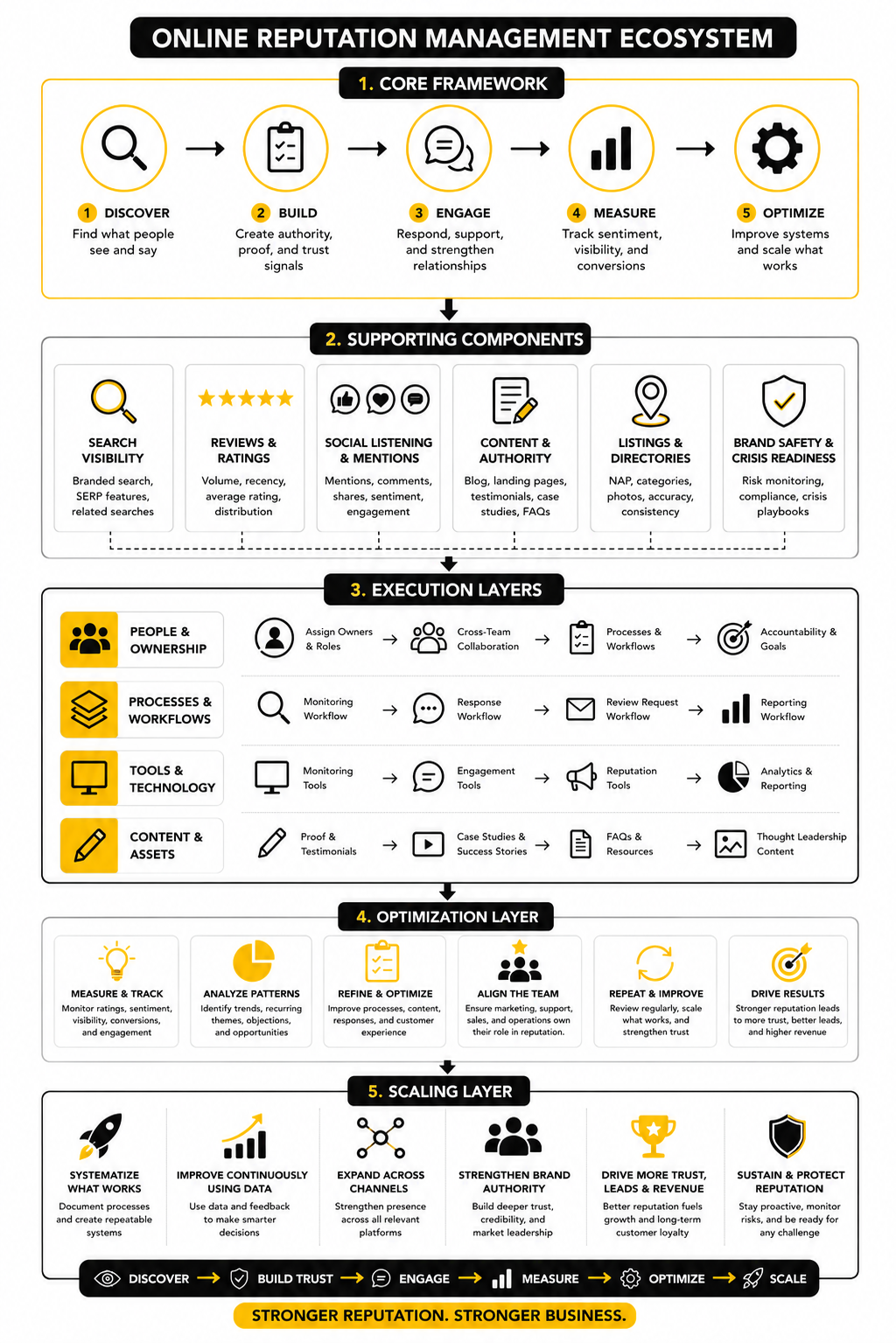
Use this final checklist to keep the whole system connected:
This checklist is not meant to create busywork. It is meant to make trust visible and manageable. When the brand can see the system clearly, it can improve the system consistently.
What Is Online Reputation Management In Digital Marketing?
Online reputation management in digital marketing is the process of shaping, monitoring, and improving how people perceive a brand across search, reviews, social media, owned content, third-party mentions, and customer conversations. It connects marketing, customer experience, public feedback, and trust signals into one system. The goal is to help buyers find accurate, credible, and current information before they decide.
Why Does Online Reputation Management Matter For Marketing?
It matters because buyers often research the brand before they convert. They may click an ad, then check reviews, search the company name, scan social comments, or compare competitors before taking action. If those trust signals are weak, paid traffic and content marketing become less efficient.
Is Reputation Management The Same As Review Management?
No, review management is only one part of reputation management. Reviews are important, but reputation also includes search visibility, social sentiment, profile accuracy, testimonials, content quality, customer support behavior, and public response standards. A brand can have decent reviews and still have a weak reputation system if the rest of the public evidence is messy.
How Often Should A Brand Monitor Its Online Reputation?
Most brands should check high-priority reputation signals weekly and review deeper patterns monthly. Weekly checks catch urgent reviews, mentions, profile issues, and public complaints. Monthly reviews reveal bigger trends, such as repeated objections, review quality changes, search visibility shifts, and operational issues.
What Are The Most Important Reputation Metrics?
The most useful metrics are review volume, review recency, average rating, rating distribution, response rate, response time, branded search quality, profile completeness, sentiment themes, and conversion behavior around reputation assets. The numbers should always lead to action. If a metric does not help the team decide what to fix, protect, or improve, it probably does not deserve much attention.
How Should A Business Respond To Negative Reviews?
A business should respond calmly, specifically, and professionally. The response should acknowledge the issue, avoid arguing, protect private information, and give the person a clear next step when needed. Google’s own guidance confirms that verified businesses can reply to reviews on their Business Profile, so those replies become part of the public trust record.
Should Businesses Ask Customers For Reviews?
Yes, but the request should be honest, timely, and simple. Ask after a real customer experience, make the process easy, and never pressure someone to leave only positive feedback. The FTC’s review rule addresses deceptive review practices, fake testimonials, review suppression, and misleading insider reviews through the Consumer Reviews and Testimonials Rule.
Are Fake Reviews Really That Risky?
Yes. Fake reviews can create legal exposure, platform penalties, public backlash, and long-term trust damage. The FTC announced a final rule in 2024 designed to combat fake reviews and testimonials by prohibiting their sale or purchase through its final rule banning fake reviews and testimonials.
How Does AI Affect Online Reputation?
AI affects reputation because buyers can use AI tools to summarize public information, compare brands, and surface review themes quickly. That means inconsistent or outdated public information can become a bigger problem. Research published in 2025 found that people had only 50.8% overall accuracy when distinguishing real product reviews from machine-generated fake reviews, which makes authenticity and verified customer feedback even more important.
What Should A Brand Do Before Scaling Paid Ads?
Before scaling ads, the brand should audit branded search results, review profiles, landing page proof, social comments, and public objections. Paid traffic will expose trust gaps faster because more people will research the brand. If the public evidence does not support the promise in the ad, conversion costs can rise even when the targeting is strong.
Can Small Businesses Manage Reputation Without Expensive Software?
Yes, small businesses can start with a spreadsheet, calendar reminders, saved response guidelines, and a simple monthly audit. The important thing is consistency, not complexity. Software becomes more useful when there are multiple locations, multiple team members, high review volume, or several customer communication channels to manage.
What Tools Help With Online Reputation Management?
The right tool depends on the workflow. A CRM and automation platform like GoHighLevel can help with follow-ups, pipelines, customer messages, and review workflows. Social tools like Buffer can support consistent publishing and channel management, while form tools like Fillout can help collect structured feedback after key customer moments.
What Is The Biggest Reputation Management Mistake?
The biggest mistake is trying to look trusted instead of becoming more trustworthy. Buyers can feel the difference between polished claims and real proof. Reputation improves fastest when the business fixes the experience behind the feedback, then makes the public evidence easier to find.
How Long Does It Take To Improve Online Reputation?
It depends on the starting point, review volume, customer volume, and severity of the issues. Simple profile fixes can happen quickly, but trust-building takes repeated positive signals over time. The goal is steady improvement: more current reviews, better responses, clearer proof, cleaner search results, and fewer repeated complaints.
Who Should Own Reputation Management Inside A Company?
Marketing can coordinate the system, but reputation should not belong to marketing alone. Support, sales, operations, leadership, and customer success all shape what customers experience and what they later say publicly. The best setup gives one person ownership of the reputation process while keeping every relevant team accountable for the issues they can fix.
Final Thoughts On Building A Reputation System
Online reputation management in digital marketing is not about controlling every opinion. It is about building enough trust signals that buyers can make a confident decision. That means accurate information, real proof, professional responses, useful content, honest review practices, and a business that learns from feedback.
The strongest reputation systems are not flashy. They are consistent. They make the brand easier to find, easier to believe, easier to contact, and easier to recommend.
That is the standard worth building toward. Not perfect. Trusted.
Build a stronger local presence with BAAM AI
Turn your website, Google profile, social channels, and AI visibility into one growth engine
Most businesses do not need more random marketing activity. They need a consistent presence system that helps the right people find them, trust them, and take action. BAAM AI brings strategy, local SEO, website updates, Google Maps visibility, social content, AI-search readiness, media production, and reporting into one practical monthly engine.
If you want your marketing to keep working after the campaign ends, start with a free BAAM AI presence audit. See how your business shows up today and where the fastest visibility wins are at BAAM AI.