
BAAM AI Blog
Online Marketing Specialist: A Practical Guide To Building Growth That Actually Converts
An online marketing specialist is the person who turns digital attention into measurable business results. That sounds simple, but the job is much broader than posting on social media, launching ads, or checking...
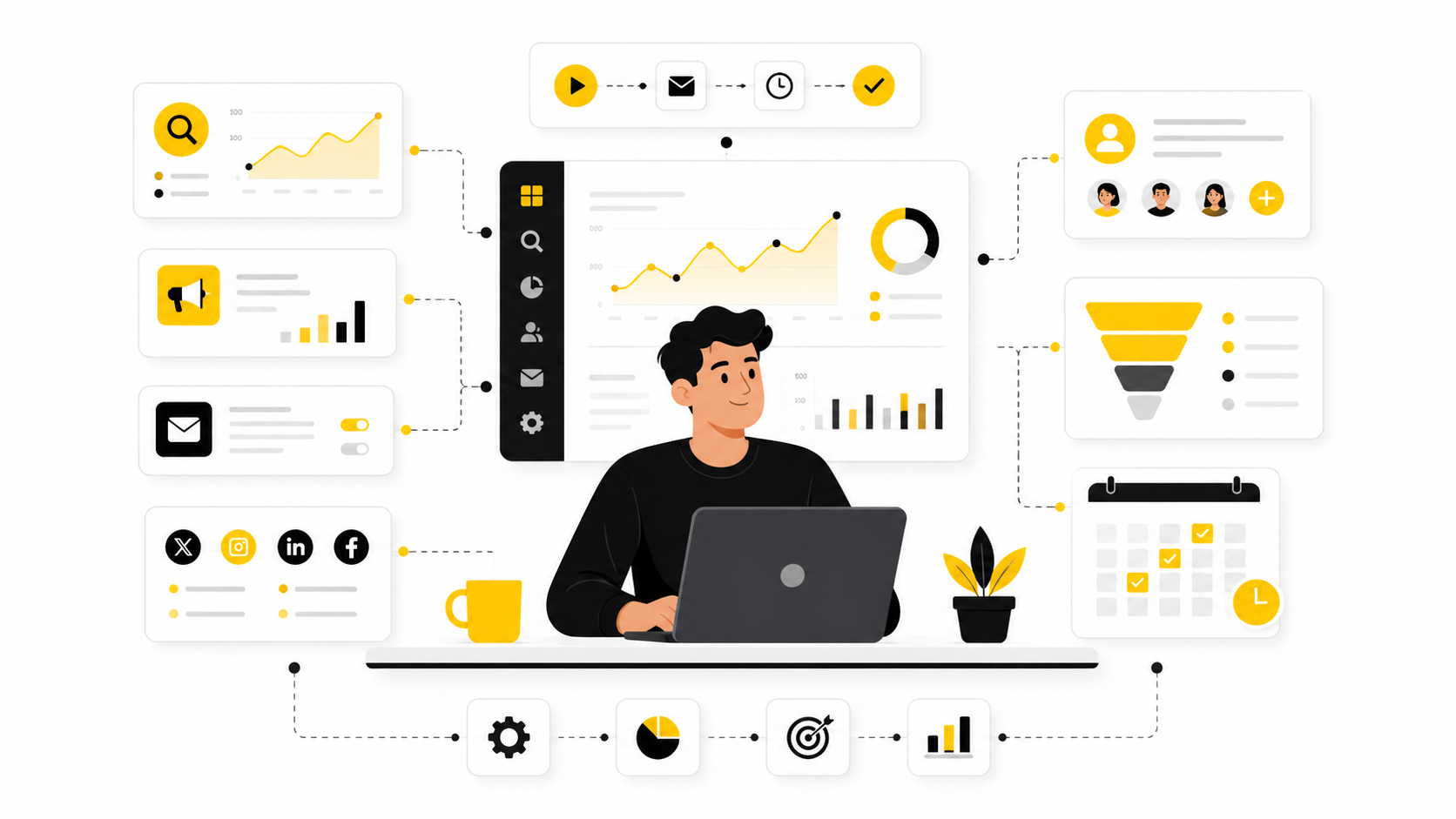
An online marketing specialist is the person who turns digital attention into measurable business results. That sounds simple, but the job is much broader than posting on social media, launching ads, or checking analytics dashboards. A strong specialist connects audience research, content, paid traffic, email, funnels, automation, conversion optimization, and reporting into one working growth system.
The role matters because online marketing is no longer a side channel. Digital now represents more than three quarters of worldwide media ad spending, with digital ad spending expected to pass 75% of total media spend, while U.S. internet advertising revenue reached $258.6 billion in 2024. That means businesses are not asking whether they should market online anymore. They are asking who can make all those channels work together without wasting budget.
A good online marketing specialist is not just a tool operator. Tools change constantly, especially now that AI, automation, and personalization are becoming normal parts of marketing work. The specialist’s real value is judgment: knowing what to prioritize, what to measure, what to ignore, and how to move a customer from first impression to confident purchase.
Why An Online Marketing Specialist Matters
The biggest mistake businesses make with online marketing is treating every channel as a separate task. One person writes posts, another runs ads, someone else sends emails, and nobody owns the full customer journey. An online marketing specialist matters because they connect those moving parts into one strategy instead of letting each channel compete for attention.
This is especially important because buyers rarely convert after one touchpoint. They might discover a brand through search, compare options on social media, read reviews, join an email list, click a retargeting ad, and only then book a call or buy. Without someone managing the whole system, the business sees activity but not momentum.
The role also matters because marketing platforms now reward clarity and consistency. Search engines need helpful content, ad platforms need strong creative and clean conversion data, email tools need relevant segmentation, and landing pages need a clear offer. A capable online marketing specialist keeps those pieces aligned so the business is not just visible, but persuasive.
The Online Marketing Specialist Framework
A practical framework for an online marketing specialist starts with the market, not the channel. Before choosing ads, email, SEO, funnels, or automation, the specialist needs to understand who the business serves, what the audience wants, what blocks the sale, and what message makes the offer feel relevant. That research shapes every decision that follows.
From there, the work moves into four connected layers: acquisition, conversion, retention, and measurement. Acquisition brings the right people into the ecosystem. Conversion turns attention into leads, customers, demos, bookings, trials, or purchases. Retention keeps the relationship alive after the first action, while measurement shows what is actually working.
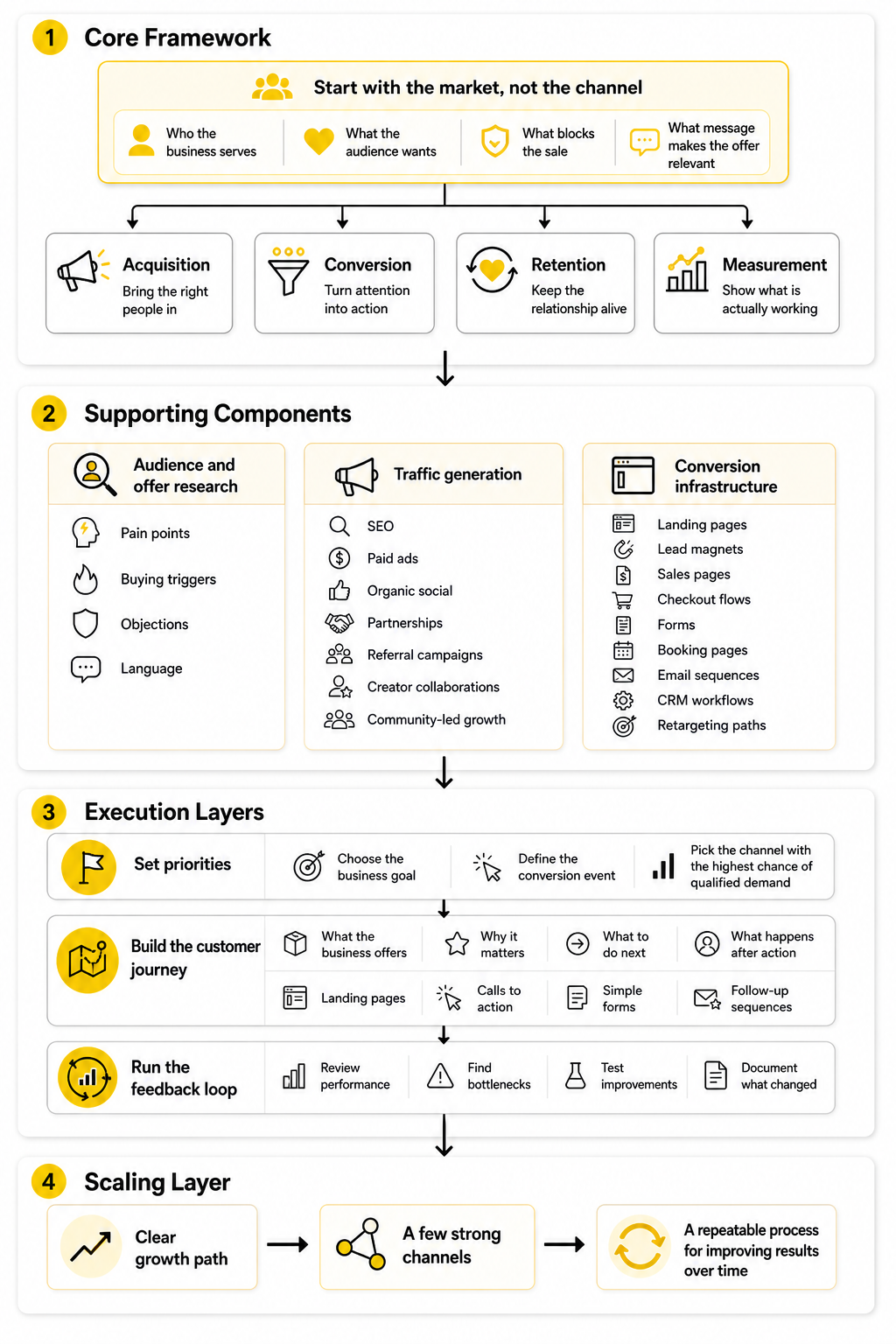
The point of the framework is focus. A business does not need to be everywhere at once. It needs a clear growth path, a few strong channels, and a repeatable process for improving results over time.
Core Components Of The Role
The first core component is audience and offer research. An online marketing specialist needs to understand customer pain points, buying triggers, objections, and language before building campaigns. Without that foundation, even a big ad budget or polished content calendar can miss the mark.
The second component is traffic generation. This can include SEO, paid ads, organic social, partnerships, referral campaigns, creator collaborations, or community-led growth. The specialist’s job is not to chase every channel, but to identify where the audience already pays attention and build a plan around that behavior.
The third component is conversion infrastructure. This includes landing pages, lead magnets, sales pages, checkout flows, forms, booking pages, email sequences, CRM workflows, and retargeting paths. Tools like GoHighLevel, ClickFunnels, Systeme.io, and Replo can support this work, but the strategy matters more than the software.
Professional Implementation Starts With Priorities
Professional implementation means turning ideas into a working operating system. It starts by choosing the business goal, defining the conversion event, and deciding which channel has the highest chance of producing qualified demand. A specialist who skips that step usually ends up optimizing tasks instead of outcomes.
The next priority is building a clean customer journey. A visitor should know what the business offers, why it matters, what to do next, and what happens after they take action. This is where strong landing pages, clear calls to action, simple forms, and relevant follow-up sequences make a real difference.
Finally, implementation requires a feedback loop. The specialist should review performance, find bottlenecks, test improvements, and document what changed. That is how online marketing becomes a system instead of a collection of random campaigns.
Core Responsibilities Of An Online Marketing Specialist
An online marketing specialist owns the practical work that moves people from awareness to action. That does not mean doing every task manually forever. It means understanding how the full system works well enough to plan, execute, measure, and improve it without losing sight of the business goal.
The role usually sits between strategy and production. A strategist may define the market position, and a designer or copywriter may create individual assets, but the online marketing specialist makes sure campaigns actually launch, connect, and produce usable data. That mix of planning and execution is what makes the role valuable.
This is also why the job can look different from company to company. In a small business, one specialist may handle SEO, email, ads, landing pages, and analytics. In a larger company, the specialist may focus on one channel while still needing to understand how that channel supports the wider funnel.
Researching The Audience Before Choosing Channels
Strong online marketing starts with research because every channel decision depends on the customer. An online marketing specialist needs to understand what the audience wants, what they already believe, what they compare, and what objections slow down the buying decision. Without that, campaigns become guesses wrapped in nice design.
Audience research can include search intent analysis, customer interviews, sales call notes, review mining, social listening, competitor research, and CRM data. The goal is not to collect endless information. The goal is to find the language, pain points, and decision triggers that make the marketing feel relevant.
This step matters even more now because attention is fragmented. People discover brands through search, short-form video, creators, newsletters, communities, paid ads, and AI-assisted search experiences. A specialist who understands the audience can choose channels based on behavior instead of copying whatever trend looks popular that week.
Building A Clear Acquisition Strategy
Acquisition is the process of bringing the right people into the business ecosystem. For an online marketing specialist, that can mean ranking content in search, running paid campaigns, growing social visibility, building referral loops, working with creators, or improving marketplace presence. The best strategy depends on where the audience already spends attention and how ready they are to buy.
Search still matters because it captures active intent. When someone searches for a solution, comparison, pricing detail, or implementation guide, they are already telling the market what they care about. That is why SEO content, landing pages, and helpful educational assets remain central to many online marketing plans.
Paid acquisition matters because it gives the business speed and control. Ads can test offers, validate messaging, retarget warm visitors, and scale what already converts. But paid traffic becomes expensive fast when the specialist sends people to weak pages, unclear offers, or generic follow-up sequences.
Turning Traffic Into Leads And Customers
Traffic alone is not the win. A business can have thousands of visitors and still struggle if the next step is unclear, the offer is weak, or the page does not match the visitor’s intent. An online marketing specialist needs to think about conversion from the beginning, not after the campaign is already live.
Conversion work includes landing page structure, offer positioning, lead capture, checkout flow, booking flow, form design, trust signals, and follow-up messaging. Small details matter because each step either reduces friction or adds doubt. A clear headline, relevant proof, simple form, and strong call to action can do more than another month of random traffic growth.
This is where funnel tools can be useful when they support the strategy. A specialist might use ClickFunnels for sales funnels, Systeme.io for a lean all-in-one setup, or Replo when ecommerce landing pages need more flexible design. The tool is not the strategy, but the right tool can make execution faster and cleaner.
Managing Content With A Business Purpose
Content should not exist just to fill a calendar. A useful content plan helps the audience understand the problem, compare solutions, trust the brand, and take the next step. That is why an online marketing specialist needs to connect content topics to the customer journey.
Top-of-funnel content can create awareness and answer early questions. Middle-of-funnel content can compare options, explain methods, handle objections, and show proof. Bottom-of-funnel content can support demos, trials, consultations, product pages, or checkout decisions.
This is where many businesses go wrong. They publish often but never connect content to offers, email capture, retargeting, or sales conversations. A specialist fixes that by making every content asset part of a larger path instead of treating it as a standalone post.
Coordinating Email, CRM, And Follow-Up
Most people do not buy immediately, so follow-up is not optional. Email and CRM workflows help the business stay present after the first click, download, booking, or abandoned checkout. An online marketing specialist uses these systems to continue the conversation in a way that feels timely and useful.
Email remains important because it is one of the few channels where the business is not fully dependent on an algorithm. The specialist can segment contacts, personalize messages, trigger automations, and build sequences around real behavior. Platforms like Brevo, Moosend, and GoHighLevel can support that work depending on the business model.
The key is relevance. A new subscriber should not receive the same message as a returning customer, a booked lead, or someone who abandoned a checkout. Better follow-up comes from matching the message to the stage of the relationship.
Measuring Performance Without Drowning In Data
Measurement is one of the most important responsibilities because it tells the specialist what to improve. The problem is that digital marketing creates more data than most teams can use. A good online marketing specialist knows which numbers matter and which numbers are just noise.
Useful metrics usually connect to the funnel. That can include qualified traffic, conversion rate, cost per lead, cost per acquisition, email revenue, booking rate, sales cycle quality, retention, and lifetime value. Vanity metrics can still give clues, but they should not become the main definition of success.
Digital ad revenue reached $258.6 billion in the U.S. in 2024, which shows how much money is flowing into online channels. But more spending does not automatically mean better marketing. The specialist’s job is to make sure the business can see what is profitable, what is underperforming, and what deserves the next round of investment.
Skills, Tools, And Channels That Drive Results
An online marketing specialist needs a wide skill set, but not in a vague “be good at everything” way. The useful version is more specific: understand the customer, choose the right channel, create a clear message, build the path to conversion, and measure what happens after launch. That combination is what separates a real growth operator from someone who only knows how to use marketing software.
The best specialists are not obsessed with tools first. They are obsessed with problems. If the problem is low awareness, the answer may be content, partnerships, creators, or paid reach. If the problem is weak conversion, the answer may be a stronger offer, better landing page, sharper follow-up, or cleaner sales process.
Tools help once the thinking is clear. A messy strategy inside expensive software is still a messy strategy. A focused strategy inside simple software can outperform it because the message, funnel, and follow-up are aligned.
Channel Selection Comes Before Channel Execution
Choosing a channel should start with buyer behavior. A business selling urgent services may need search and local intent. A creator-led education brand may need short-form content, email, and community. A B2B service provider may need LinkedIn, search content, outbound support, webinars, and a strong booking flow.
An online marketing specialist should ask where the customer already looks for information, what they need to believe before buying, and how long the decision usually takes. Those answers shape the channel mix. This prevents the common mistake of copying another business’s marketing plan without understanding why it worked for them.
The goal is not to be present everywhere. The goal is to build enough visibility in the right places and connect that visibility to a clear next step. That is how channel execution becomes strategic instead of random.
SEO And Content Build Demand Over Time
SEO and content are valuable because they help a business meet people while they are actively researching. A good content strategy does more than chase keywords. It answers real questions, handles objections, compares options, explains use cases, and gives the reader enough confidence to move forward.
For an online marketing specialist, SEO is partly technical and partly editorial. The technical side helps pages get found and understood. The editorial side makes the content worth reading, sharing, and trusting. Both matter because rankings without conversions are not the goal.
Content also supports other channels. A strong article can become an email sequence, a sales enablement asset, a retargeting angle, a social post series, or a lead magnet. That is why smart specialists think about content as infrastructure, not just publishing.
Paid Traffic Tests The Market Faster
Paid traffic gives a business speed. It can test offers, headlines, audiences, landing pages, and conversion paths much faster than organic channels alone. That makes it useful when the business needs learning, not just reach.
But paid traffic also exposes weak strategy quickly. If the offer is unclear, the page is slow, the call to action is confusing, or the follow-up is generic, more budget only makes the problem more expensive. A skilled online marketing specialist uses paid campaigns to gather insight and then improves the system around that insight.
This is where a proper funnel matters. A campaign should not dump traffic onto a page and hope for the best. It should guide people through a logical path, whether that path is a lead form, a booking page, a checkout, a trial, or a nurture sequence.
Social Media Needs A Clear Role
Social media can build trust, familiarity, reach, and community, but it needs a defined job. Some brands use it for education. Others use it for founder-led authority, product discovery, customer support, behind-the-scenes proof, or short-form demand creation. The role should be clear before the posting schedule is built.
An online marketing specialist should avoid treating social content like a separate island. The best social strategy connects back to email capture, retargeting audiences, product pages, sales calls, or community growth. Otherwise, the business may get attention without turning that attention into anything durable.
Planning tools can help keep this consistent. A specialist might use Buffer to schedule and organize social publishing, or Flick Social when hashtag research, planning, and social workflow support are useful. The real win is not scheduling posts faster. The win is making sure each post supports the broader marketing system.
Professional Implementation: Turning Strategy Into A Working System
Professional implementation is where the plan becomes real. This is the part where an online marketing specialist moves from ideas, documents, and campaign concepts into assets, workflows, tracking, and launch decisions. It is also where weak marketing plans usually fall apart because execution exposes every unclear assumption.
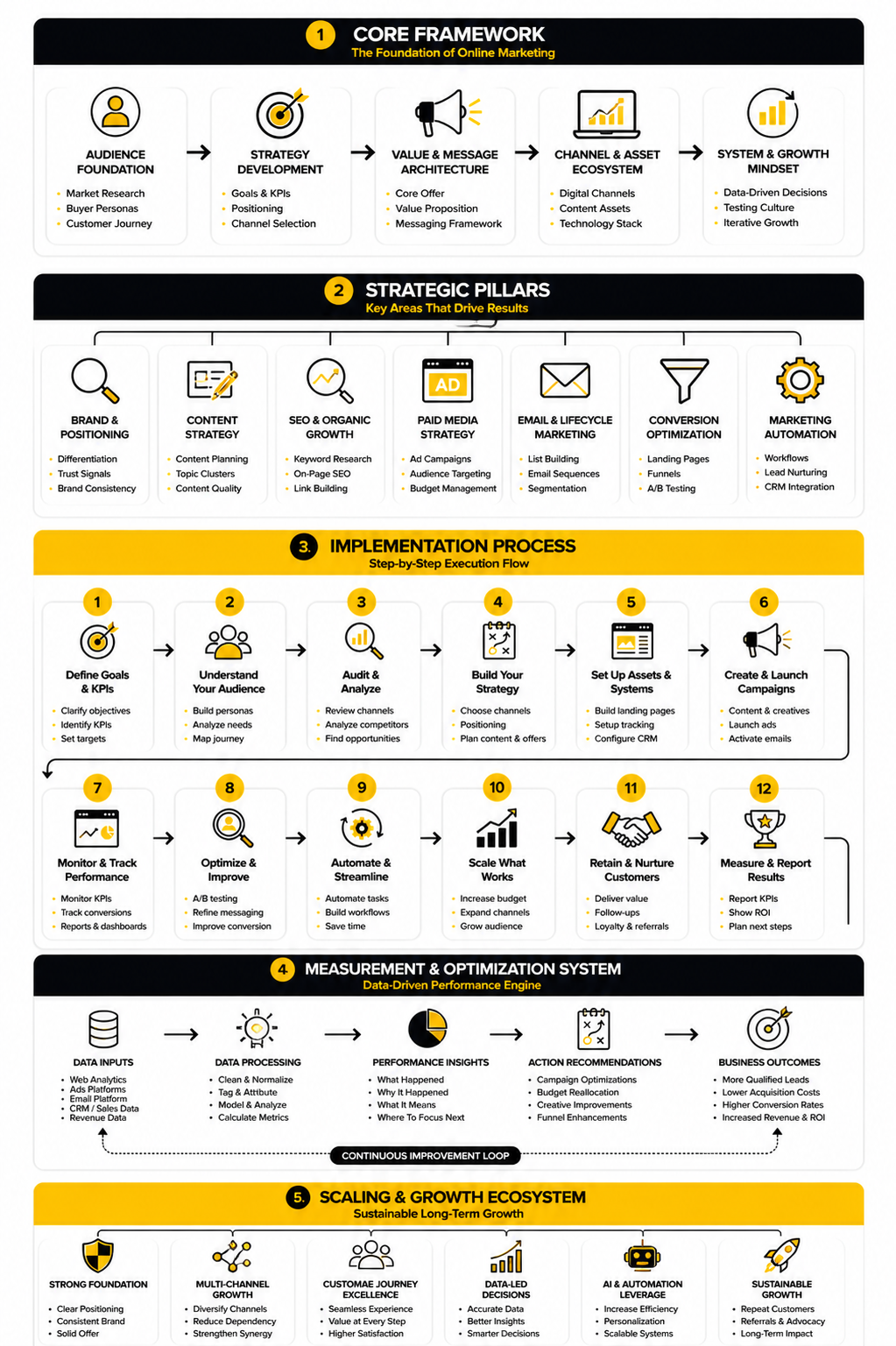
A good implementation process keeps the work practical. It defines the campaign goal, maps the customer journey, builds the required assets, connects the tools, checks tracking, launches in a controlled way, and improves based on data. That sounds basic, but it is exactly the discipline many businesses miss.
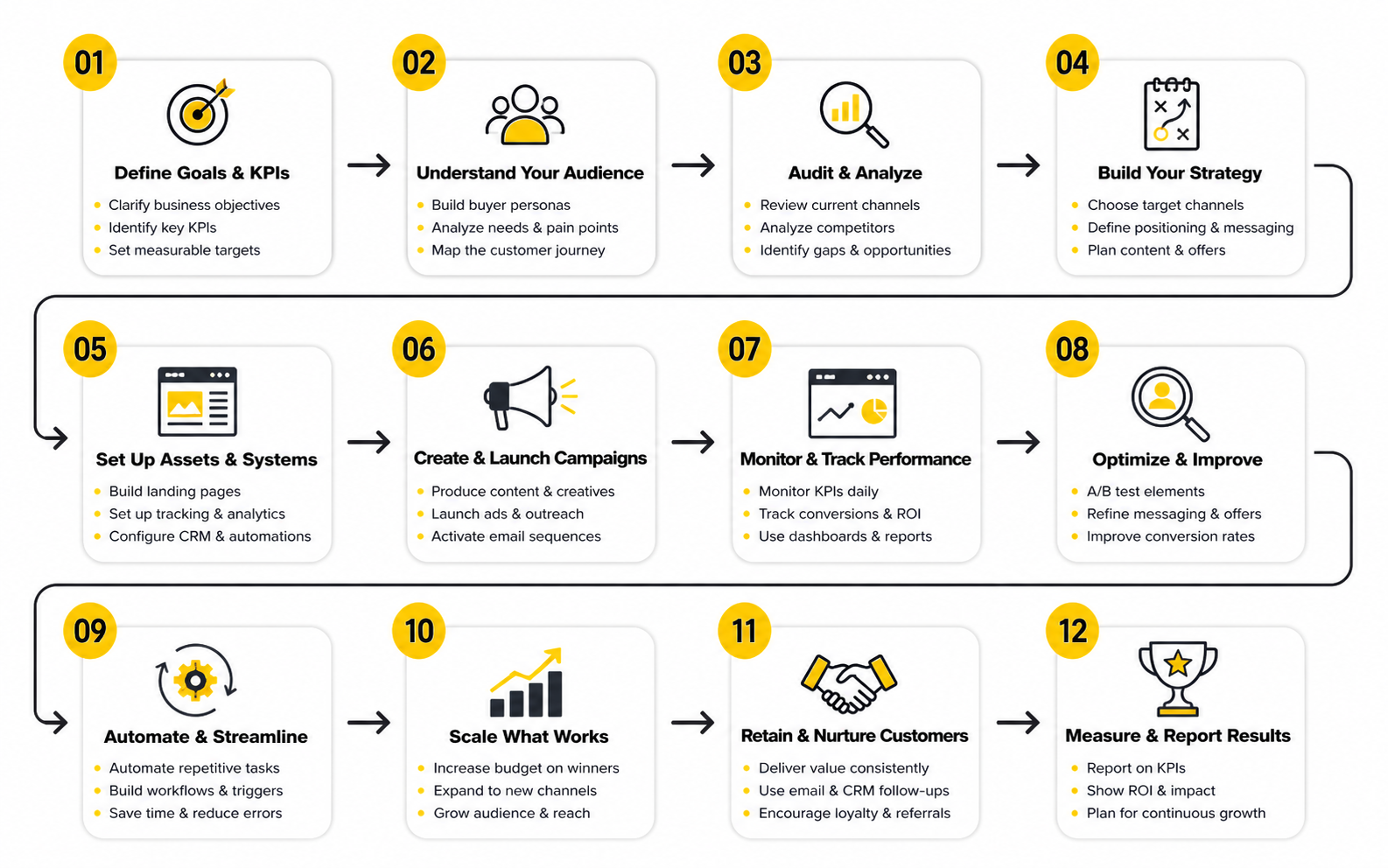
Implementation should not feel chaotic. If every campaign requires starting from zero, the business does not have a marketing system yet. The specialist’s job is to create repeatable steps so each new campaign becomes easier, faster, and more measurable than the last.
Step 1: Define The Business Goal
Every campaign needs one primary goal. That goal could be qualified leads, booked calls, trial signups, purchases, demos, webinar registrations, or reactivation of old contacts. Without one clear goal, the campaign becomes hard to judge and easy to overcomplicate.
The goal should connect to the business model. A local service business may care most about booked appointments. A SaaS company may care about product-qualified trials. An ecommerce brand may care about profitable first purchases and repeat revenue.
Once the goal is clear, the specialist can define the conversion event. This matters because every creative decision, page section, form field, email, and retargeting step should support that action. If the desired action is fuzzy, the whole campaign becomes fuzzy.
Step 2: Map The Customer Journey
The customer journey shows what happens before and after the first click. It should include the traffic source, landing page, offer, conversion action, confirmation experience, follow-up sequence, sales handoff, and next best action. This turns marketing from a set of isolated tasks into a connected flow.
An online marketing specialist should look for friction at each stage. Is the promise in the ad repeated on the page? Does the landing page explain the value quickly? Is the form too long? Does the follow-up arrive fast enough? Does the sales team know what the lead already saw?
This mapping step is especially important for businesses with longer buying cycles. People may need education, proof, reassurance, and timing before they buy. The journey should respect that instead of pushing every visitor into the same immediate sales ask.
Step 3: Build The Campaign Assets
Once the journey is mapped, the specialist can build the assets in the right order. That usually means the offer first, then the page, then the traffic creative, then the follow-up, then the tracking. Building in this order keeps the campaign focused on the conversion path instead of scattered deliverables.
Assets may include landing pages, ads, emails, forms, booking pages, checkout pages, lead magnets, short videos, sales scripts, retargeting audiences, and CRM stages. For funnel-heavy campaigns, ClickFunnels can help build direct-response flows, while GoHighLevel can support CRM, automation, booking, and follow-up in one place. For leaner setups, Systeme.io can be useful when the business needs funnels, email, and simple automation without a heavy stack.
The asset build should always include message consistency. If the ad promises a specific outcome, the landing page should continue that exact conversation. If the email invites someone to book a call, the booking page should remove doubt and make the next step obvious.
Step 4: Connect Automation And Follow-Up
Automation is where many campaigns either become scalable or start leaking leads. A form submission should trigger the right email, tag the contact properly, update the CRM, notify the right person, and move the lead into the correct follow-up path. When that does not happen, opportunities get lost quietly.
An online marketing specialist should design automation around behavior, not just time delays. A person who books a call needs different messaging from someone who only downloads a guide. A customer who buys needs a different sequence from a lead who stops halfway through checkout.
This is also where conversational tools can support the process. Chatbase can help businesses create AI chat support around common questions, while Fillout can be useful for forms, quizzes, intake flows, and lead qualification. The point is not to automate everything. The point is to automate the right moments so humans can focus on higher-value conversations.
Step 5: Check Tracking Before Launch
Tracking should be checked before the campaign goes live, not after the first results look confusing. The specialist needs to confirm that conversions are firing, forms are passing data correctly, UTMs are clean, CRM stages make sense, and reporting views match the campaign goal. This is boring work until it saves the campaign.
Bad tracking creates bad decisions. A campaign can look unprofitable because conversions are missing, or look successful because the wrong event is being counted. Either way, the business ends up optimizing based on a distorted picture.
The practical rule is simple: test the full path like a real customer. Click the ad preview, visit the page, submit the form, check the email, inspect the CRM record, confirm the notification, and verify the conversion event. Do that before spending meaningful money.
Step 6: Launch Small And Improve Fast
A smart launch does not need to be huge. Starting with a controlled budget, limited audience, or smaller content push gives the specialist room to spot problems before they become expensive. The first goal is not perfection. The first goal is clean learning.
After launch, the online marketing specialist should look for bottlenecks. If traffic is weak, the issue may be targeting, creative, or channel fit. If clicks are strong but conversions are low, the page or offer may need work. If leads come in but sales are poor, qualification or follow-up may be the real problem.
This is where implementation becomes a cycle. Build, launch, measure, learn, improve. Repeat it long enough and the business develops a real growth engine instead of a pile of disconnected campaigns.
Statistics And Data That Actually Matter
Data is useful only when it changes a decision. An online marketing specialist should not collect metrics just because a platform makes them available. The job is to separate signal from noise, understand what the numbers mean, and decide what should happen next.
The biggest measurement mistake is treating every number as equal. Impressions, clicks, opens, views, leads, bookings, purchases, retention, and revenue all tell different parts of the story. A specialist needs to know where each metric sits in the funnel so they can diagnose the real problem instead of reacting emotionally to a dashboard.
This matters because online marketing keeps getting more expensive and more competitive. U.S. internet advertising revenue reached a record $258.6 billion in 2024, which means more brands are fighting for the same attention. When competition rises, clean measurement becomes a serious advantage.
The Funnel Tells You Where The Problem Is
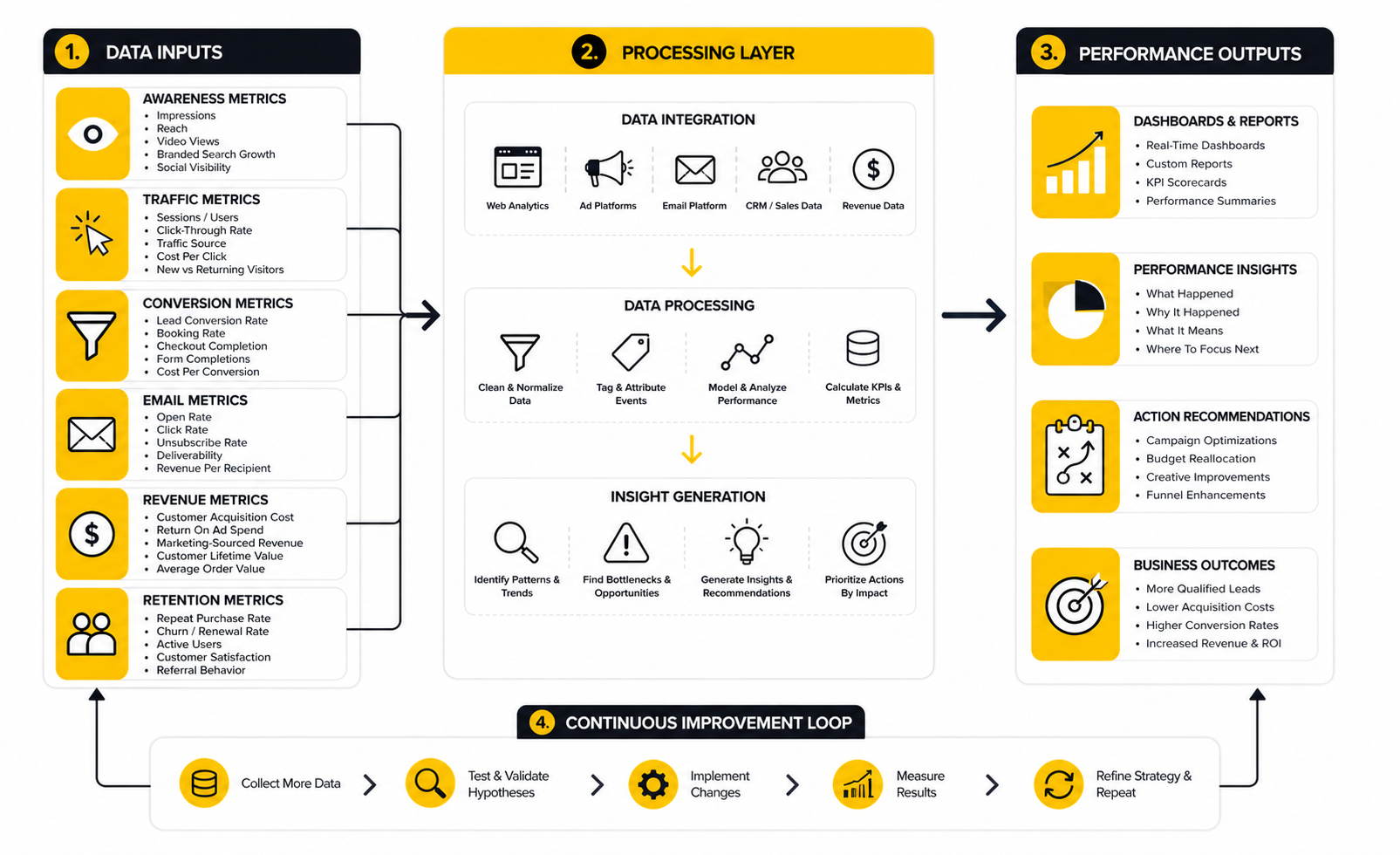
A useful analytics system starts by grouping metrics by funnel stage. Awareness metrics show whether people are seeing the brand. Engagement metrics show whether the message is getting attention. Conversion metrics show whether people are taking action. Revenue and retention metrics show whether those actions are actually valuable.
This structure matters because one weak number does not tell the full story. A campaign with low impressions may have a distribution problem. A campaign with strong clicks but poor conversions may have a landing page or offer problem. A campaign with many leads but few customers may have a qualification, follow-up, or sales process problem.
An online marketing specialist should read data like a sequence, not a pile of disconnected numbers. The question is not “is this metric good?” The better question is “what does this metric reveal about the next bottleneck?”
Awareness Metrics Show Reach, Not Success
Awareness metrics include impressions, reach, video views, branded search growth, social visibility, and content exposure. These numbers help show whether the market is actually seeing the business. They are useful at the top of the funnel, especially for new brands, launches, and campaigns that need demand creation.
But awareness is not the same as performance. A post can reach thousands of people and still fail to attract the right audience. An ad can earn cheap impressions and still bring poor-fit traffic. This is why awareness metrics should be paired with downstream behavior.
The practical move is to ask what the audience does after exposure. Do more people search the brand? Do retargeting audiences grow? Do engaged visitors return? Do views eventually turn into leads, bookings, or purchases? If not, the awareness may be broad but weak.
Traffic Metrics Reveal Channel Quality
Traffic metrics include sessions, users, click-through rate, traffic source, landing page visits, cost per click, and new versus returning visitors. These numbers help an online marketing specialist understand which channels are bringing people into the system. They also show whether the message is strong enough to earn the click.
Click-through rate is especially useful when comparing creative angles, offers, and audience segments. A weak click-through rate can mean the promise is not specific enough, the targeting is off, or the creative does not stand out. A strong click-through rate with poor conversions usually means the click was easier to earn than the sale.
Channel quality matters more than volume. One hundred visitors with clear intent can be more valuable than ten thousand random visitors. The specialist should look at what traffic does after arrival, not just how much of it exists.
Conversion Metrics Show Whether The Offer Is Working
Conversion metrics include lead conversion rate, booking rate, checkout completion, demo requests, trial signups, form completions, and cost per conversion. These are the numbers that show whether the campaign is turning attention into action. For many businesses, this is where marketing starts to become financially meaningful.
A low conversion rate is not always a traffic problem. It can be caused by a weak offer, unclear page structure, slow loading, poor proof, bad form design, missing urgency, or a call to action that does not match the visitor’s intent. The online marketing specialist needs to inspect the full experience before changing the channel.
This is where landing page and funnel tools can help when the strategy is already clear. A specialist can use ClickFunnels for direct-response funnels, Replo for ecommerce landing pages, or Systeme.io for simpler funnel and email setups. The data should guide what gets improved first: the headline, offer, proof, form, follow-up, or traffic source.
Email Metrics Need Context
Email metrics include open rate, click rate, unsubscribe rate, spam complaints, deliverability, reply rate, revenue per recipient, and lifecycle performance. These numbers matter because email often sits between first interest and final conversion. It is where many leads either warm up or disappear.
Open rate alone is not enough because privacy changes and inbox behavior can distort the picture. Clicks, replies, conversions, and revenue usually tell a cleaner story. The real question is whether the email helps the reader take the next useful step.
Email still deserves serious attention because it supports retention and repeat engagement. Recent Litmus research found that 35% of companies see email ROI of 36:1 or more, which is not a reason to blast people more often. It is a reason to make segmentation, timing, and message relevance better.
Paid Media Benchmarks Are Starting Points, Not Targets
Benchmarks can help an online marketing specialist spot obvious problems, but they should not become the strategy. Average click costs, conversion rates, CPMs, and acquisition costs vary wildly by industry, offer, geography, brand strength, and funnel quality. Comparing one campaign to a broad benchmark can be useful, but it can also be misleading.
The better approach is to build internal benchmarks. A specialist should compare campaigns against the company’s own historical performance, audience segments, offer types, landing pages, and sales outcomes. That gives a more realistic picture of what is improving.
External benchmarks are still helpful when entering a new channel. They can help set expectations and prevent panic during early testing. But once enough campaign data exists, internal performance should become the main reference point.
Revenue Metrics Keep Marketing Honest
Revenue metrics include customer acquisition cost, return on ad spend, marketing-sourced revenue, customer lifetime value, payback period, average order value, and repeat purchase rate. These numbers keep the conversation grounded. They show whether marketing is producing business value, not just activity.
Return on ad spend is useful, but it can be too narrow if the business has repeat purchases, long sales cycles, or high lifetime value. A campaign may look weak on first purchase but strong after repeat orders. Another campaign may generate cheap leads that never close.
An online marketing specialist should connect marketing data to sales and customer data wherever possible. That connection is what reveals which channels bring profitable customers, not just cheap conversions. It also helps the business spend more confidently because decisions are based on economics, not guesswork.
Retention Data Shows Whether Growth Is Healthy
Retention metrics include repeat purchase rate, churn, renewal rate, active users, email engagement over time, customer satisfaction signals, and referral behavior. These numbers matter because acquisition gets expensive when customers do not stay. Healthy marketing does not stop at the first conversion.
A business can grow revenue while quietly creating a retention problem. That happens when campaigns attract the wrong customers, oversell the offer, or create expectations the product cannot meet. The data may look good at the top of the funnel while the business becomes weaker underneath.
The specialist should watch what happens after conversion. Do customers buy again? Do they use the product? Do they respond to onboarding? Do they refer others? These answers show whether marketing is building durable growth or just feeding a leaky bucket.
Attribution Should Guide Decisions, Not Create Arguments
Attribution is the process of connecting results to the channels and touchpoints that influenced them. It is useful, but it is never perfect. People see ads, read content, ask friends, compare competitors, receive emails, and return later from a different device or browser.
That is why attribution should be treated as directional, not absolute. Last-click attribution may undervalue content, social, email, and brand activity. First-click attribution may undervalue retargeting and sales enablement. Platform-reported attribution may overstate its own role.
A practical online marketing specialist looks for patterns across multiple views. They compare platform data, analytics data, CRM data, revenue data, and customer feedback. When several signals point in the same direction, the decision becomes much easier.
Reporting Should Lead To Action
A good report does not drown the team in charts. It explains what happened, why it likely happened, what changed, and what should happen next. That is the difference between reporting and useful analysis.
The best reporting format is simple: goal, result, insight, action. The goal defines what the campaign was meant to achieve. The result shows what happened. The insight explains the likely reason. The action turns the learning into the next test or improvement.
This is where an online marketing specialist becomes more than a campaign operator. Anyone can export numbers. The specialist earns trust by turning those numbers into better decisions, cleaner priorities, and stronger performance over time.
Measurement, Optimization, And Career Growth
The advanced side of online marketing is not about adding more channels. It is about making better tradeoffs. An online marketing specialist eventually has to decide what to simplify, what to scale, what to stop, and what to protect as the business grows.
That is where experience starts to matter. Beginner marketers often ask, “What can we launch next?” Strong specialists ask, “What constraint is holding back growth right now?” Those are very different questions, and they lead to very different decisions.
At this level, the job becomes less about activity and more about judgment. More ads, more posts, more automations, and more tools can all create noise if the core system is not ready. The specialist has to know when to push harder and when to fix the foundation first.
Scaling Requires Stronger Systems, Not Just Bigger Budgets
Scaling usually exposes weaknesses that were hidden at lower volume. A landing page that works with warm traffic may fail when colder audiences arrive. A sales team that can manually follow up with twenty leads may struggle with two hundred. A reporting setup that feels fine in one channel may become confusing when paid search, paid social, email, SEO, and partnerships all run together.
This is why an online marketing specialist should treat scaling as a systems challenge. The business needs cleaner tracking, stronger creative testing, better lead routing, faster follow-up, clearer campaign naming, and more disciplined reporting. Without those pieces, more budget can create more confusion instead of more growth.
Marketing budgets are under pressure, too. Gartner’s CMO Spend Survey found that average marketing budgets dropped to 7.7% of company revenue in 2024, down from 9.1% the year before. That makes efficiency more important because teams are still expected to grow while proving that each investment deserves its place.
The Biggest Risk Is Optimizing The Wrong Thing
Optimization sounds positive, but it can become dangerous when the wrong metric gets too much attention. A campaign can lower cost per lead by attracting weaker leads. A landing page can increase form submissions by reducing qualification. An email can lift clicks with curiosity but send people to a poor-fit offer.
This is why an online marketing specialist needs to understand the business model, not just the dashboard. A cheap lead is not automatically a good lead. A high click-through rate is not automatically a strong campaign. A high return on ad spend can still be fragile if it depends on discounts, narrow audiences, or short-term promotion.
The better approach is to optimize for the next meaningful business outcome. For lead generation, that may be qualified appointments or closed revenue. For ecommerce, it may be contribution margin, repeat purchase rate, or payback period. For SaaS, it may be activated trials, retained users, or expansion potential.
Creative Fatigue Becomes A Performance Problem
Creative is one of the first things to break when campaigns scale. Audiences get used to the same angles, visuals, hooks, and offers. Performance may decline even when the targeting and funnel remain the same.
A specialist should watch for early signs of creative fatigue: rising costs, falling click-through rates, weaker engagement, slower learning, and lower conversion quality. The answer is not always a full rebrand or a completely new offer. Often, the business needs a structured creative testing system.
That system can include new hooks, formats, proof points, objections, headlines, user-generated content, founder-led content, comparison angles, and benefit-led messaging. The best creative testing is not random. It is based on customer insight and tied back to measurable performance.
Automation Should Remove Friction, Not Humanity
Automation is powerful when it makes the customer journey faster, cleaner, and more relevant. It becomes a problem when it turns the business into a cold machine. The point is not to automate every interaction. The point is to automate repeatable steps so the human moments become better.
An online marketing specialist should automate confirmations, reminders, segmentation, lead routing, abandoned checkout flows, onboarding steps, and basic qualification when it improves the experience. But they should be careful with sensitive moments where trust, timing, or context matters. A high-value lead may need a personal reply, not another generic sequence.
This is where the stack should match the business model. GoHighLevel can make sense for agencies, local businesses, and service teams that need CRM, booking, automation, and follow-up together. Brevo or Moosend can fit teams focused on email marketing and lifecycle communication. The right choice is the one that supports the journey without making the process harder to manage.
AI Changes The Workflow, But Not The Responsibility
AI can help an online marketing specialist research faster, draft variations, summarize customer feedback, generate campaign angles, analyze patterns, and speed up repetitive tasks. That is useful. But AI does not remove the need for strategy, taste, verification, and accountability.
The risk is that teams use AI to produce more average content instead of better marketing. More pages, more emails, and more ads do not matter if they do not say anything useful. The specialist still has to decide what is true, what is relevant, what matches the brand, and what deserves to be published.
HubSpot’s 2025 marketing research frames the shift around AI, changing consumer expectations, and more human marketing, not just faster content production through AI-led marketing workflows. That distinction matters. AI should increase leverage, but the specialist still owns the thinking.
Channel Diversification Protects The Business
Relying on one channel can work for a while, but it creates risk. Search rankings can change. Ad costs can rise. Social reach can drop. Email deliverability can suffer. A platform policy update can affect an entire funnel overnight.
The answer is not to panic and launch everywhere. The answer is to build smart diversification once the first channel is working. A business might start with SEO and email, then add paid retargeting. Another might start with paid acquisition, then build organic content and referral systems to reduce dependency over time.
An online marketing specialist should look for channel combinations that strengthen each other. Search content can improve retargeting. Social content can feed email growth. Email can increase repeat sales. Partnerships can create trust before the first click. That is how diversification becomes strategic instead of scattered.
Brand Strength Makes Performance Marketing Easier
Performance marketing often looks like a numbers game, but brand strength affects the numbers more than many teams admit. A known brand gets more trust from the same impression. A clear position makes ads easier to understand. A strong reputation can improve conversion before the visitor even reaches the page.
This is why an online marketing specialist should care about consistency, proof, customer experience, and message quality. These things may not always show up neatly in last-click reporting, but they influence whether people feel safe enough to act. Brand and performance are not enemies.
The practical balance is simple. Use performance marketing to create measurable growth, and use brand-building work to make that growth easier to sustain. When both sides support each other, the business becomes less dependent on discounts, hacks, and constant campaign pressure.
Expert-Level Specialists Think In Constraints
Advanced marketing is mostly constraint management. The constraint might be traffic quality, conversion rate, creative volume, offer clarity, sales follow-up, retention, budget, team capacity, or data accuracy. The specialist’s job is to identify the real constraint before prescribing the fix.
This is where many teams waste time. They improve the landing page when the offer is the problem. They increase ad spend when sales follow-up is slow. They publish more content when the existing content has no conversion path. They buy another tool when the process is unclear.
A strong online marketing specialist slows down enough to diagnose. Then they act fast on the highest-leverage fix. That combination of careful thinking and practical execution is what makes the role valuable as the business grows.
Career Growth Comes From Owning Outcomes
For someone building a career, the fastest way to grow is to move from task ownership to outcome ownership. Writing emails is useful. Owning lifecycle revenue is more valuable. Running ads is useful. Owning profitable acquisition is more valuable. Publishing content is useful. Owning organic pipeline is more valuable.
This shift requires better communication with leadership, sales, product, customer support, and finance. Marketing does not operate in isolation. The specialist who understands how their work affects the rest of the business becomes much harder to replace.
The best career path is not always becoming a manager immediately. Some online marketing specialists grow into growth strategists, lifecycle marketers, performance marketers, SEO leads, marketing operations specialists, or fractional consultants. The common thread is the same: they can connect marketing activity to business results and explain what should happen next.
Bringing The Online Marketing System Together
At this point, the role of an online marketing specialist should feel bigger than any single channel. The job is not just SEO, ads, email, funnels, social media, analytics, or automation. The job is building a connected system where each part makes the next part stronger.
That system starts with audience understanding, moves into clear messaging, turns into channel execution, and then gets refined through measurement. When those pieces work together, marketing becomes easier to manage because the business can see what is happening and why. When they are disconnected, even talented people can end up working hard on the wrong problems.
The final version of the system should be simple enough to explain and strong enough to scale. A customer discovers the brand, understands the offer, trusts the proof, takes the next step, receives relevant follow-up, and eventually becomes a buyer, repeat customer, or referral source. That is the real work.
What does an online marketing specialist do?
An online marketing specialist plans, executes, measures, and improves digital marketing campaigns. The role can include SEO, paid ads, content, email, landing pages, CRM workflows, social media, analytics, and conversion optimization. The main goal is to turn online attention into measurable business outcomes such as leads, sales, bookings, trials, or customer retention.
Is an online marketing specialist the same as a digital marketer?
The terms overlap, but they are not always used in exactly the same way. A digital marketer may describe anyone working in online channels, while an online marketing specialist usually suggests someone with deeper hands-on responsibility for campaign execution and performance. In practice, companies often use both titles for similar roles, so the responsibilities matter more than the job title.
What skills does an online marketing specialist need?
A strong specialist needs customer research, copywriting, analytics, SEO, paid media knowledge, email marketing, funnel strategy, landing page optimization, and basic marketing operations. They also need communication skills because marketing connects with sales, product, leadership, and customer support. The American Marketing Association’s 2025 skills research highlights growing uncertainty around technology, AI, data privacy, search, and social media, which makes adaptability a serious advantage for modern marketers through future-focused marketing skills.
Does an online marketing specialist need to know paid ads?
Paid ads are not required for every role, but they are highly useful. Paid traffic helps test offers, messaging, audiences, and landing pages faster than many organic channels. Even if a specialist does not manage large ad budgets directly, they should understand how paid acquisition works because it affects funnels, tracking, creative, and conversion strategy.
Does an online marketing specialist need SEO?
Yes, at least at a practical level. SEO helps businesses capture demand from people already searching for answers, products, services, comparisons, and solutions. A specialist does not always need to be a technical SEO expert, but they should understand search intent, content structure, internal linking, keyword research, and how organic traffic supports the wider customer journey.
What tools should an online marketing specialist use?
The right tools depend on the business model, budget, and workflow. A service business may need CRM, booking, forms, automation, and follow-up tools. An ecommerce brand may need landing page builders, email automation, analytics, and creative testing workflows. A specialist might use GoHighLevel for CRM and automation, ClickFunnels for funnel building, Brevo for email and customer communication, or Buffer for social scheduling, but the tool should always serve the strategy.
How do you measure online marketing performance?
Performance should be measured by funnel stage. Awareness metrics show whether people see the brand, traffic metrics show whether they visit, conversion metrics show whether they act, and revenue metrics show whether the campaign creates business value. The best reports connect goals, results, insights, and next actions instead of dumping every available number into a dashboard.
What is the biggest mistake online marketing specialists make?
The biggest mistake is optimizing isolated tasks instead of the full system. A specialist can improve clicks while lead quality drops, increase form submissions while sales results stay flat, or publish more content without creating a path to conversion. Good marketing requires looking at the whole journey, not just the metric that looks easiest to improve.
How important is AI for an online marketing specialist?
AI is becoming very important, but it should be treated as leverage, not a replacement for judgment. It can help with research, ideation, content drafts, data summaries, workflow automation, and customer support. The specialist still needs to verify claims, protect brand quality, understand the customer, and decide what is worth publishing or testing.
Can an online marketing specialist work remotely?
Yes, this role is well suited for remote work because most responsibilities happen through digital tools. Campaign planning, analytics, content workflows, paid media, email marketing, CRM setup, funnel building, and reporting can all be done remotely. The key is clear communication, documented processes, reliable reporting, and strong ownership of outcomes.
How can a beginner become an online marketing specialist?
A beginner should start by learning the fundamentals of customer research, copywriting, SEO, analytics, email marketing, and conversion strategy. Then they should build small projects that prove they can create real outcomes, even if those projects are simple. A portfolio with landing pages, campaign plans, content examples, email sequences, and performance analysis is more convincing than a list of courses.
What is the difference between a specialist and a strategist?
A specialist is usually closer to execution, while a strategist is usually closer to direction and positioning. That said, strong online marketing specialists often do both. They understand the strategy well enough to execute intelligently, and they understand execution well enough to create realistic strategies.
How do online marketing specialists find better clients or contracts?
Specialists find better opportunities by proving outcomes, showing clear examples of their work, and positioning themselves around specific business problems. Instead of saying they “do marketing,” they should explain whether they help with lead generation, ecommerce funnels, lifecycle email, SEO growth, paid acquisition, marketing automation, or conversion optimization. Clear positioning makes it easier for companies to understand why they should hire them.
Build a stronger local presence with BAAM AI
Turn your website, Google profile, social channels, and AI visibility into one growth engine
Most businesses do not need more random marketing activity. They need a consistent presence system that helps the right people find them, trust them, and take action. BAAM AI brings strategy, local SEO, website updates, Google Maps visibility, social content, AI-search readiness, media production, and reporting into one practical monthly engine.
If you want your marketing to keep working after the campaign ends, start with a free BAAM AI presence audit. See how your business shows up today and where the fastest visibility wins are at BAAM AI.