
BAAM AI Blog
Online Marketing Services for Small Businesses: What They Are and Why They Matter
Small businesses today live in a world where nearly every buying journey begins online. Over 70 % of consumer purchase journeys start with an online search, and 81 % of shoppers research brands online before buying -...
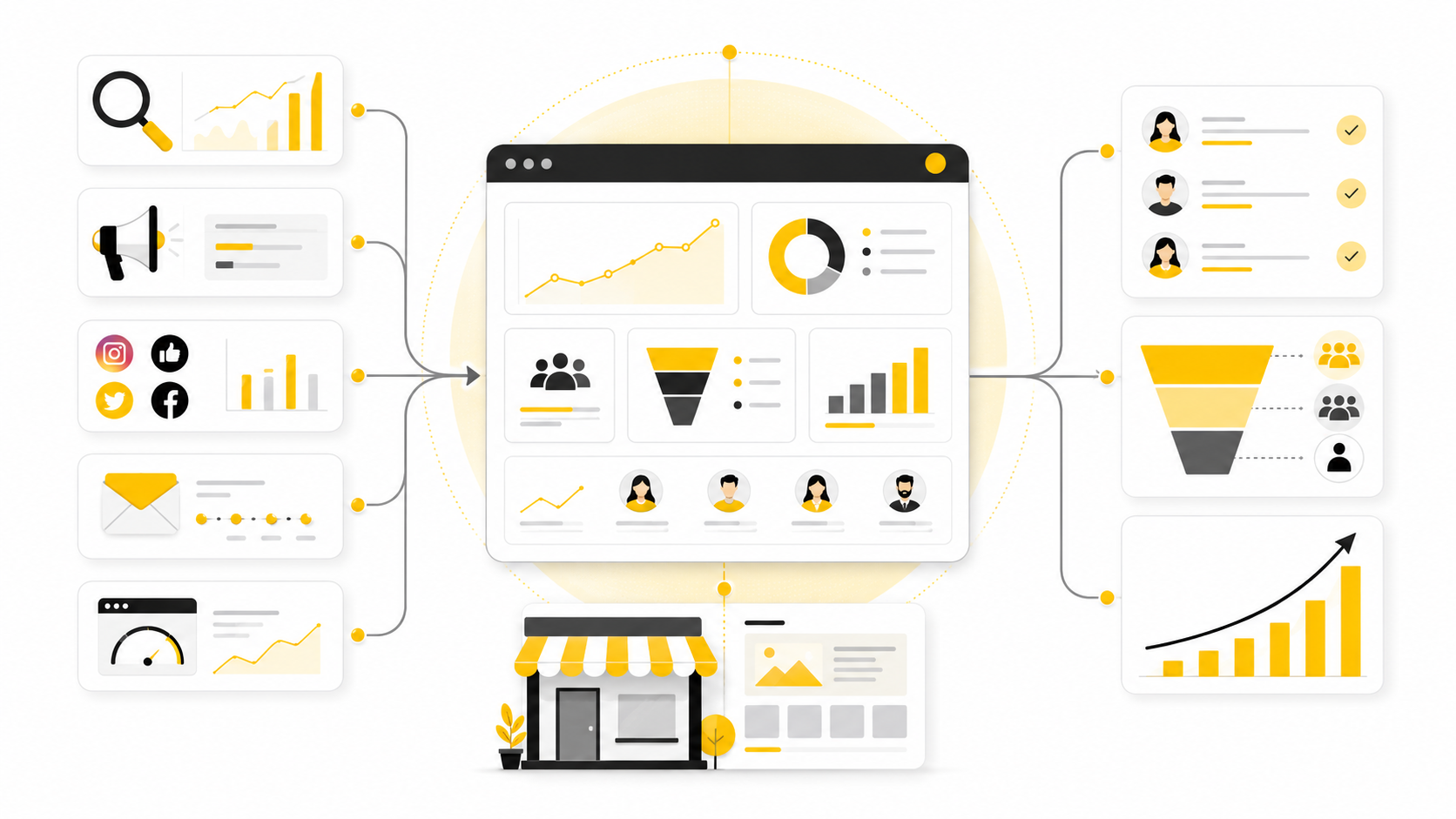
Small businesses today live in a world where nearly every buying journey begins online. Over 70 % of consumer purchase journeys start with an online search, and 81 % of shoppers research brands online before buying - whether they plan to buy in a store or online. In this context, online marketing services aren’t just a “nice to have”; they’re essential tools for visibility, credibility, and growth.
But what exactly should small business owners look for when exploring online marketing services? And how do those services work together to help attract and convert customers? this guide will make sense of it all in a clear, practical framework built specifically for small businesses that want real results without confusion.
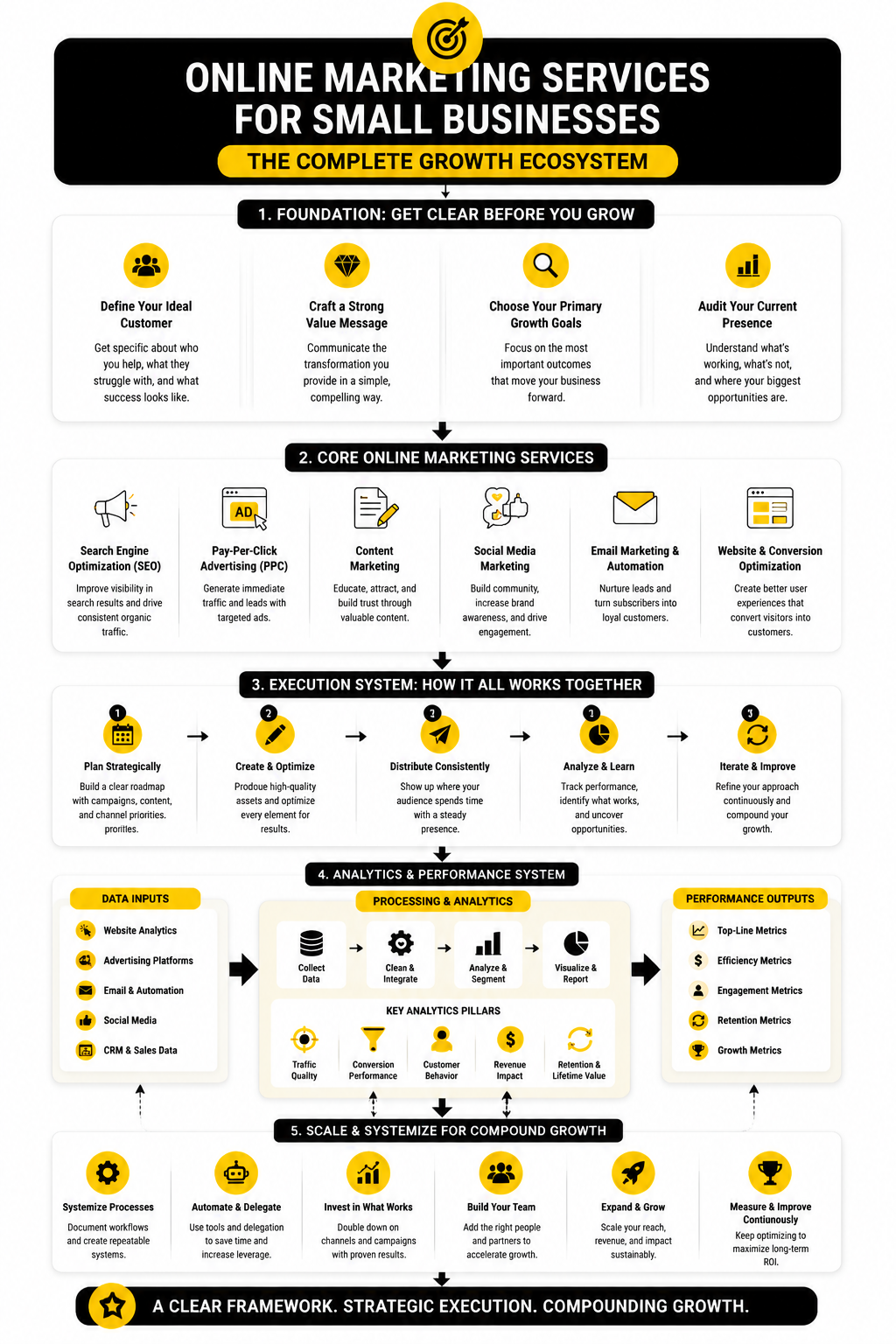
Below is the structure the full article will follow through its six parts:
Online marketing isn’t a standalone tactic - it’s a cohesive set of services that help small businesses reach their ideal customers, nurture relationships, and grow revenue. In a landscape where 96 % of small businesses use social media in their marketing strategy and email continues delivering high ROI, choosing the right mix of services influences everything from visibility to profitability.
In the next section, we’ll walk through a strategic framework that ties all effective online marketing services together in a way that makes sense for small business owners. That framework helps you see the big picture and plan with confidence - even on a tight budget.
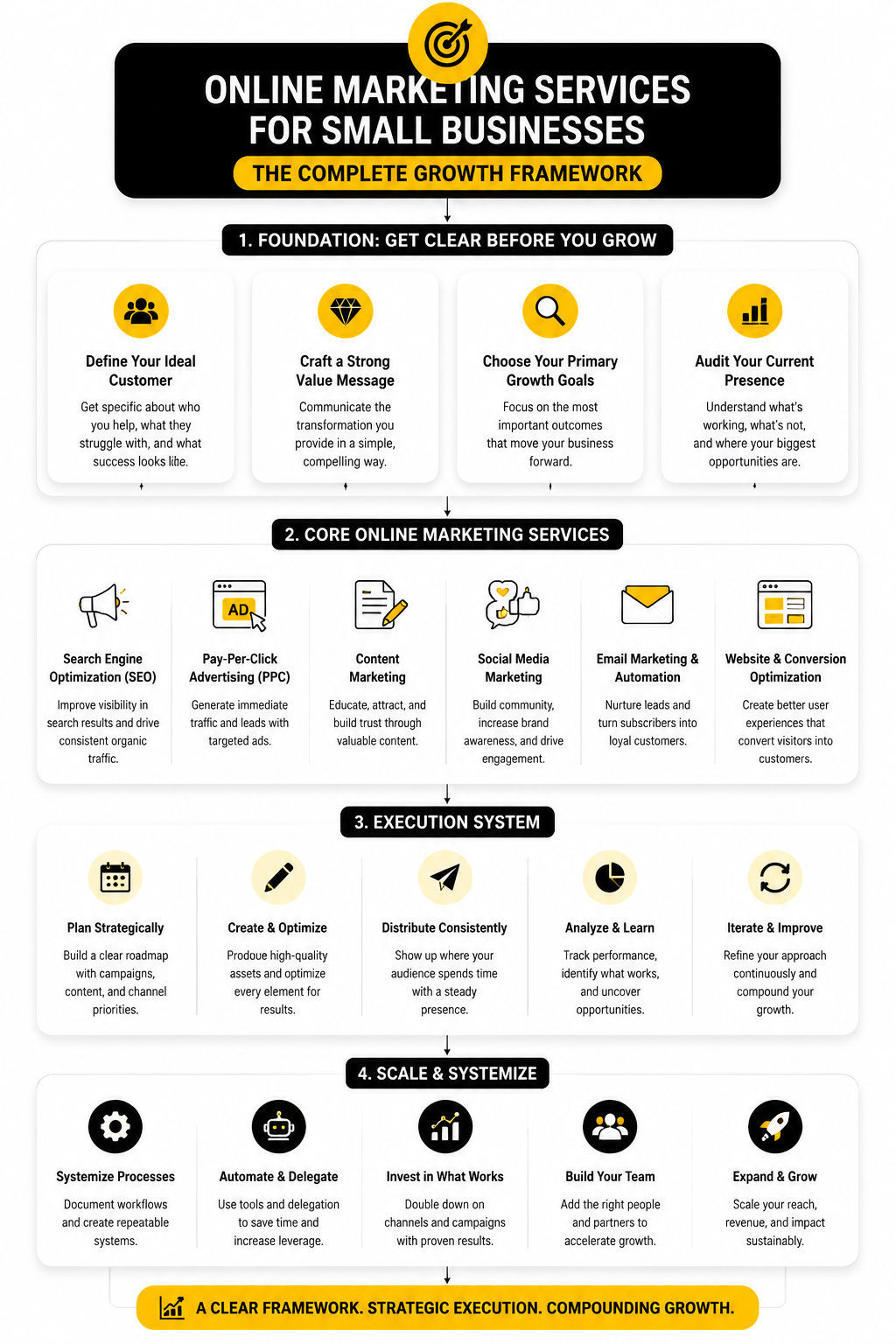
Whether you’re launching a new website, refining your search visibility, building an email list, or running targeted paid campaigns, understanding the core structure behind online marketing helps you prioritize what matters most for your business goals.
Why Online Marketing Services Matter for Small Businesses
Online marketing services play a central role in how small businesses attract customers, build credibility, and grow revenue in today’s highly competitive digital landscape. Most modern purchase journeys begin online, which means if your business can’t be found where people are already searching and engaging, you’re effectively invisible to a large portion of your potential market. This isn’t speculation - over 70 % of consumer purchase journeys start with online research, and 81 % of consumers research brands online before buying. This shift in discovery behavior makes online marketing services essential for any small business that wants sustainable growth.
A well‑executed online marketing strategy doesn’t just increase visibility - it builds trust. For example, 94 % of small businesses with a website say it’s important to their growth, and many consumers consult online reviews before making a buying decision. Without strategic online services, small businesses risk losing traffic to competitors, missing out on high‑intent customers, and failing to convert interest into sales.
Furthermore, the channels small businesses invest in are evolving. Social media is now a top driver of traffic - with businesses reporting it as a main source of website visits more often than SEO - and engagement on these platforms helps establish brand personality and community around a product or service. Meanwhile, SEO remains a crucial long‑term strategy for organic discovery. Together, these services create a more resilient and effective marketing presence than any single tactic alone.
Overview of a Small Business Online Marketing Framework
To make online marketing services manageable and effective for small business owners, it helps to think in terms of a clear, structured framework rather than disconnected tactics. At its core, a strong online marketing framework connects your strategic goals with the specific services that drive measurable results.
A practical framework consists of these interconnected parts:
This kind of framework helps small business owners prioritize actions that align with their goals, budget, and customers’ online behavior instead of spreading effort thinly across random channels. By viewing your marketing as a system rather than a checklist, you’re far more likely to see sustained progress - from initial discovery all the way to repeat business.
Online marketing services aren’t one‑size‑fits‑all, but this framework ensures each component plays a purposeful role in moving prospects closer to becoming loyal customers. In the next part, we’ll break down these core components in detail so you can see what each service actually does and how it contributes to your overall success.
Core Components of Online Marketing Implementation
Now that you understand why online marketing services for small businesses matter and how a strategic framework connects the pieces, let’s get into how you actually implement these services so they deliver results. Implementation isn’t about jumping on every tool or platform you hear about - it’s about following a process that builds steadily from clarity to measurable growth.
Step 1: Set Clear Goals and Baselines
Before buying into any service or platform, define what success looks like for your business. Are you focused on generating leads, increasing online sales, or growing local visibility? Setting measurable goals with specific timelines creates a roadmap you can follow and evaluate. This step often starts with a baseline audit of your current online presence - your website performance, search visibility, social channels, and customer feedback sources. Without this, you’re investing without knowing what works or where you need to improve.
Step 2: Understand Your Audience and Positioning
Next, clarify who your target customers are and what you offer that matters to them. This means digging into your audience’s preferences, problems, and online behaviors. Tools like analytics platforms, surveys, and even simple customer interviews can reveal where your audience spends time online and what messages resonate. With this insight, you can position your services and content in a way that feels relevant and valuable rather than generic.
Step 3: Prioritize Services Based on Goals
Not all online marketing services are equal - or right - for every business at every stage. A high‑intent business that needs customers now might prioritize search ads or paid promotion, while one building long‑term authority may start with SEO and content creation. Small businesses should avoid trying to do everything at once and instead sequence services in a logical order:
Prioritization like this ensures your budget and time are spent on services that align with your goals rather than chasing every shiny new trend.
Step 4: Execute With a Step‑by‑Step Plan
Once priorities are set, create a tangible execution plan with timelines, responsibilities, and outcomes. This might look like a quarter‑by‑quarter roadmap:
This phased approach prevents overwhelm, lets you learn what works before expanding, and aligns services to real business needs rather than spraying effort across too many fronts. Implementation becomes replicable and measurable.
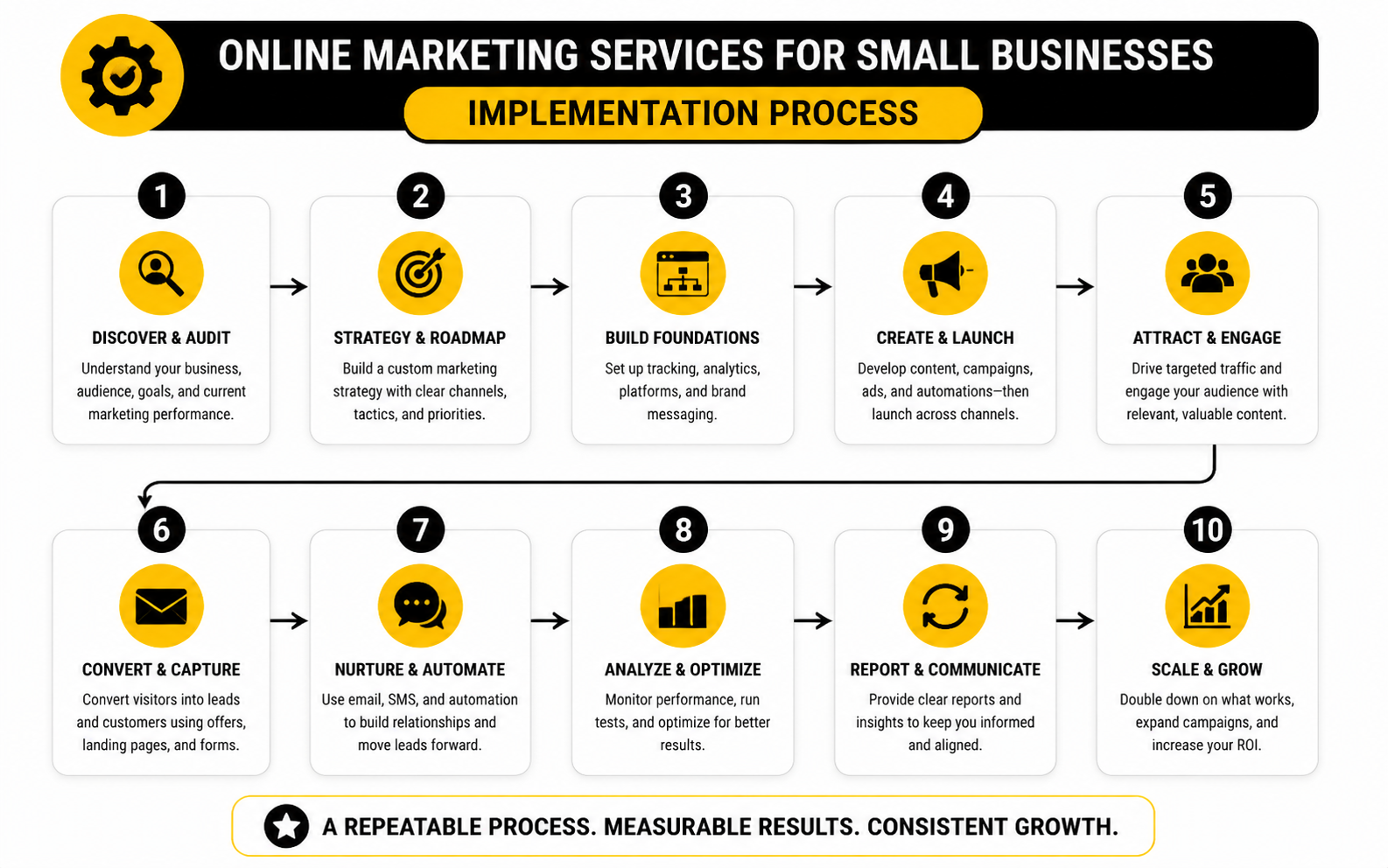
Step 5: Measure, Learn, and Improve
No implementation is complete without measurement. Set up analytics to track key performance indicators (KPIs) tied to your goals - like website traffic, conversion rates, lead quality, cost per acquisition, and customer lifetime value. Review these metrics regularly to identify what’s working and where adjustments are needed. This cycle of measure → learn → iterate turns online marketing from guesswork into a predictable growth engine.
By following this structured implementation process - from clear goals and audience understanding to prioritized services and disciplined execution - small businesses can ensure their investment in online marketing services delivers tangible outcomes instead of chaos. Continuous improvement based on real data makes your marketing more carefully over time and positions your business to grow sustainably in today’s digital marketplace.
Measuring Performance: Analytics, Benchmarks, and What the Data Means
When you invest in online marketing services for small businesses, one of the biggest questions isn’t “what do I track?” but what data actually tells you whether your investment is working. Simply collecting every number your analytics platform spits out won’t help - you need to focus on performance signals that connect directly to your business goals.
Focus on Outcomes, Not Vanity Numbers
It’s tempting to watch likes, shares, or page views because they feel like progress, but those metrics don’t always connect to revenue or customer actions that matter. The most valuable numbers are the ones tied to real business outcomes - leads, paying customers, and return on marketing spend. Metrics that don’t answer “did this activity help grow the business?” are often distractions.
Key Metrics That Reveal What’s Working
To make measurement practical and actionable, small businesses should narrow their focus to a few metrics that inform decisions about spend, optimization, and strategy:
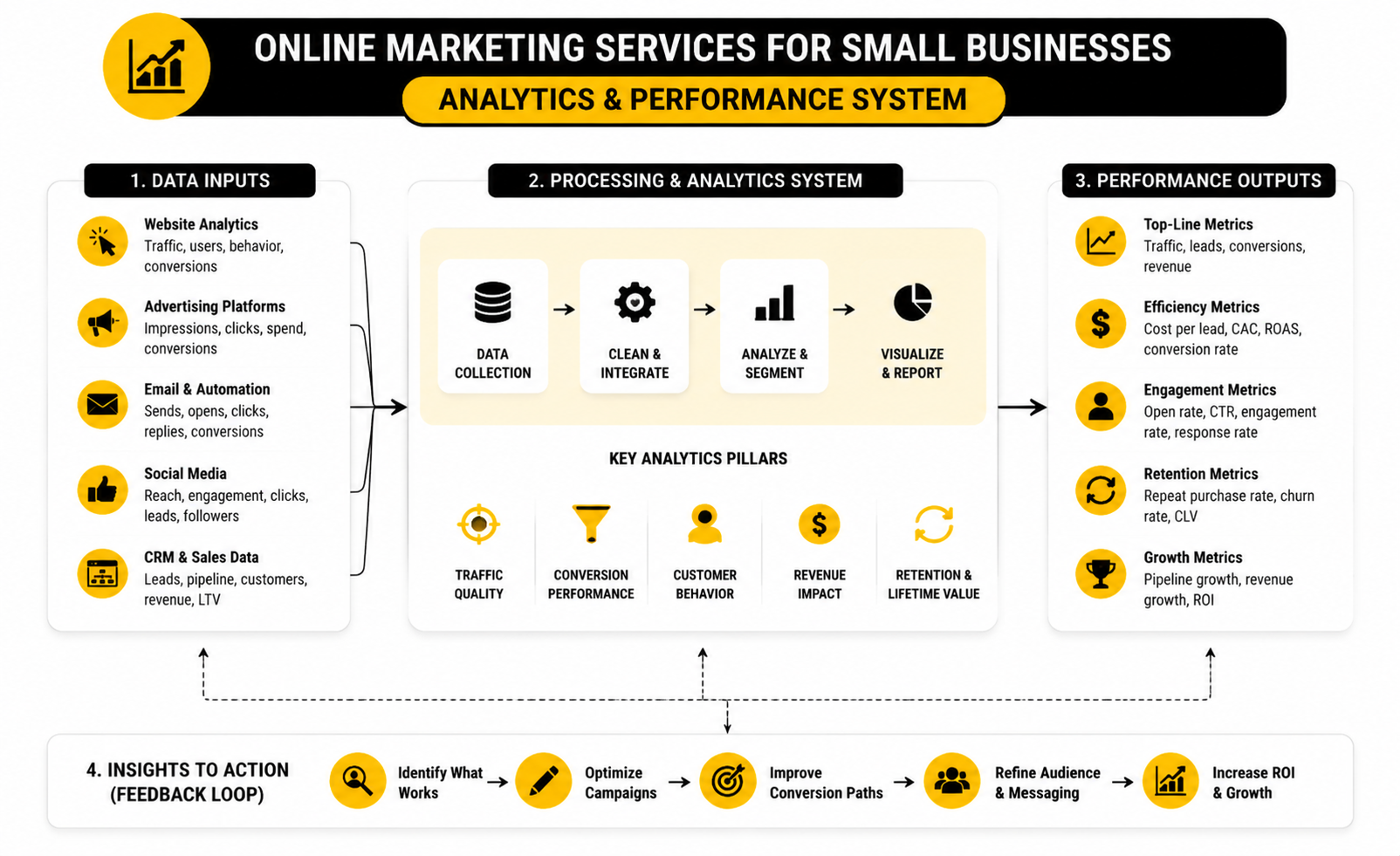
Why Benchmarks Matter - But Not in the Simplistic Way You Think
Benchmarks provide context for your results. A 4 % click‑through rate (CTR) on search ads might be average in one industry and outstanding in another, depending on offer and audience. Benchmarks help you interpret performance relative to broader patterns, but they should inform decisions, not dictate them. For example, knowing typical conversion rates between 2 % and 5 % gives you a realistic performance range, but your own business model and stage can justify targets above or below that range.
Benchmarks also help you spot issues early. If your cost per lead (CPL) starts rising above industry norms, that’s a signal to refine your audience targeting or offer message. If your email open rates dip below what’s typical for your sector, that can indicate problems with subject lines or list engagement.
Interpreting Analytics to Drive Action
Understanding what the numbers mean is crucial. Here’s how to read common signals and act on them:
Focusing on meaningful KPIs and interpreting them in the context of your goals empowers you to make decisions rooted in real performance - not guesswork or vanity. The right data strategy turns your analytics from a confusing dashboard into a decision‑making engine that drives growth and efficiency.
Advanced Considerations and Strategic Tradeoffs in Online Marketing
As you mature in your use of online marketing services for small businesses, the decisions you make become less about what to do and more about how and when to do it. Early implementation focuses on setting up systems and measuring basic performance, but scaling effectively - or avoiding common pitfalls - requires deeper strategic thinking and risk awareness.
Balancing Cost, Expertise, and Control
One of the most talked‑about tradeoffs in small business online marketing is whether to build capabilities internally or outsource them entirely. Many owners find themselves wearing multiple hats, and marketing can quickly become overwhelming without dedicated expertise. Around 60 % of small businesses report they don’t have the time or in‑house skill to manage marketing effectively on their own.
Outsourcing can save time and bring specialized skills - like detailed SEO execution or advanced paid media management - without the overhead of full‑time hires. It also allows access to strategic insights that would otherwise take months or years to develop. However, it does come with tradeoffs: outsourcing can mean relinquishing some day‑to‑day control over messaging, alignment with brand culture, and rapid iteration unless communication structures are solidified upfront.
Strategic Channel Selection vs. Spreading Too Thin
As you scale your online marketing efforts, there’s a temptation to adopt every new platform or trend. While variety can diversify risk, trying to maintain a mediocre presence across six platforms is far less effective than dominating two or three that resonate with your audience. Overextending your efforts typically results in diluted campaigns that fail to produce strong returns on any channel.
For example, organic social reach has declined across major networks, pushing many small businesses to consider paid content amplification earlier than in the past. But scaling paid channels without solid attribution, audience definitions, and conversion pathways can lead to higher costs and uncertain ROI. By contrast, focusing on a proven combination - such as search engine marketing paired with email automation - often yields more predictable returns.
The Risk of Measuring the Wrong Things
As marketing sophistication grows, so too does the temptation to track more metrics. But as expert analyses show, many organizations - big and small - still struggle to tie martech performance to actual business outcomes. Nearly half of marketers report they cannot accurately measure ROI across channels, often because analytics are set up to collect activity data (e.g., clicks, impressions) instead of outcome data (e.g., revenue tied to traffic sources).
This means you should avoid tracking data for its own sake. Instead:
Growth Plateaus and the Need for Strategic Depth
A common challenge as small businesses grow is the disconnect between marketing activity and scalable growth outcomes. Many organizations can generate traffic or email subscribers but struggle to turn that activity into consistent revenue because their systems aren’t optimized for conversion and retention. The missing piece isn’t always more content or bigger budgets - it’s integration and alignment across channels. A highly coordinated strategy ensures that messaging and experience are smooth, from first contact to repeat purchase.
This means focusing on:
When marketing departments operate in silos - for example, social media running independently from SEO and paid search - insights aren’t shared and opportunities are missed. This fragmentation increases costs and reduces the impact of every dollar spent. As research indicates, businesses with integrated, data‑driven systems consistently outperform those relying on isolated tactics.
By thinking strategically about when to outsource, which channels to prioritise, what metrics truly matter, and how to integrate your efforts, you’ll improve online marketing services for small businesses from a necessary cost center into a disciplined engine for growth. This deeper guidance ensures not just activity, but intentional, measurable, and scalable success.
Online Marketing Services for Small Businesses - FAQ
1. What are online marketing services for small businesses?
Online marketing services are professional strategies and tools that help small businesses attract, engage, and convert customers digitally. They include search engine optimization, content creation, paid advertising, social media promotion, email marketing, and analytics tracking - all tailored to your specific goals and audience.
2. How much should a small business expect to invest in online marketing services?
Investment varies widely based on scope and goals. Some businesses start with basic SEO and social media management, while others use comprehensive services that include paid campaigns and automation. A well‑structured plan matches spending to expected outcomes, not guesswork.
3. Do I need to hire a professional or can I do this myself?
You can start many of these services yourself, especially basic social media posting, simple SEO, and email newsletters. But professional support accelerates results, reduces costly mistakes, and keeps your strategy aligned with proven performance indicators rather than trial‑and‑error.
4. How long does it take to see results from online marketing services?
It depends on the channel and your goals. SEO and organic content may take several months to build momentum, while paid campaigns can deliver leads almost immediately. In all cases, consistent measurement and refinement speed up progress.
5. Which online marketing service delivers the best ROI?
There’s no single answer - ROI depends on your customers and objectives. For some businesses, email marketing or SMS yields the best return because it targets warm audiences. For others, search ads or SEO deliver the most value by capturing high‑intent customers. Measuring performance regularly is key.
6. What’s the difference between organic and paid marketing channels?
Organic marketing (like SEO and social content) builds long‑term visibility without ongoing ad spend, while paid marketing (like search and social ads) delivers quicker visibility but costs per click or impression. A balanced strategy often includes both.
7. How can I measure if my online marketing is working?
Focus on outcome‑oriented indicators such as conversions, cost per lead, customer acquisition cost, and revenue generated per channel. Analytics tools show patterns that tie activity to results and help you refine efforts strategically.
8. Should small businesses focus on all social platforms?
Not necessarily. It’s more effective to prioritize platforms where your target customers are most active and engaged. Trying to maintain a presence on every network often dilutes impact and increases workload without proportional benefit.
9. What role does content play in online marketing?
Content drives visibility, trust, and engagement. High‑quality content helps you rank in search, educate your audience, and nurture leads through long‑term relationships. It’s foundational to many online marketing services.
10. Can online marketing services help with local business visibility?
Yes. Local SEO, online listings, and geo‑targeted ads are designed specifically to make small businesses more visible to people searching nearby. This is critical for service‑area and brick‑and‑mortar businesses that rely on local customers.
Build a stronger local presence with BAAM AI
Turn your website, Google profile, social channels, and AI visibility into one growth engine
Most businesses do not need more random marketing activity. They need a consistent presence system that helps the right people find them, trust them, and take action. BAAM AI brings strategy, local SEO, website updates, Google Maps visibility, social content, AI-search readiness, media production, and reporting into one practical monthly engine.
If you want your marketing to keep working after the campaign ends, start with a free BAAM AI presence audit. See how your business shows up today and where the fastest visibility wins are at BAAM AI.