
BAAM AI Blog
Online Marketing Platform: The Practical Guide To Choosing The Right System
An online marketing platform is not just another tool in your software stack. It is the operating system for how your business attracts leads, captures attention, follows up, sells, measures results, and improves...
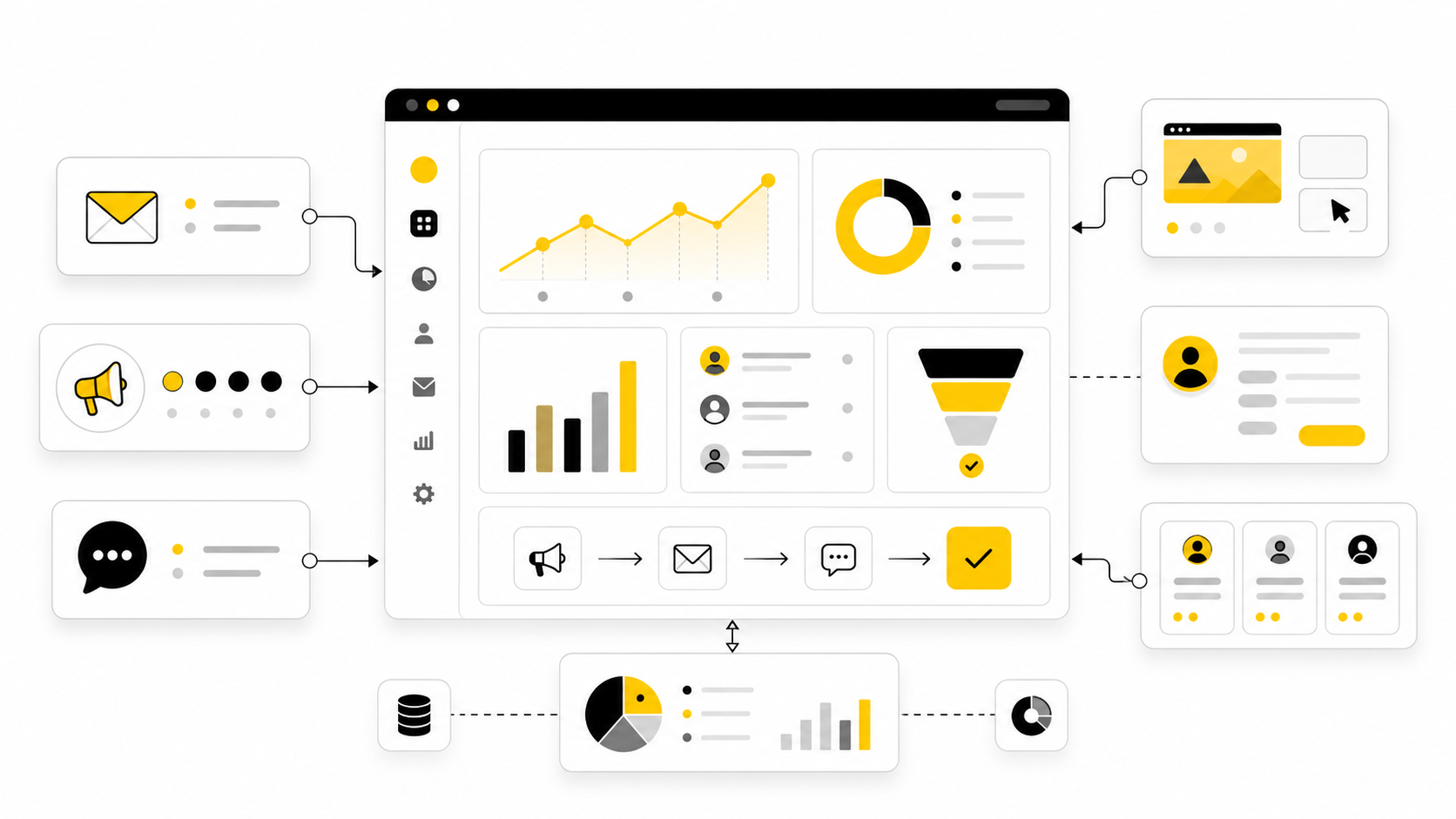
An online marketing platform is not just another tool in your software stack. It is the operating system for how your business attracts leads, captures attention, follows up, sells, measures results, and improves campaigns over time. When it is chosen well, your marketing becomes easier to manage because your channels, data, automations, and customer journeys stop living in separate places.
The problem is that most businesses do not start with a platform strategy. They start with a landing page builder, then add an email tool, then a CRM, then a chatbot, then a scheduler, then a reporting dashboard, and suddenly the team is managing marketing instead of doing marketing. That is exactly where an online marketing platform becomes useful: it gives you one structured way to connect the moving parts.
This guide will walk through the decision clearly. Not from the angle of “which tool has the most features,” because that is usually the wrong question. The better question is: which platform fits the way you get customers, serve them, and grow without creating more operational drag?
Why An Online Marketing Platform Matters
An online marketing platform matters because modern marketing is no longer one channel, one campaign, or one simple funnel. A customer might discover you through search, compare you on social media, click a retargeting ad, join an email list, ask a question in chat, book a call, and then buy days or weeks later. If each step lives in a separate tool, the business loses context exactly when context matters most.
The real value is not convenience. The real value is continuity. When your CRM, landing pages, forms, automations, messages, appointments, pipelines, and reporting work together, you can see what is actually happening instead of guessing from disconnected dashboards.
This is why platforms like GoHighLevel, ClickFunnels, Systeme.io, ManyChat, and Brevo are not interchangeable in a simple way. They can all support marketing, but they are built around different assumptions about funnels, automation, messaging, agencies, ecommerce, email, and sales follow-up. Choosing well starts with understanding your business model before comparing feature lists.
The Online Marketing Platform Framework
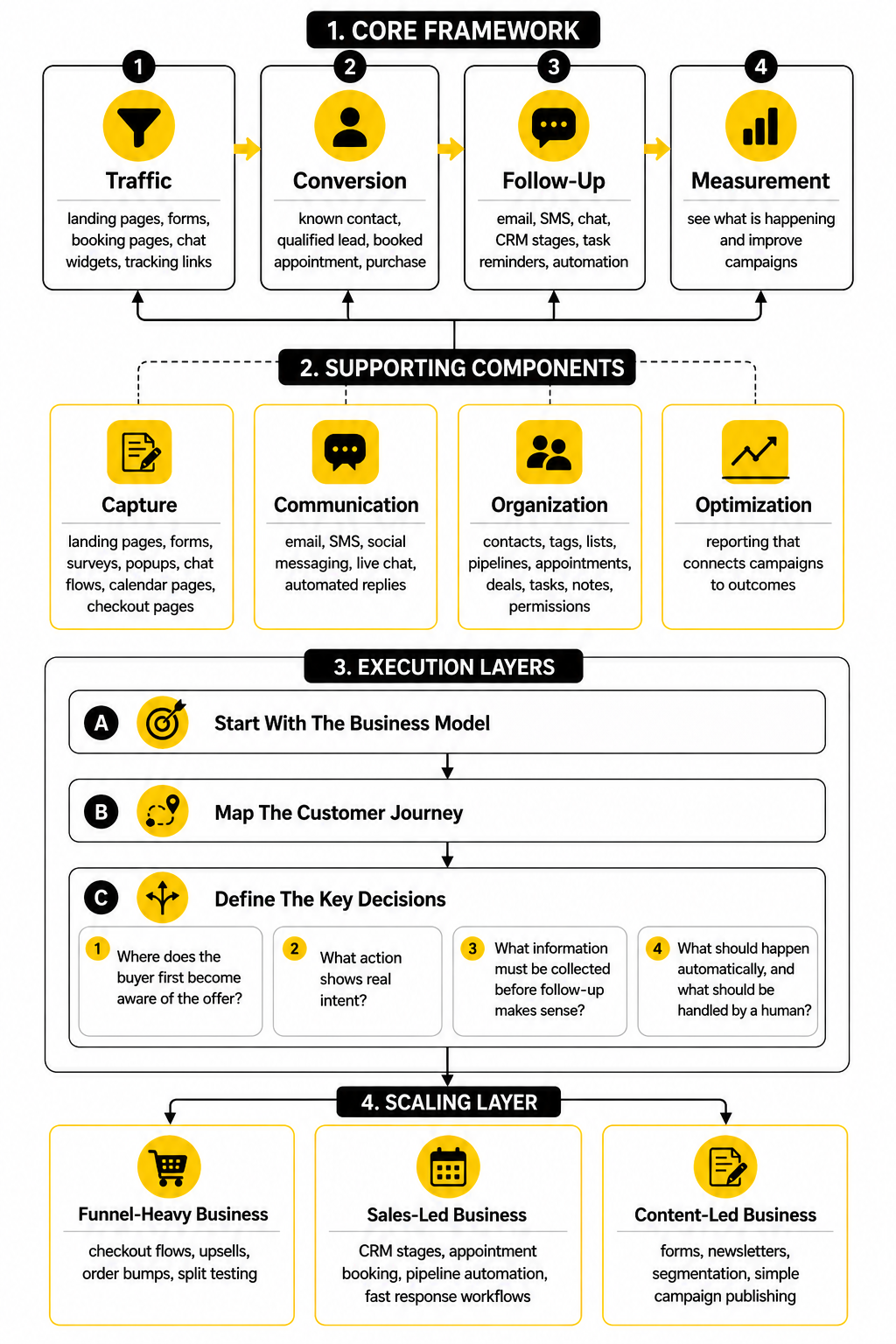
A useful online marketing platform should be judged by how well it supports the full customer journey. That journey usually includes four practical layers: traffic, conversion, follow-up, and measurement. If one layer is weak, the whole system becomes harder to scale because the team is forced to patch the gap manually.
Traffic is where attention comes from, but the platform does not need to own every traffic source. It does need to receive traffic cleanly through landing pages, forms, booking pages, chat widgets, tracking links, or campaign-specific entry points. Once someone enters your system, the platform should help convert that attention into a known contact, a qualified lead, a booked appointment, a purchase, or another meaningful next step.
Follow-up is where many businesses quietly lose money. A lead who fills out a form but receives no fast, relevant response is not really a captured lead; it is an opportunity leaking out of the system. A strong platform makes follow-up predictable through email, SMS, chat, CRM stages, task reminders, and automation logic that matches the customer’s intent.
Core Components Of The Framework
The first component is capture. This includes landing pages, forms, surveys, popups, chat flows, calendar pages, checkout pages, and any other touchpoint where an anonymous visitor becomes someone your business can continue a conversation with. For example, a funnel-focused business may care deeply about ClickFunnels, while an agency or local service business may care more about CRM pipelines and follow-up inside GoHighLevel.
The second component is communication. This is where email, SMS, social messaging, live chat, and automated replies need to feel coordinated instead of random. A business that depends on Instagram DMs, Messenger, or comment-to-message campaigns may naturally look at ManyChat, while a team that sends newsletters, transactional updates, and lifecycle campaigns may put more weight on Brevo or Moosend. The right choice depends on where your audience actually responds.
The third component is organization. This means contacts, tags, lists, pipelines, appointments, deals, tasks, notes, permissions, and internal handoffs. This part is less exciting than a beautiful landing page, but it is often where serious growth becomes possible because the team can finally see who is new, who is qualified, who needs attention, and who is ready to buy.
The fourth component is optimization. You need reporting that connects campaigns to outcomes, not just vanity metrics. Page views, opens, clicks, and replies matter only when they help you understand which offers, segments, channels, automations, and sales actions produce revenue or qualified opportunities.
Professional Implementation Starts With The Business Model
Professional implementation starts by mapping the business model before touching the software. A course creator, SaaS company, ecommerce brand, agency, consultant, clinic, and local service business may all need an online marketing platform, but they do not need the same setup. The mistake is buying a platform because it looks powerful, then forcing the business to operate around the tool.
A better process starts with the customer journey. Where does the buyer first become aware of the offer? What action shows real intent? What information must be collected before follow-up makes sense? What should happen automatically, and what should be handled by a human?
Once those questions are answered, the platform decision becomes much easier. A funnel-heavy business may prioritize checkout flows, upsells, order bumps, and split testing. A sales-led business may prioritize CRM stages, appointment booking, pipeline automation, and fast response workflows. A content-led business may prioritize forms, newsletters, segmentation, and simple campaign publishing.
What Part 2 Will Build On
The next section will go deeper into why an online marketing platform matters from a practical business perspective. It will look at the hidden costs of disconnected tools, the difference between features and systems, and the reason platform decisions should be made around revenue flow instead of software hype. That foundation matters because every later comparison depends on it.
Why An Online Marketing Platform Matters
An online marketing platform matters because the customer journey has become too fragmented to manage with guesswork. People do not move in a straight line from ad to landing page to purchase anymore. They compare, wait, ask questions, read reviews, follow social proof, abandon forms, return through email, and sometimes buy only after several quiet touchpoints.
That is why the platform decision has become a business decision, not just a software decision. The digital marketing software category continues to expand, with the market estimated at USD 121.71 billion in 2026 and projected to reach USD 248.29 billion by 2031. Businesses are spending because the work is getting more complex, but spending more does not automatically mean the system works better.
The goal is not to collect tools. The goal is to create a clear revenue path. A strong online marketing platform helps you turn scattered activity into a system where traffic, leads, conversations, sales, and reporting support each other instead of fighting for attention.
Disconnected Tools Create Hidden Costs
Disconnected tools look harmless in the beginning because each one solves a specific problem. You need a page builder, so you add one. You need email campaigns, so you add another. You need booking, chat, forms, analytics, and CRM, so the stack grows one subscription at a time.
The cost shows up later. Someone has to connect the tools, check whether the automations still work, clean duplicate contacts, export reports, fix broken handoffs, and explain why sales and marketing numbers do not match. That work rarely appears in the original software budget, but it absolutely affects profit.
This is where many businesses make the wrong comparison. They compare one platform’s monthly price against another tool’s monthly price, but they ignore the cost of manual work, missed follow-up, messy data, and slow execution. A cheaper stack can become expensive very quickly when the team has to babysit it every week.
Speed Matters More Than Most Teams Admit
Marketing speed is not about rushing random campaigns into the world. It is about reducing the time between seeing an opportunity and acting on it properly. If a team needs three people, four tools, and two days to launch a simple lead capture campaign, the platform is already slowing the business down.
A good online marketing platform gives the team reusable assets. Landing pages, email templates, automations, forms, pipelines, appointment flows, and reporting views should not be rebuilt from scratch every time. Once the basics are in place, the team should be able to launch faster without lowering quality.
This matters even more when ads, content, and offers need constant testing. A business that can test a new page, follow-up sequence, or booking flow quickly has more chances to learn. A business trapped in slow implementation ends up debating ideas instead of getting real market feedback.
Data Is Only Useful When It Is Connected
Data sounds impressive until it is spread across too many dashboards. One tool shows clicks, another shows leads, another shows email engagement, another shows booked calls, and another shows sales. The team has numbers, but not a clear picture.
A useful platform connects data to decisions. You should be able to see which campaigns create qualified leads, which lead sources turn into conversations, which follow-ups create appointments, and which offers produce revenue. Without that connection, marketing reports become activity summaries instead of decision tools.
This is one reason unified data has become a central theme in modern marketing research. Salesforce’s latest marketing research highlights AI, personalization, and data strategy through insights from nearly 4,500 marketers worldwide. The important takeaway for smaller businesses is simple: advanced marketing depends on clean, connected customer information.
Better Follow-Up Increases The Value Of Every Lead
Most businesses do not need more leads as badly as they think. They need better handling of the leads they already generate. If someone fills out a form, clicks a pricing page, replies to a message, or books a call, the next step should be obvious and fast.
An online marketing platform helps by making follow-up systematic. That can include instant confirmations, reminder messages, lead qualification steps, sales notifications, nurture emails, pipeline updates, and task creation. The point is not to automate everything; the point is to make sure important actions do not depend on memory.
This is where platforms start to separate themselves. A funnel builder may be excellent at turning attention into opt-ins or purchases, while a CRM-centered platform may be stronger at managing appointments, pipelines, and sales conversations. For example, a sales-led agency or service business may naturally lean toward GoHighLevel, while a creator or offer-led business may prefer the direct funnel structure of ClickFunnels.
Platform Fit Depends On How You Sell
There is no universal best online marketing platform because businesses sell in different ways. A low-ticket digital product needs a different system from a high-ticket coaching offer. A local clinic needs a different system from a newsletter business, and an ecommerce brand needs a different system from a B2B agency.
The key is to match the platform to the sales motion. If your business depends on booked calls, you need strong CRM, calendar, reminders, pipelines, and fast lead response. If your business depends on self-service checkout, you need strong pages, order flows, upsells, payments, and post-purchase automation.
This also keeps you from overbuying. Some teams choose the most advanced platform they can find, then use only a small part of it. Others choose the simplest tool available, then outgrow it once their campaigns, segments, and reporting needs become more serious. Fit beats hype every time.
AI Makes Platform Structure Even More Important
AI has made marketing faster, but it has also made weak systems more obvious. If your contacts are messy, your offers are unclear, your segments are random, and your reporting is unreliable, AI will not magically fix the foundation. It may simply help you create more content and automation on top of a confused system.
The strongest use of AI inside an online marketing platform is not just writing emails or generating page copy. It is helping teams act on customer context. That can mean summarizing conversations, suggesting next steps, segmenting contacts, drafting follow-ups, improving support responses, or spotting patterns in campaign performance.
This is why platform structure matters before AI features. A tool like GoHighLevel AI can be more useful when the CRM, conversations, appointments, and pipelines are already organized. AI works best when it has a clean system to support, not when it is expected to rescue a messy one.
The Real Win Is Operational Clarity
The best reason to use an online marketing platform is clarity. The team knows where leads come from, what happens next, who owns the follow-up, which campaigns are working, and where revenue is being created. That level of clarity changes how decisions get made.
Instead of arguing from opinions, the business can improve the system one layer at a time. Landing pages can be tested. Follow-up can be tightened. Lead sources can be compared. Sales conversations can be tracked, and weak points can be fixed without rebuilding everything.
That is the practical reason this topic matters. A good platform does not make the business successful by itself. It gives the business a stronger operating base, so the right strategy can actually be executed consistently.
Professional Implementation And Setup
Professional implementation is where the online marketing platform stops being an idea and becomes an operating system. This is the part most people underestimate because they think setup means connecting a domain, choosing a template, and importing a contact list. That is only surface-level setup.
Real implementation means turning your customer journey into a working process. Every page, form, automation, tag, pipeline stage, message, notification, and report should have a reason to exist. If it does not help capture demand, qualify interest, move people forward, or improve decisions, it is probably clutter.
This is also where discipline matters. A platform can give you the tools, but it cannot decide your offer, your follow-up rules, your handoff process, or your sales priorities. Those choices have to be designed before the system can support them.
Start With The Customer Journey Map
The first step is to map the customer journey in plain language. Do not start inside the software. Start with the path a real buyer takes from first awareness to final purchase, then identify the moments where the platform needs to help.
For most businesses, the journey includes a few predictable stages. Someone discovers the offer, shows interest, shares contact information, receives follow-up, considers the decision, and either buys, books, replies, or disappears. Your job is to define what should happen at each stage before building anything.
This map should be practical, not theoretical. Write down the exact entry points people use, the information you need from them, the action you want next, and the message they should receive. Once that is clear, your online marketing platform becomes much easier to configure because the system is following a real business process.
Define The Minimum Working System
The minimum working system is the smallest setup that can create, manage, and measure a real customer journey. This matters because many teams try to build everything at once. They create too many automations, too many tags, too many pages, and too many dashboards before the first version has even been tested.
A better approach is to build the core path first. For a service business, that may mean one landing page, one lead form, one calendar flow, one pipeline, one notification workflow, and one follow-up sequence. For a digital product business, it may mean one funnel, one checkout, one email sequence, one post-purchase flow, and one simple performance report.
This keeps implementation focused. You are not trying to build the perfect marketing machine on day one. You are building a clean version that can produce real data, reveal weak points, and improve quickly.
Build The Execution Process Step By Step
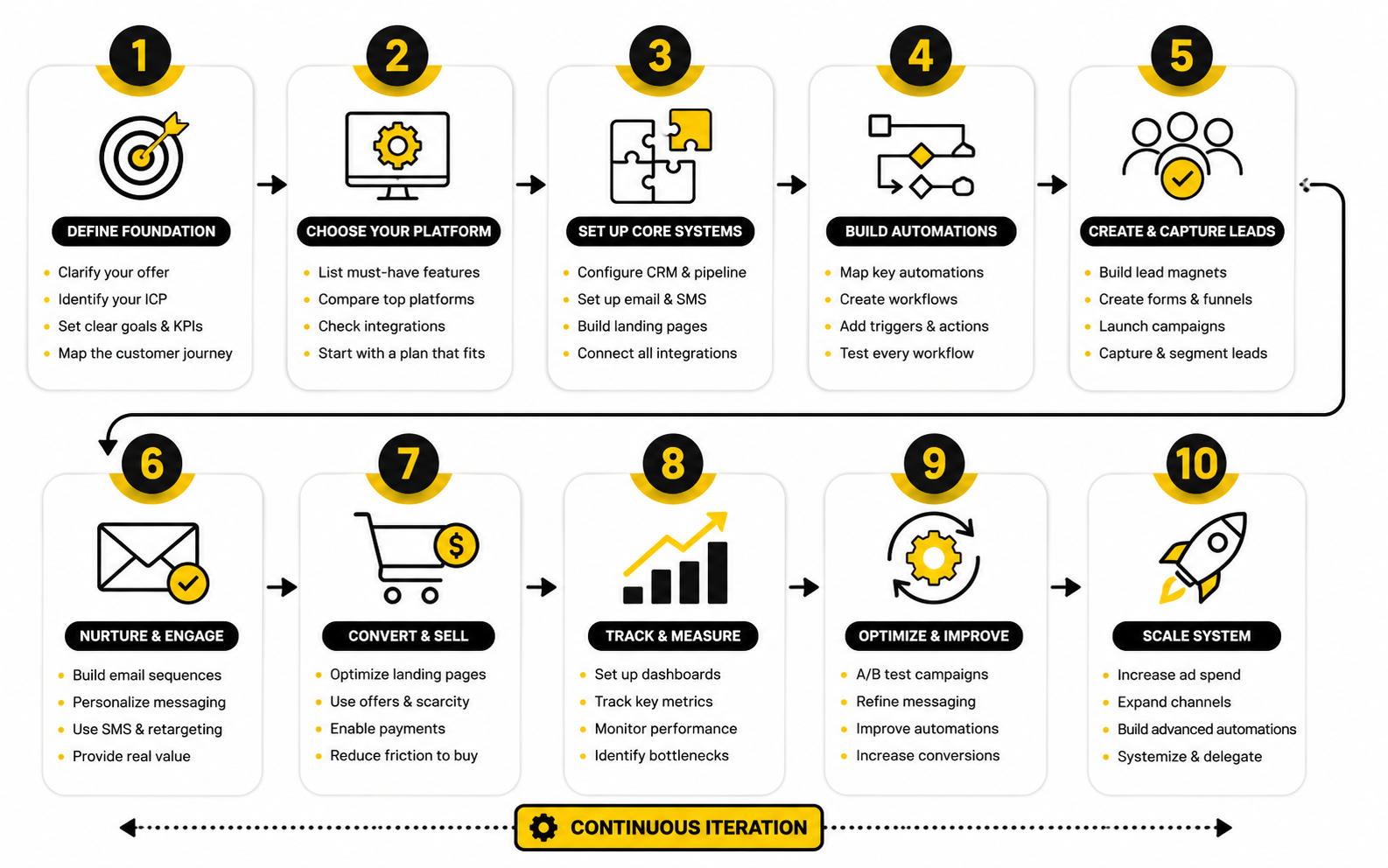
A strong implementation process should move in sequence. If you jump ahead too early, the setup becomes messy and hard to troubleshoot. The cleaner the order, the easier it is to spot problems before they affect leads or customers.
This process sounds simple because it should be simple. Complexity comes later, after the core journey works. The mistake is adding advanced logic before the basic path is clean.
Choose Platform Features Based On The Process
Once the execution process is clear, feature decisions become more grounded. You are no longer asking which platform has the longest feature list. You are asking which platform supports your actual workflow with the least friction.
If your process depends heavily on funnels, order pages, upsells, and fast offer testing, ClickFunnels may fit naturally. If your process depends on CRM pipelines, appointment reminders, reputation management, sales follow-up, and agency-style client accounts, GoHighLevel may make more sense. If your process is simpler and you want pages, email, funnels, and online selling in one lean setup, Systeme.io may be enough.
The same logic applies to specialist tools. If your customer journey depends on social conversations and automated messaging, ManyChat can become an important part of the system. If your main need is structured email and lifecycle communication, Brevo or Moosend may be more relevant than a heavier all-in-one platform.
Keep Data Clean From The Beginning
Clean data is not something you fix later without pain. If the platform starts with random tags, unclear fields, duplicate lists, and inconsistent naming, every report and automation becomes less trustworthy. That creates hesitation, and hesitation kills execution.
The basic rule is to name things like a normal human would understand them six months from now. Use clear tags, simple pipeline stages, and consistent campaign names. Avoid clever internal shorthand unless the whole team already uses it.
This matters because your online marketing platform is only as useful as the information inside it. If a lead source is missing, a stage is vague, or a tag means three different things, the system becomes harder to manage. Clean structure gives you confidence when you automate, report, and optimize.
Separate Automation From Human Judgment
Automation should remove repetitive work, not remove judgment from places where judgment is needed. A platform can send reminders, assign tasks, trigger messages, update stages, and surface important activity. It should not blindly treat every contact like they are at the same point in the buying process.
A good implementation separates routine actions from decision points. Routine actions include confirmation emails, appointment reminders, lead source tagging, nurture messages, and internal alerts. Decision points include sales qualification, custom proposals, complex objections, and high-value relationship moments.
This distinction keeps the system useful without making it robotic. The platform handles consistency. The team handles nuance. That combination is usually stronger than trying to automate every human interaction.
Test Before Traffic, Then Optimize After Data
Testing before traffic is non-negotiable. Every business has at least one painful story of a broken form, missing notification, dead checkout, wrong calendar setting, or automation that sent the wrong message. Most of those problems are avoidable with a proper test run.
The test should cover the full journey from the customer’s perspective and the team’s perspective. Submit the form like a real lead. Check the confirmation message. Review the contact record. Confirm the pipeline update. Make sure the right person gets notified and the reporting captures the action.
After traffic starts, the work changes from setup to optimization. Do not change everything at once. Improve one layer at a time so you can understand what caused the result. That is how a simple implementation becomes a reliable growth system.
Statistics And Data
Statistics are only useful when they help you make a better decision. Random benchmark numbers can make a dashboard look serious, but they do not automatically tell you what to fix. A good online marketing platform should turn data into priorities, not just charts.
The mistake is treating every metric like it has equal weight. Page views, email opens, click-through rates, form submissions, booked calls, show-up rates, sales calls, checkout conversion, revenue, and retention all matter in different contexts. The job is to understand which number explains the current bottleneck.
This is where measurement becomes practical. You are not tracking data to feel informed. You are tracking data so you know whether to improve traffic quality, landing page clarity, lead capture, follow-up speed, sales process, offer strength, or customer retention.
The Market Data Shows Why Platforms Are Expanding
The online marketing platform category is growing because businesses are trying to manage more channels, more customer touchpoints, and more data. The global digital marketing software market was estimated around USD 97.77 billion in 2025, with projections reaching USD 283.42 billion by 2033. That growth is not happening because companies suddenly love software subscriptions.
It is happening because marketing operations have become harder to run manually. More channels mean more campaign variations, more attribution questions, more audience segments, and more follow-up paths. A business that could once manage marketing with a website, an email list, and a spreadsheet now often needs a more connected system.
But this does not mean every business should buy the biggest platform available. Market growth tells you that platforms are becoming more important, not that complexity is automatically good. The more carefully move is to use market data as context, then choose a system that fits your actual sales process.
The Metrics That Actually Matter
The most useful metrics are the ones tied to movement through the customer journey. If someone sees your campaign but never clicks, you have an attention or targeting problem. If they click but do not opt in, you have a landing page, offer, or trust problem. If they opt in but never reply, book, or buy, you have a follow-up or qualification problem.
That is why the best online marketing platform reports should be organized around stages, not vanity metrics. You want to see how people move from visitor to lead, lead to qualified opportunity, opportunity to customer, and customer to repeat buyer or referral source. Each stage should reveal a specific action you can take.
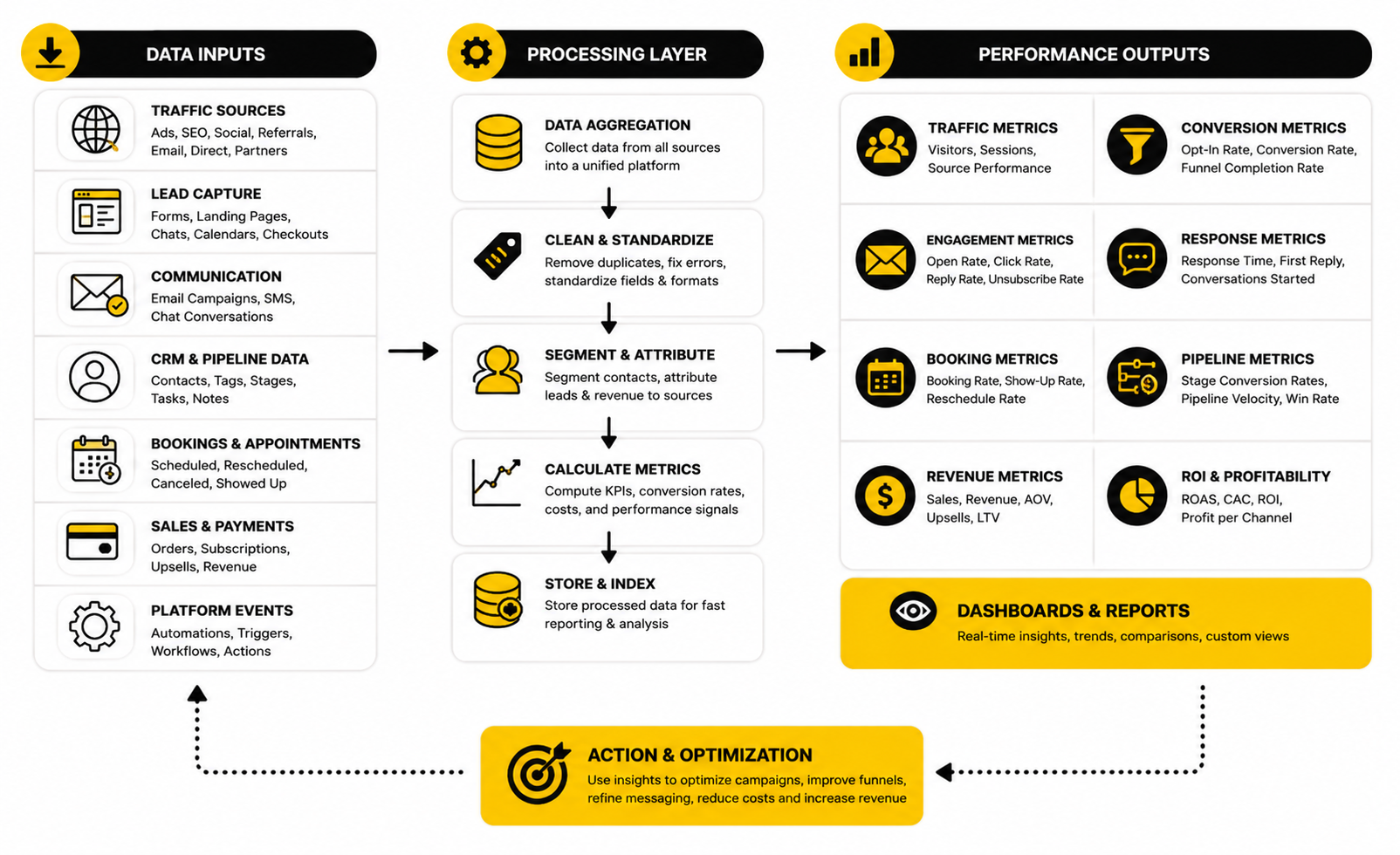
For most businesses, the core measurement categories are:
These numbers should not sit in separate dashboards with no connection. If traffic quality drops, conversion rate may look worse even when the page is fine. If follow-up slows down, sales may drop even when lead volume looks healthy. The platform has to help you see the chain, not just individual links.
Benchmarks Are Starting Points, Not Targets
Benchmarks can be useful, but only when you treat them properly. They give you a reference point, not a final goal. A benchmark can help you spot whether a number is unusually weak, but it cannot tell you everything about your offer, audience, price point, traffic source, or sales cycle.
Email is a good example. MailerLite’s benchmark data from millions of campaigns showed a median email open rate of 43.46%, with wide differences across industries. That number can help you understand whether your list engagement is in a reasonable range, but it should not become the only measure of email success.
Open rates are also less reliable than they used to be because privacy changes can affect tracking. So the better question is not just whether people opened. The better question is whether the email moved them toward a meaningful action, such as clicking, replying, booking, buying, or returning to an abandoned checkout.
Conversion Data Needs Context
Conversion rate is one of the most useful numbers in marketing, but it is also one of the easiest to misread. A low conversion rate might mean the page is weak. It might also mean the traffic is poorly matched, the offer is unclear, the audience is too cold, the price is too high for the stage, or the call to action asks for too much too soon.
This is why an online marketing platform should help connect conversion data to source data. If one traffic source converts at 8% and another converts at 1%, the landing page may not be the main issue. The issue may be intent, message match, or audience quality.
For ecommerce, Triple Whale’s 2025 benchmark analysis points to the same idea in practical terms: a low add-to-cart rate can signal product page problems, while low add-to-cart combined with high bounce rates may suggest mismatched traffic or incorrect expectations. That logic applies beyond ecommerce too. A metric rarely explains itself; it has to be read in context.
Attribution Should Guide Decisions, Not Create Arguments
Attribution is messy because customers do not behave in clean lines. Someone may discover you through social content, return through search, join your list from a landing page, click an email, and then book a call after seeing a retargeting ad. If your platform gives all the credit to the final click, you may undervalue the content or follow-up that created the decision.
That does not mean attribution is useless. It means attribution should guide decisions carefully. Look for patterns across campaigns, channels, and segments instead of pretending one report can perfectly explain every sale.
A practical attribution setup should answer three questions. Which channels create first contact? Which touchpoints move people closer to action? Which campaigns reliably create qualified leads or revenue? When your online marketing platform helps answer those questions, you can allocate budget with more confidence.
Follow-Up Metrics Reveal Operational Leaks
Follow-up metrics are often more revealing than traffic metrics. If leads are coming in but not turning into conversations, the platform should show where the handoff breaks. Maybe notifications are late, reminders are weak, sales ownership is unclear, or leads are not being segmented properly.
Useful follow-up metrics include time to first response, reply rate, appointment booking rate, appointment show-up rate, pipeline stage movement, and lead-to-customer time. These numbers tell you whether the business is treating new opportunities with enough urgency. They also show whether automation is supporting the team or simply sending messages into the void.
This matters especially for businesses using platforms like GoHighLevel, where CRM pipelines, conversations, calendars, and automation can work together. The data should make the next action obvious. If the team has to dig through contacts manually to figure out who needs attention, the system is not doing enough.
Campaign Reports Should Show What To Do Next
A campaign report should not just tell you what happened. It should tell you what to do next. If the click-through rate is strong but conversion is weak, improve the landing page or offer alignment. If conversion is strong but sales are weak, inspect lead quality, sales follow-up, or pricing friction.
This is why campaign reporting should be built around decisions. Each report should connect a metric to a possible action. Otherwise, the dashboard becomes a decoration.
A simple decision-focused report might show:
This type of reporting works whether you use ClickFunnels for funnel performance, Brevo for lifecycle email, ManyChat for messaging flows, or Systeme.io for a simpler all-in-one setup. The tool matters, but the reporting logic matters more.
AI Metrics Need Extra Scrutiny
AI is becoming part of marketing platforms, but AI performance should be measured with discipline. It is not enough to say an AI workflow saved time or generated content faster. The better question is whether it improved customer experience, response quality, conversion, sales productivity, or decision speed.
Salesforce’s marketing research frames AI, data, and personalization as central themes based on insights from nearly 4,500 marketers worldwide. That is useful context, but the action for a smaller business is more grounded: measure whether AI helps the journey move better. If it does not improve a real business outcome, it is probably just another shiny layer.
AI metrics should include quality checks, not only volume. Track reply accuracy, human takeover rates, customer satisfaction signals, conversion impact, time saved, and error patterns. Especially when AI is involved in chat, follow-up, or sales support, speed without quality can create bigger problems than slow manual work.
The Best Analytics System Is Simple Enough To Use
A measurement system fails when nobody uses it. If the dashboard is too complicated, the team will ignore it. If the numbers are unclear, people will argue about interpretation. If the reports do not connect to action, the business will keep making decisions from instinct.
The best analytics setup is simple, visible, and tied to the customer journey. It should show where people enter, where they convert, where they stall, where revenue is created, and where the next improvement should happen. That is enough to make better decisions without drowning in noise.
This is the standard to use when choosing or configuring an online marketing platform. Do not ask whether the platform has analytics. Ask whether the analytics help you improve the system. That is the difference between reporting activity and managing growth.
How To Compare Platform Options
Choosing an online marketing platform gets easier when you stop comparing tools like a feature checklist. More features can be helpful, but they can also create more training, more setup, more maintenance, and more ways for the team to get distracted. The best platform is the one that supports your business model with the least operational friction.
This is especially important now because the martech market is crowded. The 2025 marketing technology landscape includes 15,384 solutions across 49 categories, which means there is almost always another tool promising to solve one more problem. That choice can be useful, but it can also turn platform selection into a never-ending comparison exercise.
The practical move is to narrow the decision around fit. What kind of customer journey are you building? What does your team need to execute consistently? Where does your current process break? Those answers matter more than a long list of features you may never use.
The All-In-One Tradeoff
An all-in-one online marketing platform can simplify operations because more of the customer journey lives in one place. Pages, forms, CRM records, automations, conversations, calendars, payments, and reports can work together without as many fragile integrations. That can be a major advantage for small teams, agencies, local service businesses, coaches, consultants, and sales-led companies.
The tradeoff is depth. A platform that covers many functions may not always match the most advanced specialist tool in every category. The email builder may not be as deep as a dedicated email platform, the analytics may not be as flexible as a standalone BI tool, or the page builder may not be as refined as a specialist landing page product.
That does not make all-in-one platforms bad. It means you need to know what you are optimizing for. If speed, simplicity, and unified execution matter most, an all-in-one option like GoHighLevel or Systeme.io may beat a more complex stack. If your business needs best-in-class depth in one narrow area, a specialist tool may deserve a place in the system.
The Specialist Stack Tradeoff
A specialist stack gives you more control over individual parts of the marketing system. You might use one tool for landing pages, another for email, another for scheduling, another for chat, another for analytics, and another for CRM. This can work well when the team has the skill and discipline to manage integrations properly.
The risk is that specialist stacks become harder to maintain as the business grows. Each extra tool creates another login, another data source, another billing relationship, another integration point, and another place where something can break. That is not a small issue when marketing depends on timing, clean data, and fast follow-up.
This is why specialist tools should be added because they solve a clear bottleneck, not because they look impressive. A brand that needs high-converting ecommerce landing pages may justify Replo. A social-heavy business may justify Buffer for content scheduling or Flick Social for social workflows. The specialist has to earn its place by improving the system, not by adding another shiny dashboard.
Integration Risk Is A Strategic Issue
Integrations are powerful, but they are not magic. When data moves between tools, you need to know what is passed, when it is passed, what happens if it fails, and who notices. If the answer is unclear, the integration is a risk, not just a convenience.
This risk becomes bigger when your platform connects advertising, tracking, consent, forms, CRM data, payments, email, SMS, and AI workflows. A broken integration may mean leads do not receive follow-up, sales teams miss opportunities, customers get duplicate messages, or reports show the wrong performance. Small technical gaps can create real business consequences.
The fix is not to avoid integrations entirely. The fix is to design them intentionally. Use fewer connections, document the important ones, test them regularly, and make sure the team knows which system is the source of truth for each type of data.
Data Ownership And Portability Matter
Before committing to an online marketing platform, check how easily you can export your data. Contacts, tags, custom fields, form submissions, campaign history, pipeline stages, purchases, and communication records are business assets. You should not treat them like they only matter inside one tool.
Data portability matters most when a business grows, changes strategy, or moves platforms. If exporting contacts is easy but exporting automation logic, order history, or conversation context is painful, switching later may be more expensive than expected. This is one reason cheap software can become costly over time.
A practical platform evaluation should include these questions:
You may never need to migrate, and that is fine. But the ability to leave cleanly gives you leverage. It also forces you to keep your setup organized from the beginning.
Privacy, Consent, And Compliance Cannot Be Bolted On Later
Marketing platforms handle personal data, which means privacy and consent are not side details. Forms, tracking scripts, cookies, email opt-ins, SMS permissions, CRM notes, chat logs, and automation rules all touch customer information. If these pieces are handled casually, the business takes on avoidable risk.
This matters because real-world consent implementation is still messy. A 2025 academic analysis of GDPR cookie banners across top websites found that 67% used consent interfaces, but only 15% were minimally compliant. Another 2025 research paper examining web forms found widespread consent-related issues across thousands of forms, which is a strong reminder that compliance problems often appear in everyday marketing flows, not only in legal policies.
The practical takeaway is simple. Your online marketing platform should help you collect permission clearly, store consent properly, segment communication correctly, and respect unsubscribe or opt-out actions. Do not wait until the list is large, the campaigns are active, and the automations are complicated before thinking about this.
Scaling Breaks Weak Naming Systems
A messy naming system feels harmless when you have one funnel, two campaigns, and a few hundred contacts. It becomes painful when you have multiple offers, traffic sources, segments, automations, sales reps, and reports. At scale, unclear naming turns the platform into a maze.
Good naming makes the system easier to operate. Campaigns should identify the offer, channel, audience, and date or version when useful. Tags should describe real behavior or status, not vague ideas. Pipeline stages should reflect decisions the team understands, not internal labels that only one person remembers.
This is not overengineering. It is operational hygiene. The more your online marketing platform supports revenue, the more your naming conventions matter because they affect reporting, automation, handoffs, and training.
AI Adds Leverage And Governance Needs
AI can make a marketing platform more powerful, but it also raises the standard for governance. If AI drafts replies, summarizes conversations, qualifies leads, suggests next steps, or powers chat experiences, the team needs rules. Otherwise speed can create inconsistency.
The question is not whether AI should be used. The question is where it can safely improve the system. AI can help with internal summaries, first-draft content, routing support, response suggestions, and pattern detection. It needs more oversight when it touches pricing, legal claims, sensitive customer data, medical or financial advice, or high-stakes sales communication.
This is why AI features should be implemented in stages. Start with low-risk workflow support, measure quality, add review points, and expand only when the system proves reliable. A tool like Chatbase may be useful for customer-facing knowledge flows, while Wispr Flow may support faster internal writing or dictation. In both cases, the workflow needs quality control.
Team Adoption Is The Real Bottleneck
The most advanced platform can fail if the team does not use it correctly. This is not a software problem. It is an adoption problem. People avoid systems that feel confusing, slow, overbuilt, or disconnected from their actual work.
That is why implementation should include training, documentation, and ownership. The sales team should know how to move leads through the pipeline. The marketing team should know how campaigns are named and measured. The founder or manager should know which dashboard matters and how often to review it.
A platform becomes valuable when it becomes part of the team’s rhythm. If people still rely on private spreadsheets, inbox memory, or side conversations to manage leads, the system has not been adopted. Fix that before adding more features.
Cost Should Be Judged Against Execution Capacity
Platform cost is not only the subscription price. It includes setup time, training, integrations, migration, maintenance, add-ons, missed opportunities, and the internal energy required to keep everything working. A lower monthly price can still be a bad deal if it slows execution.
At the same time, expensive software does not prove strategic maturity. Some teams pay for advanced features they are not ready to use. They would get better results from a simpler setup that the team can actually run every week.
The right question is: what platform gives us the strongest execution capacity for the business we are building now and the next stage we can realistically reach? That question keeps the decision grounded. It protects you from both underbuilding and overbuying.
The Best Platform Choice Is Usually Boring
The best online marketing platform choice is often less dramatic than people expect. It is not the tool with the loudest launch, the biggest feature page, or the most exciting AI demo. It is the tool your team can use consistently to capture demand, follow up properly, measure performance, and improve the customer journey.
That might mean going all-in on GoHighLevel because the business needs CRM, automation, conversations, and client management in one place. It might mean using ClickFunnels because the business is built around funnels and offer testing. It might mean choosing Systeme.io because the team needs a leaner all-in-one setup without unnecessary complexity.
Boring is not bad. Boring means the platform works, the team understands it, and the business can execute without constantly rebuilding the machine. That is what you want.
Final Checklist And FAQ
At this point, the online marketing platform decision should feel less like software shopping and more like system design. The right platform gives your business a clear way to capture demand, follow up with leads, manage customer data, measure performance, and scale without turning every campaign into a manual project. That is the standard.
Before choosing, zoom out and look at the full ecosystem. Your website, landing pages, forms, CRM, email, SMS, chat, calendar, checkout, reporting, and AI workflows should support one customer journey. If they do not, the platform may still have impressive features, but the business will feel messy behind the scenes.
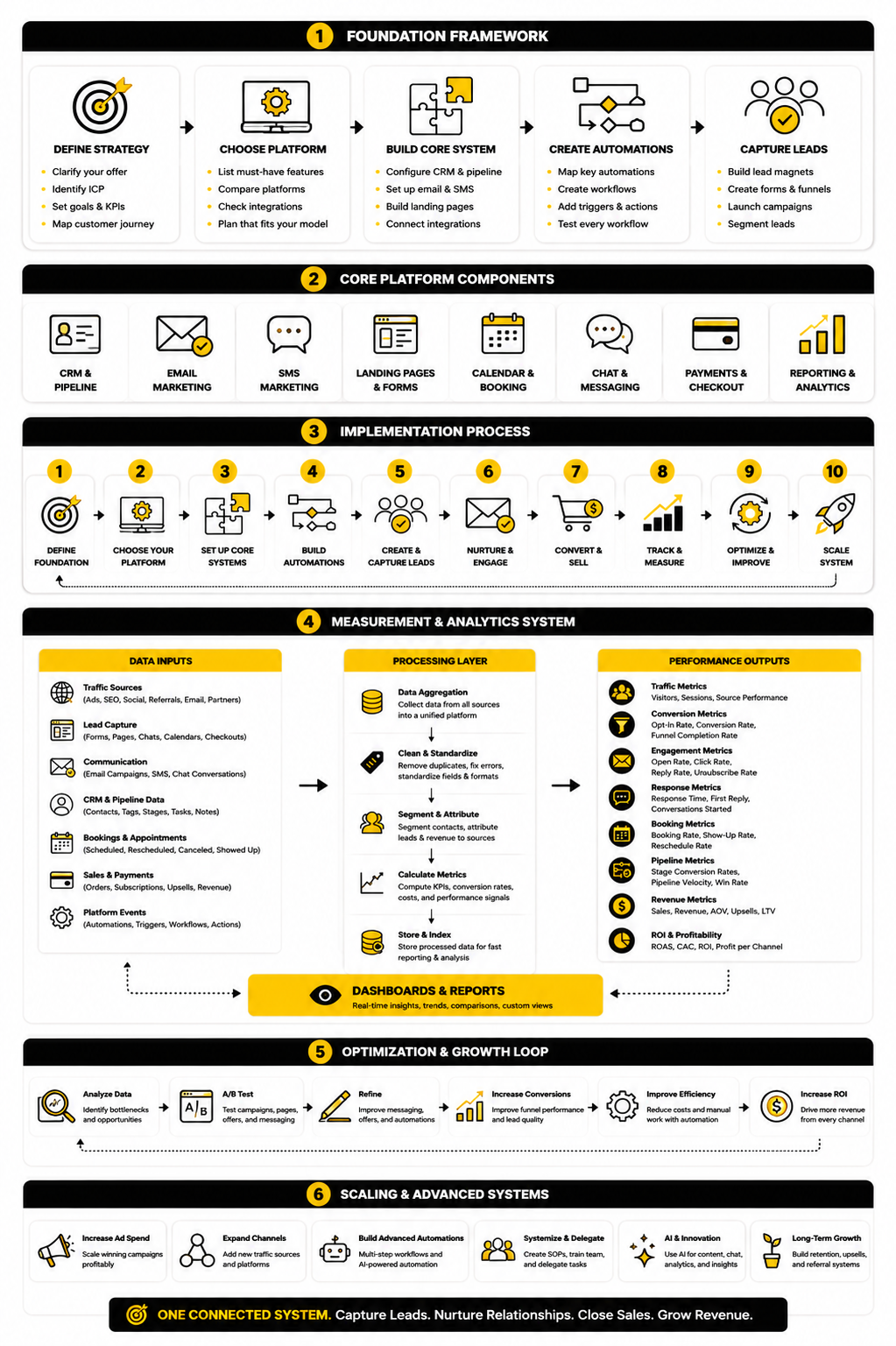
The Final Platform Checklist
Use this checklist before committing to any online marketing platform. It is not designed to make the decision complicated. It is designed to stop you from choosing a tool that looks good on a demo but fails inside your real business.
A good checklist should create focus. If a platform fails on the areas that matter most to your business model, do not ignore that because the demo looked exciting. The best online marketing platform is the one your team can run consistently and improve over time.
What Is An Online Marketing Platform?
An online marketing platform is software that helps a business manage digital marketing activities in one connected system. It can include landing pages, email campaigns, CRM, automations, forms, chat, calendars, sales pipelines, analytics, payments, and reporting. The exact feature set depends on the platform, but the goal is always the same: help the business turn attention into measurable customer action.
Why Does A Business Need An Online Marketing Platform?
A business needs an online marketing platform when marketing activity becomes too spread out to manage cleanly. If leads come from multiple channels, follow-up happens in different tools, and reporting is hard to trust, the business needs a more connected system. The platform helps reduce manual work, improve response speed, and make performance easier to understand.
What Is The Difference Between An Online Marketing Platform And A CRM?
A CRM mainly manages contacts, relationships, pipeline stages, and sales activity. An online marketing platform may include CRM features, but it usually covers more of the marketing journey, including pages, forms, automations, email, chat, analytics, and campaign workflows. For sales-led businesses, a CRM-centered platform like GoHighLevel can make sense because marketing and sales follow-up need to stay close together.
Is An All-In-One Platform Better Than Separate Tools?
An all-in-one platform is better when simplicity, speed, and connected data matter more than having the deepest specialist tool in every category. Separate tools can be better when a business has advanced needs in one area and the team can manage integrations properly. The right choice depends on execution capacity, not just feature depth.
Which Online Marketing Platform Is Best For Funnels?
For funnel-heavy businesses, ClickFunnels is often a natural option because it is built around landing pages, offers, checkout flows, upsells, and funnel testing. Systeme.io can also fit businesses that want a simpler all-in-one setup for funnels, email, and digital selling. The best choice depends on how complex the offer, checkout, and follow-up process needs to be.
Which Platform Is Best For Agencies Or Local Service Businesses?
Agencies and local service businesses often need CRM pipelines, calendars, lead follow-up, messaging, reputation workflows, client accounts, and reporting in one place. That is why GoHighLevel is commonly considered for this type of setup. The key is making sure the platform supports the full lead-to-sale process, not just campaign creation.
What Metrics Should An Online Marketing Platform Track?
The platform should track the numbers that show movement through the customer journey. That includes traffic source, conversion rate, lead quality, response speed, booking rate, show-up rate, pipeline movement, sales conversion, revenue, and customer retention. Email benchmarks such as the 2025 average open rate of 43.46% can provide context, but business decisions should be based on meaningful actions like clicks, replies, bookings, purchases, and revenue.
How Much Should A Business Spend On An Online Marketing Platform?
A business should judge platform cost against the value of better execution. The subscription price is only one part of the cost. Setup time, training, integrations, maintenance, reporting clarity, and missed opportunities also matter.
A cheaper platform may be enough if the customer journey is simple. A more advanced platform may be worth it if it reduces manual work, improves follow-up, and gives the team better control over revenue-producing activity.
How Do I Know If My Current Marketing Stack Is Too Complicated?
Your stack is probably too complicated if the team avoids using it, reports do not match, leads fall through gaps, automations break often, or nobody knows which tool is the source of truth. Another warning sign is when launching a simple campaign requires too many manual steps. Complexity is acceptable only when it produces better execution; otherwise, it is just drag.
Should AI Features Influence Platform Selection?
AI features should influence platform selection only when they support a real workflow. Useful AI can help summarize conversations, draft responses, speed up content creation, suggest next steps, support chat, and improve reporting. But AI should not distract from the basics: clean data, strong follow-up, clear offers, and reliable measurement.
How Important Is Email Marketing Inside An Online Marketing Platform?
Email is still important because it gives businesses a direct channel for nurturing leads, onboarding customers, promoting offers, and creating repeat engagement. The platform should make segmentation, automation, deliverability basics, and performance tracking easy to manage. Tools like Brevo and Moosend can be useful when email communication is a major part of the customer journey.
When Should A Business Use A Messaging Tool Like ManyChat?
A business should consider ManyChat when conversations on social platforms, Messenger, Instagram, WhatsApp, or automated chat flows play a major role in lead generation. It is especially useful when the customer journey starts with engagement instead of a traditional form submission. The important thing is to connect messaging workflows back to your broader CRM, follow-up, and reporting system.
What Is The Biggest Mistake When Choosing An Online Marketing Platform?
The biggest mistake is choosing based on features before understanding the business process. A platform can look powerful and still be wrong for your workflow. Start with the customer journey, define the minimum working system, then choose the platform that supports that process with the least friction.
How Often Should A Platform Setup Be Reviewed?
A platform setup should be reviewed whenever the business changes offers, traffic sources, sales process, team structure, or reporting priorities. At minimum, review core workflows every quarter. Check forms, automations, notifications, pipeline stages, reporting, consent settings, and data quality before small issues become serious operational problems.
Can One Online Marketing Platform Replace Every Tool?
Sometimes, but not always. One platform can replace many tools if the business needs standard pages, CRM, email, automation, calendars, chat, and reporting in one place. Specialist tools may still be useful for advanced ecommerce pages, social scheduling, AI chat, data extraction, or deeper analytics.
The right answer is not “one tool for everything” or “best tool for every task.” The right answer is a stack that is simple enough to manage and strong enough to support growth.
Build a stronger local presence with BAAM AI
Turn your website, Google profile, social channels, and AI visibility into one growth engine
Most businesses do not need more random marketing activity. They need a consistent presence system that helps the right people find them, trust them, and take action. BAAM AI brings strategy, local SEO, website updates, Google Maps visibility, social content, AI-search readiness, media production, and reporting into one practical monthly engine.
If you want your marketing to keep working after the campaign ends, start with a free BAAM AI presence audit. See how your business shows up today and where the fastest visibility wins are at BAAM AI.