
BAAM AI Blog
Online Marketing Help: A Practical Six-Part Guide For Building A System That Actually Works
Most people do not need more random marketing tips. They need online marketing help that turns scattered activity into a clear system: better positioning, sharper offers, useful content, reliable follow-up, and...
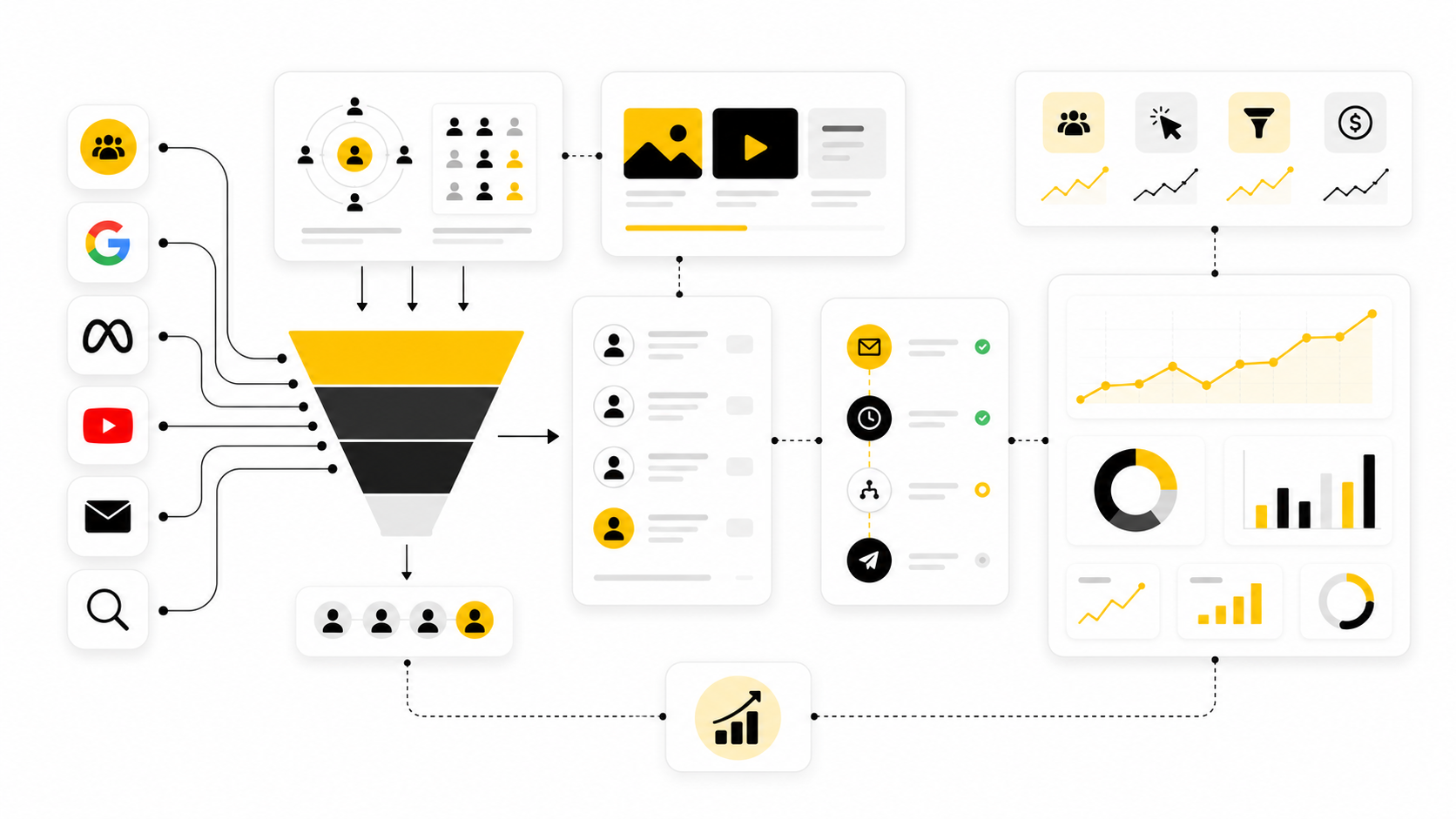
Most people do not need more random marketing tips. They need online marketing help that turns scattered activity into a clear system: better positioning, sharper offers, useful content, reliable follow-up, and measurement that shows what is actually working.
That matters because online marketing has become both easier and harder at the same time. The tools are more powerful, but the noise is louder. AI can speed up research, content, automation, and customer support, but it cannot fix a weak offer, unclear message, poor targeting, or a funnel that leaks trust at every step.
So this guide will not treat online marketing as a bag of hacks. It will walk through the practical structure behind a marketing system that can help a business attract the right people, convert attention into leads, and turn those leads into customers without depending on one platform, one campaign, or one lucky post.
The full article is split into six parts:
Why Online Marketing Help Matters More Than Ever
Online marketing used to feel simple from the outside: post content, run ads, collect leads, send emails, and make sales. In reality, those pieces only work when they support one another. A social post that attracts the wrong audience does not help much, an ad that sends traffic to a weak landing page burns money, and an email sequence with no clear offer quietly trains people to ignore you.
The bigger issue is that many businesses try to solve marketing problems at the wrong level. They think they need a better caption when they actually need clearer positioning. They think they need more traffic when they actually need a better conversion path. They think they need a new tool when they actually need a simple process for capturing, following up with, and learning from leads.
Good online marketing help gives you a way to see the whole system. It connects the promise you make, the audience you serve, the channels you use, the assets you build, and the numbers you track. That is where marketing starts becoming less emotional and more manageable.
The Online Marketing Framework That Keeps Everything Connected
A useful online marketing framework starts with one simple idea: every marketing activity should move a person from confusion to clarity, from awareness to trust, and from interest to action. That does not happen through one isolated tactic. It happens through a connected path.
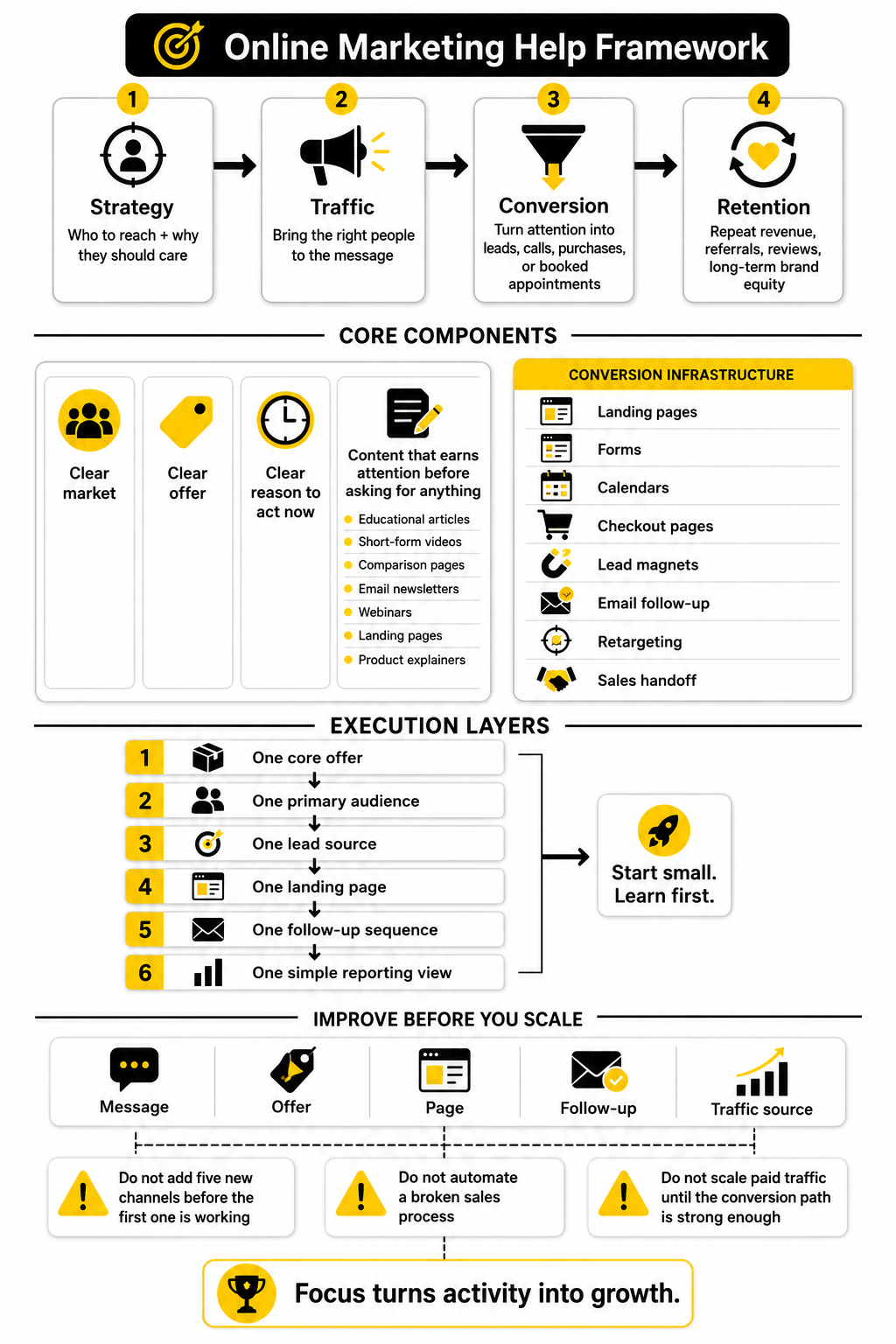
The framework in this guide has four practical layers: strategy, traffic, conversion, and retention. Strategy defines who you are trying to reach and why they should care. Traffic brings the right people into contact with your message. Conversion turns that attention into leads, calls, purchases, or booked appointments. Retention keeps the relationship alive so one customer can become repeat revenue, referrals, reviews, and long-term brand equity.
This is also where tools can help, but only when the basics are clear first. A platform like GoHighLevel can support CRM, funnels, automation, and follow-up in one place, while a tool like ManyChat can help turn social conversations into automated lead capture. But the tool is not the strategy. The tool should make the strategy easier to execute, not become a distraction from doing the hard thinking.
Core Components Of A Strong Online Marketing System
A strong online marketing system starts with a clear market, a clear offer, and a clear reason to act now. Without those three pieces, even good campaigns become fragile. You may still get clicks, impressions, or engagement, but the business result will usually feel inconsistent.
The next component is content that earns attention before asking for anything. This can include educational articles, short-form videos, comparison pages, email newsletters, webinars, landing pages, or product explainers. The format matters less than the job it performs: it should help the right person understand their problem, trust your perspective, and see your offer as a logical next step.
Then comes conversion infrastructure. That means landing pages, forms, calendars, checkout pages, lead magnets, email follow-up, retargeting, and sales handoff. For ecommerce teams, a landing page builder like Replo can support more focused campaign pages. For service businesses, booking and workflow tools can reduce friction between “I’m interested” and “I’m ready to talk.”
Professional Implementation Without Wasting Time Or Budget
Professional online marketing implementation is not about doing everything at once. That is how businesses end up with half-built funnels, abandoned newsletters, messy automation, and ad accounts full of tests nobody understands. The better move is to build the smallest complete system first.
A small complete system might include one core offer, one primary audience, one lead source, one landing page, one follow-up sequence, and one simple reporting view. That is enough to start learning. Once the numbers show where people are dropping off, you can improve the message, the offer, the page, the follow-up, or the traffic source with much less guessing.
This is where discipline matters. Do not add five new channels before the first one is working. Do not automate a broken sales process. Do not scale paid traffic until the conversion path is strong enough to handle it. Online marketing help is most valuable when it brings focus, because focus is usually what makes the difference between activity and growth.
The Online Marketing Framework That Keeps Everything Connected
The reason most marketing feels messy is simple: the pieces are not connected. Someone posts on social media without knowing what the next step should be. Someone builds a landing page without understanding where the traffic will come from. Someone sends emails without knowing what problem the reader is actively trying to solve.
That is why online marketing help should begin with structure, not tactics. The right framework turns marketing from a pile of activities into a sequence of decisions. Once you know what each part is supposed to do, you can improve the system without constantly starting over.
A practical framework has five layers:
Each layer has a different job. Positioning explains why the business is relevant. Audience defines who the message is for. Traffic creates discovery. Conversion turns attention into action. Retention turns one transaction or inquiry into a longer relationship.
Positioning Comes Before Promotion
Positioning is the foundation because it shapes everything else. If people do not quickly understand who you help, what you help them achieve, and why your approach is different, your marketing has to work much harder than it should. A weak position forces you to rely on discounts, pressure, or endless content volume.
Good positioning is specific enough to repel the wrong people. That is not a problem. It is the point. When your message is built for everyone, it usually lands with no one, because the reader cannot see themselves clearly inside the promise.
This is where many businesses need online marketing help before they touch ads, funnels, or automation. They need to sharpen the offer, simplify the message, and make the value obvious. Once that is clear, every channel becomes easier to use because the business is no longer trying to explain itself from scratch every time.
Audience Research Turns Guessing Into Direction
Audience research is not just about demographics. Age, location, income, and job title can help, but they rarely explain the emotional reason someone buys. Better research looks at the customer’s current frustration, desired outcome, buying objections, comparison criteria, and language.
The fastest way to improve your marketing is often to listen more carefully. Sales calls, support tickets, reviews, community discussions, search queries, and customer interviews can show you what people actually care about. This gives you stronger hooks, better offers, clearer landing pages, and more useful content.
The key is to separate what people say they want from what they need to believe before they take action. A prospect may say they want “more leads,” but underneath that they may want predictability, less dependence on referrals, or proof that growth is possible without hiring a large team. When your marketing speaks to that deeper layer, it starts feeling much more relevant.
Traffic Should Match Buyer Intent
Traffic is not automatically valuable. A thousand people who are curious but unqualified can create more noise than one hundred people who are actively looking for a solution. This is why a smart traffic strategy is built around intent, not vanity metrics.
Search traffic often captures people who already know they have a problem. Social content is better at creating demand, building familiarity, and staying visible before the buyer is ready. Paid ads can accelerate testing, but they expose weaknesses quickly if the offer, page, or follow-up is not strong enough.
A balanced traffic plan usually combines short-term and long-term channels. Paid campaigns can create speed, while search, email, partnerships, and content build durability. Tools like Buffer can help organize social publishing, but the real work is deciding what role each channel plays in the customer journey.
Conversion Is Where Trust Becomes Action
Conversion is not just a button, form, or checkout page. It is the moment where someone decides the next step feels worth it. That decision depends on clarity, trust, relevance, timing, and perceived risk.
A strong conversion path answers the questions people are already asking in their heads. Is this for me? Will it solve my problem? Can I trust this business? What happens after I submit the form or buy? What makes this better than the other options I am considering?
This is why landing pages, lead magnets, booking flows, and checkout pages need more than polished design. They need persuasive structure. A funnel builder like ClickFunnels can help create the flow, but the message still has to do the heavy lifting.
Retention Makes Marketing More Profitable
Most online marketing conversations obsess over acquisition. That makes sense because new leads and new customers are exciting. But retention is where marketing often becomes much more profitable.
Retention includes onboarding, email follow-up, customer education, review requests, referral prompts, community, upsells, renewals, and reactivation. These are not random extras. They are part of the marketing system because they influence lifetime value and reduce the pressure to constantly chase cold traffic.
This matters even more when acquisition costs rise or attention gets harder to earn. A business that keeps customers engaged has more room to test, improve, and grow. A business that loses people immediately after the first sale has to keep refilling the bucket forever.
Why The Framework Works Better Than Random Tactics
Random tactics feel productive because they give you something to do today. The problem is that they usually do not create a clear learning loop. You try a post, a campaign, a new tool, or a new email, but you cannot tell whether the issue was the audience, the message, the offer, the channel, or the follow-up.
A framework gives every test a place. If traffic is low, you know where to look. If traffic is strong but leads are weak, you examine the conversion path. If leads come in but sales do not close, you inspect qualification, trust, offer fit, and follow-up.
This is the practical value of online marketing help. It should not make marketing feel more complicated. It should make the next decision easier, because you can see which part of the system needs attention first.
Core Components Of A Strong Online Marketing System
Once the framework is clear, the next step is building the parts that make it real. This is where online marketing help becomes practical. You are no longer debating abstract strategy; you are deciding what assets, messages, workflows, and follow-up steps need to exist so a real person can move from first contact to confident action.
The mistake is trying to build a massive system before you have a working version. You do not need twenty lead magnets, five funnels, four newsletters, and ten ad angles on day one. You need one clean path that can attract the right person, explain the offer, capture interest, and continue the conversation.
That path should be simple enough to manage and strong enough to measure. When you can see where people arrive, what they click, where they hesitate, and when they convert, your marketing stops being a guessing game. This is the moment where execution starts to feel tangible.
Start With One Primary Offer
Your primary offer is the center of the system. It gives every campaign a destination and every piece of content a purpose. Without a clear offer, marketing turns into vague visibility, and vague visibility rarely creates consistent revenue.
A strong offer explains the outcome, the audience, the mechanism, and the next step. It should make the reader feel, “This is built for someone like me.” That does not mean the offer has to be complicated. In most cases, the best version is simpler, sharper, and easier to understand than what the business started with.
Before you build campaigns around the offer, stress-test it. Ask whether the outcome is specific, whether the value is believable, whether the risk feels low enough, and whether the next step is obvious. If any of those pieces are weak, fix the offer before you push more traffic toward it.
Build The First Complete Customer Path
A customer path is the sequence someone follows from discovering you to taking action. For a service business, that path might run from a short-form video to a landing page, then to a booking form, then to a consultation follow-up sequence. For an ecommerce brand, it might run from an ad or creator post to a product landing page, then to checkout, post-purchase education, and a retention campaign.
The point is not to copy another business’s funnel. The point is to remove unnecessary friction for your buyer. A person should not have to hunt for the next step, decode what you sell, or wonder what happens after they submit their information.
A first complete path can be built with just a few assets:
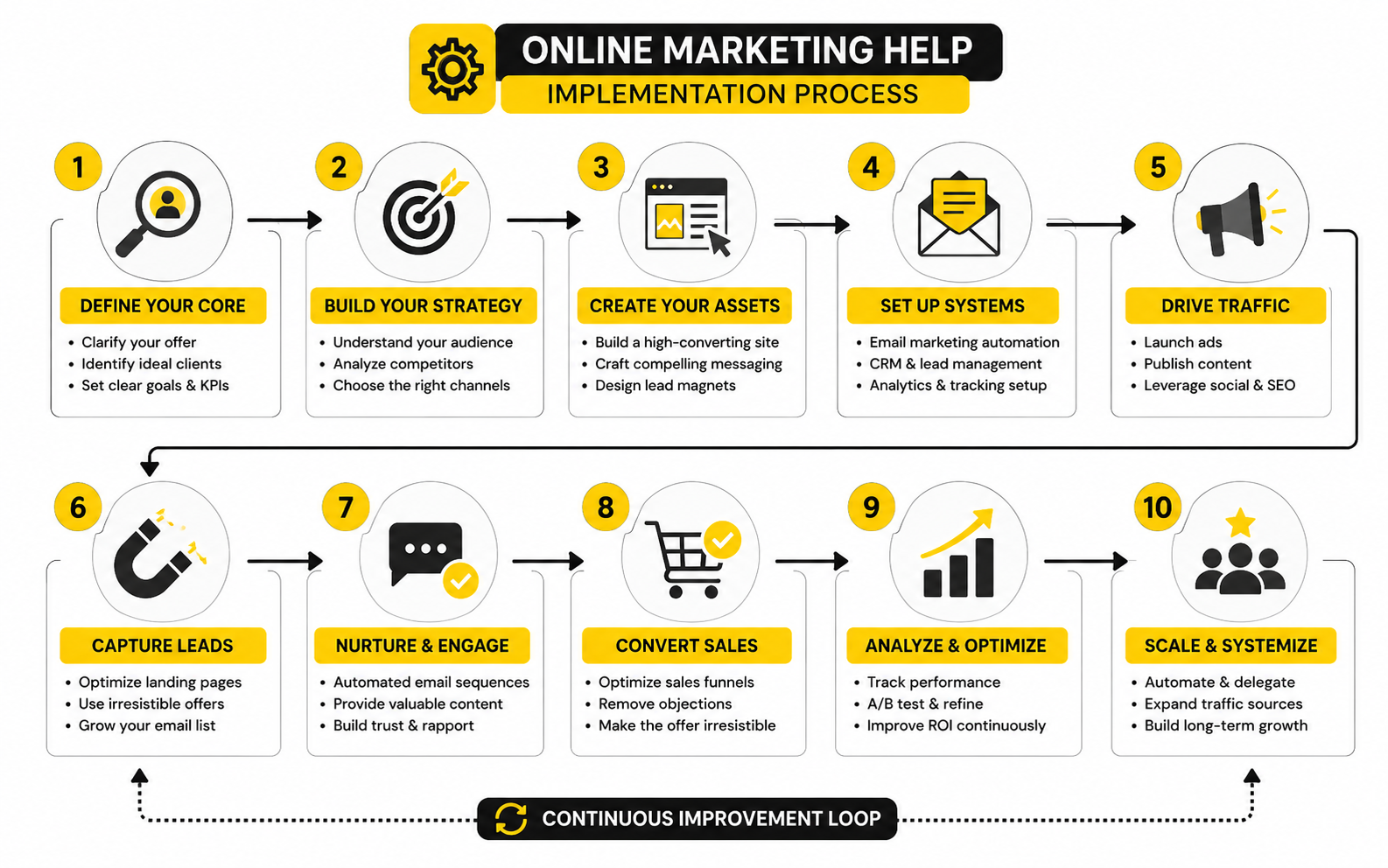
This is where tools should serve the workflow. If you want an all-in-one setup for funnels, CRM, booking, and follow-up, GoHighLevel can make sense. If your focus is launching a clean sales funnel quickly, ClickFunnels or Systeme.io can support that flow. The important thing is to choose based on the process you are building, not because a tool looks exciting.
Create Content For Each Stage Of Awareness
Content should not all do the same job. Some content introduces the problem. Some content explains the cost of inaction. Some content compares options. Some content builds trust before the buyer is ready to contact you.
This is why a serious content plan needs stages. Early-stage content helps people understand what is happening and why it matters. Middle-stage content helps them evaluate approaches, mistakes, timelines, and trade-offs. Late-stage content helps them compare solutions, understand your offer, and take the next step with less hesitation.
A useful content mix might include:
The goal is not to publish more for the sake of publishing. The goal is to make sure your best prospects can find answers at the moment they need them. That is a much better use of content than chasing every trend until the strategy becomes unrecognizable.
Set Up Follow-Up Before You Chase More Leads
Lead generation without follow-up is one of the most expensive mistakes in online marketing. People get busy, distracted, skeptical, or simply not ready yet. If your system only works when someone buys or books immediately, it is leaving money on the table.
Follow-up should begin the second someone takes an action. That might mean a welcome email, a confirmation message, a reminder, a useful resource, or a clear explanation of what happens next. It should feel helpful, not desperate.
Email platforms like Brevo and Moosend can support newsletters and automated sequences, but the real advantage comes from writing follow-up that matches buyer intent. Someone who downloaded a checklist does not need the same sequence as someone who requested pricing. Treating every lead the same is easy, but it is rarely the strongest move.
Make Measurement Part Of The Build
Measurement should not be added after everything launches. It should be part of the implementation process from the beginning. Otherwise, you end up with campaigns that are technically live but practically impossible to judge.
You do not need a complicated dashboard at the start. You need to know where traffic comes from, how many people reach the conversion page, how many take action, how many leads are qualified, and how many turn into real opportunities or sales. Those numbers reveal where the system needs work.
This matters because marketing data can easily become decorative. Impressions, likes, open rates, and clicks can be useful, but only when they connect to business outcomes. If a metric does not help you make a better decision, it should not dominate the conversation.
Improve The System In A Fixed Order
When results are weak, most people immediately look for a new channel. That is usually premature. A poor result may have nothing to do with the channel and everything to do with the offer, page, targeting, or follow-up.
A better improvement order looks like this:
This order protects you from scaling confusion. It also keeps your budget safer because you are not constantly paying to send more people into a broken path. Good online marketing help should make this discipline easier, because the goal is not more activity; the goal is a system that gets sharper every week.
Statistics And Data That Actually Help You Make Better Decisions
Data is useful only when it changes what you do next. That sounds obvious, but plenty of businesses collect marketing numbers like decoration. They look at impressions, clicks, followers, open rates, and traffic charts, then still cannot answer the basic question: what should we improve this week?
This is where online marketing help should become brutally practical. The goal is not to drown in dashboards. The goal is to understand which signals show demand, which signals show friction, which signals show trust, and which signals show revenue potential.
Benchmarks can help, but they are not rules. A landing page that converts below a general benchmark may still be profitable if the lead quality is excellent and the average deal size is high. A campaign with a strong click-through rate may still be a failure if those clicks never become qualified leads, booked calls, orders, or retained customers.
Benchmarks Are Starting Points, Not Targets
A benchmark tells you what is normal in a broad market, not what is right for your business. For example, the median landing page conversion rate is around 6.6% across all industries, based on Unbounce’s analysis of hundreds of millions of visits and tens of millions of conversion actions. That number is useful, but it becomes dangerous when people treat it like a universal goal.
A simple lead magnet page may convert far above that. A high-ticket consultation page may convert far below it and still be performing well. The more expensive, complex, or trust-heavy the decision is, the more context you need before judging the number.
The more carefully move is to compare each asset against its own purpose. A webinar registration page, product page, booking page, checkout page, and newsletter signup form should not be judged by the same standard. Each one needs a benchmark that fits the traffic source, buyer intent, offer type, and level of commitment.
The Metrics That Matter Most
The best marketing dashboard is usually smaller than people think. You need enough data to see the journey from attention to revenue, but not so much that the important signals get buried. For most businesses, five categories are enough to start.
Track these first:
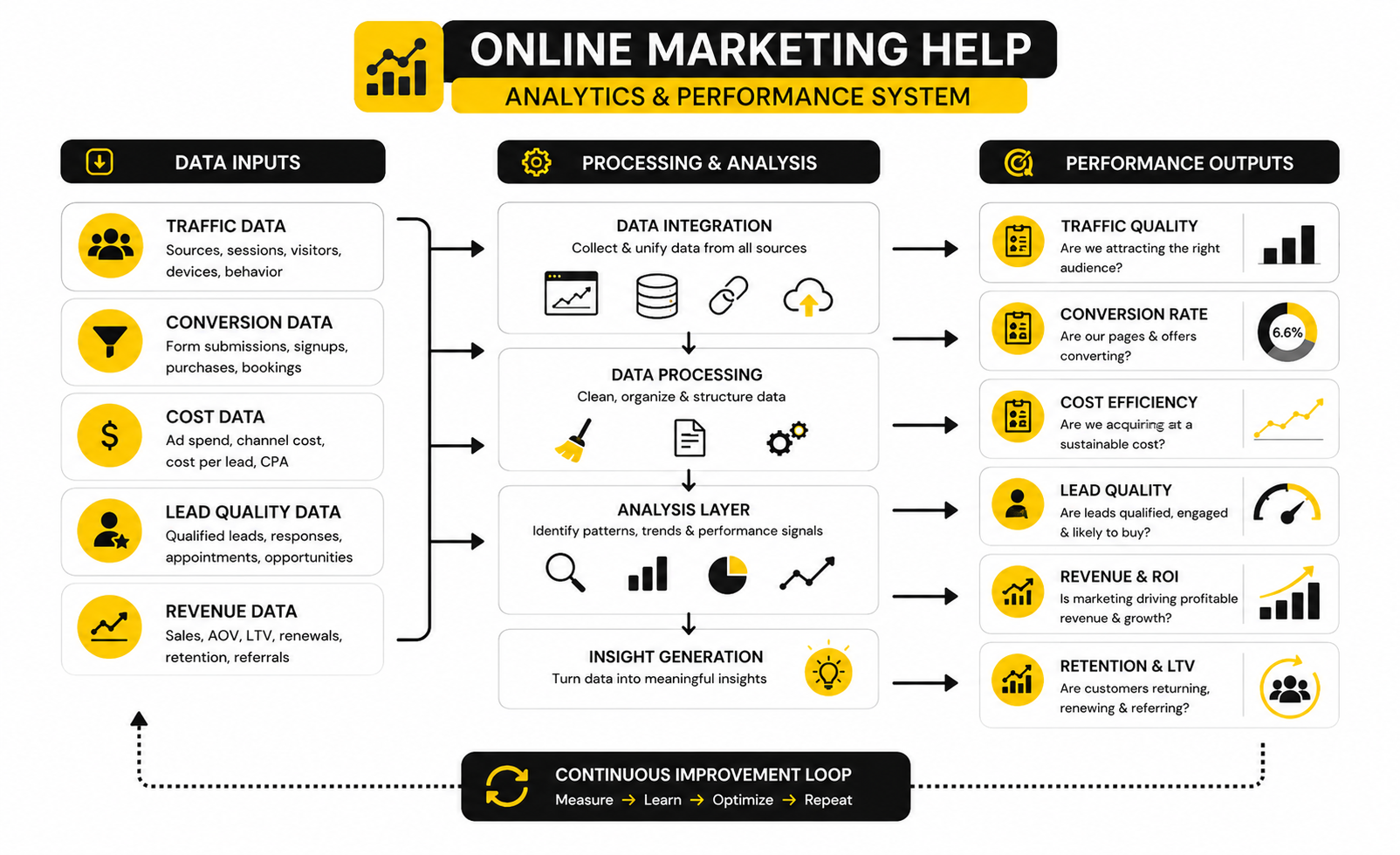
This is the analytics system in plain English: traffic tells you whether people are arriving, conversion tells you whether the page is persuasive, cost tells you whether the channel is efficient, lead quality tells you whether the targeting is right, and revenue tells you whether the whole thing deserves more investment. Miss one of those layers and the picture gets distorted.
Paid Traffic Numbers Need Revenue Context
Paid traffic can create fast feedback, but it can also create fast confusion. A campaign can look expensive at the click level and still work if the conversion rate and customer value are strong. Another campaign can look cheap and still be useless if it attracts people who never buy.
Search advertising benchmarks show why context matters. In 2025, Google Ads data across more than 16,000 campaigns showed an average cost per lead of $70.11, while the average conversion rate across Google Ads was reported around 7.52%. Those are helpful reference points, but they do not tell you whether your campaign is healthy by themselves.
A $70 lead can be terrible for a low-margin product and excellent for a service that closes into a $5,000 engagement. That is why cost per lead should never be judged alone. The real question is whether the lead becomes pipeline, whether the pipeline becomes revenue, and whether the revenue is worth the acquisition cost.
Conversion Rates Reveal Friction, Not The Whole Truth
Conversion rate is one of the most useful numbers in online marketing, but it is also one of the easiest to misread. A low conversion rate may mean the page is unclear. It may also mean the traffic is too cold, the offer asks for too much commitment, or the audience is not ready.
Ecommerce makes this especially clear. Broad ecommerce conversion benchmarks often sit around the low single digits, with recent summaries placing global averages roughly between 1.6% and 3.0%. That range can look discouraging until you remember that product type, price, device, source, seasonality, trust, shipping, checkout experience, and brand familiarity all affect the result.
So do not panic when a number looks low. Diagnose it. If people land on the page and leave quickly, the message may be wrong. If they engage but do not click, the offer or call to action may be weak. If they start checkout but abandon, the issue may be price clarity, shipping cost, payment friction, or trust.
Email Metrics Should Be Read By Intent
Email is still one of the most valuable marketing channels because it gives you a direct line to people who already raised their hand. But email reporting gets sloppy when teams obsess over open rates and ignore what happens after the click. Opens can show subject-line pull and list engagement, but they do not prove business impact.
The better question is what each email is supposed to accomplish. A welcome email should confirm the relationship and guide the next step. A nurture email should build belief and reduce hesitation. A sales email should create action from the right segment, not pressure everyone on the list equally.
Email ROI remains strong for many businesses, with Litmus reporting that email returns commonly fall between 10:1 and 36:1. That does not mean every newsletter is automatically valuable. It means email deserves serious attention when the list is clean, the segmentation is thoughtful, the message is relevant, and the follow-up connects to a real offer.
Lead Quality Beats Lead Volume
Lead volume feels good because it is easy to count. Lead quality matters more because it is tied to revenue. A campaign that produces 300 weak leads can waste more time than a campaign that produces 30 strong ones.
This is why every lead source should be judged beyond the form submission. Track whether people reply, book, attend, qualify, ask serious questions, request pricing, buy, renew, or refer. Those signals tell you whether the campaign is attracting buyers or just collecting names.
A simple lead quality review can change everything. If one channel produces cheaper leads but poor close rates, it may need tighter targeting or a different offer. If another channel produces fewer leads but stronger opportunities, it may deserve more budget even if the top-line numbers look smaller.
The Right Reporting Rhythm
Marketing data should be reviewed at different speeds. Some numbers are useful daily, some weekly, and some monthly. Reviewing everything every day creates anxiety and bad decisions, especially when a campaign has not collected enough data to show a reliable pattern.
Daily checks should focus on obvious problems: broken links, tracking errors, budget spikes, form failures, checkout issues, or campaigns spending without traffic. Weekly reviews should look at movement across traffic, conversion, lead quality, and cost. Monthly reviews should connect marketing performance to revenue, retention, and strategic priorities.
This rhythm keeps you from overreacting. A slow day does not mean the strategy is broken. A strong day does not mean the system is ready to scale. Good online marketing help gives you the patience to read the pattern before changing the plan.
What The Numbers Should Make You Do
Every metric should connect to an action. If traffic is low but conversion is strong, you may need better distribution or more budget. If traffic is strong but conversion is weak, the page, offer, or audience match needs attention. If leads are cheap but unqualified, targeting and messaging are probably too broad.
If leads are qualified but sales are slow, the issue may be follow-up speed, trust, pricing clarity, or the sales conversation. If customers buy once but do not return, retention needs more attention. The point is to locate the constraint instead of blaming the entire marketing system.
This is the difference between reporting and optimization. Reporting tells you what happened. Optimization helps you decide what to do next. When your analytics are set up that way, marketing becomes calmer, sharper, and much easier to improve.
Tools, Automation, And Optimization For more carefully Growth
After the core system is built and the numbers are readable, the next question is not “What else can we add?” The better question is “What should we improve, automate, or scale without making the system fragile?” This is where online marketing help becomes more strategic, because growth creates new problems that basic setup work does not solve.
More traffic means more data, but it also means more waste if the offer is still unclear. More automation means more speed, but it also means mistakes can reach more people faster. More content means more visibility, but it can also dilute the message if every piece is created without a clear role.
Advanced marketing is not about complexity for its own sake. It is about choosing the right tradeoffs. The business has to decide what should stay human, what should become automated, what should be tested, and what should be left alone because it is already working.
Automation Should Remove Friction, Not Responsibility
Automation is powerful when it handles repetitive steps that slow the business down. Lead routing, appointment reminders, welcome sequences, abandoned checkout messages, review requests, and basic segmentation can all make the customer journey smoother. These are good uses of automation because they support momentum without pretending the customer is just a data point.
The danger is automating before the message is proven. A weak email sequence does not become better because it sends automatically. A bad offer does not become more persuasive because it is placed inside a workflow. Automation multiplies whatever already exists, so the system needs to be useful before it becomes scalable.
A practical way to approach automation is to map the moments where people commonly get stuck. Do leads forget to book? Send a reminder. Do customers ask the same onboarding questions? Send a clear post-purchase sequence. Do prospects disappear after requesting information? Build a follow-up path that helps them make a decision without feeling chased.
AI Can Speed Up Work, But It Cannot Replace Judgment
AI is now part of modern online marketing, and ignoring it is not a serious strategy. It can help with research, outlines, ad variations, email drafts, customer support, content repurposing, personalization, and data analysis. Used well, it gives marketers more speed and more surface area for testing.
But AI is not a substitute for market understanding. It does not automatically know your customer’s pain, your offer’s real advantage, your brand voice, or the hidden reasons people hesitate before buying. If you feed it weak inputs, it will produce polished but shallow outputs.
Use AI like a sharp assistant, not a replacement brain. Let it help you generate options, summarize patterns, draft first versions, and spot gaps. Then bring human judgment back into the process, because strategy still depends on context, empathy, taste, and commercial reality.
Personalization Needs Boundaries
Personalization can improve relevance, but only when it feels helpful. A visitor who sees content based on their interests may appreciate the smoother experience. A prospect who feels watched, over-targeted, or manipulated may lose trust before the sale even begins.
That line matters more as marketing tools become more capable. Businesses can segment by behavior, source, interest, lifecycle stage, purchase history, and engagement level. The question is not just whether they can do it. The question is whether the personalization improves the experience in a way the customer would understand and accept.
A healthy personalization strategy starts with first-party data. That means information people give you directly through forms, purchases, preferences, conversations, and engagement. It is usually more useful, more durable, and more trust-friendly than trying to stitch together a buyer profile from questionable signals.
Scaling Requires A Stronger Operating Rhythm
Scaling is not simply spending more money. It means the business can handle more attention, more leads, more orders, more questions, more support needs, and more decision points without the quality falling apart. Many marketing systems break not because demand is too low, but because the business is not ready for demand to rise.
Before scaling, check the operational basics. Can leads be contacted quickly? Can appointments be booked without confusion? Can sales conversations be tracked? Can customers receive what they bought without delay? Can support questions be answered before they turn into complaints?
This is where a CRM and workflow platform can become valuable. For service businesses, agencies, coaches, consultants, and local businesses, GoHighLevel can help centralize pipelines, automations, calendars, and follow-up. The point is not to buy software because it has many features; the point is to protect the customer experience as volume increases.
Channel Expansion Should Be Earned
Adding a new marketing channel feels exciting because it creates the illusion of growth. New platform, new content format, new campaign type, new audience. But if the first channel is not understood yet, adding another one often creates more confusion.
A business earns the right to expand when it knows why the current channel works. It understands the audience, the offer angle, the conversion path, the follow-up, and the economics. Then a second channel can be added with intention instead of hope.
The right expansion path depends on the business model. A high-ticket service may move from organic content into paid retargeting, webinars, or appointment funnels. An ecommerce brand may move from paid social into search, influencer content, email segmentation, or dedicated landing pages built with a tool like Replo. A creator-led business may expand from social into email, community, digital products, or automated conversation flows through ManyChat.
Testing Should Be Focused, Not Random
Testing is essential, but random testing is just guessing with extra steps. Changing the headline, offer, creative, audience, price, and landing page all at once may produce a different result, but it will not teach you much. You need cleaner tests if you want better decisions.
A focused test starts with one question. Are people responding to the promise? Are they clicking but not converting? Are qualified leads dropping before the call? Are buyers hesitating at checkout? Each question points to a different test.
The best tests are tied to a business constraint. If the constraint is low qualified traffic, test audience and message. If the constraint is weak conversion, test page structure and offer clarity. If the constraint is poor retention, test onboarding and post-purchase communication.
Tool Stacks Should Stay Lean
A messy tool stack creates hidden costs. You pay for overlapping subscriptions, waste time moving data between platforms, and lose visibility because every system shows a different version of the truth. That is not professional implementation. That is operational drag.
A lean stack should cover the essentials without turning every task into a software project. At minimum, most businesses need a place to manage contacts, publish or distribute content, capture leads, send follow-up, schedule conversations, process purchases, and review performance. Anything beyond that should earn its place.
This is why tool choice should follow workflow design. If email is the main relationship channel, choose the platform that supports segmentation and reliable delivery. If sales calls drive revenue, prioritize CRM, booking, reminders, and pipeline tracking. If funnels are central to acquisition, a dedicated funnel platform like ClickFunnels may be more useful than stitching together too many small tools.
The Biggest Scaling Risk Is Losing The Human Signal
As marketing systems grow, teams often drift away from the customer. They look at dashboards, automations, and campaign reports, but stop listening to sales calls, support questions, reviews, objections, and comments. That is a problem because the strongest optimization ideas often come from human language, not charts.
Numbers show where something is happening. Customer language often explains why it is happening. When those two inputs are combined, marketing gets sharper fast.
So keep a feedback loop alive. Review real conversations. Save strong objections. Track the exact words buyers use before they purchase. The more advanced the system becomes, the more important it is to stay close to the people it is supposed to serve.
Expert Online Marketing Help Creates Better Constraints
The best online marketing help does not encourage a business to do everything. It creates better constraints. It helps choose the offer, the audience, the channel, the message, the workflow, and the next test with more discipline.
That discipline is what keeps growth from turning chaotic. You do not need every tactic. You need the right few moves executed properly, measured honestly, and improved consistently.
This is the expert-level shift. Beginners ask, “What can we try?” Strong operators ask, “What is the highest-leverage constraint in the system right now?” Once you start thinking that way, online marketing becomes much less noisy and much more profitable.
Measurement, Mistakes, And Frequently Asked Questions
A complete online marketing system should feel like an ecosystem, not a pile of disconnected campaigns. The offer, audience, traffic, conversion path, follow-up, automation, and reporting should all support the same business goal. When one part changes, the rest of the system should be reviewed so the customer journey still makes sense.
This is also where the best online marketing help becomes less about adding more and more about protecting clarity. A mature system does not chase every trend. It improves the customer path, removes waste, and makes better decisions from real signals.
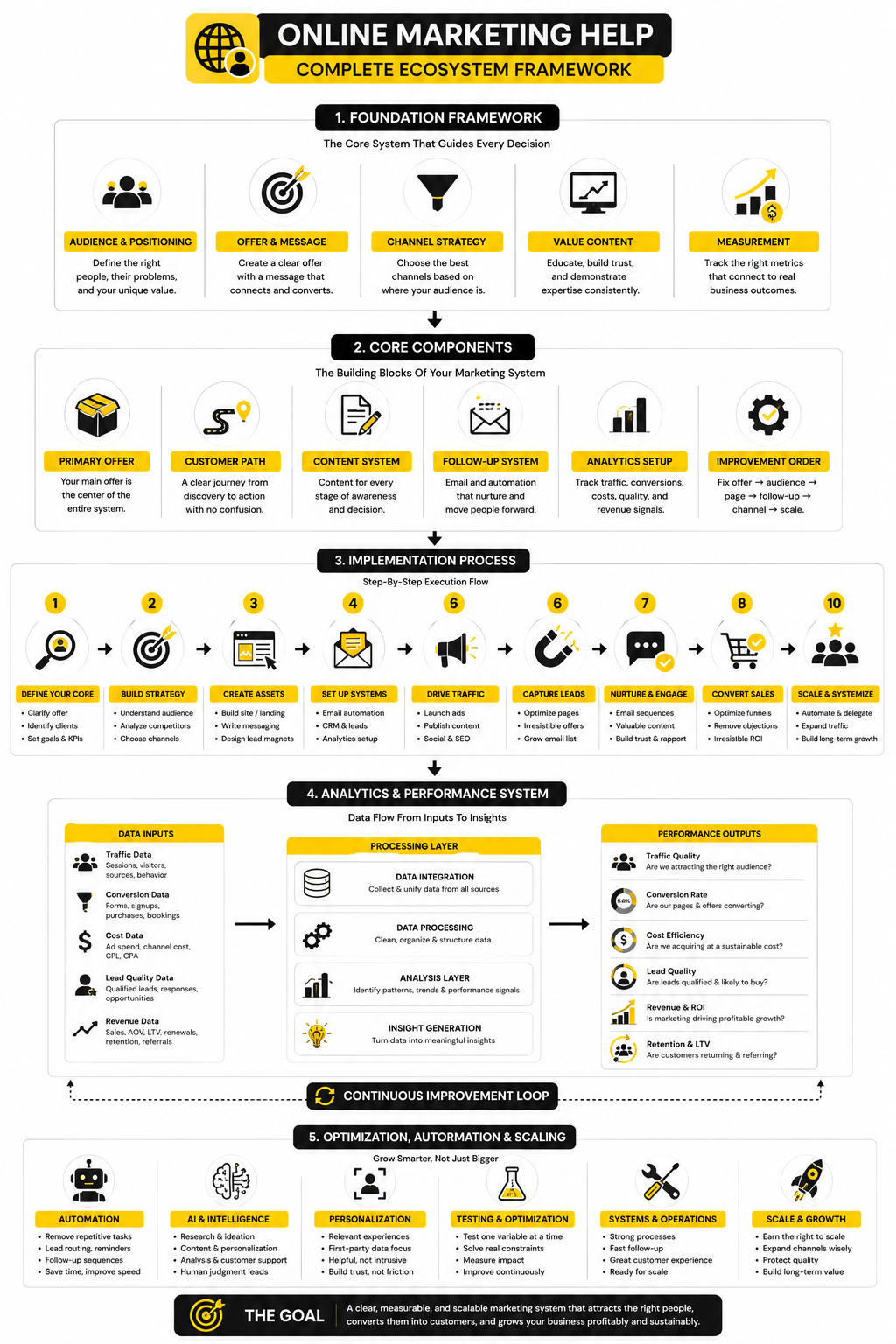
The final step is knowing what to avoid, what to clarify, and when to bring in support. Most businesses do not fail at online marketing because they lack effort. They fail because the effort is scattered, the message is unclear, the follow-up is weak, or the numbers are interpreted without context.
Common Mistakes That Slow Down Growth
The first major mistake is building around tools instead of strategy. A funnel builder, CRM, email platform, automation tool, or AI assistant can make execution faster, but none of them can rescue an unclear offer. When the message is weak, better software usually just spreads the weak message more efficiently.
The second mistake is judging campaigns too early. Marketing needs enough data to show a pattern, especially when traffic volume is low or the buying cycle is long. Reacting to every short-term movement creates constant changes, and constant changes make it harder to learn what actually worked.
The third mistake is ignoring follow-up. Many people who are interested today will not act today. A serious system keeps the relationship alive with useful reminders, relevant education, clear next steps, and timely offers instead of assuming every visitor will convert immediately.
When To Get Online Marketing Help
You should consider getting online marketing help when you are doing a lot of activity but cannot clearly explain what is driving results. That usually means the system needs diagnosis, not just more effort. A professional can help separate traffic problems from offer problems, conversion problems from targeting problems, and reporting problems from actual performance problems.
It also makes sense to get help when growth has stalled. Sometimes the business already has an audience, traffic, and customers, but the next level requires better segmentation, stronger automation, improved positioning, or a more disciplined testing process. That is not beginner work, and guessing can get expensive.
The best support should make the system easier to understand, not more confusing. You want someone who can look at the whole path, identify the constraint, and help you decide what to fix first. That is the difference between useful online marketing help and another round of random tactics.
What Is Online Marketing Help?
Online marketing help is support with the strategy, setup, execution, and improvement of digital marketing activities. It can include positioning, content, SEO, paid ads, funnels, email, automation, analytics, and conversion optimization. The best help does not just add tasks; it makes the whole system work together.
Who Needs Online Marketing Help?
Business owners, freelancers, agencies, ecommerce brands, creators, consultants, coaches, and local service providers can all benefit from online marketing help. The need usually appears when marketing feels inconsistent, unclear, or difficult to measure. If you are spending time or money on marketing but cannot confidently explain what is producing results, you probably need a better system.
What Should I Fix First In My Online Marketing?
Start with the offer and audience before changing channels. If the offer is unclear or the audience is too broad, traffic will not solve the problem. Once those pieces are sharp, improve the landing page, follow-up, and measurement before scaling spend or adding new platforms.
Is Online Marketing Better Than Traditional Marketing?
Online marketing is easier to track, test, and adjust than many traditional channels. It also gives smaller businesses access to search, social, email, automation, and paid traffic without needing a massive media budget. That said, traditional marketing can still work when it fits the audience and supports the broader customer journey.
How Long Does Online Marketing Take To Work?
The timeline depends on the channel, offer, budget, audience, and buying cycle. Paid campaigns can produce faster feedback, while SEO, content, email, and brand-building usually take longer to compound. The important thing is to measure progress by the right signals instead of expecting every channel to behave the same way.
What Is The Most Important Part Of Online Marketing?
The most important part is message-market fit. If the right people understand the problem, believe the promise, and trust the offer, every tactic becomes easier. Without that fit, even strong design, automation, and paid traffic can struggle.
Do I Need A Funnel For Online Marketing?
You need a clear customer path, whether you call it a funnel or not. People should know what you offer, why it matters, what to do next, and what happens after they take action. A tool like ClickFunnels, Systeme.io, or GoHighLevel can help build that path, but the strategy behind it matters more than the platform.
How Much Should I Spend On Online Marketing?
Your budget should match your goals, margins, current conversion rate, and ability to follow up with leads. A small budget can work if the offer is focused and the system is measured carefully. A large budget can disappear quickly if the campaign sends traffic into a weak page, unclear offer, or poor sales process.
Should I Focus On SEO, Paid Ads, Social Media, Or Email?
Choose based on the buyer journey, not personal preference. SEO works well when people actively search for the problem or solution. Paid ads help test and scale faster when the economics make sense. Social media builds attention and trust, while email helps convert and retain people who already showed interest.
Can AI Replace Online Marketing Professionals?
AI can speed up research, writing, analysis, segmentation, support, and content repurposing. It cannot fully replace judgment, positioning, customer insight, creative taste, or strategic decision-making. The strongest results usually come from combining AI speed with human experience.
What Metrics Should I Track First?
Start with traffic source, conversion rate, cost per lead or acquisition, lead quality, sales outcome, and retention. These numbers show whether people are arriving, taking action, becoming qualified, buying, and staying engaged. Avoid building a massive dashboard before you can clearly explain what each metric should make you do.
What Is The Biggest Online Marketing Mistake?
The biggest mistake is trying to scale before the system is ready. More traffic will not fix a weak offer, unclear page, poor follow-up, or broken sales process. Scaling works best after the core path is proven, measured, and stable enough to handle more volume.
How Do I Know If My Online Marketing Is Working?
Your marketing is working when it creates qualified attention, moves people toward action, and produces business outcomes at a cost you can justify. That does not always mean every campaign is profitable immediately. It means the system is teaching you what to improve and creating a path toward reliable growth.
Should I Hire An Agency Or Do It Myself?
Doing it yourself can work when the system is simple and you have time to learn, execute, and measure. Hiring help makes more sense when mistakes are becoming expensive, growth is stuck, or the business needs specialized skills. The right choice depends on your budget, urgency, internal capacity, and how complex the marketing system needs to be.
Build a stronger local presence with BAAM AI
Turn your website, Google profile, social channels, and AI visibility into one growth engine
Most businesses do not need more random marketing activity. They need a consistent presence system that helps the right people find them, trust them, and take action. BAAM AI brings strategy, local SEO, website updates, Google Maps visibility, social content, AI-search readiness, media production, and reporting into one practical monthly engine.
If you want your marketing to keep working after the campaign ends, start with a free BAAM AI presence audit. See how your business shows up today and where the fastest visibility wins are at BAAM AI.