
BAAM AI Blog
Online Marketing For Dentists: A Practical Growth Framework For Modern Dental Practices
Online marketing for dentists is no longer just about having a website, posting occasionally on social media, or running a few ads when the schedule feels light. Patients now compare practices before they ever call...
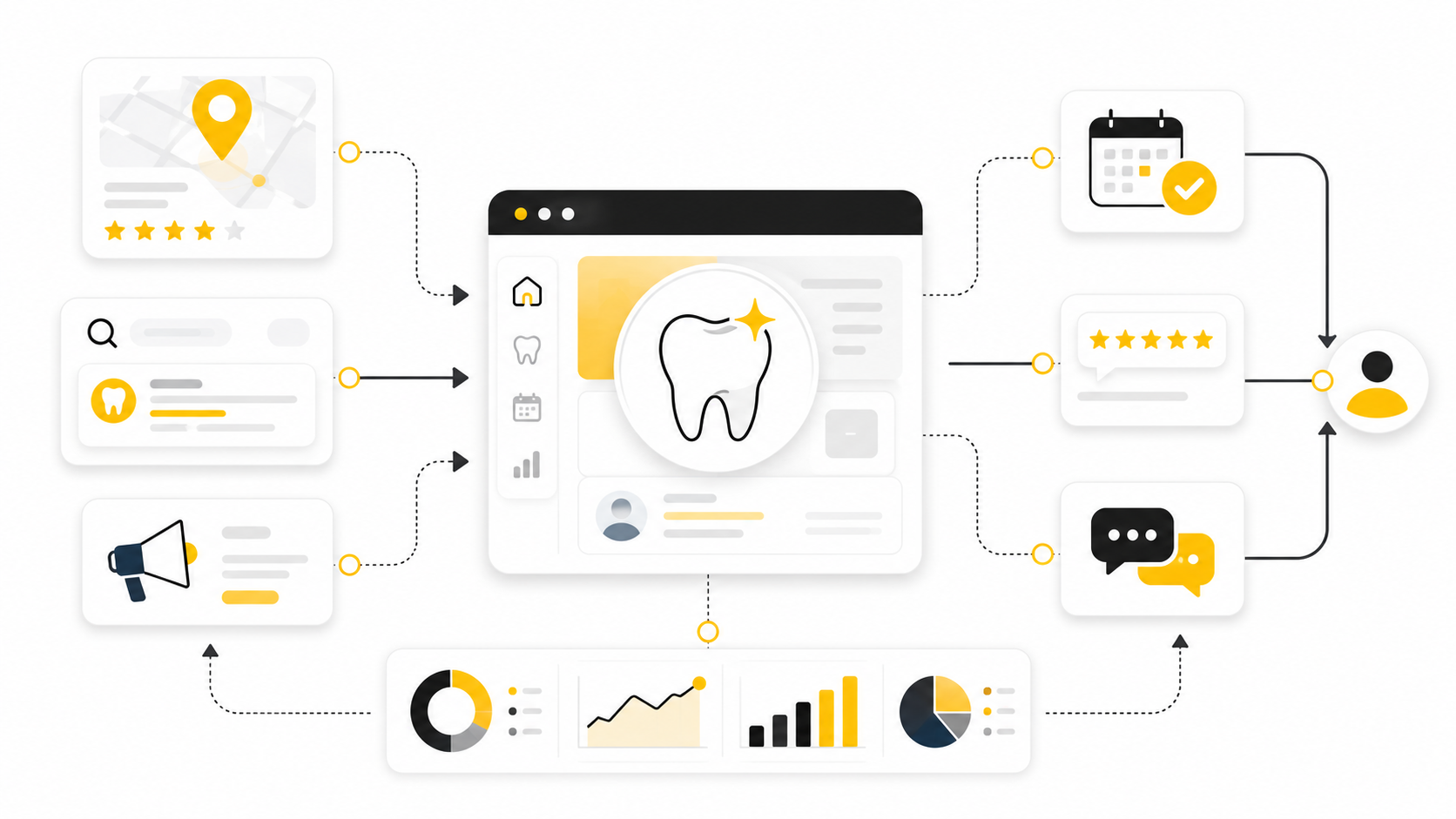
Online marketing for dentists is no longer just about having a website, posting occasionally on social media, or running a few ads when the schedule feels light. Patients now compare practices before they ever call, and they usually do it across search results, reviews, maps, websites, social profiles, and booking pages. That means your marketing has to work as one connected system, not as a pile of disconnected tactics.
The goal is simple: help the right patients find you, trust you, contact you, and show up. That sounds obvious, but it is where many dental practices lose money. They invest in traffic without fixing conversion, ask for reviews without managing reputation, or build a beautiful website that does not clearly move someone toward an appointment.
this guide breaks online marketing for dentists into a practical six-part framework. It is written for dental owners, practice managers, and marketing teams who want steady patient growth without turning the practice into a gimmicky lead-generation machine. The focus is on what actually supports long-term growth: local visibility, trust, conversion, follow-up, measurement, and professional execution.
Why Online Marketing Matters For Dentists
Dental care is local, personal, and trust-heavy. A patient is not choosing a random product from a shelf; they are choosing someone who may handle pain, anxiety, appearance, cost, and long-term health. That is why online marketing for dentists has to do more than create awareness. It has to reduce doubt.
Most patients start with a practical need. They may search for a dentist near them, compare emergency availability, check reviews, look at before-and-after photos, or scan a website to see whether the practice feels professional and approachable. If the practice looks unclear, outdated, slow to respond, or hard to contact, the patient may never say anything. They simply choose someone else.
The pressure is also rising because dental practices are dealing with real business constraints. Staffing, insurance pressure, and overhead costs remain major concerns across the industry, and the American Dental Association’s Health Policy Institute continues to track how those pressures affect practice performance. Better marketing cannot fix every operational issue, but it can help practices attract the right patients more predictably and make better use of the demand that already exists.
The Dental Marketing Growth Framework
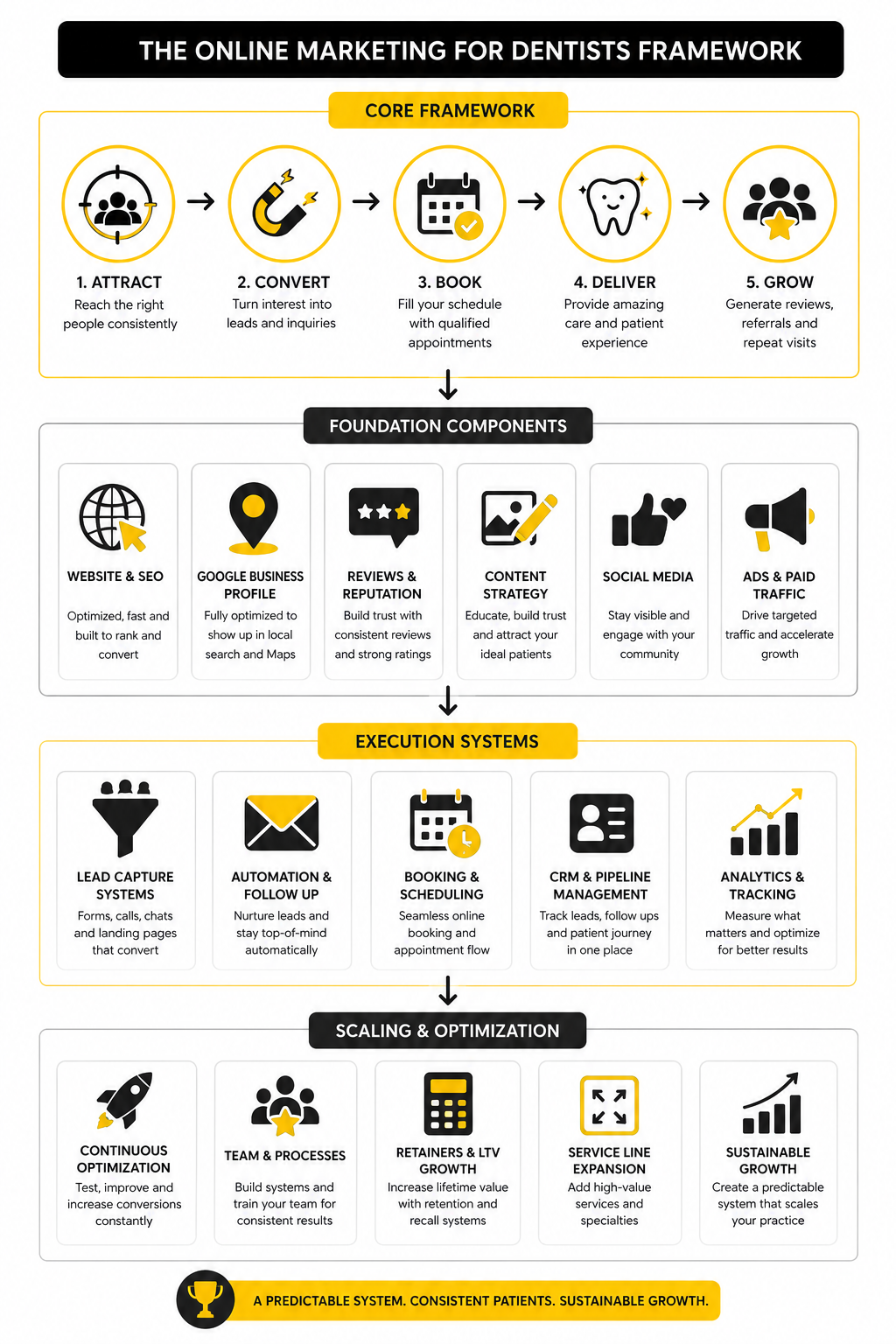
A strong dental marketing system has four jobs. It must make the practice visible, make the practice credible, make the next step easy, and make follow-up consistent. When one of those pieces is weak, the whole system leaks.
Visibility usually starts with local search, Google Business Profile, organic rankings, and sometimes paid ads. Credibility comes from reviews, website content, photos, treatment pages, team bios, and a clear explanation of what makes the practice trustworthy. Conversion depends on fast pages, clear calls to action, online booking, phone tracking, forms, and landing pages that match patient intent.
The final piece is follow-up, and this is where many dental practices quietly lose leads. A person who fills out a form, clicks a call button, or asks a question may not be ready to book instantly. Tools like GoHighLevel can fit naturally here because dental teams often need one place to manage pipelines, reminders, forms, missed-call text-back, and automated follow-up without stitching together too many separate systems.
Core Components Of Online Marketing For Dentists
Online marketing for dentists works best when the core channels support each other. Local SEO brings in high-intent patients who are actively searching. A conversion-focused website helps those visitors understand treatments, insurance options, location, availability, and how to book.
Paid ads can speed up demand, especially for competitive services like implants, Invisalign, emergency dentistry, cosmetic dentistry, or new-patient offers. But paid traffic is expensive when the landing page is weak or the follow-up is slow. That is why a funnel builder such as ClickFunnels only makes sense when it is used to create focused patient journeys, not random pages disconnected from the practice’s real intake process.
Email and SMS also matter because not every patient books on the first visit. A parent comparing family dentists, an adult researching implants, or someone nervous about treatment may need reminders, answers, and reassurance before committing. Platforms like Brevo or ManyChat can support that communication when the practice has a clear follow-up strategy and respects patient privacy, consent, and healthcare communication rules.
Professional Implementation
The biggest mistake is treating dental marketing like a checklist. A practice does not win because it “does SEO,” “runs ads,” or “posts on Instagram.” It wins when those pieces are connected to a clear business goal, such as increasing new-patient appointments, filling hygiene capacity, growing implant consultations, or improving recall reactivation.
Professional implementation starts with tracking. You need to know which channels produce calls, forms, booked appointments, attended appointments, and actual production. Without that, marketing decisions become emotional, and the loudest vendor or newest trend can pull the practice away from what is actually working.
The rest of this guide will move through the framework in order. First, we will look at local SEO and Google Business Profile visibility because that is where many dental patient journeys begin. Then we will connect that visibility to website conversion, paid campaigns, follow-up, reputation, and the practical questions dental teams usually ask before investing more seriously in online marketing.
Local SEO And Google Business Profile Visibility
Local SEO is the first serious layer of online marketing for dentists because dental demand is usually tied to location. A patient with a toothache, a parent looking for a family dentist, or someone comparing Invisalign options is not browsing the entire internet. They are looking for a trustworthy practice near them that seems available, credible, and easy to contact.
That is why your Google Business Profile matters so much. Google says local rankings are mainly shaped by relevance, distance, and prominence, which means your profile has to clearly match what the patient is searching for, be tied to the real service area, and show enough trust signals to compete locally.
For dentists, this is not just an SEO detail. It is patient acquisition infrastructure. If your profile is incomplete, inconsistent, poorly reviewed, or missing key services, you are making the patient work harder before they even reach your website.
Build The Profile Around Real Patient Intent
A dental Google Business Profile should not be treated like a basic directory listing. It should answer the questions people already have in their head: where are you, what do you treat, when are you open, how do they book, and can they trust you? The more clearly your profile answers those questions, the less friction there is between search and action.
Start with the basics because the basics are where sloppy practices lose ground. Your practice name, address, phone number, website, appointment link, opening hours, and primary category should be accurate everywhere. If your profile says one thing, your website says another, and a third-party directory has an old phone number, you are creating confusion for both patients and search engines.
Then build out the service details. General dentistry, emergency dentistry, dental implants, Invisalign, teeth whitening, pediatric dentistry, cosmetic dentistry, sedation dentistry, and periodontal care should only appear when they are real services the practice provides. This is where clarity beats stuffing. You want Google and patients to understand the practice, not fight through a messy list of every dental phrase imaginable.
Use Photos To Make The Practice Feel Real
Photos matter because dentistry is personal. Patients want to know what the place looks like, who they may meet, and whether the environment feels clean, modern, calm, and professional. Stock images can make a practice look generic, while real photos can reduce anxiety before the patient ever calls.
Use exterior photos so people recognize the building. Use reception photos so new patients know what to expect when they walk in. Use team photos when possible because human faces make the practice feel less anonymous.
Treatment-related visuals can also help, but they need to be handled carefully. Before-and-after images should follow consent rules, professional standards, and any advertising requirements that apply in your market. The point is not to shock people into booking. The point is to help them understand outcomes responsibly.
Treat Reviews As A Local Search Asset
Reviews are not just reputation decoration. They influence how people evaluate local businesses, and they often sit right beside your phone number, directions, and booking link. BrightLocal’s 2025 consumer review research shows that people still actively read reviews to judge local businesses, especially when they want specific details instead of vague star ratings.
For dental practices, the best review strategy is simple but disciplined. Ask consistently, make the process easy, and respond professionally. Do not pressure patients, do not offer questionable incentives, and do not write fake reviews. That is not marketing. That is risk.
Good review responses also matter because future patients read them. A calm, respectful response to praise shows appreciation. A careful response to criticism shows professionalism without exposing private patient details. That public tone tells people a lot about how the practice handles real human situations.
Create Location Pages That Deserve To Rank
A location page should not be a thin page with a city name swapped into the headline. Patients can feel that kind of content immediately, and search engines have become much better at ignoring low-value pages. If you serve a specific area, the page should genuinely help someone in that area decide whether your practice is a good fit.
A strong dental location page usually includes the practice address, parking details, nearby landmarks, treatment focus, hours, appointment options, insurance or payment guidance, and clear next steps. It should also connect naturally to the main service pages. Someone searching for an emergency dentist in your area should not land on a vague page and then have to hunt for emergency information.
This is where online marketing for dentists becomes more practical than flashy. You are not trying to publish content for the sake of publishing. You are building pages that help real patients make real decisions faster.
Keep Citations Consistent Across The Web
Local citations are mentions of your practice details on directories, maps, healthcare listings, social profiles, and other sites. They are not glamorous, but they support trust and consistency. When the same practice information appears accurately across the web, patients are less likely to hit dead ends or outdated details.
The most important citation details are name, address, phone number, website, and business category. If the practice has moved, changed numbers, rebranded, or merged with another office, old listings can quietly create problems. Cleaning them up is boring work, but it is the kind of boring work that protects conversion.
Do not obsess over every low-quality directory. Focus first on the places patients and search engines are most likely to trust. Google, Apple Maps, Bing Places, Yelp, Facebook, major healthcare directories, insurance directories, and relevant local business listings are usually more important than random citation sites nobody uses.
Connect Local SEO To Booking
Visibility alone does not grow a dental practice. A patient still has to take action. That means every local SEO asset should make booking obvious, fast, and low-friction.
Your Google Business Profile should link to the best appointment page, not just the homepage by default. Your website should make the phone number easy to tap on mobile. Your forms should be short enough that a busy person can complete them without giving up halfway through.
This is also where a CRM or patient follow-up system becomes useful. If leads come from Google, paid ads, forms, calls, and chat, the team needs a reliable way to track them and respond. A platform like GoHighLevel can fit this role when a practice wants pipelines, missed-call text-back, appointment reminders, and follow-up workflows in one place.
Measure Local SEO By Patient Actions
Rankings are useful, but they are not the final score. A practice can rank for terms that do not produce good patients, and it can miss opportunities if it only watches keyword positions. The better question is whether local visibility is producing calls, direction requests, appointment clicks, form submissions, and booked visits.
Track Google Business Profile actions, call volume, website conversions, and booked appointments from organic search. Separate new-patient inquiries from existing-patient admin calls when possible. Otherwise, the numbers look better than they really are.
This matters because dental marketing decisions should be based on patient behavior, not vanity metrics. If a page ranks but nobody books, it needs better intent matching or conversion work. If a profile gets views but not calls, the problem may be reviews, photos, service clarity, hours, or the next step.
Dental Website Strategy And Patient Conversion
After local search brings someone to the practice, the website has to carry the next part of the conversation. This is where online marketing for dentists becomes very real. A patient is no longer just browsing; they are deciding whether your practice feels trustworthy enough to call, book, or keep comparing.
A dental website should not behave like a digital brochure. It should act like a patient decision tool. The pages need to explain what you do, who you help, where you are, how appointments work, and why someone should feel comfortable taking the next step.
The best dental websites are not always the flashiest. They are clear, fast, mobile-friendly, specific, and easy to act on. That matters because a confused patient does not usually send feedback. They leave.
Start With The Patient’s First Question
Most dental website visitors arrive with a question already in mind. They may want to know whether you handle emergencies, whether you offer implants, whether you accept new patients, whether you treat children, or whether the practice feels gentle enough for someone with dental anxiety. Your website has to meet that intent quickly.
The homepage should make the practice’s position obvious within the first few seconds. That does not mean shouting a generic slogan like “Your Smile Is Our Passion.” It means clearly saying what kind of dental practice you are, where you are located, and what action the visitor should take next.
Service pages need the same discipline. A dental implant page should not read like a textbook. It should explain who implants may be for, what the consultation usually involves, what questions patients should ask, and how to book a real evaluation.
Build Pages Around Decisions, Not Just Treatments
A treatment page should help the patient make a decision. That is different from simply describing the treatment. Someone researching Invisalign, veneers, emergency dental care, or sedation dentistry is often comparing options, risk, cost, comfort, timing, and trust.
This is why strong service pages usually include plain-language explanations, patient concerns, realistic next steps, and clear calls to action. They should also connect to related pages naturally. A cosmetic dentistry page may link to whitening, veneers, bonding, and smile consultation options because patients often do not know the exact treatment they need yet.
The same logic applies to new-patient pages. A new patient wants to know what happens first, what to bring, whether forms are available online, how insurance works, and how long the visit may take. If that information is missing, the front desk has to answer the same questions repeatedly, and some patients will never ask at all.
Make Booking Easy Without Making It Feel Cheap
Online booking is not just a convenience feature. It is a conversion tool. Patients increasingly expect digital scheduling, reminders, and simple next steps, and healthcare research continues to show that digital appointment tools can reduce friction when they are implemented responsibly.
That does not mean every practice needs to expose every appointment type online. A dental practice may want emergency appointments, consultations, new-patient exams, or hygiene openings handled differently. The point is to create a booking path that matches the practice’s real operations instead of forcing patients into a generic form.
If the practice is not ready for full online scheduling, use a short appointment request form with clear expectations. Tell the patient what happens after submission. For example, explain that the team will confirm availability, call or text during business hours, and help match the request to the right appointment type.
Design The Website For Mobile First
Most patients will experience your website on a phone at some point. They may be parked outside, between meetings, holding a child, or dealing with pain. If the site is slow, cramped, hard to tap, or filled with tiny text, it is working against the practice.
Mobile design starts with obvious actions. The phone number should be tap-friendly. The appointment button should be visible. Location and hours should not be buried three pages deep.
The content also needs to breathe. Long blocks of text feel heavier on mobile, especially when someone is anxious or in a hurry. Shorter paragraphs, clear headings, and practical page structure help patients find what they need without feeling overwhelmed.
Follow A Practical Website Implementation Process
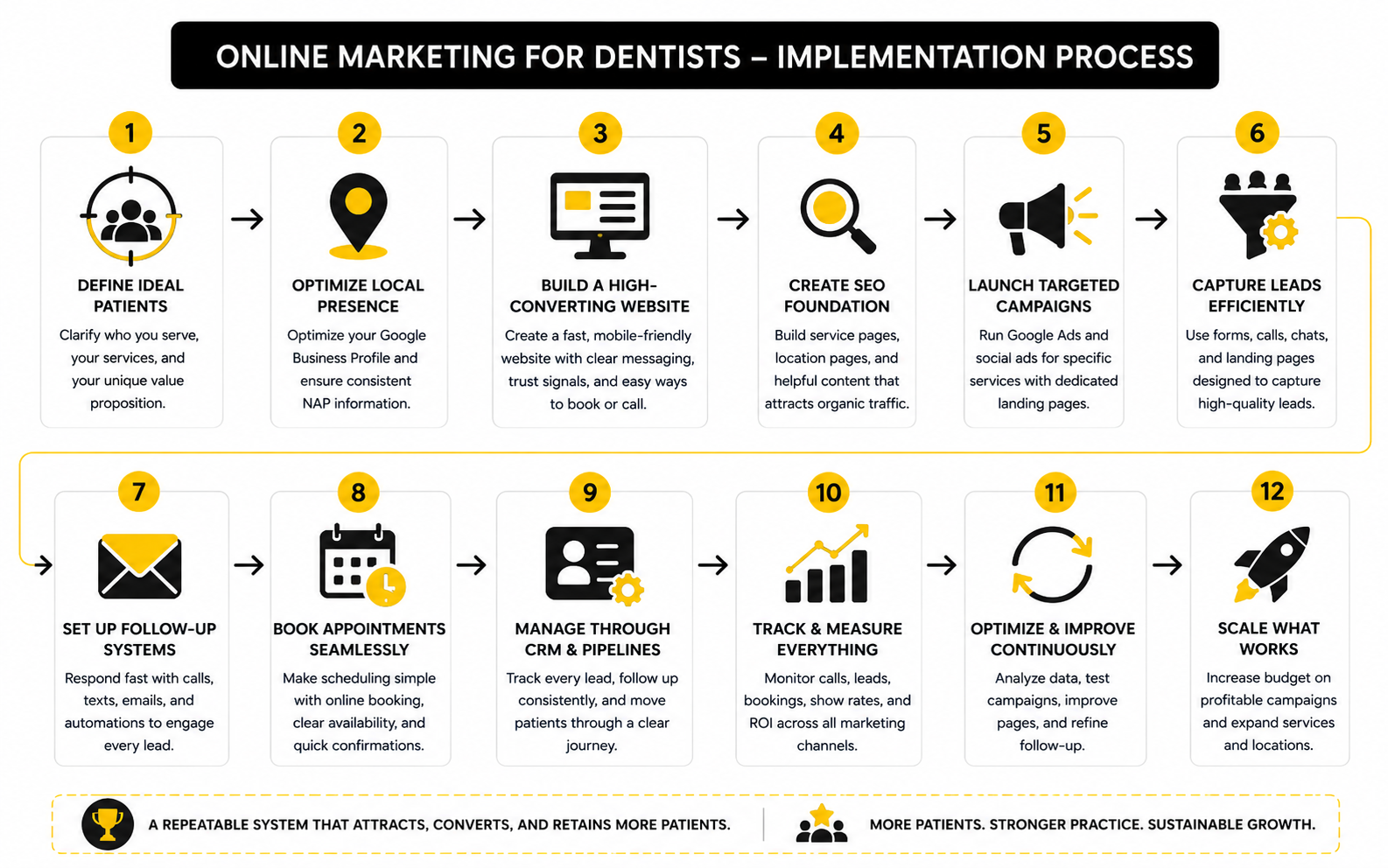
A dental website project should start with strategy, not colors. Before anyone writes copy or chooses a template, decide what the website is supposed to produce. A practice focused on emergency patients needs a different structure than a cosmetic practice, an implant-heavy practice, or a family dentistry office trying to grow hygiene capacity.
A practical implementation process looks like this:
This process prevents the website from becoming a design-only project. A beautiful dental website that does not create appointments is not finished. It may look polished, but it is still leaking value.
Use Landing Pages When The Intent Is Specific
A landing page is useful when the visitor has a focused intent. Paid ads for implants, emergency dentistry, Invisalign, whitening, or a new-patient offer usually should not send traffic to a general homepage. The more specific the campaign, the more specific the page should be.
A good dental landing page has one clear job. It should match the ad message, explain the offer or service, answer the main objections, show trust signals, and make the next step obvious. It should not distract the patient with every service the practice offers.
This is where a funnel tool can help if the practice wants fast testing without rebuilding the full website. ClickFunnels can be useful for focused campaign pages, while Systeme.io may fit practices or small marketing teams that want simpler funnel and email tools in one place. The tool is not the strategy, though. The strategy is matching the page to the patient’s intent.
Add Trust Elements Where Patients Actually Need Them
Trust elements should appear near decision points, not randomly at the bottom of the website. Reviews, credentials, association memberships, financing information, team photos, technology details, and patient comfort options can all support conversion when they answer a real concern. The key is placement.
For example, a sedation dentistry page should address anxiety early. An implant page should explain consultation steps, imaging, suitability, and financial conversation points before the call to action. An emergency page should show phone access, same-day intent when available, and what symptoms count as urgent.
Do not overload the site with badges and claims that patients cannot understand. Specific trust beats decorative trust. A clear explanation of what happens during the first visit is often more reassuring than a wall of logos.
Connect Forms, Calls, And Follow-Up
The website does not end at the form submission. That is where the operational part begins. If the practice responds slowly, misses calls, or fails to track where leads came from, the marketing system breaks after doing the expensive work of creating demand.
Every form should go somewhere reliable. Every call should be trackable. Every missed call should have a follow-up process, especially during busy clinical hours.
A platform like GoHighLevel can support this by connecting forms, pipelines, SMS follow-up, call tracking, and appointment workflows. For practices that want lightweight form building for specific campaigns, Fillout can also be useful when the form experience needs to be cleaner than the default website form. The important thing is not which tool sounds impressive. The important thing is that every inquiry gets handled quickly and consistently.
Improve The Website Based On Evidence
Once the website is live, the work shifts from building to improving. Look at which pages attract traffic, which pages produce calls, which forms get completed, and where visitors drop off. That is how you find the leaks.
Do not redesign the whole site every time performance feels flat. Fix the highest-impact problems first. If emergency visitors are not calling, improve the emergency page. If implant traffic is strong but consultations are weak, improve the offer, proof, page structure, and follow-up.
This is the practical mindset that separates serious online marketing for dentists from random activity. You are not trying to make the website perfect in one pass. You are building a system that gets clearer, faster, and more profitable over time.
Statistics And Data
Data is where online marketing for dentists becomes easier to manage and harder to fake. Without measurement, every channel can sound important. SEO looks busy, ads look active, social looks visible, and the website looks professional, but none of that proves the practice is getting more booked patients.
The point of data is not to drown the team in dashboards. The point is to show what is creating patient action, what is wasting attention, and where the next improvement should happen. Good measurement helps you make calmer decisions because you are not guessing every time the schedule slows down.
The numbers that matter most are not always the biggest numbers. Website traffic can grow while appointments stay flat. Ad clicks can look strong while the front desk quietly misses calls. Reviews can increase while the practice still loses high-intent patients because the booking path is unclear.
Measure The Full Patient Journey
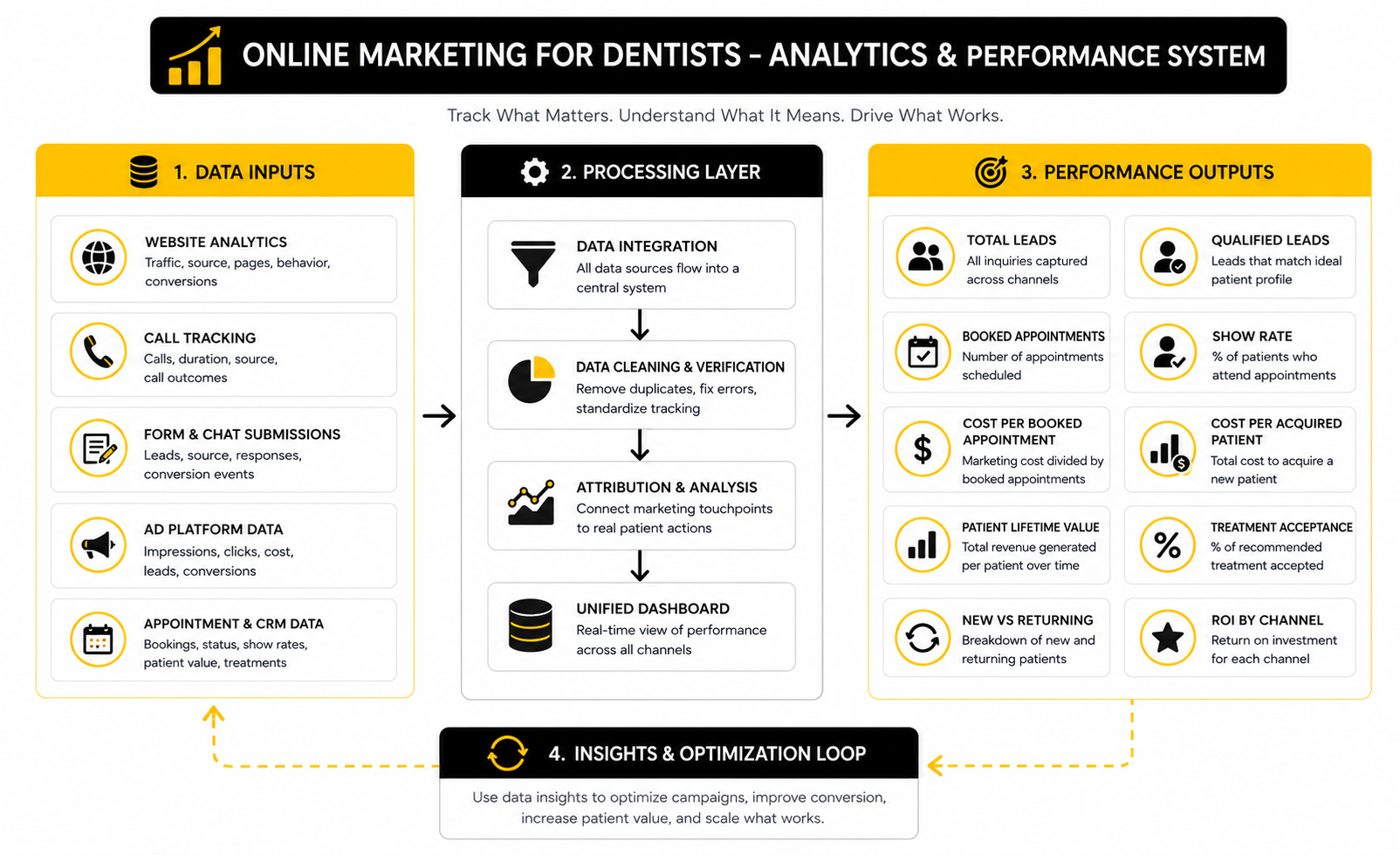
A dental marketing report should follow the patient journey from first touch to booked visit. That means looking at visibility, engagement, conversion, follow-up, and attended appointments. If you only measure the top of the funnel, you will overvalue traffic and undervalue operations.
Start with visibility metrics like Google Business Profile views, local search impressions, organic rankings, map pack presence, and paid ad impressions. These numbers show whether the practice is being found, but they do not prove growth by themselves. They are signals, not outcomes.
Then move into action metrics. Track calls, appointment button clicks, form submissions, direction requests, chat inquiries, and online booking starts. These are stronger indicators because they show that someone moved from passive browsing into active consideration.
Track The Metrics That Actually Change Decisions
The best marketing metrics are the ones that lead to a clear action. If a metric does not help you decide what to fix, scale, pause, or test, it probably belongs in the background. Dental practices do not need more vanity metrics. They need better decisions.
For online marketing for dentists, the most useful performance signals usually include:
These numbers work together. A low cost per lead means very little if the leads do not book. A high conversion rate may still be weak if the page attracts low-value inquiries. A strong review profile helps, but it has to connect to visibility and booking.
Understand Benchmarks Without Worshiping Them
Benchmarks are useful, but they are not the boss. A dental implant campaign in a competitive metro area will not behave like a hygiene-focused campaign in a smaller town. A startup practice will not have the same data pattern as a mature practice with years of reviews and local authority.
Paid search benchmarks give helpful context. WordStream’s 2025 Google Ads benchmark data shows an average search ad cost per click of $5.26 across industries, but dental campaigns can vary widely based on service, location, competition, landing page quality, and follow-up speed. That number should not become your target. It should remind you that click cost is only one piece of the economics.
Conversion benchmarks also need interpretation. WordStream’s 2025 conversion benchmark data reports an average Google Ads conversion rate of 7.52% across industries, but a dental practice should care more about qualified appointment requests than raw form fills. A campaign that produces fewer leads but more completed consultations can be better than a campaign that floods the team with weak inquiries.
Separate Leads From Booked Patients
This is critical. A lead is not a patient. A booked appointment is closer, but even that is not the final result if the person does not show up, accept treatment, or become part of the practice.
Many dental marketing reports stop too early because lead numbers make campaigns look better. A form submission feels like progress, but it may be from someone outside the service area, someone asking for a price only, or someone who never responds. That does not mean the campaign failed, but it does mean the practice needs to measure deeper.
A cleaner tracking structure separates the stages:
This is how you stop arguing about marketing in vague terms. You can see whether the issue is traffic quality, website conversion, front-desk response, appointment availability, no-shows, consultation process, or treatment acceptance. Each stage points to a different fix.
Watch Response Time Like A Revenue Metric
Speed matters because patient intent cools quickly. Someone looking for an emergency dentist or comparing implant consultations may contact more than one practice. If your team responds hours later, you may be paying to create demand that another practice captures.
Response time should be measured for calls, forms, chat, and missed calls. A missed-call text-back workflow can be especially useful during clinical peaks when the front desk is overloaded. The key is to make the first response fast, helpful, and human.
This is where automation can support the team without replacing the team. A tool like GoHighLevel can help practices centralize lead capture, missed-call text-back, pipelines, reminders, and follow-up sequences. The goal is not to automate empathy. The goal is to make sure no serious inquiry disappears because the day got busy.
Read Website Analytics By Intent
Website analytics should be read through patient intent, not just traffic volume. A visitor on an emergency dentistry page is behaving differently from someone reading about veneers. A visitor checking hours and directions may already trust the practice enough to visit, while a visitor reading financing information may need reassurance before booking.
Look at the pages that produce action. If service pages get traffic but few calls or forms, the content may not answer the right concerns. If a landing page gets clicks but weak conversion, the offer, proof, page speed, or call to action may need work.
Also look at device behavior. If mobile traffic converts poorly, the issue may not be the service itself. It may be a slow page, a difficult form, a hidden phone number, or a booking button that is too hard to tap. Small mobile fixes can have a direct effect because many dental searches happen in real-life moments, not calm desktop research sessions.
Use Review Data As A Trust Signal
Review data should be measured with more nuance than average star rating. A practice with a strong rating but very few recent reviews may look less active than a competitor with a steady stream of fresh, detailed feedback. Patients read patterns, not just scores.
BrightLocal’s 2025 review research shows that consumers pay attention to detailed review content when evaluating local businesses, not just star ratings alone. That matters for dental practices because patients often want to understand comfort, communication, scheduling, cost transparency, and how the team handles nervous patients. BrightLocal’s Local Consumer Review Survey is useful context here because it shows how review behavior keeps becoming more detail-driven.
The action is simple. Ask for reviews consistently, monitor review themes, and respond professionally. If reviews repeatedly mention long waits, billing confusion, or difficulty reaching the office, that is not just a reputation issue. That is operational data.
Build A Monthly Marketing Scorecard
A monthly scorecard keeps the practice focused. It should be short enough for the owner, manager, and marketing team to actually use. If the report is 40 pages and nobody changes behavior after reading it, the report is not doing its job.
A practical scorecard for online marketing for dentists should include:
The last line matters most. Every report should end with decisions. Increase budget here, rewrite this page, improve this form, train the front desk on this call type, build this landing page, request more reviews, or pause this campaign.
Turn Data Into Better Marketing Decisions
Data only helps when it changes behavior. If the numbers show strong implant page traffic but weak consultation bookings, the next move may be better page copy, stronger proof, clearer financing information, or faster follow-up. If Google Business Profile views are rising but calls are flat, the practice may need better photos, reviews, service clarity, or a stronger appointment link.
If paid ads produce leads but few attended visits, do not automatically blame the ads. Look at search terms, landing page intent, form quality, response time, scheduling availability, and reminder workflows. The leak may be after the click.
This is the mindset that makes dental marketing more profitable over time. You measure the system, find the constraint, fix the constraint, and then measure again. That is not flashy, but it works.
Paid Ads, Landing Pages, And Lead Follow-Up
Once the foundation is in place, paid campaigns can help a dental practice grow faster. The keyword is help. Paid ads should not be used to cover up a weak website, slow follow-up, unclear offer, or poor patient experience.
This is where many practices get burned. They launch ads because they want more patients, but they have not decided which patients they want, what those patients are worth, how quickly the team can respond, or what happens after the first inquiry. That is not a marketing strategy. That is buying traffic and hoping the practice can catch it.
A better approach is to treat paid advertising as a controlled growth lever. You choose a specific service, build a focused page, track the full path, and improve the weak points before scaling budget. That keeps online marketing for dentists tied to real economics instead of vague activity.
Choose The Right Service Before You Choose The Channel
Not every dental service should be promoted the same way. Emergency dentistry, implants, Invisalign, cosmetic dentistry, pediatric dentistry, hygiene reactivation, and new-patient exams all attract different intent. If the campaign treats them the same, the results will be messy.
Emergency campaigns are usually driven by urgency. The patient wants fast access, clear instructions, and a phone number that works immediately. Implant campaigns are more research-heavy because the patient may compare cost, trust, technology, financing, and consultation process before booking.
That difference matters. An emergency ad can often be direct and action-focused. An implant campaign usually needs more education, proof, and follow-up because the decision is bigger. The channel, page, message, and intake process should match the patient’s decision stage.
Balance Search Demand And Demand Creation
Search ads capture people who are already looking. That makes them powerful for high-intent searches like emergency dentist, dentist near me, dental implants, Invisalign, and tooth extraction. The downside is that competition can be expensive, especially in dense markets.
Social ads work differently. They can introduce services to people who are not searching right now but may still be good candidates. This can work for cosmetic treatments, smile makeovers, whitening, clear aligners, and patient education campaigns, but it usually requires stronger creative and more nurturing.
The mistake is expecting every channel to behave like search. Search responds to existing intent. Social creates or warms up intent. Retargeting reminds people who already showed interest. Each channel has a job, and the practice should not judge all of them by the same surface-level metric.
Protect The Practice From Compliance Risk
Dental marketing has to be more careful than ordinary local business marketing. You are dealing with healthcare, patient trust, clinical claims, reviews, testimonials, and sometimes sensitive personal information. That does not mean the marketing has to be boring. It means it has to be controlled.
The American Dental Association’s marketing and advertising guidance emphasizes that dental advertising should be considered through legal, ethical, state, and federal standards. Its 2025 ethics updates also addressed social media influencers and dentists acting as influencers, which matters because short-form content and creator-style promotion are now part of many dental marketing plans. ADA marketing and advertising guidance and ADA’s 2025 social media ethics update make the direction clear: visibility is not an excuse for sloppy claims.
Reviews need the same seriousness. The FTC’s rule against fake reviews and testimonials prohibits fake or false reviews, paid review manipulation, and several deceptive review practices. FTC guidance on the Consumer Reviews and Testimonials Rule matters for dental practices because review shortcuts can damage both trust and compliance.
Build Campaigns Around Capacity
Scaling marketing without looking at capacity is one of the fastest ways to create operational stress. If the practice has limited hygiene openings, weak front-desk coverage, or no room for new emergency visits, more leads can make the patient experience worse. Growth should support the practice, not overload it.
Before increasing ad spend, check the calendar. Look at open chair time, provider availability, treatment coordinator capacity, consultation slots, and how quickly new patients can be seen. If the campaign promises speed but the schedule is booked out for weeks, patient trust drops before the relationship begins.
Capacity also affects which offers make sense. A practice with open implant consultation slots may want to promote consults. A practice with hygiene gaps may focus on new-patient exams. A practice with strong same-day emergency availability may put more budget behind urgent searches.
Create A Follow-Up System Before Scaling Spend
Paid ads expose weak follow-up immediately. If the team responds late, forgets to call back, sends generic texts, or fails to separate serious inquiries from casual ones, the campaign will look worse than it really is. Sometimes the traffic is fine. The handling is the leak.
A strong follow-up system should define what happens after every call, form, chat, booking request, and missed call. The team should know who responds, how fast they respond, what they say, when they follow up again, and when a lead is considered lost. This sounds basic, but it is where a lot of revenue disappears.
For practices that want one system for pipelines, reminders, missed-call text-back, and lead nurturing, GoHighLevel can be a practical fit. For campaign-specific forms, Fillout can help create cleaner intake paths. The goal is simple: every paid inquiry should land somewhere visible and trigger a reliable next step.
Use Automation Carefully
Automation can make dental marketing more consistent, but it can also make the practice feel cold if it is used badly. A patient in pain does not want to feel trapped in a generic sequence. A nervous implant prospect does not want five pushy messages that ignore their real concern.
Use automation for speed, reminders, routing, and simple education. Use humans for judgment, reassurance, clinical nuance, and financial conversations. That division keeps the system efficient without making the patient feel processed.
Privacy matters here. HHS guidance explains that healthcare providers may communicate electronically with patients when reasonable safeguards are applied, but sensitive information should be handled carefully. HHS guidance on electronic patient communication is a reminder that convenience does not remove the need for good judgment.
Decide When To Use A Funnel Instead Of A Full Website Page
A full website page is usually better for long-term organic visibility. It can support SEO, internal linking, patient education, and the broader credibility of the practice. A landing page or funnel is better when the campaign is specific, paid, and built around one conversion goal.
For example, a dental implant SEO page may need deeper education, related treatment links, provider information, and long-term content depth. A paid implant consultation landing page may need a tighter message, a clear consultation request, financing reassurance, reviews, and fewer distractions. Both can exist, but they should not do the same job.
Tools like ClickFunnels or Systeme.io are useful when the team wants to build and test focused campaign journeys. They are not magic. A funnel only works when the offer, page, traffic, tracking, and follow-up are aligned.
Scale What The Practice Can Fulfill
Scaling is not just increasing budget. Scaling means increasing the parts of the system that are already working without breaking the patient experience. That requires discipline.
Before scaling a campaign, confirm three things. First, the leads are qualified enough to matter. Second, the team can respond quickly and book them properly. Third, the appointments create real production, not just busy calendars.
If those conditions are not true, scaling will amplify the problem. More weak leads will waste more staff time. More slow follow-up will waste more ad spend. More unqualified appointments will frustrate providers and make the marketing look worse than it is.
Manage The Tradeoff Between Growth And Brand
Dental practices often chase fast leads and forget the brand they are building. That is risky. A practice can get short-term inquiries with aggressive offers, but if the message feels cheap, confusing, or inconsistent with the clinical experience, it can damage trust.
Brand does not mean fancy colors and vague mission statements. It means the market understands who the practice is for, what it stands for, and why patients should choose it. That should show up in ads, website copy, reviews, photos, social content, and the way the phone is answered.
The stronger the brand, the less the practice has to compete only on price or urgency. That is a serious advantage. In competitive dental markets, trust compounds.
Avoid The Most Expensive Scaling Mistakes
The biggest scaling mistakes usually come from impatience. The practice sees a few leads and immediately increases spend before the data is stable. Or it changes the offer every two weeks and never gives the system enough time to learn.
Another mistake is letting vendors operate in silos. The SEO team, ad team, website team, and front desk all touch the same patient journey. If they do not share data, each team can claim success while the overall system still leaks.
A better scaling rhythm is slower and cleaner:
This is less exciting than launching everything at once. It is also much more likely to work. Serious online marketing for dentists is not about doing more things. It is about making the right things perform together.
Reviews, Reputation, Social Proof, And FAQs
At this stage, the marketing system is almost complete. The practice has local visibility, a website that helps patients decide, campaigns that can create demand, follow-up that protects leads, and analytics that show what is working. The final layer is reputation, because trust is what turns attention into appointments.
Online marketing for dentists cannot rely on visibility alone. Patients want signals that the practice is safe, professional, responsive, and worth choosing. Reviews, testimonials, photos, provider information, educational content, and consistent communication all help create that confidence.
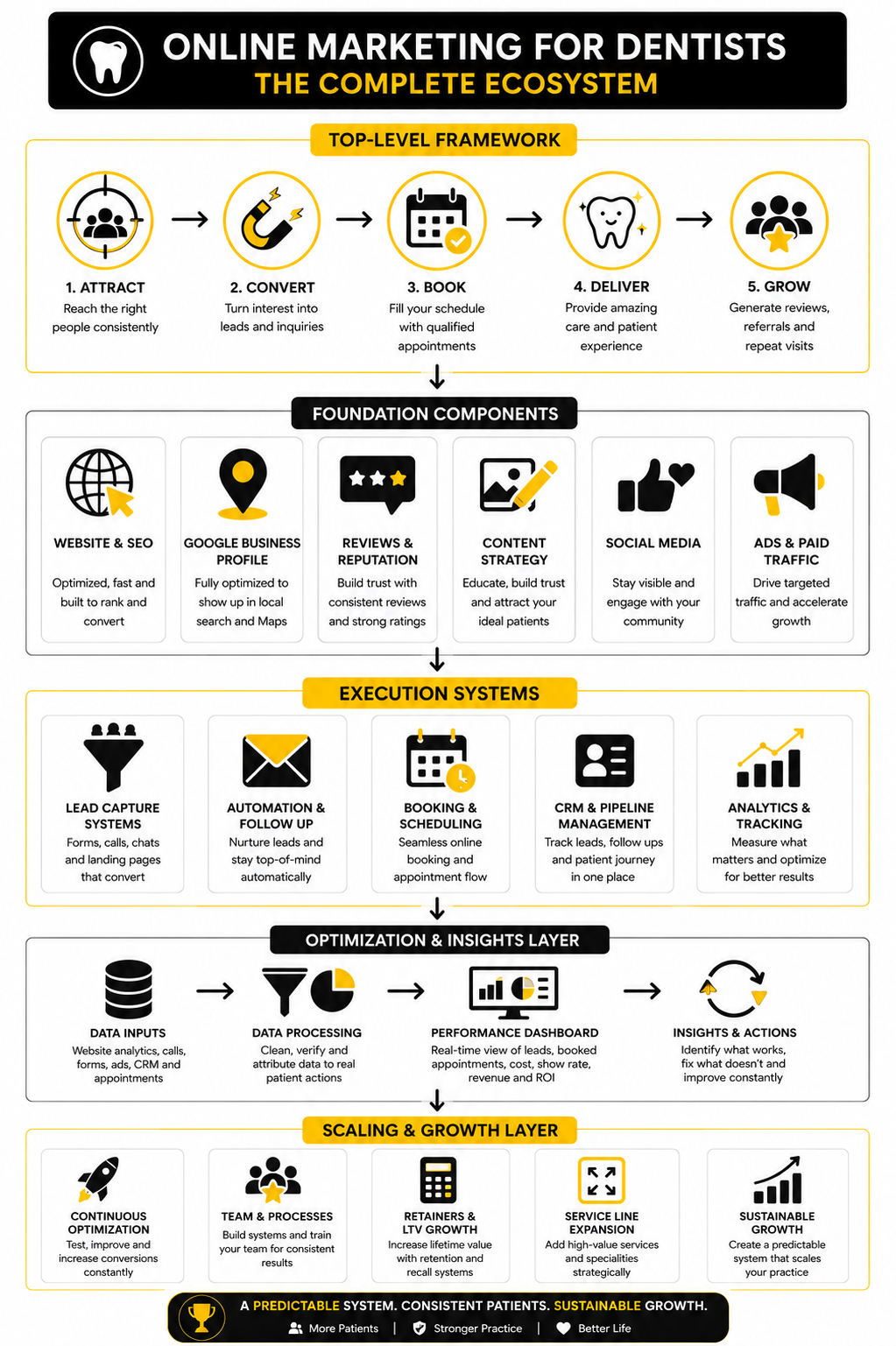
The strongest dental marketing ecosystem does not feel like marketing from the patient’s side. It feels helpful. The patient finds the practice, understands the service, sees proof, asks a question, gets a clear response, books easily, and feels reassured before walking through the door.
Build Social Proof Into The Whole Patient Journey
Social proof should not live on one lonely reviews page. It should appear where patients are making decisions. A nervous emergency patient needs different reassurance than someone researching veneers, implants, or clear aligners.
Use reviews near appointment prompts, service pages, and landing pages when they match the patient’s concern. If patients often mention gentle care, clear explanations, short wait times, or helpful front-desk communication, those themes should influence your copy. The best reputation signals are not generic praise. They answer the doubts that keep people from booking.
This also means the practice needs a consistent review request process. BrightLocal’s 2025 review research shows that consumers look for detail and objectivity in reviews, not just a high star rating. The Local Consumer Review Survey 2025 is useful here because it reinforces a simple point: patients want enough information to form their own opinion.
Keep Reputation Marketing Ethical
Dental reputation marketing has to stay clean. Fake reviews, filtered testimonials, misleading before-and-after content, and exaggerated treatment claims can damage trust fast. They can also create regulatory risk.
The ADA’s advertising guidance warns that dental advertising must account for professional, legal, and regulatory standards, including review and testimonial issues. ADA marketing and advertising guidance is worth taking seriously because dental marketing is not the same as selling ordinary consumer products. Patients are making healthcare decisions, and the practice has a higher duty to communicate responsibly.
The FTC also treats fake or manipulated reviews as a serious issue. FTC guidance on consumer reviews and testimonials makes clear that businesses need to avoid deceptive review practices. For a dental practice, the safest strategy is also the best long-term strategy: earn real feedback, ask consistently, respond professionally, and never try to manufacture trust.
Use Social Media To Support Trust, Not Chase Attention
Social media can help a dental practice, but only when it has a clear role. The role is usually trust-building, education, personality, community visibility, and patient reassurance. It is rarely the main source of immediate new-patient demand unless the practice has a strong content system and a follow-up path behind it.
Practical dental social content can include team introductions, oral health tips, practice updates, community involvement, technology explanations, new-patient guidance, and answers to common patient questions. Short-form videos can work well when they are simple, useful, and human. They should not turn the practice into a circus.
Scheduling tools can help keep the system consistent. Buffer can be useful for planning posts across channels, while Flick Social can help teams organize social content and hashtags more efficiently. The tool matters less than the habit. A steady, helpful presence beats random bursts of content followed by silence.
Bring The Full System Together
The full system works when every part supports the next part. Local SEO creates discovery. The website creates clarity. Ads create controlled demand. Follow-up protects inquiries. Reviews reduce doubt. Analytics show what to improve.
This is why online marketing for dentists should be managed as an ecosystem, not a menu of tactics. A practice does not need to do everything at once, but it does need the pieces to fit together. Otherwise, one weak link can make the whole system look worse than it really is.
The practical order is simple. Fix visibility and trust first. Improve conversion and follow-up next. Scale paid traffic only when the intake system can handle it. Then use data and patient feedback to keep improving the machine month after month.
What Is Online Marketing For Dentists?
Online marketing for dentists is the process of using digital channels to attract, educate, convert, and retain dental patients. It usually includes local SEO, Google Business Profile optimization, website strategy, paid ads, reviews, social media, email or SMS follow-up, and analytics. The goal is not just more clicks. The goal is more qualified appointments and better patient growth.
Why Is Local SEO So Important For Dental Practices?
Local SEO matters because most dental searches are tied to location. Patients usually want a nearby practice that feels trustworthy, available, and easy to contact. Google’s local ranking guidance explains that local results are shaped by relevance, distance, and prominence, which is why accurate practice information, reviews, services, and local credibility all matter. Google Business Profile local ranking guidance gives the basic framework.
How Long Does Dental SEO Take To Work?
Dental SEO usually takes time because search visibility depends on website quality, local competition, content depth, reviews, technical health, and authority. Some improvements, like fixing Google Business Profile details or adding better appointment links, can help quickly. Larger gains from service pages, location pages, and organic rankings usually build over months.
Should A Dentist Run Google Ads Or Focus On SEO First?
A dental practice should not treat this as an either-or decision. SEO is stronger for long-term visibility, while Google Ads can create faster demand for specific services. The best choice depends on the practice’s goals, budget, competition, website quality, and follow-up system.
What Is The Best Marketing Channel For Dentists?
The best channel depends on the type of patient the practice wants. Emergency dentistry often works well with high-intent search visibility. Cosmetic dentistry and Invisalign may benefit from a mix of search, social proof, retargeting, and educational content. Implants usually need deeper education, stronger proof, and more structured follow-up.
How Much Should A Dental Practice Spend On Marketing?
There is no single number that fits every practice. A startup practice, a multi-location group, and a mature solo practice will have different needs. The more carefully way to plan spend is to define the growth goal, estimate the value of a new patient or treatment type, and track cost per booked appointment, show rate, and production.
What Should A Dental Website Include?
A dental website should include clear service pages, location information, phone and booking options, provider bios, patient reviews, new-patient information, insurance or payment guidance, and trust-building content. It should also work well on mobile because many patients will visit from a phone. The website should make the next step obvious without making the patient feel rushed.
Do Dental Practices Need Landing Pages?
Landing pages are useful when the campaign has a specific goal. A dental implant ad, emergency dentist ad, Invisalign ad, or new-patient offer usually performs better when the page matches that exact intent. A general homepage can work for broad brand traffic, but paid campaigns often need tighter pages with fewer distractions.
Are Reviews Really That Important For Dentists?
Yes, reviews are one of the strongest public trust signals for dental practices. Patients often use reviews to judge comfort, communication, professionalism, scheduling, and overall experience. The practice should ask for reviews consistently, respond professionally, and use review themes to improve both marketing and operations.
Can Dentists Use Patient Testimonials In Marketing?
Dentists can use testimonials only when they follow the rules that apply to their location, licensing board, privacy obligations, and advertising standards. Consent matters, especially if the testimonial includes identifiable patient information or treatment details. The safest approach is to get proper authorization, avoid exaggeration, and make sure testimonials do not imply guaranteed outcomes.
How Should Dentists Measure Marketing Results?
Dentists should measure the full path from inquiry to booked and attended appointment. Important metrics include calls, forms, booking requests, qualified leads, booked appointments, show rate, cost per booked appointment, treatment acceptance, and production by source. Traffic and clicks are useful, but they are not enough by themselves.
What Is The Biggest Mistake Dentists Make With Online Marketing?
The biggest mistake is treating marketing as separate tactics instead of one connected system. A practice may run ads, post on social media, buy SEO, and redesign the website, but still lose patients because follow-up is slow or tracking is weak. The fix is to connect visibility, conversion, reputation, follow-up, and measurement into one operating rhythm.
Should Dental Practices Use Automation?
Automation can help with reminders, missed-call text-back, form follow-up, review requests, and basic lead nurturing. It should not replace human judgment or clinical communication. The best setup uses automation to keep the process consistent while the team handles sensitive questions, reassurance, scheduling judgment, and treatment conversations.
How Can A Dental Practice Start Improving Marketing This Month?
Start by fixing the highest-friction points. Check the Google Business Profile, update hours and services, review the website on mobile, test every phone number and form, ask for recent reviews, and track every new-patient inquiry for the next 30 days. That gives the practice a clearer picture of where growth is being blocked.
Build a stronger local presence with BAAM AI
Turn your website, Google profile, social channels, and AI visibility into one growth engine
Most businesses do not need more random marketing activity. They need a consistent presence system that helps the right people find them, trust them, and take action. BAAM AI brings strategy, local SEO, website updates, Google Maps visibility, social content, AI-search readiness, media production, and reporting into one practical monthly engine.
If you want your marketing to keep working after the campaign ends, start with a free BAAM AI presence audit. See how your business shows up today and where the fastest visibility wins are at BAAM AI.