
BAAM AI Blog
Online Advertising Costs: A Practical Framework For Planning Smarter Ad Budgets
Online advertising costs are not one fixed number. They are the result of auctions, audience demand, creative quality, conversion rates, offer strength, seasonality, tracking quality, and how aggressively competitors...
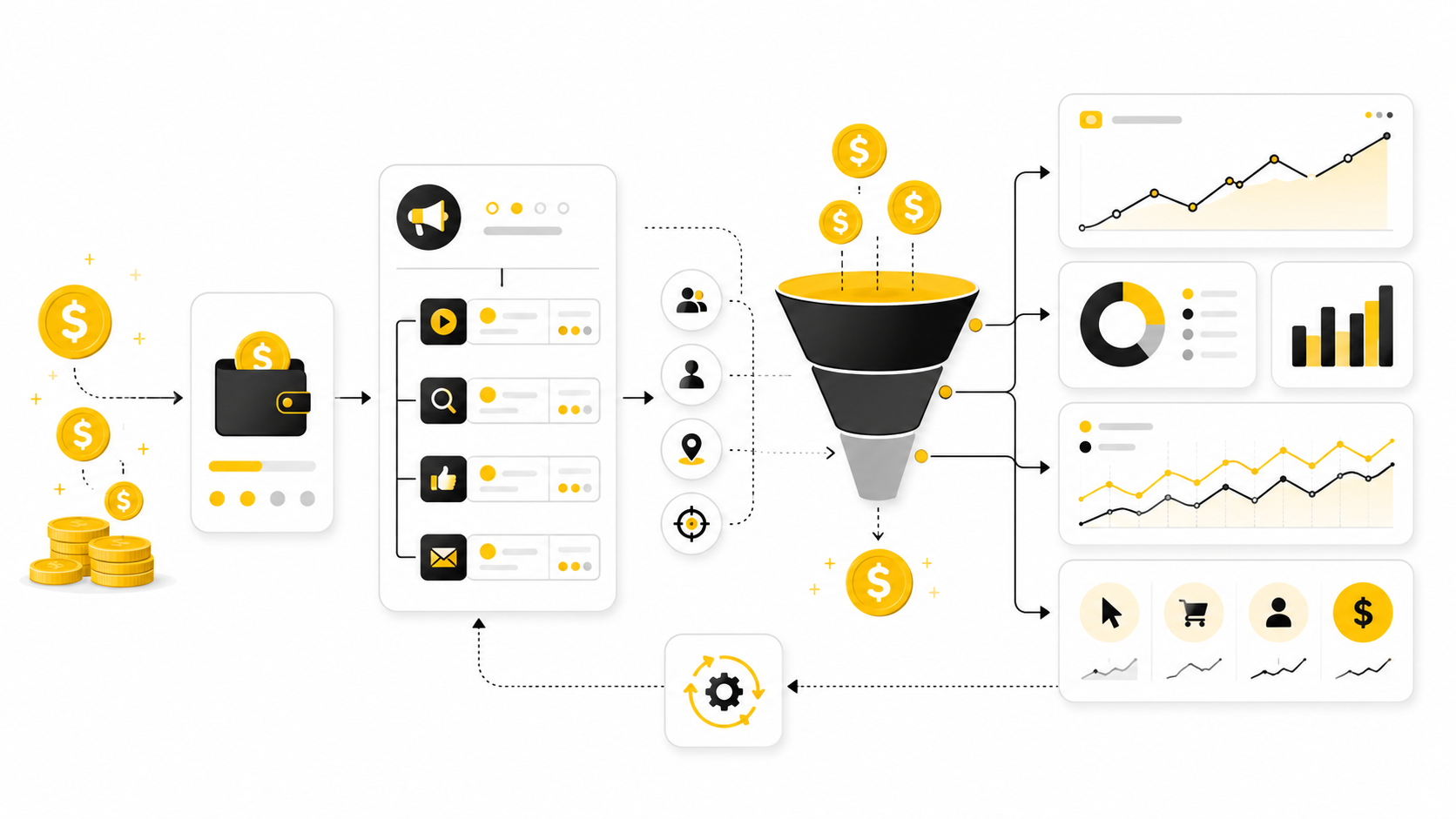
Online advertising costs are not one fixed number. They are the result of auctions, audience demand, creative quality, conversion rates, offer strength, seasonality, tracking quality, and how aggressively competitors want the same customer. That is why one business can profitably pay $8 per click while another loses money at $1.50.
The mistake most businesses make is treating online advertising costs like a price list. They ask, “How much do Facebook ads cost?” or “What is the average Google Ads CPC?” Those averages can be useful, but they are not enough to make a real budget decision. A useful answer has to connect media cost to revenue, margin, funnel performance, and the speed at which the campaign can learn.
The stakes are getting bigger. U.S. internet advertising revenue reached $294.6 billion in 2025, with the market still growing despite tighter budgets and more automation across ad buying, measurement, and creative testing, as shown in the IAB Internet Advertising Revenue Report. Search, social, video, retail media, and programmatic all compete for the same marketing dollars, so the real advantage is not simply “spending more.” The advantage is knowing what each dollar is supposed to do.
this guide is structured as a six-part guide so each section builds on the last. We will start with the big picture, then move into the mechanics behind ad pricing, budget planning, implementation, optimization, and final decision-making. The goal is to make online advertising costs feel less random and more manageable.
Why Online Advertising Costs Matter
Online advertising costs matter because they decide how fast a business can test, learn, and scale. A campaign with weak economics does not become better just because it gets more impressions. More spend only magnifies what is already happening inside the funnel.
The important number is not just CPC, CPM, CPA, or ROAS in isolation. A $5.26 average search CPC, like the 2025 benchmark reported by LocaliQ’s search advertising benchmark data, can be cheap for a law firm and expensive for a low-margin ecommerce product. Cost only makes sense when it is compared with intent, conversion rate, customer value, and profit margin.
That is why this guide treats online advertising costs as a business model question, not just a media buying question. You are not buying clicks for the sake of clicks. You are buying attention, data, qualified visits, leads, customers, repeat purchases, and sometimes long-term brand memory.
The Real Problem With Average Ad Cost Benchmarks
Average benchmarks are helpful for orientation, but dangerous when they become the whole strategy. They hide the difference between industries, countries, placements, objectives, devices, audience quality, and funnel depth. Two campaigns can have the same CPC and completely different economics.
Averages also move because the auction moves. In Q3 2025, Tinuiti reported that Amazon DSP average CPM increased 11% year over year, while Walmart Sponsored Products saw both click and CPC growth rise more than 20% year over year in the same period, based on its Digital Ads Benchmark Report. That does not mean every advertiser should panic. It means cost planning has to include volatility.
This is where many businesses get stuck. They see a rising CPM and assume ads are “too expensive,” when the real issue may be weak creative, poor landing page fit, shallow retargeting, bad offer structure, or no follow-up system. Cost is visible first, but the cause is often deeper.
Framework Overview
A practical framework for online advertising costs starts with four layers: market cost, campaign cost, funnel cost, and business cost. Market cost is what the auction tends to charge for access to an audience. Campaign cost is what your account actually pays based on targeting, creative, bidding, and objective.
Funnel cost is where the numbers become more useful. It connects clicks or impressions to leads, purchases, booked calls, trials, demos, subscriptions, or pipeline. Business cost then goes one level deeper and asks whether the campaign creates profit after product costs, sales labor, software, fulfillment, refunds, and retention are included.
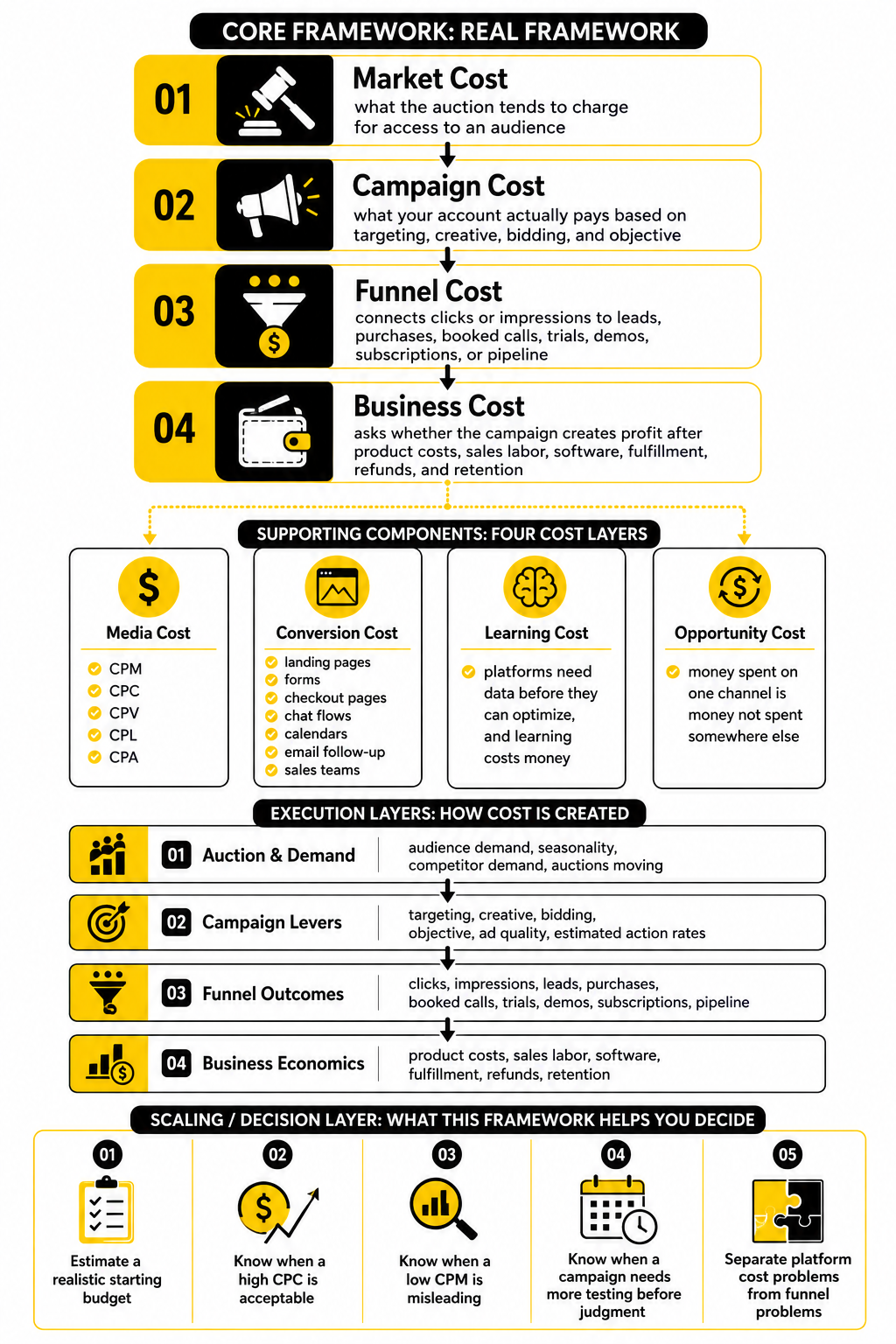
This framework prevents one of the most common advertising mistakes: optimizing the cheapest visible metric while ignoring the expensive hidden one. A low CPM campaign that brings the wrong audience can be more expensive than a high CPC campaign that brings buyers. The cheapest traffic is not always the cheapest customer.
The Four Cost Layers You Need To Understand
The first layer is media cost. This includes CPM, CPC, CPV, CPL, CPA, and other platform-level metrics that show what you paid to get exposure or action. These numbers are easy to see inside ad platforms, which is why people tend to over-focus on them.
The second layer is conversion cost. This is where landing pages, forms, checkout pages, chat flows, calendars, email follow-up, and sales teams start to matter. A tool like ManyChat can make sense when paid social campaigns need automated message follow-up, while a system like GoHighLevel can fit businesses that need lead capture, CRM, pipeline, and nurture workflows in one place.
The third layer is learning cost. Ad platforms need data before they can optimize, and that data costs money. A campaign that stops after 20 clicks usually has not failed yet; it has simply not collected enough evidence to make a serious decision.
The fourth layer is opportunity cost. Every dollar spent on one channel is a dollar not spent somewhere else. If Google Search captures high-intent demand but Meta creates cheaper top-of-funnel demand, the right budget split depends on what the business needs most: immediate buyers, warmer audiences, or long-term market growth.
Why Auctions Make Costs Feel Unpredictable
Most online advertising costs are shaped by auctions, not fixed inventory prices. Google explains that actual CPC is often lower than the maximum CPC bid and depends on what is needed to clear the auction, as described in its actual cost-per-click definition. That means your bid matters, but it is not the only thing that determines what you pay.
Meta uses a similar auction logic, but with its own ranking factors. Its ad auction considers bid, estimated action rates, and ad quality, which means the winning ad is not always the one with the highest bid, as explained in Meta’s ad auction overview. In plain English, better expected performance can help you compete more efficiently.
This is why cost control is not just a bidding exercise. Strong creative, relevant messaging, good landing pages, clean tracking, and realistic objectives all influence the economics. The platform is constantly asking whether your ad is likely to create value for the user, the advertiser, and the platform.
What this guide Will Help You Decide
By the end of the full article, you should be able to estimate a realistic starting budget without guessing. You should understand when a high CPC is acceptable, when a low CPM is misleading, and when a campaign needs more testing before you judge it. You should also be able to separate platform cost problems from funnel problems.
This matters whether you are running ads yourself, hiring an agency, or building a full growth system. A founder needs to know whether the numbers can work before scaling spend. A marketer needs to know which lever to pull when costs rise.
Most importantly, you will have a cleaner way to think about paid traffic. Online advertising costs are not random punishment from the platforms. They are signals, and once you know how to read those signals, you can make much better decisions with the same budget.
How Online Advertising Pricing Works
Online advertising pricing looks complicated because the same campaign can be charged in different ways depending on the platform, objective, placement, and bidding model. Search ads often feel like click-based buying because the advertiser is trying to capture active intent. Social, video, display, and retail media often feel more impression-based because the advertiser is buying access to attention before the customer has fully decided what they want.
The key is to separate billing model from business outcome. You may pay per click, per thousand impressions, per view, per lead, or per conversion, but the business still needs to know whether those actions are moving toward revenue. A campaign can have a cheap CPC and still be expensive if the visitors do not convert.
This is where online advertising costs become more practical. Instead of asking what the platform charges, ask what the campaign must produce. If the funnel needs booked calls, purchases, trials, demos, or qualified leads, the pricing model is only the first layer of the decision.
CPC, CPM, CPA, CPL, And ROAS Explained
CPC means cost per click. It tells you how much you paid on average for each click, and it is most useful when the click represents meaningful intent. Search campaigns often use CPC as a central planning metric because the user is actively looking for something.
CPM means cost per thousand impressions. It tells you how much you paid to show your ad 1,000 times, and it is especially common in social, display, video, and programmatic buying. CPM is useful for understanding reach cost, but it does not tell you whether the audience cared.
CPA means cost per acquisition or cost per action, depending on how the account defines the conversion. CPL means cost per lead, which matters for service businesses, B2B campaigns, agencies, local businesses, and any funnel where the sale happens after the initial form fill or call booking. ROAS means return on ad spend, and it compares revenue generated to ad spend, but it can be misleading if it ignores margin, refunds, sales costs, and repeat purchase behavior.
Why The Same Click Can Have Different Value
A click from a search term like “emergency plumber near me” is not the same as a click from a broad interest-based social ad. One person may need a solution immediately. The other may only be mildly curious.
That difference changes what a business can afford to pay. A higher CPC can be rational when the user has stronger intent, higher urgency, or a higher expected order value. A lower CPC can still be wasteful when the audience is too cold, too broad, or too far from a buying moment.
This is why comparing online advertising costs across channels without context creates bad decisions. Search may cost more per click because it captures demand that already exists. Social may cost less per click because it creates or warms demand before the customer searches, compares, or buys.
The Auction Behind The Price
Most major ad platforms use auction systems, which means advertisers compete for available attention in real time. Google explains that actual CPC is often less than the maximum CPC because advertisers usually pay only what is minimally required to clear auction thresholds and beat the competitor below them, as described in its actual cost-per-click documentation. That is why your bid sets a ceiling, but it does not fully control the final price.
Google also states that Ad Rank helps determine whether an ad can show and where it appears, using factors such as bid, ad quality, expected impact of assets, ad rank thresholds, competitiveness, search context, and expected performance, as outlined in its Ad Rank documentation. This matters because improving relevance can make the same budget work harder. Better ads do not just persuade people; they can also help you compete more efficiently inside the auction.
Meta’s auction works differently, but the basic lesson is similar. Meta explains that ads compete based on total value, which includes bid, estimated action rates, and ad quality in its ad auction overview. So when performance drops, simply raising the budget is not always the smartest move.
Why Objective Selection Changes Cost
Ad platforms optimize toward the objective you choose. If you choose traffic, the system looks for people likely to click. If you choose leads, purchases, booked calls, or app installs, the system looks for people more likely to complete that action.
That sounds obvious, but it has a major cost implication. A traffic campaign can produce a cheaper CPC while bringing visitors who rarely buy. A conversion campaign may produce a higher CPC or CPM, but the traffic can be more valuable because the platform is optimizing toward a deeper behavior.
This is why a “cheap” campaign is not always efficient. If the business needs leads, optimize for leads once there is enough conversion data to support it. If the business needs purchases, judging the campaign only by click cost will push the account toward the wrong audience.
Manual Bidding, Automated Bidding, And Budget Control
Manual bidding gives advertisers more direct control over bids, but it also requires more active management. Automated bidding gives the platform more flexibility to find conversions, but it needs clean data, enough volume, and a realistic target. Neither approach is automatically better.
The danger with manual bidding is underbidding and starving the campaign before it can collect useful data. The danger with automated bidding is giving the system a target it cannot realistically hit. If the account has weak tracking or too few conversions, automation may optimize around noisy signals.
Budget control should start with the business target, not the platform interface. If a lead is worth $200 in gross profit, a $250 cost per lead is not scalable. If a new customer is worth $3,000 over time, a $300 acquisition cost may be perfectly reasonable.
Fixed Budgets Versus Learning Budgets
A fixed budget is money allocated to keep campaigns running at a planned level. A learning budget is money allocated to find out what works. Mixing these two creates frustration because testing is rarely as clean or efficient as scaling.
Early campaigns often look expensive because they are paying for information. The account is learning which creative angles get attention, which audiences respond, which placements waste money, and which landing pages convert. That learning has a cost, and pretending otherwise leads to premature campaign shutdowns.
A practical advertiser separates testing from scaling. Testing budgets should be judged by useful evidence, not immediate perfection. Scaling budgets should be judged by repeatable economics, stable tracking, and the ability to increase spend without destroying efficiency.
Platform Pricing Differences
Google Search usually prices access to declared intent. The user types a query, and advertisers compete for that moment. That is why search CPCs can be higher in industries where one customer is worth a lot, such as legal, finance, insurance, home services, software, and healthcare.
Meta, TikTok, YouTube, display, and programmatic placements often price access to attention. The user is not always actively searching, so the creative has to create the moment. In those environments, CPM, hook strength, creative fatigue, and audience fit can matter as much as the click price.
Retail media adds another layer because ads can appear close to the point of purchase. Sponsored product placements on marketplaces and retailer sites often blend search behavior, category browsing, and product comparison. This can make the media expensive, but it can also make it measurable when purchase data is available.
The Difference Between Gross And Net Advertising Cost
Gross advertising cost is the visible spend inside the platform. Net advertising cost is what remains after you account for revenue, margin, retention, refunds, sales time, software, agency fees, creative production, and operational load. Serious budgeting needs the second number.
For example, a campaign that spends $10,000 and generates $30,000 in revenue may look strong at first glance. If the gross margin is only 25%, the business produced $7,500 before other costs, which means the campaign may actually lose money. Revenue is not profit.
This is why ROAS alone can be dangerous. A brand with high margins can survive a lower ROAS than a brand with thin margins. A subscription business can accept a higher first-purchase acquisition cost if retention is strong, while a one-time purchase business usually has less room for error.
Why Tracking Changes The Economics
Tracking does not directly lower online advertising costs, but it changes how intelligently you can manage them. Without reliable tracking, the platform cannot optimize properly and the advertiser cannot see which campaigns deserve more budget. Bad tracking turns paid media into guesswork.
Modern tracking is harder than it used to be because privacy changes, consent rules, browser limits, and attribution gaps all affect measurement. That does not mean tracking is useless. It means advertisers need cleaner event setup, better first-party data, stronger CRM discipline, and more realistic attribution windows.
For businesses that rely on lead generation, the most important tracking often happens after the form fill. A lead that never answers the phone is not equal to a lead that books, shows up, and buys. Connecting ad platforms with CRM stages through a tool like GoHighLevel can help make cost analysis more practical because the campaign can be judged closer to revenue, not just form submissions.
The Core Cost Drivers Behind Every Campaign
Once you understand how pricing works, the next step is identifying what actually pushes online advertising costs up or down. The auction matters, but the auction is only one part of the picture. Your costs are also shaped by the offer, audience, creative, landing page, funnel speed, tracking quality, and sales process.
This is where paid advertising becomes uncomfortable for a lot of businesses. It is easier to blame the platform than to inspect the full system. But if the offer is unclear, the landing page is slow, the follow-up is weak, or the sales team does not respond quickly, the media buyer cannot magically turn bad economics into good economics.
Think of online advertising costs as a diagnostic tool. When costs rise, the campaign is telling you something. The job is to figure out whether the issue is market pressure, weak execution, poor positioning, or a funnel that leaks too much value after the click.
Audience Quality
Audience quality is one of the biggest cost drivers because not every impression has the same commercial value. A person who is ready to buy, compare vendors, request a quote, or book a call is worth more than someone casually scrolling. Platforms price that attention differently because advertisers are competing harder for people who are more likely to convert.
This is why broad audiences can look attractive at first. They often produce cheaper reach, more impressions, and sometimes cheaper clicks. But if those clicks do not move into leads, sales, or meaningful pipeline, the apparent savings disappear fast.
Good audience strategy starts with the customer’s intent level. High-intent audiences usually cost more upfront but can convert faster. Low-intent audiences may cost less to reach, but they need stronger creative, more education, better retargeting, and a longer follow-up process.
Offer Strength
The offer has a direct impact on online advertising costs because it changes how much persuasion the campaign has to do. A strong offer makes the next step feel obvious, valuable, and low-friction. A weak offer forces the ad platform to find people who are unusually patient, unusually motivated, or unusually forgiving.
This does not mean every campaign needs a discount. For services, the offer might be a clear consultation, audit, quote, demo, calculator, checklist, or booking path. For ecommerce, it might be a bundle, guarantee, shipping threshold, starter kit, quiz, or product page that removes hesitation.
The key question is simple: does the offer match the awareness level of the audience? Cold audiences often need education and a softer conversion step. Warm audiences can handle a stronger call to action because they already understand the problem, category, or brand.
Creative Performance
Creative is not just the image, video, headline, or hook. Creative is the bridge between the audience’s current state and the action you want them to take. If that bridge is weak, the campaign has to spend more money to generate the same result.
Strong creative usually does three things well. It gets attention without feeling random, it frames the problem in a way the audience recognizes, and it makes the next step feel relevant. Weak creative often talks about the business too soon and the customer too late.
Creative fatigue also affects costs. When the same audience sees the same message too many times, engagement drops and the platform has fewer positive signals to work with. That can push costs higher even when the offer and targeting are still reasonable.
Landing Page Fit
The landing page has one job: continue the promise made by the ad. If the ad creates curiosity and the page creates confusion, the campaign pays for that gap. This is one of the fastest ways to make online advertising costs look worse than they really are.
Good landing page fit means the headline, proof, offer, call to action, and page structure all support the same decision. The page should not feel like a generic website visit. It should feel like the natural next step after the click.
For ecommerce and direct response campaigns, a dedicated page builder like Replo can make sense when teams need faster landing page testing without constantly waiting on developers. For funnel-based campaigns, ClickFunnels or Systeme.io can fit when the priority is building a simple path from ad click to lead, checkout, webinar, or follow-up sequence.
Conversion Friction
Conversion friction is anything that makes the next step harder than it needs to be. Long forms, unclear pricing, slow pages, weak mobile layouts, too many fields, confusing buttons, and vague confirmation steps all increase friction. The platform may still deliver traffic, but the business wastes more of it.
Friction is especially expensive on mobile. Many paid social campaigns send a large share of traffic from mobile devices, where attention is shorter and patience is lower. If the page is hard to read, slow to load, or annoying to complete, the campaign pays for people who leave before taking action.
Reducing friction does not mean removing all qualification. A high-ticket service may need a form that filters bad-fit leads. The goal is not to make every click convert; the goal is to make the right action easy for the right person.
Follow-Up Speed
Follow-up speed can make or break lead generation campaigns. A business may think it has a traffic problem when the real issue is response time. If leads wait hours or days before hearing back, online advertising costs rise because more paid leads go cold.
This is why lead capture should never be treated as the finish line. The form fill, message, quiz completion, or booked call is only the start of the sales process. The money is made when the business turns that action into a real conversation and then into revenue.
Automation helps when it supports speed without making the experience feel robotic. ManyChat can help with message-based follow-up after social campaigns, while GoHighLevel can help connect forms, calendars, CRM stages, reminders, and nurture sequences for service businesses that need tighter lead handling.
Tracking And Attribution Quality
Tracking quality affects how confidently you can manage spend. If conversions are missing, duplicated, delayed, or assigned to the wrong source, the campaign data becomes unreliable. That makes optimization slower and more expensive.
Attribution is not perfect, and it does not need to be perfect to be useful. The goal is to create enough clarity to make better decisions than guessing. You need to know which campaigns are producing qualified actions, which actions lead to revenue, and which parts of the funnel are creating waste.
A practical tracking setup should connect platform events with business outcomes. That means looking beyond clicks and form fills when possible. For lead generation, the better signal is not just “lead submitted,” but “qualified lead,” “appointment booked,” “appointment showed,” “proposal sent,” and “deal won.”
The Execution Process
The implementation process starts by turning strategy into a measurable campaign system. You do not need a complicated setup on day one, but you do need a clear sequence. Otherwise, every problem gets treated as a media buying problem, even when the real issue sits somewhere else.
A simple execution process keeps the team focused. First, define the business target. Then map the funnel, prepare tracking, build the offer, launch focused campaigns, review the early signals, and improve the weakest link before scaling.
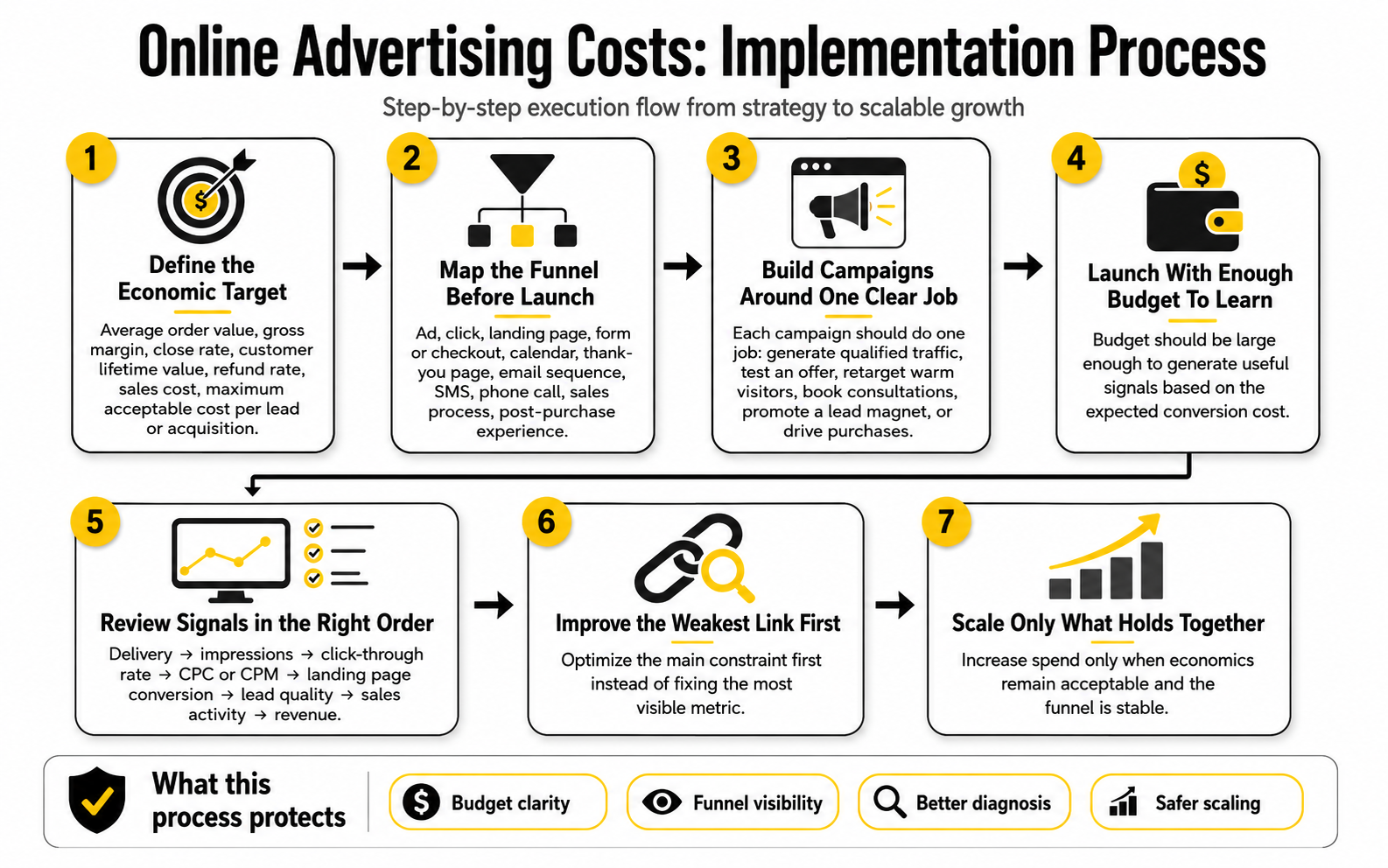
This is where discipline matters. Most campaigns do not fail because the advertiser forgot one advanced tactic. They fail because the basics were never connected properly.
Step 1: Define The Economic Target
Start with the numbers the campaign must hit to make sense. This includes average order value, gross margin, close rate, customer lifetime value, refund rate, sales cost, and the maximum acceptable cost per lead or acquisition. Without these numbers, the campaign has no real scoreboard.
This target does not need to be perfect, but it needs to be honest. If a business can only afford a $40 lead, launching campaigns with a vague hope that $150 leads will “work out later” is not strategy. It is wishful spending.
The economic target also helps you decide how much testing is reasonable. A campaign selling a $29 product has less room for slow learning than a campaign selling a $5,000 service. The higher the potential value, the more room you may have to test, qualify, and nurture.
Step 2: Map The Funnel Before Launch
Before spending money, map every step a customer takes after seeing the ad. This includes the ad, click, landing page, form, checkout, calendar, thank-you page, email sequence, SMS, phone call, sales process, and post-purchase experience. Online advertising costs become easier to manage when every step has a purpose.
A funnel map exposes weak points before the budget does. If there is no thank-you page, no confirmation message, no reminder flow, or no sales handoff, the campaign is already leaking. Fixing that before launch is cheaper than discovering it after hundreds of paid clicks.
This is also where tool choice should support the process, not distract from it. A simple funnel in Systeme.io may be enough for a creator or small business. A more advanced service business may need GoHighLevel because the funnel has to connect ads, lead capture, calendars, pipelines, automation, and client communication.
Step 3: Build Campaigns Around One Clear Job
Each campaign should have one clear job. It might generate qualified search traffic, test a new offer, retarget warm visitors, book consultations, promote a lead magnet, or drive purchases. When one campaign tries to do everything, the data becomes messy and decisions become slow.
This clarity affects budget allocation. If a campaign is meant to test creative, do not judge it like a mature scaling campaign after one day. If a campaign is meant to capture high-intent demand, do not load it with broad keywords that dilute intent.
The cleaner the campaign structure, the easier it is to diagnose performance. You can see whether the issue is traffic quality, click-through rate, landing page conversion, lead quality, or sales follow-up. That diagnosis is where real cost control begins.
Step 4: Launch With Enough Budget To Learn
A campaign needs enough budget to produce useful signals. Spending too little can be just as wasteful as spending too much because the account never gathers enough evidence to make a confident decision. The result is a cycle of tiny tests, emotional changes, and no clear learning.
The right starting budget depends on the expected conversion cost. If the target cost per lead is $50, a $100 test is unlikely to prove much. If the target cost per acquisition is $300, a $150 test is even less useful.
A better approach is to fund the test around the number of conversions needed to evaluate the next move. That does not mean blindly overspending. It means accepting that meaningful data has a price.
Step 5: Review Signals In The Right Order
When reviewing performance, look at the funnel in order. Start with delivery, then impressions, click-through rate, CPC or CPM, landing page conversion, lead quality, sales activity, and revenue. This prevents you from fixing the wrong thing.
For example, if impressions are low, the issue may be targeting, budget, bid, audience size, or approvals. If clicks are strong but conversions are weak, the issue may be the offer, page, form, or mismatch between ad and landing page. If leads are coming in but sales are not happening, the issue may be qualification, follow-up, trust, or close rate.
Do not collapse all of this into one vague complaint like “ads are expensive.” That phrase hides too much. The better question is: where exactly is the cost being created?
Step 6: Improve The Weakest Link First
Optimization works best when you improve the constraint. If the ads are not getting clicks, improve creative and targeting before obsessing over the checkout page. If clicks are cheap but leads are poor, improve qualification and messaging before increasing budget.
The weakest link is not always the most visible metric. Sometimes the ad account looks fine, but the CRM shows poor lead quality. Sometimes the landing page conversion rate looks good, but the sales team says the calls are unqualified.
This is why implementation should include both platform data and business data. The ad platform shows what happened before the conversion. The business system shows whether that conversion was worth paying for.
Step 7: Scale Only What Holds Together
Scaling is not just increasing the budget. Scaling means increasing spend while the economics remain acceptable. If the cost per acquisition rises slightly but profit still works, that may be fine. If lead volume increases but lead quality collapses, the campaign is not really scaling.
The safest scaling happens when the funnel is stable. The offer has been tested, the tracking is clean enough, the creative has proven demand, and the sales process can handle more volume. Without that foundation, bigger budgets simply create bigger messes.
This is why professional advertisers are careful with scale. They do not just ask whether a campaign is working today. They ask whether it can keep working when spend, competition, and audience saturation increase.
Building A Practical Online Advertising Budget
A practical budget is not built from averages alone. It starts with the business target, then works backward into the number of clicks, leads, calls, purchases, or demos required to reach that target. This is where online advertising costs stop being abstract and become a planning tool.
The goal is not to predict every result perfectly before launch. That is impossible because auctions move, creative fatigue happens, competitors change bids, and conversion rates shift across devices and audiences. The goal is to build a budget that gives the campaign enough room to learn without putting the business under unnecessary pressure.
A useful budget answers three questions. What can we afford to test? What must the campaign produce to continue? What numbers would justify scaling? Without those answers, the campaign becomes emotional because every bad day feels like failure and every good day feels like proof.
Statistics And Data
Benchmarks are useful when they give you perspective, not when they replace your own math. The average search advertising CPC across industries reached $5.26 in 2025, based on LocaliQ’s search advertising benchmarks. That number matters because it gives advertisers a starting point, but it does not tell you whether your own clicks are cheap, expensive, or profitable.
Lead costs show the same problem. The average Google Ads cost per lead moved from $66.69 in 2024 to $70.11 in 2025, a 5.13% increase, based on WordStream’s 2025 Google Ads benchmark data. That is useful context, but a $70 lead can be fantastic for a high-ticket service and terrible for a low-margin offer.
Market growth also matters because rising investment usually means more competition for attention. U.S. digital advertising revenue reached $294.6 billion in 2025, up 13.9% year over year, based on the IAB Internet Advertising Revenue Report. More money flowing into digital does not automatically mean your costs will rise tomorrow, but it does mean advertisers need stronger measurement discipline because the easy wins get crowded fast.
How To Interpret Benchmarks Without Getting Misled
Benchmarks should be treated like road signs, not rules. They tell you roughly where the market is, but they do not know your margin, close rate, sales cycle, lifetime value, refund rate, or brand strength. A benchmark can help you spot obvious outliers, but it cannot tell you the full story.
The biggest mistake is comparing your early test campaign against mature benchmark averages. A new campaign with limited data, fresh tracking, unproven creative, and an untested landing page will often look rough at the start. That does not mean it is doomed; it means you are still paying for learning.
Use benchmarks to ask sharper questions. If your CPC is far above the market, check intent, quality, competition, match types, audience overlap, and creative relevance. If your CPC is normal but your CPA is too high, the issue is probably not the click price; it is likely conversion rate, offer fit, lead quality, or sales follow-up.
The Measurement System That Actually Matters
The strongest measurement system connects spend to business outcomes in stages. It does not stop at impressions, clicks, or leads. It follows the customer path far enough to show whether the campaign creates revenue that the business can keep.
At minimum, the system should track spend, impressions, clicks, landing page visits, conversion actions, qualified leads, sales opportunities, closed revenue, and profit where possible. For ecommerce, this usually means purchase value, average order value, gross margin, repeat purchase rate, and refund rate. For service businesses, it usually means lead quality, booked appointments, show rate, close rate, contract value, and sales cycle length.
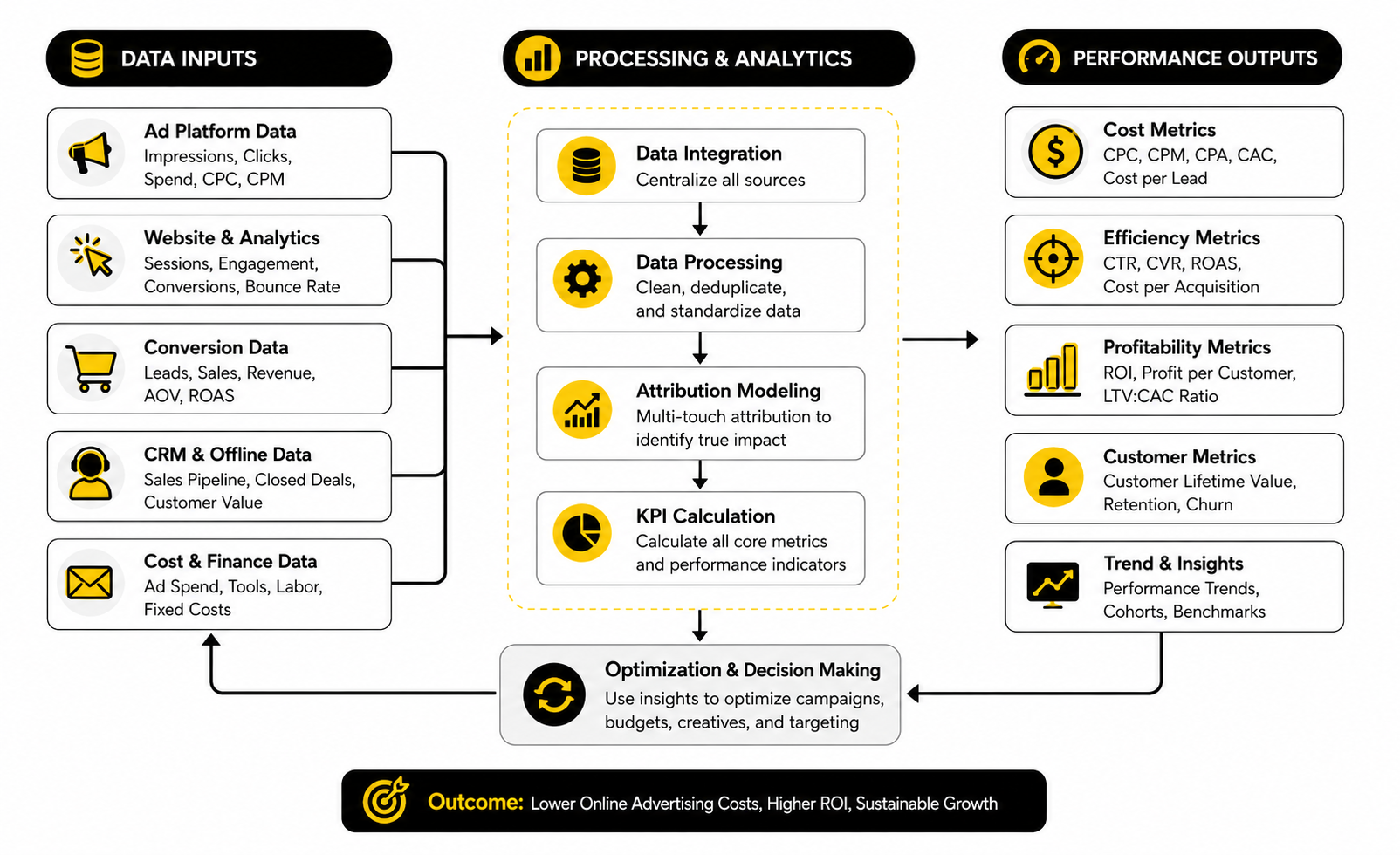
This structure matters because every stage explains a different kind of waste. High CPMs may point to competitive audiences. Weak click-through rates may point to poor creative. Low conversion rates may point to landing page or offer problems. Low close rates may point to qualification, trust, pricing, or sales execution.
The Metrics To Watch First
Start with delivery and reach before judging deeper metrics. If the campaign is barely spending, the issue may be audience size, bid strategy, account history, budget limits, policy reviews, or overly tight targeting. You cannot diagnose conversion performance properly if the campaign never gets enough delivery.
Next, look at engagement signals. Click-through rate, CPC, video hold rate, and scroll behavior can show whether the message is earning attention. These are not final business metrics, but they tell you whether the market is responding before the conversion step.
Then move to conversion and revenue metrics. Cost per lead, cost per purchase, cost per booked call, conversion rate, close rate, ROAS, MER, and payback period are where decisions become serious. These metrics tell you whether the campaign is just generating activity or actually creating value.
Why CPA Is Often More Useful Than CPC
CPC is easy to understand, which is why people obsess over it. But CPA is usually closer to the business decision because it measures the cost of the action you actually wanted. A campaign with a higher CPC can still win if it converts better and produces better customers.
This is especially important in search advertising. High-intent clicks often cost more because advertisers know those users are closer to taking action. If those clicks convert at a higher rate, the higher CPC may still produce a lower CPA.
The same logic applies to social and video campaigns. A low CPC from a broad curiosity-driven ad can look exciting until the lead quality collapses. A more expensive click from a sharper message can be better if it filters the audience before they ever reach the page.
Reading ROAS Without Fooling Yourself
ROAS is useful, but it is not the same as profit. A 3:1 ROAS means the campaign generated three dollars in tracked revenue for every dollar of ad spend. That sounds good until you include product costs, shipping, discounts, transaction fees, refunds, labor, tools, and agency fees.
A business with 80% gross margin can tolerate a different ROAS than a business with 25% gross margin. That is why two advertisers can look at the same ROAS and make opposite decisions. One can scale, while the other needs to pause or rebuild the offer.
ROAS also depends on attribution. If the platform is taking credit for repeat buyers, branded searches, view-through conversions, or purchases that would have happened anyway, the number may look cleaner than reality. Use ROAS, but cross-check it against total revenue, new customer acquisition, and contribution margin.
MER, Payback Period, And Cash Flow
MER, or marketing efficiency ratio, compares total revenue to total marketing spend. It is broader than platform-level ROAS because it looks at the business as a whole instead of one ad account. This can be useful when attribution gets messy across search, social, email, affiliates, creators, and organic traffic.
Payback period matters because profit timing can be just as important as profit size. A subscription company may be willing to acquire customers at a first-month loss if retention is strong and cash flow can support it. A small business with tight cash flow may not have that luxury.
This is where online advertising costs become a finance conversation. The campaign may be technically profitable over six months, but painful in the first 30 days. That does not make it bad, but it does change how aggressively you should scale.
Benchmarks By Channel Need Different Interpretation
Search benchmarks should be interpreted through intent. A high CPC on a bottom-of-funnel keyword may be acceptable because the user is actively looking for a solution. A cheap CPC on a broad keyword may be dangerous if it attracts research traffic that never becomes revenue.
Social benchmarks should be interpreted through creative and audience temperature. A CPM increase may not be a problem if stronger creative improves click-through rate and conversion rate. A lower CPM may not help if the campaign reaches people who are unlikely to act.
Retail media and marketplace ads need product-level interpretation. A sponsored product campaign should not be judged only by ad-attributed revenue if it also affects organic rank, repeat purchase, or total category sales. At the same time, those broader effects should not be used as an excuse to ignore weak unit economics.
When Rising Costs Are Actually A Good Sign
Rising costs are not always bad. Sometimes CPC or CPM rises because the campaign is moving toward a more valuable audience. Sometimes CPA rises during scaling because the easiest conversions were captured first and the campaign is now reaching a wider market.
The question is whether the business outcome improves enough to justify the higher cost. If higher spend brings more qualified leads, higher average order value, stronger close rates, or better retention, the increase may be acceptable. If the extra spend only brings weaker traffic, then the campaign is stretching too far.
This is why cost analysis should always include quality. A cheaper lead that never buys is not cheaper. A more expensive lead that closes faster, spends more, and stays longer may be the better deal.
When Lower Costs Are A Warning Sign
Lower costs can also be misleading. A sudden drop in CPC may happen because the campaign is attracting easier clicks from weaker audiences. A drop in CPM may look good while the campaign quietly moves into cheaper placements that do not convert.
This is especially common when campaigns optimize for traffic instead of meaningful conversions. The platform may find people who love clicking but rarely buy. That makes the dashboard look efficient while the business sees no real lift.
A good advertiser asks what changed behind the cost drop. Did conversion rate hold? Did lead quality hold? Did revenue hold? If not, the lower cost is not a win; it is a distraction.
Turning Data Into Decisions
Data only matters when it drives action. If the campaign has high impressions but weak clicks, test new creative, hooks, angles, and audience framing. If clicks are healthy but conversions are weak, improve the landing page, offer, proof, page speed, and form flow.
If leads are coming in but sales are weak, inspect qualification and follow-up. Look at response time, call booking rate, show rate, sales notes, objections, and close rate. This is where a CRM and automation setup can help because the business needs visibility after the ad platform stops reporting.
A platform like GoHighLevel can be useful when the paid traffic system needs lead capture, pipeline tracking, reminders, and follow-up in one place. For email-heavy funnels, Brevo or Moosend can support nurture sequences that help paid leads become buyers instead of forgotten contacts.
The Simple Reporting Rhythm
A practical reporting rhythm keeps decision-making calm. Daily checks should focus on delivery problems, tracking issues, spend pacing, and obvious campaign errors. Daily data is usually too noisy for major strategic decisions unless something is clearly broken.
Weekly reviews should focus on performance trends. Look at spend, click quality, conversion rate, CPA, lead quality, revenue, and the tests that were active during the period. This is where you decide what to pause, what to adjust, and what deserves another week.
Monthly reviews should focus on business impact. Look at total acquisition cost, blended efficiency, customer quality, payback, creative fatigue, channel mix, and budget allocation. This is where online advertising costs become part of growth planning instead of just campaign management.
Professional Implementation And Optimization
At this stage, the conversation changes. The basics are no longer enough. Once tracking, reporting, funnel structure, and budget logic are in place, the next challenge is managing online advertising costs while the market keeps moving.
Professional implementation is about tradeoffs. More control can mean slower learning. More automation can mean less visibility. More scale can mean weaker efficiency. Better measurement can mean more operational complexity.
That is why experienced advertisers do not treat optimization like a checklist. They build a decision system. The system helps them know when to test, when to cut, when to consolidate, when to segment, when to scale, and when to accept higher costs because the business outcome still works.
The Tradeoff Between Control And Automation
Automation can improve performance when the account has clean data, enough conversion volume, and a realistic target. It can also waste budget quickly when the signal is weak, the conversion event is shallow, or the business target is unrealistic. The platform will optimize toward what you tell it to optimize toward, not what you secretly hope will happen later.
Manual control can be useful when campaigns need tight keyword selection, strict audience rules, specific placement choices, or careful budget pacing. But manual control can also limit the system if the advertiser over-segments too early. Too many small campaigns can starve the algorithm and make online advertising costs harder to read.
The practical answer is not “manual” or “automated.” It is matching control level to campaign maturity. Early testing often benefits from structure and clear constraints, while proven campaigns may benefit from broader optimization once the data supports it.
When To Consolidate Campaigns
Campaign consolidation can help when the account is fragmented across too many campaigns, ad sets, keywords, audiences, or objectives. Fragmentation spreads data too thin. That makes learning slower and can leave each campaign with too little conversion volume to optimize properly.
Consolidation is especially useful when multiple campaigns are chasing the same audience with the same offer. In that case, internal competition can make reporting messy and budget allocation inefficient. A cleaner structure can help the platform make better decisions with fewer artificial walls.
But consolidation is not always the answer. If different products have different margins, different regions have different sales teams, or different audiences need different offers, separation may still be necessary. The rule is simple: consolidate when the business goal is the same, separate when the economics or customer journey are meaningfully different.
When To Segment Campaigns
Segmentation matters when averages hide important differences. A campaign may look acceptable overall while one audience, product, market, keyword group, or device segment is carrying the results. Without segmentation, the strong parts subsidize the weak parts and the budget slowly leaks.
Useful segmentation usually follows business logic. Separate high-margin products from low-margin products. Separate branded demand from non-branded demand. Separate cold acquisition from retargeting. Separate lead quality sources when the sales team reports major differences.
Do not segment just because the platform gives you buttons to do it. Every segment needs enough budget and data to support decisions. If the segment is too small to learn, it may feel precise but operate like noise.
Creative Testing As A Cost-Control System
Creative testing is one of the most practical ways to manage online advertising costs. Better creative can improve click-through rate, conversion intent, audience quality, and sometimes auction efficiency. More importantly, it can reveal what the market actually cares about.
The wrong way to test creative is to change everything at once and guess what worked. The better way is to test clear variables: problem angle, desired outcome, proof type, format, hook, offer framing, or objection handling. This keeps learning useful instead of turning the account into a pile of random ads.
Creative testing should also be tied to funnel intent. A top-of-funnel video may be judged by hold rate, engagement quality, and assisted conversion value. A bottom-of-funnel ad should be judged more directly by conversion rate, CPA, revenue quality, and payback.
The Hidden Cost Of Creative Fatigue
Creative fatigue happens when an audience has seen the message too often and stops responding. It can show up as declining click-through rate, rising CPM, weaker conversion rate, lower engagement quality, or more expensive leads. Sometimes the platform still spends smoothly, but the campaign quietly becomes less efficient.
Fatigue is not always solved by making more ads. It is solved by making more distinct reasons to care. New hooks, proof points, objections, offers, formats, and customer segments can refresh performance without abandoning the core strategy.
This is especially important in paid social. The creative is not just decoration; it is targeting, qualification, and persuasion compressed into one asset. If the creative stops doing that work, online advertising costs rise because the campaign has to buy more impressions to generate the same action.
The Risk Of Over-Optimizing Too Early
Early campaign data is noisy. A few conversions can make one ad look like a winner and another look dead, even when the difference is not stable yet. Cutting too aggressively can remove options before the campaign has enough evidence.
Over-optimization often happens when advertisers watch dashboards too closely. They change bids, budgets, audiences, creative, and landing pages before the system has time to learn. The account never gets a clean test because every variable keeps moving.
The better approach is to set decision rules before launch. Decide how much spend, time, or conversion volume a test needs before you judge it. That does not mean ignoring obvious problems, but it does mean avoiding emotional edits every time the numbers move.
The Risk Of Scaling Too Fast
Scaling too fast can break a campaign that looked strong at a lower budget. As spend increases, the campaign may need to reach less responsive audiences, compete in more expensive auctions, or show ads more often to the same people. That can push costs up even when the original campaign was healthy.
Fast scaling can also break the business behind the campaign. More leads can overwhelm the sales team. More orders can strain fulfillment. More booked calls can reduce response quality. When operations fall behind, the ad account gets blamed for problems created after the click.
This is why scaling should be treated as a stress test. Increase spend in a way that checks whether audience quality, conversion rate, close rate, delivery, and customer experience hold together. If one layer cracks, fix the constraint before adding more budget.
The Problem With Attribution Confidence
Attribution can make marketers overconfident. A platform may claim conversions that were influenced by other channels, repeat customers, branded demand, email, organic search, or sales activity. That does not make the platform useless, but it does mean platform-reported results should not be treated as absolute truth.
Privacy changes and signal loss have made this even more important. The IAB State of Data 2025 report highlights how measurement, attribution, and AI-driven optimization are changing as advertisers deal with fragmented signals and evolving privacy expectations. In practical terms, the dashboard is still useful, but it is not the whole scoreboard.
Better attribution confidence comes from triangulation. Compare platform data with CRM data, ecommerce data, analytics data, customer surveys, incrementality tests, and blended business performance. When several sources point in the same direction, decisions become safer.
Incrementality And The Question That Actually Matters
The real question is not “Did the platform report a conversion?” The better question is “Would this conversion have happened without the ad?” That is incrementality, and it is one of the most important ideas in advanced paid media.
Incrementality matters because some campaigns capture demand that already existed. Branded search, retargeting, and warm audience campaigns can look extremely efficient because they reach people who were already close to buying. They may still be valuable, but their reported ROAS can overstate the true lift.
Testing incrementality does not always require a perfect lab setup. Geo tests, holdout groups, budget split tests, and time-based comparisons can all help when designed carefully. The point is to avoid scaling campaigns only because they take credit well.
First-Party Data As A Cost Advantage
First-party data is becoming more valuable because it helps businesses reduce dependence on platform guessing. Email lists, customer records, purchase history, lead stages, call outcomes, and onsite behavior can all improve targeting, exclusion, reporting, and follow-up. The stronger your owned data, the less blind your paid media system becomes.
This does not mean uploading every list and hoping for magic. The data needs to be clean, consented, organized, and tied to useful customer states. A list of all leads is less useful than a list of qualified leads, won customers, high-value customers, churned customers, and bad-fit leads.
First-party data also improves customer economics after the first click. Email, SMS, CRM follow-up, and sales workflows can turn paid traffic into repeat revenue instead of one-off transactions. That is where tools like Brevo, Moosend, or GoHighLevel can support the system when they are used to follow up with real intent.
Budget Allocation Across Channels
Budget allocation should follow the role each channel plays in the customer journey. Search is often strong at capturing demand. Paid social can create demand, test angles, and build retargeting pools. Email and lifecycle marketing help convert leads and customers after the first touch.
A mature budget usually does not depend on one channel forever. If all sales depend on one ad platform, the business is exposed to auction volatility, policy changes, tracking shifts, and creative fatigue. Diversification does not mean spreading money randomly; it means building more than one reliable path to revenue.
The tradeoff is focus. Small budgets usually need concentration because spreading too thin prevents learning. Larger budgets can test channel mix more seriously because there is enough spend to generate meaningful signals.
Competitive Pressure And Seasonal Cost Swings
Online advertising costs often rise when more advertisers enter the auction. This can happen around holidays, major retail periods, elections, industry events, product launches, local seasonal demand, or end-of-quarter sales pushes. The same campaign can cost more simply because the market is temporarily more crowded.
Seasonality does not always mean a campaign is worse. A higher CPM during a high-demand buying period may still be profitable if conversion intent and average order value improve. The mistake is judging seasonal costs without looking at seasonal revenue quality.
Planning ahead helps. Build creative early, prepare offers before demand spikes, check landing pages before peak traffic, and avoid launching major untested changes during the most expensive period. When the market gets noisy, preparation becomes a cost advantage.
Agency, Freelancer, And Software Costs
Ad spend is only one part of online advertising costs. Management fees, creative production, landing page tools, tracking tools, analytics software, call tracking, CRM systems, and sales support all affect the real cost of acquisition. Ignoring these costs makes campaigns look more profitable than they are.
That does not mean every extra cost is bad. A good landing page, better creative, faster follow-up, or cleaner reporting system can pay for itself by improving conversion rates and reducing waste. The question is whether the extra cost improves the economics enough to justify itself.
For simple funnels, lightweight tools may be enough. For more complex sales systems, a stronger stack can be worth it if it improves speed, visibility, and follow-up. The tool should serve the campaign economics, not become another shiny expense.
When To Accept Higher Online Advertising Costs
Sometimes higher costs are the right move. If a campaign reaches better-fit buyers, improves lead quality, increases average order value, or produces customers with stronger retention, the visible ad cost can rise while the business gets healthier. Cheap acquisition is not the goal; profitable acquisition is.
This is especially true when moving upmarket. Higher-value customers often require more education, stronger proof, better sales processes, and more expensive traffic sources. The cost per lead may rise, but the value per customer can rise even more.
The key is to know what improved. Do not accept higher costs just because the campaign “feels premium.” Accept them when the downstream data proves better economics.
When To Cut Spend Fast
There are also times to cut quickly. If tracking breaks, conversion events fire incorrectly, the landing page goes down, the wrong audience is targeted, or policy issues distort delivery, stop the waste before it compounds. Discipline is not only about patience; it is also about protecting budget when the system is clearly broken.
You should also cut when the campaign has enough data and the economics are clearly outside the acceptable range. If the offer has been tested, the page is functional, the audience is relevant, and the cost still cannot approach the business target, forcing more spend is not courage. It is denial.
The best advertisers are not emotionally attached to campaigns. They are attached to learning, economics, and momentum. If a campaign cannot support those things, the budget should move somewhere more useful.
Cost Benchmarks, Mistakes, Tools, And FAQs
The final step is putting the whole system together. Online advertising costs become much easier to manage when you stop treating every platform metric as a verdict and start treating it as a clue. CPC, CPM, CPA, ROAS, MER, lead quality, close rate, and payback period all matter, but none of them tell the full story alone.
A strong paid media system connects the ad platform, landing page, CRM, analytics, follow-up, and sales process. That connection is what separates businesses that “run ads” from businesses that can actually scale paid acquisition. The more clearly each part of the system talks to the next part, the easier it becomes to find waste and protect profit.
The best advertisers do not chase the lowest possible cost. They chase the best possible economics. That means they are willing to pay more when the customer quality justifies it, and they are disciplined enough to cut spend when the numbers do not support the strategy.
Common Mistakes That Make Ads More Expensive
The first major mistake is launching without knowing the acceptable acquisition cost. If you do not know what a lead, booked call, trial, or customer can be worth, you cannot judge whether the campaign is working. You end up reacting to the dashboard instead of managing the business.
The second mistake is optimizing for the wrong event. Traffic campaigns can bring cheap clicks, but cheap clicks are not the same as qualified demand. If the business needs customers, the campaign should eventually be measured against customer-producing actions, not surface-level engagement.
The third mistake is ignoring what happens after the conversion. Many businesses pay for leads and then respond slowly, follow up inconsistently, or never connect sales outcomes back to the campaign. That makes online advertising costs look like a media problem when the real issue is operational.
The Final Cost Control Ecosystem
A complete advertising system has four connected layers. The first layer is acquisition, where the campaign earns attention through targeting, creative, bidding, and placement. The second layer is conversion, where the landing page, form, checkout, calendar, or chat experience turns attention into action.
The third layer is follow-up, where email, SMS, sales calls, retargeting, CRM stages, and nurture sequences turn action into revenue. The fourth layer is financial review, where the business checks whether revenue, margin, payback, retention, and customer quality justify the spend. Without all four layers, cost control is incomplete.
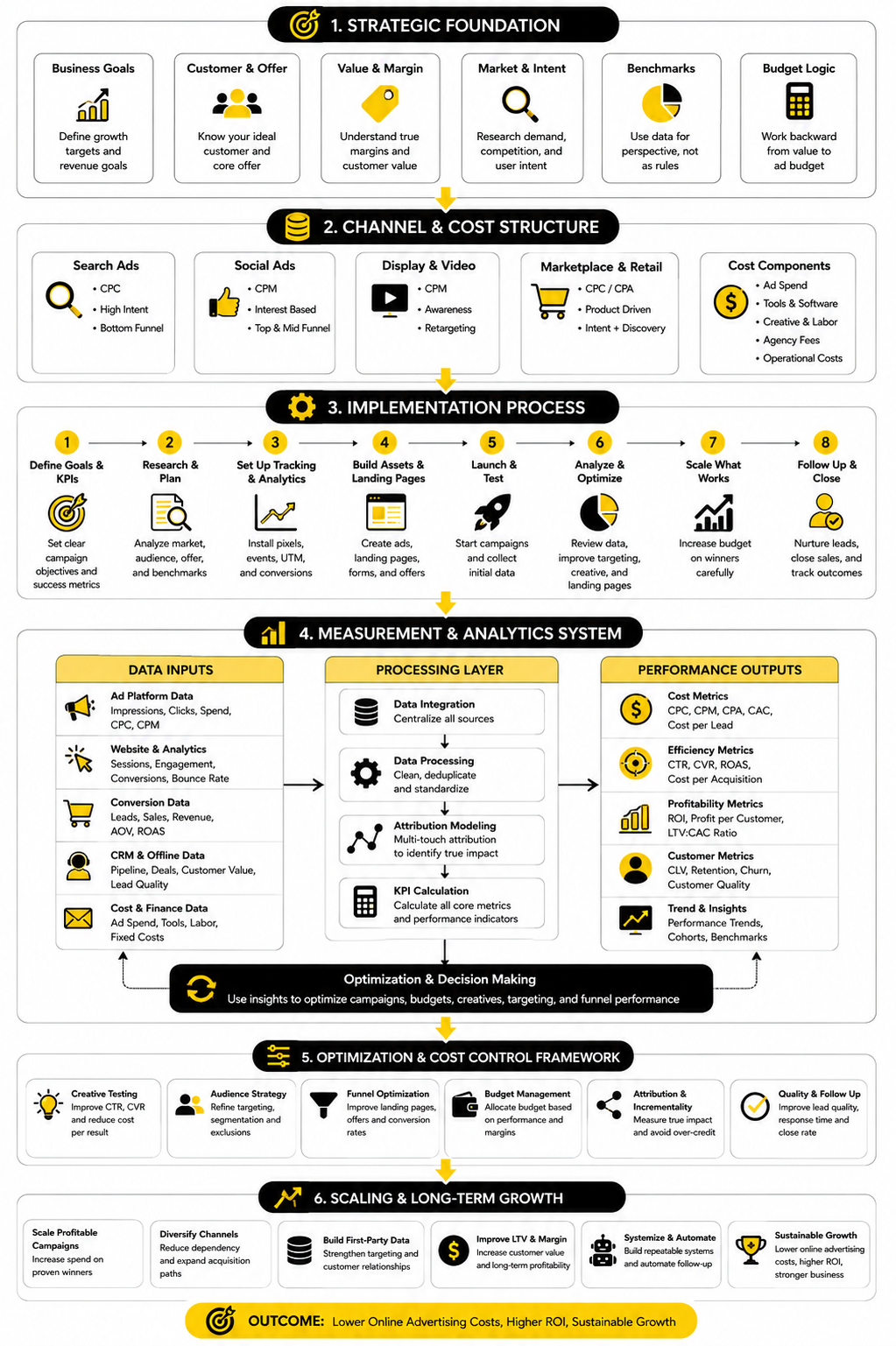
This is why tools should be chosen around the system, not around hype. GoHighLevel can fit service businesses that need CRM, automation, calendars, and pipeline tracking. ManyChat can fit campaigns where social messaging and fast follow-up are central to conversion.
Choosing Tools Without Overcomplicating The Stack
A simple business does not need a complicated software stack. If you are testing one offer, one landing page, and one traffic source, the priority is speed, clarity, and clean tracking. A funnel builder like Systeme.io or ClickFunnels can be enough when the goal is to move from ad click to lead or sale quickly.
As the business grows, the stack should support better decisions. That may mean a stronger landing page workflow, better email nurturing, clearer lead qualification, or more reliable customer data. Tools like Brevo, Moosend, and Fillout can support specific parts of the funnel when they solve a real bottleneck.
The danger is buying tools before fixing the offer, creative, or sales process. Software cannot rescue a campaign that has no clear economics. Use tools to improve speed, visibility, and conversion, not to avoid hard strategic decisions.
A Practical Decision Checklist
Before increasing ad spend, check the basics carefully. The campaign should have enough data, the tracking should be clean enough to trust, and the conversion event should match the business goal. If those conditions are missing, scaling usually makes the problem bigger.
A useful checklist looks like this:
This checklist is intentionally practical. It does not require a massive analytics department. It requires discipline, clean thinking, and a refusal to confuse activity with profit.
What Are Online Advertising Costs?
Online advertising costs are the expenses a business pays to reach, attract, and convert people through digital ad platforms. These costs can include CPC, CPM, CPA, CPL, creative production, landing page tools, tracking tools, agency fees, and follow-up systems. The real cost is not only what you spend in the ad account; it is what it costs to turn attention into profitable revenue.
How Much Should A Small Business Spend On Online Advertising?
A small business should spend enough to generate useful data without risking cash flow. The right starting budget depends on the expected conversion cost, the value of a customer, the sales cycle, and how quickly the business can follow up. A tiny test budget can feel safe, but it often produces too little evidence to make a confident decision.
What Is A Good Cost Per Click?
A good cost per click is one that helps produce profitable conversions. A $10 click can be cheap if it brings qualified buyers, while a $0.50 click can be expensive if it brings people who never act. CPC should always be judged beside conversion rate, lead quality, customer value, and margin.
Why Are My Online Advertising Costs Increasing?
Costs can increase because of stronger competition, weaker creative, audience fatigue, poor landing page performance, seasonal demand, tracking issues, or changes in platform optimization. The first move is not to panic. The first move is to identify where the cost is rising and whether the customer quality is improving, holding steady, or getting worse.
Is CPM More Important Than CPC?
CPM and CPC answer different questions. CPM tells you how expensive it is to reach an audience, while CPC tells you how expensive it is to get a click from that audience. Neither metric is enough by itself because the business still needs to know whether those impressions and clicks lead to qualified actions.
What Is The Difference Between CPA And CPL?
CPA usually means cost per acquisition or cost per action, while CPL means cost per lead. CPL is useful when the campaign goal is to generate inquiries, form fills, booked calls, or demo requests. CPA is usually more useful when the business can track the final action it really wants, such as a purchase, signup, booked appointment, or closed customer.
Why Do Cheap Leads Often Perform Poorly?
Cheap leads often perform poorly because the campaign attracts people who are easy to convert at the form level but not serious enough to buy. This usually happens when the offer is too broad, the qualification is weak, or the campaign optimizes for lead volume instead of lead quality. A lower CPL only helps if the leads can become real revenue.
Should I Optimize For ROAS Or Profit?
ROAS is useful, but profit is more important. ROAS compares revenue to ad spend, while profit includes margin, fulfillment, refunds, transaction fees, labor, tools, and other costs. A campaign with lower ROAS can sometimes be better if it attracts higher-margin customers or stronger repeat buyers.
How Long Should I Test A Campaign Before Judging It?
A campaign should be tested long enough to gather meaningful evidence. That usually means judging it after enough spend, clicks, or conversions have accumulated, not after one emotional day of results. The higher the expected conversion cost, the more budget and patience the test usually needs.
What Is The Biggest Hidden Cost In Paid Advertising?
The biggest hidden cost is often weak follow-up. Businesses spend money to generate leads, then lose them because response time is slow, reminders are missing, sales notes are poor, or no one tracks what happens after the form fill. This creates waste that never appears clearly inside the ad platform.
Can Better Creative Lower Online Advertising Costs?
Better creative can reduce costs by improving attention, relevance, click-through rate, conversion intent, and audience qualification. It can also help the platform find better responders because the ad creates stronger engagement signals. Creative is not just decoration; it is one of the main levers for cost control.
Are Online Advertising Costs Higher For Competitive Industries?
Competitive industries often have higher costs because more advertisers are bidding for the same valuable customers. Legal, finance, insurance, healthcare, home services, and B2B software can be expensive because one customer may be worth a lot. Higher costs are not automatically bad if the customer value supports them.
How Do I Know If My Ads Are Actually Profitable?
You know ads are profitable when tracked revenue and margin exceed the full cost of acquiring and serving the customer. That includes ad spend, software, management, creative, sales labor, refunds, and fulfillment. The cleaner your reporting system, the easier it becomes to separate profitable growth from dashboard noise.
Should I Use One Platform Or Multiple Platforms?
Start with the platform most likely to match your customer’s intent and your budget. A small budget usually needs focus because spreading spend too thin slows learning. As the business grows, adding channels can reduce dependency and create a stronger acquisition system.
What Should I Do Before Scaling A Winning Campaign?
Before scaling, confirm that tracking is reliable, lead or customer quality is strong, the landing page can handle more traffic, and the sales or fulfillment process can absorb extra demand. Then increase spend carefully enough to see whether the economics hold. A campaign is not truly scalable until it works beyond the original budget level.
Build a stronger local presence with BAAM AI
Turn your website, Google profile, social channels, and AI visibility into one growth engine
Most businesses do not need more random marketing activity. They need a consistent presence system that helps the right people find them, trust them, and take action. BAAM AI brings strategy, local SEO, website updates, Google Maps visibility, social content, AI-search readiness, media production, and reporting into one practical monthly engine.
If you want your marketing to keep working after the campaign ends, start with a free BAAM AI presence audit. See how your business shows up today and where the fastest visibility wins are at BAAM AI.