
BAAM AI Blog
Online Ad Agency: How To Choose, Manage, And Scale With The Right Partner
Hiring an online ad agency used to mean outsourcing media buying. Today, that is only one piece of the job. A good agency has to understand offer strategy, tracking, landing pages, creative testing, attribution...
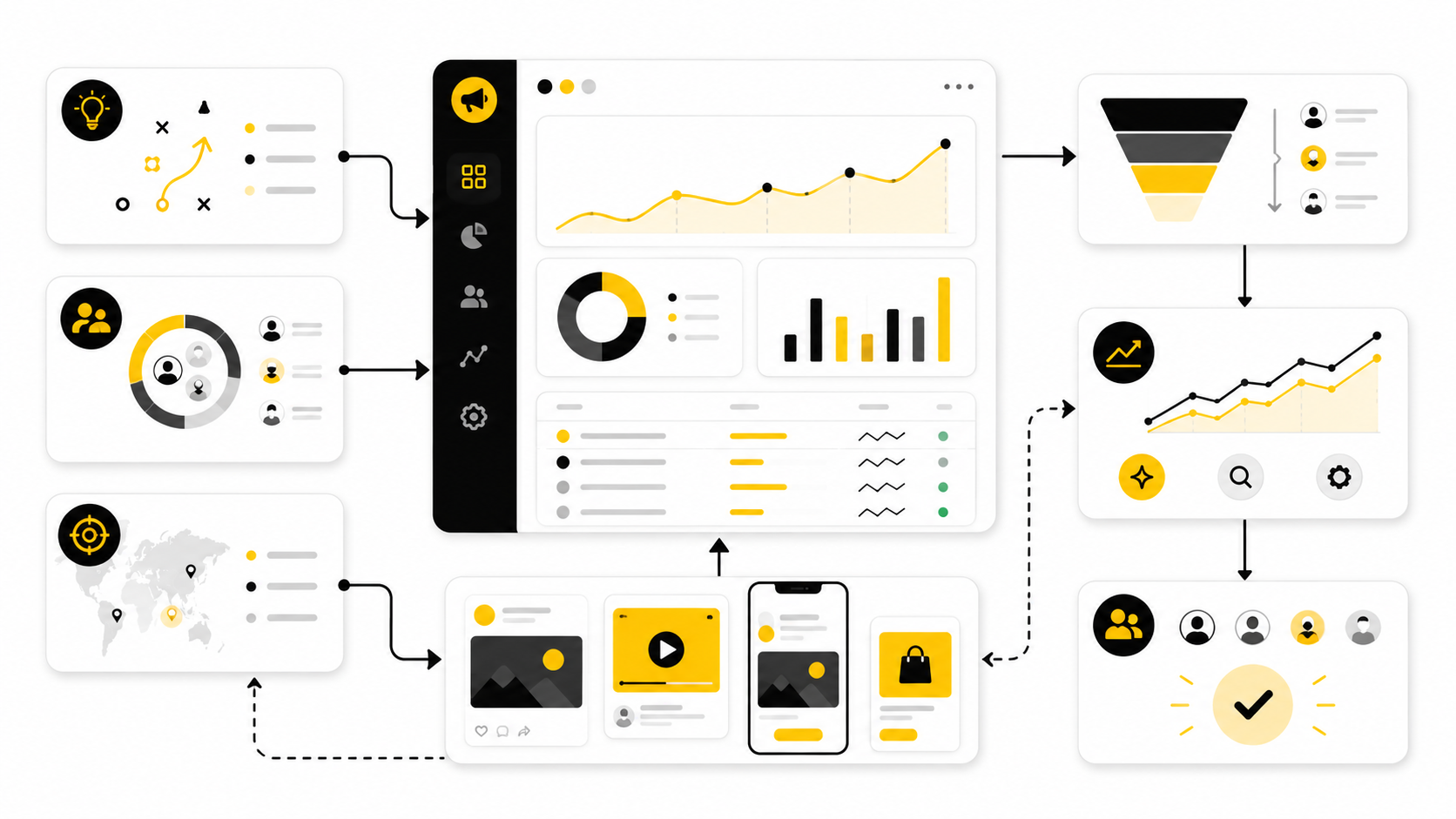
Hiring an online ad agency used to mean outsourcing media buying. Today, that is only one piece of the job. A good agency has to understand offer strategy, tracking, landing pages, creative testing, attribution, automation, reporting, and how paid traffic fits into the rest of the revenue system.
That matters because digital advertising is no longer a side channel. U.S. internet advertising revenue reached nearly $300 billion in 2025, while global marketers spent close to $1.1 trillion on advertising in 2024. More competition usually means higher expectations, tighter measurement, and less room for lazy campaign management.
An online ad agency can help you move faster, but only if you know what kind of partner you need. Some agencies are built for local lead generation. Some are built for ecommerce. Some are strong at creative production, others at Google Ads, Meta Ads, TikTok, LinkedIn, YouTube, programmatic, funnels, CRM automation, or full-funnel growth. The mistake is treating all agencies as if they sell the same thing.
this guide will walk through the practical side of choosing and managing an online ad agency without getting distracted by vague promises. The goal is simple: understand what agencies actually do, how to judge whether one is good, what systems need to exist before you scale spend, and how to avoid paying for activity instead of outcomes.
Why An Online Ad Agency Matters
A strong online ad agency does not just “run ads.” It helps turn attention into measurable business outcomes. That can mean booked calls, ecommerce purchases, qualified pipeline, trial signups, app installs, event registrations, repeat purchases, or higher customer lifetime value.
The reason this matters is that ad platforms have become more automated, not less complex. Google’s Performance Max uses AI across bidding, budgets, audiences, creative, attribution, and placements, which sounds simple until you realize that automation still depends on clean inputs, strong creative, reliable tracking, and a clear business objective. Google has also continued expanding AI-driven campaign tools such as AI Max for Search campaigns, which makes strategic control more important, not optional.
The wrong agency will hide behind platform automation and send you screenshots. The right agency will ask uncomfortable questions about your offer, margins, sales process, conversion rates, customer quality, and follow-up system. That is where the real difference usually appears.
The Online Ad Agency Framework
An online ad agency should be judged through a framework, not a sales call. The basic framework is simple: strategy, tracking, creative, media buying, conversion infrastructure, reporting, and optimization. If one of those pieces is weak, performance eventually breaks somewhere.
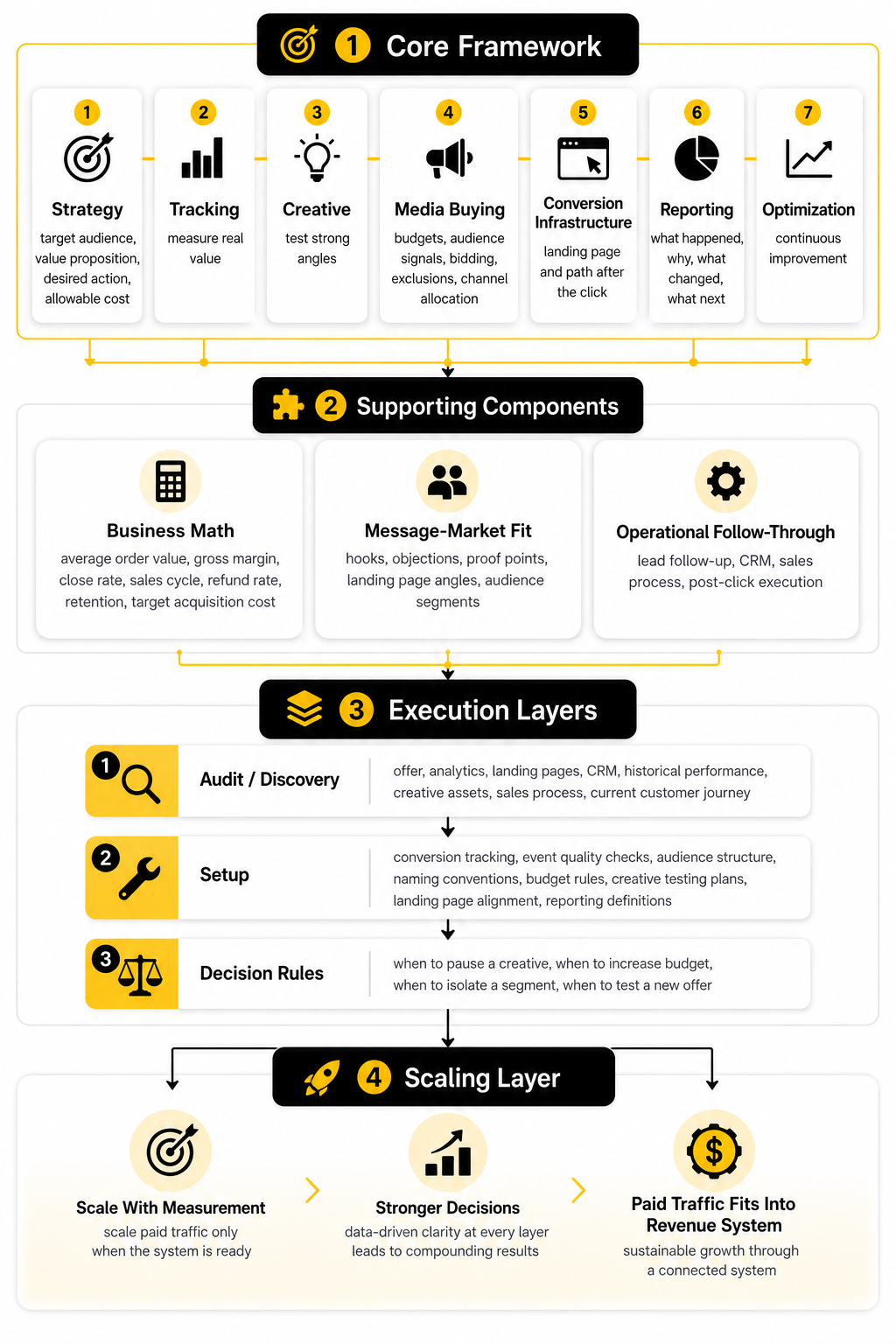
Strategy defines who you are targeting, why they should care, what action you want them to take, and how much you can afford to pay for that action. Tracking tells you whether the campaign is creating real value or just producing attractive platform numbers. Creative gives the platforms enough strong angles to test, while media buying controls budgets, audience signals, bidding logic, exclusions, and channel allocation.
Conversion infrastructure is where many campaigns quietly fail. A campaign can have good targeting and strong creative, but if the landing page is slow, unclear, or disconnected from the ad promise, the budget leaks. For ecommerce landing pages and product-page testing, a tool like Replo can fit naturally into the workflow because it helps teams build and iterate pages without waiting on a full development cycle.
Reporting ties everything together. A useful report does not just say what happened. It explains what changed, why it changed, what the agency learned, and what decision comes next.
Core Components Of A Strong Agency Partnership
A serious agency partnership starts with business math. Before spend increases, everyone should understand your average order value, gross margin, close rate, sales cycle, refund rate, retention, and target acquisition cost. Without those numbers, “good performance” becomes a feeling instead of a decision.
The next component is message-market fit. Paid ads amplify what already resonates; they do not magically fix a weak offer. An online ad agency should be able to test hooks, objections, proof points, landing page angles, and audience segments without turning every test into a random experiment.
The third component is operational follow-through. If leads are generated but nobody follows up quickly, the agency may look bad even when the campaign is doing its job. For service businesses and agencies that need CRM, automation, booking, pipelines, and follow-up in one place, GoHighLevel is often relevant because it connects the advertising side with the sales process after the click.
Professional Implementation Starts Before The First Ad
Professional implementation begins before a single campaign goes live. A good agency will audit your offer, analytics, landing pages, CRM, historical performance, creative assets, sales process, and current customer journey. That discovery phase prevents the team from spending money just to learn things that should have been obvious from the start.
The setup phase should include conversion tracking, event quality checks, audience structure, naming conventions, budget rules, creative testing plans, landing page alignment, and reporting definitions. These details are not glamorous, but they protect the account from confusion later. When campaigns scale, messy setup becomes expensive very quickly.
The best agencies also define decision rules in advance. They know when to pause a creative, when to increase budget, when to isolate a segment, when to test a new offer, and when to stop blaming the platform. That discipline is what separates professional media buying from constant guessing.
Why An Online Ad Agency Matters
The biggest reason to work with an online ad agency is not because ads are impossible to manage in-house. It is because the cost of bad decisions compounds quickly. When media spend, creative testing, tracking, landing pages, and sales follow-up are disconnected, the business often pays for traffic without learning anything useful.
This is especially true now because online advertising is more competitive and more automated at the same time. U.S. digital ad revenue reached nearly $300 billion in 2025, and global ad spend was already close to $1.1 trillion in 2024. More money in the market means more brands fighting for the same attention, which makes weak strategy painfully expensive.
A good agency gives you leverage in three areas. It brings specialist knowledge you may not have internally, it creates a testing rhythm your team may struggle to maintain, and it gives you an outside view of what is actually limiting growth. That last part matters because many companies think they have an ad problem when they really have an offer, page, tracking, or follow-up problem.
The Real Job Of An Online Ad Agency
The real job of an online ad agency is to manage the full path from impression to revenue. That includes the ad someone sees, the page they land on, the action they take, the follow-up they receive, and the way performance is measured afterward. If an agency only looks at platform dashboards, it is seeing part of the picture.
This is where many business owners get disappointed. They hire an agency expecting revenue growth, but the agency only accepts responsibility for clicks, impressions, and leads. That gap creates frustration because the client is measuring business outcomes while the agency is defending platform activity.
The better model is shared accountability around the full funnel. The agency may not control your sales team, your pricing, or your fulfillment, but it should understand how those pieces affect paid media performance. If the agency cannot connect campaign decisions to commercial outcomes, it is not operating at a high enough level.
Why Platform Automation Does Not Replace Strategy
Ad platforms are pushing harder into automation, and that is not going away. Google’s AI Max for Search campaigns focuses on expanding reach and improving campaign performance through AI-driven matching and reporting. Meta’s Advantage+ suite also leans heavily into AI and automation for campaign optimization.
That does not make strategy less important. It makes strategy more important. Automation can decide where to allocate budget inside the system, but it still depends on the quality of the inputs you give it.
Bad creative will not become good because the algorithm is advanced. A weak offer will not become irresistible because a campaign type is newer. Poor tracking will not magically produce clean decisions because the dashboard looks sophisticated.
This is one of the main reasons an experienced online ad agency can still be valuable. The agency’s job is not to fight automation for the sake of control. The job is to feed the system better creative, cleaner data, stronger conversion paths, and clearer business goals.
Why Most Ad Problems Are Not Just Ad Problems
When a campaign underperforms, the easy reaction is to blame the platform. Sometimes that is fair. Markets change, auctions get more expensive, tracking becomes less reliable, and competitors improve.
But most problems deserve a wider diagnosis. The audience may be right, but the message may be vague. The ad may be strong, but the landing page may not match the promise. The leads may be cheap, but the sales team may respond too slowly.
That is why a proper online ad agency should ask questions that go beyond campaign setup. How fast do you contact new leads? What percentage of booked calls show up? What objections appear repeatedly in sales conversations? Which customers are actually profitable after refunds, discounts, support time, and retention are considered?
Those questions are not “extra.” They are the work.
The Online Ad Agency Framework
A practical agency framework has four layers: market clarity, conversion infrastructure, media execution, and learning loops. Each layer supports the next one. If you skip the early layers, paid traffic becomes guesswork with a budget attached.
Market clarity defines who the campaign is for and why they should care now. Conversion infrastructure turns interest into action through pages, forms, calendars, checkout flows, CRM workflows, and follow-up sequences. Media execution handles channels, budgets, creative, bidding, targeting, exclusions, and testing.
The learning loop is what makes the whole system improve. Every campaign should produce insight, not just results. If you spend money and learn nothing about the market, the offer, the creative, or the funnel, the agency is not doing its job properly.
Layer 1: Market Clarity
Before an online ad agency launches campaigns, it should understand the market you are trying to win. This means identifying the buyer’s pain, current alternatives, buying triggers, objections, urgency, and decision process. Without this clarity, campaign targeting becomes a substitute for actual positioning.
Market clarity also protects the creative process. Instead of testing random headlines, the agency can test meaningful angles. One angle might focus on speed, another on risk reduction, another on status, another on cost savings, and another on ease of implementation.
This is where strong agencies separate themselves from button-pushers. Anyone can build a campaign structure. Not everyone can translate buyer psychology into ads that make the right person stop, pay attention, and take action.
Layer 2: Conversion Infrastructure
Conversion infrastructure is the system that receives paid traffic. It includes landing pages, funnels, forms, checkout pages, calendars, chat widgets, CRM stages, email sequences, SMS follow-up, and sales notifications. This layer determines whether expensive attention turns into measurable demand.
For ecommerce brands, the landing page often needs constant iteration because creative angles change quickly. A product page that works for one angle may not work for another. Tools like Replo can be useful when a team needs to build and test campaign-specific pages without waiting for slow development cycles.
For service businesses, the back-end follow-up system is just as important as the landing page. A lead that waits hours for a response can lose intent fast. Platforms like GoHighLevel can fit this kind of workflow because they combine pipelines, forms, calendars, automations, and follow-up in one operating system.
Layer 3: Media Execution
Media execution is where the agency turns strategy into campaigns. This includes choosing platforms, structuring campaigns, writing briefs, launching creative, setting budgets, managing bids, excluding waste, and monitoring performance. It is the most visible part of the work, but it should not be treated as the whole job.
A strong agency does not simply spend the budget evenly across channels because the client asked for “Google, Meta, and TikTok.” It looks at buying intent, audience behavior, creative requirements, sales cycle, offer type, and tracking reliability. Then it decides which channels deserve budget now and which should wait.
Execution also requires restraint. Scaling too early can hide problems instead of solving them. A professional online ad agency knows when to push, when to hold, and when the data is still too thin to make a confident decision.
Layer 4: Learning Loops
The learning loop is the difference between campaign management and growth management. Every test should create a decision. That decision might be to scale a winning angle, cut a weak audience, rebuild a landing page section, change the offer, improve lead qualification, or tighten follow-up.
The agency should document what was tested, what happened, what was learned, and what changes next. Without that rhythm, the account becomes noisy. Everyone remembers different things, old ideas get repeated, and performance conversations become emotional instead of useful.
This is also where reporting needs to be practical. A report should not be a decorative PDF filled with charts nobody acts on. It should help the business make better decisions about spend, creative, funnel improvements, and revenue growth.
Core Components Of A Strong Agency Partnership
Once the framework is clear, the next question is practical: what should the agency actually own? This is where a lot of partnerships get messy. The client assumes the online ad agency is managing growth, while the agency assumes it is only managing campaigns.
A healthy partnership removes that ambiguity early. Everyone should know who owns strategy, creative production, landing pages, CRM setup, tracking, reporting, sales feedback, and budget decisions. If those responsibilities are vague, performance conversations become political instead of useful.
The best agency relationships are not built on blind trust. They are built on clear inputs, clear decision rules, and clear accountability. That gives the agency enough room to do its job while giving the business enough visibility to know whether the work is actually moving the right numbers.
Business Goals And Unit Economics
Before an online ad agency spends serious money, it needs to understand the economics of the business. That means average order value, gross margin, customer lifetime value, sales close rate, refund rate, churn, fulfillment capacity, and acceptable payback window. Without those numbers, the agency is optimizing in the dark.
This is especially important when platform metrics look attractive but business quality is weak. A campaign can produce cheap leads that never buy, low-cost purchases that refund quickly, or high-volume traffic that overwhelms the sales team. None of that is growth.
The agency should help translate business goals into media targets. If the company can afford a $120 cost per qualified lead but not a $220 lead, that changes how aggressively campaigns should scale. If a customer is worth more after the second or third purchase, that changes how much the business can reasonably invest upfront.
Tracking And Measurement Discipline
Tracking is not just a technical setup task. It is the foundation for every serious decision the agency makes. If conversion events are duplicated, missing, delayed, or poorly defined, the platforms receive bad signals and the reporting becomes unreliable.
Modern tracking also needs to respect the reality of privacy changes, consent rules, browser limitations, and attribution gaps. Google’s AI-led campaign tools are designed to improve reach and reporting, but they still depend on the quality of the data being passed back into the account through conversion events and measurement settings. Meta’s Advantage+ tools also rely heavily on automation, which makes clean event data and clear conversion priorities even more important.
A good online ad agency should verify tracking before judging performance. That includes testing forms, checkouts, booking flows, thank-you pages, offline conversion imports, CRM stages, and revenue reporting. This is boring work, but it is the kind of boring work that saves real money.
Creative Strategy And Testing Rhythm
Creative is no longer just a set of polished assets. It is the main lever that helps platforms find the right people and gives buyers a reason to care. A strong agency should treat creative as a testing system, not a one-time production task.
That system should include hooks, offers, formats, angles, proof points, objections, and calls to action. One round of ads may test urgency, another may test clarity, another may test social proof, and another may test a sharper pain point. The point is not to make more ads for the sake of volume.
The agency should also separate creative taste from creative performance. A founder may dislike an ad that customers respond to. A designer may love an ad that does nothing in the market. The job is to protect the brand while still letting real buyer behavior guide decisions.
Landing Pages And Funnel Fit
A paid ad makes a promise. The landing page has to continue that promise without forcing the visitor to mentally reconnect the dots. When the message changes between the ad and the page, conversion rates usually suffer because the user feels like they have landed in the wrong place.
For lead generation, the page should make the next step obvious and reduce friction. The form should ask for enough information to qualify the lead, but not so much that serious prospects abandon the process. For ecommerce, the page should handle objections quickly, show the product clearly, build confidence, and make the buying path feel simple.
This is why funnel tools can be useful when speed matters. If the campaign needs a dedicated offer path, ClickFunnels can help teams build sales funnels without turning every change into a full website project. For simpler all-in-one funnels, email, and checkout workflows, Systeme.io can also fit smaller teams that need structure without heavy software complexity.
How Professional Implementation Actually Works
Professional implementation is not a dramatic launch moment. It is a sequence of small decisions made in the right order. A good online ad agency does not rush straight from onboarding call to live campaigns because that usually creates avoidable waste.
The implementation process should feel structured. First, the agency diagnoses the current situation. Then it fixes measurement and funnel issues. Then it launches controlled tests, reads the data, and scales only what has earned more budget.
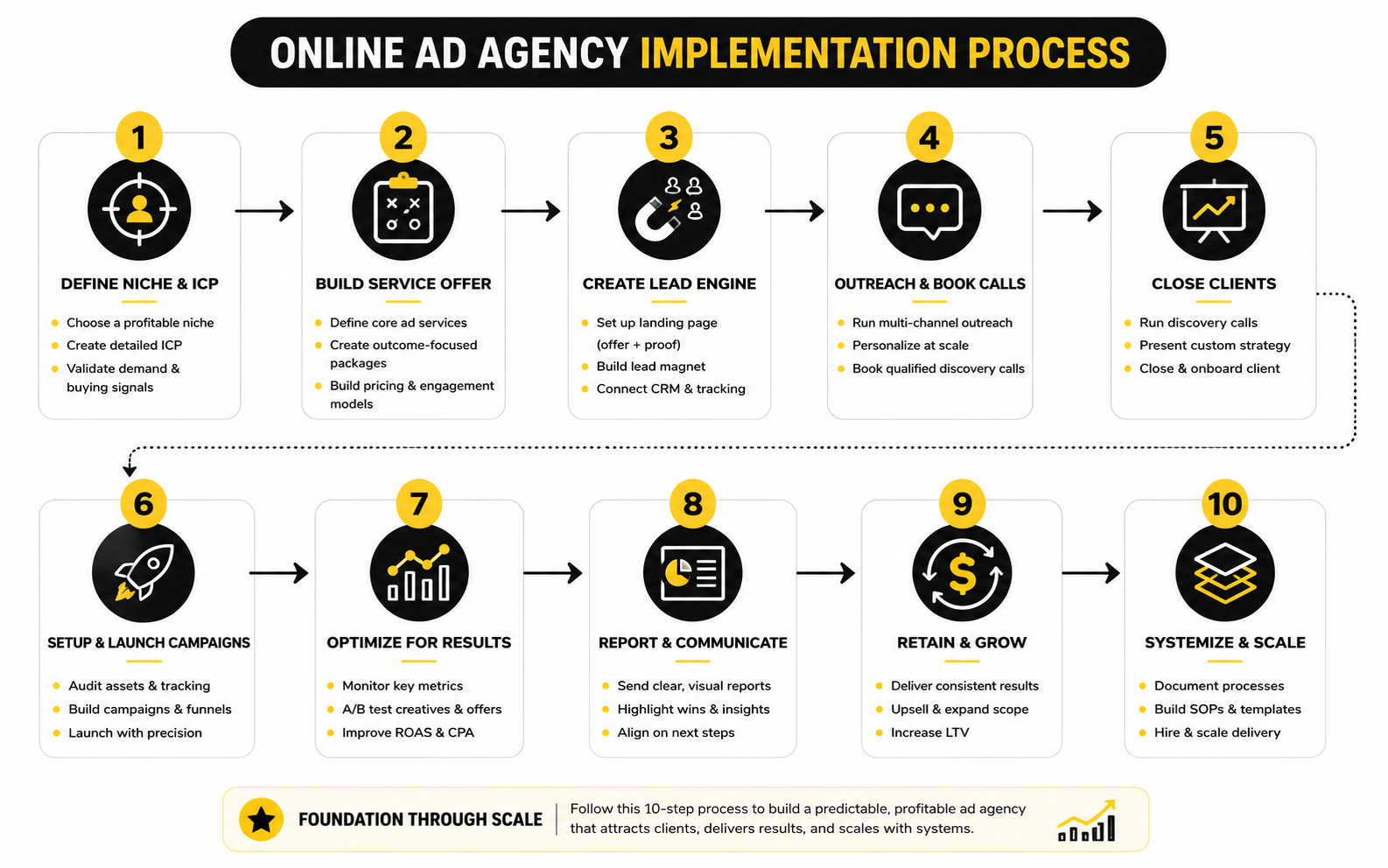
That order matters. If you scale before tracking is clean, you are amplifying uncertainty. If you scale before the offer is clear, you are buying more impressions for a weak message. If you scale before the follow-up system works, you are paying to create demand your business cannot properly capture.
Step 1: Audit The Current Growth System
The first step is a proper audit. The agency should review ad accounts, analytics, landing pages, CRM stages, creative assets, historical results, email and SMS follow-up, booking flows, sales notes, and customer quality. This gives the team a realistic starting point instead of a theory.
The audit should identify where the biggest constraint sits. Sometimes the issue is traffic quality. Sometimes it is a landing page problem. Sometimes it is slow sales response, unclear reporting, weak creative, or an offer that does not stand out.
A good audit ends with priorities. It should not dump a giant list of problems on the client and call that strategy. It should say what needs to be fixed first, what can wait, and what impact each fix is expected to have.
Step 2: Define The Campaign Strategy
Once the audit is complete, the agency should define the campaign strategy. This includes the target audience, offer, channels, budget range, creative angles, conversion events, landing page path, and performance targets. The strategy should be specific enough that everyone can see what is being tested.
This is also where the agency decides what not to do. Not every channel deserves budget at the same time. Not every audience needs a separate campaign. Not every campaign needs a complex funnel.
The strategy should match the business stage. A new offer may need fast learning and proof of demand. A mature account may need efficiency gains, creative refreshes, new audience expansion, or better conversion value tracking. Different stages require different behavior from the agency.
Step 3: Build The Measurement Foundation
Before launch, the agency should build or repair the measurement foundation. That means conversion events, pixels, server-side signals where appropriate, CRM source tracking, UTM standards, call tracking, form tracking, checkout tracking, and reporting views. The goal is not perfect attribution because perfect attribution does not exist.
The goal is decision-grade visibility. You need enough accuracy to know which campaigns, offers, creatives, and channels are producing valuable outcomes. If a lead becomes a qualified opportunity or a sale happens offline, that information should not stay trapped in the CRM.
This is where many teams benefit from connecting the ad system to the sales system. GoHighLevel can be useful for agencies and service businesses that want forms, calendars, pipelines, automations, and reporting closer together. The cleaner the handoff from click to conversation, the easier it becomes to improve the whole system.
Step 4: Launch Controlled Tests
The first launch should be controlled, not chaotic. The agency should test a small number of clear variables so the results are readable. If it changes the offer, audience, creative, landing page, and follow-up at the same time, nobody knows what caused the result.
Controlled testing does not mean moving slowly. It means moving with discipline. The agency can still test aggressively, but each test should have a purpose and a decision attached to it.
A useful first round might compare two creative angles, one landing page path, and one conversion goal. Another round might keep the winning angle and test new proof points or formats. The agency should build momentum through learning, not through random campaign activity.
Step 5: Optimize The Full Funnel
Optimization should not stop inside the ad account. Once traffic is running, the agency should look at page behavior, form completion, booking rates, lead quality, sales acceptance, close rates, and revenue. Each stage reveals a different kind of friction.
If clicks are strong but conversions are weak, the page may need work. If leads are cheap but unqualified, the message or form may be attracting the wrong people. If qualified leads are not closing, the issue may be offer fit, sales process, pricing, or speed to lead.
This is why a real online ad agency needs access to more than platform metrics. Without downstream data, the agency can optimize for what looks good instead of what pays. That is dangerous because the platforms will happily find more of whatever conversion event you tell them to find.
Step 6: Scale What Has Proof
Scaling should happen after there is enough proof to justify more spend. That proof might be stable acquisition cost, improving lead quality, profitable purchase volume, higher qualified pipeline, or a repeatable creative pattern. The exact signal depends on the business model.
Scaling can mean increasing budget, expanding audiences, testing new channels, launching new creative variations, improving funnel depth, or building retargeting layers. It does not always mean simply raising the daily budget. Sometimes the smartest scale move is improving conversion rate before buying more traffic.
A disciplined agency will protect the business from reckless scaling. It will also protect the business from being too timid when the data is strong. The balance is simple: push when the signal is real, pause when the signal is noisy, and never confuse activity with progress.
Statistics And Data That Actually Matter
The numbers only matter if they change what you do next. A professional online ad agency should not bury you in dashboards, screenshots, or vanity metrics. It should help you understand which signals prove demand, which signals expose friction, and which signals are too weak to trust yet.
Start with market context. Digital advertising is huge, crowded, and still growing, with U.S. internet advertising revenue reaching nearly $300 billion in 2025 and global advertising spend reaching close to $1.1 trillion in 2024. That does not mean every business should spend more. It means your agency needs a sharper measurement system because more competition usually punishes vague offers, weak creative, and sloppy funnel tracking.
Benchmarks can be useful, but they should never become the strategy. A 2025 Google Ads benchmark report put the average conversion rate at 7.52% across Google Ads, while another benchmark page listed average cost per lead at $70.11 across Google Ads. Those numbers are helpful for orientation, but they are not your business model.
Benchmarks Are A Starting Point, Not A Scorecard
Benchmarks tell you what is normal in a broad market. They do not tell you what is profitable for your company. A $70 lead can be brilliant for a high-ticket service business and terrible for a low-margin offer.
This is why a good online ad agency should interpret benchmarks through your economics. If your close rate is strong, your margins are healthy, and your customer lifetime value is high, you may be able to outbid competitors while still making money. If your sales process is weak or your retention is poor, even a below-average cost per lead can hide a serious problem.
Benchmarks also vary heavily by industry, intent, and channel. A search campaign targeting urgent buyers will behave differently from a social campaign introducing a new product to cold audiences. Treating both campaigns as if they should hit the same conversion rate is lazy analysis.
The Metrics That Deserve Attention
The most useful metrics are the ones connected to decisions. You do not need fifty numbers in every report. You need the right numbers grouped by the part of the funnel they explain.
At the traffic level, the agency should watch impressions, reach, click-through rate, cost per click, frequency, and engagement quality. These metrics help diagnose whether the message is earning attention and whether the platform can find relevant users. They do not prove revenue by themselves.
At the conversion level, the agency should watch landing page conversion rate, form completion rate, checkout completion, booking rate, cost per lead, cost per acquisition, and conversion value. These metrics show whether attention is turning into action. If traffic looks healthy but conversion is weak, the next move is usually page, offer, or funnel improvement.
At the revenue level, the agency should watch qualified lead rate, sales acceptance, show-up rate, close rate, average order value, customer acquisition cost, payback period, refund rate, and lifetime value. These are the numbers that separate “campaign performance” from business performance. This is where the truth usually lives.
Attribution Should Guide Decisions, Not Create Arguments
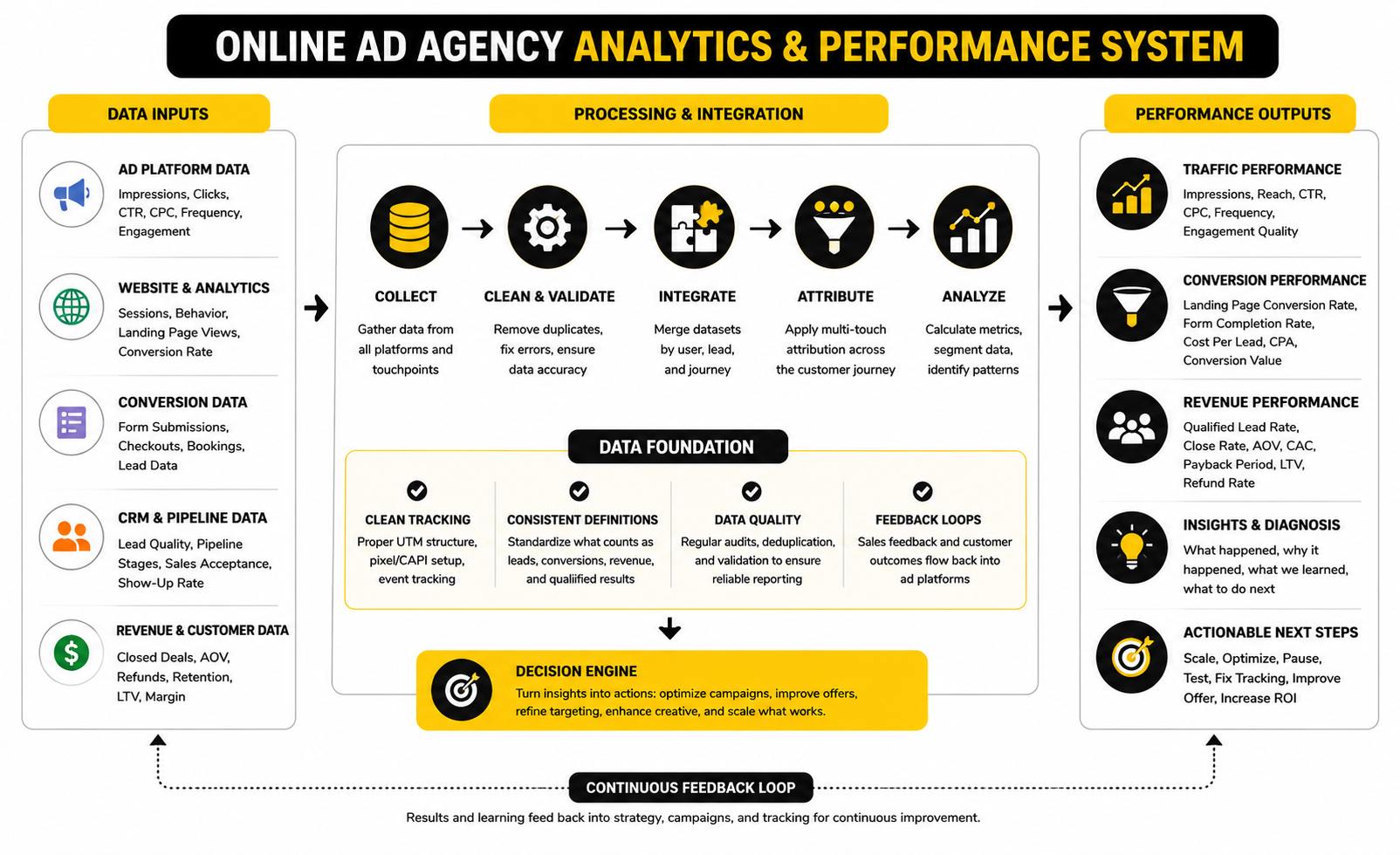
Attribution is useful, but it is not a courtroom. You are not trying to prove one platform deserves all the credit. You are trying to understand which touchpoints help create profitable demand.
Modern attribution is messy because buyers move across devices, browsers, channels, inboxes, social feeds, search results, and sales conversations. Privacy changes and tracking limits make the picture less complete than many dashboards pretend. A serious online ad agency should be honest about that instead of acting like one report explains everything perfectly.
The practical solution is to combine multiple views. Platform data shows how each ad system is optimizing. Analytics data shows website behavior. CRM data shows lead quality and sales movement. Revenue data shows whether the business is actually growing.
What Good Reporting Should Look Like
Good reporting should answer four questions. What happened? Why did it happen? What did we learn? What are we doing next? If a report does not answer those questions, it is probably just decoration.
A useful report should separate leading indicators from lagging indicators. Click-through rate, cost per click, and landing page conversion rate can show early direction. Revenue, payback, retention, and lifetime value take longer to understand but matter more.
The agency should also explain confidence level. A result from 20 clicks is not the same as a result from 20,000 clicks. A campaign that looks profitable after two purchases may still be too early to scale. Smart reporting helps the business avoid both overreacting and waiting too long.
How To Read Performance Signals
A strong click-through rate usually means the creative or message is getting attention. That is useful, but attention is not the final goal. If clicks are cheap and conversions are poor, the ad may be attracting curiosity instead of buyers.
A rising cost per click is not always bad. It can happen when the agency moves toward more competitive, higher-intent audiences. The question is whether downstream quality improves enough to justify the higher cost.
A low cost per lead can also be dangerous. If those leads do not show up, do not qualify, or do not buy, the campaign is training the platform to find the wrong people. This is why lead quality feedback should move from the sales team back into the ad account as quickly as possible.
When The Data Says To Scale
Scaling is justified when the signal is stable, the economics work, and the operations can handle more volume. That means the agency should see consistent acquisition costs, acceptable conversion quality, enough sample size, and no obvious bottleneck in sales or fulfillment. Scaling before those conditions exist is gambling with nicer charts.
The action does not always have to be a budget increase. Sometimes the better move is to launch more creative around a proven angle. Sometimes it is to duplicate a winning funnel for another segment. Sometimes it is to improve the sales follow-up system before buying more traffic.
For service businesses, speed and follow-up discipline often decide whether paid leads become revenue. A platform like GoHighLevel can support that process when the team needs forms, calendars, pipelines, automations, and lead follow-up in one place. The point is not software for the sake of software; the point is making sure demand does not leak after the click.
When The Data Says To Pause
Pausing is not failure. It is discipline. A professional online ad agency should know when the numbers are telling the team to stop spending and fix the system.
Pause when tracking is broken, when the offer is attracting the wrong audience, when the landing page clearly fails to convert, or when lead quality is consistently poor. Also pause when the sample size is too small to justify a big decision. Bad data plus fast action is a dangerous combination.
The smartest agencies do not pause and disappear. They pause with a diagnosis. Then they return with a specific fix, a cleaner test, and a better reason to spend again.
How To Choose The Right Online Ad Agency
Choosing an online ad agency is not about finding the loudest promise. It is about finding the partner whose operating model matches your stage, your economics, and your growth bottleneck. A great agency for a local service business may be the wrong fit for a SaaS company, and a strong ecommerce media buyer may not understand long-cycle B2B pipeline.
The first filter is specialization. You want to know whether the agency has real experience with your business model, not just your ad platform. Lead generation, ecommerce, marketplace growth, info products, high-ticket services, local businesses, and B2B demand generation all require different judgment.
The second filter is how the agency thinks. If the conversation stays only on clicks, budgets, and campaign types, be careful. A serious online ad agency will ask about your offer, margins, conversion path, sales process, follow-up, customer quality, and what happens after the lead or purchase.
Agency Types And Where They Fit
A media buying agency focuses mainly on campaign setup, optimization, and budget allocation. This can work well when your offer, funnel, creative production, and analytics are already strong. It is usually not enough if the business still needs help fixing the message, page, or sales process.
A creative performance agency puts heavier emphasis on ad concepts, hooks, scripts, UGC-style production, testing systems, and creative refreshes. This can be a better fit when the account has enough budget but struggles with fatigue or weak messaging. In many paid social accounts, creative is the main constraint, so this model can make sense.
A full-funnel agency looks across ads, pages, automation, CRM, follow-up, and reporting. This is often the strongest fit for businesses that need the whole growth system tightened, not just campaign management. The tradeoff is that full-funnel work usually requires more collaboration and more access to internal data.
The Questions Worth Asking Before You Hire
The best questions reveal how the agency makes decisions. Ask how they diagnose poor performance, how they decide when to scale, how they handle bad tracking, and how they report lead quality. Their answers will tell you whether they operate from a process or from vibes.
You should also ask what they need from you to succeed. Weak agencies say they can handle everything with minimal involvement. Strong agencies are honest about the inputs they need, including sales feedback, offer details, customer insights, creative approvals, CRM access, and margin data.
Do not just ask for results. Ask how those results were achieved. You want to understand whether the agency inherited a strong account, fixed a broken system, improved creative, rebuilt tracking, changed the offer, or simply benefited from a market tailwind.
Red Flags That Should Slow You Down
Be careful with any online ad agency that guarantees specific revenue without seeing your economics, sales process, or historical data. Paid advertising has too many variables for that kind of promise to be credible. Confidence is good, but certainty before diagnosis is a problem.
Another red flag is vague reporting. If the agency cannot explain what changed, what was learned, and what will happen next, the relationship will probably become frustrating. Dashboards are useful, but they are not a replacement for thinking.
Also watch for agencies that hide behind platform automation. Automation can be powerful, but it does not remove the need for strategy, creative quality, clean data, and funnel discipline. If the agency’s answer to every problem is “the algorithm needs more time,” you may be dealing with passivity dressed up as expertise.
The Tradeoff Between Control And Speed
Some businesses want tight control over every creative, campaign, and landing page change. That can protect the brand, but it can also slow learning to a crawl. If every test needs weeks of internal approval, the agency cannot build momentum.
Other businesses give the agency too much freedom too quickly. That can create speed, but it can also lead to off-brand messaging, messy experiments, and unclear accountability. Speed without standards becomes chaos.
The better approach is controlled autonomy. Define brand boundaries, approval rules, testing limits, budget thresholds, and reporting expectations upfront. Then let the agency operate inside those boundaries without turning every decision into a committee meeting.
Advanced Considerations Before Scaling
Scaling paid traffic is not just a media buying challenge. It is an operational challenge. More traffic can expose weaknesses in sales capacity, customer support, fulfillment, onboarding, product quality, cash flow, and retention.
This is why some businesses feel like ads “stop working” when they increase spend. The ads may still be working, but the system around them cannot absorb the volume. The agency should help identify those constraints before the business mistakes operational pressure for campaign failure.
A mature online ad agency should talk about scaling in layers. First, prove the offer. Then prove the funnel. Then prove the sales or checkout process. Then expand creative, audiences, budgets, and channels in a way the business can actually support.
Creative Fatigue And Message Expansion
Creative fatigue happens when the same message reaches the same audience too often. Performance drops because the market has already seen the angle, ignored it, or acted on it. Refreshing the visuals alone may not solve the problem if the underlying message is still the same.
The better solution is message expansion. Instead of making ten versions of the same claim, the agency should develop new angles around different buyer motivations. That might include speed, certainty, simplicity, status, savings, risk reduction, convenience, or a specific pain the buyer already feels.
This requires a real creative pipeline. The agency should be collecting insights from comments, search terms, sales calls, reviews, customer interviews, competitor ads, and landing page behavior. Great creative does not come from staring at a blank document; it comes from listening carefully to the market.
Channel Expansion Without Losing Focus
Adding more channels can help growth, but it can also dilute attention. A business that cannot make one or two channels work should be careful before spreading budget across five. More platforms create more complexity, more creative requirements, and more reporting noise.
The right time to expand is when the current channel has a clear role and the next channel has a clear reason to exist. Search may capture demand. Paid social may create demand. Email may convert and retain demand. Retargeting may recover demand that was not ready yet.
For teams that need stronger social publishing and scheduling around paid campaigns, Buffer can support the organic side of the content system. That does not replace paid media, but it can help keep brand presence consistent while the agency tests paid acquisition.
Automation Should Support The Strategy
Automation is useful when it removes friction from a clear process. It is dangerous when it hides the fact that the process is unclear. An online ad agency should not automate chaos and call it scale.
Lead routing, appointment reminders, nurture sequences, missed-call follow-up, abandoned checkout flows, and post-purchase journeys can all improve performance when they match the customer journey. The key is relevance. A fast automated message that says the wrong thing still creates a bad experience.
For lead generation, ManyChat can be useful when the campaign depends on conversational flows through social messaging. For email and customer communication, Brevo can support structured follow-up beyond the first click. The strategic point is simple: automation should make good timing easier, not make the brand feel robotic.
AI Tools Need Human Judgment
AI can help agencies move faster with research, drafts, variations, summaries, analysis, and workflow support. That speed is useful, especially when creative testing requires many angles and formats. But AI output still needs human judgment, customer understanding, and brand context.
The risk is that every competitor can use similar tools to create similar-looking campaigns. When that happens, advantage moves back to better positioning, better offers, better data, and better taste. AI can accelerate production, but it cannot decide what your market genuinely cares about unless the team gives it strong inputs.
This is where expert guidance still matters. An online ad agency should know where AI helps and where it creates risk. Faster production is valuable only when the work is pointed in the right direction.
The Hidden Risk Of Misaligned Incentives
Agency pricing affects agency behavior. A flat retainer can be stable, but it may not reward upside. A percentage of ad spend can encourage scaling, but it can also create pressure to spend more before the account is ready.
Performance-based pricing sounds attractive, but it needs clean definitions. If the agency is paid for leads, it may optimize toward volume instead of quality. If it is paid for revenue, it needs enough visibility and influence over the funnel to be accountable fairly.
The best structure depends on the business. What matters is that incentives are visible and honest. Both sides should know what success means, how it is measured, and which decisions the agency can actually control.
Building A Long-Term Agency Relationship
A good agency relationship gets stronger over time because the learning compounds. The agency understands the market better, the creative archive grows, the reporting gets cleaner, and the team learns which offers and audiences deserve more attention. That compounding only happens when the relationship is managed properly.
The client has responsibilities too. You need to give the agency timely feedback, accurate data, clear priorities, and enough context to make good decisions. If the agency is always guessing what happened after the lead came in, performance will eventually suffer.
The relationship should also evolve. Early on, the focus may be setup, diagnosis, and testing. Later, it may shift toward scale, retention, channel expansion, creative systems, and improving profit quality instead of just increasing volume.
Communication Rhythm
A weekly or biweekly rhythm usually works better than random check-ins. The meeting should focus on decisions, not just updates. What changed, what was learned, what needs approval, and what is blocking progress?
The agency should not need a meeting to explain every small adjustment. At the same time, the client should never feel blind. The right rhythm gives visibility without turning the agency into a reporting assistant.
Written summaries help a lot. A short recap of tests, results, decisions, and next actions prevents confusion later. It also creates a record of learning, which becomes valuable when the account grows more complex.
What To Bring In-House Over Time
Not everything should stay outsourced forever. As the business grows, it may make sense to bring certain capabilities in-house. That could include creative production, analytics, landing page updates, CRM operations, or organic content.
The agency can still remain valuable as a strategic and execution partner. In many cases, the best model becomes hybrid. The internal team owns brand knowledge and speed, while the agency brings external expertise, channel depth, and performance discipline.
The decision should be based on leverage. If a function needs constant daily context, it may belong in-house. If it requires specialized skill, broader market exposure, or platform expertise, it may still make sense to keep agency support.
When To Replace An Agency
Sometimes the right move is to fix the relationship. Sometimes the right move is to leave. The difference usually comes down to whether the agency can diagnose problems honestly and improve the operating system.
Replace the agency if it repeatedly avoids accountability, gives vague answers, hides data, ignores lead quality, misses basic tracking issues, or keeps repeating tests that already failed. Also replace it if your business has outgrown the agency’s skill set. That is not always a scandal; sometimes it is just a stage mismatch.
Do not replace an agency just because one month is soft. Paid media has volatility. The better question is whether the agency understands why performance changed and has a credible plan for what comes next.
Final Checks Before You Commit
Before you sign with an online ad agency, slow down and look at the full system one more time. The agency may be talented, but talent alone does not fix unclear goals, weak economics, poor tracking, slow follow-up, or a funnel that does not match the offer. A strong partner can improve those things, but only if the relationship is built around truth instead of hope.
The best decision is rarely about choosing the agency with the flashiest case studies. It is about choosing the team that understands your growth stage and can explain the work in plain language. If they can show you how strategy, creative, media buying, landing pages, automation, reporting, and sales feedback connect, you are much closer to a serious partnership.
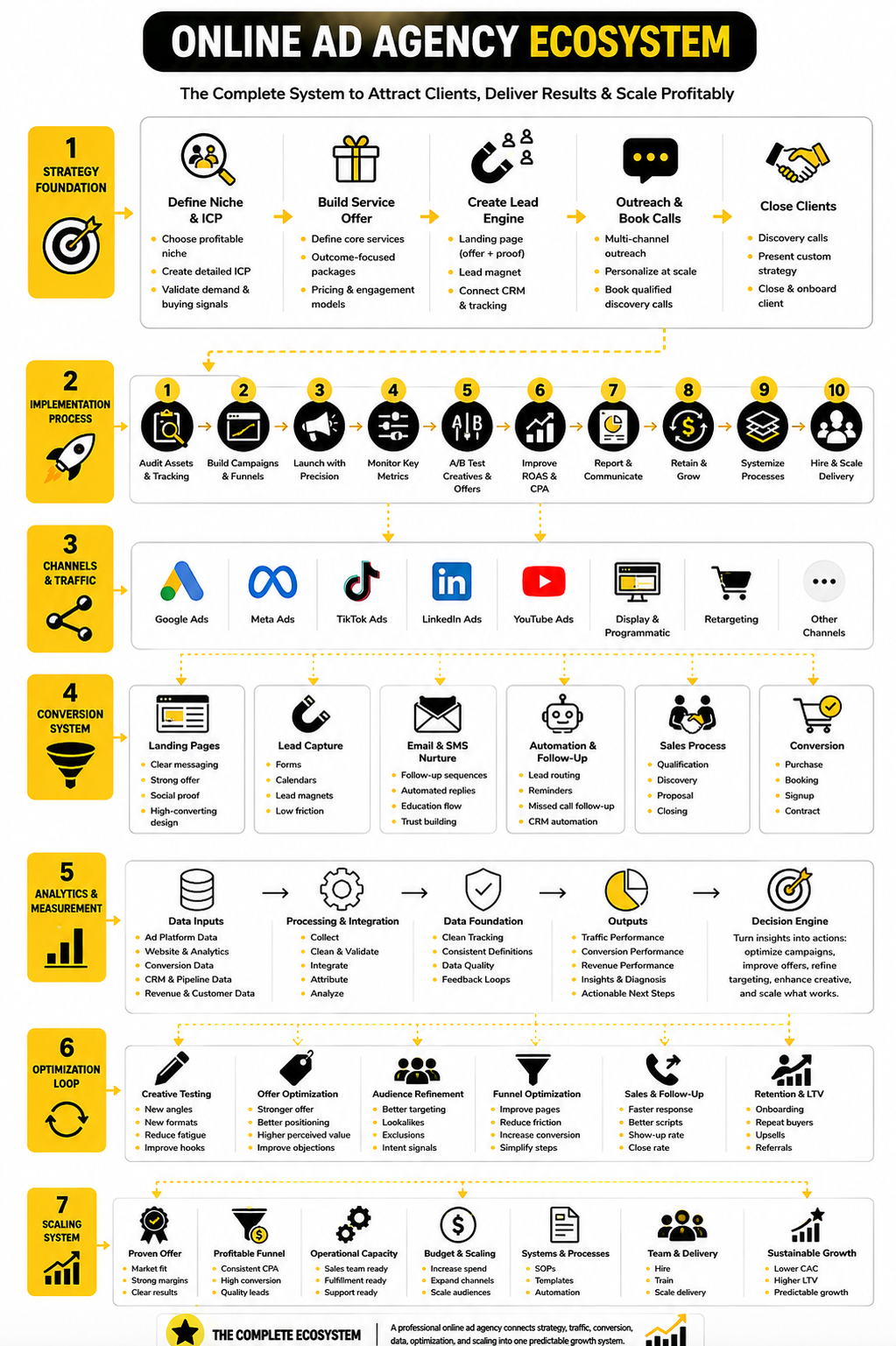
This is the ecosystem you are really building. Ads create demand, pages capture intent, automation protects speed, sales converts interest, reporting improves decisions, and customer quality tells you whether the whole system is worth scaling. When those pieces work together, an online ad agency becomes more than a vendor.
What does an online ad agency do?
An online ad agency helps businesses plan, launch, manage, measure, and improve paid advertising campaigns across digital channels. That can include Google Ads, Meta Ads, TikTok Ads, LinkedIn Ads, YouTube Ads, programmatic ads, retargeting, landing pages, creative testing, reporting, and conversion tracking. The best agencies go beyond campaign setup and help connect paid traffic to real business outcomes.
How is an online ad agency different from a traditional marketing agency?
A traditional marketing agency may focus on branding, messaging, design, PR, content, or broad campaign planning. An online ad agency usually focuses more directly on paid digital channels, conversion paths, measurable performance, and ongoing optimization. Some agencies do both, but you should always clarify whether they are strongest in strategy, creative, media buying, analytics, or full-funnel growth.
When should a business hire an online ad agency?
You should consider hiring an online ad agency when paid traffic is important to growth but your internal team lacks the time, skill, or testing discipline to manage it properly. It also makes sense when your current campaigns have stalled and you need an outside diagnosis. If your offer, sales process, and economics are still completely unclear, fix those basics first or choose an agency that can help with the full system.
How much does an online ad agency cost?
Agency pricing depends on scope, channel mix, spend level, service depth, and business complexity. Some agencies charge a flat monthly retainer, some charge a percentage of ad spend, and some use hybrid or performance-based pricing. The real question is not only what the agency costs, but whether its work can improve acquisition efficiency, revenue quality, and decision-making enough to justify the investment.
What should I prepare before hiring an online ad agency?
Prepare your business goals, historical campaign data, website analytics, offer details, customer profiles, margins, average order value, sales close rates, CRM data, landing pages, creative assets, and current follow-up process. The more clearly you understand your numbers, the faster the agency can make useful decisions. If you hide weak spots, you only make the agency slower and the testing more expensive.
What are the biggest red flags when choosing an agency?
Red flags include guaranteed results before diagnosis, vague reporting, no clear testing process, poor communication, no interest in lead quality, and an obsession with vanity metrics. Be careful with agencies that talk only about clicks and impressions while ignoring your sales process and customer economics. Also watch for agencies that blame the platform every time performance drops without offering a practical fix.
How long does it take for an online ad agency to show results?
Some early signals can appear quickly, such as click-through rate, landing page conversion rate, lead volume, and cost per lead. More meaningful signals, such as qualified pipeline, revenue, payback period, retention, and lifetime value, usually take longer because they depend on the full customer journey. A good agency should explain which signals matter now and which require more data before you make a scaling decision.
Should an online ad agency manage landing pages too?
In many cases, yes. Paid ads and landing pages are too connected to treat separately. If the agency controls traffic but has no influence over the page experience, it may struggle to improve conversion rates.
That does not mean every agency must build your entire website. It does mean the agency should be able to diagnose page problems, recommend changes, and work with whoever owns implementation. For ecommerce teams that need faster campaign-specific page testing, Replo can fit naturally into the workflow.
Should I use one agency for every channel?
One agency can work well if it has real depth across the channels you need and can manage the full system coherently. The advantage is simpler communication, cleaner strategy, and fewer handoff problems. The risk is that the agency may claim expertise in every channel while only being truly strong in one or two.
A specialist model can also work. You might use one agency for search, another for paid social, and an internal team for email or creative. If you do that, reporting and ownership must be extremely clear or everyone will optimize their own slice while the full funnel suffers.
How do I know if my agency is doing a good job?
A good online ad agency should make your decisions clearer. You should understand what is being tested, why it matters, what the results mean, and what happens next. Even when performance is not perfect, the agency should be able to explain the diagnosis and the plan.
You should also see stronger operational discipline over time. Tracking should improve, creative testing should become more structured, reporting should become more useful, and campaign decisions should feel less random. If every month feels like starting from zero, something is wrong.
What metrics should I care about most?
The most important metrics depend on your business model, but they should connect to money. Cost per qualified lead, customer acquisition cost, conversion rate, average order value, close rate, payback period, lifetime value, and revenue quality usually matter more than clicks or impressions. Early-stage metrics can help diagnose problems, but they should not become the final scoreboard.
For lead generation, lead quality and sales outcomes matter more than raw lead volume. For ecommerce, contribution margin and repeat purchase behavior matter more than surface-level return on ad spend. The agency should help you separate useful signals from noise.
Can an online ad agency help with automation and follow-up?
Yes, and this is often where performance improves without simply increasing ad spend. Automation can help with lead routing, appointment reminders, missed-call follow-up, email sequences, SMS follow-up, abandoned checkout recovery, and post-purchase communication. The key is making automation feel timely and relevant, not robotic.
For service businesses and agencies that need one system for forms, calendars, pipelines, automations, and follow-up, GoHighLevel can be a practical fit. For email and customer communication workflows, Brevo can also support structured follow-up after the first click.
What should I do if my agency is getting leads but no sales?
First, do not assume the ads are the only problem. Check lead source quality, form fields, landing page promise, sales response speed, qualification process, offer clarity, pricing objections, show-up rate, and close rate. A campaign can generate leads and still fail commercially if the downstream system is weak.
Then ask the agency to review the full path with you. Look at real lead records, sales notes, call outcomes, and CRM stages. If the agency refuses to engage with post-lead quality, you may need a stronger partner or a clearer internal handoff process.
Is it better to hire an agency or build an in-house team?
It depends on your stage and the kind of expertise you need. An agency can give you faster access to specialists, broader market experience, and established processes. An in-house team can give you deeper brand context, faster internal collaboration, and more control.
Many growing businesses eventually use a hybrid model. The internal team owns brand knowledge, customer insight, and daily coordination, while the agency supports strategy, channel execution, creative testing, analytics, or scale. The right answer is the model that gives you better decisions and better execution, not the one that sounds cleaner on paper.
Build a stronger local presence with BAAM AI
Turn your website, Google profile, social channels, and AI visibility into one growth engine
Most businesses do not need more random marketing activity. They need a consistent presence system that helps the right people find them, trust them, and take action. BAAM AI brings strategy, local SEO, website updates, Google Maps visibility, social content, AI-search readiness, media production, and reporting into one practical monthly engine.
If you want your marketing to keep working after the campaign ends, start with a free BAAM AI presence audit. See how your business shows up today and where the fastest visibility wins are at BAAM AI.