
BAAM AI Blog
Octopus Email Marketing: A Practical Guide To Building A Simple, Profitable Email System
Octopus email marketing usually refers to EmailOctopus, a lean email marketing platform built for businesses that want newsletters, forms, landing pages, segmentation, and automations without carrying the weight of a...
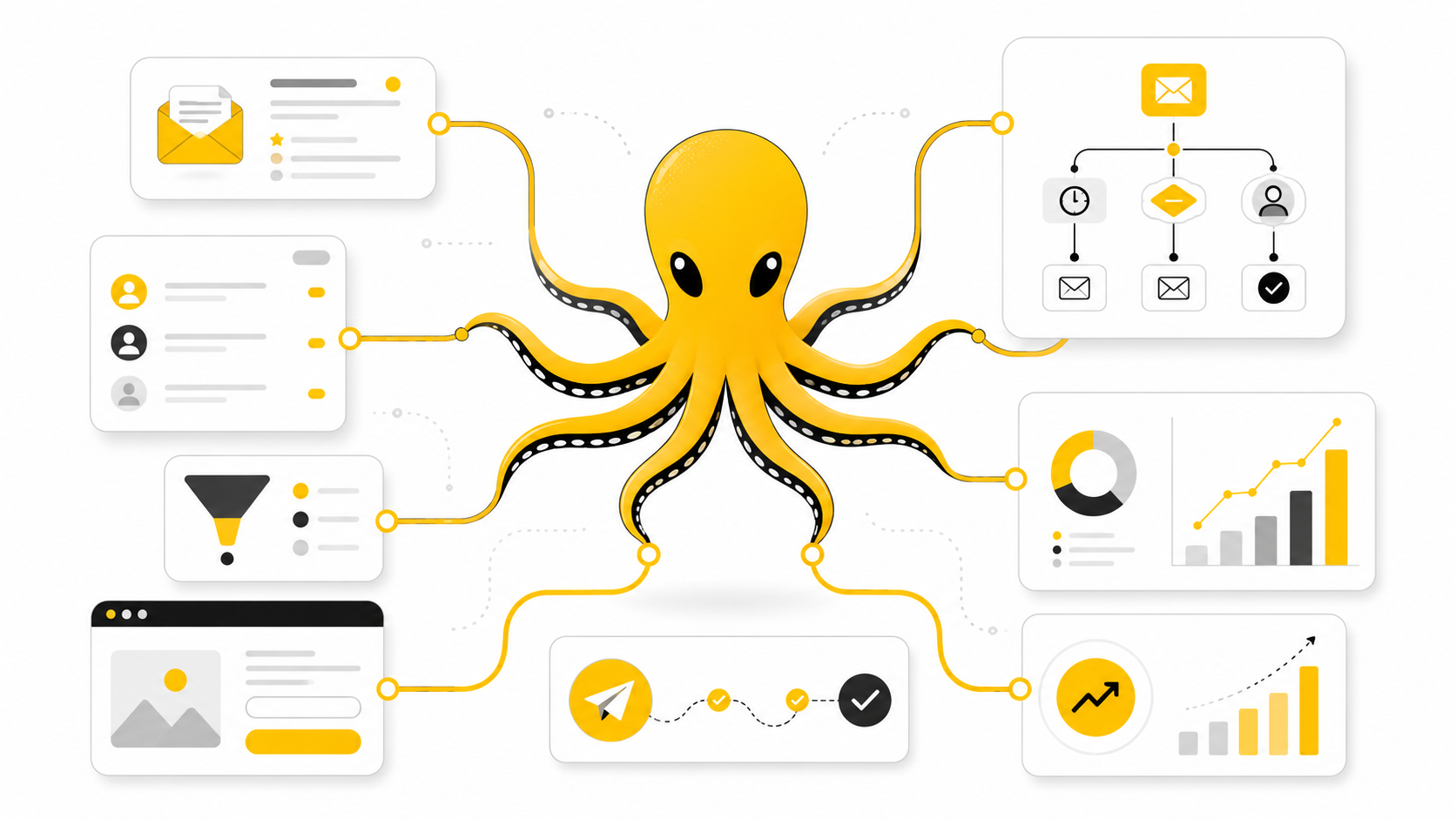
Octopus email marketing usually refers to EmailOctopus, a lean email marketing platform built for businesses that want newsletters, forms, landing pages, segmentation, and automations without carrying the weight of a full CRM or all-in-one marketing suite. That simplicity is the point. A lot of teams do not need fifty dashboards, ten sales pipelines, and a maze of settings before they can send a useful campaign.
Email still deserves serious attention because it remains one of the few channels you actually own. Social reach can disappear overnight, ad costs can rise, and search traffic can shift after an algorithm update. A well-built email list gives you a direct relationship with subscribers who have chosen to hear from you.
The opportunity is not just sending more emails. It is building a cleaner system where the right people join the right list, receive the right first message, move through the right automation, and get measured against business outcomes instead of vanity metrics. Recent benchmark data shows email still performs strongly when the fundamentals are handled well, with the DMA’s 2025 Email Benchmarking Report showing delivery rates at 98%, open rates at 35.9%, and unique click rates at 2.3% across its benchmark set: email benchmarking data.
That matters because small teams often lose money by overcomplicating email. They buy a powerful platform, use 10% of it, ignore deliverability, send the same message to everyone, and wonder why engagement drops. Octopus email marketing works best when you treat it as a focused operating system for audience growth, not as a dumping ground for random broadcasts.
Why Octopus Email Marketing Matters
Octopus email marketing matters because it solves a very specific problem: many creators, small businesses, agencies, and lean ecommerce brands need reliable email marketing without unnecessary complexity. EmailOctopus positions itself around email marketing rather than trying to become a bloated platform for everything, and its own feature set focuses on campaigns, automations, forms, landing pages, templates, reporting, and integrations. That focus is useful when the business goal is clear communication, not software gymnastics.
The bigger trend also supports this kind of tool. Email inboxes are more crowded, privacy changes have made open-rate interpretation less clean, and AI-generated content has made generic campaigns easier to ignore. So the advantage goes to brands that collect consent properly, segment intelligently, write useful messages, and build automations that feel timely rather than robotic.
This is where a simple platform can outperform a complicated one. If your team can launch a form, tag subscribers by source, trigger a welcome sequence, and review campaign reports without needing a specialist every time, execution gets faster. In email marketing, speed and consistency often beat having the most advanced feature list on paper.
The Octopus Email Marketing Framework
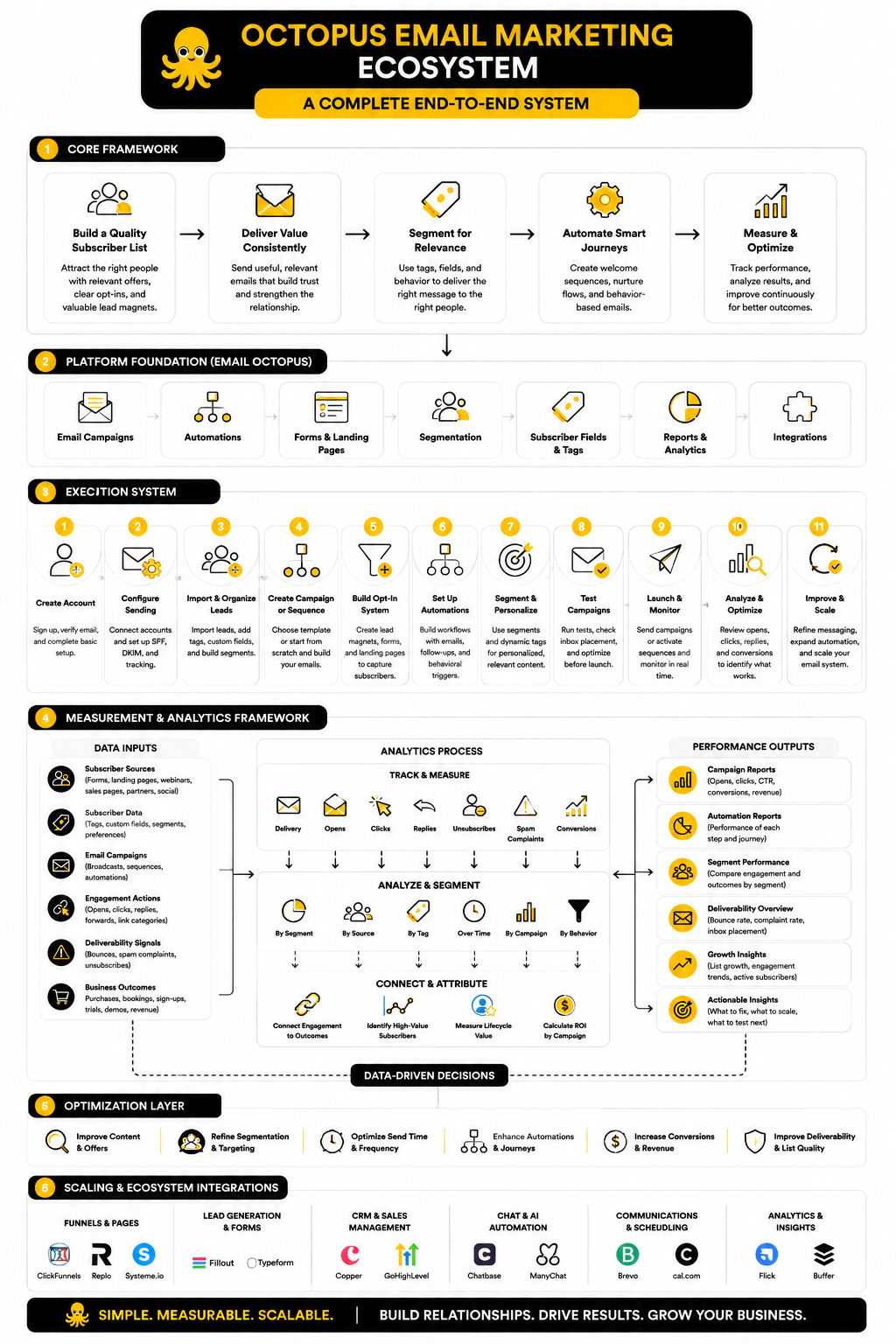
The cleanest way to think about octopus email marketing is as a six-part system: capture, consent, segmentation, content, automation, and measurement. Each part supports the next one. If capture is weak, the list does not grow; if segmentation is weak, the message feels generic; if measurement is weak, you keep repeating the same mistakes.
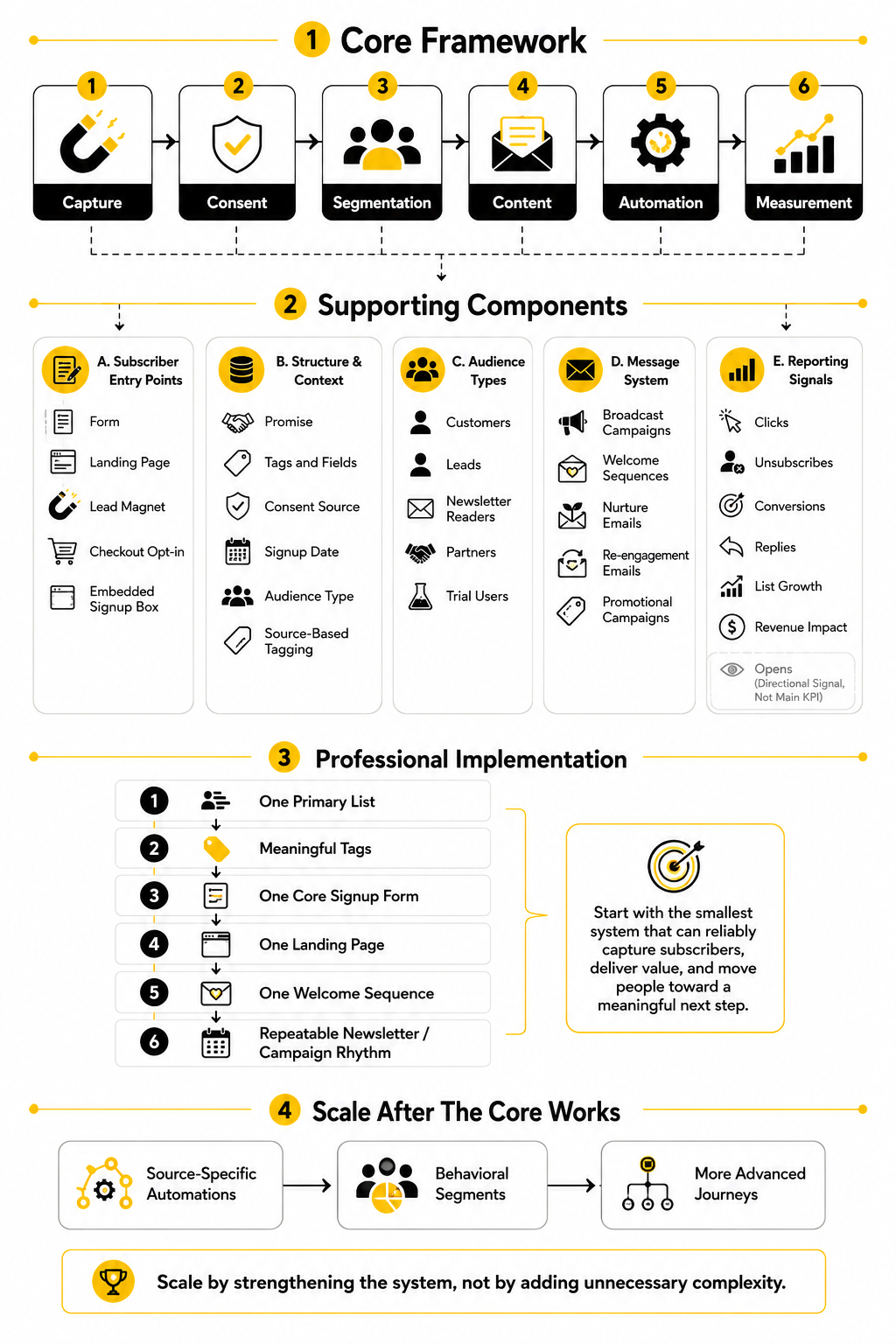
The framework starts with the subscriber journey, not the email editor. A person sees a form, landing page, lead magnet, checkout opt-in, or embedded signup box, then decides whether your promise is worth their email address. That first promise shapes everything that follows, because a subscriber who joined for weekly tactical advice should not be treated the same as someone who joined after downloading a discount code.
From there, the system needs structure. Tags and fields help identify where people came from, what they asked for, and what kind of follow-up makes sense. EmailOctopus supports this kind of practical workflow through forms, landing pages, segmentation, and automation options, including source-based tagging for different signup paths.
Core Components Of A High-Performing EmailOctopus Setup
A strong EmailOctopus setup begins with list architecture. That means deciding what data you actually need before you start collecting it. At minimum, most businesses need email address, consent source, signup date, and a simple way to separate major audience types such as customers, leads, newsletter readers, partners, or trial users.
The second component is the capture layer. EmailOctopus includes forms and landing pages that can be used to collect subscribers without needing a separate landing page tool for every basic use case. That is important for lean teams because every extra tool adds another integration, another bill, and another place where tracking can break.
The third component is the message system. This includes broadcast campaigns, welcome sequences, nurture emails, re-engagement emails, and promotional campaigns. The goal is not to email constantly; the goal is to make every email have a job.
The fourth component is reporting. Open rates can still be useful as directional signals, but they should not be the only measure of success. Clicks, unsubscribes, conversions, replies, list growth, and revenue impact give you a more honest view of whether your email program is working.
Professional Implementation Starts With Restraint
Professional implementation does not mean building a giant automation map on day one. It means building the smallest system that can reliably capture subscribers, deliver value, and move people toward a meaningful next step. That is especially important with octopus email marketing because the platform’s strength is clarity, and you lose that advantage when you recreate the same messy complexity you were trying to escape.
A practical first build usually includes one primary list, a small number of meaningful tags, one core signup form, one landing page, one welcome sequence, and a repeatable newsletter or campaign rhythm. Once those pieces are working, you can add source-specific automations, behavioral segments, and more advanced journeys. Scaling email should feel like strengthening the system, not adding random branches because the software allows it.
this guide will continue by breaking that system down piece by piece. The next section will focus on why EmailOctopus fits certain businesses well, where it may not be enough, and how to decide whether it belongs in your marketing stack before you invest time building around it.
Why Octopus Email Marketing Fits Lean Teams
Octopus email marketing makes the most sense when your email program needs discipline more than decoration. A lean team usually does not need a huge marketing cloud just to publish newsletters, build a welcome sequence, collect subscribers, and understand what people clicked. It needs a system that removes friction, because friction is what kills consistency.
That is why EmailOctopus tends to appeal to creators, consultants, small ecommerce teams, nonprofits, local service businesses, and agencies managing simple audience journeys. These teams usually care about speed, clean design, straightforward automation, and predictable costs. They want to send better emails without turning every campaign into a technical project.
The mistake is thinking that simple means amateur. Simple can be very professional when the strategy behind it is clear. A focused octopus email marketing setup can support lead generation, customer education, product launches, event promotion, partner updates, and content distribution without forcing the business into a tool stack it is not ready to manage.
The Real Reason Email Still Works
Email still works because it sits closer to intent than most channels. Someone who joins your list has already taken a small action that says, “I want more from this brand.” That is a very different starting point from interrupting cold audiences with ads or hoping an algorithm decides to show your post.
The best email programs do not treat subscribers like traffic. They treat them like people moving through different stages of trust. A new subscriber needs context, a warm lead needs proof, a customer needs confidence, and a quiet subscriber may need a useful reason to re-engage.
This is also why octopus email marketing should not be judged only by the size of the list. A smaller list with clear intent can outperform a larger list filled with people who barely remember signing up. The quality of the relationship matters more than the raw number in the dashboard.
When EmailOctopus Is The Right Choice
EmailOctopus is a good fit when your main priority is email communication and list growth. If you want to build forms, publish landing pages, send campaigns, create simple automations, segment subscribers, and keep reporting easy to understand, it fits the job well. It is especially attractive when you do not want to pay for CRM features, SMS tools, sales pipelines, or advanced ecommerce logic you will not use.
It also fits businesses that already have the rest of their stack handled elsewhere. For example, your checkout might live in Shopify, your booking process might happen in Cal.com, your funnel pages might be built in ClickFunnels, and your audience nurturing can still happen through a focused email platform. In that kind of setup, octopus email marketing becomes the communication layer rather than the entire business operating system.
That separation can be healthy. When each tool has a clear role, your stack becomes easier to troubleshoot. Problems get harder when one platform tries to do everything and nobody on the team understands where the issue actually lives.
When You May Need A Bigger Platform
EmailOctopus may not be enough if your business needs deep CRM automation, complex sales pipelines, appointment workflows, multi-channel follow-up, reputation management, or agency-level client subaccounts. In those cases, an all-in-one system like GoHighLevel may be a better fit because it is built around broader customer journey management. That does not make it automatically better; it simply solves a different class of problem.
You may also need another platform if funnels are the center of your business model. If your main workflow is sales pages, order bumps, upsells, downsells, webinars, and conversion-focused funnel testing, ClickFunnels will usually feel more natural. In that case, email is still important, but the funnel architecture becomes the main system.
For budget-conscious founders who want email, funnels, digital products, and basic automation under one roof, Systeme.io can also make sense. The tradeoff is that all-in-one tools often require a stronger commitment to their ecosystem. Before switching, be honest about whether you need more power or just need to use your current email system properly.
The Decision Comes Down To Operational Fit
The right tool is the one your team will actually use well. That sounds obvious, but it is where many businesses get email marketing wrong. They choose software based on a feature comparison table, then ignore the platform because the day-to-day workflow feels heavy.
A practical decision starts with the kind of email program you are building. If your core activity is publishing useful emails, growing a list, tagging subscribers, and running simple automations, octopus email marketing is a clean and sensible route. If your core activity is managing leads across calls, texts, bookings, pipelines, and multiple client accounts, you are probably looking at a broader CRM and automation platform.
Do not buy complexity as a form of ambition. Buy the system that matches the next twelve months of execution. A simple tool used every week will beat an advanced tool nobody wants to open.
The Hidden Cost Of Overbuilding
Overbuilding creates hidden costs that rarely appear on a pricing page. Every extra field, tag, list, trigger, and condition has to be maintained. When nobody owns that structure, the account slowly turns into a junk drawer.
This is dangerous because email marketing depends on trust. If subscribers receive irrelevant emails, duplicate campaigns, broken automations, or confusing offers, they do not care how advanced your software is. They just stop clicking, unsubscribe, or silently ignore you.
A clean octopus email marketing setup protects against that by forcing better decisions. You define the subscriber journey before adding complexity. You build only the automations you can explain. You measure the metrics that actually guide the next campaign.
What To Build Before You Upgrade Anything
Before you upgrade tools, rebuild the basics. Start with one clear signup promise, one clean form, one welcome sequence, and one repeatable email rhythm. If those pieces are weak, a bigger platform will only help you make bigger mistakes faster.
Your first welcome sequence should answer three simple questions. Why did the person join? What should they expect next? What is the most useful next step they can take? Those answers create the foundation for every later campaign.
Once that foundation works, you can add more carefully segmentation, source tracking, lead magnets, sales sequences, and partner integrations. That is the right order. Strategy first, structure second, automation third.
Core Components Of A High-Performing EmailOctopus Setup
A strong octopus email marketing system is not built inside the campaign editor first. It starts with the boring decisions that make every future email easier to send. You decide what the list is for, who belongs on it, what subscribers should receive first, and how you will know whether the system is working.
This is where many teams rush. They create a form, paste it on a site, send a newsletter, and call it a strategy. That can work for a week, but it usually breaks once the list has multiple signup sources, different audience types, and subscribers with different levels of intent.
The better approach is to build the system in layers. Keep the first version simple, but make it organized enough that you can grow without cleaning up a mess later.
Start With The Subscriber Promise
Every email system needs a clear promise before it needs a template. A subscriber should understand what they are signing up for, why it matters, and what kind of emails they will receive. If that promise is vague, the list may still grow, but engagement will usually suffer because people did not join with a clear expectation.
For octopus email marketing, this promise should appear consistently on forms, landing pages, thank-you pages, and the first welcome email. That consistency builds trust from the first click. It also makes your content planning easier because the list has a defined purpose instead of becoming a place where every random announcement gets dumped.
A good promise is specific without being restrictive. “Get weekly ecommerce growth ideas” is stronger than “Join our newsletter” because it tells people what value they can expect. “Get launch updates and early access” is stronger than “Stay in touch” because it connects the signup to a real reason.
Build The List Structure Before Collecting Contacts
The next step is list structure. EmailOctopus works best when you avoid unnecessary fragmentation and use tags or fields to create context. Instead of creating a separate list for every campaign, think carefully about whether a tag can solve the problem more cleanly.
This matters because duplicate structures create duplicate work. If the same subscriber can end up in several disconnected places, reporting gets harder and automations become easier to misfire. A clean list with thoughtful tags gives you flexibility without losing control.
For most lean teams, the first layer of structure should capture source and intent. Source tells you where the person came from, such as a blog form, landing page, referral, webinar, checkout, or lead magnet. Intent tells you why they joined, such as education, product interest, discount access, partner updates, or event reminders.
Create The Capture Points
Once the structure is clear, build the capture points. EmailOctopus includes forms and landing pages, so you can create basic subscriber entry points without immediately adding another landing page builder. Its forms and landing pages are designed for quick setup, customization, embedded forms, pop-ups, slide-ins, and shareable signup pages: forms and landing pages.
A good capture point does not need to be clever. It needs a clear headline, a useful reason to subscribe, a small number of fields, and a button that matches the promise. Asking for too much information too early usually lowers completion because people have not received value yet.
Use hidden fields or tags when you need source tracking without making the subscriber do extra work. EmailOctopus support documentation includes guidance on using hidden fields and tags to track subscription source, which is exactly the kind of practical detail that keeps reporting cleaner later: tracking subscription source. This is small setup work, but it pays you back every time you analyze which signup paths are actually producing engaged subscribers.
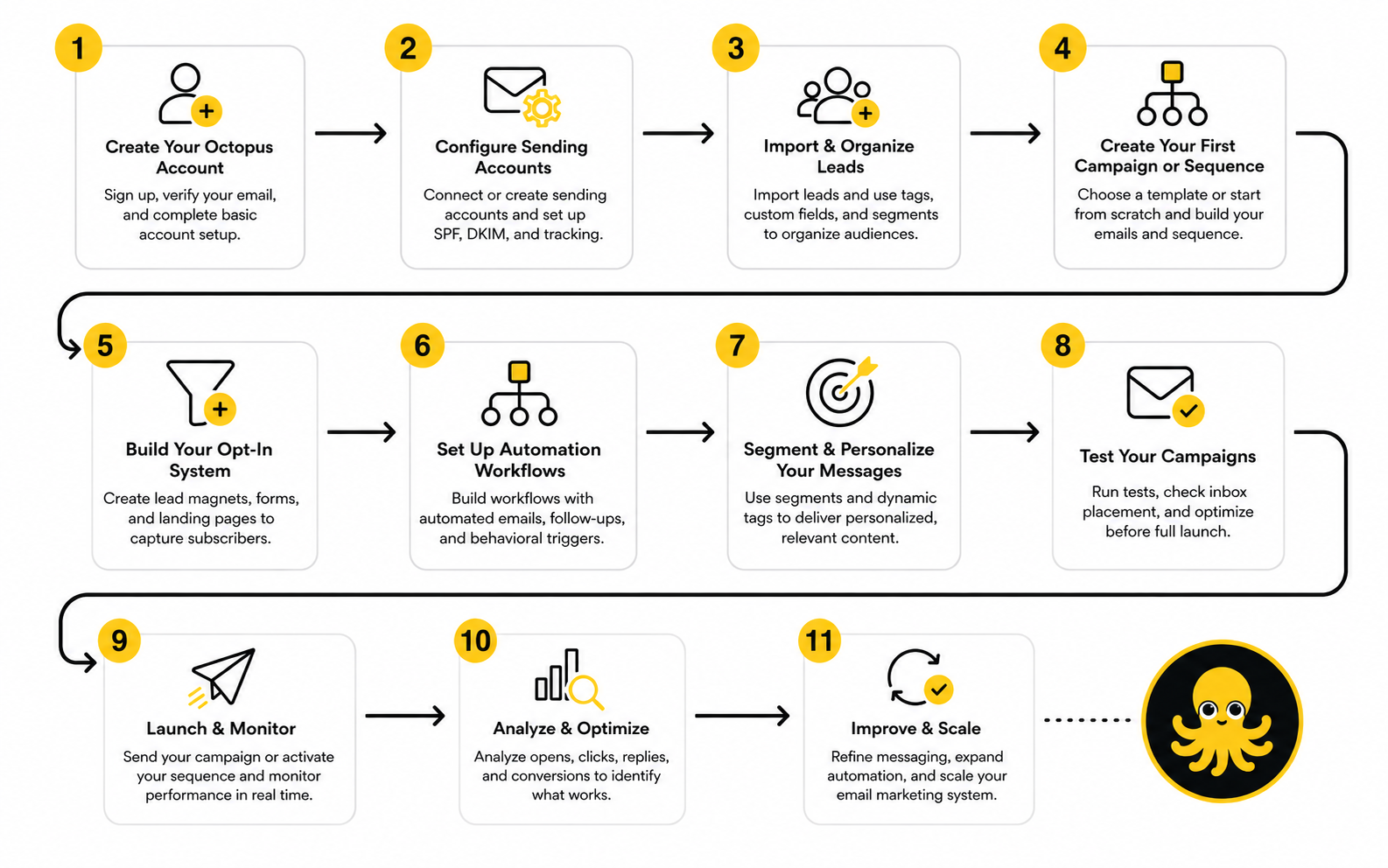
The Practical Implementation Process
A clean implementation should feel like a controlled sequence, not a software binge. The goal is to move from strategy to launch without creating unnecessary branches. You can always add complexity after the core system proves itself.
This process is intentionally simple. The power comes from completing the loop, not from making the diagram look impressive. Once a subscriber can join, receive the right first message, and move into a useful communication rhythm, your octopus email marketing system has a real foundation.
Write The Welcome Sequence Before The Newsletter
The welcome sequence should be written before the regular newsletter because it sets the relationship. A newsletter is ongoing communication, but the welcome sequence is the first guided experience. If that experience is weak, every later campaign has to work harder.
The first email should confirm the promise and deliver any expected resource. The second email can explain your point of view, your best advice, or the problem your brand helps solve. The third email should guide the subscriber toward the next meaningful action, such as reading a key article, checking a product, booking a call, joining a webinar, or replying with a question.
Do not overload the welcome sequence with every offer you have. New subscribers need clarity first. A focused three-to-five email sequence usually beats a long sequence that tries to educate, sell, survey, segment, and promote all at once.
Segment By Usefulness, Not Curiosity
Segmentation is only valuable when it changes what you send. If a tag does not help you make a better decision, it is probably just clutter. This is where restraint matters.
EmailOctopus supports segmentation using tags, subscriber data, and behavior, which gives you enough room to target without turning the account into a maze: segmentation features. Use that power for obvious, practical differences first. Customers and non-customers may need different messages, as will people who joined from a product waitlist versus people who joined from a general blog form.
Avoid creating segments just because the data exists. A segment should answer a business question. What should this person receive that another person should not? If you cannot answer that clearly, do not build the segment yet.
Connect The Surrounding Tools Carefully
Email rarely works alone. It often connects to landing pages, forms, checkout tools, CRMs, social scheduling tools, booking pages, and analytics. The key is connecting only what supports the subscriber journey you have already designed.
If your business depends on conversion-focused funnel pages, ClickFunnels can handle the funnel layer while EmailOctopus handles ongoing email communication. If you need forms with more complex logic, surveys, or qualification steps before someone enters your list, Fillout can be useful before sending clean subscriber data into your email workflow. If your audience growth depends heavily on social content, Buffer can help maintain the publishing rhythm that feeds your signup forms.
The warning is simple: do not connect tools before you know what data should move between them. Integrations are not strategy. They are pipes, and pipes only help when you know what needs to flow through them.
Test The Full Journey Before Promoting It
Before you drive traffic to a form or landing page, test the full journey like a subscriber. Sign up with a real test address, check the confirmation experience, read the first email on desktop and mobile, click every link, and confirm that tags or fields were applied correctly. This is basic, but skipping it is how broken automations reach real people.
Also check authentication and sender setup before scaling volume. Gmail’s sender guidelines state that messages should authenticate with SPF or DKIM and that DMARC alignment matters for passing authentication: email sender guidelines. Yahoo’s sender guidance also emphasizes authentication, low complaint rates, and easy unsubscribe options: sender best practices.
This is not technical busywork. Deliverability is part of implementation. If people asked to hear from you but mailbox providers do not trust your sending setup, your content strategy cannot do its job.
Statistics And Data
Measurement is where octopus email marketing becomes a business system instead of a sending habit. The point is not to stare at dashboards after every campaign and panic over tiny changes. The point is to understand which signals show trust, which signals show relevance, and which signals show commercial progress.
Good email reporting should answer a few practical questions. Did the message reach people? Did the right people open it? Did they click the thing that mattered? Did the campaign create the action the business actually wanted?
Benchmarks help, but they should never become the whole strategy. Email performance changes by industry, list source, sending frequency, audience relationship, subject matter, offer strength, and deliverability. A benchmark is a reference point, not a verdict.
What The Main Metrics Actually Mean
Open rate shows whether subscribers noticed the email and whether the sender relationship is still alive. It is useful, but it is also imperfect because privacy features and automated opens can distort the number. Treat opens as a directional signal, not a clean measure of human attention.
Click rate is usually more useful because it shows active interest. If people click, the email gave them a reason to move. If opens are strong but clicks are weak, the subject line may be doing its job while the body, offer, or call to action is not.
Unsubscribe rate tells you whether the promise and the content still match. A small number of unsubscribes is normal, especially when you send consistently. A sudden spike usually means the message surprised people in the wrong way, reached the wrong segment, or pushed too hard too soon.
Bounce rate is a list-quality signal. Hard bounces often point to invalid or outdated addresses, while soft bounces may reflect temporary delivery issues. If bounces rise, clean the list before you blame the copy.
The Benchmarks Worth Paying Attention To
Email benchmarks vary depending on the dataset, but they are still useful when interpreted carefully. MailerLite’s 2025 benchmark data reported an average open rate of 43.46%, a click rate of 2.09%, a click-to-open rate of 6.81%, and an unsubscribe rate of 0.22% across its analyzed campaigns: email marketing benchmarks. Those numbers give you a rough sense of what healthy engagement can look like, but they should not replace your own baseline.
The DMA’s 2025 benchmark report showed a 98% delivery rate, 35.9% open rate, and 2.3% unique click rate in its benchmark set: email benchmarking report. That matters because delivery, opens, and clicks represent different stages of the funnel. If delivery is weak, the campaign may not get a fair chance; if opens are weak, the relationship or subject line may be the issue; if clicks are weak, the message or offer probably needs work.
Salesforce’s benchmark guidance places a typical “good” click-through rate in the 2% to 5% range, while noting that industry, company size, and email type all affect performance: email marketing benchmarks. This is useful because it keeps expectations realistic. A 3% click rate can be strong if those clicks are qualified and tied to a real business outcome.
Build A Simple Analytics System
Your analytics system should track the full subscriber journey, not just individual campaigns. Start with the source of the subscriber, then follow what they receive, what they click, and what action they take after clicking. This gives octopus email marketing a clearer role inside the broader growth system.
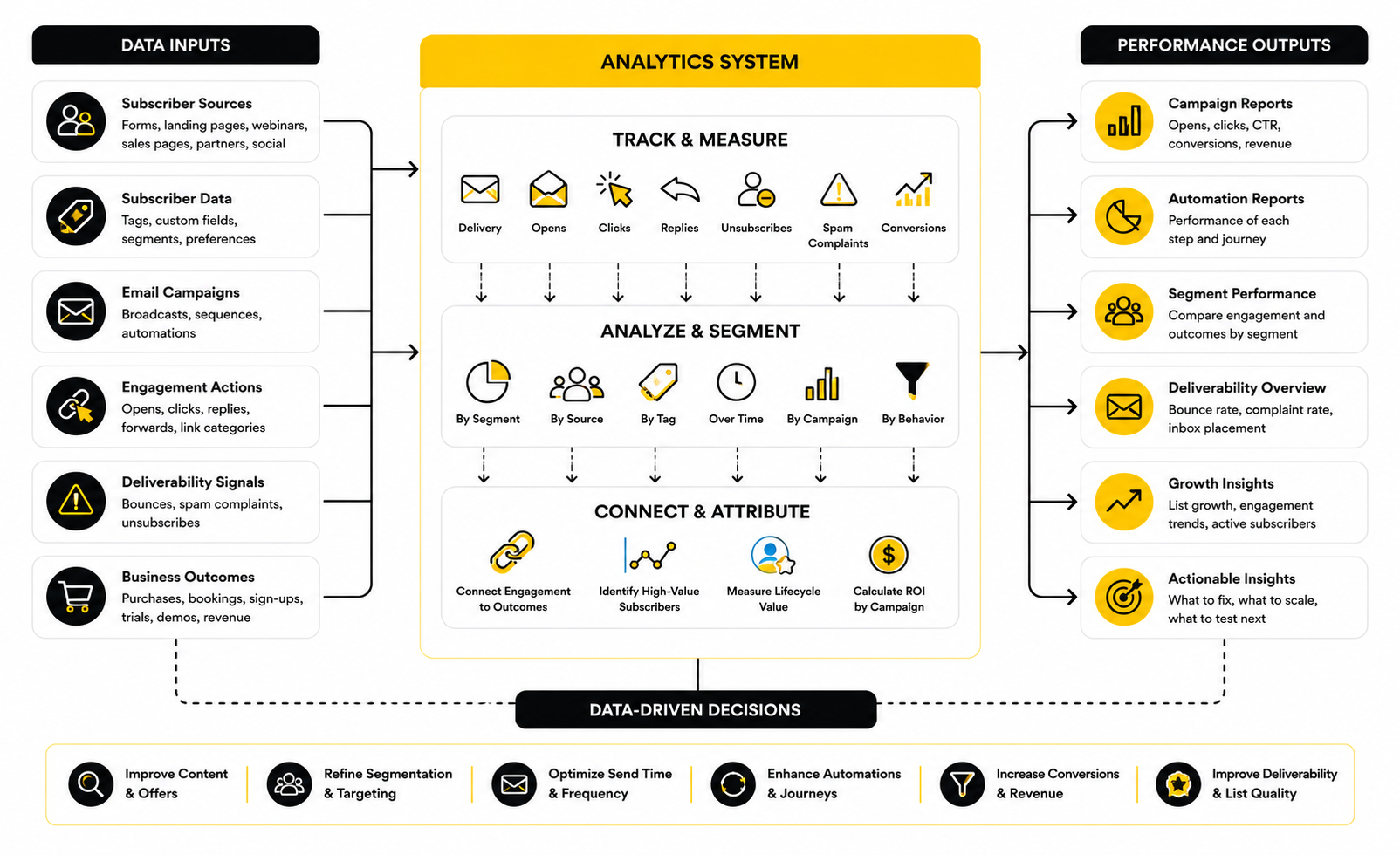
A simple reporting rhythm can be built around four layers. First, check deliverability signals such as bounces, spam complaints, and unsubscribes. Second, review engagement signals such as opens and clicks. Third, review intent signals such as link category, reply behavior, and repeat engagement. Fourth, connect those actions to business outcomes such as bookings, purchases, trials, demos, or content consumption.
This structure prevents one of the most common mistakes in email marketing: celebrating the wrong number. A high open rate is not automatically a win if nobody clicks. A lower open rate can still be profitable if the email reaches a smaller but more qualified segment and drives the right action.
How EmailOctopus Reporting Fits The Workflow
EmailOctopus reporting is designed to show practical campaign activity such as opens, clicks, bounces, unsubscribes, and individual subscriber history: EmailOctopus analytics. That is enough for most lean teams to understand whether campaigns are being received, read, and acted on. The key is to review those reports with a decision in mind.
For example, if a campaign gets a healthy open rate but weak clicks, do not immediately send more often. Look at the call to action, the link placement, and the relationship between the subject line and the actual content. People may have opened because the subject was interesting, then left because the email did not deliver a clear next step.
If clicks are strong but conversions are weak, the email may not be the problem. The landing page, offer, checkout flow, booking page, or follow-up process may be leaking attention. This is why email analytics should be reviewed alongside the destination experience, not in isolation.
Measure Automations Differently From Broadcasts
Automations should be measured differently from newsletters and one-time campaigns. A broadcast is usually judged by campaign-level performance over a short time window. An automation is judged by how well it performs repeatedly for new subscribers over time.
EmailOctopus automation reports show performance information for automated emails, which helps you review how each step is doing after people enter the journey: automation reports. This matters because a weak second or third email can quietly reduce the value of every subscriber who joins. You may not notice it from one campaign report, but the automation will keep repeating the same problem until you fix it.
For welcome sequences, watch the drop-off between emails. If the first email performs well and the second email collapses, the second message may not be continuing the promise clearly enough. If the final email gets clicks but no action, the offer may need a softer bridge, stronger proof, or a clearer reason to act now.
Use Segments To Explain The Numbers
Average performance can hide the truth. A campaign sent to your whole list may look acceptable overall while performing extremely well for one segment and poorly for another. That is why segmentation is not just a targeting tool; it is also a diagnostic tool.
EmailOctopus segmentation can use tags, subscriber data, and behavior to help send more relevant campaigns: segmentation features. In measurement terms, this lets you compare people by source, interest, customer status, or engagement level. You can then stop guessing and start seeing which groups actually respond.
This is especially important when list growth comes from multiple channels. Subscribers from a high-intent landing page may behave very differently from subscribers who joined through a broad giveaway or casual blog form. If you only look at the average, you may either overvalue weak traffic or undervalue a smaller source that produces better buyers.
Watch Deliverability Before You Chase Growth
Deliverability is the quiet metric behind every other metric. If inbox providers do not trust your domain, open rates and click rates become harder to interpret because fewer people are seeing the email in the first place. Growth without deliverability discipline is dangerous because it can damage the channel you are trying to build.
Gmail requires all senders to authenticate with SPF or DKIM, while bulk senders need SPF, DKIM, and DMARC: email sender guidelines. Yahoo also emphasizes authentication, easy unsubscribing, and keeping complaint rates below 0.3% for bulk senders: sender best practices. These requirements are not optional details for serious email programs.
This is why list quality matters more than list size. If subscribers do not remember signing up, do not want the content, or cannot easily unsubscribe, your complaint risk rises. A clean octopus email marketing setup should make consent, expectations, and unsubscribing obvious from the beginning.
Turn Reports Into Decisions
The value of reporting is the decision it creates. If a metric does not change what you do next, it is probably not worth obsessing over. Your job is to turn campaign data into better segmentation, clearer offers, stronger content, and cleaner list management.
Use a simple decision framework after each meaningful campaign. If delivery is weak, inspect authentication, bounces, and list quality. If opens are weak, review sender name, subject line, timing, and audience fit. If clicks are weak, improve the content structure, call to action, and link relevance. If clicks are strong but revenue or leads are weak, inspect the landing page and conversion path.
This keeps optimization practical. You are not trying to “improve email” in a vague way. You are finding the weakest link in the journey and fixing that before moving to the next one.
Optimization, Reporting, And Growth Workflows
Once the core system is working, octopus email marketing becomes less about setup and more about controlled improvement. This is the stage where you stop asking, “Can we send emails?” and start asking, “Which subscribers are becoming more valuable over time?” That shift matters because scaling a weak email system only spreads weak habits faster.
Optimization should be boring in the best possible way. You improve one part of the journey, measure the result, and then move to the next constraint. The teams that win with email are usually not doing wild tricks; they are making hundreds of clear, small decisions that compound.
The main risk at this stage is chasing sophistication before the fundamentals are stable. More automations, more segments, and more integrations can help, but only when each one has a purpose. If the system gets harder to understand every month, you are not scaling; you are drifting.
Scale The List Without Diluting Intent
List growth is only useful when the new subscribers have a real reason to be there. A giveaway, viral post, or broad lead magnet can grow the list quickly, but fast growth often brings weaker intent if the offer attracts people who are not close to your actual business. That is why subscriber quality should be judged by downstream engagement, not signup volume alone.
A stronger growth workflow starts with acquisition source tracking. Blog forms, product pages, webinars, partner campaigns, checkout opt-ins, social bios, and paid landing pages should not all look identical in your email account. If the source is tracked cleanly, you can compare which paths create clicks, replies, purchases, bookings, or long-term engagement.
This is where a focused octopus email marketing setup can stay simple while still becoming more carefully. You do not need a complicated attribution model at the beginning. You need enough source and intent data to know which growth channels deserve more attention and which ones are only inflating the list.
Use Lead Magnets With Restraint
Lead magnets can work, but they can also damage list quality when they are too disconnected from the business. A checklist, template, guide, webinar, or discount should attract the kind of person you actually want to keep emailing. If the free asset attracts the wrong people, your welcome sequence will be forced to qualify an audience that should not have joined in the first place.
The best lead magnets create a clean bridge to your next offer. A service business can offer a diagnostic checklist that naturally leads into a consultation. A software company can offer a practical workflow guide that naturally leads into a product trial. An ecommerce brand can offer buying guidance that naturally leads into a useful product recommendation.
Do not build a library of lead magnets just because it feels productive. Each asset adds maintenance, tracking, and content expectations. One strong signup path with clear intent is usually better than five weak ones that bring in subscribers you cannot serve well.
Add Automation Only Where Timing Matters
Automation is most valuable when timing changes the result. A welcome email should arrive immediately because the subscriber’s attention is fresh. A post-purchase education sequence should arrive after the order because the customer needs confidence and guidance. A re-engagement email should arrive after silence because the relationship needs a decision point.
That does not mean every behavior needs its own branch. Too much automation can make the system fragile, especially when tags, triggers, and conditions are not documented. A lean team should automate the moments where delay creates lost value, then keep the rest of the program campaign-led and human.
EmailOctopus supports automated email sequences for practical workflows such as welcome emails, lead nurturing, and subscriber follow-up: email automation features. Use that power to remove manual repetition, not to build a maze. If you cannot explain an automation in one clear sentence, it probably needs to be simplified.
Protect Deliverability As You Grow
Deliverability gets more important as volume grows. A small list can often survive messy habits for a while, but a larger list exposes every weakness. Old addresses, unclear consent, irrelevant campaigns, and sudden volume spikes can all create reputation problems.
Mailbox providers are now much more explicit about sender expectations. Gmail’s guidance says senders should keep spam rates below 0.1% and avoid ever reaching 0.3% or higher: sender guideline FAQ. Yahoo also tells bulk senders to monitor complaints and remain below 0.3%: sender best practices.
That should change how you think about growth. A bigger list is not automatically an asset if it creates more complaints, bounces, and disengagement. The list is valuable only when people still want the emails and inbox providers can see that they want them.
Clean The List Before It Forces You To
List hygiene should not be treated as emergency maintenance. If you wait until deliverability drops, the damage may already be affecting campaign performance. A better approach is to build cleaning and re-engagement into the operating rhythm.
Start by watching hard bounces, repeated non-openers, inactive subscribers, and complaint behavior. Hard bounces should be removed because they represent addresses that cannot receive mail. Long-term inactive subscribers should be handled with a re-engagement sequence before you keep emailing them indefinitely.
This is not about being ruthless for the sake of it. It is about respecting the channel. If someone has not engaged for a long time and does not respond to a clear re-engagement attempt, continuing to send may hurt your sender reputation more than it helps your business.
Make The Content Calendar Serve The Buyer Journey
A content calendar should not be a random list of topics. It should support the buyer journey from awareness to trust to action. If every email is a promotion, the list gets tired; if every email is pure education, the business may never capture demand.
A balanced octopus email marketing calendar usually includes a few recurring content types. Educational emails build trust. Proof-based emails reduce doubt. Product or service emails create buying moments. Community, behind-the-scenes, or founder-led emails make the brand feel human.
The rhythm depends on the business model. A creator may send weekly essays and occasional offers. An ecommerce brand may send more product-led campaigns around launches, seasonality, and buying moments. A service business may send fewer emails but make each one sharper, more consultative, and more connected to a specific next step.
Know When To Integrate A CRM
At some point, email engagement may need to flow into a sales process. This is where a CRM becomes useful. The signal is not “we have a list”; the signal is “email activity should change how our team follows up with specific leads.”
For simple subscriber communication, EmailOctopus can remain the main email layer. For relationship management, pipeline movement, task tracking, and sales conversations, a CRM such as Copper may be useful when the team needs more visibility into individual opportunities. If the business needs broader marketing automation, sales pipelines, booking flows, and client management under one roof, GoHighLevel may be a stronger operational fit.
The tradeoff is complexity. A CRM can make follow-up sharper, but only if the team keeps data clean and actually uses the pipeline. If the sales process is not defined, connecting more software will not magically create discipline.
Use AI Carefully In Email Workflows
AI can speed up email planning, drafting, repurposing, and research, but it should not replace the strategic voice of the business. Generic AI-written campaigns are easy to produce and just as easy to ignore. The best use of AI is to accelerate thinking while keeping the final judgment human.
Use AI to create draft variations, summarize customer research, turn long content into newsletter ideas, or help organize campaign angles. Then edit for specificity, proof, tone, and relevance. The final email should sound like it came from a real person with a real point of view.
If AI is part of the wider customer experience, tools such as Chatbase can support website or knowledge-base interactions while email handles ongoing relationship building. Just keep the roles clear. AI can help answer questions, but your email strategy still needs a human promise, human judgment, and human accountability.
Document The System Before It Gets Messy
Documentation is not exciting, but it protects the system as the business grows. Write down what each tag means, what each form is for, what each automation does, and which metrics decide whether something stays or gets changed. This prevents future confusion when a campaign needs to be updated quickly.
A simple document is enough. Include the list structure, active signup sources, key automations, suppression rules, naming conventions, and campaign review rhythm. The goal is not corporate bureaucracy; the goal is making sure the system can be understood without relying on one person’s memory.
This becomes especially important if contractors, assistants, or agency partners touch the account. Without documentation, everyone makes small “temporary” changes that slowly corrupt the structure. With documentation, octopus email marketing remains clean enough to scale without constant rebuilding.
The Advanced Rule Is Still Simple
The advanced rule is this: every added layer must earn its place. A new segment should make emails more relevant. A new automation should improve timing. A new integration should move useful data. A new report should create a better decision.
That is the mindset that keeps email marketing profitable as it grows. Complexity is not the enemy by itself. Unexplained complexity is the enemy.
A mature octopus email marketing system should feel calm from the inside. Subscribers know what they signed up for, campaigns have a purpose, automations do useful work, reports guide decisions, and the list stays clean. That is not flashy, but it is exactly how email becomes a dependable growth asset.
The Final System: Keep It Useful, Measurable, And Clean
A mature octopus email marketing setup should not feel complicated to operate. It should feel like a clear system where subscribers enter through the right door, receive useful messages, and move toward the next logical action. That is the whole game.
The final system has four jobs. It grows the list with relevant people, delivers a strong first experience, sends campaigns that match subscriber intent, and uses reporting to make the next decision better. If those jobs are handled well, email becomes dependable instead of chaotic.
This is also where the tool discussion becomes less emotional. EmailOctopus can be a strong fit when you want focused email marketing, simple automation, clean segmentation, and practical reporting. If your business later needs deeper CRM workflows, funnel infrastructure, or multi-channel automation, you can connect or upgrade the surrounding stack without turning email into a mess.
What is octopus email marketing?
Octopus email marketing usually refers to using EmailOctopus to manage email campaigns, subscribers, forms, landing pages, automations, and reporting. It is a focused email marketing platform rather than a heavy all-in-one CRM. That makes it useful for businesses that want to grow and communicate with an audience without overbuilding their software stack.
Is EmailOctopus good for beginners?
Yes, EmailOctopus can be a good choice for beginners because the core workflow is straightforward. You can create a list, build a form, send campaigns, and set up basic automations without needing a complex marketing operations background. Beginners still need to think carefully about consent, segmentation, and deliverability, but the platform itself keeps the mechanics relatively simple.
Who should use EmailOctopus?
EmailOctopus is a strong fit for creators, newsletter operators, small businesses, nonprofits, consultants, educators, agencies, and lean ecommerce brands that mainly need reliable email communication. It works especially well when the goal is to build a clean subscriber list and send useful campaigns without paying for features the team will not use. If your workflow depends on complex pipelines, SMS follow-up, call tracking, or client subaccounts, a broader system like GoHighLevel may be a better operational fit.
What is the biggest advantage of octopus email marketing?
The biggest advantage is simplicity with enough structure to be useful. You can manage subscribers, use tags and fields, create targeted segments, send campaigns, and build automations without feeling trapped inside a giant enterprise platform. That simplicity helps teams execute consistently, which matters more than having advanced features that nobody uses.
What is the biggest limitation of EmailOctopus?
The biggest limitation is that EmailOctopus is not trying to be a full CRM, sales pipeline, funnel builder, booking system, or agency operating platform. That is fine if email is the main job. It becomes limiting when your customer journey needs deeper sales management, complex automations across multiple channels, or advanced ecommerce behavior flows.
How should I structure my first EmailOctopus list?
Start with one main list and use tags or fields to organize subscribers by source and intent. For example, you might tag people who joined from a blog form, product waitlist, webinar, checkout, or lead magnet. This keeps the account easier to manage than creating separate lists for every small campaign.
What should my first automation be?
Your first automation should usually be a welcome sequence. It should confirm why the subscriber joined, deliver any promised resource, explain what kind of emails they will receive, and guide them toward one useful next step. Keep it focused before you add more branches.
How many emails should be in a welcome sequence?
A simple welcome sequence often works well with three to five emails. The first email should deliver the promise and set expectations, while the next emails should build trust, provide useful context, and introduce the next action naturally. Longer sequences can work, but only when every email has a clear purpose.
Which metrics matter most in octopus email marketing?
The most useful metrics are delivery, bounces, opens, clicks, unsubscribes, complaints, replies, and conversions. Opens can show directional interest, but clicks and downstream actions usually tell you more about real intent. The best approach is to connect campaign reporting to the business outcome you actually care about, such as purchases, bookings, trials, replies, or content engagement.
What is a healthy email click rate?
A healthy click rate depends on the audience, industry, offer, and email type. Recent benchmark data commonly places average click rates around the low single digits, so a campaign in the 2% to 5% range can be solid when the clicks are relevant and tied to a meaningful action. Do not judge performance by one campaign alone; build your own baseline over time.
How do I improve low open rates?
Low open rates usually point to a problem with audience fit, sender recognition, subject line relevance, timing, or deliverability. Start by checking whether subscribers clearly opted in and still expect your emails. Then test clearer subject lines, stronger sender consistency, and better segmentation before increasing send frequency.
How do I improve low click rates?
Low click rates usually mean the email did not create enough reason to act. Tighten the message around one main idea, make the call to action obvious, and ensure the link matches the subscriber’s intent. If people open but do not click, the body of the email or the offer usually needs more work.
How often should I email my list?
The right frequency depends on the promise you made when people subscribed. A weekly newsletter can work well for education-led brands, while ecommerce brands may send more frequently around launches, promotions, and seasonal moments. The key is consistency plus relevance, not volume for its own sake.
Should I clean inactive subscribers?
Yes, inactive subscribers should be reviewed and cleaned over time. Start with a re-engagement sequence before removing people, because some subscribers may still want to hear from you but have not clicked recently. If they do not respond after a clear re-engagement attempt, keeping them forever may hurt deliverability and distort reporting.
Can I use EmailOctopus with landing page or funnel tools?
Yes, EmailOctopus can fit into a stack where another tool handles the landing page or funnel layer. For example, ClickFunnels can manage funnel pages while EmailOctopus handles email communication. The important part is making sure source data and subscriber intent are passed cleanly into your email system.
Can I use EmailOctopus with forms, surveys, or qualification flows?
Yes, but the setup should be intentional. If you need more advanced form logic, a form tool like Fillout can collect structured information before a subscriber enters the email system. Only collect information you will actually use for segmentation, personalization, or follow-up.
Is octopus email marketing enough for agencies?
It can be enough for agencies that manage straightforward newsletters, campaigns, and simple automations. It may not be enough for agencies that need client subaccounts, pipeline management, SMS, reputation management, call tracking, or full marketing automation across many client accounts. For that broader model, GoHighLevel is often a more natural fit.
How does EmailOctopus compare with Systeme.io?
EmailOctopus is more focused on email marketing, while Systeme.io is more of an all-in-one platform for funnels, email, digital products, and automation. If you want a dedicated email layer, EmailOctopus may feel cleaner. If you want one tool to handle more of the business infrastructure, Systeme.io may be worth comparing.
Should I use AI to write EmailOctopus campaigns?
AI can help with drafts, outlines, subject line ideas, repurposing, and research, but it should not replace your judgment. The final email still needs a clear promise, a specific audience, and a human point of view. Generic AI emails are easy to produce and easy to ignore.
What is the best way to start with octopus email marketing?
Start with one clear subscriber promise, one main list, a small number of useful tags, one signup form, and one welcome sequence. Test the full journey before promoting it. Once the basics work, improve reporting, segmentation, and automation one layer at a time.
Build a stronger local presence with BAAM AI
Turn your website, Google profile, social channels, and AI visibility into one growth engine
Most businesses do not need more random marketing activity. They need a consistent presence system that helps the right people find them, trust them, and take action. BAAM AI brings strategy, local SEO, website updates, Google Maps visibility, social content, AI-search readiness, media production, and reporting into one practical monthly engine.
If you want your marketing to keep working after the campaign ends, start with a free BAAM AI presence audit. See how your business shows up today and where the fastest visibility wins are at BAAM AI.